


IEC 61375-3-1:2012
(Main)Electronic railway equipment - Train communication network (TCN) - Part 3-1: Multifunction Vehicle Bus (MVB)
Electronic railway equipment - Train communication network (TCN) - Part 3-1: Multifunction Vehicle Bus (MVB)
IEC 61375-3-1:2012 applies where MVB is required.
Matériel électronique ferroviaire - Réseau embarqué de train (TCN) - Partie 3-1: Bus de Véhicule Multifonctions (MVB)
La CEI 61375-3-1:2012 s'applique lorsque le MVB est exigé.
General Information
- Status
- Published
- Publication Date
- 20-Jun-2012
- Technical Committee
- TC 9 - Electrical equipment and systems for railways
- Drafting Committee
- WG 43 - TC 9/WG 43
- Current Stage
- PPUB - Publication issued
- Start Date
- 21-Jun-2012
- Completion Date
- 31-May-2012
Relations
- Replaces
IEC 61375-1:2007 - Electric railway equipment - Train bus - Part 1: Train communication network - Effective Date
- 05-Sep-2023
Overview
IEC 61375-3-1:2012 is an international standard developed by the International Electrotechnical Commission (IEC) that defines the specifications for the Multifunction Vehicle Bus (MVB) within the Train Communication Network (TCN). This standard plays a critical role in electronic railway equipment by ensuring reliable communication and data exchange between various components of a train's control and monitoring systems.
MVB, as standardized in IEC 61375-3-1, is designed to handle complex communications on railway vehicles, supporting multiple device classes and medium types. The standard establishes physical layer properties, signaling protocols, frame formats, and control mechanisms that facilitate interoperability and efficient data transmission on the train network.
Key Topics
Train Communication Network (TCN) and MVB
- MVB serves as a backbone for onboard train communications, enabling integration of subsystems like traction control, braking, passenger information, and diagnostics.
- The standard specifies a robust physical layer supporting various media types, such as electrical short and middle distance cables, and optical glass fiber.
- It addresses network topology, including segment definition, couplers, and support for redundant media to enhance system reliability.
Physical Layer and Device Classes
- Detailed requirements for MVB's physical signaling, including data rates, propagation delay, and transceiver interfaces, are outlined.
- Supports multiple device classes (0 to 5), defining capabilities and attachment rules to the bus, enabling a flexible system architecture.
- Emphasis on shielding, connectors, and interference management to guarantee electromagnetic compatibility within the railway environment.
Data Framing and Telegrams
- Defines frame formats for master and slave communication, including start and end delimiters, encoding methods, and error detection using check sequences.
- Specifies telegram types such as process data, message data, and supervisory data for various operational functions.
- Introduces timing constraints like reply delays and frame spacing to maintain synchronized communication.
Link Layer Control and Addressing
- Establishes addressing schemes with device, logical, and group addresses to organize data flow efficiently.
- Provides protocols for frame content organization and the encoding of control codes to manage access and data transfers.
- Covers mechanisms to detect collisions, silence, and errors for robust link layer operation.
Medium Allocation and Redundancy
- Details the organization of communication turns and basic periods to optimize bandwidth and ensure deterministic data transmission.
- Optional support for redundant communication channels to increase fault tolerance and maintain network operation in case of component failure.
Applications
IEC 61375-3-1:2012 is essential for railway manufacturers, system integrators, and operators seeking standardized communication solutions for electronic railway equipment. Practical applications include:
- Onboard Train Control Systems: Enabling real-time data exchange for traction, braking, and safety systems through reliable MVB communication.
- Passenger Information Systems: Integrating multimedia and status updates via communication networks aligned with IEC 61375 standards.
- Diagnostic and Monitoring Tools: Facilitating maintenance and fault detection using standardized telegrams and addressing.
- Interoperability Enhancements: Ensuring different equipment and subsystems from multiple vendors can communicate seamlessly across the train network.
- Redundant Network Design: Applying optional features for link redundancy to enhance system availability and prevent communication losses in critical scenarios.
By following IEC 61375-3-1 specifications, railway operators can achieve optimal system reliability, safety, and performance conformity.
Related Standards
- IEC 61375-1: Overall Train Communication Network (TCN) general architecture and concepts.
- IEC 61375-2: Consist Network (CN) specifics complementing the Vehicle Bus.
- IEC 60571: Electronic equipment for rolling stock, including environmental requirements.
- IEC 61131: Programmable controllers, relevant for interfacing control systems.
- IEC 62278: Railway applications – Specification of the system engineering process for railway applications.
These related standards provide a comprehensive regulatory framework addressing the entire communication and control ecosystem in railway systems encompassing hardware, software, and network protocols.
Keywords: IEC 61375-3-1, Multifunction Vehicle Bus, MVB, Train Communication Network, TCN, railway communication, electronic railway equipment, train control systems, data framing, link layer control, railway standards, railway network redundancy, railway data protocols

Frequently Asked Questions
IEC 61375-3-1:2012 is a standard published by the International Electrotechnical Commission (IEC). Its full title is "Electronic railway equipment - Train communication network (TCN) - Part 3-1: Multifunction Vehicle Bus (MVB)". This standard covers: IEC 61375-3-1:2012 applies where MVB is required.
IEC 61375-3-1:2012 applies where MVB is required.
IEC 61375-3-1:2012 is classified under the following ICS (International Classification for Standards) categories: 45.060.01 - Railway rolling stock in general. The ICS classification helps identify the subject area and facilitates finding related standards.
IEC 61375-3-1:2012 has the following relationships with other standards: It is inter standard links to IEC 61375-1:2007. Understanding these relationships helps ensure you are using the most current and applicable version of the standard.
You can purchase IEC 61375-3-1:2012 directly from iTeh Standards. The document is available in PDF format and is delivered instantly after payment. Add the standard to your cart and complete the secure checkout process. iTeh Standards is an authorized distributor of IEC standards.
Standards Content (Sample)
IEC 61375-3-1 ®
Edition 1.0 2012-06
INTERNATIONAL
STANDARD
NORME
INTERNATIONALE
Electronic railway equipment – Train communication network (TCN) –
Part 3-1: Multifunction Vehicle Bus (MVB)
Matériel électronique ferroviaire – Réseau embarqué de train (TCN) –
Partie 3-1: Bus de Véhicule Multifonctions (MVB)
All rights reserved. Unless otherwise specified, no part of this publication may be reproduced or utilized in any form
or by any means, electronic or mechanical, including photocopying and microfilm, without permission in writing from
either IEC or IEC's member National Committee in the country of the requester.
If you have any questions about IEC copyright or have an enquiry about obtaining additional rights to this publication,
please contact the address below or your local IEC member National Committee for further information.
Droits de reproduction réservés. Sauf indication contraire, aucune partie de cette publication ne peut être reproduite ni
utilisée sous quelque forme que ce soit et par aucun procédé, électronique ou mécanique, y compris la photocopie et les
microfilms, sans l'accord écrit de la CEI ou du Comité national de la CEI du pays du demandeur.
Si vous avez des questions sur le copyright de la CEI ou si vous désirez obtenir des droits supplémentaires sur cette
publication, utilisez les coordonnées ci-après ou contactez le Comité national de la CEI de votre pays de résidence.
IEC Central Office Tel.: +41 22 919 02 11
3, rue de Varembé Fax: +41 22 919 03 00
CH-1211 Geneva 20 info@iec.ch
Switzerland www.iec.ch
About the IEC
The International Electrotechnical Commission (IEC) is the leading global organization that prepares and publishes
International Standards for all electrical, electronic and related technologies.
About IEC publications
The technical content of IEC publications is kept under constant review by the IEC. Please make sure that you have the
latest edition, a corrigenda or an amendment might have been published.
Useful links:
IEC publications search - www.iec.ch/searchpub Electropedia - www.electropedia.org
The advanced search enables you to find IEC publications The world's leading online dictionary of electronic and
by a variety of criteria (reference number, text, technical electrical terms containing more than 30 000 terms and
committee,…). definitions in English and French, with equivalent terms in
It also gives information on projects, replaced and additional languages. Also known as the International
withdrawn publications. Electrotechnical Vocabulary (IEV) on-line.
IEC Just Published - webstore.iec.ch/justpublished Customer Service Centre - webstore.iec.ch/csc
Stay up to date on all new IEC publications. Just Published If you wish to give us your feedback on this publication
details all new publications released. Available on-line and or need further assistance, please contact the
also once a month by email. Customer Service Centre: csc@iec.ch.
A propos de la CEI
La Commission Electrotechnique Internationale (CEI) est la première organisation mondiale qui élabore et publie des
Normes internationales pour tout ce qui a trait à l'électricité, à l'électronique et aux technologies apparentées.
A propos des publications CEI
Le contenu technique des publications de la CEI est constamment revu. Veuillez vous assurer que vous possédez
l’édition la plus récente, un corrigendum ou amendement peut avoir été publié.
Liens utiles:
Recherche de publications CEI - www.iec.ch/searchpub Electropedia - www.electropedia.org
La recherche avancée vous permet de trouver des Le premier dictionnaire en ligne au monde de termes
publications CEI en utilisant différents critères (numéro de électroniques et électriques. Il contient plus de 30 000
référence, texte, comité d’études,…). termes et définitions en anglais et en français, ainsi que
Elle donne aussi des informations sur les projets et les les termes équivalents dans les langues additionnelles.
publications remplacées ou retirées. Egalement appelé Vocabulaire Electrotechnique
International (VEI) en ligne.
Just Published CEI - webstore.iec.ch/justpublished
Service Clients - webstore.iec.ch/csc
Restez informé sur les nouvelles publications de la CEI.
Just Published détaille les nouvelles publications parues. Si vous désirez nous donner des commentaires sur
Disponible en ligne et aussi une fois par mois par email. cette publication ou si vous avez des questions
contactez-nous: csc@iec.ch.
IEC 61375-3-1 ®
Edition 1.0 2012-06
INTERNATIONAL
STANDARD
NORME
INTERNATIONALE
Electronic railway equipment – Train communication network (TCN) –
Part 3-1: Multifunction Vehicle Bus (MVB)
Matériel électronique ferroviaire – Réseau embarqué de train (TCN) –
Partie 3-1: Bus de Véhicule Multifonctions (MVB)
INTERNATIONAL
ELECTROTECHNICAL
COMMISSION
COMMISSION
ELECTROTECHNIQUE
PRICE CODE
INTERNATIONALE
XF
CODE PRIX
ICS 45.060 ISBN 978-2-88912-070-3
– 2 – 61375-3-1 ¤ IEC:2012
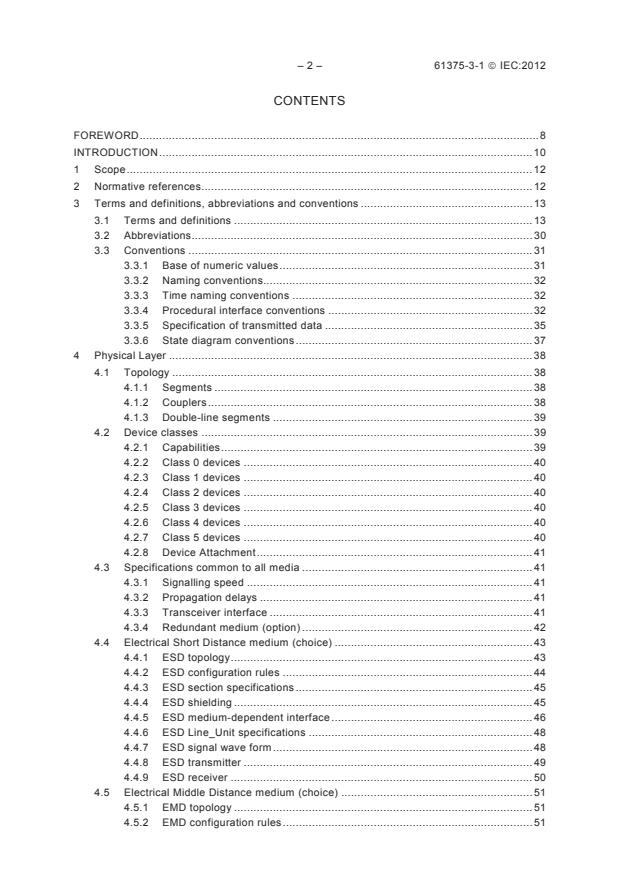
CONTENTS
FO REW O RD . 8
INT RODUCT ION . 10
1 Scope . 12
2 Normative references. 12
3 Terms and definitions, abbreviations and conventions . 13
3.1 Terms and definitions . 13
3.2 Abbreviations . 30
3.3 Conventions . 31
3.3.1 Base of numeric values . 31
3.3.2 Naming conventions. 32
3.3.3 Time naming conventions . 32
3.3.4 Procedural interface conventions . 32
3.3.5 Specification of transmitted data . 35
3.3.6 State diagram conventions . 37
4 Physical Layer . 38
4.1 Topology . 38
4.1.1 Segments . 38
4.1.2 Couplers . 38
4.1.3 Double-line segments . 39
4.2 Device classes . 39
4.2.1 Capabilities . 39
4.2.2 Class 0 devices . 40
4.2.3 Class 1 devices . 40
4.2.4 Class 2 devices . 40
4.2.5 Class 3 devices . 40
4.2.6 Class 4 devices . 40
4.2.7 Class 5 devices . 40
4.2.8 Device Attachment . 41
4.3 Specifications common to all media . 41
4.3.1 Signalling speed . 41
4.3.2 Propagation delays . 41
4.3.3 Transceiver interface . 41
4.3.4 Redundant medium (option) . 42
4.4 Electrical Short Distance medium (choice) . 43
4.4.1 ESD topology . 43
4.4.2 ESD configuration rules . 44
4.4.3 ESD section specifications . 45
4.4.4 ESD shielding . 45
4.4.5 ESD medium-dependent interface . 46
4.4.6 ESD Line_Unit specifications . 48
4.4.7 ESD signal wave form . 48
4.4.8 ESD transmitter . 49
4.4.9 ESD receiver . 50
4.5 Electrical Middle Distance medium (choice) . 51
4.5.1 EMD topology . 51
4.5.2 EMD configuration rules . 51
61375-3-1 ¤ IEC:2012 – 3 –
4.5.3 EMD terminator. 52
4.5.4 Cable section . 52
4.5.5 EMD shielding. 53
4.5.6 EMD medium-dependent interface . 54
4.5.7 EMD Line_Unit specifications . 57
4.5.8 EMD signal waveform . 58
4.5.9 EMD transmitter specifications . 58
4.5.10 EMD receiver specifications . 62
4.6 Optical Glass Fibre medium (choice). 63
4.6.1 OGF topology . 64
4.6.2 OGF optical cable and fibre . 64
4.6.3 OGF medium-dependent interface . 64
4.6.4 OGF test signal (guideline) . 65
4.6.5 OGF transmitter specifications . 66
4.6.6 OGF receiver specifications . 66
4.6.7 OGF active star coupler . 67
4.6.8 OGF double-line layout (option) . 68
5 Medium-dependent s ignalling . 68
5.1 Frame encoding and decoding . 68
5.1.1 Conventions . 68
5.1.2 Bit encoding . 69
5.1.3 Non-data symbols . 69
5.1.4 Start Bit . 69
5.1.5 Start Delimiter . 69
5.1.6 End Delimiter . 70
5.1.7 Valid frame (def inition) . 71
5.1.8 Detection of line idle . 71
5.1.9 Detection of collision . 71
5.1.10 Receiver behaviour in case of error . 71
5.1.11 Jabber halt . 71
5.2 Line redundancy (option) . 72
5.2.1 Principle . 72
5.2.2 Redundant transmission. 72
5.2.3 Redundant reception . 72
5.2.4 Switchover . 72
5.2.5 Redundancy status report . 73
5.3 Repeater . 73
5.3.1 Repeater between single-line segments . 74
5.3.2 Repeater for redundant medium (option) . 74
6 Frames and telegrams . 75
6.1 Frame format . 75
6.1.1 Master Frame format . 75
6.1.2 Slave Frame format . 75
6.1.3 Check Sequence . 76
6.2 Telegram timing . 77
6.2.1 Conventions . 77
6.2.2 Reply delay (definition) . 77
6.2.3 Frame spacing at the source . 79
6.2.4 Frame spacing at the destination. 79
– 4 – 61375-3-1 ¤ IEC:2012
6.2.5 Frame spacing at the master . 80
6.3 Detection of correct frames, collision and silence by the master . 81
6.3.1 Correct frame (definition) . 81
6.3.2 Detection of collision by the master . 81
6.3.3 Detection of silence by the master . 81
7 Link Layer Control . 81
7.1 Addressing . 81
7.1.1 Device Address . 81
7.1.2 Logical_Address . 81
7.1.3 G r oup_Addr es s . 82
7.2 Master Frames contents . 82
7.2.1 Master Frame format . 82
7.2.2 F_code encoding . 82
7.3 Slave Frame contents . 83
7.3.1 Slave Frame format . 83
7.3.2 Size error . 84
7.4 Telegram types . 84
7.4.1 Process Data telegram . 84
7.4.2 Message Data . 85
7.4.3 Supervisory Data telegrams . 86
8 Medium allocation . 87
8.1 Organisation . 87
8.1.1 Turn . 87
8.1.2 Basic Period . 87
8.1.3 Padding . 88
8.2 Periodic Polling . 88
8.2.1 Periodic List . 88
8.2.2 Individual Period . 88
8.2.3 Periodic Phase construction . 89
8.3 Event Polling . 90
8.3.1 G r oup_Addr es s . 90
8.3.2 Event_Round . 91
8.3.3 Recommended event search algorithm . 93
8.3.4 Supervisory Data frames for Event_Arbitration . 94
8.4 Devices_Scan . 96
8.4.1 Device_Status . 96
8.4.2 Device_Status protocol . 98
8.4.3 Devices_Scan protocol . 99
9 Mastership transfer . 99
9.1 Mastership transfer operation . 99
9.1.1 Bus administrator configuration . 99
9.2 Mastership transfer specifications . 100
9.2.1 States . 100
9.2.2 Time-outs for mastership transfer . 103
9.3 Supervisory data frames for mastership transfer . 103
9.3.1 Device_Status telegram . 103
9.3.2 Mastership transfer telegram . 104
10 Link Layer Interface . 104
10.1 Link Layer layering . 104
61375-3-1 ¤ IEC:2012 – 5 –
10.2 Link Process Data interface . 105
10.3 Link Message Data inter f ac e . 105
10.3.1 General . 105
10.3.2 Priority . 106
10.3.3 Packet size . 106
10.3.4 Protocol_Type. 106
10.3.5 Message Transport Protocol . 106
10.4 Link Supervision Interface . 106
10.4.1 General . 106
10.4.2 Link Supervision Interface procedures . 106
10.4.3 MVB_Status . 107
10.4.4 MVB_Control . 107
10.4.5 MVB_Devices . 108
10.4.6 MVB_Administrator . 108
10.4.7 MVB_Report . 110
11 Real-Time Protocols . 111
12 Gateway Function . 111
13 Network Management . 111
13.1 Contents of this clause . 111
13.2 MVB Managed objects . 111
13.2.1 MVB link objects . 111
13.3 MVB Services and management messages . 112
13.3.1 MVB link services . 112
Bibliography . 126
Figure 1 – Reference device and structure of the doc um ent . 11
Figure 2 – State transition example . 37
Figure 3 – MVB configuration . 39
Figure 4 – Transceiver interface . 42
Figure 5 – Example of ESD segment . 43
Figure 6 – Example of terminator. 44
Figure 7 – ESD backplane section (double- line) . 46
Figure 8 – ESD connector arrangement . 47
Figure 9 – ESD terminator connector arrangement . 48
Figure 10 – Example of start of frame (ESD) . 49
Figure 11 – End of an ESD frame (both cases) . 50
Figure 12 – EMD medium . 51
Figure 13 – Shielding (single-line segment) . 53
Figure 14 – Single-line device attachment . 54
Figure 15 – Double-line device attachment to EMD . 55
Figure 16 – EMD connectors arrangement . 56
Figure 17 – EMD terminator strapping . 57
Figure 18 – Example of start of an EMD frame . 58
Figure 19 – Example of pulse waveform at EMD transmitter . 60
Figure 20 – Example of end of EMD frame . 61
Figure 21 – EMD receiver test signal . 62
– 6 – 61375-3-1 ¤ IEC:2012
Figure 22 – Optical link . 64
Figure 23 – Optical connector (dimensions in millimeters) . 65
Figure 24 – Example of start of OGF frame . 66
Figure 25 – Edge jitter . 67
Figure 26 – Example of active star coupler . 67
Figure 27 – Example of a duplicated star coupler . 68
Figure 28 – "0" and "1" data encoding . 69
Figure 29 – Non_Data symbols encoding . 69
Figure 30 – Master Start Delimiter . 70
Figure 31 – Slave Start Delimiter . 70
Figure 32 – Example of End Delimiter for EMD medium . 70
Figure 33 – Example of a valid frame (OGF medium) . 71
Figure 34 – Signal skew . 72
Figure 35 – Example of repeater for single-line a ttac h m ent . 74
Figure 36 – Example of repeater connecting a double-line to a single line segment . 75
Figure 37 – Master Frame Format . 75
Figure 38 – Slave Frames . 76
Figure 39 – Telegram timing . 77
Figure 40 – Example of Reply delay. 78
Figure 41 – Frame spacing at the source side . 79
Figure 42 – Frame spacing at the destination(s) . 79
Figure 43 – Frame spacing at the master side . 80
Figure 44 – Master Frame contents . 82
Figure 45 – Word ordering in a Slave Frame . 84
Figure 46 – Process Data telegram . 84
Figure 47 – Message Data telegram . 85
Figure 48 – Supervisory Data telegram . 86
Figure 49 – Basic Periods . 87
Figure 50 – Example of construction of the Macro_Cycle . 90
Figure 51 – General_Event_Request frame format . 94
Figure 52 – Group_Event_Request frame (M = 6, C = ABCDEF) . 94
Figure 53 – Single_Event_Request frame . 95
Figure 54 – Event_Identifier_Response frame . 95
Figure 55 – Device_Status_Request . 96
Figure 56 – Device_Status_Response . 96
Figure 57 – Device_Status of Class 1 device . 97
Figure 58 – Device_Status of Class 2/3/4/5 device . 97
Figure 59 – Device_Status of a device with Bus Administrator capability . 97
Figure 60 – Device_Status of a device with Gateway capability . 98
Figure 61 – Mastership Transfer states . 102
Figure 62 – Device_Status_Request (sent by current master) . 103
Figure 63 – Device_Status_Response (sent by proposed master) . 103
Figure 64 – Mastership_Transfer_Request (sent by current master) . 104
61375-3-1 ¤ IEC:2012 – 7 –
Figure 65 – Mastership_Transfer_Response (sent by proposed next master) . 104
Figure 66 – Link Layer Layering . 105
Table 1 – Template for the specification of an interface procedure . 34
Table 2 – Example of message structure . 35
Table 3 – Example of textual message form (corresponding to Table 2) . 36
Table 4 – State transitions table . 37
Table 5 – MVB devices capabilities . 40
Table 6 – Pin assignment for the ESD connector . 47
Table 7 – Pin assignment for the EMD connector . 56
Table 8 – Master Frame types and F_code . 83
Table 9 – LS_RESULT encoding . 107
Table 10 – MVB_Status object . 107
Table 11 – MVB_Control object . 108
Table 12 – MVB_Devices object . 108
Table 13 – MVB_Administrator object . 109
Table 14 – LS_V_REPORT encoding . 111
Table 15 – Example of mvb_administrator_list . 123
– 8 – 61375-3-1 ¤ IEC:2012
INTERNATIONAL ELECTROTECHNICAL COMMISSION
____________
ELECTRONIC RAILWAY EQUIPMENT –
TRAIN COMMUNICATION NETWORK (TCN) –
Part 3-1: Multifunction Vehicle Bus (MVB)
FOREWORD
1) The International Electrotechnical Commission (IEC) is a worldwide organization for standardization comprising
all national electrotechnical committees (IEC National Committees). The object of IEC is to promote
international co-operation on all questions concerning standardization in the electrical and electronic fields. To
this end and in addition to other activities, IEC publishes International Standards, Technical Specifications,
Technical Reports, Publicly Available Specifications (PAS) and Guides (hereafter referred to as “IEC
Publication(s)”). Their preparation is entrusted to technical committees; any IEC National Committee interested
in the subject dealt with may participate in this preparatory work. International, governmental and non-
governmental organizations liaising with the IEC also participate in this preparation. IEC collaborates closely
with the International Organization for Standardization (ISO) in accordance with conditions determined by
agreement between the two organizations.
2) The formal decisions or agreements of IEC on technical matters express, as nearly as possible, an international
consensus of opinion on the relevant subjects since each technical committee has representation from all
interested IEC National Committees.
3) IEC Publications have the form of recommendations for international use and are accepted by IEC National
Committees in that sense. While all reasonable efforts are made to ensure that the technical content of IEC
Publications is accurate, IEC cannot be held responsible for the way in which they are used or for any
misinterpretation by any end user.
4) In order to promote international uniformity, IEC National Committees undertake to apply IEC Publications
transparently to the maximum extent possible in their national and regional publications. Any divergence
between any IEC Publication and the corresponding national or regional publication shall be clearly indicated in
the latter.
5) IEC itself does not provide any attestation of conformity. Independent certification bodies provide conformity
assessment services and, in some areas, access to IEC marks of conformity. IEC is not responsible for any
services carried out by independent certification bodies.
6) All users should ensure that they have the latest edition of this publication.
7) No liability shall attach to IEC or its directors, employees, servants or agents including individual experts and
members of its technical committees and IEC National Committees for any personal injury, property damage or
other damage of any nature whatsoever, whether direct or indirect, or for costs (including legal fees) and
expenses arising out of the publication, use of, or reliance upon, this IEC Publication or any other IEC
Publications.
8) Attention is drawn to the Normative references cited in this publication. Use of the referenced publications is
indispensable for the correct application of this publication.
9) Attention is drawn to the possibility that some of the elements of this IEC Publication may be the subject of
patent rights. IEC shall not be held responsible for identifying any or all such patent rights.
International Standard IEC 61375-3-1 has been prepared by IEC technical committee 9:
Electrical equipment and systems for railways.
This first edition cancels and replaces the clauses of IEC 61375-1, second edition, published
in 2007, relevant to the specification of MVB and constitutes a technical revision.
It was prepared taking into account IEC 61375-1 third edition.
The text of this standard is based on the following documents:
FDIS Report on voting
9/1644/FDIS 9/1668/RVD
Full information on the voting for the approval of this standard can be found in the report on
voting indicated in the above table.
61375-3-1 ¤ IEC:2012 – 9 –
This publication has been drafted in accordance with the ISO/IEC Directives, Part 2.
A list of all parts of IEC 61375 series, under the general title Electronic railway equipment –
Train communication network (TCN), can be found on the IEC website.
The committee has decided that the contents of this publication will remain unchanged until the
stability date indicated on the IEC web site under "http://webstore.iec.ch" in the data related to
the specific publication. At this date, the publication will be
‡ reconfirmed,
‡ withdrawn,
‡ replaced by a revised edition, or
‡ amended.
– 10 – 61375-3-1 ¤ IEC:2012
INTRODUCTION
This part of IEC 61375 specifies one component of the Train Communication Network, the
Multifunction Vehicle Bus (MVB), a serial data communication bus designed primarily, but not
exclusively, for interconnecting equipment where interoperability and interchangeability are
needed.
This part specifies:
a) the physical media in single-line and double-line configurations;
b) the signalling and the redundancy handling;
c) the format and timing of the transmitted frame and telegrams;
d) the organisation of the bus traffic;
e) the allocation of Mastership;
f) the management of the bus;
g) the Link Layer interface and the layer management interface.
This part is structured following the OSI layers of a reference MVB device as shown in
Figure 1:
Caluse 4 Physical Layer
x Electrical medium for short distance (RS-485, 20,0 m)
x Electrical medium for middle distance (transformer-coupled, 200,0 m)
x Optical fibre for long distances (glass fibres, 2,0 km)
Clause 5 Medium-dependent signalling
x Frame encoding and decoding
x Line Unit interface
x Physical redundancy handling
Clause 6 Frames and telegrams
x Master Frame and Slave Frame encoding, Telegram timing
Clause 7 Link Layer Control
x Addressing
x Master Frame and Slave Frame format
Clause 8 Medium allocation
x Periodic Polling
x Event Polling
x Devices Scan
Clause 9 Mastership transfer
x Regular and exceptional mastership transfer
Clause 10 Link Layer Interface
x Link Process Data Interface (LPI),
x Link Message Data Interface (LMI),
x Link Supervision Interface (LSI).
Clause 11 Real-Time Protocols
Clause 12 Gateway Function
Clause 13 Network Management
61375-3-1 ¤ IEC:2012 – 11 –
Station
Real-Time
Protocols management
Clause
link layer interface LPI
LMI LSI
link layer adapter
layer
management
9 mastership transfer
medium allocation
periodic, event, supervisory scan
link control
frame formats and content
frames and telegrams
coding, timing and synchronisation
medium attachment unit interface
redundancy handling
line unit interface
signalling
signalling
frame encoder / decoder frame encoder / decoder
transceiver interface
redundant line
(optional)
Electrical_Short_ Electrical_Middle_ Optical_Glass_
Physical Layer
Distance (ESD) Distance (EMD) Fibre (OGF)
Figure 1 – Reference device and structure of the document
– 12 – 61375-3-1 ¤ IEC:2012
ELECTRONIC RAILWAY EQUIPMENT –
TRAIN COMMUNICATION NETWORK (TCN) –
Part 3-1: Multifunction Vehicle Bus (MVB)
1 Scope
This part of IEC 61375 applies where MVB is required.
2 Normative references
The following documents, in whole or in part, are normatively referenced in this document and
are indispensable for its application. For dated references, only the edition cited applies. For
undated references, the latest edition of the referenced document (including any amendments)
applies.
IEC 60245-1, Rubber insulated cables – Rated voltages up to and including 450/750 V – Part 1:
General requirements
IEC 60304, Standard colours for insulation for low-frequency cables and wires
IEC 60332-1-1, Tests on electric and optical fibre cables under fire conditions – Part 1-1: Test
for vertical flame propagation for a single insulated wire or cable – Apparatus
IEC 60571, Electronic equipment used on rail vehicles
IEC 60794-1-1, Optical fibre cables – Part 1-1: Generic specification – General
IEC 60807 (all parts), Rectangular connectors for frequencies below 3 MHz
IEC 60870-5-1, Telecontrol equipment and systems – Part 5: Transmission protocols – Section
One: Transmission frame formats
IEC 61375-2-1, Electronic railway equipment – Train Communication Network (TCN) –
Part 2-1: Wire Train Bus (WTB)
ISO/IEC 8482, Information technology – Telecommunications and information exchange
between systems – Twisted pair multipoint interconnections
ISO/IEC 8802-2, Information technology – Telecommunications and information exchange
between systems – Local and metropolitan area networks – Specific requirements – Part 2:
Logical link control
ISO/IEC 8824 (all parts), Information technology – Abstract Syntax Notation One (ASN.1)
ISO/IEC 8825 (all parts), Information technology – ASN.1 encoding rules
ISO/IEC 9646 (all parts), Information technology – Open Systems Interconnec
...
Questions, Comments and Discussion
Ask us and Technical Secretary will try to provide an answer. You can facilitate discussion about the standard in here.
Loading comments...