


IEC 62279:2002
(Main)Railway applications - Communications, signalling and processing systems - Software for railway control and protection systems
General Information
- Abstract
Specifies procedures and technical requirements for the development of programmable electronic systems for use in railway control and protection applications. Aimed at use in any area where there are safety implications. These may range from the very critical, such as safety signalling to the non-critical, such as management information systems. These systems may be implemented using dedicated microprocessors, programmable logic controllers, multiprocessor distributed systems, larger scale central processor systems or other architectures.
- Status
- Published
- Publication Date
- 18-Sep-2002
- Technical Committee
- TC 9 - Electrical equipment and systems for railways
- Current Stage
- DELPUB - Deleted Publication
- Start Date
- 25-Jun-2015
- Completion Date
- 28-Aug-2026
Overview
IEC 62279:2002 is an international standard developed by the International Electrotechnical Commission (IEC) focusing on software requirements for railway control and protection systems. This standard defines procedures and technical requirements for the development of programmable electronic systems used in railway safety-critical applications. It covers various system architectures including dedicated microprocessors, programmable logic controllers (PLCs), multiprocessor distributed systems, and larger central processor systems.
The scope of IEC 62279 extends to any railway-related software with safety implications - from critical safety signalling systems to non-critical management information systems. It is designed to ensure that the software embedded in railway control and protection equipment meets stringent safety, integrity, and lifecycle requirements.
Key Topics
IEC 62279 addresses essential aspects of software development for railway applications, emphasizing safety and reliability through the entire software lifecycle:
Safety Integrity Levels
The standard specifies software safety integrity levels (SILs), defining the degree of rigor required in development, testing, and validation to meet safety-critical performance.Personnel and Responsibilities
Clearly outlines roles and responsibilities for personnel involved in software development, ensuring accountability and competence.Software Lifecycle Management
Covers comprehensive lifecycle processes including planning, specification, design, implementation, verification, validation, integration, and maintenance.Documentation and Traceability
Mandates thorough documentation at all stages providing traceability from requirements through testing to final validation.Software Requirements Specification (SRS)
Emphasizes precise definition and analysis of software requirements as a crucial step for achieving safety and functionality.Software Architecture and Design
Sets requirements for structuring software architecture to foster maintainability, testability, and compliance with safety goals.Verification, Testing, and Validation
Details rigorous verification and testing procedures to detect defects and validate that software meets defined requirements.Software/Hardware Integration
Addresses integration processes to ensure reliable operation of software in conjunction with hardware components.Quality Assurance and Maintenance
Provides directives for continuous quality assurance and controlled software maintenance to preserve safety throughout operational life.Configuration Management
Includes management of configuration items and application data to control changes and ensure consistency.
Applications
IEC 62279 is critical for organizations involved in the following railway-related software development and deployment activities:
- Developing safety signalling systems that prevent collisions and ensure safe train movements.
- Creating protection systems that safeguard infrastructure and personnel.
- Integrating programmable electronic systems in rolling stock and trackside equipment.
- Producing railway management information systems that, while non-safety-critical, require dependable operation.
- Designing software for various embedded computing architectures such as microprocessors and PLCs in railway control.
Railway manufacturers, system integrators, software developers, and certification bodies leverage IEC 62279 to streamline development, mitigate risk, meet regulatory requirements, and facilitate interoperability between railway control systems.
Related Standards
IEC 62279 complements several other standards within the railway and software engineering domain, including:
- IEC 61508 – Functional safety of electrical/electronic/programmable electronic safety-related systems. Provides foundational principles for safety lifecycle and integrity levels which IEC 62279 applies specifically in railway contexts.
- EN 50128 – Railway applications – Communication, signalling and processing systems – Software for railway control and protection systems. A European standard aligned closely with IEC 62279.
- IEC 60950 / IEC 62368 – Standards related to safety of information technology and audio/video equipment, relevant for hardware interfacing.
- ISO/IEC 12207 – Systems and software engineering – Software lifecycle processes, providing general lifecycle guidance applicable in railway software development.
Adherence to IEC 62279 ensures software meets international best practices for reliability and safety in railway systems, helping transport operators and manufacturers achieve certification and maintain high safety standards.
By following IEC 62279:2002, railway industry stakeholders can enhance safety, improve software quality, and reliably deploy advanced control and protection systems critical to modern railway infrastructure.
Relations
- Effective Date
- 05-Sep-2023
Get Certified
Connect with accredited certification bodies for this standard

IRIS Certification (UNIFE)
International Railway Industry Standard certification.

TÜV SÜD Rail GmbH
TÜV SÜD railway certification services.

Bureau Veritas Railway Certification
Railway and transportation certification.
Sponsored listings
Frequently Asked Questions
IEC 62279:2002 is a standard published by the International Electrotechnical Commission (IEC). Its full title is "Railway applications - Communications, signalling and processing systems - Software for railway control and protection systems". This standard covers: Specifies procedures and technical requirements for the development of programmable electronic systems for use in railway control and protection applications. Aimed at use in any area where there are safety implications. These may range from the very critical, such as safety signalling to the non-critical, such as management information systems. These systems may be implemented using dedicated microprocessors, programmable logic controllers, multiprocessor distributed systems, larger scale central processor systems or other architectures.
Specifies procedures and technical requirements for the development of programmable electronic systems for use in railway control and protection applications. Aimed at use in any area where there are safety implications. These may range from the very critical, such as safety signalling to the non-critical, such as management information systems. These systems may be implemented using dedicated microprocessors, programmable logic controllers, multiprocessor distributed systems, larger scale central processor systems or other architectures.
IEC 62279:2002 is classified under the following ICS (International Classification for Standards) categories: 45.060.01 - Railway rolling stock in general. The ICS classification helps identify the subject area and facilitates finding related standards.
IEC 62279:2002 has the following relationships with other standards: It is inter standard links to IEC 62279:2015. Understanding these relationships helps ensure you are using the most current and applicable version of the standard.
IEC 62279:2002 is available in PDF format for immediate download after purchase. The document can be added to your cart and obtained through the secure checkout process. Digital delivery ensures instant access to the complete standard document.
Standards Content (Sample)
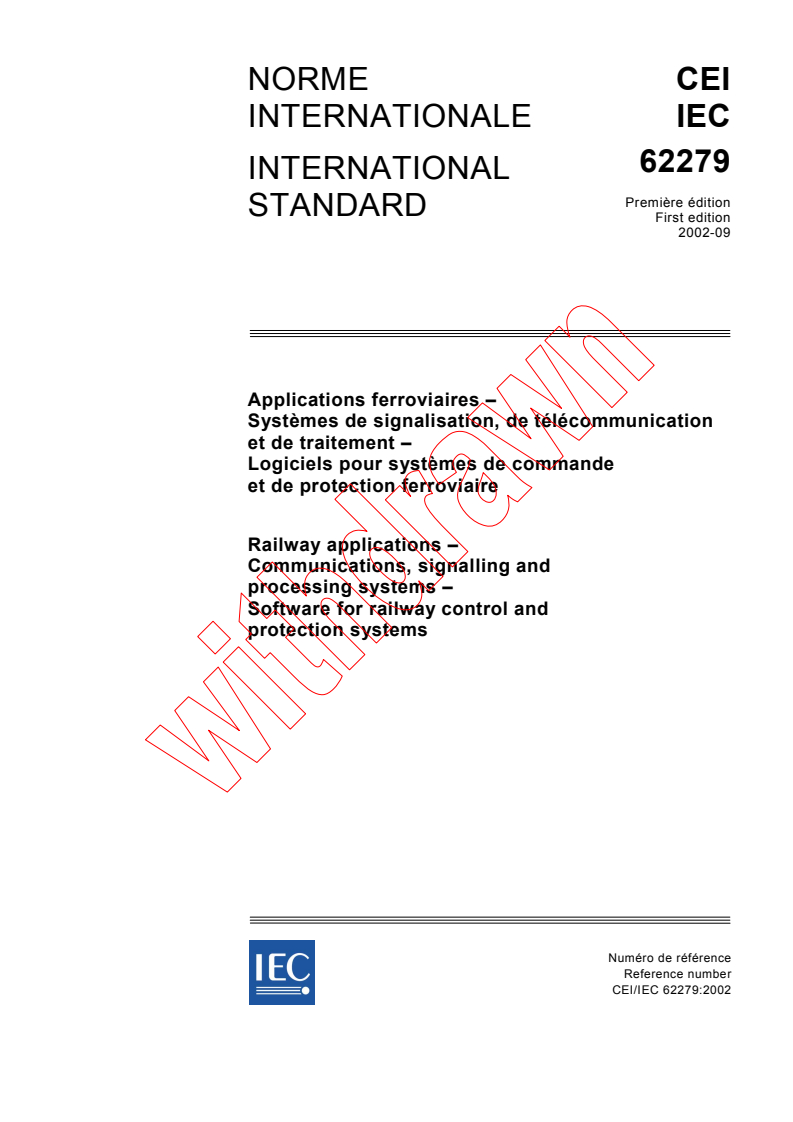
NORME CEI
INTERNATIONALE IEC
INTERNATIONAL
Première édition
STANDARD
First edition
2002-09
Applications ferroviaires –
Systèmes de signalisation, de télécommunication
et de traitement –
Logiciels pour systèmes de commande
et de protection ferroviaire
Railway applications –
Communications, signalling and
processing systems –
Software for railway control and
protection systems
Numéro de référence
Reference number
CEI/IEC 62279:2002
Numérotation des publications Publication numbering
Depuis le 1er janvier 1997, les publications de la CEI As from 1 January 1997 all IEC publications are
sont numérotées à partir de 60000. Ainsi, la CEI 34-1 issued with a designation in the 60000 series. For
devient la CEI 60034-1. example, IEC 34-1 is now referred to as IEC 60034-1.
Editions consolidées Consolidated editions
Les versions consolidées de certaines publications de la The IEC is now publishing consolidated versions of its
CEI incorporant les amendements sont disponibles. Par publications. For example, edition numbers 1.0, 1.1
exemple, les numéros d’édition 1.0, 1.1 et 1.2 indiquent and 1.2 refer, respectively, to the base publication,
respectivement la publication de base, la publication de the base publication incorporating amendment 1 and
base incorporant l’amendement 1, et la publication de the base publication incorporating amendments 1
base incorporant les amendements 1 et 2. and 2.
Informations supplémentaires Further information on IEC publications
sur les publications de la CEI
Le contenu technique des publications de la CEI est The technical content of IEC publications is kept
constamment revu par la CEI afin qu'il reflète l'état under constant review by the IEC, thus ensuring that
actuel de la technique. Des renseignements relatifs à the content reflects current technology. Information
cette publication, y compris sa validité, sont dispo- relating to this publication, including its validity, is
nibles dans le Catalogue des publications de la CEI available in the IEC Catalogue of publications
(voir ci-dessous) en plus des nouvelles éditions, (see below) in addition to new editions, amendments
amendements et corrigenda. Des informations sur les and corrigenda. Information on the subjects under
sujets à l’étude et l’avancement des travaux entrepris consideration and work in progress undertaken by the
par le comité d’études qui a élaboré cette publication, technical committee which has prepared this
ainsi que la liste des publications parues, sont publication, as well as the list of publications issued,
également disponibles par l’intermédiaire de: is also available from the following:
• Site web de la CEI (www.iec.ch) • IEC Web Site (www.iec.ch)
• Catalogue des publications de la CEI • Catalogue of IEC publications
Le catalogue en ligne sur le site web de la CEI The on-line catalogue on the IEC web site
(http://www.iec.ch/searchpub/cur_fut.htm) vous permet (http://www.iec.ch/searchpub/cur_fut.htm) enables
de faire des recherches en utilisant de nombreux you to search by a variety of criteria including text
critères, comprenant des recherches textuelles, par searches, technical committees and date of
comité d’études ou date de publication. Des publication. On-line information is also available
informations en ligne sont également disponibles sur on recently issued publications, withdrawn and
les nouvelles publications, les publications rempla- replaced publications, as well as corrigenda.
cées ou retirées, ainsi que sur les corrigenda.
• IEC Just Published • IEC Just Published
Ce résumé des dernières publications parues This summary of recently issued publications
(http://www.iec.ch/online_news/justpub/jp_entry.htm) (http://www.iec.ch/online_news/justpub/jp_entry.htm)
est aussi disponible par courrier électronique. is also available by email. Please contact the
Veuillez prendre contact avec le Service client Customer Service Centre (see below) for further
(voir ci-dessous) pour plus d’informations. information.
• Service clients • Customer Service Centre
Si vous avez des questions au sujet de cette If you have any questions regarding this
publication ou avez besoin de renseignements publication or need further assistance, please
supplémentaires, prenez contact avec le Service contact the Customer Service Centre:
clients:
Email: custserv@iec.ch Email: custserv@iec.ch
Tél: +41 22 919 02 11 Tel: +41 22 919 02 11
Fax: +41 22 919 03 00 Fax: +41 22 919 03 00
.
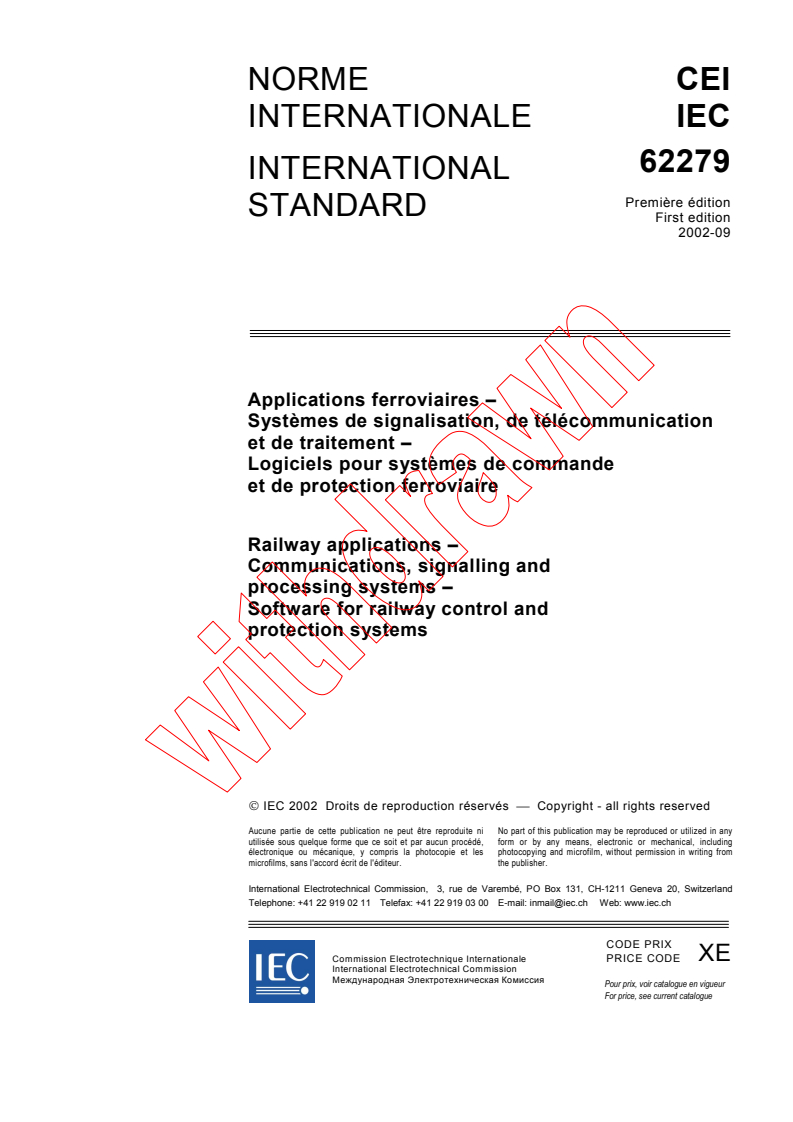
NORME CEI
INTERNATIONALE IEC
INTERNATIONAL
Première édition
STANDARD
First edition
2002-09
Applications ferroviaires –
Systèmes de signalisation, de télécommunication
et de traitement –
Logiciels pour systèmes de commande
et de protection ferroviaire
Railway applications –
Communications, signalling and
processing systems –
Software for railway control and
protection systems
IEC 2002 Droits de reproduction réservés Copyright - all rights reserved
Aucune partie de cette publication ne peut être reproduite ni No part of this publication may be reproduced or utilized in any
utilisée sous quelque forme que ce soit et par aucun procédé, form or by any means, electronic or mechanical, including
électronique ou mécanique, y compris la photocopie et les photocopying and microfilm, without permission in writing from
microfilms, sans l'accord écrit de l'éditeur. the publisher.
International Electrotechnical Commission, 3, rue de Varembé, PO Box 131, CH-1211 Geneva 20, Switzerland
Telephone: +41 22 919 02 11 Telefax: +41 22 919 03 00 E-mail: inmail@iec.ch Web: www.iec.ch
CODE PRIX
XE
Commission Electrotechnique Internationale PRICE CODE
International Electrotechnical Commission
Международная Электротехническая Комиссия
Pour prix, voir catalogue en vigueur
For price, see current catalogue
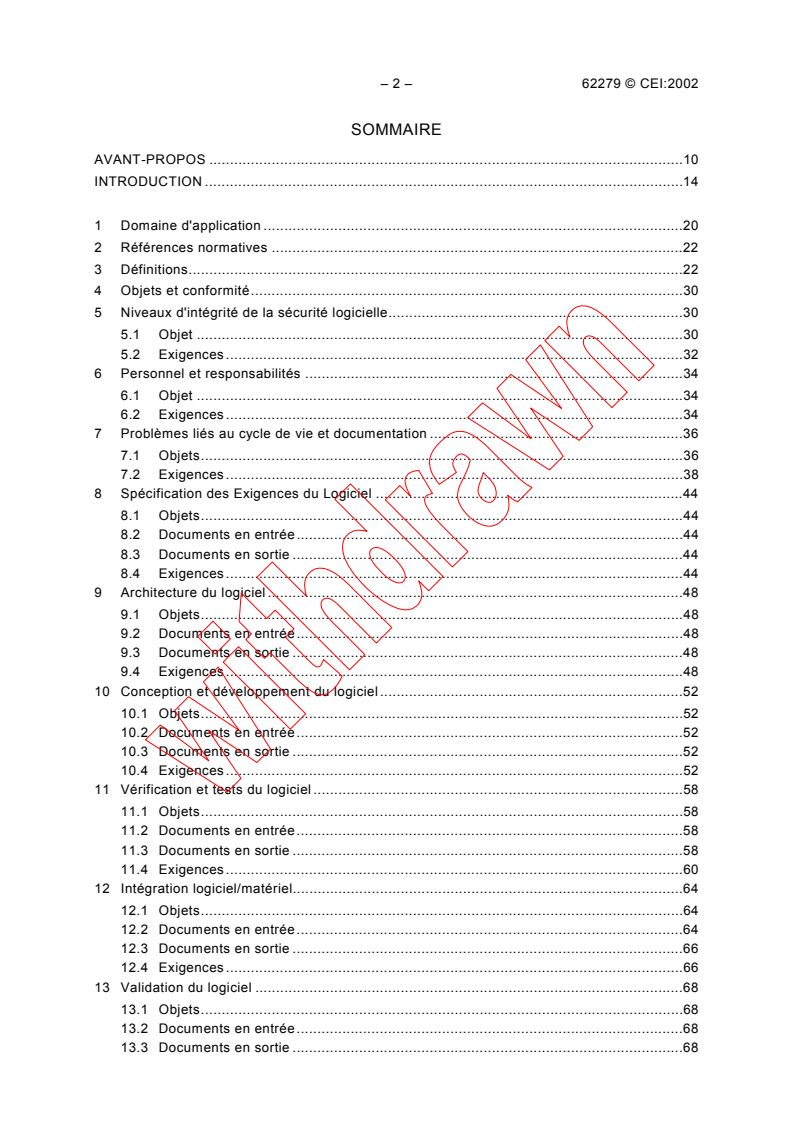
– 2 – 62279 © CEI:2002
SOMMAIRE
AVANT-PROPOS .10
INTRODUCTION .14
1 Domaine d'application .20
2 Références normatives .22
3 Définitions.22
4 Objets et conformité.30
5 Niveaux d'intégrité de la sécurité logicielle.30
5.1 Objet .30
5.2 Exigences.32
6 Personnel et responsabilités .34
6.1 Objet .34
6.2 Exigences.34
7 Problèmes liés au cycle de vie et documentation .36
7.1 Objets.36
7.2 Exigences.38
8 Spécification des Exigences du Logiciel .44
8.1 Objets.44
8.2 Documents en entrée.44
8.3 Documents en sortie .44
8.4 Exigences.44
9 Architecture du logiciel .48
9.1 Objets.48
9.2 Documents en entrée.48
9.3 Documents en sortie .48
9.4 Exigences.48
10 Conception et développement du logiciel.52
10.1 Objets.52
10.2 Documents en entrée.52
10.3 Documents en sortie .52
10.4 Exigences.52
11 Vérification et tests du logiciel .58
11.1 Objets.58
11.2 Documents en entrée.58
11.3 Documents en sortie .58
11.4 Exigences.60
12 Intégration logiciel/matériel.64
12.1 Objets.64
12.2 Documents en entrée.64
12.3 Documents en sortie .66
12.4 Exigences.66
13 Validation du logiciel .68
13.1 Objets.68
13.2 Documents en entrée.68
13.3 Documents en sortie .68
62279 © IEC:2002 – 3 –
CONTENTS
FOREWORD .11
INTRODUCTION .15
1 Scope .21
2 Normative references.23
3 Definitions.23
4 Objectives and conformance .31
5 Software safety integrity levels .31
5.1 Objective .31
5.2 Requirements .33
6 Personnel and responsibilities .35
6.1 Objective .35
6.2 Requirements .35
7 Life cycle issues and documentation .37
7.1 Objectives.37
7.2 Requirements .39
8 Software requirements specification .45
8.1 Objectives.45
8.2 Input documents .45
8.3 Output documents.45
8.4 Requirements .45
9 Software architecture .49
9.1 Objectives.49
9.2 Input documents .49
9.3 Output documents.49
9.4 Requirements .49
10 Software design and implementation .53
10.1 Objectives.53
10.2 Input documents .53
10.3 Output documents.53
10.4 Requirements .53
11 Software verification and testing.59
11.1 Objective .59
11.2 Input documents .59
11.3 Output documents.59
11.4 Requirements .61
12 Software/hardware integration .65
12.1 Objectives.65
12.2 Input documents .65
12.3 Output documents.67
12.4 Requirements .67
13 Software validation.69
13.1 Objective .69
13.2 Input documents .69
13.3 Output documents.69
– 4 – 62279 © CEI:2002
13.4 Exigences.68
14 Evaluation du logiciel .72
14.1 Objets.72
14.2 Documents en entrée.72
14.3 Documents en sortie .72
14.4 Exigences.72
15 Assurance qualité du logiciel .74
15.1 Objets.74
15.2 Documents en entrée.74
15.3 Documents en sortie .74
15.4 Exigences.74
16 Maintenance du logiciel.78
16.1 Objets.78
16.2 Documents en entrée.78
16.3 Documents en sortie .78
16.4 Exigences.80
17 Systèmes configurés par des données d'application .82
17.1 Objets.82
17.2 Documents en entrée.82
17.3 Documents en sortie .82
17.4 Exigences.84
Annexe A (normative) Critères de sélection des techniques et mesures .102
Annexe B (informative) Bibliographie des techniques .122
B.1 Intelligence artificielle – Correction des défauts (référencé par l'article 9) .122
B.2 Programmes analysables (référencé par l'article 10).122
B.3 Tests de surcharge (référencé par td6).124
B.4 Analyse des valeurs aux limites (référencé par td2, td3 et td8).124
B.5 Rattrapage par régression (référencé par l'article 9) .126
B.6 Schémas de cause et de conséquence (référencé par l'article 14 et td3).126
B.7 Outils certifiés et compilateurs certifiés (référencé par l'article 10).128
B.8 Listes de contrôle (référencé par l'article 14 et td8) .128
B.9 Analyse de flux de contrôle (référencé par td8).130
B.10 Analyse des défaillances de mode commun (référencé par l'article 14) .130
B.11 Analyse du flux de données (référencé par td8) .132
B.12 Diagrammes des flux de données (référencé par td5 et td7) .134
B.13 Enregistrement et analyse des données (référencé par les articles 10 et 16).136
B.14 Tables de décision (Tables de vérité) (référencé par l'article 14 et td7) .136
B.15 Programmation défensive (référencé par l'article 9) .138
B.16 Normes de conception et de codage (référencé par D.1) .140
B.17 Programmation diversifiée (référencé par l'article 9) .140
B.18 Reconfiguration dynamique (référencé par l'article 9) .142
B.19 Tests de classes d'équivalence et de partition des données (référencé par td2
et td3) .144
B.20 Codes correcteurs et détecteurs d'erreurs (référencé par l'article 9) .144
B.21 Supposition d'erreurs (référencé par td2 et td8) .144
62279 © IEC:2002 – 5 –
13.4 Requirements .69
14 Software assessment .73
14.1 Objective .73
14.2 Input documents .73
14.3 Output documents.73
14.4 Requirements .73
15 Software quality assurance.75
15.1 Objectives.75
15.2 Input documents .75
15.3 Output documents.75
15.4 Requirements .75
16 Software maintenance.79
16.1 Objective .79
16.2 Input documents .79
16.3 Output documents.79
16.4 Requirements .81
17 Systems configured by application data .83
17.1 Objectives.83
17.2 Input documents .83
17.3 Output documents.83
17.4 Requirements .85
Annex A (normative) Criteria for the Selection of Techniques and Measures .103
Annex B (informative) Bibliography of techniques.123
B.1 Artificial Intelligence – Fault Correction (referenced by clause 9) .123
B.2 Analysable Programs (referenced by clause 10) .123
B.3 Avalanche/Stress Testing (referenced by dt6).125
B.4 Boundary Value Analysis (referenced by dt2, dt3 and dt8).125
B.5 Backward Recovery (referenced by clause 9) .127
B.6 Cause Consequence Diagrams (referenced by clause 14 and dt3).127
B.7 Certified Tools and Certified Translators (referenced by clause 10) .129
B.8 Checklists (referenced by clause 14 and dt8).129
B.9 Control Flow Analysis (referenced by dt8).131
B.10 Common Cause Failure Analysis (referenced by clause 14) .131
B.11 Data Flow Analysis (referenced by dt8).133
B.12 Data Flow Diagrams (referenced by dt5 and dt7) .135
B.13 Data Recording and Analysis (referenced by clauses 10 and 16) .137
B.14 Decision Tables (Truth Tables) (referenced by clause 14 and dt7) .137
B.15 Defensive Programming (referenced by clause 9).139
B.16 Design and Coding Standards (referenced by dt1) .141
B.17 Diverse Programming (referenced by clause 9) .141
B.18 Dynamic Reconfiguration (referenced by clause 9) .143
B.19 Equivalence Classes and Input Partition Testing (referenced by D2 and dt3).145
B.20 Error Detecting and Correcting Codes (referenced by clause 9) .145
B.21 Error Guessing (referenced by dt2 and dt8) .145
– 6 – 62279 © CEI:2002
B.22 Insertion d'erreurs (référencé par td2) .146
B.23 Analyse par arbre des événements (référencé par l'article 14) .146
B.24 Inspection de Fagan (référencé par td8) .148
B.25 Programmation par assertion (référencé par l'article 9).148
B.26 SEEA – Analyse des effets des erreurs du logiciel (référencé par les articles 9,
11 et 14 ) .150
B.27 Détection des défauts et diagnostic (référencé par l'article 9) .152
B.28 Analyse par arbre des causes (référencé par les articles 9 et 14) .152
B.29 Automates à états finis/Schémas de transition d'état (référencé par td5 et td7) .154
B.30 Méthodes formelles (référencé par les article 8 et 10 et td5) .156
B.31 Preuve formelle (référencé par l'article 11) .166
B.32 Rattrapage par progression (référencé par l'article 9) .166
B.33 Dégradation contrôlée .166
B.34 Etude de risque et d'opérabilité HAZOP (Hazard and Operability Study).168
B.35 Analyse d'impact (référencé par l'article 16) .170
B.36 Masquage d'informations/Encapsulage (référencé par td9) .170
B.37 Tests d'interface (référencé par l'article 10).172
B.38 Sous-ensemble de langage (référencé par l'article 10 et td4) .172
B.39 Mémorisation des cas exécutés (référencé par l'article 9) .174
B.40 Bibliothèque de modules et de composants sécurisés/vérifiés (référencé par
l'article 10) .174
B.41 Modèles de Markov (référencé par l'article 14) .176
B.42 Métriques (référencé par les articles 11 et 14) .176
B.43 Approche modulaire (référencé par td9) .178
B.44 Simulation de Monte Carlo .180
B.45 Modélisation des performances (référencé par td2 et td5).180
B.46 Exigences en matière de performance (référencé par td6) .182
B.47 Tests probabilistes (référencé par les articles 11 et 13) .182
B.48 Simulation du processus (référencé par td3).184
B.49 Prototypage/Animation (référencé par td3 et td5).186
B.50 Bloc de rattrapage (référencé par l'article 9) .186
B.51 Schéma bloc de la fiabilité (référencé par l'article 14) .188
B.52 Temps de réponse et contraintes de place mémoire (référencé par td6) .188
B.53 Rattrapage par réexécution (référencé par l'article 9) .188
B.54 Sécurité contrôlée (Safety Bag) (référencé par l'article 9) .190
B.55 Analyse des chemins insidieux (référencé par td8) .190
B.56 Gestion de la configuration du logiciel (référencé par l'article 15).192
B.57 Langages de programmation à fort typage (référencé par l'article 10) .192
B.58 Tests structurels (référencé par td2).194
B.59 Schémas de structure (référencé par td5).196
B.60 Méthode structurée (référencé par les articles 8 et 10) .198
B.61 Programmation structurée (référencé par l'article 10) .206
B.62 Langages de programmations adaptés (référencé par td4) .206
B.63 Exécution symbolique (référencé par td8).208
62279 © IEC:2002 – 7 –
B.22 Error Seeding (referenced by dt2) .147
B.23 Event Tree Analysis (referenced by clause 14) .147
B.24 Fagan Inspections (referenced by dt8).149
B.25 Failure Assertion Programming (referenced by clause 9) .149
B.26 SEEA – Software Error Effect Analysis (referenced by clauses 9, 11 and 14) .151
B.27 Fault Detection and Diagnosis (referenced by clause 9).153
B.28 Fault Tree Analysis (referenced by clauses 9 and 14) .153
B.29 Finite State Machines/State Transition Diagrams (referenced by dt5 and dt7) .155
B.30 Formal Methods (referenced by clauses 8 and 10 and dt5) .157
B.31 Normal Proof (referenced by clause 11) .167
B.32 Forward Recovery (referenced by clause 9).167
B.33 Graceful Degradation .167
B.34 Hazard and Operability Study (HAZOP) .169
B.35 Impact Analysis (referenced by clause 16).171
B.36 Information Hiding / Encapsulation (referenced by dt9) .171
B.37 Interface Testing (referenced by clause 10) .173
B.38 Language Subset (referenced by clause 10 and dt4).173
B.39 Memorising Executed Cases (referenced by clause 9) .175
B.40 Library of Trusted/Verified Modules and Components (referenced by clause 10) .175
B.41 Markov Models (referenced by clause 14).177
B.42 Metrics (referenced by clauses 11 and 14) .177
B.43 Modular Approach (referenced by dt9).179
B.44 Monte Carlo Simulation .181
B.45 Performance Modelling (referenced by dt2 and dt5) .181
B.46 Performance Requirements (referenced by dt6).183
B.47 Probabilistic Testing (referenced by clauses 11 and 13).183
B.48 Process Simulation (referenced by dt3) .185
B.49 Prototyping/Animation (referenced by dt3 and dt5).187
B.50 Recovery Block (referenced by clause 9).187
B.51 Reliability Block Diagram (referenced by clause 14).189
B.52 Response Timing and Memory Constraints (Referenced by dt6) .189
B.53 Re-Try Fault Recovery Mechanisms (referenced by clause 9) .189
B.54 Safety Bag (referenced by clause 9) .191
B.55 Sneak Circuit Analysis (referenced by dt8) .191
B.56 Software Configuration Management (referenced by clause 15) .193
B.57 Strongly Typed Programming Languages (referenced by clause 10) .193
B.58 Structure Based Testing (referenced by dt2).195
B.59 Structure Diagrams (referenced by dt5) .197
B.60 Structured Methodology (referenced by clauses 8 and 10) .199
B.61 Structured Programming (referenced by clause 10) .207
B.62 Suitable Programming Languages (referenced by dt4) .207
B.63 Symbolic Execution (referenced by dt8).209
– 8 – 62279 © CEI:2002
B.64 Réseaux de Pétri temporels (référencé par td5 et td7) .208
B.65 Compilateur éprouvé à l'utilisation (référencé par l'article 10) .210
B.66 Revues/Examens de la conception (référencé par td8) .212
B.67 Logique floue (référencé par l'article 10).212
B.68 Programmation orientée objet (référencé par l'article 10).214
B.69 Traçabilité (référencé par l'article 11) .216
Figure 1 – Niveaux d'intégrité de la sécurité pour les systèmes liés à la sécurité .90
Figure 2 – Démarche de la sécurité du logiciel.92
Figure 3 – Cycle de vie 1 du développement .94
Figure 4 – Cycle de vie 2 du développement .96
Figure 5 – Indépendance en fonction du niveau d'intégrité de la sécurité du logiciel .98
Figure 6 – Relation entre le développement du système générique et le développement
du cas spécifique .100
Table de correspondance des documents .42
Tableau A.1 – Problèmes liés au cycle de vie et documentation (article 7).104
Tableau A.2 – Spécification des Exigences du Logiciel (article 8).104
Tableau A.3 – Architecture du Logiciel (article 9) .106
Tableau A.4 – Conception et mise en œuvre du Logiciel (article 10).108
Tableau A.5 – Vérification et Tests (article 11).110
Tableau A.7 – Validation du Logiciel (article 13).110
Tableau A.8 – Articles à évaluer .112
Tableau A.9 – Evaluation du logiciel (article 14) Techniques d'évaluation .112
Tableau A.10 – Assurance qualité du logiciel (article 15).112
Tableau A.11 – Maintenance du logiciel (article 16).114
Tableau A.12 – Normes de conception et de codage (td1) Référencé par l'article 10 .114
Tableau A.13 – Analyse et tests dynamiques (td2) Référencé par les articles 11 et 14 .114
Tableau A.14 – Test fonctionnel/boîte noire (td3) Référencé par les articles 10, 12, 13
et 14 .116
Tableau A.15 – Langages de programmation (td4) Référencé par l'article 10.116
Tableau A.16 – Modélisation (td5) Référencé par l'article 13 .118
Tableau A.17 – Tests de performance (td6) Référencé par les articles 10, 12 et 13.118
Tableau A.18 – Méthodes semi-formelles (td7) Référencé par les articles 8 et 10 .118
Tableau A.19 – Analyse statique (td8) Référencé par les articles 11 et 14 .120
Tableau A.20 – Approche modulaire (td9) Référencé par l'article 10.120
62279 © IEC:2002 – 9 –
B.64 Time Petri Nets (referenced by dt5 and dt7) .209
B.65 Translator Proven In Use (referenced by clause 10) .211
B.66 Walk-throughs/Design Reviews (referenced by dt8) .213
B.67 Fuzzy Logic (referenced by clause 10).213
B.68 Object Oriented Programming (referenced by clause 10) .215
B.69 Traceability (referenced by clause 11) .217
Figure 1 – Integrity Levels for Safety-Related Systems.91
Figure 2 – Software Safety Route Map.93
Figure 3 – Development Life Cycle 1.95
Figure 4 – Development Life Cycle 2.97
Figure 5 – Independence Versus Software Integrity Level .99
Figure 6 – Relationship between Generic System Development and Application
Development .101
Documents cross-reference table .43
Table A.1 – Life Cycle Issues and Documentation (clause 7).105
Table A.2 – Software Requirements Specification (clause 8) .105
Table A.3 – Software Architecture (clause 9) .107
Table A.4 – Software Design and Implementation (clause 10) .109
Table A.5 – Verification and Testing (clause 11) .111
Table A.6 – Software/Hardware Integration (clause 12) .111
Table A.7 – Software Validation (clause 13).111
Table A.8 – Clauses to be assessed .113
Table A.9 – Software Assessment (clause 14) Assessment Techniques .113
Table A.10 – Software Quality Assurance (clause 15) .113
Table A.11 – Software Maintenance (clause 16).115
Table A.12 – Design and Coding Standards (dt1) Referenced by clause 10 .115
Table A.13 – Dynamic Analysis and Testing (dt2) Referenced by clauses 11 and 14.115
Table A.14 – Functional/Black Box Test (dt3) Referenced by clauses 10,12, 13 and 14 .117
Table A.15 – Programming Languages (dt4) Referenced by clause 10 .117
Table A.16 – Modelling (dt5) Referenced by clause 13 .119
Table A.17 –Performance Testing (dt6) Referenced by clauses 10, 12 and 13.119
Table A.18 – Semi-Formal Methods (dt7) Referenced by clauses 8 and 10.119
Table A.19 – Static Analysis (dt8) Referenced by clauses 11 and 14 .121
Table A.20 – Modular Approach (dt9) Referenced by clause 10.121
– 10 – 62279 © CEI:2002
COMMISSION ÉLECTROTECHNIQUE I
...