

IEC TS 62312-2:2007
(Main)Guideline for synchronization of audio and video - Part 2: Methods for synchronization of audio and video systems
General Information
- Abstract
It gives guidelines for methods of synchronization of audio and video. It describes the system model and general methods for the synchronization of audio and video. The methods exclude the synchronization of the signal source and the spatial delay of audio reproduction.
- Status
- Published
- Publication Date
- 13-Jun-2007
- Technical Committee
- TA 20 - Analogue and digital audio
- Current Stage
- DELPUB - Deleted Publication
- Start Date
- 02-Nov-2018
- Completion Date
- 28-Aug-2026
Overview
IEC TS 62312-2:2007 - Guideline for synchronization of audio and video, Part 2 - provides practical guidance on methods for synchronizing audio and video in systems that include digital signal processing. It defines a system model, key terms (latency, delay, latency information, time stamp), and general synchronization methods. The specification focuses on controlling device-side latencies and delays via synchronization information and controller functions; it explicitly excludes synchronization of the signal source and spatial (acoustic) delay of audio reproduction.
Key topics and technical requirements
- System model: Describes an AV system made up of audio and video devices (each with units that incur latency and delay), controllers, signal interfaces and final reproducers (speakers and displays). Emphasizes that total latency/delay is the sum of unit contributions.
- Definitions: Clear differentiation between latency (inevitable processing delay) and delay (including intentional or functional delays); defines latency information and time stamp usage.
- Information & control functions: Devices must accept synchronization information and provide control mechanisms (via digital interfaces or control lines) to adjust processing delays.
- Primary synchronization methods:
- Time-code / time-stamp based methods - align events using reference clocks and time-code information.
- Latency-information methods - exchange summed latency/delay values so controllers can compute offsets.
- Interface-specific methods - examples cover use with consumer digital audio interfaces and AV protocols (references to IEC 60958-3 and IEC 61883-6).
- Scope limitations: Methods do not attempt to synchronize the original source timing (outside the system model) nor compensate for audio spatial propagation delay.
Applications and who uses it
IEC TS 62312-2 is targeted at professionals designing, integrating or testing AV systems where digital processing introduces timing disparities:
- Consumer electronics manufacturers (set-top boxes, media players, TVs, AV receivers)
- Broadcast and streaming system designers
- AV system integrators and installers (home theater, public displays, digital signage)
- Firmware and software engineers implementing synchronization controllers and interface protocols
- Test and measurement engineers verifying audio–video lip-sync performance
Practical use cases include synchronizing separate digital audio and video outputs from media players, compensating for display processing delays, and designing control signaling between devices to maintain lip-sync across an AV chain.
Related standards
- IEC 60958-1 / IEC 60958-3 - Digital audio interface (consumer applications)
- IEC 61883-6 - AV digital interface - audio/music data transmission protocol
Keywords: audio-video synchronization, IEC TS 62312-2:2007, latency, time-code, latency information, AV system model, lip-sync, digital audio interface.
Relations
- Effective Date
- 05-Sep-2023
Get Certified
Connect with accredited certification bodies for this standard

ANCE
Mexican certification and testing association.

Intertek Slovenia
Intertek testing, inspection, and certification services in Slovenia.

LNE (Laboratoire National de Métrologie et d'Essais)
French national laboratory for metrology and testing.
Sponsored listings
Frequently Asked Questions
IEC TS 62312-2:2007 is a technical specification published by the International Electrotechnical Commission (IEC). Its full title is "Guideline for synchronization of audio and video - Part 2: Methods for synchronization of audio and video systems". This standard covers: It gives guidelines for methods of synchronization of audio and video. It describes the system model and general methods for the synchronization of audio and video. The methods exclude the synchronization of the signal source and the spatial delay of audio reproduction.
It gives guidelines for methods of synchronization of audio and video. It describes the system model and general methods for the synchronization of audio and video. The methods exclude the synchronization of the signal source and the spatial delay of audio reproduction.
IEC TS 62312-2:2007 is classified under the following ICS (International Classification for Standards) categories: 33.160.01 - Audio, video and audiovisual systems in general. The ICS classification helps identify the subject area and facilitates finding related standards.
IEC TS 62312-2:2007 has the following relationships with other standards: It is inter standard links to IEC TS 62312-2:2018. Understanding these relationships helps ensure you are using the most current and applicable version of the standard.
IEC TS 62312-2:2007 is available in PDF format for immediate download after purchase. The document can be added to your cart and obtained through the secure checkout process. Digital delivery ensures instant access to the complete standard document.
Standards Content (Sample)
TECHNICAL IEC
SPECIFICATION TS 62312-2
First edition
2007-06
Guideline for synchronization of audio and video –
Part 2:
Methods for synchronization of audio
and video systems
Reference number
IEC/TS 62312-2:2007(E)
All rights reserved. Unless otherwise specified, no part of this publication may be reproduced or utilized in any form
or by any means, electronic or mechanical, including photocopying and microfilm, without permission in writing from
either IEC or IEC's member National Committee in the country of the requester.
If you have any questions about IEC copyright or have an enquiry about obtaining additional rights to this publication,
please contact the address below or your local IEC member National Committee for further information.
IEC Central Office
3, rue de Varembé
CH-1211 Geneva 20
Switzerland
Email: inmail@iec.ch
Web: www.iec.ch
About the IEC
The International Electrotechnical Commission (IEC) is the leading global organization that prepares and publishes
International Standards for all electrical, electronic and related technologies.
About IEC publications
The technical content of IEC publications is kept under constant review by the IEC. Please make sure that you have the
latest edition, a corrigenda or an amendment might have been published.
ƒ Catalogue of IEC publications: www.iec.ch/searchpub
The IEC on-line Catalogue enables you to search by a variety of criteria (reference number, text, technical committee,…).
It also gives information on projects, withdrawn and replaced publications.
ƒ IEC Just Published: www.iec.ch/online_news/justpub
Stay up to date on all new IEC publications. Just Published details twice a month all new publications released. Available
on-line and also by email.
ƒ Customer Service Centre: www.iec.ch/webstore/custserv
If you wish to give us your feedback on this publication or need further assistance, please visit the Customer Service
Centre FAQ or contact us:
Email: csc@iec.ch
Tel.: +41 22 919 02 11
Fax: +41 22 919 03 00
TECHNICAL IEC
SPECIFICATION TS 62312-2
First edition
2007-06
Guideline for synchronization of audio and video –
Part 2:
Methods for synchronization of audio
and video systems
PRICE CODE
Commission Electrotechnique Internationale P
International Electrotechnical Commission
МеждународнаяЭлектротехническаяКомиссия
For price, see current catalogue
– 2 – TS 62312-2 © IEC:2007(E)
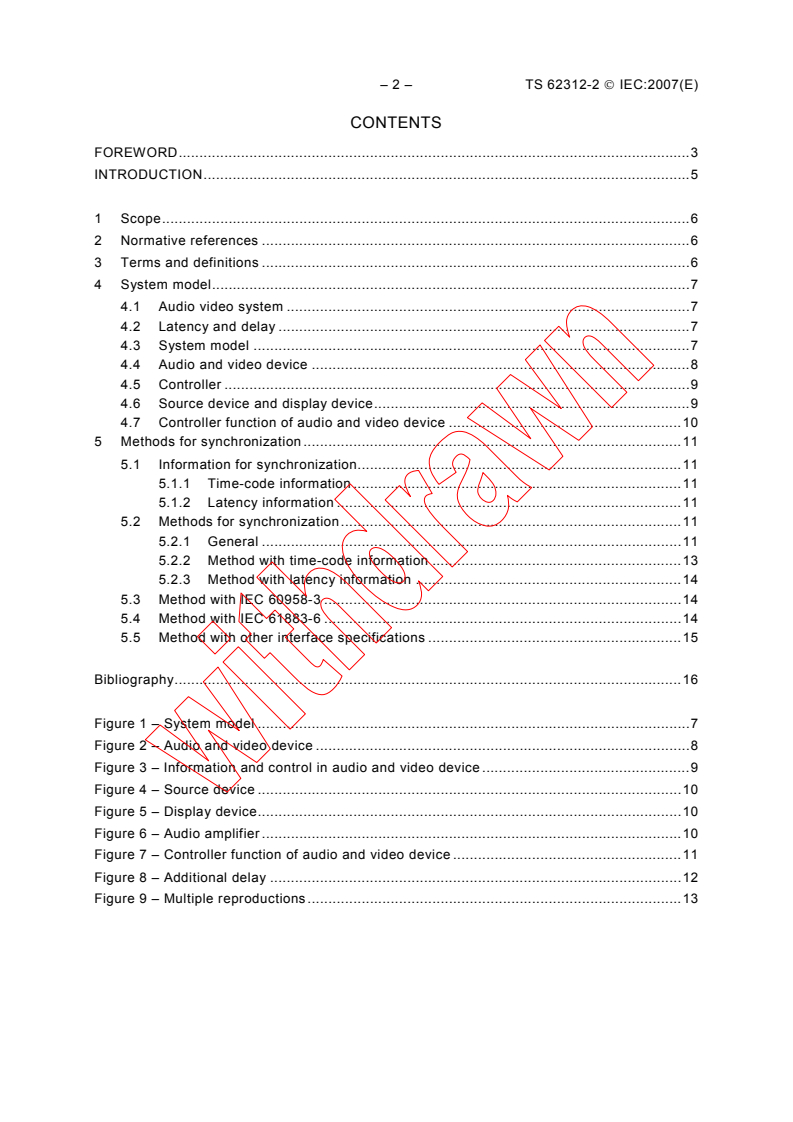
CONTENTS
FOREWORD.3
INTRODUCTION.5
1 Scope.6
2 Normative references .6
3 Terms and definitions .6
4 System model.7
4.1 Audio video system .7
4.2 Latency and delay .7
4.3 System model .7
4.4 Audio and video device .8
4.5 Controller .9
4.6 Source device and display device.9
4.7 Controller function of audio and video device .10
5 Methods for synchronization .11
5.1 Information for synchronization.11
5.1.1 Time-code information .11
5.1.2 Latency information .11
5.2 Methods for synchronization.11
5.2.1 General .11
5.2.2 Method with time-code information .13
5.2.3 Method with latency information .14
5.3 Method with IEC 60958-3 .14
5.4 Method with IEC 61883-6 .14
5.5 Method with other interface specifications .15
Bibliography.16
Figure 1 – System model .7
Figure 2 – Audio and video device .8
Figure 3 – Information and control in audio and video device .9
Figure 4 – Source device .10
Figure 5 – Display device.10
Figure 6 – Audio amplifier .10
Figure 7 – Controller function of audio and video device .11
Figure 8 – Additional delay .12
Figure 9 – Multiple reproductions.13
TS 62312-2 © IEC:2007(E) – 3 –
INTERNATIONAL ELECTROTECHNICAL COMMISSION
____________
GUIDELINE FOR SYNCHRONIZATION OF AUDIO AND VIDEO –
Part 2: Methods for synchronization of audio and video systems
FOREWORD
1) The International Electrotechnical Commission (IEC) is a worldwide organization for standardization comprising
all national electrotechnical committees (IEC National Committees). The object of IEC is to promote
international co-operation on all questions concerning standardization in the electrical and electronic fields. To
this end and in addition to other activities, IEC publishes International Standards, Technical Specifications,
Technical Reports, Publicly Available Specifications (PAS) and Guides (hereafter referred to as “IEC
Publication(s)”). Their preparation is entrusted to technical committees; any IEC National Committee interested
in the subject dealt with may participate in this preparatory work. International, governmental and non-
governmental organizations liaising with the IEC also participate in this preparation. IEC collaborates closely
with the International Organization for Standardization (ISO) in accordance with conditions determined by
agreement between the two organizations.
2) The formal decisions or agreements of IEC on technical matters express, as nearly as possible, an international
consensus of opinion on the relevant subjects since each technical committee has representation from all
interested IEC National Committees.
3) IEC Publications have the form of recommendations for international use and are accepted by IEC National
Committees in that sense. While all reasonable efforts are made to ensure that the technical content of IEC
Publications is accurate, IEC cannot be held responsible for the way in which they are used or for any
misinterpretation by any end user.
4) In order to promote international uniformity, IEC National Committees undertake to apply IEC Publications
transparently to the maximum extent possible in their national and regional publications. Any divergence
between any IEC Publication and the corresponding national or regional publication shall be clearly indicated in
the latter.
5) IEC provides no marking procedure to indicate its approval and cannot be rendered responsible for any
equipment declared to be in conformity with an IEC Publication.
6) All users should ensure that they have the latest edition of this publication.
7) No liability shall attach to IEC or its directors, employees, servants or agents including individual experts and
members of its technical committees and IEC National Committees for any personal injury, property damage or
other damage of any nature whatsoever, whether direct or indirect, or for costs (including legal fees) and
expenses arising out of the publication, use of, or reliance upon, this IEC Publication or any other IEC
Publications.
8) Attention is drawn to the Normative references cited in this publication. Use of the referenced publications is
indispensable for the correct application of this publication.
9) Attention is drawn to the possibility that some of the elements of this IEC Publication may be the subject of
patent rights. IEC shall not be held responsible for identifying any or all such patent rights.
The main task of IEC technical committees is to prepare International Standards. In
exceptional circumstances, a technical committee may propose the publication of a technical
specification when
• the required support cannot be obtained for the publication of an International Standard,
despite repeated efforts, or
• the subject is still under technical development, or where, for any other reason, there is
the future but no immediate possibility of an agreement on an International Standard.
Technical specifications are subject to review within three years of publication to decide
whether they can be transformed into International Standards.
IEC 62312-2, which is a technical specification, has been prepared by IEC technical
committee 100: Audio, video and multimedia systems and equipment.
– 4 – TS 62312-2 © IEC:2007(E)
The text of this technical specification is based on the following documents:
Enquiry draft Report on voting
100/1195/DTS 100/1226/RVC
Full information on the voting for the approval of this technical specification can be found in
the report on voting indicated in the above table.
This publication has been drafted in accordance with the ISO/IEC Directives, Part 2.
The list of all the parts of IEC 62312, under the general title Guideline for synchronization of
audio and video, can be found on the IEC website.
The committee has decided that the contents of this publication will remain unchanged until
the maintenance result date indicated on the IEC web site under "http://webstore.iec.ch" in
the data related to the specific publication. At this date, the publication will be
• transformed into an International standard,
• reconfirmed,
• withdrawn,
• replaced by a revised edition, or
• amended.
A bilingual version of this publication may be issued at a later date.
TS 62312-2 © IEC:2007(E) – 5 –
INTRODUCTION
Audio, video and multimedia systems and equipment have begun to use digital technologies.
Digital systems or equipment may cause delay of audio and video signals because digital
signal processing causes latency and delay. The unevenness of the delay between audio and
video may cause synchronization problems.
For instance, a digital broadcasting system uses signal compression of audio and video. A
receiver has signal decoders, and this may cause unevenness of the delay between audio and
video. Digital video signal processing of display causes a significant delay in the reproduction
time of the video image. Another example is an audio video system consisting of a digital
media player, an audio amplifier and display. A digital media player outputs audio and video
signals separately to the amplifier and display through digital interfaces. This may cause
synchronization problems of audio and video when each processing time of the equipment is
different.
To solve synchronization problems, this technical specification gives guidelines for general
methods for the synchronization of audio and video.
– 6 – TS 62312-2 © IEC:2007(E)
GUIDELINE FOR SYNCHRONIZATION OF AUDIO AND VIDEO –
Part 2: Methods for synchronization of audio and video systems
1 Scope
The IEC 62312 series gives guidelines for methods of synchronization of audio and video.
This part of IEC 62312 describes the system model and general methods for the
synchronization of audio and video. The methods exclude the synchronization of the signal
source and the spatial delay of audio reproduction.
2 Normative references
The following referenced documents are indispensable for the application of this document.
For dated references, only the edition cited applies. For undated references, the latest edition
of the referenced document (including any amendments) applies.
IEC 60958-1, Digital audio interface – Part 1: General
IEC 60958-3, Digital audio interface – Part 3: Consumer applications
IEC 61883-6, Consumer audio/video equipment – Digital interface – Part 6: Audio and music
data transmission protocol
3 Terms and definitions
For the purposes of this document, the following terms and definitions apply.
3.1
latency
inevitable delay of signal that is caused by principle or unavoidable signal processing
3.2
delay
general meaning of delay other than latency, including delay that is caused by functional
signal processing and delay that is set intentionally
3.3
latency information
information of the sum value of latency and delay
3.4
time stamp
quantized timing in which an event occurs on the basis of a reference clock
TS 62312-2 © IEC:2007(E) – 7 –
4 System model
4.1 Audio video system
An audio video system consists of audio and video devices and these devices may include
digital signal processing that causes latency and delay. Each device is connected to the other
device by analogue or digital signal interfaces. The final outputs from the audio video system
to the user are reproduction of audio with speakers and visual image with display device.
These reproductions have no information of synchronization and the method for
synchronization should be applied at the stage prior to the final reproduction.
To control synchronization of audio and video, synchronization information should be provided,
and the controller should control the delay of the audio and video devices with the
synchronization information. The synchronization information and the controller signal are
transmitted through digital interfaces or control line.
4.2 Latency and delay
Latency means an inevitable delay of signal in the audio and video device that is caused by
principle or unavoidable signal processing. For instance, signal encoding and decoding, signal
compression and de-compression, and signal transmission through interface cause latency.
The term “delay” is sometimes used as meaning latency. In this technical specification,
“delay” is defined as delay other than latency. Functional signal processing causes delay or
delay is set intentionally.
4.3 System model
Figure 1 shows the system model.
B
A
Video
Video Video
D
Audio and Audio and
Audio
Signal
video video
source
Devices 1 Devices n
Information Audio
Audio
Speakers
Information and control line
Controller
IEC 979/07
Figure 1 – System model
In this system model, audio and video synchronization of the signal source is outside the
scope because this model cannot identify it or control it. The audio and video devices have
latencies and delays because of their structure. The system consists of a number of audio
and video devices. The display unit is a visual reproducer such as CRT or a flat panel display
device. The speakers are audio reproducers. These display unit and speaker
...