

IEC TR 63482:2024
(Main)Maintenance of low voltage switchgear and controlgear and their assemblies
General Information
- Abstract
IEC TR 63482:2024 provides guidance for the specification and selection of the appropriate approach and for the planning and the execution of the maintenance of low-voltage switchgear and controlgear and their assemblies having a rated voltage up to and including 1 000 V AC or 1 500 V DC, and designed for a nominal frequency of the incoming supply or supplies not exceeding 1 000 Hz.
The content of the corrigendum 1 (2024-11) has been included in this copy.
- Status
- Published
- Publication Date
- 23-Jul-2024
- Technical Committee
- TC 121 - Switchgear and controlgear and their assemblies for low voltage
- Drafting Committee
- PT 63482 - TC 121/PT 63482
- Current Stage
- PPUB - Publication issued
- Start Date
- 24-Jul-2024
- Completion Date
- 26-Jul-2024
Overview
IEC TR 63482:2024 is a Technical Report from the IEC that gives guidance for the specification, selection, planning and execution of maintenance for low-voltage switchgear and controlgear and their assemblies. It applies to assemblies with rated voltages up to and including 1 000 V AC or 1 500 V DC, and nominal supply frequencies not exceeding 1 000 Hz. This edition (1.0, 2024-07) incorporates Corrigendum 1 (2024-11).
The report complements manufacturer instructions and design standards by focusing on safe, effective maintenance strategies that preserve performance, reliability and availability over long service lifetimes.
Key Topics
- Safety measures for maintenance (local regulations, isolation, working on live equipment, insulating and earthing equipment, emergency provisions).
- Maintenance approaches: scheduled (time-based), condition-based and predictive maintenance using monitoring technologies.
- Electrical preventive maintenance: objectives, values and benefits to reduce failure risk and extend service life.
- Maintenance categories and functions: classification of assemblies by maintenance level and required actions to achieve each category.
- Implementation and management: planning, skill levels for personnel (Skill levels 1–3), maintenance instructions, replacement parts, re‑energisation and record-keeping.
- Periodic verification and recommended frequencies (environmental and operating conditions influence intervals).
- Circular economy considerations: maintenance to extend lifetime, lower carbon footprint, and maximize material efficiency; guidance on reuse, refurbishment and remanufacture.
- Supporting annexes: maintenance plan templates, country-specific notes, and frequency guidance tied to operating conditions and application criticality.
Applications
IEC TR 63482 is practical for anyone responsible for the lifecycle and operational safety of LV electrical assemblies:
- Maintenance engineers and technicians designing and executing maintenance programs for LV switchgear and controlgear.
- Asset managers and reliability engineers implementing condition-based or predictive maintenance and monitoring strategies.
- Plant managers and facility operators who need compliant procedures for periodic verification, re‑energisation and documentation.
- Manufacturers and system integrators who provide maintenance instructions and recommend replacement parts.
- Safety and compliance officers ensuring maintenance meets local regulations and reduces operational risk.
The guidance helps reduce downtime, improve safety, and support sustainability objectives through targeted maintenance and monitoring.
Related Standards
- IEC 61439 series (low-voltage switchgear and controlgear assemblies) - design and verification of assemblies.
- IEC 60947 series (low-voltage switchgear and controlgear) - device standards commonly used within assemblies.
Keywords: IEC TR 63482, maintenance of low-voltage switchgear, LV switchgear maintenance, condition-based maintenance, predictive maintenance, IEC 61439, IEC 60947.
Relations
- Effective Date
- 08-Nov-2024
Get Certified
Connect with accredited certification bodies for this standard

IMQ S.p.A. (Certification)
Italian electrical product certification.

SLG Prüf- und Zertifizierungs GmbH
German testing and certification body.

UL Solutions
Global safety science company with testing, inspection and certification.
Sponsored listings
Frequently Asked Questions
IEC TR 63482:2024 is a technical report published by the International Electrotechnical Commission (IEC). Its full title is "Maintenance of low voltage switchgear and controlgear and their assemblies". This standard covers: IEC TR 63482:2024 provides guidance for the specification and selection of the appropriate approach and for the planning and the execution of the maintenance of low-voltage switchgear and controlgear and their assemblies having a rated voltage up to and including 1 000 V AC or 1 500 V DC, and designed for a nominal frequency of the incoming supply or supplies not exceeding 1 000 Hz. The content of the corrigendum 1 (2024-11) has been included in this copy.
IEC TR 63482:2024 provides guidance for the specification and selection of the appropriate approach and for the planning and the execution of the maintenance of low-voltage switchgear and controlgear and their assemblies having a rated voltage up to and including 1 000 V AC or 1 500 V DC, and designed for a nominal frequency of the incoming supply or supplies not exceeding 1 000 Hz. The content of the corrigendum 1 (2024-11) has been included in this copy.
IEC TR 63482:2024 is classified under the following ICS (International Classification for Standards) categories: 29.130.20 - Low voltage switchgear and controlgear. The ICS classification helps identify the subject area and facilitates finding related standards.
IEC TR 63482:2024 has the following relationships with other standards: It is inter standard links to IEC TR 63482:2024/COR1:2024. Understanding these relationships helps ensure you are using the most current and applicable version of the standard.
IEC TR 63482:2024 is available in PDF format for immediate download after purchase. The document can be added to your cart and obtained through the secure checkout process. Digital delivery ensures instant access to the complete standard document.
Standards Content (Sample)
IEC TR 63482 ®
Edition 1.0 2024-07
TECHNICAL
REPORT
Maintenance of low voltage switchgear and controlgear and their assemblies
All rights reserved. Unless otherwise specified, no part of this publication may be reproduced or utilized in any form
or by any means, electronic or mechanical, including photocopying and microfilm, without permission in writing from
either IEC or IEC's member National Committee in the country of the requester. If you have any questions about IEC
copyright or have an enquiry about obtaining additional rights to this publication, please contact the address below or
your local IEC member National Committee for further information.
IEC Secretariat Tel.: +41 22 919 02 11
3, rue de Varembé info@iec.ch
CH-1211 Geneva 20 www.iec.ch
Switzerland
About the IEC
The International Electrotechnical Commission (IEC) is the leading global organization that prepares and publishes
International Standards for all electrical, electronic and related technologies.
About IEC publications
The technical content of IEC publications is kept under constant review by the IEC. Please make sure that you have the
latest edition, a corrigendum or an amendment might have been published.
IEC publications search - webstore.iec.ch/advsearchform IEC Products & Services Portal - products.iec.ch
The advanced search enables to find IEC publications by a Discover our powerful search engine and read freely all the
variety of criteria (reference number, text, technical publications previews, graphical symbols and the glossary.
committee, …). It also gives information on projects, replaced With a subscription you will always have access to up to date
and withdrawn publications. content tailored to your needs.
IEC Just Published - webstore.iec.ch/justpublished
Electropedia - www.electropedia.org
Stay up to date on all new IEC publications. Just Published
The world's leading online dictionary on electrotechnology,
details all new publications released. Available online and once
containing more than 22 500 terminological entries in English
a month by email.
and French, with equivalent terms in 25 additional languages.
Also known as the International Electrotechnical Vocabulary
IEC Customer Service Centre - webstore.iec.ch/csc
(IEV) online.
If you wish to give us your feedback on this publication or need
further assistance, please contact the Customer Service
Centre: sales@iec.ch.
IEC TR 63482 ®
Edition 1.0 2024-07
TECHNICAL
REPORT
Maintenance of low voltage switchgear and controlgear and their assemblies
INTERNATIONAL
ELECTROTECHNICAL
COMMISSION
ICS 29.130.20 ISBN 978-2-8322-9457-4
– 2 – IEC TR 63482:2024 © IEC 2024
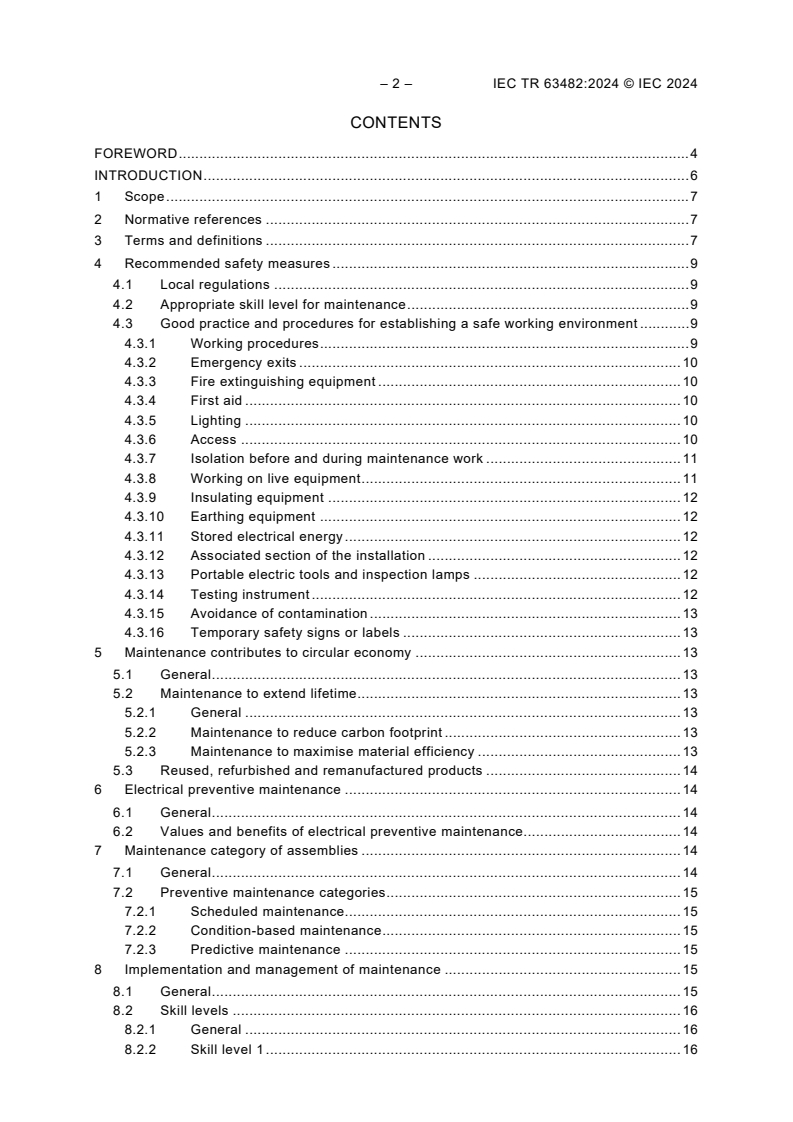
CONTENTS
FOREWORD . 4
INTRODUCTION . 6
1 Scope . 7
2 Normative references . 7
3 Terms and definitions . 7
4 Recommended safety measures . 9
4.1 Local regulations . 9
4.2 Appropriate skill level for maintenance . 9
4.3 Good practice and procedures for establishing a safe working environment . 9
4.3.1 Working procedures . 9
4.3.2 Emergency exits . 10
4.3.3 Fire extinguishing equipment . 10
4.3.4 First aid . 10
4.3.5 Lighting . 10
4.3.6 Access . 10
4.3.7 Isolation before and during maintenance work . 11
4.3.8 Working on live equipment . 11
4.3.9 Insulating equipment . 12
4.3.10 Earthing equipment . 12
4.3.11 Stored electrical energy . 12
4.3.12 Associated section of the installation . 12
4.3.13 Portable electric tools and inspection lamps . 12
4.3.14 Testing instrument . 12
4.3.15 Avoidance of contamination . 13
4.3.16 Temporary safety signs or labels . 13
5 Maintenance contributes to circular economy . 13
5.1 General . 13
5.2 Maintenance to extend lifetime . 13
5.2.1 General . 13
5.2.2 Maintenance to reduce carbon footprint . 13
5.2.3 Maintenance to maximise material efficiency . 13
5.3 Reused, refurbished and remanufactured products . 14
6 Electrical preventive maintenance . 14
6.1 General . 14
6.2 Values and benefits of electrical preventive maintenance. 14
7 Maintenance category of assemblies . 14
7.1 General . 14
7.2 Preventive maintenance categories . 15
7.2.1 Scheduled maintenance. 15
7.2.2 Condition-based maintenance . 15
7.2.3 Predictive maintenance . 15
8 Implementation and management of maintenance . 15
8.1 General . 15
8.2 Skill levels . 16
8.2.1 General . 16
8.2.2 Skill level 1 . 16
8.2.3 Skill level 2 . 16
8.2.4 Skill level 3 . 17
8.3 Maintenance instructions . 17
8.4 Periodic verification . 18
8.5 Replacement parts . 18
8.6 Re-energisation . 18
8.7 Documentation and records . 18
9 Maintenance categories and associated functionalities . 18
9.1 General . 18
9.2 Maintenance category over lifetime of an assembly . 19
9.3 Functions necessary to achieve a specific maintenance category . 19
9.4 Details to be available for each category of maintenance . 19
9.5 Shift from one category to another . 20
Annex A (informative) Maintenance plan according to maintenance level . 21
Annex B (informative) List of notes concerning certain countries . 23
Annex C (informative) Frequency of periodic verification . 24
C.1 Environmental conditions and device operating condition . 24
C.1.1 General . 24
C.1.2 Favourable environmental conditions and device operating conditions . 24
C.1.3 Normal environmental conditions and device operating conditions . 25
C.1.4 Severe environmental conditions and device operating conditions . 25
C.2 Criticality of user application . 25
C.3 Recommended frequency for maintenance program . 26
Bibliography . 27
Table 1 – Maintenance operation level . 17
Table 2 – Functions associated with each category of maintenance . 19
Table 3 – Details to be available for each category of maintenance . 20
Table A.1 – Maintenance plan . 21
Table C.1 – Favourable environmental conditions . 24
Table C.2 – Normal environmental conditions . 25
Table C.3 – Severe environmental conditions . 25
Table C.4 – Recommended frequency according to operating conditions and criticality
of the user application . 26
– 4 – IEC TR 63482:2024 © IEC 2024
INTERNATIONAL ELECTROTECHNICAL COMMISSION
____________
MAINTENANCE OF LOW-VOLTAGE SWITCHGEAR
AND CONTROLGEAR AND THEIR ASSEMBLIES
FOREWORD
1) The International Electrotechnical Commission (IEC) is a worldwide organization for standardization comprising
all national electrotechnical committees (IEC National Committees). The object of IEC is to promote international
co-operation on all questions concerning standardization in the electrical and electronic fields. To this end and
in addition to other activities, IEC publishes International Standards, Technical Specifications, Technical Reports,
Publicly Available Specifications (PAS) and Guides (hereafter referred to as “IEC Publication(s)”). Their
preparation is entrusted to technical committees; any IEC National Committee interested in the subject dealt with
may participate in this preparatory work. International, governmental and non-governmental organizations liaising
with the IEC also participate in this preparation. IEC collaborates closely with the International Organization for
Standardization (ISO) in accordance with conditions determined by agreement between the two organizations.
2) The formal decisions or agreements of IEC on technical matters express, as nearly as possible, an international
consensus of opinion on the relevant subjects since each technical committee has representation from all
interested IEC National Committees.
3) IEC Publications have the form of recommendations for international use and are accepted by IEC National
Committees in that sense. While all reasonable efforts are made to ensure that the technical content of IEC
Publications is accurate, IEC cannot be held responsible for the way in which they are used or for any
misinterpretation by any end user.
4) In order to promote international uniformity, IEC National Committees undertake to apply IEC Publications
transparently to the maximum extent possible in their national and regional publications. Any divergence between
any IEC Publication and the corresponding national or regional publication shall be clearly indicated in the latter.
5) IEC itself does not provide any attestation of conformity. Independent certification bodies provide conformity
assessment services and, in some areas, access to IEC marks of conformity. IEC is not responsible for any
services carried out by independent certification bodies.
6) All users should ensure that they have the latest edition of this publication.
7) No liability shall attach to IEC or its directors, employees, servants or agents including individual experts and
members of its technical committees and IEC National Committees for any personal injury, property damage or
other damage of any nature whatsoever, whether direct or indirect, or for costs (including legal fees) and
expenses arising out of the publication, use of, or reliance upon, this IEC Publication or any other IEC
Publications.
8) Attention is drawn to the Normative references cited in this publication. Use of the referenced publications is
indispensable for the correct application of this publication.
9) IEC draws attention to the possibility that the implementation of this document may involve the use of (a)
patent(s). IEC takes no position concerning the evidence, validity or applicability of any claimed patent rights in
respect thereof. As of the date of publication of this document, IEC had not received notice of (a) patent(s), which
may be required to implement this document. However, implementers are cautioned that this may not represent
the latest information, which may be obtained from the patent database available at https://patents.iec.ch. IEC
shall not be held responsible for identifying any or all such patent rights.
IEC TR 63482 has been prepared by IEC technical committee 121: Switchgear and controlgear
and their assemblies for low voltage. It is a Technical Report.
The text of this Technical Report is based on the following documents:
Draft Report on voting
121/160/DTR 121/165A/RVDTR
Full information on the voting for its approval can be found in the report on voting indicated in
the above table.
The language used for the development of this Technical Report is English.
This document was drafted in accordance with ISO/IEC Directives, Part 2, and developed in
accordance with ISO/IEC Directives, Part 1 and ISO/IEC Directives, IEC Supplement, available
at www.iec.ch/members_experts/refdocs. The main document types developed by IEC are
described in greater detail at www.iec.ch/publications.
The committee has decided that the contents of this document will remain unchanged until the
stability date indicated on the IEC website under webstore.iec.ch in the data related to the
specific document. At this date, the document will be
• reconfirmed,
• withdrawn, or
• revised.
– 6 – IEC TR 63482:2024 © IEC 2024
INTRODUCTION
In the low-voltage domain, the evolution of the IEC 61439 series of standards (low-voltage
switchgear and controlgear assemblies) incorporating devices according to IEC 60947 series
(low-voltage switchgear and controlgear) have contributed significantly to improve safety, the
performance and reliability of assemblies and power availability of low-voltage energy.
The IEC 61439 series is essentially dedicated to design and verification of assemblies up to the
delivery to the customer. Most applications use assemblies to run 20 years or more. Over such
long periods, without suitable maintenance, the performance of an assembly can be affected
and unacceptably deteriorate with serious consequences for the safety of people and the
application.
To minimize the risk of malfunction due to ageing of the low-voltage assemblies some type of
maintenance is implemented depending on local rules, customer maintenance policy or
assembly manufacturer instruction relating to the assembly or the built-in components within
the assembly. Traditionally, maintenance is scheduled and has been predefined using a fixed
schedule. To avoid malfunctions, the schedules are usually conservative.
As new technologies emerge, providing new functionalities and possibilities, for example
measurement of equipment temperatures, loads including harmonic content, currents
interrupted, climatic conditions, alternative and more effective maintenance approaches are
possible. A preventive maintenance approach using such technologies can be more cost
effective and less disruptive than the traditional schedule-based maintenance arrangements.
This document sets out the basic maintenance considerations for low-voltage switchgear,
controlgear and their assemblies, which is supplemented by the assembly manufacturer’s
instructions. It recognises that the traditional basic approach of maintenance can be improved
and enhanced. This document shows that it is possible to provide one suitable maintenance
approach depending on the current customer’s application, but it is also possible to move to a
more advanced maintenance approach, if an assembly is suitably upgraded.
NOTE It is beneficial to refer to individual product standards and/or manufacturer instruction for further information
on devices incorporated in an assembly.
MAINTENANCE OF LOW-VOLTAGE SWITCHGEAR
AND CONTROLGEAR AND THEIR ASSEMBLIES
1 Scope
This document provides guidance for the specification and selection of the appropriate
approach and for the planning and the execution of the maintenance of low-voltage switchgear
and controlgear and their assemblies having a rated voltage up to and including 1 000 V AC or
1 500 V DC, and designed for a nominal frequency of the incoming supply or supplies not
exceeding 1 000 Hz.
This document provides guidance on the safety precautions for personnel designed to carry out
maintenance services, with the aim to minimize the safety risks, optimize service continuity
(power availability) and contribute to the environment of a low-voltage switchgear and
controlgear assemblies. It recognises there are different approaches to maintenance, e.g.
scheduled maintenance, condition-based maintenance and predictive maintenance. This
document does not consider specifically corrective maintenance but many of the
recommendations included would apply when carrying out corrective maintenance. It provides
additional recommendations to comply with validation requirements in IEC 60364-6.
This document explains how the use of preventive maintenance improves the efficiency and
lifetime of built-in components and consequently the assemblies themselves. All parties
(specifiers, owners, designers, manufacturers, maintenance personnel) involved with low-voltage
switchgear and controlgear assemblies can benefit from this document.
This document applies to both stationary and movable switchgear and controlgear assemblies
with or without an enclosure. It is also applicable to switchgear and controlgear assemblies
intended for use under special service conditions, possibly with additional recommendations,
for example in ships and rail vehicles. It also applies to low-voltage assembly upgrades which
can have additional considerations to ensure modifications are fully verified to the appropriate
assembly standard.
This document does not apply to low-voltage switchgear and controlgear assemblies used in
potentially explosive atmospheres.
Finally, this document is not a substitute for national regulations regarding the safety of
electrical equipment and for the manufacturer’s maintenance instructions. These are required
to complement the overall principles defined in this document.
2 Normative references
There are no normative references in this document.
3 Terms and definitions
For the purposes of this document, the terms and definitions given in the IEC 61439 series, the
IEC 60947 series and the following apply.
ISO and IEC maintain terminology databases for use in standardization at the following
addresses:
• IEC Electropedia: available at https://www.electropedia.org/
• ISO Online browsing platform: available at https://www.iso.org/obp
– 8 – IEC TR 63482:2024 © IEC 2024
3.1
maintenance
combination of all technical and management actions intended to retain an item in, or restore it
to, a state in which it can perform as required
Note 1 to entry: Management is assumed to include supervision activities.
[SOURCE: IEC 60050-192:2015, 192-06-01]
3.2
corrective maintenance
maintenance carried out after fault detection to effect restoration
[SOURCE: IEC 60050-192:2015, 192-06-06]
3.3
preventive maintenance
maintenance carried out to mitigate degradation and reduce the probability of failure (of an
item)
[SOURCE: IEC 60050-192:2015, 192-06-05]
3.3.1
scheduled maintenance
preventive maintenance carried out in accordance with a specified time schedule
Note 1 to entry: Scheduled maintenance may identify the need for some corrective maintenance action.
[SOURCE: IEC 60050-192:2015, 192-06-12, modified: the term preventive has been added]
3.3.2
condition-based maintenance
preventive maintenance based on the assessment of physical condition
Note 1 to entry: The condition assessment may be by operator observation, conducted according to a schedule, or
by condition monitoring of system parameters.
[SOURCE: IEC 60050-192:2015, 192-06-07]
3.3.3
predictive maintenance
advanced form of preventive maintenance using data analysis tools and techniques to predict
anomalies in operation and anticipate malfunction to extrapolate the residual time before the
failure
3.4
digital twin
virtual representation in a digital format of a product or a system
Note 1 to entry: In this document, digital twin can be used for design, simulation, optimization or maintenance
purposes using real time data throughout lifetime of product or system.
3.5
mean time to restoration
MTTR
DEPRECATED: mean time to repair
DEPRECATED: mean time to recovery
expectation of the time to restoration
[SOURCE: IEC 60050-192:2015, 192-07-23]
4 Recommended safety measures
4.1 Local regulations
Local regulations can differ from country to country. When local regulations and legal
obligations are in place, they take precedence over this document and the manufacturer’s
maintenance instructions.
See Annex B for list of notes concerning certain countries.
4.2 Appropriate skill level for maintenance
Unless required otherwise by national or local regulations, maintenance tasks are carried out
by people with the appropriate level of competency: instructed persons, skilled persons or
skilled persons mandated by the assembly manufacturer. See Table 1.
4.3 Good practice and procedures for establishing a safe working environment
4.3.1 Working procedures
The risk assessment prior to commencing work is the recognized method of identifying safety
risks. For maintenance activities on equipment, there is usually a written system of rules and
procedures and all personnel involved with maintenance activities are aware of their existence.
The level of detail and complexity of the rules and procedures is dependent on the organisation,
personnel, working environment and equipment to be used. The risk assessment process is
used to ensure that hazards specific to maintenance activities have been adequately addressed
in the development of the associated rules and procedures. For example, different working
practices and competencies are required for work on DC systems than are required for AC
systems. Safety rules set out the principles and practices expected clearly and in a format that
can be understood by those expected to use them. The rules and procedures reflect the
requirements of an overall electrical safety policy. In most circumstances a policy for working
on electrical equipment requires equipment to be deenergised and isolated prior to work
commencing.
Safety rules addressing specific issues such as circuits associated with:
– interlocking and padlocking supplies;
– auto-reclosing devices;
– alternative supplies including generators, battery supplies, photovoltaic (PV), wind power;
– mechanically stored energy;
– capacitively stored energy; and/or
– control supplies (AC and DC).
All personnel are made aware to take notice of warning signs and follow instructions provided
by the assembly manufacturer.
Product standards are recommended to include minimum requirements for the maintenance
instructions to be provided by the manufacturer.
– 10 – IEC TR 63482:2024 © IEC 2024
4.3.2 Emergency exits
Emergency exits are checked prior to carrying out maintenance work to ensure that they are
clear.
4.3.3 Fire extinguishing equipment
When carrying out maintenance on equipment where there is a fire risk, fire-fighting equipment
is readily available. Training is provided in the use of such appliances; personnel are made
aware of the limitations of their use and how to raise the alarm and summon help.
The type of fire extinguishing equipment provided for use on electrical equipment is compatible
with the equipment and not dangerous to use in the situation.
Where automatic fire extinguishing installations are provided, systems are in place to safeguard
people against danger from the extinguishing medium when entering the protected area.
Where maintenance is planned on an electrical switchgear or controlgear assembly connected
to the electrical supply to the fire-fighting installation, attention is paid to the possible impact of
that maintenance on the availability of the fire-fighting equipment. Where necessary, additional
fire-fighting equipment is provided.
4.3.4 First aid
Rapid action can save life in the event of electric shock. Personnel working in the vicinity of
exposed live parts is normally accompanied by someone who has the necessary competence
to avoid injury and sufficient knowledge to be able to disconnect the supply. Personnel carrying
out maintenance are aware of how to obtain assistance and who to contact in the event of an
emergency.
A notice giving instructions for the treatment of persons suffering from electric shock is affixed
in a prominent position in the vicinity in which work on electrical installations will be carried out.
The training of electrical maintenance personnel or those who might accompany them in
resuscitation is recommended.
Arrangements are in place to ensure immediate attention is available in the event that someone
is taken ill or injured at work. As a minimum a suitably stocked first aid kit is available. It is
important that the arrangements for seeking assistance or calling the emergency services are
understood.
4.3.5 Lighting
Lighting is provided to ensure safe access and working. Temporary lighting, either battery
powered or from generators, is provided where normal supplies are not available. Special
attention is given to the continuity of lighting for emergency exits.
4.3.6 Access
Working space and access ways are kept free from obstruction. Particular consideration is given
where live conductors are exposed within the work environment. There is space to allow people
to move away from the conductors without hazard and if necessary for people to pass one
another.
NOTE See 729.410.3.7 of IEC 60364-7-729:2007 for further information.
Where equipment to be worked on is located in a general work area, special attention is paid
to prevent access by unqualified personnel, especially whilst covers are open.
4.3.7 Isolation before and during maintenance work
Whenever it is possible to do so, equipment is isolated before maintenance work commences.
Isolation procedures ensure that:
a) accidental or inadvertent re-energization is prevented;
b) equipment is proven to be deenergized e.g. using a suitable voltage indicator.
A device suitable for isolation is provided to prevent any equipment from being unintentionally
energized. Such precaution includes usually a selection of device suitable for padlocking in the
OFF position as well as a notice or label applied at the place of isolation to inform others who
might also be performing maintenance work that someone is working on the equipment.
The following recommendations can be considered:
– Use any device suitable for isolation.
– Where provision is provided, this device is locked in the OFF position and/or caution notices
are exhibited at the points of isolation.
– Where possible, devices with earthing facilities are placed in EARTH position and locked.
– Any shutters covering live, or potentially live isolating contacts are locked closed or other
precautions taken to ensure safety.
– Safety locks are used, and a system put in place to ensure that locks and notices are
available and that the keys to locks in use are controlled.
– Where removal and retention of fuse links or bolted links are used as the only means of
isolation, then precautions are taken to prevent duplicates being inserted.
– Contactors are never considered as a means of isolation.
– Reliance is never placed on control circuit isolation, switching or electrical interlocks to
prevent accidental or inadvertent re-energization of the main or other auxiliary circuits, e.g.
emergency stops.
– It is not always possible to observe the contacts of a device used as a disconnector and the
operation of an external handle or control is not assumed to have opened all contacts of the
connected device. Tests using voltage indicator are carried out prior to working on any
deenergized equipment. These tests include verifying voltages between live parts and earth
to guard against the possibility of a wrong connection. The equipment used for checking
voltage are to be tested, in a safe manner, for example against a known voltage source to
confirm that it is working correctly.
– Equipment often contains circuits having sources of supply different from those of the main
circuits. Examples include alarm and sequence interlocks, heating and lighting circuits,
battery supplies. Such circuits are not always isolated when the main disconnector is in the
OFF position. These are identified with warning notices and ideally shrouded to prevent
inadvertent contact. Particular care is taken to avoid danger from reverse energization of
voltage/control transformers or the open circuiting of current transformer secondaries.
– Where a form of internal separation is used to facilitate access to one functional unit for
maintenance or other operations, while adjacent function units are in service, suitable
additional precaution are in place, e.g. use of appropriate personal protective equipment
(PPE), adequately skilled personnel to ensure the work can be undertaken safely.
4.3.8 Working on live equipment
The likelihood of an occurrence and the severity of injuries that can occur due to electric
hazards when undertaking work on or near live equipment are such that working on live
equipment is rarely permitted.
– 12 – IEC TR 63482:2024 © IEC 2024
Where it is not possible and/or acceptable for an equipment to be deenergized, special
precautions are usually applied. The special precautions depend on the design of the
equipment, the nature of the task and the outcome of a risk assessment. The working area is
restricted to authorised personnel (skill level 1 or 2; see Table 1). The level of supervision and
the accompaniment is taken into account. Further information for selection of tools and clothes
is given in IEC 61482-2:2018.
4.3.9 Insulating equipment
Permanent and/or portable insulating stands or screens, insulated tools and insulating gloves
are provided and used where necessary. All these items are maintained in sound condition and
periodically inspected. The personnel responsible for the maintenance task verify, prior to use,
that all these items and any test equipment are suitable and serviceable.
4.3.10 Earthing equipment
Earthing equipment, where required, is available and maintained in good working order.
Earthing is performed by wearable accessories compliant to IEC 61230 or dedicated switching
device compliant to the relevant IEC 60947 standard. Suitable earthing equipment outside the
assembly adjacent to relevant loads or circuits can be used when maintenance is being carried
out.
4.3.11 Stored electrical energy
Measures are taken to discharge sources of stored energy, such as cables or capacitors and
to ensure that they do not become charged during the execution of maintenance work. Suitably
designed equipment is used to discharge stored energy. Earth leads might be used to prevent
charge accumulating during the work activity.
4.3.12 Associated section of the installation
When performing functional testing on switchgear and controlgear assemblies care is taken to
ensure that danger is not caused by energizing the connected load. It might be necessary to
disconnect motors or other items of the electromechanical loads before testing the functionality
of the control equipment. This could be achieved with the installation of an enclosed load break
switch disconnector close to the motor. Advice from the plant operator is also considered. The
use of earthing equipment (4.3.10) is highly recommended when stored electrical energy is
present.
4.3.13 Portable electric tools and inspection lamps
Portable electric tools and inspection lamps are operated at extra-low voltage. For system
voltages, see IEC 60364-4-41:2005, 414. In confined conducting spaces, apparatus with an
operational voltage of 25 V to earth or lower are used, see IEC 60364-7-706. Where mains
voltage portable tools are used, they are all insulated or double insulated construction and
protected by a residual current device with an operating current not exceeding 30 mA and
without intentional delay.
Cable connectors are designed for the environment in which they are operating. All portable
electrical equipment is regularly inspected and tested. It is a good practice for the user to
inspect portable electrical equipment before each occasion of use.
4.3.14 Testing instrument
Care is taken when applying test voltages to ensure that these are the lowest value required
for the purpose with the minimum current output. Where equipment is capable of storing a
charge, this equipment is safely discharged after every test.
Instruments are of a type suitable for the measurements that are to be made so that a
malfunction or the introduction of transients and/or reversed polarities into the connected
circuits is avoided. The manufacturer’s instructions are followed.
An earthed instrument lead can create danger if it is applied to an active signal circuit that is
normally floating. The instrument casings are usually earthed at all times but, where the nature
of the test precludes this, specific care is taken by the operator to secure their own safety and
that of others by the adoption of a safe system of work. Suitably protected test leads are used
at all times.
4.3.15 Avoidance of contamination
The ingress of moisture, dust, vermin, etc. into an electrical equipment can occur during normal
operation or periods when the assembly is out of service. This contamination can cause
malfunction and danger. Maintenance includes an inspection for such contamination and
appropriate action to remove it from the assembly.
4.3.16 Temporary safety signs or labels
Legible temporary safety signs and/or labels are placed as necessary.
5 Maintenance contributes to circular economy
5.1 General
Equipment maintenance is well recognized to be an important aspect of power availability,
electrical safety and reliability of equipment. Maintenance can also be considered as a major
topic for circular economy. A good management of category of maintenance can extend the
service life of built-in components of an assembly and consequently the assembly itself, but
also optimize material usage and reduce waste. See also IEC 63058 dealing with environmental
aspects.
5.2 Maintenance to extend lifetime
5.2.1 General
Circular economy brought a new approach to the use of components and/or devices.
Consideration of production / consumption / end of life is being substituted by a new approach
where the product life cycle is fully considered from its initial concept to its end of life as
applicable.
5.2.2 Maintenance to reduce carbon footprint
Performing the relevant maintenance on a device reduces it replacement by new parts and
decreases the waste of material. Carbon footprint is becoming a differentiator of increasing
importance for specifiers and an additional performance criterion in the choice of an electrical
equipment.
Extending the service life of a device or assembly does not affect the carbon footprint of the
construction phase but affects the carbon footprint value of the operation phase. Comparing
with scheduled maintenance, the condition-based maintenance and predictive maintenance
provide means of optimizing the carbon footprint, while maintaining the high level of electrical
safety and power availability.
5.2.3 Maintenance to maximise material efficiency
Maintenance plays an essential role in extending the lifetime of equipment, thereby decreasing
waste. When reliability becomes a priority, it is essential to adjust the maintenance strategy
with that goal in mind.
– 14 – IEC TR 63482:2024 © IEC 2024
Adapting maintenance actions to be performed based on the conditions of use brings value to
the customer by saving time, reducing downtime and maximising the overall material efficiency.
Beyond ordinary schedule maintenance, condition-based and predictive maintenance
contributes to adding value to the customer by saving time, reducing downtime but also enabling
maximum the overall material efficiency. Thus, depending on demands, different type of
maintenance can be analysed to determine the most suitable maintenance strategy. See 7.2.
5.3 Reused, refurbished and remanufactured products
Reused, refurbished and remanufactured products can be used both at one stage to build a
new assembly or for any stage of any maintenance step.
Several levels of product quality service are possible, for example:
– Reused products: according to the documentation of original manufacturer the products
have safety check up before being delivered to customers;
– Refurbished products: according to the documentation of original manufacturer the products
have a safety check up with replacement of damaged parts before being delivered to
customers;
– Remanufactured products: according to the documentation of original manufacturer the
products have a safety check up with replacement of all accessories and all damaged parts.
They are re-certified based on their latest product standard, e.g. IEC 60947-2 for a circuit-
breaker. If they do not pass the test they are replaced by a new product.
6 Electrical preventive maintenance
6.1 General
Equipment ageing, part of its design life, is taken into account with a necessary maintenance
activity to delay equipment failure. As soon as new equipment is installed, a process of normal
deterioration begins. Unchecked, the deterioration process can cause malfunction or an
electrical failure. Deterioration can be accelerated by factors such as a hostile environment,
overload, or severe duty cycle. An effective electrical preventive maintenance program
identifies and recognizes these factors and provides measures for coping with them.
6.2 Values and benefits of electrical preventive maintenance
An electrical preventive maintenance service reduces incidents and minimizes breakdowns and
unplanned shutdowns of production equipment. Potential issues can be identified, and solutions
applied, before they become major problems requiring more expensive, time-consuming
solutions.
The benefits from preventive maintenance are twofold:
– Safety, as a result of documentation giving appropriate inspection, testing and repair
procedures;
– Ensuring a better power availability by reducing the downtime of the equipment.
7 Maintenance category of assemblies
7.1 General
The three preventive categories of maintenance described in this document are sometimes
joined with a fourth category, corrective maintenance. With a strategy to use only corrective
maintenance, no regular verifications and maintenance are carried out on the equipment. This
category is not included in this document since it is generally intended for equipment whose
repair is quick and easy, and the MTTR does not result in a significant loss of production.
Maintenance incorporating remote monitoring is to determine deterioration and facilities for
corrective adjustments carried out either locally or remotely.
7.2 Preventive maintenance categories
7.2.1 Scheduled maintenance
Scheduled maintenance is a type of maintenance, carried out at established intervals in time.
It is a scheduled activity consisting of a series of systematic actions based on the assumed
operating conditions and expected life of the assembly and its components.
Scheduled maintenance enables the planning of interruptions for maintenance, thereby
minimising the costs associated with loss of production and allowing power to be available to
the connected loads, when expected.
7.2.2 Conditi
...