

IEC TR 60930:2008
(Main)Guidelines for administrative, medical and nursing staff concerned with the safe use of medical electrical equipment and medical electrical systems
General Information
- Abstract
IEC/TR 60930:2008(E) is intended to lessen the risk to patients, operators, and their surroundings by providing a code of safe application. This reduction of risk is in addition to that brought about by the risk control measures incorporated in the medical electrical equipment, the medical electrical system, and the electrical installation in medical locations, hereafter referred to as me equipment, me system and installation respectively. Not all existing me equipment, me systems or installations meet the requirements of the relevant IEC standards. From time to time, operators and responsible organizations will encounter me equipment and me systems complying with older safety standards. However, the guidelines for safe application given in this technical report should nevertheless be followed in so far as this is possible. The guidelines in this technical report can be used with me equipment or me systems for the home healthcare environment provided the manufacturer has included home use in the intended use or the clinical engineering department has checked that the electrical installation and the physical environment will not result in any unacceptable risks. These guidelines can also be applied to equipment used for compensation or alleviation of disease, injury or disability. If the me equipment, an me system or the installation does not comply with the relevant IEC standards, the responsible organization should consult with the clinical engineering department or the manufacturer for instructions on how to achieve an adequate level of safety. This second edition cancels and replaces the first edition published in 1988. This edition constitutes a technical revision. This edition has been aligned with IEC 60601-1:2005, IEC 60601-1-2:2007, IEC 60601-1-8:2006 and IEC 62353:2007. This edition includes medical electrical systems within its scope.
- Status
- Published
- Publication Date
- 18-Sep-2008
- Technical Committee
- SC 62A - Common aspects of medical equipment, software, and systems
- Drafting Committee
- MT 24 - TC 62/SC 62A/MT 24
- Current Stage
- PPUB - Publication issued
- Start Date
- 19-Sep-2008
- Completion Date
- 31-Dec-2008
Buy Documents
IEC TR 60930:2008 - Guidelines for administrative, medical and nursing staff concerned with the safe use of medical electrical equipment and medical electrical systems Released:9/19/2008
Overview
IEC TR 60930:2008 - "Guidelines for administrative, medical and nursing staff concerned with the safe use of medical electrical equipment and medical electrical systems" - is a technical report published by the IEC that provides practical, non-design guidance to reduce risks to patients, operators and surroundings from medical electrical equipment (ME equipment) and medical electrical systems (ME systems). Edition 2 (2008) updates the 1988 report and aligns guidance with IEC 60601‑1:2005 and related standards. It covers safe application, selection, installation, commissioning, training and maintenance - including use in home healthcare where intended by the manufacturer.
Key Topics and Requirements
- Risk reduction and safe application: Advice to lower hazards (electrical shock, burns, radiation, fire) beyond the intrinsic risk controls implemented by manufacturers.
- Scope includes ME systems: Guidance extends from single devices to interconnected systems and patient environments.
- Markings, documentation and indicators: Importance of accompanying documents, correct interpretation of indicator colours, markings and safety symbols.
- Protection features: Electrical protection of applied parts, mechanical stability, thermal/fire prevention, ingress protection, and protection from unwanted radiation.
- Alarm systems: Prioritization and visual/auditory alarm characteristics consistent with IEC 60601‑1‑8.
- Electromagnetic phenomena: Practical recommendations for EMC, marking and documentation to maintain device performance in clinical settings.
- Installation and electrical infrastructure: Guidance on electrical installations in medical locations and on multiple socket-outlets (MSOs).
- Cleaning, disinfection and sterilization: Considerations for safe reprocessing without compromising electrical safety.
- Purchasing, commissioning and maintenance: Roles and responsibilities of the responsible organization, clinical engineering departments, and manufacturers; maintenance programmes and verification of equipment safety.
- Home use and legacy equipment: Application guidance for home healthcare and for devices that conform to older standards - with recommendation to consult clinical engineering or the manufacturer if compliance is uncertain.
Applications
IEC TR 60930 is intended for practical use in:
- Hospitals and clinics (procurement, biomedical engineering, nursing stations)
- Clinical engineering and biomedical maintenance teams for developing maintenance programmes and verification procedures
- Administrative and safety officers for policy, device selection and commissioning
- Nursing and medical staff for safe operation, alarm interpretation and basic device checks
- Home healthcare coordinators when devices are intended for home use
- Manufacturers and suppliers as guidance on user information and labeling
Who Should Use This Standard
- Clinical engineers and biomedical technicians
- Medical device procurement and maintenance managers
- Nursing and medical staff responsible for device operation
- Healthcare facility safety managers and administrators
- Manufacturers preparing user instructions and safety documentation
Related Standards
- IEC 60601‑1:2005 - Medical electrical equipment - General requirements for basic safety and essential performance
- IEC 60601‑1‑2:2007 - EMC
- IEC 60601‑1‑8:2006 - Alarm systems
- IEC 62353:2007 - Recurrent tests and testing of medical electrical equipment
- IEC 60513 - Fundamental aspects of safety standards for medical electrical equipment
Keywords: IEC TR 60930, medical electrical equipment, medical electrical systems, clinical engineering, electrical safety, maintenance, alarm systems, home healthcare, IEC 60601.
Buy Documents
IEC TR 60930:2008 - Guidelines for administrative, medical and nursing staff concerned with the safe use of medical electrical equipment and medical electrical systems Released:9/19/2008
Get Certified
Connect with accredited certification bodies for this standard

BSI Group
BSI (British Standards Institution) is the business standards company that helps organizations make excellence a habit.

TÜV Rheinland
TÜV Rheinland is a leading international provider of technical services.

TÜV SÜD
TÜV SÜD is a trusted partner of choice for safety, security and sustainability solutions.
Sponsored listings
Frequently Asked Questions
IEC TR 60930:2008 is a technical report published by the International Electrotechnical Commission (IEC). Its full title is "Guidelines for administrative, medical and nursing staff concerned with the safe use of medical electrical equipment and medical electrical systems". This standard covers: IEC/TR 60930:2008(E) is intended to lessen the risk to patients, operators, and their surroundings by providing a code of safe application. This reduction of risk is in addition to that brought about by the risk control measures incorporated in the medical electrical equipment, the medical electrical system, and the electrical installation in medical locations, hereafter referred to as me equipment, me system and installation respectively. Not all existing me equipment, me systems or installations meet the requirements of the relevant IEC standards. From time to time, operators and responsible organizations will encounter me equipment and me systems complying with older safety standards. However, the guidelines for safe application given in this technical report should nevertheless be followed in so far as this is possible. The guidelines in this technical report can be used with me equipment or me systems for the home healthcare environment provided the manufacturer has included home use in the intended use or the clinical engineering department has checked that the electrical installation and the physical environment will not result in any unacceptable risks. These guidelines can also be applied to equipment used for compensation or alleviation of disease, injury or disability. If the me equipment, an me system or the installation does not comply with the relevant IEC standards, the responsible organization should consult with the clinical engineering department or the manufacturer for instructions on how to achieve an adequate level of safety. This second edition cancels and replaces the first edition published in 1988. This edition constitutes a technical revision. This edition has been aligned with IEC 60601-1:2005, IEC 60601-1-2:2007, IEC 60601-1-8:2006 and IEC 62353:2007. This edition includes medical electrical systems within its scope.
IEC/TR 60930:2008(E) is intended to lessen the risk to patients, operators, and their surroundings by providing a code of safe application. This reduction of risk is in addition to that brought about by the risk control measures incorporated in the medical electrical equipment, the medical electrical system, and the electrical installation in medical locations, hereafter referred to as me equipment, me system and installation respectively. Not all existing me equipment, me systems or installations meet the requirements of the relevant IEC standards. From time to time, operators and responsible organizations will encounter me equipment and me systems complying with older safety standards. However, the guidelines for safe application given in this technical report should nevertheless be followed in so far as this is possible. The guidelines in this technical report can be used with me equipment or me systems for the home healthcare environment provided the manufacturer has included home use in the intended use or the clinical engineering department has checked that the electrical installation and the physical environment will not result in any unacceptable risks. These guidelines can also be applied to equipment used for compensation or alleviation of disease, injury or disability. If the me equipment, an me system or the installation does not comply with the relevant IEC standards, the responsible organization should consult with the clinical engineering department or the manufacturer for instructions on how to achieve an adequate level of safety. This second edition cancels and replaces the first edition published in 1988. This edition constitutes a technical revision. This edition has been aligned with IEC 60601-1:2005, IEC 60601-1-2:2007, IEC 60601-1-8:2006 and IEC 62353:2007. This edition includes medical electrical systems within its scope.
IEC TR 60930:2008 is classified under the following ICS (International Classification for Standards) categories: 11.040.01 - Medical equipment in general. The ICS classification helps identify the subject area and facilitates finding related standards.
IEC TR 60930:2008 is available in PDF format for immediate download after purchase. The document can be added to your cart and obtained through the secure checkout process. Digital delivery ensures instant access to the complete standard document.
Standards Content (Sample)
IEC/TR 60930
Edition 2.0 2008-09
TECHNICAL
REPORT
Guidelines for administrative, medical, and nursing staff concerned with the safe
use of medical electrical equipment and medical electrical systems
IEC/TR 60930:2008(E)
All rights reserved. Unless otherwise specified, no part of this publication may be reproduced or utilized in any form
or by any means, electronic or mechanical, including photocopying and microfilm, without permission in writing from
either IEC or IEC's member National Committee in the country of the requester.
If you have any questions about IEC copyright or have an enquiry about obtaining additional rights to this publication,
please contact the address below or your local IEC member National Committee for further information.
IEC Central Office
3, rue de Varembé
CH-1211 Geneva 20
Switzerland
Email: inmail@iec.ch
Web: www.iec.ch
About the IEC
The International Electrotechnical Commission (IEC) is the leading global organization that prepares and publishes
International Standards for all electrical, electronic and related technologies.
About IEC publications
The technical content of IEC publications is kept under constant review by the IEC. Please make sure that you have the
latest edition, a corrigenda or an amendment might have been published.
ƒ Catalogue of IEC publications: www.iec.ch/searchpub
The IEC on-line Catalogue enables you to search by a variety of criteria (reference number, text, technical committee,…).
It also gives information on projects, withdrawn and replaced publications.
ƒ IEC Just Published: www.iec.ch/online_news/justpub
Stay up to date on all new IEC publications. Just Published details twice a month all new publications released. Available
on-line and also by email.
ƒ Electropedia: www.electropedia.org
The world's leading online dictionary of electronic and electrical terms containing more than 20 000 terms and definitions
in English and French, with equivalent terms in additional languages. Also known as the International Electrotechnical
Vocabulary online.
ƒ Customer Service Centre: www.iec.ch/webstore/custserv
If you wish to give us your feedback on this publication or need further assistance, please visit the Customer Service
Centre FAQ or contact us:
Email: csc@iec.ch
Tel.: +41 22 919 02 11
Fax: +41 22 919 03 00
IEC/TR 60930
Edition 2.0 2008-09
TECHNICAL
REPORT
Guidelines for administrative, medical, and nursing staff concerned with the
safe use of medical electrical equipment and medical electrical systems
INTERNATIONAL
ELECTROTECHNICAL
COMMISSION
PRICE CODE
U
ICS 11.040 ISBN 978-2-88910-333-1
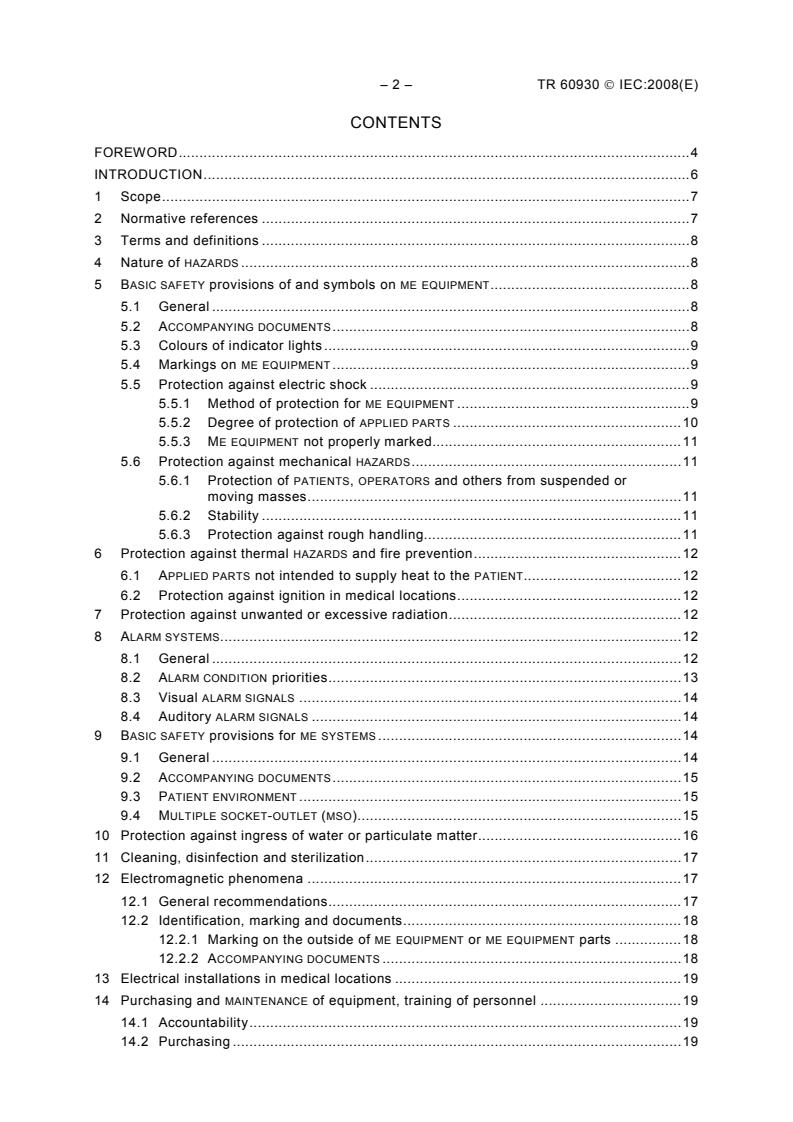
– 2 – TR 60930 © IEC:2008(E)
CONTENTS
FOREWORD.4
INTRODUCTION.6
1 Scope.7
2 Normative references .7
3 Terms and definitions .8
4 Nature of HAZARDS .8
5 BASIC SAFETY provisions of and symbols on ME EQUIPMENT.8
5.1 General .8
5.2 ACCOMPANYING DOCUMENTS.8
5.3 Colours of indicator lights.9
5.4 Markings on ME EQUIPMENT .9
5.5 Protection against electric shock .9
5.5.1 Method of protection for ME EQUIPMENT .9
5.5.2 Degree of protection of APPLIED PARTS .10
5.5.3 ME EQUIPMENT not properly marked.11
5.6 Protection against mechanical HAZARDS.11
5.6.1 Protection of PATIENTS, OPERATORS and others from suspended or
moving masses.11
5.6.2 Stability .11
5.6.3 Protection against rough handling.11
6 Protection against thermal HAZARDS and fire prevention.12
6.1 APPLIED PARTS not intended to supply heat to the PATIENT.12
6.2 Protection against ignition in medical locations.12
7 Protection against unwanted or excessive radiation.12
8 ALARM SYSTEMS.12
8.1 General .12
8.2 ALARM CONDITION priorities.13
8.3 Visual ALARM SIGNALS .14
8.4 Auditory ALARM SIGNALS .14
9 BASIC SAFETY provisions for ME SYSTEMS .14
9.1 General .14
9.2 ACCOMPANYING DOCUMENTS.15
9.3 PATIENT ENVIRONMENT .15
9.4 MULTIPLE SOCKET-OUTLET (MSO).15
10 Protection against ingress of water or particulate matter.16
11 Cleaning, disinfection and sterilization.17
12 Electromagnetic phenomena .17
12.1 General recommendations.17
12.2 Identification, marking and documents.18
12.2.1 Marking on the outside of ME EQUIPMENT or ME EQUIPMENT parts .18
12.2.2 ACCOMPANYING DOCUMENTS .18
13 Electrical installations in medical locations .19
14 Purchasing and MAINTENANCE of equipment, training of personnel .19
14.1 Accountability.19
14.2 Purchasing .19
TR 60930 © IEC:2008(E) – 3 –
14.3 Delivery and commissioning .20
14.4 Training.20
14.5 MAINTENANCE.21
14.5.1 Concepts .21
14.5.2 MAINTENANCE programme .21
14.6 Checking of the installation and selection of the ME EQUIPMENT or ME SYSTEM .22
14.6.1 Installation.22
14.6.2 Verification of equipment safety.22
14.6.3 Single items of ME EQUIPMENT .22
14.6.4 Combinations of ME EQUIPMENT .22
14.6.5 Connection of ME EQUIPMENT or an ME SYSTEM to the health care
facilities’ data network .22
15 Recommended practice .23
Annex A (informative) PATIENT ENVIRONMENT .25
Bibliography.26
Index of defined terms used in this technical report.27
Figure 1 – Symbols indicating the degree of protection provided by an APPLIED PART .10
Figure 2 – Symbols indicating the degree of protection against the effects of a
discharge of a cardiac defibrillator .10
Figure 3 – Safety signs indicating a RISK from a person pushing, sitting or stepping on
ME EQUIPMENT .11
Figure 4 – Symbols indicating the ME EQUIPMENT is designed to avoid ignition of
FLAMMABLE ANAESTHETIC MIXTURE WITH AIR, or FLAMMABLE ANAESTHETIC MIXTURE WITH
OXYGEN OR NITROUS OXIDE .12
Figure 5 – Example of the construction of a MULTIPLE SOCKET-OUTLET (MSO) .16
Figure A.1 – Example of PATIENT ENVIRONMENT.25
Table 1 – Colours of indicator lights and their meaning for ME EQUIPMENT .9
Table 2 – ALARM CONDITION priorities from IEC 60601-1-8:2006 .14
Table 3 – Characteristics of alarm indicator lights from IEC 60601-1-8:2006.14
– 4 – TR 60930 © IEC:2008(E)
INTERNATIONAL ELECTROTECHNICAL COMMISSION
____________
GUIDELINES FOR ADMINISTRATIVE, MEDICAL, AND NURSING STAFF
CONCERNED WITH THE SAFE USE OF MEDICAL ELECTRICAL
EQUIPMENT AND MEDICAL ELECTRICAL SYSTEMS
FOREWORD
1) The International Electrotechnical Commission (IEC) is a worldwide organization for standardization comprising
all national electrotechnical committees (IEC National Committees). The object of IEC is to promote
international co-operation on all questions concerning standardization in the electrical and electronic fields. To
this end and in addition to other activities, IEC publishes International Standards, Technical Specifications,
Technical Reports, Publicly Available Specifications (PAS) and Guides (hereafter referred to as “IEC
Publication(s)”). Their preparation is entrusted to technical committees; any IEC National Committee interested
in the subject dealt with may participate in this preparatory work. International, governmental and non-
governmental organizations liaising with the IEC also participate in this preparation. IEC collaborates closely
with the International Organization for Standardization (ISO) in accordance with conditions determined by
agreement between the two organizations.
2) The formal decisions or agreements of IEC on technical matters express, as nearly as possible, an international
consensus of opinion on the relevant subjects since each technical committee has representation from all
interested IEC National Committees.
3) IEC Publications have the form of recommendations for international use and are accepted by IEC National
Committees in that sense. While all reasonable efforts are made to ensure that the technical content of IEC
Publications is accurate, IEC cannot be held responsible for the way in which they are used or for any
misinterpretation by any end user.
4) In order to promote international uniformity, IEC National Committees undertake to apply IEC Publications
transparently to the maximum extent possible in their national and regional publications. Any divergence
between any IEC Publication and the corresponding national or regional publication shall be clearly indicated in
the latter.
5) IEC provides no marking procedure to indicate its approval and cannot be rendered responsible for any
equipment declared to be in conformity with an IEC Publication.
6) All users should ensure that they have the latest edition of this publication.
7) No liability shall attach to IEC or its directors, employees, servants or agents including individual experts and
members of its technical committees and IEC National Committees for any personal injury, property damage or
other damage of any nature whatsoever, whether direct or indirect, or for costs (including legal fees) and
expenses arising out of the publication, use of, or reliance upon, this IEC Publication or any other IEC
Publications.
8) Attention is drawn to the Normative references cited in this publication. Use of the referenced publications is
indispensable for the correct application of this publication.
9) Attention is drawn to the possibility that some of the elements of this IEC Publication may be the subject of
patent rights. IEC shall not be held responsible for identifying any or all such patent rights.
The main task of IEC technical committees is to prepare International Standards. However, a
technical committee may propose the publication of a technical report when it has collected
data of a different kind from that which is normally published as an International Standard, for
example "state of the art".
IEC 60930, which is a technical report, has been prepared by subcommittee 62A: Common
aspects of electrical equipment used in medical practice, of IEC technical committee 62:
Electrical equipment in medical practice.
This second edition cancels and replaces the first edition published in 1988. This edition
constitutes a technical revision. This edition has been aligned with IEC 60601-1:2005,
IEC 60601-1-2:2007, IEC 60601-1-8:2006 and IEC 62353:2007. This edition includes medical
electrical systems within its scope.
TR 60930 © IEC:2008(E) – 5 –
The text of this technical report is based on the following documents:
Enquiry draft Report on voting
62A/614/DTR 62A/626/RVC
Full information on the voting for the approval of this technical report can be found in the
report on voting indicated in the above table.
This publication has been drafted in accordance with the ISO/IEC Directives, Part 2.
The committee has decided that the contents of this publication will remain unchanged until
the maintenance result date indicated on the IEC web site under "http://webstore.iec.ch" in
the data related to the specific publication. At this date, the publication will be
• reconfirmed,
• withdrawn,
• replaced by a revised edition, or
• amended.
A bilingual version of this publication may be issued at a later date.
– 6 – TR 60930 © IEC:2008(E)
INTRODUCTION
The amount of electrical equipment and the number of medical procedures employing MEDICAL
ELECTRICAL EQUIPMENT or MEDICAL ELECTRICAL SYSTEMS continue to grow. In order to prevent
accidents or near accidents such as burns, excessive radiation, electrical shock or even
cardiac arrest, procedures should be available to handle the selection, installation, application
and MAINTENANCE of MEDICAL ELECTRICAL EQUIPMENT and MEDICAL ELECTRICAL SYSTEMS by
qualified personnel.
In order to establish a satisfactory level of BASIC SAFETY and performance for MEDICAL
ELECTRICAL EQUIPMENT, MEDICAL ELECTRICAL SYSTEMS and electrical installations in medical
locations, requirements for design and construction are specified in standards prepared by the
IEC. These standards are intended to cover the design and construction of new equipment
and installations (see the Bibliography). The requirements of these standards should also be
met if the equipment or installation is REPAIRED or modified. IEC 60513 explains the basic
aspects of safety philosophy.
The following guidelines are suggested:
– The MEDICAL ELECTRICAL EQUIPMENT or MEDICAL ELECTRICAL SYSTEM has to be safe, that is,
built to the relevant IEC standards.
– The electrical installation in medical locations has to be safe, that is, in accordance with
the relevant IEC standards or corresponding national regulations.
– The instructions for use have to be available at the site of use. The instructions for use,
warning statements and markings on MEDICAL ELECTRICAL EQUIPMENT or a MEDICAL
ELECTRICAL SYSTEM have to be written in a language acceptable to the OPERATOR.
– Besides their knowledge of the medical procedure, the OPERATORS need to know the BASIC
SAFETY characteristics and performance of the MEDICAL ELECTRICAL EQUIPMENT or MEDICAL
ELECTRICAL SYSTEM. This can be achieved by instruction and training under the supervision
)
of the RESPONSIBLE ORGANIZATION e.g. by the MANUFACTURER or the CLINICAL ENGINEERING
DEPARTMENT of the health care facility.
NOTE 1 In IEC 60601-1:2005, the RESPONSIBLE ORGANIZATION is defined as the entity accountable for the
use and maintenance of the ME EQUIPMENT or the ME SYSTEM. The accountable entity can be, for example, a
hospital, an individual clinician or a lay person. In home use applications, the PATIENT, OPERATOR and
RESPONSIBLE ORGANIZATION can be one and the same person. In earlier editions of IEC 60601-1, the
RESPONSIBLE ORGANIZATION was referred to as the “user.”
– The RESPONSIBLE ORGANIZATION and CLINICAL ENGINEERING DEPARTMENT have to ensure that
BASIC SAFETY and performance, including the ESSENTIAL PERFORMANCE, of the MEDICAL
ELECTRICAL EQUIPMENT or MEDICAL ELECTRICAL SYSTEM are maintained by an effective
MAINTENANCE scheme. This can be achieved by an adequate MAINTENANCE programme and
regular SERVICING performed by an appropriately staffed and organized CLINICAL
ENGINEERING DEPARTMENT.
NOTE 2 This report contains a simplified explanation which is partly related to IEC 60513:1994, Fundamental
aspects of safety standards for medical electrical equipment, and partly to IEC 60601-1:2005: Medical electrical
equipment, Part 1: General requirements for basic safety and essential performance, IEC 60601-1-2:2007, Medical
electrical equipment – Part 1-2: General requirements for basic safety and essential performance – Collateral
standard: Electromagnetic compatibility – Requirements and tests and IEC 60601-1-8:2006, Medical electrical
equipment - Part 1-8: General requirements for basic safety and essential performance - Collateral Standard:
General requirements, tests and guidance for alarm systems in medical electrical equipment and medical electrical
systems. Due to the nature of this report it is recommended that it be translated into the language spoken in each
country. At the same time, National Committees are asked to go through the report thoroughly in order to amend
the text to contain the special national requirements (e.g. depending on the electrical installations).
This technical report applies to MEDICAL ELECTRICAL EQUIPMENT, MEDICAL ELECTRICAL SYSTEMS
and electrical installations in medical locations. The term “equipment” should be understood
to mean MEDICAL ELECTRICAL EQUIPMENT or other electrical or non-electrical equipment in the
context of a MEDICAL ELECTRICAL SYSTEM. That equipment will usually be electrically powered
(i.e. connected to a SUPPLY MAINS or INTERNALLY POWERED). It can be assumed, however, that
the approach to the subject in this report will generally be equally valid for medical equipment
powered by other energy sources, such as compressed gases.
TR 60930 © IEC:2008(E) – 7 –
GUIDELINES FOR ADMINISTRATIVE, MEDICAL, AND NURSING STAFF
CONCERNED WITH THE SAFE USE OF MEDICAL ELECTRICAL
EQUIPMENT AND MEDICAL ELECTRICAL SYSTEMS
1 Scope
This technical report is intended to lessen the RISK to PATIENTS, OPERATORS, and their
surroundings by providing a code of safe application. This reduction of RISK is in addition to
that brought about by the RISK CONTROL measures incorporated in the MEDICAL ELECTRICAL
EQUIPMENT, the MEDICAL ELECTRICAL SYSTEM, and the electrical installation in medical locations,
hereafter referred to as ME EQUIPMENT, ME SYSTEM and installation respectively.
Not all existing ME EQUIPMENT, ME SYSTEMS or installations meet the requirements of the
relevant IEC standards. From time to time, OPERATORS and RESPONSIBLE ORGANIZATIONS will
encounter ME EQUIPMENT and ME SYSTEMS complying with older safety standards. However,
the guidelines for safe application given in this technical report should nevertheless be
followed in so far as this is possible.
The guidelines in this technical report can be used with ME EQUIPMENT or ME SYSTEMS for the
home healthcare environment provided the MANUFACTURER has included home use in the
INTENDED USE or the CLINICAL ENGINEERING DEPARTMENT has checked that the electrical
installation and the physical environment will not result in any unacceptable RISKS. These
guidelines can also be applied to equipment used for compensation or alleviation of disease,
injury or disability.
If the ME EQUIPMENT, an ME SYSTEM or the installation does not comply with the relevant IEC
standards, the RESPONSIBLE ORGANIZATION should consult with the CLINICAL ENGINEERING
DEPARTMENT or the MANUFACTURER for instructions on how to achieve an adequate level of
safety.
2 Normative references
The following referenced documents are indispensable for the application of this document.
For dated references, only the edition cited applies. For undated references, the latest edition
of the referenced document (including any amendments) applies.
IEC 60601-1:2005, Medical electrical equipment – Part 1: General requirements for basic
safety and essential performance
IEC 60601-1-2:2007, Medical electrical equipment – Part 1-2: General requirements for basic
safety and essential performance – Collateral standard: Electromagnetic compatibility –
Requirements and tests
IEC 60601-1-8:2006, Medical electrical equipment – Part 1-8: General requirements for basic
safety and essential performance – Collateral Standard: General requirements, tests and
guidance for alarm systems in medical electrical equipment and medical electrical systems
IEC 62353:2007, Medical electrical equipment – Recurrent test and test after repair of medical
electrical equipment
– 8 – TR 60930 © IEC:2008(E)
3 Terms and definitions
For the purposes of this document, the terms and definitions in IEC 60601-1:2005,
IEC 60601-1-2:2007, IEC 60601-1-8:2006 and IEC 62353:2007 and the following term and
definition apply.
NOTE 1 The term “electrical equipment” is used to mean ME EQUIPMENT or other electrical equipment. This
technical report also uses the term “equipment” to mean ME EQUIPMENT or other electrical or non-electrical
equipment in the context of an ME SYSTEM.
NOTE 2 An index of defined terms used in this technical report is found beginning on page 27.
3.1
CLINICAL ENGINEERING DEPARTMENT
entity accountable on behalf of the RESPONSIBLE ORGANIZATION for the safe and effective
management of technology and the application of medical and biomedical engineering within
the clinical environment.
NOTE Clinical engineering services can be provided by the health care facility or they can be obtained from
outside.
4 Nature of HAZARDS
ME EQUIPMENT or ME SYSTEMS can introduce a number of HAZARDS for PATIENTS, OPERATORS or
the surroundings (e.g. poisonous gases, overpressure, explosion, electrical shock). These
can be caused by misapplication, faults in the equipment that might not be obvious, improper
functioning, installation or environmental conditions.
PATIENTS can be exceptionally sensitive to HAZARDS because they are either unaware of them,
unable to react normally (for example, if they are unconscious), or because the nature of their
treatment makes them more susceptible.
Proper construction of the ME EQUIPMENT, ME SYSTEM or the installation alone do not always
achieve the desired safety; the mode of use (application), environment, MAINTENANCE and
training also need to be considered.
5 BASIC SAFETY provisions of and symbols on ME EQUIPMENT
5.1 General
BASIC SAFETY provisions of ME EQUIPMENT that
This clause contains a description of those
need to be available to the OPERATOR in order to operate the ME EQUIPMENT properly. The
OPERATOR should also know the meaning of all symbols marked on the ME EQUIPMENT. For the
BASIC SAFETY provisions for ME SYSTEMS, see Clause 9.
5.2 ACCOMPANYING DOCUMENTS
ME EQUIPMENT is provided with ACCOMPANYING DOCUMENTS, which are considered to be an
essential part of the ME EQUIPMENT.
The ACCOMPANYING DOCUMENTS consist partly of instructions for use intended for the
OPERATOR and partly of a technical description for the CLINICAL ENGINEERING DEPARTMENT. The
two parts can be provided in separate volumes.
The instructions for use contain all the information necessary to operate the ME EQUIPMENT
and ensure its correct functioning. The instructions for use should be easily accessible to the
OPERATOR. Whenever possible, the instructions for use should remain with the ME EQUIPMENT.
TR 60930 © IEC:2008(E) – 9 –
Short instructions for use (in the form of a label or a sheet) should be fixed to the
ME EQUIPMENT if its use is not obvious or if it represents special HAZARDS to the PATIENT. A
copy of such short instructions should be incorporated in the instructions for use.
NOTE Prior to the publication of IEC 60601-1:2005, the symbol was used in the IEC 60601 series of
standards to mean “Attention, consult accompanying documents”. In IEC 60601-1:2005, that symbol is used to
indicate caution, which aligns with its common usage outside the ME EQUIPMENT sector. IEC 60601-1:2005 added a
symbol to indicate, “follow operating instructions”. Additionally, a new safety sign has been added
to mark ME EQUIPMENT where failure to follow operating instructions could place the PATIENT or OPERATOR at RISK.
5.3 Colours of indicator lights
A description of the colours used for indicator lights is given in Table 1.
Table 1 – Colours of indicator lights and their meaning
for ME EQUIPMENT
Colour Meaning
Red Warning – immediate response by the OPERATOR is required
Yellow Caution – prompt response by the OPERATOR is required
Green Ready for use
Any other colour Meaning other than that of red, yellow or green
Dot-matrix and other alphanumeric displays are not considered to be indicator lights unless
they are used to simulate alarm indicator lights. See Table 3 for a description of the colours
used for alarm indicator lights.
5.4 Markings on ME EQUIPMENT
Warnings, marking of controls, and other symbols are explained in the instructions for use.
Additional markings provide help to identify each piece of ME EQUIPMENT for REPAIR and
MAINTENANCE purposes (see also note in 5.2).
When markings are used to convey a warning, prohibition or mandatory action that mitigates a
RISK that is not obvious to the OPERATOR, the MANUFACTURER should use a safety sign
selected from ISO 7010. When a safety sign is not available, the MANUFACTURER can use:
– the general warning sign along with an affirmative statement describing the
principal RISK(S) foreseen (e.g. “May cause burns”, “Risk of explosion”);
– the general prohibition sign along with a statement describing what is prohibited
(e.g. “Do not open”, ‘Do not drop”); or
– the general mandatory action sign along with text describing the required action
(e.g. “Wear protective gloves”, “Scrub before entering”).
5.5 Protection against electric shock
5.5.1 Method of protection for ME EQUIPMENT
In order to protect the PATIENT, the OPERATOR and other persons against the danger of electric
shock, ME EQUIPMENT is constructed according to the following classes:
– 10 – TR 60930 © IEC:2008(E)
a) CLASS I ME EQUIPMENT (PROTECTIVELY EARTHED)
The BASIC SAFETY of CLASS I ME EQUIPMENT is ensured by BASIC INSULATION and by being
PROTECTIVELY EARTHED.
b) CLASS II ME EQUIPMENT (with DOUBLE INSULATION)
The BASIC SAFETY of CLASS II ME EQUIPMENT is ensured by DOUBLE or REINFORCED
INSULATION. CLASS II ME EQUIPMENT can be identified by the symbol .
c) INTERNALLY POWERED ME EQUIPMENT
INTERNALLY POWERED ME EQUIPMENT gets the power necessary for its operation from an
INTERNAL ELECTRICAL POWER SOURCE, such as a battery.
INTERNALLY POWERED ME EQUIPMENT usually has no connection to a SUPPLY MAINS.
However, INTERNALLY POWERED ME EQUIPMENT that has a means of connection to a SUPPLY
MAINS is required to be CLASS I or CLASS II while connected to the SUPPLY MAINS (e.g. to
recharge batteries).
NOTE Electrical equipment not belonging to these classes should not be used for medical purposes.
5.5.2 Degree of protection of APPLIED PARTS
The APPLIED PARTS of the ME EQUIPMENT are further classified according to the degree of
protection they provide against electrical shock. The different types are: TYPE B, TYPE BF, and
TYPE CF APPLIED PARTS. The degree of protection is indicated by the symbols in Figure 1
marked adjacent to or on the connector for the APPLIED PART.
a) TYPE B APPLIED PART b) TYPE BF APPLIED PART C) TYPE CF APPLIED PART
Figure 1 – Symbols indicating the degree of protection provided by an APPLIED PART
If there is no connector, then the symbol should appear on the APPLIED PART.
Only TYPE CF APPLIED PARTS are suitable to be used in DIRECT CARDIAC APPLICATIONS.
EXAMPLE A catheter that comes into direct contact with the heart muscle during an ablation procedure.
APPLIED PARTS can be protected against the effects of a discharge of a cardiac defibrillator.
These APPLIED PARTS can be recognized by the symbols in Figure 2.
a) TYPE B APPLIED PART b) TYPE BF APPLIED PART C) TYPE CF APPLIED PART
with protection against with protection against with protection against
the effects of a the effects of a the effects of a
discharge of a cardiac discharge of a cardiac discharge of a cardiac
defibrillator defibrillator defibrillator
Figure 2 – Symbols indicating the degree of protection against the effects
of a discharge of a cardiac defibrillator
TR 60930 © IEC:2008(E) – 11 –
5.5.3 ME EQUIPMENT not properly marked
If the degree of protection provided by the APPLIED PARTS has not been marked on the
ME EQUIPMENT or stated in the instructions for use (e.g. older ME EQUIPMENT), such
ME EQUIPMENT is to be checked by the CLINICAL ENGINEERING DEPARTMENT to determine
whether it is suitable for use in the PATIENT ENVIRONMENT, and marked accordingly.
NOTE 1 See a description of the PATIENT ENVIRONMENT in Annex A.
NOTE 2 Do not connect ME EQUIPMENT to the PATIENT, especially in combination with other electrical equipment, if
it is not marked with an appropriate degree of protection of the APPLIED PARTS.
5.6 Protection against mechanical HAZARDS
5.6.1 Protection of PATIENTS, OPERATORS and others from suspended or moving
masses
ME EQUIPMENT should not be allowed to expose the PATIENT, OPERATOR, or other persons to a
MECHANICAL HAZARD, especially if it contains suspended or moving masses or automatic
controls, e.g. X-ray equipment, operating tables, etc. The OPERATOR should regularly check
the functioning of ALARM SYSTEMS and other safety devices as set out in the instructions for
use.
If the ME EQUIPMENT or ME SYSTEM is equipped with an emergency stopping device, the
actuator will be coloured red and will be distinct from other controls. If the actuator interrupts
mechanical movement, then it is marked on or adjacent to the face of the actuator with the
word "STOP" or the symbol .
5.6.2 Stability
E EQUIPMENT or a combination of equipment should not be made unstable during NORMAL USE
M
or during transport (e.g. inappropriate stacking).
ME EQUIPMENT or an ME SYSTEM that might tip over while being moved from one place to
another will be identified by either a warning notice on the ME EQUIPMENT itself or within the
instructions for use.
ME EQUIPMENT that presents a substantial RISK of tipping over as the result of a PATIENT,
OPERATOR or other person pushing, sitting or stepping on the ME EQUIPMENT will either be
permanently marked with a warning or one of the safety signs in Figure 3.
No pushing No sitting No stepping
on surface
Figure 3 – Safety signs indicating a RISK from a person pushing,
sitting or stepping on ME EQUIPMENT
5.6.3 Protection against rough handling
If ME EQUIPMENT or an ME SYSTEM is dropped, or subjected to a fall or to other extremely rough
handling, it should be checked by the CLINICAL ENGINEERING DEPARTMENT in order to ensure it
is operating correctly and all means for reducing RISKS are intact.
– 12 – TR 60930 © IEC:2008(E)
6 Protection against thermal HAZARDS and fire prevention
6.1 APPLIED PARTS not intended to supply heat to the PATIENT
The maximum skin contact temperature of an APPLIED PART not intended to supply heat to the
patient can exceed 41 °C . The OPERATOR should check the instructions for use or consult with
CLINICAL ENGINEERING DEPARTMENT to determine if an APPLIED PART can exceed the 41 °C
the
limit.
NOTE IEC 60601-1:2005 allows the maximum skin contact temperature of an APPLIED PART to exceed 41 °C
based on the type of material used in the APPLIED PART, the duration of contact with healthy skin, and the area of
skin of an adult in contact with the hot surface. If the APPLIED PART can exceed 41 °C, the MANUFACTURER is
1)
required to disclose the maximum temperature in the instructions for use.
6.2 Protection against ignition in medical locations
A RISK of fire or explosion can exist in rooms where flammable anaesthetic, cleaning or
disinfection agents are used, since they can form explosive mixtures with air, oxygen or
nitrous oxide. Usually the RISK of fire is small because of good ventilation of the room. Some
electrical equipment is designed to operate in environments where the RISK of ignition can not
be mitigated by measures such as ventilation that keeps the concentration of such agents
below the ignition threshold. Such electrical equipment will be marked with one of the symbols
in Figure 4.
a) Category AP b) Category APG
Equipment designed to Equipment designed to
avoid ignition of avoid ignition of
FLAMMABLE ANAESTHETIC FLAMMABLE ANAESTHETIC
MIXTURE WITH AIR MIXTURE WITH OXYGEN OR
NITROUS OXIDE
Figure 4 – Symbols indicating the ME EQUIPMENT is designed to avoid ignition of
FLAMMABLE ANAESTHETIC MIXTURE WITH AIR, or FLAMMABLE ANAESTHETIC MIXTURE WITH OXYGEN
OR NITROUS OXIDE
In case of doubt, the CLINICAL ENGINEERING DEPARTMENT should be consulted.
7 Protection against unwanted or excessive radiation
In this context, radiation includes ionizing radiation (e.g. X-ray, alpha, beta, gamma, neutron,
and other particle radiation), non-ionizing radiation (e.g. electromagnetic, infrared, visible
light, ultraviolet and microwave) and acoustic energy. When radiation is used for diagnostic or
therapeutic purposes, precautions should be taken in accordance with local laws and health
care facility procedures. Medical physicists should be consulted concerning radiation
protection and relevant laws and regulations.
8 ALARM SYSTEMS
8.1 General
ALARM SIGNALS are used:
—————————
1)
The human contact temperatures in IEC 60601-1:2005 were based on clinical expertise, clinical literature,
published standards and experimentation. For additional information, see EN 563, Safety of machinery –
Temperature of touchable surfaces – Ergonomic date to establish temperature limit values for hot surfaces, and
th
SCHWARTZ, SI., SHIRES, GT., SPENCER, FC., STORER, EH., Principles of Surgery, 7 Ed., McGraw-Hill,
Inc., ISBN 0-07-054256-2.
TR 60930 © IEC:2008(E) – 13 –
– to indicate unsatisfactory physiological PATIENT states;
– to indicate unsatisfactory functional states of the ME EQUIPMENT or ME SYSTEM or the
installation; or
– to warn the OPERATOR of HAZARDS to the PATIENT or OPERATOR due to the ME EQUIPMENT or
ME SYSTEM.
INFORMATION SIGNALS convey information that is independent of an ALARM CONDITION.
The following information about the ALARM SYSTEM is provided in the instructions for use:
– an overview of the ALARM SYSTEM, including a listing and description of every possible
ALARM CONDITION and, when appropriate for the intended OPERATOR, a summary of how it
is determined;
– an indication of any delay inherent in the determination of an ALARM CONDITION; and
– instructions on how and when to verify the functionality of the ALARM SYSTEM.
When translating the MANUFACTURER’S instructions for use or when writing the health care
facilities’ own instructions for an ALARM SYSTEM, it is important to use a stringent terminology
to avoid misunderstandings. Wording corresponding to the defined terms should be used to
describe the state of the ALARM SYSTEM (e.g. ALARM OFF, ALARM PAUSED, AUDIO OFF, and AUDIO
PAUSED). The following terms should not be used to describe the state of the ALARM SYSTEM:
Silence, Silence/Reset, Pre-Silence, Mute, Suspend, Disable, Inhibit, Prevent, Pause, or Off.
For example, the OPERATOR needs to clearly understand the difference between inactivating
the generation of an auditory ALARM SIGNAL (AUDIO OFF) and inactivating the generation of all
ALARM SIGNALS (ALARM OFF).
For the safety of the PATIENT, it is very important that the medical staff understand how the
ALARM SYSTEMS are configured and work for different pieces of ME EQUIPMENT. A single piece
of ME EQUIPMENT can have multiple MANUFACTURER-configured ALARM PRESETS. An ALARM
PRESET is a set of stored configuration parameters that affect the performance of the ALARM
SYSTEM. The ME EQUIPMENT can also have multiple RESPONSIBLE ORGANIZATION- and OPERATOR-
configured ALARM PRESETS that the OPERATOR can choose from.
The configuration of the ALARM SYSTEM should be approved by the head of department or a
responsible physician.
8.2 ALARM CONDITION priorities
The MANUFACTURER assigns each ALARM CONDITION to one or more of the following priorities:
HIGH PRIORITY, MEDIUM PRIORITY, or LOW PRIORITY based on Table 2. The standards for
particular ME EQUIPMENT can specify the priority for a specific ALARM CONDITION. Each ALARM
CONDITION and its associated priority is described in the instructions for use.
– 14 – TR 60930 © IEC:2008(E)
Table 2 – ALARM CONDITION priorities from IEC 60601-1-8:2006
a
Potential result of failure Onset of potential HARM
to respond to the cause
b c d
Immediate Prompt Delayed
of ALARM CONDITION
e
Death or irreversible injury HIGH PRIORITY HIGH PRIORITY MEDIUM PRIORITY
Reversible injury HIGH PRIORITY MEDIUM PRIORITY LOW PRIORITY
Minor injury or discomfort MEDIUM PRIORITY LOW PRIORITY LOW PRIORITY
or no ALARM SIGNAL
An INFORMATION SIGNAL may also be used to indicate the potential for delayed minor injury or discomfort.
a
Onset of potential HARM refers to when an injury occurs and not to when it is manifested.
b
Having the potential for the event to develop within a period of time not usually sufficient for manual corrective
action.
c
Having the potential for the event to develop within a period of time usually sufficient for manual corrective
action.
d
Having the potential for the event to develop within an unspecified time greater than that given under “prompt”.
e
Where practicable, ME EQUIPMENT with a therapeutic function should incorporate automatic safety mechanisms
to prevent immediate death or irreversible injury caused by the ME EQUIPMENT.
8.3 Visual ALARM SIGNALS
For each ALARM CONDITION, an ALARM SYSTEM is required to generate visual ALARM SIGNALS to
indicate the presence of ALARM CONDITIONS and their priority. These can be in the form of an
alarm indicator light or a graphical simulation of an indicator light. The visual ALARM SIGNAL
should comply with the colour and flashing requirements given in Table 3.
Table 3 – Characteristics of alarm indicator lights from IEC 60601-1-8:2006
Alarm priority Indicator colour Flashing frequency Duty cycle
HIGH PRIORITY Red 1,4 Hz to 2,8 Hz 20 % to 60 % on
MEDIUM PRIORITY Yellow 0,4 Hz to 0,8 Hz 20 % to 60 % on
LOW PRIORITY Cyan or yellow Constant (on) 100 % on
Dot matrix or other alphanumeric displays are not considered to be an alarm indicator light
unless those displays are used to simulate an alarm indicator light.
8.4 Auditory ALARM SIGNALS
In addition to visual ALARM SIGNALS, an ALARM SYSTEM can provide one or more sets of
auditory ALARM SIGNALS. If auditory ALARM SIGNALS are provided, then the following apply:
– auditory ALARM SIGNALS are to be priority encoded;
– HIGH PRIORITY auditory ALARM SIGNALS of a particular set of ALARM SIGNALS should convey a
higher level of urgency than the MEDIUM or LOW PRIORITY ALARM SIGNALS and INFORMATION
SIGNALS of that ALARM SIGNAL set;
– MEDIUM PRIORITY auditory ALARM SIGNALS of a particular set of ALARM SIGNALS should
convey a higher level of urgency than the LOW PRIORITY ALARM SIGNALS and INFORMATION
SIGNALS of that ALARM SIGNAL set.
9 BASIC SAFETY provisions for ME SYSTEMS
9.1 General
ME SYSTEM is a combination of items of equipment, at least one of which is ME EQUIPMENT.
An
An ME SYSTEM is created when the various pieces of equipment are inter-connected by
TR 60930 © IEC:2008(E) – 15 –
FUNCTIONAL CONNECTIONS or by use of a MULTIPLE SOCKET-OUTLET (MSO). Inside the PATIENT
ENVIRONMENT the ME SYSTEM should provide a level of BASIC SAFETY equivalent to
ME EQUIPMENT. Outside the PATIENT ENVIRONMENT the ME SYSTEM should provide a level of
BASIC SAFETY equivalent to equipment complying with the relevant safety standards applicable
to that equipment.
9.2 ACCOMPANYING DOCUMENTS
An ME SYSTEM is provided with ACCOMPANYING DOCUMENTS, which are considered to be an
essential part of the ME SYSTEM. The ACCOMPANYING DOCUMENTS should include the
ACCOMPANYING DOCUMENTS for each item of ME EQUIPMENT (see 5.2) as well as each item of
non-ME-EQUIPMENT provided by the MANUFACTURER of the ME SYSTEM.
The ME SYSTEM’S ACCOMPANYING DOCUMENTS will describe which parts of the ME SYSTEM are
suitable for use within the PATIENT ENVIRONMENT.
9.3 PATIENT ENVIRONMENT
As the non-ME EQUIPMENT elements of an ME SYSTEM might not provide the same level of
protection for the PATIENT as the ME EQUIPMENT, the OPERATOR should take special care when
introducing equipment into the PATIENT ENVIRONMENT to prevent:
– placing the non-ME EQUIPMENT elements where they can be touched by the PATIENT; and
– tou
...