

IEC 61992-6:2006
(Main)Railway applications - Fixed installations - DC switchgear - Part 6: DC switchgear assemblies
General Information
- Abstract
Covers d.c. metal-enclosed and non-metallic enclosed switchgear assemblies used in indoor stationary installations of traction systems, with nominal voltage not exceeding 3 000 V.
The content of the corrigendum 1 (2025-05) has been included in this copy.
- Status
- Published
- Publication Date
- 25-May-2020
- Technical Committee
- TC 9 - Electrical equipment and systems for railways
- Current Stage
- PPUB - Publication issued
- Start Date
- 07-Feb-2006
- Completion Date
- 15-Apr-2006
Buy Documents

IEC 61992-6:2006+AMD1:2014+AMD2:2020 CSV - Railway applications - Fixed installations - DC switchgear - Part 6: DC switchgear assemblies Released:5/26/2020
IEC 61992-6:2006 - Railway applications - Fixed installations - DC switchgear - Part 6: DC switchgear assemblies Released:2/7/2006

IEC 61992-6:2006+AMD1:2014 CSV - Railway applications - Fixed installations - DC switchgear - Part 6:DC switchgear assemblies Released:4/29/2014
Overview
IEC 61992-6:2006 (consolidated with Amendments 1 and 2, edition 1.2, and Corrigendum 1 included) is an International Electrotechnical Commission (IEC) standard for DC switchgear assemblies in railway fixed installations. It covers both metal‑enclosed and non‑metallic enclosed assemblies for indoor, stationary traction-system installations with nominal voltages up to 3 000 V d.c.. The consolidated edition reflects updates from 2014 and 2020 and incorporates the latest corrigendum (2025‑05) in this copy.
Key Topics
The standard defines functional, constructional and testing requirements that ensure safety, reliability and interoperability of DC switchgear used in traction systems. Major technical topics include:
- Scope and service requirements for indoor traction installations.
- Characteristics of assemblies: rated voltages/currents and operational properties.
- Construction requirements: enclosure types, insulation, primary connections and layout.
- Earthing and protective bonding: main circuit and enclosure earthing.
- Degree of protection and internal fault containment (including internal arcing considerations).
- Covers, doors, inspection windows, ventilation, partitions and shutters to protect personnel and equipment.
- Interlocks and mechanical safety devices for safe operation and maintenance.
- Thermal performance: temperature‑rise limits and heating/cooling provisions.
- Dielectric strength and noise emission requirements.
- Short‑time and short‑circuit withstand capability of busbars and connections.
- Information, marking and documentation required for procurement and maintenance.
- Type and routine tests: dielectric tests, temperature‑rise tests, mechanical and electrical operation tests, short‑time withstand tests, internal arc tests and verification of degree of protection.
Applications
IEC 61992-6 is applied where DC switchgear assemblies form part of traction power installations, including:
- Traction substations and distribution rooms for metro, tram and commuter rail systems
- Depot and workshop switchgear rooms for DC-fed rolling stock systems
- Equipment rooms in light rail and urban transit where DC supplies ≤ 3 000 V are used
- Retrofit and modernization projects requiring conformity with international safety and testing practices
Who Should Use This Standard
- Switchgear manufacturers and designers developing DC traction assemblies
- Railway system integrators, utilities and infrastructure owners specifying equipment
- Procurement engineers preparing technical specifications and tender documents
- Test laboratories and certification bodies performing conformity and type tests
- Maintenance and safety engineers responsible for installation, commissioning and asset management
Related Standards
IEC 61992 series (Parts 1–7) covers complementary topics such as general requirements (Part 1), DC circuit breakers (Part 2), indoor/outdoor disconnectors (Parts 3 & 4), surge arresters (Part 5) and measurement/protection devices (Part 7). Use these together for complete DC traction switchgear system specifications.
Keywords: IEC 61992-6, DC switchgear assemblies, railway applications, traction systems, internal arc, degree of protection, temperature-rise, earthing, dielectric tests.
Relations
- Effective Date
- 05-Sep-2023
- Effective Date
- 05-Sep-2023
- Effective Date
- 26-Oct-2025
Buy Documents
IEC 61992-6:2006+AMD1:2014+AMD2:2020 CSV - Railway applications - Fixed installations - DC switchgear - Part 6: DC switchgear assemblies Released:5/26/2020
IEC 61992-6:2006 - Railway applications - Fixed installations - DC switchgear - Part 6: DC switchgear assemblies Released:2/7/2006
IEC 61992-6:2006+AMD1:2014 CSV - Railway applications - Fixed installations - DC switchgear - Part 6:DC switchgear assemblies Released:4/29/2014
Get Certified
Connect with accredited certification bodies for this standard

IRIS Certification (UNIFE)
International Railway Industry Standard certification.

TÜV SÜD Rail GmbH
TÜV SÜD railway certification services.

Bureau Veritas Railway Certification
Railway and transportation certification.
Sponsored listings
Frequently Asked Questions
IEC 61992-6:2006 is a standard published by the International Electrotechnical Commission (IEC). Its full title is "Railway applications - Fixed installations - DC switchgear - Part 6: DC switchgear assemblies". This standard covers: Covers d.c. metal-enclosed and non-metallic enclosed switchgear assemblies used in indoor stationary installations of traction systems, with nominal voltage not exceeding 3 000 V. The content of the corrigendum 1 (2025-05) has been included in this copy.
Covers d.c. metal-enclosed and non-metallic enclosed switchgear assemblies used in indoor stationary installations of traction systems, with nominal voltage not exceeding 3 000 V. The content of the corrigendum 1 (2025-05) has been included in this copy.
IEC 61992-6:2006 is classified under the following ICS (International Classification for Standards) categories: 45.060.01 - Railway rolling stock in general. The ICS classification helps identify the subject area and facilitates finding related standards.
IEC 61992-6:2006 has the following relationships with other standards: It is inter standard links to IEC 61992-6:2006/AMD2:2020, IEC 61992-6:2006/AMD1:2014, IEC 61992-6:2006/COR1:2025. Understanding these relationships helps ensure you are using the most current and applicable version of the standard.
IEC 61992-6:2006 is available in PDF format for immediate download after purchase. The document can be added to your cart and obtained through the secure checkout process. Digital delivery ensures instant access to the complete standard document.
Standards Content (Sample)
IEC 61992-6 ®
Edition 1.2 2020-05
CONSOLIDATED VERSION
INTERNATIONAL
STANDARD
colour
inside
Railway applications – Fixed installations – DC switchgear –
Part 6: DC switchgear assemblies
All rights reserved. Unless otherwise specified, no part of this publication may be reproduced or utilized in any form
or by any means, electronic or mechanical, including photocopying and microfilm, without permission in writing from
either IEC or IEC's member National Committee in the country of the requester. If you have any questions about IEC
copyright or have an enquiry about obtaining additional rights to this publication, please contact the address below or
your local IEC member National Committee for further information.
IEC Central Office Tel.: +41 22 919 02 11
3, rue de Varembé info@iec.ch
CH-1211 Geneva 20 www.iec.ch
Switzerland
About the IEC
The International Electrotechnical Commission (IEC) is the leading global organization that prepares and publishes
International Standards for all electrical, electronic and related technologies.
About IEC publications
The technical content of IEC publications is kept under constant review by the IEC. Please make sure that you have the
latest edition, a corrigendum or an amendment might have been published.
IEC publications search - webstore.iec.ch/advsearchform Electropedia - www.electropedia.org
The advanced search enables to find IEC publications by a The world's leading online dictionary on electrotechnology,
variety of criteria (reference number, text, technical containing more than 22 000 terminological entries in English
committee,…). It also gives information on projects, replaced and French, with equivalent terms in 16 additional languages.
and withdrawn publications. Also known as the International Electrotechnical Vocabulary
(IEV) online.
IEC Just Published - webstore.iec.ch/justpublished
Stay up to date on all new IEC publications. Just Published IEC Glossary - std.iec.ch/glossary
details all new publications released. Available online and 67 000 electrotechnical terminology entries in English and
once a month by email. French extracted from the Terms and definitions clause of
IEC publications issued between 2002 and 2015. Some
IEC Customer Service Centre - webstore.iec.ch/csc entries have been collected from earlier publications of IEC
If you wish to give us your feedback on this publication or TC 37, 77, 86 and CISPR.
need further assistance, please contact the Customer Service
Centre: sales@iec.ch.
IEC 61992-6 ®
Edition 1.2 2020-05
CONSOLIDATED VERSION
INTERNATIONAL
STANDARD
colour
inside
Railway applications – Fixed installations – DC switchgear –
Part 6: DC switchgear assemblies
INTERNATIONAL
ELECTROTECHNICAL
COMMISSION
ICS 45.060.01 ISBN 978-2-8322-8411-7
IEC 61992-6 ®
Edition 1.2 2020-05
REDLINE VERSION
colour
inside
Railway applications – Fixed installations – DC switchgear –
Part 6: DC switchgear assemblies
– 2 – IEC 61992-6:2006+AMD1:2014
+AMD2:2020 CSV IEC 2020
CONTENTS
1 Scope . 6
2 Normative references . 6
3 Terms and definitions . 6
4 Service requirements . 7
5 Characteristics of the assemblies . 7
6 Construction characteristics . 7
6.1 General . 7
6.2 Insulation requirements . 8
6.3 Primary connections . 9
6.4 Location of the primary connections . 9
6.5 Earthing . 9
6.5.1 Earthing of the main circuit . 9
6.5.2 Earthing of the enclosure . 9
6.6 Degree of protection and internal fault . 10
6.6.1 Protection against approach to live parts and contact with moving
parts . 10
6.6.2 Internal arcing . 11
6.7 Covers and doors . 11
6.8 Inspection windows . 11
6.9 Ventilating openings . 12
6.10 Partitions and shutters . 12
6.10.1 General . 12
6.10.2 Partitions . 12
6.10.3 Shutters . 12
6.10.4 Isolating distances . 13
6.11 Interlocks . 13
6.12 Temperature-rises . 14
6.13 Dielectric strength . 14
6.14 Painting and finishing . 14
6.15 Noise emission . 14
6.16 Cooling and heating . 14
6.17 Operating temperature of auxiliary and control equipment . 14
6.18 Rated short-time withstand current of busbars . 14
7 Information and marking . 15
7.1 Information . 15
7.2 Marking . 15
8 Tests . 15
8.1 General . 15
8.2 List of the applicable tests . 16
8.3 Performance of tests . 16
8.3.1 Verification of conformity to the manufacturing drawings and to
characteristics of the assembly . 16
8.3.2 Operation test . 17
8.3.3 Dielectric tests . 17
8.3.4 Short-time withstand current tests . 19
8.3.5 Mechanical operation test . 21
+AMD2:2020 CSV IEC 2020
8.3.6 Verification of the degree of protection . 21
8.3.7 Temperature-rise tests . 21
8.3.8 Electrical operation test . 23
8.3.9 Internal arc test . 24
Annex A (informative) Information required . 25
A.1 General . 25
A.2 Procurement specification . 25
A.3 Manufacturer’s tender specification . 26
A.4 Information and data to be supplied by the manufacturer during the delivery
stage . 27
Annex B (normative) Method for testing under conditions of arcing due to an internal
fault . 29
B.1 Purpose of the test . 29
B.2 Characteristics – Rated short-circuit current under internal arcing conditions
(I ) . 29
Narc
B.3 Test arrangements . 29
B.3.1 Test specimen . 29
B.3.2 Test circuit . 30
B.3.3 Voltage . 30
B.3.4 Duration of the test . 30
B.4 Test procedure . 30
B.4.1 Supply circuit . 30
B.4.2 Arc initiation . 31
B.4.3 Indicators . 32
B.4.4 Repetition of the test . 32
B.5 Assessment of the test . 32
B.6 Test report . 33
Figure 1 – Test arrangement for short-time current withstand test on busbars . 20
Figure 2 – Test arrangement for temperature-rise test on main circuits . 22
Figure 3 – Test arrangement for temperature-rise test on the busbars . 23
Figure B.1 – Room simulation and indicator positioning, functional unit fitted with roof . 34
Figure B.2 – Mounting frame for vertical indicators . 35
Figure B.3 – Indicators arranged in a checkerboard pattern . 35
Table 1 – Degrees of protection . 11
Table 2 – List of applicable tests . 16
Table B.1 – Sizes of the copper ignition wire . 31
– 4 – IEC 61992-6:2006+AMD1:2014
+AMD2:2020 CSV IEC 2020
INTERNATIONAL ELECTROTECHNICAL COMMISSION
____________
RAILWAY APPLICATIONS –
FIXED INSTALLATIONS –
DC SWITCHGEAR –
Part 6: DC switchgear assemblies
FOREWORD
1) The International Electrotechnical Commission (IEC) is a worldwide organization for standardization comprising
all national electrotechnical committees (IEC National Committees). The object of IEC is to promote
international co-operation on all questions concerning standardization in the electrical and electronic fields. To
this end and in addition to other activities, IEC publishes International Standards, Technical Specifications,
Technical Reports, Publicly Available Specifications (PAS) and Guides (hereafter referred to as “IEC
Publication(s)”). Their preparation is entrusted to technical committees; any IEC National Committee interested
in the subject dealt with may participate in this preparatory work. International, governmental and non-
governmental organizations liaising with the IEC also participate in this preparation. IEC collaborates closely
with the International Organization for Standardization (ISO) in accordance with conditions determined by
agreement between the two organizations.
2) The formal decisions or agreements of IEC on technical matters express, as nearly as possible, an international
consensus of opinion on the relevant subjects since each technical committee has representation from all
interested IEC National Committees.
3) IEC Publications have the form of recommendations for international use and are accepted by IEC National
Committees in that sense. While all reasonable efforts are made to ensure that the technical content of IEC
Publications is accurate, IEC cannot be held responsible for the way in which they are used or for any
misinterpretation by any end user.
4) In order to promote international uniformity, IEC National Committees undertake to apply IEC Publications
transparently to the maximum extent possible in their national and regional publications. Any divergence
between any IEC Publication and the corresponding national or regional publication shall be clearly indicated in
the latter.
5) IEC itself does not provide any attestation of conformity. Independent certification bodies provide conformity
assessment services and, in some areas, access to IEC marks of conformity. IEC is not responsible for any
services carried out by independent certification bodies.
6) All users should ensure that they have the latest edition of this publication.
7) No liability shall attach to IEC or its directors, employees, servants or agents including individual experts and
members of its technical committees and IEC National Committees for any personal injury, property damage or
other damage of any nature whatsoever, whether direct or indirect, or for costs (including legal fees) and
expenses arising out of the publication, use of, or reliance upon, this IEC Publication or any other IEC
Publications.
8) Attention is drawn to the Normative references cited in this publication. Use of the referenced publications is
indispensable for the correct application of this publication.
9) Attention is drawn to the possibility that some of the elements of this IEC Publication may be the subject of
patent rights. IEC shall not be held responsible for identifying any or all such patent rights.
This consolidated version of the official IEC Standard and its amendments has been
prepared for user convenience.
IEC 61992-6 edition 1.2 contains the first edition (2006-02) [documents 9/891/FDIS and
9/913/RVD], its amendment 1 (2014-04) [documents 9/1792/CDV and 9/1852/RVC] and its
amendment 2 (2020-05) [documents 9/2542/CDV and 9/2584A/RVC].
In this Redline version, a vertical line in the margin shows where the technical content
is modified by amendments 1 and 2. Additions are in green text, deletions are in
strikethrough red text. A separate Final version with all changes accepted is available
in this publication.
+AMD2:2020 CSV IEC 2020
International Standard IEC 61992-6 has been prepared by IEC technical committee 9:
Electrical equipment and systems for railways.
IEC 61992 consists of the following parts, under the general title Railway applications – Fixed
installations – DC switchgear:
Part 1: General
Part 2: D.C. circuit breakers
Part 3: Indoor d.c. disconnectors, switch-disconnectors and earthing switches
Part 4: Outdoor d.c. disconnectors, switch-disconnectors and earthing switches
Part 5: Surge arresters and low-voltage limiters for specific use in d.c. systems
Part 6: D.C. switchgear assemblies
Part 7-1: Measurement, control and protection devices for specific use in d.c. traction
systems – Application guide
Part 7-2: Measurement, control and protection devices for specific use in d.c. traction
systems – Isolating current transducers and other current measuring devices
Part 7-3: Measurement, control and protection devices for specific use in d.c. traction
systems – Isolating voltage transducers and other voltage measuring devices
The committee has decided that the contents of the base publication and its amendments will
remain unchanged until the stability date indicated on the IEC web site under
"http://webstore.iec.ch" in the data related to the specific publication. At this date, the
publication will be
• reconfirmed;
• withdrawn;
• replaced by a revised edition, or
• amended.
IMPORTANT – The “colour inside” logo on the cover page of this publication indicates
that it contains colours which are considered to be useful for the correct understanding
of its contents. Users should therefore print this publication using a colour printer.
– 6 – IEC 61992-6:2006+AMD1:2014
+AMD2:2020 CSV IEC 2020
RAILWAY APPLICATIONS –
FIXED INSTALLATIONS –
DC SWITCHGEAR –
Part 6: DC switchgear assemblies
1 Scope
This part of IEC 61992 covers d.c. metal-enclosed and non-metallic enclosed switchgear
assemblies used in indoor stationary installations of traction systems, with nominal voltage
not exceeding 3 000 V.
It is intended that individual items of equipment, for example circuit breakers, housed in the
assembly are designed, manufactured and individually tested (simulating the enclosure when
necessary) in accordance with their respective parts of IEC 61992 or, when appropriate, with
another applicable standard.
NOTE 1 The requirements covered in this part of IEC 61992 are those concerning the assembly as such, its
enclosure and the mutual influence of the equipment enclosed.
NOTE 2 EMC requirements are covered by IEC 62236-5 and additional requirements concerning dependability
(RAMS) are covered by IEC 62278.
2 Normative references
The following referenced documents are indispensable for the application of this document.
For dated references, only the edition cited applies. For undated references, the latest edition
of the referenced document (including any amendments) applies.
IEC 60243-1:1998, Electrical strength of insulating materials – Test methods – Part 1: Tests
at power frequencies
IEC 60529:1989, Degrees of protection provided by enclosures (IP Code)
IEC 61992-1:2006+A1:2014, Railway applications – Fixed installations – DC switchgear – Part
1: General
IEC 61992-2:2006+A1:2014, Railway applications – Fixed installations – DC switchgear – Part
2: DC circuit-breakers
IEC 61992-3:2006, Railway applications – Fixed installations – DC switchgear – Part 3: Indoor
d.c. disconnectors, switch-disconnectors and earthing switches
3 Terms and definitions
For the purposes of this document, the terms and definitions given in IEC 61992-1 apply.
For the purposes of this document, the terms and definitions given in IEC 61992-1 and the
following apply.
ISO and IEC maintain terminological databases for use in standardization at the following
addresses:
• IEC Electropedia: available at http://www.electropedia.org/
+AMD2:2020 CSV IEC 2020
• ISO Online browsing platform: available at http://www.iso.org/obp
3.1
internal arc
arcing within a switchgear assembly arising from a fault between active parts and/or between
active parts and other conductive parts
3.2
rated short-circuit current under internal arcing conditions
I
Narc
current, during the test duration of 150 ms, indicating the maximum allowable value of
sustained short-circuit current at the terminals of the incoming unit for which the requirements
of this test specification are fulfilled
Note 1 to entry: The value is the maximum value of the prospective sustained short-circuit current.
3.3
compartment under test
compartment of a switchgear assembly which is subject to an internal arc test
4 Service requirements
Normal service requirements are detailed in Clause 4 and Annex B of IEC 61992-1 for indoor
installations. In this standard, the pollution degree PD4 and overvoltage categories (see notes
to Table 1 of IEC 61992-1) as described in EN 50124-1 are considered to be the normal
condition.
5 Characteristics of the assemblies
The main characteristics of an assembly shall be indicated in the procurement specification as
follows:
a) type of the assembly enclosure;
b) list of functional units enclosed;
c) rated insulation voltages;
d) rated values of the equipment enclosed as required in relevant standards;
e) if constructed for an earth fault protection;
f) detailed protection and control requirements (see IEC 61992-7).
Other important characteristics are listed in Clause A.2.
6 Construction characteristics
6.1 General
Enclosures are either metallic or non-metallic. Non-metallic enclosed switchgear shall not be
used for nominal voltages above 1,5 kV.
All requirements specified herein also apply when both conductive and insulating materials
are used, except for insulating clearances which shall be designed and tested as appropriate.
A cell made of masonry shall not be considered as an enclosure, as far as this standard is
concerned.
– 8 – IEC 61992-6:2006+AMD1:2014
+AMD2:2020 CSV IEC 2020
The floor surface may be considered as part of an enclosure. The measures to be taken in
order to obtain the degree of protection provided by floor surfaces shall be subject to an
agreement between purchaser and supplier.
The walls of a room shall not be considered as parts of the enclosure.
Switchgear assemblies and relevant enclosures shall be designed so that normal service,
inspection and maintenance operations, earthing of connected cables or busbars, locating of
cable faults, voltage tests on connected cables or other apparatus and the elimination of
electrostatic charges, can be carried out easily and safely.
All materials used shall be of the quality and of the class most suitable for working under the
conditions specified. Special attention is to be paid to its ability to withstand moisture and fire:
unless fire behaviour Class F0 is allowed (see Annex B of IEC 61992-1), materials used shall
be metallic or of the self-extinguishing type, so that the risk of propagation of fire from one
cubicle or compartment to another is minimised.
The selection of materials and the construction of the assembly shall be such that corrosion
due to atmospheric and electrolytic effects are minimised.
All identical devices, forming part of an assembly for a given use and with the same
characteristics, shall be interchangeable.
Withdrawable switching devices shall be prevented from insertion into functional units on the
same switchgear assembly, having a different function or higher current ratings.
Sufficient space shall be provided inside the compartments for the entry and termination of
incoming cables without their minimum bending radii being infringed.
The detachable parts of the protection enclosures shall be firmly attached to the fixed parts as
specified in 6.7. Accidental untightening or detachment shall not occur because of the
operation of the equipment.
All apparatus and connections for the safe operation, control and protection of the equipment
concerned, shall be provided whether or not specifically mentioned. The equipment shall be
adequately earthed, insulated, screened or enclosed as may be appropriate to ensure the
protection of the equipment and safety of those concerned in its operation and maintenance.
Control and auxiliary circuits and contacts shall comply with the requirements of 5.2 of
IEC 61992-1.
All components contained within the enclosure shall comply with their relevant standards.
6.2 Insulation requirements
Test voltages and clearances are given in Table 1 of IEC 61992-1. Recommended values for
creepage distances are given in Annex D of IEC 61992-1.
The adverse effect of ionisation (due to arcs) on the clearances of other equipment in the
assembly shall be taken into account. The minimum clearances between the arc chute of a
switching device and metallic or non-metallic parts (i.e. above the arc chute and to the sides)
shall be in accordance with those given by the switching device manufacturer.
Insulating material used to fully or partially line a metallic enclosure shall be firmly secured to
the enclosure.
+AMD2:2020 CSV IEC 2020
In case of withdrawable units, where access within the enclosure is required during
maintenance operations, the busbars and all other conductors shall be separated by a barrier.
Openings through such a barrier for the circuit and busbar connectors, etc. shall be shuttered
and capable of being locked closed.
6.3 Primary connections
Non-withdrawable functional units may be equipped with fixed, removable (bolted or clamped)
connectors. Withdrawable functional units may be equipped with plug-in connectors.
6.4 Location of the primary connections
In case of non-withdrawable assemblies, the terminals for the primary connections shall be
accessible with the functional units as in normal operating conditions.
6.5 Earthing
NOTE Depending on the d.c. system earthing requirements, "earthing" means connection either to earth or to the
return circuit.
6.5.1 Earthing of the main circuit
To ensure safety during maintenance work, all parts of the main circuit to which access is
required or provided shall be capable of being earthed through suitable means. This does not
apply to those parts, which are withdrawable or removable and which become accessible after
being separated from the switchgear.
A withdrawable part, however, shall not be removed from the enclosure unless capacitors on
it have been discharged to safe values.
In case of withdrawable circuit breakers, the earth connection shall be made before the
shutters are opened and the shutters shall be closed before the earth connection is
disconnected.
Earthing switches shall comply with IEC 61992-3. The requirement that it shall be possible to
know the operating position of the earthing switch is met if one of the following conditions is
fulfilled:
– the isolating distance is visible;
– the position of the earthing switch is clearly visible and the position corresponding to full
connection and full isolation are clearly identified;
– the position of the earthing switch is indicated by a reliable indicating device.
6.5.2 Earthing of the enclosure
The purchaser shall indicate in the enquiry how to earth the enclosure (e.g. the return circuit
or to earth) in accordance with 6.5.8 of IEC 61992-7-1.
The metallic parts of the enclosures, such as frames, structure and fixed elements, shall be
connected to each other and to a suitable earthing terminal, placed in an accessible position,
in order to allow the connection to the main earth system of the installation. The earthing
terminal shall be suitably protected against corrosion. The standard earth symbol shall be
clearly and permanently marked.
An earthing conductor shall be provided extending the whole length of the metal-enclosed
switchgear to connect the individual earthing terminals. The current density of the earthing
conductor, if of copper, shall not exceed 200 A/mm based on a specified earth fault of
– 10 – IEC 61992-6:2006+AMD1:2014
+AMD2:2020 CSV IEC 2020
10 000 A for 1 s; therefore, its cross-section area shall be not less than 50 mm . The earthing
conductor shall be terminated by a clearly and permanently marked main earthing terminal.
The continuity of the earth system shall be ensured taking into account the thermal and
mechanical stresses caused by the magnitude and duration of the current it may have to
carry.
The purchaser shall indicate in the enquiry if the earthing system shall differ from the above.
The purchaser shall specify in the enquiry the maximum earth fault current. The standard
value for the duration is 0,25 s due to the typical breaking time of the a.c. rectifier circuit
breaker(s). If the purchaser requires a longer duration, he shall specify this in the enquiry.
The terminals and connections shall be adequately dimensioned for the earth fault current.
The enclosure of each functional unit shall be connected to this earthing conductor. All the
metallic parts within a functional unit and not belonging to a main, control or auxiliary circuit,
shall also be connected to the earthing conductor directly or through metallic structural parts.
In the latter case, earthing of said elements, such as walls and doors of compartments, may
be fulfilled by normal construction elements, ensuring an adequate electrical continuity and
suitable dimensioning. For any bolts or similar fixing used for earth continuity, the
maintenance instructions shall state the requirements for cleaning surfaces and ensuring
tightness.
The metallic parts of a withdrawable part which are normally earthed in the service position,
shall also remain earth-connected in the test and disconnected positions and between each
position.
The purchaser shall indicate in the enquiry if the earthing system deviates from the
requirements stated in this subclause.
6.6 Degree of protection and internal fault
6.6.1 Protection against approach to live parts and contact with moving parts
For metal-clad and for compartmented switchgear, the degree of protection shall be specified.
If required, separate degrees of protection for doors and walls, for partitions and for the roof
of the enclosure shall be specified. For cubicle switchgear, it is only necessary to specify the
degree of protection for the enclosure.
The degree of protection against contact of persons with live parts of auxiliary circuits and
with any moving parts (other than smooth rotating shafts and moving linkages) shall be
indicated by means of the designation specified in Table 1 below, taken from IEC 60529.
Normally, no degree of protection is provided for indoor switchgear assemblies against
ingress of water.
+AMD2:2020 CSV IEC 2020
Table 1 – Degrees of protection
Degree of
Protection against approach of live parts and contact with moving parts
protection
IP20 By fingers or similar objects of diameter greater than 12 mm
IP30 By tools, wires, etc. of diameter of thickness greater than 2,5 mm
IP40 By tools, wires, etc. of diameter of thickness greater than 1,0 mm
NOTE 1 The first characteristic numeral indicates the degree of protection provided by the enclosure against the
ingress of solid bodies and approach to live parts for all given enclosure conditions.
NOTE 2 Protection against ingress of water is given by the second numeral.
6.6.2 Internal arcing
Failure within the enclosure of switchgear due to a defect or an exceptional service condition
or mal-operation may initiate an exceptional internal arc.
Ventilating openings and vent outlets shall be arranged in such a way that gas or vapour
escaping under pressure does not endanger the operator.
A manufacturer may assign a rated short-circuit current under internal arcing conditions I
Narc
to the equipment. Requirements are given in Clause B.2.
6.7 Covers and doors
Covers and doors which are part of the enclosure shall be metallic if the enclosure is metallic.
When they are closed, they shall provide the degree of protection specified for the enclosure.
Covers or doors shall not be made of woven wire mesh, expanded metal or similar. When
ventilating openings and vent outlets are incorporated in the cover or door, reference is made
to 6.9.
Two categories of covers or doors are recognized with regard to access to compartments at
main circuit potential:
a) those which need not to be opened for the normal purposes of operation or maintenance
(fixed covers): it shall not be possible for them to be opened, dismantled or removed
without the use of tools or other provisions which may be required by the purchaser;
b) those which need to be opened for the normal purposes of operation (removable covers,
doors): these shall not require tools for their opening or removal; they shall be provided
with locking facilities (for example provisions for padlocks), unless the safety of persons is
assured by a suitable interlocking device.
NOTE It is recommended, with metal-clad or compartmented switchgear, that doors giving access to live parts be
suitable for opening only when the part of the exposed main circuit contained in the compartment being made
accessible is dead. Equivalent provisions may also be provided.
6.8 Inspection windows
Inspection windows shall provide at least the degree of protection specified for the enclosure.
They shall be covered by a transparent sheet of mechanical strength comparable to that of
the enclosure.
The insulation between live parts of the main circuit and the inspection windows shall
withstand the test voltages specified in Table 1 of IEC 61992-1.
– 12 – IEC 61992-6:2006+AMD1:2014
+AMD2:2020 CSV IEC 2020
6.9 Ventilating openings
Ventilating openings shall be so arranged or shielded that the same degree of protection as
that specified for the enclosure is obtained. Such openings may make use of wire mesh or the
like, provided that it is of suitable mechanical strength.
6.10 Partitions and shutters
6.10.1 General
Partitions and shutters shall provide at least the degree of protection specified in Table 1.
Partitions and shutters made of insulating material shall meet the following requirements:
a) the insulation between live parts of the main circuit and the accessible surface of
insulating partitions and shutters shall withstand the test voltages specified in Table 1 of
IEC 61992-1;
b) apart from mechanical strength, the insulating material shall withstand the test voltages
specified in item a); the appropriate test method given in IEC 60243-1 shall be applied;
c) if a leakage current reaches the accessible side of the insulating partitions and shutters by
a continuous path over insulating surfaces or by a path broken only by small air gaps, this
current shall be not greater than 0,5 mA under the specified test conditions (see 8.3.3.1
a)).
Openings in the enclosure of the switchgear assembly and in partitions of metal-clad or
compartmented switchgear, through which contacts of removable parts engage fixed contacts,
shall be provided with automatic shutters properly operated in normal service operations to
ensure the protection of persons in any of the positions defined in 3.3.24 to 3.3.27 of
IEC 61992-1.
If maintenance requirements imply that one set of fixed contacts shall be accessible through
opened shutters, all the shutters shall be provided with means of locking them independently
in the closed position or it shall be possible to insert a screen to prevent the live set of the
fixed contacts being exposed.
Conductors other than busbars passing through metallic partitions are insulated by bushings
or other equivalent means and the openings may be provided by bushings or shutters having
non-metallic parts.
6.10.2 Partitions
Partitions of metal-clad switchgear shall be metallic and earthed.
Partitions of compartmented and cubicle switchgear may be non-metallic, provided (unless
otherwise agreed between purchaser and supplier) they do not become part of the enclosure
with the removable part in any of the positions defined in 3.3.25 to 3.3.27 of IEC 61992-1. If
partitions become part of the enclosure with the removable part in any of these positions, they
shall be of the same material as the enclosure and shall provide the degree of protection
specified for the enclosure. Metallic partitions shall be earthed.
NOTE 1 A partition becomes part of the enclosure, if it is accessible in any of the positions defined in 3.3.25 to
3.3.27 of IEC 61992-1.
NOTE 2 If a door which can be closed in the positions defined in 3.3.25 to 3.3.27 of IEC 61992-1 is provided, the
partition behind the door is not considered to be a part of the enclosure.
6.10.3 Shutters
The shutters of all types of switchgear assemblies may be either metallic or non-metallic.
+AMD2:2020 CSV IEC 2020
If shutters are of insulating material, they shall not become part of the enclosure. If shutters
are metallic, they shall be earthed and, if they become part of the enclosure, they shall
provide the degree of protection specified for the enclosure.
6.10.4 Isolating distances
The devices for ensuring the isolating distance between the main circuit conductors are
considered to be disconnectors which shall comply with IEC 61992-3, except for the
mechanical operation test (see 8.3.5).
The requirement that it shall be possible to know the operating position of the disconnector is
met if one of the following conditions is fulfilled:
– the isolating distance is visible;
– the position of the withdrawable part, in relation to the fixed part, is clearly visible and the
positions corresponding to full connection and full isolation are clearly identified;
– the position of the disconnector is indicated by a reliable indicating device.
Any removable part shall be so attached to the fixed part that its contacts will not open
inadvertently due to forces which may occur in service, in particular those due to short circuit.
The dielectric requirements stated in 6.2 shall be observed.
6.11 Interlocks
Interlocks between different components of the equipment are provided for reasons of safety
and for convenience of operation. The following provisions are mandatory for main circuits:
a) Switchgear with removable parts
The withdrawal or engagement of a circuit breaker, switch, disconnector or contactor shall
be impossible unless it is in the open position.
The operation of a circuit breaker, switch, disconnector or contactor shall be impossible
unless it is in the service, disconnected, removed, test or earthing position.
It shall be impossible to close the circuit breaker, switch, disconnector or contactor in the
service position unless it is connected to the auxiliary and control circuit, unless it is
designed to open automatically without the use of a separate auxiliary and control circuit.
b) Switchgear without removable parts and provided with disconnectors
Interlocks shall be provided to prevent operation of disconnectors under conditions other
than those uses for which they are intended (see IEC 61992-3). The operation of a
disconnector shall be impossible unless the associated circuit breaker, switch or contactor
is in the open position. No interlock is required if all currents (including fault currents) in
the circuit to be switched on or off, are within the making and breaking capacity of the
disconnector.
The operation of the circuit breaker, switch or contactor shall be impossible unless the
associated disconnector is in the closed, open or earthing position (if provided).
The provision of alternative interlocks shall be subject to agreement between purchaser and
supplier. The supplier shall give all necessary information on the character and function of
interlocks.
Earthing switches having a short-circuit making capacity less than the peak short circuit
current Î of the circuit shall be interlocked with the associated disconnectors.
ss
Apparatus installed in main circuits, the incorrect operation of which can cause damage or
which are used for assuring isolating distances during maintenance work, shall be provided
with locking facilities (for example provision of padlocks).
– 14 – IEC 61992-6:2006+AMD1:2014
+AMD2:2020 CSV IEC 2020
NOTE Whenever practical, preference should be given to mechanical interlocks.
6.12 Temperature-rises
Maximum temperature-rises are detailed in Clause 6 of IEC 61992-1.
These temperature-rises shall not be exceeded for operation at rated service current and/or
conventional thermal current I or I and at overloads as specified by the purchaser for
Ne the
normal service conditions as specified in Annex B of IEC 61992-1. The effects on
temperature-rise caused by adjacent functional units and any permanently energized anti-
condensation heaters shall be taken into consideration.
In addition, the auxiliary and control circuits, as well as the auxiliary devices, shall carry their
conventional thermal current (for switching devices) or their rated service current (for other
equipment).
Through faults may produce temperature-rises in excess of those mentioned above, but shall
not cause permanent damage or distortion in the switchgear assembly.
6.13 Dielectric strength
Dielectric withstand strength and isolating distances shall conform to the requirements
specified in 4.2 of IEC 61992-1.
When it is not practical to disconnect the cable for the dielectric tests from the switchgear
assembly, those parts which remain connected to the cable shall be capable of withstanding
the cable test voltages specified for the cables.
6.14 Painting and finishing
Steelwork (other than stainless steel) and other materials of the enclosure shall be treated in
accordance with an approved type of corrosion protection.
6.15 Noise emission
Noise emission from all equipment shall be minimized. The level of the noise emission during
the breaking of the rated normal service current I shall be indicated by the supplier, if
Ne
requested.
The method of measuring is to be indicated.
6.16 Cooling and heating
All equipment shall be naturally air cooled unless otherwise agreed between purchaser and
supplier.
Space heaters, positioned to prevent the accumulation of moisture on internal components,
shall be provided where necessary
...
NORME CEI
INTERNATIONALE
IEC
61992-6
INTERNATIONAL
Première édition
STANDARD
First edition
2006-02
Applications ferroviaires –
Installations fixes –
Appareillage à courant continu –
Partie 6:
Ensembles d'appareillage à courant continu
Railway applications –
Fixed installations –
DC switchgear –
Part 6:
DC switchgear assemblies
Numéro de référence
Reference number
CEI/IEC 61992-6:2006
Numérotation des publications Publication numbering
Depuis le 1er janvier 1997, les publications de la CEI As from 1 January 1997 all IEC publications are
sont numérotées à partir de 60000. Ainsi, la CEI 34-1 issued with a designation in the 60000 series. For
devient la CEI 60034-1. example, IEC 34-1 is now referred to as IEC 60034-1.
Editions consolidées Consolidated editions
Les versions consolidées de certaines publications de la The IEC is now publishing consolidated versions of its
CEI incorporant les amendements sont disponibles. Par publications. For example, edition numbers 1.0, 1.1
exemple, les numéros d’édition 1.0, 1.1 et 1.2 indiquent and 1.2 refer, respectively, to the base publication,
respectivement la publication de base, la publication de the base publication incorporating amendment 1 and
base incorporant l’amendement 1, et la publication de the base publication incorporating amendments 1
base incorporant les amendements 1 et 2. and 2.
Informations supplémentaires Further information on IEC publications
sur les publications de la CEI
Le contenu technique des publications de la CEI est The technical content of IEC publications is kept
constamment revu par la CEI afin qu'il reflète l'état under constant review by the IEC, thus ensuring that
actuel de la technique. Des renseignements relatifs à the content reflects current technology. Information
cette publication, y compris sa validité, sont dispo- relating to this publication, including its validity, is
nibles dans le Catalogue des publications de la CEI available in the IEC Catalogue of publications
(voir ci-dessous) en plus des nouvelles éditions, (see below) in addition to new editions, amendments
amendements et corrigenda. Des informations sur les and corrigenda. Information on the subjects under
sujets à l’étude et l’avancement des travaux entrepris consideration and work in progress undertaken by the
par le comité d’études qui a élaboré cette publication, technical committee which has prepared this
ainsi que la liste des publications parues, sont publication, as well as the list of publications issued,
également disponibles par l’intermédiaire de: is also available from the following:
• Site web de la CEI (www.iec.ch) • IEC Web Site (www.iec.ch)
• Catalogue des publications de la CEI • Catalogue of IEC publications
Le catalogue en ligne sur le site web de la CEI The on-line catalogue on the IEC web site
(www.iec.ch/searchpub) vous permet de faire des (www.iec.ch/searchpub) enables you to search by a
recherches en utilisant de nombreux critères, variety of criteria including text searches,
comprenant des recherches textuelles, par comité technical committees and date of publication. On-
d’études ou date de publication. Des informations en line information is also available on recently
ligne sont également disponibles sur les nouvelles issued publications, withdrawn and replaced
publications, les publications remplacées ou retirées, publications, as well as corrigenda.
ainsi que sur les corrigenda.
• IEC Just Published • IEC Just Published
Ce résumé des dernières publications parues This summary of recently issued publications
(www.iec.ch/online_news/justpub) est aussi dispo- (www.iec.ch/online_news/justpub) is also available
nible par courrier électronique. Veuillez prendre by email. Please contact the Customer Service
contact avec le Service client (voir ci-dessous) Centre (see below) for further information.
pour plus d’informations.
• Service clients • Customer Service Centre
Si vous avez des questions au sujet de cette If you have any questions regarding this
publication ou avez besoin de renseignements publication or need further assistance, please
supplémentaires, prenez contact avec le Service contact the Customer Service Centre:
clients:
Email: custserv@iec.ch Email: custserv@iec.ch
Tél: +41 22 919 02 11 Tel: +41 22 919 02 11
Fax: +41 22 919 03 00 Fax: +41 22 919 03 00
.
NORME CEI
INTERNATIONALE
IEC
61992-6
INTERNATIONAL
Première édition
STANDARD
First edition
2006-02
Applications ferroviaires –
Installations fixes –
Appareillage à courant continu –
Partie 6:
Ensembles d'appareillage à courant continu
Railway applications –
Fixed installations –
DC switchgear –
Part 6:
DC switchgear assemblies
IEC 2006 Droits de reproduction réservés Copyright - all rights reserved
Aucune partie de cette publication ne peut être reproduite ni No part of this publication may be reproduced or utilized in any
utilisée sous quelque forme que ce soit et par aucun procédé, form or by any means, electronic or mechanical, including
électronique ou mécanique, y compris la photocopie et les photocopying and microfilm, without permission in writing from
microfilms, sans l'accord écrit de l'éditeur. the publisher.
International Electrotechnical Commission, 3, rue de Varembé, PO Box 131, CH-1211 Geneva 20, Switzerland
Telephone: +41 22 919 02 11 Telefax: +41 22 919 03 00 E-mail: inmail@iec.ch Web: www.iec.ch
CODE PRIX
U
PRICE CODE
Commission Electrotechnique Internationale
International Electrotechnical Commission
МеждународнаяЭлектротехническаяКомиссия
Pour prix, voir catalogue en vigueur
For price, see current catalogue
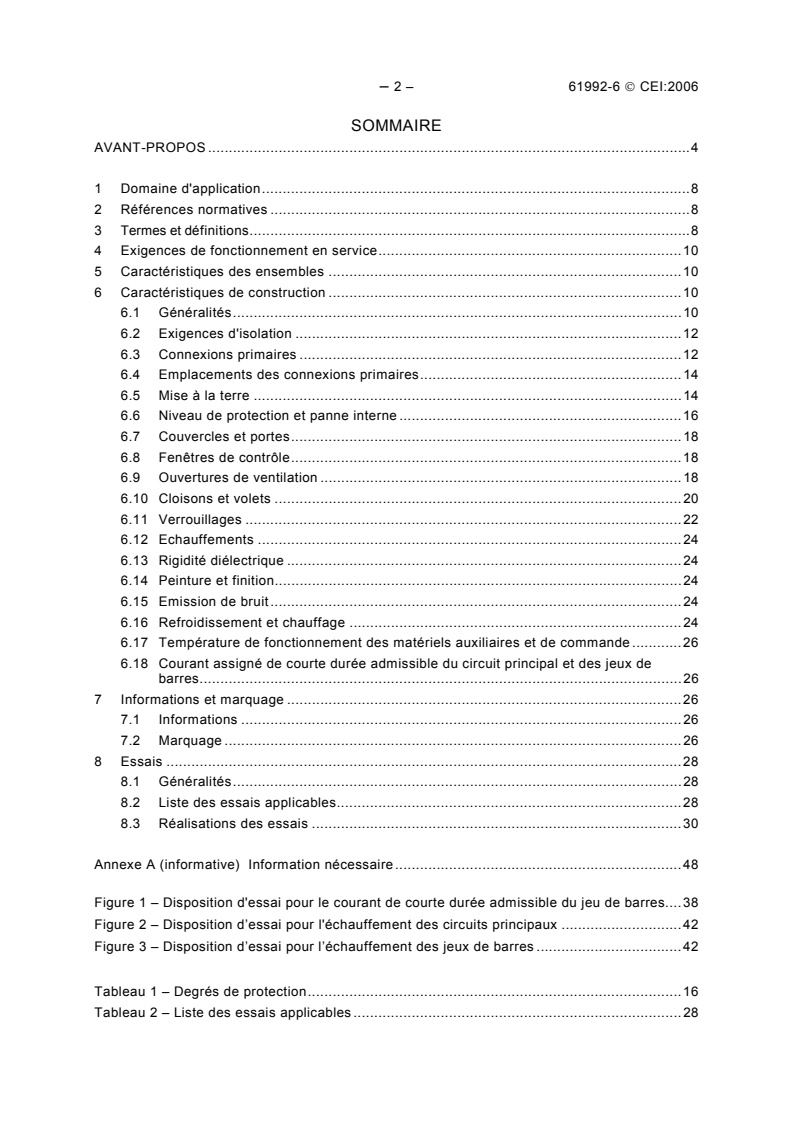
– 2 – 61992-6 CEI:2006
SOMMAIRE
AVANT-PROPOS .4
1 Domaine d'application.8
2 Références normatives .8
3 Termes et définitions.8
4 Exigences de fonctionnement en service.10
5 Caractéristiques des ensembles .10
6 Caractéristiques de construction .10
6.1 Généralités.10
6.2 Exigences d'isolation .12
6.3 Connexions primaires .12
6.4 Emplacements des connexions primaires.14
6.5 Mise à la terre .14
6.6 Niveau de protection et panne interne .16
6.7 Couvercles et portes.18
6.8 Fenêtres de contrôle.18
6.9 Ouvertures de ventilation .18
6.10 Cloisons et volets .20
6.11 Verrouillages .22
6.12 Echauffements .24
6.13 Rigidité diélectrique .24
6.14 Peinture et finition.24
6.15 Emission de bruit.24
6.16 Refroidissement et chauffage .24
6.17 Température de fonctionnement des matériels auxiliaires et de commande .26
6.18 Courant assigné de courte durée admissible du circuit principal et des jeux de
barres.26
7 Informations et marquage .26
7.1 Informations .26
7.2 Marquage .26
8 Essais .28
8.1 Généralités.28
8.2 Liste des essais applicables.28
8.3 Réalisations des essais .30
Annexe A (informative) Information nécessaire.48
Figure 1 – Disposition d'essai pour le courant de courte durée admissible du jeu de barres.38
Figure 2 – Disposition d’essai pour l'échauffement des circuits principaux .42
Figure 3 – Disposition d’essai pour l’échauffement des jeux de barres .42
Tableau 1 – Degrés de protection.16
Tableau 2 – Liste des essais applicables .28
61992-6 IEC:2006 – 3 –
CONTENTS
FOREWORD.5
1 Scope.9
2 Normative references.9
3 Terms and definitions .9
4 Service requirements .11
5 Characteristics of the assemblies.11
6 Construction characteristics .11
6.1 General.11
6.2 Insulation requirements .13
6.3 Primary connections .13
6.4 Location of the primary connections .15
6.5 Earthing.15
6.6 Degree of protection and internal fault .17
6.7 Covers and doors .19
6.8 Inspection windows.19
6.9 Ventilating openings .19
6.10 Partitions and shutters .21
6.11 Interlocks.23
6.12 Temperature-rises.25
6.13 Dielectric strength.25
6.14 Painting and finishing.25
6.15 Noise emission .25
6.16 Cooling and heating.25
6.17 Operating temperature of auxiliary and control equipment .27
6.18 Rated short-time withstand current of busbars .27
7 Information and marking .27
7.1 Information.27
7.2 Marking.27
8 Tests.29
8.1 General.29
8.2 List of the applicable tests .29
8.3 Performance of tests .31
Annex A (informative) Information required.49
Figure 1 – Test arrangement for short-time current withstand test on busbars.39
Figure 2 – Test arrangement for temperature-rise test on main circuits .43
Figure 3 – Test arrangement for temperature-rise test on the busbars .43
Table 1 – Degrees of protection .17
Table 2 – List of applicable tests .29
– 4 – 61992-6 CEI:2006
COMMISSION ÉLECTROTECHNIQUE INTERNATIONALE
____________
APPLICATIONS FERROVIAIRES –
INSTALLATIONS FIXES –
APPAREILLAGE À COURANT CONTINU –
Partie 6: Ensembles d’appareillage à courant continu
AVANT-PROPOS
1) La CEI (Commission Electrotechnique Internationale) est une organisation mondiale de normalisation composée
de l'ensemble des comités électrotechniques nationaux (Comités nationaux de la CEI). La CEI a pour objet de
favoriser la coopération internationale pour toutes les questions de normalisation dans les domaines de
l'électricité et de l'électronique. A cet effet, la CEI – entre autres activités – publie des Normes internationales,
des Spécifications techniques, des Rapports techniques, des Spécifications accessibles au public (PAS) et des
Guides (ci-après dénommés "Publication(s) de la CEI"). Leur élaboration est confiée à des comités d'études,
aux travaux desquels tout Comité national intéressé par le sujet traité peut participer. Les organisations
internationales, gouvernementales et non gouvernementales, en liaison avec la CEI, participent également aux
travaux. La CEI collabore étroitement avec l'Organisation Internationale de Normalisation (ISO), selon des
conditions fixées par accord entre les deux organisations.
2) Les décisions ou accords officiels de la CEI concernant les questions techniques, représentent, dans la mesure
du possible un accord international sur les sujets étudiés, étant donné que les Comités nationaux intéressés
sont représentés dans chaque comité d’études.
3) Les publications de la CEI se présentent sous la forme de recommandations internationales et sont agréées
comme tels par les Comités nationaux de la CEI. Tous les efforts raisonnables sont entrepris afin que la CEI
s'assure de l'exactitude du contenu technique de ses publications; la CEI ne peut pas être tenue responsable de
l'éventuelle mauvaise utilisation ou interprétation qui en est faite par un quelconque utilisateur final
4) Dans le but d'encourager l'uniformité internationale, les Comités nationaux de la CEI s'engagent, dans toute la
mesure possible, à appliquer de façon transparente les Publications de la CEI dans leurs publications
nationales et régionales. Toute divergence entre la norme de la CEI et la norme nationale ou régionale
correspondante doit être indiquée en termes clairs dans cette dernière.
5) La CEI n’a fixé aucune procédure concernant le marquage comme indication d’approbation et sa responsabilité
n’est pas engagée quand un matériel est déclaré conforme à l’une de ses normes.
6) Tous les utilisateurs doivent s'assurer qu'ils sont en possession de la dernière édition de cette publication.
7) Aucune responsabilité ne doit être imputée à la CEI, à ses administrateurs, employés, auxiliaires ou
mandataires, y compris ses experts particuliers et les membres de ses comités d'études et des Comités
nationaux de la CEI, pour tout préjudice causé en cas de dommages corporels et matériels, ou de tout autre
dommage de quelque nature que ce soit, directe ou indirecte, ou pour supporter les coûts (y compris les frais
de justice) et les dépenses découlant de la publication ou de l'utilisation de cette Publication de la CEI ou de
toute autre Publication de la CEI, ou au crédit qui lui est accordé.
8) L'attention est attirée sur les références normatives citées dans cette publication. L'utilisation de publications
référencées est indispensable pour une application correcte de la présente publication.
9) L’attention est attirée sur le fait que certains des éléments de la présente Publication de la CEI peuvent faire
l’objet de droits de propriété intellectuelle ou de droits analogues. La CEI ne saurait être tenue pour
responsable de ne pas avoir identifié de tels droits de propriété et de ne pas avoir signalé leur existence.
La Norme internationale CEI 61992-6 a été établie par le comité d’études 9 de la CEI: Matériels
et systèmes électriques ferroviaires.
Le texte de la présente norme est issu de l’EN 50123-6 ainsi que des documents suivants:
FDIS Rapport de vote
9/891/FDIS 9/913/RVD
Le rapport de vote indiqué dans le tableau ci-dessus donne toute information sur le vote ayant
abouti à l'approbation de la présente Norme.
Cette publication a été rédigée selon les Directives ISO/CEI, Partie 2.
61992-6 IEC:2006 – 5 –
INTERNATIONAL ELECTROTECHNICAL COMMISSION
____________
RAILWAY APPLICATIONS –
FIXED INSTALLATIONS –
DC SWITCHGEAR –
Part 6: DC switchgear assemblies
FOREWORD
1) The International Electrotechnical Commission (IEC) is a worldwide organization for standardization comprising
all national electrotechnical committees (IEC National Committees). The object of IEC is to promote
international co-operation on all questions concerning standardization in the electrical and electronic fields. To
this end and in addition to other activities, IEC publishes International Standards, Technical Specifications,
Technical Reports, Publicly Available Specifications (PAS) and Guides (hereafter referred to as “IEC
Publication(s)”). Their preparation is entrusted to technical committees; any IEC National Committee interested
in the subject dealt with may participate in this preparatory work. International, governmental and non-
governmental organizations liaising with the IEC also participate in this preparation. IEC collaborates closely
with the International Organization for Standardization (ISO) in accordance with conditions determined by
agreement between the two organizations.
2) The formal decisions or agreements of IEC on technical matters express, as nearly as possible, an international
consensus of opinion on the relevant subjects since each technical committee has representation from all
interested IEC National Committees.
3) IEC Publications have the form of recommendations for international use and are accepted by IEC National
Committees in that sense. While all reasonable efforts are made to ensure that the technical content of IEC
Publications is accurate, IEC cannot be held responsible for the way in which they are used or for any
misinterpretation by any end user.
4) In order to promote international uniformity, IEC National Committees undertake to apply IEC Publications
transparently to the maximum extent possible in their national and regional publications. Any divergence
between any IEC Publication and the corresponding national or regional publication shall be clearly indicated in
the latter.
5) IEC provides no marking procedure to indicate its approval and cannot be rendered responsible for any
equipment declared to be in conformity with an IEC Publication.
6) All users should ensure that they have the latest edition of this publication.
7) No liability shall attach to IEC or its directors, employees, servants or agents including individual experts and
members of its technical committees and IEC National Committees for any personal injury, property damage or
other damage of any nature whatsoever, whether direct or indirect, or for costs (including legal fees) and
expenses arising out of the publication, use of, or reliance upon, this IEC Publication or any other IEC
Publications.
8) Attention is drawn to the Normative references cited in this publication. Use of the referenced publications is
indispensable for the correct application of this publication.
9) Attention is drawn to the possibility that some of the elements of this IEC Publication may be the subject of
patent rights. IEC shall not be held responsible for identifying any or all such patent rights.
International Standard IEC 61992-6 has been prepared by IEC technical committee 9: Electrical
equipment and systems for railways.
The text of this standard is based on EN 50123-6 and the following documents:
FDIS Report on voting
9/891/FDIS 9/913/RVD
Full information on the voting for the approval of this standard can be found in the report on
voting indicated in the above table.
This publication has been drafted in accordance with the ISO/IEC Directives, Part 2.
– 6 – 61992-6 CEI:2006
La CEI 61992 comprend les parties suivantes, présentées sous le titre général Applications
ferroviaires – Installations fixes – Appareillage à courant continu:
Partie 1: Généralités
Partie 2: Disjoncteurs en courant continu
Partie 3: Interrupteurs-sectionneurs, sectionneurs et sectionneurs de terre à courant
continu, pour l'intérieur
Partie 4: Interrupteurs-sectionneurs, sectionneurs et sectionneurs de terre à courant
continu, pour usage extérieur
Partie 5: Parafoudres et limiteurs de tension pour usage spécifique dans les systèmes de
traction à courant continu
Partie 6: Ensembles d’appareillage à courant continu
Partie 7-1: Appareils de mesure, de contrôle et de protection pour usage spécifique dans les
systèmes de traction à courant continu – Guide d'application
Partie 7-2: Appareils de mesure, de contrôle et de protection pour usage spécifique dans les
systèmes de traction à courant continu – Transducteurs de courant d’isolement et
autres appareils de mesure du courant
Partie 7-3: Appareils de mesure, de contrôle et de protection pour usage spécifique dans les
systèmes de traction à courant continu – Transducteurs de tension d’isolement et
autres appareils de mesure de la tension
Le comité a décidé que le contenu de cette publication ne sera pas modifié avant la date de
maintenance indiquée sur le site web de la CEI sous «http://webstore.iec.ch» dans les données
relatives à la publication recherchée. A cette date, la publication sera
• reconduite;
• supprimée;
• remplacée par une édition révisée, ou
• amendée.
61992-6 IEC:2006 – 7 –
IEC 61992 consists of the following parts, under the general title Railway applications – Fixed
installations – DC switchgear:
Part 1: General
Part 2: D.C. circuit breakers
Part 3: Indoor d.c. disconnectors, switch-disconnectors and earthing switches
Part 4: Outdoor d.c. disconnectors, switch-disconnectors and earthing switches
Part 5: Surge arresters and low-voltage limiters for specific use in d.c. systems
Part 6: D.C. switchgear assemblies
Part 7-1: Measurement, control and protection devices for specific use in d.c. traction
systems – Application guide
Part 7-2: Measurement, control and protection devices for specific use in d.c. traction
systems – Isolating current transducers and other current measuring devices
Part 7-3: Measurement, control and protection devices for specific use in d.c. traction
systems – Isolating voltage transducers and other voltage measuring devices
The committee has decided that the contents of this publication will remain unchanged until the
maintenance result date indicated on the IEC web site under "http://webstore.iec.ch" in the data
related to the specific publication. At this date, the publication will be
• reconfirmed;
• withdrawn;
• replaced by a revised edition, or
• amended.
– 8 – 61992-6 CEI:2006
APPLICATIONS FERROVIAIRES –
INSTALLATIONS FIXES –
APPAREILLAGE À COURANT CONTINU –
Partie 6: Ensembles d’appareillage à courant continu
1 Domaine d'application
La présente partie de la CEI 61992 couvre les ensembles d’appareillage à courant continu
sous enveloppe métallique et non métallique utilisés en intérieur dans les systèmes
d'installations fixes de traction, avec une tension nominale ne dépassant pas 3 000 V.
Les éléments individuels d'équipement intégrés dans un ensemble, comme par exemple des
disjoncteurs, sont conçus, fabriqués et individuellement essayés (en simulant, si besoin,
l'enveloppe) en accord avec les parties respectives de la CEI 61992, ou le cas échéant, avec
une autre norme applicable.
NOTE 1 Les exigences évoquées dans la présente partie de la CEI 61992 concernent l'ensemble en tant que tel,
son enveloppe et l'influence mutuelle du matériel installé dans ladite enveloppe.
NOTE 2 Les exigences de CEM sont traitées par la norme CEI 62236-5 et des exigences supplémentaires
concernant la fiabilité (FDMS) se trouvent dans la CEI 62278.
2 Références normatives
Les documents de référence suivants sont indispensables pour l'application du présent
document. Pour les références datées, seule l'édition citée s'applique. Pour les références non
datées, la dernière édition du document de référence s'applique (y compris les éventuels
amendements).
EN 60243-1:1998, Rigidité diélectrique des matériaux isolants – Méthodes d'essai – Partie 1:
Essais aux fréquences industrielles
CEI 60529:1989, Degrés de protection procurés par les enveloppes (Code IP)
CEI 61992-1:2006, Applications ferroviaires – Installations fixes – Appareillage à courant
continu – Partie 1: Généralités
CEI 61992-2:2006, Applications ferroviaires – Installations fixes – Appareillage à courant
continu – Partie 2: Disjoncteurs en courant continu
CEI 61992-3:2006, Applications ferroviaires – Installations fixes – Appareillage à courant
continu – Partie 3: Interrupteurs-sectionneurs, sectionneurs, et sectionneurs de terre à courant
continu pour l’intérieur
3 Termes et définitions
Pour les besoins du présent document, les termes et définitions donnés dans la CEI 61992-1
s'appliquent.
61992-6 IEC:2006 – 9 –
RAILWAY APPLICATIONS –
FIXED INSTALLATIONS –
DC SWITCHGEAR –
Part 6: DC switchgear assemblies
1 Scope
This part of IEC 61992 covers d.c. metal-enclosed and non-metallic enclosed switchgear
assemblies used in indoor stationary installations of traction systems, with nominal voltage not
exceeding 3 000 V.
It is intended that individual items of equipment, for example circuit breakers, housed in the
assembly are designed, manufactured and individually tested (simulating the enclosure when
necessary) in accordance with their respective parts of IEC 61992 or, when appropriate, with
another applicable standard.
NOTE 1 The requirements covered in this part of IEC 61992 are those concerning the assembly as such, its
enclosure and the mutual influence of the equipment enclosed.
NOTE 2 EMC requirements are covered by IEC 62236-5 and additional requirements concerning dependability
(RAMS) are covered by IEC 62278.
2 Normative references
The following referenced documents are indispensable for the application of this document. For
dated references, only the edition cited applies. For undated references, the latest edition of
the referenced document (including any amendments) applies.
IEC 60243-1:1998, Electrical strength of insulating materials – Test methods – Part 1: Tests at
power frequencies
IEC 60529:1989, Degrees of protection provided by enclosures (IP Code)
IEC 61992-1:2006, Railway applications – Fixed installations – DC switchgear – Part 1:
General
IEC 61992-2:2006, Railway applications – Fixed installations – DC switchgear – Part 2: DC
circuit-breakers
IEC 61992-3:2006, Railway applications – Fixed installations – DC switchgear – Part 3: Indoor
d.c. disconnectors, switch-disconnectors and earthing switches
3 Terms and definitions
For the purposes of this document, the terms and definitions given in IEC 61992-1 apply.
– 10 – 61992-6 CEI:2006
4 Exigences de fonctionnement en service
Les exigences de service normal concernant les installations intérieures sont détaillées à
l'Article 4 et dans l'Annexe B de la CEI 61992-1. Dans la présente norme, on considère comme
conditions normales le degré de pollution PD4 et les catégories de surtension (voir la
CEI 61992-1, notes du Tableau 1) indiquées dans l’EN 50124-1.
5 Caractéristiques des ensembles
Les principales caractéristiques d'un ensemble doivent être indiquées dans les spécifications
d'approvisionnement:
a) type d'enveloppe de l'ensemble;
b) liste des unités fonctionnelles sous enveloppe;
c) tensions assignées d'isolement;
d) valeurs assignées du matériel sous enveloppe selon les exigences des normes
correspondantes;
e) s'il est construit pour une protection contre un défaut à la terre;
f) protection détaillée et exigences de commande (voir la CEI 61992-7).
D'autres caractéristiques importantes sont énumérées à l’Article A.2.
6 Caractéristiques de construction
6.1 Généralités
Les enveloppes sont métalliques ou non métalliques. Les appareillages sous enveloppes non
métalliques ne doivent pas être utilisés à des tensions assignées supérieures à 1,5 kV.
Toutes les exigences spécifiées ici s'appliquent également lors d'utilisation de matériaux
conducteurs et isolants, à l'exception des distances d'isolement qui doivent être conçues et
essayées comme il convient.
Une cellule maçonnée ne doit pas être considérée comme une enveloppe, en ce qui concerne
cette norme.
Il est permis de considérer la surface du sol comme une partie d'une enveloppe. Les mesures
à prendre pour obtenir le degré de protection fourni par des surfaces au sol doivent faire l'objet
d'un accord entre l'acheteur et le fournisseur.
Les murs d'une pièce ne doivent pas être considérés comme des parties d'une enveloppe.
Les ensembles d’appareillages et les enveloppes correspondantes doivent être conçus pour
que les opérations d'entretien normal, de contrôle et de maintenance, la mise à la terre des
câbles ou des jeux de barres raccordés, la localisation des défauts dans les câbles, les essais
de tension sur des câbles raccordés ou d'autres appareils et l'élimination des charges
électrostatiques, puissent être effectués sans difficulté et en toute sécurité.
Tous les matériaux utilisés doivent être de la qualité et de la classe la mieux adaptée à un
fonctionnement dans les conditions spécifiées. Il faut porter une attention particulière à leur
capacité de tenue à l'humidité et au feu. A moins que la Classe F0 du comportement en cas
d'incendie ne soit admise (voir CEI 61992-1, Annexe B), les matériaux utilisés doivent être en
métal ou auto-extinguibles, de telle sorte que le risque de propagation de l'incendie entre des
armoires ou des compartiments soit minimum.
61992-6 IEC:2006 – 11 –
4 Service requirements
Normal service requirements are detailed in Clause 4 and Annex B of IEC 61992-1 for indoor
installations. In this standard, the pollution degree PD4 and overvoltage categories (see notes
to Table 1 of IEC 61992-1) as described in EN 50124-1 are considered to be the normal
condition.
5 Characteristics of the assemblies
The main characteristics of an assembly shall be indicated in the procurement specification as
follows:
a) type of the assembly enclosure;
b) list of functional units enclosed;
c) rated insulation voltages;
d) rated values of the equipment enclosed as required in relevant standards;
e) if constructed for an earth fault protection;
f) detailed protection and control requirements (see IEC 61992-7).
Other important characteristics are listed in Clause A.2.
6 Construction characteristics
6.1 General
Enclosures are either metallic or non-metallic. Non-metallic enclosed switchgear shall not be
used for nominal voltages above 1,5 kV.
All requirements specified herein also apply when both conductive and insulating materials are
used, except for insulating clearances which shall be designed and tested as appropriate.
A cell made of masonry shall not be considered as an enclosure, as far as this standard is
concerned.
The floor surface may be considered as part of an enclosure. The measures to be taken in
order to obtain the degree of protection provided by floor surfaces shall be subject to an
agreement between purchaser and supplier.
The walls of a room shall not be considered as parts of the enclosure.
Switchgear assemblies and relevant enclosures shall be designed so that normal service,
inspection and maintenance operations, earthing of connected cables or busbars, locating of
cable faults, voltage tests on connected cables or other apparatus and the elimination of
electrostatic charges, can be carried out easily and safely.
All materials used shall be of the quality and of the class most suitable for working under the
conditions specified. Special attention is to be paid to its ability to withstand moisture and fire:
unless fire behaviour Class F0 is allowed (see Annex B of IEC 61992-1), materials used shall
be metallic or of the self-extinguishing type, so that the risk of propagation of fire from one
cubicle or compartment to another is minimised.
– 12 – 61992-6 CEI:2006
La sélection des matériaux et la construction de l'ensemble doivent être faites de telle sorte
que la corrosion due aux conditions atmosphériques et électrolytiques soit minimisée.
Tous les dispositifs identiques, constituant un élément d'un ensemble pour une utilisation
donnée et ayant les mêmes caractéristiques, doivent être interchangeables.
Les appareils de connexion débrochables ne doivent pas accepter une quelconque insertion
dans des unités fonctionnelles du même ensemble d'appareillages ayant une fonction
différente ou des caractéristiques assignées supérieures du courant.
On doit prévoir un espace suffisant à l'intérieur des compartiments pour l'arrivée des câbles et
leurs connexions sans devoir transgresser leur rayon de courbure minimal.
Les parties amovibles des enveloppes de protection doivent être fermement reliées aux parties
fixes comme spécifié en 6.7. Il ne doit pas se produire des séparations ou des desserrages
accidentels du fait de l'exploitation du matériel.
Tous les appareils et raccordements doivent être fournis pour un fonctionnement sûr, la
commande et la protection du matériel en question, que cela soit ou non explicitement
mentionné. Le matériel doit être convenablement mis à la terre, isolé, blindé ou placé dans une
enveloppe appropriée afin d'assurer sa protection et la sécurité des opérateurs et du personnel
de maintenance.
Les circuits et contacts auxiliaires et de commande doivent être conformes aux exigences de
5.2 de la CEI 61992-1.
Tous les éléments constitutifs présents dans l'enveloppe doivent satisfaire aux normes
appropriées.
6.2 Exigences d'isolation
Les tensions d'essais et les distances d'isolement sont indiquées au Tableau 1 de la
CEI 61992-1. Les valeurs recommandées des lignes de fuite sont données à l'Annexe D de la
CEI 61992-1.
L'effet défavorable de l'ionisation (dû aux arcs) sur les distances d'isolement avec d'autres
matériels de l'ensemble doit être pris en compte. Les distances d'isolement minimales entre la
boîte de soufflage d'un appareil de connexion et les parties métalliques ou non (c'est-à-dire au
dessus de la boîte de soufflage et sur les parois) doivent être conformes à celles données par
le constructeur de l'appareil.
Le matériau isolant utilisé pour recouvrir partiellement ou entièrement une enveloppe
métallique doit être solidement fixé à celle-ci.
Dans le cas d'unités débrochables, lorsqu'il faut accéder à l'intérieur de l'enveloppe au cours
d'opérations de maintenance, les jeux de barres et tous les autres conducteurs doivent être
séparés par une barrière. Les ouvertures à travers une telle barrière pour les connecteurs du
circuit et des jeux de barres, etc., doivent être obturées et susceptibles d'être condamnées.
6.3 Connexions primaires
Il est permis d'équiper les unités fonctionnelles non débrochables de connexions fixes ou
amovibles (boulonnées ou par griffes). Les unités fonctionnelles débrochables peuvent être
équipées de connecteurs embrochables.
61992-6 IEC:2006 – 13 –
The selection of materials and the construction of the assembly shall be such that corrosion
due to atmospheric and electrolytic effects are minimised.
All identical devices, forming part of an assembly for a given use and with the same
characteristics, shall be interchangeable.
Withdrawable switching devices shall be prevented from insertion into functional units on the
same switchgear assembly, having a different function or higher current ratings.
Sufficient space shall be provided inside the compartments for the entry and termination of
incoming cables without their minimum bending radii being infringed.
The detachable parts of the protection enclosures shall be firmly attached to the fixed parts as
specified in 6.7. Accidental untightening or detachment shall not occur because of the
operation of the equipment.
All apparatus and connections for the safe operation, control and protection of the equipment
concerned, shall be provided whether or not specifically mentioned. The equipment shall be
adequately earthed, insulated, screened or enclosed as may be appropriate to ensure the
protection of the equipment and safety of those concerned in its operation and maintenance.
Control and auxiliary circuits and contacts shall comply with the requirements of 5.2 of
IEC 61992-1.
All components contained within the enclosure shall comply with their relevant standards.
6.2 Insulation requirements
Test voltages and clearances are given in Table 1 of IEC 61992-1. Recommended values for
creepage distances are given in Annex D of IEC 61992-1.
The adverse effect of ionisation (due to arcs) on the clearances of other equipment in the
assembly shall be taken into account. The minimum clearances between the arc chute of a
switching device and metallic or non-metallic parts (i.e. above the arc chute and to the sides)
shall be in accordance with those given by the switching device manufacturer.
Insulating material used to fully or partially line a metallic enclosure shall be firmly secured to
the enclosure.
In case of withdrawable units, where access within the enclosure is required during
maintenance operations, the busbars and all other conductors shall be separated by a barrier.
Openings through such a barrier for the circuit and busbar connectors, etc. shall be shuttered
and capable of being locked closed.
6.3 Primary connections
Non-withdrawable functional units may be equipped with fixed, removable (bolted or clamped)
connectors. Withdrawable functional units may be equipped with plug-in connectors.
– 14 – 61992-6 CEI:2006
6.4 Emplacements des connexions primaires
En cas de montages non débrochables, les bornes des connexions primaires doivent être
accessibles aux unités fonctionnelles comme dans des conditions de service normales.
6.5 Mise à la terre
NOTE Selon les exigences de mise à la terre du système à courant continu, «mise à la terre« signifie le
raccordement soit à la terre de protection soit au circuit de retour.
6.5.1 Mise à la terre du circuit principal
Pour assurer la sécurité pendant la maintenance, tous les éléments du circuit principal
nécessitant ou pourvu d'un accès, doivent pouvoir être mis à la terre à l'aide de moyens
appropriés. Ceci ne s'applique pas aux éléments amovibles ou débrochables ni à ceux rendus
accessibles après leur séparation de l'appareillage.
Toutefois, un élément débrochable ne doit pas être retiré de l'enveloppe à moins que, pour des
raisons de sécurité, ses condensateurs n'aient été déchargés.
On doit mettre à la terre les disjoncteurs débrochables avant l'ouverture des volets et on doit
fermer ceux-ci avant de déconnecter leur mise à la terre.
Les sectionneurs de mise à la terre doivent satisfaire à la CEI 61992-3. L'exigence selon
laquelle il doit être possible de connaître la position de fonctionnement du sectionneur de terre
est satisfaite si l'une des conditions ci-dessous est remplie:
– la distance de sectionnement est visible;
– la position du sectionneur de mise à la terre est parfaitement visible et les positions
correspondant à la connexion complète et à l'isolement total sont clairement identifiées;
– le sectionneur de mise à la terre est équipé d'un dispositif indicateur de position fiable.
6.5.2 Mise à la terre de l'enveloppe
L'acheteur doit indiquer dans l'appel d'offre la méthode de mise à la terre de l'enveloppe (par
exemple, circuit de retour ou mise à la masse) conformément à 6.5.8 de la CEI 61992-7-1.
Les parties métalliques des enveloppes, comme des bâtis, une structure et des éléments fixes,
doivent être raccordées entre elles et à une borne de terre appropriée, placées dans une
position accessible, permettant ainsi le raccordement sur le système principal de mise à la
terre de l'installation. La borne de terre doit être correctement protégée contre la corrosion. Le
symbole normalisé de mise à la terre doit être marqué de façon permanente et claire.
Un conducteur de mise à la terre doit être fourni de telle sorte que sa longueur totale dépasse
celle de l'appareillage sous enveloppe métallique pour raccorder chaque borne de terre. La
densité de courant du conducteur de terre, s'il est en cuivre, ne doit pas dépasser 200 A/mm
basé sur un défaut de terre spécifié de 10 000 A pendant 1 s; donc, sa section transversale ne
doit pas être inférieure à 50 mm . Le conducteur de terre doit avoir pour extrémité une b
...
IEC 61992-6 ®
Edition 1.1 2014-04
CONSOLIDATED
VERSION
VERSION
CONSOLIDÉE
colour
inside
Railway applications – Fixed installations – DC switchgear –
Part 6: DC switchgear assemblies
Applications ferroviaires – Installations fixes – Appareillage à courant continu –
Partie 6: Ensembles d'appareillage à courant continu
All rights reserved. Unless otherwise specified, no part of this publication may be reproduced or utilized in any form
or by any means, electronic or mechanical, including photocopying and microfilm, without permission in writing from
either IEC or IEC's member National Committee in the country of the requester. If you have any questions about IEC
copyright or have an enquiry about obtaining additional rights to this publication, please contact the address below or
your local IEC member National Committee for further information.
Droits de reproduction réservés. Sauf indication contraire, aucune partie de cette publication ne peut être reproduite
ni utilisée sous quelque forme que ce soit et par aucun procédé, électronique ou mécanique, y compris la photocopie
et les microfilms, sans l'accord écrit de l'IEC ou du Comité national de l'IEC du pays du demandeur. Si vous avez des
questions sur le copyright de l'IEC ou si vous désirez obtenir des droits supplémentaires sur cette publication, utilisez
les coordonnées ci-après ou contactez le Comité national de l'IEC de votre pays de résidence.
IEC Central Office Tel.: +41 22 919 02 11
3, rue de Varembé Fax: +41 22 919 03 00
CH-1211 Geneva 20 info@iec.ch
Switzerland www.iec.ch
About the IEC
The International Electrotechnical Commission (IEC) is the leading global organization that prepares and publishes
International Standards for all electrical, electronic and related technologies.
About IEC publications
The technical content of IEC publications is kept under constant review by the IEC. Please make sure that you have the
latest edition, a corrigenda or an amendment might have been published.
IEC Catalogue - webstore.iec.ch/catalogue Electropedia - www.electropedia.org
The stand-alone application for consulting the entire The world's leading online dictionary of electronic and
bibliographical information on IEC International Standards, electrical terms containing more than 30 000 terms and
Technical Specifications, Technical Reports and other definitions in English and French, with equivalent terms in 14
documents. Available for PC, Mac OS, Android Tablets and additional languages. Also known as the International
iPad. Electrotechnical Vocabulary (IEV) online.
IEC publications search - www.iec.ch/searchpub IEC Glossary - std.iec.ch/glossary
The advanced search enables to find IEC publications by a More than 55 000 electrotechnical terminology entries in
variety of criteria (reference number, text, technical English and French extracted from the Terms and Definitions
committee,…). It also gives information on projects, replaced clause of IEC publications issued since 2002. Some entries
and withdrawn publications. have been collected from earlier publications of IEC TC 37,
77, 86 and CISPR.
IEC Just Published - webstore.iec.ch/justpublished
Stay up to date on all new IEC publications. Just Published IEC Customer Service Centre - webstore.iec.ch/csc
details all new publications released. Available online and If you wish to give us your feedback on this publication or
also once a month by email. need further assistance, please contact the Customer Service
Centre: csc@iec.ch.
A propos de l'IEC
La Commission Electrotechnique Internationale (IEC) est la première organisation mondiale qui élabore et publie des
Normes internationales pour tout ce qui a trait à l'électricité, à l'électronique et aux technologies apparentées.
A propos des publications IEC
Le contenu technique des publications IEC est constamment revu. Veuillez vous assurer que vous possédez l’édition la
plus récente, un corrigendum ou amendement peut avoir été publié.
Catalogue IEC - webstore.iec.ch/catalogue Electropedia - www.electropedia.org
Application autonome pour consulter tous les renseignements
Le premier dictionnaire en ligne de termes électroniques et
bibliographiques sur les Normes internationales,
électriques. Il contient plus de 30 000 termes et définitions en
Spécifications techniques, Rapports techniques et autres
anglais et en français, ainsi que les termes équivalents dans
documents de l'IEC. Disponible pour PC, Mac OS, tablettes
14 langues additionnelles. Egalement appelé Vocabulaire
Android et iPad.
Electrotechnique International (IEV) en ligne.
Recherche de publications IEC - www.iec.ch/searchpub
Glossaire IEC - std.iec.ch/glossary
Plus de 55 000 entrées terminologiques électrotechniques, en
La recherche avancée permet de trouver des publications IEC
en utilisant différents critères (numéro de référence, texte, anglais et en français, extraites des articles Termes et
comité d’études,…). Elle donne aussi des informations sur les Définitions des publications IEC parues depuis 2002. Plus
projets et les publications remplacées ou retirées. certaines entrées antérieures extraites des publications des
CE 37, 77, 86 et CISPR de l'IEC.
IEC Just Published - webstore.iec.ch/justpublished
Service Clients - webstore.iec.ch/csc
Restez informé sur les nouvelles publications IEC. Just
Published détaille les nouvelles publications parues. Si vous désirez nous donner des commentaires sur cette
Disponible en ligne et aussi une fois par mois par email. publication ou si vous avez des questions contactez-nous:
csc@iec.ch.
IEC 61992-6 ®
Edition 1.1 2014-04
CONSOLIDATED
VERSION
VERSION
CONSOLIDÉE
colour
inside
Railway applications – Fixed installations – DC switchgear –
Part 6: DC switchgear assemblies
Applications ferroviaires – Installations fixes – Appareillage à courant continu –
Partie 6: Ensembles d'appareillage à courant continu
INTERNATIONAL
ELECTROTECHNICAL
COMMISSION
COMMISSION
ELECTROTECHNIQUE
INTERNATIONALE
ICS 45.060 ISBN 978-2-8322-1546-3
IEC 61992-6 ®
Edition 1.1 2014-04
REDLINE VERSION
VERSION REDLINE
colour
inside
Railway applications – Fixed installations – DC switchgear –
Part 6: DC switchgear assemblies
Applications ferroviaires – Installations fixes – Appareillage à courant continu –
Partie 6: Ensembles d'appareillage à courant continu
– 2 – IEC 61992-6:2006
+AMD1:2014 CSV IEC 2014
CONTENTS
FOREWORD . 3
1 Scope . 5
2 Normative references. 5
3 Terms and definitions . 5
4 Service requirements . 5
5 Characteristics of the assemblies . 6
6 Construction characteristics . 6
6.1 General . 6
6.2 Insulation requirements . 7
6.3 Primary connections . 7
6.4 Location of the primary connections . 7
6.5 Earthing . 7
6.6 Degree of protection and internal fault . 9
6.7 Covers and doors . 9
6.8 Inspection windows . 10
6.9 Ventilating openings . 10
6.10 Partitions and shutters . 10
6.11 Interlocks . 11
6.12 Temperature-rises . 12
6.13 Dielectric strength . 12
6.14 Painting and finishing . 12
6.15 Noise emission . 12
6.16 Cooling and heating . 12
6.17 Operating temperature of auxiliary and control equipment . 13
6.18 Rated short-time withstand current of busbars . 13
7 Information and marking . 13
7.1 Information . 13
7.2 Marking . 13
8 Tests . 14
8.1 General . 14
8.2 List of the applicable tests . 14
8.3 Performance of tests . 15
Annex A (informative) Information required . 23
Figure 1 – Test arrangement for short-time current withstand test on busbars . 18
Figure 2 – Test arrangement for temperature-rise test on main circuits . 20
Figure 3 – Test arrangement for temperature-rise test on the busbars . 21
Table 1 – Degrees of protection . 9
Table 2 – List of applicable tests . 14
+AMD1:2014 CSV IEC 2014
INTERNATIONAL ELECTROTECHNICAL COMMISSION
____________
RAILWAY APPLICATIONS –
FIXED INSTALLATIONS –
DC SWITCHGEAR –
Part 6: DC switchgear assemblies
FOREWORD
1) The International Electrotechnical Commission (IEC) is a worldwide organization for standardization comprising
all national electrotechnical committees (IEC National Committees). The object of IEC is to promote
international co-operation on all questions concerning standardization in the electrical and electronic fields. To
this end and in addition to other activities, IEC publishes International Standards, Technical Specifications,
Technical Reports, Publicly Available Specifications (PAS) and Guides (hereafter referred to as “IEC
Publication(s)”). Their preparation is entrusted to technical committees; any IEC National Committee interested
in the subject dealt with may participate in this preparatory work. International, governmental and non-
governmental organizations liaising with the IEC also participate in this preparation. IEC collaborates closely
with the International Organization for Standardization (ISO) in accordance with conditions determined by
agreement between the two organizations.
2) The formal decisions or agreements of IEC on technical matters express, as nearly as possible, an international
consensus of opinion on the relevant subjects since each technical committee has representation from all
interested IEC National Committees.
3) IEC Publications have the form of recommendations for international use and are accepted by IEC National
Committees in that sense. While all reasonable efforts are made to ensure that the technical content of IEC
Publications is accurate, IEC cannot be held responsible for the way in which they are used or for any
misinterpretation by any end user.
4) In order to promote international uniformity, IEC National Committees undertake to apply IEC Publications
transparently to the maximum extent possible in their national and regional publications. Any divergence
between any IEC Publication and the corresponding national or regional publication shall be clearly indicated in
the latter.
5) IEC itself does not provide any attestation of conformity. Independent certification bodies provide conformity
assessment services and, in some areas, access to IEC marks of conformity. IEC is not responsible for any
services carried out by independent certification bodies.
6) All users should ensure that they have the latest edition of this publication.
7) No liability shall attach to IEC or its directors, employees, servants or agents including individual experts and
members of its technical committees and IEC National Committees for any personal injury, property damage or
other damage of any nature whatsoever, whether direct or indirect, or for costs (including legal fees) and
expenses arising out of the publication, use of, or reliance upon, this IEC Publication or any other IEC
Publications.
8) Attention is drawn to the Normative references cited in this publication. Use of the referenced publications is
indispensable for the correct application of this publication.
9) Attention is drawn to the possibility that some of the elements of this IEC Publication may be the subject of
patent rights. IEC shall not be held responsible for identifying any or all such patent rights.
This Consolidated version of IEC 61992-6 bears the edition number 1.1. It consists of the
first edition (2006-02) [documents 9/891/FDIS and 9/913/RVD] and its amendment 1
(2014-04) [documents 9/1792/CDV and 9/1852/RVC]. The technical content is identical to
the base edition and its amendment.
In this Redline version, a vertical line in the margin shows where the technical content is
modified by amendment 1. Additions and deletions are displayed in red, with deletions
being struck through. A separate Final version with all changes accepted is available in
this publication.
This publication has been prepared for user convenience.
– 4 – IEC 61992-6:2006
+AMD1:2014 CSV IEC 2014
International Standard IEC 61992-6 has been prepared by IEC technical committee 9: Electrical
equipment and systems for railways.
IEC 61992 consists of the following parts, under the general title Railway applications – Fixed
installations – DC switchgear:
Part 1: General
Part 2: D.C. circuit breakers
Part 3: Indoor d.c. disconnectors, switch-disconnectors and earthing switches
Part 4: Outdoor d.c. disconnectors, switch-disconnectors and earthing switches
Part 5: Surge arresters and low-voltage limiters for specific use in d.c. systems
Part 6: D.C. switchgear assemblies
Part 7-1: Measurement, control and protection devices for specific use in d.c. traction
systems – Application guide
Part 7-2: Measurement, control and protection devices for specific use in d.c. traction
systems – Isolating current transducers and other current measuring devices
Part 7-3: Measurement, control and protection devices for specific use in d.c. traction
systems – Isolating voltage transducers and other voltage measuring devices
The committee has decided that the contents of the base publication and its amendment will
remain unchanged until the stability date indicated on the IEC web site under
"http://webstore.iec.ch" in the data related to the specific publication. At this date, the
publication will be
• reconfirmed;
• withdrawn;
• replaced by a revised edition, or
• amended.
IMPORTANT – The “colour inside” logo on the cover page of this publication indicates
that it contains colours which are considered to be useful for the correct understanding
of its contents. Users should therefore print this publication using a colour printer.
+AMD1:2014 CSV IEC 2014
RAILWAY APPLICATIONS –
FIXED INSTALLATIONS –
DC SWITCHGEAR –
Part 6: DC switchgear assemblies
1 Scope
This part of IEC 61992 covers d.c. metal-enclosed and non-metallic enclosed switchgear
assemblies used in indoor stationary installations of traction systems, with nominal voltage
not exceeding 3 000 V.
It is intended that individual items of equipment, for example circuit breakers, housed in the
assembly are designed, manufactured and individually tested (simulating the enclosure when
necessary) in accordance with their respective parts of IEC 61992 or, when appropriate, with
another applicable standard.
NOTE 1 The requirements covered in this part of IEC 61992 are those concerning the assembly as such, its
enclosure and the mutual influence of the equipment enclosed.
NOTE 2 EMC requirements are covered by IEC 62236-5 and additional requirements concerning dependability
(RAMS) are covered by IEC 62278.
2 Normative references
The following referenced documents are indispensable for the application of this document.
For dated references, only the edition cited applies. For undated references, the latest edition
of the referenced document (including any amendments) applies.
IEC 60243-1:1998, Electrical strength of insulating materials – Test methods – Part 1: Tests
at power frequencies
IEC 60529:1989, Degrees of protection provided by enclosures (IP Code)
IEC 61992-1:2006+ A1:2014, Railway applications – Fixed installations – DC switchgear –
Part 1: General
IEC 61992-2:2006+ A1:2014, Railway applications – Fixed installations – DC switchgear –
Part 2: DC circuit-breakers
IEC 61992-3:2006, Railway applications – Fixed installations – DC switchgear – Part 3:
Indoor d.c. disconnectors, switch-disconnectors and earthing switches
3 Terms and definitions
For the purposes of this document, the terms and definitions given in IEC 61992-1 apply.
4 Service requirements
Normal service requirements are detailed in Clause 4 and Annex B of IEC 61992-1 for indoor
installations. In this standard, the pollution degree PD4 and overvoltage categories (see
notes to Table 1 of IEC 61992-1) as described in EN 50124-1 are considered to be the
normal condition.
– 6 – IEC 61992-6:2006
+AMD1:2014 CSV IEC 2014
5 Characteristics of the assemblies
The main characteristics of an assembly shall be indicated in the procurement specification as
follows:
a) type of the assembly enclosure;
b) list of functional units enclosed;
c) rated insulation voltages;
d) rated values of the equipment enclosed as required in relevant standards;
e) if constructed for an earth fault protection;
f) detailed protection and control requirements (see IEC 61992-7).
Other important characteristics are listed in Clause A.2.
6 Construction characteristics
6.1 General
Enclosures are either metallic or non-metallic. Non-metallic enclosed switchgear shall not be
used for nominal voltages above 1,5 kV.
All requirements specified herein also apply when both conductive and insulating materials are
used, except for insulating clearances which shall be designed and tested as appropriate.
A cell made of masonry shall not be considered as an enclosure, as far as this standard is
concerned.
The floor surface may be considered as part of an enclosure. The measures to be taken in
order to obtain the degree of protection provided by floor surfaces shall be subject to an
agreement between purchaser and supplier.
The walls of a room shall not be considered as parts of the enclosure.
Switchgear assemblies and relevant enclosures shall be designed so that normal service,
inspection and maintenance operations, earthing of connected cables or busbars, locating of
cable faults, voltage tests on connected cables or other apparatus and the elimination of
electrostatic charges, can be carried out easily and safely.
All materials used shall be of the quality and of the class most suitable for working under the
conditions specified. Special attention is to be paid to its ability to withstand moisture and fire:
unless fire behaviour Class F0 is allowed (see Annex B of IEC 61992-1), materials used shall
be metallic or of the self-extinguishing type, so that the risk of propagation of fire from one
cubicle or compartment to another is minimised.
The selection of materials and the construction of the assembly shall be such that corrosion
due to atmospheric and electrolytic effects are minimised.
All identical devices, forming part of an assembly for a given use and with the same
characteristics, shall be interchangeable.
Withdrawable switching devices shall be prevented from insertion into functional units on the
same switchgear assembly, having a different function or higher current ratings.
Sufficient space shall be provided inside the compartments for the entry and termination of
incoming cables without their minimum bending radii being infringed.
+AMD1:2014 CSV IEC 2014
The detachable parts of the protection enclosures shall be firmly attached to the fixed parts as
specified in 6.7. Accidental untightening or detachment shall not occur because of the
operation of the equipment.
All apparatus and connections for the safe operation, control and protection of the equipment
concerned, shall be provided whether or not specifically mentioned. The equipment shall be
adequately earthed, insulated, screened or enclosed as may be appropriate to ensure the
protection of the equipment and safety of those concerned in its operation and maintenance.
Control and auxiliary circuits and contacts shall comply with the requirements of 5.2 of
IEC 61992-1.
All components contained within the enclosure shall comply with their relevant standards.
6.2 Insulation requirements
Test voltages and clearances are given in Table 1 of IEC 61992-1. Recommended values for
creepage distances are given in Annex D of IEC 61992-1.
The adverse effect of ionisation (due to arcs) on the clearances of other equipment in the
assembly shall be taken into account. The minimum clearances between the arc chute of a
switching device and metallic or non-metallic parts (i.e. above the arc chute and to the sides)
shall be in accordance with those given by the switching device manufacturer.
Insulating material used to fully or partially line a metallic enclosure shall be firmly secured to
the enclosure.
In case of withdrawable units, where access within the enclosure is required during
maintenance operations, the busbars and all other conductors shall be separated by a barrier.
Openings through such a barrier for the circuit and busbar connectors, etc. shall be shuttered
and capable of being locked closed.
6.3 Primary connections
Non-withdrawable functional units may be equipped with fixed, removable (bolted or clamped)
connectors. Withdrawable functional units may be equipped with plug-in connectors.
6.4 Location of the primary connections
In case of non-withdrawable assemblies, the terminals for the primary connections shall be
accessible with the functional units as in normal operating conditions.
6.5 Earthing
NOTE Depending on the d.c. system earthing requirements, "earthing" means connection either to earth or to the
return circuit.
6.5.1 Earthing of the main circuit
To ensure safety during maintenance work, all parts of the main circuit to which access is
required or provided shall be capable of being earthed through suitable means. This does not
apply to those parts, which are withdrawable or removable and which become accessible after
being separated from the switchgear.
A withdrawable part, however, shall not be removed from the enclosure unless capacitors on it
have been discharged to safe values.
– 8 – IEC 61992-6:2006
+AMD1:2014 CSV IEC 2014
In case of withdrawable circuit breakers, the earth connection shall be made before the
shutters are opened and the shutters shall be closed before the earth connection is
disconnected.
Earthing switches shall comply with IEC 61992-3. The requirement that it shall be possible to
know the operating position of the earthing switch is met if one of the following conditions is
fulfilled:
– the isolating distance is visible;
– the position of the earthing switch is clearly visible and the position corresponding to full
connection and full isolation are clearly identified;
– the position of the earthing switch is indicated by a reliable indicating device.
6.5.2 Earthing of the enclosure
The purchaser shall indicate in the enquiry how to earth the enclosure (e.g. the return circuit or
to earth) in accordance with 6.5.8 of IEC 61992-7-1.
The metallic parts of the enclosures, such as frames, structure and fixed elements, shall be
connected to each other and to a suitable earthing terminal, placed in an accessible position, in
order to allow the connection to the main earth system of the installation. The earthing terminal
shall be suitably protected against corrosion. The standard earth symbol shall be clearly and
permanently marked.
An earthing conductor shall be provided extending the whole length of the metal-enclosed
switchgear to connect the individual earthing terminals. The current density of the earthing
based on a specified earth fault of
conductor, if of copper, shall not exceed 200 A/mm
10 000 A for 1 s; therefore, its cross-section area shall be not less than 50 mm . The earthing
conductor shall be terminated by a clearly and permanently marked main earthing terminal.
The continuity of the earth system shall be ensured taking into account the thermal and
mechanical stresses caused by the magnitude and duration of the current it may have to carry.
The purchaser shall indicate in the enquiry if the earthing system shall differ from the above.
The purchaser shall specify in the enquiry the maximum earth fault current. The standard value
for the duration is 0,25 s due to the typical breaking time of the a.c. rectifier circuit breaker(s).
If the purchaser requires a longer duration, he shall specify this in the enquiry.
The terminals and connections shall be adequately dimensioned for the earth fault current.
The enclosure of each functional unit shall be connected to this earthing conductor. All the
metallic parts within a functional unit and not belonging to a main, control or auxiliary circuit,
shall also be connected to the earthing conductor directly or through metallic structural parts.
In the latter case, earthing of said elements, such as walls and doors of compartments, may be
fulfilled by normal construction elements, ensuring an adequate electrical continuity and
suitable dimensioning. For any bolts or similar fixing used for earth continuity, the maintenance
instructions shall state the requirements for cleaning surfaces and ensuring tightness.
The metallic parts of a withdrawable part which are normally earthed in the service position,
shall also remain earth-connected in the test and disconnected positions and between each
position.
The purchaser shall indicate in the enquiry if the earthing system deviates from the
requirements stated in this subclause.
+AMD1:2014 CSV IEC 2014
6.6 Degree of protection and internal fault
6.6.1 Protection against approach to live parts and contact with moving parts
For metal-clad and for compartmented switchgear, the degree of protection shall be specified.
If required, separate degrees of protection for doors and walls, for partitions and for the roof of
the enclosure shall be specified. For cubicle switchgear, it is only necessary to specify the
degree of protection for the enclosure.
The degree of protection against contact of persons with live parts of auxiliary circuits and with
any moving parts (other than smooth rotating shafts and moving linkages) shall be indicated by
means of the designation specified in Table 1 below, taken from IEC 60529.
Normally, no degree of protection is provided for indoor switchgear assemblies against ingress
of water.
Table 1 – Degrees of protection
Degree of
Protection against approach of live parts and contact with moving parts
protection
IP20 By fingers or similar objects of diameter greater than 12 mm
IP30 By tools, wires, etc. of diameter of thickness greater than 2,5 mm
IP40 By tools, wires, etc. of diameter of thickness greater than 1,0 mm
NOTE 1 The first characteristic numeral indicates the degree of protection provided by the enclosure against the
ingress of solid bodies and approach to live parts for all given enclosure conditions.
NOTE 2 Protection against ingress of water is given by the second numeral.
6.6.2 Internal arcing
Failure within the enclosure of switchgear due to a defect or an exceptional service condition or
mal-operation may initiate an exceptional internal arc.
Ventilating openings and vent outlets shall be arranged in such a way that gas or vapour
escaping under pressure does not endanger the operator.
6.7 Covers and doors
Covers and doors which are part of the enclosure shall be metallic if the enclosure is metallic.
When they are closed, they shall provide the degree of protection specified for the enclosure.
Covers or doors shall not be made of woven wire mesh, expanded metal or similar. When
ventilating openings and vent outlets are incorporated in the cover or door, reference is made
to 6.9.
Two categories of covers or doors are recognized with regard to access to compartments at
main circuit potential:
a) those which need not to be opened for the normal purposes of operation or maintenance
(fixed covers): it shall not be possible for them to be opened, dismantled or removed
without the use of tools or other provisions which may be required by the purchaser;
b) those which need to be opened for the normal purposes of operation (removable covers,
doors): these shall not require tools for their opening or removal; they shall be provided with
locking facilities (for example provisions for padlocks), unless the safety of persons is
assured by a suitable interlocking device.
NOTE It is recommended, with metal-clad or compartmented switchgear, that doors giving access to live parts be
suitable for opening only when the part of the exposed main circuit contained in the compartment being made
accessible is dead. Equivalent provisions may also be provided.
– 10 – IEC 61992-6:2006
+AMD1:2014 CSV IEC 2014
6.8 Inspection windows
Inspection windows shall provide at least the degree of protection specified for the enclosure.
They shall be covered by a transparent sheet of mechanical strength comparable to that of the
enclosure.
The insulation between live parts of the main circuit and the inspection windows shall withstand
the test voltages specified in Table 1 of IEC 61992-1.
6.9 Ventilating openings
Ventilating openings shall be so arranged or shielded that the same degree of protection as
that specified for the enclosure is obtained. Such openings may make use of wire mesh or the
like, provided that it is of suitable mechanical strength.
6.10 Partitions and shutters
6.10.1 General
Partitions and shutters shall provide at least the degree of protection specified in Table 1.
Partitions and shutters made of insulating material shall meet the following requirements:
a) the insulation between live parts of the main circuit and the accessible surface of insulating
partitions and shutters shall withstand the test voltages specified in Table 1 of IEC 61992-1;
b) apart from mechanical strength, the insulating material shall withstand the test voltages
specified in item a); the appropriate test method given in IEC 60243-1 shall be applied;
c) if a leakage current reaches the accessible side of the insulating partitions and shutters by
a continuous path over insulating surfaces or by a path broken only by small air gaps, this
current shall be not greater than 0,5 mA under the specified test conditions (see 8.3.3.1 a)).
Openings in the enclosure of the switchgear assembly and in partitions of metal-clad or
compartmented switchgear, through which contacts of removable parts engage fixed contacts,
shall be provided with automatic shutters properly operated in normal service operations to
ensure the protection of persons in any of the positions defined in 3.3.24 to 3.3.27 of
IEC 61992-1.
If maintenance requirements imply that one set of fixed contacts shall be accessible through
opened shutters, all the shutters shall be provided with means of locking them independently in
the closed position or it shall be possible to insert a screen to prevent the live set of the fixed
contacts being exposed.
Conductors other than busbars passing through metallic partitions are insulated by bushings or
other equivalent means and the openings may be provided by bushings or shutters having non-
metallic parts.
6.10.2 Partitions
Partitions of metal-clad switchgear shall be metallic and earthed.
Partitions of compartmented and cubicle switchgear may be non-metallic, provided (unless
otherwise agreed between purchaser and supplier) they do not become part of the enclosure
with the removable part in any of the positions defined in 3.3.25 to 3.3.27 of IEC 61992-1. If
partitions become part of the enclosure with the removable part in any of these positions, they
shall be of the same material as the enclosure and shall provide the degree of protection
specified for the enclosure. Metallic partitions shall be earthed.
NOTE 1 A partition becomes part of the enclosure, if it is accessible in any of the positions defined in 3.3.25 to
3.3.27 of IEC 61992-1.
+AMD1:2014 CSV IEC 2014
NOTE 2 If a door which can be closed in the positions defined in 3.3.25 to 3.3.27 of IEC 61992-1 is provided, the
partition behind the door is not considered to be a part of the enclosure.
6.10.3 Shutters
The shutters of all types of switchgear assemblies may be either metallic or non-metallic.
If shutters are of insulating material, they shall not become part of the enclosure. If shutters are
metallic, they shall be earthed and, if they become part of the enclosure, they shall provide the
degree of protection specified for the enclosure.
6.10.4 Isolating distances
The devices for ensuring the isolating distance between the main circuit conductors are
considered to be disconnectors which shall comply with IEC 61992-3, except for the
mechanical operation test (see 8.3.5).
The requirement that it shall be possible to know the operating position of the disconnector is
met if one of the following conditions is fulfilled:
– the isolating distance is visible;
– the position of the withdrawable part, in relation to the fixed part, is clearly visible and the
positions corresponding to full connection and full isolation are clearly identified;
– the position of the disconnector is indicated by a reliable indicating device.
Any removable part shall be so attached to the fixed part that its contacts will not open
inadvertently due to forces which may occur in service, in particular those due to short circuit.
The dielectric requirements stated in 6.2 shall be observed.
6.11 Interlocks
Interlocks between different components of the equipment are provided for reasons of safety
and for convenience of operation. The following provisions are mandatory for main circuits:
a) Switchgear with removable parts
The withdrawal or engagement of a circuit breaker, switch, disconnector or contactor shall
be impossible unless it is in the open position.
The operation of a circuit breaker, switch, disconnector or contactor shall be impossible
unless it is in the service, disconnected, removed, test or earthing position.
It shall be impossible to close the circuit breaker, switch, disconnector or contactor in the
service position unless it is connected to the auxiliary and control circuit, unless it is
designed to open automatically without the use of a separate auxiliary and control circuit.
b) Switchgear without removable parts and provided with disconnectors
Interlocks shall be provided to prevent operation of disconnectors under conditions other
than those uses for which they are intended (see IEC 61992-3). The operation of a
disconnector shall be impossible unless the associated circuit breaker, switch or contactor
is in the open position. No interlock is required if all currents (including fault currents) in the
circuit to be switched on or off, are within the making and breaking capacity of the
disconnector.
The operation of the circuit breaker, switch or contactor shall be impossible unless the
associated disconnector is in the closed, open or earthing position (if provided).
The provision of alternative interlocks shall be subject to agreement between purchaser and
supplier. The supplier shall give all necessary information on the character and function of
interlocks.
– 12 – IEC 61992-6:2006
+AMD1:2014 CSV IEC 2014
Earthing switches having a short-circuit making capacity less than the peak short circuit current
Î of the circuit shall be interlocked with the associated disconnectors.
ss
Apparatus installed in main circuits, the incorrect operation of which can cause damage or
which are used for assuring isolating distances during maintenance work, shall be provided
with locking facilities (for example provision of padlocks).
NOTE Whenever practical, preference should be given to mechanical interlocks.
6.12 Temperature-rises
Maximum temperature-rises are detailed in Clause 6 of IEC 61992-1.
These temperature-rises shall not be exceeded for operation at rated service current and/or
conventional thermal current I or I and at overloads as specified by the purchaser for
Ne the
normal service conditions as specified in Annex B of IEC 61992-1. The effects on temperature-
rise caused by adjacent functional units and any permanently energized anti-condensation
heaters shall be taken into consideration.
In addition, the auxiliary and control circuits, as well as the auxiliary devices, shall carry their
conventional thermal current (for switching devices) or their rated service current (for other
equipment).
Through faults may produce temperature-rises in excess of those mentioned above, but shall
not cause permanent damage or distortion in the switchgear assembly.
6.13 Dielectric strength
Dielectric withstand strength and isolating distances shall conform to the requirements
specified in 4.2 of IEC 61992-1.
When it is not practical to disconnect the cable for the dielectric tests from the switchgear
assembly, those parts which remain connected to the cable shall be capable of withstanding
the cable test voltages specified for the cables.
6.14 Painting and finishing
Steelwork (other than stainless steel) and other materials of the enclosure shall be treated in
accordance with an approved type of corrosion protection.
6.15 Noise emission
Noise emission from all equipment shall be minimized. The level of the noise emission during
the breaking of the rated normal service current I shall be indicated by the supplier, if
Ne
requested.
The method of measuring is to be indicated.
6.16 Cooling and heating
All equipment shall be naturally air cooled unless otherwise agreed between purchaser and
supplier.
Space heaters, positioned to prevent the accumulation of moisture on internal components,
shall be provided where necessary for the service conditions specified by the purchaser.
+AMD1:2014 CSV IEC 2014
6.17 Operating temperature of auxiliary and control equipment
Auxiliary and control equipment, when installed in the switchgear, shall be suitable for
operating at rated performance at the recorded local ambient temperature within their
enclosure.
6.18 Rated short-time withstand current of busbars
Busbars shall have a short-time withstand current rating (I ).
Ncw
NOTE The I rating is the same value as the I rating of the line circuit breaker for a time duration of 0,25 s.
Ncw Nss
By mutual agreement between manufacturer and purchaser, a tie interconnecting station
switchboard may be supplied with a reduced I busbar rating, as I fault current is normally
Ncw cw
of lower magnitude than at a substation. If a tie station needs to be upgraded to a rectifier
substation at a later date, then the purchaser shall indicate this at the time of the enquiry and
order and shall define the I requirement.
Ncw
7 Information and marking
7.1 Information
Both parties shall exchange any necessary information in order to assure that the switchgear
assembly is suitable for the intended duty. A summary of this information is given in Annex A.
7.2 Marking
All necessary labelling shall be indelibly marked and provided as necessary for the purposes of
safety, identification, instruction and information. Lifting attachments and the earth terminal
shall be marked by their symbols. The following indications shall be placed on the assembly
enclosure on one or more rating plates in an accessible visible position on a non-removable
structure.
a) name of the manufacturer or trademark;
b) the reference to this part of IEC 61992;
c) type designation;
d) serial number designation;
e) year of manufacture;
f) rated voltage U of main circuits;
Ne
g) rated voltage(s) U of auxiliary and control circuits;
Ne
h) rated service current I of busbars and main circuits;
Ne
i) rated short-circuit current I ;
Nss
j) rated short-time withstand current of busbars I ;
Ncw
k) rated earth fault current I ;
Ncwe
l) degree of protection for the enclosure and partitions (if different);
m) compliance with service requirements differing from those indicated as normal (see
Clause 4 of IEC 61992-1 – preferably by a separate label).
– 14 – IEC 61992-6:2006
+AMD1:2014 CSV IEC 2014
8 Tests
8.1 General
General requirements concerning tests are shown in Clause 7 of IEC 61992-1.
The tests shall be carried out as described in the relevant clauses of this standard and, as far
as applicable, of IEC 61992-1. For procedural matters not covered in either of those standards,
reference may be made to other IEC or E
...