


IEC 60670-22:2024
(Main)Boxes and enclosures for electrical accessories for household and similar fixed electrical installations - Part 22: Particular requirements for connecting boxes and enclosures
Boxes and enclosures for electrical accessories for household and similar fixed electrical installations - Part 22: Particular requirements for connecting boxes and enclosures
IEC 60670-22:2024 applies to boxes, enclosures and parts of enclosures (hereafter called "boxes" and "enclosures") for electrical accessories with a rated voltage not exceeding 1 000 V AC and 1 500 V DC intended for household or similar fixed electrical installations, either indoors or outdoors. Boxes and enclosures complying with this document are suitable for use at ambient temperatures not normally exceeding +40 °C, but their average over a period of 24 h does not exceed +35 °C, with a lower limit of the ambient air temperature of −5 °C. Other temperatures outside the above range can apply according to the classification of the boxes and the enclosures. This document applies to junction connecting boxes or tapping connecting boxes or both.
This second edition cancels and replaces the first edition published in 2003 and Amendment 1:2015. This edition constitutes a technical revision.
This edition includes the following significant technical changes with respect to the previous edition:
a) addition of cable joints as a new type of box with the related tests and requirements;
b) addition of tests and requirements for boxes and enclosures exposed to direct sunlight with the related Annex CC;
c) addition of connecting boxes and enclosures having encapsulation capability as a new type of boxes with the related tests, requirements and related Annex DD.
Boîtes et enveloppes pour appareillage électrique pour installations électriques fixes pour usages domestiques et analogues - Partie 22: Règles particulières concernant les boîtes et enveloppes de connexion
L'IEC 60670-22:2024 s'applique aux boîtes, enveloppes et parties d'enveloppes (ci-après désignées par les termes "boîtes" et "enveloppes") pour appareillages électriques dont la tension assignée ne dépasse pas 1 000 V en courant alternatif et 1 500 V en courant continu pour installations électriques fixes pour usages domestiques et analogues, en intérieur ou en extérieur. Les boîtes et enveloppes conformes au présent document sont adaptés à un usage à des températures ambiantes qui ne dépassent pas habituellement +40 °C, mais dont la moyenne sur une période de 24 h ne dépasse pas +35 °C, avec une limite basse de la température ambiante de −5 °C. D'autres températures situées en dehors de la plage ci-dessus peuvent s'appliquer selon la classification des boîtes et enveloppes. Le présent document s'applique aux boîtes de connexion pour jonction ou aux boîtes de connexion pour dérivation, ou aux deux. Cette deuxième édition annule et remplace la première édition parue en 2003 et son Amendement 1:2015. Cette édition constitue une révision technique.
Cette édition inclut les modifications techniques majeures suivantes par rapport à l'édition précédente:
a) des jonctions de câbles ont été ajoutées en tant que nouveau type de boîte, ainsi que les essais et exigences associés;
b) des essais et exigences ont été ajoutés pour les boîtes et enveloppes exposées à la lumière directe du soleil, ainsi que l'Annexe CC associée;
c) des boîtes et enveloppes de connexion avec aptitude d'encapsulage ont été ajoutées en tant que nouveau type de boîtes, ainsi que les essais, les exigences et l'Annexe DD associés.
La version française de la norme n'a pas été soumise au vote.
General Information
- Status
- Published
- Publication Date
- 17-Dec-2024
- Technical Committee
- SC 23B - Plugs, socket-outlets and switches
- Drafting Committee
- MT 5 - TC 23/SC 23B/MT 5
- Current Stage
- PPUB - Publication issued
- Start Date
- 18-Dec-2024
- Completion Date
- 27-Dec-2024
Relations
- Effective Date
- 05-Sep-2023
- Effective Date
- 05-Sep-2023
Overview
IEC 60670-22:2024 is Part 22 of the IEC 60670 series and specifies particular requirements for connecting boxes and enclosures used with electrical accessories for household and similar fixed installations. It applies to boxes and enclosures (indoor or outdoor) for rated voltages up to 1 000 V AC and 1 500 V DC, suitable for ambient temperatures normally up to +40 °C (24 h average not exceeding +35 °C) down to −5 °C. This second edition (2024) replaces the 2003 edition and Amendment 1:2015 and is a technical revision introducing new types and tests.
Key topics and technical requirements
- Scope and classification: Covers junction connecting boxes, tapping connecting boxes and combinations thereof, plus new box types added in this edition (see below).
- Rated voltages and temperatures: Limits for AC/DC voltages and defined ambient temperature ranges for product suitability.
- Types of boxes: Definitions and requirements for cord outlet boxes, boxes with integrated clamping units, detachable terminals, provisions for subsequent incorporation of terminals, and floating terminals.
- New additions (Edition 2.0):
- Cable joints: Added as a new type of box with specific tests and requirements.
- Direct sunlight exposure: New tests and requirements in Annex CC for enclosures exposed to sunlight.
- Encapsulation capability: New type of connecting boxes that have encapsulation features; related tests and Annex DD.
- Essential technical areas covered:
- Marking, dimensions and classification
- Protection against electric shock and provision for earthing
- Construction and mechanical strength
- Resistance to ageing, water ingress and solids
- Insulation resistance, electric strength, creepage and clearance
- Resistance to heat, tracking, fire, corrosion
- Electromagnetic compatibility (EMC)
- Rated connecting capacity and terminal/clamping unit definitions
- Supporting annexes: Annex AA (examples), Annex BB (schematic presentations), Annex CC (sunlight), Annex DD (encapsulation).
Applications and users
IEC 60670-22 is essential for:
- Manufacturers of junction boxes, connecting enclosures and cable joints designing products for household and similar installations.
- Product designers and engineers specifying clamping units, terminals and encapsulation features.
- Test laboratories and certification bodies performing conformity testing against IEC requirements.
- Specifiers, installers and building electrical safety authorities selecting compliant enclosures for fixed installations.
- Regulatory and procurement teams requiring standardized performance for indoor/outdoor connecting boxes.
Related standards
- IEC 60670-1:2024 (general requirements for boxes and enclosures) - used in conjunction with Part 22.
- IEC 60998 series, IEC 60999-1 (connecting devices and clamping units).
- Referenced ISO standards for material testing (ISO 62, ISO 178, ISO 179-1, ISO 4892-2).
Keywords: IEC 60670-22, connecting boxes, junction boxes, cable joints, electrical enclosures, encapsulation, direct sunlight testing, IEC standard.
IEC 60670-22:2024 RLV - Boxes and enclosures for electrical accessories for household and similar fixed electrical installations - Part 22: Particular requirements for connecting boxes and enclosures Released:18. 12. 2024 Isbn:9782832701133
Frequently Asked Questions
IEC 60670-22:2024 is a standard published by the International Electrotechnical Commission (IEC). Its full title is "Boxes and enclosures for electrical accessories for household and similar fixed electrical installations - Part 22: Particular requirements for connecting boxes and enclosures". This standard covers: IEC 60670-22:2024 applies to boxes, enclosures and parts of enclosures (hereafter called "boxes" and "enclosures") for electrical accessories with a rated voltage not exceeding 1 000 V AC and 1 500 V DC intended for household or similar fixed electrical installations, either indoors or outdoors. Boxes and enclosures complying with this document are suitable for use at ambient temperatures not normally exceeding +40 °C, but their average over a period of 24 h does not exceed +35 °C, with a lower limit of the ambient air temperature of −5 °C. Other temperatures outside the above range can apply according to the classification of the boxes and the enclosures. This document applies to junction connecting boxes or tapping connecting boxes or both. This second edition cancels and replaces the first edition published in 2003 and Amendment 1:2015. This edition constitutes a technical revision. This edition includes the following significant technical changes with respect to the previous edition: a) addition of cable joints as a new type of box with the related tests and requirements; b) addition of tests and requirements for boxes and enclosures exposed to direct sunlight with the related Annex CC; c) addition of connecting boxes and enclosures having encapsulation capability as a new type of boxes with the related tests, requirements and related Annex DD.
IEC 60670-22:2024 applies to boxes, enclosures and parts of enclosures (hereafter called "boxes" and "enclosures") for electrical accessories with a rated voltage not exceeding 1 000 V AC and 1 500 V DC intended for household or similar fixed electrical installations, either indoors or outdoors. Boxes and enclosures complying with this document are suitable for use at ambient temperatures not normally exceeding +40 °C, but their average over a period of 24 h does not exceed +35 °C, with a lower limit of the ambient air temperature of −5 °C. Other temperatures outside the above range can apply according to the classification of the boxes and the enclosures. This document applies to junction connecting boxes or tapping connecting boxes or both. This second edition cancels and replaces the first edition published in 2003 and Amendment 1:2015. This edition constitutes a technical revision. This edition includes the following significant technical changes with respect to the previous edition: a) addition of cable joints as a new type of box with the related tests and requirements; b) addition of tests and requirements for boxes and enclosures exposed to direct sunlight with the related Annex CC; c) addition of connecting boxes and enclosures having encapsulation capability as a new type of boxes with the related tests, requirements and related Annex DD.
IEC 60670-22:2024 is classified under the following ICS (International Classification for Standards) categories: 29.120.10 - Conduits for electrical purposes. The ICS classification helps identify the subject area and facilitates finding related standards.
IEC 60670-22:2024 has the following relationships with other standards: It is inter standard links to IEC 60670-22:2003/AMD1:2015, IEC 60670-22:2003. Understanding these relationships helps ensure you are using the most current and applicable version of the standard.
You can purchase IEC 60670-22:2024 directly from iTeh Standards. The document is available in PDF format and is delivered instantly after payment. Add the standard to your cart and complete the secure checkout process. iTeh Standards is an authorized distributor of IEC standards.
Standards Content (Sample)
IEC 60670-22 ®
Edition 2.0 2024-12
REDLINE VERSION
INTERNATIONAL
STANDARD
colour
inside
Boxes and enclosures for electrical accessories for household and similar fixed
electrical installations –
Part 22: Particular requirements for connecting boxes and enclosures
All rights reserved. Unless otherwise specified, no part of this publication may be reproduced or utilized in any form
or by any means, electronic or mechanical, including photocopying and microfilm, without permission in writing from
either IEC or IEC's member National Committee in the country of the requester. If you have any questions about IEC
copyright or have an enquiry about obtaining additional rights to this publication, please contact the address below or
your local IEC member National Committee for further information.
IEC Secretariat Tel.: +41 22 919 02 11
3, rue de Varembé info@iec.ch
CH-1211 Geneva 20 www.iec.ch
Switzerland
About the IEC
The International Electrotechnical Commission (IEC) is the leading global organization that prepares and publishes
International Standards for all electrical, electronic and related technologies.
About IEC publications
The technical content of IEC publications is kept under constant review by the IEC. Please make sure that you have the
latest edition, a corrigendum or an amendment might have been published.
IEC publications search - webstore.iec.ch/advsearchform IEC Products & Services Portal - products.iec.ch
The advanced search enables to find IEC publications by a Discover our powerful search engine and read freely all the
variety of criteria (reference number, text, technical publications previews, graphical symbols and the glossary.
committee, …). It also gives information on projects, replaced With a subscription you will always have access to up to date
and withdrawn publications. content tailored to your needs.
IEC Just Published - webstore.iec.ch/justpublished
Electropedia - www.electropedia.org
Stay up to date on all new IEC publications. Just Published
The world's leading online dictionary on electrotechnology,
details all new publications released. Available online and once
containing more than 22 500 terminological entries in English
a month by email.
and French, with equivalent terms in 25 additional languages.
Also known as the International Electrotechnical Vocabulary
IEC Customer Service Centre - webstore.iec.ch/csc
(IEV) online.
If you wish to give us your feedback on this publication or need
further assistance, please contact the Customer Service
Centre: sales@iec.ch.
IEC 60670-22 ®
Edition 2.0 2024-12
REDLINE VERSION
INTERNATIONAL
STANDARD
colour
inside
Boxes and enclosures for electrical accessories for household and similar fixed
electrical installations –
Part 22: Particular requirements for connecting boxes and enclosures
INTERNATIONAL
ELECTROTECHNICAL
COMMISSION
ICS 29.120.10 ISBN 978-2-8327-0113-3
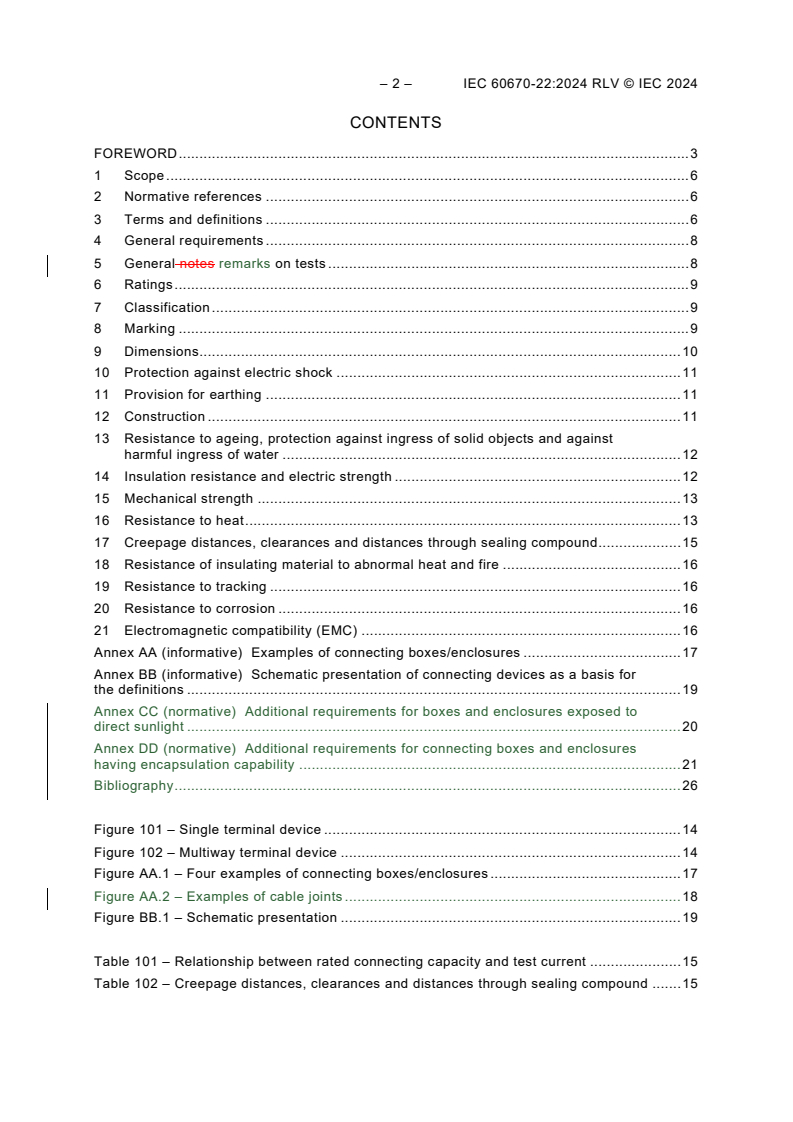
– 2 – IEC 60670-22:2024 RLV © IEC 2024
CONTENTS
FOREWORD . 3
1 Scope . 6
2 Normative references . 6
3 Terms and definitions . 6
4 General requirements . 8
5 General notes remarks on tests . 8
6 Ratings . 9
7 Classification . 9
8 Marking . 9
9 Dimensions. 10
10 Protection against electric shock . 11
11 Provision for earthing . 11
12 Construction . 11
13 Resistance to ageing, protection against ingress of solid objects and against
harmful ingress of water . 12
14 Insulation resistance and electric strength . 12
15 Mechanical strength . 13
16 Resistance to heat . 13
17 Creepage distances, clearances and distances through sealing compound . 15
18 Resistance of insulating material to abnormal heat and fire . 16
19 Resistance to tracking . 16
20 Resistance to corrosion . 16
21 Electromagnetic compatibility (EMC) . 16
Annex AA (informative) Examples of connecting boxes/enclosures . 17
Annex BB (informative) Schematic presentation of connecting devices as a basis for
the definitions . 19
Annex CC (normative) Additional requirements for boxes and enclosures exposed to
direct sunlight . 20
Annex DD (normative) Additional requirements for connecting boxes and enclosures
having encapsulation capability . 21
Bibliography . 26
Figure 101 – Single terminal device . 14
Figure 102 – Multiway terminal device . 14
Figure AA.1 – Four examples of connecting boxes/enclosures . 17
Figure AA.2 – Examples of cable joints . 18
Figure BB.1 – Schematic presentation . 19
Table 101 – Relationship between rated connecting capacity and test current . 15
Table 102 – Creepage distances, clearances and distances through sealing compound . 15
INTERNATIONAL ELECTROTECHNICAL COMMISSION
____________
BOXES AND ENCLOSURES FOR ELECTRICAL ACCESSORIES FOR
HOUSEHOLD AND SIMILAR FIXED ELECTRICAL INSTALLATIONS –
Part 22: Particular requirements for connecting boxes and enclosures
FOREWORD
1) The International Electrotechnical Commission (IEC) is a worldwide organization for standardization comprising
all national electrotechnical committees (IEC National Committees). The object of IEC is to promote international
co-operation on all questions concerning standardization in the electrical and electronic fields. To this end and
in addition to other activities, IEC publishes International Standards, Technical Specifications, Technical Reports,
Publicly Available Specifications (PAS) and Guides (hereafter referred to as "IEC Publication(s)"). Their
preparation is entrusted to technical committees; any IEC National Committee interested in the subject dealt with
may participate in this preparatory work. International, governmental and non-governmental organizations liaising
with the IEC also participate in this preparation. IEC collaborates closely with the International Organization for
Standardization (ISO) in accordance with conditions determined by agreement between the two organizations.
2) The formal decisions or agreements of IEC on technical matters express, as nearly as possible, an international
consensus of opinion on the relevant subjects since each technical committee has representation from all
interested IEC National Committees.
3) IEC Publications have the form of recommendations for international use and are accepted by IEC National
Committees in that sense. While all reasonable efforts are made to ensure that the technical content of IEC
Publications is accurate, IEC cannot be held responsible for the way in which they are used or for any
misinterpretation by any end user.
4) In order to promote international uniformity, IEC National Committees undertake to apply IEC Publications
transparently to the maximum extent possible in their national and regional publications. Any divergence between
any IEC Publication and the corresponding national or regional publication shall be clearly indicated in the latter.
5) IEC itself does not provide any attestation of conformity. Independent certification bodies provide conformity
assessment services and, in some areas, access to IEC marks of conformity. IEC is not responsible for any
services carried out by independent certification bodies.
6) All users should ensure that they have the latest edition of this publication.
7) No liability shall attach to IEC or its directors, employees, servants or agents including individual experts and
members of its technical committees and IEC National Committees for any personal injury, property damage or
other damage of any nature whatsoever, whether direct or indirect, or for costs (including legal fees) and
expenses arising out of the publication, use of, or reliance upon, this IEC Publication or any other IEC
Publications.
8) Attention is drawn to the Normative references cited in this publication. Use of the referenced publications is
indispensable for the correct application of this publication.
9) IEC draws attention to the possibility that the implementation of this document may involve the use of (a)
patent(s). IEC takes no position concerning the evidence, validity or applicability of any claimed patent rights in
respect thereof. As of the date of publication of this document, IEC had not received notice of (a) patent(s), which
may be required to implement this document. However, implementers are cautioned that this may not represent
the latest information, which may be obtained from the patent database available at https://patents.iec.ch. IEC
shall not be held responsible for identifying any or all such patent rights.
This redline version of the official IEC Standard allows the user to identify the changes
made to the previous edition IEC 60670-22:2003+AMD1:2015 CSV. A vertical bar appears
in the margin wherever a change has been made. Additions are in green text, deletions
are in strikethrough red text.
– 4 – IEC 60670-22:2024 RLV © IEC 2024
IEC 60670-22 has been prepared by subcommittee 23B: Plugs, socket-outlets and switches, of
IEC technical committee 23: Electrical accessories. It is an International Standard.
This second edition cancels and replaces the first edition published in 2003 and
Amendment 1:2015. This edition constitutes a technical revision.
This edition includes the following significant technical changes with respect to the previous
edition:
a) addition of cable joints as a new type of box with the related tests and requirements;
b) addition of tests and requirements for boxes and enclosures exposed to direct sunlight with
the related Annex CC;
c) addition of connecting boxes and enclosures having encapsulation capability as a new type
of boxes with the related tests, requirements and related Annex DD.
The text of this International Standard is based on the following documents:
Draft Report on voting
23B/1535/FDIS 23B/1553/RVD
Full information on the voting for its approval can be found in the report on voting indicated in
the above table.
The language used for the development of this International Standard is English.
This document was drafted in accordance with ISO/IEC Directives, Part 2, and developed in
accordance with ISO/IEC Directives, Part 1 and ISO/IEC Directives, IEC Supplement, available
at www.iec.ch/members_experts/refdocs. The main document types developed by IEC are
described in greater detail at www.iec.ch/publications.
A list of all parts in the IEC 60670 series, published under the general title Boxes and enclosures
for electrical accessories for household and similar fixed installations, can be found on the IEC
website.
This document is to be used in conjunction with IEC 60670-1:2024. It lists the changes
necessary to convert that standard into a specific standard for connecting boxes and
enclosures.
Where this document states "addition", "modification" or "replacement", the relevant
requirement, test specifications or explanatory matter in IEC 60670-1:2024 shall be adapted
accordingly.
Clauses and subclauses, notes, figures or tables which are additional to those in
IEC 60670-1:2024 are numbered starting from 101.
Additional annexes to IEC 60670-1:2024 are numbered AA, BB, etc.
In this publication the following print types are used:
• requirements proper: in roman type.
• test specifications: in italic type.
• notes: in smaller roman type.
The committee has decided that the contents of this document will remain unchanged until the
stability date indicated on the IEC website under webstore.iec.ch in the data related to the
specific document. At this date, the document will be
• reconfirmed,
• withdrawn, or
• revised.
IMPORTANT – The "colour inside" logo on the cover page of this document indicates
that it contains colours which are considered to be useful for the correct understanding
of its contents. Users should therefore print this document using a colour printer.
– 6 – IEC 60670-22:2024 RLV © IEC 2024
BOXES AND ENCLOSURES FOR ELECTRICAL ACCESSORIES FOR
HOUSEHOLD AND SIMILAR FIXED ELECTRICAL INSTALLATIONS –
Part 22: Particular requirements for connecting boxes and enclosures
1 Scope
Clause 1 of IEC 60670-1:2024 applies with the following addition:
Add the following after the fourth third paragraph:
This document applies to junction connecting boxes for junction(s) and/ or tapping(s) connecting
boxes or both.
NOTE Unless otherwise stated, throughout the document the term "boxes" also applies to "enclosures".
2 Normative references
Clause 2 of IEC 60670-1:2024 applies with the following additions:
IEC 60998 (all parts), Connecting devices for low-voltage circuits for household and similar
purposes
IEC 60999-1:1999, Connecting devices – Electrical copper conductors – Safety requirements
for screw-type and screwless-type clamping units – Part 1: General requirements and particular
2 2
requirements for clamping units for conductors from 0,2 mm up to 35 mm (included)
ISO 62:2008, Determination of water absorption
ISO 178:2019, Plastics – Determination of flexural properties
ISO 179-1:2010, Plastics – Determination of Charpy impact properties – Part 1 1:
Non-instrumented impact test
ISO 4892-2:2013, Plastics – Methods of exposure to laboratory light sources – Part 2:
Xenon-arc lamps
ISO 4892-2:2013/AMD1:2021
3 Terms and definitions
Clause 3 of IEC 60670-1:2024 applies with the following additions:
3.101
connecting box
junction box
box allowing connection of conductors
3.101.1
junction connecting box
connecting box allowing connection of one or more junctions
3.101.2
tapping connecting box
connecting box allowing connection of one or more taps from one or more main conductors
Note 1 to entry: Connecting boxes according to 3.101.1 and 3.101.2 may be combined.
3.101.3
cord outlet connecting box
connecting box allowing one or more connections to be made between a fixed installation and
a flexible cable
3.102
connecting box with integrated clamping units
connecting box box allowing connection of conductors in which clamping units are permanently
retained as an integrated part of the box (see Annex AA)
Note 1 to entry: For example, see Figure AA.1
3.103
connecting box with incorporated terminals or connecting devices
connecting box box allowing connection of conductors with detachable terminals or connecting
devices retained within the box by mechanical means (see Annex AA)
Note 1 to entry: For example, see Figure AA.1
3.104
connecting box with provisions for subsequent incorporation of terminals or
connecting devices
lowing connection of conductors with provisions for incorporating
connecting box box al
terminals or connecting devices to be retained within the box by mechanical means (see
Annex AA)
Note 1 to entry: For example, see Figure AA.1
3.105
connecting box for floating terminals or connecting devices
connecting box box allowing connection of conductors intended to accommodate terminals or
connecting devices but without provision to retain them (see Annex AA)
Note 1 to entry: For example, see Figure AA.1
3.106
rated connecting capacity
cross-sectional area of the largest conductors as declared by the manufacturer
3.107
terminal
conductive part of one pole comprising one or more clamping unit(s) and insulation if necessary
3.108
clamping unit
part(s) of a terminal necessary for the mechanical clamping and the electrical connection of the
conductor(s) including the parts which are necessary to ensure correct contact pressure
3.109
connecting device
device for the electrical connection of two or more conductors comprising one or more terminals
and if necessary, insulation and/or ancillary parts
Note 1 to entry: For a schematic representation of connecting devices see Figure BB.1 of Annex BB.
– 8 – IEC 60670-22:2024 RLV © IEC 2024
3.110
cable joint
connecting enclosure provided with cable glands (or other means) having cable anchorage
function, intended to make a connection between two or more insulated cables to form a
continuous circuit in the fixed installation
Note 1 to entry: For example, see Figure AA.2
3.111
junction
connection between two or more conductor ends
3.112
tapping
connection of a conductor end (called "tapped conductor") on any point of another conductor
(called "main conductor")
Note 1 to entry: The main conductor is not interrupted.
3.113
CBEC
connecting box having encapsulation capability
box allowing the connection of conductors and intended to encapsulate the clamping units,
terminals or connecting devices with an encapsulating compound
3.114
encapsulating compound
material to encapsulate the clamping units, terminals or connecting devices in CBEC
4 General requirements
Clause 4 of IEC 60670-1:2024 is applicable with the following addition:
Connecting devices incorporated in connecting boxes shall comply with the requirements of the
IEC 60998 series; integrated clamping units shall comply with the requirements of the
IEC 60999 series IEC 60999-1:1999.
NOTE 101 In the following countries terminal blocks according to IEC 60947-7-1 and IEC 60947-7-2 are allowed to
be incorporated in connecting boxes: DE.
5 General notes remarks on tests
Clause 5 of IEC 60670-1:2024 applies with the following addition:
5.2 Add at the end of Subclause 5.2:
Connecting boxes with provision for subsequent incorporation of clamping units are tested with
the clamping units recommended by the manufacturer.
Connecting devices that are in accordance with the IEC 60998 series need are not required to
be tested again.
NOTE 1101 In the following countries terminal blocks according to IEC 60947-7-1 and IEC 60947-7-2 need are not
required to be tested again: DE.
NOTE 2102 In the following countries connecting boxes shall be tested either:
• with their incorporated terminals or connecting devices or
• with the terminals or connecting devices recommended by the manufacturer for connecting boxes with provision
for subsequent incorporation of terminals or connecting devices: UK.
6 Ratings
Clause 6 of IEC 60670-1:2024 is replaced by the following:
6.1 The preferred values of the rated voltage of the integrated or incorporated connecting
devices are 125 V, 250 V, 300 V, 400 V, 500 V, 600 V, 690 V, 800 V, 1 000 V AC and
1 500 V DC.
2 2 2 2
6.2 The standard rated connecting capacities are 0,2 mm , 0,34 mm , 0,5 mm , 0,75 mm ,
2 2 2 2 2 2 2 2 2
1 mm , 1,5 mm , 2,5 mm , 4 mm , 6 mm , 10 mm , 16 mm , 25 mm , 35 mm .
NOTE 1 101 For the time being, designation by wire gauge may be used in some countries (for example AWG in
US and CA), instead of the cross-sectional areas expressed in mm .
NOTE 2 102 The approximate relation between mm and AWG sizes is given in Annex A of IEC 60999-1:1999.
NOTE 3 103 In UK, a standard connecting capacity of 1,25 mm is used.
2 2 2 2 2 2
NOTE 4 104 In Japan, standard connecting capacities of 0,9 mm ,1,25 mm , 2,0 mm , 3,5 mm , 5,5 mm , 8 mm ,
2 2
14 mm , 22 mm are used.
7 Classification
Clause 7 of IEC 60670-1:2024 applies with the following addition:
Add the following to Table 1:
7.101 The method of fixing the 7.101.1 With integrated clamping units
terminals or connecting devices
7.101.2 With incorporated terminals or
in the connecting box
connecting devices
7.101.3 With provisions for subsequent
incorporation of terminals or connecting
devices
7.101.4 Without fixing (for floating
terminals or connecting devices)
7.102 The capability to 7.102.1 Without the capability to
encapsulate the clamping units, encapsulate the clamping units,
terminals or connecting devices terminals or connecting devices
7.102.2 With the capability to
encapsulate the clamping units,
terminals or connecting devices (see
Annex DD)
8 Marking
Clause 8 of IEC 60670-1:2024 applies with the following additions:
8.1 General
Add after j):
– 10 – IEC 60670-22:2024 RLV © IEC 2024
k) rated insulation voltage for boxes with integrated or incorporated terminals or connecting
devices (see note 1),
l) rated connecting capacity (see notes 1 and 2),
m) maximum number of conductors to be placed in the box (see notes 1 and 2).
The information l) and m) are optional for boxes classified according to 7.101.4.
n) Boxes and enclosures classified according to 7.101.1 or 7.101.2 shall be marked with an
appropriate rated current which does not exceed the test current given in Table 101.
NOTE 1 In the case of:
– integrated clamping units, k), l) and n) should be marked on the boxes,
– incorporated terminals or connecting devices, the marking k), l) and n) if marked on the box or on the
incorporated terminals or connecting devices, should be visible during installation,
– empty boxes for floating terminals or connecting devices classified according to 7.101.4, the marking l) and m),
if marked on the box, should be visible during installation.
NOTE 2 The manufacturer may mark or declare more than one combination of l) and m). This information is
mandatory for boxes classified according to 7.101.4 in the following countries: DE and SE.
Add the following after list item k):
l) rated voltage for boxes with integrated or incorporated terminals or connecting devices;
m) rated connecting capacity (see Note 101);
n) maximum number of conductors to be placed in the box (see Note 101);
The information in items m) and n) is optional for boxes classified according to 7.101.4.
The manufacturer may mark or declare more than one combination of m) and n).
NOTE 101 In the following countries this information in Subclause 8.1 is mandatory for boxes classified according
to 7.101.4: DE and SE.
o) boxes and enclosures classified according to 7.101.1 or 7.101.2 shall be marked with an
appropriate rated current which does not exceed the test current given in Table 101.
NOTE 102 In the following country the marking of the rated current is optional: DE
Add the following subclauses:
8.101 Symbols
When symbols are used they shall be as follows:
Volt . V
Rated connecting capacity . mm or or AWG
8.102 Instructions for cable joints
Information shall be given in the manufacturer's instructions that cable joints are not intended
for portable use or for being buried underground. These instructions are not required to be
provided with the product.
9 Dimensions
Clause 9 of IEC 60670-1:2024 applies.
10 Protection against electric shock
Clause 10 of IEC 60670-1:2024 applies.
11 Provision for earthing
Clause 11 of IEC 60670-1:2024 applies.
12 Construction
Clause 12 of IEC 60670-1:2024 applies with the following modifications:
12.2.1 Add the following after the first paragraph:
In connecting boxes where the fixing means of covers or cover-plates serve also to fix the
connecting device, it the fixing means shall maintain the connecting device in the correct
position after removal of the cover or cover-plate.
Compliance is checked by inspection.
12.3 Drain holes
Add after the last paragraph:
This Subclause 12.3 does not apply for cable joints.
12.7 Boxes and enclosures with a cable anchorage(s)
Subclause 12.7 of IEC 60670-1:2024 applies with the following addition before Figure 12:
For the purpose of cable joints, the test of 12.7 is repeated with rigid cables as specified in the
instructions.
Add the following subclauses:
12.101 Connecting boxes shall have adequate space to allow the correct connection of
conductors which are specified in the relevant clauses of the particular requirements of Parts 2
of IEC 60998 IEC 60998-2-1, IEC 60998-2-2, IEC 60998-2-3, and IEC 60998-2-4 concerning
the number and cross-sectional area of the conductors.
For connecting boxes classified according to 7.101.1, 7.101.2 and 7.101.3, compliance is
checked by fitting the maximum number of conductors of the maximum cross-sectional area if
that is the worst-case combination. If not, the most unfavourable combination shall be checked.
This test shall be carried out in conjunction with that of 12.102.
For boxes classified according to 7.101.4 the test is made only if l) and m) of 8.1 are marked or
declared.
For boxes classified according to 7.101.4 compliance is checked by fitting the maximum number
of conductors and connecting devices as declared in 8.1 m) and 8.1 n). The test is carried out
only if m) and n) of 8.1 are marked or declared.
12.102 Retention means for terminals or connecting devices shall withstand the mechanical
stresses occurring during installation and normal use.
– 12 – IEC 60670-22:2024 RLV © IEC 2024
Compliance is checked by connecting conductors in accordance with the relevant Part(s) 2 of
IEC 60998 IEC 60998-2-1, IEC 60998-2-2, IEC 60998-2-3 or IEC 60998-2-4 as applicable for
the type of the connecting device used.
After the test there shall be no harmful deformation, cracks or similar damage which would lead
to non-compliance with this document.
12.103 Connecting boxes classified according to 7.101.1, 7.101.2 and 7.101.3 shall comply
with the temperature rise requirements of 16.102.
12.104 Cable joints shall be classified according to 7.4.2, having means for cable anchorage,
and provided with cable glands or other means as defined by the manufacturer.
Compliance is checked by inspection and by the test of 12.7.
NOTE IEC 62444 is applicable to cable glands for electrical installations.
13 Resistance to ageing, protection against ingress of solid objects and against
harmful ingress of water
Clause 13 of IEC 60670-1:2024 applies with the following addition:
13.3.3 Replace the last paragraph by the following:
The specimens, except connecting boxes classified according to 7.101.4, shall withstand an
electric strength test specified in 14.2 which shall be started within 5 min of the completion of
the test according to this Subclause 13.3.3.
14 Insulation resistance and electric strength
Clause 14 of IEC 60670-1:2024 applies with the following addition:
Add the following:
14.2.101 For boxes with integrated or incorporated terminals or connecting devices, the
measurements are made consecutively as indicated below.
Each clamping unit of a connecting device shall be tested when connected alternatively with
conductors of the smallest and tested when connected with connectors of the largest cross-
sectional area.
The insulation resistance is then measured with a DC voltage of approximately 500 V applied,
the measurement being made 1 min after application of the voltage:
a) between all clamping units connected together and the body for connecting devices without
fixing means or between all clamping units connected together and the mounting base for
connecting devices with fixing means;
b) between each clamping unit and all others connected to the body for connecting devices
without fixing means or between each clamping unit and all others connected to the
mounting base for connecting devices with fixing means.
The metal foil is applied in such a way that the sealing compound, if any, is effectively tested.
The insulation resistance shall be not less than 5 MΩ.
15 Mechanical strength
Clause 15 of IEC 60670-1:2024 applies with the following amendment modifications:
15.2 Impact test at low temperature
Replace the sixth paragraph with the following paragraph:
Damage to the finish, small dents which do not reduce creepage distances or clearances below
the value specified in Table 102 and small chips which do not adversely affect the protection
against electric shock or harmful ingress of water are disregarded.
Add the following subclause:
15.101 Additional requirements for boxes and enclosures exposed to direct sunlight
When boxes or enclosures are declared to be resistant to UV radiation, they are tested
according to Annex CC of this document.
This test applies only to boxes and enclosures classified according to 7.1.1, 7.1.3 and 7.1.4.
16 Resistance to heat
Clause 16 of IEC 60670-1:2024 applies with the following addition:
Add the following subclauses:
16.101 Resistance to heat of connecting devices
16.101.1 Connecting devices having parts of insulating material shall be sufficiently resistant
to heat.
Compliance is checked by the test of 16.101.12 to 16.101.34 performed on three extra
specimens.
16.101.12 The specimens or portions of the specimens are kept for 1 h in a heating cabinet
at a temperature of (85 ± 2) °C.
During the test they shall not undergo any change impairing their further use and sealing
compound if any, shall not flow to such an extent that live parts are exposed.
After the test and after the specimens have been allowed to cool to approximately ambient
temperature, there shall be no access to live parts which are normally not accessible when the
specimens are mounted as in normal use, even if the test probe B of IEC 61032 is applied with
a force not exceeding 5 N.
After the test, markings shall still be legible.
16.101.23 Parts of the insulating material not necessary to retain current carrying parts and
parts of the earthing circuit in position, even though they are in contact with them, are subjected
to a ball-pressure test as described in IEC 60670-1:2024, Clause 16 but at a temperature of (70
± 2) °C or (40 ± 2) °C, plus the highest temperature rise determined for the relevant part during
the test of 16.102.45, whichever is the higher.
– 14 – IEC 60670-22:2024 RLV © IEC 2024
16.101.34 Parts of the insulating material necessary to retain current carrying parts and parts
of the earthing circuit in position are subjected to a ball pressure test in a heating cabinet at
a temperature of (125 ± 2) °C.
16.102 Resistance to heat of connecting devices integrated in connecting boxes
16.102.1 Connecting devices integrated in connecting boxes shall be so constructed that the
temperature rise in normal use does not exceed the value specified in 16.102.45.
Compliance is checked by the tests of 16.102.12 to 16.102.3.
NOTE 101 In the following countries connecting devices integrated or incorporated in connecting boxes shall be so
constructed that the temperature rise in normal use does not exceed the values specified in 16.102.45. Compliance
is checked by the tests of 16.102.12 to 16.102.34: UK.
16.102.12 Connecting devices with a single terminal (see Figure 101) having one or more
clamping units shall be connected to conductors in the intended manner and under the most
unfavourable conditions.
Figure 101 – Single terminal device
16.102.23 For multiway terminal devices a maximum of three adjacent terminals are
connected in series. If single pole connecting devices are designed to be mounted side by side,
three devices are placed in the intended manner and connected together (see Figure 102).
Figure 102 – Multiway terminal device
16.102.34 The connections are made with new rigid or flexible conductors of the largest cross-
sectional area appropriate to the clamping units, the clamping units being connected according
to the specifications of the relevant part of IEC 60998.
Conductor length shall be 1 m for a cross-sectional area up to and including 10 mm and 2 m
for a cross-sectional area above 10 mm . Conductor length may be reduced in agreement with
the manufacturer.
16.102.45 Temperature rise measurements are made when the device under test has reached
thermal equilibrium. It is generally accepted that the temperature is stable when the temperature
of the part under test does not increase by more than 1 K/h. During the test the devices are
loaded with an alternating current having the value shown in Table 101 for the corresponding
rated connecting capacity.
The temperature is determined by means of colour changing indicators or thermocouples, so
chosen and positioned that they have a negligible effect on the temperature being determined
(e.g. on the metallic part in contact with the conductor).
Table 101 – Relationship between rated connecting capacity and test current
Rated connecting capacity Test current
mm A
0,2 4
0,34 5
0,5 6
0,75 9
1 13,5
1,5 17,5
2,5 24
4 32
6 41
10 57
16 76
25 101
35 125
The temperature rise of current-carrying parts of the clamping unit shall not exceed 45 K, it
being understood that in the case of an insulated device the temperature rise of the conductor
shall be measured as close as possible to the clamping unit.
NOTE For the purpose of the test of 16.101.23, the temperature rise of external parts of
insulating material not necessary to retain current-carrying parts and parts of the earthing circuit
in position, even though they are in contact with them, is also determined.
17 Creepage distances, clearances and distances through sealing compound
Creepage distances, clearances and distances through sealing compound shall not be less than
the value shown in Table 102.
This test does not apply to connecting boxes for floating terminals or connecting devices
classified according to 7.101.4.
Table 102 – Creepage distances, clearances and distances through sealing compound
Creepage distance, clearance and
Rated voltage
distance through sealing compound
V mm
≤ 130 1,5
> 130 and ≤ 250 3,0
– 16 – IEC 60670-22:2024 RLV © IEC 2024
> 250 and ≤ 450 4,0
> 450 and ≤ 750 6,0
> 750 8,0
Compliance is checked by measurement between the following parts:
Creepage distances and clearances:
– between live parts of different polarity;
– between live parts and
• metal covers and boxes without insulating lining;
• the surface on which the box is mounted.
Distances through sealing compound:
– between live parts covered with sealing compound and the surface on which the box is
mounted.
For multi-way terminal devices and terminals without fixing means but with protection, distances
are measured between live parts and any opening which represents the closest point liable to
touch any other part when the terminal is fitted with conductors having the largest
cross-sectional area.
In cases where various terminals or connecting devices may be mounted in the box, the most
unfavourable combinations shall be tested.
18 Resistance of insulating material to abnormal heat and fire
Clause 18 of IEC 60670-1:2024 applies.
19 Resistance to tracking
Clause 19 of IEC 60670-1:2024 applies.
20 Resistance to corrosion
Clause 20 of IEC 60670-1:2024 applies.
21 Electromagnetic compatibility (EMC)
Clause 21 of IEC 60670-1:2024 applies.
Annex AA
(informative)
Examples of connecting boxes/enclosures
a) EnclosuresConnecting box with integrated
clamping units according to 7.101.1
b) EnclosuresConnecting box with incorporated
terminals or connecting devices according to
7.101.2
c) EnclosuresConnecting box with provisions for
subsequent incorporation of terminals or
connecting devices according to 7.101.3
d) EnclosuresConnecting box without fixing (for
floating terminals or connecting devices) according
to 7.101.4
Figure AA.1 – Four examples of connecting boxes/enclosures
– 18 – IEC 60670-22:2024 RLV © IEC 2024
Key
1) Cable
2) Cable gland
3) Connecting device
4) Box
Figure AA.2 – Examples of cable joints
Annex BB
(informative)
Schematic presentation of connecting devices
as a basis for the definitions
Figure BB.1 – Schematic presentation
– 20 – IEC 60670-22:2024 RLV © IEC 2024
Annex CC
(normative)
Additional requirements for boxes and
enclosures exposed to direct sunlight
Boxes and enclosures declared to be resistant to UV radiation shall comply with the following
tests.
The tests shall be made on six test specimens of standard size according to ISO 178:2019 and
on six test specimens of standard size according to ISO 179-1 exposed for 500 h to Xenon-arc,
Method A, Cycle 1 in accordance with ISO 4892-2. The specimens shall be mounted in the UV
apparatus in an appropriate manner:
• suitable for both the product to be tested and the test equipment and,
• so that the samples do not touch each other.
Compliance is checked by verification that the flexural strength (according to ISO 178) and
Charpy impact (according to ISO 179-1) of synthetic materials have 70 % minimum retention.
For the test carried out in accordance with ISO 178, the surface of the specimens exposed to
UV shall be turned face down and the pressure applied to the non-exposed surface.
For the test carried out in accordance with ISO 179-1 no notch shall be cut into the specimens
and the impact shall be applied to the exposed surface. For materials whose impact bending
strength cannot be determined prior to exposure because no rupture has occurred, not more
than three of the exposed test specimens shall be allowed to break.
The specimens shall not show cracks or deterioration visible to normal or corrected vision
without additional magnification.
These tests are not required to be carried out if the manufacturer can provide data from the
material supplier to demonstrate that materials of the same thickness or thinner comply with
this requirement.
Annex DD
(normative)
Additional requirements for connecting boxes and
enclosures having encapsulation capability
DD.1 General
Under certain ambient conditions, water condensation inside boxes or enclosures and the entry
of water and solid objects can lead to insulation faults and failure of internally connected
circuits. Encapsulation with a compound is intended to prevent this from occurring.
DD.2 Applicability of this annex
This Annex DD applies to boxes and enclosures having the capability to encapsulate the
clamping units, terminals or connecting devices and their connections with conductors
according to classification 7.102.2.
These boxes and enclosures are intended to prevent the formation of water condensation and
the entry of water and solid objects.
NOTE Boxes and enclosures according to this Annex DD can be used for example in the ground, high humidity
areas, flooded areas (temporarily submerged) and ground-level installation (rain, snow).
The use of connecting boxes having encapsulation capability (CBEC) buried in the ground is
limited to use at a reduced depth and where they are not subjected to significant compression
forces due to the passage of vehicles, people or similar case.
This Annex DD does not apply to
– cable accessories (for example products covered by EN 50393);
– products buried in the ground with traffic loads;
– other inaccessible, encapsulated connections.
NOTE The following modifications to this document are applicable to connecting boxes and enclosures having
encapsulation capability. The clause numbers in that follow refer to the clause numbers in the main body text of this
document that are modified.
DD.3 General requirements
Add the following at the end of the clause:
CBEC shall be used with connecting devices and encapsulating compound according to the
manufacturer's instructions.
5.1 Test conditions and number of samples
Add the following at the end of the subclause:
CBEC shall be tested when mounted, assembled and wired as for normal use according to the
manufacturer's instructions.
CBECs are tested filled with encapsulating compound unless otherwise specified in this
Annex DD.
– 22 – IEC 60670-22:2024 RLV © IEC 2024
8 Marking
Modification:
8.1 General
Add the following at the end of the subclause, after NOTE 103:
The encapsulating compound to be used shall be specified in the manufacturer's instructions.
If different IP codes are declared for a CBEC when it is filled with encapsulating compound or
without encapsulating compound, both IP codes shall be marked so that it is clear to which
situation each IP code corresponds.
8.101 Symbols
Add the following at the end of the subclause:
IP code when encapsulated
(IEC 60417-6458 (2023-11))
NOTE 101 In the IP code
...
Die IEC 60670-22:2024 ist ein bedeutender Standard für Kisten und Gehäuse für elektrische Zubehörteile in Haushalts- und ähnlichen festen elektrischen Installationen. Dieser Standard definiert konkrete Anforderungen an Verbindungsboxen und Gehäuse, die für Spannungen bis zu 1.000 V AC und 1.500 V DC ausgelegt sind. Die Norm ist sowohl für Innen- als auch für Außenanwendungen gedacht und stellt sicher, dass die Produkte auch unter verschiedenen Bedingungen zuverlässig funktionieren, wobei die zulässigen Umgebungsbedingungen zwischen -5 °C und +40 °C liegen. Ein herausragendes Merkmal dieser zweiten Ausgabe ist die Addition von Kabelverbindungselementen als neuen Boxentyp. Dies zeigt die Anpassungsfähigkeit des Standards an technologische Entwicklungen und die bietende Flexibilität für Hersteller und Anwender. Die neuen Tests und Anforderungen, die für diese Kabelverbindungen vorgeschrieben sind, erhöhen die Sicherheit und die Funktionalität der Produkte erheblich. Ein weiteres starkes Element der IEC 60670-22:2024 ist die Berücksichtigung von Gehäusen, die direkter Sonneneinstrahlung ausgesetzt sind. Diese Erweiterung in Form des Annex CC ist entscheidend für Anwendungen im Freien, wo UV-Strahlen die Materialien beeinträchtigen könnten. So wird sichergestellt, dass die Produkte nicht nur funktional, sondern auch langlebig sind. Zusätzlich wurde die Kapazität für die Kapselung in Bezug auf Verbindungsboxen und Gehäuse neu definiert. Dieser Aspekt, einschließlich der entsprechenden Tests und Anforderungen im Annex DD, stellt sicher, dass die Boxen einen hohen Schutz gegen umweltbedingte Einflüsse bieten und somit die Sicherheit und Effizienz der elektrischen Installationen erhöhen. Die IEC 60670-22:2024 ist somit nicht nur eine technische Überarbeitung der vorherigen Ausgabe von 2003 und der Änderung 1:2015, sondern auch eine umfassende Aktualisierung, die den aktuellen Anforderungen und Herausforderungen des Marktes Rechnung trägt. Ihre Relevanz zeigt sich in der Förderung von Sicherheit, Funktionalität und der Anpassung an moderne Installationsbedingungen, was sie zu einem unverzichtbaren Dokument für Fachleute im Bereich der Elektroinstallation macht.
IEC 60670-22:2024 표준은 가정용 및 유사한 고정 전기 설치를 위한 전기 장식용 상자와 인클로저에 대한 특정 요구 사항을 다루고 있습니다. 이 표준의 적용 범위는 정격 전압이 1,000 V AC 및 1,500 V DC를 초과하지 않는 전기 액세서리에 사용되는 상자 및 인클로저에 해당하며, 실내 또는 실외에서의 사용을 목적으로 합니다. 또한, 이 문서에 적합한 상자와 인클로저는 일반적으로 +40 °C를 초과하지 않는 주변 온도에서 사용할 수 있으며, 24시간 평균 온도가 +35 °C를 넘지 않고, 최소 주변 온도는 -5 °C로 설정되어 있습니다. 특정 분류에 따라 추가 온도 범위를 적용할 수 있습니다. 이 표준의 강점은 새로운 상자 유형의 도입을 포함한 기술 개정에 있습니다. 첫째, 전선 접합부를 새로운 상자 유형으로 추가하였으며, 이에 대한 관련 테스트와 요구 사항이 포함되었습니다. 둘째, 직접적인 햇빛에 노출되는 상자와 인클로저에 대한 테스트와 요구 사항이 추가되어, Annex CC에서 이러한 사항들을 상세히 규명하였습니다. 셋째, 캡슐화 기능이 있는 상자와 인클로저도 새로운 유형으로 지정되어, 관련 테스트 및 요구 사항과 함께 Annex DD에서 다루어졌습니다. IEC 60670-22:2024 표준은 전기 장치의 안전성과 성능을 극대화하기 위한 필수적인 기준을 제공하며, 사용자가 기술적인 변화에 현명하게 대응할 수 있도록 돕는 중요한 문서입니다. 이 문서는 가정용 및 유사한 고정 전기 설치에 적합하며, 최신 기술 변화와 요구 사항을 반영하여 실제 적용에서 유용성을 제공할 것입니다.
La norme IEC 60670-22:2024 propose des exigences spécifiques concernant les boîtes et les enclosures destinées aux accessoires électriques pour des installations électriques fixes domestiques et similaires. Son champ d’application est clairement défini, englobant les boîtes et enclosures pour accessoires électriques ayant une tension nominale ne dépassant pas 1 000 V AC et 1 500 V DC. Cette norme est particulièrement pertinente pour les installations à l’intérieur et à l'extérieur, répondant également à des critères de température ambiante adaptés, ce qui assure une utilisation efficace et sécurisée dans divers environnements. L'une des forces majeures de la norme IEC 60670-22:2024 réside dans ses révisions techniques significatives par rapport à son édition précédente. L'ajout des joints de câble, en tant que nouveau type de boîte, avec ses tests et exigences associés, élargit considérablement son application. De plus, l'introduction de tests et exigences pour les boîtes et enclosures exposées au soleil direct, documentée dans l'Annexe CC, démontre une adaptation consciente aux conditions climatiques variées, garantissant une durabilité accrue. L'inclusion de boîtes et enclosures avec une capacité d'encapsulation, détaillée dans l'Annexe DD, met également en avant l'innovation et la réactivité aux besoins du marché. En somme, la norme IEC 60670-22:2024 est d'une grande pertinence dans le secteur des installations électriques. Elle répond non seulement aux exigences techniques modernes, mais établit également des standards qui favorisent la sécurité et la fiabilité des installations électriques dans les foyers et autres environnements similaires. Cette norme servira sans doute de référence essentielle pour les professionnels du secteur souhaitant optimiser la conformité et la performance des systèmes électriques.
IEC 60670-22:2024は、家庭用および類似の固定電気設備向けの電気アクセサリー用ボックスおよびエンクロージャーに関する規格であり、特に接続ボックスとエンクロージャーに対する具体的な要件を定めています。本規格は、交流電圧1,000Vおよび直流電圧1,500Vを超えない電気アクセサリーのためのボックス、エンクロージャーおよびその部品に適用されます。さらに、室内および屋外での使用を想定しており、適切な環境温度範囲が設定されています。この範囲は、通常+40°Cを超えず、24時間の平均が+35°Cを超えないこと、また下限が−5°Cとなっています。 本規格の強みは、その技術的改訂にあります。特に、関連する試験や要件を伴う新型のケーブルジョイントボックスの追加、直射日光にさらされるボックスおよびエンクロージャーのための試験と要件の追加、エンクapsulation機能を持つ接続ボックスおよびエンクロージャーの追加が挙げられます。これにより、ユーザーは新しい技術的要求に対応し、より安全で信頼性の高い製品を市場に提供することができるようになります。 さらに、本規格は2003年に発行された初版及び2015年の改正を廃止し、最新の技術環境に基づいた内容を提供しています。このような改訂は、業界のニーズに対応するための重要なステップであり、特に技術の進歩や新しい材料の使用が進む中での適応を促進します。 IEC 60670-22:2024は、規格の整合性と実用性を確保するための基準として極めて重要であり、その適用範囲や強みは、業界全体の品質向上に寄与するものです。この文書は、家庭用および類似の固定電気設備に関わるすべての専門家にとって、必携のリソースとなるでしょう。
IEC 60670-22:2024 provides comprehensive guidelines specifically aimed at boxes and enclosures for electrical accessories in household and similar fixed electrical installations. The scope delineates that it pertains to products with rated voltages not exceeding 1,000 V AC and 1,500 V DC. This concentration on both indoor and outdoor applications underlines its relevance to a wide range of installations, promoting safety and efficiency across various environments. The strengths of IEC 60670-22:2024 are immediately apparent in its technical advancements and inclusivity of new products. The document introduces cable joints as a new box type, thereby expanding the applications and facilitating improved connectivity options. Furthermore, the addition of requirements for boxes and enclosures exposed to direct sunlight, along with the corresponding Annex CC, addresses previous deficiencies by ensuring that these products can withstand harsher environmental factors. Another notable enhancement is the inclusion of connecting boxes and enclosures with encapsulation capabilities. This addition, along with the associated tests and requirements outlined in Annex DD, acknowledges the evolving needs of modern electrical installations where moisture and dust protection is paramount. The specification of operational temperature ranges, which allows for variability based on specific classifications, underscores the adaptability of these boxes and enclosures, ensuring that they can be utilized effectively in diverse climatic conditions while maintaining operational integrity. Overall, IEC 60670-22:2024 exemplifies a robust and forward-thinking standard that not only improves safety and functionality of electrical installations but also supports innovation within the industry. Its detailed guidelines make it a critical document for manufacturers and practitioners in the realm of electrical engineering, assuring compliance with current safety standards and improving overall product reliability in domestic and similar setups.
Questions, Comments and Discussion
Ask us and Technical Secretary will try to provide an answer. You can facilitate discussion about the standard in here.
Loading comments...