


IEC 62149-5:2009
(Main)Fibre optic active components and devices - Performance standards - Part 5: ATM-PON transceivers with LD driver and CDR ICs
Fibre optic active components and devices - Performance standards - Part 5: ATM-PON transceivers with LD driver and CDR ICs
IEC 62149-5:2009 specifies performance on the transceiver modules for asynchronous-transfer-mode passive optical network (ATM-PON) systems recommended by the International Telecommunication Union (ITU) in ITU-T Recommendation G.983.1. The main changes with respect to the previous edition are:
- Normative references have been updated;
- Incorrect "Letter symbols" have been corrected;
- Some "Notes" in tables have been revised in order to harmonize with IEC 62150-2 (2004).
Composants et dispositifs actifs à fibres optiques - Normes de fonctionnement - Partie 5: Emetteurs-récepteurs ATM-PON avec programme de gestion LD et ICs CDR
La CEI 62149-5:2009 spécifie les performances applicables aux modules d'émetteurs-récepteurs pour les systèmes de réseau optique passif en mode de transfert asynchrone (ATM-PON) recommandées par l'Union Internationale de Télécommunication (UIT) dans la Recommandation UIT-T G.983.1. Les principaux changements par rapport à l'édition précédente sont:
- Les références normatives ont été mises à jour;
- Les symboles incorrects ont été corrigés;
- Certaines "Notes" se trouvant dans les tableaux ont été révisées afin d'être harmonisées avec la CEI 62150-2 (2004).
General Information
- Status
- Published
- Publication Date
- 10-Aug-2009
- Technical Committee
- SC 86C - Fibre optic systems, sensing and active devices
- Current Stage
- DELPUB - Deleted Publication
- Start Date
- 18-Aug-2020
- Completion Date
- 19-Apr-2019
Relations
- Effective Date
- 05-Sep-2023
- Effective Date
- 05-Sep-2023
Overview
IEC 62149-5:2009 is an international standard developed by the International Electrotechnical Commission (IEC) that specifies performance standards for fibre optic transceiver modules used in asynchronous-transfer-mode passive optical network (ATM-PON) systems. These systems are recommended by the International Telecommunication Union (ITU) through ITU-T Recommendation G.983.1. The standard focuses specifically on ATM-PON transceivers that integrate laser diode (LD) drivers and clock and data recovery (CDR) integrated circuits (ICs).
This second edition (2009) updates normative references, corrects letter symbols, and harmonizes table notes with related standards, enhancing clarity and consistency within fibre optic active component performance criteria.
Key Topics
- Performance Specifications: Defines optical and electrical performance parameters for ATM-PON transceiver modules, including transmitter and receiver sections.
- Transceiver Module Description: Covers functional definitions and block diagrams detailing transceiver components such as LD drivers and CDR ICs.
- Classification and Product Definition: Outlines the types and applied forms of transceiver modules for PON systems.
- Testing Procedures: Includes characterization and performance testing guidelines to ensure compliance with operational and reliability criteria.
- Environmental and Safety Standards: Specifies requirements for laser safety, electromagnetic emission, and environmental conditions such as vibration, shock, temperature, and humidity to ensure operational robustness.
- Normative References: Incorporates relevant IEC standards (e.g., IEC 60068 series for environmental testing, IEC 60825-1 for laser safety) essential for proper implementation and testing.
Applications
IEC 62149-5:2009 is critical for manufacturers, designers, and quality assurance professionals working with ATM-PON fibre optic transceivers in telecommunications networks. Its applications include:
- Passive Optical Networks (PON): Ensures standardized performance for optical transceivers used in ATM-based PON architectures facilitating broadband access delivery.
- Telecommunication Equipment Manufacturing: Serves as a guideline for developing high-quality transceiver modules compatible with ITU standards to promote interoperability.
- System Integration and Testing: Provides a framework for testing fibre optic transceiver modules under various environmental and electrical conditions to assure system reliability.
- Network Upgrades and Maintenance: Assists telecommunications providers and network operators in selecting compliant transceivers that meet updated performance and safety standards.
Related Standards
This standard aligns closely with other international standards and recommendations that complement its scope:
- ITU-T Recommendation G.983.1 – Defines requirements for broadband optical access networks specifically for ATM-PON systems.
- IEC 60068 series – Environmental testing standards covering vibration, shock, and temperature endurance for electrical and electronic components.
- IEC 60825-1 – Laser safety requirements ensuring safe use of laser-emitting components in fibre optics.
- IEC 60950-1 – Specifies general safety requirements for information technology equipment, relevant to transceiver design and testing.
- IEC 61280 series – Test procedures for optical communication subsystem characterization.
- IEC 61300 series – Basic test and measurement procedures for fibre optic interconnecting devices and components, included for environmental endurance and mechanical tests.
By adhering to IEC 62149-5:2009, stakeholders ensure fibre optic transceivers used in ATM-PON systems meet internationally recognized performance, safety, and reliability standards-enabling interoperable and high-quality telecommunication networks worldwide.
Get Certified
Connect with accredited certification bodies for this standard

TL 9000 QuEST Forum
Telecommunications quality management system.

ANCE
Mexican certification and testing association.

Intertek Slovenia
Intertek testing, inspection, and certification services in Slovenia.
Sponsored listings
Frequently Asked Questions
IEC 62149-5:2009 is a standard published by the International Electrotechnical Commission (IEC). Its full title is "Fibre optic active components and devices - Performance standards - Part 5: ATM-PON transceivers with LD driver and CDR ICs". This standard covers: IEC 62149-5:2009 specifies performance on the transceiver modules for asynchronous-transfer-mode passive optical network (ATM-PON) systems recommended by the International Telecommunication Union (ITU) in ITU-T Recommendation G.983.1. The main changes with respect to the previous edition are: - Normative references have been updated; - Incorrect "Letter symbols" have been corrected; - Some "Notes" in tables have been revised in order to harmonize with IEC 62150-2 (2004).
IEC 62149-5:2009 specifies performance on the transceiver modules for asynchronous-transfer-mode passive optical network (ATM-PON) systems recommended by the International Telecommunication Union (ITU) in ITU-T Recommendation G.983.1. The main changes with respect to the previous edition are: - Normative references have been updated; - Incorrect "Letter symbols" have been corrected; - Some "Notes" in tables have been revised in order to harmonize with IEC 62150-2 (2004).
IEC 62149-5:2009 is classified under the following ICS (International Classification for Standards) categories: 33.180.20 - Fibre optic interconnecting devices. The ICS classification helps identify the subject area and facilitates finding related standards.
IEC 62149-5:2009 has the following relationships with other standards: It is inter standard links to IEC 62149-5:2020, IEC 62149-5:2003. Understanding these relationships helps ensure you are using the most current and applicable version of the standard.
IEC 62149-5:2009 is available in PDF format for immediate download after purchase. The document can be added to your cart and obtained through the secure checkout process. Digital delivery ensures instant access to the complete standard document.
Standards Content (Sample)
IEC 62149-5 ®
Edition 2.0 2009-08
INTERNATIONAL
STANDARD
NORME
INTERNATIONALE
Fibre optic active components and devices – Performance standards –
Part 5: ATM-PON transceivers with LD driver and CDR ICs
Composants et dispositifs actifs à fibres optiques – Normes de
fonctionnement –
Partie 5: Emetteurs-récepteurs ATM-PON avec programme de gestion LD
et ICs CDR
All rights reserved. Unless otherwise specified, no part of this publication may be reproduced or utilized in any form or by
any means, electronic or mechanical, including photocopying and microfilm, without permission in writing from either IEC or
IEC's member National Committee in the country of the requester.
If you have any questions about IEC copyright or have an enquiry about obtaining additional rights to this publication,
please contact the address below or your local IEC member National Committee for further information.
Droits de reproduction réservés. Sauf indication contraire, aucune partie de cette publication ne peut être reproduite
ni utilisée sous quelque forme que ce soit et par aucun procédé, électronique ou mécanique, y compris la photocopie
et les microfilms, sans l'accord écrit de la CEI ou du Comité national de la CEI du pays du demandeur.
Si vous avez des questions sur le copyright de la CEI ou si vous désirez obtenir des droits supplémentaires sur cette
publication, utilisez les coordonnées ci-après ou contactez le Comité national de la CEI de votre pays de résidence.
IEC Central Office
3, rue de Varembé
CH-1211 Geneva 20
Switzerland
Email: inmail@iec.ch
Web: www.iec.ch
About the IEC
The International Electrotechnical Commission (IEC) is the leading global organization that prepares and publishes
International Standards for all electrical, electronic and related technologies.
About IEC publications
The technical content of IEC publications is kept under constant review by the IEC. Please make sure that you have the
latest edition, a corrigenda or an amendment might have been published.
ƒ Catalogue of IEC publications: www.iec.ch/searchpub
The IEC on-line Catalogue enables you to search by a variety of criteria (reference number, text, technical committee,…).
It also gives information on projects, withdrawn and replaced publications.
ƒ IEC Just Published: www.iec.ch/online_news/justpub
Stay up to date on all new IEC publications. Just Published details twice a month all new publications released. Available
on-line and also by email.
ƒ Electropedia: www.electropedia.org
The world's leading online dictionary of electronic and electrical terms containing more than 20 000 terms and definitions
in English and French, with equivalent terms in additional languages. Also known as the International Electrotechnical
Vocabulary online.
ƒ Customer Service Centre: www.iec.ch/webstore/custserv
If you wish to give us your feedback on this publication or need further assistance, please visit the Customer Service
Centre FAQ or contact us:
Email: csc@iec.ch
Tel.: +41 22 919 02 11
Fax: +41 22 919 03 00
A propos de la CEI
La Commission Electrotechnique Internationale (CEI) est la première organisation mondiale qui élabore et publie des
normes internationales pour tout ce qui a trait à l'électricité, à l'électronique et aux technologies apparentées.
A propos des publications CEI
Le contenu technique des publications de la CEI est constamment revu. Veuillez vous assurer que vous possédez
l’édition la plus récente, un corrigendum ou amendement peut avoir été publié.
ƒ Catalogue des publications de la CEI: www.iec.ch/searchpub/cur_fut-f.htm
Le Catalogue en-ligne de la CEI vous permet d’effectuer des recherches en utilisant différents critères (numéro de référence,
texte, comité d’études,…). Il donne aussi des informations sur les projets et les publications retirées ou remplacées.
ƒ Just Published CEI: www.iec.ch/online_news/justpub
Restez informé sur les nouvelles publications de la CEI. Just Published détaille deux fois par mois les nouvelles
publications parues. Disponible en-ligne et aussi par email.
ƒ Electropedia: www.electropedia.org
Le premier dictionnaire en ligne au monde de termes électroniques et électriques. Il contient plus de 20 000 termes et
définitions en anglais et en français, ainsi que les termes équivalents dans les langues additionnelles. Egalement appelé
Vocabulaire Electrotechnique International en ligne.
ƒ Service Clients: www.iec.ch/webstore/custserv/custserv_entry-f.htm
Si vous désirez nous donner des commentaires sur cette publication ou si vous avez des questions, visitez le FAQ du
Service clients ou contactez-nous:
Email: csc@iec.ch
Tél.: +41 22 919 02 11
Fax: +41 22 919 03 00
IEC 62149-5 ®
Edition 2.0 2009-08
INTERNATIONAL
STANDARD
NORME
INTERNATIONALE
Fibre optic active components and devices – Performance standards –
Part 5: ATM-PON transceivers with LD driver and CDR ICs
Composants et dispositifs actifs à fibres optiques – Normes de
fonctionnement –
Partie 5: Emetteurs-récepteurs ATM-PON avec programme de gestion LD
et ICs CDR
INTERNATIONAL
ELECTROTECHNICAL
COMMISSION
COMMISSION
ELECTROTECHNIQUE
PRICE CODE
INTERNATIONALE
U
CODE PRIX
ICS 33.180.20 ISBN 978-2-88910-634-9
– 2 – 62149-5 © IEC:2009
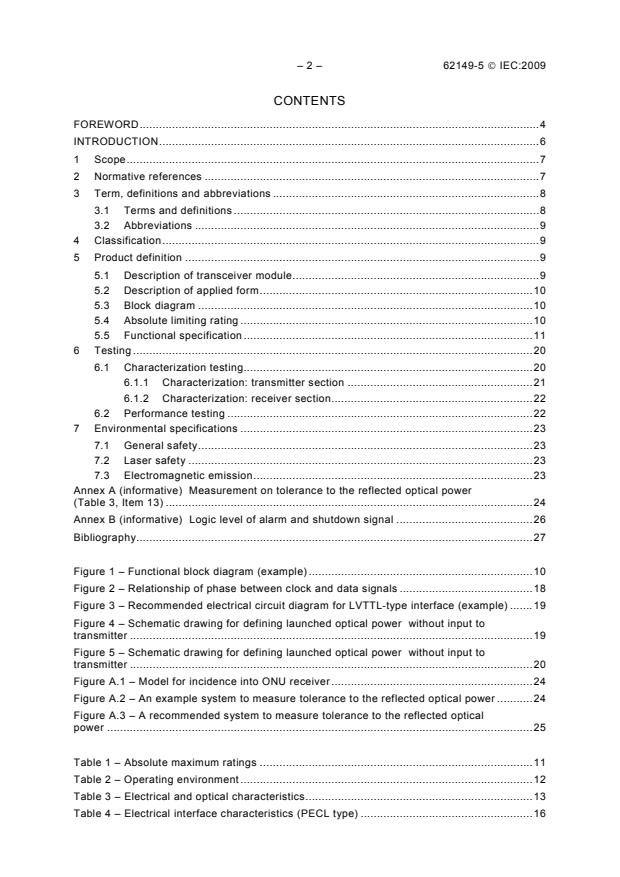
CONTENTS
FOREWORD.4
INTRODUCTION.6
1 Scope.7
2 Normative references .7
3 Term, definitions and abbreviations .8
3.1 Terms and definitions .8
3.2 Abbreviations .9
4 Classification.9
5 Product definition .9
5.1 Description of transceiver module.9
5.2 Description of applied form.10
5.3 Block diagram .10
5.4 Absolute limiting rating .10
5.5 Functional specification .11
6 Testing .20
6.1 Characterization testing.20
6.1.1 Characterization: transmitter section .21
6.1.2 Characterization: receiver section.22
6.2 Performance testing .22
7 Environmental specifications .23
7.1 General safety.23
7.2 Laser safety .23
7.3 Electromagnetic emission.23
Annex A (informative) Measurement on tolerance to the reflected optical power
(Table 3, Item 13) .24
Annex B (informative) Logic level of alarm and shutdown signal .26
Bibliography.27
Figure 1 – Functional block diagram (example) .10
Figure 2 – Relationship of phase between clock and data signals .18
Figure 3 – Recommended electrical circuit diagram for LVTTL-type interface (example) .19
Figure 4 – Schematic drawing for defining launched optical power without input to
transmitter .19
Figure 5 – Schematic drawing for defining launched optical power without input to
transmitter .20
Figure A.1 – Model for incidence into ONU receiver.24
Figure A.2 – An example system to measure tolerance to the reflected optical power .24
Figure A.3 – A recommended system to measure tolerance to the reflected optical
power .
Table 1 – Absolute maximum ratings .
Table 2 – Operating environment .12
Table 3 – Electrical and optical characteristics.13
Table 4 – Electrical interface characteristics (PECL type) .16
62149-5 © IEC:2009 – 3 –
Table 5 – Electrical interface characteristics (LVTTL type).17
Table 6 – Electrical interface characteristics of alarm output voltage (PECL type).17
Table 7 – Electrical interface characteristics of alarm output voltage (LVTTL type) .17
Table 8 – Electrical interface characteristics of shutdown input voltage (both PECL
and LVTTL types) .18
Table 9 – Transmitter section characterization tests .21
Table 10 – Receiver section characterization tests .22
Table 11 – Performance testing plan.23
– 4 – 62149-5 © IEC:2009
INTERNATIONAL ELECTROTECHNICAL COMMISSION
____________
FIBRE OPTIC ACTIVE COMPONENTS AND DEVICES –
PERFORMANCE STANDARDS –
Part 5: ATM-PON transceivers with LD driver and CDR ICs
FOREWORD
1) The International Electrotechnical Commission (IEC) is a worldwide organization for standardization comprising
all national electrotechnical committees (IEC National Committees). The object of IEC is to promote
international co-operation on all questions concerning standardization in the electrical and electronic fields. To
this end and in addition to other activities, IEC publishes International Standards, Technical Specifications,
Technical Reports, Publicly Available Specifications (PAS) and Guides (hereafter referred to as “IEC
Publication(s)”). Their preparation is entrusted to technical committees; any IEC National Committee interested
in the subject dealt with may participate in this preparatory work. International, governmental and non-
governmental organizations liaising with the IEC also participate in this preparation. IEC collaborates closely
with the International Organization for Standardization (ISO) in accordance with conditions determined by
agreement between the two organizations.
2) The formal decisions or agreements of IEC on technical matters express, as nearly as possible, an international
consensus of opinion on the relevant subjects since each technical committee has representation from all
interested IEC National Committees.
3) IEC Publications have the form of recommendations for international use and are accepted by IEC National
Committees in that sense. While all reasonable efforts are made to ensure that the technical content of IEC
Publications is accurate, IEC cannot be held responsible for the way in which they are used or for any
misinterpretation by any end user.
4) In order to promote international uniformity, IEC National Committees undertake to apply IEC Publications
transparently to the maximum extent possible in their national and regional publications. Any divergence
between any IEC Publication and the corresponding national or regional publication shall be clearly indicated in
the latter.
5) IEC provides no marking procedure to indicate its approval and cannot be rendered responsible for any
equipment declared to be in conformity with an IEC Publication.
6) All users should ensure that they have the latest edition of this publication.
7) No liability shall attach to IEC or its directors, employees, servants or agents including individual experts and
members of its technical committees and IEC National Committees for any personal injury, property damage or
other damage of any nature whatsoever, whether direct or indirect, or for costs (including legal fees) and
expenses arising out of the publication, use of, or reliance upon, this IEC Publication or any other IEC
Publications.
8) Attention is drawn to the Normative references cited in this publication. Use of the referenced publications is
indispensable for the correct application of this publication.
9) Attention is drawn to the possibility that some of the elements of this IEC Publication may be the subject of
patent rights. IEC shall not be held responsible for identifying any or all such patent rights.
International Standard IEC 62149-5 has been prepared by subcommittee 86C: Fibre optic
systems and active devices, of IEC technical committee 86: Fibre optics.
This second edition cancels and replaces the first edition published in 2003, and constitutes a
technical revision.
The main changes with respect to the previous edition are listed below:
– Normative references have been updated
– Incorrect “Letter symbols” have been corrected
– Some “Notes” in tables have been revised in order to harmonize with IEC 62150-2 (2004).
62149-5 © IEC:2009 – 5 –
The text of this standard is based on the following documents:
FDIS Report on voting
86C/891/FDIS 86C/916/RVD
Full information on the voting for the approval of this standard can be found in the report on
voting indicated in the above table.
This publication has been drafted in accordance with the ISO/IEC Directives, Part 2.
A list of all parts of IEC 62149 series, published under the general title Fibre optic active
components and devices – Performance standards, can be found on the IEC website.
The committee has decided that the contents of this publication will remain unchanged until
the maintenance result date indicated on the IEC web site under "http://webstore.iec.ch" in
the data related to the specific publication. At this date, the publication will be
• reconfirmed,
• withdrawn,
• replaced by a revised edition, or
• amended.
– 6 – 62149-5 © IEC:2009
INTRODUCTION
Fibre optic transceivers are used to convert electrical signals into optical signals and vice
versa. The optical performance criteria are generally well specified for a number of
internationally agreed applications areas such as ITU-T Recommendation G.983.1 and IEEE
802.3. This standard aims to assure inter-changeability in performance between fibre optic
transceivers for ATM-PON systems supplied by different manufacturers, but does not
guarantee operation between fibre optic transceivers.
Manufacturers using the standards are responsible for meeting the required performance
and/or reliability and quality assurance under a recognized scheme.
62149-5 © IEC:2009 – 7 –
FIBRE OPTIC ACTIVE COMPONENTS AND DEVICES –
PERFORMANCE STANDARDS –
Part 5: ATM-PON transceivers with LD driver and CDR ICs
1 Scope
This part of IEC 62149 specifies performance on the transceiver modules for asynchronous-
transfer-mode passive optical network (ATM-PON) systems recommended by the International
Telecommunication Union (ITU) in ITU-T Recommendation G.983.1.
2 Normative references
The following referenced documents are indispensable for the application of this document.
For dated references, only the edition cited applies. For undated references, the latest edition
of the referenced document (including any amendments) applies.
IEC 60068-2-6:2007, Environmental testing – Part 2-6: Tests – Test Fc: Vibration (sinusoidal)
IEC 60068-2-27:2008, Environmental testing – Part 2-27: Tests – Test Ea and guidance:
Shock
IEC 60825-1:2007, Safety of laser products – Part 1: Equipment classification and
requirements
IEC 60950-1:2005, Information technology equipment – Safety – Part 1: General requirements
IEC 61000-6-3, Electromagnetic compatibility (EMC) – Part 6-3: Generic standards –
Emission standard for residential, commercial and light-industrial environments
IEC 61280-1-1:1998, Fibre optic communication subsystem basic test procedures – Part 1-1:
Test procedures for general communication subsystems – Transmitter output optical power
measurement for single-mode optical fibre cable
IEC 61280-1-3:1998, Fibre optic communication subsystem basic test procedures – Part 1-3:
Test procedures for general communication subsystems – Central wavelength and spectral
width measurement
IEC 61280-2-2:2008, Fibre optic communication subsystem test procedures – Part 2-2: Digital
systems – Optical eye pattern, waveform and extinction ratio measurement
IEC 61300-2-4:1995, Fibre optic interconnecting devices and passive components – Basic
test and measurement procedures – Part 2-4: Tests – Fibre/cable retention
IEC 61300-2-17:2003, Fibre optic interconnecting devices and passive components – Basic
test and measurement procedures – Part 2-17: Tests – Cold
IEC 61300-2-18:2005, Fibre optic interconnecting devices and passive components – Basic
test and measurement procedures – Part 2-18: Tests – Dry heat – High temperature
endurance
– 8 – 62149-5 © IEC:2009
IEC 61300-2-19:2005, Fibre optic interconnecting devices and passive components – Basic
test and measurement procedures – Part 2-19: Tests – Damp heat (steady state)
IEC 61300-2-22:2007, Fibre optic interconnecting devices and passive components – Basic
test and measurement procedures – Part 2-22: Tests – Change of temperature
IEC 61300-3-6:2003, Fibre optic interconnecting devices and passive components – Basic
test and measurement procedures – Part 3-6: Examinations and measurements – Return loss
IEC 61753-1:2007, Fibre optic interconnecting devices and passive components performance
standard – Part 1: General and guidance for performance standards
IEC 61931, Fibre optic – Terminology
IEC62150-2:2004, Fibre optic active components and devices – Test and measurement
procedures - Part 2: ATM-PON transceivers
ITU-T Recommendation G.983.1: Broadband optical access systems based on Passive
Optical Networks (PON)
3 Term, definitions and abbreviations
For the purposes of this document, the following terms, definitions and abbreviations apply.
Further terminology concerning related physical concepts, types of devices, general terms,
and terms related to ratings and characteristics can be found in IEC 61931.
It is also recommended to refer to ITU-T Recommendation G.983.1.
3.1 Terms and definitions
3.1.1
optical access network
OAN
set of access links sharing the same network-side interfaces and supported by optical access
transmission systems.
NOTE The OAN may include a number of ODNs connected to the same OLT.
3.1.2
optical distribution network
ODN
apparatus or component that provides the optical transmission means from the OLT to the
users, and vice versa. It utilizes passive optical components
3.1.3
optical line termination
OLT
apparatus that provides the network-side interface of the OAN, and is connected to one or
more ODNs
3.1.4
optical network unit
ONU
apparatus that provides (directly or remotely) the user-side interface of the OAN, and is
connected to the ODN
62149-5 © IEC:2009 – 9 –
3.2 Abbreviations
ATM-PON Asynchronous transfer mode passive optical network
ATT Attenuator
BER Bit error ratio
CDR Clock and data recovery
DUT Device under test
ERD Error ratio detector
EX Extinction ratio
FTT Cab/C/B/H Fibre to the cabinet/curb/building/home
IC Integrated circuit
LD Laser diode
MLM Multi-longitudinal mode
PPG Pulse pattern generator
RMS Root mean square
SLM Single-longitudinal modes
4 Classification
Fibre optic transceiver modules are classified into 5 types of forms according to the
combination of mating types of electrical and optical interfaces (for details, see IEC 62148-1).
Those combinations include the following:
Type 1: Fibre optic connector interface with direct solderable type electrical terminals.
Type 2: Fibre optic connector interface with plug-in type electrical terminals.
Type 3: Fibre optic pigtail interface with direct solderable type electrical terminals.
Type 4: Fibre optic pigtail interface with plug-in type electrical terminals.
Type 5: Modules are not classified into type 1 to type 4. (A typical example is a module that
has both electrical connectors and non-connector type terminals as an electrical
interface such as a coaxial connector for signal and lead terminals for the power
supply.)
5 Product definition
5.1 Description of transceiver module
Information on the following devices constituting the optical transceiver module shall be
stated. This statement shall include details of technologies. For example, technologies used
for ICs such as CMOS, bipolar, etc., shall be described.
• For a transmitter:
– laser diode (in this description, a single- or a multi-longitudinal mode type shall be
specified);
– monitoring photodiode;
– driver IC;
– thermal sensor (where appropriate).
• For a receiver:
– photodiode;
– pre-amp IC;
– 10 – 62149-5 © IEC:2009
– data/clock recovery IC.
• For a wavelength division multiplexer device:
– technology used for this device.
• For a package:
– refer to the IEC document number standardized as a package interface standard.
5.2 Description of applied form
According to ITU-T Recommendation G.983.1, applied form of nominal bit rate, class (class B
or class C), applied unit (ONU or OLT), and the number of fibres (one for duplex working or
two for simplex working) shall be stated.
5.3 Block diagram
Block diagram or equivalent circuit information on the optical transceiver module shall be
given.
The following terminals may be distinguished:
• supply terminals, i.e., terminals intended to be connected to the power supplies;
• input and output terminals, i.e., terminals into or out of which signals are passed.
The term “signal” includes both pulse and more complex waveforms, and includes strobe or
control pulses.
Power
Optical
supply
input/output
Data input
Data output
Clock input Clock output
Bias control
(where appropriate)
Shutdown Alarm
Earth
IEC 1489/09
Figure 1 – Functional block diagram (example)
5.4 Absolute limiting rating
Absolute limiting (maximum) ratings imply that no catastrophic damage will occur if the
product is subjected to these ratings for short periods, provided each limiting parameter is in
isolation and all other parameters have values within the normal performance parameters. It
should not be assumed that limiting values of more than one parameter could be applied at
any one time.
62149-5 © IEC:2009 – 11 –
Table 1 – Absolute maximum ratings
Letter
Items Condition Requirements Units
symbol
Minimum Maximum
a
Storage temperature T –40 85
°C
stg
Storage humidity H 5 95 %
stg
Bend radius of pigtail for type 3, 4, and 5
transceivers (at specified distance from the r 30 mm
case)
Pulse cycle:
b 2
Shock 18 ms 300 m/s
3 times/axis
10 Hz -55 Hz,
c 2
Vibration 3 axes, 100 m/s
1,5 mm, 2 h
Tensile force on devices with pigtail
d
Buffer-coated fibre 5
F N
d
Reinforced fibre 100
Electrical limiting values
– Power supply voltage V –0,5 4,0 V
SUPmax
– Input voltage V –0,5 V V
INmax sup
– Output voltage V 0 V +0,5 V
OUTmax sup
– Output current
PECL interface I 0 50 mA
OUTmax
LVTTL interface –20 20
Optical limiting values
– Permissible input power P –5 dBm
in
a
Ambient temperature and humidity for outdoor ONU is under further study in ITU-T Recommendation
G.983.1, thus these specifications may be varied in the future.
b
IEC 60068-2-27 shall be referred to for detail.
c
IEC 60068-2-6 shall be referred to for detail.
d
For requirements see IEC 61753-1.
5.5 Functional specification
Electro-optical characteristics for the items in Table 3 shall be satisfied at the operating
environmental conditions specified in Table 2.
NOTE Optical characteristics specified in ITU-T Recommendation G.983.1 should be satisfied.
Each electrical and optical characteristics of this clause shall be measured under conditions
specified in each reference.
Each electrical and optical characteristic of this clause shall be stated under specified worst-
case conditions, with respect to the recommended range of operating conditions as stated.
The measuring method of each electrical and optical characteristics specified in Table 3 shall
be measured based on the method stated in the reference of each row.
– 12 – 62149-5 © IEC:2009
Table 2 – Operating environment
Letter
Items Requirements Units
symbol
Minimum Typical Maximum
Power supply voltage V 3,135 3,3 3,465 V
SUP
a
Operating case temperature T –5 75
case °C
a
Ambient humidity RH 5 95 %
a
Operating case temperature and humidity for outdoor ONU is under further study in ITU-T
Recommendation G.983.1, thus these specifications may be varied in the future.
62149-5 IEC:2009 – 13 –
©
Table 3 – Electrical and optical characteristics
Requirements
Item number Items Letter symbol Units Reference
Minimum Typical Maximum
1 Nominal bit rate B 155,52 Mb/s
a
Mean launched power
2 – Class B P –4 +2 dBm IEC 61280-1-1
mean
– Class C –2 +4
3 Transmitter wavelength λ 1260 1 360 nm IEC 61280-1-3
b
4 Mask of transmitter eye diagram –
5 Extinction ratio Ex 10 dB IEC 61280-2-2
6 For MLM laser, maximum RMS width Δλ 5,8 nm IEC 61280-1-3
7 For SLM laser, maximum -20 dB width 1,0 nm IEC 61280-1-3
Δλ
8 For SLM laser, minimum side mode suppression ratio SMSR 30 dB IEC 61280-1-3
9 Maximum reflectance, measured at transmitter wavelength R –6 dB IEC 61300-3-6, 4.1
TX
Receiver overload:
10 – Class B S –8 dBm IEC 62150-2
O
– Class C –11
Receiver sensitivity:
11 – Class B S –30 dBm IEC 62150-2
– Class C –33
12 Maximum reflectance, measured at receiver wavelength R –20 dB IEC 61300-3-6, 4.1
RX
ITU-T G.957
c
13 Tolerance to the reflected optical power 10 dB
Appendix III
14 Clock input voltage (high) See Tables 4 and 5
15 Clock input voltage (low) See Tables 4 and 5
16 Clock input voltage (swing centre) See Tables 4 and 5
17 Data input voltage (high) See Tables 4 and 5
18 Data input voltage (low) See Tables 4 and 5
19 Data input voltage (swing centre) See Tables 4 and 5
– 14 – 62149-5 © IEC:2009
Table 3 (continued)
Requirements
Item number Items Letter symbol Units Reference
Minim Maxi
Typical
um mum
20 Clock output voltage (high) See Tables 4 and 5
21 Clock output voltage (low) See Tables 4 and 5
22 Data output voltage (high) See Tables 4 and 5
23 Data output voltage (low) See Tables 4 and 5
d
24 Alarm output voltage (high) See Tables 6 and 7 IEC 62150– 2
d
25 Alarm output voltage (low) See Tables 6 and 7 IEC 62150– 2
e
26 Shutdown input voltage (high) See Table 8 IEC 62150– 2
e
27 Shutdown input voltage (low) See Table 8
IEC 62150– 2
f
28 Bias control voltage (high) V
BiasH
f
29 Bias control voltage (low) V
BiasL
30 Line code Scrambled NRZ
g
Launched optical power without input to transmitter
31 - Class B –40 dBm IEC 61280-1-1
- Class C –43
g
32 Tolerance to the transmitter incident light power –15 dB
b
33 Consecutive identical digit immunity
b
34 Jitter generation
b
35 Jitter tolerance
b
36 Jitter transfer
62149-5 IEC:2009 – 15 –
©
Table 3 (continued)
a
Pseudo random data shall be put into the transmitter according to the specification of 8.2.6.3 of ITU-T Recommendation G.983.1.
b
These items shall be specified so as to meet the specifications of ITU-T Recommendation G. 983.1.
c
This item shall be measured based on the measuring method described in the reference. See Annex A for more detail.
d
With logic ‘Low’, an alarm signal is effective. The alarm test shall be done whether logic ‘Low’ is put out when no optical power is launched to the transceiver,
and logic ‘High’ is put out when optical power more than that specified in Item 11 is launched to the transceiver (see Annex B).
e
With logic ‘Low’, a shutdown signal is effective. The shutdown test shall be done whether optical power less than that specified in Item 31 is launched when
logic ‘Low’ is put into the ‘Shutdown’ terminal, and optical powerwithin the range specified in Item 2 is launched when logic ‘High’ is put into the ‘Shutdown’
terminal (see Annex B).
f
These items shall be specified between vendors and users.
g
Measurement methods on these items are stated in this clause.
– 16 – 62149-5 © IEC:2009
The clock and data input/output interface shall be satisfied with either the specification listed
in Table 4 or that in Table 5. The interface specifications characterized by each table are
normally referred to as PECL and LVTTL interfaces, respectively. New interface dimensions
will be added properly.
Table 4 – Electrical interface characteristics (PECL type)
Requirements Units
Letter
Items
symbol
Minimum Typical Maximum
V
CINH
Clock input voltage (high) –1,17 –0,88 V
- V
SUP
–1,43
V
CINL
Clock input voltage (low) –1,81 V
- V
SUP
V
DINH
Data input voltage (high) –1,17 –0,88 V
- V
SUP
V
DINL
Data input voltage (low) –1,81 –1,43 V
- V
sup
V
a
COUTH
Clock output voltage (high) –0,96 V
- V
SUP
V
a
COUTL
Clock output voltage (low) –1,71 V
- V
SUP
V
a
DOUTH
Data output voltage (high) –0,96 V
- V
SUP
V
a
DOUTL
Data output voltage (low) –1,71 V
- V
SUP
a
V –2V.
Outputs terminated to
SUP
62149-5 © IEC:2009 – 17 –
Table 5 – Electrical interface characteristics (LVTTL type)
Requirements Units
Letter
Items
symbol
Minimum Typical Maximum
V
CINL
Clock input voltage (high) V V V
CINH SUP
+0,3
V
CINH
Clock input voltage (low) V 0 V
CINL
–0,3
V /2 V /2
SUP SUP
V
Clock input voltage (swing centre) V
Ccenter
–0,1 +0,1
V
DINL
V V
Data input voltage (high) V
DINH SUP
+0,3
V
DINH
Data input voltage (low) V V
DINL
+0,3
V /2 V /2
SUP SUP
Data input voltage (swing centre) V V
Dcenter
–0,1 +0,1
V
a
TT
Clock output voltage (high) V V
COUTH
+0,4
V
a
TT
Clock output voltage (low) V V
COUTL
–0,4
V
a
TT
Data output voltage (high) V V
DOUTH
+0,4
V
a
TT
Data output voltage (low) V V
DOUTL
–0,4
a
V = 1,5 V to 1,8 V.
TT
Alarm output interface shall be satisfied with either specification listed in Table 6 or that in
Table 7. The interface specifications characterized by each table are normally referred to as
PECL and LVTTL interfaces, respectively. New interface dimensions will be added properly.
Table 6 – Electrical interface characteristics of alarm output voltage (PECL type)
Letter Requirements Units
Items
symbol
Minimum Typical Maximum
a
Alarm output voltage (high) V 2,4 V
ALH
a
Alarm output voltage (low) V 0,4 V
ALL
a
Test shall be performed with current at high level (I ) = –2 mA and current at low level (I )
ALH ALL
= 2 mA at V between 3,135 V and 3,465 V.
SUP
Table 7 – Electrical interface characteristics of alarm output voltage (LVTTL type)
Requirements Units
Letter
Items
symbol
Minimum Typical Maximum
V
a
SUP
Alarm output voltage (high) V V
ALH
- 0,2
a
Alarm output voltage (low) V 0,2 V
ALL
a
Test shall be performed with current at high level (I ) = –100 μA and current at low level
ALH
(I ) = 100 μA at V between 3,135 V and 3,465 V.
ALL SUP
Shutdown input interface shall be satisfied with either specifications listed in Table 8. New
interface dimensions will be added properly.
– 18 – 62149-5 © IEC:2009
Table 8 – Electrical interface characteristics of shutdown input voltage
(both PECL and LVTTL types)
Requirements Units
Letter
Items
symbol
Minimum Typical Maximum
V
SUP
a
Shutdown input voltage (high) V 2,0 V
SDH
+ 0,3
a
Shutdown input voltage (low) V –0,3 0,8 V
SDL
a
Test shall be performed with V between 3,135 V and 3,465 V.
SUP
NOTE The interfaces listed in Tables 6, 7 and 8 refer to EIA/JEDEC JESD8-B, with the exception of power supply
voltage V that is definitely specified in Table 2.
SUP
Relationship of the phase between clock and data signals is shown in Figure 2. Phase of data
signals are timed so that data signals are latched at a fall time of clock.
Clock
Data
IEC 1490/09
Figure 2 – Relationship of phase between clock and data signals
Examples of recommended electrical circuit diagrams for LVTTL-type interface are shown in
Figure 3.
62149-5 © IEC:2009 – 19 –
V
TT Clock/Data
Clock/Data Input
Output
50 Ω
50 Ω
82 Ω
a)
V /V
out in IEC 1491/09
V
CC
Clock/Data
Clock/Data
Input
Output
100 Ω 100 Ω
82 Ω
b)
100 Ω 100 Ω
Ground
V /V
out in
IEC 1492/09
Figure 3 – Recommended electrical circuit diagram for LVTTL-type interface (example)
Launched optical power without input to transmitter (Table 3, Item 31) is schematically
defined in Figure 4. The measuring method of the power shall basically follow IEC 61280-1-1,
but it shall be specified in detail between vendors and users.
Burst signals
Launched optical power
without input to transmitter
IEC 1493/09
Figure 4 – Schematic drawing for defining launched optical power
without input to transmitter
Tolerance to the transmitter incident light power (Table 3, Item 32) is measured, for example,
by an experimental setup shown in Figure 5. The value of reflection at the reflector is set so
that incident light power back to the transmitter is 15 dB less than that of mean transmitter
Optical power level
– 20 – 62149-5 © IEC:2009
launching power. Pass/fall criteria depend on whether or not the waveform of signals
transmitted from the DUT and monitored at the waveform monitor satisfies the eye mask
specified in Table 3, Item 4.
Waveform High return loss
monitor termination
Optical
coupler
Reflector DUT
–15dB
IEC 1494/09
Figure 5 – Schematic drawing for defining launched optical power
without input to transmitter
6 Testing
Initial characterization and qualification shall be undertaken. Qualification maintenance is
carried using periodic testing programs. Test conditions for all tests unless otherwise stated
are 25 °C ± 2 °C
6.1 Characterization testing
Characterization testing including both transmitter and receiver sections shall be carried out
based on the specifications listed in Table 9 for the transmitter section and Table 10 for the
receiver section. These testing shall be carried out on at the least 11 products taken from a
manufacturing lot for each user. The testing lot shall be specified by each supplier. If any
changes occur in the design of the transceiver, the testing shall be carried out again.
62149-5 © IEC:2009 – 21 –
6.1.1 Characterization: transmitter section
Table 9 – Transmitter section characterization tests
Test limit Test limit
Parameters Test conditions Unit
Minimum Maximum
As a minimum, 11 devices taken from a
manufacturing lot for each user to be
measured at case temperatures of (–5 ±
2) °C, (25 ± 2) °C and (75 ± 2) °C and V at
cc
(V –5 %) V, (V ) V and (V + 5 %) V
nom nom nom
Single-mode fibre, PRBS 2 – 1 at
155,52 Mbit/s modulation
Mean launched power
– Class B
–4,0 +2,0 dBm
– Class C
–2,0 +4,0
Central wavelength
– 1at 155,52 Mbit/s modulation 1 260 1 360 nm
PRBS 2
PRBS 2 – 1 at 155,52 Mbit/s modulation
Spectral width
– MLM laser 5,8
nm
– SLM laser 1,0
Extinction ratio 155,52 Mbit/s square wave 10 dB
Fourth-order Thomson filter (Cut-off frequency
a 23
Mask test of eye diagram is (0,75 × 155,52) MHz), PRBS 2 – 1 at No hits No hits
155,52 Mbit/s
PRBS 2 – 1 at 155,52 Mbit/s modulation,
Shutdown input voltage: low level
Shutdown test of launched
dBm
power – Class B –40
– Class C –43
a
Mask of the eye diagrams for downstream and upstream transmissions are specified in ITU-T Recommendation
G.983.1.
– 22 – 62149-5 © IEC:2009
6.1.2 Characterization: receiver section
Table 10 – Receiver section characterization tests
Test limit Test limit
Parameters Test conditions Unit
Minimum Maximum
As minimum, 11 devices taken from an
initial manufacturing lot to be measured
at case temperatures of (–5 ± 2) °C,
(25 ± 2) °C and (75 ± 2) °C and V at
cc
(V – 5 %) V, (V ) V and
nom nom
(V + 5 %) V
nom
PRBS modulation NRZ at 155,52 Mbit/s
Sensitivity at 1E-10
assuming 10dB extinction ratio source
BER
dBm
–30,0
– Class B
–33,0
– Class C
PRBS modulation NRZ at 155,52 Mbit/s
Overload at 1E-10
assuming 10 dB extinction ratio source
BER
dBm
–8
– Class B
–11
– Class C
PRBS modulation NRZ at 155,52 Mbit/s
assuming 10 dB extinction ratio source
a
Alarm on threshold dBm
– Class B –30,0
– Class C –33,0
a
Alarm signal is effective with logic ‘low’ specified in Tables 6 and 7 when optical power less than
that of threshold is launched to the transceiver.
6.2 Performance testing
Performance testing is undertaken to assure reliability of products when characterization
testing is complete. The testing items, definite testing conditions and pass/fail criteria are
listed in Table 11. This testing shall be carried out on at least 11 products taken from a
manufacturing lot for each user. The testing lot shall be specified by each supplier. The
products may be new or sourced from a previous test.
62149-5 © IEC:2009 – 23 –
Table 11 – Performance testing plan
a
Items Reference Condition Criteria Failure
Mechanical shock IEC 60068-2-27 300 m/s , 18 ms 3 times/axis
100 m/s , 10-55 Hz, 3 axes,
Vibration IEC 60068-2-6
1,5 mm, 2 h
100 N ± 2 N at 5 N/s,
120 s duration for reinforced
cables
b
Fibre pull IEC 61300-2-4
5 N ± 0,5 N at 0,5 N/s,
60 s duration for buffered
fibres
⎜ΔP ⎜ ≤ 1 dB
mean
⎜ΔS ⎜ ≤ 1 dB 0/11
–40 °C to + 85 °C
min
b
Temperature cycling IEC 61300-2-22 1 h duration at extremes,
at 25 °C
more than 12 cycles
+85 °C, more than 96 h
b
High temperature storage IEC 61300-2-18
duration
–40 °C, more than 96 h
b
Low temperature storage IEC 61300-2-17
duration
+40 °C ± 2 °C,
b
Damp heat IEC 61300-2-19
RH: 93 % ± 2 %,
96 h duration
Flammability IEC 60332-3-24
a
Pass/fail criteria are specified to be 1 dB maximum change (or less) in mean launched power and receiver
sensitivity, respectively. The quantity of 1 dB is determined to include the 0,5 dB pass/fail criteria specified
in Telecordia GR-468-CORE and a 0,5 dB margin in measurement error.
b
The testing conditions of these items may refer to Telcordia GR-468-CORE instead of IEC 61753-1 if a user
requires it.
7 Environmental specifications
7.1 General safety
All products meeting this standard shall conform to IEC 60950-1.
7.2 Laser safety
Fibre optic transceivers shall be class 1 laser-certified under any condition of operation. This
includes single-fault conditions whether coupled into a fibre or out of an open bore.
Transceivers shall be certified to be in conformance to IEC 60825-1.
Laser safety standards and regulations require that the manufacturer of a laser product
provide information about the product’s laser, safety features, labelling, use, maintenance and
service. This documentation shall explicitly define requirements and usage restrictions on the
host system necessary to meet these safety certifications.
7.3 Electromagnetic emission
Products defined in this specification shall comply with IEC 61000-6-3 for the limitation of
electromagnetic interference.
– 24 – 62149-5 © IEC:2009
Annex A
(informative)
Measurement on tolerance to the reflected optical power
(Table 3, Item 13)
Tolerance to the reflected optical power is defined in ITU-T Recommendation G.983.1 as the
allowable ratio of optical input average power of O to reflected optical average power at
rd
minimum receiving sensitivity when multiple reflected light is regarded as a noise light at O .
rd
Here, O is the optical interface at the reference point between ONU and the ODN for the
rd
downstream directions. A specified value of 10 dB in Item 13 means that the BER
specification shall be satisfied even if noise light with a power of 10 dB less than the receiver
sensitivity is put into the transceiver. In addition, the influence of reflectance into ONU
receiver is described in Appendix B.2.2. in ITU-T Recommendation G.983.1. Figure A.1 shows
the model for the incidence into the ONU receiver that is described in the Appendix B.2.2.
This model considers that transmitted signals from the ONU No. 1 returns to the ONU No. 1
receiver as a noise through the reflection of ODN and through a WDM. Thus the noise light is
the reflected light of burst signals transmitted from the ONU itself with wavelength between
1 260 nm and 1 360 nm that is specified in Table 3, Item 3.
ONU No. 1
TX
P
Oru_1
O
rd
WDM
RX
R
upper
OLT
Star coupler
ONU No. N
IEC 1495/09
Figure A.1 – Model for incidence into ONU receiver
According to the model described above, burst signals with 1 300 nm band wavelength shall
be used as a noise by an example measuring system shown in Figure A.2. It should be noted
that the reflected optical power to the receiver section (RX) in the ONU, which i
...
Questions, Comments and Discussion
Ask us and Technical Secretary will try to provide an answer. You can facilitate discussion about the standard in here.
Loading comments...