


IEC 62091:2007
(Main)Low-voltage switchgear and controlgear - Controllers for drivers of stationary fire pumps
Low-voltage switchgear and controlgear - Controllers for drivers of stationary fire pumps
This International Standard applies to controllers intended for starting, controlling and stopping stationary fire pumps, including automatic and non-automatic types for alternating current electric motor or diesel engine-driven fire pumps. It is anticipated that a controller only controls a single driver. This first edition cancels and replaces the technical specification published in 2003. It constitutes a technical revision and now has the status of an International Standard.
Appareillage à basse tension - Appareils de commande des entraînements de pompes à incendie fixes
La présente Norme internationale s'applique aux appareils de commande destinés au démarrage, à la commande et à l'arrêt des pompes à incendie fixes, incluant les types automatiques et non automatiques de pompes à incendie pilotées par un moteur électrique à courant alternatif ou par un moteur diesel. Il est convenu qu'un appareil de commande contrôle seulement un entraînement unique. Cette première édition annule et remplace la spécification technique publiée en 2003. Elle constitue une révision technique qui conduit au statut de Norme internationale.
General Information
- Status
- Published
- Publication Date
- 23-Jan-2007
- Technical Committee
- SC 121A - Low-voltage switchgear and controlgear
- Current Stage
- PPUB - Publication issued
- Start Date
- 24-Jan-2007
- Completion Date
- 31-May-2007
Relations
- Effective Date
- 28-Jun-2024
Overview
IEC 62091:2007 is an international standard developed by the International Electrotechnical Commission (IEC) that specifies the requirements for controllers used in low-voltage switchgear and controlgear systems designed for drivers of stationary fire pumps. This standard applies to controllers intended for starting, controlling, and stopping stationary fire pumps powered by alternating current (AC) electric motors or diesel engines. It covers both automatic and non-automatic types and is meant to ensure consistent performance, safety, and reliability for fire pump control systems.
Having replaced the earlier technical specification from 2003, IEC 62091:2007 offers a comprehensive technical revision that provides up-to-date guidelines aligned with current technology in fire pump controllers. The standard is essential for manufacturers, system integrators, and safety engineers involved in the design, installation, and maintenance of fire pump control systems.
Key Topics
Scope and Classification
Defines the types of fire pump controllers covered - electric motor-driven, diesel engine-driven, residential fire pumps (electric-only), and foam pump controllers. Classification helps in identifying specific control features and functional requirements.Electrical Characteristics
Specifies essential electrical parameters such as rated values, operational voltages, and control signals that ensure proper operation of fire pump controllers.Construction and Functional Requirements
Details design and construction guidelines to enhance durability and reliability under normal service, mounting, and transport conditions. Includes requirements for component performance and control logic prioritization.Automatic and Manual Operations
Describes modes of operation including starting, running, and stopping sequences for pumps driven by electric motors or diesel engines, addressing scenarios like pressure-activated and non-pressure activated automatic operation.Testing and Compliance
Outlines test protocols for verifying conformity to construction, functional performance, electromagnetic compatibility (EMC), and safety requirements, ensuring that controllers meet stringent operational standards.Marking and Documentation
Specifies requirements for clear labeling, identification, and provision of installation, operation, and maintenance instructions to aid safe and effective use.
Applications
IEC 62091:2007 is relevant in various settings where reliable fire suppression systems are critical, including:
Building Safety Systems
Ensuring dependable pump control in commercial, residential, and industrial buildings to maintain water supply for fire sprinkler systems.Industrial Facilities
Controlling diesel or electric motor-driven fire pumps used in hazardous or remote locations requiring robust and automatic fire protection.Municipal and Infrastructure Projects
Utilized in water supply systems for firefighting in urban infrastructure, ensuring compliance with international safety standards.Maintenance and Testing Services
Provides a standardized framework for commissioning, inspecting, and testing fire pump controllers to guarantee operational readiness.
Using IEC 62091 ensures that controllers for all types of stationary fire pumps perform with high safety, efficiency, and reliability, which is vital in minimizing fire damage and enhancing public safety.
Related Standards
When implementing IEC 62091:2007, the following related standards may be referenced for complementary guidance:
- IEC 60034-1: Rotating electrical machines - General requirements, relevant to the electric motors driving fire pumps.
- IEC 60947 series: Low-voltage switchgear and controlgear, providing standards on electrical components potentially integrated into fire pump controllers.
- NFPA 20: Standard for the Installation of Stationary Pumps for Fire Protection - widely used alongside IEC standards in fire protection design.
- IEC 61000 series: Electromagnetic compatibility standards ensuring compatibility of controllers with other electrical systems.
By aligning fire pump controller design and installation with IEC 62091 and related standards, stakeholders can achieve harmonized international compliance, improved safety outcomes, and enhanced operational reliability in fire protection systems.
Keywords: IEC 62091, fire pump controllers, low-voltage switchgear, diesel engine fire pump, electric fire pump, stationary fire pumps, fire protection equipment, fire pump controlgear, automatic fire pump controller, IEC standards, fire safety systems.
Get Certified
Connect with accredited certification bodies for this standard

Intertek Testing Services NA Inc.
Intertek certification services in North America.

UL Solutions
Global safety science company with testing, inspection and certification.

ANCE
Mexican certification and testing association.
Sponsored listings
Frequently Asked Questions
IEC 62091:2007 is a standard published by the International Electrotechnical Commission (IEC). Its full title is "Low-voltage switchgear and controlgear - Controllers for drivers of stationary fire pumps". This standard covers: This International Standard applies to controllers intended for starting, controlling and stopping stationary fire pumps, including automatic and non-automatic types for alternating current electric motor or diesel engine-driven fire pumps. It is anticipated that a controller only controls a single driver. This first edition cancels and replaces the technical specification published in 2003. It constitutes a technical revision and now has the status of an International Standard.
This International Standard applies to controllers intended for starting, controlling and stopping stationary fire pumps, including automatic and non-automatic types for alternating current electric motor or diesel engine-driven fire pumps. It is anticipated that a controller only controls a single driver. This first edition cancels and replaces the technical specification published in 2003. It constitutes a technical revision and now has the status of an International Standard.
IEC 62091:2007 is classified under the following ICS (International Classification for Standards) categories: 29.130.10 - High voltage switchgear and controlgear. The ICS classification helps identify the subject area and facilitates finding related standards.
IEC 62091:2007 has the following relationships with other standards: It is inter standard links to IEC TS 62091:2003. Understanding these relationships helps ensure you are using the most current and applicable version of the standard.
IEC 62091:2007 is available in PDF format for immediate download after purchase. The document can be added to your cart and obtained through the secure checkout process. Digital delivery ensures instant access to the complete standard document.
Standards Content (Sample)
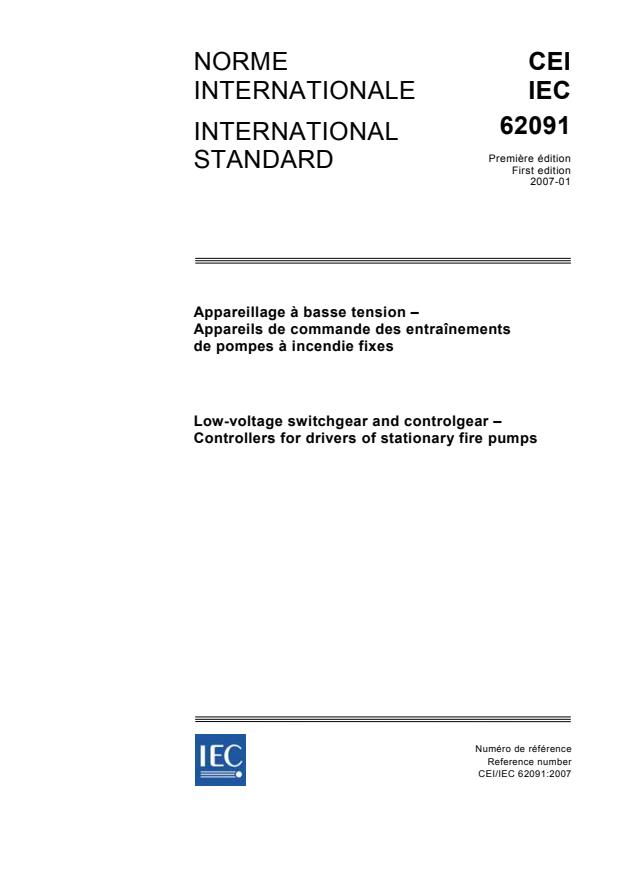
NORME CEI
INTERNATIONALE
IEC
INTERNATIONAL
Première édition
STANDARD
First edition
2007-01
Appareillage à basse tension –
Appareils de commande des entraînements
de pompes à incendie fixes
Low-voltage switchgear and controlgear –
Controllers for drivers of stationary fire pumps
Numéro de référence
Reference number
CEI/IEC 62091:2007
Numérotation des publications Publication numbering
Depuis le 1er janvier 1997, les publications de la CEI As from 1 January 1997 all IEC publications are
sont numérotées à partir de 60000. Ainsi, la CEI 34-1 issued with a designation in the 60000 series. For
devient la CEI 60034-1. example, IEC 34-1 is now referred to as IEC 60034-1.
Editions consolidées Consolidated editions
Les versions consolidées de certaines publications de la The IEC is now publishing consolidated versions of its
CEI incorporant les amendements sont disponibles. Par publications. For example, edition numbers 1.0, 1.1
exemple, les numéros d’édition 1.0, 1.1 et 1.2 indiquent and 1.2 refer, respectively, to the base publication,
respectivement la publication de base, la publication de the base publication incorporating amendment 1 and
base incorporant l’amendement 1, et la publication de the base publication incorporating amendments 1
base incorporant les amendements 1 et 2. and 2.
Informations supplémentaires Further information on IEC publications
sur les publications de la CEI
Le contenu technique des publications de la CEI est The technical content of IEC publications is kept
constamment revu par la CEI afin qu'il reflète l'état under constant review by the IEC, thus ensuring that
actuel de la technique. Des renseignements relatifs à the content reflects current technology. Information
cette publication, y compris sa validité, sont dispo- relating to this publication, including its validity, is
nibles dans le Catalogue des publications de la CEI available in the IEC Catalogue of publications
(voir ci-dessous) en plus des nouvelles éditions, (see below) in addition to new editions, amendments
amendements et corrigenda. Des informations sur les and corrigenda. Information on the subjects under
sujets à l’étude et l’avancement des travaux entrepris consideration and work in progress undertaken by the
par le comité d’études qui a élaboré cette publication, technical committee which has prepared this
ainsi que la liste des publications parues, sont publication, as well as the list of publications issued,
également disponibles par l’intermédiaire de: is also available from the following:
• Site web de la CEI (www.iec.ch) • IEC Web Site (www.iec.ch)
• Catalogue des publications de la CEI • Catalogue of IEC publications
Le catalogue en ligne sur le site web de la CEI The on-line catalogue on the IEC web site
(www.iec.ch/searchpub) vous permet de faire des (www.iec.ch/searchpub) enables you to search by a
recherches en utilisant de nombreux critères, variety of criteria including text searches,
comprenant des recherches textuelles, par comité technical committees and date of publication. On-
d’études ou date de publication. Des informations en line information is also available on recently
ligne sont également disponibles sur les nouvelles issued publications, withdrawn and replaced
publications, les publications remplacées ou retirées, publications, as well as corrigenda.
ainsi que sur les corrigenda.
• IEC Just Published • IEC Just Published
Ce résumé des dernières publications parues This summary of recently issued publications
(www.iec.ch/online_news/justpub) est aussi dispo- (www.iec.ch/online_news/justpub) is also available
nible par courrier électronique. Veuillez prendre by email. Please contact the Customer Service
contact avec le Service client (voir ci-dessous) Centre (see below) for further information.
pour plus d’informations.
• Service clients • Customer Service Centre
Si vous avez des questions au sujet de cette If you have any questions regarding this
publication ou avez besoin de renseignements publication or need further assistance, please
supplémentaires, prenez contact avec le Service contact the Customer Service Centre:
clients:
Email: custserv@iec.ch Email: custserv@iec.ch
Tél: +41 22 919 02 11 Tel: +41 22 919 02 11
Fax: +41 22 919 03 00 Fax: +41 22 919 03 00
.
NORME CEI
INTERNATIONALE
IEC
INTERNATIONAL
Première édition
STANDARD
First edition
2007-01
Appareillage à basse tension –
Appareils de commande des entraînements
de pompes à incendie fixes
Low-voltage switchgear and controlgear –
Controllers for drivers of stationary fire pumps
© IEC 2007 Droits de reproduction réservés ⎯ Copyright - all rights reserved
Aucune partie de cette publication ne peut être reproduite ni No part of this publication may be reproduced or utilized in any
utilisée sous quelque forme que ce soit et par aucun procédé, form or by any means, electronic or mechanical, including
électronique ou mécanique, y compris la photocopie et les photocopying and microfilm, without permission in writing from
microfilms, sans l'accord écrit de l'éditeur. the publisher.
International Electrotechnical Commission, 3, rue de Varembé, PO Box 131, CH-1211 Geneva 20, Switzerland
Telephone: +41 22 919 02 11 Telefax: +41 22 919 03 00 E-mail: inmail@iec.ch Web: www.iec.ch
CODE PRIX
XB
PRICE CODE
Commission Electrotechnique Internationale
International Electrotechnical Commission
МеждународнаяЭлектротехническаяКомиссия
Pour prix, voir catalogue en vigueur
For price, see current catalogue
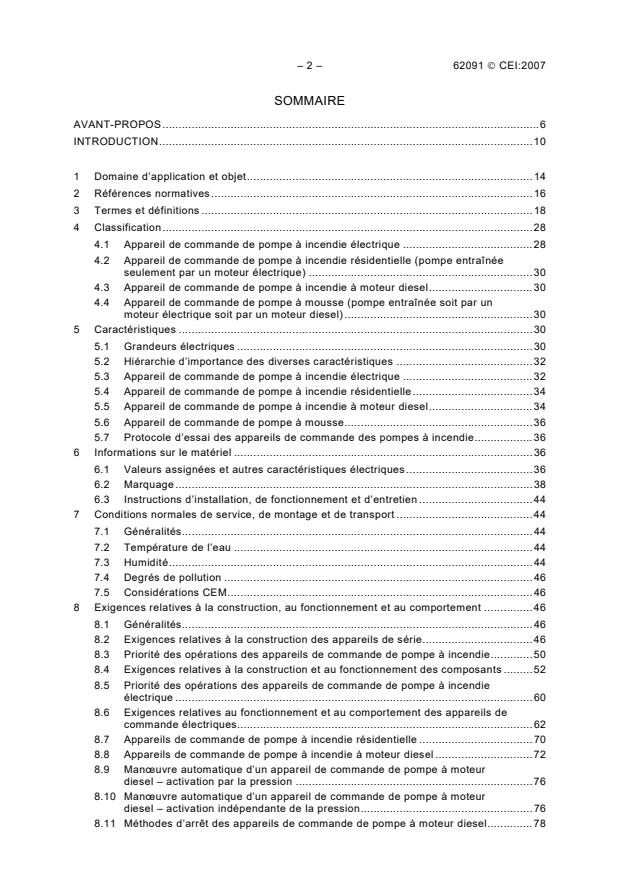
– 2 – 62091 © CEI:2007
SOMMAIRE
AVANT-PROPOS.6
INTRODUCTION.10
1 Domaine d’application et objet.14
2 Références normatives.16
3 Termes et définitions .18
4 Classification.28
4.1 Appareil de commande de pompe à incendie électrique .28
4.2 Appareil de commande de pompe à incendie résidentielle (pompe entraînée
seulement par un moteur électrique) .30
4.3 Appareil de commande de pompe à incendie à moteur diesel.30
4.4 Appareil de commande de pompe à mousse (pompe entraînée soit par un
moteur électrique soit par un moteur diesel) .30
5 Caractéristiques .30
5.1 Grandeurs électriques .30
5.2 Hiérarchie d’importance des diverses caractéristiques .32
5.3 Appareil de commande de pompe à incendie électrique .32
5.4 Appareil de commande de pompe à incendie résidentielle.34
5.5 Appareil de commande de pompe à incendie à moteur diesel.34
5.6 Appareil de commande de pompe à mousse.36
5.7 Protocole d’essai des appareils de commande des pompes à incendie.36
6 Informations sur le matériel .36
6.1 Valeurs assignées et autres caractéristiques électriques .36
6.2 Marquage.38
6.3 Instructions d’installation, de fonctionnement et d’entretien .44
7 Conditions normales de service, de montage et de transport .44
7.1 Généralités.44
7.2 Température de l’eau .44
7.3 Humidité.44
7.4 Degrés de pollution .46
7.5 Considérations CEM.46
8 Exigences relatives à la construction, au fonctionnement et au comportement .46
8.1 Généralités.46
8.2 Exigences relatives à la construction des appareils de série.46
8.3 Priorité des opérations des appareils de commande de pompe à incendie.50
8.4 Exigences relatives à la construction et au fonctionnement des composants .52
8.5 Priorité des opérations des appareils de commande de pompe à incendie
électrique .60
8.6 Exigences relatives au fonctionnement et au comportement des appareils de
commande électriques.62
8.7 Appareils de commande de pompe à incendie résidentielle .70
8.8 Appareils de commande de pompe à incendie à moteur diesel .72
8.9 Manœuvre automatique d’un appareil de commande de pompe à moteur
diesel – activation par la pression .76
8.10 Manœuvre automatique d’un appareil de commande de pompe à moteur
diesel – activation indépendante de la pression.76
8.11 Méthodes d’arrêt des appareils de commande de pompe à moteur diesel.78
62091 © IEC:2007 – 3 –
CONTENTS
FOREWORD.7
INTRODUCTION.11
1 Scope and object.15
2 Normative references .17
3 Terms and definitions .19
4 Classification.29
4.1 Electric fire pump controller.29
4.2 Residential fire pump controller (pump driven by an electric motor only).31
4.3 Diesel engine fire pump controller .31
4.4 Foam pump controller (pump driven either by an electric motor or by a diesel
engine).31
5 Characteristics .31
5.1 Electrical quantities .31
5.2 Hierarchy of importance for the various characteristics.33
5.3 Electric fire pump controller.33
5.4 Residential fire pump controller .35
5.5 Diesel engine fire pump controller .35
5.6 Foam pump controller.37
5.7 Fire pump controller test protocol .37
6 Product information .37
6.1 Rated values and other electrical characteristics .37
6.2 Marking .39
6.3 Instructions for installation, operation and maintenance .45
7 Normal service, mounting and transport conditions.45
7.1 General .45
7.2 Water temperature .45
7.3 Humidity.45
7.4 Degrees of pollution .47
7.5 EMC considerations .47
8 Constructional, functional and performance requirements.47
8.1 General .47
8.2 Constructional requirements for the type-tested devices.47
8.3 Priority of operations for electric fire pump controllers .51
8.4 Functional and performance requirements for components .53
8.5 Priority of operations for electric fire pump controllers .61
8.6 Functional and performance requirements for electric controllers .63
8.7 Residential fire pump controllers .71
8.8 Diesel engine fire pump controllers .73
8.9 Automatic operation of a diesel engine drive controller – pressure-actuated.77
8.10 Automatic operation of a diesel engine drive controller – non-pressure-
actuated .77
8.11 Methods of stopping diesel engine fire pump controllers.79
– 4 – 62091 © CEI:2007
8.12 Essai des appareils de commande de pompe à moteur diesel .80
8.13 Exigences supplémentaires relatives au fonctionnement et au comportement
des appareils de commande de pompe à mousse.80
8.14 Exigences de CEM .80
9 Essais .82
9.1 Nature des essais .82
9.2 Conformité aux dispositions constructives .84
9.3 Conformité aux exigences fonctionnelles.84
9.4 Essais de CEM.96
9.5 Essais individuels.100
Annexe A (informative) Eléments informatifs.118
Bibliographie.120
Figure 1 – Exemple d’une disposition typique pour un appareil de commande de
pompe à incendie électrique convenant pour deux sources d’alimentation, la source de
remplacement étant l’alimentation de secours sur site .108
Figure 2 – Exemple d’une disposition typique pour un appareil de commande de
pompe à incendie électrique convenant pour deux sources d’alimentation, les deux
provenant du réseau public (avec une protection contre le blocage du rotor) .110
Figure 3 – Exemple d’une disposition typique pour un appareil de commande de
pompe à incendie électrique convenant pour deux sources d’alimentation, les deux
provenant du réseau public (avec deux protections contre le blocage du rotor).112
Figure 4 – Disposition typique pour un appareil de commande de pompe à incendie
convenant pour une source d’alimentation unique.114
Figure 5 – Diagramme typique pour un appareil de commande de pompe à incendie à
moteur diesel convenant pour une source d’alimentation monophasée .116
Tableau 1 – Numérotation des bornes des appareils de commande de pompe à
incendie à moteur diesel .102
Tableau 2 − Espace de courbure pour le câblage des bornes sur site .102
Tableau 3 – Critères d’évaluation.104
Tableau 4 – Vérification du pouvoir de fermeture .104
Tableau 5 – Tension d’essai diélectrique en fonction de la tension assignée
d’isolement .104
Tableau 6 – Critères d’acceptation lorsque les perturbations électromagnétiques sont
présentes (critères de comportement pendant les essais).106
62091 © IEC:2007 – 5 –
8.12 Testing of diesel engine fire pump controllers.81
8.13 Additional functional and performance requirements for foam pump
controllers .81
8.14 EMC requirements.81
9 Tests .83
9.1 Kinds of test .83
9.2 Compliance with construction requirements.85
9.3 Compliance with performance requirements .85
9.4 EMC tests .97
9.5 Routine tests .101
Annex A (informative) Informative material.119
Bibliography.121
Figure 1 – Example of a typical arrangement for the electric FPC suitable for two
power sources, the alternate source being on-site standby power.109
Figure 2 – Example of a typical arrangement for the electric FPC suitable for two
power sources, both of which are utilities (with one locked rotor protector) .111
Figure 3 – Example of a typical arrangement for the electric FPC suitable for two
power sources, both of which are utilities (with two locked rotor protectors).113
Figure 4 – Typical arrangement for the electric fire pump controller suitable for a single
power source .115
Figure 5 – Typical block diagram for the diesel engine fire pump controller suitable for
a single phase power source.117
Table 1 – Diesel fire pump controller terminal numbering.103
Table 2 − Wire bending space at field wiring terminals .103
Table 3 – Assessment criteria.105
Table 4 – Verification of making capacity .105
Table 5 – Dielectric test voltage corresponding to the rated insulation voltage .105
Table 6 – Acceptance criteria when electromagnetic disturbances are present
(performance criteria during tests) .107
– 6 – 62091 © CEI:2007
COMMISSION ÉLECTROTECHNIQUE INTERNATIONALE
____________
APPAREILLAGE À BASSE TENSION –
APPAREILS DE COMMANDE DES ENTRAÎNEMENTS
DE POMPES À INCENDIE FIXES
AVANT-PROPOS
1) La Commission Electrotechnique Internationale (CEI) est une organisation mondiale de normalisation
composée de l'ensemble des comités électrotechniques nationaux (Comités nationaux de la CEI). La CEI a
pour objet de favoriser la coopération internationale pour toutes les questions de normalisation dans les
domaines de l'électricité et de l'électronique. A cet effet, la CEI – entre autres activités – publie des Normes
internationales, des Spécifications techniques, des Rapports techniques, des Spécifications accessibles au
public (PAS) et des Guides (ci-après dénommés "Publication(s) de la CEI"). Leur élaboration est confiée à des
comités d'études, aux travaux desquels tout Comité national intéressé par le sujet traité peut participer. Les
organisations internationales, gouvernementales et non gouvernementales, en liaison avec la CEI, participent
également aux travaux. La CEI collabore étroitement avec l'Organisation Internationale de Normalisation (ISO),
selon des conditions fixées par accord entre les deux organisations.
2) Les décisions ou accords officiels de la CEI concernant les questions techniques représentent, dans la mesure
du possible, un accord international sur les sujets étudiés, étant donné que les Comités nationaux de la CEI
intéressés sont représentés dans chaque comité d’études.
3) Les Publications de la CEI se présentent sous la forme de recommandations internationales et sont agréées
comme telles par les Comités nationaux de la CEI. Tous les efforts raisonnables sont entrepris afin que la CEI
s'assure de l'exactitude du contenu technique de ses publications; la CEI ne peut pas être tenue responsable
de l'éventuelle mauvaise utilisation ou interprétation qui en est faite par un quelconque utilisateur final.
4) Dans le but d'encourager l'uniformité internationale, les Comités nationaux de la CEI s'engagent, dans toute la
mesure possible, à appliquer de façon transparente les Publications de la CEI dans leurs publications
nationales et régionales. Toutes divergences entre toutes Publications de la CEI et toutes publications
nationales ou régionales correspondantes doivent être indiquées en termes clairs dans ces dernières.
5) La CEI n’a prévu aucune procédure de marquage valant indication d’approbation et n'engage pas sa
responsabilité pour les équipements déclarés conformes à une de ses Publications.
6) Tous les utilisateurs doivent s'assurer qu'ils sont en possession de la dernière édition de cette publication.
7) Aucune responsabilité ne doit être imputée à la CEI, à ses administrateurs, employés, auxiliaires ou
mandataires, y compris ses experts particuliers et les membres de ses comités d'études et des Comités
nationaux de la CEI, pour tout préjudice causé en cas de dommages corporels et matériels, ou de tout autre
dommage de quelque nature que ce soit, directe ou indirecte, ou pour supporter les coûts (y compris les frais
de justice) et les dépenses découlant de la publication ou de l'utilisation de cette Publication de la CEI ou de
toute autre Publication de la CEI, ou au crédit qui lui est accordé.
8) L'attention est attirée sur les références normatives citées dans cette publication. L'utilisation de publications
référencées est obligatoire pour une application correcte de la présente publication.
9) L’attention est attirée sur le fait que certains des éléments de la présente Publication de la CEI peuvent faire
l’objet de droits de propriété intellectuelle ou de droits analogues. La CEI ne saurait être tenue pour
responsable de ne pas avoir identifié de tels droits de propriété et de ne pas avoir signalé leur existence.
La Norme internationale CEI 62091 a été établie par le sous-comité 17B: Appareillage à
basse tension, du comité d'études 17 de la CEI: Appareillage.
Cette première édition annule et remplace la spécification technique publiée en 2003. Elle
constitue une révision technique qui conduit au statut de Norme internationale.
Le texte de cette norme est issu des documents suivants:
FDIS Rapport de vote
17B/1527/FDIS 17B/1536/RVD
Le rapport de vote indiqué dans le tableau ci-dessus donne toute information sur le vote ayant
abouti à l'approbation de cette norme.
Cette publication a été rédigée selon les Directives ISO/CEI, Partie 2.
62091 © IEC:2007 – 7 –
INTERNATIONAL ELECTROTECHNICAL COMMISSION
____________
LOW-VOLTAGE SWITCHGEAR AND CONTROLGEAR –
CONTROLLERS FOR DRIVERS OF STATIONARY FIRE PUMPS
FOREWORD
1) The International Electrotechnical Commission (IEC) is a worldwide organization for standardization comprising
all national electrotechnical committees (IEC National Committees). The object of IEC is to promote
international co-operation on all questions concerning standardization in the electrical and electronic fields. To
this end and in addition to other activities, IEC publishes International Standards, Technical Specifications,
Technical Reports, Publicly Available Specifications (PAS) and Guides (hereafter referred to as “IEC
Publication(s)”). Their preparation is entrusted to technical committees; any IEC National Committee interested
in the subject dealt with may participate in this preparatory work. International, governmental and non-
governmental organizations liaising with the IEC also participate in this preparation. IEC collaborates closely
with the International Organization for Standardization (ISO) in accordance with conditions determined by
agreement between the two organizations.
2) The formal decisions or agreements of IEC on technical matters express, as nearly as possible, an international
consensus of opinion on the relevant subjects since each technical committee has representation from all
interested IEC National Committees.
3) IEC Publications have the form of recommendations for international use and are accepted by IEC National
Committees in that sense. While all reasonable efforts are made to ensure that the technical content of IEC
Publications is accurate, IEC cannot be held responsible for the way in which they are used or for any
misinterpretation by any end user.
4) In order to promote international uniformity, IEC National Committees undertake to apply IEC Publications
transparently to the maximum extent possible in their national and regional publications. Any divergence
between any IEC Publication and the corresponding national or regional publication shall be clearly indicated in
the latter.
5) IEC provides no marking procedure to indicate its approval and cannot be rendered responsible for any
equipment declared to be in conformity with an IEC Publication.
6) All users should ensure that they have the latest edition of this publication.
7) No liability shall attach to IEC or its directors, employees, servants or agents including individual experts and
members of its technical committees and IEC National Committees for any personal injury, property damage or
other damage of any nature whatsoever, whether direct or indirect, or for costs (including legal fees) and
expenses arising out of the publication, use of, or reliance upon, this IEC Publication or any other IEC
Publications.
8) Attention is drawn to the Normative references cited in this publication. Use of the referenced publications is
indispensable for the correct application of this publication.
9) Attention is drawn to the possibility that some of the elements of this IEC Publication may be the subject of
patent rights. IEC shall not be held responsible for identifying any or all such patent rights.
International Standard IEC 62091 has been prepared by subcommittee 17B: Low-voltage
switchgear and controlgear, of IEC technical committee 17: Switchgear and controlgear.
This first edition cancels and replaces the technical specification published in 2003. It
constitutes a technical revision and now has the status of an International Standard.
The text of this standard is based on the following documents:
FDIS Report on voting
17B/1527/FDIS 17B/1536/RVD
Full information on the voting for the approval of this standard can be found in the report on
voting indicated in the above table.
This publication has been drafted in accordance with the ISO/IEC Directives, Part 2.
– 8 – 62091 © CEI:2007
Le comité a décidé que le contenu de cette publication ne sera pas modifié avant la date de
maintenance indiquée sur le site web de la CEI sous "http://webstore.iec.ch" dans les
données relatives à la publication recherchée. A cette date, la publication sera
• reconduite,
• supprimée,
• remplacée par une édition révisée, ou
• amendée.
62091 © IEC:2007 – 9 –
The committee has decided that the contents of this publication will remain unchanged until
the maintenance result date indicated on the IEC web site under "http://webstore.iec.ch" in
the data related to the specific publication. At this date, the publication will be
• reconfirmed,
• withdrawn,
• replaced by a revised edition, or
• amended.
– 10 – 62091 © CEI:2007
INTRODUCTION
La CEI 62091 concerne les matériels de sécurité et est basée en partie sur la NFPA 20 (1996)
Standard for the Installation of Centrifugal Fire Pumps. Lorsque l’on fait appel à un signal
automatique, à un signal électrique manuel ou à la mise en marche manuelle d’urgence, il est
attendu que l’appareil de commande démarre l’entraînement de la pompe (moteur électrique ou
moteur diesel) parce que «l’immeuble est en feu». Le manquement à cette tâche augmentera
les dommages dus au feu de l’immeuble, à ce qu’il contient et aux personnes à l’intérieur.
La position par défaut de ces appareils de commande est l’état MARCHE. Ils sont destinés à
être installés conformément aux exigences locales qui les placent généralement dans des
locaux de pompes ou des postes de pompes qui ont un degré spécifié de protection contre le
feu. Ces endroits ont souvent des tuyaux aériens d’aspersion, ils peuvent être munis de
sprinklers et sont à proximité de salles protégées abritant d'autres matériels de distribution du
bâtiment.
Les pompes à incendie sont prévues pour augmenter la pression de l’eau. Beaucoup de
systèmes d’arrosage (sprinklers) sont présumés avoir de petites fuites pour lesquelles sont
installées des «jockey pumps» (dites aussi pompes d’appoint) qui maintiennent la pression
désirée dans les tuyaux d’arrosage évitant ainsi de trop nombreux démarrages et arrêts de la
pompe à incendie principale. L’expérience a montré que cette fuite d’eau s’écoulant dans la
pompe à incendie (au repos) pendant de longues périodes d’inactivité de la pompe peut
transporter du sable, des agrégats, des pierres, de la rouille qui se rassemblent dans la
pompe à incendie. Ces pollutions peuvent empêcher un démarrage normal jusqu’à ce que la
roue à palette de la pompe accélère pour nettoyer son logement. La présente norme
reconnaît les conditions d’une sous-utilisation des pompes à incendie en autorisant un
courant de blocage du rotor jusqu’à 20 s, que le démarrage soit «à froid» (démarrage initial)
ou «à chaud» (redémarrages). Le démarrage d’une pompe endommagée peut causer un
dommage temporaire ou permanent aux conducteurs électriques, aux matériels et au moteur
parce que son arrêt pour protéger le matériel pourrait éventuellement favoriser sa destruction
par le feu avec celle du bâtiment et ce qu’il contient.
Plusieurs exemples de construction et d’installation entre un appareil de commande de
pompe à incendie et d’autres appareils de commande comprennent ce qui suit:
(1) tous les appareils de commande de pompe à incendie
a) Les conducteurs du circuit principal et les composants sont considérés comme
sacrificiels (c’est-à-dire que des niveaux de dommages temporaires ou permanents
sont autorisés) durant toute tentative de démarrage d’un moteur/pompe endommagé et
de le conserver opérationnel.
b) Ils sont réputés fournir un degré de fiabilité important pour démarrer automatiquement
l’entraînement de la pompe et supprimer un feu sur la perception d’une chute de
pression dans le conduit d’arrosage (sprinkler) ou par d’autres matériels de détection
automatique du feu.
c) Il convient que les défauts dans les circuits de commande externes n’empêchent pas
le fonctionnement des pompes par tous les autres moyens internes ou externes.
d) Les circuits de commande externes sont réputés être conçus de telle sorte que la
défaillance de tout circuit externe (ouvert ou en court-circuit) n’empêchera pas le
fonctionnement de la ou des pompes à partir de tous les autres moyens internes ou
externes. La coupure, la déconnexion, la mise en court-circuit des conducteurs ou la
perte de puissance de ces circuits peut provoquer un fonctionnement continu de la
pompe à incendie mais il convient qu’il n’empêche pas, en cas de causes étrangères à
ces circuits externes, le ou les appareils de commande de démarrer la ou les pompes
à incendie.
e) Il convient que le démarrage automatique par des moyens externes s’effectue par
l’ouverture d’un contact à ouverture des dispositifs externes pour mettre hors tension
le circuit de commande, normalement sous tension, dans l’appareil de commande.
62091 © IEC:2007 – 11 –
INTRODUCTION
IEC 62091 pertains to life-safety equipment and is based in part on NFPA 20 (1996) Standard
for the Installation of Centrifugal Fire Pumps. When called upon to work by automatic signal,
manual-electric signal or manual-emergency actuation, the controller is expected to start the
pump driver (motor or diesel engine) because “the building is on fire”. Failure to carry out its
task will increase fire damage to the building, its contents and people therein.
These controllers default to a RUN state. They are intended to be located in compliance with
local requirements which generally will place them in pump rooms or pump houses that have
some specified degree of fire protection. These locations often have sweating overhead
pipes, are possibly sprinklered and are in the vicinity of vaults housing other building
distribution equipment.
Fire pumps are intended to boost water pressure. Many sprinkler systems are assumed to
have small leaks for which “Jockey Pumps” (also known as make-up pumps) are installed to
maintain desired pressure in the sprinkler pipes, thus preventing the main fire pump from
excessive starts and stops. Experience has shown that leakage water flowing through the fire
pump (at rest) over long periods of pump inactivity can carry sand, aggregates, rocks, rust
and such which collect in the fire pump. These contaminants may prevent normal starting until
the pump impeller accelerates to clear the pump housing. This standard recognizes the
condition of under-exercised fire pumps by permitting up to 20 s at locked rotor current,
whether the starts are “cold starts” (initial starts) or “hot starts” (restarts). Starting a
distressed pump may cause temporary or permanent damage to electrical conductors,
equipment and the motor, because shutdown for equipment protection could possibly permit
its destruction by fire along with the building and its contents.
Several examples of the construction and installation applications between a fire pump
controller and other controllers include the following:
(1) all fire pump controllers
a) The main circuit conductors and components are considered to be sacrificial (i.e.
temporary and permanent damage levels are permitted) during any attempt to start a
distressed motor/pump and to keep it operating.
b) They are expected to provide a high degree of reliability to start the pump driver
automatically and suppress a fire upon sensing a pressure drop in the sprinkler pipe or
by other automatic fire detection equipment.
c) Failures in external control circuits should not prevent operations of pumps from all
other internal or other external means.
d) External control circuits are expected to be arranged so that failure of any external
circuit (open or short-circuit) will not prevent operation of pump(s) from all other
internal or external means. Breakage, disconnecting, shorting of the wires or loss of
power to these circuits can cause continuous running of the fire pump but should not
prevent the controller(s) from starting the fire pump(s) due to causes other than these
external circuits.
e) External automatic starting means should be accomplished by opening a normally
closed contact on the external means to de-energize a normally energized control
circuit in the controller.
– 12 – 62091 © CEI:2007
f) Bien que des boutons de démarrage ou d’autres moyens de démarrage externes
soient autorisés, il convient que l’appareil de commande ne soit pas équipé de moyens
permettant un arrêt à distance (il convient qu’un bouton ARRÊT à distance ne soit pas
utilisé).
g) Des défauts de démarrage sont autorisés dans le cas où une défaillance des
composants internes de commande permet le démarrage du moteur.
(2) les appareils de commande de pompe à incendie à moteur électrique
a) Ils sont réputés inclure des dispositifs pour un fonctionnement mécanique manuel
externe à l’appareil de commande dans le cas d’une perte de capacité à fermer le
contacteur électriquement/magnétiquement.
b) Il convient que les appareils de protection contre les surintensités à action thermique
ne soient pas autorisés. Il convient que l’appareil de commande fournisse seulement
une protection contre les courts-circuits et le blocage du rotor.
c) Les déclencheurs des dispositifs de protection contre les surintensités de l’appareil de
commande de pompe à incendie (dispositifs de protection contre les courts-circuits et
contre le blocage du rotor) sont réputés permettre à celui-ci de transporter, pendant
une période de temps prolongée, 300 % du courant assigné d’emploi du moteur.
(3) les appareils de commande de pompe à incendie à moteur diesel
a) Il convient qu’ils fournissent les moyens de solliciter automatiquement le moteur sur
une base hebdomadaire.
b) Lorsqu’un signal automatique ou manuel de démarrage est présent, (sauf en mode
TEST) il y a lieu, qu’en aucun cas, l’appareil de commande n’arrête le moteur sauf en
cas d’OVERSPEED. En mode TEST, l’appareil de commande peut arrêter le moteur
dans des conditions de faible pression de l’huile ou de forte température du moteur.
Les deux conditions mentionnées illustrent la nature sacrificielle pendant le combat
d’un incendie.
En conséquence, l’objectif le plus significatif de la présente norme est de caractériser les
spécificités des appareils de commande des pompes à incendie.
Une installation avec deux pompes à incendie augmentera la fiabilité et la sécurité de
l’installation, particulièrement si les deux pompes à incendie sont alimentées à partir de deux
sources d’alimentation différentes. Cela est surtout vrai pendant l’entretien ou la réparation
d’un appareil de commande, la protection contre le feu étant toujours maintenue par l’autre
pompe à incendie.
62091 © IEC:2007 – 13 –
f) While external start buttons or other starting means are permitted, the controller
should not be equipped with any means to accommodate remote stopping (a remote
STOP button should not be used).
g) Nuisance starts are permitted in the case where a failure of internal control
components might cause the motor to start running.
(2) electric motor fire pump controllers
a) They are expected to include means for external, manual mechanical operation of the
controller in the event of loss of ability to close the contactor electrically/magnetically.
b) Thermally reactive over-current protective devices should not be permitted. The
controller should provide short-circuit and locked rotor protection only.
c) Releases of the FPC-overcurrent protective devices (short-circuit protective and locked
rotor protective devices) are expected to permit it to carry 300 % of rated operational
motor current for an extended period of time.
(3) diesel engine fire pump controllers
a) Should provide means to automatically exercise the engine on a weekly basis.
b) When an automatic or manual signal to start/run exists, (except under TEST) the
controller should not shut down the engine for any reason except OVERSPEED. When
in TEST mode, the controller may shut down under low oil pressure and high engine
temperature conditions. The two conditions mentioned illustrate the sacrificial nature
while fighting a fire.
Therefore, the most significant purpose of this standard is to characterize the unique features
of fire pump controllers.
An installation with two fire pumps will increase the reliability and safety of the installation,
especially if the two fire pumps are supplied from two different power supplies. This is
especially true during maintenance or repairing of a single controller, as fire protection is still
being maintained by the other fire pump.
– 14 – 62091 © CEI:2007
APPAREILLAGE À BASSE TENSION –
APPAREILS DE COMMANDE DES ENTRAÎNEMENTS
DE POMPES À INCENDIE FIXES
1 Domaine d’application et objet
La présente Norme internationale s’applique aux appareils de commande destinés au
démarrage, à la commande et à l’arrêt des pompes à incendie fixes, incluant les types
automatiques et non automatiques de pompes à incendie pilotées par un moteur électrique à
courant alternatif ou par un moteur diesel. Il est convenu qu’un appareil de commande
contrôle seulement un entraînement unique.
Les appareils de commande des pompes à incendie entraînées par un moteur électrique
comprennent toujours, comme partie intégrante de l’appareil de comma
...
Questions, Comments and Discussion
Ask us and Technical Secretary will try to provide an answer. You can facilitate discussion about the standard in here.
Loading comments...