


IEC 60168:1994
(Main)Tests on indoor and outdoor post insulators of ceramic material or glass for systems with nominal voltages greater than 1000 V
Tests on indoor and outdoor post insulators of ceramic material or glass for systems with nominal voltages greater than 1000 V
Applies to post insulators and post insulator units of ceramic material or glass for indoor and outdoor service in electrical installations or equipment operating on alternating current with a nominal voltage greater than 1 000 V and a frequency not greater than 100 Hz. Notes: -May also be regarded as a provisional standard for insulators for use on d.c. systems, see IEC 60438. -When considering hollow insulators, see IEC 60233. -Tests on indoor post insulators of organic material will be covered by a future publication: Tests on indoor post insulators of organic material for systems with nominal voltages greater than 1 000 V up to but not including 300 kV. -For artificial pollution and radio-interference tests, see IEC 60437 and 60507. -For numerical values for insulator characteristics and for selection of insulators for specific operating conditions, see IEC 60273.
Essais des supports isolants d'intérieur et d'extérieur, en matière céramique ou en verre, destinés à des installations de tension nominale supérieure à 1000 V
S'applique aux supports isolants et éléments de supports isolants d'intérieur et d'extérieur, en matière céramique ou en verre, destinés à l'équipement d'installations ou d'appareils électriques fonctionnant en courant alternatif à une tension nominale supérieure à 1 000 V et à une fréquence au plus égale à 100 Hz. Notes: 1. Cette norme peut aussi être considérée comme s'appliquant provisoirement aux supports isolants destinés aux réseaux fonctionnant en courant continu, voir CEI 60438. 2. Lorsqu'il s'agit d'isolateurs creux, voir CEI 60233. 3. Les essais des supports isolants d'intérieur en matière organique feront l'objet d'une future publication: Essais des supports isolants d'intérieur en matière organique destinés à des installations de tension nominale supérieure à 1 000 V jusqu'à 300 kV non compris. 4. Pour les essais de pollution artificielle et de perturbations radioélectriques, voir CEI 60437 et 60507. 5. Pour les valeurs numériques de caractéristiques d'isolateur et pour la sélection d'un isolateur en fonction du service qu'il doit assurer, voir CEI 60273.
General Information
- Status
- Published
- Publication Date
- 15-Nov-1994
- Technical Committee
- TC 36 - Insulators
- Current Stage
- PPUB - Publication issued
- Start Date
- 16-Nov-1994
- Completion Date
- 05-Jul-1994
Relations
- Effective Date
- 05-Sep-2023
- Effective Date
- 05-Sep-2023
Overview
IEC 60168:1994 is an international standard published by the International Electrotechnical Commission (IEC) that defines tests on indoor and outdoor post insulators made of ceramic material or glass. These insulators are designed for electrical installations and equipment operating on alternating current with nominal voltages greater than 1000 V and frequencies up to 100 Hz. This standard establishes the requirements for type tests, sample tests, and routine tests to ensure the performance, safety, and reliability of post insulators in high-voltage electrical systems.
The standard covers post insulators made from ceramic and glass materials and applies strictly to systems using alternating current, although it may be considered provisional for direct current (d.c.) applications with reference to IEC 60438. It specifies detailed testing procedures for electrical, mechanical, and other characteristics essential to high-voltage insulation performance.
Key Topics
Scope and Definitions: Specifies material types, insulator designs, and system parameters such as voltage and frequency.
Classification of Tests:
- Type Tests: Verify design conformity and overall performance.
- Sample Tests: Conducted on production samples to maintain quality.
- Routine Tests: Carried out on individual insulators for acceptance.
Electrical Tests:
- Dry and wet lightning impulse withstand tests.
- Switching impulse withstand voltage tests under dry and wet conditions.
- Dry and wet power-frequency withstand voltage tests (indoor and outdoor specific).
- Puncture tests to measure insulation breakdown.
- Routine electrical testing for production units.
Mechanical and Other Tests:
- Dimensional verification and tolerances.
- Mechanical failure load and deflection under load.
- Temperature cycling and thermal shock tests for durability.
- Porosity tests for ceramic insulators.
- Galvanization quality testing of metal parts.
- Visual inspections and routine mechanical tests.
Test Conditions and Procedures:
- Standards for artificial rain used in wet tests.
- Guidelines for mounting and atmospheric conditions during testing.
- Sampling procedures for quality assurance testing.
Identification and Marking: Requirements to ensure traceability of insulators through identification marks.
Applications
IEC 60168:1994 standard is primarily applicable to post insulators used in:
- High-voltage electrical distribution and transmission networks operating above 1000 V.
- Indoor installations such as switchgear and panel insulation where power-frequency withstand voltage testing is critical.
- Outdoor installations exposed to environmental stress, requiring wet withstand testing and mechanical robustness.
- Power utilities and manufacturing quality assurance for insulator reliability under electrical and mechanical stresses.
- Design validation and certification for post insulators made from ceramic and glass to ensure compliance with international safety standards.
The standard also supports the integration of post insulators within high voltage equipment subjected to natural and artificial pollution, supporting reference to related IEC standards for pollution and interference testing.
Related Standards
- IEC 60438: Specifies requirements for insulators used in d.c. systems; referenced for applications of post insulators beyond a.c. systems.
- IEC 60233: Covers tests for hollow insulators, complementing solid post insulator testing.
- IEC 60437 and IEC 60507: Standards for artificial pollution and radio-interference tests affecting insulator performance.
- IEC 60273: Provides numerical values and criteria for insulator characteristics and selection for specific operating conditions.
- Future IEC Publications on organic indoor post insulators and advanced testing methods.
Conclusion
IEC 60168:1994 is a comprehensive international standard ensuring the quality, safety, and performance of ceramic and glass post insulators in high-voltage electric systems above 1000 V. It provides detailed test methods essential for manufacturers, utilities, and testing laboratories to certify electrical and mechanical integrity under a variety of operational and environmental conditions. Compliance with this standard is critical for enhancing system reliability, reducing outage risks, and supporting global electrical infrastructure safety.
Get Certified
Connect with accredited certification bodies for this standard

Intertek Testing Services NA Inc.
Intertek certification services in North America.

UL Solutions
Global safety science company with testing, inspection and certification.

ANCE
Mexican certification and testing association.
Sponsored listings
Frequently Asked Questions
IEC 60168:1994 is a standard published by the International Electrotechnical Commission (IEC). Its full title is "Tests on indoor and outdoor post insulators of ceramic material or glass for systems with nominal voltages greater than 1000 V". This standard covers: Applies to post insulators and post insulator units of ceramic material or glass for indoor and outdoor service in electrical installations or equipment operating on alternating current with a nominal voltage greater than 1 000 V and a frequency not greater than 100 Hz. Notes: -May also be regarded as a provisional standard for insulators for use on d.c. systems, see IEC 60438. -When considering hollow insulators, see IEC 60233. -Tests on indoor post insulators of organic material will be covered by a future publication: Tests on indoor post insulators of organic material for systems with nominal voltages greater than 1 000 V up to but not including 300 kV. -For artificial pollution and radio-interference tests, see IEC 60437 and 60507. -For numerical values for insulator characteristics and for selection of insulators for specific operating conditions, see IEC 60273.
Applies to post insulators and post insulator units of ceramic material or glass for indoor and outdoor service in electrical installations or equipment operating on alternating current with a nominal voltage greater than 1 000 V and a frequency not greater than 100 Hz. Notes: -May also be regarded as a provisional standard for insulators for use on d.c. systems, see IEC 60438. -When considering hollow insulators, see IEC 60233. -Tests on indoor post insulators of organic material will be covered by a future publication: Tests on indoor post insulators of organic material for systems with nominal voltages greater than 1 000 V up to but not including 300 kV. -For artificial pollution and radio-interference tests, see IEC 60437 and 60507. -For numerical values for insulator characteristics and for selection of insulators for specific operating conditions, see IEC 60273.
IEC 60168:1994 is classified under the following ICS (International Classification for Standards) categories: 29.080.10 - Insulators. The ICS classification helps identify the subject area and facilitates finding related standards.
IEC 60168:1994 has the following relationships with other standards: It is inter standard links to IEC 60168:1994/AMD2:2000, IEC 60168:1994/AMD1:1997. Understanding these relationships helps ensure you are using the most current and applicable version of the standard.
IEC 60168:1994 is available in PDF format for immediate download after purchase. The document can be added to your cart and obtained through the secure checkout process. Digital delivery ensures instant access to the complete standard document.
Standards Content (Sample)
IEC 60168 ®
Edition 4.2 2001-04
CONSOLIDATED VERSION
INTERNATIONAL
STANDARD
NORME
INTERNATIONALE
Tests on indoor and outdoor post insulators of ceramic material or glass for
systems with nominal voltages greater than 1 000 V
Essais des supports isolants d'intérieur et d'extérieur, en matière céramique ou
en verre, destinés à des installations de tension nominale supérieure à 1 000 V
All rights reserved. Unless otherwise specified, no part of this publication may be reproduced or utilized in any form
or by any means, electronic or mechanical, including photocopying and microfilm, without permission in writing from
either IEC or IEC's member National Committee in the country of the requester. If you have any questions about IEC
copyright or have an enquiry about obtaining additional rights to this publication, please contact the address below or
your local IEC member National Committee for further information.
Droits de reproduction réservés. Sauf indication contraire, aucune partie de cette publication ne peut être reproduite
ni utilisée sous quelque forme que ce soit et par aucun procédé, électronique ou mécanique, y compris la photocopie
et les microfilms, sans l'accord écrit de l'IEC ou du Comité national de l'IEC du pays du demandeur. Si vous avez des
questions sur le copyright de l'IEC ou si vous désirez obtenir des droits supplémentaires sur cette publication, utilisez
les coordonnées ci-après ou contactez le Comité national de l'IEC de votre pays de résidence.
IEC Central Office Tel.: +41 22 919 02 11
3, rue de Varembé Fax: +41 22 919 03 00
CH-1211 Geneva 20 info@iec.ch
Switzerland www.iec.ch
About the IEC
The International Electrotechnical Commission (IEC) is the leading global organization that prepares and publishes
International Standards for all electrical, electronic and related technologies.
About IEC publications
The technical content of IEC publications is kept under constant review by the IEC. Please make sure that you have the
latest edition, a corrigenda or an amendment might have been published.
IEC Catalogue - webstore.iec.ch/catalogue Electropedia - www.electropedia.org
The stand-alone application for consulting the entire The world's leading online dictionary of electronic and
bibliographical information on IEC International Standards, electrical terms containing 20 000 terms and definitions in
Technical Specifications, Technical Reports and other English and French, with equivalent terms in 15 additional
documents. Available for PC, Mac OS, Android Tablets and languages. Also known as the International Electrotechnical
iPad. Vocabulary (IEV) online.
IEC publications search - www.iec.ch/searchpub IEC Glossary - std.iec.ch/glossary
The advanced search enables to find IEC publications by a 65 000 electrotechnical terminology entries in English and
variety of criteria (reference number, text, technical French extracted from the Terms and Definitions clause of
committee,…). It also gives information on projects, replaced IEC publications issued since 2002. Some entries have been
and withdrawn publications. collected from earlier publications of IEC TC 37, 77, 86 and
CISPR.
IEC Just Published - webstore.iec.ch/justpublished
Stay up to date on all new IEC publications. Just Published IEC Customer Service Centre - webstore.iec.ch/csc
details all new publications released. Available online and If you wish to give us your feedback on this publication or
also once a month by email. need further assistance, please contact the Customer Service
Centre: csc@iec.ch.
A propos de l'IEC
La Commission Electrotechnique Internationale (IEC) est la première organisation mondiale qui élabore et publie des
Normes internationales pour tout ce qui a trait à l'électricité, à l'électronique et aux technologies apparentées.
A propos des publications IEC
Le contenu technique des publications IEC est constamment revu. Veuillez vous assurer que vous possédez l’édition la
plus récente, un corrigendum ou amendement peut avoir été publié.
Catalogue IEC - webstore.iec.ch/catalogue Electropedia - www.electropedia.org
Application autonome pour consulter tous les renseignements
Le premier dictionnaire en ligne de termes électroniques et
bibliographiques sur les Normes internationales,
électriques. Il contient 20 000 termes et définitions en anglais
Spécifications techniques, Rapports techniques et autres
et en français, ainsi que les termes équivalents dans 15
documents de l'IEC. Disponible pour PC, Mac OS, tablettes
langues additionnelles. Egalement appelé Vocabulaire
Android et iPad.
Electrotechnique International (IEV) en ligne.
Recherche de publications IEC - www.iec.ch/searchpub
Glossaire IEC - std.iec.ch/glossary
La recherche avancée permet de trouver des publications IEC
65 000 entrées terminologiques électrotechniques, en anglais
en utilisant différents critères (numéro de référence, texte,
et en français, extraites des articles Termes et Définitions des
comité d’études,…). Elle donne aussi des informations sur les
publications IEC parues depuis 2002. Plus certaines entrées
projets et les publications remplacées ou retirées.
antérieures extraites des publications des CE 37, 77, 86 et
CISPR de l'IEC.
IEC Just Published - webstore.iec.ch/justpublished
Restez informé sur les nouvelles publications IEC. Just Service Clients - webstore.iec.ch/csc
Published détaille les nouvelles publications parues. Si vous désirez nous donner des commentaires sur cette
Disponible en ligne et aussi une fois par mois par email. publication ou si vous avez des questions contactez-nous:
csc@iec.ch.
IEC 60168 ®
Edition 4.2 2001-04
CONSOLIDATED VERSION
INTERNATIONAL
STANDARD
NORME
INTERNATIONALE
Tests on indoor and outdoor post insulators of ceramic material or glass for
systems with nominal voltages greater than 1 000 V
Essais des supports isolants d'intérieur et d'extérieur, en matière céramique ou
en verre, destinés à des installations de tension nominale supérieure à 1 000 V
INTERNATIONAL
ELECTROTECHNICAL
COMMISSION
COMMISSION
ELECTROTECHNIQUE
INTERNATIONALE
ICS 29.080.10 ISBN 2-8318-5726-0
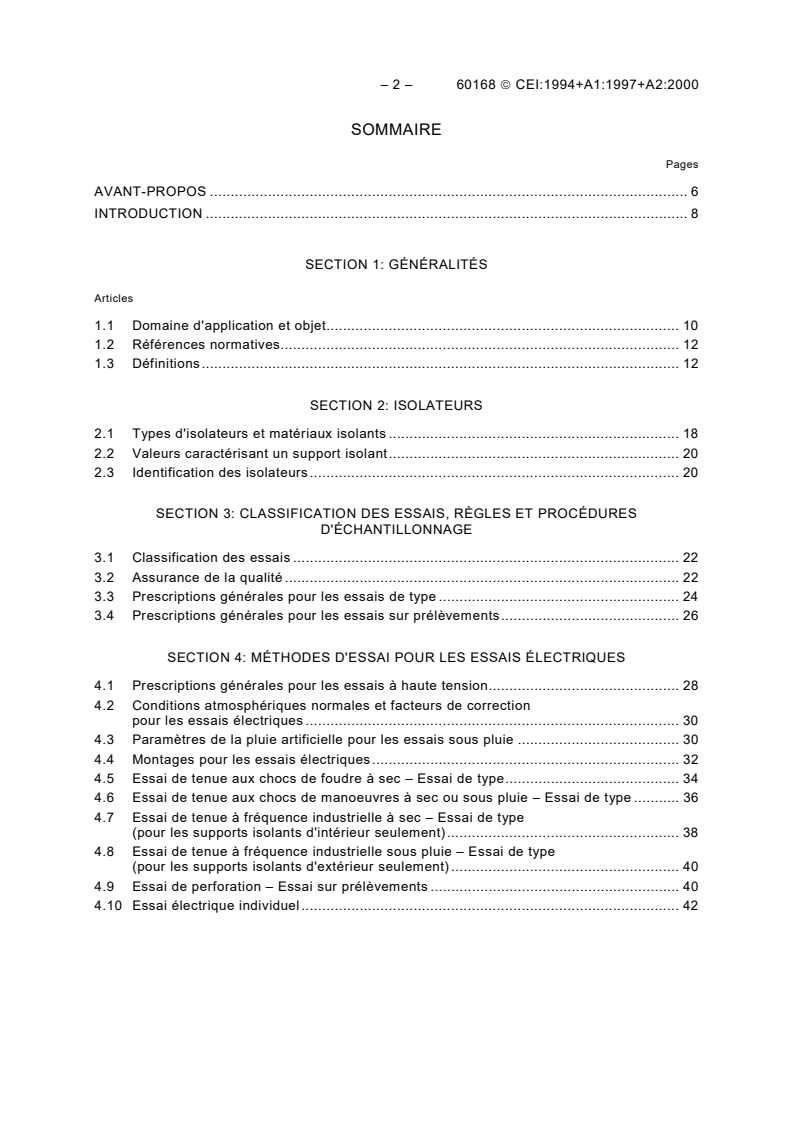
– 2 – 60168 CEI:1994+A1:1997+A2:2000
SOMMAIRE
Pages
AVANT-PROPOS . 6
INTRODUCTION .8
SECTION 1: GÉNÉRALITÉS
Articles
1.1 Domaine d'application et objet. 10
1.2 Références normatives. 12
1.3 Définitions. 12
SECTION 2: ISOLATEURS
2.1 Types d'isolateurs et matériaux isolants . 18
2.2 Valeurs caractérisant un support isolant. 20
2.3 Identification des isolateurs. 20
SECTION 3: CLASSIFICATION DES ESSAIS, RÈGLES ET PROCÉDURES
D'ÉCHANTILLONNAGE
3.1 Classification des essais . 22
3.2 Assurance de la qualité . 22
3.3 Prescriptions générales pour les essais de type . 24
3.4 Prescriptions générales pour les essais sur prélèvements. 26
SECTION 4: MÉTHODES D'ESSAI POUR LES ESSAIS ÉLECTRIQUES
4.1 Prescriptions générales pour les essais à haute tension. 28
4.2 Conditions atmosphériques normales et facteurs de correction
pour les essais électriques . 30
4.3 Paramètres de la pluie artificielle pour les essais sous pluie . 30
4.4 Montages pour les essais électriques. 32
4.5 Essai de tenue aux chocs de foudre à sec – Essai de type. 34
4.6 Essai de tenue aux chocs de manoeuvres à sec ou sous pluie – Essai de type . 36
4.7 Essai de tenue à fréquence industrielle à sec – Essai de type
(pour les supports isolants d'intérieur seulement). 38
4.8 Essai de tenue à fréquence industrielle sous pluie – Essai de type
(pour les supports isolants d'extérieur seulement) . 40
4.9 Essai de perforation – Essai sur prélèvements . 40
4.10 Essai électrique individuel. 42
60168 IEC:1994+A1:1997+A2:2000 – 3 –
CONTENTS
Page
FOREWORD . 7
INTRODUCTION .9
SECTION 1: GENERAL
Clause
1.1 Scope and object . 11
1.2 Normative references . 13
1.3 Definitions. 13
SECTION 2: INSULATORS
2.1 Insulator designs and insulating materials . 19
2.2 Values which characterize a post insulator . 21
2.3 Identification of insulators . 21
SECTION 3: CLASSIFICATION OF THE TESTS,
SAMPLING RULES AND PROCEDURES
3.1 Classification of the tests . 23
3.2 Quality assurance . 23
3.3 General requirements for type tests . 25
3.4 General requirements for sample tests . 27
SECTION 4: TEST PROCEDURES FOR ELECTRICAL TESTS
4.1 General requirements for high-voltage tests . 29
4.2 Standard atmospheric conditions and correction factors for electrical tests . 31
4.3 Artificial rain parameters for wet tests . 31
4.4 Mounting arrangements for electrical tests . 33
4.5 Dry lightning-impulse withstand voltage test – Type test. 35
4.6 Dry or wet switching-impulse withstand voltage tests – Type test . 37
4.7 Dry power-frequency withstand voltage test – Type test
(applicable only to post insulators for indoor use). 39
4.8 Wet power-frequency withstand voltage test – Type test
(applicable only to post insulators for outdoor use). 41
4.9 Puncture test – Sample test . 41
4.10 Routine electrical test. 43
– 4 – 60168 CEI:1994+A1:1997+A2:2000
Articles Pages
SECTION 5: MÉTHODES D'ESSAI POUR LES ESSAIS MÉCANIQUES
ET AUTRES ESSAIS
5.1 Vérification des dimensions – Essai de type et sur prélèvements . 44
5.2 Essai de rupture mécanique – Essai de type et sur prélèvements. 46
5.3 Mesure de la flèche sous charge – Essai particulier de type. 52
5.4 Essai de résistance aux variations brusques de température –
Essai sur prélèvements . 52
5.5 Essai individuel de choc thermique (seulement sur les parties en verre trempé). 54
5.6 Vérification de l'absence de porosité – Essai sur prélèvements
(pour les supports isolants en céramique seulement) . 56
5.7 Vérification de la qualité de la galvanisation – Essai sur prélèvements. 56
5.8 Examen visuel individuel . 60
5.9 Essai mécanique individuel . 62
SECTION 6: ESSAIS APPLICABLES AUX SUPPORTS ISOLANTS
6.1 Essais de type. 66
6.2 Essais sur prélèvements . 68
6.3 Essais individuels. 68
6.4 Résumé des essais sur supports isolants . 70
Annexe A (informative) Méthodes d'essai pour mesurer les tolérances de parallélisme,
d'excentricité, de décalage angulaire, de la flèche propre et de l'inclinaison des ailettes
des supports isolants. 78
Annexe B (informative) Méthodes d'essai individuel sur des éléments
isolants non scellés . 84
Annexe C (informative) Bibliographie . 90
Figure 1 – Support isolant cylindrique de type fût plein. 74
Figure 2 – Support isolant cylindrique creux . 74
Figure 3 – Support isolant cylindrique à armatures internes. 74
Figure 4 – Support isolant cylindrique à armatures internes. 76
Figure 5 – Support isolant à capot et embase. 76
Figure 6 – Support isolant cylindrique . 76
Figures A.1 à B.3 .78 à 88
Tableau 1 – Nombre de pièces prélevées pour les essais sur prélèvements. 26
Tableau 2 – Hauteur du montage des supports isolants d'extérieur . 34
Tableau 3 – Essais de type applicables aux supports isolants . 70
Tableau 4 – Essais sur prélèvements applicables aux supports isolants. 70
Tableau 5 – Essais individuels applicables aux supports isolants . 72
60168 IEC:1994+A1:1997+A2:2000 – 5 –
Clause Page
SECTION 5: TEST PROCEDURES FOR MECHANICAL AND OTHER TESTS
5.1 Verification of the dimensions – Type and sample test . 45
5.2 Mechanical failing load test – Type and sample test . 47
5.3 Test for deflection under load – Special type test . 53
5.4 Temperature cycle test – Sample test. 53
5.5 Routine thermal shock test (applicable only to toughened glass insulating parts) . 55
5.6 Porosity test – Sample test (applicable only to ceramic post insulators) . 57
5.7 Galvanizing test – Sample test . 57
5.8 Routine visual inspection. 61
5.9 Routine mechanical test . 63
SECTION 6: TESTS APPLICABLE TO POST INSULATORS
6.1 Type tests .67
6.2 Sample tests . 69
6.3 Routine tests. 69
6.4 Summary of tests on post insulators. 71
Annex A (informative) Methods of testing for tolerances of parallelism, eccentricity,
angular deviation, camber, and shed angle of post insulators. 79
Annex B (informative) Methods of routine testing of unassembled insulator units . 85
Annex C (informative) Bibliography . 91
Figure 1 – Solid core cylindrical post insulator. 75
Figure 2 – Cavity core cylindrical post insulator. 75
Figure 3 – Cylindrical post insulator with internal metal fittings . 75
Figure 4 – Cylindrical post insulator with internal metal fittings . 77
Figure 5 – Pedestal post insulator . 77
Figure 6 – Cylindrical post insulator . 77
Figures A.1 to B.3 .79 to 89
Table 1 – Number of samples for sample tests . 27
Table 2 – Mounting height of outdoor post insulators. 35
Table 3 – Type tests applicable to post insulators . 71
Table 4 – Sample tests applicable to post insulators . 71
Table 5 – Routine tests applicable to post insulators . 73
– 6 – 60168 © CEI:1994+A1:1997+A2:2000
COMMISSION ÉLECTROTECHNIQUE INTERNATIONALE
____________
ESSAIS DES SUPPORTS ISOLANTS D'INTÉRIEUR ET D'EXTÉRIEUR,
EN MATIÈRE CÉRAMIQUE OU EN VERRE,
DESTINÉS À DES INSTALLATIONS DE TENSION NOMINALE
SUPÉRIEURE À 1 000 V
AVANT-PROPOS
1) La CEI (Commission Électrotechnique Internationale) est une organisation mondiale de normalisation
composée de l'ensemble des comités électrotechniques nationaux (Comités nationaux de la CEI). La CEI a
pour objet de favoriser la coopération internationale pour toutes les questions de normalisation dans les
domaines de l'électricité et de l'électronique. A cet effet, la CEI, entre autres activités, publie des Normes
internationales. Leur élaboration est confiée à des comités d'études, aux travaux desquels tout Comité national
intéressé par le sujet traité peut participer. Les organisations internationales, gouvernementales et non
gouvernementales, en liaison avec la CEI, participent également aux travaux. La CEI collabore étroitement
avec l'Organisation Internationale de Normalisation (ISO), selon des conditions fixées par accord entre les
deux organisations.
2) Les décisions ou accords officiels de la CEI concernant les questions techniques représentent, dans la mesure
du possible, un accord international sur les sujets étudiés, étant donné que les Comités nationaux intéressés
sont représentés dans chaque comité d’études.
3) Les documents produits se présentent sous la forme de recommandations internationales. Ils sont publiés
comme normes, spécifications techniques, rapports techniques ou guides et agréés comme tels par les
Comités nationaux.
4) Dans le but d'encourager l'unification internationale, les Comités nationaux de la CEI s'engagent à appliquer de
façon transparente, dans toute la mesure possible, les Normes internationales de la CEI dans leurs normes
nationales et régionales. Toute divergence entre la norme de la CEI et la norme nationale ou régionale
correspondante doit être indiquée en termes clairs dans cette dernière.
5) La CEI n’a fixé aucune procédure concernant le marquage comme indication d’approbation et sa responsabilité
n’est pas engagée quand un matériel est déclaré conforme à l’une de ses normes.
6) L’attention est attirée sur le fait que certains des éléments de la présente Norme internationale peuvent faire
l’objet de droits de propriété intellectuelle ou de droits analogues. La CEI ne saurait être tenue pour
responsable de ne pas avoir identifié de tels droits de propriété et de ne pas avoir signalé leur existence
Cette version consolidée de la Norme IEC officielle et de ses amendements a été
préparée pour la commodité de l'utilisateur.
La CEI 60168 édition 4.2 contient la quatrième édition (1994) [documents 36C(BC)58 et
36C(BC)60], son amendement 1 (1997) [documents 36C/81/FDIS et 36C/89/RVD] et son
amendement 2 (2000) [documents 36C/121/FDIS et 36C/124/RVD].
Une ligne verticale dans la marge indique où la publication de base a été modifiée par
l'amendement 1 et l'amendement 2.
La Norme internationale CEI 60168 a été établie par le sous-comité 36C, Isolateurs pour sous-
stations, du comité d'études 36 de la CEI: Isolateurs.
Cette quatrième édition annule et remplace la troisième édition parue en 1988, et constitue une
révision technique.
Les annexes A, B et C sont données uniquement à titre d'information.
Le comité a décidé que le contenu de la publication de base et de ses amendements 1 et 2 ne
sera pas modifié avant 2007. A cette date, la publication sera
• reconduite;
• supprimée;
• remplacée par une édition révisée, ou
• amendée.
60168 © IEC:1994+A1:1997+A2:2000 – 7 –
INTERNATIONAL ELECTROTECHNICAL COMMISSION
____________
TESTS ON INDOOR AND OUTDOOR POST INSULATORS
OF CERAMIC MATERIAL OR GLASS FOR SYSTEMS
WITH NOMINAL VOLTAGES GREATER THAN 1 000 V
FOREWORD
1) The IEC (International Electrotechnical Commission) is a worldwide organization for standardization comprising
all national electrotechnical committees (IEC National Committees). The object of the IEC is to promote
international co-operation on all questions concerning standardization in the electrical and electronic fields. To
this end and in addition to other activities, the IEC publishes International Standards. Their preparation is
entrusted to technical committees; any IEC National Committee interested in the subject dealt with may
participate in this preparatory work. International, governmental and non-governmental organizations liaising
with the IEC also participate in this preparation. The IEC collaborates closely with the International
Organization for Standardization (ISO) in accordance with conditions determined by agreement between the
two organizations.
2) The formal decisions or agreements of the IEC on technical matters express, as nearly as possible, an
international consensus of opinion on the relevant subjects since each technical committee has representation
from all interested National Committees.
3) The documents produced have the form of recommendations for international use and are published in the form
of standards, technical specifications, technical reports or guides and they are accepted by the National
Committees in that sense.
4) In order to promote international unification, IEC National Committees undertake to apply IEC International
Standards transparently to the maximum extent possible in their national and regional standards. Any
divergence between the IEC Standard and the corresponding national or regional standard shall be clearly
indicated in the latter.
5) The IEC provides no marking procedure to indicate its approval and cannot be rendered responsible for any
equipment declared to be in conformity with one of its standards.
6) Attention is drawn to the possibility that some of the elements of this International Standard may be the subject
of patent rights. The IEC shall not be held responsible for identifying any or all such patent rights.
This consolidated version of the official IEC Standard and its amendments has been
prepared for user convenience.
IEC 60168 edition 4.2 contains the fourth edition (1994) [documents 36C(CO)58 and
36C(CO)60], its amendment 1 (1997) [documents 36C/81/FDIS and 36C/89/RVD] and
amendment 2 (2000) [documents 36C/121/FDIS and 36C/124/RVD].
A vertical line in the margin shows where the base publication has been modified by
amendment 1 and amendment 2.
International Standard IEC 60168 has been prepared by subcommittee 36C, Insulators for
substations, of IEC technical committee 36: Insulators.
This fourth edition cancels and replaces the third edition published in 1988 and constitutes a
technical revision.
Annexes A, B and C are for information only.
The committee has decided that the contents of the base publication and its amendments 1
and 2 will remain unchanged until 2007. At this date, the publication will be
• reconfirmed;
• withdrawn;
• replaced by a revised edition, or
• amended.
– 8 – 60168 CEI:1994+A1:1997+A2:2000
INTRODUCTION
L'objectif principal de cette édition est d'aligner d'aussi près que possible ce texte et sa
présentation sur la quatrième édition de la CEI 60383-1 et de la CEI 60383-2.
Les notions d'équivalence électrique et mécanique entre supports isolants ont été introduites
et les articles relatifs aux essais mécaniques ont été remaniés afin de clarifier les conditions
d'essai.
60168 IEC:1994+A1:1997+A2:2000 – 9 –
INTRODUCTION
The main purpose in preparing this edition has been to align the text and presentation as far
as practicable with the fourth edition of IEC 60383-1 and IEC 60383-2.
Concepts of electrical and mechanical equivalence of post insulators have been introduced,
and the clauses dealing with mechanical testing have been redrafted to clarify the test
requirements.
– 10 – 60168 CEI:1994+A1:1997+A2:2000
ESSAIS DES SUPPORTS ISOLANTS D'INTÉRIEUR ET D'EXTÉRIEUR,
EN MATIÈRE CÉRAMIQUE OU EN VERRE,
DESTINÉS À DES INSTALLATIONS DE TENSION NOMINALE
SUPÉRIEURE À 1 000 V
1 Section 1: Généralités
1.1 Domaine d'application et objet
La présente Norme internationale CEI 60168 est applicable aux supports isolants et aux
éléments de supports isolants d'intérieur et d'extérieur, en matière céramique ou en verre,
destinés à l'équipement d'installation ou d'appareils électriques fonctionnant en courant
alternatif à une tension nominale supérieure à 1 000 V et à une fréquence au plus égale
à 100 Hz.
Elle peut aussi être considérée comme norme provisoire pour les isolateurs destinés aux
réseaux fonctionnant en courant continu. Des directives générales concernant ces isolateurs
sont données dans la CEI 60438.
La présente norme n'est applicable aux isolateurs composites ni aux supports isolants
*
d'intérieur en matière organique qui font l'objet d'une autre norme de la CEI [1] .
La présente norme a pour objet de définir:
– les termes employés;
– les caractéristiques électriques et mécaniques des supports isolants;
– les conditions dans lesquelles les valeurs spécifiées de ces caractéristiques sont
vérifiées;
– les méthodes d'essais;
– les conditions d'acceptation d'une fourniture.
La CEI 60273 spécifie les valeurs numériques pour les caractéristiques des supports isolants.
Cette norme ne contient pas de prescriptions relatives au choix d'un isolateur en fonction du
service qu'il doit assurer.
NOTE 1 Un guide pour le choix des isolateurs sous pollution a été publié par la CEI, voir [2].
NOTE 2 Cette norme ne comprend pas les essais de pollution artificielle et de perturbations radioélectriques. Ces
questions et les méthodes d'essai s'y rapportant sont traitées dans d'autres publications de la CEI, voir [3], [4] et [5].
NOTE 3 Lorsque cette norme est appliquée aux supports isolants creux, on tiendra également compte d'autres
publications de la CEI, voir [6] et [7].
________
*
Les chiffres entre crochets se rapportent à l'annexe C (Bibliographie).
60168 IEC:1994+A1:1997+A2:2000 – 11 –
TESTS ON INDOOR AND OUTDOOR POST INSULATORS
OF CERAMIC MATERIAL OR GLASS FOR SYSTEMS
WITH NOMINAL VOLTAGES GREATER THAN 1 000 V
1 Section 1: General
1.1 Scope and object
This International Standard IEC 60168 is applicable to post insulators and post insulator units
of ceramic material or glass, for indoor and outdoor use in electrical installations or
equipment, operating on alternating current with a nominal voltage greater than 1 000 V and a
frequency not greater than 100 Hz.
This standard may be regarded as a provisional standard for post insulators for use on d.c.
systems. IEC 60438 gives general guidance for those insulators.
This standard does not apply to composite insulators, or to those indoor post insulators in
*
organic material which are covered by another IEC standard [1] .
The object of this standard is to define:
– the terms used;
– the electrical and mechanical characteristics of post insulators;
– the conditions under which the specified values of these characteristics are verified;
– the methods of test;
– the acceptance criteria.
Numerical values of characteristics of post insulators are specified in IEC 60273.
This standard does not include requirements dealing with the choice of post insulators for
specific operating conditions.
NOTE 1 A guide for the choice of insulators under polluted conditions is available, see [2].
NOTE 2 This standard does not include radio interference tests or artificial pollution tests. These subjects and
relevant test methods are dealt with in other IEC publications, see [3], [4] and [5].
NOTE 3 When this standard is applied to hollow post insulators, other IEC publications should also be taken into
account, see [6] and [7].
________
*
The figures in square brackets refer to annex C (Bibliography).
– 12 – 60168 CEI:1994+A1:1997+A2:2000
1.2 Références normatives
Les documents normatifs suivants contiennent des dispositions qui, par suite de la référence
qui y est faite, constituent des dispositions valables pour la présente Norme internationale.
Au moment de la publication, les éditions indiquées étaient en vigueur. Tout document
normatif est sujet à révision et les parties prenantes aux accords fondés sur la présente
Norme internationale sont invitées à rechercher la possibilité d'appliquer les éditions les plus
récentes des documents normatifs indiqués ci-après. Les membres de la CEI et de l'ISO
possèdent le registre des Normes internationales en vigueur.
CEI 60050(471):1984, Vocabulaire Electrotechnique International (VEI) – Chapitre 471:
Isolateurs
CEI 60060-1:1989, Techniques des essais à haute tension – Première partie: Définitions et
prescriptions générales relatives aux essais
CEI 60071-1:1993, Coordination de l'isolement – Partie 1: Définitions, principes et règles
CEI 60071-2:1976, Coordination de l'isolement – Deuxième partie: Guide d'application
CEI 60071-3:1982, Coordination de l'isolement – Troisième partie: Coordination de l'isolement
entre phases. Principes, règles et guide d'application
CEI 60273:1990, Caractéristiques des supports isolants d'intérieur et d'extérieur destinés à
des installations de tension nominale supérieure à 1 000 V
CEI 60438:1973, Essais et dimensions des isolateurs pour hautes tensions continues
ISO 1459:1973, Revêtements métalliques – Protection contre la corrosion par galvanisation à
chaud – Principes directeurs
ISO 1460:1992, Revêtements métalliques – Revêtements de galvanisation à chaud sur
métaux ferreux – Détermination gravimétrique de la masse par unité de surface
ISO 1461:1973, Revêtements métalliques – Revêtements de galvanisation à chaud sur
produits finis en fer – Spécification
ISO 1463:1982, Revêtements métalliques et couches d'oxyde – Mesurage de l'épaisseur –
Méthode par coupe micrographique
ISO 2064:1980, Revêtements métalliques et autres revêtements non organiques – Définitions
et principes concernant le mesurage de l'épaisseur
ISO 2178:1982, Revêtements métalliques non magnétiques sur métal de base magnétique –
Mesurage de l'épaisseur du revêtement – Méthode magnétique
1.3 Définitions
Pour les besoins de la présente norme les définitions suivantes s'appliquent.
Les définitions ci-dessous sont, soit celles qui ne figurent pas dans la CEI 60050(471) soit
celles qui diffèrent de celles de la CEI 60050(471).
60168 IEC:1994+A1:1997+A2:2000 – 13 –
1.2 Normative references
The following normative documents contain provisions which, through reference in this text,
constitute provisions of this International Standard. At the time of publication, the editions
indicated were valid. All normative documents are subject to revision, and parties to
agreements based on this International Standard are encouraged to investigate the possibility
of applying the most recent edition of the normative documents listed below. Members of IEC
and ISO maintain registers of currently valid normative documents.
IEC 60050(471):1984, International Electrotechnical Vocabulary (IEV) – Chapter 471: Insulators
IEC 60060-1:1989, High-voltage test techniques – Part 1: General definitions and test
requirements
IEC 60071-1:1993, Insulation co-ordination – Part 1: Definitions, principles and rules
IEC 60071-2:1976, Insulation co-ordination – Part 2: Application guide
IEC 60071-3:1982, Insulation co-ordination – Part 3: Phase-to-phase insulation co-ordination.
Principles, rules and application guide
IEC 60273:1990, Characteristics of indoor and outdoor post insulators for systems with
nominal voltages greater than 1 000 V
IEC 60438:1973, Tests and dimensions for high-voltage d.c. insulators
ISO 1459:1973, Metallic coatings – Protection against corrosion by hot dip galvanizing –
Guiding principles
ISO 1460:1992, Metallic coatings – Hot dip galvanized coatings on ferrous metals –
Gravimetric determination of the mass per unit area
ISO 1461:1973, Metallic coatings – Hot dip galvanized coatings on fabricated ferrous products –
Requirements
ISO 1463:1982, Metal and oxide coatings – Measurement of coating thickness –
Microscopical method
ISO 2064:1980, Metallic and other non-organic coatings – Definitions and conventions
concerning the measurement of thickness
ISO 2178:1982, Non-magnetic coatings on magnetic substrates – Measurement of coating
thickness – Magnetic method
1.3 Definitions
For the purposes of this standard, the following definitions apply.
The definitions given below are those which either do not appear in IEC 60050(471), or differ
from those given in IEC 60050(471).
– 14 – 60168 CEI:1994+A1:1997+A2:2000
1.3.1
isolateur
le terme «isolateur» utilisé dans cette norme fait référence à l'objet en essai. Sauf
spécification contraire, cela se réfère à un isolateur complet assemblé avec ses armatures
métalliques. Dans cette norme, le terme «support isolant» doit être considéré comme
désignant un support isolant ou un élément de support isolant, suivant le sens du texte
NOTE 1 Le terme «forme approximativement cylindrique» correspond à un élément de section circulaire pouvant
varier en diamètre.
NOTE 2 Pour les installations intérieures soumises à des condensations importantes, des isolateurs d'extérieur
ou des isolateurs d'intérieur d'un type spécial peuvent être utilisés.
1.3.2
lot
groupe d'isolateurs du même fabricant et du même modèle présentés à la réception et
fabriqués dans des conditions de fabrication présumées similaires. Un ou plusieurs lots
peuvent être présentés ensemble à la réception; le ou les lots présentés peuvent être
constitués d'une fraction ou de la totalité de la commande
1.3.3
tension de tenue aux chocs de foudre à sec
tension de choc de foudre que le support isolant tient à sec dans les conditions d'essai
prescrites
1.3.4
tension de contournement à 50 % aux chocs de foudre à sec
valeur de la tension de choc de foudre qui, dans les conditions d'essai prescrites, a une
probabilité de 50 % de provoquer un contournement à sec du support isolant
NOTE Le terme «contournement» employé dans la présente norme comprend soit le contournement le long de la
surface de l'isolateur, soit des décharges disruptives par amorçage dans l'air près de l'isolateur. Ce n'est
qu'occasionnellement que des décharges disruptives vont se produire à des endroits différents (par exemple vers
d'autres structures ou vers la terre). De tels cas ne seront pas pris en considération pour l'application de la
présente norme.
1.3.5
tension de tenue aux chocs de manoeuvres à sec ou sous pluie
tension de choc de manoeuvre que le support isolant tient, à sec ou sous pluie, dans les
conditions d'essai prescrites
1.3.6
tension de contournement à 50 % aux chocs de manoeuvres à sec ou sous pluie
valeur de la tension de choc de manoeuvre qui, dans les conditions d'essai prescrites, a une
probabilité de 50 % de provoquer le contournement, à sec ou sous pluie, du support isolant
1.3.7
tension de tenue à fréquence industrielle à sec ou sous pluie
tension à fréquence industrielle que le support isolant tient, à sec ou sous pluie, dans les
conditions d'essai prescrites
1.3.8
tension de contournement à fréquence industrielle à sec ou sous pluie
valeur moyenne arithmétique des tensions mesurées qui provoquent le contournement
du support isolant, à sec ou sous pluie, dans les conditions d'essai prescrites
1.3.9
tension de perforation
tension qui provoque la perforation du support isolant dans les conditions d'essai prescrites
60168 IEC:1994+A1:1997+A2:2000 – 15 –
1.3.1
insulator
the term "insulator" is used in this standard to refer to the object being tested. Unless
otherwise specified, this refers to an assembled post insulator, complete with metal fittings.
In this standard, the term "post insulator" shall be taken to mean post insulator, or post
insulator unit, as required by the text
NOTE 1 The term "approximately cylindrical shape" covers a unit of circular cross-section, which may vary in
diameter.
NOTE 2 For indoor installations subject to excessive condensation, outdoor post insulators, or special indoor post
insulators may be used.
1.3.2
lot
a group of insulators offered for acceptance from the same manufacturer, of the same design
and manufactured under similar conditions of production. One or more lots may be offered
together for acceptance; the lot(s) offered may consist of the whole, or part, of the quantity
ordered
1.3.3
dry lightning-impulse withstand voltage
the lightning-impulse voltage which the post insulator withstands dry, under the prescribed
conditions of test
1.3.4
50 % dry lightning impulse flashover voltage
the value of the lightning-impulse voltage which, under the prescribed conditions of test, has
a 50 % probability of producing flashover on the post insulator, dry
NOTE The term "flashover" used in this standard includes flashover across the insulator surface as well as
disruptive discharges by sparkover through air adjacent to the insulator. Disruptive discharges should only occur
occasionally elsewhere (for instance, to other structures or to earth), in which event they should not be taken into
account for the purpose of this standard.
1.3.5
dry or wet switching-impulse withstand voltage
the switching-impulse voltage which the post insulator withstands, dry or wet respectively,
under the prescribed conditions of test
1.3.6
50 % dry or wet switching-impulse flashover voltage
the value of the switching-impulse voltage which, under the prescribed conditions of test, has
a 50 % probability of producing flashover on the post insulator, dry or wet respectively
1.3.7
dry or wet power-frequency withstand voltage
the power-frequency voltage which the post insulator withstands dry or wet respectively,
under the prescribed conditions of test
1.3.8
dry or wet power-frequency flashover voltage
the arithmetic mean value of the measured voltages which cause flashover on the post
insulator, dry or wet respectively, under the prescribed conditions of test
1.3.9
puncture voltage
the voltage which causes puncture of a post insulator under the prescribed conditions of test
– 16 – 60168 CEI:1994+A1:1997+A2:2000
1.3.10
charge de rupture mécanique
charge maximale qui peut être atteinte lorsqu'un support isolant est essayé dans les
conditions d'essai prescrites
1.3.11
ligne de fuite
plus courte distance ou somme des plus courtes distances le long des surfaces extérieures
des parties isolantes en céramique ou en verre de l'isolateur entre les parties qui sont
normalement soumises à la tension de service
NOTE 1 La surface du ciment ou de toute autre matière non isolante formant des joints est considérée comme ne
faisant pas partie de la ligne de fuite.
NOTE 2 Si un revêtement à haute résistance électrique est appliqué sur des parties de la surface de l'isolateur,
ces parties sont considérées comme étant des surfaces isolantes effectives et la distance le long de ces parties
est incluse dans la ligne de fuite.
NOTE 3 La résistivité superficielle de ces revêtements à haute résistance est généralement de l'ordre de 10 Ω,
mais peut descendre à 10 Ω.
NOTE 4 Si des revêtements à haute résistance électrique sont appliqués sur toute la surface du support isolant
(il prend alors le nom d'isolateur stabilisé), les questions de résistivité superficielle et de ligne de fuite feront l'objet
d'un accord entre l'acheteur et le fabricant.
NOTE 5 La ligne de fuite ainsi définie correspond à la ligne de fuite nominale minimale de la CEI 60273.
1.3.12
caractéristique spécifiée
une caractéristique spécifée est:
– soit la valeur numérique d'une tension ou d'une charge mécanique ou de toute autre
caractéristique spécifiée dans une norme de la CEI,
– soit la valeur numérique de toute caractéristique fixée d'un commun accord entre le
fabricant et l'acheteur.
Les tensions spécifiées de tenue et de contournement s'entendent pour des conditions
atmosphériques normales (voir 4.2.1).
1.3.13
par
...
Questions, Comments and Discussion
Ask us and Technical Secretary will try to provide an answer. You can facilitate discussion about the standard in here.
Loading comments...