


IEC TR 63228:2019
(Main)Measurement protocols for photovoltaic devices based on organic, dye-sensitized or perovskite materials
Measurement protocols for photovoltaic devices based on organic, dye-sensitized or perovskite materials
IEC TR 63228:2019 summarises present perspectives on the performance evaluation of emerging PV technologies, specifically OPV, DSC and PSC devices. These devices present some challenges for accurate measurement under the existing IEC 60904 series of standards, which were developed in the context of silicon wafer solar cells. These challenges can be different for different devices, but in general they arise due to one or more of the following:
- instability in performance over time;
- unusual spectral responsivity;
- small device size; difficulty in measuring temperature;
- a transient response to external stimulus;
- optical interference effects; and
- a non-linear current response to irradiance. These challenges can lead to the cell output in laboratory testing being significantly different to the output that would be observed in a real application.
The primary focus of the report is measurement of the current-voltage (I‑V) relationship under illumination for the purpose of determining the device output power, or power conversion efficiency. Where appropriate, the report makes reference to the IEC 60904 series which describes the standard approach to measuring the performance of all PV devices. The report also references existing published standards that seek to accommodate OPV, DSC or PSC devices.
General Information
- Status
- Published
- Publication Date
- 07-Jul-2019
- Technical Committee
- TC 82 - Solar photovoltaic energy systems
- Current Stage
- PPUB - Publication issued
- Start Date
- 08-Jul-2019
- Completion Date
- 09-Jul-2019
Overview
IEC TR 63228:2019 provides measurement protocols and a state-of-the-art review for emerging photovoltaic (PV) technologies based on organic photovoltaics (OPV), dye‑sensitized solar cells (DSC) and perovskite solar cells (PSC). The technical report summarises current best practices for evaluating device performance where conventional silicon‑focused standards (notably the IEC 60904 series) may not adequately address unique measurement challenges. The primary focus is accurate measurement of the illuminated current‑voltage (I‑V) relationship to determine device output power and power conversion efficiency (PCE).
Key Topics and Requirements
The report highlights measurement issues and recommended approaches rather than prescriptive new limits. Key technical topics include:
- Measurement challenges specific to OPV/DSC/PSC
- Instability over time, transient and diurnal effects
- Unusual spectral responsivity and spectral mismatch
- Small device size and difficulties in temperature measurement/control
- Transient electrical response to external stimuli
- Optical interference effects and non‑linear irradiance response
- I‑V measurement practices
- Protocols for steady‑state vs. transient measurements
- Considerations for agreement between forward and reverse I‑V scans
- Flow‑chart based decision procedures for devices showing drift
- Pre‑conditioning and stabilization
- Concepts such as light soaking, pre‑conditioning routines and how they affect reported PCE
- Reference cells and spectral responsivity
- Use of filtered reference cells and mitigation of spectral mismatch errors
- Measurement of spectral responsivity for devices with transient responses
- Sample preparation and temperature control
- Packaging, aperture masking, wiring, rear support and temperature measurement strategies
- Practical guidance for special cases
- Tandem cells and non‑standard testing light conditions
Practical Applications and Who Uses This Standard
IEC TR 63228:2019 is valuable for:
- PV research laboratories and academic groups characterizing OPV, DSC, PSC devices
- Industrial test labs and manufacturers developing thin‑film and emerging PV products
- Standards and certification organizations aligning test methods for non‑silicon PV
- R&D engineers optimizing device architectures and stability testing protocols
Use of this report helps ensure that laboratory measurements better reflect real‑world device performance and supports reliable comparison of PCE across different technologies.
Related Standards
- IEC 60904 series (general PV measurement)
- IEC 60891 (performance correction methods)
- SEMI‑PV57, OITDA‑PV01‑2009, JIS and other regional test documents
- IEC 60904‑1, IEC 60904‑2, IEC 60904‑8, ASTM E1021, ASTM E1040 (referenced for specific methods)
- JEITA and CIE spectral guidance (for non‑standard illumination)
Keywords: IEC TR 63228:2019, measurement protocols, photovoltaic devices, OPV, DSC, PSC, I‑V measurement, spectral responsivity, power conversion efficiency.
Get Certified
Connect with accredited certification bodies for this standard

DNV
DNV is an independent assurance and risk management provider.

Lloyd's Register
Lloyd's Register is a global professional services organisation specialising in engineering and technology.
DNV Energy Systems
Energy and renewable energy certification.
Sponsored listings
Frequently Asked Questions
IEC TR 63228:2019 is a technical report published by the International Electrotechnical Commission (IEC). Its full title is "Measurement protocols for photovoltaic devices based on organic, dye-sensitized or perovskite materials". This standard covers: IEC TR 63228:2019 summarises present perspectives on the performance evaluation of emerging PV technologies, specifically OPV, DSC and PSC devices. These devices present some challenges for accurate measurement under the existing IEC 60904 series of standards, which were developed in the context of silicon wafer solar cells. These challenges can be different for different devices, but in general they arise due to one or more of the following: - instability in performance over time; - unusual spectral responsivity; - small device size; difficulty in measuring temperature; - a transient response to external stimulus; - optical interference effects; and - a non-linear current response to irradiance. These challenges can lead to the cell output in laboratory testing being significantly different to the output that would be observed in a real application. The primary focus of the report is measurement of the current-voltage (I‑V) relationship under illumination for the purpose of determining the device output power, or power conversion efficiency. Where appropriate, the report makes reference to the IEC 60904 series which describes the standard approach to measuring the performance of all PV devices. The report also references existing published standards that seek to accommodate OPV, DSC or PSC devices.
IEC TR 63228:2019 summarises present perspectives on the performance evaluation of emerging PV technologies, specifically OPV, DSC and PSC devices. These devices present some challenges for accurate measurement under the existing IEC 60904 series of standards, which were developed in the context of silicon wafer solar cells. These challenges can be different for different devices, but in general they arise due to one or more of the following: - instability in performance over time; - unusual spectral responsivity; - small device size; difficulty in measuring temperature; - a transient response to external stimulus; - optical interference effects; and - a non-linear current response to irradiance. These challenges can lead to the cell output in laboratory testing being significantly different to the output that would be observed in a real application. The primary focus of the report is measurement of the current-voltage (I‑V) relationship under illumination for the purpose of determining the device output power, or power conversion efficiency. Where appropriate, the report makes reference to the IEC 60904 series which describes the standard approach to measuring the performance of all PV devices. The report also references existing published standards that seek to accommodate OPV, DSC or PSC devices.
IEC TR 63228:2019 is classified under the following ICS (International Classification for Standards) categories: 27.160 - Solar energy engineering. The ICS classification helps identify the subject area and facilitates finding related standards.
IEC TR 63228:2019 is available in PDF format for immediate download after purchase. The document can be added to your cart and obtained through the secure checkout process. Digital delivery ensures instant access to the complete standard document.
Standards Content (Sample)
IEC TR 63228 ®
Edition 1.0 2019-07
TECHNICAL
REPORT
Measurement protocols for photovoltaic devices based on organic,
dye-sensitized or perovskite materials
All rights reserved. Unless otherwise specified, no part of this publication may be reproduced or utilized in any form
or by any means, electronic or mechanical, including photocopying and microfilm, without permission in writing from
either IEC or IEC's member National Committee in the country of the requester. If you have any questions about IEC
copyright or have an enquiry about obtaining additional rights to this publication, please contact the address below or
your local IEC member National Committee for further information.
IEC Central Office Tel.: +41 22 919 02 11
3, rue de Varembé info@iec.ch
CH-1211 Geneva 20 www.iec.ch
Switzerland
About the IEC
The International Electrotechnical Commission (IEC) is the leading global organization that prepares and publishes
International Standards for all electrical, electronic and related technologies.
About IEC publications
The technical content of IEC publications is kept under constant review by the IEC. Please make sure that you have the
latest edition, a corrigendum or an amendment might have been published.
IEC publications search - webstore.iec.ch/advsearchform Electropedia - www.electropedia.org
The advanced search enables to find IEC publications by a The world's leading online dictionary on electrotechnology,
variety of criteria (reference number, text, technical containing more than 22 000 terminological entries in English
committee,…). It also gives information on projects, replaced and French, with equivalent terms in 16 additional languages.
and withdrawn publications. Also known as the International Electrotechnical Vocabulary
(IEV) online.
IEC Just Published - webstore.iec.ch/justpublished
Stay up to date on all new IEC publications. Just Published IEC Glossary - std.iec.ch/glossary
details all new publications released. Available online and 67 000 electrotechnical terminology entries in English and
once a month by email. French extracted from the Terms and Definitions clause of
IEC publications issued since 2002. Some entries have been
IEC Customer Service Centre - webstore.iec.ch/csc collected from earlier publications of IEC TC 37, 77, 86 and
If you wish to give us your feedback on this publication or CISPR.
need further assistance, please contact the Customer Service
Centre: sales@iec.ch.
IEC TR 63228 ®
Edition 1.0 2019-07
TECHNICAL
REPORT
Measurement protocols for photovoltaic devices based on organic,
dye-sensitized or perovskite materials
INTERNATIONAL
ELECTROTECHNICAL
COMMISSION
ICS 27.160 ISBN 978-2-8322-7067-7
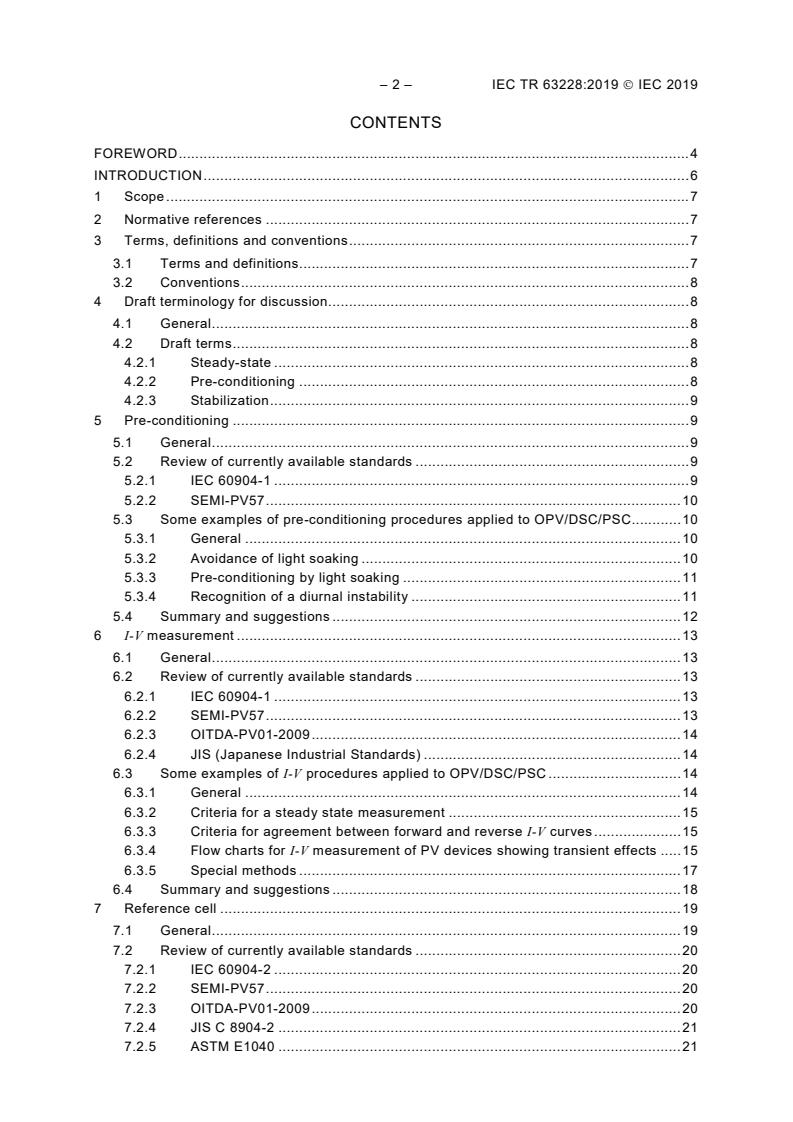
– 2 – IEC TR 63228:2019 IEC 2019
CONTENTS
FOREWORD . 4
INTRODUCTION . 6
1 Scope . 7
2 Normative references . 7
3 Terms, definitions and conventions . 7
3.1 Terms and definitions . 7
3.2 Conventions . 8
4 Draft terminology for discussion . 8
4.1 General . 8
4.2 Draft terms . 8
4.2.1 Steady-state . 8
4.2.2 Pre-conditioning . 8
4.2.3 Stabilization . 9
5 Pre-conditioning . 9
5.1 General . 9
5.2 Review of currently available standards . 9
5.2.1 IEC 60904-1 . 9
5.2.2 SEMI-PV57 . 10
5.3 Some examples of pre-conditioning procedures applied to OPV/DSC/PSC. 10
5.3.1 General . 10
5.3.2 Avoidance of light soaking . 10
5.3.3 Pre-conditioning by light soaking . 11
5.3.4 Recognition of a diurnal instability . 11
5.4 Summary and suggestions . 12
6 I-V measurement . 13
6.1 General . 13
6.2 Review of currently available standards . 13
6.2.1 IEC 60904-1 . 13
6.2.2 SEMI-PV57 . 13
6.2.3 OITDA-PV01-2009 . 14
6.2.4 JIS (Japanese Industrial Standards) . 14
6.3 Some examples of I-V procedures applied to OPV/DSC/PSC . 14
6.3.1 General . 14
6.3.2 Criteria for a steady state measurement . 15
6.3.3 Criteria for agreement between forward and reverse I-V curves . 15
6.3.4 Flow charts for I-V measurement of PV devices showing transient effects . 15
6.3.5 Special methods . 17
6.4 Summary and suggestions . 18
7 Reference cell . 19
7.1 General . 19
7.2 Review of currently available standards . 20
7.2.1 IEC 60904-2 . 20
7.2.2 SEMI-PV57 . 20
7.2.3 OITDA-PV01-2009 . 20
7.2.4 JIS C 8904-2 . 21
7.2.5 ASTM E1040 . 21
7.3 Common practices for reference cells for OPV/DSC/PSC . 21
7.4 Summary and suggestions . 22
8 Spectral responsivity measurement . 23
8.1 General . 23
8.2 Review of currently available standards . 23
8.2.1 IEC 60904-8 . 23
8.2.2 ASTM E1021 . 24
8.3 Practices for spectral responsivity on OPV/DSC/PSC devices . 25
8.3.1 Determining the chopping frequency for devices with a transient response . 25
8.4 Summary and suggestions . 25
9 Sample preparation . 25
9.1 General . 25
9.2 Elements of effective packaging . 26
9.2.1 Rear-side support . 26
9.2.2 Wiring . 26
9.2.3 Aperture masking . 26
9.3 A note on sample size . 26
9.4 Summary and suggestions . 27
10 Temperature control . 27
10.1 General . 27
10.2 Review of currently available standards . 27
10.3 Current practices in temperature measurement/control for OPV/DSC/PSC . 27
10.3.1 Keeping the exposure time short using a shutter . 27
10.3.2 Use of a temperature sensor and a temperature-controlled stage . 28
10.4 Summary and suggestions . 28
11 Non-standard testing light condition . 28
11.1 General . 28
11.2 Review of currently available standards . 28
11.2.1 General . 28
11.2.2 JEITA . 29
11.2.3 SEMI . 29
11.2.4 CIE spectra . 29
11.3 Practical issues when using illumination sources to characterise PV cells . 29
11.4 Summary and suggestions . 30
12 Tandem solar cells . 30
12.1 General . 30
12.2 Review of currently available standards . 30
12.3 Practical issues in applying the existing standards for OPV/DSC/PSC . 31
12.4 Summary and suggestions . 31
Bibliography . 32
Figure 1 – Example flowchart for the electrical characterization of OPV/DSC/PSC . 16
Figure 2 – Alternative flowchart for devices exhibiting long-term drift . 17
Table 1 – Filtered c-Si reference cell . 20
Table 2 – Typical AM1.5G spectral mismatch errors for various device/reference
combinations for an AM1.5G-filtered Xe arc lamp. 22
– 4 – IEC TR 63228:2019 IEC 2019
INTERNATIONAL ELECTROTECHNICAL COMMISSION
____________
MEASUREMENT PROTOCOLS FOR PHOTOVOLTAIC DEVICES BASED
ON ORGANIC, DYE-SENSITIZED OR PEROVSKITE MATERIALS
FOREWORD
1) The International Electrotechnical Commission (IEC) is a worldwide organization for standardization comprising
all national electrotechnical committees (IEC National Committees). The object of IEC is to promote
international co-operation on all questions concerning standardization in the electrical and electronic fields. To
this end and in addition to other activities, IEC publishes International Standards, Technical Specifications,
Technical Reports, Publicly Available Specifications (PAS) and Guides (hereafter referred to as "IEC
Publication(s)"). Their preparation is entrusted to technical committees; any IEC National Committee interested
in the subject dealt with may participate in this preparatory work. International, governmental and non-
governmental organizations liaising with the IEC also participate in this preparation. IEC collaborates closely
with the International Organization for Standardization (ISO) in accordance with conditions determined by
agreement between the two organizations.
2) The formal decisions or agreements of IEC on technical matters express, as nearly as possible, an international
consensus of opinion on the relevant subjects since each technical committee has representation from all
interested IEC National Committees.
3) IEC Publications have the form of recommendations for international use and are accepted by IEC National
Committees in that sense. While all reasonable efforts are made to ensure that the technical content of IEC
Publications is accurate, IEC cannot be held responsible for the way in which they are used or for any
misinterpretation by any end user.
4) In order to promote international uniformity, IEC National Committees undertake to apply IEC Publications
transparently to the maximum extent possible in their national and regional publications. Any divergence
between any IEC Publication and the corresponding national or regional publication shall be clearly indicated in
the latter.
5) IEC itself does not provide any attestation of conformity. Independent certification bodies provide conformity
assessment services and, in some areas, access to IEC marks of conformity. IEC is not responsible for any
services carried out by independent certification bodies.
6) All users should ensure that they have the latest edition of this publication.
7) No liability shall attach to IEC or its directors, employees, servants or agents including individual experts and
members of its technical committees and IEC National Committees for any personal injury, property damage or
other damage of any nature whatsoever, whether direct or indirect, or for costs (including legal fees) and
expenses arising out of the publication, use of, or reliance upon, this IEC Publication or any other IEC
Publications.
8) Attention is drawn to the Normative references cited in this publication. Use of the referenced publications is
indispensable for the correct application of this publication.
9) Attention is drawn to the possibility that some of the elements of this IEC Publication may be the subject of
patent rights. IEC shall not be held responsible for identifying any or all such patent rights.
The main task of IEC technical committees is to prepare International Standards. However, a
technical committee may propose the publication of a technical report when it has collected
data of a different kind from that which is normally published as an International Standard, for
example "state of the art".
IEC TR 63228, which is a Technical Report, has been prepared by IEC technical committee
82: Solar photovoltaic energy systems.
The text of this Technical Report is based on the following documents:
Enquiry draft Report on voting
82/1502/DTR 82/1555A/RVDTR
Full information on the voting for the approval of this technical report can be found in the
report on voting indicated in the above table.
This document has been drafted in accordance with the ISO/IEC Directives, Part 2.
The committee has decided that the contents of this document will remain unchanged until the
stability date indicated on the IEC website under "http://webstore.iec.ch" in the data related to
the specific document. At this date, the document will be
• reconfirmed,
• withdrawn,
• replaced by a revised edition, or
• amended.
A bilingual version of this publication may be issued at a later date.
– 6 – IEC TR 63228:2019 IEC 2019
INTRODUCTION
For years, considerable research effort worldwide has been invested in the development of
new thin-film photovoltaic (PV) technologies that may offer lower cost production, new
applications or both. In particular, organic photovoltaics (OPV), dye-sensitised solar cells
(DSC) and perovskite solar cells (PSC) have generated great interest and the market potential
of these products is being explored.
To date, the performance of all new PV technologies has typically been determined using the
test methods described in the IEC 60904 series and IEC 60891. However, these three
technologies in particular present some additional measurement challenges that are at
present not dealt with in these documents.
This document provides an overview of current best practices for measuring the performance
of PV devices subject to these challenges. It seeks to highlight where the existing standards
fail to accommodate the requirements of these technologies, to identify what additional
measures may be needed for accurate determination of the device efficiency, and how these
measures might be standardised in the future.
It is recognised that this is a rapidly developing field and many items presented are subject to
ongoing active research. Therefore, currently no concrete suggestions can be made to amend
existing IEC standards with respect to these technologies. However, as the field matures, it is
expected that procedures evolve and lead to agreement between experts, so that they can be
introduced into international standards. Whether this will consist of amending existing
standards or in the issue of a separate standard collecting all procedures relevant to these
technologies will be decided in the future.
MEASUREMENT PROTOCOLS FOR PHOTOVOLTAIC DEVICES BASED
ON ORGANIC, DYE-SENSITIZED OR PEROVSKITE MATERIALS
1 Scope
This Technical Report summarises present perspectives on the performance evaluation of
emerging PV technologies, specifically OPV, DSC and PSC devices. These devices present
some challenges for accurate measurement under the existing IEC 60904 series of standards,
which were developed in the context of silicon wafer solar cells. These challenges can be
different for different devices, but in general they arise due to one or more of the following:
instability in performance over time; unusual spectral responsivity; small device size; difficulty
in measuring temperature; a transient response to external stimulus; optical interference
effects; and a non-linear current response to irradiance. These challenges can lead to the cell
output in laboratory testing being significantly different to the output that would be observed in
a real application.
The primary focus of the report is measurement of the current-voltage (I-V) relationship under
illumination for the purpose of determining the device output power, or power conversion
efficiency. Where appropriate, the report makes reference to the IEC 60904 series which
describes the standard approach to measuring the performance of all PV devices. The report
also references existing published standards that seek to accommodate OPV, DSC or PSC
devices.
The report does not seek to find consensus on measurement protocols at this stage. A lot of
work has been done by the community toward that aim, but more work is needed. The report
therefore seeks to document current knowledge and practices, hence serving as a reference
and a tool for conducting further discussion. It is hoped that by identifying the issues that
remain unresolved, the report will focus efforts toward resolving those issues, such that a
guiding Technical Specification can be prepared in the near future. A robust Technical
Specification will bring clarity and confidence to the markets for these PV products as they
develop.
2 Normative references
The following documents are referred to in the text in such a way that some or all of their
content constitutes requirements of this document. For dated references, only the edition
cited applies. For undated references, the latest edition of the referenced document (including
any amendments) applies.
IEC TS 61836, Solar photovoltaic energy systems – Terms, definitions and symbols
3 Terms, definitions and conventions
3.1 Terms and definitions
For the purposes of this document, the terms and definitions given in IEC TS 61836 apply.
ISO and IEC maintain terminological databases for use in standardization at the following
addresses:
• IEC Electropedia: available at http://www.electropedia.org/
• ISO Online browsing platform: available at http://www.iso.org/obp
– 8 – IEC TR 63228:2019 IEC 2019
3.2 Conventions
Clauses 5 to 12 of this report each deal with a separate issue relating to the measurement of
solar cell performance. Each of those sections is structured as follows:
• General
• Review of currently available standards
• Examples of how the issue is currently handled by researchers around the world
• Summary and possible next steps
At times throughout the report, it is instructive to indicate that a particular issue may be
specific to only one or two of the PV technologies being discussed. To assist with this, a key
has been included at the end of some paragraphs. The key indicates applicability to a
particular technology with a filled square, and uses an open square for the technology to
which the issue does not apply. For example, (■OPV ■DSC □PSC) indicates that the above
issue applies to OPV and DSC technologies, but not to PSC technologies.
4 Draft terminology for discussion
4.1 General
Any study of the various standards for PV measurement, or the scientific literature on the
topic, will show that while some terms are well-defined and applied with consistency, others
are not. In particular, certain terms relating to the stability of PV devices and their
measurements, have not to date been considered important enough to standardize.
For emerging PV devices however, the topic of stabilization is of profound importance,
particularly where accurate and representative measurements are desired. For this reason, an
attempt is made here to identify the most commonly used definitions for three key terms. It is
hoped that by providing draft definitions for these terms here, the industrial and research
communities may arrive at a common language to describe these concepts.
4.2 Draft terms
4.2.1 Steady-state
The term steady-state is used in this document to describe the response of a PV device
where that response has achieved a defined level of short-term stability under the prevailing
conditions of irradiance, temperature and voltage bias. The term may be applied to any point
on an appropriately measured I-V curve, and by extension, to any parameter extracted from
such a curve. A steady-state I-V curve is one in which the voltage sweep rate is slow enough
to allow each current measurement to stabilize to within a defined stability criterion. The
efficiency of a solar cell determined from such a measurement is independent of the I-V
sweep parameters (to within the margin of the stability criterion) and, ideally, represents the
efficiency the cell would exhibit under a maximum power point tracker at the time of the
measurement. Note there is no requirement for the cell performance to be stable in the long
term.
4.2.2 Pre-conditioning
The term pre-conditioning is used to refer to the practice of holding a photovoltaic device
under a certain set of conditions, again irradiance, temperature and voltage bias, for some
period immediately prior to making a current-voltage (I-V) measurement. The practice of pre-
conditioning has historically been applied as an attempt to create short-term stability in the
device, so that a subsequent I-V measurement reflects or approximates the steady-state
device performance in a relatively rapid sweep, so limiting device degradation during the
measurement. In some cases pre-conditioning may also be used to artificially inflate the
measured device efficiency, although this latter practice is discouraged.
4.2.3 Stabilization
In IEC TS 61836, conditioning refers to a process for stabilizing a device prior to an
environmental test. It is always performed prior to that test; however, it is unclear whether it
shall be performed immediately before the test (as per pre-conditioning above), or whether
instead it is designed to stabilize the device in the long term.
To make the above distinction clear, in this document the term stabilize is used to describe
treatments that result in the performance of a PV device being stable over much longer time
periods. A measurement of the device performance parameters may or may not be
independent of the I-V sweep parameters, however steady-state measurements on a
stabilized device produce the same result regardless of any reasonable device exposure
and/or time between measurements. This definition is consistent with the historical use of this
term in the published PV efficiency tables.
5 Pre-conditioning
5.1 General
The practice of pre-conditioning an unstable PV device prior to I-V measurement is
contentious, owing to its ability to influence the measurement, sometimes producing a result
that would not represent the device's performance in a real-world environment. Nevertheless,
many endorse its use as a way of achieving reproducible results. Certainly, pre-exposure of a
solar device with light seems reasonable, given the environment it will ultimately be used in.
This clause seeks to briefly summarize the practices that invoke pre-conditioning and the
standards that refer to it. At present, there is no single pre-conditioning procedure recognized
as effective for all devices, even within a given technology type.
5.2 Review of currently available standards
5.2.1 IEC 60904-1
IEC 60904-1 (Photovoltaic devices – Part 1: Measurement of photovoltaic current-voltage
characteristics) [1] provides no guidance for devices that are unstable on the timescale of the
I-V curve measurement. The only reference to device instability in that document is as follows:
"In measuring PV devices which are non-stable, care shall be taken in selecting a
representative spectral responsivity".
At the time of preparing this report, a new edition of IEC 60904-1 is in draft. The draft
currently includes text that extends the above statement to include reference to "pre-
conditioning"; however, the use of that term is more akin to what we have defined above as
stabilization. This is understandable for OPV and DSC devices, where long term stabilization
can usually be achieved with pre-treatment. However, to accommodate PSC devices, it may
be of value to distinguish between pre-conditioning and stabilization using the definitions
above.
The draft of IEC 60904-1 suggests that guidance on pre-conditioning can be taken from the
Clause on Stabilization (Test MQT 19) in the current IEC 61215 series (described specifically
in IEC 61215-2:2016 [2]). The MQT 19 method contains good detail, particularly in regard to
stabilization by light soaking. Regarding other types of stabilization, the document permits any
method provided the method is validated, and a validation procedure is described in the
document.
In summary, the MQT 19 procedure states that all PV modules should be electrically
stabilized prior to measurement. It defines electrical stabilization as a stabilization of the
observed output power value (P) according to
(P – P ) / P < x (1)
max min average
– 10 – IEC TR 63228:2019 IEC 2019
where P , P and P are the extreme values of P taken from a sequence of three
max min average
measurements interleaved with periods of irradiation to a defined minimum dose. The values
of both x and the minimum dose are defined in the technology specific sub-parts of
IEC 61215-1 [3] (IEC 61215-1-1 for crystalline silicon, IEC 61215-1-2 for cadmium telluride,
IEC 61215-1-3 for amorphous silicon and IEC 61215-1-4 for copper indium gallium
(di)selenide). Presently, there is no current plan to include sub-parts for OPV, DSC or PSC
into the IEC 61215 series, although this is likely at some point in the future if these
technologies reach market maturity.
5.2.2 SEMI-PV57
The SEMI-PV57 [4] is a standard from Semiconductor Equipment and Materials International
(SEMI) about test method for current-voltage performance measurement of organic
photovoltaic and dye-sensitized solar cell. In SEMI-PV57 is stated that in order to anneal and
stabilize the electrical characteristics of a device under test using simulated solar irradiation
for 10 minutes to 30 minutes, some requirements are recommended as follows (SEMI-PV57,
9.6.1):
2 2
– use a reference device to adjust the irradiance in the range 600 W/m to 1 000 W/m , then
record the irradiance (SEMI-PV57, 9.6.2);
– mount the device within the light field and monitor its maximum power using a source-
measure unit (SMU) or variable resistive load;
– stabilization is achieved when the check criteria defined in Formula (2), based on
measurements from two consecutive periods of at least 43 kWh/m , each integrated over
periods when the temperature is in the range 40 °C to 60 °C, are in agreement to better
than 2 %.
check criteria ≡ (P – P ) / P × 100 % (2)
max min average
This method is very similar to the MQT 19 method described in IEC 61215-2 and summarised
in 5.2.1 above and uses the dose of 43 kWh/m used for the thin-film a-Si devices as in
IEC 61215-1-3.
This standard is similar to IEC 60904-1 but does not address preconditioning or stabilization
criteria.
(■ OPV ■ DSC □ PSC)
5.3 Some examples of pre-conditioning procedures applied to OPV/DSC/PSC
5.3.1 General
A number of different approaches to device pre-conditioning are described in the literature.
Different groups appear to be using procedures suited to their own particular material system.
The situation is further complicated by degradation effects, which impact different devices in
different ways. The most common approaches are described briefly in 5.3.2 to 5.3.4, and the
issue also comes into the subsequent clause on I-V measurement.
5.3.2 Avoidance of light soaking
Some groups do not recommend pre-conditioning with light, based on the fact that light can
cause degradation, or in some cases even artificial enhancement in the device. The latter may
occur if the device incorporates doped oxides as barrier layers, as many oxides are
photoactive under the UV component of the light source. Ultraviolet (UV) is often not present
in a real application, owing to absorption by encapsulating layers in the final commercial
product.
Even in the absence of UV effects or light-induced degradation, PSC devices are well-known
to be sensitive to the exposure history, with effects that vary with the voltage bias during any
recent light exposure. A recent report based on a multi-lab intercomparison experiment [5],
identified a persistent relationship between the measured cell efficiency and the type of light
soak performed. Light soaking at the short-circuit condition was observed to produce low
hysteresis, but also the lowest efficiency result. Avoidance of light soaking produced a similar
result. Light soaking at V produced a higher efficiency with some hysteresis. Light soaking
mp
at the open circuit condition produced the largest hysteresis and hence no efficiency could
reliably be extracted.
The argument to avoid light soaking in PSC devices is understandable, given the complexities
of the device response described above.
(□ OPV □ DSC ■ PSC)
5.3.3 Pre-conditioning by light soaking
The impact of light soaking is not restricted to PSC devices. In addition to irreversible
degradation, effects on OPV and DSC devices can include short-term variations owing to
reversible degradation and/or annealing, as well as recovery from dark ageing. For these
reasons, light soaking is a common form of pre-conditioning treatment for these devices.
A light soaking pre-treatment has been shown to have a stabilizing effect on the performance
of OPV and DSC devices, especially for devices that were kept in the dark beforehand
([6] and [7]). For devices stored in the dark for long periods, a suitable treatment is to hold the
device for around 40 minutes at open circuit under broadband illumination, with irradiance
around 1 000 W/m and temperature held around 25 °C. This pre-conditioning treatment
primarily stabilises the fill-factor of the resulting I-V curve. After this treatment, shorter light
soaking treatments of around 10 minutes are usually sufficient to bring the device back to its
light-stable performance, provided only a few days have passed since the last full light soak.
In accelerated ageing studies of OPV mini-modules, the need for longer light-soaking
treatments (up to about 1 h) with increased ageing was noticed, particularly for devices kept
under humidity stress [7].
The enormous range of device behaviours at the R&D stage means that standardising a light
soaking procedure for pre-conditioning will not be an easy task. This may be made simpler
once device technologies mature to a stage at which they can be stabilized using a procedure
such as MQT 19 in IEC 61215-1. Stabilization will not necessarily remove the need for special
steps to achieve a steady-state measurement, such as pre-conditioning, or one of the other
techniques discussed in Clause 6.
(■ OPV ■ DSC □ PSC)
5.3.4 Recognition of a diurnal instability
Some groups have identified the fact that some devices, particularly PSC, can exhibit a
reversible instability over the 24 hour day-night cycle [8], [9] and [10]. They contend that this
means it is not appropriate to seek a single stabilized device performance, but instead a fair
assessment should consider that the real application also includes nighttime. How this should
be measured in the laboratory remains an issue for discussion; however, it may mean that
pre-conditioning before I-V measurement is not useful, or perhaps should be performed in two
parts, one for the morning performance and the other for the afternoon performance.
(□ OPV □ DSC ■ PSC)
– 12 – IEC TR 63228:2019 IEC 2019
5.4 Summary and suggestions
Based on the draft terminology in Clause 4, the aim of a pre-conditioning procedure is to
reduce the exposure time required for an I-V curve to represent the behaviour of the device in
a real application. Shorter exposures reduce the impact of exposure effects during the
measurement; hence this issue may become less important as devices become more stable.
Stabilization of devices, as proposed, is a different concept, albeit equally important.
Standardising this term for OPV/DSC/PSC to match the existing usage in IEC 61215 series
will remove ambiguity for the test laboratories in making measurements for the record
efficiency tables, by clarifying the requirement for a device to avoid being marked as ‘not
stabilised’ in those tables.
Having an agreed method for confirming long term stability will also simplify exchanges
between test laboratories, meaning stronger validation of devices and ultimately better
measurement practices.
Adoption of the IEC 61215-1 approach to stabilization for OPV/DSC/PSC devices will mean
that stability parameters (the values of x and the minimum exposure dose in Clause 5.2.1) will
need to be developed for these devices. These parameters can be codified in additional
technology-specific sub-parts of IEC 61215-1-x (e.g. -1-5, -1-6, -1-7).
If the definitions in Clause 4 become widely agreed upon, it will be of value for these to be
codified in IEC TS 61836.
Alternatively, the opportunity may be afforded to opponents of the IEC 61215-1 stabilization
concept to argue that any such definition should accommodate a diurnal behaviour in these
devices.
At this stage, the large number of device/material combinations for OPV/DSC/PSC means that
the necessity and nature of pre-conditioning will need to remain at the discretion of the
individual researcher. It may be helpful to have a structured decision process for evaluating
the need for pre-conditioning on any device, and for selecting the appropriate method.
Whatever pre-conditioning method is chosen (including no pre-conditioning), it will be
important that this is recorded and included in any report of the measurement.
Whichever approach is identified as best, it will be of value to work with the developers of the
next edition of IEC 60904-1 to ensure consistency in terminology. For example, it will likely be
important that the difference between pre-conditioning and stabilization be captured in that
document. Likewise, the concept of a steady-state measurement may be addressed, with
specific instructions for achieving a steady-state measurement being potentially available in a
separate document, such as a Technical Specification for OPV/DSC/PSC. A possible wording
to include in IEC 60904-1 could be:
"Care shall be taken in measuring PV devices that are metastable. If it is possible to
stabilise the device, stabilisation should be performed before any characterisation (I-V or
spectral responsivity measurement). Any stabilisation procedure performed shall be
reported together with the test results. The IEC 61215 series of standards provides
guidance on technology-dependent appropriate stabilisation."
6 I-V measurement
6.1 General
The standard procedure for measuring the current response of a PV device to an applied
voltage under illumination is described in IEC 60904-1. The procedure is robust if the current
response to changes in the applied voltage is rapid compared to the time between changes in
voltage. The procedure does accommodate devices with a slightly slower response, with the
following text:
"Depending on the cell technology, I-V measurement may be influenced by the voltage
sweep rate and the sweep direction. Cells with high capacitance are more problematic.
These effects should be carefully analyzed in a test programme. Negative effects can be
excluded when measurements in the positive voltage direction starting at the short-circuit
current and in the negative direction starting at the open-circuit voltage overlap optimally."
The above statement is effective in dealing with devices where I-V hysteresis is the result of a
simple time constant in the current response to a change in irradiance or applied voltage bias.
The existing standards listed in Clause 6.2 are primarily designed to assist in the selection of
appropriate sweep speeds (delay times for each voltage step) so as to avoid measurement
errors arising from this kind of device response.
However, certain PV technologies are not compatible with the above procedure. In particular,
recent reports, e.g. [11] have shown that for many PSC devices, agreement between the
forward and reverse I-V curves does not guarantee that the result will be repeatable, even in
the absence of irreversible degradation. This situation occurs when the device, which may be
stable on a 100 ms timescale, exhibits a change in its performance under illumination or
applied voltage on a timescale of seconds to minutes, or even hours. This is problematic for
the I-V curve measurement, for two reasons:
1) Slow I-V sweeps, designed to avoid errors due to a transient response, are not completed
before the device exhibits changes under the influence of the light or applied voltage, and,
2) Rapid I-V sweeps, designed to avoid long-term drift in the device, are often affected by the
transient response time, or even if not, are unlikely to be representative of the
performance of the device in a real application with continuous illumination.
According to the report in [11], when the forward and reverse I-V curves agree under a wide
range of sweep conditions, the measurement result can be defined as the "true" I-V curve. In
many cases however, it is not possible to find agreement between I-V curves taken using
different sweep conditions, hence the true result simply cannot be determined. Subclause 6.3
discusses some approaches being applied by the PV research community to address this
problem.
(□ OPV □ DSC ■ PSC)
6.2 Review of currently available standards
6.2.1 IEC 60904-1
This has been described in 5.2.1.
6.2.2 SEMI-PV57
This SEMI-PV57 standard includes three relevant clauses:
"I-V Sweep by Setting Delay Time – The delay time should be longer than 20 ms for
measuring OPV, longer than 40 ms for measuring DSSC with organic solvent electrolyte,
and be longer than 1 000 ms for measuring DSSC with ionic liquid electrolyte [SEMI-PV57
section 9.7.2]."
– 14 – IEC TR 63228:2019 IEC 2019
"I-V Sweep Including Real-time Removing Capacity Effect – This method needs to read
simultaneously multi-point forming step after taking the optimization stabilizing area as a
point on the I-V curve [SEMI-PV57 section 9.7.3]."
"I-V measurements of both scan directions are necessary to estimate the related
measurement error, as the temporal response is expected to be dependent on the device
structure of the device under test a
...
Questions, Comments and Discussion
Ask us and Technical Secretary will try to provide an answer. You can facilitate discussion about the standard in here.
Loading comments...