

IEC TR 63292:2020
(Main)Photovoltaic power systems (PVPSs) - Roadmap for robust reliability
General Information
- Abstract
IEC TR 63292:2020 continues the effort started with the availability technical specification (IEC TS 63019). Availability is closely related to PVPS operational capability, health and condition and to produce energy and is a real-time or historical measure. The availability of a system or component is impacted by contractual and non-contractual reliability specifications, maintenance metrics and a corresponding maintenance and repair strategy, and also external factors such as site environmental and grid conditions. The intention of this document is to be a precursor examination of the reliability issues for further address in a task to produce an IEC Technical Specification on this topic.
While this document identifies reliability tools, topics and procedures, there are commercial products available to perform analyses and there is no assessment of those tools or to provide recommendations for one tool over another in this document.
- Status
- Published
- Publication Date
- 25-Jun-2020
- Technical Committee
- TC 82 - Solar photovoltaic energy systems
- Drafting Committee
- WG 3 - TC 82/WG 3
- Current Stage
- PPUB - Publication issued
- Start Date
- 26-Jun-2020
- Completion Date
- 06-Jul-2020
Overview
IEC TR 63292:2020 - Photovoltaic power systems (PVPSs) – Roadmap for robust reliability - is an IEC Technical Report that continues the work started in IEC TS 63019. It frames a roadmap for improving the reliability and availability of PV systems by describing reliability concepts, tools, metrics and procedures relevant across design and operational phases. The report is a precursor to a future Technical Specification and does not evaluate or endorse commercial reliability software or tools.
Key Topics
The report organizes practical reliability knowledge for PV system stakeholders and covers:
- RAM interrelationships - Reliability, Availability and Maintainability fundamentals and how they affect PV performance and energy yield.
- Dependability and stakeholder perspectives - Roles of owners, O&M teams, designers and financiers in reliability management.
- Reliability tools and techniques (described, not vendor-evaluated), including:
- Reliability Block Diagrams (RBD) and Monte Carlo simulations
- Failure Modes and Effects Analysis (FMEA)
- Fault Tree Analysis (FTA)
- Failure Reporting and Corrective Action System (FRACAS)
- Root Cause Analysis (RCA), Pareto and long-term trend analysis
- Critical item lists, data analysis and maintainability metrics
- Risk analysis and life-cycle cost considerations
- Data and metrics guidance - Recommendations for collecting failure data, trend analysis, and example metrics for monitoring PV health and availability.
- Practical recommendations and a reliability plan (informative annexes) to help implement reliability processes during both concept/design and O&M phases.
Applications
IEC TR 63292 is intended for practitioners who need to improve PV system resilience and optimize energy production:
- PV system designers and manufacturers - integrate reliability thinking into concept and design; use failure-mode insights to select components and test strategies.
- Asset owners and investors - assess reliability risk, forecast availability and plan lifecycle costs.
- O&M engineers and contractors - implement data acquisition, FRACAS, RCA and maintenance strategies to reduce downtime and improve availability.
- Reliability engineers and consultants - apply standardized reliability tools to PV-specific challenges and prepare reliability plans.
- Standards developers and policymakers - use the roadmap to inform future technical specifications and industry best practices.
Related Standards
- IEC TS 63019 - Availability for PV power systems (foundation referenced by IEC TR 63292)
- Prepared by IEC Technical Committee 82 (Solar photovoltaic energy systems)
This Technical Report is a practical resource for improving photovoltaic reliability, asset availability and long-term energy performance while guiding data-driven O&M and design decisions. Keywords: photovoltaic reliability, PV system availability, PV O&M, reliability tools, FRACAS, FMEA, RBD, RCA.
Get Certified
Connect with accredited certification bodies for this standard

DNV
DNV is an independent assurance and risk management provider.

Lloyd's Register
Lloyd's Register is a global professional services organisation specialising in engineering and technology.
DNV Energy Systems
Energy and renewable energy certification.
Sponsored listings
Frequently Asked Questions
IEC TR 63292:2020 is a technical report published by the International Electrotechnical Commission (IEC). Its full title is "Photovoltaic power systems (PVPSs) - Roadmap for robust reliability". This standard covers: IEC TR 63292:2020 continues the effort started with the availability technical specification (IEC TS 63019). Availability is closely related to PVPS operational capability, health and condition and to produce energy and is a real-time or historical measure. The availability of a system or component is impacted by contractual and non-contractual reliability specifications, maintenance metrics and a corresponding maintenance and repair strategy, and also external factors such as site environmental and grid conditions. The intention of this document is to be a precursor examination of the reliability issues for further address in a task to produce an IEC Technical Specification on this topic. While this document identifies reliability tools, topics and procedures, there are commercial products available to perform analyses and there is no assessment of those tools or to provide recommendations for one tool over another in this document.
IEC TR 63292:2020 continues the effort started with the availability technical specification (IEC TS 63019). Availability is closely related to PVPS operational capability, health and condition and to produce energy and is a real-time or historical measure. The availability of a system or component is impacted by contractual and non-contractual reliability specifications, maintenance metrics and a corresponding maintenance and repair strategy, and also external factors such as site environmental and grid conditions. The intention of this document is to be a precursor examination of the reliability issues for further address in a task to produce an IEC Technical Specification on this topic. While this document identifies reliability tools, topics and procedures, there are commercial products available to perform analyses and there is no assessment of those tools or to provide recommendations for one tool over another in this document.
IEC TR 63292:2020 is classified under the following ICS (International Classification for Standards) categories: 27.160 - Solar energy engineering. The ICS classification helps identify the subject area and facilitates finding related standards.
IEC TR 63292:2020 is available in PDF format for immediate download after purchase. The document can be added to your cart and obtained through the secure checkout process. Digital delivery ensures instant access to the complete standard document.
Standards Content (Sample)
IEC TR 63292 ®
Edition 1.0 2020-06
TECHNICAL
REPORT
colour
inside
Photovoltaic power systems (PVPSs) – Roadmap for robust reliability
All rights reserved. Unless otherwise specified, no part of this publication may be reproduced or utilized in any form
or by any means, electronic or mechanical, including photocopying and microfilm, without permission in writing from
either IEC or IEC's member National Committee in the country of the requester. If you have any questions about IEC
copyright or have an enquiry about obtaining additional rights to this publication, please contact the address below or
your local IEC member National Committee for further information.
IEC Central Office Tel.: +41 22 919 02 11
3, rue de Varembé info@iec.ch
CH-1211 Geneva 20 www.iec.ch
Switzerland
About the IEC
The International Electrotechnical Commission (IEC) is the leading global organization that prepares and publishes
International Standards for all electrical, electronic and related technologies.
About IEC publications
The technical content of IEC publications is kept under constant review by the IEC. Please make sure that you have the
latest edition, a corrigendum or an amendment might have been published.
IEC publications search - webstore.iec.ch/advsearchform Electropedia - www.electropedia.org
The advanced search enables to find IEC publications by a The world's leading online dictionary on electrotechnology,
variety of criteria (reference number, text, technical containing more than 22 000 terminological entries in English
committee,…). It also gives information on projects, replaced and French, with equivalent terms in 16 additional languages.
and withdrawn publications. Also known as the International Electrotechnical Vocabulary
(IEV) online.
IEC Just Published - webstore.iec.ch/justpublished
Stay up to date on all new IEC publications. Just Published IEC Glossary - std.iec.ch/glossary
details all new publications released. Available online and 67 000 electrotechnical terminology entries in English and
once a month by email. French extracted from the Terms and Definitions clause of
IEC publications issued since 2002. Some entries have been
IEC Customer Service Centre - webstore.iec.ch/csc collected from earlier publications of IEC TC 37, 77, 86 and
If you wish to give us your feedback on this publication or CISPR.
need further assistance, please contact the Customer Service
Centre: sales@iec.ch.
IEC TR 63292 ®
Edition 1.0 2020-06
TECHNICAL
REPORT
colour
inside
Photovoltaic power systems (PVPSs) – Roadmap for robust reliability
INTERNATIONAL
ELECTROTECHNICAL
COMMISSION
ICS 27.160 ISBN 978-2-8322-8472-8
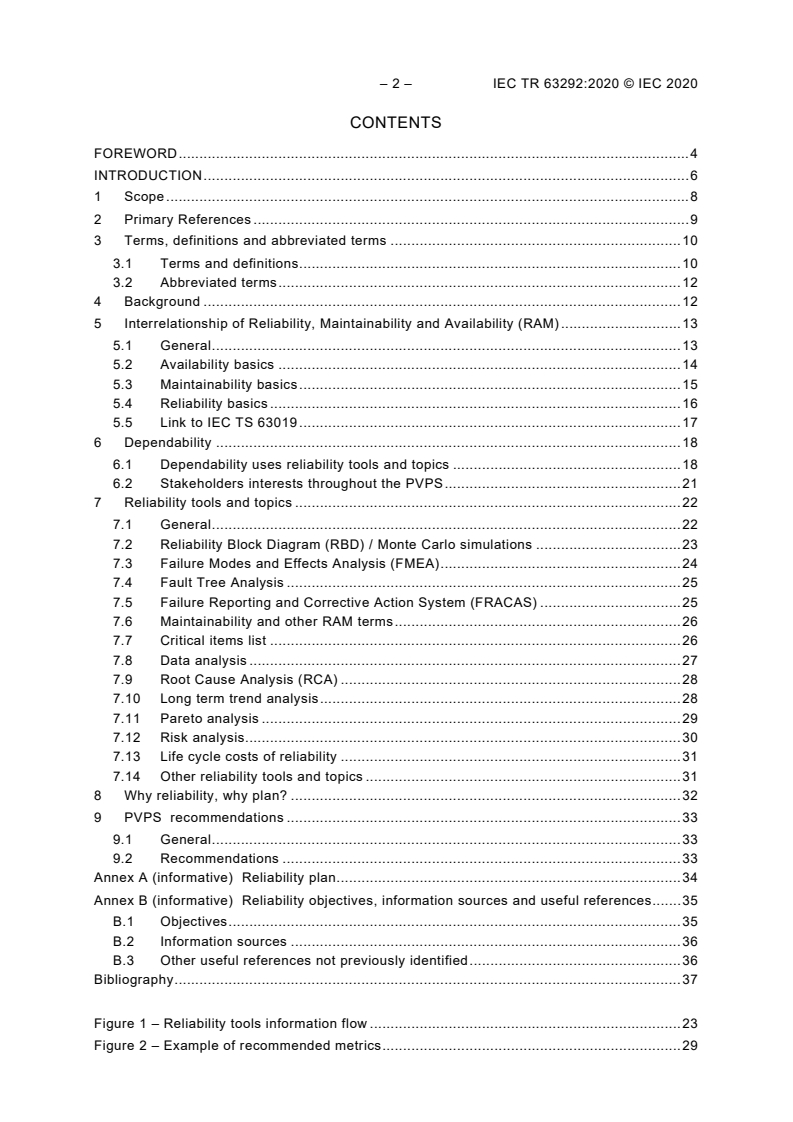
– 2 – IEC TR 63292:2020 © IEC 2020
CONTENTS
FOREWORD . 4
INTRODUCTION . 6
1 Scope . 8
2 Primary References . 9
3 Terms, definitions and abbreviated terms . 10
3.1 Terms and definitions . 10
3.2 Abbreviated terms . 12
4 Background . 12
5 Interrelationship of Reliability, Maintainability and Availability (RAM) . 13
5.1 General . 13
5.2 Availability basics . 14
5.3 Maintainability basics . 15
5.4 Reliability basics . 16
5.5 Link to IEC TS 63019 . 17
6 Dependability . 18
6.1 Dependability uses reliability tools and topics . 18
6.2 Stakeholders interests throughout the PVPS . 21
7 Reliability tools and topics . 22
7.1 General . 22
7.2 Reliability Block Diagram (RBD) / Monte Carlo simulations . 23
7.3 Failure Modes and Effects Analysis (FMEA) . 24
7.4 Fault Tree Analysis . 25
7.5 Failure Reporting and Corrective Action System (FRACAS) . 25
7.6 Maintainability and other RAM terms . 26
7.7 Critical items list . 26
7.8 Data analysis . 27
7.9 Root Cause Analysis (RCA) . 28
7.10 Long term trend analysis . 28
7.11 Pareto analysis . 29
7.12 Risk analysis. 30
7.13 Life cycle costs of reliability . 31
7.14 Other reliability tools and topics . 31
8 Why reliability, why plan? . 32
9 PVPS recommendations . 33
9.1 General . 33
9.2 Recommendations . 33
Annex A (informative) Reliability plan . 34
Annex B (informative) Reliability objectives, information sources and useful references . 35
B.1 Objectives . 35
B.2 Information sources . 36
B.3 Other useful references not previously identified . 36
Bibliography . 37
Figure 1 – Reliability tools information flow . 23
Figure 2 – Example of recommended metrics . 29
Figure 3 – Frequency analysis of key weather terms in the PVROM database . 30
Figure A.1 – Reliability plan example flowchart . 34
Table 1 – Information category overview for a PVPS (modified from
IEC TS 63019:2019) . 18
Table 2 – Primary reliability interest of stakeholders . 21
– 4 – IEC TR 63292:2020 © IEC 2020
INTERNATIONAL ELECTROTECHNICAL COMMISSION
____________
PHOTOVOLTAIC POWER SYSTEMS (PVPSs) –
ROADMAP FOR ROBUST RELIABILITY
FOREWORD
1) The International Electrotechnical Commission (IEC) is a worldwide organization for standardization comprising
all national electrotechnical committees (IEC National Committees). The object of IEC is to promote international
co-operation on all questions concerning standardization in the electrical and electronic fields. To this end and
in addition to other activities, IEC publishes International Standards, Technical Specifications, Technical Reports,
Publicly Available Specifications (PAS) and Guides (hereafter referred to as "IEC Publication(s)"). Their
preparation is entrusted to technical committees; any IEC National Committee interested in the subject dealt with
may participate in this preparatory work. International, governmental and non-governmental organizations liaising
with the IEC also participate in this preparation. IEC collaborates closely with the International Organization for
Standardization (ISO) in accordance with conditions determined by agreement between the two organizations.
2) The formal decisions or agreements of IEC on technical matters express, as nearly as possible, an international
consensus of opinion on the relevant subjects since each technical committee has representation from all
interested IEC National Committees.
3) IEC Publications have the form of recommendations for international use and are accepted by IEC National
Committees in that sense. While all reasonable efforts are made to ensure that the technical content of IEC
Publications is accurate, IEC cannot be held responsible for the way in which they are used or for any
misinterpretation by any end user.
4) In order to promote international uniformity, IEC National Committees undertake to apply IEC Publications
transparently to the maximum extent possible in their national and regional publications. Any divergence between
any IEC Publication and the corresponding national or regional publication shall be clearly indicated in the latter.
5) IEC itself does not provide any attestation of conformity. Independent certification bodies provide conformity
assessment services and, in some areas, access to IEC marks of conformity. IEC is not responsible for any
services carried out by independent certification bodies.
6) All users should ensure that they have the latest edition of this publication.
7) No liability shall attach to IEC or its directors, employees, servants or agents including individual experts and
members of its technical committees and IEC National Committees for any personal injury, property damage or
other damage of any nature whatsoever, whether direct or indirect, or for costs (including legal fees) and
expenses arising out of the publication, use of, or reliance upon, this IEC Publication or any other IEC
Publications.
8) Attention is drawn to the Normative references cited in this publication. Use of the referenced publications is
indispensable for the correct application of this publication.
9) Attention is drawn to the possibility that some of the elements of this IEC Publication may be the subject of patent
rights. IEC shall not be held responsible for identifying any or all such patent rights.
The main task of IEC technical committees is to prepare International Standards. However, a
technical committee may propose the publication of a technical report when it has collected
data of a different kind from that which is normally published as an International Standard, for
example "state of the art".
IEC TR 63292 which is a technical report, has been prepared by IEC technical committee 82:
Solar photovoltaic energy systems.
The text of this technical report is based on the following documents:
Enquiry draft Report on voting
82/1671/DTR 82/1716/RVDTR
82/1716A/RVDTR
Full information on the voting for the approval of this technical report can be found in the report
on voting indicated in the above table.
This document has been drafted in accordance with the ISO/IEC Directives, Part 2.
Mandatory information categories defined in this document are written in capital letters; optional
information categories are written in bold letters.
The committee has decided that the contents of this document will remain unchanged until the
stability date indicated on the IEC website under "http://webstore.iec.ch" in the data related to
the specific document. At this date, the document will be
• reconfirmed,
• withdrawn,
• replaced by a revised edition, or
• amended.
IMPORTANT – The 'colour inside' logo on the cover page of this publication indicates
that it contains colours which are considered to be useful for the correct understanding
of its contents. Users should therefore print this document using a colour printer.
– 6 – IEC TR 63292:2020 © IEC 2020
INTRODUCTION
Reliability of a PVPS or its components is perceived in many ways depending on the perspective
of the observer. This document addresses many of these perspectives ranging from component
failures to the human factors needed in operations and maintenance (O&M) of a PVPS.
Technically, reliability is the probability that a product or a system will perform its intended
functions satisfactorily without failure and within specified performance limits for a specified
length of time, operating under specified environmental and operational conditions. Stated as
such, reliability analysis is a physics problem in that it includes what, how, and why of failure.
Reliability is determined by a variety of factors (failure modes) and each failure mode is
generally characterized as an average or mean time to or between failure or by failure rates
(commonly failures per unit of time) or by failure distributions. Causes include failure
mechanisms such as overstress and below specification strength, natural and induced
environmental exposures, chemical aging, radiation, and other factors such as weak or
intermittent manufacturing quality or shipping and handling induced damage that lead to a
component failure. The failed items will need repair or replacement through a function of
maintenance actions. Reliability analysis and best practices should be applied throughout the
concept and design phases to identify, pre-empt, prevent, forestall, or mitigate such failures
during planned operation. Cognizance of reliability factors is important for owners, and others
performing project or program financial and technical risk asset management.
Acquiring data to find and understand failure trends, spares forecasting, manpower forecasting,
obsolescence planning and repeating component failures requires a management focus to
mitigate or eliminate recurring issues and document accurate failure tracking. The ability to
estimate the resulting loss of Photovoltaic Power System (PVPS) capability forms the basis for
how to allocate time, power, energy and even cost for reporting reliability metrics or, more
directly, unreliability due to failure events and/or trends, which in turn, necessitate corrective
actions.
Assuring reliability can generally be viewed as two specific and major interrelated efforts:
a) concept and design phase, and
b) the operational and maintenance (O&M) phase.
During concept and design evidence of prior product failures and system history and current
testing data are used to estimate the reliability of the system(s). The evidence comes in the
form of data from historical operation of existing plants that has sufficient breadth of information
to provide the basic reliability information as well as attributes such as the failure distribution
(e.g., normal, Weibull, exponential, etc.), failure mechanisms and failure modes, and required
corrective actions. With rapidly advancing technologies the concept and design phases also
require using engineering judgement, experience, design trade-off assessments, and
design/reliability testing of new components for developing failure models. For instance,
understanding the physics of failure applies to the design assessment.
During O&M, the owner/operators and the O&M contractor implement a failure detection and
data acquisition system that likewise provides data for analysis of the current failures including
root cause, failure modes, and failure rates by documenting and tracking the failures and then
using the data to develop corrective action plans and when feasible changing the design to
accommodate new stresses or to correct a flawed design.
Effective reliability practices will reduce overall system costs through reduction of failures and
their consequences. There are initial costs associated with design analyses and reviews,
component selection, and analysis of reliability testing. In this context, reliability should be
viewed as an investment in the plant or company future. Failure to perform reliability practices
results in a low reliability product and its ramification of extended costs for field repairs and
replacements, impact to energy generation, problems during warranty, or worse, the loss of
business.
This document continues the effort started with the availability technical specification (IEC
TS 63019). Availability is closely related to PVPS operational capability, health and condition
and to produce energy and is a real-time or historical measure. The availability of a system or
component is impacted by contractual and non-contractual reliability specifications,
maintenance metrics and a corresponding maintenance and repair strategy, and also external
factors such as site environmental and grid conditions. Reliability has a focus more closely
aligned on the capability of the components, their health and condition, systems to sustain
production, and what manner of operations, maintenance, analysis and actions are effective for
economic asset management of the PVPS.
The PV industry has had a recent period of rapid growth of installations. Existing PV plants are
starting to age. Concurrently, new and evolving products are being introduced and a lack of
reliability data is a general issue of concern as often there is insufficient testing or test data to
properly assign the reliability attributes to these new technologies. This goes to the intended
function of the systems, which is a topic for addressing through reliability analyses to determine
the impact of known and unknown (postulated) failures and/or the effects of underestimated
declining performance. There has been expressed levels of dissatisfaction for many plants not
meeting power/energy expectations and, in some cases, this has led to plant shutdowns or
expensive upgrades or down rating (derating) of the plant. In some instances, the loss of or the
renegotiations of power purchase agreements has also occurred.
Clarity is needed to specifically address issues of the intended function not meeting appropriate
specifications, and to numerically assess reliability performance and economic impacts.
Throughout, there is competition in the market with cost pressures and without the expectations
of continuous process improvement, those pressures will continue to exist.
The motivation for addressing reliability in the implementation and operation of a PVPS is
founded in the desire for long lasting energy performance, energy production, secure production
and revenue, and safe function. Management of a PVPS may come in many forms, but for
reliability to be properly addressed, it is derived from a commitment to establish practices from
the beginning development of concept and plans to take necessary actions and financial
investment to ensure results and avoid the costs of unreliability. The commitment for reliability
must begin at the highest levels of the organization and for those who have financial risks in
the project, the course of action must be defined and implemented in a manner similar as that
of environmental safety, health and quality. This document is supportive of that approach and
defines methodology for accomplishment.
An intention of this document is to be a precursor examination of the reliability issues for further
address in a task to produce an IEC Technical Specification on this topic.
While this document identifies reliability tools, topics and procedures, there are commercial
products available to perform analyses and there is no assessment of those tools or to provide
recommendations for one tool over another in this document.
– 8 – IEC TR 63292:2020 © IEC 2020
PHOTOVOLTAIC POWER SYSTEMS (PVPSs) –
ROADMAP FOR ROBUST RELIABILITY
1 Scope
PVPS component and system reliability engineering works to define the PVPS probability of
making the indicated value such as energy or revenue, also at a given statistical confidence
level for an estimate. This needs to be assessed properly as an accurate levelized cost of
energy (LCOE) results from identifying and acting on a set of quantifiable metrics based upon
real measured data of actual plants under the widest variety of real site conditions. In many
instances, the use of P numbers (which stands for "percentile") may not be clearly understood
and as a result, inappropriate conclusions drawn which have a financial result. P values are
used to establish the confidence that one can require to provide the assurance that the item
will meet specification. A P50 value, for example, provides that there is a 50 % confidence in
the value used in reliability predictions. This value of confidence translates to the median of the
population or in other words, it is equivalent to a coin toss on whether the value is valid. It is
better to have a higher confidence that the system will work to specification. For reliability
metrics, this is typically defined as being a P90 or P95 values. This level of confidence
significantly characterizes financial and technical risk plant availability.
The failure rates and mode become important for predicting future failures. In a worst case,
significant wear out failures may be indicative of serial failures and attention is warranted. A
needed caution is the components may have multiple failure modes and root cause analyses
may be useful discerning the failure modes.
The LCOE calculations may not adequately include all the relevant costs, i.e. all-in costs, and
risks which create further uncertainty. That uncertainty has a high probability of coming to
inaccurate conclusions and choices.
Ideally, the owners, maintainers and operators should look for reliability issues early in the
concept, system, and hardware and software design engineering efforts. Otherwise, the defects
in software code and poor design or weak components will manifest themselves in a multitude
of unexpected failures resulting in unwanted and unexpected risks and costs.
In addition, there is another issue that is a by-product of unexpected costs. Organizational angst
is the result of not addressing issues at specification prior to design that in turn results in
organizational effort, time, and expense in the solving of problems (often originally simple) that
become quite complicated after the plant has been built. Because this effort may not be
adequately budgeted, and places additional stress on the organization, it tends to have a
negative impact on the human performance of scope and adds risk to the PVPS performance.
Without analysis of accurate field data and metrics, there are a series of negative results that
include unidentified or unexpected levels of plant failures and degradation. Lack of ongoing
(from concept to end-of-life project phases) reliability analyses, the results of inaction raise
unaddressed costs, risks, reduced plant capacity and capability, and potential for plant derating.
All these issues could potentially result in substantial negative financial impacts to the owners,
insurers, users and/or operators.
Reliability of a PVPS requires a comprehensive approach to identify, maintain, correct, and
understand costs. Some critically necessary specific gaps for the PV industry need
advancement:
a) A standard way to define failure statistics for PV, for PV components and specifically PV
modules where failure can be either catastrophic- or degradation-driven. This can be
accomplished by a bottoms-up fault tree nodal model with further guidance on how each of
the nodal distributions can be derived qualitatively.
b) Defining a common nomenclature of describing failures in the field so that failure statistics
can be gathered and analysed (i.e., failure coded or word search capability). Further there
needs to be coordination between the various stakeholders to standardize data capture in
a format that allows for meta-analysis. Different levels of data can be used for different or
enhanced understanding of reliability issues depending on available technology and
installed capability. Improvement in monitoring is assumed but there is a need to create
standardization criteria, and details on data capture.
c) Defining a standard for how operational failure data is classified, root cause identified, and
reported to aid objective b) with guidance or criteria established or cited.
Reliable systems, processes, and procedures produce energy more safely at a consistently
lower cost while reducing waste, unnecessary labour, unplanned O&M, and unnecessary
organizational angst while providing additional actionable information to continually build and
operate better, higher producing and safer plants.
An obvious concern is that the system appears imposing at first sight. It is not the intention that
the effort be a greater cost than its benefits. The resultant specifications and design shall fit the
business /financial needs of the project. The cost of ensuring reliability needs to be weighed
against the costs of not ensuring reliability at achievable levels. The types of data and
commitment to data collection, however, should be tempered while addressing the initial and
future data requirements. The Pareto techniques allow insights to be gained on the vital few as
per the 80/20 % rule (see 7.11). However, much data needs to be collected and this provides
references to other documents that address data.
2 Normative references
The following documents are referred to in the text in such a way that some or all of their content
constitutes requirements of this document. For dated references, only the edition cited applies.
For undated references, the latest edition of the referenced document (including any
amendments) applies.
IEC 60050-192, International Electrotechnical Vocabulary (IEV) – Part 192: Dependability
IEC 60300-1:2014, Dependability management – Part 1: Guidance for management and
application
IEC 60300-3-3:2017, Dependability management – Part 3-3: Application guide – Life cycle
costing
IEC 60812:2018, Failure modes and effects analysis (FMEA and FMECA)
IEC 61078:2016, Reliability block diagrams
IEC 61215 (all parts), Terrestrial photovoltaic (PV) modules - Design qualification and type
approval
IEC 61649:2008, Weibull analysis
IEC 61703:2016, Mathematical expressions for reliability, availability, maintainability and
maintenance support terms
IEC 62740:2015, Root cause analysis (RCA)
IEC TS 63019:2019, Photovoltaic power systems (PVPS) – Information model for availability
ISO 9001: 2015, Quality management systems – Requirements
– 10 – IEC TR 63292:2020 © IEC 2020
ISO 55000:2014, Asset management – Overview, principles and terminology
IEEE 493, DoD Failure Modes and Distributions, Gold Book
3 Terms, definitions and abbreviated terms
For the purposes of this document, the following terms and definitions apply.
The International Organization for Standardization (ISO) and IEC maintain terminological
databases for use in standardization at the following addresses:
• IEC Electropedia: available at http://www.electropedia.org/
• ISO online browsing platform: available at http://www.iso.org/obp
3.1 Terms and definitions
3.1.1
availability
ability of an item—under combined aspects of its reliability,maintainability, and maintenance
support—to perform its required function at a stated instant of time or over a stated period of
time
3.1.2
available state
where the PVPS, a subsystem, or a component is capable of providing service, regardless of
whether it is actually in service and regardless of the capacity level that can be provided
3.1.3
confidence level
probability that the value of a parameter falls within a specified range of values
3.1.4
derating
a) using an item in such a way that applied stresses are below rated values
b) lowering of the rating of an item in one stress field to allow an increase in another stress
field
3.1.5
failure
event or inoperable condition in which a PVPS, a subsystem, or a component did not, or could
not, perform as intended when required
3.1.6
forced outage
damage, fault, failure or alarm that has disabled a system or component
3.1.7
inherent availability
steady state availability considering only corrective downtime and no other causes
3.1.8
lowest level of repair
lowest level of item (component, assembly, module, card, box, or subsystem) that is replaced
as the result of failure of the end item
3.1.9
maintenance action
element of a maintenance event. One or more tasks (i.e., fault localization, fault isolation,
servicing and inspection) necessary to retain an item in or restore it to an operable condition
3.1.10
maintenance event
one or more maintenance actions required to effect corrective and preventive maintenance due
to any type of failure or malfunction, false alarm or scheduled maintenance plan
3.1.11
maintenance task
maintenance effort necessary for retaining an item in or changing/restoring it to a specified
condition
3.1.12
maintenance time
element of downtime which excludes modification and delay time
3.1.13
maintenance:
actions necessary for retaining an item in or restoring it to a specified condition
3.1.14
Mean corrective maintenance time
MCT
basic measure of time needed for corrective maintenance
3.1.15
Mean Time Between Failure
MTBF
basic measure of reliability for repairable items. The mean number of life units during which all
parts of the item perform within their specified limits, during a particular measurement interval
under stated conditions.
3.1.16
Mean Time to Failure
MTTF
basic measure of reliability for non-repairable items. The total number of life units of an item
population divided by the number of failures within that population, during a particular
measurement interval under stated conditions.
3.1.17
Mean Time to repair
MTTR
mean time to replace or repair a failed component
3.1.18
reliability
probability that an item (component, assembly, or system) can perform its intended function for
a specified period of time under stated conditions
3.1.19
repair
to restore equipment damaged, faulty or worn to a serviceable condition
– 12 – IEC TR 63292:2020 © IEC 2020
3.1.20
repowering
planned event wherein the plant is repopulated with the latest generation of PV modules/panels,
new inverters, power components, or mechanical items due to wear and fatigue
3.1.21
scheduled maintenance
planned repair or replacement of items before expected failure based on strong historical
evidence. Includes preventive maintenance which is performance of maintenance before a
known failure mechanism or mode can occur
3.1.22
unavailability
operational state when the equipment is not capable of operation because of operational or
equipment failures, external restrictions, testing, work being performed, or some adverse
condition
3.2 Abbreviated terms
EPC Engineering, Procurement, Construction
FMEA Failure Modes and Effects
FRACAS Failure Reporting and Corrective Action
FTA Fault Tree Analysis
KPI Key Performance Indicators
LCOE Levelized Cost of Energy
MCT Mean Corrective Time
MTBF Mean Time Between Failure
MTTF Mean Time to Failure
MTTR Mean Time to Repair
O&M Operations and Maintenance
PFMEA Process Failure Modes and Effects Analysis
PV Photovoltaics
PVPS Photovoltaic Power System
RAM Reliability, Availability, Maintainability
RBD Reliability Block Diagram
RCA Root Cause Analysis
TR Technical Report
TS Technical Specification
YOY Year on Year
4 Background
Asset managers and owners dealing with the PVPS failure to meet expectations or
specifications and the resulting field problems share these concerns and can benefit from the
reliability discipline and its toolkit of analyses and approaches. A key objective of this document
is to advise users of recommended reliability topics and tools, related information, and
approaches for use in predictive and assessment analytical models, all in order to satisfy the
stakeholders’ needs for dependable PVPS operation. Stakeholders will be able to use this
information as a common basis for reliability assessments, effective O&M planning and
execution, reporting and communicating of field data and reliability metrics. Reliability feedback
to stakeholders is an objective to be defined by the stakeholders themselves. Individual
stakeholders will have differing needs for data and reporting and shall be sensitive to that
variability of specific needs.
Many of these items can be used to support business case validation during the project phases
and the ability to target critical components and discrete O&M actions that can have
demonstrated value in practice. The resulting findings can aid as valuable lessons for future or
next generation power plants. The lifetime goals for the components include real-time capability
assessment and longer for reporting of reliability metrics. The overall application of reliability
practices here is intended to be practical and reduce the costs of failure.
The concept of PV plant reliability stretches into many different aspects of planning, modelling,
operation, and maintenance. The use of a systematic system engineering approach and using
reliability and system engineering tools to define reliability can aid in several different ways.
• Financial modelling of PV plants will take into account a level of plant availability, usually
measured at an inverter level of resolution (but sometimes even down to the combiner, string
level or module level), which can be inferred by proper monitoring, data collection, and
analysis. The reliability of key components has a direct impact upon the plant availability
and therefore the financial model. By improving understanding of the reliability of critical
and key components, informed decisions regarding the trade-off between higher cost, higher
reliability and therefore higher availability can be made versus lower cost approaches that
result in lower availability.
• The impact of component failures on plant availability can also be minimized by having an
ample stock of spare parts. Through knowledge of failure rates as available, and restocking
logistics and time, the parts inventory can be optimized for use and costs.
• Many of the key PV plant components are covered by warranty or guarantees for several
years, but, following the expiration of the guarantees, understanding of the magnitude of
component replacements should be derived from the previously developed failure rates.
Given the long lifetime expectations for PVPS, particularly for electronic components, a
good understanding of random and wear out failure modes and its impact on the
maintenance policy is critical and this may require a component or subsystem level FMEA
and failure estimation exercise. This is useful for maintenance reserve accounts and the
financial model. This reinforces the need to capture reliability data from even before the
onset of energization of the PVPS, not just at a contractual point of change later. This will
be addressed as a requirement in a future technical specification to ensure sound and
complete reliability data.
• There are forms of recoverable and unrecoverable degradation. PV modules may require
replacement beyond a certain point of lost capability. Such degradation may or may not be
considered failures per se and may not affect availability by its strict definition, but it does
affect the overall plant performance and as a boundary case and even drive replacement of
components or redesign of power plant as remediation. By understanding the probabilities
of exceedance of degradation percentages, one can better estimate the risk and account
for it adequately in a design and performance model. Clarity on intended function, definitions
of failure, and how to address specification and determination is needed. It is considered
that degradation greater than defined expectations is a reliability issue and is a topic for
consideration.
5 Interrelationship of Reliability, Maintainability and Availability (RAM)
5.1 General
The discipline of reliability analysis often uses the acronym RAM derived from the combination
of reliability, availability, and maintainability. The reliability, availability, and maintainability
(RAM) attributes can be assessed using several commercial tools and standard methodologies
that provide for the assessment and understanding of the current and future state of the PVPS.
In addition, this data provides a means to make improvements in the current plant and provide
the basis for improved specification for future plants.
Availability is a higher-level metric and a mathematical function of both reliability and
maintainability and is addressed below.
– 14 – IEC TR 63292:2020 © IEC 2020
5.2 Availability basics
Availability, as shown in IEC TS 63019, is an important aspect of PVPS. However, energy
availability alone, as viewed as performance, does not allow one to determine or assess the
status of the system with respect to underlying equipment failures, maintenance and trends. To
determine the state of the plant as a design metric and or during operation requires detailed
information about the inherent and operational availability and the principal metrics of
maintenance.
Reliability is both a reported (through historical tracking) and predictive metric that stakeholders
use to numerically characterize their requirements and use to verify that that the PVPS is
meeting specification or contract. Various stakeholders’ reliability metrics may require
somewhat different PVPS attributes to satisfy their needs for detection of failure trends that
lead to detriments in ability to produce power, increase operating cost, increase LCOE, or
produce contractual defaults. and possible liquidated damages. The available state is where
the PVPS, a subsystem, or a component is capable of providing power/energy, regardless of
whether it is actually in service and regardless of the capacity level that can be provided.
High availability is facilitated through high reliability parts, and/or efficient and timely
maintenance and is a critical component of a PVPS by which to maintain the ability to generate
power/energy when requested or required. The information model includes categories for
maintenance and the constraints of the external operating conditions.
Availability is a measure of the degree to which an item is in an operable and committable state
(i.e. its health and condition). As such there are several different metrics related to availability
based on the equipment reliability and maintainability attributes. Because the function of
power/energy production depends on availability, resource, grid capability, and demand, this
document addresses these states as part of the information model as categorized in IEC TS
63019.
Addressing the equipment, the operational availability, A , can be found as:
O
𝑇𝑇𝑇𝑇𝑡𝑡𝑇𝑇𝑇𝑇 𝑢𝑢𝑢𝑢 𝑡𝑡𝑡𝑡𝑡𝑡𝑡𝑡 (𝑂𝑂𝑢𝑢𝑡𝑡𝑂𝑂𝑇𝑇𝑡𝑡𝑡𝑡𝑂𝑂𝑂𝑂 𝐻𝐻𝑇𝑇𝑢𝑢𝑂𝑂𝐻𝐻)
𝐴𝐴 (𝑡𝑡 ) =
𝑂𝑂 𝑜𝑜𝑜𝑜
𝑇𝑇𝑇𝑇𝑡𝑡𝑇𝑇𝑇𝑇 𝑢𝑢𝑢𝑢 𝑡𝑡𝑡𝑡𝑡𝑡𝑡𝑡 +𝑡𝑡𝑇𝑇𝑡𝑡𝑇𝑇𝑇𝑇 𝐶𝐶𝑇𝑇𝑂𝑂𝑂𝑂𝑡𝑡𝐶𝐶𝑡𝑡𝑡𝑡𝐶𝐶𝑡𝑡 𝑀𝑀𝑇𝑇𝑡𝑡𝑂𝑂𝑡𝑡𝑡𝑡𝑇𝑇𝑂𝑂𝐶𝐶𝑡𝑡 𝑡𝑡𝑡𝑡𝑡𝑡𝑡𝑡
Establishing availability requires reliability and maintainability data. For the purposes of this
document, the time is tracked in the categories to determine the availability metrics for n items
over the total time T or the operating interval top. In addition, there is an attribute called inherent
Availability related to the MTBF and MTTR as:
𝑀𝑀𝑇𝑇𝑀𝑀𝑀𝑀
𝐴𝐴(𝐼𝐼𝑂𝑂ℎ𝑡𝑡𝑂𝑂𝑡𝑡𝑂𝑂𝑡𝑡) =
𝑀𝑀𝑇𝑇𝑀𝑀𝑀𝑀 +𝑀𝑀𝑇𝑇𝑇𝑇𝑀𝑀
Time in reliability terms relates to the plant components (by category, such as transformers,
inverters, fuses, combiners, etc.) working over some defined period of time. In addition, there
is a consideration for the duty cycle that the equipment has during normal operation. The best-
case scenario is that the sun shines every day over a year. If this is true, then the best-case
result is that the plant sees 4 380 sunshine hours a year – minus the time that is lost until the
insolation/irradiation rises sufficiently for the plant to provide power to the grid or its load.
The first is the cumulative reliability which is total operating hours (or cycles) 𝑂𝑂𝑇𝑇, divided by the
total failures to that point in time, 𝑥𝑥, from the day the equipment was turned on.
𝑂𝑂𝑇𝑇
𝑀𝑀𝑇𝑇𝑀𝑀𝑀𝑀 =
𝑥𝑥
For example: 100 inverters (𝑂𝑂) operating over 5 years or 15 000 h per unit (𝑇𝑇) and having 100
total failures (𝑥𝑥) implies that the MTBF is 15 000 h. The other is reliability trend data, which is
usually based on performance over each month, quarter or year and the number of failures that
occur in those periods.
𝑂𝑂𝑡𝑡
𝑜𝑜𝑜𝑜
𝑀𝑀𝑇𝑇𝑀𝑀𝑀𝑀(𝑡𝑡) =
𝑥𝑥(𝑡𝑡 )
𝑜𝑜𝑜𝑜
Where
𝑂𝑂 is the number of like items,
𝑡𝑡 is the operating interval, and
𝑜𝑜𝑜𝑜
𝑥𝑥(𝑡𝑡 ) is the number of failures 𝑥𝑥 as a function of the operating interval.
𝑜𝑜𝑜𝑜
For this example, the inverters may have had 5 failures the first year, 9 the next, 15 for year 3,
20 for year 4 and 51 for year 5. The apparent reliability of 15 000 MTBF is now only 5 882 h.
The data along with deeper examination and expanded calculations allow for trend analysis,
cost estimating, maintenance projections, spare projections, and more, as may be needed by
various stakeholders.
Inherent Availability is the attribute of the equipment that accounts for the time to repair or
restore to functional specification assuming that all equipment, support equipment, spares, and
requisite manpower are immediately available.
5.3 Maintainability
...