

IEC 62841-2-17:2017
(Main)Electric motor-operated hand-held tools, transportable tools and lawn and garden machinery - Safety - Part 2-17: Particular requirements for hand-held routers
General Information
- Abstract
IEC 62841-2-17:2017 applies to routers intended for cutting slots into or shaping the edge of various materials. The rated voltage is not more than 250 V for single-phase a.c. or d.c. tools, and 480 V for three-phase a.c. tools. The rated input is not more than 3 700 W. The limits for the applicability of this standard for battery tools are given in K.1 and L.1. This standard deals with the hazards presented by tools which are encountered by all persons in the normal use and reasonably foreseeable misuse of the tools. Hand-held electric tools, which can be mounted on a support or working stand for use as fixed tools without any alteration of the tool itself, are within the scope of this standard and such combination of a hand-held tool and a support is considered to be a transportable tool and thus covered by the relevant Part 3.
This part of IEC 62841 does not apply to jointers.
Routers that are primarily used for trimming the edge of materials are also known as trimmers.
Routers that are used to cut various materials through the rotary action are also known as rotary cutters.
This Part 2-17 is to be used in conjunction with the first edition of IEC 62841-1:2014.
The attention of National Committees is drawn to the fact that equipment manufacturers and testing organizations may need a transitional period following publication of a new, amended or revised IEC publication in which to make products in accordance with the new requirements and to equip themselves for conducting new or revised tests.
It is the recommendation of the committee that the content of this publication be adopted for implementation nationally not earlier than 36 months from the date of publication.
- Status
- Published
- Publication Date
- 26-Feb-2025
- Technical Committee
- TC 116 - Safety of motor-operated electric tools
- Drafting Committee
- WG 8 - TC 116/WG 8
- Current Stage
- PPUB - Publication issued
- Start Date
- 23-Aug-2017
- Completion Date
- 09-Sep-2017
Buy Documents
IEC 62841-2-17:2017+AMD1:2025 CSV - Electric motor-operated hand-held tools, transportable tools and lawn and garden machinery - Safety - Part 2-17: Particular requirements for hand-held routers Released:2/27/2025
IEC 62841-2-17:2017 - Electric motor-operated hand-held tools, transportable tools and lawn and garden machinery - Safety - Part 2-17: Particular requirements for hand-held routers Released:8/23/2017
Overview - IEC 62841-2-17:2017 (Hand-held routers safety)
IEC 62841-2-17:2017 is the particular requirements of the IEC 62841 series that addresses safety for electric motor‑operated hand-held routers (including trimmers and rotary cutters). It supplements and modifies the general requirements in IEC 62841-1:2014 and applies to routers for cutting slots or shaping edges of wood, plastics and non‑ferrous metals (except magnesium). Key scope limits include rated supply voltages (≤ 250 V for single‑phase a.c./d.c.; ≤ 480 V for three‑phase a.c.) and a rated input not exceeding 3 700 W. Battery‑tool applicability and limits are detailed in normative Annexes K and L.
Key topics and technical requirements
- Scope & definitions: Precise definitions for router components (base, collet, rotary cutting bit) and device types - type 1 (light, small collet ≤ 8 mm) and type 2 (larger/heavier or collet > 8 mm).
- Safety requirements: Additional construction, mechanical strength, protection against access to live parts, starting, input/current and heating requirements as they modify Part 1.
- Marking & instructions: Mandatory information such as rated no‑load speed and specific safety instructions for routers (e.g., hold by insulated gripping surfaces; secure workpiece using clamps).
- Testing & performance: General test conditions (mass includes handles and dust‑extraction adapter), endurance, abnormal operation, overload and component tests.
- Annexes: Noise and vibration measurement (Annex I) and normative guidance for battery tools and battery packs (Annexes K and L).
- Transportable tools: Hand‑held tools that can be mounted on a support without alteration are treated as transportable and fall under the applicable Part 3 requirements.
Practical applications - who uses this standard
- Manufacturers and designers of routers, trimmers and rotary cutters - to design compliant products, label ratings, and prepare user instructions.
- Test laboratories and certification bodies - to verify conformity with performance, electrical and mechanical safety tests including noise/vibration measurements.
- Compliance officers and safety engineers - to support risk assessments, technical files and product declarations for global markets.
- Procurement and training teams - to specify safe equipment and enforce correct use (clamping workpiece, insulated grips).
Related standards
- IEC 62841-1:2014 - General requirements for electric motor‑operated hand‑held tools (use in conjunction).
- IEC 62841-2-19 - Particular requirements for jointers (routers excluded).
- IEC 62841-2-23 - Particular requirements for small rotary tools.
- Other parts of the IEC 62841 series as relevant for transportable/fixed mounting and lawn & garden machinery.
This standard is recommended for national adoption with a transitional implementation period (commonly 36 months) to allow manufacturers and test houses to update designs and procedures.
Relations
- Effective Date
- 08-Dec-2023
Buy Documents
IEC 62841-2-17:2017+AMD1:2025 CSV - Electric motor-operated hand-held tools, transportable tools and lawn and garden machinery - Safety - Part 2-17: Particular requirements for hand-held routers Released:2/27/2025
IEC 62841-2-17:2017 - Electric motor-operated hand-held tools, transportable tools and lawn and garden machinery - Safety - Part 2-17: Particular requirements for hand-held routers Released:8/23/2017
Get Certified
Connect with accredited certification bodies for this standard

DVS-ZERT GmbH
German welding certification society.
CARES (UK Certification Authority for Reinforcing Steels)
UK certification for reinforcing steels and construction.
EWF/IIW (European/International Welding Federation)
International welding personnel certification.
Sponsored listings
Frequently Asked Questions
IEC 62841-2-17:2017 is a standard published by the International Electrotechnical Commission (IEC). Its full title is "Electric motor-operated hand-held tools, transportable tools and lawn and garden machinery - Safety - Part 2-17: Particular requirements for hand-held routers". This standard covers: IEC 62841-2-17:2017 applies to routers intended for cutting slots into or shaping the edge of various materials. The rated voltage is not more than 250 V for single-phase a.c. or d.c. tools, and 480 V for three-phase a.c. tools. The rated input is not more than 3 700 W. The limits for the applicability of this standard for battery tools are given in K.1 and L.1. This standard deals with the hazards presented by tools which are encountered by all persons in the normal use and reasonably foreseeable misuse of the tools. Hand-held electric tools, which can be mounted on a support or working stand for use as fixed tools without any alteration of the tool itself, are within the scope of this standard and such combination of a hand-held tool and a support is considered to be a transportable tool and thus covered by the relevant Part 3. This part of IEC 62841 does not apply to jointers. Routers that are primarily used for trimming the edge of materials are also known as trimmers. Routers that are used to cut various materials through the rotary action are also known as rotary cutters. This Part 2-17 is to be used in conjunction with the first edition of IEC 62841-1:2014. The attention of National Committees is drawn to the fact that equipment manufacturers and testing organizations may need a transitional period following publication of a new, amended or revised IEC publication in which to make products in accordance with the new requirements and to equip themselves for conducting new or revised tests. It is the recommendation of the committee that the content of this publication be adopted for implementation nationally not earlier than 36 months from the date of publication.
IEC 62841-2-17:2017 applies to routers intended for cutting slots into or shaping the edge of various materials. The rated voltage is not more than 250 V for single-phase a.c. or d.c. tools, and 480 V for three-phase a.c. tools. The rated input is not more than 3 700 W. The limits for the applicability of this standard for battery tools are given in K.1 and L.1. This standard deals with the hazards presented by tools which are encountered by all persons in the normal use and reasonably foreseeable misuse of the tools. Hand-held electric tools, which can be mounted on a support or working stand for use as fixed tools without any alteration of the tool itself, are within the scope of this standard and such combination of a hand-held tool and a support is considered to be a transportable tool and thus covered by the relevant Part 3. This part of IEC 62841 does not apply to jointers. Routers that are primarily used for trimming the edge of materials are also known as trimmers. Routers that are used to cut various materials through the rotary action are also known as rotary cutters. This Part 2-17 is to be used in conjunction with the first edition of IEC 62841-1:2014. The attention of National Committees is drawn to the fact that equipment manufacturers and testing organizations may need a transitional period following publication of a new, amended or revised IEC publication in which to make products in accordance with the new requirements and to equip themselves for conducting new or revised tests. It is the recommendation of the committee that the content of this publication be adopted for implementation nationally not earlier than 36 months from the date of publication.
IEC 62841-2-17:2017 is classified under the following ICS (International Classification for Standards) categories: 25.140.20 - Electric tools. The ICS classification helps identify the subject area and facilitates finding related standards.
IEC 62841-2-17:2017 has the following relationships with other standards: It is inter standard links to IEC 62841-2-17:2017/AMD1:2025. Understanding these relationships helps ensure you are using the most current and applicable version of the standard.
IEC 62841-2-17:2017 is available in PDF format for immediate download after purchase. The document can be added to your cart and obtained through the secure checkout process. Digital delivery ensures instant access to the complete standard document.
Standards Content (Sample)
IEC 62841-2-17 ®
Edition 1.1 2025-02
CONSOLIDATED VERSION
INTERNATIONAL
STANDARD
Electric motor-operated hand-held tools, transportable tools and lawn and
garden machinery – Safety –
Part 2-17: Particular requirements for hand-held routers
All rights reserved. Unless otherwise specified, no part of this publication may be reproduced or utilized in any form
or by any means, electronic or mechanical, including photocopying and microfilm, without permission in writing from
either IEC or IEC's member National Committee in the country of the requester. If you have any questions about IEC
copyright or have an enquiry about obtaining additional rights to this publication, please contact the address below or
your local IEC member National Committee for further information.
IEC Secretariat Tel.: +41 22 919 02 11
3, rue de Varembé info@iec.ch
CH-1211 Geneva 20 www.iec.ch
Switzerland
About the IEC
The International Electrotechnical Commission (IEC) is the leading global organization that prepares and publishes
International Standards for all electrical, electronic and related technologies.
About IEC publications
The technical content of IEC publications is kept under constant review by the IEC. Please make sure that you have the
latest edition, a corrigendum or an amendment might have been published.
IEC publications search - webstore.iec.ch/advsearchform IEC Products & Services Portal - products.iec.ch
The advanced search enables to find IEC publications by a Discover our powerful search engine and read freely all the
variety of criteria (reference number, text, technical publications previews, graphical symbols and the glossary.
committee, …). It also gives information on projects, replaced With a subscription you will always have access to up to date
and withdrawn publications. content tailored to your needs.
IEC Just Published - webstore.iec.ch/justpublished
Electropedia - www.electropedia.org
Stay up to date on all new IEC publications. Just Published
The world's leading online dictionary on electrotechnology,
details all new publications released. Available online and once
containing more than 22 500 terminological entries in English
a month by email.
and French, with equivalent terms in 25 additional languages.
Also known as the International Electrotechnical Vocabulary
IEC Customer Service Centre - webstore.iec.ch/csc
(IEV) online.
If you wish to give us your feedback on this publication or need
further assistance, please contact the Customer Service
Centre: sales@iec.ch.
IEC 62841-2-17 ®
Edition 1.1 2025-02
CONSOLIDATED VERSION
INTERNATIONAL
STANDARD
Electric motor-operated hand-held tools, transportable tools and lawn and
garden machinery – Safety –
Part 2-17: Particular requirements for hand-held routers
INTERNATIONAL
ELECTROTECHNICAL
COMMISSION
ICS 25.140.20 ISBN 978-2-8327-0290-1
REDLINE VERSION – 2 – IEC 62841-2-17:2017+AMD1:2025 CSV
© IEC 2025
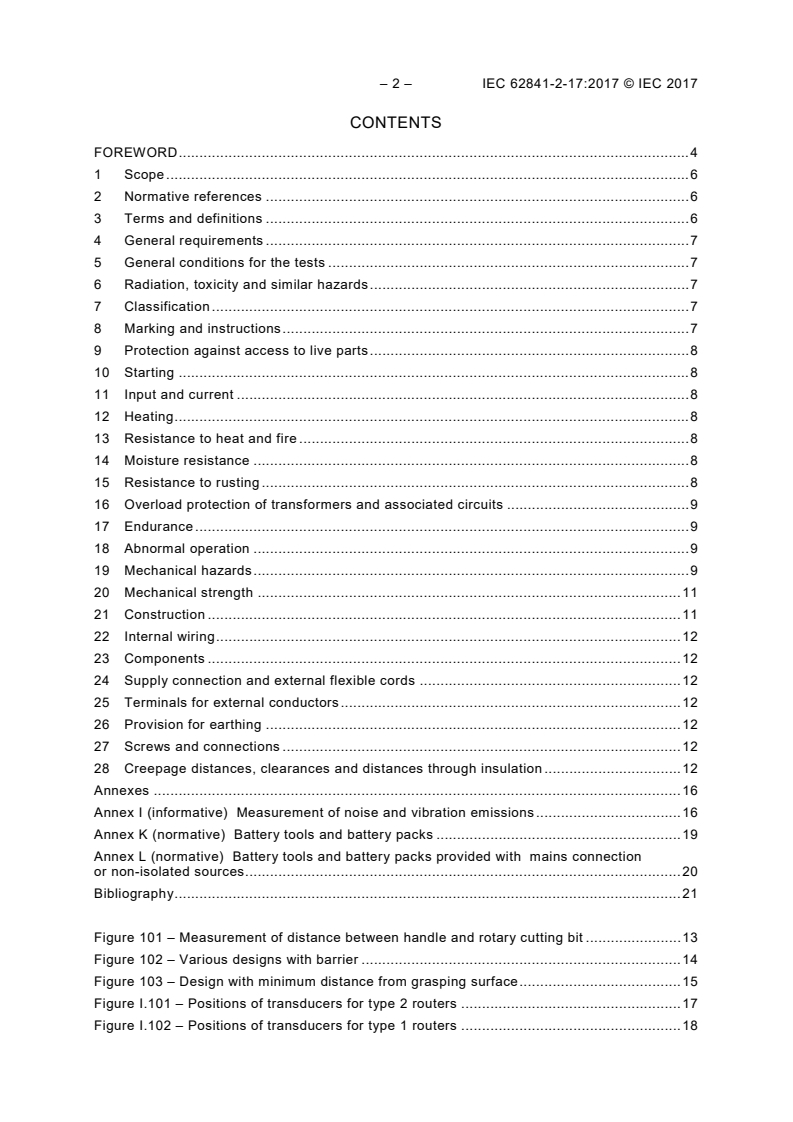
CONTENTS
FOREWORD . 4
1 Scope . 6
2 Normative references . 6
3 Terms and definitions . 6
4 General requirements . 7
5 General conditions for the tests . 7
6 Radiation, toxicity and similar hazards . 7
7 Classification . 7
8 Marking and instructions . 7
9 Protection against access to live parts . 8
10 Starting . 8
11 Input and current . 8
12 Heating . 8
13 Resistance to heat and fire . 8
14 Moisture resistance . 8
15 Resistance to rusting . 8
16 Overload protection of transformers and associated circuits . 9
17 Endurance . 9
18 Abnormal operation . 9
19 Mechanical hazards . 9
20 Mechanical strength . 11
21 Construction . 11
22 Internal wiring . 12
23 Components . 12
24 Supply connection and external flexible cords . 12
25 Terminals for external conductors . 12
26 Provision for earthing . 12
27 Screws and connections . 12
28 Creepage distances, clearances and distances through insulation . 12
Annexes . 16
Annex I (informative) Measurement of noise and vibration emissions . 16
Annex K (normative) Battery tools and battery packs . 19
Annex L (normative) Battery tools and battery packs provided with mains connection
or non-isolated sources . 20
Bibliography . 21
Figure 101 – Measurement of distance between handle and rotary cutting bit . 13
Figure 102 – Various designs with barrier . 14
Figure 103 – Design with minimum distance from grasping surface . 15
Figure I.101 – Positions of transducers for type 2 routers . 17
Figure I.102 – Positions of transducers for type 1 routers . 18
© IEC 2025
Table 4 – Required performance levels . 9
Table I.101 – Test conditions for type 2 routers . 16
REDLINE VERSION – 4 – IEC 62841-2-17:2017+AMD1:2025 CSV
© IEC 2025
INTERNATIONAL ELECTROTECHNICAL COMMISSION
____________
ELECTRIC MOTOR-OPERATED HAND-HELD TOOLS, TRANSPORTABLE
TOOLS AND LAWN AND GARDEN MACHINERY – SAFETY –
Part 2-17: Particular requirements for hand-held routers
FOREWORD
1) The International Electrotechnical Commission (IEC) is a worldwide organization for standardization comprising
all national electrotechnical committees (IEC National Committees). The object of IEC is to promote
international co-operation on all questions concerning standardization in the electrical and electronic fields. To
this end and in addition to other activities, IEC publishes International Standards, Technical Specifications,
Technical Reports, Publicly Available Specifications (PAS) and Guides (hereafter referred to as "IEC
Publication(s)"). Their preparation is entrusted to technical committees; any IEC National Committee interested
in the subject dealt with may participate in this preparatory work. International, governmental and non-
governmental organizations liaising with the IEC also participate in this preparation. IEC collaborates closely
with the International Organization for Standardization (ISO) in accordance with conditions determined by
agreement between the two organizations.
2) The formal decisions or agreements of IEC on technical matters express, as nearly as possible, an international
consensus of opinion on the relevant subjects since each technical committee has representation from all
interested IEC National Committees.
3) IEC Publications have the form of recommendations for international use and are accepted by IEC National
Committees in that sense. While all reasonable efforts are made to ensure that the technical content of IEC
Publications is accurate, IEC cannot be held responsible for the way in which they are used or for any
misinterpretation by any end user.
4) In order to promote international uniformity, IEC National Committees undertake to apply IEC Publications
transparently to the maximum extent possible in their national and regional publications. Any divergence
between any IEC Publication and the corresponding national or regional publication shall be clearly indicated in
the latter.
5) IEC itself does not provide any attestation of conformity. Independent certification bodies provide conformity
assessment services and, in some areas, access to IEC marks of conformity. IEC is not responsible for any
services carried out by independent certification bodies.
6) All users should ensure that they have the latest edition of this publication.
7) No liability shall attach to IEC or its directors, employees, servants or agents including individual experts and
members of its technical committees and IEC National Committees for any personal injury, property damage or
other damage of any nature whatsoever, whether direct or indirect, or for costs (including legal fees) and
expenses arising out of the publication, use of, or reliance upon, this IEC Publication or any other IEC
Publications.
8) Attention is drawn to the Normative references cited in this publication. Use of the referenced publications is
indispensable for the correct application of this publication.
9) IEC draws attention to the possibility that the implementation of this document may involve the use of (a)
patent(s). IEC takes no position concerning the evidence, validity or applicability of any claimed patent rights in
respect thereof. As of the date of publication of this document, IEC had not received notice of (a) patent(s),
which may be required to implement this document. However, implementers are cautioned that this may not
represent the latest information, which may be obtained from the patent database available at
https://patents.iec.ch. IEC shall not be held responsible for identifying any or all such patent rights.
This consolidated version of the official IEC Standard and its amendment has been
prepared for user convenience.
IEC 62841-2-17 edition 1.1 contains the first edition (2017-08) [documents 116/335/FDIS
and 116/342/RVD] and its amendment 1 (2025-02) [documents 116/858/FDIS and
116/881/RVD].
In this Redline version, a vertical line in the margin shows where the technical content
is modified by amendment 1. Additions are in green text, deletions are in strikethrough
red text. A separate Final version with all changes accepted is available in this
publication.
© IEC 2025
International Standard IEC 62841-2-17 has been prepared by IEC technical committee 116:
Safety of motor-operated electric tools.
This document has been drafted in accordance with the ISO/IEC Directives, Part 2.
This Part 2-17 is to be used in conjunction with the first edition of IEC 62841-1 (2014).
This Part 2-17 supplements or modifies the corresponding clauses in IEC 62841-1, so as to
convert it into the IEC standard: Particular requirements for hand-held routers.
Where a particular subclause of Part 1 is not mentioned in this Part 2-17, that subclause
applies as far as relevant. Where this standard states “addition”, “modification” or
“replacement”, the relevant text in Part 1 is to be adapted accordingly.
The following print types are used:
• requirements: in roman type;
• test specifications: in italic type;
• notes: in small roman type.
The terms defined in Clause 3 are printed in bold typeface.
Subclauses, notes and figures which are additional to those in Part 1 are numbered starting
from 101.
A list of all parts of the IEC 62841 series, under the general title: Electric motor-operated
hand-held tools, transportable tools and lawn and garden machinery – Safety, can be found
on the IEC website.
The committee has decided that the contents of this document and its amendment will remain
unchanged until the stability date indicated on the IEC website under webstore.iec.ch in the
data related to the specific document. At this date, the document will be
• reconfirmed,
• withdrawn, or
• revised.
The National Committees are requested to note that for this document the stability date
is 2019.
THIS TEXT IS INCLUDED FOR THE INFORMATION OF THE NATIONAL COMMITTEES AND WILL BE
DELETED AT THE PUBLICATION STAGE.
NOTE The attention of National Committees is drawn to the fact that equipment manufacturers and testing
organizations may need a transitional period following publication of a new, amended or revised IEC publication in
which to make products in accordance with the new requirements and to equip themselves for conducting new or
revised tests.
It is the recommendation of the committee that the content of this publication be adopted for implementation
nationally not earlier than 36 months from the date of publication.
REDLINE VERSION – 6 – IEC 62841-2-17:2017+AMD1:2025 CSV
© IEC 2025
ELECTRIC MOTOR-OPERATED HAND-HELD TOOLS, TRANSPORTABLE
TOOLS AND LAWN AND GARDEN MACHINERY – SAFETY –
Part 2-17: Particular requirements for hand-held routers
1 Scope
This clause of Part 1 is applicable, except as follows:
Addition:
This part of IEC 62841 applies to hand-held routers intended for cutting slots into or shaping
the edge of wood and analogous materials, plastics and non-ferrous metals except
magnesium.
NOTE 101 Routers that are primarily used for trimming the edge of materials are also known as trimmers.
NOTE 102 Routers that are used to cut various materials through the rotary action are also known as rotary
cutters.
This part of IEC 62841 does not apply to jointers.
NOTE 103 Jointers are covered by IEC 62841-2-19.
This part of IEC 62841 does not apply to small rotary tools.
NOTE 104 Small rotary tools are covered by IEC 62841-2-23.
2 Normative references
This clause of Part 1 is applicable.
3 Terms and definitions
This clause of Part 1 is applicable, except as follows:
Additional definitions:
3.101
base
upporting of the router that supports other parts of the tool on the workpiece
part s
3.102
rotary cutting bit
rotating cutting accessory with a shank for mounting it into a collet having its main feed
direction perpendicular to its axis of rotation
Note 1 to entry: There are rotary cutting bits that allow an additional plunging operation parallel to its axis of
rotation.
3.103
router
tool with a which includes a motor housing, base and a collet, designed to be fitted with a
rotary cutting bit
© IEC 2025
3.104
trimmer
type 1 router designed to be fitted with a rotary cutter and a base that allows for control of
trimming the edge of laminate sheet or similar materials
3.105
type 1 router
router that has the following criteria:
mass, excluding a detachable base, a separable battery pack or a detachable battery
a) a
pack a mass of the motor housing and collet, excluding the base, supply cord, any
separable battery pack or any detachable battery pack, not exceeding 2 kg; and
b) a collet capacity not exceeding 8 mm
3.106
type 2 router
router that has the following criteria:
a) a mass, excluding a detachable base, a separable battery pack or a detachable battery
pack a mass of the motor housing and collet, excluding the base, supply cord, any
separable battery pack or any detachable battery pack, exceeding 2 kg; or
b) a collet capacity exceeding 8 mm
4 General requirements
This clause of Part 1 is applicable.
5 General conditions for the tests
This clause of Part 1 is applicable, except as follows:
5.17 Addition:
The mass of the tool includes all handles and the dust extraction adapter, if any.
6 Radiation, toxicity and similar hazards
This clause of Part 1 is applicable.
7 Classification
This clause of Part 1 is applicable.
8 Marking and instructions
This clause of Part 1 is applicable, except as follows:
8.1 Addition:
– rated no-load speed.
8.14.1 Addition:
The additional safety instructions as specified in 8.14.1.101 shall be given. This part may be
printed separately from the “General Power Tool Safety Warnings”.
REDLINE VERSION – 8 – IEC 62841-2-17:2017+AMD1:2025 CSV
© IEC 2025
8.14.1.101 Safety instructions for routers
a) Hold the power tool by insulated gripping surfaces only, because the cutter may
contact its own cord. Cutting a "live" wire may make exposed metal parts of the power
tool "live" and could give the operator an electric shock.
b) Use clamps or another practical way to secure and support the workpiece to a
stable platform. Holding the work by your hand or against the body leaves it unstable and
may lead to loss of control.
8.14.2 a) Additional items:
101) Information about the types of rotary cutting bits for which the tool is designed;
102) Information concerning the diameter of shank for which the collet(s) is intended;
103) Instruction to use only rotary cutting bits of the correct shank diameter for the collet
mounted;
104) Instruction to use only rotary cutting bits suitable for the speed of the tool;
105) Instruction on how to change the collet or the collet cone (e.g. for setting up different
shank diameters), if applicable.
8.14.2 b) Additional items:
101) Instruction on the correct use of the dust collection system, if applicable.
9 Protection against access to live parts
This clause of Part 1 is applicable.
10 Starting
This clause of Part 1 is applicable.
11 Input and current
This clause of Part 1 is applicable.
12 Heating
This clause of Part 1 is applicable.
13 Resistance to heat and fire
This clause of Part 1 is applicable.
14 Moisture resistance
This clause of Part 1 is applicable.
15 Resistance to rusting
This clause of Part 1 is applicable.
© IEC 2025
16 Overload protection of transformers and associated circuits
This clause of Part 1 is applicable.
17 Endurance
This clause of Part 1 is applicable.
18 Abnormal operation
This clause of Part 1 is applicable, except as follows:
18.8 Replacement of Table 4 by the following:
Table 4 – Required performance levels
Type and purpose of SCF Minimum performance
level (PL)
Power switch – prevent unwanted switch-on for type 1 routers b
Power switch – prevent unwanted switch-on for type 2 routers c
Power switch – provide desired switch-off b
Any electronic control to pass the test of 18.3 a
Overspeed prevention to prevent output speed above 130 % of rated no-load speed b
Provide desired direction of rotation a
Prevent exceeding thermal limits as in Clause 18.4 and 18.5.3 a
Prevent self-resetting as required in 23.3 for type 1 routers a
Prevent self-resetting as required in 23.3 for type 2 routers b
Prevent unwanted lock-on of the power switch function b
Lock-off function as required by 21.18.1.2 for type 1 routers a
Lock-off function as required by 21.18.1.2 for type 2 routers b
NOTE In Europe (EN 62841-2-17), the following additional requirement applies: b
Restart prevention as required by 21.18.1.1
19 Mechanical hazards
This clause of Part 1 is applicable, except as follows:
19.1 Replacement of the first paragraph:
Moving and dangerous parts other than the rotary cutting bit and the collet shall be so
positioned or enclosed to provide adequate protection against personal injury. The protection
of the user against accidental contact with the rotary cutting bit and the collet is provided by
the requirements of 19.4.101.
19.4 Replacement:
Type 1 routers shall have at least one handle or grasping surface. The motor housing and/or
parts of the base that assist in guiding the router in use may be considered as a grasping
surface, if identified as such in accordance with 8.14.2 b) 6).
REDLINE VERSION – 10 – IEC 62841-2-17:2017+AMD1:2025 CSV
© IEC 2025
Type 2 routers shall have at least one handle and an additional handle or grasping surface to
allow the operation of the tool with two hands. The motor housing and/or parts of the base
that assist in guiding the router in use may be considered as a grasping surface, if identified
as such in accordance with 8.14.2 b) 6).
Compliance is checked by inspection.
19.4.101 Prevention of inadvertent contact
The handles shall be so shaped or located as to minimise the risk of inadvertent contact of
the user’s hand with the rotary cutting bit and the collet.
For type 1 routers, a removable cover for the purpose of changing the accessory which is
provided to meet the requirements of 19.4.101 may be removable without the aid of a tool.
For handle(s), inadvertent contact of the user’s hand is considered to be prevented if there is
sufficient distance between a defined measuring point on the handle surface and the rotary
cutting bit and the collet.
Compliance is checked as follows:
A test pin with a diameter of the largest collet size is mounted to the tool. A mark is applied
around the test pin (10 ± 1) mm from the collet. The distance between the defined measuring
point and the mark on the test pin shall be at least 120 mm. The measurement shall be
carried out as a chain distance. See Figure 101.
With the base set to maximum depth of cut, to establish the measuring point on the handle(s),
follow the outlined procedure below.
a) Establish the closest (A) and the most distant (B) points from the plane of the base on the
handle. Equidistant between points (A) and (B), draw the horizontal intersecting line on
the plane parallel with the base and the surface of the handle.
b) The point on the intersecting line of the handle surface with the largest radial distance
from the centreline of the spindle is the defined measuring point.
For a motor housing and/or parts of the base used as a grasping surface, inadvertent contact
of the user’s hand is considered to be prevented by a barrier located between the grasping
surface and the rotary cutting bit, see Figure 102. The barrier shall have a height x of at
least 6 mm. A dust collecting system may be part of this barrier.
Alternatively to a barrier, for a motor housing and/or parts of the base used as a grasping
surface in a type 1 router with an open portion(s) above the base, inadvertent contact of the
user’s hand is also considered to be prevented if either
– the rotary cutting bit and the collet are not accessible above the base by means of the
test probe B of IEC 61032:1997 with a force not exceeding 5 N;
or
– there is a minimum distance of 60 mm between
• a point located 40 mm above the lower edge of the grasping surface area in
accordance with 8.14.2 b) 6) along its centreline; and
• any point on the edge of any open portion (see Figure 103).
Compliance is checked by manual test using test probe B of IEC 61032:1997 and by
measurement. No covers are removed for the manual test. The 60 mm measurement is
carried out as a chain distance.
© IEC 2025
Adjustment elements capable of being readjusted while the tool is operating, e.g. “revolving
depth gauge”, shall be located so that touching of rotating parts is avoided.
Compliance is checked by inspection.
19.6 This subclause of Part 1 is applicable.
19.101 Type 2 routers shall be provided with a base which is capable of being adjusted to
surround the rotary cutting bit so as to provide sufficient stability during normal operation.
Compliance is checked by inspection and by the following test.
For the test, the tool is prepared as follows:
– the motor is switched off;
– no rotary cutting bit is installed;
– the tool is adjusted such that the collet is at the highest position;
– tools provided with an appliance inlet are fitted with an appropriate connector and flexible
cable or cord.
The tool is placed in its most unfavourable position with its base resting on a plane that is
inclined at an angle of 10° to the horizontal. The cable or cord, if any, shall rest on the
inclined plane in the most unfavourable position. For the test, the tool is prevented from
sliding.
The tool shall not tip over.
19.102 Type 1 routers shall be provided with a base so as to provide guidance during
operation.
Compliance is checked by inspection.
20 Mechanical strength
This clause of Part 1 is applicable.
21 Construction
This clause of Part 1 is applicable, except as follows:
21.18.1 Addition:
For routers, power switches other than momentary power switches are permitted.
21.18.1.1 Addition:
For routers, power switches other than momentary power switches are permitted.
NOTE In Europe (EN 62841-2-17), the following additional requirement applies:
For routers, either
– the power switch shall be a momentary power switch without having a locking arrangement in the “on”
position
or
REDLINE VERSION – 12 – IEC 62841-2-17:2017+AMD1:2025 CSV
© IEC 2025
– the tool shall not restart after an interruption of the mains supply without releasing and re-actuating the power
switch.
21.18.1.2 Addition:
Routers are regarded as tools having a risk associated with inadvertent starting.
21.35 This subclause of Part 1 is applicable for all routers except for trimmers.
Addition:
An integral dust collection/suction device or dust outlet(s) may be removable without the use
of a tool.
22 Internal wiring
This clause of Part 1 is applicable.
23 Components
This clause of Part 1 is applicable, except as follows:
23.3 Replacement of the first paragraph:
Protection devices or circuits shall be of the non-self-resetting type unless the tool is
equipped with a momentary power switch with no provision for being locked in the "on"
position.
24 Supply connection and external flexible cords
This clause of Part 1 is applicable.
25 Terminals for external conductors
This clause of Part 1 is applicable.
26 Provision for earthing
This clause of Part 1 is applicable.
27 Screws and connections
This clause of Part 1 is applicable.
28 Creepage distances, clearances and distances through insulation
This clause of Part 1 is applicable.
© IEC 2025
Dimensions in millimetres
B
B
A
A
≥ 120
≥ 120
IEC
Key
1 defined measuring points
A, B reference points
Figure 101 – Measurement of distance between handle and rotary cutting bit
10 ±1
REDLINE VERSION – 14 – IEC 62841-2-17:2017+AMD1:2025 CSV
© IEC 2025
x
x
4 4
x
x
IEC
Key
1 workpiece
2 grasping surface
3 motor housing
4 base
5 auxiliary handle
x height of a barrier
Figure 102 – Various designs with barrier
© IEC 2025
Dimensions in millimetres
≥ 60
IEC
Key
1 workpiece
2 grasping surface
3 open portion above the base
Figure 103 – Design with minimum distance from grasping surface
REDLINE VERSION – 16 – IEC 62841-2-17:2017+AMD1:2025 CSV
© IEC 2025
Annexes
The annexes of Part 1 are applicable except as follows.
Annex I
(informative)
Measurement of noise and vibration emissions
NOTE In Europe (EN 62841-2-17), Annex I is normative.
I.2 Noise test code (grade 2)
This clause of Part 1 is applicable except as follows:
I.2.4 Installation and mounting conditions of the power tools during noise tests
Addition:
Type 2 routers are held and used as specified in I.2.5.
Type 1 routers are suspended. The base of the tool shall be horizontal.
I.2.5 Operating conditions
Addition:
The temperature requirements of 5.6 are not applicable.
Type 1 routers are tested at no-load, all speed setting devices adjusted to the highest value.
Type 2 routers are tested under load observing the conditions shown in Table I.101.
Table I.101 – Test conditions for type 2 routers
Orientation Cutting grooves in a horizontal piece of medium density fibreboard (MDF) having the minimum
dimensions 800 mm (length) × 400 mm (width) × 30 mm (depth).
The board is fixed on a bench by screws, clamps, air cylinders or the like with a resilient material
between bench and workpiece
Tool bit New ∅ 12 mm straight sided rotary cutting bit for the entire series of tests, as specified for MDF
Feed force As necessary for smoothly working without overloading the machine. Apply equal force to both
handles avoiding excessive gripping forces
Test cycle Cutting a 10 mm deep groove across the 400 mm width of the MDF. Distance between grooves to
be 10 mm using the guide fence if supplied
I.3 Vibration
This clause of Part 1 is applicable except as follows:
I.3.3.2 Location of measurement
Addition:
Figure I.101 and Figure I.102 show the positions at both handles.
© IEC 2025
I.3.5.1 General
Addition:
For battery operated tools, the tests are conducted with the lightest battery in accordance
with K.8.14.2 e) 2) of Part 1 that has sufficient capacity
– for type 1 routers, to operate the tool at no-load for at least 25 min; and
– for type 2 routers, to complete the 15 measurements as specified in I.3.6.1 of Part 1,
under the operating conditions described in Table I.101.
I.3.5.3 Operating conditions
Addition:
Type 1 routers are tested at no-load.
Type 2 routers are tested under load according to the conditions shown in Table I.101.
I.3.6.2 Declaration of the vibration total value
Addition:
The vibration total value a of the handle with the highest emission and the uncertainty K shall
h
be declared.
Detail of transducers
(measurement in axes X, Y, Z)
IEC
Figure I.101 – Positions of transducers for type 2 routers
REDLINE VERSION – 18 – IEC 62841-2-17:2017+AMD1:2025 CSV
© IEC 2025
IEC
Figure I.102 – Positions of transducers for type 1 routers
© IEC 2025
Annex K
(normative)
Battery tools and battery packs
K.1 Scope
Addition:
All clauses of this Part 2-17 apply unless otherwise specified in this annex.
K.8.14.1.101 Item a) is not applicable.
K.21.18.1.2 Type 1 routers are regarded as tools having a risk associated with inadvertent
starting.
For type 2 routers, two separate and dissimilar actions shall be necessary before the motor
is switched on (e.g. a power switch which has to be pushed in before it can be moved
laterally to close the contacts to start the motor). It shall not be possible to achieve these two
actions with a single grasping motion or a straight line motion.
Compliance is checked by inspection and by manual test.
NOTE In Europe (EN 62841-2-17), the following additional subclause applies:
K.21.18.Z101 Isolation and disabling device
Tools with an integral battery shall either be equipped
– with an isolation device to prevent the risk of injury from mechanical hazards during servicing or user
maintenance; or
– with a disabling device that prevents unintentional starting of the tool.
An isolation device shall
– provide disconnection of all poles of the battery from the serviceable region of the tool;
– be equipped with an unambiguous indication of the state of the disconnection device which corresponds to
each position of its manual control (actuator);
– be provided with protection against accidental reconnection.
NOTE 1 Examples of methods to achieve this disconnection include removable jumpers, integral batteries
that can be disconnected for servicing or user maintenance, or an electromechanical power switch with a
direct mechanical link between the actuator and the contact.
NOTE 2 The risk of accidental reconnection for a power switch is addressed by the requirement of
21.18.1.2. The other examples in NOTE 1 achieve this by the necessary actions for reconnection.
A disabling device may be achieved by any of the following:
– a self-restoring or non-self-restoring lock-off device where two separate and dissimilar actions are
necessary before the motor is switched on (e.g. a power switch which has to be pushed in before it can
be moved laterally to close the contacts to start the motor). It shall not be possible to achieve these two
actions with a single grasping motion or a straight line motion;
– a removable disabling device provided with the tool where it shall not be possible for the tool to be
operated when either applied or removed.
Compliance is checked by inspection and by manual test.
REDLINE VERSION – 20 – IEC 62841-2-17:2017+AMD1:2025 CSV
© IEC 2025
Annex L
(normative)
Battery tools and battery packs provided with
mains connection or non-isolated sources
L.1 Scope
Addition:
All clauses of this Part 2-17 apply unless otherwise specified in this annex.
L.21.18.1.2 Type 1 routers are regarded as tools having a risk associated with inadvertent
starting.
For type 2 routers, two separate and dissimilar actions shall be necessary before the motor
is switched on (e.g. a power switch which has to be pushed in before it can be moved
laterally to close the contacts to start the motor). It shall not be possible to achieve these two
actions with a single grasping motion or a straight line motion.
Compliance is checked by inspection and by manual test.
NOTE In Europe (EN 62841-2-17), the following additional subclause applies:
L.21.18.Z101 Isolation and disabling device
Tools with an integral battery shall either be equipped
– with an isolation device to prevent the risk of injury from mechanical hazards during servicing or user
maintenance; or
– with a disabling device that prevents unintentional starting of the tool.
An isolation device shall
– provide disconnection of all poles of the battery from the serviceable region of the tool;
– be equipped with an unambiguous indication of the state of the disconnection device which corresponds to
each position of its manual control (actuator);
– be provided with protection against accidental reconnection.
NOTE 1 Examples of methods to achieve this disconnection include removable jumpers, integral batteries
that can be disconnected for servicing or user maintenance, or an electromechanical power switch with a
direct mechanical link between the actuator and the contact.
NOTE 2 The risk of accidental reconnection for a power switch is addressed by the requirement of
21.18.1.2. The other examples in NOTE 1 achieve this by the necessary actions for reconnection.
A disabling device may be achieved by any of the following:
– a self-restoring or non-self-restoring lock-off device where two separate and dissimilar actions are
necessary before the motor is switched on (e.g. a power switch which has to be pushed in before it can
be moved laterally to close the contacts to start the motor). It shall not be possible to achieve these two
actions with a single grasping motion or a straight line motion;
– a removable disabling device provided with the tool where it shall not be possible for the tool to be
operated when either applied or removed.
Compliance is checked by inspection and by manual test.
© IEC 2025
Bibliography
The bibliography of Part 1 is applicable, except as follows:
Addition:
IEC 62841-2-19, Electric motor-operated hand-held tools, transportable tools and lawn and
garden machinery – Safety – Part 2-19: Particular requirements for hand-held jointers
IEC 62841-2-23, Electric motor-operated hand-held tools, transportable tools and lawn and
garden machinery – Safety – Part 2-23: Particular requirements for hand-held small rotary
tools
___________
___________
Under consideration.
Under consideration.
FINAL VERSION – 2 – IEC 62841-2-17:2017+AMD1:2025 CSV
© IEC 2025
CONTENTS
FOREWORD . 4
1 Scope . 6
2 Normative references . 6
3 Terms and definitions . 6
4 General requirements . 7
5 General conditions for the tests . 7
6 Radiation, toxicity and similar hazards . 7
7 Classification . 7
8 Marking and instructions . 7
9 Protection against access to live parts . 8
10 Starting . 8
11 Input and current . 8
12 Heating . 8
13 Resistance to heat and fire . 8
14 Moisture resistance . 8
15 Resistance to rusting . 8
16 Overload protection of transformers and associated circuits . 9
17 Endurance . 9
18 Abnormal operation . 9
19 Mechanical hazards . 9
20 Mechanical strength . 11
21 Construction . 11
22 Internal wiring . 12
23 Components . 12
24 Supply connection and external flexible cords . 12
25 Terminals for external conductors . 12
26 Provision for earthing . 12
27 Screws and connections . 12
28 Creepage distances, clearances and distances through insulation . 12
Annexes . 16
Annex I (informative) Measurement of noise and vibration emissions . 16
Annex K (normative) Battery tools and battery packs . 19
Annex L (normative) Battery tools and battery packs provided with mains connection
or non-isolated sources . 20
Bibliography . 21
Figure 101 – Measurement of distance between handle and rotary cutting bit . 13
Figure 102 – Various designs with barrier . 14
Figure 103 – Design with minimum distance from grasping surface . 15
Figure I.101 – Positions of transducers for type 2 routers . 17
Figure I.102 – Positions of transducers for type 1 routers . 18
© IEC 2025
Table 4 – Required performance levels . 9
Table I.
...
IEC 62841-2-17 ®
Edition 1.0 2017-08
INTERNATIONAL
STANDARD
NORME
INTERNATIONALE
Electric motor-operated hand-held tools, transportable tools and lawn and
garden machinery – safety –
Part 2-17: Particular requirements for hand-held routers
Outils électroportatifs à moteur, outils portables et machines pour jardins et
pelouses – sécurité –
Partie 2-17: Exigences particulières pour les défonceuses portatives
All rights reserved. Unless otherwise specified, no part of this publication may be reproduced or utilized in any form
or by any means, electronic or mechanical, including photocopying and microfilm, without permission in writing from
either IEC or IEC's member National Committee in the country of the requester. If you have any questions about IEC
copyright or have an enquiry about obtaining additional rights to this publication, please contact the address below or
your local IEC member National Committee for further information.
Droits de reproduction réservés. Sauf indication contraire, aucune partie de cette publication ne peut être reproduite
ni utilisée sous quelque forme que ce soit et par aucun procédé, électronique ou mécanique, y compris la photocopie
et les microfilms, sans l'accord écrit de l'IEC ou du Comité national de l'IEC du pays du demandeur. Si vous avez des
questions sur le copyright de l'IEC ou si vous désirez obtenir des droits supplémentaires sur cette publication, utilisez
les coordonnées ci-après ou contactez le Comité national de l'IEC de votre pays de résidence.
IEC Central Office Tel.: +41 22 919 02 11
3, rue de Varembé Fax: +41 22 919 03 00
CH-1211 Geneva 20 info@iec.ch
Switzerland www.iec.ch
About the IEC
The International Electrotechnical Commission (IEC) is the leading global organization that prepares and publishes
International Standards for all electrical, electronic and related technologies.
About IEC publications
The technical content of IEC publications is kept under constant review by the IEC. Please make sure that you have the
latest edition, a corrigenda or an amendment might have been published.
IEC Catalogue - webstore.iec.ch/catalogue Electropedia - www.electropedia.org
The stand-alone application for consulting the entire The world's leading online dictionary of electronic and
bibliographical information on IEC International Standards, electrical terms containing 20 000 terms and definitions in
Technical Specifications, Technical Reports and other English and French, with equivalent terms in 16 additional
documents. Available for PC, Mac OS, Android Tablets and languages. Also known as the International Electrotechnical
iPad. Vocabulary (IEV) online.
IEC publications search - www.iec.ch/searchpub IEC Glossary - std.iec.ch/glossary
The advanced search enables to find IEC publications by a 65 000 electrotechnical terminology entries in English and
variety of criteria (reference number, text, technical French extracted from the Terms and Definitions clause of
committee,…). It also gives information on projects, replaced IEC publications issued since 2002. Some entries have been
and withdrawn publications. collected from earlier publications of IEC TC 37, 77, 86 and
CISPR.
IEC Just Published - webstore.iec.ch/justpublished
Stay up to date on all new IEC publications. Just Published IEC Customer Service Centre - webstore.iec.ch/csc
details all new publications released. Available online and If you wish to give us your feedback on this publication or
also once a month by email. need further assistance, please contact the Customer Service
Centre: csc@iec.ch.
A propos de l'IEC
La Commission Electrotechnique Internationale (IEC) est la première organisation mondiale qui élabore et publie des
Normes internationales pour tout ce qui a trait à l'électricité, à l'électronique et aux technologies apparentées.
A propos des publications IEC
Le contenu technique des publications IEC est constamment revu. Veuillez vous assurer que vous possédez l’édition la
plus récente, un corrigendum ou amendement peut avoir été publié.
Catalogue IEC - webstore.iec.ch/catalogue Electropedia - www.electropedia.org
Application autonome pour consulter tous les renseignements
Le premier dictionnaire en ligne de termes électroniques et
bibliographiques sur les Normes internationales,
électriques. Il contient 20 000 termes et définitions en anglais
Spécifications techniques, Rapports techniques et autres
et en français, ainsi que les termes équivalents dans 16
documents de l'IEC. Disponible pour PC, Mac OS, tablettes
langues additionnelles. Egalement appelé Vocabulaire
Android et iPad.
Electrotechnique International (IEV) en ligne.
Recherche de publications IEC - www.iec.ch/searchpub
Glossaire IEC - std.iec.ch/glossary
65 000 entrées terminologiques électrotechniques, en anglais
La recherche avancée permet de trouver des publications IEC
en utilisant différents critères (numéro de référence, texte, et en français, extraites des articles Termes et Définitions des
comité d’études,…). Elle donne aussi des informations sur les publications IEC parues depuis 2002. Plus certaines entrées
projets et les publications remplacées ou retirées. antérieures extraites des publications des CE 37, 77, 86 et
CISPR de l'IEC.
IEC Just Published - webstore.iec.ch/justpublished
Service Clients - webstore.iec.ch/csc
Restez informé sur les nouvelles publications IEC. Just
Published détaille les nouvelles publications parues. Si vous désirez nous donner des commentaires sur cette
Disponible en ligne et aussi une fois par mois par email. publication ou si vous avez des questions contactez-nous:
csc@iec.ch.
IEC 62841-2-17 ®
Edition 1.0 2017-08
INTERNATIONAL
STANDARD
NORME
INTERNATIONALE
Electric motor-operated hand-held tools, transportable tools and lawn and
garden machinery – safety –
Part 2-17: Particular requirements for hand-held routers
Outils électroportatifs à moteur, outils portables et machines pour jardins et
pelouses – sécurité –
Partie 2-17: Exigences particulières pour les défonceuses portatives
INTERNATIONAL
ELECTROTECHNICAL
COMMISSION
COMMISSION
ELECTROTECHNIQUE
INTERNATIONALE
ICS 25.140.20 ISBN 9978-2-8322-4704-4
– 2 – IEC 62841-2-17:2017 © IEC 2017
CONTENTS
FOREWORD . 4
1 Scope . 6
2 Normative references . 6
3 Terms and definitions . 6
4 General requirements . 7
5 General conditions for the tests . 7
6 Radiation, toxicity and similar hazards . 7
7 Classification . 7
8 Marking and instructions . 7
9 Protection against access to live parts . 8
10 Starting . 8
11 Input and current . 8
12 Heating . 8
13 Resistance to heat and fire . 8
14 Moisture resistance . 8
15 Resistance to rusting . 8
16 Overload protection of transformers and associated circuits . 9
17 Endurance . 9
18 Abnormal operation . 9
19 Mechanical hazards . 9
20 Mechanical strength . 11
21 Construction . 11
22 Internal wiring . 12
23 Components . 12
24 Supply connection and external flexible cords . 12
25 Terminals for external conductors . 12
26 Provision for earthing . 12
27 Screws and connections . 12
28 Creepage distances, clearances and distances through insulation . 12
Annexes . 16
Annex I (informative) Measurement of noise and vibration emissions . 16
Annex K (normative) Battery tools and battery packs . 19
Annex L (normative) Battery tools and battery packs provided with mains connection
or non-isolated sources . 20
Bibliography . 21
Figure 101 – Measurement of distance between handle and rotary cutting bit . 13
Figure 102 – Various designs with barrier . 14
Figure 103 – Design with minimum distance from grasping surface . 15
Figure I.101 – Positions of transducers for type 2 routers . 17
Figure I.102 – Positions of transducers for type 1 routers . 18
Table 4 – Required performance levels . 9
Table I.101 – Test conditions for type 2 routers . 16
– 4 – IEC 62841-2-17:2017 © IEC 2017
INTERNATIONAL ELECTROTECHNICAL COMMISSION
____________
ELECTRIC MOTOR-OPERATED HAND-HELD TOOLS, TRANSPORTABLE
TOOLS AND LAWN AND GARDEN MACHINERY – SAFETY –
Part 2-17: Particular requirements for hand-held routers
FOREWORD
1) The International Electrotechnical Commission (IEC) is a worldwide organization for standardization comprising
all national electrotechnical committees (IEC National Committees). The object of IEC is to promote
international co-operation on all questions concerning standardization in the electrical and electronic fields. To
this end and in addition to other activities, IEC publishes International Standards, Technical Specifications,
Technical Reports, Publicly Available Specifications (PAS) and Guides (hereafter referred to as “IEC
Publication(s)”). Their preparation is entrusted to technical committees; any IEC National Committee interested
in the subject dealt with may participate in this preparatory work. International, governmental and non-
governmental organizations liaising with the IEC also participate in this preparation. IEC collaborates closely
with the International Organization for Standardization (ISO) in accordance with conditions determined by
agreement between the two organizations.
2) The formal decisions or agreements of IEC on technical matters express, as nearly as possible, an international
consensus of opinion on the relevant subjects since each technical committee has representation from all
interested IEC National Committees.
3) IEC Publications have the form of recommendations for international use and are accepted by IEC National
Committees in that sense. While all reasonable efforts are made to ensure that the technical content of IEC
Publications is accurate, IEC cannot be held responsible for the way in which they are used or for any
misinterpretation by any end user.
4) In order to promote international uniformity, IEC National Committees undertake to apply IEC Publications
transparently to the maximum extent possible in their national and regional publications. Any divergence
between any IEC Publication and the corresponding national or regional publication shall be clearly indicated in
the latter.
5) IEC itself does not provide any attestation of conformity. Independent certification bodies provide conformity
assessment services and, in some areas, access to IEC marks of conformity. IEC is not responsible for any
services carried out by independent certification bodies.
6) All users should ensure that they have the latest edition of this publication.
7) No liability shall attach to IEC or its directors, employees, servants or agents including individual experts and
members of its technical committees and IEC National Committees for any personal injury, property damage or
other damage of any nature whatsoever, whether direct or indirect, or for costs (including legal fees) and
expenses arising out of the publication, use of, or reliance upon, this IEC Publication or any other IEC
Publications.
8) Attention is drawn to the Normative references cited in this publication. Use of the referenced publications is
indispensable for the correct application of this publication.
9) Attention is drawn to the possibility that some of the elements of this IEC Publication may be the subject of
patent rights. IEC shall not be held responsible for identifying any or all such patent rights.
International Standard IEC 62841-2-17 has been prepared by IEC technical committee 116:
Safety of motor-operated electric tools.
The text of this standard is based on the following documents:
FDIS Report on voting
116/335/FDIS 116/342/RVD
Full information on the voting for the approval of this International Standard can be found in
the report on voting indicated in the above table.
This document has been drafted in accordance with the ISO/IEC Directives, Part 2.
This Part 2-17 is to be used in conjunction with the first edition of IEC 62841-1 (2014).
This Part 2-17 supplements or modifies the corresponding clauses in IEC 62841-1, so as to
convert it into the IEC standard: Particular requirements for hand-held routers.
Where a particular subclause of Part 1 is not mentioned in this Part 2-17, that subclause
applies as far as relevant. Where this standard states “addition”, “modification” or
“replacement”, the relevant text in Part 1 is to be adapted accordingly.
The following print types are used:
• requirements: in roman type;
• test specifications: in italic type;
• notes: in small roman type.
The terms defined in Clause 3 are printed in bold typeface.
Subclauses, notes and figures which are additional to those in Part 1 are numbered starting
from 101.
A list of all parts of the IEC 62841 series, under the general title: Electric motor-operated
hand-held tools, transportable tools and lawn and garden machinery – Safety, can be found
on the IEC website.
The committee has decided that the contents of this document will remain unchanged until the
stability date indicated on the IEC website under "http://webstore.iec.ch" in the data related to
the specific document. At this date, the document will be
• reconfirmed,
• withdrawn,
• replaced by a revised edition, or
• amended.
The National Committees are requested to note that for this document the stability date
is 2019.
THIS TEXT IS INCLUDED FOR THE INFORMATION OF THE NATIONAL COMMITTEES AND WILL BE
DELETED AT THE PUBLICATION STAGE.
NOTE The attention of National Committees is drawn to the fact that equipment manufacturers and testing
organizations may need a transitional period following publication of a new, amended or revised IEC publication in
which to make products in accordance with the new requirements and to equip themselves for conducting new or
revised tests.
It is the recommendation of the committee that the content of this publication be adopted for implementation
nationally not earlier than 36 months from the date of publication.
– 6 – IEC 62841-2-17:2017 © IEC 2017
ELECTRIC MOTOR-OPERATED HAND-HELD TOOLS, TRANSPORTABLE
TOOLS AND LAWN AND GARDEN MACHINERY – SAFETY –
Part 2-17: Particular requirements for hand-held routers
1 Scope
This clause of Part 1 is applicable, except as follows:
Addition:
This part of IEC 62841 applies to hand-held routers intended for cutting slots into or shaping
the edge of wood and analogous materials, plastics and non-ferrous metals except
magnesium.
NOTE 101 Routers that are primarily used for trimming the edge of materials are also known as trimmers.
NOTE 102 Routers that are used to cut various materials through the rotary action are also known as rotary
cutters.
This part of IEC 62841 does not apply to jointers.
NOTE 103 Jointers are covered by IEC 62841-2-19.
This part of IEC 62841 does not apply to small rotary tools.
NOTE 104 Small rotary tools are covered by IEC 62841-2-23.
2 Normative references
This clause of Part 1 is applicable.
3 Terms and definitions
This clause of Part 1 is applicable, except as follows:
Additional definitions:
3.101
base
part supporting the router on the workpiece
3.102
rotary cutting bit
rotating cutting accessory with a shank for mounting it into a collet having its main feed
direction perpendicular to its axis of rotation
Note 1 to entry: There are rotary cutting bits that allow an additional plunging operation parallel to its axis of
rotation.
3.103
router
tool with a base and a collet, designed to be fitted with a rotary cutting bit
3.104
trimmer
type 1 router designed to be fitted with a rotary cutter and a base that allows for control of
trimming the edge of laminate sheet or similar materials
3.105
type 1 router
router that has the following criteria:
a) a mass, excluding a detachable base, a separable battery pack or a detachable battery
pack, not exceeding 2 kg; and
b) a collet capacity not exceeding 8 mm
3.106
type 2 router
router that has the following criteria:
a) a mass, excluding a detachable base, a separable battery pack or a detachable battery
pack, exceeding 2 kg; or
b) a collet capacity exceeding 8 mm
4 General requirements
This clause of Part 1 is applicable.
5 General conditions for the tests
This clause of Part 1 is applicable, except as follows:
5.17 Addition:
The mass of the tool includes all handles and the dust extraction adapter, if any.
6 Radiation, toxicity and similar hazards
This clause of Part 1 is applicable.
7 Classification
This clause of Part 1 is applicable.
8 Marking and instructions
This clause of Part 1 is applicable, except as follows:
8.1 Addition:
– rated no-load speed.
8.14.1 Addition:
The additional safety instructions as specified in 8.14.1.101 shall be given. This part may be
printed separately from the “General Power Tool Safety Warnings”.
– 8 – IEC 62841-2-17:2017 © IEC 2017
8.14.1.101 Safety instructions for routers
a) Hold the power tool by insulated gripping surfaces only, because the cutter may
contact its own cord. Cutting a "live" wire may make exposed metal parts of the power
tool "live" and could give the operator an electric shock.
b) Use clamps or another practical way to secure and support the workpiece to a
stable platform. Holding the work by your hand or against the body leaves it unstable and
may lead to loss of control.
8.14.2 a) Additional items:
101) Information about the types of rotary cutting bits for which the tool is designed;
102) Information concerning the diameter of shank for which the collet(s) is intended;
103) Instruction to use only rotary cutting bits of the correct shank diameter for the collet
mounted;
104) Instruction to use only rotary cutting bits suitable for the speed of the tool;
105) Instruction on how to change the collet or the collet cone (e.g. for setting up different
shank diameters), if applicable.
8.14.2 b) Additional items:
101) Instruction on the correct use of the dust collection system, if applicable.
9 Protection against access to live parts
This clause of Part 1 is applicable.
10 Starting
This clause of Part 1 is applicable.
11 Input and current
This clause of Part 1 is applicable.
12 Heating
This clause of Part 1 is applicable.
13 Resistance to heat and fire
This clause of Part 1 is applicable.
14 Moisture resistance
This clause of Part 1 is applicable.
15 Resistance to rusting
This clause of Part 1 is applicable.
16 Overload protection of transformers and associated circuits
This clause of Part 1 is applicable.
17 Endurance
This clause of Part 1 is applicable.
18 Abnormal operation
This clause of Part 1 is applicable, except as follows:
18.8 Replacement of Table 4 by the following:
Table 4 – Required performance levels
Type and purpose of SCF Minimum performance
level (PL)
Power switch – prevent unwanted switch-on for type 1 routers b
Power switch – prevent unwanted switch-on for type 2 routers c
Power switch – provide desired switch-off b
Any electronic control to pass the test of 18.3 a
Overspeed prevention to prevent output speed above 130 % of rated no-load speed
b
Provide desired direction of rotation a
Prevent exceeding thermal limits as in Clause 18 a
Prevent self-resetting as required in 23.3 for type 1 routers a
Prevent self-resetting as required in 23.3 for type 2 routers b
Prevent unwanted lock-on of the power switch function b
Lock-off function as required by 21.18.1.2 for type 1 routers a
Lock-off function as required by 21.18.1.2 for type 2 routers
b
NOTE In Europe (EN 62841-2-17), the following additional requirement applies: b
Restart prevention as required by 21.18.1.1
19 Mechanical hazards
This clause of Part 1 is applicable, except as follows:
19.1 Replacement of the first paragraph:
Moving and dangerous parts other than the rotary cutting bit and the collet shall be so
positioned or enclosed to provide adequate protection against personal injury. The protection
of the user against accidental contact with the rotary cutting bit and the collet is provided by
the requirements of 19.4.101.
19.4 Replacement:
Type 1 routers shall have at least one handle or grasping surface. The motor housing and/or
parts of the base that assist in guiding the router in use may be considered as a grasping
surface, if identified as such in accordance with 8.14.2 b) 6).
– 10 – IEC 62841-2-17:2017 © IEC 2017
Type 2 routers shall have at least one handle and an additional handle or grasping surface to
allow the operation of the tool with two hands. The motor housing and/or parts of the base
that assist in guiding the router in use may be considered as a grasping surface, if identified
as such in accordance with 8.14.2 b) 6).
Compliance is checked by inspection.
19.4.101 Prevention of inadvertent contact
The handles shall be so shaped or located as to minimise the risk of inadvertent contact of
the user’s hand with the rotary cutting bit and the collet.
For type 1 routers, a removable cover for the purpose of changing the accessory which is
provided to meet the requirements of 19.4.101 may be removable without the aid of a tool.
For handle(s), inadvertent contact of the user’s hand is considered to be prevented if there is
sufficient distance between a defined measuring point on the handle surface and the rotary
cutting bit and the collet.
Compliance is checked as follows:
A test pin with a diameter of the largest collet size is mounted to the tool. A mark is applied
around the test pin (10 ± 1) mm from the collet. The distance between the defined measuring
point and the mark on the test pin shall be at least 120 mm. The measurement shall be
carried out as a chain distance. See Figure 101.
With the base set to maximum depth of cut, to establish the measuring point on the handle(s),
follow the outlined procedure below.
a) Establish the closest (A) and the most distant (B) points from the plane of the base on the
handle. Equidistant between points (A) and (B), draw the horizontal intersecting line on
the plane parallel with the base and the surface of the handle.
b) The point on the intersecting line of the handle surface with the largest radial distance
from the centreline of the spindle is the defined measuring point.
For a motor housing and/or parts of the base used as a grasping surface, inadvertent contact
of the user’s hand is considered to be prevented by a barrier located between the grasping
surface and the rotary cutting bit, see Figure 102. The barrier shall have a height x of at
least 6 mm. A dust collecting system may be part of this barrier.
Alternatively to a barrier, for a motor housing and/or parts of the base used as a grasping
surface in a type 1 router with an open portion(s) above the base, inadvertent contact of the
user’s hand is also considered to be prevented if either
– the rotary cutting bit and the collet are not accessible above the base by means of the
test probe B of IEC 61032:1997 with a force not exceeding 5 N;
or
– there is a minimum distance of 60 mm between
• a point located 40 mm above the lower edge of the grasping surface area in
accordance with 8.14.2 b) 6) along its centreline; and
• any point on the edge of any open portion (see Figure 103).
Compliance is checked by manual test using test probe B of IEC 61032:1997 and by
measurement. No covers are removed for the manual test. The 60 mm measurement is
carried out as a chain distance.
Adjustment elements capable of being readjusted while the tool is operating, e.g. “revolving
depth gauge”, shall be located so that touching of rotating parts is avoided.
Compliance is checked by inspection.
19.101 Type 2 routers shall be provided with a base which is capable of being adjusted to
surround the rotary cutting bit so as to provide sufficient stability during normal operation.
Compliance is checked by inspection and by the following test.
For the test, the tool is prepared as follows:
– the motor is switched off;
– no rotary cutting bit is installed;
– the tool is adjusted such that the collet is at the highest position;
– tools provided with an appliance inlet are fitted with an appropriate connector and flexible
cable or cord.
The tool is placed in its most unfavourable position with its base resting on a plane that is
inclined at an angle of 10° to the horizontal. The cable or cord, if any, shall rest on the
inclined plane in the most unfavourable position. For the test, the tool is prevented from
sliding.
The tool shall not tip over.
19.102 Type 1 routers shall be provided with a base so as to provide guidance during
operation.
Compliance is checked by inspection.
20 Mechanical strength
This clause of Part 1 is applicable.
21 Construction
This clause of Part 1 is applicable, except as follows:
21.18.1.1 Addition:
For routers, power switches other than momentary power switches are permitted.
NOTE In Europe (EN 62841-2-17), the following additional requirement applies:
For routers, either
– the power switch shall be a momentary power switch without having a locking arrangement in the “on”
position
or
– the tool shall not restart after an interruption of the mains supply without releasing and re-actuating the power
switch.
21.18.1.2 Addition:
Routers are regarded as tools having a risk associated with inadvertent starting.
– 12 – IEC 62841-2-17:2017 © IEC 2017
21.35 This subclause of Part 1 is applicable for all routers except for trimmers.
Addition:
An integral dust collection/suction device or dust outlet(s) may be removable without the use
of a tool.
22 Internal wiring
This clause of Part 1 is applicable.
23 Components
This clause of Part 1 is applicable.
24 Supply connection and external flexible cords
This clause of Part 1 is applicable.
25 Terminals for external conductors
This clause of Part 1 is applicable.
26 Provision for earthing
This clause of Part 1 is applicable.
27 Screws and connections
This clause of Part 1 is applicable.
28 Creepage distances, clearances and distances through insulation
This clause of Part 1 is applicable.
Dimensions in millimetres
B
B
A
A
≥ 120
≥ 120
IEC
Key
1 defined measuring points
A, B reference points
Figure 101 – Measurement of distance between handle and rotary cutting bit
10 ±1
– 14 – IEC 62841-2-17:2017 © IEC 2017
x
x
4 4
x
x
IEC
Key
1 workpiece
2 grasping surface
3 motor housing
4 base
5 auxiliary handle
x height of a barrier
Figure 102 – Various designs with barrier
Dimensions in millimetres
≥ 60
IEC
Key
1 workpiece
2 grasping surface
3 open portion above the base
Figure 103 – Design with minimum distance from grasping surface
– 16 – IEC 62841-2-17:2017 © IEC 2017
Annexes
The annexes of Part 1 are applicable except as follows.
Annex I
(informative)
Measurement of noise and vibration emissions
NOTE In Europe (EN 62841-2-17), Annex I is normative.
I.2 Noise test code (grade 2)
This clause of Part 1 is applicable except as follows:
I.2.4 Installation and mounting conditions of the power tools during noise tests
Addition:
Type 2 routers are held and used as specified in I.2.5.
Type 1 routers are suspended. The base of the tool shall be horizontal.
I.2.5 Operating conditions
Addition:
The temperature requirements of 5.6 are not applicable.
Type 1 routers are tested at no-load, all speed setting devices adjusted to the highest value.
Type 2 routers are tested under load observing the conditions shown in Table I.101.
Table I.101 – Test conditions for type 2 routers
Orientation
Cutting grooves in a horizontal piece of medium density fibreboard (MDF) having the minimum
dimensions 800 mm (length) × 400 mm (width) × 30 mm (depth).
The board is fixed on a bench by screws, clamps, air cylinders or the like with a resilient material
between bench and workpiece
Tool bit New ∅ 12 mm straight sided rotary cutting bit for the entire series of tests, as specified for MDF
Feed force As necessary for smoothly working without overloading the machine. Apply equal force to both
handles avoiding excessive gripping forces
Test cycle Cutting a 10 mm deep groove across the 400 mm width of the MDF. Distance between grooves to
be 10 mm using the guide fence if supplied
I.3 Vibration
This clause of Part 1 is applicable except as follows:
I.3.3.2 Location of measurement
Addition:
Figure I.101 and Figure I.102 show the positions at both handles.
I.3.5.3 Operating conditions
Addition:
Type 1 routers are tested at no-load.
Type 2 routers are tested under load according to the conditions shown in Table I.101.
I.3.6.2 Declaration of the vibration total value
Addition:
The vibration total value a of the handle with the highest emission and the uncertainty K shall
h
be declared.
Detail of transducers
(measurement in axes X, Y, Z)
IEC
Figure I.101 – Positions of transducers for type 2 routers
– 18 – IEC 62841-2-17:2017 © IEC 2017
IEC
Figure I.102 – Positions of transducers for type 1 routers
Annex K
(normative)
Battery tools and battery packs
K.1 Scope
Addition:
All clauses of this Part 2-17 apply unless otherwise specified in this annex.
K.8.14.1.101 Item a) is not applicable.
K.21.18.1.2 Type 1 routers are regarded as tools having a risk associated with inadvertent
starting.
For type 2 routers, two separate and dissimilar actions shall be necessary before the motor
is switched on (e.g. a power switch which has to be pushed in before it can be moved
laterally to close the contacts to start the motor). It shall not be possible to achieve these two
actions with a single grasping motion or a straight line motion.
Compliance is checked by inspection and by manual test.
NOTE In Europe (EN 62841-2-17), the following additional subclause applies:
K.21.18.Z101 Isolation and disabling device
Tools with an integral battery shall either be equipped
– with an isolation device to prevent the risk of injury from mechanical hazards during servicing or user
maintenance; or
– with a disabling device that prevents unintentional starting of the tool.
An isolation device shall
– provide disconnection of all poles of the battery from the serviceable region of the tool;
– be equipped with an unambiguous indication of the state of the disconnection device which corresponds to
each position of its manual control (actuator);
– be provided with protection against accidental reconnection.
NOTE 1 Examples of methods to achieve this disconnection include removable jumpers, integral batteries
that can be disconnected for servicing or user maintenance, or an electromechanical power switch with a
direct mechanical link between the actuator and the contact.
NOTE 2 The risk of accidental reconnection for a power switch is addressed by the requirement of
21.18.1.2. The other examples in NOTE 1 achieve this by the necessary actions for reconnection.
A disabling device may be achieved by any of the following:
– a self-restoring or non-self-restoring lock-off device where two separate and dissimilar actions are
necessary before the motor is switched on (e.g. a power switch which has to be pushed in before it can
be moved laterally to close the contacts to start the motor). It shall not be possible to achieve these two
actions with a single grasping motion or a straight line motion;
– a removable disabling device provided with the tool where it shall not be possible for the tool to be
operated when either applied or removed.
Compliance is checked by inspection and by manual test.
– 20 – IEC 62841-2-17:2017 © IEC 2017
Annex L
(normative)
Battery tools and battery packs provided with
mains connection or non-isolated sources
L.1 Scope
Addition:
All clauses of this Part 2-17 apply unless otherwise specified in this annex.
L.21.18.1.2 Type 1 routers are regarded as tools having a risk associated with inadvertent
starting.
For type 2 routers, two separate and dissimilar actions shall be necessary before the motor
is switched on (e.g. a power switch which has to be pushed in before it can be moved
laterally to close the contacts to start the motor). It shall not be possible to achieve these two
actions with a single grasping motion or a straight line motion.
Compliance is checked by inspection and by manual test.
NOTE In Europe (EN 62841-2-17), the following additional subclause applies:
L.21.18.Z101 Isolation and disabling device
Tools with an integral battery shall either be equipped
– with an isolation device to prevent the risk of injury from mechanical hazards during servicing or user
maintenance; or
– with a disabling device that prevents unintentional starting of the tool.
An isolation device shall
– provide disconnection of all poles of the battery from the serviceable region of the tool;
– be equipped with an unambiguous indication of the state of the disconnection device which corresponds to
each position of its manual control (actuator);
– be provided with protection against accidental reconnection.
NOTE 1 Examples of methods to achieve this disconnection include removable jumpers, integral batteries
that can be disconnected for servicing or user maintenance, or an electromechanical power switch with a
direct mechanical link between the actuator and the contact.
NOTE 2 The risk of accidental reconnection for a power switch is addressed by the requirement of
21.18.1.2. The other examples in NOTE 1 achieve this by the necessary actions for reconnection.
A disabling device may be achieved by any of the following:
– a self-restoring or non-self-restoring lock-off device where two separate and dissimilar actions are
necessary before the motor is switched on (e.g. a power switch which has to be pushed in before it can
be moved laterally to close the contacts to start the motor). It shall not be possible to achieve these two
actions with a single grasping motion or a straight line motion;
– a removable disabling device provided with the tool where it shall not be possible for the tool to be
operated when either applied or removed.
Compliance is checked by inspection and by manual test.
Bibliography
The bibliography of Part 1 is applicable, except as follows:
Addition:
IEC 62841-2-19, Electric motor-operated hand-held tools, transportable tools and lawn and
garden machinery – Safety – Part 2-19: Particular requirements for hand-held jointers
IEC 62841-2-23, Electric motor-operated hand-held tools, transportable tools and lawn and
garden machinery – Safety – Part 2-23: Particular requirements for hand-held small rotary
tools
___________
___________
Under consideration.
Under consideration.
– 22 – IEC 62841-2-17:2017 © IEC 2017
SOMMAIRE
AVANT-PROPOS . 24
1 Domaine d'application . 26
2 Références normatives . 26
3 Termes et définitions . 26
4 Exigences générales . 27
5 Conditions générales d’essai . 27
6 Rayonnement, toxicité et dangers analogues . 27
7 Classification . 27
8 Marquage et indications . 27
9 Protection contre l'accès aux parties actives. 28
10 Démarrage . 28
11 Puissance et courant . 28
12 Échauffements. 28
13 Résistance à la chaleur et au feu . 29
14 Résistance à l'humidité . 29
15 Protection contre la rouille . 29
16 Protection contre la surcharge des transformateurs et des circuits associés . 29
17 Endurance . 29
18 Fonctionnement anormal . 29
19 Dangers mécaniques . 30
20 Résistance mécanique . 32
21 Construction . 32
22 Conducteurs internes. 33
23 Composants . 33
24 Raccordement au réseau et câbles souples extérieurs . 33
25 Bornes pour conducteurs externes . 33
26 Dispositions de mise à la terre . 33
27 Vis et connexions . 33
28 Lignes de fuite, distances d’isolement et distances à travers l’isolation . 33
Annexes . 37
Annexe I (informative) Mesure des émissions acoustique et de vibration . 37
Annexe K (normative) Outils fonctionnant sur batteries et blocs de batteries . 40
Annexe L (normative) Outils fonctionnant sur batteries et blocs de batteries équipés
d’une connexion avec le réseau ou avec des sources non isolées .
...