


IEC PAS 62443-3:2008
(Main)Security for industrial process measurement and control - Network and system security
General Information
- Abstract
It establishes a framework for securing information and communication technology aspects of industrial process measurement and control systems including its networks and devices on those networks, during the operational phase of the plant's life cycle. It provides guidance on a plant's operational security requirements and is primarily intended for automation system owners/operators (responsible for ICS operation).
- Status
- Withdrawn
- Publication Date
- 21-Jan-2008
- Withdrawal Date
- 09-Jul-2018
- Technical Committee
- TC 65 - Industrial-process measurement, control and automation
- Current Stage
- WPUB - Publication withdrawn
- Start Date
- 10-Jul-2018
- Completion Date
- 09-Jul-2018

Get Certified
Connect with accredited certification bodies for this standard

BSI Group
BSI (British Standards Institution) is the business standards company that helps organizations make excellence a habit.

DVS-ZERT GmbH
German welding certification society.
CARES (UK Certification Authority for Reinforcing Steels)
UK certification for reinforcing steels and construction.
Sponsored listings
Frequently Asked Questions
IEC PAS 62443-3:2008 is a technical specification published by the International Electrotechnical Commission (IEC). Its full title is "Security for industrial process measurement and control - Network and system security". This standard covers: It establishes a framework for securing information and communication technology aspects of industrial process measurement and control systems including its networks and devices on those networks, during the operational phase of the plant's life cycle. It provides guidance on a plant's operational security requirements and is primarily intended for automation system owners/operators (responsible for ICS operation).
It establishes a framework for securing information and communication technology aspects of industrial process measurement and control systems including its networks and devices on those networks, during the operational phase of the plant's life cycle. It provides guidance on a plant's operational security requirements and is primarily intended for automation system owners/operators (responsible for ICS operation).
IEC PAS 62443-3:2008 is classified under the following ICS (International Classification for Standards) categories: 25.040.40 - Industrial process measurement and control; 35.110 - Networking. The ICS classification helps identify the subject area and facilitates finding related standards.
IEC PAS 62443-3:2008 is available in PDF format for immediate download after purchase. The document can be added to your cart and obtained through the secure checkout process. Digital delivery ensures instant access to the complete standard document.
Standards Content (Sample)
IEC/PAS 62443-3
Edition 1.0 2008-01
PUBLICLY AVAILABLE
SPECIFICATION
PRE-STANDARD
Security for industrial process measurement and control – Network and system
security
IEC/PAS 62443-3:2008(E)
All rights reserved. Unless otherwise specified, no part of this publication may be reproduced or utilized in any form
or by any means, electronic or mechanical, including photocopying and microfilm, without permission in writing from
either IEC or IEC's member National Committee in the country of the requester.
If you have any questions about IEC copyright or have an enquiry about obtaining additional rights to this publication,
please contact the address below or your local IEC member National Committee for further information.
IEC Central Office
3, rue de Varembé
CH-1211 Geneva 20
Switzerland
Email: inmail@iec.ch
Web: www.iec.ch
About the IEC
The International Electrotechnical Commission (IEC) is the leading global organization that prepares and publishes
International Standards for all electrical, electronic and related technologies.
About IEC publications
The technical content of IEC publications is kept under constant review by the IEC. Please make sure that you have the
latest edition, a corrigenda or an amendment might have been published.
ƒ Catalogue of IEC publications: www.iec.ch/searchpub
The IEC on-line Catalogue enables you to search by a variety of criteria (reference number, text, technical committee,…).
It also gives information on projects, withdrawn and replaced publications.
ƒ IEC Just Published: www.iec.ch/online_news/justpub
Stay up to date on all new IEC publications. Just Published details twice a month all new publications released. Available
on-line and also by email.
ƒ Electropedia: www.electropedia.org
The world's leading online dictionary of electronic and electrical terms containing more than 20 000 terms and definitions
in English and French, with equivalent terms in additional languages. Also known as the International Electrotechnical
Vocabulary online.
ƒ Customer Service Centre: www.iec.ch/webstore/custserv
If you wish to give us your feedback on this publication or need further assistance, please visit the Customer Service
Centre FAQ or contact us:
Email: csc@iec.ch
Tel.: +41 22 919 02 11
Fax: +41 22 919 03 00
IEC/PAS 62443-3
Edition 1.0 2008-01
PUBLICLY AVAILABLE
SPECIFICATION
PRE-STANDARD
Security for industrial process measurement and control – Network and system
security
INTERNATIONAL
ELECTROTECHNICAL
COMMISSION
PRICE CODE
XA
ICS 25.040.40; 35.110 ISBN 2-8318-9543-X
PAS 62443-3 © IEC:2008(E) – 2 –
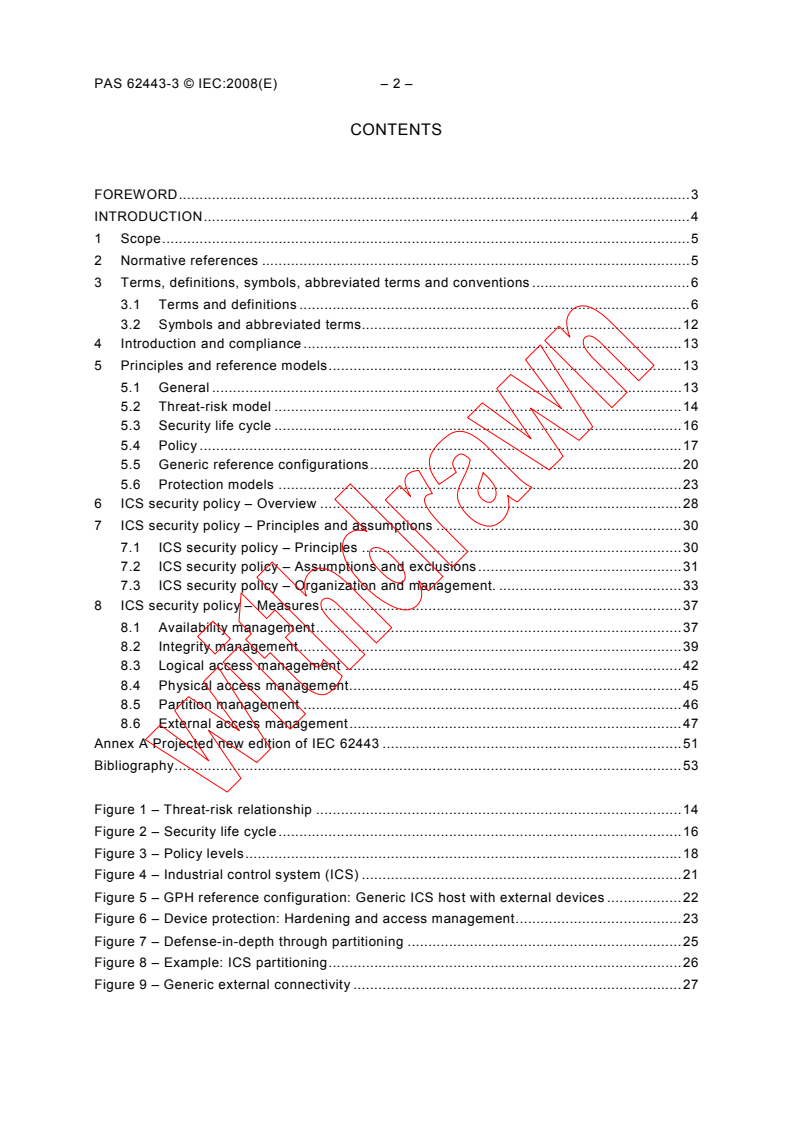
CONTENTS
FOREWORD.3
INTRODUCTION.4
1 Scope.5
2 Normative references .5
3 Terms, definitions, symbols, abbreviated terms and conventions .6
3.1 Terms and definitions .6
3.2 Symbols and abbreviated terms.12
4 Introduction and compliance .13
5 Principles and reference models.13
5.1 General .13
5.2 Threat-risk model .14
5.3 Security life cycle .16
5.4 Policy .17
5.5 Generic reference configurations.20
5.6 Protection models .23
6 ICS security policy – Overview .28
7 ICS security policy – Principles and assumptions .30
7.1 ICS security policy – Principles .30
7.2 ICS security policy – Assumptions and exclusions.31
7.3 ICS security policy – Organization and management. .33
8 ICS security policy – Measures.37
8.1 Availability management.37
8.2 Integrity management.39
8.3 Logical access management .42
8.4 Physical access management.45
8.5 Partition management .46
8.6 External access management.47
Annex A Projected new edition of IEC 62443 .51
Bibliography.53
Figure 1 – Threat-risk relationship .14
Figure 2 – Security life cycle.16
Figure 3 – Policy levels.18
Figure 4 – Industrial control system (ICS) .21
Figure 5 – GPH reference configuration: Generic ICS host with external devices .22
Figure 6 – Device protection: Hardening and access management.23
Figure 7 – Defense-in-depth through partitioning .25
Figure 8 – Example: ICS partitioning.26
Figure 9 – Generic external connectivity .27
– 3 – PAS 62443-3 © IEC:2008(E)
INTERNATIONAL ELECTROTECHNICAL COMMISSION
____________
SECURITY FOR INDUSTRIAL PROCESS MEASUREMENT AND CONTROL –
NETWORK AND SYSTEM SECURITY
FOREWORD
1) The International Electrotechnical Commission (IEC) is a worldwide organization for standardization comprising
all national electrotechnical committees (IEC National Committees). The object of IEC is to promote
international co-operation on all questions concerning standardization in the electrical and electronic fields. To
this end and in addition to other activities, IEC publishes International Standards, Technical Specifications,
Technical Reports, Publicly Available Specifications (PAS) and Guides (hereafter referred to as “IEC
Publication(s)”). Their preparation is entrusted to technical committees; any IEC National Committee interested
in the subject dealt with may participate in this preparatory work. International, governmental and non-
governmental organizations liaising with the IEC also participate in this preparation. IEC collaborates closely
with the International Organization for Standardization (ISO) in accordance with conditions determined by
agreement between the two organizations.
2) The formal decisions or agreements of IEC on technical matters express, as nearly as possible, an international
consensus of opinion on the relevant subjects since each technical committee has representation from all
interested IEC National Committees.
3) IEC Publications have the form of recommendations for international use and are accepted by IEC National
Committees in that sense. While all reasonable efforts are made to ensure that the technical content of IEC
Publications is accurate, IEC cannot be held responsible for the way in which they are used or for any
misinterpretation by any end user.
4) In order to promote international uniformity, IEC National Committees undertake to apply IEC Publications
transparently to the maximum extent possible in their national and regional publications. Any divergence
between any IEC Publication and the corresponding national or regional publication shall be clearly indicated in
the latter.
5) IEC provides no marking procedure to indicate its approval and cannot be rendered responsible for any
equipment declared to be in conformity with an IEC Publication.
6) All users should ensure that they have the latest edition of this publication.
7) No liability shall attach to IEC or its directors, employees, servants or agents including individual experts and
members of its technical committees and IEC National Committees for any personal injury, property damage or
other damage of any nature whatsoever, whether direct or indirect, or for costs (including legal fees) and
expenses arising out of the publication, use of, or reliance upon, this IEC Publication or any other IEC
Publications.
8) Attention is drawn to the Normative references cited in this publication. Use of the referenced publications is
indispensable for the correct application of this publication.
9) Attention is drawn to the possibility that some of the elements of this IEC Publication may be the subject of
patent rights. IEC shall not be held responsible for identifying any or all such patent rights.
A PAS is a technical specification not fulfilling the requirements for a standard but made
available to the public.
IEC-PAS 62443-3 has been processed by IEC technical committee 65: Industrial-process
measurement, control and automation.
The text of this PAS is based on the This PAS was approved for
following document: publication by the P-members of the
committee concerned as indicated in
the following document
Draft PAS Report on voting
65/402/NP 65/412/RVN
Following publication of this PAS, which is a pre-standard publication, the technical committee
or subcommittee concerned will transform it into an International Standard.
This publication seeks the status of a basic security publication according to IEC Guide 104.
This PAS shall remain valid for an initial maximum period of three years starting from
2008-01. The validity may be extended for a single three-year period, following which it shall
be revised to become another type of normative document or shall be withdrawn.
PAS 62443-3 © IEC:2008(E) – 4 –
INTRODUCTION
The increasing degree of public networking of formerly isolated automation systems increases
the exposure of such systems to attack. Standard IT security protection mechanisms have
protection goals and strategies that may be inappropriate for automation systems. This PAS
addresses the topic of securing access to and within industrial systems while assuring timely
response which may be critical to plant operation.
For safety applications and applications in the pharmaceutical or other highly specialized
industries, additional standards, guidelines, definitions and stipulations may apply, for
example, IEC 61508, GAMP (ISPE), for GMP Compliance 21 CFR (FDA) and the Standard
Operating Procedure of the European Medicines Agency (SOP/INSP/2003).
– 5 – PAS 62443-3 © IEC:2008(E)
SECURITY FOR INDUSTRIAL PROCESS MEASUREMENT AND CONTROL –
NETWORK AND SYSTEM SECURITY
1 Scope
This PAS establishes a framework for securing information and communication technology
aspects of industrial process measurement and control systems including its networks and
devices on those networks, during the operational phase of the plant’s life cycle.
This PAS provides guidance on a plant’s operational security requirements and is primarily
intended for automation system owners/operators (responsible for ICS operation)
Furthermore, the operational requirements of this PAS may interest ICS stakeholders such as:
a) automation system designers;
b) manufacturers (vendors) of devices, subsystems, and systems;
c) integrators of subsystems and systems.
The PAS allows for the following concerns:
• graceful migration/evolution of existing systems;
• meeting security objectives with existing COTS technologies and products;
• assurance of reliability/availability of the secured communications services;
• applicability to systems of any size and risk (scalability);
• coexistence of safety, legal and regulatory and automation functionality requirements with
security requirements.
NOTE 1 Plants and systems may contain safety critical components and devices. Any safety-related security
components may be subject to certification based on IEC 61508 and according to the SILs therein. This PAS does
not guarantee that its specifications are all or in part appropriate or sufficient for the security of such safety critical
components and devices.
NOTE 2 This PAS does not include requirements for security assurance evaluation and testing.
NOTE 3 The measures provided by this PAS are rather process-based and general in nature than technically
specific or prescriptive in terms of technical countermeasures and configurations.
NOTE 4 The procedures of this PAS are written with the plant owner/operator's mind set.
NOTE 5 This PAS does not cover the concept, design and implementation live cycle processes, i.e. requirements
on control equipment manufacturer's future product development cycle.
NOTE 6 This PAS does not cover the integration of components and subsystems into a system.
NOTE 7 This PAS does not cover procurement for integration into an existing system, i.e. procurement
requirements for owner/operators of a plant.
NOTE 8 This PAS will be extended into a 3-part International Standard to cover most of the restrictions expressed
in the previous notes; for the planned scope of the extended standards, refer to Annex A.
2 Normative references
The following referenced documents are indispensable for the application of this document.
For dated references, only the edition cited applies. For undated references, the latest edition
of the referenced document (including any amendments) applies.
ISO/IEC 15408 (all parts), Information technology – Security techniques – Evaluation criteria
for IT security
ISO/IEC 27002:2005, Information technology – Security techniques – Code of practice for IT
security management
PAS 62443-3 © IEC:2008(E) – 6 –
ISO/IEC Guide 73:2002, Risk management – Vocabulary – Guidelines for use in standards
3 Terms, definitions, symbols, abbreviated terms and conventions
3.1 Terms and definitions
For the purposes of this document, the following terms and definitions apply.
3.1.1
access control
prevention of unauthorized use of a restricted resource, including its use in an unauthorized
manner
[ISO/IEC 18028-2:2006, modified]
3.1.2
adversary
entity that attacks, or is a threat to, a system
[RFC 2828]
3.1.3
alert
instant indication that an information system and network may be under attack, or in danger
because of accident, failure or people error
[ISO/IEC 18028-1:2006]
3.1.4
asset
anything that has value to the organization
[ISO/IEC 13335-1:2004]
3.1.5
assurance
performance of appropriate activities or processes to instil confidence that a deliverable
meets its security objectives
[ISO/IEC/TR 15443-1]
3.1.6
attack
attempts to destroy, expose, alter, or disable an information system and/or information within
it or otherwise reach the security policy
[ISO/IEC 18043}
3.1.7
attack surface
set of system resources exposed directly and indirectly to potential attack.
3.1.8
audit
formal inquiry, formal examination, or verification of facts against expectations, for compliance
and conformity
[ISO/IEC 18028-1]
3.1.9
authenticate, authentication
provision of assurance of the claimed identity of an entity
[ISO/IEC 19792]
– 7 – PAS 62443-3 © IEC:2008(E)
3.1.10
availability
property of being accessible and usable upon demand by an authorized entity
[ISO/IEC 7498-2]
3.1.11
commercial off-the shelf (COTS)
items which are manufactured and distributed commercially for multiple usages and/or
customers; may be tailored for specific usage
NOTE COTS is in contrast to custom products designed entirely and uniquely for the specific application.
3.1.12
compromise
unauthorized use, disclosure, modification, or substitution, respectively, of data, programs or
systems configuration, i.e., by and after intrusion.
3.1.13
confidentiality
property that information is not made available or disclosed to unauthorized individuals,
entities, or processes
[ISO/IEC 13335-3]
3.1.14
credentials
means of proving that it is the one who claim to be, the abstract can be an IT account to
access an information service or resource
[ISO/IEC 24760]
3.1.15
demilitarized zone (DMZ)
security host or small network (also known as a screened sub-net) inserted as a ‘neutral zone’
between networks
[ISO/IEC 18028-3]
NOTE It forms a security buffer zone (ISO/IEC 18028-3).
3.1.16
denial of service (attack)
attack against a system to deter its availability
[ISO/IEC 18028-4]
3.1.17
event
occurrence in a system that is relevant to the security of the system
[RFC 2828, modified]
3.1.18
exposed, exposure
evident state of being vulnerable and exposed to attack
3.1.19
external
outside of, or at the external border of the security perimeter of the ICN, i.e. relating to an
external organizational or public network
PAS 62443-3 © IEC:2008(E) – 8 –
3.1.20
external connectivity gateway (ECG)
dedicated security gateway (SGW) at the external border of the security perimeter of the ICN,
typically with additional functionality to meet specific requirements, i.e. for the connectivity of
external devices
3.1.21
external network (EN)
network external to the ICN and either part of the organization to which the ICN belongs,
belonging to a third party or public, i.e., the Internet
3.1.22
forensic
post-incident effort to explain an event in a formal and verifiable manner to attribute
responsibilities in a consecutive and logical manner
3.1.23
gateway, security gateway (SGW)
point of connection between networks, or from a network to subnetworks and external
networks, intended to protect a network or subnetwork according to a specified security policy
[ISO/IEC 18028-3, modified]
NOTE A security gateway comprises more than only firewalls; the term includes routers and switches which
provide the functionality of access control and optionally encryption (ISO/IEC 18028-3).
3.1.24
harden, hardening
removing unnecessary functionality to reduce physical, logical and/or organizational
vulnerabilities
3.1.25
human-machine-interface (HMI)
equipment function designed to present information output to, and to accept information input
from the operator to make a human, as operator, integral part of a process
3.1.26
incident
security event, or a combination of multiple security events, that constitutes a security
3.1.27
industrial control network (ICN)
network connecting ICS equipment; different ICNs may coexist within one plant and may be
connected to remote equipment and resources outside the plant
3.1.28
industrial control system (ICS)
system consisting of computing and industrial control hosts, devices and equipment, that are
integrated together to control an industrial production, transmission, or distribution process
NOTE In the context of this PAS, the term ICS stands for automation systems in general, including supervisory
control and data acquisition (SCADA).
3.1.29
insider, inside, internal
(entity) inside the security perimeter; insider is an entity authorized to access system
resources
NOTE An insider attack refers to use of system resources in an unauthorized manner.
3.1.30
integrity
safeguarding the accuracy and completeness of information and processing methods
[ISO/IEC 21827]
– 9 – PAS 62443-3 © IEC:2008(E)
NOTE Integrity may apply specifically to data (data integrity) or to the integrity of the operational ICS as system
integrity.
3.1.31
intranet
computer network, especially one based on public network technology, that an organization
uses for its own internal, and usually private, purposes and that is closed to outsiders
3.1.32
intrusion
incident in which an unauthorized entity, i.e. an attacker, gains or evidently attempts to gain,
access to restricted system resources
[RFC 2828, modified]
3.1.33
intrusion detection
security service that monitors and analyses system events for the purpose of finding, and
providing real-time or near real-time warning of, attempts to access system resources in an
unauthorized manner
[RFC 2828]
3.1.34
(cryptographic or physical) key
device, media or plaintext associated with authentication or cryptographic methods or access
control privileges.
3.1.35
log, logging
gathering of data on information security events for the purpose of review and analysis, and
ongoing monitoring
[ISO/IEC 18028-1]
3.1.36
malware
malicious software, such as a virus or a trojan, designed specifically to damage or disrupt a
system
[ISO/IEC 18028-1]
3.1.37
(counter-) measure
action, device, procedure, or technique that reduces a threat, a vulnerability, or an incident by
eliminating or preventing it, by minimizing the harm it can cause, or by discovering and
reporting it so that corrective action can be taken
[RFC 2828]
3.1.38
message
ordered series of octets (or bits) intended to convey information
[ISO/IEC 2382, modified]
3.1.39
monitor
observe real-time actions and events to provide evidence about what was observed
[ISO/IEC 13888-1, modified]
PAS 62443-3 © IEC:2008(E) – 10 –
3.1.40
non-repudiation
property of an action that permits repeated subsequent proof that the action was performed
by, or originated from, a given actor
[RFC 2828, modified]
3.1.41
owner/operator
business enterprise responsible for operating an ICS or SCADA system
3.1.42
partition, partitioning
delimited physical or logical zone to allow or deny access to resources, subject to access
rules and control mechanisms
[CCOPP v0.5, modified]
NOTE A partition has a clear border with other partitions. The security policy of a partition is typically enforced by
a combination of mechanisms both at the partition edge and within the partition. Partitions can be hierarchical.
3.1.43
perimeter
boundary of a network partition or zone, typically protected by mechanisms according to
security policy or specified access control rules.
3.1.44
physical access gate (PAG)
physical access point to control the authorization of, for example, personnel and
equipment when entering or leaving the security perimeter of the plant and/or a
physical ICS partition
3.1.45
plaintext
human or machine readable and intelligible data, i.e. data input prior to transformation by
encryption, or data output by decryption
[RFC 2828, modified]
3.1.46
plant
facilities, typically with a physically protected perimeter, hosting the physical process, the ICS
and its ICN
3.1.47
privilege
right or permission expressly granted to a single or specified group of user(s) or device(s) to
perform specified actions, in specified roles and associated to established identity
3.1.48
proxy (server)
computer process that relays a protocol between client and server computer systems, by
appearing to the client to be the server and appearing to the server to be the client
[RFC 2828, modified]
3.1.49
real-time
referring to the response time of computing devices as being so short that it seems to be
immediate and without delay
– 11 – PAS 62443-3 © IEC:2008(E)
3.1.50
redundancy
duplication of security critical components of a system with the intention of increasing
availability of the system
NOTE While redundancy increases the availability, for example, of a communication channel, its side-effect
generally is an increase in vulnerability.
3.1.51
residual risk
risk that remains after countermeasures have been applied
[RFC 2828]
3.1.52
risk
combination of the probability of an event and its consequence where probability is the extent
to which an event is likely to occur
[ISO/IEC Guide 73:2002]
NOTE Consequence is the harm to assets.
3.1.53
secure, security
a product, system, or service is considered to be secure to the extent that its users can rely
that it functions (or will function) in the intended way. This is usually considered in the context
of an assessment of actual or perceived threats
[ISO/IEC/TR 15443-1]
3.1.54
security centre
trusted resource for monitoring, patching, updating, handling signature and alert information
relative to the security maintenance of the ICN; an external security centre is located outside
the ICN security perimeter
3.1.55
(information) security management system (ISMS)
that part of the overall management system, based on a business risk approach, to establish,
implement, operate, monitor, review, maintain and improve organizational security
[ISO/IEC 27001, modified]
3.1.56
security measure
(security) measure against possible breach of security of a protected system
3.1.57
security policy
set of rules and practices that specify or regulate how a system or organization provides
security services to protect sensitive and critical system resources
[RFC 2828]
3.1.58
security relevance/relevant
item, i.e. action or event, that could result in a breach of security
PAS 62443-3 © IEC:2008(E) – 12 –
3.1.59
security violation
act or event that disobeys or otherwise breaches security policy
[RFC 2828]
3.1.60
strength of function
quality of a security function expressing the minimum efforts assumed necessary to defeat its
expected security behaviour by directly attacking its underlying security mechanisms
[ISO/IEC 15408-1, modified]
3.1.61
trust, trusted
expectation that a partition, host or device will behave in a predictable manner for a specific
purpose under specified operating condition and subject to explicit security policy
3.1.62
threat
potential for violation of security, which exists when there is a circumstance, capability,
action, or event that could breach security and cause harm
[RFC 2828]
3.1.63
user
person, organization entity, or automated process that accesses a system, whether
authorized to do so or not
[RFC 2828]
3.2 Symbols and abbreviated terms
COTS Commercial off-the-shelf
DMZ Demilitarized zone
ECG External connectivity gateway
EN External network
GPH General purpose host
HMI Human-machine-interface
ICS Industrial control system
IDS Intrusion detection system
ISMS (Information) security management system
O/S Operating system
PAG Physical access gate
ICN Industrial control network
PSM Portable storage medium
SED Stand-alone external device
SGW Security gateway
– 13 – PAS 62443-3 © IEC:2008(E)
4 Introduction and compliance
Use of IT security methods and standards have become common place in the office
environment in the form of the ubiquitous code of practice for information security
management (ISO/IEC 27002, previously known as ISO/IEC 17799), for operational security,
and the evaluation criteria for IT security (ISO/IEC 15408), for product development.
Now the internet and wireless networks have arrived on the shop floor. Security problems in
automation systems are increasingly making headlines in the specialized press; but commonly
acknowledged practice and related standards are lagging, and this despite the higher stakes
involved in automation systems, with possible physical production losses and impact on
health, human life and environment.
As has previously occurred in the operational security in the office environment, this PAS is
an initial effort to provide guidance for the operational security of automation systems.
However, the methods and standards from the office environment cannot be easily applied to
automation systems. A study of EWICS [15] has shown that the widely used ISO/IEC 27002
would have to be extended considerably to be applicable to industrial control systems. While
189 items have been judged applicable to very applicable, 85 % or 45 % have been found to
require additional guidance.
This PAS contains good practice identified by practitioners based on their practical
experience but developed independently of ISO/IEC 27002.
NOTE While it may be desirable to harmonize the structure and vocabulary of this PAS with ISO/IEC 27002, this
has not been done at this time.
This PAS is intended to fill the presently existing void while further efforts are planned to
enhance the guidance in a future edition of IEC 62443 as outlined in Annex A.
Compliance to the policy of this PAS is a local matter. It may be stated in reference to all
provisions of the ICS policy or to part of it or to a customized version of it.
Certain measures of the policy may not be applied because they are not applicable at a given
time for a given configuration in a given security context. The policy allows for this modularity
and customization.
Also, depending on the specific ICS, it may be deemed necessary or desirable, for example,
from a risk/cost trade-off perspective, not to implement certain measures as prescribed by the
policy. By the nature of security, this may only be done temporarily in application of ICS
policy using its exception management provision.
5 Principles and reference models
5.1 General
This PAS describes good practice in terms of technical and organizational security measures
for the protection of the ICS and its industrial control network (ICN), including generally
existing ICN subnetworks.
This clause explains the underlying reference models.
———————
Figures in square brackets refer to the bibliography.
PAS 62443-3 © IEC:2008(E) – 14 –
The users of this PAS should customize these models for their specific application, in order to
apply the provisions of the security policy to their specific requirements.
The advice of this PAS may need to be complemented by other models and related policy, i.e.
threat-risk assessment, general security policy, and ISMS.
5.2 Threat-risk model
5.2.1 Overview
A general security related threat-risk model is shown in Figure 1. From the figure can be
read:
• threats are using vulnerabilities of the ICS;
• without counter-measures they may represent intolerable risk (to the assets);
• generally counter-measures are required to minimize risk (to the assets).
ThThThrerereatatatsss AsAsAsssseeetttsss
VVVuuulnlnlnererera-a-a-
ususiningg
RiskRiskRisk
bibibilitilitilitieeesss toto
rerequiquirere CCCooounter-unter-unter- miminniimmiizzee
mememeasuasuasuresresres
* a* adapdaptetedd ffrroomm IISSOO//IIEECC 1154085408--11
Figure 1 – Threat-risk relationship
Counter-measures are widely available, as general processes, detailed procedures and
sometimes in detail specifications.
This PAS will provide counter-measures as processes, and this in the form of a proposed
policy.
5.2.2 Threats
Threats are possible security-related unwanted events causing damage, i.e. monetary loss.
Events that have some likelihood to occur in an ICS are:
• attacks by vandals and terrorists;
• ICS failure following a security event;
• denial of service attacks;
• breach of confidentiality, for example, disclosure of production information;
• breach of the law;
• undesirable event through acts of God, for example, extreme weather conditions like a
storm or tornado.
Other events could be added that may be specific to a particular organization.
Typically, occurrence of such events would be reported to management, the speed of
reporting, related action and the level of management involved being a function of their
severity.
Such an event, also known as security incident, may be thought of as a newspaper headline.
– 15 – PAS 62443-3 © IEC:2008(E)
5.2.3 Risk
Risk is defined in ISO/IEC Guide 73 as a "combination of the probability of an event and its
consequence", as the damage, or consequence of a security incident. The occurrence of an
incident may give rise to one or more consequences and may also trigger other events.
Damage that may be suffered in an ICS includes
• loss of revenue;
• unanticipated costs;
• inability to carry out some or all of a business;
• loss of the monetary value of buildings and contents;
• safety incident;
• fines due to violation of legal requirements such as emission control;
• consequences due to violation of regulatory requirements such as GAMP 0;
• customer dissatisfaction;
• adverse press coverage;
• court action against an employee or the business itself.
It is a fact that protection efforts require monetary efforts for technologic, physical and
organizational measures. Therefore, the consequence of an adverse security event generally
needs to be expressed in monetary terms.
The risk to the assets of the ICS requires to capture the value of the assets and their
unsecured exposure to attack. This is usually very difficult and subjective, for example, when
considering as a consequence a loss in the reputation of an organization.
5.2.4 Threat-risk assessment
Threat-risk assessment (TRA) leads to the evaluation of risk and its correspondent assets-at-
risk, threats and vulnerabilities. TRA is a prerequisite to the selection and detailed
specification of protection measures.
TRA, in particular with respect to electronic attack on computer systems connected to
unsecured or untrusted networks, are at this time not amenable to mathematical-statistical
analysis, i.e., malicious human attacks are purposeful and do not have the statistical property
of random failure events. Thus extrapolating from historical data (as generally possible with
random failures) cannot predict the future probability of human attack. For this reason, the
likelihood of security-related occurrences may elude a purely statistical approach forever.
While there are many TRA models available, none has been widely accepted. Quantitative
methods are misleading. Generally, security risk is assessed by in-house experts or
consultants, followed by evaluation against the ICS owner/operator's risk criteria.
Because of the foregoing, this PAS does not propose TRA methods.
5.2.5 Risk treatment, acceptance and communication
After their assessment, risks generally will be found unacceptable without risk treatment.
Risks are treated using such measures as those proposed by this PAS, other measures that
may be indicated as prerequisites in this PAS, and still others that are not mentioned in this
PAS and that may be judged necessary by the owner/operator of the ICS, a regulator or the
legislator.
PAS 62443-3 © IEC:2008(E) – 16 –
Security measures should be
• effective, efficient, and strong enough to withstand identified threats;
• predictable with respect to the effort for establishing them;
• easy to install and to use;
• free of retroactive impact on the existing manufacturing process;
• ideally maintenance-free.
Most of the requirements of this PAS will allow for options differing by the amount of invested
effort and obtained level of protection, to suit acceptable risk. Strength of measures should
be balanced such that achieved protection by one measure may not be weakened by lack of
protection of another measure.
Measures have to be reasonably complete, that is not leaving security holes. In concert,
measures should mutually independent and preferably supportive of each other. Special care
shall be given to assure that measures do not impede each other.
Measures are costs. Therefore, chosen measures need to be balanced to yield a cost-
effective solution. If an organization cannot afford the cost, this may require an optimization
process, including change to ICS configuration, limitation of communications and
complementary organizational measures.
Finally, risk has to be accepted by the stakeholders and communicated to those involved prior
to the implementation of measures and at every major change.
NOTE The foregoing, and this PAS, do not cover formal establishment of trust which requires security evaluation
using acknowledged criteria and methodology, for example, ISO/IEC 15408 and/or ISO/IEC 27001.
5.3 Security life cycle
The provisions of this PAS are based on a security life cycle model, shown in Figure 2.
HuHumanman & &
OOrrgaganniizzaatitiononalal
PhPhyyssicaicall & &
NaNatuturraall
EleEleccttrroonnicic & &
LLogiogiccaall
Figure 2 – Security life-cycle
DDeesisigngn,, I Immplpleemmeennttaattiion &on &
MaMaiinntteenanancnce oe of Mf Meeaassuurreses
MMonionittoorr & & D Deetteectct
MaMananagegemmeenntt,,
LoLoggggiing &ng & C Coorrerrectctiioonn
ExExcceeptptionion,,
EEmmerergegencncy &y & R Reecocovveerryy
– 17 – PAS 62443-3 © IEC:2008(E)
The following three areas of threat and (counter-)measures should be addressed when
securing an ICS.
• Human and organizational threats and measures, i.e., malicious insiders and inadequate
personnel supervision.
• Physical and natural threats and measures, i.e., malicious outsiders and physical access
control.
• Electronic and logical threats and measures, i.e., e-mail and anti-virus programs.
2 suggest, this PAS is mainly concerned with
As the sizes of the check-marks in Figure
electronic and logical aspects.
NOTE Where a specific application-oriented life cycle is required (for example, safety life cycle) this life cycle
management procedure should integrate the IT-security aspects of this PAS.
The model suggests four (4) areas of attention:
• design, implementation and maintenance of (risk containment) measures, including update
and patch management;
• monitoring of the thus created and maintained security system, i.e., to detect any
intrusion;
• management of the system, including log preservation and corrective actions as long as
the intrusions are manageable;
• exception, emergency and recovery management when more serious incidents happen,
including contingency management of worst-case scenarios.
As the straight arrow suggests, these four (4) logically sequential areas are logically
sequential in concept, and may be entered sequentially at least initially at the start-up of an
ICS after securing it.
However, it is important to recognize that – unlike traditional engineering disciplines – the
nature of security engineering is a never-ending process. This process requires that all areas
are continuously or periodically re-entered to adapt the ICS to the ever-changing technology
and threat environments.
5.4 Policy
5.4.1 Overview
Policy is a collection of generic security principles and measures. Measures are grouped
according to security aspects which relate to general well-acknowledged security concepts.
The measures proposed by this policy remain generic to allow for scalability, freedom of
choice of appropriate available technologies and future evolutions.
PAS 62443-3 © IEC:2008(E) – 18 –
Policy is hierarchically structured into four (4) policy levels, as shown in
GovGovernierning ng
SecurSecuriittyy
PolPoliiccyy
OperOperatiatioonnaall
PPooliclicyy
OOperatperatiionalonal Pr Procedurocedureses
OOperatperatiionalonal Pr Practactiiccee
Figure 3. This PAS concentrates on proposing operational policy which generally has the
character of processes. Operational policy should be understood within the complete policy
framework.
GovGovernierning ng
SecurSecuriittyy
PolPoliiccyy
OperOperatiatioonnaall
PPooliclicyy
OOperatperatiionalonal Pr Procedurocedureses
OOperatperatiionalonal Pr Practactiiccee
Figure 3 – Policy levels
5.4.2 Governing security policy
The policy at the top level of an organization mandates the security program and sets the
direction. It states the organization's overall security objectives.
The policy statement of top management should be circumspect enough to remain pertinent
and accurate through changes in the structure of the organization, changes in system and
security technology, and changes in the kinds of security threats. By being circumspect, the
policy can be stable and will need to be rewritten only when the organization's basic position
on security changes. However, the policy statement is also unambiguous; it clearly identifies
what is required.
The organization’s top-level security policy proposes general areas of responsibility and
accountability for organizational areas.
NOTE For example, the policy may define the relationship between the corporate IT department and ICS
management and identify their respective responsibilities. The policy may differentiate security objectives of the
control system from those of the corporate network, for example, maintaining confidentiality may be a top
– 19 – PAS 62443-3 © IEC:2008(E)
consideration of security for the corporate network, whereas maintaining continuous operation may be a top
consideration for the control system.
In addition, the organizational security policy may identify particular standards and regulations
that apply to the organization as a whole.
Management should communicate the security policy throughout the organization so that all
employees understand it and may also indicate the consequences for policy violations.
Security policy at this level is reviewed periodically. Periods may vary as seen appropriate by
management, more frequently in the initial phases after introduction.
This level of ICS security policy is reflected in Clause 7.
5.4.3 Operational policy
Operational policies are developed at lower levels of the organization to specify how the
provisions of corporate security policy are implemented in respective organi
...