


IEC 61076-4-115:2003
(Main)Connectors for electronic equipment - Part 4-115: Printed board connectors - Backplane connector for InfiniBand equipment
Connectors for electronic equipment - Part 4-115: Printed board connectors - Backplane connector for InfiniBand equipment
Describes a single-part hybrid connector, with a section for high-speed on a 3 mm grid and a low-speed section with power and ground connections on a 2 mm grid, for printed boards and backplanes in accordance with IEC 60917-2-2
Connecteurs pour équipements électroniques - Partie 4-115: Connecteurs pour cartes imprimées - Connecteur de fond de panier pour équipement InfiniBand
Décrit un connecteur hybride en une partie, avec une section pour connexions à débits élevés au pas de 3 mm et une section à bas débits avec contacts de puissance et continuité de masse au pas de 2 mm, pour cartes imprimées et fonds de panier selon la CEI 60917-2-2
General Information
- Status
- Published
- Publication Date
- 25-Feb-2003
- Technical Committee
- SC 48B - Electrical connectors
- Current Stage
- PPUB - Publication issued
- Start Date
- 26-Feb-2003
- Completion Date
- 15-Apr-2003
Relations
- Effective Date
- 05-Sep-2023
Overview
IEC 61076-4-115:2003 is an international standard issued by the International Electrotechnical Commission (IEC) that specifies requirements for printed board connectors, specifically backplane connectors designed for InfiniBand electronic equipment. This standard details a single-part hybrid connector optimized for high-speed and low-speed connections on printed boards and backplanes, aligning with IEC 60917-2-2 guidelines. It establishes the dimensional, mechanical, electrical, and environmental characteristics essential for reliable InfiniBand system interconnects.
This connector standard combines high-speed data transmission capabilities on a 3 mm grid section and accommodates lower-speed signal, power, and ground terminals on a 2 mm grid. Its focus on hybrid design addresses the increasing demand for compact, high-performance, and power-efficient interconnections in electronic communication infrastructure.
Key Topics
Connector Design and Configuration
The standard specifies a hybrid backplane connector with two distinct contact sections:- High-speed signal contacts arranged on a 3 mm pitch grid for optimized differential signaling.
- Low-speed contacts supporting power and grounding on a 2 mm pitch grid.
Mechanical and Dimensional Specifications
- Details dimensional tolerances and mating parameters to ensure reliable insertion force and secure mechanical coupling.
- Defines mounting methods consistent with recommended installation practices for backplane integration.
- Includes illustrated guidance for gauge measurements and mounting safeguards such as paddle-guards.
Electrical and High-Speed Performance
- Ratings for current, voltage, and signal integrity conform to InfiniBand equipment requirements.
- Characterization of impedance and crosstalk to maintain signal quality at high data rates.
- Defines test methods for confirming electrical performance including differential pair handling.
Environmental and Durability Aspects
- Climatic category and dust/fibre resistance to ensure operability under various environmental conditions.
- Mechanical endurance tests for mating cycles and insertion/extraction forces to guarantee long-term reliability.
Testing and Compliance
- Extensive test schedules covering mechanical, electrical, and environmental assessments.
- Supplementary annexes specify test methods for gauge supporting force and contamination resistance.
Applications
IEC 61076-4-115 connectors are crucial in advanced electronic systems requiring high bandwidth and reliable data exchange, such as:
- InfiniBand Network Equipment
- Used in high-performance computing clusters and data centers where low latency and high throughput connections are critical.
- Telecommunications Backplanes
- Facilitate modular system design with combined power and signal connectivity for telecom infrastructure.
- Server and Storage Systems
- Provide robust backplane interfaces supporting mixed signal and power requirements for server modules.
- Embedded Systems
- Employed in printed circuit boards necessitating compact connectors that handle diverse signal types.
This standard ensures interoperability, enhanced data transmission performance, and mechanical robustness of connectors used in these demanding environments.
Related Standards
- IEC 60917-2-2
- Offers established guidelines for printed board connector mounting, which IEC 61076-4-115 references for installation practices.
- IEC 61076 Series
- Covers various types of connectors for electronic equipment, providing a comprehensive framework for connector design and usage.
- InfiniBand Trade Association Specifications
- Define the system-level electrical and protocol requirements that these connectors are designed to support.
By adhering to IEC 61076-4-115, manufacturers and system integrators ensure consistent quality, performance, and compatibility, supporting the efficient deployment of InfiniBand and high-speed backplane systems worldwide.
Keywords: IEC 61076-4-115, InfiniBand connector, hybrid backplane connector, printed board connector, electronic equipment connectors, high-speed data connector, power and ground contacts, InfiniBand backplane, electrical connector standard, IEC connector standards, high-frequency connector, data center interconnect, backplane design.
Frequently Asked Questions
IEC 61076-4-115:2003 is a standard published by the International Electrotechnical Commission (IEC). Its full title is "Connectors for electronic equipment - Part 4-115: Printed board connectors - Backplane connector for InfiniBand equipment". This standard covers: Describes a single-part hybrid connector, with a section for high-speed on a 3 mm grid and a low-speed section with power and ground connections on a 2 mm grid, for printed boards and backplanes in accordance with IEC 60917-2-2
Describes a single-part hybrid connector, with a section for high-speed on a 3 mm grid and a low-speed section with power and ground connections on a 2 mm grid, for printed boards and backplanes in accordance with IEC 60917-2-2
IEC 61076-4-115:2003 is classified under the following ICS (International Classification for Standards) categories: 31.220.10 - Plug-and-socket devices. Connectors. The ICS classification helps identify the subject area and facilitates finding related standards.
IEC 61076-4-115:2003 has the following relationships with other standards: It is inter standard links to IEC PAS 61076-4-115:2001. Understanding these relationships helps ensure you are using the most current and applicable version of the standard.
IEC 61076-4-115:2003 is available in PDF format for immediate download after purchase. The document can be added to your cart and obtained through the secure checkout process. Digital delivery ensures instant access to the complete standard document.
Standards Content (Sample)
NORME CEI
INTERNATIONALE IEC
61076-4-115
INTERNATIONAL
Première édition
STANDARD
First edition
2003-02
Connecteurs pour équipements électroniques –
Partie 4-115:
Connecteurs pour cartes imprimées –
Connecteur de fond de panier
pour équipement InfiniBand
Connectors for electronic equipment –
Part 4-115:
Printed board connectors –
Backplane connector
for InfiniBand equipment
Numéro de référence
Reference number
CEI/IEC 61076-4-115:2003
Numérotation des publications Publication numbering
Depuis le 1er janvier 1997, les publications de la CEI As from 1 January 1997 all IEC publications are
sont numérotées à partir de 60000. Ainsi, la CEI 34-1 issued with a designation in the 60000 series. For
devient la CEI 60034-1. example, IEC 34-1 is now referred to as IEC 60034-1.
Editions consolidées Consolidated editions
Les versions consolidées de certaines publications de la The IEC is now publishing consolidated versions of its
CEI incorporant les amendements sont disponibles. Par publications. For example, edition numbers 1.0, 1.1
exemple, les numéros d’édition 1.0, 1.1 et 1.2 indiquent and 1.2 refer, respectively, to the base publication,
respectivement la publication de base, la publication de the base publication incorporating amendment 1 and
base incorporant l’amendement 1, et la publication de the base publication incorporating amendments 1
base incorporant les amendements 1 et 2. and 2.
Informations supplémentaires Further information on IEC publications
sur les publications de la CEI
Le contenu technique des publications de la CEI est The technical content of IEC publications is kept
constamment revu par la CEI afin qu'il reflète l'état under constant review by the IEC, thus ensuring that
actuel de la technique. Des renseignements relatifs à the content reflects current technology. Information
cette publication, y compris sa validité, sont dispo- relating to this publication, including its validity, is
nibles dans le Catalogue des publications de la CEI available in the IEC Catalogue of publications
(voir ci-dessous) en plus des nouvelles éditions, (see below) in addition to new editions, amendments
amendements et corrigenda. Des informations sur les and corrigenda. Information on the subjects under
sujets à l’étude et l’avancement des travaux entrepris consideration and work in progress undertaken by the
par le comité d’études qui a élaboré cette publication, technical committee which has prepared this
ainsi que la liste des publications parues, sont publication, as well as the list of publications issued,
également disponibles par l’intermédiaire de: is also available from the following:
• Site web de la CEI (www.iec.ch) • IEC Web Site (www.iec.ch)
• Catalogue des publications de la CEI • Catalogue of IEC publications
Le catalogue en ligne sur le site web de la CEI The on-line catalogue on the IEC web site
(www.iec.ch/catlg-f.htm) vous permet de faire des (www.iec.ch/catlg-e.htm) enables you to search
recherches en utilisant de nombreux critères, by a variety of criteria including text searches,
comprenant des recherches textuelles, par comité technical committees and date of publication. On-
d’études ou date de publication. Des informations line information is also available on recently
en ligne sont également disponibles sur les issued publications, withdrawn and replaced
nouvelles publications, les publications rempla- publications, as well as corrigenda.
cées ou retirées, ainsi que sur les corrigenda.
• IEC Just Published
• IEC Just Published
Ce résumé des dernières publications parues
This summary of recently issued publications
(www.iec.ch/JP.htm) est aussi disponible par
(www.iec.ch/JP.htm) is also available by email.
courrier électronique. Veuillez prendre contact
Please contact the Customer Service Centre (see
avec le Service client (voir ci-dessous) pour plus
below) for further information.
d’informations.
• Service clients
• Customer Service Centre
Si vous avez des questions au sujet de cette
If you have any questions regarding this
publication ou avez besoin de renseignements
publication or need further assistance, please
supplémentaires, prenez contact avec le Service
contact the Customer Service Centre:
clients:
Email: custserv@iec.ch
Email: custserv@iec.ch
Tél: +41 22 919 02 11
Tel: +41 22 919 02 11
Fax: +41 22 919 03 00
Fax: +41 22 919 03 00
.
NORME CEI
INTERNATIONALE IEC
61076-4-115
INTERNATIONAL
Première édition
STANDARD
First edition
2003-02
Connecteurs pour équipements électroniques –
Partie 4-115:
Connecteurs pour cartes imprimées –
Connecteur de fond de panier
pour équipement InfiniBand
Connectors for electronic equipment –
Part 4-115:
Printed board connectors –
Backplane connector
for InfiniBand equipment
IEC 2003 Droits de reproduction réservés Copyright - all rights reserved
Aucune partie de cette publication ne peut être reproduite ni No part of this publication may be reproduced or utilized in any
utilisée sous quelque forme que ce soit et par aucun procédé, form or by any means, electronic or mechanical, including
électronique ou mécanique, y compris la photocopie et les photocopying and microfilm, without permission in writing from
microfilms, sans l'accord écrit de l'éditeur. the publisher.
International Electrotechnical Commission, 3, rue de Varembé, PO Box 131, CH-1211 Geneva 20, Switzerland
Telephone: +41 22 919 02 11 Telefax: +41 22 919 03 00 E-mail: inmail@iec.ch Web: www.iec.ch
CODE PRIX
XB
Commission Electrotechnique Internationale PRICE CODE
International Electrotechnical Commission
Международная Электротехническая Комиссия
Pour prix, voir catalogue en vigueur
For price, see current catalogue
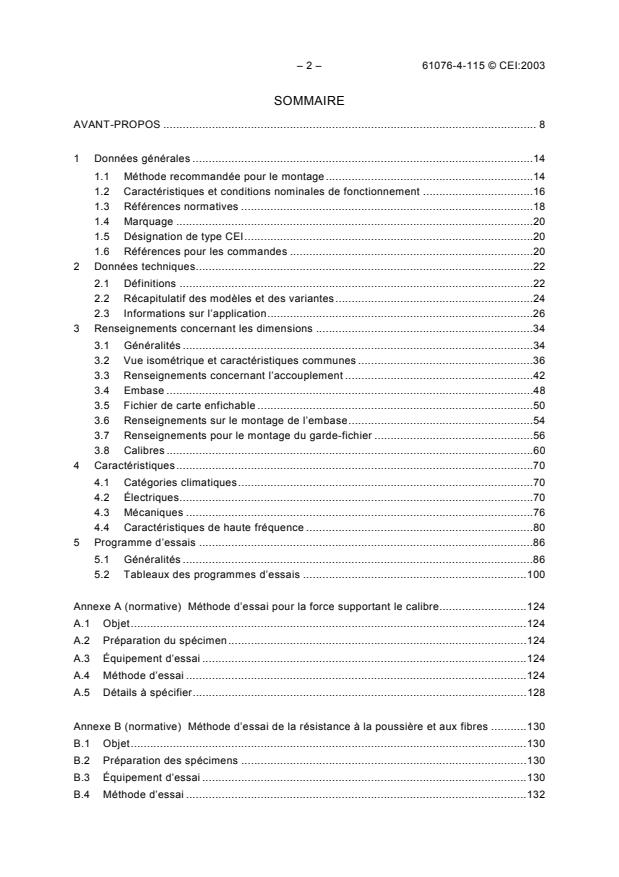
– 2 – 61076-4-115 © CEI:2003
SOMMAIRE
AVANT-PROPOS . 8
1 Données générales .14
1.1 Méthode recommandée pour le montage.14
1.2 Caractéristiques et conditions nominales de fonctionnement .16
1.3 Références normatives .18
1.4 Marquage .20
1.5 Désignation de type CEI.20
1.6 Références pour les commandes .20
2 Données techniques.22
2.1 Définitions .22
2.2 Récapitulatif des modèles et des variantes.24
2.3 Informations sur l’application.26
3 Renseignements concernant les dimensions .34
3.1 Généralités .34
3.2 Vue isométrique et caractéristiques communes .36
3.3 Renseignements concernant l’accouplement .42
3.4 Embase .48
3.5 Fichier de carte enfichable .50
3.6 Renseignements sur le montage de l’embase.54
3.7 Renseignements pour le montage du garde-fichier .56
3.8 Calibres .60
4 Caractéristiques.70
4.1 Catégories climatiques.70
4.2 Électriques.70
4.3 Mécaniques .76
4.4 Caractéristiques de haute fréquence .80
5 Programme d’essais .86
5.1 Généralités .86
5.2 Tableaux des programmes d’essais .100
Annexe A (normative) Méthode d’essai pour la force supportant le calibre.124
A.1 Objet.124
A.2 Préparation du spécimen.124
A.3 Équipement d’essai .124
A.4 Méthode d’essai .124
A.5 Détails à spécifier.128
Annexe B (normative) Méthode d’essai de la résistance à la poussière et aux fibres .130
B.1 Objet.130
B.2 Préparation des spécimens .130
B.3 Équipement d’essai .130
B.4 Méthode d’essai .132
61076-4-115 IEC:2003 – 3 –
CONTENTS
FOREWORD . 9
1 General data .15
1.1 Recommended method of mounting .15
1.2 Ratings and characteristics .17
1.3 Normative references.19
1.4 Marking .21
1.5 IEC type designation .21
1.6 Ordering information .21
2 Technical data .23
2.1 Definitions .23
2.2 Survey of styles and variants.25
2.3 Information on application .27
3 Dimensional information.35
3.1 General .35
3.2 Isometric view and common features.37
3.3 Mating information .43
3.4 Fixed connector .49
3.5 Plug-in card paddle .51
3.6 Mounting information for fixed connector .55
3.7 Mounting information for paddle-guard .57
3.8 Gauges.61
4 Characteristics.71
4.1 Climatic category .71
4.2 Electrical.71
4.3 Mechanical .77
4.4 High-speed characteristics .81
5 Test schedule .87
5.1 General .87
5.2 Test schedule tables .101
Annex A (normative) Test method for gauge supporting force .125
A.1 Object .125
A.2 Preparation of the specimen .125
A.3 Test equipment .125
A.4 Test method.125
A.5 Details to be specified .129
Annex B (normative) Test method for dust and fibre resistance.131
B.1 Object .131
B.2 Preparation of the specimen .131
B.3 Test equipment .131
B.4 Test method.133
– 4 – 61076-4-115 © CEI:2003
Figure 1 – Méthode de montage par insertion à force/compression .14
Figure 2 – Exemple d’un garde-fichier, à monter sur le fichier de carte.26
Figure 3 – Désignation des contacts sur le fond de panier dans le cas du montage en
CIF et compression .28
Figure 4 – Désignation des contacts côté composants .30
Figure 5 – Désignation des contacts côté soudure .30
Figure 6 – Section à bas débits – Les ouvertures dans le garde-fichier contrôlent
l’accouplement séquentiel.32
Figure 7 – Dimensions de coordination .36
Figure 8 – Dimensions et pas de montage en hauteur .38
Figure 9 – Dimensions et pas de montage en largeur.40
Figure 10 – Dimensions en profondeur .40
Figure 11 – Plage de contact en relation avec le gauchissement et la profondeur d’insertion .42
Figure 12 – Écart acceptable en hauteur et largeur .44
Figure 13 – Inclinaison acceptable en hauteur et en largeur (état accouplé) .46
Figure 14 – Dimensions hors tout des embases du style A et du style C.48
Figure 15 – Dimensions détaillées de l’entrée de la fente .48
Figure 16 – Position des lames de contact jumelées en état accouplé .50
Figure 17 – Dimensions hors tout du garde-fichier .50
Figure 18 – Dimensions détaillées du garde-fichier de style I .52
Figure 19 – Implantation sur fond de panier pour l’embase montée en CIF et en
compression.54
Figure 20 – Dimensions détaillées des doigts de contact à débits élevés et des plans de
continuité de masse .56
Figure 21 – Dimensions détaillées des doigts de contact à bas débits – exemple pour
l’application InfiniBand.58
Figure 22 – Calibre pour les contacts à débits élevés de la rangée a.60
Figure 23 – Calibre pour les contacts à débits élevés de la rangée b.62
Figure 24 – Porte-calibre d’essai pour la section à débits élevés .64
Figure 25 – Calibre de forçage pour les contacts à bas débits.66
Figure 26 – Calibre d’essai pour les contacts à bas débits .66
Figure 27 – Porte-calibre d’essai pour la section à bas débits .68
Figure 28 – Courbe d’intensité réduite pour paires différentielles.72
Figure 29 – Courbe d’intensité réduite pour contacts à bas débits .72
Figure 30 – Profil d’impédance caractéristique, comprenant les doigts et les trous-via
(exemple pour information seulement) .80
Figure 31 – Superposition de profils caractéristiques de la paradiaphonie
(exemple pour information seulement) .82
Figure 32 – Agencement de carte enfichable et fond de panier pour un spécimen
d’essais électromécaniques.88
Figure 33 – Agencement des circuits imprimés pour la validation d’intégrité des signaux.90
Figure 34 – Montage pour la mesure de la résistance de contact .92
Figure 35 – Montage pour les essais de contraintes dynamiques.92
Figure 36 – Disposition de câblage pour la tension en tenue et tension de polarisation.94
61076-4-115 IEC:2003 – 5 –
Figure 1 – Press-in/compression method of mounting .15
Figure 2 – Example of a paddle-guard, to be mounted on the plug-in card paddle.27
Figure 3 – Designation of contacts on backplane for press-in/compression mounting .29
Figure 4 – Designation of contacts on component side.31
Figure 5 – Designation of contacts on solder side .31
Figure 6 – Low-speed section – Apertures in paddle-guard control engaging sequence .33
Figure 7 – Co-ordination dimensions.37
Figure 8 – Height dimensions and mounting pitch .39
Figure 9 – Width dimensions and mounting pitch .41
Figure 10 – Depth dimensions .41
Figure 11 – Contact range in relation to bow and insertion depth.43
Figure 12 – Allowed misalignment in height and width directions .45
Figure 13 – Allowed inclination in height and width directions (mated situation) .47
Figure 14 – Overall dimensions of style A and style C fixed connectors .49
Figure 15 – Detailed dimensions of the lead-in slot .49
Figure 16 – Position of the bifurcated contact beams in the mated condition.51
Figure 17 – Overall dimensions of paddle-guard .51
Figure 18 – Detailed dimensions of paddle-guard style I.53
Figure 19 – Footprint on backplane for press-in/compression mounted fixed connector .55
Figure 20 – Detailed dimensions of contact pads for high-speed and
shielding ground planes.57
Figure 21 – Detailed dimensions of contact pads for low-speed – example
for InfiniBand application .59
Figure 22 – Gauges for high-speed contacts in row a.61
Figure 23 – Gauges for high-speed contacts in row b.63
Figure 24 – Holder for test gauges for high-speed section.65
Figure 25 – Sizing gauge for low-speed contacts.67
Figure 26 – Test gauge for low-speed contacts .67
Figure 27 – Holder for test gauges for low-speed section .69
Figure 28 – Derating curve for differential pairs.73
Figure 29 – Derating curve for low-speed contacts.73
Figure 30 – Typical impedance profile, including pads and via-holes (example
for guidance only).81
Figure 31 – Superposition of typical near-end cross-talk curves
(example for guidance only).83
Figure 32 – Layout of plug-in card and backplane for one electromechanical
test specimen.89
Figure 33 – Layout of printed circuit boards for signal integrity validation.91
Figure 34 – Arrangement for measurement of contact resistance .93
Figure 35 – Fixture for dynamic stress tests.93
Figure 36 – Wiring arrangement for voltage proof and polarisation voltage .95
– 6 – 61076-4-115 © CEI:2003
Figure 37 – Disposition pour l’essai de force supportant le calibre aux contacts
à débits élevés .96
Figure 38 – Disposition pour le forçage des contacts à bas débits .98
Figure 39 – Disposition pour l’essai de force supportant le calibre aux contacts à bas débits.98
Figure A.1 – Exemple de disposition pour vérification de la force de support .126
Tableau 1 – Nombre de contacts des embases .16
Tableau 2 – Nombre d’ouvertures dans le garde-fichier.16
Tableau 3 – Récapitulatif des embases.24
Tableau 4 – Récapitulatif des garde-fichiers .24
Tableau 5 – Récapitulatif des sorties côté fond de panier.24
Tableau 6 – Récapitulatif des variantes de garde-fichier .24
Tableau 7 – Dimensions de coordination et caractéristiques communes.38
Tableau 8 – Catégories climatiques .70
Tableau 9 – Lignes de fuite et distances dans l’air .70
Tableau 10 – Tensions assignées de tenue aux chocs .70
Tableau 11 – Tensions assignées d’isolement .70
Tableau 12 – Résistances de contact maximales .74
Tableau 13 – Résistances d’isolement minimales .74
Tableau 14 – Forces maximales d’accouplement et de désaccouplement.76
Tableau 15 – Vibrations.76
Tableau 16 – Chocs .78
Tableau 17 – Décalage dans le retard de propagation.84
Tableau 18 – Nombres de spécimens pour l’inspection et les essais électromécaniques .86
Tableau 19 – Groupe P – Programme d’essais préliminaires.100
Tableau 20 – Groupe A – Programme d’essais dynamiques/climatiques.102
Tableau 21 – Groupe B – Programme d’essais d’endurance mécanique.106
Tableau 22 – Groupe C – Programme d’essais d’humidité .110
Tableau 23 – Groupe D – Programme d’essais de charge électrique .114
Tableau 24 – Groupe E – Programme d’essais de résistance mécanique .116
Tableau 25 – Groupe F – Programme d’essais de résistance à la poussière.118
Tableau 26 – Groupe G – Programme d’essais de la performance à débits élevés .120
61076-4-115 IEC:2003 – 7 –
Figure 37 – Arrangement for gauge supporting force test on high-speed contacts .97
Figure 38 – Arrangement for sizing on low-speed contacts .99
Figure 39 – Arrangement for gauge supporting force test on low-speed contacts.99
Figure A.1 – Example of a test arrangement for supporting force verification.127
Table 1 – Number of contacts for fixed connector .17
Table 2 – Number of cavities for paddle guard .17
Table 3 – Survey of fixed connectors .25
Table 4 – Survey of paddle-guards .25
Table 5 – Survey of terminations to the backplane .25
Table 6 – Survey of paddle-guard variants .25
Table 7 – Co-ordination dimensions and common features.39
Table 8 – Climatic category .71
Table 9 – Creepage and clearance distances.71
Table 10 – Rated impulse voltages .71
Table 11 – Rated insulation voltages .71
Table 12 – Maximum contact resistances.75
Table 13 – Minimum insulation resistances .75
Table 14 – Maximum engaging and separating forces .77
Table 15 – Vibration .77
Table 16 – Shock .79
Table 17 – Propagation delay skew.85
Table 18 – Number of specimens for inspection and electromechanical test sequence .87
Table 19 – Group P – Preliminary testing sequence .101
Table 20 – Group A – Dynamic/Climatic testing sequence.103
Table 21 – Group B – Mechanical endurance testing sequence .107
Table 22 – Group C – Moisture testing sequence .111
Table 23 – Group D – Electrical load testing sequence.115
Table 24 – Group E – Mechanical resistivity testing sequence.117
Table 25 – Group F – Dust testing sequence .119
Table 26 – Group G – High-speed performance testing sequence .121
– 8 – 61076-4-115 © CEI:2003
COMMISSION ÉLECTROTECHNIQUE INTERNATIONALE
___________
CONNECTEURS POUR ÉQUIPEMENTS ÉLECTRONIQUES –
Partie 4-115: Connecteurs pour cartes imprimées –
Connecteur de fond de panier
pour équipement InfiniBand
AVANT-PROPOS
1) La CEI (Commission Électrotechnique Internationale) est une organisation mondiale de normalisation composée
de l'ensemble des comités électrotechniques nationaux (Comités nationaux de la CEI). La CEI a pour objet de
favoriser la coopération internationale pour toutes les questions de normalisation dans les domaines de
l'électricité et de l'électronique. A cet effet, la CEI, entre autres activités, publie des Normes internationales.
Leur élaboration est confiée à des comités d'études, aux travaux desquels tout Comité national intéressé par le
sujet traité peut participer. Les organisations internationales, gouvernementales et non gouvernementales, en
liaison avec la CEI, participent également aux travaux. La CEI collabore étroitement avec l'Organisation
Internationale de Normalisation (ISO), selon des conditions fixées par accord entre les deux organisations.
2) Les décisions ou accords officiels de la CEI concernant les questions techniques représentent, dans la mesure
du possible, un accord international sur les sujets étudiés, étant donné que les Comités nationaux intéressés
sont représentés dans chaque comité d’études.
3) Les documents produits se présentent sous la forme de recommandations internationales. Ils sont publiés
comme normes, spécifications techniques, rapports techniques ou guides et agréés comme tels par les Comités
nationaux.
4) Dans le but d'encourager l'unification internationale, les Comités nationaux de la CEI s'engagent à appliquer de
façon transparente, dans toute la mesure possible, les Normes internationales de la CEI dans leurs normes
nationales et régionales. Toute divergence entre la norme de la CEI et la norme nationale ou régionale
correspondante doit être indiquée en termes clairs dans cette dernière.
5) La CEI n’a fixé aucune procédure concernant le marquage comme indication d’approbation et sa responsabilité
n’est pas engagée quand un matériel est déclaré conforme à l’une de ses normes.
La Commission Electrotechnique Internationale (CEI) attire l’attention sur le fait qu’il est déclaré que la conformité
avec les dispositions du présent document peut impliquer l’utilisation d’un brevet concernant
a) un connecteur électrique assemblé afin d’établir un contact électrique avec des dispositifs de contact de bornes
externes, par exemple les endroits de soudure à une carte de circuit;
b) un connecteur électrique assemblé afin d’établir un contact électrique avec des bornes externes équipées de
dispositifs de contact ayant des surfaces de contact par exemple les endroits de soudure à une carte de circuit;
c) un connecteur électrique assemblé avec un connecteur électrique ayant des positions de contact et des dispo-
sitifs de contact pour établir un contact électrique entre une première et une seconde carte de circuit imprimé.
La CEI ne prend pas position quant à la preuve, à la validité et à la portée de ces droits de propriété.
Le détenteur de ces droits de propriété a donné l’assurance à la CEI qu’il consent à négocier des licences avec
des demandeurs du monde entier, à des termes et conditions raisonnables et non discriminatoires. A ce propos,
la déclaration du détenteur des droits de propriété est enregistrée à la CEI. Des informations peuvent être
demandées à:
Tyco Electronics Corporation
PO Box 3608
Harrisburg, PA 17105-3608
USA
L’attention est d’autre part attirée sur le fait que certains des éléments du présent document peuvent faire l’objet de
droits de propriété autres que ceux qui ont été mentionnés ci-dessus. La CEI ne saurait être tenue pour
responsable de l’identification de ces droits de propriété en tout ou partie.
La Norme internationale CEI 61076-4-115 a été établie par le sous-comité 48B: Connecteurs,
du comité d'étude 48 de la CEI: Composants électromécaniques et structures mécaniques pour
équipements électroniques.
La présente norme annule et remplace l’IEC/PAS 61076-4-115 publiée en 2001. Cette
première édition constitue une révision technique.
61076-4-115 IEC:2003 – 9 –
INTERNATIONAL ELECTROTECHNICAL COMMISSION
___________
CONNECTORS FOR ELECTRONIC EQUIPMENT –
Part 4-115: Printed board connectors –
Backplane connector
for InfiniBand equipment
FOREWORD
1) The IEC (International Electrotechnical Commission) is a worldwide organization for standardization comprising
all national electrotechnical committees (IEC National Committees). The object of the IEC is to promote
international co-operation on all questions concerning standardization in the electrical and electronic fields. To
this end and in addition to other activities, the IEC publishes International Standards. Their preparation is
entrusted to technical committees; any IEC National Committee interested in the subject dealt with may
participate in this preparatory work. International, governmental and non-governmental organizations liaising
with the IEC also participate in this preparation. The IEC collaborates closely with the International Organization
for Standardization (ISO) in accordance with conditions determined by agreement between the two
organizations.
2) The formal decisions or agreements of the IEC on technical matters express, as nearly as possible, an
international consensus of opinion on the relevant subjects since each technical committee has representation
from all interested National Committees.
3) The documents produced have the form of recommendations for international use and are published in the form
of standards, technical specifications, technical reports or guides and they are accepted by the National
Committees in that sense.
4) In order to promote international unification, IEC National Committees undertake to apply IEC International
Standards transparently to the maximum extent possible in their national and regional standards. Any
divergence between the IEC Standard and the corresponding national or regional standard shall be clearly
indicated in the latter.
5) The IEC provides no marking procedure to indicate its approval and cannot be rendered responsible for any
equipment declared to be in conformity with one of its standards.
The International Electrotechnical Commission (IEC) draws attention to the fact that it is claimed that compliance
with this document may involve the use of a patent concerning
a) an electrical connector assembly for establishing electrical contact with contacting devices of external terminals,
e.g. with solder points of a circuit board;
b) an electrical connector assembly for establishing electrical contact with external terminals having contacting devices
with contact faces, e.g. with solder points of a circuit board;
c) an electrical connector assembly with an electrical connector having a connecting position and contacting
devices for establishing electrical contact between a first and a second printed circuit board.
IEC takes no position concerning the evidence, validity and scope of this patent right.
The holder of this patent right has assured the IEC that he/she is willing to negotiate licences under reasonable and
non-discriminatory terms and conditions with applicants throughout the world. In this respect, the statement of the
holder of this patent right is registered with IEC. Information may be obtained from:
Tyco Electronics Corporation
PO Box 3608
Harrisburg, PA 17105-3608
USA
Attention is drawn to the possibility that some of the elements of this document may be the subject of patent rights
other than those identified above. IEC shall not be held responsible for identifying any or all such patent rights.
International Standard IEC 61076-4-115 has been prepared by subcommittee 48B: Connectors,
of IEC technical committee 48: Electromechanical components and mechanical structures for
electronic equipment.
This standard cancels and replaces IEC/PAS 61076-4-115 published in 2001. This first edition
constitutes a technical revision.
– 10 – 61076-4-115 © CEI:2003
Le texte de cette norme est issu des documents suivants:
FDIS Rapport de vote
48B/1288/FDIS 48B/1308/RVD
Le rapport de vote indiqué dans le tableau ci-dessus donne toute information sur le vote ayant
abouti à l'approbation de cette norme.
Les futures normes de cette série porteront le nouveau titre général cité ci-dessus. Les titres
des normes existant dans cette série seront mis à jour lors d’une prochaine édition.
Cette publication a été rédigée selon les Directives ISO/CEI, Partie 2.
Le comité a décidé que le contenu de cette publication ne sera pas modifié avant 2007. A cette
date, la publication sera:
• reconduite;
• supprimée;
• remplacée par une édition révisée, ou
• amendée.
61076-4-115 IEC:2003 – 11 –
The text of this standard is based on the following documents:
FDIS Report on voting
48B/1288/FDIS 48B/1308/RVD
Full information on the voting for the approval of this standard can be found in the report on
voting indicated in the above table.
Future standards in this series will carry the new general title as cited above. Titles of existing
standards in this series will be updated when a new edition is prepared.
This publication has been drafted in accordance with the ISO/IEC Directives, Part 2.
The committee has decided that the contents of this publication will remain unchanged until 2007.
At this date, the publication will be
• reconfirmed;
• withdrawn;
• replaced by a revised edition, or
• amended.
– 12 – 61076-4-115 © CEI:2003
CONNECTEURS POUR ÉQUIPEMENTS ÉLECTRONIQUES –
Partie 4-115: Connecteurs pour cartes imprimées –
Connecteur de fond de panier
pour équipement InfiniBand
CEI SC 48B – Connecteurs
Composants électroniques sous assurance de la qualité Spécification particulière cadre:
en conformité avec la CEI 61076-1:1995
CEI 61076-4-001:1996
Connecteur hybride en une partie, avec
une section pour connexions à débits
élevés au pas de 3 mm et une section à
bas débits avec contacts de puissance et
continuité de masse au pas de 2 mm,
pour cartes imprimées et fonds de panier
selon la CEI 60917-2-2.
Connecteur hybride comportant une section
contenant 2 rangées de 12 paires de
contacts pour la transmission par paire
différentielle au pas de 3 mm
et une section avec 1 rangée de 18 contacts
pour les connexions à bas débits et contacts
de puissance au pas de 2 mm.
Les embases ont une hauteur de 50 mm,
elles sont insérées à force dans le fond de
panier ou soudées par montage en surface.
L’interface de la carte enfichable est
protégée par un garde-fichier.
Niveaux de performance (NP): 1
IEC 684/03
Les informations concernant les fabricants capables de fournir des composants conformes à cette spécification
particulière sont fournies dans la liste des produits qualifiés.
61076-4-115 IEC:2003 – 13 –
CONNECTORS FOR ELECTRONIC EQUIPMENT –
Part 4-115: Printed board connectors –
Backplane connector
for InfiniBand equipment
IEC SC 48B – Connectors
Electronic components of assessed quality in accordance Blank detail specification:
with IEC 61076-1:1995
IEC 61076-4-001:1996
Single-part hybrid connector, with
a section for high-speed on a 3 mm
grid and a low-speed section with
power and ground connections on
a 2 mm grid,
for printed boards and backplanes
in accordance with IEC 60917-2-2.
Hybrid connector having one section
containing 2 rows of 12 contact pairs for
differential pair transmission on a 3 mm
pitch
and one section with 1 row of 18
contacts for low-speed and power
connections on a 2 mm pitch.
The fixed connectors are 50 mm high,
pressed-in or surface mount soldered
onto the backplane.
The plug-in card interface is protected
by a paddle-guard.
Performance levels (PL): 1
IEC 684/03
Information on the availability of components qualified to this detail specification is given in the qualified
product list.
– 14 – 61076-4-115 © CEI:2003
1 Données générales
1.1 Méthode recommandée pour le montage
Le montage sur le fond de panier peut se faire selon trois méthodes.
a) Connexion par insertion à force/compression
L’embase est insérée à force dans le fond de panier, par l’intermédiaire de 18 connexions
à bas débits et quatre broches à insérer à force.
Les
...
Questions, Comments and Discussion
Ask us and Technical Secretary will try to provide an answer. You can facilitate discussion about the standard in here.
Loading comments...