

IEC 60947-4-1:2018
(Main)Low-voltage switchgear and controlgear - Part 4-1: Contactors and motor-starters - Electromechanical contactors and motor-starters
General Information
- Abstract
IEC 60947-4-1:2018 is applicable to the following equipment:
- electromechanical contactors and starters including motor protective switching device (MPSD);
- actuators of contactor relays;
- contacts dedicated exclusively to the coil circuit of this contactor or this contactor relay;
- dedicated accessories (e.g. dedicated wiring, dedicated latch accessory);
intended to be connected to distribution circuits, motors circuits and other load circuits, the rated voltage of which does not exceed 1 000 V AC or 1 500 V DC. This fourth edition cancels and replaces the third edition published in 2009 and its Amendment 1:2012. This edition constitutes a technical revision. This edition includes the following significant technical changes with respect to the previous edition:
- Scope structure and exclusions
- Editorial correction of notes and hanging paragraphs
- Reference to IEC 62683-1
- Motor protective switching device (MPSD) with its requirements
- Safety aspects related to:
- General aspects;
- Limited energy circuits;
- Electronic circuits;
- Assessment procedure for electromechanical overload protection used in safety -applications (new Annex L)
- Introduction of provisions covering the impact of higher locked rotor current to achieve high efficiency class
- Mention of dedicated wiring accessories
- Pickup power measurement
- Alignment to IEC 60947-1:2007, IEC 60947-1:2007/AMD1:2010, and IEC 60947‑1:2007/AMD2:2014
- Direct current requirements for covering photovoltaic application (new Annex M)
- Load monitoring indicators (new Annex O)
- Short-circuit breaking tests of MPSD (new Annex P)
- Co-ordination under short-circuit conditions between a MPSD and another short-circuit protective device associated in the same circuit (new Annex Q).
The contents of the interpretation sheet of March 2020, the corrigendum 1 of April 2020 and the corrigendum 2 of April 2021 have been included in this copy.
- Status
- Published
- Publication Date
- 24-Oct-2018
- Technical Committee
- SC 121A - Low-voltage switchgear and controlgear
- Current Stage
- DELPUB - Deleted Publication
- Start Date
- 08-Nov-2023
- Completion Date
- 23-Feb-2022
Buy Documents
IEC 60947-4-1:2018 RLV - Low-voltage switchgear and controlgear - Part 4-1: Contactors and motor-starters - Electromechanical contactors and motor-starters Released:10/25/2018
IEC 60947-4-1:2018 - Low-voltage switchgear and controlgear - Part 4-1: Contactors and motor-starters - Electromechanical contactors and motor-starters Released:10/25/2018
Overview
IEC 60947-4-1:2018 is the fourth-edition international standard for low-voltage switchgear and controlgear covering electromechanical contactors and motor‑starters, including motor protective switching devices (MPSD), contactor-relay actuators, coil‑circuit contacts, and dedicated accessories. It applies to equipment intended for distribution, motor and other load circuits with rated voltages up to 1 000 V AC or 1 500 V DC. This 2018 edition replaces the 2009 edition and Amendment 1:2012 and includes significant technical revisions and new annexes.
Key topics and technical requirements
- Scope & classification: Defines kinds of equipment, poles, current types (AC/DC), utilization categories (AC-2/3/3e/4) and rated values.
- Constructional requirements: Materials, current-carrying parts, clearances/creepage, terminals, enclosures, limited energy and stored-charge circuits, and provisions for isolation and earthing.
- Performance & testing: Temperature-rise, dielectric properties, normal/overload performance, short‑circuit behaviour, and detailed type, routine and sampling tests. New requirements include pickup power measurement and tests for higher locked‑rotor currents to meet efficiency classes.
- Motor protective switching device (MPSD): New dedicated requirements, including short‑circuit breaking tests, coordination under short‑circuit conditions and overload relay characteristics.
- Safety aspects: General safety, limited energy circuits, electronic circuits, and an assessment procedure for electromechanical overload protection (Annex L).
- New annexes & additions:
- Annex L: safety assessment for overload protection
- Annex M: DC requirements for photovoltaic applications
- Annex O: load monitoring indicators
- Annex P: short‑circuit breaking tests of MPSD
- Annex Q: coordination between MPSD and short‑circuit protective devices
- EMC, marking & documentation: Immunity/emission limits, marking, instructions for installation, maintenance and environmental information.
- Alignment & references: Aligned to IEC 60947‑1 editions and references IEC 62683‑1.
Applications and who uses it
- Manufacturers of contactors, motor‑starters and MPSDs for product design, conformity and test specifications.
- Test laboratories and certification bodies performing type and routine testing.
- Electrical engineers, panel builders and system integrators specifying low‑voltage motor control gear for industrial, commercial and photovoltaic systems.
- Safety assessors and maintenance teams ensuring correct selection, installation and coordination of protective devices.
Related standards
- IEC 60947‑1 (general rules for low‑voltage switchgear and controlgear) - alignment referenced throughout.
- IEC 62683‑1 - referenced for specific requirements.
- See also other parts of the IEC 60947 series for complementary device classes and auxiliary functions.
Keywords: IEC 60947-4-1, low-voltage switchgear and controlgear, electromechanical contactors and motor-starters, MPSD, photovoltaic DC requirements, short-circuit tests, load monitoring indicators.
Relations
- Effective Date
- 22-Apr-2026
- Effective Date
- 05-Sep-2023
- Effective Date
- 05-Sep-2023
- Effective Date
- 05-Sep-2023
- Effective Date
- 05-Sep-2023
- Effective Date
- 05-Sep-2023
- Effective Date
- 05-Sep-2023
Buy Documents
IEC 60947-4-1:2018 RLV - Low-voltage switchgear and controlgear - Part 4-1: Contactors and motor-starters - Electromechanical contactors and motor-starters Released:10/25/2018
IEC 60947-4-1:2018 - Low-voltage switchgear and controlgear - Part 4-1: Contactors and motor-starters - Electromechanical contactors and motor-starters Released:10/25/2018
Get Certified
Connect with accredited certification bodies for this standard

IMQ S.p.A. (Certification)
Italian electrical product certification.

SLG Prüf- und Zertifizierungs GmbH
German testing and certification body.

UL Solutions
Global safety science company with testing, inspection and certification.
Sponsored listings
Frequently Asked Questions
IEC 60947-4-1:2018 is a standard published by the International Electrotechnical Commission (IEC). Its full title is "Low-voltage switchgear and controlgear - Part 4-1: Contactors and motor-starters - Electromechanical contactors and motor-starters". This standard covers: IEC 60947-4-1:2018 is applicable to the following equipment: - electromechanical contactors and starters including motor protective switching device (MPSD); - actuators of contactor relays; - contacts dedicated exclusively to the coil circuit of this contactor or this contactor relay; - dedicated accessories (e.g. dedicated wiring, dedicated latch accessory); intended to be connected to distribution circuits, motors circuits and other load circuits, the rated voltage of which does not exceed 1 000 V AC or 1 500 V DC. This fourth edition cancels and replaces the third edition published in 2009 and its Amendment 1:2012. This edition constitutes a technical revision. This edition includes the following significant technical changes with respect to the previous edition: - Scope structure and exclusions - Editorial correction of notes and hanging paragraphs - Reference to IEC 62683-1 - Motor protective switching device (MPSD) with its requirements - Safety aspects related to: - General aspects; - Limited energy circuits; - Electronic circuits; - Assessment procedure for electromechanical overload protection used in safety -applications (new Annex L) - Introduction of provisions covering the impact of higher locked rotor current to achieve high efficiency class - Mention of dedicated wiring accessories - Pickup power measurement - Alignment to IEC 60947-1:2007, IEC 60947-1:2007/AMD1:2010, and IEC 60947‑1:2007/AMD2:2014 - Direct current requirements for covering photovoltaic application (new Annex M) - Load monitoring indicators (new Annex O) - Short-circuit breaking tests of MPSD (new Annex P) - Co-ordination under short-circuit conditions between a MPSD and another short-circuit protective device associated in the same circuit (new Annex Q). The contents of the interpretation sheet of March 2020, the corrigendum 1 of April 2020 and the corrigendum 2 of April 2021 have been included in this copy.
IEC 60947-4-1:2018 is applicable to the following equipment: - electromechanical contactors and starters including motor protective switching device (MPSD); - actuators of contactor relays; - contacts dedicated exclusively to the coil circuit of this contactor or this contactor relay; - dedicated accessories (e.g. dedicated wiring, dedicated latch accessory); intended to be connected to distribution circuits, motors circuits and other load circuits, the rated voltage of which does not exceed 1 000 V AC or 1 500 V DC. This fourth edition cancels and replaces the third edition published in 2009 and its Amendment 1:2012. This edition constitutes a technical revision. This edition includes the following significant technical changes with respect to the previous edition: - Scope structure and exclusions - Editorial correction of notes and hanging paragraphs - Reference to IEC 62683-1 - Motor protective switching device (MPSD) with its requirements - Safety aspects related to: - General aspects; - Limited energy circuits; - Electronic circuits; - Assessment procedure for electromechanical overload protection used in safety -applications (new Annex L) - Introduction of provisions covering the impact of higher locked rotor current to achieve high efficiency class - Mention of dedicated wiring accessories - Pickup power measurement - Alignment to IEC 60947-1:2007, IEC 60947-1:2007/AMD1:2010, and IEC 60947‑1:2007/AMD2:2014 - Direct current requirements for covering photovoltaic application (new Annex M) - Load monitoring indicators (new Annex O) - Short-circuit breaking tests of MPSD (new Annex P) - Co-ordination under short-circuit conditions between a MPSD and another short-circuit protective device associated in the same circuit (new Annex Q). The contents of the interpretation sheet of March 2020, the corrigendum 1 of April 2020 and the corrigendum 2 of April 2021 have been included in this copy.
IEC 60947-4-1:2018 is classified under the following ICS (International Classification for Standards) categories: 29.120.99 - Other electrical accessories; 29.130.20 - Low voltage switchgear and controlgear. The ICS classification helps identify the subject area and facilitates finding related standards.
IEC 60947-4-1:2018 has the following relationships with other standards: It is inter standard links to EN ISO 13577-4:2022, IEC 60947-4-1:2018/COR1:2020, IEC 60947-4-1:2018/COR2:2021, IEC 60947-4-1:2023, IEC 60947-4-1:2009/AMD1:2012, IEC 60947-4-1:2009, IEC 60947-4-1:2018/ISH1:2020. Understanding these relationships helps ensure you are using the most current and applicable version of the standard.
IEC 60947-4-1:2018 is available in PDF format for immediate download after purchase. The document can be added to your cart and obtained through the secure checkout process. Digital delivery ensures instant access to the complete standard document.
Standards Content (Sample)
IEC 60947-4-1 ®
Edition 4.0 2018-10
REDLINE VERSION
INTERNATIONAL
STANDARD
colour
inside
Low-voltage switchgear and controlgear –
Part 4-1: Contactors and motor-starters – Electromechanical contactors and
motor-starters
All rights reserved. Unless otherwise specified, no part of this publication may be reproduced or utilized in any form
or by any means, electronic or mechanical, including photocopying and microfilm, without permission in writing from
either IEC or IEC's member National Committee in the country of the requester. If you have any questions about IEC
copyright or have an enquiry about obtaining additional rights to this publication, please contact the address below or
your local IEC member National Committee for further information.
IEC Central Office Tel.: +41 22 919 02 11
3, rue de Varembé info@iec.ch
CH-1211 Geneva 20 www.iec.ch
Switzerland
About the IEC
The International Electrotechnical Commission (IEC) is the leading global organization that prepares and publishes
International Standards for all electrical, electronic and related technologies.
About IEC publications
The technical content of IEC publications is kept under constant review by the IEC. Please make sure that you have the
latest edition, a corrigenda or an amendment might have been published.
IEC Catalogue - webstore.iec.ch/catalogue Electropedia - www.electropedia.org
The stand-alone application for consulting the entire The world's leading online dictionary of electronic and
bibliographical information on IEC International Standards, electrical terms containing 21 000 terms and definitions in
Technical Specifications, Technical Reports and other English and French, with equivalent terms in 16 additional
documents. Available for PC, Mac OS, Android Tablets and languages. Also known as the International Electrotechnical
iPad. Vocabulary (IEV) online.
IEC publications search - webstore.iec.ch/advsearchform IEC Glossary - std.iec.ch/glossary
The advanced search enables to find IEC publications by a 67 000 electrotechnical terminology entries in English and
variety of criteria (reference number, text, technical French extracted from the Terms and Definitions clause of
committee,…). It also gives information on projects, replaced IEC publications issued since 2002. Some entries have been
and withdrawn publications. collected from earlier publications of IEC TC 37, 77, 86 and
CISPR.
IEC Just Published - webstore.iec.ch/justpublished
Stay up to date on all new IEC publications. Just Published IEC Customer Service Centre - webstore.iec.ch/csc
details all new publications released. Available online and If you wish to give us your feedback on this publication or
also once a month by email. need further assistance, please contact the Customer Service
Centre: sales@iec.ch.
IEC 60947-4-1 ®
Edition 4.0 2018-10
REDLINE VERSION
INTERNATIONAL
STANDARD
colour
inside
Low-voltage switchgear and controlgear –
Part 4-1: Contactors and motor-starters – Electromechanical contactors and
motor-starters
INTERNATIONAL
ELECTROTECHNICAL
COMMISSION
ICS 29.120.99, 29.130.20 ISBN 978-2-8322-6208-5
IEC 2020
INTERNATIONAL ELECTROTECHNICAL COMMISSION
____________
IEC 60947-4-1
Edition 4.0 2018-10
LOW-VOLTAGE SWITCHGEAR AND CONTROLGEAR –
Part 4-1: Contactors and motor-starters –
Electromechanical contactors and motor-starters
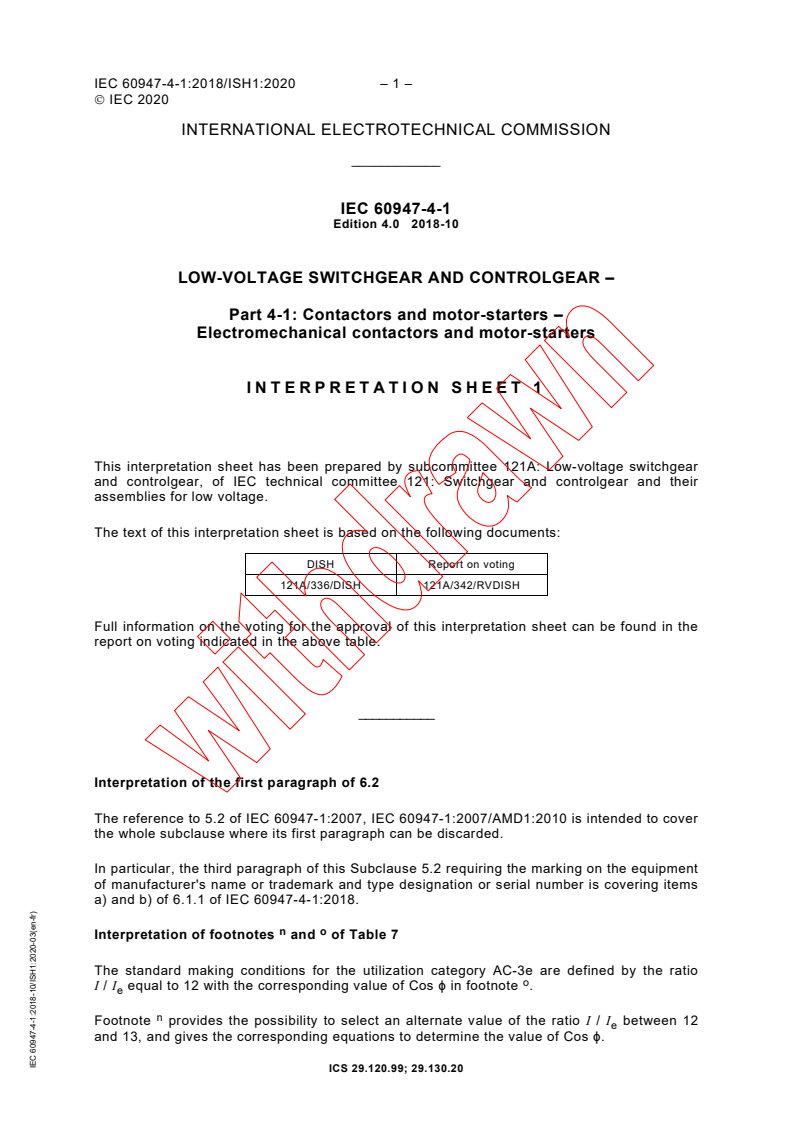
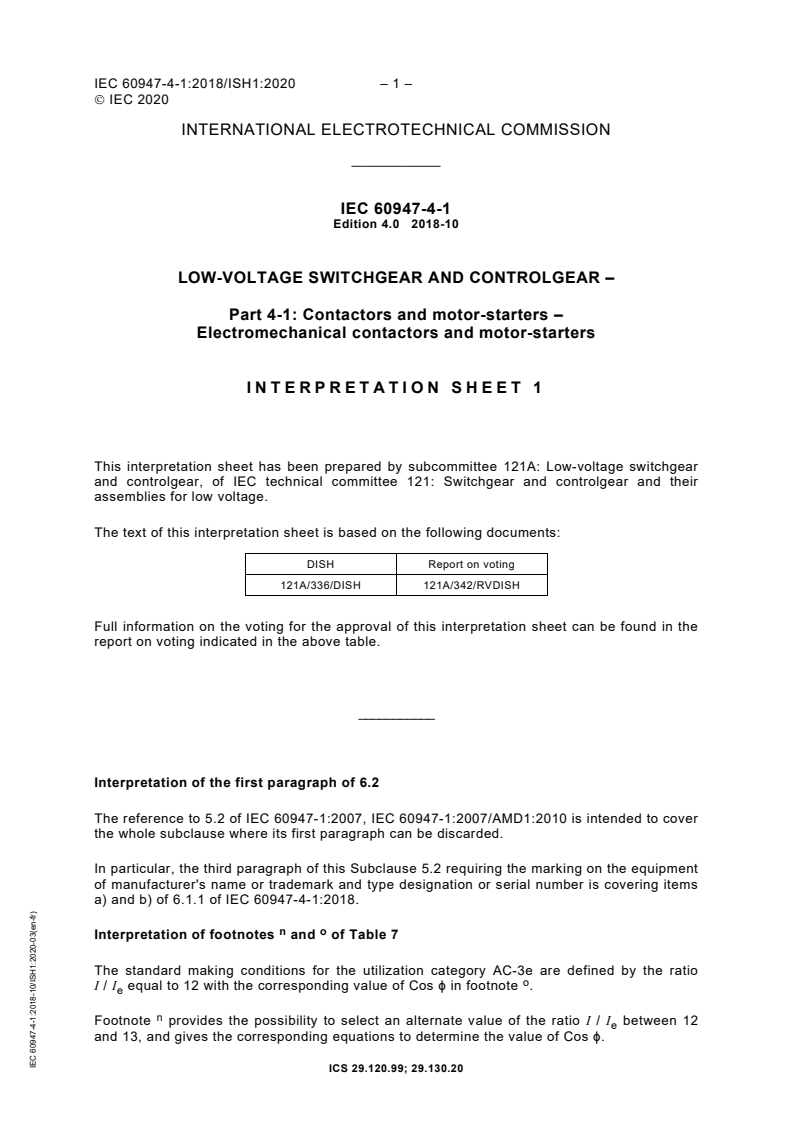
INTERPRETATION SHEET 1
This interpretation sheet has been prepared by subcommittee 121A: Low-voltage switchgear
and controlgear, of IEC technical committee 121: Switchgear and controlgear and their
assemblies for low voltage.
The text of this interpretation sheet is based on the following documents:
DISH Report on voting
121A/336/DISH 121A/342/RVDISH
Full information on the voting for the approval of this interpretation sheet can be found in the
report on voting indicated in the above table.
___________
Interpretation of the first paragraph of 6.2
The reference to 5.2 of IEC 60947-1:2007, IEC 60947-1:2007/AMD1:2010 is intended to cover
the whole subclause where its first paragraph can be discarded.
In particular, the third paragraph of this Subclause 5.2 requiring the marking on the equipment
of manufacturer's name or trademark and type designation or serial number is covering items
a) and b) of 6.1.1 of IEC 60947-4-1:2018.
n o
and of Table 7
Interpretation of footnotes
The standard making conditions for the utilization category AC-3e are defined by the ratio
o
I / I equal to 12 with the corresponding value of Cos ϕ in footnote .
e
n
Footnote provides the possibility to select an alternate value of the ratio I / I between 12
e
and 13, and gives the corresponding equations to determine the value of Cos ϕ.
ICS 29.120.99; 29.130.20
– 2 – IEC 60947-4-1:2018/ISH1:2020
IEC 2020
Interpretation of the rated operational current of Table 13 and Table 14
Tables 13 and 14 are intended to be used for contactors and starters specified for motor
loads. If the contactor or starter is specified with more than one motor load utilization category
(AC-2, AC-3, AC-3e or AC-4), the rated operational current I corresponding to the utilization
e
category AC-3 is preferred for determining the prospective current “r” for the test.
The utilization category AC-3 is considered as the most representative use case and is
deemed to cover the other motor utilization categories.
– 2 – IEC 60947-4-1:2018 RLV © IEC 2018
CONTENTS
FOREWORD . 10
INTRODUCTION . 13
1 Scope and object . 14
2 Normative references . 17
3 Terms, definitions, symbols and abbreviated terms . 20
3.1 General . 20
3.2 Alphabetical index of terms . 20
3.3 Terms and definitions concerning contactors . 22
3.4 Terms and definitions concerning starters . 24
3.5 Terms and definitions concerning characteristic quantities . 29
3.6 Terms and definitions concerning safety aspects . 30
3.7 Symbols and abbreviated terms . 31
4 Classification . 32
5 Characteristics of contactors and starters . 32
5.1 Summary of characteristics . 32
5.2 Type of equipment . 33
5.2.1 Kind of equipment . 33
5.2.2 Number of poles . 33
5.2.3 Kind of current (AC or DC) . 33
5.2.4 Interrupting medium (air, oil, gas, vacuum, etc.) . 33
5.2.5 Operating conditions of the equipment . 33
5.3 Rated and limiting values for main circuits . 33
5.3.1 Rated voltages . 33
5.3.2 Currents or powers . 35
5.3.3 Rated frequency . 37
5.3.4 Rated duties . 37
5.3.5 Normal load and overload characteristics . 38
5.3.6 Short-circuit characteristics . 40
5.3.7 Pole impedance of a contactor (Z) . 40
5.4 Utilization category . 40
5.4.1 General . 40
5.4.2 Assignment of utilization categories based on the results of tests . 41
5.5 Control circuits . 43
5.6 Auxiliary circuits . 44
5.7 Characteristics of relay and release of overload relays and motor protective
switching device (MPSD) . 44
5.7.1 Summary of characteristics . 44
5.7.2 Types of relay or release . 45
5.7.3 Characteristic values . 45
5.7.4 Designation and current settings of overload relays . 47
5.7.5 Time-current characteristics of overload relays . 47
5.7.6 Influence of ambient air temperature. 48
5.8 Co-ordination with short-circuit protective devices . 48
5.9 Void . 48
5.10 Types and characteristics of automatic change-over devices and automatic
acceleration control devices . 48
5.10.1 Types . 48
5.10.2 Characteristics. 48
5.11 Types and characteristics of auto-transformers for two-step auto-transformer
starters . 49
5.12 Types and characteristics of starting resistors for rheostatic rotor starters . 49
6 Product information . 49
6.1 Nature of information . 49
6.1.1 Identification . 49
6.1.2 Characteristics, basic rated values and utilization . 50
6.2 Marking . 51
6.3 Instructions for installation, operation, maintenance, decommissioning
and dismantling. 52
6.4 Environmental information . 53
7 Normal service, mounting and transport conditions . 53
8 Constructional and performance requirements . 53
8.1 Constructional requirements . 53
8.1.1 General . 53
8.1.2 Materials . 54
8.1.3 Current-carrying parts and their connections . 54
8.1.4 Clearances and creepage distances . 54
8.1.5 Actuator . 55
8.1.6 Indication of the contact position . 55
8.1.7 Additional requirements for equipment suitable for isolation . 55
8.1.8 Terminals . 55
8.1.9 Additional requirements for equipment provided with a neutral pole . 56
8.1.10 Provisions for protective earthing . 56
8.1.11 Enclosures for equipment . 56
8.1.12 Degrees of protection of enclosed equipment . 56
8.1.13 Conduit pull-out, torque and bending with metallic conduits . 56
8.1.14 Limited energy source . 56
8.1.15 Stored charge energy circuit . 58
8.1.16 Fault and abnormal conditions . 59
8.1.17 Short-circuit and overload protection of ports . 59
8.2 Performance requirements . 59
8.2.1 Operating conditions . 59
8.2.2 Temperature-rise . 67
8.2.3 Dielectric properties . 69
8.2.4 Normal load and overload performance requirements . 70
8.2.5 Co-ordination with short-circuit protective devices . 80
Void .
Additional requirements for combination starters and combination
switching devices suitable for isolation .
8.3 Electromagnetic compatibility (EMC) . 82
8.3.1 General . 82
8.3.2 Immunity . 83
8.3.3 Emission . 83
9 Tests . 84
9.1 Kinds of test . 84
9.1.1 General . 84
– 4 – IEC 60947-4-1:2018 RLV © IEC 2018
9.1.2 Type tests . 84
9.1.3 Routine tests . 84
9.1.4 Sampling tests . 85
9.1.5 Special tests . 85
9.2 Compliance with constructional requirements . 86
9.2.1 General . 86
9.2.2 Electrical performance of screwless-type clamping units . 86
9.2.3 Ageing test for screwless-type clamping units . 87
9.2.4 Limited energy source test . 87
9.2.5 Breakdown of components . 88
9.3 Compliance with performance requirements . 88
9.3.1 Test sequences . 88
9.3.2 General test conditions . 89
9.3.3 Performance under no load, normal load and overload conditions . 90
9.3.4 Performance under short-circuit conditions . 101
9.3.5 Overload current withstand capability of contactors . 106
9.3.6 Routine tests and sampling tests . 107
9.4 EMC tests . 108
9.4.1 General . 108
9.4.2 Immunity . 109
9.4.3 Emission . 111
Annex A (normative) Marking and identification of terminals of contactors, starters and
associated overload relays . 113
A.1 General . 113
A.2 Marking and identification of terminals of main circuits . 113
A.3 Marking and identification of terminals of overload relays . 113
Annex B (normative) Special tests . 115
B.1 General . 115
B.2 Mechanical durability . 115
B.2.1 General . 115
B.2.2 Verification of mechanical durability . 115
B.3 Electrical durability . 117
B.3.1 General . 117
B.3.2 Results to be obtained . 118
B.3.3 Statistical analysis of test results for contactors or starters . 119
B.4 Coordination at the crossover current between the starter and associated
SCPD . 119
B.4.1 General and definitions . 119
B.4.2 Condition for the test for the verification of co-ordination at the
crossover current by a direct method . 120
B.4.3 Test currents and test circuits . 120
B.4.4 Test procedure and results to be obtained . 120
B.4.5 Verification of co-ordination at the crossover current by an indirect
method . 121
Annex C (Void) (informative) Typical characteristics of starters . 124
Annex D (informative) Items subject to agreement between manufacturer and user . 131
Annex E (informative) Examples of control circuit configurations (Void) . 131
Annex F (normative) Requirements for auxiliary contact linked with power contact
(mirror contact) . 133
F.1 Application and object . 133
F.1.1 Application. 133
F.1.2 Object . 133
F.2 Terms and definitions . 133
F.3 Characteristics . 133
F.4 Product information . 133
F.5 Normal service, mounting and transport conditions . 134
F.6 Constructional and performance requirements . 134
F.7 Tests . 134
F.7.1 General . 134
F.7.2 Tests on products in a new condition . 134
F.7.3 Test after conventional operational performance (defined under Table
10) . 135
Annex G (informative) Rated operational currents and rated operational powers of
switching devices for electrical motors . 136
G.1 General . 136
G.2 Rated operational powers and rated operational currents . 136
Annex H (normative) Extended functions within to electronic overload relays . 140
H.1 General . 140
H.2 Terms and definitions . 140
H.3 Limits of operation of control functions . 140
H.3.1 General . 140
H.3.2 Limits of electronic overload relay with main circuit under-voltage
restarting function . 140
H.4 Test of the control functions . 141
Annex I (informative) AC-1 contactors for use with semiconductor controlled motor
load . 142
Annex J (Void) . 143
Annex K (normative) Procedure to determine data for electromechanical contactors
used in functional safety applications . 144
K.1 General . 145
K.2 Test requirements . 145
K.3 Characterization of a failure mode . 145
K.4 Failure ratios of a contactor . 146
Annex L (normative) Assessment procedure for electromechanical overload protection
used in safety applications and especially in explosive atmospheres . 147
L.1 Application and object . 147
L.1.1 Application . 147
L.1.2 Object . 147
L.2 Terms, definitions and symbols . 147
L.2.1 Terms and definitions . 147
L.2.2 Symbols and abbreviations . 148
L.3 Procedure . 149
L.3.1 General . 149
L.3.2 Safety design process . 149
L.4 Requirements . 150
L.4.1 General . 150
L.4.2 Safety plan . 150
L.4.3 Design . 151
– 6 – IEC 60947-4-1:2018 RLV © IEC 2018
L.4.4 Failure mode and effects analysis of the safety function . 151
L.4.5 Design plan . 152
L.4.6 Verification . 152
L.4.7 Function assessed . 152
L.5 Documentation . 152
L.5.1 Technical safety documentation . 152
L.5.2 Safety instructions . 152
L.6 Example. 153
L.6.1 architecture description . 153
L.6.2 FMEA . 154
Annex M (normative) DC contactors for use in photovoltaic (PV) applications . 162
M.1 Application . 162
M.2 Object . 162
M.3 Terms and definitions . 162
M.4 Classification . 163
M.5 Characteristics . 163
M.5.1 General . 163
M.5.2 Rated impulse withstand voltage. 163
M.5.3 Utilization category . 163
M.6 Product information . 164
M.7 Normal service, mounting and transport conditions . 164
M.7.1 General . 164
M.7.2 Ambient air temperature . 164
M.7.3 Altitude . 164
M.8 Constructional and performance requirements . 165
M.8.1 Constructional requirements . 165
M.8.2 Performance requirements . 165
M.8.3 Electromagnetic compatibility (EMC) . 166
M.9 Tests . 166
M.9.1 General . 166
M.9.2 Type tests . 166
M.9.3 Making and breaking capacities and conventional operational
performance . 167
M.9.4 Thermal cycling test . 167
M.9.5 Climatic test. 167
M.9.6 Dielectric test . 167
M.9.7 Critical load current test . 168
M.9.8 Mechanical properties . 169
M.9.9 Degree of protection of enclosed contactors . 170
M.9.10 EMC . 170
M.9.11 Clearance and creepage distances . 170
Annex N (normative) Additional requirements and tests for equipment with protective
separation . 171
N.1 General . 171
N.2 Definitions. 171
N.3 Requirements . 171
N.3.1 Test method for implementing protective impedance . 171
N.3.2 Touch current measurement . 172
Annex O (informative) Load monitoring indicators . 174
O.1 General . 174
O.2 Indicators list . 174
O.3 Uncertainty . 176
O.4 Tests . 177
O.4.1 Routine tests . 177
O.4.2 Type tests . 177
Annex P (normative) Short-circuit breaking tests of MPSD . 179
P.1 General test conditions . 179
P.2 Rated service short-circuit breaking capacity . 179
P.2.1 General . 179
P.2.2 Test of rated service short-circuit breaking capacity. 180
P.2.3 Verification of operational performance capability . 180
P.2.4 Verification of dielectric withstand . 180
P.2.5 Verification of temperature-rise . 181
P.2.6 Verification of overload releases . 181
P.3 Rated ultimate short-circuit breaking capacity . 181
P.3.1 General . 181
P.3.2 Verification of overload releases . 181
P.3.3 Test of rated ultimate short-circuit breaking capacity . 182
P.3.4 Verification of dielectric withstand . 182
P.3.5 Verification of overload releases . 182
P.4 Test of MPSD for IT system . 182
P.4.1 General . 182
P.4.2 Individual pole short-circuit . 182
P.4.3 Verification of dielectric withstand . 183
P.4.4 Verification of overload releases . 183
P.4.5 Marking . 183
Annex Q (normative) Co-ordination under short-circuit conditions between a MPSD
and another short-circuit protective device associated in the same circuit . 184
Q.1 Application . 184
Q.2 Object . 184
Q.3 General requirements for the co-ordination of a MPSD with another SCPD . 185
Q.3.1 General considerations . 185
Q.3.2 Behaviour of C in association with another SCPD . 185
Q.4 Type and characteristics of the associated SCPD . 185
Q.5 Verification of selectivity . 186
Q.5.1 General . 186
Q.5.2 Consideration of selectivity by desk study . 186
Q.5.3 Selectivity determined by test . 187
Bibliography . 192
Figure 1 – Multiple of current setting limits for ambient air temperature compensated
time-delay overload relays . 64
Figure 2 – Thermal memory test . 65
Figure 3 – Examples of co-ordination characteristics of a starter. 81
Figure 4 – Voltage drop measurement at contact point of the clamping terminal . 87
Figure 5 – Example of a pole impedance measurement for a 3 pole contactor . 92
Figure A.1 – Main circuit . 113
– 8 – IEC 60947-4-1:2018 RLV © IEC 2018
Figure A.2 – Overload relays . 114
Figure B.1 – Examples of time-current withstand characteristic . 123
Figure C.1 – Typical curves of currents and torques during a star-delta start (see
3.4.4.1) . 124
Figure C.2 – Typical curves of currents and torques during an auto-transformer start
(see 3.4.4.2) . 125
Figure C.3 – Typical variants of protected starters, combination starters, protected
switching devices and combination switching devices . 126
Figure C.4 – Example of three-phase diagram of a rheostatic rotor starter with three
starting steps and one direction of rotation (in the case when all the mechanical
switching devices are contactors) . 127
Figure C.5 – Typical methods and diagrams of starting alternating-current induction
motors by means of auto-transformers . 129
Figure C.6 – Examples of speed/time curves corresponding to cases a), b), c), d), e)
and f) of 5.3.5.6.1 . 130
Figure F.1 – Mirror contact . 134
Figure L.1 – Safety design process . 150
Figure L.2 – Typical structure of a thermal overload relay . 153
Figure L.3 – typical structure of MPSD . 154
Figure M.1 – Critical current . 168
Figure N.1 – Protection by means of protective impedance . 172
Figure N.2 – Measuring instrument . 173
Figure O.1 – Example of quantification of a process change . 176
Figure Q.1 – Over-current co-ordination between a MPSD and a fuse or back-up
protection by a fuse: operating characteristics . 189
Figure Q.2 – Total selectivity between MPSD and circuit-breakers – Case 1 . 190
Figure Q.3 – Total selectivity between MPSD and circuit-breakers – Case 2 . 190
Figure Q.4 – Back-up protection by a circuit-breaker – Operating characteristics –
Case 1 . 191
Figure Q.5 – Back-up protection by a circuit-breaker – Operating characteristics –
Case 2 . 191
Table 1 – Utilization categories . 42
Table 2 – Trip classes of overload relays . 46
Table 3 – Limits of operation of time-delay overload relays when energized on all
poles. 63
Table 4 – Limits of operation of three-pole time-delay overload relays when energized
on two poles only . 66
Table 5 – Temperature-rise limits for insulated coils in air and in oil . 68
Table 6 – Intermittent duty test cycle data . 69
Table 7 – Making and breaking capacities – Making and breaking conditions according
to utilization category .
...
IEC 60947-4-1 ®
Edition 4.0 2018-10
INTERNATIONAL
STANDARD
NORME
INTERNATIONALE
colour
inside
Low-voltage switchgear and controlgear –
Part 4-1: Contactors and motor-starters – Electromechanical contactors and
motor-starters
Appareillage à basse tension –
Partie 4-1: Contacteurs et démarreurs de moteurs – Contacteurs et démarreurs
électromécaniques
All rights reserved. Unless otherwise specified, no part of this publication may be reproduced or utilized in any form
or by any means, electronic or mechanical, including photocopying and microfilm, without permission in writing from
either IEC or IEC's member National Committee in the country of the requester. If you have any questions about IEC
copyright or have an enquiry about obtaining additional rights to this publication, please contact the address below or
your local IEC member National Committee for further information.
Droits de reproduction réservés. Sauf indication contraire, aucune partie de cette publication ne peut être reproduite
ni utilisée sous quelque forme que ce soit et par aucun procédé, électronique ou mécanique, y compris la photocopie
et les microfilms, sans l'accord écrit de l'IEC ou du Comité national de l'IEC du pays du demandeur. Si vous avez des
questions sur le copyright de l'IEC ou si vous désirez obtenir des droits supplémentaires sur cette publication, utilisez
les coordonnées ci-après ou contactez le Comité national de l'IEC de votre pays de résidence.
IEC Central Office Tel.: +41 22 919 02 11
3, rue de Varembé info@iec.ch
CH-1211 Geneva 20 www.iec.ch
Switzerland
About the IEC
The International Electrotechnical Commission (IEC) is the leading global organization that prepares and publishes
International Standards for all electrical, electronic and related technologies.
About IEC publications
The technical content of IEC publications is kept under constant review by the IEC. Please make sure that you have the
latest edition, a corrigenda or an amendment might have been published.
IEC Catalogue - webstore.iec.ch/catalogue Electropedia - www.electropedia.org
The stand-alone application for consulting the entire The world's leading online dictionary of electronic and
bibliographical information on IEC International Standards, electrical terms containing 21 000 terms and definitions in
Technical Specifications, Technical Reports and other English and French, with equivalent terms in 16 additional
documents. Available for PC, Mac OS, Android Tablets and languages. Also known as the International Electrotechnical
iPad. Vocabulary (IEV) online.
IEC publications search - webstore.iec.ch/advsearchform IEC Glossary - std.iec.ch/glossary
The advanced search enables to find IEC publications by a 67 000 electrotechnical terminology entries in English and
variety of criteria (reference number, text, technical French extracted from the Terms and Definitions clause of
committee,…). It also gives information on projects, replaced IEC publications issued since 2002. Some entries have been
and withdrawn publications. collected from earlier publications of IEC TC 37, 77, 86 and
CISPR.
IEC Just Published - webstore.iec.ch/justpublished
Stay up to date on all new IEC publications. Just Published IEC Customer Service Centre - webstore.iec.ch/csc
details all new publications released. Available online and If you wish to give us your feedback on this publication or
also once a month by email. need further assistance, please contact the Customer Service
Centre: sales@iec.ch.
A propos de l'IEC
La Commission Electrotechnique Internationale (IEC) est la première organisation mondiale qui élabore et publie des
Normes internationales pour tout ce qui a trait à l'électricité, à l'électronique et aux technologies apparentées.
A propos des publications IEC
Le contenu technique des publications IEC est constamment revu. Veuillez vous assurer que vous possédez l’édition la
plus récente, un corrigendum ou amendement peut avoir été publié.
Catalogue IEC - webstore.iec.ch/catalogue Electropedia - www.electropedia.org
Application autonome pour consulter tous les renseignements
Le premier dictionnaire en ligne de termes électroniques et
bibliographiques sur les Normes internationales,
électriques. Il contient 21 000 termes et définitions en anglais
Spécifications techniques, Rapports techniques et autres
et en français, ainsi que les termes équivalents dans 16
documents de l'IEC. Disponible pour PC, Mac OS, tablettes
langues additionnelles. Egalement appelé Vocabulaire
Android et iPad.
Electrotechnique International (IEV) en ligne.
Recherche de publications IEC -
Glossaire IEC - std.iec.ch/glossary
webstore.iec.ch/advsearchform
67 000 entrées terminologiques électrotechniques, en anglais
La recherche avancée permet de trouver des publications IEC et en français, extraites des articles Termes et Définitions des
en utilisant différents critères (numéro de référence, texte, publications IEC parues depuis 2002. Plus certaines entrées
comité d’études,…). Elle donne aussi des informations sur les antérieures extraites des publications des CE 37, 77, 86 et
projets et les publications remplacées ou retirées. CISPR de l'IEC.
IEC Just Published - webstore.iec.ch/justpublished Service Clients - webstore.iec.ch/csc
Restez informé sur les nouvelles publications IEC. Just Si vous désirez nous donner des commentaires sur cette
Published détaille les nouvelles publications parues. publication ou si vous avez des questions contactez-nous:
Disponible en ligne et aussi une fois par mois par email. sales@iec.ch.
IEC 60947-4-1 ®
Edition 4.0 2018-10
INTERNATIONAL
STANDARD
NORME
INTERNATIONALE
colour
inside
Low-voltage switchgear and controlgear –
Part 4-1: Contactors and motor-starters – Electromechanical contactors and
motor-starters
Appareillage à basse tension –
Partie 4-1: Contacteurs et démarreurs de moteurs – Contacteurs et démarreurs
électromécaniques
INTERNATIONAL
ELECTROTECHNICAL
COMMISSION
COMMISSION
ELECTROTECHNIQUE
INTERNATIONALE
ICS 29.120.99, 29.130.20 ISBN 978-2-8322-5922-1
IEC 2020
INTERNATIONAL ELECTROTECHNICAL COMMISSION
____________
IEC 60947-4-1
Edition 4.0 2018-10
LOW-VOLTAGE SWITCHGEAR AND CONTROLGEAR –
Part 4-1: Contactors and motor-starters –
Electromechanical contactors and motor-starters
INTERPRETATION SHEET 1
This interpretation sheet has been prepared by subcommittee 121A: Low-voltage switchgear
and controlgear, of IEC technical committee 121: Switchgear and controlgear and their
assemblies for low voltage.
The text of this interpretation sheet is based on the following documents:
DISH Report on voting
121A/336/DISH 121A/342/RVDISH
Full information on the voting for the approval of this interpretation sheet can be found in the
report on voting indicated in the above table.
___________
Interpretation of the first paragraph of 6.2
The reference to 5.2 of IEC 60947-1:2007, IEC 60947-1:2007/AMD1:2010 is intended to cover
the whole subclause where its first paragraph can be discarded.
In particular, the third paragraph of this Subclause 5.2 requiring the marking on the equipment
of manufacturer's name or trademark and type designation or serial number is covering items
a) and b) of 6.1.1 of IEC 60947-4-1:2018.
n o
and of Table 7
Interpretation of footnotes
The standard making conditions for the utilization category AC-3e are defined by the ratio
o
I / I equal to 12 with the corresponding value of Cos ϕ in footnote .
e
n
Footnote provides the possibility to select an alternate value of the ratio I / I between 12
e
and 13, and gives the corresponding equations to determine the value of Cos ϕ.
ICS 29.120.99; 29.130.20
– 2 – IEC 60947-4-1:2018/ISH1:2020
IEC 2020
Interpretation of the rated operational current of Table 13 and Table 14
Tables 13 and 14 are intended to be used for contactors and starters specified for motor
loads. If the contactor or starter is specified with more than one motor load utilization category
(AC-2, AC-3, AC-3e or AC-4), the rated operational current I corresponding to the utilization
e
category AC-3 is preferred for determining the prospective current “r” for the test.
The utilization category AC-3 is considered as the most representative use case and is
deemed to cover the other motor utilization categories.
– 2 – IEC 60947-4-1:2018 © IEC 2018
CONTENTS
FOREWORD . 10
INTRODUCTION . 13
1 Scope . 14
2 Normative references . 15
3 Terms, definitions, symbols and abbreviated terms . 16
3.1 General . 16
3.2 Alphabetical index of terms . 16
3.3 Terms and definitions concerning contactors . 18
3.4 Terms and definitions concerning starters . 19
3.5 Terms and definitions concerning characteristic quantities . 25
3.6 Terms and definitions concerning safety aspects . 26
3.7 Symbols and abbreviated terms . 27
4 Classification . 28
5 Characteristics of contactors and starters . 28
5.1 Summary of characteristics . 28
5.2 Type of equipment . 29
5.2.1 Kind of equipment . 29
5.2.2 Number of poles . 29
5.2.3 Kind of current (AC or DC) . 29
5.2.4 Interrupting medium (air, oil, gas, vacuum, etc.) . 29
5.2.5 Operating conditions of the equipment . 29
5.3 Rated and limiting values for main circuits . 29
5.3.1 Rated voltages . 29
5.3.2 Currents or powers . 31
5.3.3 Rated frequency . 32
5.3.4 Rated duties . 32
5.3.5 Normal load and overload characteristics . 33
5.3.6 Short-circuit characteristics . 35
5.3.7 Pole impedance of a contactor (Z) . 36
5.4 Utilization category . 36
5.4.1 General . 36
5.4.2 Assignment of utilization categories based on the results of tests . 36
5.5 Control circuits . 38
5.6 Auxiliary circuits . 39
5.7 Characteristics of relay and release of overload relays and motor protective
switching device (MPSD) . 39
5.7.1 Summary of characteristics . 39
5.7.2 Types of relay or release . 39
5.7.3 Characteristic values . 39
5.7.4 Designation and current settings of overload relays . 41
5.7.5 Time-current characteristics of overload relays . 41
5.7.6 Influence of ambient air temperature. 42
5.8 Co-ordination with short-circuit protective devices . 42
5.9 Void . 42
5.10 Types and characteristics of automatic change-over devices and automatic
acceleration control devices . 42
5.10.1 Types . 42
5.10.2 Characteristics. 42
5.11 Types and characteristics of auto-transformers for two-step auto-transformer
starters . 43
5.12 Types and characteristics of starting resistors for rheostatic rotor starters . 43
6 Product information . 43
6.1 Nature of information . 43
6.1.1 Identification . 43
6.1.2 Characteristics, basic rated values and utilization . 43
6.2 Marking . 44
6.3 Instructions for installation, operation, maintenance, decommissioning and
dismantling . 46
6.4 Environmental information . 46
7 Normal service, mounting and transport conditions . 46
8 Constructional and performance requirements . 47
8.1 Constructional requirements . 47
8.1.1 General . 47
8.1.2 Materials . 47
8.1.3 Current-carrying parts and their connections . 48
8.1.4 Clearances and creepage distances . 48
8.1.5 Actuator . 48
8.1.6 Indication of the contact position . 49
8.1.7 Additional requirements for equipment suitable for isolation . 49
8.1.8 Terminals . 49
8.1.9 Additional requirements for equipment provided with a neutral pole . 49
8.1.10 Provisions for protective earthing . 49
8.1.11 Enclosures for equipment . 49
8.1.12 Degrees of protection of enclosed equipment . 50
8.1.13 Conduit pull-out, torque and bending with metallic conduits . 50
8.1.14 Limited energy source . 50
8.1.15 Stored charge energy circuit . 52
8.1.16 Fault and abnormal conditions . 52
8.1.17 Short-circuit and overload protection of ports . 53
8.2 Performance requirements . 53
8.2.1 Operating conditions . 53
8.2.2 Temperature-rise . 59
8.2.3 Dielectric properties . 61
8.2.4 Normal load and overload performance requirements . 62
8.2.5 Co-ordination with short-circuit protective devices . 68
8.3 Electromagnetic compatibility (EMC) . 71
8.3.1 General . 71
8.3.2 Immunity . 71
8.3.3 Emission . 72
9 Tests . 72
9.1 Kinds of test . 72
9.1.1 General . 72
9.1.2 Type tests . 73
9.1.3 Routine tests . 73
– 4 – IEC 60947-4-1:2018 © IEC 2018
9.1.4 Sampling tests . 73
9.1.5 Special tests . 74
9.2 Compliance with constructional requirements . 75
9.2.1 General . 75
9.2.2 Electrical performance of screwless-type clamping units . 75
9.2.3 Ageing test for screwless-type clamping units . 75
9.2.4 Limited energy source test . 76
9.2.5 Breakdown of components . 76
9.3 Compliance with performance requirements . 77
9.3.1 Test sequences . 77
9.3.2 General test conditions . 78
9.3.3 Performance under no load, normal load and overload conditions . 78
9.3.4 Performance under short-circuit conditions . 90
9.3.5 Overload current withstand capability of contactors . 95
9.3.6 Routine tests and sampling tests . 95
9.4 EMC tests . 97
9.4.1 General . 97
9.4.2 Immunity . 97
9.4.3 Emission . 99
Annex A (normative) Marking and identification of terminals of contactors, starters and
associated overload relays . 101
A.1 General . 101
A.2 Marking and identification of terminals of main circuits . 101
A.3 Marking and identification of terminals of overload relays . 101
Annex B (normative) Special tests . 103
B.1 General . 103
B.2 Mechanical durability . 103
B.2.1 General . 103
B.2.2 Verification of mechanical durability . 103
B.3 Electrical durability . 105
B.3.1 General . 105
B.3.2 Results to be obtained . 106
B.3.3 Statistical analysis of test results for contactors or starters . 106
B.4 Coordination at the crossover current between the starter and associated
SCPD . 107
B.4.1 General and definitions . 107
B.4.2 Condition for the test for the verification of co-ordination at the
crossover current by a direct method . 108
B.4.3 Test currents and test circuits . 108
B.4.4 Test procedure and results to be obtained . 108
B.4.5 Verification of co-ordination at the crossover current by an indirect
method . 108
Annex C (informative) Typical characteristics of starters . 111
Annex D (informative) Items subject to agreement between manufacturer and user . 118
Annex E (Void) . 119
Annex F (normative) Requirements for auxiliary contact linked with power contact
(mirror contact) . 120
F.1 Application and object . 120
F.1.1 Application . 120
F.1.2 Object . 120
F.2 Terms and definitions . 120
F.3 Characteristics . 120
F.4 Product information . 120
F.5 Normal service, mounting and transport conditions . 121
F.6 Constructional and performance requirements . 121
F.7 Tests . 121
F.7.1 General . 121
F.7.2 Tests on products in a new condition . 121
F.7.3 Test after conventional operational performance (defined under Table
13) . 122
Annex G (informative) Rated operational currents and rated operational powers of
switching devices for electrical motors . 123
G.1 General . 123
G.2 Rated operational powers and rated operational currents . 123
Annex H (normative) Extended functions to electronic overload relays . 127
H.1 General . 127
H.2 Terms and definitions . 127
H.3 Limits of operation of control functions . 127
H.3.1 General . 127
H.3.2 Limits of electronic overload relay with main circuit under-voltage
restarting function . 127
H.4 Test of the control functions . 128
Annex I (informative) AC-1 contactors for use with semiconductor controlled motor
load . 129
Annex J (Void) . 130
Annex K (normative) Procedure to determine data for electromechanical contactors
used in functional safety applications . 131
K.1 General . 131
K.2 Test requirements . 131
K.3 Characterization of a failure mode . 131
K.4 Failure ratios of a contactor . 131
Annex L (normative) Assessment procedure for electromechanical overload protection
used in safety applications and especially in explosive atmospheres . 133
L.1 Application and object . 133
L.1.1 Application . 133
L.1.2 Object . 133
L.2 Terms, definitions and symbols . 133
L.2.1 Terms and definitions . 133
L.2.2 Symbols and abbreviations . 134
L.3 Procedure . 135
L.3.1 General . 135
L.3.2 Safety design process . 135
L.4 Requirements . 136
L.4.1 General . 136
L.4.2 Safety plan . 136
L.4.3 Design . 137
L.4.4 Failure mode and effects analysis of the safety function . 137
L.4.5 Design plan . 138
– 6 – IEC 60947-4-1:2018 © IEC 2018
L.4.6 Verification . 138
L.4.7 Function assessed . 138
L.5 Documentation . 138
L.5.1 Technical safety documentation . 138
L.5.2 Safety instructions . 138
L.6 Example. 139
L.6.1 architecture description . 139
L.6.2 FMEA . 140
Annex M (normative) DC contactors for use in photovoltaic (PV) applications . 148
M.1 Application . 148
M.2 Object . 148
M.3 Terms and definitions . 148
M.4 Classification . 149
M.5 Characteristics . 149
M.5.1 General . 149
M.5.2 Rated impulse withstand voltage. 149
M.5.3 Utilization category . 149
M.6 Product information . 150
M.7 Normal service, mounting and transport conditions . 150
M.7.1 General . 150
M.7.2 Ambient air temperature . 150
M.7.3 Altitude . 150
M.8 Constructional and performance requirements . 151
M.8.1 Constructional requirements . 151
M.8.2 Performance requirements . 151
M.8.3 Electromagnetic compatibility (EMC) . 152
M.9 Tests . 152
M.9.1 General . 152
M.9.2 Type tests . 152
M.9.3 Making and breaking capacities and conventional operational
performance . 153
M.9.4 Thermal cycling test . 153
M.9.5 Climatic test. 153
M.9.6 Dielectric test . 153
M.9.7 Critical load current test . 154
M.9.8 Mechanical properties . 155
M.9.9 Degree of protection of enclosed contactors . 156
M.9.10 EMC . 156
M.9.11 Clearance and creepage distances . 156
Annex N (normative) Additional requirements and tests for equipment with protective
separation . 157
N.1 General . 157
N.2 Definitions. 157
N.3 Requirements . 157
N.3.1 Test method for implementing protective impedance . 157
N.3.2 Touch current measurement . 158
Annex O (informative) Load monitoring indicators . 160
O.1 General . 160
O.2 Indicators list . 160
O.3 Uncertainty . 162
O.4 Tests . 163
O.4.1 Routine tests . 163
O.4.2 Type tests . 163
Annex P (normative) Short-circuit breaking tests of MPSD . 165
P.1 General test conditions . 165
P.2 Rated service short-circuit breaking capacity . 165
P.2.1 General . 165
P.2.2 Test of rated service short-circuit breaking capacity. 166
P.2.3 Verification of operational performance capability . 166
P.2.4 Verification of dielectric withstand . 166
P.2.5 Verification of temperature-rise . 167
P.2.6 Verification of overload releases . 167
P.3 Rated ultimate short-circuit breaking capacity . 167
P.3.1 General . 167
P.3.2 Verification of overload releases . 167
P.3.3 Test of rated ultimate short-circuit breaking capacity . 168
P.3.4 Verification of dielectric withstand . 168
P.3.5 Verification of overload releases . 168
P.4 Test of MPSD for IT system . 168
P.4.1 General . 168
P.4.2 Individual pole short-circuit . 168
P.4.3 Verification of dielectric withstand . 169
P.4.4 Verification of overload releases . 169
P.4.5 Marking . 169
Annex Q (normative) Co-ordination under short-circuit conditions between a MPSD
and another short-circuit protective device associated in the same circuit . 170
Q.1 Application . 170
Q.2 Object . 170
Q.3 General requirements for the co-ordination of a MPSD with another SCPD . 171
Q.3.1 General considerations . 171
Q.3.2 Behaviour of C in association with another SCPD . 171
Q.4 Type and characteristics of the associated SCPD . 171
Q.5 Verification of selectivity . 172
Q.5.1 General . 172
Q.5.2 Consideration of selectivity by desk study . 172
Q.5.3 Selectivity determined by test . 173
Bibliography . 178
Figure 1 – Multiple of current setting limits for ambient air temperature compensated
time-delay overload relays . 56
Figure 2 – Thermal memory test . 57
Figure 3 – Examples of co-ordination characteristics of a starter. 70
Figure 4 – Voltage drop measurement at contact point of the clamping terminal . 75
Figure 5 – Example of a pole impedance measurement for a 3 pole contactor . 81
Figure A.1 – Main circuit . 101
Figure A.2 – Overload relays . 102
– 8 – IEC 60947-4-1:2018 © IEC 2018
Figure B.1 – Examples of time-current withstand characteristic . 110
Figure C.1 – Typical curves of currents and torques during a star-delta start (see
3.4.4.1) . 111
Figure C.2 – Typical curves of currents and torques during an auto-transformer start
(see 3.4.4.2) . 112
Figure C.3 – Typical variants of protected starters, combination starters, protected
switching devices and combination switching devices . 113
Figure C.4 – Example of three-phase diagram of a rheostatic rotor starter with three
starting steps and one direction of rotation (in the case when all the mechanical
switching devices are contactors) . 114
Figure C.5 – Typical methods and diagrams of starting alternating-current induction
motors by means of auto-transformers . 116
Figure C.6 – Examples of speed/time curves corresponding to cases a), b), c), d), e)
and f) of 5.3.5.6.1 . 117
Figure F.1 – Mirror contact . 121
Figure L.1 – Safety design process . 136
Figure L.2 – Typical structure of a thermal overload relay . 139
Figure L.3 – typical structure
...