

IEC 61513:2026
(Main)Nuclear power plants - Instrumentation and control important to safety - General requirements for systems
General Information
- Abstract
IEC 61513:2026 provides requirements and recommendations for the overall I&C which may contain one or several of these technologies.
This document highlights also the need for complete and precise requirements, derived from the plant safety goals, as a pre-requisite for generating the comprehensive requirements for the overall I&C, and hence for the individual I&C systems important to safety.
This document introduces the concept of a safety lifecycle for the overall I&C including the I&C architecture, and a safety lifecycle for the individual systems. By this, it highlights the relations between the safety objectives of the NPP and the requirements for the architecture of the I&C systems important to safety, and the relations between the I&C architecture and the requirements of the individual systems important to safety.
Standards such as ISO/IEC/IEEE 15288 provide an overarching concept of system life cycle provisions covering product-related processes as well business development. The scope of IEC 61513 refers to safety aspects and their demonstration and significantly deepens the considerations of ISO/IEC/IEEE 15288 in this field.
The lifecycles illustrated in and followed by this document are not the only ones possible; other lifecycles can be followed, provided that the requirements stated in this document are satisfied.
This document applies to the I&C of new nuclear power plants as well as to I&C upgrading or back-fitting of existing plants.
This third edition cancels and replaces the second edition, published in 2011. This edition includes the following significant technical changes with respect to the previous edition:
- to align this document with the recent IAEA documents SSR-2/1 and SSG-39,
- to review the existing requirements and to update the terminology and definitions;
- to take account of, as far as possible, requirements associated with standards published or thoroughly revised since the second edition, IEC 62566, IEC 61226, IEC 62138, IEC 60987, IEC 63046 and IEC 63351;
- to incorporate the technical requirements related to I&C systems and equipment from IEC 61226:2020, Annex A.
- Status
- Published
- Publication Date
- 17-Jun-2026
- Technical Committee
- SC 45A - Instrumentation, control and electrical power systems of nuclear facilities
- Drafting Committee
- WG 3 - TC 45/SC 45A/WG 3
- Current Stage
- PPUB - Publication issued
- Start Date
- 18-Jun-2026
- Completion Date
- 15-May-2026
Overview
IEC 61513:2026 “Nuclear power plants - Instrumentation and control important to safety - General requirements for systems,” published by the International Electrotechnical Commission (IEC), establishes comprehensive requirements and recommendations for instrumentation and control (I&C) systems that are vital to nuclear power plant (NPP) safety. Addressing both new facilities and upgrades to existing plants, this standard outlines the general framework, safety lifecycle, and critical considerations for I&C systems, ensuring their alignment with plant safety goals and international best practices.
By focusing on the safety lifecycle, architecture, and functional requirements derived from the safety design basis, IEC 61513:2026 supports designers, operators, evaluators, and regulators in demonstrating and maintaining nuclear safety and compliance.
Key Topics
I&C Safety Lifecycle
IEC 61513:2026 introduces a systematic approach to implementing and managing I&C systems important to safety, emphasizing the full safety lifecycle-from requirements derivation to commissioning, operation, and maintenance.Requirements Specification and Architecture
The standard highlights deriving complete, precise I&C requirements from plant safety goals and defines how these requirements influence the architecture of both the overall and individual systems. Key focus areas include:- Functional, performance, and independence requirements
- Categorization of I&C functions and safety classification
- Human-machine interfaces and human factors engineering
- Data communication and system interconnections
Integration with International Norms
IEC 61513:2026 aligns with recent IAEA safety guides (SSR-2/1, SSG-39) and references relevant IEC standards such as IEC 62566, IEC 61226, IEC 62138, and IEC 60987, ensuring compatibility with a broad ecosystem of nuclear safety standards.Quality Assurance and Cybersecurity Planning
The standard stresses comprehensive planning-covering quality assurance, cybersecurity, configuration management, integration, operation, and maintenance-to support safe and reliable I&C system deployment and lifecycle management.Support for Digital and Legacy Technologies
Requirements address both hardwired and programmable digital equipment, allowing for flexibility in technology selection and integration during new builds or modernization projects.
Applications
New Nuclear Power Plants
IEC 61513:2026 serves as the baseline for designing and implementing I&C systems in new nuclear power facilities, ensuring all safety-critical functions are addressed from the earliest project stages.Modernization and Backfitting
The standard applies to upgrades or backfitting of I&C systems in existing plants, guiding selective adoption of requirements relevant to the project scope and supporting compliance during modernization.System Evaluation and Regulatory Compliance
The structured requirements facilitate rigorous system evaluation, acceptance testing, and regulatory review, enabling stakeholders to clearly demonstrate how I&C systems satisfy nuclear safety goals.Documentation and Lifecycle Management
With detailed guidance for planning, implementing, and documenting the I&C safety lifecycle, IEC 61513:2026 supports effective lifecycle management and traceability for safety-critical systems.
Related Standards
IEC 61513:2026 is part of a suite of standards that interlock to support safe and compliant nuclear I&C implementation:
- IEC 62566: Development of HDL-programmed integrated circuits for safety systems
- IEC 61226: Categorization of safety functions in nuclear power plants
- IEC 62138: Software aspects for computer-based systems (categories B & C)
- IEC 60987: Hardware requirements for I&C systems important to safety
- IEC 62645: Cybersecurity requirements for instrumentation, control, and electrical power systems
- IEC 63046: Electrical power systems requirements for nuclear facilities
- IEC 61508: Functional safety of electrical/electronic/programmable electronic safety-related systems
- IAEA SSR-2/1, SSG-39: IAEA’s foundational safety and instrumentation/control guides
IEC 61513:2026 is a critical reference that integrates with ISO/IEC/IEEE 15288 for system lifecycles and ensures all stakeholders in nuclear safety benefit from a consistent, internationally harmonized framework for I&C system requirements and best practices.
Relations
- Effective Date
- 05-Sep-2023
Get Certified
Connect with accredited certification bodies for this standard

DNV
DNV is an independent assurance and risk management provider.

Lloyd's Register
Lloyd's Register is a global professional services organisation specialising in engineering and technology.
DNV Energy Systems
Energy and renewable energy certification.
Sponsored listings
Frequently Asked Questions
IEC 61513:2026 is a standard published by the International Electrotechnical Commission (IEC). Its full title is "Nuclear power plants - Instrumentation and control important to safety - General requirements for systems". This standard covers: IEC 61513:2026 provides requirements and recommendations for the overall I&C which may contain one or several of these technologies. This document highlights also the need for complete and precise requirements, derived from the plant safety goals, as a pre-requisite for generating the comprehensive requirements for the overall I&C, and hence for the individual I&C systems important to safety. This document introduces the concept of a safety lifecycle for the overall I&C including the I&C architecture, and a safety lifecycle for the individual systems. By this, it highlights the relations between the safety objectives of the NPP and the requirements for the architecture of the I&C systems important to safety, and the relations between the I&C architecture and the requirements of the individual systems important to safety. Standards such as ISO/IEC/IEEE 15288 provide an overarching concept of system life cycle provisions covering product-related processes as well business development. The scope of IEC 61513 refers to safety aspects and their demonstration and significantly deepens the considerations of ISO/IEC/IEEE 15288 in this field. The lifecycles illustrated in and followed by this document are not the only ones possible; other lifecycles can be followed, provided that the requirements stated in this document are satisfied. This document applies to the I&C of new nuclear power plants as well as to I&C upgrading or back-fitting of existing plants. This third edition cancels and replaces the second edition, published in 2011. This edition includes the following significant technical changes with respect to the previous edition: - to align this document with the recent IAEA documents SSR-2/1 and SSG-39, - to review the existing requirements and to update the terminology and definitions; - to take account of, as far as possible, requirements associated with standards published or thoroughly revised since the second edition, IEC 62566, IEC 61226, IEC 62138, IEC 60987, IEC 63046 and IEC 63351; - to incorporate the technical requirements related to I&C systems and equipment from IEC 61226:2020, Annex A.
IEC 61513:2026 provides requirements and recommendations for the overall I&C which may contain one or several of these technologies. This document highlights also the need for complete and precise requirements, derived from the plant safety goals, as a pre-requisite for generating the comprehensive requirements for the overall I&C, and hence for the individual I&C systems important to safety. This document introduces the concept of a safety lifecycle for the overall I&C including the I&C architecture, and a safety lifecycle for the individual systems. By this, it highlights the relations between the safety objectives of the NPP and the requirements for the architecture of the I&C systems important to safety, and the relations between the I&C architecture and the requirements of the individual systems important to safety. Standards such as ISO/IEC/IEEE 15288 provide an overarching concept of system life cycle provisions covering product-related processes as well business development. The scope of IEC 61513 refers to safety aspects and their demonstration and significantly deepens the considerations of ISO/IEC/IEEE 15288 in this field. The lifecycles illustrated in and followed by this document are not the only ones possible; other lifecycles can be followed, provided that the requirements stated in this document are satisfied. This document applies to the I&C of new nuclear power plants as well as to I&C upgrading or back-fitting of existing plants. This third edition cancels and replaces the second edition, published in 2011. This edition includes the following significant technical changes with respect to the previous edition: - to align this document with the recent IAEA documents SSR-2/1 and SSG-39, - to review the existing requirements and to update the terminology and definitions; - to take account of, as far as possible, requirements associated with standards published or thoroughly revised since the second edition, IEC 62566, IEC 61226, IEC 62138, IEC 60987, IEC 63046 and IEC 63351; - to incorporate the technical requirements related to I&C systems and equipment from IEC 61226:2020, Annex A.
IEC 61513:2026 is classified under the following ICS (International Classification for Standards) categories: 27.120.20 - Nuclear power plants. Safety. The ICS classification helps identify the subject area and facilitates finding related standards.
IEC 61513:2026 has the following relationships with other standards: It is inter standard links to IEC 61513:2011. Understanding these relationships helps ensure you are using the most current and applicable version of the standard.
IEC 61513:2026 is available in PDF format for immediate download after purchase. The document can be added to your cart and obtained through the secure checkout process. Digital delivery ensures instant access to the complete standard document.
Standards Content (Sample)
IEC 61513 ®
Edition 3.0 2026-06
INTERNATIONAL
STANDARD
Nuclear power plants - Instrumentation and control important to safety - General
requirements for systems
ICS 27.120.20 ISBN 978-2-8327-1235-1
All rights reserved. Unless otherwise specified, no part of this publication may be reproduced or utilized in any form or
by any means, electronic or mechanical, including photocopying and microfilm, without permission in writing from either
IEC or IEC's member National Committee in the country of the requester. If you have any questions about IEC copyright
or have an enquiry about obtaining additional rights to this publication, please contact the address below or your local
IEC member National Committee for further information.
IEC Secretariat Tel.: +41 22 919 02 11
3, rue de Varembé info@iec.ch
CH-1211 Geneva 20 www.iec.ch
Switzerland
About the IEC
The International Electrotechnical Commission (IEC) is the leading global organization that prepares and publishes
International Standards for all electrical, electronic and related technologies.
About IEC publications
The technical content of IEC publications is kept under constant review by the IEC. Please make sure that you have the
latest edition, a corrigendum or an amendment might have been published.
IEC publications search - IEC Products & Services Portal - products.iec.ch
webstore.iec.ch/advsearchform Discover our powerful search engine and read freely all the
The advanced search enables to find IEC publications by a
publications previews, graphical symbols and the glossary.
variety of criteria (reference number, text, technical With a subscription you will always have access to up to date
committee, …). It also gives information on projects, content tailored to your needs.
replaced and withdrawn publications.
Electropedia - www.electropedia.org
IEC Just Published - webstore.iec.ch/justpublished The world's leading online dictionary on electrotechnology,
Stay up to date on all new IEC publications. Just Published containing more than 22 500 terminological entries in English
details all new publications released. Available online and and French, with equivalent terms in 25 additional languages.
once a month by email. Also known as the International Electrotechnical Vocabulary
(IEV) online.
IEC Customer Service Centre - webstore.iec.ch/csc
If you wish to give us your feedback on this publication or
need further assistance, please contact the Customer
Service Centre: sales@iec.ch.
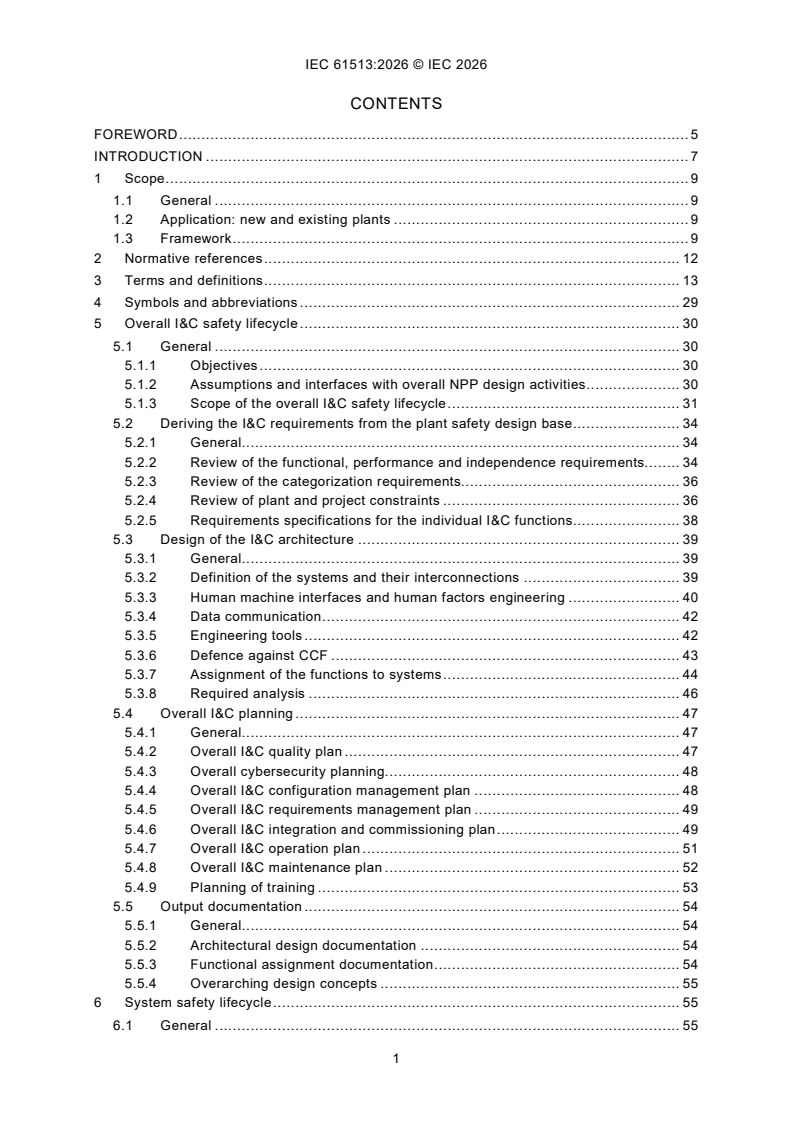
CONTENTS
FOREWORD . 5
INTRODUCTION . 7
1 Scope . 9
1.1 General . 9
1.2 Application: new and existing plants . 9
1.3 Framework . 9
2 Normative references . 12
3 Terms and definitions . 13
4 Symbols and abbreviations . 29
5 Overall I&C safety lifecycle . 30
5.1 General . 30
5.1.1 Objectives . 30
5.1.2 Assumptions and interfaces with overall NPP design activities . 30
5.1.3 Scope of the overall I&C safety lifecycle . 31
5.2 Deriving the I&C requirements from the plant safety design base . 34
5.2.1 General. 34
5.2.2 Review of the functional, performance and independence requirements. 34
5.2.3 Review of the categorization requirements. 36
5.2.4 Review of plant and project constraints . 36
5.2.5 Requirements specifications for the individual I&C functions. 38
5.3 Design of the I&C architecture . 39
5.3.1 General. 39
5.3.2 Definition of the systems and their interconnections . 39
5.3.3 Human machine interfaces and human factors engineering . 40
5.3.4 Data communication . 42
5.3.5 Engineering tools . 42
5.3.6 Defence against CCF . 43
5.3.7 Assignment of the functions to systems . 44
5.3.8 Required analysis . 46
5.4 Overall I&C planning . 47
5.4.1 General. 47
5.4.2 Overall I&C quality plan . 47
5.4.3 Overall cybersecurity planning. 48
5.4.4 Overall I&C configuration management plan . 48
5.4.5 Overall I&C requirements management plan . 49
5.4.6 Overall I&C integration and commissioning plan . 49
5.4.7 Overall I&C operation plan . 51
5.4.8 Overall I&C maintenance plan . 52
5.4.9 Planning of training . 53
5.5 Output documentation . 54
5.5.1 General. 54
5.5.2 Architectural design documentation . 54
5.5.3 Functional assignment documentation . 54
5.5.4 Overarching design concepts . 55
6 System safety lifecycle . 55
6.1 General . 55
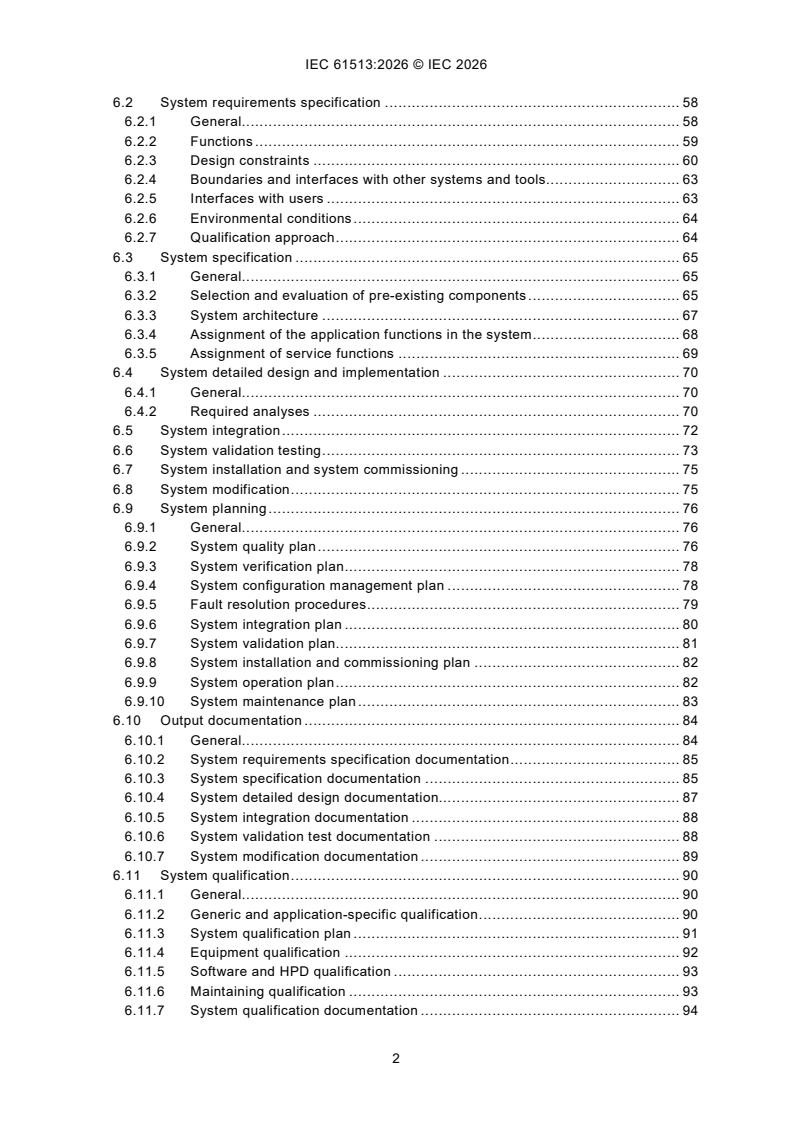
6.2 System requirements specification . 58
6.2.1 General. 58
6.2.2 Functions . 59
6.2.3 Design constraints . 60
6.2.4 Boundaries and interfaces with other systems and tools . 63
6.2.5 Interfaces with users . 63
6.2.6 Environmental conditions . 64
6.2.7 Qualification approach . 64
6.3 System specification . 65
6.3.1 General. 65
6.3.2 Selection and evaluation of pre-existing components . 65
6.3.3 System architecture . 67
6.3.4 Assignment of the application functions in the system . 68
6.3.5 Assignment of service functions . 69
6.4 System detailed design and implementation . 70
6.4.1 General. 70
6.4.2 Required analyses . 70
6.5 System integration . 72
6.6 System validation testing . 73
6.7 System installation and system commissioning . 75
6.8 System modification . 75
6.9 System planning . 76
6.9.1 General. 76
6.9.2 System quality plan . 76
6.9.3 System verification plan . 78
6.9.4 System configuration management plan . 78
6.9.5 Fault resolution procedures . 79
6.9.6 System integration plan . 80
6.9.7 System validation plan . 81
6.9.8 System installation and commissioning plan . 82
6.9.9 System operation plan . 82
6.9.10 System maintenance plan . 83
6.10 Output documentation . 84
6.10.1 General. 84
6.10.2 System requirements specification documentation . 85
6.10.3 System specification documentation . 85
6.10.4 System detailed design documentation. 87
6.10.5 System integration documentation . 88
6.10.6 System validation test documentation . 88
6.10.7 System modification documentation . 89
6.11 System qualification . 90
6.11.1 General. 90
6.11.2 Generic and application-specific qualification . 90
6.11.3 System qualification plan . 91
6.11.4 Equipment qualification . 92
6.11.5 Software and HPD qualification . 93
6.11.6 Maintaining qualification . 93
6.11.7 System qualification documentation . 94
7 Overall integration and commissioning . 95
7.1 General . 95
7.2 Requirements on the objectives to be achieved . 96
7.3 Output documentation . 96
8 Overall operation and maintenance . 96
8.1 General . 96
8.2 Requirements on the objectives to be achieved . 97
8.3 Output documentation . 97
Annex A (informative) Fundamental safety principles in the NPP . 98
A.1 General . 98
A.2 Fundamental safety functions, safety analysis and safety assessment . 98
A.2.1 General. 98
A.2.2 Safety assessment . 99
A.2.3 Safety analysis . 100
A.3 Defence-in-depth . 101
A.3.1 General. 101
A.3.2 Independence . 102
A.3.3 Common cause failures . 102
A.4 Interfaces of safety with nuclear security . 103
Annex B (informative) Relations of IEC 61508 with IEC 61513 and standards of the
nuclear application sector . 104
B.1 General . 104
B.2 Comparison of scopes and concepts . 104
B.3 Correspondence between IEC 61508-1 and IEC 61513 . 106
B.4 Correspondence between IEC 61508-2 and IEC 61513 . 108
B.5 Correspondence between some important terms of IEC 61508-4 and the
definitions of IEC 61513 and of the nuclear application sector . 109
Annex C (informative) Typical document structure for overall I&C, I&C architecture
and I&C system design . 112
Annex D (informative) Changes in later revisions of SC 45A standards to adapt to this
version of IEC 61513. 116
Bibliography . 118
Figure 1 – Overall framework of this document . 11
Figure 2 – Typical relations of hardware and software in a computer-based system . 28
Figure 3 – Relations between system failure, random failure and systematic fault . 29
Figure 4 – Connections between the overall I&C safety lifecycle and the safety
lifecycles of the individual I&C systems . 32
Figure 5 – System safety lifecycle . 58
Figure 6 – Topics related to equipment and system qualification to be addressed in the
planning documents . 95
Figure A.1 – Overview of the safety assessment process (IAEA GSR Part 4:2016,
Figure 1) . 99
Table 1 – Overview of the overall I&C safety lifecycle . 32
Table 2 – Correlation between classes of I&C systems and categories of I&C functions . 40
Table 3 – Overview of the system safety lifecycle . 57
Table C.1 – Typical list of overall I&C and I&C architecture result documentation . 112
Table C.2 – Typical list of I&C system result documentation. 113
INTERNATIONAL ELECTROTECHNICAL COMMISSION
____________
Nuclear power plants -
Instrumentation and control important to safety -
General requirements for systems
FOREWORD
1) The International Electrotechnical Commission (IEC) is a worldwide organization for standardization comprising
all national electrotechnical committees (IEC National Committees). The object of IEC is to promote international
co-operation on all questions concerning standardization in the electrical and electronic fields. To this end and
in addition to other activities, IEC publishes International Standards, Technical Specifications, Technical Reports,
Publicly Available Specifications (PAS) and Guides (hereafter referred to as “IEC Publication(s)”). Their
preparation is entrusted to technical committees; any IEC National Committee interested in the subject dealt with
may participate in this preparatory work. International, governmental and non-governmental organizations liaising
with the IEC also participate in this preparation. IEC collaborates closely with the International Organization for
Standardization (ISO) in accordance with conditions determined by agreement between the two organizations.
2) The formal decisions or agreements of IEC on technical matters express, as nearly as possible, an international
consensus of opinion on the relevant subjects since each technical committee has representation from all
interested IEC National Committees.
3) IEC Publications have the form of recommendations for international use and are accepted by IEC National
Committees in that sense. While all reasonable efforts are made to ensure that the technical content of IEC
Publications is accurate, IEC cannot be held responsible for the way in which they are used or for any
misinterpretation by any end user.
4) In order to promote international uniformity, IEC National Committees undertake to apply IEC Publications
transparently to the maximum extent possible in their national and regional publications. Any divergence between
any IEC Publication and the corresponding national or regional publication shall be clearly indicated in the latter.
5) IEC itself does not provide any attestation of conformity. Independent certification bodies provide conformity
assessment services and, in some areas, access to IEC marks of conformity. IEC is not responsible for any
services carried out by independent certification bodies.
6) All users should ensure that they have the latest edition of this publication.
7) No liability shall attach to IEC or its directors, employees, servants or agents including individual experts and
members of its technical committees and IEC National Committees for any personal injury, property damage or
other damage of any nature whatsoever, whether direct or indirect, or for costs (including legal fees) and
expenses arising out of the publication, use of, or reliance upon, this IEC Publication or any other IEC
Publications.
8) Attention is drawn to the Normative references cited in this publication. Use of the referenced publications is
indispensable for the correct application of this publication.
9) IEC draws attention to the possibility that the implementation of this document may involve the use of (a)
patent(s). IEC takes no position concerning the evidence, validity or applicability of any claimed patent rights in
respect thereof. As of the date of publication of this document, IEC had not received notice of (a) patent(s), which
may be required to implement this document. However, implementers are cautioned that this may not represent
the latest information, which may be obtained from the patent database available at https://patents.iec.ch. IEC
shall not be held responsible for identifying any or all such patent rights.
IEC 61513 has been prepared by subcommittee 45A: Instrumentation and control of nuclear
facilities, of IEC technical committee 45: Nuclear instrumentation. It is an International
Standard.
This third edition cancels and replaces the second edition, published in 2011. This edition
constitutes a technical revision.
This edition includes the following significant technical changes with respect to the previous
edition:
a) to align this document with the recent IAEA documents SSR-2/1 and SSG-39, to review the
existing requirements and to update the terminology and definitions;
b) to take account of, as far as possible, requirements associated with standards published or
thoroughly revised since the second edition, IEC 62566, IEC 61226, IEC 62138, IEC 60987,
IEC 63046 and IEC 63351;
c) to incorporate the technical requirements related to I&C systems and equipment from
IEC 61226:2020, Annex A.
The text of this International Standard is based on the following documents:
Draft Report on voting
45A/1645/FDIS 45A/1651/RVD
Full information on the voting for its approval can be found in the report on voting indicated in
the above table.
The language used for the development of this International Standard is English.
This document was drafted in accordance with ISO/IEC Directives, Part 2, and developed in
accordance with ISO/IEC Directives, Part 1 and ISO/IEC Directives, IEC Supplement, available
at www.iec.ch/members_experts/refdocs. The main document types developed by IEC are
described in greater detail at www.iec.ch/publications.
The committee has decided that the contents of this document will remain unchanged until the
stability date indicated on the IEC website under webstore.iec.ch in the data related to the
specific document. At this date, the document will be
– reconfirmed,
– withdrawn, or
– revised.
INTRODUCTION
a) Technical background, main issues and organization of this document
This International Standard sets out requirements applicable to instrumentation and control
systems and equipment (I&C systems) that are used to perform functions important to safety
in nuclear power plants (NPPs).
This document highlights the relations between
1) the safety objectives of the NPP and the requirements for the overall architecture of the
I&C systems important to safety;
2) the overall architecture of the I&C systems and the requirements of the individual
systems important to safety.
It is intended that this document be used by designers, operators of NPPs (utilities), systems
evaluators and by licensors.
b) Situation of the current standard in the structure of the IEC SC 45A standard series
IEC 61513 is the first level IEC SC 45A document tackling the issue of general requirements
for systems. It is the entry point of the IEC SC 45A standard series regarding I&C systems.
For more details on the structure of the IEC SC 45A standard series, see item d) of this
introduction.
c) Recommendations and limitations regarding the application of this document
It is important to note that this document establishes no additional functional requirements
for systems important to safety.
To ensure that this document will continue to be relevant in future years, the emphasis has
been placed on issues of principle, rather than specific technologies.
d) Description of the structure of the IEC SC 45A standard series and relationships with
other IEC documents and other bodies documents (IAEA, ISO)
The IEC SC 45A standard series comprises a consistent set of documents organized in a
hierarchy of four levels. The top-level documents of the IEC SC 45A standard series are
IEC 61513 and IEC 63046, covering respectively general requirements for instrumentation
and control (I&C) systems and general requirements for electrical power systems of NPPs.
IEC 61513 and IEC 63046 adopt an overall system life-cycle framework and constitute,
along with the relevant second-level standards, the nuclear implementation of the basic
safety series IEC 61508.
IEC 61513 and IEC 63046 refer directly to other IEC SC 45A standards for general topics
related to categorization of functions and classification of systems, qualification, separation,
defence against common cause failure, control room design, electromagnetic compatibility,
cybersecurity, software and hardware aspects for programmable digital systems,
coordination of safety and cybersecurity requirements and management of ageing. The
standards referenced directly at this second level are to be considered together with
IEC 61513 and IEC 63046 as a consistent document set.
At a third level, IEC SC 45A standards not directly referenced by IEC 61513 or by IEC 63046
are standards related to specific equipment, technical methods, or specific activities.
Usually these documents, which make reference to second-level documents for general
topics, can be used on their own.
A fourth level extending the IEC SC 45 standard series, corresponds to the Technical
Reports which are not normative.
The IEC SC 45A standards series consistently implement and details the safety and
cybersecurity principles and basic aspects provided in the relevant IAEA safety standards
and in the relevant documents of the IAEA nuclear security series (NSS). In particular this
includes the IAEA requirements SSR-2/1, establishing safety requirements related to the
design of nuclear power plants (NPPs), the IAEA safety guide SSG-30 dealing with the
safety classification of structures, systems and components in NPPs, the IAEA safety guide
SSG-39 dealing with the design of instrumentation and control systems for NPPs, the IAEA
safety guide SSG-34 dealing with the design of electrical power systems for NPPs, the IAEA
safety guide SSG-51 dealing with human factors engineering in the design of NPPs, and the
implementing guide IAEA NSS No. 42-G for computer security at nuclear facilities. The
safety and cyber security terminology and definitions used by SC 45A standards are
consistent with those used by the IAEA.
IEC 61513 and IEC 63046 refer to ISO 9001 as well as to IAEA GS-R Part 2 and
IAEA GS-G-3.1 and IAEA GS-G-3.5 for topics related to quality assurance (QA).
At level 2, regarding nuclear security, IEC 62645 is the entry document for the IEC SC 45A
cybersecurity standards. It builds upon the valid high-level principles and main concepts of
the generic cybersecurity standards, in particular ISO/IEC 27001 and ISO/IEC 27002; it
adapts them and completes them to fit the nuclear context and coordinates with the
IEC 62443 series. At level 2, IEC 60964 is the entry document for the IEC/SC 45A control
rooms standards, IEC 63351 is the entry document for the human factors engineering
standards, and IEC 62342 is the entry document for the ageing management standards.
NOTE IEC TR 63400 provides a more comprehensive description of the overall structure of the IEC SC 45A
standards series and of its relationship with other standards bodies and standards.
1 Scope
1.1 General
I&C systems important to safety may be implemented using hardwired equipment,
programmable digital equipment such as processor-based or HDL-programmed devices, or by
using a combination of several types of technologies. This document provides requirements
and recommendations for the overall I&C which may contain one or several of these
technologies.
This document highlights also the need for complete and precise requirements, derived from
the plant safety goals, as a pre-requisite for generating the comprehensive requirements for the
overall I&C, and hence for the individual I&C systems important to safety.
This document introduces the concept of a safety lifecycle for the overall I&C including the I&C
architecture, and a safety lifecycle for the individual systems. By this, it highlights the relations
between the safety objectives of the NPP and the requirements for the architecture of the I&C
systems important to safety, and the relations between the I&C architecture and the
requirements of the individual systems important to safety.
Standards such as ISO/IEC/IEEE 15288 provide an overarching concept of system lifecycle
provisions covering product-related processes as well as business development. The scope of
IEC 61513 refers to safety aspects and their demonstration, and significantly deepens the
considerations of ISO/IEC/IEEE 15288 in this field.
The lifecycles illustrated in and followed by this document are not the only ones possible; other
lifecycles can be followed, provided that the requirements stated in this document are satisfied.
NOTE This document addresses the safety lifecycle of the overall I&C and of the individual systems. Although
systems not important to safety are not in the scope of this document, they are considered in the overall I&C safety
lifecycle, as they can constitute constraints for the design and qualification of systems important to safety (e.g.
installation in common rooms, interfaces, sizing of support systems, coordination of installation and commissioning
works).
Furthermore, this document does not describe the handling of interfaces between organizations (owner, architect
engineering organization, engineering organizations, commissioning organizations). In practice, responsibilities for
plans, activities and documents will be allocated according to the contractual arrangements.
1.2 Application: new and existing plants
This document applies to the I&C of new nuclear power plants as well as to I&C upgrading or
back-fitting of existing plants.
For existing plants, only a subset of requirements is applicable depending on the scope of the
project, and this subset is identified at the beginning of any project.
1.3 Framework
This document comprises four normative clauses (an overview is provided in Figure 1):
– Clause 5 addresses the overall I&C safety lifecycle:
• defining requirements for the I&C functions, and associated systems and equipment
derived from the safety analysis of the NPP, the defence-in-depth and diversity concept
of the NPP, the categorization of I&C functions, and the plant layout and operational
context;
• structuring the I&C architecture, dividing it into a number of systems and assigning the
I&C functions to systems. Design criteria are identified, including those to give defence-
in-depth and to minimize the potential for common cause failure (CCF);
• planning the I&C architecture.
– Clause 6 addresses the requirements for the individual I&C systems important to safety,
particularly the requirements for systems built from programmable digital equipment. A
differentiation of requirements according to the safety category of the I&C functions (A, B
or C) or according to the safety class of the systems (1, 2 or 3) is made when relevant;
– Clause 7 and Clause 8 address the overall integration, commissioning, operation and
maintenance of the I&C systems.
Figure 1 outlines the structure of this document to support navigation and readability. It is not
intended to prescribe how this document is practically applied.
Additionally, this document provides informative annexes:
– Annex A highlights the relations between IAEA and basic safety concepts that are used
throughout this document;
– Annex B provides guidance to support comparison of this document with parts 1, 2 and 4 of
IEC 61508. Annex B surveys the main requirements of IEC 61508 to verify that the issues
relevant to safety are adequately addressed, considers the use of common terms and
explains the reason for adopting different or complementary techniques or terms;
– Annex C provides a proposal for the documentation structure for overall I&C planning and
I&C system design;
– Annex D indicates the main changes to be considered during the next update cycles of
several SC 45A standards to align them to this revision of IEC 61513.
5 Overall I&C safety lifecycle: Requirements specification for the overall I&C
5.2 Deriving the I&C requirements from the Output documentation
plant safety design base
5.2.2 Functional, performance and 5.2.5 Requirements specifications for the
independence requirements individual I&C functions
5.2.3 Categorization
5.2.4 Plant constraints
5 Overall safety lifecycle: Derivation of requirements for the overall I&C and design of the I&C
architecture
5.3 Design of the I&C 5.4 Overall I&C (O) planning 5.5 Output documentation
architecture
5.3.2 Definition of the 5.4.2 O QA programs 5.5.2 Architectural design
systems
5.4.3 O cybersecurity 5.5.3 Functional assignment
5.3.3 Human machine planning
5.5.4 Overarching design
interfaces and HFE
5.4.4 O configuration concepts
5.3.4 Data communication management plan
5.3.5 Engineering tools 5.4.5 O requirements
management plan
5.3.6 Defence against CCF
5.4.6 O integration and
5.3.7 Assignment of the
commissioning plan
functions to systems
5.4.7 O operation plan
5.3.8 Required analysis
5.4.8 O maintenance plan
5.4.9 Planning of training
6 System safety lifecycle: Realisation and planning of the individual I&C systems
6.1 System (S) lifecycle 6.9 System (S) planning 6.10 Output documentation
phases
6.2 S requirements 6.9.2 S quality plan 6.10.2 S requirements
specification specification
6.9.3 S verification plan
6.3 S specification 6.10.3 S specification
6.9.4 S configuration
6.4 S detailed design & management plan 6.10.4 S detailed design
implementation
6.9.5 Fault resolution 6.10.5 S integration
6.5 S integration procedures
6.10.6 S validation test
6.6 S validation testing 6.9.6 S integration plan
6.10.7 S modification
6.7 S installation and 6.9.7 S validation plan
commissioning
6.9.8 S installation and
commissioning plan
6.8 S modification
6.9.9 S operation plan
6.9.10 S maintenance plan
6.11 System qualification
6.11.2 Generic / application- 6.11.3 S qualification plan 6.11.7 S qualification
specific qualification documentation
6.11.6 Maintaining
qualification
7 Overall integration and commissioning
7.2 Requirements on the objectives 7.3 Output documentation
8 Overall operation and maintenance
8.2 Requirements on the objectives 8.3 Output documentation
Key QA: Quality Assurance; O: Overall I&C; S: System
Figure 1 – Overall framework of this document
2 Normative references
The following documents are referred to in the text in such a way that some or all of their content
constitutes requirements of this document. For dated references, only the edition cited applies.
For undated references, the latest edition of the referenced document (including any
amendments) applies.
IEC 60671, Nuclear power plants - Instrumentation and control systems important to safety -
Surveillance testing
IEC 60709, Nuclear power plants - Instrumentation, control and electrical power systems
important to safety - Separation
IEC/IEEE 60780-323, Nuclear power plants - Electrical equipment important to safety -
Qualification
, Nuclear power plants - Instrumentation and control systems important to
IEC/IEEE 60880:–
safety - Software aspects for computer-based systems performing category A functions
IEC 60964, Nuclear power plants - Control rooms - Design
IEC 60965, Nuclear power plants - Control rooms - Supplementary control room for reactor
shutdown without access to the main control room
IEC/IEEE 60980-344, Nuclear facilities - Equipment important to safety - Seismic qualification
IEC 60987, Nuclear power plants - Instrumentation and control important to safety - Hardware
requirements
IEC 61500, Nuclear power plants - Instrumentation and control important to safety - Data
communication in systems performing category A functions
IEC 62138:2018, Nuclear power plants - Instrumentation and control systems important for
safety - Software aspects for computer-based systems performing category B or C functions
IEC 62340, Nuclear power plants - Instrumentation and control systems important to safety -
Requirements for coping with common cause failure (CCF)
IEC 62566, Nuclear power plants - Instrumentation and control important to safety -
Development of HDL-programmed integrated circuits for systems performing category A
functions
IEC 62566-2, Nuclear power plants - Instrumentation and control systems important to safety -
Development of HDL-programmed integrated circuits - Part 2: HDL-programmed integrated
circuits for systems performing category B or C functions
IEC 62645, Nuclear power plants - Instrumentation, control and electrical power systems -
Cybersecurity requirements
IEC 62671, Nuclear power plants - Instrumentation and control important to safety - Selection
and use of industrial digital devices of limited functionality
___________
Under preparation. Stage at the time of publication: IEC/IEEE CDV 60880:2025.
IEC 62988, Nuclear power plants - Instrumentation and control systems important to safety -
Selection and use of wireless devices
3 Terms and definitions
For the purposes of this document, the following terms and definitions apply.
ISO and IEC maintain terminology databases for use in standardization at the following
addresses:
– IEC Electropedia: available at https://www.electropedia.org/
– ISO Online browsing platform: available at https://www.iso.org/obp
In order to be consistent with IEC directives, the articles at the beginning of the IAEA definitions
are removed.
3.1
application function
function of an I&C system that performs a task related to the process being controlled rather
than to the functioning of the system itself
Note 1 to entry: An application function is normally a subfunction of an I&C function. The term is independent from
the used technology. For example, in a software-based systems, the application functions will typically have parts
implemented in the hardware, in the application software and in the operational system software.
Note 2 to entry: See also “I&C function”, “I&C system”, “application software”, “service function”. “Application
software” contrasts with “system software” whereas “application function” contrasts with “service function”.
3.2
application software
software part of an I&C system which is distinct from the operational system software
Note 1 to entry: The distinction between system software (generic, re-usable) and application software (typically
plant-specific) is generally made to minimize re-development of code and to optimize the allocation of the qualification
activities. It is an especially useful distinction when using an I&C platform.
Note 2 to entry: See also “system software”, “application function”, “service function”.
3.3
application software library
collection of software modules with functionality suitable to create application software
Note 1 to entry: When using pre-existing equipment, such a library is considered to be part of the system software
and qualified as such.
Note 2 to entry: See also Figure 2.
3.4
category of an I&C function
one of three possible safety assignments (A, B, C) of I&C functions resulting from
considerations of the safety relevance of the function to be performed. An uncategorized
assignment may be made if the function has no importance to safety
Note 1 to entry: See also “class of an I&C system”, “I&C function”.
Note 2 to entry: IEC 61226 defines three categories of I&C functions. It sets out requirements for each category on
the I&C function and the I&C chain involved in its delivery.
3.5
channel
arrangement of interconnected components within a system that initiates a single output
Note 1 to entry: A channel loses its identity where the single-output signals are combined with signals from other
channels (e.g. from a monitoring channel or a safety actuation channel).
[SOURCE: IAEA Nuclear Safety and Security Glossary (2022 Interim Edition)]
3.6
class of an I&C system
one of three possible assignments (1, 2, 3) of I&C systems important to safety resulting from
consideration of their requirement to implement I&C functions of different safety importance. An
unclassified assignment is made if the I&C system does not implement functions important to
safety
Note 1 to entry: See also “category of an I&C function”, “items important to safety”, “safety systems”.
3.7
commissioning
process by means of which systems and components of facilities and activities, having been
constructed, are made operational and verified to be in accordance with the design and to have
met the required performance criteria
Note 1 to entry: Commissioning is typically structured in subsequent steps and according to disciplines:
commissioning of I&C systems and of electrical systems, non-nuclear commissioning of process systems,
commissioning of interconnected plant systems, nuclear commissioning. All steps contribute to the qualification of
the I&C systems.
[SOURCE: IAEA Nuclear Safety and Security Glossary (2022 Interim Edition), modified – Note 1
to entry added.]
3.8
common cause failure
CCF
failures of two or more structures, systems or components due to a single specific event or
cause
Note 1 to entry: Common causes can be internal or external to an I&C system.
[SOURCE: IAEA Nuclear Safety and Security Glossary (2022 Interim Edition)]
3.9
complexity
degree to which a system or component has a design, implementation or behaviour that is
difficult to understand and verify
[SOURCE: ISO/IEC/IEEE 24765:2017, 3.694, modified – “behaviour” has been added after
“implementation”.]
3.10
component
one of the parts that make up
...