


IEC 60851-5:2008+AMD1:2011 CSV
(Main)Winding wires - Test methods - Part 5: Electrical properties
Winding wires - Test methods - Part 5: Electrical properties
IEC 60851-5:2008+A1:2011 specifies the following tests:
- Test 5: Electrical resistance;
- Test 13: Breakdown voltage;
- Test 14: Continuity of insulation;
- Test 19: Dielectric dissipation factor.
Significant revisions to the previous edition include the following points:
- In Subclause 5.3, the addition of the use of carbon brush electrodes for the counting discontinuities during the high voltage continuity test, as an alternative to the V-groove pulley electrode; and
- Clarifications in the breakdown voltage test for round wires larger than 2,500 mm and for fibrous covered wires. This consolidated version consists of the fourth edition (2008) and its amendment 1 (2011). Therefore, no need to order amendment in addition to this publication.
Fils de bobinage - Méthodes d'essai - Partie 5: Propriétés électriques
La CEI 60851-5:2008+A1:2011 donne les méthodes d'essai suivantes:
- Essai 5: Résistance électrique;
- Essai 13: Tension de claquage;
- Essai 14: Continuité de l'enveloppe isolante;
- Essai 19: Facteur de dissipation diélectrique.
Les modifications significatives par rapport à l'édition précédente comprennent les points suivants:
- Au Paragraphe 5.3, l'ajout de l'utilisation des électrodes balais en carbone pour le comptage des discontinuités pendant l'essai de continuité sous haute tension, comme alternative à l'électrode poulie ayant une gorge en forme de "V"; et
- Des clarifications apportées à l'essai de la tension de claquage pour les fils de section circulaire avec diamètre nominal du conducteur supérieur à 2,500 mm et pour les fils guipés de fibre. Cette version consolidée comprend la quatrième édition (2008) et son amendement 1 (2011). Il n'est donc pas nécessaire de commander l'amendement avec cette publication.
General Information
- Status
- Published
- Publication Date
- 18-Aug-2011
- Technical Committee
- TC 55 - Winding wires
- Current Stage
- PPUB - Publication issued
- Start Date
- 19-Aug-2011
- Completion Date
- 19-Aug-2011
Overview
IEC 60851-5:2008+AMD1:2011 CSV is an internationally recognized standard issued by the International Electrotechnical Commission (IEC) under the title Winding wires - Test methods - Part 5: Electrical properties. This standard specifies the test methods required to evaluate the electrical properties of winding wires, which are essential components used in electrical machinery, transformers, and electronic equipment.
IEC 60851-5 covers the assessment of key electrical characteristics, ensuring that winding wires meet the necessary safety and performance criteria for use in various high-demand applications. The latest consolidated version combines the fourth edition (2008) with Amendment 1 (2011), incorporating important technical updates and clarifications.
Key Topics
IEC 60851-5:2008+A1:2011 details standardized test methods for the following properties of winding wires:
Electrical Resistance (Test 5):
Measurement of the wire’s resistance at a standard temperature (20°C), ensuring minimal power loss in operation.Breakdown Voltage (Test 13):
Verification of the insulation’s ability to withstand high voltages without failure, crucial for electrical safety and reliability.Continuity of Insulation (Test 14):
Detection of insulation faults along the wire's length, both at low and high-voltage levels, to ensure defect-free insulation.Dielectric Dissipation Factor (Test 19):
Evaluation of energy losses in the wire’s insulation, which can impact performance, particularly in high-frequency environments.
Significant revisions in the current edition include:
- The addition of carbon brush electrodes as an alternative to V-groove pulley electrodes for counting discontinuities in high-voltage continuity tests.
- Clarifications on breakdown voltage testing, especially for round wires larger than 2,500 mm and fibrous covered wires.
Applications
IEC 60851-5 is widely utilized throughout the electrical industry to ensure that winding wires conform to global expectations for safety, efficiency, and durability. Key applications include:
Quality Assurance in Manufacturing:
Wire manufacturers use these test methods to validate the electrical properties of their products before release.Compliance in Electrical Equipment:
Designers and manufacturers of transformers, motors, and electronic devices reference this standard to certify that their winding wires are up to specification.Testing and Certification Laboratories:
Independent laboratories use IEC 60851-5 to deliver consistent and reliable testing services for wire products.Procurement and Acceptance:
Organizations sourcing winding wires specify this standard in their requirements to ensure reliable performance in demanding environments, such as power distribution, automotive electrical systems, and industrial automation.
Related Standards
To provide a comprehensive approach to winding wire testing and specification, the IEC 60851 series is organized as follows:
IEC 60851-1: Winding wires – Test methods – Part 1: General
(Fundamental definitions and overarching procedures)IEC 60317: Specifications for particular types of winding wires
IEC 60264: Packaging of winding wires
Adherence to IEC 60851-5 ensures compatibility with these related standards and supports a harmonized approach to international quality and safety for electrical winding wires.
Keywords: IEC 60851-5, winding wires, electrical test methods, electrical resistance, breakdown voltage, insulation continuity, dielectric dissipation factor, IEC standards, wire testing, electrical properties, wire insulation.
Get Certified
Connect with accredited certification bodies for this standard

IMQ S.p.A. (Certification)
Italian electrical product certification.

SLG Prüf- und Zertifizierungs GmbH
German testing and certification body.

UL Solutions
Global safety science company with testing, inspection and certification.
Sponsored listings
Frequently Asked Questions
IEC 60851-5:2008+AMD1:2011 CSV is a standard published by the International Electrotechnical Commission (IEC). Its full title is "Winding wires - Test methods - Part 5: Electrical properties". This standard covers: IEC 60851-5:2008+A1:2011 specifies the following tests: - Test 5: Electrical resistance; - Test 13: Breakdown voltage; - Test 14: Continuity of insulation; - Test 19: Dielectric dissipation factor. Significant revisions to the previous edition include the following points: - In Subclause 5.3, the addition of the use of carbon brush electrodes for the counting discontinuities during the high voltage continuity test, as an alternative to the V-groove pulley electrode; and - Clarifications in the breakdown voltage test for round wires larger than 2,500 mm and for fibrous covered wires. This consolidated version consists of the fourth edition (2008) and its amendment 1 (2011). Therefore, no need to order amendment in addition to this publication.
IEC 60851-5:2008+A1:2011 specifies the following tests: - Test 5: Electrical resistance; - Test 13: Breakdown voltage; - Test 14: Continuity of insulation; - Test 19: Dielectric dissipation factor. Significant revisions to the previous edition include the following points: - In Subclause 5.3, the addition of the use of carbon brush electrodes for the counting discontinuities during the high voltage continuity test, as an alternative to the V-groove pulley electrode; and - Clarifications in the breakdown voltage test for round wires larger than 2,500 mm and for fibrous covered wires. This consolidated version consists of the fourth edition (2008) and its amendment 1 (2011). Therefore, no need to order amendment in addition to this publication.
IEC 60851-5:2008+AMD1:2011 CSV is classified under the following ICS (International Classification for Standards) categories: 29.060.10 - Wires. The ICS classification helps identify the subject area and facilitates finding related standards.
IEC 60851-5:2008+AMD1:2011 CSV is available in PDF format for immediate download after purchase. The document can be added to your cart and obtained through the secure checkout process. Digital delivery ensures instant access to the complete standard document.
Standards Content (Sample)
IEC 60851-5 ®
Edition 4.1 2011-08
INTERNATIONAL
STANDARD
NORME
INTERNATIONALE
Winding wires – Test methods –
Part 5: Electrical properties
Fils de bobinage – Méthodes d’essai –
Partie 5: Propriétés électriques
IEC 60851-5:2008+A1:2011
All rights reserved. Unless otherwise specified, no part of this publication may be reproduced or utilized in any form or by
any means, electronic or mechanical, including photocopying and microfilm, without permission in writing from either IEC or
IEC's member National Committee in the country of the requester.
If you have any questions about IEC copyright or have an enquiry about obtaining additional rights to this publication,
please contact the address below or your local IEC member National Committee for further information.
Droits de reproduction réservés. Sauf indication contraire, aucune partie de cette publication ne peut être reproduite
ni utilisée sous quelque forme que ce soit et par aucun procédé, électronique ou mécanique, y compris la photocopie
et les microfilms, sans l'accord écrit de la CEI ou du Comité national de la CEI du pays du demandeur.
Si vous avez des questions sur le copyright de la CEI ou si vous désirez obtenir des droits supplémentaires sur cette
publication, utilisez les coordonnées ci-après ou contactez le Comité national de la CEI de votre pays de résidence.
IEC Central Office
3, rue de Varembé
CH-1211 Geneva 20
Switzerland
Email: inmail@iec.ch
Web: www.iec.ch
About the IEC
The International Electrotechnical Commission (IEC) is the leading global organization that prepares and publishes
International Standards for all electrical, electronic and related technologies.
About IEC publications
The technical content of IEC publications is kept under constant review by the IEC. Please make sure that you have the
latest edition, a corrigenda or an amendment might have been published.
Catalogue of IEC publications: www.iec.ch/searchpub
The IEC on-line Catalogue enables you to search by a variety of criteria (reference number, text, technical committee,…).
It also gives information on projects, withdrawn and replaced publications.
IEC Just Published: www.iec.ch/online_news/justpub
Stay up to date on all new IEC publications. Just Published details twice a month all new publications released. Available
on-line and also by email.
Electropedia: www.electropedia.org
The world's leading online dictionary of electronic and electrical terms containing more than 20 000 terms and definitions
in English and French, with equivalent terms in additional languages. Also known as the International Electrotechnical
Vocabulary online.
Customer Service Centre: www.iec.ch/webstore/custserv
If you wish to give us your feedback on this publication or need further assistance, please visit the Customer Service
Centre FAQ or contact us:
Email: csc@iec.ch
Tel.: +41 22 919 02 11
Fax: +41 22 919 03 00
A propos de la CEI
La Commission Electrotechnique Internationale (CEI) est la première organisation mondiale qui élabore et publie des
normes internationales pour tout ce qui a trait à l'électricité, à l'électronique et aux technologies apparentées.
A propos des publications CEI
Le contenu technique des publications de la CEI est constamment revu. Veuillez vous assurer que vous possédez
l’édition la plus récente, un corrigendum ou amendement peut avoir été publié.
Catalogue des publications de la CEI: www.iec.ch/searchpub/cur_fut-f.htm
Le Catalogue en-ligne de la CEI vous permet d’effectuer des recherches en utilisant différents critères (numéro de référence,
texte, comité d’études,…). Il donne aussi des informations sur les projets et les publications retirées ou remplacées.
Just Published CEI: www.iec.ch/online_news/justpub
Restez informé sur les nouvelles publications de la CEI. Just Published détaille deux fois par mois les nouvelles
publications parues. Disponible en-ligne et aussi par email.
Electropedia: www.electropedia.org
Le premier dictionnaire en ligne au monde de termes électroniques et électriques. Il contient plus de 20 000 termes et
définitions en anglais et en français, ainsi que les termes équivalents dans les langues additionnelles. Egalement appelé
Vocabulaire Electrotechnique International en ligne.
Service Clients: www.iec.ch/webstore/custserv/custserv_entry-f.htm
Si vous désirez nous donner des commentaires sur cette publication ou si vous avez des questions, visitez le FAQ du
Service clients ou contactez-nous:
Email: csc@iec.ch
Tél.: +41 22 919 02 11
Fax: +41 22 919 03 00
IEC 60851-5 ®
Edition 4.1 2011-08
INTERNATIONAL
STANDARD
NORME
INTERNATIONALE
Winding wires – Test methods –
Part 5: Electrical properties
Fils de bobinage – Méthodes d’essai –
Partie 5: Propriétés électriques
INTERNATIONAL
ELECTROTECHNICAL
COMMISSION
COMMISSION
ELECTROTECHNIQUE
PRICE CODE
INTERNATIONALE
CODE PRIX CL
ICS 29.060.10 ISBN 978-2-88912-611-8
– 2 – 60851-5 IEC:2008+A1:2011
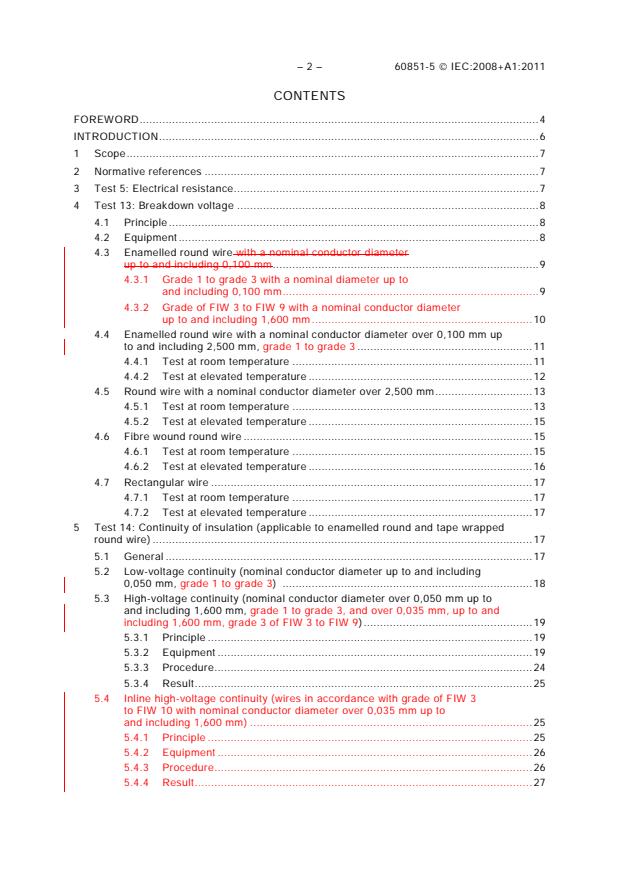
CONTENTS
FOREWORD . 4
INTRODUCTION . 6
1 Scope . 7
2 Normative references . 7
3 Test 5: Electrical resistance. 7
4 Test 13: Breakdown voltage . 8
4.1 Principle . 8
4.2 Equipment . 8
4.3 Enamelled round wire with a nominal conductor diameter
up to and including 0,100 mm . 9
4.3.1 Grade 1 to grade 3 with a nominal diameter up to
and including 0,100 mm . 9
4.3.2 Grade of FIW 3 to FIW 9 with a nominal conductor diameter
up to and including 1,600 mm . 10
4.4 Enamelled round wire with a nominal conductor diameter over 0,100 mm up
to and including 2,500 mm, grade 1 to grade 3 . 11
4.4.1 Test at room temperature . 11
4.4.2 Test at elevated temperature . 12
4.5 Round wire with a nominal conductor diameter over 2,500 mm . 13
4.5.1 Test at room temperature . 13
4.5.2 Test at elevated temperature . 15
4.6 Fibre wound round wire . 15
4.6.1 Test at room temperature . 15
4.6.2 Test at elevated temperature . 16
4.7 Rectangular wire . 17
4.7.1 Test at room temperature . 17
4.7.2 Test at elevated temperature . 17
5 Test 14: Continuity of insulation (applicable to enamelled round and tape wrapped
round wire) . 17
5.1 General . 17
5.2 Low-voltage continuity (nominal conductor diameter up to and including
0,050 mm, grade 1 to grade 3) . 18
5.3 High-voltage continuity (nominal conductor diameter over 0,050 mm up to
and including 1,600 mm, grade 1 to grade 3, and over 0,035 mm, up to and
including 1,600 mm, grade 3 of FIW 3 to FIW 9) . 19
5.3.1 Principle . 19
5.3.2 Equipment . 19
5.3.3 Procedure . 24
5.3.4 Result . 25
5.4 Inline high-voltage continuity (wires in accordance with grade of FIW 3
to FIW 10 with nominal conductor diameter over 0,035 mm up to
and including 1,600 mm) . 25
5.4.1 Principle . 25
5.4.2 Equipment . 26
5.4.3 Procedure . 26
5.4.4 Result . 27
60851-5 IEC:2008+A1:2011 – 3 –
6 Test 19: Dielectric dissipation factor (applicable to enamelled wire and bunched
wire) . 27
6.1 Principle . 27
6.2 Equipment . 28
6.3 Specimen . 29
6.3.1 Specimen for a metal bath electrode . 29
6.3.2 Specimen for a conductive suspension electrode . 29
6.4 Procedure . 29
6.5 Result . 29
7 Test 23: Pin hole test. 29
Annex A (informative) Dissipation factor methods . 31
Figure 1 – Arrangement of cylinder and specimen for the breakdown voltage test . 10
Figure 2 – Device for twisting the specimen for breakdown voltage test . 12
Figure 3 – U-bend specimen for the breakdown voltage test
(specimen placed in shot bath) . 14
Figure 4 – Coil-wound specimen for the breakdown voltage test . 16
Figure 5 – Apparatus for testing the low-voltage continuity of covering . 18
Figure 6 – High-voltage d.c. continuity – Pulleys for wire size 0,050 mm to 0,250 mm . 21
Figure 7 – Pulley dimensions and spacing for wire size 0,250 mm to 1,600 mm . 21
Figure 8a – Graphite fibre single brush electrode assembly . 22
Figure 8b – Graphite fibre dual brush electrode assembly . 23
Figure 8 – Graphite fibre single or dual brush electrode asssembly . 23
Figure 9 – Suitable electrode arrangement for testing the dielectric dissipation factor . 28
Figure A.1 – Example of linear method for sole coating . 33
Figure A.2 – Example of logarithmic method for sole coating . 33
Table 1 – Rates of test voltage increase . 8
Table 2 – Loads applied to the wire . 9
Table 3 – Loads applied to the wire and number of twists . 12
Table 4 – Off-line HVC fault currents . 20
Table 5 – Test voltages. 24
able 5.1 – Off-line HVC test voltages for grades 1 – 3 . 24
Table 5.2 – Off-line HVC test voltages for grade of FIW 3 – FIW 9 . 25
Table 6 – In-line HVC fault currents . 26
Table 7 – In-line HVC test voltages . 27
– 4 – 60851-5 IEC:2008+A1:2011
INTERNATIONAL ELECTROTECHNICAL COMMISSION
____________
WINDING WIRES –
TEST METHODS –
Part 5: Electrical properties
FOREWORD
1) The International Electrotechnical Commission (IEC) is a worldwide organization for standardization comprising
all national electrotechnical committees (IEC National Committees). The object of IEC is to promote
international co-operation on all questions concerning standardization in the electrical and electronic fields. To
this end and in addition to other activities, IEC publishes International Standards, Technical Specifications,
Technical Reports, Publicly Available Specifications (PAS) and Guides (hereafter referred to as “IEC
Publication(s)”). Their preparation is entrusted to technical committees; any IEC National Committee interested
in the subject dealt with may participate in this preparatory work. International, governmental and non-
governmental organizations liaising with the IEC also participate in this preparation. IEC collaborates closely
with the International Organization for Standardization (ISO) in accordance with conditions determined by
agreement between the two organizations.
2) The formal decisions or agreements of IEC on technical matters express, as nearly as possible, an international
consensus of opinion on the relevant subjects since each technical committee has representation from all
interested IEC National Committees.
3) IEC Publications have the form of recommendations for international use and are accepted by IEC National
Committees in that sense. While all reasonable efforts are made to ensure that the technical content of IEC
Publications is accurate, IEC cannot be held responsible for the way in which they are used or for any
misinterpretation by any end user.
4) In order to promote international uniformity, IEC National Committees undertake to apply IEC Publications
transparently to the maximum extent possible in their national and regional publications. Any divergence
between any IEC Publication and the corresponding national or regional publication shall be clearly indicated in
the latter.
5) IEC itself does not provide any attestation of conformity. Independent certification bodies provide conformity
assessment services and, in some areas, access to IEC marks of conformity. IEC is not responsible for any
services carried out by independent certification bodies.
6) All users should ensure that they have the latest edition of this publication.
7) No liability shall attach to IEC or its directors, employees, servants or agents including individual experts and
members of its technical committees and IEC National Committees for any personal injury, property damage or
other damage of any nature whatsoever, whether direct or indirect, or for costs (including legal fees) and
expenses arising out of the publication, use of, or reliance upon, this IEC Publication or any other IEC
Publications.
8) Attention is drawn to the Normative references cited in this publication. Use of the referenced publications is
indispensable for the correct application of this publication.
9) Attention is drawn to the possibility that some of the elements of this IEC Publication may be the subject of
patent rights. IEC shall not be held responsible for identifying any or all such patent rights.
This consolidated version of IEC 60851-5 consists of the fourth edition (2008)
[documents 55/1069/FDIS and 55/1078/RVD] and its amendment 1 (2011) [documents
55/1223/FDIS and 55/1251/RVD]. It bears the edition number 4.1.
The technical content is therefore identical to the base edition and its amendment and
has been prepared for user convenience. A vertical line in the margin shows where the
base publication has been modified by amendment 1. Additions and deletions are
displayed in red, with deletions being struck through.
60851-5 IEC:2008+A1:2011 – 5 –
International Standard IEC 60851-5 has been prepared by IEC technical committee 55:
Winding wires.
Significant revisions to the previous edition include the following points:
• in Subclause 5.3, the addition of the use of carbon brush electrodes for the counting
discontinuities during the high voltage continuity test, as an alternative to the V-groove
pulley electrode;
• clarifications in the breakdown voltage test for round wires larger than 2,500 mm and for
fibrous covered wires.
This publication has been drafted in accordance with the ISO/IEC Directives, Part 2.
A list of all the parts in the IEC 60851 series, under the general title Winding wires − Test
methods, can be found on the website.
The amendment 1 includes
• in Clause 4 the addition of dielectric breakdown requirements for fully insulated (FIW)
zero-defect enamelled round copper wires;
• in Clause 5 the addition of continuity requirements for fully insulated (FIW) zero-defect
enamelled round copper wires.
The committee has decided that the contents of the base publication and its amendments will
remain unchanged until the stability date indicated on the IEC web site under
"http://webstore.iec.ch" in the data related to the specific publication. At this date, the
publication will be
• reconfirmed,
• withdrawn,
• replaced by a revised edition, or
• amended.
IMPORTANT – The “colour inside” logo on the cover page of this publication indicates
that it contains colours which are considered to be useful for the correct understanding
of its contents. Users should therefore print this publication using a colour printer.
– 6 – 60851-5 IEC:2008+A1:2011
INTRODUCTION
This part of IEC 60851 forms an element of a series of standards which deals with insulated
wires used for windings in electrical equipment. The series has three groups describing
a) winding wires – Test methods (IEC 60851);
b) specifications for particular types of winding wires (IEC 60317);
c) packaging of winding wires (IEC 60264).
60851-5 IEC:2008+A1:2011 – 7 –
WINDING WIRES –
TEST METHODS –
Part 5: Electrical properties
1 Scope
This part of IEC 60851 specifies the following tests:
– Test 5: Electrical resistance;
– Test 13: Breakdown voltage;
– Test 14: Continuity of insulation;
– Test 19: Dielectric dissipation factor;
– Test 23: Pin hole.
For definitions, general notes on methods of test and the complete series of methods of test
for winding wires, see IEC 60851-1.
2 Normative references
The following referenced documents are indispensable for the application of this document.
For dated references, only the edition cited applies. For undated references, the latest edition
of the referenced document (including any amendments) applies.
IEC 60851-1, Winding wires – Test methods – Part 1: General
3 Test 5: Electrical resistance
Electrical resistance is the d.c. resistance at 20 °C of 1 m of wire.
The method used shall provide a precision of 0,5 %.
For bunched wires a length of up to 10 m shall be used and the ends shall be soldered before
the measurement. When measuring the resistance to check for an excessive number of
broken wires, a length of 10 m of bunched wire shall be used.
If the resistance R is measured at a temperature t other than 20 °C, the resistance R
t 20
at 20 °C shall be calculated by means of the following formula:
R
t
R =
1+ α (t − 20)
where
t is the actual temperature in degrees Celsius during the measurement;
–1
α is the temperature coefficient in K .
– 8 – 60851-5 IEC:2008+A1:2011
In the temperature range from 15 °C to 25 °C, the temperature coefficient to be used shall be:
–3 –1
– for copper: α = 3,96 × 10 K ;
–3 –1
– for aluminium: α = 4,07 × 10 K .
One test shall be made. The electrical resistance shall be reported.
4 Test 13: Breakdown voltage
4.1 Principle
The test voltage shall be an a.c. voltage of 50 Hz or 60 Hz nominal frequency. The test
voltage shall be applied at zero and increased at a uniform rate according to Table 1.
Table 1 – Rates of test voltage increase
Breakdown voltage
Rate of
V
increase
Up to and
V/s
Over
including
– 500 20
500 2 500 100
2 500 – 500
4.2 Equipment
The following equipment shall be used:
– test transformer with a rated power of at least 500 VA providing an a.c. voltage of an
undistorted sine waveform under test conditions, with a peak factor being within the limits
of 2 ± 5 % (1,34 to 1,48) and with a capacity to supply a current of 5 mA with a maximum
voltage drop of 2 %;
– fault detection circuit, which operates at a current of 5 mA or more;
– arrangement to provide a uniform rise of the test voltage at the specified rate;
– oven with forced air circulation;
– polished metal cylinder, 25 mm ± 1 mm in diameter, mounted with its axis horizontal
(see Figure 1) and electrically connected to one terminal of the test voltage supply;
– twisting device according to Figure 2, that allows to twist two pieces of wire for a length of
125 mm;
– strips of metal foil, 6 mm in width and pressure sensitive tape, 12 mm in width;
– container with metal shot of stainless steel or nickel-plated iron. The diameter of the shot
shall not exceed 2 mm. The shot shall be cleaned periodically by suitable means;
– metal mandrel, 50 mm ± 2 mm in diameter;
– metal mandrel, 25 mm ± 1 mm in diameter;
– metal mandrel, 80 mm ± 3 mm in diameter.
60851-5 IEC:2008+A1:2011 – 9 –
4.3 Enamelled round wire with a nominal conductor diameter up to and including
0,100 mm
4.3.1 Grade 1 to grade 3 with a nominal diameter up to and including 0,100 mm
A straight piece of wire with the insulation removed at one end shall be connected to the
upper terminal as shown in Figure 1 and wound once around the cylinder. A load as specified
in Table 2 shall be applied to the lower end of the wire to keep the specimen in close contact
with the cylinder.
The test is carried out on a cylinder with a diameter of 25 mm ± 1 mm. A straight piece of wire
with the insulation removed at one end shall be connected to the upper terminal as shown in
Figure 1 and wound once around the cylinder. A load as specified in Table 2.1 shall be
applied to the lower end of the wire to keep the specimen in close contact with the cylinder.
The test voltage shall be applied according to 4.1 between the conductor of the wire and the
cylinder. The test shall be carried out at room temperature.
Five specimens shall be tested. The five single values shall be reported.
Table 2.1 – Loads applied to the wire
Nominal conductor diameter
Load
mm
Up to and
Over
including N
–
0,018 0,013
0,018
0,020 0,015
0,020
0,022 0,020
0,022
0,025 0,025
0,025
0,028 0,030
0,028
0,032 0,040
0,032
0,036 0,050
0,036
0,040 0,060
0,040
0,045 0,080
0,045
0,050 0,100
0,050
0,056 0,120
0,056
0,063 0,150
0,063
0,071 0,200
0,071
0,080 0,250
0,080
0,090 0,300
0,090
0,100 0,400
– 10 – 60851-5 IEC:2008+A1:2011
Test voltage Test voltage
Load
IEC 1271/08
1 specimen
2 insulating material
3 upper terminal
4 cylinder
Figure 1 – Arrangement of cylinder and specimen
for the breakdown voltage test
4.3.2 Grade of FIW 3 to FIW 9 with a nominal conductor diameter up to
and including 1,600 mm
The test is carried out on a cylinder with a diameter as set out in Table 2.2.
A straight piece of wire with the insulation removed at one end shall be connected to the
upper terminal as shown in Figure 1 and wound once around the cylinder. A load as specified
in Table 2.2 shall be applied to the lower end of the wire to keep the specimen in close
contact with the cylinder.
The test voltage shall be applied according to 4.1 between the conductor of the wire and the
cylinder. The test shall be carried out at room temperature. Five specimens shall be tested.
The five single values shall be reported.
60851-5 IEC:2008+A1:2011 – 11 –
Table 2.2 – Loads and diameters of test cylinders applied to wire
Nominal diameter Nominal diameter Load Diameter of test cylinder
mm mm N mm
Over Up to and including
- 0,040 0,080 25 ± 1
0,040 0,045 0,100 25 ± 1
0,045 0,050 0,130 25 ± 1
0,050 0,056 0,160 25 ± 1
0,056 0,063 0,200 25 ± 1
0,063 0,071 0,260 25 ± 1
0,071 0,080 0,330 25 ± 1
0,080 0,090 0,400 25 ± 1
0,090 0,100 0,500 25 ± 1
0,100 0,160 0,600 25 ± 1
0,160 0,250 0,850 25 ± 1
0,250 0,355 1,700 25 ± 1
0,355 0,500 3,400 25 ± 1
0,500 0,710 7,000 50 ± 2
0,710 1,060 13,500 50 ± 2
1,060 1,400 27,000 80 ± 3
1,400 1,600 54,000 80 ± 3
4.4 Enamelled round wire with a nominal conductor diameter over 0,100 mm
up to and including 2,500 mm, grade 1 to grade 3
4.4.1 Test at room temperature
A straight piece of wire, approximately 400 mm in length, with the insulation removed at both
ends, shall be twisted back on itself for a distance of (125 ± 5) mm on the twisting device as
shown in Figure 2. The ends of the wire shall be joined, and the load applied with the number
of twists, as given in Table 3. The loop at the end of the twisted section shall be cut at two
places to provide a maximum spacing between the cut ends. Any bending to ensure adequate
separation between the two wire ends shall avoid sharp bends or damage to the coating.
The test voltage shall be applied according to 4.1 between the conductors of the wires.
Five specimens shall be tested. The five single values shall be reported.
– 12 – 60851-5 IEC:2008+A1:2011
Table 3 – Loads applied to the wire and number of twists
Nominal conductor diameter
Load
mm Number
of twists
Up to and
N
Over
including
0,100 0,250 0,85 33
0,250 0,355 1,70 23
0,355 0,500 3,40 16
0,500 0,710 7,00 12
0,710 1,060 13,50 8
1,060 1,400 27,00 6
1,400 2,000 54,00 4
2,000 2,500 108,00 3
Load
1 3 2
IEC 1272/08
1 spacer
2 rotary hook
3 specimen
Figure 2 – Device for twisting the specimen for breakdown voltage test
4.4.2 Test at elevated temperature
A specimen prepared according to 4.4.1 shall be placed in the oven preheated to the
specified test temperature ±3 °C. The test voltage shall be applied according to 4.1 between
the conductors of the wires in not less than 15 min after placing the specimen in the oven.
The test shall be completed within 30 min.
Five specimens shall be tested. The five single values shall be reported.
60851-5 IEC:2008+A1:2011 – 13 –
4.5 Round wire with a nominal conductor diameter over 2,500 mm
4.5.1 Test at room temperature
A straight piece of wire of sufficient length, with the insulation removed at one end, shall be
bent around a mandrel as shown in Figure 3.
The diameter of the mandrel shall be 50 mm ± 2 mm.
The specimen shall be placed in the container and shall be surrounded by shot at least 5 mm
between the specimen and the inner walls of the container. The ends of the specimen shall be
sufficiently long to avoid flashover.
The shot shall be poured gently into a container until the specimen is covered by shot at a
depth of 90 mm. The metal shot shall be not more than 2 mm in diameter; balls of stainless
steel, nickel or nickel-plated iron have been found suitable. The shot shall be cleaned
periodically with a suitable solvent (for example, 1,1,1-trichloroethane).
The test voltage shall be applied according to 4.1, between the conductor and the shot.
NOTE By agreement between the purchaser and the supplier, the test may be carried out with the specimen
under oil. Oil should be in accordance with IEC 60296 or as agreed upon between customer and supplier.
Five specimens shall be tested. The five single values shall be reported.
– 14 – 60851-5 IEC:2008+A1:2011
Dimensions in millimetres
Test voltage electrodes
Bent wire specimen
~
Filling of metal shot not
more than 2 mm
diameter
≥5 ≥5
∅25
or
∅50
IEC 1273/08
Figure 3 – U-bend specimen for the breakdown voltage test
(specimen placed in shot bath)
≥5
60851-5 IEC:2008+A1:2011 – 15 –
4.5.2 Test at elevated temperature
A specimen prepared according to 4.5.1 shall be placed in the oven preheated to the
specified test temperature ±3 °C. The shot and container shall be preheated within the oven
at the test temperature and kept there during the loading of the test specimen. The loading
operation of the test specimen shall be performed very gently in order to avoid damage to the
specimen.
The test voltage shall be applied according to 4.1 between the conductor and the shot in not
less than 15 min after placing the specimen in the oven. The test shall be completed within
30 min.
The temperature shall be kept within ±3 °C.
Five specimens shall be tested. The five single values shall be reported.
4.6 Fibre wound round wire
4.6.1 Test at room temperature
A straight piece of wire of sufficient length with the insulation removed at one end shall be
bent 10 turns around a mandrel as shown in Figure 4. The diameter of the mandrel shall be
– 25 mm ± 1 mm for nominal diameter up to and including 2,500 mm;
– 50 mm ± 2 mm for nominal diameter over 2,500 mm.
The specimen shall be placed in the container as shown in Figure 4 and shall be surrounded
by shot at least 5 mm between the specimen and the inner walls of the container. There shall
be a minimum distance of 2,5 mm between adjacent turns. The ends of the specimen shall be
sufficiently long to avoid flashover.
The shot shall be poured gently into the container until the specimen is covered by shot at a
depth of 90 mm. The metal shot shall not be more than 2 mm in diameter; balls of stainless
steel, nickel or nickel-plated iron have been found suitable. The shot shall be cleaned once
per year.
The test voltage shall be applied according to 4.1 between the conductor of the wire and the
shot.
NOTE By agreement between the purchaser and the supplier, the test may be carried out with the specimen
under oil. Oil should be in accordance with IEC 60296 or as agreed upon between customer and supplier.
Five specimens shall be tested. The five single values shall be reported.
– 16 – 60851-5 IEC:2008+A1:2011
Dimensions in millimetres
Test voltage electrodes
Bent wire specimen
~
Filling of metal shot not
more than 2 mm
diameter
≥5
≥5
Space between
one turn and
the other turn
2,5 mm min.
IEC 1274/08
Figure 4 – Coil-wound specimen for the breakdown voltage test
4.6.2 Test at elevated temperature
A specimen prepared according to 4.6.1 shall be placed in the oven preheated to the
specified test temperature ±3 °C. The shot and container shall be preheated within the oven
at the test temperature and kept there during the loading of the test specimen. The loading
operation of the test specimen shall be performed very gently in order to avoid damage to the
specimen. The test voltage shall be applied according to 4.1 between the conductor and the
shot in not less than 15 min after placing the specimen in the oven. The test shall be
completed within 30 min.
The temperature shall be kept within ±3 °C.
Five specimens shall be tested. The five single values shall be reported.
∅25
or
∅50
≥5
60851-5 IEC:2008+A1:2011 – 17 –
4.7 Rectangular wire
4.7.1 Test at room temperature
A straight piece of wire approximately 350 mm in length with the insulation removed at one
end shall be bent on the flat around a mandrel as shown in Figure 3. The diameter of the
mandrel shall be
– 25 mm ± 1 mm for nominal thicknesses up to and including 2,500 mm;
– 50 mm ± 2 mm for nominal thicknesses over 2,500 mm.
The specimen shall be placed in the container and shall be surrounded by shot at least 5 mm
between the specimen and the inner walls of the container. The ends of the specimen shall be
sufficiently long to avoid flashover.
The shot shall be poured gently into the container until the specimen is covered by shot at a
depth of 90 mm. The metal shot shall not be more than 2 mm in diameter; balls of stainless
steel, nickel or nickel-plated iron have been found suitable. The shot shall be cleaned
periodically.
The test voltage shall be applied according to 4.1 between the conductor of the wire and the
shot.
NOTE By agreement between purchaser and supplier, the test may be carried out with the specimen under oil.
Oil should be in accordance with IEC 60296 or as agreed upon between customer and supplier.
Five specimens shall be tested. The five single values shall be reported.
4.7.2 Test at elevated temperature
A specimen prepared according to 4.7.1 shall be placed in the oven preheated to the
specified test temperature ±3 °C. The shot and container shall be preheated within the oven
at the test temperature and kept there during the loading of the test specimen. The loading
operation of the test specimen shall be performed very gently in order to avoid damage to the
specimen. The test voltage shall be applied according to 4.1 between the conductor and the
shot in not less than 15 min after placing the specimen in the oven. The test shall be
completed within 30 min.
The temperature shall be kept within ±3 °C.
Five specimens shall be tested. The five single values shall be reported.
5 Test 14: Continuity of insulation (applicable to enamelled round and tape
wrapped round wire)
5.1 General
Continuity of insulation is expressed by the number of faults per length of wire detected by
means of an electrical test circuit.
– 18 – 60851-5 IEC:2008+A1:2011
5.2 Low-voltage continuity (nominal conductor diameter up to and including
0,050 mm, grade 1 to grade 3)
A wire specimen of (30 ± 1) m shall be pulled with a speed of (275 ± 25) mm/s between two
felt pads, which shall be immersed in an electrolytic solution of sodium sulphate in water
(30 g/l) with the conductor of the wire and the solution connected to an electrical circuit with
an open-circuit d.c. test voltage of (50 ± 3) V (see Figure 5). The force applied to the wire
shall not exceed 0,03 N. Faults shall be detected by means of a suitable relay along with a
counter. The counter shall operate when the wire coating has a resistance of less than 10 kΩ
for a period of at least 0,04 s. The counter shall not operate when the resistance is 15 kΩ or
more. The fault detection circuit shall operate with a speed response of (5 ± 1) m/s and with a
fault counter repeating at a rate of (500 ± 25) counts per minute when a bare wire is tested.
One test shall be made. The number of faults per 30 m of wire length shall be reported.
Dimensions in millimetres
–
4 50 V ± 3 V
+
10 11
IEC 1275/08
1 wire
7 resistor 50 kΩ
2 felt pads 8 counter
3 electrolytic solution bath (30 g Na SO /l water) 9 pilot lamp
2 4
4 d.c. supply 10 delivery spool with winding wire
5 relay 11 take-up spool
6 resistor 50 kΩ
Figure 5 – Apparatus for testing the low-voltage continuity of covering
60851-5 IEC:2008+A1:2011 – 19 –
5.3 High-voltage continuity (nominal conductor diameter over 0,050 mm up to and
including 1,600 mm, grade 1 to grade 3, and over 0,035 mm, up to and including
1,600 mm, grade 3 of FIW 3 to FIW 9)
5.3.1 Principle
A wire specimen with the conductor earthed is pulled over a "V" grooved electrode (pulley) or
through a graphite brush electrode at a constant speed. A d.c. test voltage is applied between
the electrode and earth. Any faults in the insulation of the wire are detected and recorded on
a counter. The result is listed in faults per 30 m.
5.3.2 Equipment
The following equipment shall be used:
– high-voltage power supply providing a smooth filtered d.c. voltage with a ripple content
less than 5 %, with an open-circuit test voltage adjustable from 350 V to 2 000 V with a
short-circuit current limited by internal series resistance to (25 ± 5) μA at any test voltage
and with not more than 75 % drop in voltage in case of a 50 MΩ fault resistance;
– high voltage power supply providing a smooth filtered d.c. voltage with a ripple content
less than 5 %, with an open circuit test voltage adjustable from 350 V to 3000 V with a
short circuit current limited by internal series resistance to 25 μA ± 5 μA at any test
voltage with not more than 75 % drop in voltage in case of a 50 MΩ fault resistance;
– fault detection circuit, which operates at a fault current as shown in Table 4 with a speed
of response of (5 ± 1) ms and with a fault counter repeating at a rate of (500 ± 25) counts
per minute when a bare wire is tested;
– dual high-voltage electrode pulleys according to Figure 6 made of stainless steel and
providing a wire contact length of approximately 25 mm on each pulley;
– high-voltage electrode pulley according to Figure 7 made of stainless steel and providing a
wire contact length of 25 mm to 30 mm;
– graphite fibre brush electrode assembly according to Figure 8, constructed so that the
conductive brushes completely surround and contact the wire surface for a length of (25 ±
2,5) mm (see Figure 6). The graphite fibre brush electrode shall be inspected, cleaned, or
replaced if excessive wear or accumulation of foreign material is present. The graphite
brush electrode assembly shall be electrically isolated for the duration of the test to
prevent false readings at the specified voltages;
– earthed guide pulleys having an outside diameter of (50 ± 0,25) mm and root diameter of
(40 ± 0,25) mm and spaced (140 ± 2) mm apart;
– surge damping resistor of 4,7 MΩ ± 10 % installed in the high-voltage line.
NOTE The earth insulation for the high-voltage electrode should be a high-resistivity material, non-hygroscopic,
non-tracking and easily cleaned, having a clearance for maintaining a continuous voltage of 3 000 V. No shielding
should be used on the high-voltage lead since a minimum capacitance to ground is required during switching and
counting events. The drive motor should be the brushless type and should have sufficient power to maintain the
required speed to pull 1,600 mm wire.
– 20 – 60851-5 IEC:2008+A1:2011
Table 4 – Off-line HVC fault currents
Test voltage (d.c.) Fault current
V
μA
2 000 12
1 500 10
1 000 8
750 7
500 6
350 5
3 000 16
2 500 14
2 000 12
1 500 10
1 000 8
750 7
500 6
350 5
60851-5 IEC:2008+A1:2011 – 21 –
Dimensions in millimetres
50 ± 0,25
16 ± 0,25 40 ± 0,25
16 ± 0,25
30 ± 0,25
Guide pulley
Wire specimen
25 ± 0,25
20°
–8°
Guide pulley
Electrode
70 ± 1 70 ± 1
Approximately 25 mm
Length of wire in contact
with each pulley
90° ± 3°
IEC 1276/08
Figure 6 – High-voltage d.c. continuity –
Pulleys for wire size 0,050 mm to 0,250 mm
Dimensions in millimetres
Outside diameter
50 ± 0,25
Root diameter
40 ± 0,25
Guide pulley
Electrode
Guide pulley
70 ± 1
70 ± 1
45° ± 0,5°
10 ± 0,25
Material: stainless steel
IEC 1277/08
Figure 7 – Pulley dimensions and spacing for wire size 0,250 mm to 1,600 mm
5 ± 0,1
– 22 – 60851-5 IEC:2008+A1:2011
Dimensions in millimetres, tolerance of ±1%
9,2
1 1
6,4
31,7
Individual strands 5 μm-8 μm in diameter
IEC 1278/08
1 wire path
2 brush mounting block
3 single graphite brush
Figure 8a – Graphite fibre single brush electrode assembly
34,9
25,4
2,5
2,5
∅6,3
60851-5 IEC:2008+A1:2011 – 23 –
Dimensions in millimetres, tolerance of ±1%
3,1
45°
6,4
25,4
34,9
Individual strands 5 μm-8 μm in diameter
IEC 1279/08
1 wire path
2 dual graphite brushes
Figure 8b – Graphite fibre dual brush electrode assembly
Figure 8 – Graphite fibre single or dual brush electrode asssembly
31,7
– 24 – 60851-5 IEC:2008+A1:2011
5.3.3 Procedure
A wire specimen of 30 m ± 1 m shall be pulled with a speed of (275 ± 25) mm/s over the high-
voltage electrode pulley or through the graphite brush electrode mounted between the earthed
guide pulleys with the conductor of the wire and the electrode connected to the electrical
circuit, with the open-circuit d.c. test voltage adjusted according to Table 5 with a tolerance of
±5 % and with a positive polarity with respect to the earthed conductor of the wire.
A wire specimen of 30 m ± 1 m shall be pulled with a speed of (275 ± 25) mm/s over the high-
voltage electrode pulley or through the graphite brush electrode mounted between the earthed
guide pulleys with the conductor of the wire and the electrode connected to the electrical
circuit, with the open-circuit d.c. test voltage adjusted according to Table 5.1 or Table 5.2,
whichever applies, with a tolerance of ± 5 % and with a positive polarity with respect to the
earthed conductor of the wire.
Table 5 – Test voltages
Nominal conductor Voltage (d.c.)
diameter
V
Type of
mm
conductor
Up to and
Over Grade 1 Grade 2 Grade 3
including
Copper 0,050 0,125 350 500 750
0,125 0,250 500 750 1 000
0,250 0,500 750 1 000 1 500
0,500 1,600 1 000 1 500 2 000
Aluminium 0,400 1,600 500 1 500 –
Table 5.1 – Off-line HVC test voltages for grades 1 – 3
Nominal conductor diameter Voltage (d.c.)
Type of mm V
conductor
Over Up to and Grade 1 Grade 2 Grade 3
including
Copper 0,050 0,125 350 500 750
0,125 0,250 500 750 1000
0,250 0,500 750 1000 1500
0,500 1,600 1000 1500 2000
Aluminium 0,400 1,600 500 1500
60851-5 IEC:2008+A1:2011 – 25 –
Tabl
...
Questions, Comments and Discussion
Ask us and Technical Secretary will try to provide an answer. You can facilitate discussion about the standard in here.
Loading comments...