

IEC 61400-3-2:2025
(Main)Wind energy generation systems - Part 3-2: Design requirements for floating offshore wind turbines
General Information
- Abstract
IEC 61400-3-2:2025 specifies requirements for assessment of the external conditions at a floating offshore wind turbine (FOWT) site and specifies essential design requirements to ensure the engineering integrity of FOWTs. Its purpose is to provide an appropriate level of protection against damage from all anticipated hazards during the planned lifetime.
This document focuses on the engineering integrity of the structural components of a FOWT but is also concerned with subsystems such as control and protection mechanisms, internal electrical systems and mechanical systems.
This first edition cancels and replaces IEC TS 61400-3-2, published in 2019. This edition includes the following significant technical changes with respect to IEC TS 61400‑3-2:
a) The relevant contents of IEC 61400-3-1 have been migrated into IEC 61400-3-2, making IEC 61400-3-2 a self-standing document that does not have to be read directly in conjunction with IEC 61400-3-1.
b) Several modifications have been made regarding metocean conditions in Clause 6 considering the nature of FOWT and the offshore site where FOWT will be installed, including: (1) the importance of wave directional spreading has been highlighted as it may result in larger loads for FOWT, including the addition of the new informative Annex O and Annex P and (2) the characteristic of swell has been explained, which may be relevant for some FOWT projects, including the addition of new informative Annex R regarding the characteristic of swell.
c) Subclauses 7.1, 7.2, 7.3, 7.4 and 7.5 have been changed to include a revised DLC table and its related descriptions, including amongst others updated requirements on directionality, wave conditions, redundancy check and damage stability cases, and a robustness check case; further updates are made related to guidance and necessities provided on load calculations and simulation requirements.
d) Subclause 7.6 has been updated with guidance on fatigue assessment along with clarifications on serviceability analysis and the applicable material for WSD; related Annex L has been updated and a new Annex M has been added for clarification of the safety factors and load and load effect approach for floating substructures
e) The concept of floater control system that will interact with the wind turbine controller has been introduced in Clause 8.
f) Clause 11 has been renamed from "Foundation and substructure design" to "Anchor design" and requirements for the transient conditions have been added.
g) A more detailed clause regarding concrete design has been added to Clause 16 together with an informative Annex Q.
h) Clause 15 has been updated with the aim to improve ease of use, using experience from oil and gas and considering unique wind turbine characteristics; updates included guidance for TLPs, damage stability, dynamic stability, testing and the addition for Annex S regarding how to analyse collision probability.
- Status
- Published
- Publication Date
- 21-Jan-2025
- Technical Committee
- TC 88 - Wind energy generation systems
- Drafting Committee
- MT 3-2 - TC 88/MT 3-2
- Current Stage
- PPUB - Publication issued
- Start Date
- 22-Jan-2025
- Completion Date
- 08-Nov-2024
Overview
IEC 61400-3-2:2025 is the international standard specifying design requirements for floating offshore wind turbines (FOWTs). Published by the International Electrotechnical Commission (IEC), this first edition replaces the previous technical specification from 2019 and integrates relevant content from IEC 61400-3-1, becoming a self-contained document. The standard focuses on ensuring the engineering integrity of structural components and key subsystems such as control and protection mechanisms, internal electrical systems, and mechanical components throughout the planned lifetime of a FOWT.
The primary goal of IEC 61400-3-2:2025 is to provide comprehensive requirements for assessing offshore site conditions and for designing FOWTs to withstand all anticipated hazards, including harsh metocean (meteorological and oceanographic) conditions, ensuring safety, reliability, and robust performance.
Key Topics
Assessment of External Conditions
The standard details methods to define and evaluate essential environmental factors impacting FOWTs, emphasizing wind conditions, marine conditions such as waves and swell, electrical power network characteristics, soil conditions, and other relevant environmental influences at an offshore installation site.Structural Design Requirements
It specifies design methodologies, load cases, and safety classes to ensure structural integrity against gravitational, inertial, aerodynamic, hydrodynamic, ice, and other special loads. It includes updated guidance on directional wave spreading, fatigue assessment, simulation requirements, and load effect calculations.Control and Safety Systems
Introduction of the concept of floater control systems interacting with turbine controllers is emphasized, enhancing operational reliability and dynamic stability in variable marine environments.Anchoring and Stationkeeping Systems
Requirements for foundation and substructure design have been expanded under "Anchor design," including provisions for transient load conditions. Different stationkeeping system configurations such as catenary or taut moorings and tendon systems are addressed.Materials and Marine Support Systems
Guidelines on materials used for floating substructures, concrete design, marine support including bilge and ballast systems are included to maintain structural performance and longevity under offshore conditions.Installation, Operation, and Maintenance
The standard provides guidance for planning, transport, assembly, commissioning, safe operation, inspection, and maintenance to ensure the FOWT meets design expectations throughout its service life.
Applications
IEC 61400-3-2:2025 serves as a vital framework for:
- Design Engineers and Manufacturers developing floating offshore wind turbines to ensure compliance with international safety and performance standards.
- Offshore Wind Farm Developers and Operators for risk assessment and design verification tailored to specific marine environments.
- Certification Bodies and Regulatory Authorities to evaluate conformity and enforce design requirements for FOWT installations.
- Research and Consulting Firms conducting site assessments and structural analyses considering advanced metocean phenomena such as wave directional spreading and swell effects.
- Supply Chain Stakeholders including material suppliers, marine equipment manufacturers, and service providers aligning with recognized quality and safety standards.
The document supports innovation in floating wind technology by addressing unique challenges such as dynamic stability, fatigue under complex load spectra, and integration of advanced control systems.
Related Standards
- IEC 61400-3-1: Design requirements for offshore wind turbines on fixed foundations - some content integrated into IEC 61400-3-2 for better coherence.
- IEC 61400 Series: Comprehensive standards covering wind energy generation systems including turbine design, performance testing, safety, and grid integration.
- ISO and API Offshore Standards: Complementary guidelines for offshore structures and marine engineering applicable to floating substructures and mooring systems.
- IEC 61400-22: Certification procedures for wind turbines - relevant for conformity assessment using IEC 61400-3-2 criteria.
By adhering to IEC 61400-3-2:2025, stakeholders in the floating offshore wind industry can ensure robust, safe, and durable turbine designs optimized for complex offshore environments, thus facilitating sustainable and reliable wind energy generation on the global scale.
Relations
- Effective Date
- 05-Sep-2023
Get Certified
Connect with accredited certification bodies for this standard

DNV
DNV is an independent assurance and risk management provider.

Lloyd's Register
Lloyd's Register is a global professional services organisation specialising in engineering and technology.
DNV Energy Systems
Energy and renewable energy certification.
Sponsored listings
Frequently Asked Questions
IEC 61400-3-2:2025 is a standard published by the International Electrotechnical Commission (IEC). Its full title is "Wind energy generation systems - Part 3-2: Design requirements for floating offshore wind turbines". This standard covers: IEC 61400-3-2:2025 specifies requirements for assessment of the external conditions at a floating offshore wind turbine (FOWT) site and specifies essential design requirements to ensure the engineering integrity of FOWTs. Its purpose is to provide an appropriate level of protection against damage from all anticipated hazards during the planned lifetime. This document focuses on the engineering integrity of the structural components of a FOWT but is also concerned with subsystems such as control and protection mechanisms, internal electrical systems and mechanical systems. This first edition cancels and replaces IEC TS 61400-3-2, published in 2019. This edition includes the following significant technical changes with respect to IEC TS 61400‑3-2: a) The relevant contents of IEC 61400-3-1 have been migrated into IEC 61400-3-2, making IEC 61400-3-2 a self-standing document that does not have to be read directly in conjunction with IEC 61400-3-1. b) Several modifications have been made regarding metocean conditions in Clause 6 considering the nature of FOWT and the offshore site where FOWT will be installed, including: (1) the importance of wave directional spreading has been highlighted as it may result in larger loads for FOWT, including the addition of the new informative Annex O and Annex P and (2) the characteristic of swell has been explained, which may be relevant for some FOWT projects, including the addition of new informative Annex R regarding the characteristic of swell. c) Subclauses 7.1, 7.2, 7.3, 7.4 and 7.5 have been changed to include a revised DLC table and its related descriptions, including amongst others updated requirements on directionality, wave conditions, redundancy check and damage stability cases, and a robustness check case; further updates are made related to guidance and necessities provided on load calculations and simulation requirements. d) Subclause 7.6 has been updated with guidance on fatigue assessment along with clarifications on serviceability analysis and the applicable material for WSD; related Annex L has been updated and a new Annex M has been added for clarification of the safety factors and load and load effect approach for floating substructures e) The concept of floater control system that will interact with the wind turbine controller has been introduced in Clause 8. f) Clause 11 has been renamed from "Foundation and substructure design" to "Anchor design" and requirements for the transient conditions have been added. g) A more detailed clause regarding concrete design has been added to Clause 16 together with an informative Annex Q. h) Clause 15 has been updated with the aim to improve ease of use, using experience from oil and gas and considering unique wind turbine characteristics; updates included guidance for TLPs, damage stability, dynamic stability, testing and the addition for Annex S regarding how to analyse collision probability.
IEC 61400-3-2:2025 specifies requirements for assessment of the external conditions at a floating offshore wind turbine (FOWT) site and specifies essential design requirements to ensure the engineering integrity of FOWTs. Its purpose is to provide an appropriate level of protection against damage from all anticipated hazards during the planned lifetime. This document focuses on the engineering integrity of the structural components of a FOWT but is also concerned with subsystems such as control and protection mechanisms, internal electrical systems and mechanical systems. This first edition cancels and replaces IEC TS 61400-3-2, published in 2019. This edition includes the following significant technical changes with respect to IEC TS 61400‑3-2: a) The relevant contents of IEC 61400-3-1 have been migrated into IEC 61400-3-2, making IEC 61400-3-2 a self-standing document that does not have to be read directly in conjunction with IEC 61400-3-1. b) Several modifications have been made regarding metocean conditions in Clause 6 considering the nature of FOWT and the offshore site where FOWT will be installed, including: (1) the importance of wave directional spreading has been highlighted as it may result in larger loads for FOWT, including the addition of the new informative Annex O and Annex P and (2) the characteristic of swell has been explained, which may be relevant for some FOWT projects, including the addition of new informative Annex R regarding the characteristic of swell. c) Subclauses 7.1, 7.2, 7.3, 7.4 and 7.5 have been changed to include a revised DLC table and its related descriptions, including amongst others updated requirements on directionality, wave conditions, redundancy check and damage stability cases, and a robustness check case; further updates are made related to guidance and necessities provided on load calculations and simulation requirements. d) Subclause 7.6 has been updated with guidance on fatigue assessment along with clarifications on serviceability analysis and the applicable material for WSD; related Annex L has been updated and a new Annex M has been added for clarification of the safety factors and load and load effect approach for floating substructures e) The concept of floater control system that will interact with the wind turbine controller has been introduced in Clause 8. f) Clause 11 has been renamed from "Foundation and substructure design" to "Anchor design" and requirements for the transient conditions have been added. g) A more detailed clause regarding concrete design has been added to Clause 16 together with an informative Annex Q. h) Clause 15 has been updated with the aim to improve ease of use, using experience from oil and gas and considering unique wind turbine characteristics; updates included guidance for TLPs, damage stability, dynamic stability, testing and the addition for Annex S regarding how to analyse collision probability.
IEC 61400-3-2:2025 is classified under the following ICS (International Classification for Standards) categories: 27.180 - Wind turbine energy systems. The ICS classification helps identify the subject area and facilitates finding related standards.
IEC 61400-3-2:2025 has the following relationships with other standards: It is inter standard links to IEC TS 61400-3-2:2019. Understanding these relationships helps ensure you are using the most current and applicable version of the standard.
IEC 61400-3-2:2025 is available in PDF format for immediate download after purchase. The document can be added to your cart and obtained through the secure checkout process. Digital delivery ensures instant access to the complete standard document.
Standards Content (Sample)
IEC 61400-3-2 ®
Edition 1.0 2025-01
INTERNATIONAL
STANDARD
NORME
INTERNATIONALE
Wind energy generation systems –
Part 3-2: Design requirements for floating offshore wind turbines
Systèmes de génération d’énergie éolienne –
Partie 3-2: Exigences de conception des éoliennes en mer flottantes
All rights reserved. Unless otherwise specified, no part of this publication may be reproduced or utilized in any form
or by any means, electronic or mechanical, including photocopying and microfilm, without permission in writing from
either IEC or IEC's member National Committee in the country of the requester. If you have any questions about IEC
copyright or have an enquiry about obtaining additional rights to this publication, please contact the address below or
your local IEC member National Committee for further information.
Droits de reproduction réservés. Sauf indication contraire, aucune partie de cette publication ne peut être reproduite ni
utilisée sous quelque forme que ce soit et par aucun procédé, électronique ou mécanique, y compris la photocopie et
les microfilms, sans l'accord écrit de l'IEC ou du Comité national de l'IEC du pays du demandeur. Si vous avez des
questions sur le copyright de l'IEC ou si vous désirez obtenir des droits supplémentaires sur cette publication, utilisez
les coordonnées ci-après ou contactez le Comité national de l'IEC de votre pays de résidence.
IEC Secretariat Tel.: +41 22 919 02 11
3, rue de Varembé info@iec.ch
CH-1211 Geneva 20 www.iec.ch
Switzerland
About the IEC
The International Electrotechnical Commission (IEC) is the leading global organization that prepares and publishes
International Standards for all electrical, electronic and related technologies.
About IEC publications
The technical content of IEC publications is kept under constant review by the IEC. Please make sure that you have the
latest edition, a corrigendum or an amendment might have been published.
IEC publications search - webstore.iec.ch/advsearchform IEC Products & Services Portal - products.iec.ch
The advanced search enables to find IEC publications by a Discover our powerful search engine and read freely all the
variety of criteria (reference number, text, technical publications previews, graphical symbols and the glossary.
committee, …). It also gives information on projects, replaced With a subscription you will always have access to up to date
and withdrawn publications. content tailored to your needs.
IEC Just Published - webstore.iec.ch/justpublished
Electropedia - www.electropedia.org
Stay up to date on all new IEC publications. Just Published
The world's leading online dictionary on electrotechnology,
details all new publications released. Available online and once
containing more than 22 500 terminological entries in English
a month by email.
and French, with equivalent terms in 25 additional languages.
Also known as the International Electrotechnical Vocabulary
IEC Customer Service Centre - webstore.iec.ch/csc
(IEV) online.
If you wish to give us your feedback on this publication or need
further assistance, please contact the Customer Service
Centre: sales@iec.ch.
A propos de l'IEC
La Commission Electrotechnique Internationale (IEC) est la première organisation mondiale qui élabore et publie des
Normes internationales pour tout ce qui a trait à l'électricité, à l'électronique et aux technologies apparentées.
A propos des publications IEC
Le contenu technique des publications IEC est constamment revu. Veuillez vous assurer que vous possédez l’édition la
plus récente, un corrigendum ou amendement peut avoir été publié.
Recherche de publications IEC - IEC Products & Services Portal - products.iec.ch
webstore.iec.ch/advsearchform Découvrez notre puissant moteur de recherche et consultez
La recherche avancée permet de trouver des publications IEC gratuitement tous les aperçus des publications, symboles
en utilisant différents critères (numéro de référence, texte, graphiques et le glossaire. Avec un abonnement, vous aurez
comité d’études, …). Elle donne aussi des informations sur les toujours accès à un contenu à jour adapté à vos besoins.
projets et les publications remplacées ou retirées.
Electropedia - www.electropedia.org
IEC Just Published - webstore.iec.ch/justpublished
Le premier dictionnaire d'électrotechnologie en ligne au monde,
Restez informé sur les nouvelles publications IEC. Just
avec plus de 22 500 articles terminologiques en anglais et en
Published détaille les nouvelles publications parues.
français, ainsi que les termes équivalents dans 25 langues
Disponible en ligne et une fois par mois par email.
additionnelles. Egalement appelé Vocabulaire
Electrotechnique International (IEV) en ligne.
Service Clients - webstore.iec.ch/csc
Si vous désirez nous donner des commentaires sur cette
publication ou si vous avez des questions contactez-nous:
sales@iec.ch.
IEC 61400-3-2 ®
Edition 1.0 2025-01
INTERNATIONAL
STANDARD
NORME
INTERNATIONALE
Wind energy generation systems –
Part 3-2: Design requirements for floating offshore wind turbines
Systèmes de génération d’énergie éolienne –
Partie 3-2: Exigences de conception des éoliennes en mer flottantes
INTERNATIONAL
ELECTROTECHNICAL
COMMISSION
COMMISSION
ELECTROTECHNIQUE
INTERNATIONALE
ICS 27.180 ISBN 978-2-8322-9825-1
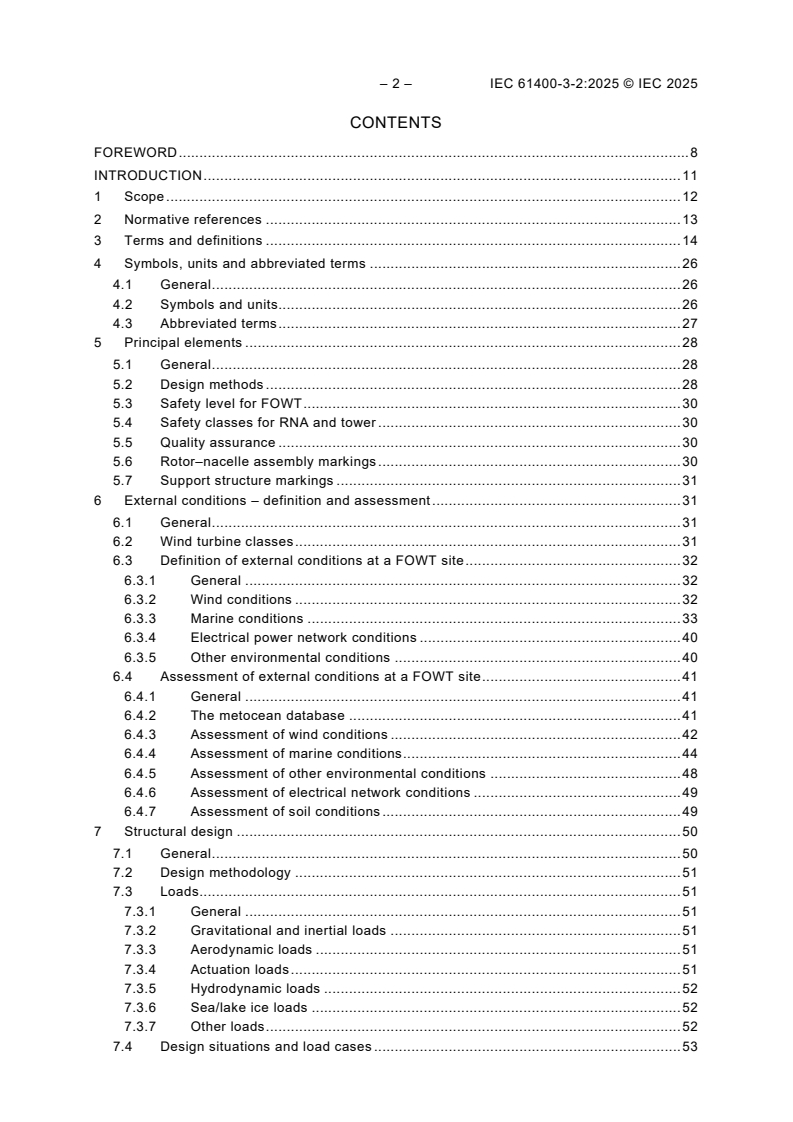
– 2 – IEC 61400-3-2:2025 © IEC 2025
CONTENTS
FOREWORD . 8
INTRODUCTION . 11
1 Scope . 12
2 Normative references . 13
3 Terms and definitions . 14
4 Symbols, units and abbreviated terms . 26
4.1 General . 26
4.2 Symbols and units. 26
4.3 Abbreviated terms . 27
5 Principal elements . 28
5.1 General . 28
5.2 Design methods . 28
5.3 Safety level for FOWT . 30
5.4 Safety classes for RNA and tower . 30
5.5 Quality assurance . 30
5.6 Rotor–nacelle assembly markings . 30
5.7 Support structure markings . 31
6 External conditions – definition and assessment . 31
6.1 General . 31
6.2 Wind turbine classes . 31
6.3 Definition of external conditions at a FOWT site . 32
6.3.1 General . 32
6.3.2 Wind conditions . 32
6.3.3 Marine conditions . 33
6.3.4 Electrical power network conditions . 40
6.3.5 Other environmental conditions . 40
6.4 Assessment of external conditions at a FOWT site . 41
6.4.1 General . 41
6.4.2 The metocean database . 41
6.4.3 Assessment of wind conditions . 42
6.4.4 Assessment of marine conditions . 44
6.4.5 Assessment of other environmental conditions . 48
6.4.6 Assessment of electrical network conditions . 49
6.4.7 Assessment of soil conditions . 49
7 Structural design . 50
7.1 General . 50
7.2 Design methodology . 51
7.3 Loads. 51
7.3.1 General . 51
7.3.2 Gravitational and inertial loads . 51
7.3.3 Aerodynamic loads . 51
7.3.4 Actuation loads . 51
7.3.5 Hydrodynamic loads . 52
7.3.6 Sea/lake ice loads . 52
7.3.7 Other loads . 52
7.4 Design situations and load cases . 53
7.4.1 General . 53
7.4.2 Power production (DLC 1.1 to 1.6) . 63
7.4.3 Power production plus occurrence of fault or loss of electrical network
connection (DLC 2.1 – 2.6) . 64
7.4.4 Start up (DLC 3.1 to 3.3). 66
7.4.5 Normal shutdown (DLC 4.1 to 4.3) . 67
7.4.6 Emergency stop (DLC 5.1) . 68
7.4.7 Parked (standstill or idling) (DLC 6.1 to 6.5) . 68
7.4.8 Parked plus fault conditions (DLC 7.1 and 7.2) . 69
7.4.9 Transport, assembly, maintenance and repair (DLC 8.1 to 8.4) . 70
7.4.10 Redundancy check and damage stability (DLC F1.1 to F2.3) . 74
7.5 Load and load effect calculations . 75
7.5.1 General . 75
7.5.2 Relevance of hydrodynamic loads . 75
7.5.3 Calculation of hydrodynamic loads . 76
7.5.4 Calculation of sea/lake ice loads . 77
7.5.5 Overall damping assessment for support structure response evaluations . 77
7.5.6 Simulation requirements . 78
7.5.7 Other requirements . 82
7.6 Limit state analysis . 83
7.6.1 Method . 83
7.6.2 Ultimate strength analysis . 86
7.6.3 Fatigue analysis . 87
7.6.4 Serviceability analysis . 88
8 Control system . 89
9 Mechanical systems . 90
10 Electrical system . 91
11 Anchor design . 91
12 Assembly, transport and installation . 91
12.1 General . 91
12.2 Planning . 92
12.3 Environmental conditions . 92
12.4 Documentation . 92
12.5 Transport, receiving, handling and storage . 93
13 Commissioning, operation and maintenance . 93
13.1 General . 93
13.2 Design requirements for safe operation, inspection and maintenance . 93
13.3 Commissioning . 94
13.3.1 General . 94
13.3.2 Energization . 95
13.3.3 Commissioning tests . 95
13.3.4 Records . 95
13.3.5 Post commissioning activities . 95
13.4 Operator’s instruction manual . 95
13.4.1 General . 95
13.4.2 Instructions for operations and maintenance record . 96
13.4.3 Instructions for unscheduled automatic shutdown . 96
13.4.4 Instructions for diminished reliability . 96
– 4 – IEC 61400-3-2:2025 © IEC 2025
13.4.5 Work procedures plan . 96
13.4.6 Emergency procedures plan . 97
13.5 Maintenance manual . 97
14 Stationkeeping systems . 98
14.1 General . 98
14.2 Catenary, semi-taut or taut stationkeeping systems . 98
14.3 Tendon systems . 99
14.4 Synthetic mooring . 99
14.5 Stationkeeping system hardware . 99
14.6 Dynamic power cable . 99
15 Floating stability . 100
15.1 General . 100
15.2 Intact static stability criteria . 101
15.3 Quasi static evaluation . 101
15.4 Dynamic response evaluation . 102
15.5 Damage stability criteria . 102
16 Materials . 103
17 Marine support systems . 103
17.1 General . 103
17.2 Bilge system . 103
17.3 Ballast system . 103
Annex A (informative) Key design parameters for a floating offshore wind turbine
(FOWT) . 104
A.1 Floating offshore wind turbine (FOWT) identifiers. 104
A.1.1 General . 104
A.1.2 Rotor nacelle assembly (machine) parameters . 104
A.1.3 Support structure parameters . 105
A.1.4 Wind conditions (based on a 10-min reference period and including
wind farm wake effects where relevant) . 105
A.1.5 Marine conditions (based on a 3-hour reference period where relevant) . 106
A.1.6 Electrical network conditions at turbine . 107
A.2 Other environmental conditions . 107
A.3 Limiting conditions for transport, installation and maintenance . 108
Annex B (informative) Guidance on calculation of hydrodynamic loads . 109
B.1 General . 109
B.2 Morison’s equation . 109
B.3 Diffraction and radiation theory . 109
B.4 Slam loading . 110
B.5 Vortex-induced vibrations and motions . 110
B.6 Appurtenances and marine growth . 111
B.7 Global analysis and fatigue analysis methods . 111
B.8 Breaking wave loads . 112
B.9 Air gap . 112
Annex C (informative) Floating offshore wind turbine (FOWT) anchor design . 113
Annex D (informative) Statistical extrapolation of operational metocean parameters for
ultimate strength analysis . 114
D.1 General . 114
D.2 Use of IFORM to determine 50-yr significant wave height conditional on
mean wind speed . 114
D.3 Examples of joint distributions of V and H and approximations to the
s
environmental contour . 116
D.4 Choice of sea state duration . 118
D.5 Determination of the extreme individual wave height to optionally be
embedded in SSS . 119
Annex E (informative) Corrosion protection . 120
E.1 General . 120
E.2 The marine environment . 120
E.3 Corrosion protection considerations . 121
E.4 Corrosion protection systems – Support structures . 121
E.5 Corrosion protection in the rotor-nacelle assembly . 122
Annex F (informative) Prediction of extreme wave heights during tropical cyclones . 123
F.1 General . 123
F.2 Wind field estimation for tropical cyclones . 123
F.3 Wave estimation for tropical cyclones . 124
Annex G (informative) Recommendations for alignment of safety levels in tropical
cyclone regions . 125
G.1 General . 125
G.2 Global robustness level criteria . 125
G.3 Design load cases. 125
Annex H (informative) Earthquakes . 127
Annex I (informative) Model tests . 128
Annex J (informative) Tsunamis . 131
J.1 General . 131
J.2 Numerical model of tsunami [51], [52] . 131
J.3 Evaluation of variance of water surface elevation and current velocity [5] . 134
Annex K (informative) Redundancy of stationkeeping system . 135
Annex L (informative) Differing limit state methods in IEC and ISO standards . 136
Annex M (informative) Application of load and load effect logic to floating substructure
design . 138
M.1 General . 138
M.2 Typical load computation setups . 138
M.3 Applied example . 139
Annex N (informative) Guidance on simulation length and associated parameters . 140
N.1 General considerations . 140
N.1.1 General . 140
N.1.2 Initial transient time . 140
N.1.3 Low-frequency dynamics sampling . 140
N.1.4 Reference period . 140
N.2 Simulations for fatigue limit state analysis . 141
N.2.1 General . 141
N.2.2 Response variance and reference period . 141
N.2.3 Statistical convergence of damage . 141
N.3 Simulations for extreme limit state analysis . 141
N.3.1 General . 141
N.3.2 Characteristic extreme consistency with the reference period . 142
N.3.3 Characteristic value variability . 142
– 6 – IEC 61400-3-2:2025 © IEC 2025
Annex O (informative) Estimation of wave directional spreading by long wave method /
single point measurement . 143
O.1 Background. 143
O.2 Linear free-wave extraction . 144
O.3 Second-order calculation . 144
Annex P (informative) Direction spreading function . 146
Annex Q (informative) Concrete structures design . 147
Q.1 General . 147
Q.2 Design load cases. 147
Q.2.1 Limit states in reinforced concrete design . 147
Q.2.2 ULS, ALS and FLS load cases . 148
Q.2.3 SLS load cases . 148
Q.2.4 Load factors . 148
Q.3 Design criteria . 149
Q.3.1 Material factors . 149
Q.3.2 ULS, ALS, FLS verifications . 149
Q.3.3 SLS: Watertightness verification . 150
Q.3.4 SLS: Crack-opening verification . 150
Q.3.5 SLS: Limitation of stresses . 150
Annex R (informative) Relationship between peak wave period and significant wave
height in the sea areas affected by swell. 151
R.1 General . 151
R.2 Relationship between wave height and wave period in the sea areas affected
by swell . 151
Annex S (informative) Application of damage stability criteria . 152
S.1 Objective . 152
S.2 Scenario of loss of floating stability . 152
S.3 Flow of application of new damage stability criteria . 152
S.4 Definition of target probability of failure (PS) . 153
S.5 Definition of collision probability (P1) . 154
S.6 Definition of total loss probability by ship collision (P2) . 156
S.6.1 Concept of estimation of P2 and PT . 156
S.6.2 Simplification of FEM analysis . 156
S.6.3 Estimation of P2 by limit curve . 158
S.7 Additional countermeasure to reduce P2 . 159
Bibliography . 160
Figure 1 – Parts of a floating offshore wind turbine (FOWT) . 16
Figure 2 – Rigid-body motion degrees of freedom of a floating substructure; illustration
by Alfred Hicks, National Renewable Energy Laboratory . 17
Figure 3 – Design process for a floating offshore wind turbine (FOWT) . 29
Figure 4 – Definition of water levels . 38
Figure 5 – Top-down view of nacelle yaw and nacelle yaw misalignment in a simulation . 62
Figure 6 – The two approaches to calculate the design load effect . 84
Figure D.1 – Example of the construction of the 50-year environmental contour for a 3-
hour sea state duration . 115
Figure J.1 – The calculated result of Equation (J.8) . 133
Figure M.1 – Example of load and load effect workflow for a hybrid "beams" and
"nodes" floating substructure model setup . 139
Figure O.1 – A typical 60-min (full-scale) time history spectrum with Hs = 6,18 m and
Tp = 10,36 s recorded at the Ocean Engineering Wide Tank, University of Ulsan,
Korea (South) . 143
Figure R.1 – The relationship between significant wave height and significant wave
period based on the measurement at Fukushima offshore site [2] . 151
Figure S.1 – Concept flow of application of new damage stability criteria . 153
Figure S.2 – Concept image of the approaching frequency . 155
Figure S.3 – Concept of estimation of P2 and PT in a strict way. 156
Figure S.4 – Concept of a limit curve . 158
Figure S.5 – Concept of the probability of total loss probability by ship collision. 158
Table 1 – Conversion between extreme wind speeds of different averaging periods . 42
Table 2 – Design load cases . 56
Table 3 – Safety factor for yield stress . 87
Table G.1 – Additional load cases for tropical cyclone affected regions . 126
Table L.1 – Mapping of limit states in ISO 19904-1 Table 4 and load cases from
IEC 61400-3-2 . 137
Table Q.1 – Partial factors γ for actions for different limit states . 149
F
Table Q.2 – Material factors γ for different limit states and materials . 149
m
Table Q.3 – Allowable crack-width for different exposure zones . 150
Table S.1 – Annual reliability of offshore structures . 154
– 8 – IEC 61400-3-2:2025 © IEC 2025
INTERNATIONAL ELECTROTECHNICAL COMMISSION
____________
WIND ENERGY GENERATION SYSTEMS –
Part 3-2: Design requirements for floating offshore wind turbines
FOREWORD
1) The International Electrotechnical Commission (IEC) is a worldwide organization for standardization comprising
all national electrotechnical committees (IEC National Committees). The object of IEC is to promote international
co-operation on all questions concerning standardization in the electrical and electronic fields. To this end and
in addition to other activities, IEC publishes International Standards, Technical Specifications, Technical Reports,
Publicly Available Specifications (PAS) and Guides (hereafter referred to as "IEC Publication(s)"). Their
preparation is entrusted to technical committees; any IEC National Committee interested in the subject dealt with
may participate in this preparatory work. International, governmental and non-governmental organizations liaising
with the IEC also participate in this preparation. IEC collaborates closely with the International Organization for
Standardization (ISO) in accordance with conditions determined by agreement between the two organizations.
2) The formal decisions or agreements of IEC on technical matters express, as nearly as possible, an international
consensus of opinion on the relevant subjects since each technical committee has representation from all
interested IEC National Committees.
3) IEC Publications have the form of recommendations for international use and are accepted by IEC National
Committees in that sense. While all reasonable efforts are made to ensure that the technical content of IEC
Publications is accurate, IEC cannot be held responsible for the way in which they are used or for any
misinterpretation by any end user.
4) In order to promote international uniformity, IEC National Committees undertake to apply IEC Publications
transparently to the maximum extent possible in their national and regional publications. Any divergence between
any IEC Publication and the corresponding national or regional publication shall be clearly indicated in the latter.
5) IEC itself does not provide any attestation of conformity. Independent certification bodies provide conformity
assessment services and, in some areas, access to IEC marks of conformity. IEC is not responsible for any
services carried out by independent certification bodies.
6) All users should ensure that they have the latest edition of this publication.
7) No liability shall attach to IEC or its directors, employees, servants or agents including individual experts and
members of its technical committees and IEC National Committees for any personal injury, property damage or
other damage of any nature whatsoever, whether direct or indirect, or for costs (including legal fees) and
expenses arising out of the publication, use of, or reliance upon, this IEC Publication or any other IEC
Publications.
8) Attention is drawn to the Normative references cited in this publication. Use of the referenced publications is
indispensable for the correct application of this publication.
9) IEC draws attention to the possibility that the implementation of this document may involve the use of (a)
patent(s). IEC takes no position concerning the evidence, validity or applicability of any claimed patent rights in
respect thereof. As of the date of publication of this document, IEC had not received notice of (a) patent(s), which
may be required to implement this document. However, implementers are cautioned that this may not represent
the latest information, which may be obtained from the patent database available at https://patents.iec.ch. IEC
shall not be held responsible for identifying any or all such patent rights.
IEC 61400-3-2 has been prepared by IEC technical committee 88: Wind energy generation
systems. It is an International Standard.
This first edition cancels and replaces IEC TS 61400-3-2, published in 2019. This edition
constitutes a technical revision.
This edition includes the following significant technical changes with respect to
IEC TS 61400-3-2:
a) The relevant contents of IEC 61400-3-1 have been migrated into IEC 61400-3-2, making
IEC 61400-3-2 a self-standing document that does not have to be read directly in
conjunction with IEC 61400-3-1.
b) Several modifications have been made regarding metocean conditions in Clause 6
considering the nature of FOWT and the offshore site where FOWT will be installed,
including: (1) the importance of wave directional spreading has been highlighted as it may
result in larger loads for FOWT, including the addition of the new informative Annex O and
Annex P and (2) the characteristic of swell has been explained, which may be relevant for
some FOWT projects, including the addition of new informative Annex R regarding the
characteristic of swell.
c) Subclauses 7.1, 7.2, 7.3, 7.4 and 7.5 have been changed to include a revised DLC table
and its related descriptions, including amongst others updated requirements on
directionality, wave conditions, redundancy check and damage stability cases, and a
robustness check case; further updates are made related to guidance and necessities
provided on load calculations and simulation requirements.
d) Subclause 7.6 has been updated with guidance on fatigue assessment along with
clarifications on serviceability analysis and the applicable material for WSD; related Annex L
has been updated and a new Annex M has been added for clarification of the safety factors
and load and load effect approach for floating substructures.
e) The concept of floater control system that will interact with the wind turbine controller has
been introduced in Clause 8.
f) Clause 11 has been renamed from "Foundation and substructure design" to "Anchor design"
and requirements for the transient conditions have been added.
g) A more detailed clause regarding concrete design has been added to Clause 16 together
with an informative Annex Q.
h) Clause 15 has been updated with the aim to improve ease of use, using experience from oil
and gas and considering unique wind turbine characteristics; updates included guidance for
TLPs, damage stability, dynamic stability, testing and the addition for Annex S regarding
how to analyse collision probability.
This International Standard is to be read in conjunction with IEC 61400-1, Wind energy
generation systems – Part 1: Design requirements.
The text of this International Standard is based on the following documents:
Draft Report on voting
88/1028/FDIS 88/1050/RVD
Full information on the voting for the approval of this International Standard can be found in the
report on voting indicated in the above table.
The language used for the development of this International Standard is English.
This publication was drafted in accordance with the ISO/IEC Directives, Part 2, and developed
in accordance with the ISO/IEC Directives, Part 1 and ISO/IEC Directives, IEC Supplement,
available at www.iec.ch/members_experts/refdocs. The main document types developed by IEC
are described in greater detail at www.iec.ch/publications.
A list of all parts of the IEC 61400 series, published under the general title Wind energy
generation systems, can be found on the IEC website.
– 10 – IEC 61400-3-2:2025 © IEC 2025
The committee has decided that the contents of this document will remain unchanged until the
stability date indicated on the IEC website under webstore.iec.ch in the data related to the
specific document. At this date, the document will be
• reconfirmed,
• withdrawn, or
• revised.
IMPORTANT – The "colour inside" logo on the cover page of this document indicates
that it contains colours which are considered to be useful for the correct understanding
of its contents. Users should therefore print this document using a colour printer.
INTRODUCTION
This part of IEC 61400 outlines the minimum design requirements for floating offshore wind
turbines (FOWT) and is not intended for use as a complete design specification or instruction
manual.
Several
...