IEC 60068-2-75:2014/AMD1:2025/COR1:2025
(Amendment)Corrigendum 1 - Amendment 1 - Environmental testing - Part 2-75: Tests - Test Eh: Hammer tests
Corrigendum 1 - Amendment 1 - Environmental testing - Part 2-75: Tests - Test Eh: Hammer tests
Corrigendum 1 - Amendement 1 - Essais d'environnement - Partie 2-75: Essais - Tests Eh: Essais au marteau
General Information
Relations
Standards Content (Sample)
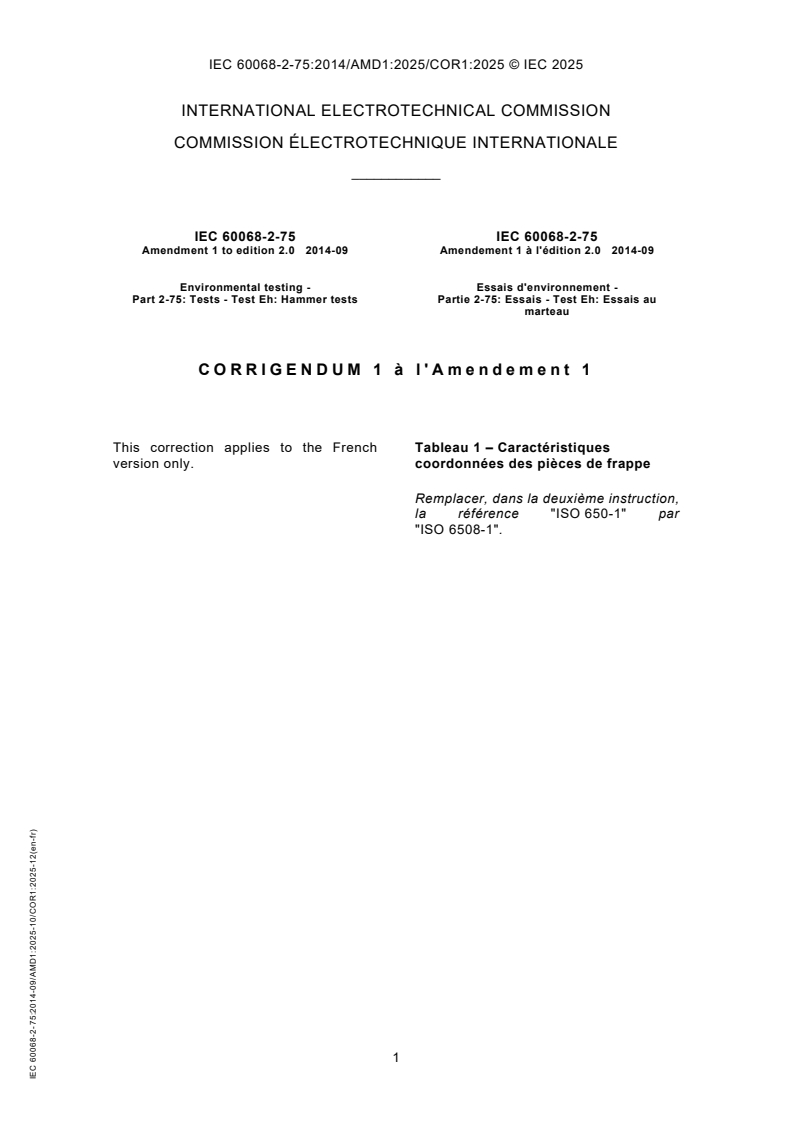
INTERNATIONAL ELECTROTECHNICAL COMMISSION
COMMISSION ÉLECTROTECHNIQUE INTERNATIONALE
____________
IEC 60068-2-75 IEC 60068-2-75
Amendment 1 to edition 2.0 2014-09 Amendement 1 à l'édition 2.0 2014-09
Environmental testing - Essais d'environnement -
Part 2-75: Tests - Test Eh: Hammer tests Partie 2-75: Essais - Test Eh:
...
This May Also Interest You
The content of the corrigendum 1 of amendment 1 (2025-12) applies only to the French version.
- Standard2 pagesEnglish languagesale 15% off
- Standard2 pagesFrench languagesale 15% off
- Standard4 pagesEnglish and French languagesale 15% off
IEC 60068-2-75:2014 provides three standardized and coordinated test methods for determining the ability of a specimen to withstand specified severities of impact. It is used, in particular, to demonstrate an acceptable level of robustness when assessing the safety of a product and is primarily intended for the testing of electrotechnical items. It consists of the application to the specimen of a prescribed number of impacts defined by their impact energy and applied in the prescribed directions. This part of IEC 60068 covers energy levels ranging from 0,14 J (joules) to 50 J (joules). This second edition cancels and replaces the first edition, published in 1997, and constitutes a technical revision. This edition includes the following significant technical change with respect to the previous edition:
- reconsideration of some values in Tables 1 and 2. Although some values are no longer recommended, they have been retained as alternatives for historical consistency purposes.
- Standard62 pagesEnglish languagesale 15% off
- Standard65 pagesEnglish and French languagesale 15% off
IEC 60068-2-1:2025 specifies temperature tests at low temperatures, generally referred to as "cold tests", that are applicable to non-heat-dissipating and heat-dissipating specimens, to determine the ability of components, equipment, or other articles to be used, transported or stored at low temperature.
This document is applicable to energized as well as non-energized specimens that normally achieve temperature stability during the test. The specimens can be subject to test in packed condition (to simulate transportation and storage) or in unpacked condition (to simulate use).
This document does not specify tests to determine the impact of temperature changes on specimens.
This seventh edition cancels and replaces the sixth edition published in 2007. This edition constitutes a technical revision.
This edition includes the following significant technical changes with respect to the previous edition:
a) revision of the introduction and scope;
b) inclusion of new figures and symbols for clarification purposes;
c) clarification of the test procedure for ascertaining high or low air velocity in the test chamber;
d) clarification of the requirements for measuring points around, on or in specimens;
e) reintroduction of the nomogram procedure for the correction of the conditioning temperature when testing with high air velocity (Test Ad and Test Ae);
f) revision of the temperature tolerances of the test;
g) revision of standardized requirements for the relevant specification and test report;
h) inclusion of the advantages and disadvantages of the testing procedures.
- Standard29 pagesEnglish languagesale 15% off
- Standard31 pagesFrench languagesale 15% off
- Standard60 pagesEnglish and French languagesale 15% off
IEC 60068-2-2:2025 specifies dry heat temperature tests that are applicable to non-heat-dissipating and heat-dissipating specimens, to determine the ability of components, equipment or other articles to be used, transported or stored at high temperature.
This document is applicable to energized as well as non-energized specimens that normally achieve temperature stability during the test. The specimens can be subject to test in packed condition (to simulate transportation and storage) or in unpacked condition (to simulate use).
This document does not specify tests to determine the impact of temperature changes on specimens.
This sixth edition cancels and replaces the fifth edition published in 2007. This edition constitutes a technical revision.
This edition includes the following significant technical changes with respect to the previous edition:
a) revision of the introduction and scope;
b) inclusion of new figures and symbols for clarification purposes;
c) clarification of the test procedure for ascertaining high or low air velocity in the test chamber;
d) clarification of the requirements for measuring points around, on or in specimens;
e) reintroduction of the nomogram procedure for the correction of the conditioning temperature when testing with high air velocity (Test Bd and Test Be);
f) revision of the temperature tolerances of the test;
g) revision of standardized requirements for the relevant specification and test report;
h) inclusion of the advantages and disadvantages of the testing procedures.
- Standard29 pagesEnglish languagesale 15% off
- Standard32 pagesFrench languagesale 15% off
- Standard61 pagesEnglish and French languagesale 15% off
IEC 60068-2-30:2025 specifies a test procedure to determine the suitability of components, equipment, or other articles for use, transportation, and storage under conditions of high humidity combined with cyclic temperature changes and, in general, producing condensation on the surface of the specimen. This test method can also be used to validate the packaging of specimen for transportation and storage.
This fourth edition cancels and replaces the third edition published in 2005. This edition constitutes a technical revision.
This edition includes the following significant technical changes with respect to the previous edition:
a) revision of the requirements for the test chamber;
b) change of the temperature tolerances of the test to limits;
c) updating of the figures for clarification purposes;
d) revision of the limits of the temperature and relative humidity during conditioning;
e) revision of the intermediate measurements;
f) revision of standardized requirements for the test report.
- Standard24 pagesEnglish languagesale 15% off
- Standard24 pagesFrench languagesale 15% off
- Standard48 pagesEnglish and French languagesale 15% off
IEC 60068-2-78:2025 establishes a test method for determining the ability of components or equipment to withstand transportation, storage and use under conditions of high humidity. The object of this document is to investigate the effect of high humidity at constant temperature without condensation on a specimen over a specified period. It is applicable to small equipment or components as well as large equipment and can be applied to both heat-dissipating and non-heat-dissipating specimens. This third edition cancels and replaces the second edition published in 2012. This edition constitutes a technical revision.
This edition includes the following significant technical changes with respect to the previous edition:
a) revision of the requirements for the test chamber;
b) revision of the severities and including the dew point temperatures;
c) change of the temperature tolerances of the test to limits;
d) inclusion of a specified preconditioning procedure;
e) inclusion of a new figure for clarification purposes;
f) revision of standardized requirements for the test report.
- Standard40 pagesEnglish languagesale 15% off
IEC 60068-3-14:2025 describes a generic process for developing a climatic sequential test programme by sequencing test methods selected from the IEC 60068-2 series.
This generic process comprises a systematic approach to the development of a sequential environmental test programme.
A climatic sequential test is applicable to electrical, electromechanical or electronic equipment and devices, as well as their subassemblies, constituent parts and components. It can be customized according to specific product requirements and applications.
The process is designed for use by product designers, manufacturers and users.
The process is particularly relevant to electrical products which include components or materials that have the potential to degrade, as a consequence of environmental exposures.
- Standard20 pagesEnglish languagesale 15% off
- Standard21 pagesFrench languagesale 15% off
- Standard41 pagesEnglish and French languagesale 15% off
IEC 60721-3-6:2025 classifies the groups of environmental parameters and their severities to which a product is subjected when installed aboard a ship.
Ships where electrotechnical products may be permanently or temporarily installed include
- ships propelled by mechanical means, including mobile offshore units, and
- ships not propelled by mechanical means, including sailing boats and life rafts.
The classes defined apply to all sizes of ship from pleasure craft to trawlers, ferry boats, icebreakers, cargo ships including tankers.
The areas in which ships normally navigate are
- inland waterways (canals, rivers, lakes etc.),
- coastal waters, and
- oceans.
Areas where ships navigate in ice are also included.
This second edition cancels and replaces the first edition, published in 1987, and constitutes a technical revision.
This edition includes the following significant changes with respect to the previous edition:
a) most classes have been replaced by completely new classes based on the use of new information obtained from referenced Technical Reports;
b) Table 1 through to Table 5 have been updated;
c) the content of Annex A and Annex B has either been incorporated into main body text or deleted.
- Standard31 pagesEnglish languagesale 15% off
- Standard31 pagesFrench languagesale 15% off
- Standard31 pagesEnglish and French languagesale 15% off
IEC 60721-2-2:2024 presents fundamental properties, quantities for characterization, and a classification of environmental conditions dependent on precipitation and wind relevant to electrotechnical products.
This third edition cancels and replaces the second edition published in 2012. This edition constitutes a technical revision.
This edition includes the following significant technical changes with respect to the previous edition:
a) the layout of the information provided has been re-organized;
b) the information provided has been extensively enhanced and revised;
c) new information on wind severities has been included.
- Standard113 pagesEnglish and French languagesale 15% off
IEC 60068-2-87:2024 describes exposures of materials and components to UV-C radiation during ultraviolet germicidal irradiation (UVGI) treatments or other processes that require UV‑C exposure and test procedures to simulate those environments. Severities representing various frequencies and intensities of UV-C exposures are described. Test conditions are described and limited to devices that utilize low pressure mercury lamps which emit most of their radiation at a single spectral line at 254 nm.
- Standard29 pagesEnglish and French languagesale 15% off


Questions, Comments and Discussion
Ask us and Technical Secretary will try to provide an answer. You can facilitate discussion about the standard in here.