


IEC TR 62278-3:2010
(Main)Railway applications - Specification and demonstration of reliability, availability, maintainability and safety (RAMS) - Part 3: Guide to the application of IEC 62278 for rolling stock RAM
Railway applications - Specification and demonstration of reliability, availability, maintainability and safety (RAMS) - Part 3: Guide to the application of IEC 62278 for rolling stock RAM
IEC/TR 62278-3:2010(E) provides guidance on applying the reliability, availability and maintainability (RAM) requirements in IEC 62278 to rolling stock and for dealing with RAM activities during the system life cycle phases from invitation to tender to demonstration in operation only. The technical report is aimed at the customers/operators and main suppliers of rolling stock.
This publication is to be read in conjunction with IEC 62278:2002.
General Information
- Status
- Published
- Publication Date
- 20-Apr-2010
- Technical Committee
- TC 9 - Electrical equipment and systems for railways
- Current Stage
- PPUB - Publication issued
- Start Date
- 21-Apr-2010
- Completion Date
- 30-Jun-2010
Overview
IEC TR 62278-3:2010 is a technical report from the IEC that provides guidance on applying the RAM (reliability, availability, maintainability) requirements of IEC 62278 specifically to rolling stock. Intended for customers/operators and main suppliers, it covers RAM activities across the rolling stock life cycle from invitation to tender through to demonstration in operation. The report complements IEC 62278:2002 and is based on EN 50126-3, focusing on practical RAMS implementation and linking RAM performance to life‑cycle cost (LCC) considerations.
Key topics and requirements
- Life‑cycle approach: Guidance for RAM activities during procurement, design, testing and demonstration phases, emphasizing traceability across the life cycle.
- Preliminary RAM analysis: Methods to capture system breakdown structures (functional/physical), failure categories and initial RAM risk assessments.
- Reliability targets: Setting and documenting reliability requirements and prediction processes for components and functions.
- Maintainability targets: Qualitative and quantitative maintainability requirements, preventive and corrective maintenance planning, and logistics support needs.
- Availability targets: Defining availability figures and how availability links to operational performance and LCC.
- RAM programme: Templates and outline for a RAM programme, including configuration management, data requirements and example analysis sheets (reliability prediction, preventive/corrective maintenance, FMECA).
- RAM assurance: Activities and documentation required for tender, design and demonstration phases to prove RAM compliance.
- LCC integration: Identification of RAM parameters to be incorporated into Life Cycle Cost models to support economic decision‑making.
Practical applications and users
Who uses IEC TR 62278-3:2010:
- Railway operators and asset owners defining RAM requirements in tenders and contracts.
- Rolling stock manufacturers and main suppliers preparing RAM programmes, reliability predictions and maintenance plans.
- Systems engineers, RAMS engineers and maintenance planners applying FMECA, failure categorization and maintainability analysis.
- Procurement and project managers integrating RAM targets with LCC and contractual obligations.
Practical uses:
- Translating high‑level RAMS requirements into rolling stock specifications.
- Structuring RAM evidence for tender evaluation and demonstration in operation.
- Defining preventive/corrective maintenance regimes and logistics support requirements.
- Feeding RAM inputs into LCC models for total cost of ownership analysis.
Related standards
- IEC 62278:2002 (read in conjunction)
- EN 50126-3 (basis for this technical report)
Keywords: IEC TR 62278-3:2010, rolling stock RAM, RAMS, IEC 62278, reliability, availability, maintainability, life cycle, life cycle cost, FMECA, preventive maintenance.
Buy Documents
IEC TR 62278-3:2010 - Railway applications - Specification and demonstration of reliability, availability, maintainability and safety (RAMS) - Part 3: Guide to the application of IEC 62278 for rolling stock RAM
Get Certified
Connect with accredited certification bodies for this standard

Bureau Veritas Railway Certification
Railway and transportation certification.

Deutsch Quality Systems (India) Pvt. Ltd. (DQS India)
Subsidiary of DQS Holding GmbH, founding member of IQNet. CDSCO Notified Body.

Excellence Ireland Quality Association (EIQA)
Irish quality certification organization.
Sponsored listings
Frequently Asked Questions
IEC TR 62278-3:2010 is a technical report published by the International Electrotechnical Commission (IEC). Its full title is "Railway applications - Specification and demonstration of reliability, availability, maintainability and safety (RAMS) - Part 3: Guide to the application of IEC 62278 for rolling stock RAM". This standard covers: IEC/TR 62278-3:2010(E) provides guidance on applying the reliability, availability and maintainability (RAM) requirements in IEC 62278 to rolling stock and for dealing with RAM activities during the system life cycle phases from invitation to tender to demonstration in operation only. The technical report is aimed at the customers/operators and main suppliers of rolling stock. This publication is to be read in conjunction with IEC 62278:2002.
IEC/TR 62278-3:2010(E) provides guidance on applying the reliability, availability and maintainability (RAM) requirements in IEC 62278 to rolling stock and for dealing with RAM activities during the system life cycle phases from invitation to tender to demonstration in operation only. The technical report is aimed at the customers/operators and main suppliers of rolling stock. This publication is to be read in conjunction with IEC 62278:2002.
IEC TR 62278-3:2010 is classified under the following ICS (International Classification for Standards) categories: 45.060.01 - Railway rolling stock in general. The ICS classification helps identify the subject area and facilitates finding related standards.
IEC TR 62278-3:2010 is available in PDF format for immediate download after purchase. The document can be added to your cart and obtained through the secure checkout process. Digital delivery ensures instant access to the complete standard document.
Standards Content (Sample)
IEC/TR 62278-3 ®
Edition 1.0 2010-04
TECHNICAL
REPORT
colour
inside
Railway applications – Specification and demonstration of reliability, availability,
maintainability and safety (RAMS) –
Part 3: Guide to the application of IEC 62278 for rolling stock RAM
IEC/TR 62278-3:2010(E)
All rights reserved. Unless otherwise specified, no part of this publication may be reproduced or utilized in any form or by
any means, electronic or mechanical, including photocopying and microfilm, without permission in writing from either IEC or
IEC's member National Committee in the country of the requester.
If you have any questions about IEC copyright or have an enquiry about obtaining additional rights to this publication,
please contact the address below or your local IEC member National Committee for further information.
Droits de reproduction réservés. Sauf indication contraire, aucune partie de cette publication ne peut être reproduite
ni utilisée sous quelque forme que ce soit et par aucun procédé, électronique ou mécanique, y compris la photocopie
et les microfilms, sans l'accord écrit de la CEI ou du Comité national de la CEI du pays du demandeur.
Si vous avez des questions sur le copyright de la CEI ou si vous désirez obtenir des droits supplémentaires sur cette
publication, utilisez les coordonnées ci-après ou contactez le Comité national de la CEI de votre pays de résidence.
IEC Central Office
3, rue de Varembé
CH-1211 Geneva 20
Switzerland
Email: inmail@iec.ch
Web: www.iec.ch
About IEC publications
The technical content of IEC publications is kept under constant review by the IEC. Please make sure that you have the
latest edition, a corrigenda or an amendment might have been published.
ƒ Catalogue of IEC publications: www.iec.ch/searchpub
The IEC on-line Catalogue enables you to search by a variety of criteria (reference number, text, technical committee,…).
It also gives information on projects, withdrawn and replaced publications.
ƒ IEC Just Published: www.iec.ch/online_news/justpub
Stay up to date on all new IEC publications. Just Published details twice a month all new publications released. Available
on-line and also by email.
ƒ Electropedia: www.electropedia.org
The world's leading online dictionary of electronic and electrical terms containing more than 20 000 terms and definitions
in English and French, with equivalent terms in additional languages. Also known as the International Electrotechnical
Vocabulary online.
ƒ Customer Service Centre: www.iec.ch/webstore/custserv
If you wish to give us your feedback on this publication or need further assistance, please visit the Customer Service
Centre FAQ or contact us:
Email: csc@iec.ch
Tel.: +41 22 919 02 11
Fax: +41 22 919 03 00
IEC/TR 62278-3 ®
Edition 1.0 2010-04
TECHNICAL
REPORT
colour
inside
Railway applications – Specification and demonstration of reliability, availability,
maintainability and safety (RAMS) –
Part 3: Guide to the application of IEC 62278 for rolling stock RAM
INTERNATIONAL
ELECTROTECHNICAL
COMMISSION
PRICE CODE
XB
ICS 45.060 ISBN 978-2-88910-660-8
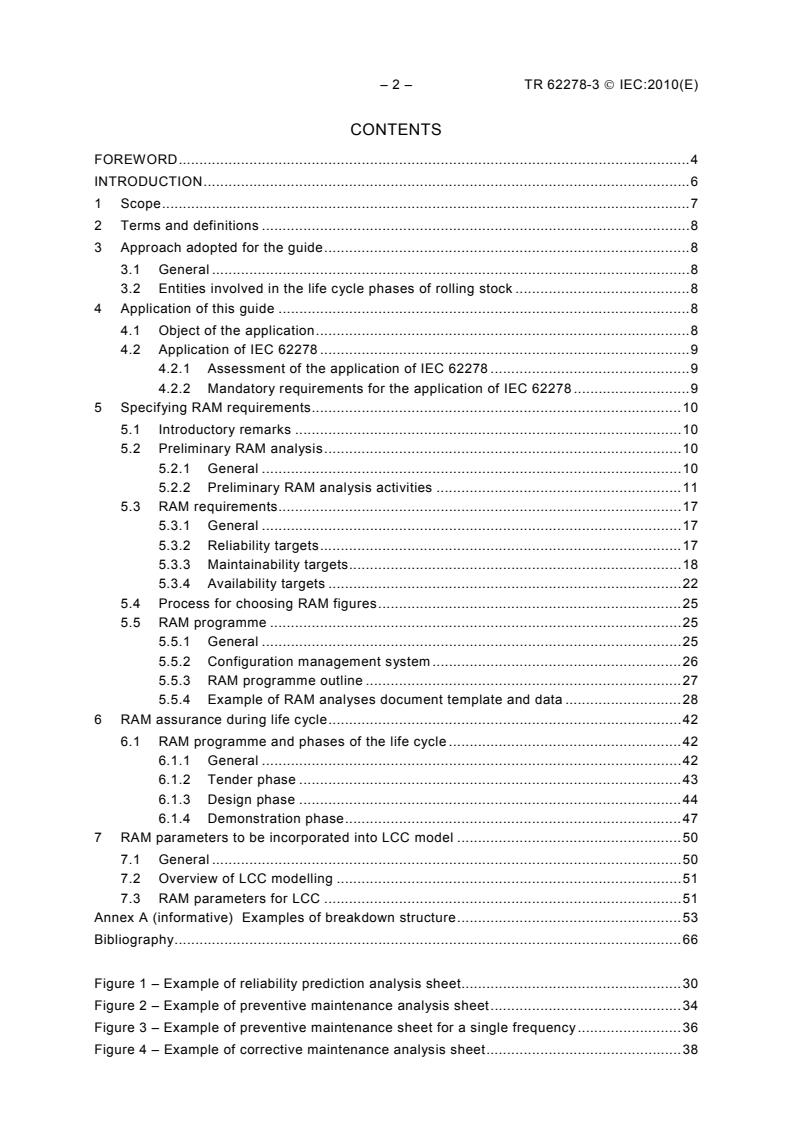
– 2 – TR 62278-3 © IEC:2010(E)
CONTENTS
FOREWORD.4
INTRODUCTION.6
1 Scope.7
2 Terms and definitions .8
3 Approach adopted for the guide.8
3.1 General .8
3.2 Entities involved in the life cycle phases of rolling stock .8
4 Application of this guide .8
4.1 Object of the application.8
4.2 Application of IEC 62278 .9
4.2.1 Assessment of the application of IEC 62278 .9
4.2.2 Mandatory requirements for the application of IEC 62278 .9
5 Specifying RAM requirements.10
5.1 Introductory remarks .10
5.2 Preliminary RAM analysis.10
5.2.1 General .10
5.2.2 Preliminary RAM analysis activities .11
5.3 RAM requirements.17
5.3.1 General .17
5.3.2 Reliability targets.17
5.3.3 Maintainability targets.18
5.3.4 Availability targets .22
5.4 Process for choosing RAM figures.25
5.5 RAM programme .25
5.5.1 General .25
5.5.2 Configuration management system.26
5.5.3 RAM programme outline .27
5.5.4 Example of RAM analyses document template and data .28
6 RAM assurance during life cycle.42
6.1 RAM programme and phases of the life cycle .42
6.1.1 General .42
6.1.2 Tender phase .43
6.1.3 Design phase .44
6.1.4 Demonstration phase.47
7 RAM parameters to be incorporated into LCC model .50
7.1 General .50
7.2 Overview of LCC modelling .51
7.3 RAM parameters for LCC .51
Annex A (informative) Examples of breakdown structure.53
Bibliography.66
Figure 1 – Example of reliability prediction analysis sheet.30
Figure 2 – Example of preventive maintenance analysis sheet.34
Figure 3 – Example of preventive maintenance sheet for a single frequency.36
Figure 4 – Example of corrective maintenance analysis sheet.38
TR 62278-3 © IEC:2010(E) – 3 –
Figure 5 – Example of items FMECA sheet .40
Figure 6 – Example of functions FMECA sheet .41
Figure 7 – RAM programme and life cycle phases.42
Figure 8 – Possible relationships between customer, main supplier, sub-supplier during
some phases of life cycle for rolling stock .43
Figure 9 – Flow diagram representing activities/documentations of design phase .45
Figure A.1 – Example of physical structure using organisation chart for an Electrical
Multiple Unit Coach.54
Figure A.2 – Example of functional structure using organisation chart for an Electrical
Multiple Unit Coach.55
Figure A.3 – Example of structure using the tree breakdown chart for an EMU
(Electrical Multiple Unit) traction vehicle .56
Figure A.4 – Example of structure using the tree breakdown chart for an EMU
(Electrical Multiple Unit) coach.63
Table 1 – Possible sharing of responsibility .8
Table 2 – Example of minimum set of data of the header for a form representing a
breakdown structure .14
Table 3 – Example of minimum set of data representing a breakdown structure.14
Table 4 – RAM failure categories .15
Table 5 – Significant failure specification .16
Table 6 – Major failure specification.16
Table 7 – Minor failure specification.16
Table 8 – Reliability requirements for failure categories .18
Table 9 – Qualitative requirements for maintainability .20
Table 10 – Preventive/corrective maintenance requirements.21
Table 11 – Logistic support requirements.21
Table 12 – Maintenance cost requirements .22
Table 13 – Availability requirements .24
Table 14 – Example of minimum set of data of the header for RAM analyses template .28
Table 15 – Example of minimum set of data for reliability prediction sheets .29
Table 16 – Example of minimum set of data for preventive maintenance sheets .33
Table 17 – Example of minimum set of data for corrective maintenance sheets .37
Table 18 – Example of minimum set of data for items FMECA sheets .39
Table 19 – Description of the main tasks of design phase .46
– 4 – TR 62278-3 © IEC:2010(E)
INTERNATIONAL ELECTROTECHNICAL COMMISSION
____________
RAILWAY APPLICATIONS –
SPECIFICATION AND DEMONSTRATION OF RELIABILITY,
AVAILABILITY, MAINTAINABILITY AND SAFETY (RAMS) –
Part 3: Guide to the application of IEC 62278
for rolling stock RAM
FOREWORD
1) The International Electrotechnical Commission (IEC) is a worldwide organization for standardization comprising
all national electrotechnical committees (IEC National Committees). The object of IEC is to promote
international co-operation on all questions concerning standardization in the electrical and electronic fields. To
this end and in addition to other activities, IEC publishes International Standards, Technical Specifications,
Technical Reports, Publicly Available Specifications (PAS) and Guides (hereafter referred to as “IEC
Publication(s)”). Their preparation is entrusted to technical committees; any IEC National Committee interested
in the subject dealt with may participate in this preparatory work. International, governmental and non-
governmental organizations liaising with the IEC also participate in this preparation. IEC collaborates closely
with the International Organization for Standardization (ISO) in accordance with conditions determined by
agreement between the two organizations.
2) The formal decisions or agreements of IEC on technical matters express, as nearly as possible, an international
consensus of opinion on the relevant subjects since each technical committee has representation from all
interested IEC National Committees.
3) IEC Publications have the form of recommendations for international use and are accepted by IEC National
Committees in that sense. While all reasonable efforts are made to ensure that the technical content of IEC
Publications is accurate, IEC cannot be held responsible for the way in which they are used or for any
misinterpretation by any end user.
4) In order to promote international uniformity, IEC National Committees undertake to apply IEC Publications
transparently to the maximum extent possible in their national and regional publications. Any divergence
between any IEC Publication and the corresponding national or regional publication shall be clearly indicated in
the latter.
5) IEC itself does not provide any attestation of conformity. Independent certification bodies provide conformity
assessment services and, in some areas, access to IEC marks of conformity. IEC is not responsible for any
services carried out by independent certification bodies.
6) All users should ensure that they have the latest edition of this publication.
7) No liability shall attach to IEC or its directors, employees, servants or agents including individual experts and
members of its technical committees and IEC National Committees for any personal injury, property damage or
other damage of any nature whatsoever, whether direct or indirect, or for costs (including legal fees) and
expenses arising out of the publication, use of, or reliance upon, this IEC Publication or any other IEC
Publications.
8) Attention is drawn to the Normative references cited in this publication. Use of the referenced publications is
indispensable for the correct application of this publication.
9) Attention is drawn to the possibility that some of the elements of this IEC Publication may be the subject of
patent rights. IEC shall not be held responsible for identifying any or all such patent rights.
The main task of IEC technical committees is to prepare International Standards. However, a
technical committee may propose the publication of a technical report when it has collected
data of a different kind from that which is normally published as an International Standard, for
example "state of the art".
IEC 62278-3, which is a technical report, has been prepared by IEC technical committee 9:
Electrical equipment and systems for railways.
This technical report is based on EN 50126-3.
This technical report is to be read in conjunction with IEC 62278 (2002).
TR 62278-3 © IEC:2010(E) – 5 –
The text of this technical report is based on the following documents:
Enquiry draft Report on voting
9/1284/DTR 9/1315A/RVC
Full information on the voting for the approval of this technical report can be found in the
report on voting indicated in the above table.
This publication has been drafted in accordance with the ISO/IEC Directives, Part 2.
The committee has decided that the contents of this publication will remain unchanged until
the stability date indicated on the IEC web site under "http://webstore.iec.ch" in the data
related to the specific publication. At this date, the publication will be
• reconfirmed,
• withdrawn,
• replaced by a revised edition, or
• amended.
A bilingual version of this publication may be issued at a later date.
IMPORTANT – The 'colour inside' logo on the cover page of this publication indicates
that it contains colours which are considered to be useful for the correct
understanding of its contents. Users should therefore print this document using a
colour printer.
– 6 – TR 62278-3 © IEC:2010(E)
INTRODUCTION
IEC 62278 is likely to enhance the general understanding of the issues involved in achieving
RAMS characteristics within the railway field. It defines a comprehensive set of tasks for the
different phases of a generic life cycle for a total rail system. Although some of the examples
given in the annexes of IEC 62278 are for rolling stock, the standard is essentially aimed as a
top level railway system document.
RAMS characteristics for rolling stock (i.e. its long-term operating behaviour performance), as
for any other system, form an important part of its overall performance characteristics. But the
consideration of RAMS, in contractual terms, between a customer / operator and a main
supplier for the procurement of rolling stock has been problematic. Also, in rolling stock
contracts, there is now a greater emphasis on the impact on end customers of service failures
and on the economic and risk considerations of RAMS (i.e. the business perspective).
Consequently, Life Cycle Cost is being used as a measure of satisfying customer needs and
providing a wider perspective of RAMS importance in terms of the business economics.
Life cycle cost approach represents a holistic, total cost of ownership philosophy for
addressing economic considerations. The contribution of RAMS to the LCC (Life Cycle Cost)
of rolling stock could be used to allow economic considerations to be addressed.
This application guide focuses mainly on the tasks and issues from procurement, engineering
and maintenance, from the tender to the operation/maintenance phase, and is intended to
help in establishing a common approach for capturing the different, time dependant,
performance requirements of rolling stock from an operator/business perspective.
IEC 62278 is a standard, which treats the overall aspects of RAMS in railway applications.
This guide deals with the application of RAM part of IEC 62278 to rolling stock only, as stated
in the scope and clarifies areas where IEC 62278 could be misinterpreted.
TR 62278-3 © IEC:2010(E) – 7 –
RAILWAY APPLICATIONS –
SPECIFICATION AND DEMONSTRATION OF RELIABILITY,
AVAILABILITY, MAINTAINABILITY AND SAFETY (RAMS) –
Part 3: Guide to the application of IEC 62278
for rolling stock RAM
1 Scope
This part of IEC 62278 provides guidance on applying the RAM requirements in IEC 62278 to
rolling stock and for dealing with RAM activities during the system life cycle phases from
invitation to tender to demonstration in operation only. All references to IEC 62278 concern
the 2002 issue.
The guide is aimed at the customers/operators and main suppliers of rolling stock. The main
purpose of the guide is to:
• enable a customer/operator of rolling stock:
– to specify the RAM requirements addressing the type of operation in terms of the end
customer needs, considering service availability and economic considerations;
– to evaluate different tenders, in terms of RAM requirements, on a common basis with
the aid of specific RAM documents;
– to gain assurance, during design/development phase, that the rolling stock being
offered is likely to satisfy the RAM contractual requirements by examining step by step
detailed and specific RAM documents as an output of the RAM activities performed
during the development phase;
– to validate that the rolling stock, as delivered, satisfies the specified RAM
requirements;
• to enable the main supplier of rolling stock;
– to understand the customers/operators RAM requirements;
– to provide substantive information/visibility in a tender to show that the product offered
is likely to satisfy the RAM requirements by performing preliminary RAM analysis;
– to provide substantive information during design/development phase to show that the
product offered is likely to satisfy the RAM requirements by performing detailed RAM
analysis;
– to demonstrate that the product delivered satisfies the RAM requirements.
Regarding LCC, this application guide is restricted to providing only the key RAM parameters
necessary to be incorporated into an LCC model.
This application guide excludes:
• RAM values connected to the different RAM requirements (however, it contains a simple
guideline of actions for supporting the decision making process and choosing appropriate
values, see 5.4);
• specific RAM documents to be produced and activities to be performed. However, it
provides, only as an example, typical data and document templates for recording the
output of a RAM analysis).
– 8 – TR 62278-3 © IEC:2010(E)
2 Terms and definitions
For the purposes of this document, the terms and definitions given in IEC 62278 and the
following apply:
2.1
part number
the alphanumeric code, generally assigned by the main supplier, to represent a family of
items with the same characteristics of form, fit and function
3 Approach adopted for the guide
3.1 General
The approach adopted is to raise the following questions, for each phase of the Life Cycle, in
order to successively set up the requirements of IEC 62278 and the basis for satisfying them:
• WHAT: what activities / tasks are to be performed and the supporting documents to be
produced?
• WHO: who has the responsibility for these activities / tasks?
• HOW: which type of method or tool should be used?
This process is adopted for the development of the guide and should be applied in
accordance with the structure of the application guide.
3.2 Entities involved in the life cycle phases of rolling stock
Depending on the organisational and management structure of the railway system concerned,
a number of entities, performing different functions, may be involved within the life cycle
phases of rolling stock. For the purpose of guidance on contractual relations, the entities are
divided into 2 main categories, i.e. customer and supplier.
It is therefore advisable, to identify all the entities that can be a part of this relationship and to
examine how the responsibilities of dealing with these entities are shared between the
customer and supplier relationship. Table 1 gives some typical examples only.
Table 1 – Possible sharing of responsibility
Supplier Customer
Entity
responsibility responsibility
Main supplier of the rolling stock X
Sub-supplier of the rolling stock X
Operator of the rolling stock X
Owner of the rolling stock X
Maintainer of the rolling stock X X
4 Application of this guide
4.1 Object of the application
This guide is applicable to rolling stock (train, coach, locomotive, etc.) and to all the
subsystems, assemblies and parts belonging to the rolling stock, according to their boundary
limits.
TR 62278-3 © IEC:2010(E) – 9 –
Referring to 1.2 of IEC 62278, the guide is for use by Railway Authorities and the railway
support industry and is applicable to:
• new rolling stock,
• modification/refurbishment of existing rolling stock.
For use in this document only, the above two bullet point items should be referred to by the
generic term “system”, comprising the complete sequence “system, sub-system, component”
of a rolling stock or the whole rolling stock itself breakdown structure.
4.2 Application of IEC 62278
4.2.1 Assessment of the application of IEC 62278
Referring to 5.3 of IEC 62278 and taking into account the responsibilities of the different
entities involved in the life cycle phases, the following subclause gives a synthesis of the main
actions required to meet the requirements.
According to 5.3.2 of IEC 62278, the assessment of the application of the requirements of
IEC 62278 to rolling stock (system under consideration) shall be defined by the Railway
Authority and according to 5.3.4 of IEC 62278, the assessment shall:
a) Specify phases applicable, and for each one of these:
• Justify and demonstrate the compliance with the principles of the requirements of the
standard.
• Specify the mandatory activities/requirements, with respect to rolling stock (system
under consideration), including:
1) The scope of each requirement,
2) The methods, tools and techniques required against each requirement and the
scope and depth of their application,
3) The verification/validation activities required against each requirement and the
scope of their application,
4) Input/output documentation.
b) Justify any deviation from the activities and requirement of the standard.
c) Justify the adequacy of the tasks chosen for the system under consideration.
Both the customer and the main supplier should provide documented evidence for the above
specifications and justifications that are within their responsibility.
Where main supplier introduces limitations, they should be discussed and agreed with the
customer.
These documents are considered as part of the RAM programme.
4.2.2 Mandatory requirements for the application of IEC 62278
The correct application of IEC 62278 is effected through several requirements.
The following is a synthesis of the mandatory requirements in 5.3.5 of IEC 62278 regarding
RAM only:
• define and agree the responsibilities for carrying out all RAM tasks within each phase
chosen;
• ensure the competence of the personnel involved within RAM tasks;
• establish and implement a RAM programme, where the following should be identified and
managed:
– 10 – TR 62278-3 © IEC:2010(E)
– conflicts between RAM and safety tasks,
– details of all RAM analysis, including the depth of analysis activities;
• ensure that the requirements of IEC 62278 are implemented within business processes,
supported by a Quality Management System (QMS) compliant with the requirements of
ISO 9000 series;
• establish and implement an adequate and effective configuration management system
including, at least:
– all system documentation,
– all other system deliverables.
Both the customer and the main supplier should provide evidence by documents about the
fulfilment of these mandatory requirements, within their responsibility.
These documents are considered as part of the RAM programme.
5 Specifying RAM requirements
5.1 Introductory remarks
The purpose of this clause is to establish the process to define RAM requirements for rolling
stock and for all the subsystems, assemblies and parts belonging to the rolling stock
according to its boundary limits.
This clause gives detailed information on phases 1, 2, 4 and 5 of system life cycle
requirements described in 6.1, 6.2, 6.4 and 6.5 of IEC 62278.
To start with, as part of the system definition process, all available data and relevant
information about the rolling stock under consideration should be collected.
The final goal is the derivation of RAM targets through the appropriate analysis of all the
information collected and organised in a structured way.
5.2 Preliminary RAM analysis
5.2.1 General
This subclause complements 6.1.3.4, 6.2.3.1, 6.2.3.2, 6.4.3.1 and Clause A.2 of IEC 62278
and gives further details.
The purpose of the preliminary RAM analysis is to identify the application environment and
the operating conditions of the rolling stock, in order to recognise the fundamental concepts
for basing the overall RAM requirements.
The analysis involves undertaking the following activities:
• similar system review:
– a list of similar existing rolling stock is created, suitable for extracting relevant RAM-
related information;
• preliminary system analysis:
– all available and relevant rolling stock documentation is reviewed in order to define, at
a preliminary level, the overall system structure and its mission profile and to
recognise the system failure conditions.
Deliverables of the preliminary RAM-related activities constitute the necessary background for
defining the overall RAM requirements specification in terms of:
TR 62278-3 © IEC:2010(E) – 11 –
– RAM requirements.
– Demonstration and acceptance criteria.
– RAM programme requirements.
5.2.2 Preliminary RAM analysis activities
5.2.2.1 General
Preliminary RAM-related activities consist of investigating all the relevant available
documentation in order to recognise all the functional requirements, which may affect the
RAM performance of the rolling stock.
The resultant deliverables of the preliminary RAM-related activities are:
• System identification: where the rolling stock has to be identified in terms of its boundary
limits, operational conditions, functions, interfaces, system breakdown structure, logistics
and maintenance conditions.
• Failure conditions: where the failures of the rolling stock have to be identified and
categorised in order to define appropriate requirements.
5.2.2.2 System identification
This subclause provides a general overview of the main features identifying a rolling stock
(see IEC 62278, Clause A.2).
The identification process is carried out to gain assurance that the rolling stock is correctly
analysed and all the factors influencing its RAM performance have been identified.
These characteristics define the conditions under which the rolling stock is required to
accomplish its mission and constitute the reference conditions for:
• defining the rolling stock RAM requirements;
• demonstrating, by analysis and tests, that each specific implementation fulfils the RAM
requirements in all relevant lifecycle phases.
The main characteristics and features necessary to describe a rolling stock are its mission
profile, route profile, operating conditions, environmental conditions and maintenance
conditions (including logistics). Items contained in each of these are listed below:
a) Mission profile:
• Reference route,
• Commercial speed (mission duration / mission length),
• Mean length of a run,
• Mean distance between train stops,
• Operating time or distance per year,
• Revenue operating time or distance per year,
• Stand-by time per day,
• Idle time per day (i.e. time when the rolling stock is neither in operation nor stand-by),
• Planned total time of use (life expectancy in years).
b) Route profile:
• Number of tunnels related to reference route,
• Number of viaducts related to reference route,
• Cumulative distance in tunnels,
– 12 – TR 62278-3 © IEC:2010(E)
• Cumulative distance on surface, including viaducts,
• Gradients and curves on the route with their lengths.
c) Operating conditions:
• Equivalent speed related to the time the equipment is powered during a given calendar
period (cumulated distance / Time the equipment is powered over the period),
• Time an equipment is powered over a given calendar period (this parameter could be
defined for each equipment, but is generally defined for categories of equipment),
• Time during which traction is activated,
• Time or percentage of time during which electric braking is activated,
• Operating time of the compressor,
• Number of compressor startups,
• Time of presence of catenary power, for each voltage,
• Time during which a trainset is awake (i.e. in operation or standby),
• Operating time for Heating Ventilation and Air Conditioning, in heating mode and in air
conditioning mode,
• Average speed and maximum speed,
• Potential use in multiple units,
• Total time of coupled operation,
• Frequency of coupling and de-coupling,
• Internal temperature range of the rolling stock,
• Mechanical (shock and vibration),
• Electrical (power supplies),
• Electromagnetic compatibility (e.g. EMC – train to train or system to system),
• Signalling interfaces (e.g. on-board and way-side),
• Ergonomics.
d) Environmental conditions:
• Outside air temperatures (OAT),
• Maximum height above the sea level,
• Solar radiation,
• Humidity,
• Wind and pressure pulses,
• Water and precipitation,
• Pollutants and contaminants,
• Resistance to corrosion.
e) Maintenance conditions:
• Indicative maintenance plan (i.e. minimum preventive maintenance interval, maximum
contemporary number of personnel required for maintenance interval tasks, maximum
standstill time to complete maintenance interval tasks, etc.),
• Number, location and description of the sites for maintenance,
• Description of the standard equipment, tools and resources at the maintenance sites.
TR 62278-3 © IEC:2010(E) – 13 –
5.2.2.3 Breakdown structure and boundary limits
5.2.2.3.1 General
Breakdown structure of the rolling stock is the most important baseline of the identification
process. Establishing a breakdown structure of the rolling stock, gives a clear reference
outline for all the activities and analyses for supporting RAM programme through the life
cycle.
Generally, the scope of the breakdown structure is to set up the borders of a system by listing
all the items belonging to that system and, by using an appropriate number of discrete
breakdown levels for the system, to draw out the relationships existing between the different
items of the rolling stock.
There are two categories of structures to support RAM analyses:
• Functional breakdown structure,
• Physical breakdown structure.
The functional breakdown is used to perform preliminary criticality analyses. The last
functional level allows consequences of functional failure modes to be developed and the next
physical level allows the critical item list to be developed.
The physical breakdown is used to perform maintainability analyses. The last level of this
breakdown is the LRU (Line Replaceable Unit), as defined in 5.5.4.4. This breakdown is
sometimes called the logistic breakdown structure.
5.2.2.3.2 Common rules to set up a physical breakdown structure
For setting up a breakdown structure, a decomposition process is carried out starting from the
first level to the other levels identified and being able to represent all the items and their
functional relationships.
The decomposition process is based on a hierarchical breakdown in a top down process
commencing with the rolling stock as the system under consideration.
At each level identified in the hierarchy, every system identified becomes the next system
under consideration and can be further decomposed into lower levels, as necessary.
There are several methods and tools to set up a breakdown structure. The following are
recommendations to be followed in order to develop an appropriate and suitable breakdown
structure for RAM purposes:
• Avoid the use of "large number of levels" and limit these to a reasonable number (three or
four are suggested),
• Last item identified along a branch shall be a LRU,
• Force the use of the same terms and definitions for identical items,
• Ensure that the terms and definitions used for every item are the same in all the design
documents (drawings, outlines, diagrams, specifications, etc.),
• After the first issue of the structure avoid continuous modifications,
• Avoid the use of vague or unclear definitions.
The definition used for LRU is well explained in 5.5.4.4.
– 14 – TR 62278-3 © IEC:2010(E)
5.2.2.3.3 Data to identify the physical breakdown structure
Every breakdown structure shall be presented together with a set of drawings, diagrams, and
functional outlines in order to meet the target of identifying the rolling stock and all its
subsystems, assemblies and parts, clarifying at least:
• all the relationships between the items of the breakdown structure,
• the functional borders between different systems, subsystems, assemblies.
A minimum set of data is used to represent and to manage the breakdown structure.
This kind of data is the baseline of the different analyses that should be carried out during the
life cycle.
Every breakdown structure should be represented with a header containing at least the following
(see Table 2):
Table 2 – Example of minimum set of data of the header for a form representing
a breakdown structure
Subject Details
Rolling stock ID code or definition of rolling stock
Doc. N. Code of document
Version Number Number to identify the version of the document
Date Date of document referred to the version of the document
Page n/N Consecutive number of page/total number of pages
Drawn up by First and last name of author
Filename Name of file of the document
The following (see Table 3) are the minimum set of data to represent a breakdown structure:
Table 3 – Example of minimum set of data representing a breakdown structure
Subject Details
Code Breakdown level code of the item
Description Description of the item
Qty Amount of the item under consideration in the higher level item
Part No. Part No. of the item
NOTE 1 The use of quantity information is suggested for breakdown structure where the product is defined.
NOTE 2 As appropriate, it is recommended to use the Part Number for every item of the breakdown structure.
Examples of breakdown structure are given in Annex A.
5.2.2.4 Failure Conditions
This subclause complements 4.5.2.2 and 6.4.3.2 of IEC 62278 and gives further details.
The following general failure conditions are defined for the rolling stock based on general
failure categories, which may be experienced by a generic railway transport:
• Immobilising failures,
• Service failures,
TR 62278-3 © IEC:2010(E) – 15 –
• Minor failures.
Table 4 shows the failure categories indicated in IEC 62278 and defines them in terms of their
application to rolling stock.
Table 4 – RAM failure categories
Failure category Definition
A failure that:
Significant – prevents train movement or causes a delay to service greater than a specified
(Immobilising failure) time and/or
– generates a cost greater than a specified level
A failure that:
Major – must be rectified for the rolling stock to achieve its specified performance and
(Service failure)
– does not cause a delay or cost greater than the minimum threshold specified for
a significant failure
A failure that:
Minor – does not prevent rolling stock achieving its specified performance and
– does not meet criteria for significant or major failures
In order to better define the above mentioned failure categories the following conditions are
applicable to rolling stock and to all its subsystems, assemblies and parts:
• Significant failure (immobilising failure): Any failure occurring on rolling stock and leading,
at least, to one of the following conditions:
– A delay greater than a specified time,
– Train stopped on the track,
– Train not allowed to enter service,
– Withdrawal of the train from service,
– A cost greater than a specified threshold.
• Major failure (service failure): Any failure occurring on the rolling stock and leading, at
least, to one of the following conditions:
– A delay less than a specified time,
– Loss of specific functions or their performance threshold falling below the specified
minimum acceptable level,
– A cost less than a specified threshold.
• Minor failure:
– Any failure occurring on the rolling stock, that is not classified as significant or major,
leading to a maintenance task, even if this failure has no impact on service.
According to the above mentioned definitions and conditions of failures, the customer should
state:
• The number of minutes of delay for significant failures and major failures,
• The threshold cost for significant failures and major failures,
• The method for counting the delay (i.e. at the end of the run only, cumulated during all the
stops, the maximum between two stops, etc.),
• Specific service conditions which are deemed to result in stopping the train on the track or
withdrawing the train from service in case of significant failure,
– 16 – TR 62278-3 © IEC:2010(E)
• Functions and their performance thresholds, which are deemed to be classed as Major
Failures (e.g. the failure of the passenger air-conditioning, the failure of driver’s cab air-
conditioning, the failure of door system per side, the failure of a specified number of toilet
system, the failure of the coach lighting system, etc.).
Tables 5 to 7 show the specifications for each failure category.
Table 5 – Significant failure specification
Failure Threshold
Conditions Specification requested
category dimension
Delay greater than
Time Specify mode of counting delay
or
Train stopped on the track
Rolling stock unable to proceed under
its own power.
or
SIGNIFICANT
Withdrawal of the train from
Specify special service conditions
(immobilising
service/Train not allowed to
under which the customer decides that
failure)
enter service
the train is withdrawn from service or
Fail
I
stopped from entering service
or
Cost greater than Money Specify reference cost
Table 6 – Major failure specification
Threshold
Failure category Conditions Specification requested
dimension
Delay less than
Time Specify mode of counting delay
or
Specify services/functions and their
Failing specified performance
performance threshold levels below
MAJOR
which the customer considers it as
or
(service failure)
service failure
Fail
S
Cost less than Money Specify reference cost
Table 7 – Minor failure specification
Threshold
Failure category Conditions Specification requested
dimension
MINOR Any failure occurring on the
Time
Fail rolling stock
M
It should be noted that one or more conditions for each table of failure category might be
applied.
TR 62278-3 © IEC:2010(E) – 17 –
5.3 RAM requirements
5.3.1 General
This subclause complements 4.5.2.2 and 6.4.3.2 of IEC 62278 and gives further additional
details.
The aim of this subclause is to give an overview of the most commonly used RAM
requirements in order to help the customer choose the most appropriate requirements for his
rolling stock, and also take into account any possible legal requirements, when existing.
In choosing the appropriate RAM requirements, the customer is strongly advised to consider
the following:
• System identification characteristics (mission profile, operating condition, function
requested, etc.),
• Economic implications,
• Practicalities of being able to measure RAM performance from his field operations,
depending on his organisational and logistical structure and service procedures.
The customer should document his process for choosing RAM requirements stating the
consideration given to address each requirement chosen.
5.3.2 Reliability targets
This subclause provides guidance on description of reliability targets required for the failure
categories significant (Immobilising),
...
Questions, Comments and Discussion
Ask us and Technical Secretary will try to provide an answer. You can facilitate discussion about the standard in here.
Loading comments...