


IEC 61915-1:2007
(Main)Low-voltage switchgear and controlgear - Device profiles for networked industrial devices - Part 1: General rules for the development of device profiles
General Information
- Abstract
The IEC 61915 series is intended to improve interoperability of devices, network tools and application software. This part of IEC 61915 defines a framework for common representation of networked industrial devices and provides a template for documenting such a representation, independent of the network used. This framework follows the principles given in IEC/TR 62390, the "Common automation device - Profile guideline", and refers to ISO 15745, "Industrial automation systems and integration - Open systems application integration framework". This first edition cancels and replaces the IEC/TS 61915 technical specification published in 2003. It now has the status of an International Standard.
- Status
- Published
- Publication Date
- 26-Nov-2007
- Technical Committee
- SC 121A - Low-voltage switchgear and controlgear
- Drafting Committee
- WG 3 - TC 121/SC 121A/WG 3
- Current Stage
- PPUB - Publication issued
- Start Date
- 27-Nov-2007
- Completion Date
- 15-Dec-2007
Buy Documents
IEC 61915-1:2007 - Low-voltage switchgear and controlgear - Device profiles for networked industrial devices - Part 1: General rules for the development of device profiles Released:11/27/2007
Overview
IEC 61915-1:2007 is an international standard developed by the International Electrotechnical Commission (IEC) that focuses on low-voltage switchgear and controlgear, specifically addressing device profiles for networked industrial devices. Part 1 of this series establishes general rules for the development of device profiles to enhance the interoperability of industrial devices, network tools, and application software across various platforms and communication networks.
This standard provides a framework for the common representation of networked industrial devices and defines a template for documenting these profiles. Importantly, IEC 61915-1:2007 is independent of the network type used, thus promoting versatile implementation in diverse industrial automation environments.
Key Topics
Device Profile Framework
The standard introduces a structured framework for creating device profiles which formalize descriptions of industrial devices for networking purposes. This framework is compatible with guidelines from IEC/TR 62390 and integrates concepts from ISO 15745 to ensure openness and standardization in industrial automation.Root Device Profiles
Root device profiles serve as fundamental templates that define general device characteristics, parameter definitions, functional elements, state models, and services. These provide a baseline for manufacturers to build upon or customize.Manufacturer’s Device Profiles
Manufacturers can either base their custom device profiles on existing root profiles or create profiles independently. The document details the rules for both approaches including headers, parameters, complex data types, parameter assemblies, and services.Parameter and Data Type Definitions
IEC 61915-1 comprehensively describes mandatory and optional elements such as parameter names, data types, units, access rights, ranges, and the structure of complex data types including arrays, enumerations, and structured types.Profile Relationships and Compatibility
The standard addresses how profiles relate to each other to maintain compatibility and facilitate communication between devices from different manufacturers or models within automated systems.
Applications
Industrial Automation
Facilitates seamless integration of low-voltage switchgear and controlgear with networked industrial systems, ensuring devices can communicate efficiently across diverse industrial networks.Device Interoperability
By standardizing how device information is represented and exchanged, IEC 61915-1 supports interoperable industrial devices improving flexibility and reducing integration time and cost.Network Tools and Software Development
Provides a clear, standardized template that network tool developers and software engineers can implement to ensure consistent interpretation of device capabilities and services.Manufacturing and Process Control
Enables consistent device identification, monitoring, control, and diagnostics in smart factories and automated processes.
Related Standards
IEC/TR 62390 – Common Automation Device Profile Guideline
Supports and complements IEC 61915-1 by offering principles for device profile development in automation environments.ISO 15745 – Industrial Automation Systems and Integration – Open Systems Application Integration Framework
Related to the open integration paradigms adopted within IEC 61915-1 for device network profiles.IEC 61915 Series – Device profiles for networked industrial devices
This part 1 standard serves as the foundational document for subsequent parts of the IEC 61915 series, which address more specific device profile aspects.
Keywords: IEC 61915-1, device profiles, low-voltage switchgear, controlgear, industrial automation, networked industrial devices, interoperability, IEC standards, manufacturer device profiles, root device profiles, industrial networks, automation systems integration.
Relations
- Effective Date
- 05-Sep-2023
Buy Documents
IEC 61915-1:2007 - Low-voltage switchgear and controlgear - Device profiles for networked industrial devices - Part 1: General rules for the development of device profiles Released:11/27/2007
Get Certified
Connect with accredited certification bodies for this standard

IMQ S.p.A. (Certification)
Italian electrical product certification.

SLG Prüf- und Zertifizierungs GmbH
German testing and certification body.

UL Solutions
Global safety science company with testing, inspection and certification.
Sponsored listings
Frequently Asked Questions
IEC 61915-1:2007 is a standard published by the International Electrotechnical Commission (IEC). Its full title is "Low-voltage switchgear and controlgear - Device profiles for networked industrial devices - Part 1: General rules for the development of device profiles". This standard covers: The IEC 61915 series is intended to improve interoperability of devices, network tools and application software. This part of IEC 61915 defines a framework for common representation of networked industrial devices and provides a template for documenting such a representation, independent of the network used. This framework follows the principles given in IEC/TR 62390, the "Common automation device - Profile guideline", and refers to ISO 15745, "Industrial automation systems and integration - Open systems application integration framework". This first edition cancels and replaces the IEC/TS 61915 technical specification published in 2003. It now has the status of an International Standard.
The IEC 61915 series is intended to improve interoperability of devices, network tools and application software. This part of IEC 61915 defines a framework for common representation of networked industrial devices and provides a template for documenting such a representation, independent of the network used. This framework follows the principles given in IEC/TR 62390, the "Common automation device - Profile guideline", and refers to ISO 15745, "Industrial automation systems and integration - Open systems application integration framework". This first edition cancels and replaces the IEC/TS 61915 technical specification published in 2003. It now has the status of an International Standard.
IEC 61915-1:2007 is classified under the following ICS (International Classification for Standards) categories: 29.130.20 - Low voltage switchgear and controlgear. The ICS classification helps identify the subject area and facilitates finding related standards.
IEC 61915-1:2007 has the following relationships with other standards: It is inter standard links to IEC TS 61915:2003. Understanding these relationships helps ensure you are using the most current and applicable version of the standard.
IEC 61915-1:2007 is available in PDF format for immediate download after purchase. The document can be added to your cart and obtained through the secure checkout process. Digital delivery ensures instant access to the complete standard document.
Standards Content (Sample)
IEC 61915-1
Edition 1.0 2007-11
INTERNATIONAL
STANDARD
NORME
INTERNATIONALE
Low-voltage switchgear and controlgear – Device profiles for networked
industrial devices –
Part 1: General rules for the development of device profiles
Appareillage à basse tension – Profils d’appareil pour les appareils industriels
mis en réseau –
Partie 1: Règles générales pour le développement de profils d’appareil
All rights reserved. Unless otherwise specified, no part of this publication may be reproduced or utilized in any form or by
any means, electronic or mechanical, including photocopying and microfilm, without permission in writing from either IEC or
IEC's member National Committee in the country of the requester.
If you have any questions about IEC copyright or have an enquiry about obtaining additional rights to this publication,
please contact the address below or your local IEC member National Committee for further information.
Droits de reproduction réservés. Sauf indication contraire, aucune partie de cette publication ne peut être reproduite
ni utilisée sous quelque forme que ce soit et par aucun procédé, électronique ou mécanique, y compris la photocopie
et les microfilms, sans l'accord écrit de la CEI ou du Comité national de la CEI du pays du demandeur.
Si vous avez des questions sur le copyright de la CEI ou si vous désirez obtenir des droits supplémentaires sur cette
publication, utilisez les coordonnées ci-après ou contactez le Comité national de la CEI de votre pays de résidence.
IEC Central Office
3, rue de Varembé
CH-1211 Geneva 20
Switzerland
Email: inmail@iec.ch
Web: www.iec.ch
About the IEC
The International Electrotechnical Commission (IEC) is the leading global organization that prepares and publishes
International Standards for all electrical, electronic and related technologies.
About IEC publications
The technical content of IEC publications is kept under constant review by the IEC. Please make sure that you have the
latest edition, a corrigenda or an amendment might have been published.
ƒ Catalogue of IEC publications: www.iec.ch/searchpub
The IEC on-line Catalogue enables you to search by a variety of criteria (reference number, text, technical committee,…).
It also gives information on projects, withdrawn and replaced publications.
ƒ IEC Just Published: www.iec.ch/online_news/justpub
Stay up to date on all new IEC publications. Just Published details twice a month all new publications released. Available
on-line and also by email.
ƒ Electropedia: www.electropedia.org
The world's leading online dictionary of electronic and electrical terms containing more than 20 000 terms and definitions
in English and French, with equivalent terms in additional languages. Also known as the International Electrotechnical
Vocabulary online.
ƒ Customer Service Centre: www.iec.ch/webstore/custserv
If you wish to give us your feedback on this publication or need further assistance, please visit the Customer Service
Centre FAQ or contact us:
Email: csc@iec.ch
Tel.: +41 22 919 02 11
Fax: +41 22 919 03 00
A propos de la CEI
La Commission Electrotechnique Internationale (CEI) est la première organisation mondiale qui élabore et publie des
normes internationales pour tout ce qui a trait à l'électricité, à l'électronique et aux technologies apparentées.
A propos des publications CEI
Le contenu technique des publications de la CEI est constamment revu. Veuillez vous assurer que vous possédez
l’édition la plus récente, un corrigendum ou amendement peut avoir été publié.
ƒ Catalogue des publications de la CEI: www.iec.ch/searchpub/cur_fut-f.htm
Le Catalogue en-ligne de la CEI vous permet d’effectuer des recherches en utilisant différents critères (numéro de référence,
texte, comité d’études,…). Il donne aussi des informations sur les projets et les publications retirées ou remplacées.
ƒ Just Published CEI: www.iec.ch/online_news/justpub
Restez informé sur les nouvelles publications de la CEI. Just Published détaille deux fois par mois les nouvelles
publications parues. Disponible en-ligne et aussi par email.
ƒ Electropedia: www.electropedia.org
Le premier dictionnaire en ligne au monde de termes électroniques et électriques. Il contient plus de 20 000 termes et
définitions en anglais et en français, ainsi que les termes équivalents dans les langues additionnelles. Egalement appelé
Vocabulaire Electrotechnique International en ligne.
ƒ Service Clients: www.iec.ch/webstore/custserv/custserv_entry-f.htm
Si vous désirez nous donner des commentaires sur cette publication ou si vous avez des questions, visitez le FAQ du
Service clients ou contactez-nous:
Email: csc@iec.ch
Tél.: +41 22 919 02 11
Fax: +41 22 919 03 00
IEC 61915-1
Edition 1.0 2007-11
INTERNATIONAL
STANDARD
NORME
INTERNATIONALE
Low-voltage switchgear and controlgear – Device profiles for networked
industrial devices –
Part 1: General rules for the development of device profiles
Appareillage à basse tension – Profils d’appareil pour les appareils industriels
mis en réseau –
Partie 1: Règles générales pour le développement de profils d’appareil
INTERNATIONAL
ELECTROTECHNICAL
COMMISSION
COMMISSION
ELECTROTECHNIQUE
PRICE CODE
INTERNATIONALE
XD
CODE PRIX
ICS 29.130.20 ISBN 2-8318-9394-1
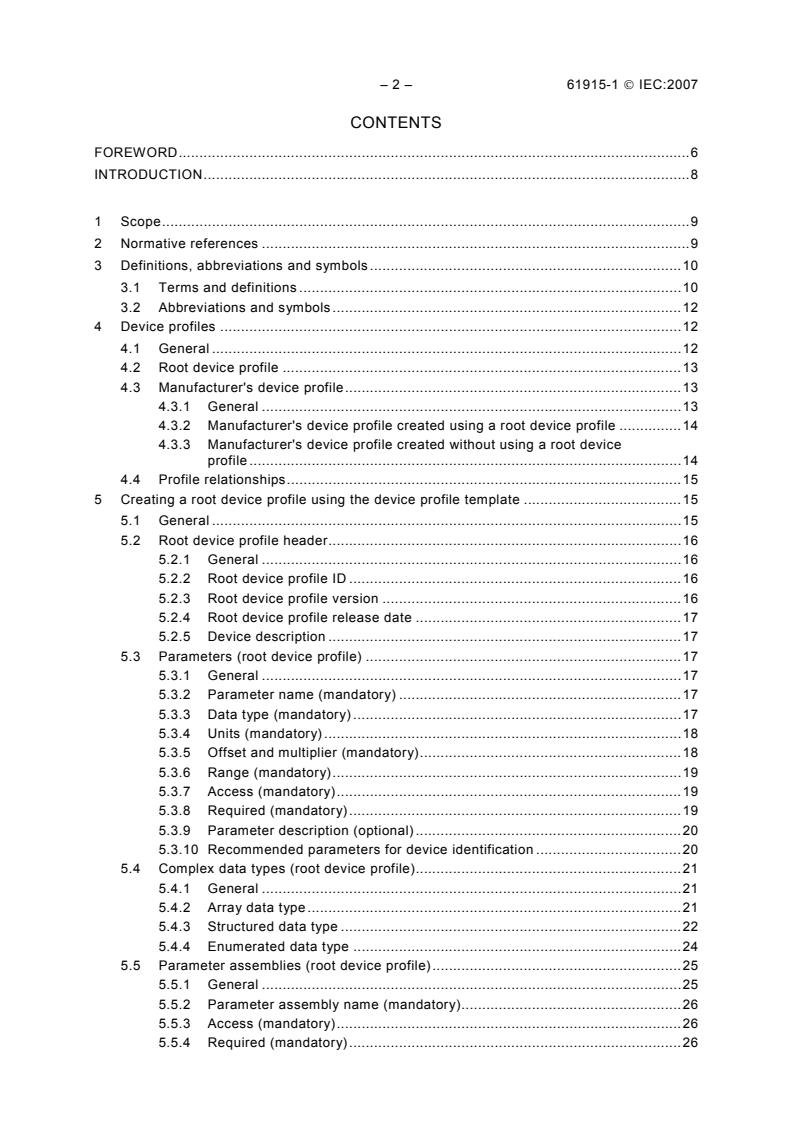
– 2 – 61915-1 © IEC:2007
CONTENTS
FOREWORD.6
INTRODUCTION.8
1 Scope.9
2 Normative references .9
3 Definitions, abbreviations and symbols .10
3.1 Terms and definitions .10
3.2 Abbreviations and symbols.12
4 Device profiles .12
4.1 General .12
4.2 Root device profile .13
4.3 Manufacturer's device profile.13
4.3.1 General .13
4.3.2 Manufacturer's device profile created using a root device profile .14
4.3.3 Manufacturer's device profile created without using a root device
profile .14
4.4 Profile relationships.15
5 Creating a root device profile using the device profile template .15
5.1 General .15
5.2 Root device profile header.16
5.2.1 General .16
5.2.2 Root device profile ID .16
5.2.3 Root device profile version .16
5.2.4 Root device profile release date .17
5.2.5 Device description .17
5.3 Parameters (root device profile) .17
5.3.1 General .17
5.3.2 Parameter name (mandatory) .17
5.3.3 Data type (mandatory) .17
5.3.4 Units (mandatory) .18
5.3.5 Offset and multiplier (mandatory).18
5.3.6 Range (mandatory).19
5.3.7 Access (mandatory).19
5.3.8 Required (mandatory).19
5.3.9 Parameter description (optional).20
5.3.10 Recommended parameters for device identification .20
5.4 Complex data types (root device profile).21
5.4.1 General .21
5.4.2 Array data type.21
5.4.3 Structured data type .22
5.4.4 Enumerated data type .24
5.5 Parameter assemblies (root device profile).25
5.5.1 General .25
5.5.2 Parameter assembly name (mandatory).26
5.5.3 Access (mandatory).26
5.5.4 Required (mandatory).26
61915-1 © IEC:2007 – 3 –
5.5.5 Parameter assembly data (mandatory) .26
5.6 Parameter groups (root device profile) .27
5.6.1 General .27
5.6.2 Group name (mandatory).28
5.6.3 Group type (mandatory).28
5.6.4 Number of members (mandatory) .28
5.6.5 Required (mandatory).28
5.6.6 Description (optional) .28
5.6.7 Additional information (optional) .28
5.6.8 Member names (mandatory) .28
5.7 Functional elements (root device profile) .28
5.7.1 General .28
5.7.2 Functional structure diagram (optional).30
5.7.3 Functional element list (optional) .31
5.8 State model (root device profile).31
5.8.1 General .31
5.8.2 State model name .31
5.8.3 State chart diagrams .32
5.8.4 State transition tables.33
5.9 Services (root device profile) .36
5.9.1 General .36
5.9.2 Service name (mandatory).36
5.9.3 Request parameter group (optional) .36
5.9.4 Response parameter group (optional).36
5.9.5 Required (mandatory).36
5.9.6 Description (optional) .36
5.9.7 Additional information (optional) .36
6 Creating a manufacturer's device profile using a root device profile.37
6.1 General .37
6.2 Manufacturer’s device profile header .37
6.2.1 General .37
6.2.2 Manufacturer’s device profile ID (mandatory).37
6.2.3 Manufacturer’s device profile description (optional) .37
6.2.4 Manufacturer’s device profile version (mandatory) .38
6.2.5 Manufacturer’s device profile release date (mandatory) .38
6.2.6 Manufacturer ID (mandatory) .38
6.2.7 Model compatibility (optional) .38
6.2.8 Software compatibility (optional) .38
6.2.9 Hardware compatibility (optional).38
6.2.10 Profile type (mandatory) .38
6.2.11 Profile availability (mandatory) .39
6.2.12 Additional information (optional) .39
6.3 Implementation of root device profile parameters .39
6.4 Parameters (manufacturer-specific).39
6.5 Implementation of root device profile complex data types .40
6.6 Complex data types (manufacturer-specific) .40
6.7 Implementation of root device profile parameter assemblies.40
6.8 Parameter assemblies (manufacturer-specific) .41
6.9 Implementation of root device profile parameter groups.41
– 4 – 61915-1 © IEC:2007
6.10 Parameter groups (manufacturer-specific) .42
6.11 Implementation of root device profile functional elements.42
6.12 Functional elements (manufacturer-specific) .43
6.13 State model (manufacturer-specific) .43
6.14 Implementation of root device profile services .43
6.15 Services (manufacturer-specific) .44
7 Creating a manufacturer's device profile without using a root device profile.44
7.1 General .44
7.2 Manufacturer’s device profile header .45
7.2.1 General .45
7.2.2 Manufacturer’s device profile ID (mandatory).45
7.2.3 Manufacturer’s device profile description (optional) .45
7.2.4 Manufacturer’s device profile version (mandatory) .45
7.2.5 Manufacturer’s device profile release date (mandatory) .45
7.2.6 Manufacturer ID (mandatory) .45
7.2.7 Model compatibility (optional) .45
7.2.8 Software compatibility (optional) .45
7.2.9 Hardware compatibility (optional).45
7.2.10 Profile type (optional) .45
7.2.11 Profile availability (optional).45
7.2.12 Additional information (optional) .45
7.3 Root device profile header.46
7.3.1 Root device profile ID .46
7.3.2 Root device profile version .46
7.3.3 Root device profile release date .46
7.3.4 Device description (optional) .46
7.4 Parameters (root device profile) .46
7.5 Parameters (manufacturer-specific).46
7.6 Complex data types (root device profile).46
7.7 Complex data types (manufacturer-specific) .46
7.8 Parameter assemblies (root device profile).46
7.9 Parameter assemblies (manufacturer-specific) .46
7.10 Parameter groups (root device profile) .46
7.11 Parameter groups (manufacturer-specific) .46
7.12 Functional elements (root device profile) .46
7.13 Functional elements (manufacturer-specific) .46
7.14 State model (root device profile).47
7.15 State model (manufacturer-specific) .47
7.16 Services (root device profile) .47
7.17 Services (manufacturer-specific) .47
Annex A (normative) Device profile template.48
Annex B (informative) Device profile examples .55
Annex C (informative) Profile creation guidelines .78
Annex D (informative) Profile exchange language .79
Annex E (informative) Categories of parameters .91
Bibliography.93
61915-1 © IEC:2007 – 5 –
Figure 1 – Relationship between IEC 61915-1 and device profiles .15
Figure 2 – Array data type example .21
Figure 3 – Structured data type example.22
Figure 4 – Enumerated data type examples .24
Figure 5 – Example description format (1).27
Figure 6 – Example description format (2).27
Figure 7 – Example description format (3).27
Figure 8 – Example device structure .29
Figure 9 – Combination motor starter example.30
Figure 10 – Example of a state chart diagram for a photoelectric switch .32
Figure 11 – Example of a state chart diagram for a motor starter .33
Figure 12 – State transition table for the photoelectric switch example.34
Figure 13 – State transition table for the motor starter example .35
Figure A.1 – Device profile template .54
Figure B.1 – Example of a root device profile – Photoelectric switch .59
Figure B.2 – Example of a root device profile − Motor starter .69
Figure B.3 – Example of a generic device profile created using a root device profile.73
Figure B.4 – Example of a specific device profile created without using a root device
profile .77
Figure C.1 – Simple proximity switch parameter assembly .78
Figure C.2 – Diagnostic proximity switch parameter assembly .78
Figure D.1 – Overview of an ISO 15745 device profile .80
Figure D.2 – Device profile schema structure.90
Table 1 – Valid simple data types .18
Table A.1 – Contents of the “Required” field in a device profile .48
Table D.1 – Mapping for a root device profile (ProfileHeader) .80
Table D.2 – Example mapping for a root device profile (ProfileBody) .81
Table D.3 – Correspondence with ISO 15745 for a manufacturer’s device profile.81
Table D.4 – Example mapping for a manufacturer’s device profile (ProfileBody) .82
– 6 – 61915-1 © IEC:2007
INTERNATIONAL ELECTROTECHNICAL COMMISSION
____________
LOW-VOLTAGE SWITCHGEAR AND CONTROLGEAR –
DEVICE PROFILES FOR NETWORKED INDUSTRIAL DEVICES –
Part 1: General rules for the development of device profiles
FOREWORD
1) The International Electrotechnical Commission (IEC) is a worldwide organization for standardization comprising
all national electrotechnical committees (IEC National Committees). The object of IEC is to promote
international co-operation on all questions concerning standardization in the electrical and electronic fields. To
this end and in addition to other activities, IEC publishes International Standards, Technical Specifications,
Technical Reports, Publicly Available Specifications (PAS) and Guides (hereafter referred to as “IEC
Publication(s)”). Their preparation is entrusted to technical committees; any IEC National Committee interested
in the subject dealt with may participate in this preparatory work. International, governmental and non-
governmental organizations liaising with the IEC also participate in this preparation. IEC collaborates closely
with the International Organization for Standardization (ISO) in accordance with conditions determined by
agreement between the two organizations.
2) The formal decisions or agreements of IEC on technical matters express, as nearly as possible, an international
consensus of opinion on the relevant subjects since each technical committee has representation from all
interested IEC National Committees.
3) IEC Publications have the form of recommendations for international use and are accepted by IEC National
Committees in that sense. While all reasonable efforts are made to ensure that the technical content of IEC
Publications is accurate, IEC cannot be held responsible for the way in which they are used or for any
misinterpretation by any end user.
4) In order to promote international uniformity, IEC National Committees undertake to apply IEC Publications
transparently to the maximum extent possible in their national and regional publications. Any divergence
between any IEC Publication and the corresponding national or regional publication shall be clearly indicated in
the latter.
5) IEC provides no marking procedure to indicate its approval and cannot be rendered responsible for any
equipment declared to be in conformity with an IEC Publication.
6) All users should ensure that they have the latest edition of this publication.
7) No liability shall attach to IEC or its directors, employees, servants or agents including individual experts and
members of its technical committees and IEC National Committees for any personal injury, property damage or
other damage of any nature whatsoever, whether direct or indirect, or for costs (including legal fees) and
expenses arising out of the publication, use of, or reliance upon, this IEC Publication or any other IEC
Publications.
8) Attention is drawn to the Normative references cited in this publication. Use of the referenced publications is
indispensable for the correct application of this publication.
9) Attention is drawn to the possibility that some of the elements of this IEC Publication may be the subject of
patent rights. IEC shall not be held responsible for identifying any or all such patent rights.
International Standard IEC 61915-1 has been prepared by subcommittee 17B: Low-voltage
switchgear and controlgear, of IEC technical committee 17: Switchgear and controlgear.
This first edition cancels and replaces the IEC/TS 61915 technical specification published in
2003. It now has the status of an International Standard.
The text of this standard is based on the following documents:
FDIS Report on voting
17B/1575/FDIS 17B/1583/RVD
Full information on the voting for the approval of this standard can be found in the report on
voting indicated in the above table.
This publication has been drafted in accordance with the ISO/IEC Directives, Part 2.
61915-1 © IEC:2007 – 7 –
A list of all the parts in the IEC 61915 series, under the general title Low-voltage switchgear
and controlgear – Device profiles for networked industrial devices, can be found on the IEC
website.
The committee has decided that the contents of this publication will remain unchanged until
the maintenance result date indicated on the IEC web site under "http://webstore.iec.ch" in
the data related to the specific publication. At this date, the publication will be
• reconfirmed,
• withdrawn,
• replaced by a revised edition, or
• amended.
– 8 – 61915-1 © IEC:2007
INTRODUCTION
The purpose of this International Standard is to provide a framework within which IEC product
committees can define profiles for devices within their scope.
NOTE This framework follows the principles given in IEC/TR 62390, the “Common automation device – Profile
guideline”, and refers to ISO 15745, “Industrial automation systems and integration – Open systems application
integration framework”.
Profiles define a common set of functionality (data and behaviour) for a class of devices in a
given industrial domain, thus allowing system designers, system integrators and maintenance
staff to handle profile-based devices without special tool configuration. Profiles also provide
consistent structuring and semantics of device functionality.
This part of IEC 61915 (Part 1) defines general rules for the development of device profiles
for networked industrial devices, including recommendations of general interest and
application, for example a documentation template and a profile exchange language. This will
allow uniformity of profile structure throughout the different device types.
IEC product committees may define “root device profiles” for their devices, in which they will
specify the amount of information which their products should make available through any
network, using the general rules defined in this part of IEC 61915. This will facilitate
uniformity of profiles throughout the corresponding family of devices. These root device
profiles will be published in subsequent parts of the IEC 61915 series.
This International Standard also gives manufacturers or other organizations a common
framework to represent their network capable devices.
Manufacturers or other organizations may use the root device profiles specified by the IEC
product committees for various device types as a basis for developing device profiles
corresponding to their products, using the general rules defined in this part of IEC 61915 to
add the required manufacturer-specific extensions. Alternatively, they may develop their own
device profiles using only the general rules. These manufacturer’s device profiles will typically
be published within the product documentation.
This International Standard facilitates the writing of network independent application software.
61915-1 © IEC:2007 – 9 –
LOW-VOLTAGE SWITCHGEAR AND CONTROLGEAR –
DEVICE PROFILES FOR NETWORKED INDUSTRIAL DEVICES –
Part 1: General rules for the development of device profiles
1 Scope
The IEC 61915 series is intended to improve interoperability of devices, network tools and
application software.
This part of IEC 61915 defines a framework for common representation of networked
industrial devices and provides a template for documenting such a representation,
independent of the network used. This framework follows the principles given in
IEC/TR 62390, the “Common automation device – Profile guideline”, and refers to ISO 15745,
“Industrial automation systems and integration – Open systems application integration
framework”.
NOTE 1 The device profile format specified in this part of IEC 61915 is compatible with devices connected to both
bit- and byte-oriented networks.
This part of IEC 61915 applies to root device profiles, generic device profiles, and specific
device profiles. The root device profiles will be published in subsequent parts of the
IEC 61915 series.
NOTE 2 This International Standard is specifically intended for products covered by the IEC 60947 series.
NOTE 3 Organisations such as consortia are encouraged to use the rules defined in this part of IEC 61915 to
develop generic device profiles for use within their own organisations.
Users (product manufacturers and other organizations) should use the root device profiles
together with the rules defined in this part of IEC 61915. This part of IEC 61915 allows users
to make extensions to the root device profiles and/or generic device profiles. Where no
suitable root device profile exists, the user may develop generic or specific device profiles
using the rules defined in this part of IEC 61915.
This part of IEC 61915 recommends the use of a profile exchange language for representation
of the device profile information in order to facilitate the profile’s use by network tools and
application software.
NOTE 4 The types of devices may vary from simple devices, such as pilot lights, push-buttons and limit switches,
to more complex devices with many bytes of information, such as motor controllers, semiconductor motor starters,
etc.
2 Normative references
The following referenced documents are indispensable for the application of this document.
For dated references, only the edition cited applies. For undated references, the latest edition
of the referenced document (including any amendments) applies.
IEC 60559:1989, Binary floating-point arithmetic for microprocessor systems
IEC 61131-3:2003, Programmable controllers − Part 3: Programming languages
IEC/TR 62390:2005, Common automation device − Profile guideline
– 10 – 61915-1 © IEC:2007
ISO 1000:1992, SI units and recommendations for the use of their multiples and of certain
other units
Amendment 1 (1998)
ISO 15745 (all parts), Industrial automation systems and integration – Open systems
application integration framework
ISO/IEC 10646:2003, Information technology − Universal Multiple-Octet Coded Character Set
(UCS) − Part 1: Architecture and Basic Multilingual Plane
ISO/IEC 19501:2005, Information technology – Open Distributed Processing – Unified
Modeling Language (UML) Version 1.4.2
3 Definitions, abbreviations and symbols
3.1 Terms and definitions
For the purposes of this document, the following terms and definitions apply.
3.1.1
device profile
representation of a device that describes the device’s data and behaviour as viewed through
a network, independent from any network technology
NOTE Description of the communication options to be used to transfer data using a given network technology is
outside the scope of the device profile.
[IEC/TR 62390, Definition 3.1.9, modified]
3.1.2
functional element
entity of software or software combined with hardware, capable of accomplishing a specified
function of a device
NOTE 1 A functional element has interface(s), associations to other functional elements and functions.
NOTE 2 A functional element can be made out of function block(s), object(s) or parameter list(s).
[IEC/TR 62390, Definition 3.1.12]
3.1.3
generic device profile
manufacturer’s device profile for a family of similar devices (e.g. similar device types with
differing feature levels)
3.1.4
manufacturer’s device profile
device profile, defined by a manufacturer or any other organization, containing the mandatory
elements and the selected optional elements of a root device profile, if such a root device
profile is applicable, and which may also include manufacturer-specific extension(s)
NOTE 1 A manufacturer’s device profile is either a generic device profile, or a specific device profile.
NOTE 2 Organizations include users’ organizations, consortia, institutions, or standards bodies.
61915-1 © IEC:2007 – 11 –
3.1.5
manufacturer-specific extension
information contained within a manufacturer’s device profile which is specified by a particular
manufacturer or other organization and is in addition to the mandatory and optional parts of
the root profile
3.1.6
parameter
data element that represents device information that can be read from or written to a device,
e.g. through the network or a local HMI
NOTE A parameter is typically characterized by a parameter name, data type and access direction.
[IEC/TR 62390, Definition 3.1.22]
3.1.7
parameter assembly
collection of one or more parameters that can be read from or written to a device
NOTE Assemblies are typically used to increase efficiency of data exchanges.
3.1.8
parameter group
logical collection of parameters, typically associated with the same operational purpose or
functional element in a device
NOTE 1 Parameter groups may be nested, i.e. it is possible to define a parameter group composed of other
parameter groups.
NOTE 2 Contrary to parameter assemblies, parameter groups are not defined to increase efficiency of data
exchanges. Instead, they are mainly defined for the purpose of organizing long lists of parameters into meaningful
sets (e.g. for HMIs).
3.1.9
root device profile
device profile, defined by an IEC product committee, comprising mandatory and optional
elements
NOTE Mandatory and optional elements include parameters, parameter groups, …, as well as individual
characteristics of these.
3.1.10
service
means for a user or an application to request execution of specific actions (e.g. fault reset,
calibrate, identify, diagnostics)
NOTE 1 The service may be provided by the device or one of its functional elements.
NOTE 2 Actual execution may require that related preliminary conditions are satisfied.
NOTE 3 Services are futher detailed in 5.9.
3.1.11
specific device profile
manufacturer’s device profile for a single device (e.g. a specific catalogue model)
NOTE A specific device profile is also commonly referred to as a device description.
– 12 – 61915-1 © IEC:2007
3.2 Abbreviations and symbols
A Applied
D Device-specific
FE Functional element
ID Identifier
m Mandatory (if defined in a generic device profile)
M Mandatory (if defined in a root device profile)
O Optional
R Read
RW Read/write
UML Unified modelling language
W Write
XML Extensible markup language
na Not applicable
r Reserved
4 Device profiles
4.1 General
A device profile consists of the data (parameters, parameter assemblies and parameter
groups) and behaviour (functional elements, state model and services) provided by the
device. This device profile is used to represent the device independently of the network, e.g.
when designing an industrial automation application.
A device profile shall define the format and content of any control and management
information (see Annex E) that is received and/or sent by the device. Annex A defines the
template for the device profile. The entire template is used as a basis for both root device
profiles and manufacturer’s device profiles. Unless otherwise instructed in this part of
IEC 61915, unused fields shall remain empty.
NOTE 1 If some main template sections are completely empty (e.g. the manufacturer’s header for a root device
profile), these sections may be omitted in the profile.
Each profile shall stand alone without reference to other profiles, i.e. profiles shall not contain
other profiles embedded within them (see Annex C for profile creation guidelines). Simpler
device profiles should be subsets of the parameter lists, parameter assemblies, parameter
groups, state models and services of more complex device profiles, rather than redefining this
information.
Values of the parameters defined by the specific device profile will be transmitted on the
network. The application uses the profile information to interpret the parameter values
exchanged with the device.
NOTE 2 A device profile exists either on paper or in an electronic format.
NOTE 3 A device may store parts or all of the profile information; in this case, this information may also be read
through the network from the device. Format of these exchanges is not covered by this standard.
Parameter assemblies and parameter groups shall only include parameters that are defined in
the device profile.
61915-1 © IEC:2007 – 13 –
Parameter names and device state names shall use the terminology utilised in the
corresponding product standards.
NOTE 4 Annex D gives a recommended syntax for the documentation and transfer of device profiles when using
XML.
4.2 Root device profile
A root device profile is created by the relevant IEC product committee for each device type
(see Note 3 of Clause 1 for use by other organizations).
When defining root device profiles, IEC product committees shall apply the following rules,
unless there is a substantial technical justification.
a) The same parameters shall be used for the root device profiles of all the devices within
a product family.
b) The meaning assigned to the value of each parameter shall be the same throughout
the family, e.g. for a start/stop bit (Boolean) parameter, the value 1 should always
mean start.
c) Similarly, for assemblies the bit and byte order shall be consistent with assemblies in
other root device profiles belonging to the same product family, e.g. in a motor starter
control assembly, the start bit should be in the same position for each type of motor
starter.
A root device profile shall specify which parts of the profile (e.g. parameters) are mandatory,
i.e. required for all devices claiming compliance with this specific root device profile, and
which parts are optional, i.e. need not be used by all devices using this specific root device
profile.
The root device profile shall not include information which is network-specific.
Two practical examples of root device profiles are given in Clause B.2. Figure B.1 provides an
example for a photoelectric switch and Figure B.2 provides an example for a motor starter.
EXAMPLE 1 The photoelectric switch root device profile is an example of a presence sensor device that can be
configured over the network to detect the presence of an object either by the presence of light or the absence of
light, and to transmit a value of 1 over the network for the Presence parameter, indicating the object's presence.
The device can also be put in either configuration or automatic mode and normal or test states by sending the
device appropriate parameters values over the network. The mandatory requirement of the Device and Operate
mode parameters gives the device description “Photoelectric switch with mode control”. A manufacturer’s device
profile could use this root profile to create a device with a profile that only includes the parameters Presence,
Device mode and Operate mode. The device manufacturer’s description could be the same as the root profile. Or
the manufacturer could make a device that adds the Alarm and Test parameters and describe the device as “Mode
control photoelectric switch with alarm and test”.
EXAMPLE 2 The motor starter root device profile is an example of a motor controller device root profile that would
allow a manufacturer’s profile based on it to represent either an electro-mechanical, solid state or softstart starter.
A particular motor controller device may provide additional information over the network, such as motor current
value. Its manufacturer could use the motor starter root device profile as a basis, and extend it by adding specific
features such as a “Motor Full Load Current” parameter.
4.3 Manufacturer's device profile
4.3.1 General
Two main types of manufacturer’s device profiles may be defined:
– a
...