

IEC 61010-2-032:2023
(Main)Safety requirements for electrical equipment for measurement, control, and laboratory use - Part 2-032: Particular requirements for hand-held and hand-manipulated current sensors for electrical test and measurement
General Information
- Abstract
IEC 61010-2-032:2023 specifies safety requirements for hand-held and hand-manipulated current sensors intended for measuring, detecting or injecting current, or indicating current waveforms on circuits without physically opening the current path of the circuit being measured.
These current sensors are hand-manipulated before and/or after a test or measurement, but are not necessarily hand-held during the test or measurement. They can be stand-alone current sensors or accessories to other equipment or parts of combined equipment. These include measurement circuits which are part of electrical test and measurement equipment, laboratory equipment, or process control equipment.
This fifth edition cancels and replaces the fourth edition published in 2019. This edition constitutes a technical revision.
This edition includes the following significant technical changes with respect to the previous edition:
a) In 1.1.1, definitions of current sensor types have been moved to a new Annex FF;
b) Clause 2, all normative references have been dated and new normative references have been added;
c) 3.2.103, a new definition protective fingerguard has been added which replaces the previous definition of protective barrier;
d) 4.4.2.101 is a new subclause about surge protective devices;
e) in 5.1.5.101.2, minimum ratings for voltage of measuring terminals are required;
f) Subclause 6.5.1 has been modified;
g) Subclause 6.5.5 is no longer used;
h) Subclause 6.6.101 modifies 6.6.101 and 6.6.102 of previous edition:
1) in 6.6.101.1, insulating material of group I may be allowed for determination of creepage distances of measuring circuit terminals;
2) in 6.6.101.2, clearances and creepage distances up to 3 000 V for measuring circuit terminals in unmated position have been defined;
3) in 6.6.101.3, requirements for measuring circuit terminals in partially mated position have been specified;
4) in 6.6.101.4, requirements for measuring circuit terminals in mated position have been specified;
5) Subclause 6.6.101.5 replaces 6.6.102;
i) Subclause 6.6.102 replaces 6.101 of previous edition with modifications;
j) Subclause 6.101.2 replaces 6.9.101.1 of previous edition with modifications;
k) Subclause 6.101.3 replaces 6.9.101.2 of previous edition with modifications;
l) Subclause 6.101.4 replaces 6.9.102 of previous edition with modifications;
m) in 8.101, jaw ends abrasion test has been modified;
n) 8.105 is a new subclause for input/output leads attachment has been added;
o) in 9.101.2, relocation of 101.3 of previous edition;
p) in 9.101.3, relocation of 101.4 of previous edition, extension to measurement category II and reference to IEC 61000-4-5 for tests:
q) Table 104 has been replaced by Table K.101:
r) in 9.102, relocation of Clause 102 of previous edition;
s) in 14.101, relocation of 14.102. Subclause 14.101 of previous edition has been deleted;
t) 101.3 is a new subclause for protections against hazard occurring from reading a voltage value in replacement of Clause EE.5 of previous edition;
u) in Table D.101, transients are disregarded for insulation between jaw ends and input/output circuits;
v) in Clause F.101, test voltages for routine test of jaws have been modified;
w) in K.2.1, another method for determination of clearances of secondary circuits is proposed;
x) in K.3.2, new Table K.15 and Table K.16 for clearance calculation;
y) K.3.101 is a new clause;
z) Clause K.4, redraft of the clause to propose a method for determination of Ut for circuits which reduce transient overvoltages;
aa) Table K.101 replaces Table 104;
bb) Subclause K.101.4 has been reviewed and tables and tests for solid insulation have been modified;
cc) Table K.104 of previous edition has been deleted;
dd) Annex AA: Figure AA.1 has been redesigned;
ee) Annex EE: addition of a new informative annex for determination of clearances for Table 101;
ff) Annex GG: this annex was Annex EE of previous edition and the current sensor type of
- Status
- Published
- Publication Date
- 19-Sep-2023
- Technical Committee
- TC 66 - Safety of measuring, control and laboratory equipment
- Drafting Committee
- WG 2 - TC 66/WG 2
- Current Stage
- PPUB - Publication issued
- Start Date
- 20-Sep-2023
- Completion Date
- 22-Sep-2023
Buy Documents

IEC 61010-2-032:2023 EXV - Safety requirements for electrical equipment for measurement, control, and laboratory use - Part 2-032: Particular requirements for hand-held and hand-manipulated current sensors for electrical test and measurement Released:9/20/2023
IEC 61010-2-032:2023 - Safety requirements for electrical equipment for measurement, control, and laboratory use - Part 2-032: Particular requirements for hand-held and hand-manipulated current sensors for electrical test and measurement Released:9/20/2023
Overview
IEC 61010-2-032:2023 - Part 2-032 of the IEC 61010 series - defines safety requirements for hand‑held and hand‑manipulated current sensors used in electrical test, measurement and laboratory environments. This fifth edition (2023) is a technical revision that replaces the 2019 edition and covers stand‑alone current sensors, accessories and combined equipment that measure, detect, inject or indicate current without opening the circuit under test.
Keywords: IEC 61010-2-032:2023, hand-held current sensors, current probes, clamp meters, safety requirements, test and measurement.
Key topics and technical requirements
The standard focuses on practical safety and verification aspects for current sensors. Major topics include:
- Scope and definitions - Equipment included/excluded; new organization of sensor type definitions (moved to Annex FF).
- Marking and documentation - Required ratings, warnings and user instructions for safe use.
- Protection against electric shock - Requirements for insulation, protective fingerguards, basic and supplementary insulation, and protective impedances.
- Measuring circuit terminals - Minimum voltage ratings, clearances and creepage distances (including definitions up to 3 000 V for unmated measuring terminals), and considerations for mated/partially mated states.
- Construction and mechanical tests - Jaw abrasion tests, input/output lead attachment, routine test voltages for jaws and other mechanical durability tests.
- Surge and transient considerations - New subclauses on surge protective devices and references to transient testing (including measurement category II and IEC 61000‑4‑5).
- Test procedures and verification - Type and routine tests, test sequences, humidity preconditioning and single‑fault condition testing.
- Annexes and calculation methods - New and revised annexes (K, AA, EE, etc.) providing methods for clearance calculation, Ut determination for transient reduction circuits, and revised tables (e.g., Table K.101).
Practical applications
This standard is practical guidance for ensuring safe design, manufacture and use of current sensors such as:
- Clamp meters and current probes used by electricians and field technicians
- Hand‑manipulated current sensors used with oscilloscopes and multimeters in R&D and laboratories
- Accessories integrated into process control and test systems where current measurement is required without breaking the circuit
Who should use this standard
- Design and test engineers developing current probes and clamp meters
- Compliance and safety officers ensuring product certification to IEC requirements
- Manufacturers, test labs and notified bodies performing type and routine testing
- Procurement and maintenance teams specifying safe measurement equipment for field use
Related standards
- IEC 61010-1 (General requirements for electrical equipment for measurement, control and laboratory use) - referenced and included in the extended version.
- IEC 61000-4-5 - referenced for surge testing and transient immunity guidance.
This concise summary helps manufacturers and users understand the practical safety, testing and design implications of IEC 61010-2-032:2023 for hand‑held and hand‑manipulated current sensors.
Relations
- Effective Date
- 05-Sep-2023
- Effective Date
- 05-Sep-2023
Buy Documents
IEC 61010-2-032:2023 EXV - Safety requirements for electrical equipment for measurement, control, and laboratory use - Part 2-032: Particular requirements for hand-held and hand-manipulated current sensors for electrical test and measurement Released:9/20/2023
IEC 61010-2-032:2023 - Safety requirements for electrical equipment for measurement, control, and laboratory use - Part 2-032: Particular requirements for hand-held and hand-manipulated current sensors for electrical test and measurement Released:9/20/2023
Get Certified
Connect with accredited certification bodies for this standard

IMP NDT d.o.o.
Non-destructive testing services. Radiography, ultrasonic, magnetic particle, penetrant, visual inspection.
Inštitut za kovinske materiale in tehnologije
Institute of Metals and Technology. Materials testing, metallurgical analysis, NDT.
Q Techna d.o.o.
NDT and quality assurance specialist. 30+ years experience. NDT personnel certification per ISO 9712, nuclear and thermal power plant inspections, QA/
Sponsored listings
Frequently Asked Questions
IEC 61010-2-032:2023 is a standard published by the International Electrotechnical Commission (IEC). Its full title is "Safety requirements for electrical equipment for measurement, control, and laboratory use - Part 2-032: Particular requirements for hand-held and hand-manipulated current sensors for electrical test and measurement". This standard covers: IEC 61010-2-032:2023 specifies safety requirements for hand-held and hand-manipulated current sensors intended for measuring, detecting or injecting current, or indicating current waveforms on circuits without physically opening the current path of the circuit being measured. These current sensors are hand-manipulated before and/or after a test or measurement, but are not necessarily hand-held during the test or measurement. They can be stand-alone current sensors or accessories to other equipment or parts of combined equipment. These include measurement circuits which are part of electrical test and measurement equipment, laboratory equipment, or process control equipment. This fifth edition cancels and replaces the fourth edition published in 2019. This edition constitutes a technical revision. This edition includes the following significant technical changes with respect to the previous edition: a) In 1.1.1, definitions of current sensor types have been moved to a new Annex FF; b) Clause 2, all normative references have been dated and new normative references have been added; c) 3.2.103, a new definition protective fingerguard has been added which replaces the previous definition of protective barrier; d) 4.4.2.101 is a new subclause about surge protective devices; e) in 5.1.5.101.2, minimum ratings for voltage of measuring terminals are required; f) Subclause 6.5.1 has been modified; g) Subclause 6.5.5 is no longer used; h) Subclause 6.6.101 modifies 6.6.101 and 6.6.102 of previous edition: 1) in 6.6.101.1, insulating material of group I may be allowed for determination of creepage distances of measuring circuit terminals; 2) in 6.6.101.2, clearances and creepage distances up to 3 000 V for measuring circuit terminals in unmated position have been defined; 3) in 6.6.101.3, requirements for measuring circuit terminals in partially mated position have been specified; 4) in 6.6.101.4, requirements for measuring circuit terminals in mated position have been specified; 5) Subclause 6.6.101.5 replaces 6.6.102; i) Subclause 6.6.102 replaces 6.101 of previous edition with modifications; j) Subclause 6.101.2 replaces 6.9.101.1 of previous edition with modifications; k) Subclause 6.101.3 replaces 6.9.101.2 of previous edition with modifications; l) Subclause 6.101.4 replaces 6.9.102 of previous edition with modifications; m) in 8.101, jaw ends abrasion test has been modified; n) 8.105 is a new subclause for input/output leads attachment has been added; o) in 9.101.2, relocation of 101.3 of previous edition; p) in 9.101.3, relocation of 101.4 of previous edition, extension to measurement category II and reference to IEC 61000-4-5 for tests: q) Table 104 has been replaced by Table K.101: r) in 9.102, relocation of Clause 102 of previous edition; s) in 14.101, relocation of 14.102. Subclause 14.101 of previous edition has been deleted; t) 101.3 is a new subclause for protections against hazard occurring from reading a voltage value in replacement of Clause EE.5 of previous edition; u) in Table D.101, transients are disregarded for insulation between jaw ends and input/output circuits; v) in Clause F.101, test voltages for routine test of jaws have been modified; w) in K.2.1, another method for determination of clearances of secondary circuits is proposed; x) in K.3.2, new Table K.15 and Table K.16 for clearance calculation; y) K.3.101 is a new clause; z) Clause K.4, redraft of the clause to propose a method for determination of Ut for circuits which reduce transient overvoltages; aa) Table K.101 replaces Table 104; bb) Subclause K.101.4 has been reviewed and tables and tests for solid insulation have been modified; cc) Table K.104 of previous edition has been deleted; dd) Annex AA: Figure AA.1 has been redesigned; ee) Annex EE: addition of a new informative annex for determination of clearances for Table 101; ff) Annex GG: this annex was Annex EE of previous edition and the current sensor type of
IEC 61010-2-032:2023 specifies safety requirements for hand-held and hand-manipulated current sensors intended for measuring, detecting or injecting current, or indicating current waveforms on circuits without physically opening the current path of the circuit being measured. These current sensors are hand-manipulated before and/or after a test or measurement, but are not necessarily hand-held during the test or measurement. They can be stand-alone current sensors or accessories to other equipment or parts of combined equipment. These include measurement circuits which are part of electrical test and measurement equipment, laboratory equipment, or process control equipment. This fifth edition cancels and replaces the fourth edition published in 2019. This edition constitutes a technical revision. This edition includes the following significant technical changes with respect to the previous edition: a) In 1.1.1, definitions of current sensor types have been moved to a new Annex FF; b) Clause 2, all normative references have been dated and new normative references have been added; c) 3.2.103, a new definition protective fingerguard has been added which replaces the previous definition of protective barrier; d) 4.4.2.101 is a new subclause about surge protective devices; e) in 5.1.5.101.2, minimum ratings for voltage of measuring terminals are required; f) Subclause 6.5.1 has been modified; g) Subclause 6.5.5 is no longer used; h) Subclause 6.6.101 modifies 6.6.101 and 6.6.102 of previous edition: 1) in 6.6.101.1, insulating material of group I may be allowed for determination of creepage distances of measuring circuit terminals; 2) in 6.6.101.2, clearances and creepage distances up to 3 000 V for measuring circuit terminals in unmated position have been defined; 3) in 6.6.101.3, requirements for measuring circuit terminals in partially mated position have been specified; 4) in 6.6.101.4, requirements for measuring circuit terminals in mated position have been specified; 5) Subclause 6.6.101.5 replaces 6.6.102; i) Subclause 6.6.102 replaces 6.101 of previous edition with modifications; j) Subclause 6.101.2 replaces 6.9.101.1 of previous edition with modifications; k) Subclause 6.101.3 replaces 6.9.101.2 of previous edition with modifications; l) Subclause 6.101.4 replaces 6.9.102 of previous edition with modifications; m) in 8.101, jaw ends abrasion test has been modified; n) 8.105 is a new subclause for input/output leads attachment has been added; o) in 9.101.2, relocation of 101.3 of previous edition; p) in 9.101.3, relocation of 101.4 of previous edition, extension to measurement category II and reference to IEC 61000-4-5 for tests: q) Table 104 has been replaced by Table K.101: r) in 9.102, relocation of Clause 102 of previous edition; s) in 14.101, relocation of 14.102. Subclause 14.101 of previous edition has been deleted; t) 101.3 is a new subclause for protections against hazard occurring from reading a voltage value in replacement of Clause EE.5 of previous edition; u) in Table D.101, transients are disregarded for insulation between jaw ends and input/output circuits; v) in Clause F.101, test voltages for routine test of jaws have been modified; w) in K.2.1, another method for determination of clearances of secondary circuits is proposed; x) in K.3.2, new Table K.15 and Table K.16 for clearance calculation; y) K.3.101 is a new clause; z) Clause K.4, redraft of the clause to propose a method for determination of Ut for circuits which reduce transient overvoltages; aa) Table K.101 replaces Table 104; bb) Subclause K.101.4 has been reviewed and tables and tests for solid insulation have been modified; cc) Table K.104 of previous edition has been deleted; dd) Annex AA: Figure AA.1 has been redesigned; ee) Annex EE: addition of a new informative annex for determination of clearances for Table 101; ff) Annex GG: this annex was Annex EE of previous edition and the current sensor type of
IEC 61010-2-032:2023 is classified under the following ICS (International Classification for Standards) categories: 19.080 - Electrical and electronic testing. The ICS classification helps identify the subject area and facilitates finding related standards.
IEC 61010-2-032:2023 has the following relationships with other standards: It is inter standard links to IEC 61010-2-032:2019, IEC 61010-2-032:2019/COR1:2020. Understanding these relationships helps ensure you are using the most current and applicable version of the standard.
IEC 61010-2-032:2023 is available in PDF format for immediate download after purchase. The document can be added to your cart and obtained through the secure checkout process. Digital delivery ensures instant access to the complete standard document.
Standards Content (Sample)
IEC 61010-2-032 ®
Edition 5.0 2023-09
EXTENDED VERSION
INTERNATIONAL
STANDARD
colour
inside
This extended version of IEC 61010-2-032:2023 includes the content of the references made to
IEC 61010-1:2010 and IEC 61010-1:2010/AMD1:2016
Safety requirements for electrical equipment for measurement, control, and
laboratory use –
Part 2-032: Particular requirements for hand-held and hand-manipulated current
sensors for electrical test and measurement
All rights reserved. Unless otherwise specified, no part of this publication may be reproduced or utilized in any form
or by any means, electronic or mechanical, including photocopying and microfilm, without permission in writing from
either IEC or IEC's member National Committee in the country of the requester. If you have any questions about IEC
copyright or have an enquiry about obtaining additional rights to this publication, please contact the address below or
your local IEC member National Committee for further information.
IEC Secretariat Tel.: +41 22 919 02 11
3, rue de Varembé info@iec.ch
CH-1211 Geneva 20 www.iec.ch
Switzerland
About the IEC
The International Electrotechnical Commission (IEC) is the leading global organization that prepares and publishes
International Standards for all electrical, electronic and related technologies.
About IEC publications
The technical content of IEC publications is kept under constant review by the IEC. Please make sure that you have the
latest edition, a corrigendum or an amendment might have been published.
IEC publications search - webstore.iec.ch/advsearchform IEC Products & Services Portal - products.iec.ch
The advanced search enables to find IEC publications by a Discover our powerful search engine and read freely all the
variety of criteria (reference number, text, technical publications previews. With a subscription you will always have
committee, …). It also gives information on projects, replaced access to up to date content tailored to your needs.
and withdrawn publications.
Electropedia - www.electropedia.org
IEC Just Published - webstore.iec.ch/justpublished
The world's leading online dictionary on electrotechnology,
Stay up to date on all new IEC publications. Just Published
containing more than 22 300 terminological entries in English
details all new publications released. Available online and once
and French, with equivalent terms in 19 additional languages.
a month by email.
Also known as the International Electrotechnical Vocabulary
(IEV) online.
IEC Customer Service Centre - webstore.iec.ch/csc
If you wish to give us your feedback on this publication or need
further assistance, please contact the Customer Service
Centre: sales@iec.ch.
IEC 61010-2-032 ®
Edition 5.0 2023-09
EXTENDED VERSION
INTERNATIONAL
STANDARD
colour
inside
This extended version of IEC 61010-2-032:2023 includes the content of the references made to
IEC 61010-1:2010 and IEC 61010-1:2010/AMD1:2016
Safety requirements for electrical equipment for measurement, control, and
laboratory use –
Part 2-032: Particular requirements for hand-held and hand-manipulated current
sensors for electrical test and measurement
INTERNATIONAL
ELECTROTECHNICAL
COMMISSION
ICS 19.080 ISBN 978-2-8322-7569-6
TC 66/Publication 61010-1 (2010), Third edition/I-SH 01
SAFETY REQUIREMENTS FOR ELECTRICAL EQUIPMENT
FOR MEASUREMENT, CONTROL, AND LABORATORY USE –
Part 1: General requirements
INTERPRETATION SHEET 1
This interpretation sheet has been prepared by IEC technical committee 66: Safety of
measuring, control and laboratory equipment.
The text of this interpretation sheet is based on the following documents:
ISH Report on voting
66/497A/ISH 66/505/RVD
Full information on the voting for the approval of this interpretation sheet can be found in the
report on voting indicated in the above table.
___________
IEC 61010-1:2010 contains a requirement in 6.8.3.1 pertaining to voltage testers for type tests
as follows:
“The generator shall be able to supply a power of at least 500 VA.”
This has given rise to the following questions:
How does one interpret the requirement for voltage testers in 6.8.3.1 of IEC 61010-1:2010?
Specifically, this subclause requires that “The generator shall be able to supply a power of at
least 500 VA.” Does this requirement apply throughout the rated output range of the voltage
tester? What is meant by the word “generator”? Is the “generator” the power supply within the
voltage tester, or the voltage tester output, or something else?
Interpretation:
“A voltage tester used for type tests must be able to deliver at least 500 VA at its full-rated
output voltage. It does not necessarily need to deliver 500 VA if set for lower voltages.
For example, a voltage tester that can deliver 100 mA at any test output voltage up to 5 000 V
(and a current corresponding to 500 VA above 5 000 V) would meet the requirement.
The requirements for voltage testers used for routine (production line) tests are included in
Annex F. The requirements of 6.8.3.1 do not apply to these voltage testers.”
February 2013 ICS 19.080, 71.040.10 French text overleaf
– 2 – IEC 61010-2-032:2023 EXV © IEC 2023
CONTENTS
FOREWORD . 11
INTRODUCTION to IEC 61010-1:2010 and IEC 61010-1:2010/AMD1:2016 . 15
INTRODUCTION . 16
1 Scope and object . 17
1.1 Scope . 17
1.1.1 Equipment included in scope . 17
1.1.2 Equipment excluded from scope . 17
1.1.3 Computing equipment . 17
1.2 Object . 18
1.2.1 Aspects included in scope . 18
1.2.2 Aspects excluded from scope . 18
1.3 Verification . 18
1.4 Environmental conditions . 18
1.4.1 Normal environmental conditions . 18
1.4.2 Extended environmental conditions . 19
2 Normative references . 19
3 Terms and definitions . 21
3.1 Equipment and states of equipment . 21
3.2 Parts and accessories . 22
3.3 Quantities . 23
3.4 Tests . 24
3.5 Safety terms . 24
3.6 Insulation . 26
4 Tests . 27
4.1 General . 27
4.2 Sequence of tests. 28
4.3 Reference test conditions . 28
4.3.1 Environmental conditions . 28
4.3.2 State of equipment . 28
4.4 Testing in SINGLE FAULT CONDITION . 30
4.4.1 General . 30
4.4.2 Application of fault conditions . 30
4.4.3 Duration of tests . 32
4.4.4 Conformity after application of fault conditions . 33
5 Marking and documentation . 33
5.1 Marking . 33
5.1.1 General . 33
5.1.2 Identification . 34
5.1.3 MAINS supply . 34
5.1.4 Fuses . 37
5.1.5 TERMINALS, connections and operating devices . 37
5.1.6 Switches and circuit-breakers . 39
5.1.7 Equipment protected by DOUBLE INSULATION or REINFORCED
INSULATION . 40
5.1.8 Field-wiring TERMINAL boxes . 40
5.2 Warning markings . 40
5.3 Durability of markings . 41
5.4 Documentation . 41
5.4.1 General . 41
5.4.2 Equipment RATINGS . 42
5.4.3 Equipment installation . 42
5.4.4 Equipment operation . 43
5.4.5 Equipment maintenance and service . 44
5.4.6 Integration into systems or effects resulting from special conditions . 44
6 Protection against electric shock . 44
6.1 General . 44
6.1.1 Requirements . 44
6.1.2 Exceptions . 44
6.2 Determination of ACCESSIBLE parts . 45
6.2.1 General . 45
6.2.2 Examination. 45
6.2.3 Openings above parts that are HAZARDOUS LIVE. 46
6.2.4 Openings for pre-set controls. 46
6.3 Limit values for ACCESSIBLE parts . 46
6.3.1 Levels in NORMAL CONDITION . 46
6.3.2 Levels in SINGLE FAULT CONDITION . 47
6.4 Primary means of protection . 50
6.4.1 General . 50
6.4.2 ENCLOSURES and PROTECTIVE BARRIERS . 50
6.4.3 BASIC INSULATION . 50
6.4.4 Impedance . 50
6.5 Additional means of protection in case of SINGLE FAULT CONDITIONS . 50
6.5.1 General . 50
6.5.2 Not used . 51
6.5.3 SUPPLEMENTARY INSULATION and REINFORCED INSULATION . 51
6.5.4 PROTECTIVE IMPEDANCE . 51
6.5.5 Not used . 52
6.5.6 Current- or voltage-limiting device . 52
6.6 Connections to external circuits . 52
6.6.1 General . 52
6.6.2 TERMINALS for external circuits . 53
6.6.3 Circuits with TERMINALS which are HAZARDOUS LIVE . 53
6.6.4 TERMINALS for stranded conductors . 53
6.6.101 Measuring circuit TERMINALS. 53
6.6.102 Input/output circuit leads . 56
6.7 Insulation requirements . 57
6.7.1 The nature of insulation . 57
6.7.2 Insulation for MAINS CIRCUITS of OVERVOLTAGE CATEGORY II with a
nominal supply voltage up to 300 V . 59
6.7.3 Insulation for secondary circuits derived from MAINS CIRCUITS of
OVERVOLTAGE CATEGORY II up to 300 V . 63
6.8 Procedure for voltage tests . 69
6.8.1 General . 69
6.8.2 Humidity preconditioning . 70
6.8.3 Test procedures . 71
– 4 – IEC 61010-2-032:2023 EXV © IEC 2023
6.9 Constructional requirements for protection against electric shock . 72
6.9.1 General . 72
6.9.2 Insulating materials . 72
6.9.3 Colour coding . 72
6.10 Connection to the MAINS supply source and connections between parts of
equipment . 72
6.10.1 MAINS supply cords . 72
6.10.2 Fitting of non-detachable MAINS supply cords . 73
6.10.3 Plugs and connectors . 75
6.11 Disconnection from supply source . 75
6.11.1 General . 75
6.11.2 Exceptions . 75
6.11.3 Requirements according to type of equipment . 76
6.11.4 Disconnecting devices . 76
6.101 Protection against hazardous live conductors . 77
6.101.1 General . 77
6.101.2 Protection by a PROTECTIVE FINGERGUARD . 77
6.101.3 Insulation of HAND-HELD or hand-manipulated parts for
Type A current sensors . 78
6.101.4 Insulation of input/output circuits . 79
7 Protection against mechanical HAZARDS . 79
7.1 General . 79
7.2 Sharp edges . 80
7.3 Moving parts . 80
7.3.1 General . 80
7.3.2 Exceptions . 80
7.3.3 RISK assessment for mechanical HAZARDS to body parts . 80
7.3.4 Limitation of force and pressure . 81
7.3.5 Gap limitations between moving parts . 82
7.4 Stability . 84
7.5 Provisions for lifting and carrying . 85
7.5.1 General . 85
7.5.2 Handles and grips . 85
7.5.3 Lifting devices and supporting parts. 85
7.6 Wall mounting . 85
7.7 Expelled parts . 86
8 Resistance to mechanical stresses . 86
8.1 General . 86
8.2 ENCLOSURE rigidity tests . 87
8.2.1 Static test . 87
8.2.2 Impact test . 87
8.3 Drop test . 88
8.3.1 Equipment other than HAND-HELD EQUIPMENT and DIRECT PLUG-IN
................................................................................................. 88
EQUIPMENT
8.3.2 HAND-HELD EQUIPMENT and DIRECT PLUG-IN EQUIPMENT . 89
8.101 JAW ENDS abrasion test . 89
8.102 JAW impact test . 90
8.103 Pressure test at high temperature for insulation of flexible current sensors . 91
8.104 Pull test for endcaps of flexible current sensors . 93
8.105 Attachment of the input/output leads . 93
8.105.1 General . 93
8.105.2 Pull test . 94
8.105.3 Flexing test . 94
9 Protection against the spread of fire and arc flash . 96
9.1 General . 96
9.2 Eliminating or reducing the sources of ignition within the equipment . 98
9.3 Containment of fire within the equipment, should it occur . 98
9.3.1 General . 98
9.3.2 Constructional requirements . 98
9.4 Limited-energy circuit . 101
9.5 Requirements for equipment containing or using flammable liquids . 102
9.6 Overcurrent protection . 102
9.6.1 General . 102
9.6.2 PERMANENTLY CONNECTED EQUIPMENT . 103
9.6.3 Other equipment . 103
9.101 Protection of measuring circuits . 103
9.101.1 General . 103
9.101.2 Protection against mismatches of inputs and ranges . 103
9.101.3 Protection against mains overvoltages . 106
9.102 Prevention of hazard from arc flash and short-circuits . 107
9.102.1 General . 107
9.102.2 Protection against short-circuits during clamping . 107
9.102.3 Protection against short-circuits in closed position . 109
10 Equipment temperature limits and resistance to heat . 109
10.1 Surface temperature limits for protection against burns . 109
10.2 Temperatures of windings . 110
10.3 Other temperature measurements . 110
10.4 Conduct of temperature tests . 111
10.4.1 General . 111
10.4.2 Temperature measurement of heating equipment . 111
10.4.3 Equipment intended for installation in a cabinet or a wall . 111
10.5 Resistance to heat. 112
10.5.1 Integrity of CLEARANCES and CREEPAGE DISTANCES . 112
10.5.2 Non-metallic ENCLOSURES . 112
10.5.3 Insulating material . 112
10.5.101 Resistance to heat of current sensors . 113
10.101 Other temperatures of current sensors . 113
11 Protection against HAZARDS from fluids and solid foreign objects . 114
11.1 General . 114
11.2 Cleaning . 114
11.3 Spillage . 114
11.4 Overflow . 114
11.5 Battery electrolyte . 115
11.6 Equipment RATED with a degree of ingress protection (IP code) . 115
11.6.1 General . 115
11.6.2 Conditions for testing . 115
11.6.3 Protection against solid foreign objects (including dust) . 116
11.6.4 Protection against water . 116
– 6 – IEC 61010-2-032:2023 EXV © IEC 2023
11.7 Fluid pressure and leakage . 116
11.7.1 Maximum pressure . 116
11.7.2 Leakage and rupture at high pressure . 117
11.7.3 Leakage from low-pressure parts . 118
11.7.4 Overpressure safety device . 118
12 Protection against radiation, including laser sources, and against sonic and
ultrasonic pressure . 119
12.1 General . 119
12.2 Equipment producing ionizing radiation . 119
12.2.1 Ionizing radiation . 119
12.2.2 Accelerated electrons . 120
12.3 Optical radiation . 120
12.4 Microwave radiation . 121
12.5 Sonic and ultrasonic pressure . 121
12.5.1 Sound level . 121
12.5.2 Ultrasonic pressure. 122
12.6 Laser sources . 122
13 Protection against liberated gases and substances, explosion and implosion . 123
13.1 Poisonous and injurious gases and substances . 123
13.2 Explosion and implosion . 123
13.2.1 Components . 123
13.2.2 Batteries and battery charging . 123
13.2.3 Implosion of cathode ray tubes . 124
14 Components and subassemblies . 124
14.1 General . 124
14.2 Motors . 125
14.2.1 Motor temperatures . 125
14.2.2 Series excitation motors . 125
14.3 Overtemperature protection devices . 126
14.4 Fuse holders . 126
14.5 MAINS voltage selection devices . 126
14.6 MAINS transformers tested outside equipment . 126
14.7 Printed wiring boards . 127
14.8 Circuits used to limit TRANSIENT OVERVOLTAGES . 127
14.101 Probe assemblies and accessories . 127
15 Protection by interlocks . 128
15.1 General . 128
15.2 Prevention of reactivating . 128
15.3 Reliability . 128
16 HAZARDS resulting from application . 128
16.1 REASONABLY FORESEEABLE MISUSE . 128
16.2 Ergonomic aspects . 128
17 RISK assessment . 129
101 Measuring circuits . 129
101.1 General . 129
101.2 Current sensor with an internal current transformer . 130
101.3 Indicating devices . 130
101.3.1 General . 130
101.3.2 Battery level . 130
101.3.3 Over-range indication . 131
101.3.4 Permanent overvoltages . 131
Annex A (normative) Measuring circuits for touch current (see 6.3) . 133
Annex B (normative) Standard test fingers (see 6.2) . 136
Annex C (normative) Measurement of CLEARANCES and CREEPAGE DISTANCES . 138
Annex D (normative) Parts between which insulation requirements are specified (see
6.4, 6.5.3 and 6.101) . 142
Annex E (informative) Guideline for reduction of POLLUTION DEGREES . 146
Annex F (normative) ROUTINE TESTS . 147
Annex G (informative) Leakage and rupture from fluids under pressure . 150
Annex H (normative) Qualification of conformal coatings for protection against
POLLUTION . 155
Annex I (informative) Line-to-neutral voltages for common MAINS supply systems . 158
Annex J (informative) RISK assessment . 160
Annex K (normative) Insulation requirements not covered by 6.7 . 163
Annex L (informative) Index of defined terms . 192
Annex AA (normative) MEASUREMENT CATEGORIES . 194
Annex BB (informative) HAZARDS pertaining to measurements performed in certain
environments . 197
Annex CC (informative) 4 mm "banana" TERMINALS . 200
Annex DD (informative) Flowchart for insulation according to the type of circuit . 202
Annex EE (informative) Determination of CLEARANCES for Table 101 . 205
Annex FF (normative) Type of current sensors . 206
Annex GG (normative) CLAMP MULTIMETER . 208
Bibliography . 210
Figure 1 – Measurements through openings in ENCLOSURES . 46
Figure 2 – Maximum duration of short-term ACCESSIBLE voltages in SINGLE FAULT
CONDITION (see 6.3.2 a)) . 48
Figure 3 – Capacitance level versus voltage in NORMAL CONDITION and SINGLE FAULT
(see 6.3.1 c) and 6.3.2 c)) . 49
CONDITION
Figure 4 – Acceptable arrangement of protective means against electric shock . 51
Figure 6 – Distance between conductors on an interface between two layers . 61
Figure 7 – Distance between adjacent conductors along an interface of two inner
layers. 62
Figure 8 – Distance between adjacent conductors located between the same two
layers. 63
Figure 9 – Detachable MAINS supply cords and connections . 73
Figure 101 – CLEARANCE between the PROTECTIVE FINGERGUARD to the JAWS and to the
HAZARDOUS LIVE conductor . 78
Figure 10 – Impact test using a sphere . 88
Figure 102 – Abrasion test of the JAW ENDS . 90
Figure 103 – Impact points for JAW impact test . 91
Figure 104 – Indentation device . 92
Figure 105 – Example of a current sensor with strain reliefs . 94
– 8 – IEC 61010-2-032:2023 EXV © IEC 2023
Figure 106 – Flexing test . 95
Figure 11 – Flow chart to explain the requirements for protection against
the spread of fire . 97
Figure 12 – Baffle . 100
Figure 13 – Area of the bottom of an ENCLOSURE to be constructed as specified in
9.3.2 c) 1) . 100
Figure 107 – Test probe to check protection against short-circuits . 108
Figure 108 – Use of the test probe of Figure 107 . 108
Figure 14 – Ball-pressure test apparatus. 113
Figure 16 – Ratio between test pressure and maximum working pressure . 118
Figure 15 – Flow chart for conformity options 14.1 a), b), c) and d) . 125
Figure A.1 – Measuring circuit for a.c. with frequencies up to 1 MHz and for d.c. . 133
Figure A.2 – Measuring circuits for sinusoidal a.c. with frequencies up to 100 Hz and
for d.c. . 134
Figure A.3 – Current measuring circuit for electrical burns . 135
Figure A.4 – Current measuring circuit for wet contact . 135
Figure B.1 – Rigid test finger . 136
Figure B.2 – Jointed test finger . 137
Figure C.1 – Examples of methods of measuring CLEARANCES and CREEPAGE DISTANCES . 141
Figures D.1a) to d) – Protection between HAZARDOUS LIVE circuits and ACCESSIBLE
parts . 143
Figures D.1e) to h) – Protection between HAZARDOUS LIVE circuits and circuits with
ACCESSIBLE external TERMINALS . 143
Figures D.2 a) and D.2 b) – Protection between a HAZARDOUS LIVE internal circuit and
an ACCESSIBLE part which is not bonded to other ACCESSIBLE parts . 144
Figures D.2 c) and D.2 d) – Protection between a HAZARDOUS LIVE primary circuit and
circuits which have ACCESSIBLE external TERMINALS . 144
Figure D.3 – Protection of external ACCESSIBLE TERMINALS of two HAZARDOUS LIVE
circuits . 144
Figure D.101 – Parts of current sensors (see also Table D.101) . 145
Figure G.1 – Conformity verification process (see G.2) . 151
Figure H.1 – Test sequence and conformity . 157
Figure J.1 – Iterative process of RISK assessment and RISK reduction . 160
Figure J.2 – RISK reduction . 161
Figure K.1 – Distance between conductors on an interface between two layers . 167
Figure K.2 – Distance between adjacent conductors along an interface of an inner
layer . 168
Figure K.3 – Distance between adjacent conductors located between the same two
layers. 169
Figure K.4 – Example of recurring peak voltage . 182
Figure K.101 – CLEARANCES between the conductor, the input/output circuit and the
enclosure of a Type A current sensor . 184
Figure K.102 – Test circuit for evaluation of TRANSIENT OVERVOLTAGE attenuation . 186
Figure AA.1 – Example to identify the locations of MEASUREMENT CATEGORIES . 195
Figure CC.1 – Recommended dimensions of 4 mm TERMINALS . 201
Figure DD.1 – Requirements for CLEARANCE, CREEPAGE DISTANCE and solid insulation . 204
Figure FF.1 – Examples of current sensors and their parts . 207
Figure GG.1 – Examples of CLAMP MULTIMETERS . 208
Table 1 – Symbols . 36
Table 101 – CLEARANCES for unmated measuring circuit TERMINALS. 54
Table 3 – Multiplication factors for CLEARANCES of equipment RATED for operation at
altitudes up to 5 000 m . 58
TABLE 4 – CLEARA
...
IEC 61010-2-032 ®
Edition 5.0 2023-09
INTERNATIONAL
STANDARD
NORME
INTERNATIONALE
colour
inside
Safety requirements for electrical equipment for measurement, control, and
laboratory use –
Part 2-032: Particular requirements for hand-held and hand-manipulated current
sensors for electrical test and measurement
Exigences de sécurité pour appareils électriques de mesurage, de régulation et
de laboratoire –
Partie 2-032: Exigences particulières pour les capteurs de courant, portatifs et
manipulés manuellement, pour essai électrique et mesurage
All rights reserved. Unless otherwise specified, no part of this publication may be reproduced or utilized in any form
or by any means, electronic or mechanical, including photocopying and microfilm, without permission in writing from
either IEC or IEC's member National Committee in the country of the requester. If you have any questions about IEC
copyright or have an enquiry about obtaining additional rights to this publication, please contact the address below or
your local IEC member National Committee for further information.
Droits de reproduction réservés. Sauf indication contraire, aucune partie de cette publication ne peut être reproduite ni
utilisée sous quelque forme que ce soit et par aucun procédé, électronique ou mécanique, y compris la photocopie et
les microfilms, sans l'accord écrit de l'IEC ou du Comité national de l'IEC du pays du demandeur. Si vous avez des
questions sur le copyright de l'IEC ou si vous désirez obtenir des droits supplémentaires sur cette publication, utilisez
les coordonnées ci-après ou contactez le Comité national de l'IEC de votre pays de résidence.
IEC Secretariat Tel.: +41 22 919 02 11
3, rue de Varembé info@iec.ch
CH-1211 Geneva 20 www.iec.ch
Switzerland
About the IEC
The International Electrotechnical Commission (IEC) is the leading global organization that prepares and publishes
International Standards for all electrical, electronic and related technologies.
About IEC publications
The technical content of IEC publications is kept under constant review by the IEC. Please make sure that you have the
latest edition, a corrigendum or an amendment might have been published.
IEC publications search - webstore.iec.ch/advsearchform IEC Products & Services Portal - products.iec.ch
The advanced search enables to find IEC publications by a Discover our powerful search engine and read freely all the
variety of criteria (reference number, text, technical publications previews. With a subscription you will always have
committee, …). It also gives information on projects, replaced access to up to date content tailored to your needs.
and withdrawn publications.
Electropedia - www.electropedia.org
IEC Just Published - webstore.iec.ch/justpublished
The world's leading online dictionary on electrotechnology,
Stay up to date on all new IEC publications. Just Published
containing more than 22 300 terminological entries in English
details all new publications released. Available online and once
and French, with equivalent terms in 19 additional languages.
a month by email.
Also known as the International Electrotechnical Vocabulary
(IEV) online.
IEC Customer Service Centre - webstore.iec.ch/csc
If you wish to give us your feedback on this publication or need
further assistance, please contact the Customer Service
Centre: sales@iec.ch.
A propos de l'IEC
La Commission Electrotechnique Internationale (IEC) est la première organisation mondiale qui élabore et publie des
Normes internationales pour tout ce qui a trait à l'électricité, à l'électronique et aux technologies apparentées.
A propos des publications IEC
Le contenu technique des publications IEC est constamment revu. Veuillez vous assurer que vous possédez l’édition la
plus récente, un corrigendum ou amendement peut avoir été publié.
Recherche de publications IEC - IEC Products & Services Portal - products.iec.ch
webstore.iec.ch/advsearchform Découvrez notre puissant moteur de recherche et consultez
La recherche avancée permet de trouver des publications IEC gratuitement tous les aperçus des publications. Avec un
en utilisant différents critères (numéro de référence, texte, abonnement, vous aurez toujours accès à un contenu à jour
comité d’études, …). Elle donne aussi des informations sur les adapté à vos besoins.
projets et les publications remplacées ou retirées.
Electropedia - www.electropedia.org
IEC Just Published - webstore.iec.ch/justpublished
Le premier dictionnaire d'électrotechnologie en ligne au monde,
Restez informé sur les nouvelles publications IEC. Just
avec plus de 22 300 articles terminologiques en anglais et en
Published détaille les nouvelles publications parues.
français, ainsi que les termes équivalents dans 19 langues
Disponible en ligne et une fois par mois par email.
additionnelles. Egalement appelé Vocabulaire
Electrotechnique International (IEV) en ligne.
Service Clients - webstore.iec.ch/csc
Si vous désirez nous donner des commentaires sur cette
publication ou si vous avez des questions contactez-nous:
sales@iec.ch.
IEC 61010-2-032 ®
Edition 5.0 2023-09
INTERNATIONAL
STANDARD
NORME
INTERNATIONALE
colour
inside
Safety requirements for electrical equipment for measurement, control, and
laboratory use –
Part 2-032: Particular requirements for hand-held and hand-manipulated current
sensors for electrical test and measurement
Exigences de sécurité pour appareils électriques de mesurage, de régulation et
de laboratoire –
Partie 2-032: Exigences particulières pour les capteurs de courant, portatifs et
manipulés manuellement, pour essai électrique et mesurage
INTERNATIONAL
ELECTROTECHNICAL
COMMISSION
COMMISSION
ELECTROTECHNIQUE
INTERNATIONALE
ICS 19.080 ISBN 978-2-8322-7423-1
– 2 – IEC 61010-2-032:2023 © IEC 2023
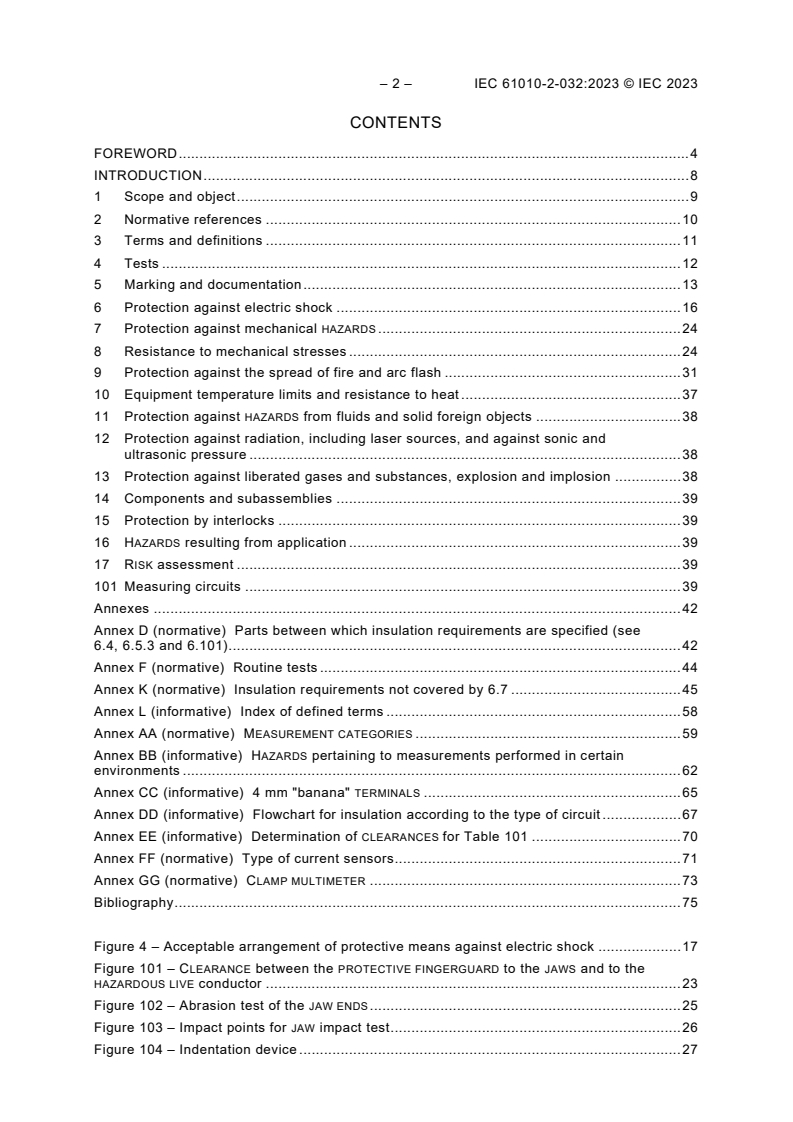
CONTENTS
FOREWORD . 4
INTRODUCTION . 8
1 Scope and object . 9
2 Normative references . 10
3 Terms and definitions . 11
4 Tests . 12
5 Marking and documentation . 13
6 Protection against electric shock . 16
7 Protection against mechanical HAZARDS . 24
8 Resistance to mechanical stresses . 24
9 Protection against the spread of fire and arc flash . 31
10 Equipment temperature limits and resistance to heat . 37
11 Protection against HAZARDS from fluids and solid foreign objects . 38
12 Protection against radiation, including laser sources, and against sonic and
ultrasonic pressure . 38
13 Protection against liberated gases and substances, explosion and implosion . 38
14 Components and subassemblies . 39
15 Protection by interlocks . 39
16 HAZARDS resulting from application . 39
17 RISK assessment . 39
101 Measuring circuits . 39
Annexes . 42
Annex D (normative) Parts between which insulation requirements are specified (see
6.4, 6.5.3 and 6.101) . 42
Annex F (normative) Routine tests . 44
Annex K (normative) Insulation requirements not covered by 6.7 . 45
Annex L (informative) Index of defined terms . 58
Annex AA (normative) MEASUREMENT CATEGORIES . 59
Annex BB (informative) HAZARDS pertaining to measurements performed in certain
environments . 62
Annex CC (informative) 4 mm "banana" TERMINALS . 65
Annex DD (informative) Flowchart for insulation according to the type of circuit . 67
Annex EE (informative) Determination of CLEARANCES for Table 101 . 70
Annex FF (normative) Type of current sensors . 71
Annex GG (normative) CLAMP MULTIMETER . 73
Bibliography . 75
Figure 4 – Acceptable arrangement of protective means against electric shock . 17
Figure 101 – CLEARANCE between the PROTECTIVE FINGERGUARD to the JAWS and to the
HAZARDOUS LIVE conductor . 23
Figure 102 – Abrasion test of the JAW ENDS . 25
Figure 103 – Impact points for JAW impact test . 26
Figure 104 – Indentation device . 27
Figure 105 – Example of a current sensor with strain reliefs . 29
Figure 106 – Flexing test . 30
Figure 107 – Test probe to check protection against short-circuits . 36
Figure 108 – Use of the test probe of Figure 107 . 36
Figure D.101 – Parts of current sensors (see also Table D.101) . 42
Figure K.101 – CLEARANCES between the conductor, the input/output circuit and the
enclosure of a Type A current sensor . 49
Figure K.102 – Test circuit for evaluation of TRANSIENT OVERVOLTAGE attenuation . 52
Figure AA.1 – Example to identify the locations of MEASUREMENT CATEGORIES . 60
Figure CC.1 – Recommended dimensions of 4 mm TERMINALS . 66
Figure DD.1 – Requirements for CLEARANCE, CREEPAGE DISTANCE and solid insulation . 69
Figure FF.1 – Examples of current sensors and their parts . 72
Figure GG.1 – Examples of CLAMP MULTIMETERS . 73
Table 1 – Symbols . 13
Table 101 – CLEARANCES for unmated measuring circuit TERMINALS. 18
Table 102 – Energy level for JAW impact test . 26
Table 103 – Pull forces for endcaps of flexible current sensors . 28
Table 104 – Pull forces for input/output lead attachment test . 31
Table 105 – Thickness of the test probe of Figure 107 and test voltages. 37
Table D.101 – Insulation requirements for current sensors . 43
Table K.15 – CLEARANCE values for the calculation of K.3.2 . 46
Table K.16 – Test voltages based on CLEARANCES . 47
Table K.101 – Impulse voltages for circuits connected to MAINS . 51
Table K.102 – CLEARANCES for measuring circuits RATED for MEASUREMENT CATEGORIES . 53
Table K.103 – Impulse test voltages for testing electric strength of solid insulation for
measuring circuits RATED for MEASUREMENT CATEGORIES . 54
Table K.104 – a.c. test voltages for testing electric strength of solid insulation for
measuring circuits RATED for MEASUREMENT CATEGORIES . 54
Table K.105 – Minimum values for distance or thickness of solid insulation for
measuring circuits RATED for MEASUREMENT CATEGORIES . 56
Table AA.1 – Characteristics of MEASUREMENT CATEGORIES . 61
Table EE.1 – CLEARANCE values for Table 101 . 70
– 4 – IEC 61010-2-032:2023 © IEC 2023
INTERNATIONAL ELECTROTECHNICAL COMMISSION
____________
SAFETY REQUIREMENTS FOR ELECTRICAL EQUIPMENT
FOR MEASUREMENT, CONTROL, AND LABORATORY USE –
Part 2-032: Particular requirements for hand-held and hand-manipulated
current sensors for electrical test and measurement
FOREWORD
1) The International Electrotechnical Commission (IEC) is a worldwide organization for standardization comprising
all national electrotechnical committees (IEC National Committees). The object of IEC is to promote international
co-operation on all questions concerning standardization in the electrical and electronic fields. To this end and
in addition to other activities, IEC publishes International Standards, Technical Specifications, Technical Reports,
Publicly Available Specifications (PAS) and Guides (hereafter referred to as "IEC Publication(s)"). Their
preparation is entrusted to technical committees; any IEC National Committee interested in the subject dealt with
may participate in this preparatory work. International, governmental and non-governmental organizations liaising
with the IEC also participate in this preparation. IEC collaborates closely with the International Organization for
Standardization (ISO) in accordance with conditions determined by agreement between the two organizations.
2) The formal decisions or agreements of IEC on technical matters express, as nearly as possible, an international
consensus of opinion on the relevant subjects since each technical committee has representation from all
interested IEC National Committees.
3) IEC Publications have the form of recommendations for international use and are accepted by IEC National
Committees in that sense. While all reasonable efforts are made to ensure that the technical content of IEC
Publications is accurate, IEC cannot be held responsible for the way in which they are used or for any
misinterpretation by any end user.
4) In order to promote international uniformity, IEC National Committees undertake to apply IEC Publications
transparently to the maximum extent possible in their national and regional publications. Any divergence between
any IEC Publication and the corresponding national or regional publication shall be clearly indicated in the latter.
5) IEC itself does not provide any attestation of conformity. Independent certification bodies provide conformity
assessment services and, in some areas, access to IEC marks of conformity. IEC is not responsible for any
services carried out by independent certification bodies.
6) All users should ensure that they have the latest edition of this publication.
7) No liability shall attach to IEC or its directors, employees, servants or agents including individual experts and
members of its technical committees and IEC National Committees for any personal injury, property damage or
other damage of any nature whatsoever, whether direct or indirect, or for costs (including legal fees) and
expenses arising out of the publication, use of, or reliance upon, this IEC Publication or any other IEC
Publications.
8) Attention is drawn to the Normative references cited in this publication. Use of the referenced publications is
indispensable for the correct application of this publication.
9) Attention is drawn to the possibility that some of the elements of this IEC Publication may be the subject of patent
rights. IEC shall not be held responsible for identifying any or all such patent rights.
IEC 61010-2-032 has been prepared by IEC technical committee 66: Safety of measuring,
control and laboratory equipment. It is an International Standard.
This fifth edition cancels and replaces the fourth edition published in 2019. This edition
constitutes a technical revision.
This edition includes the following significant technical changes with respect to the previous
edition:
a) In 1.1.1, definitions of current sensor types have been moved to a new Annex FF;
b) Clause 2, all normative references have been dated and new normative references have
been added;
c) 3.2.103, a new definition PROTECTIVE FINGERGUARD has been added which replaces the
PROTECTIVE BARRIER;
previous definition of
d) 4.4.2.101 is a new subclause about surge protective devices;
e) in 5.1.5.101.2, minimum RATINGS for voltage of measuring TERMINALS are required;
f) Subclause 6.5.1 has been modified;
g) Subclause 6.5.5 is no longer used;
h) Subclause 6.6.101 modifies 6.6.101 and 6.6.102 of previous edition:
1) in 6.6.101.1, insulating material of group I may be allowed for determination of CREEPAGE
DISTANCES of measuring circuit TERMINALS;
2) in 6.6.101.2, CLEARANCES and CREEPAGE DISTANCES up to 3 000 V for measuring circuit
TERMINALS in unmated position have been defined;
3) in 6.6.101.3, requirements for measuring circuit TERMINALS in partially mated position
have been specified;
4) in 6.6.101.4, requirements for measuring circuit TERMINALS in mated position have been
specified;
5) Subclause 6.6.101.5 replaces 6.6.102;
i) Subclause 6.6.102 replaces 6.101 of previous edition with modifications;
j) Subclause 6.101.2 replaces 6.9.101.1 of previous edition with modifications;
k) Subclause 6.101.3 replaces 6.9.101.2 of previous edition with modifications;
l) Subclause 6.101.4 replaces 6.9.102 of previous edition with modifications;
m) in 8.101, JAW ENDS abrasion test has been modified;
n) 8.105 is a new subclause for input/output leads attachment has been added;
o) in 9.101.2, relocation of 101.3 of previous edition;
p) in 9.101.3, relocation of 101.4 of previous edition, extension to MEASUREMENT CATEGORY II
and reference to IEC 61000-4-5 for tests;
q) Table 104 has been replaced by Table K.101;
r) in 9.102, relocation of Clause 102 of previous edition;
s) in 14.101, relocation of 14.102. Subclause 14.101 of previous edition has been deleted;
HAZARD occurring from reading a voltage
t) 101.3 is a new subclause for protections against
value in replacement of Clause EE.5 of previous edition;
u) in Table D.101, transients are disregarded for insulation between JAW ENDS and input/output
circuits;
v) in Clause F.101, test voltages for routine test of JAWS have been modified;
w) in K.2.1, another method for determination of CLEARANCES of secondary circuits is proposed;
x) in K.3.2, new Table K.15 and Table K.16 for CLEARANCE calculation;
y) K.3.101 is a new clause;
z) Clause K.4, redraft of the clause to propose a method for determination of U for circuits
t
which reduce TRANSIENT OVERVOLTAGES;
aa) Table K.101 replaces Table 104;
bb) Subclause K.101.4 has been reviewed and tables and tests for solid insulation have been
modified;
cc) Table K.104 of previous edition has been deleted;
dd) Annex AA: Figure AA.1 has been redesigned;
ee) Annex EE: addition of a new informative annex for determination of CLEARANCES for
Table 101;
ff) Annex GG: this annex was Annex EE of previous edition and the current sensor type of a
CLAMP MULTIMETER is type A or type B.
– 6 – IEC 61010-2-032:2023 © IEC 2023
The text of this International Standard is based on the following documents:
Draft Report on voting
66/788A/FDIS 66/798/RVD
Full information on the voting for its approval can be found in the report on voting indicated in
the above table.
The language used for the development of this International Standard is English.
This document was drafted in accordance with ISO/IEC Directives, Part 2, and developed in
accordance with ISO/IEC Directives, Part 1 and ISO/IEC Directives, IEC Supplement, available
at www.iec.ch/members_experts/refdocs. The main document types developed by IEC are
described in greater detail at www.iec.ch/publications.
A list of all parts of the IEC 61010 series, under the general title Safety requirements for
electrical equipment for measurement, control, and laboratory use, can be found on the IEC
website.
This document is to be used in conjunction with IEC 61010-1:2010 and
IEC 61010-1:2010/AMD1:2016.
This document supplements or modifies the corresponding clauses in IEC 61010-1 so as to
convert that publication into the IEC standard: Particular requirements for hand-held and
hand-manipulated current sensors for electrical test and measurement.
Where a particular subclause of IEC 61010-1 is not mentioned in this document, that subclause
applies as far as is reasonable. Where this document states "addition", "modification",
"replacement", or "deletion", the relevant requirement, test specification or note in IEC 61010-1
should be adapted accordingly.
In this standard:
a) the following print types are used:
– requirements: in roman type;
– NOTES: in small roman type;
– conformity and tests: in italic type;
– terms used throughout this standard which have been defined in Clause 3: SMALL ROMAN
CAPITALS;
b) subclauses, figures, tables and notes which are additional to those in IEC 61010-1 are
numbered starting from 101. Additional annexes are lettered starting from AA and additional
list items are lettered from aa).
The committee has decided that the contents of this document will remain unchanged until the
stability date indicated on the IEC website under webstore.iec.ch in the data related to the
specific document. At this date, the document will be
• reconfirmed,
• withdrawn,
• replaced by a revised edition, or
• amended.
IMPORTANT – The "colour inside" logo on the cover page of this document indicates
that it contains colours which are considered to be useful for the correct understanding
of its contents. Users should therefore print this document using a colour printer.
– 8 – IEC 61010-2-032:2023 © IEC 2023
INTRODUCTION
IEC 61010-1 specifies the safety requirements that are generally applicable to all equipment
within its scope. For certain types of equipment, the requirements of IEC 61010-1 and its
amendment will be supplemented or modified by the special requirements of one or more
standard from the IEC 61010-2 series which is/are read in conjunction with the requirements of
IEC 61010-1.
1) IEC 61010-2-030:2023 specifies the safety requirements for equipment with testing or
measuring circuits which are connected for test or measurement purposes to devices or
circuits outside the measurement equipment itself.
2) This document specifies the safety requirements for hand-held and hand-manipulated
current sensors for measuring, detecting or injecting current, or indicating current
waveforms on circuits without physically opening the current path of the circuit being
measured.
Most of the requirements of IEC 61010-2-030:2023 have been included in this document.
Equipment within the scopes of both IEC 61010-2-030:2023 and this document is
considered to be covered by the requirements of this document.
However, for current sensors in combined equipment with protective bonding and automatic
disconnection of the supply, IEC 61010-2-030:2023 and this document are read in
conjunction.
3) IEC 61010-2-033:2023 specifies the safety requirements for hand-held multimeters and
other meters for domestic and professional use, capable of measuring mains voltage,
intended to measure voltage and other electrical quantities such as resistance or current.
All relevant requirements of IEC 61010-2-030 have been included in IEC 61010-2-033:2023.
4) IEC 61010-2-034:2023 specifies the safety requirements for measurement equipment for
insulation resistance and test equipment for electric strength which are connected to units,
lines or circuits for test or measurement purposes.
All relevant requirements of IEC 61010-2-030:2023 have been included in
IEC 61010-2-034:2023. However, for equipment within the scope of this document and
IEC 61010-2-034:2023, these standards are read in conjunction.
IEC 61010-031 specifies the safety requirements for hand-held and hand-manipulated probe
assemblies and their related accessories intended to be used in particular with equipment in
the scope of IEC 61010-2-030, this document, IEC 61010-2-033 and IEC 61010-2-034. These
probe assemblies are for non-contact or direct electrical connection between a part and
electrical test and measurement equipment. They may be fixed to the equipment or be
detachable accessories for the equipment.
SAFETY REQUIREMENTS FOR ELECTRICAL EQUIPMENT
FOR MEASUREMENT, CONTROL, AND LABORATORY USE –
Part 2-032: Particular requirements for hand-held and hand-manipulated
current sensors for electrical test and measurement
1 Scope and object
IEC 61010-1:2010, Clause 1 and IEC 61010-1:2010/AMD1:2016, Clause 1 apply except as
follows:
1.1.1 Equipment included in scope
Replace the existing text with the following:
This document specifies safety requirements for HAND-HELD and hand-manipulated current
sensors intended for measuring, detecting or injecting current, or indicating current waveforms
on circuits without physically opening the current path of the circuit being measured.
These current sensors are hand-manipulated before and/or after a test or measurement, but
are not necessarily HAND-HELD during the test or measurement. They can be stand-alone current
sensors or accessories to other equipment or parts of combined equipment. These include
measurement circuits which are part of electrical test and measurement equipment, laboratory
equipment, or process control equipment.
NOTE 1 Combined equipment is equipment that is electrically connected to a current sensor by means of a
permanent connection which can be detached only by the use of a TOOL.
NOTE 2 Some current sensors are also known as current clamps, CLAMP MULTIMETERS and current probes.
The types of current sensors covered by this document are defined in Annex FF.
1.1.2 Equipment excluded from scope
Add the following new paragraph:
This document does not apply to current sensors used as FIXED EQUIPMENT.
1.2.1 Aspects included in scope
Replace item c) of the second paragraph with the following new item c):
c) spread of fire or arc flash from the current sensor (see Clause 9);
Replace the third paragraph with the following two new paragraphs:
Requirements for protection against HAZARDS arising from NORMAL USE, REASONABLY
FORESEEABLE MISUSE and ergonomic factors are specified in Clause 16, Clause 101 and
Annex GG.
Annex BB provides guidance to equipment manufacturers on HAZARDS that should be
considered for equipment intended for performing tests and measurements on hazardous
conductors, including MAINS conductors and telecommunication network conductors.
– 10 – IEC 61010-2-032:2023 © IEC 2023
2 Normative references
IEC 61010-1:2010, Clause 2 and IEC 61010-1:2010/AMD1:2016, Clause 2 apply except as
follows:
Replace the following existing normative references:
IEC 60068-2-75, Environmental testing – Part 2-75: Tests – Test Eh: Hammer tests
IEC 60364-4-44:2007, Low-voltage electrical installations – Part 4-44: Protection for safety –
Protection against voltage disturbances and electromagnetic disturbances
IEC 60364-4-44:2007/AMD1:2015
IEC 61010-031, Safety requirements for electrical equipment for measurement, control and
laboratory use – Part 031: Safety requirements for hand-held probe assemblies for electrical
measurement and test
IEC 61180 (all parts), High-voltage test techniques for low-voltage equipment
IEC 61180-1, High-voltage test techniques for low-voltage equipment – Part 1: Definitions, test
and procedure requirements
IEC 61180-2, High-voltage test techniques for low-voltage equipment – Part 2: Test equipment
IEC 62262, Degrees of protection provided by enclosures for electrical equipment against
external impacts (IK code)
with the following new normative references:
IEC 60068-2-75:2014, Environmental testing – Part 2-75: Tests – Test Eh: Hammer tests
IEC 60364-4-44:2007, Low-voltage electrical installations – Part 4-44: Protection for safety –
Protection against voltage disturbances and electromagnetic disturbances
IEC 60364-4-44:2007/AMD1:2015
IEC 60364-4-44:2007/AMD2:2018
IEC 61010-031:2022, Safety requirements for electrical equipment for measurement, control,
and laboratory use – Part 031: Safety requirements for hand-held and hand-manipulated probe
assemblies for electrical test and measurement
IEC 61180:2016, High-voltage test techniques for low-voltage equipment – Definitions, test and
procedure requirements, test equipment
IEC 62262:2002, Degrees of protection provided by enclosures for electrical equipment against
external mechanical impacts (IK code)
IEC 62262:2002/AMD1:2021
Add the following new normative reference:
IEC 61000-4-5:2014, Electromagnetic compatibility (EMC) – Part 4-5: Testing and
measurement techniques – Surge immunity test
IEC 61000-4-5:2014/AMD1:2017
___________
"IEC 61180:2016" replaces everywhere IEC 61180, IEC 61180-1 and IEC 61180-2 are referenced in
IEC 61010-1.
3 Terms and definitions
IEC 61010-1:2010, Clause 3 and IEC 61010-1:2010/AMD1:2016, Clause 3 apply except as
follows:
3.1 Equipment and states of equipment
Add the following two new terms and definitions:
3.1.101
HAND-HELD
intended to be supported by one hand during NORMAL USE
3.1.102
CLAMP MULTIMETER
HAND-HELD multi-range and multifunction measuring instrument intended to measure current on
a live MAINS without physically opening the conductors, voltage on a live MAINS and other
electrical quantities such as resistance
3.2 Parts and accessories
Add the following three new terms and definitions:
3.2.101
JAW
part of a current sensor which surrounds or partially surrounds the conductor under test
3.2.102
JAW END
part of the JAW where opening occurs while clamping around a conductor
3.2.103
PROTECTIVE FINGERGUARD
part of the enclosure that indicates the limit of safe access and that reduces the risk of the
operator touching HAZARDOUS LIVE parts
3.5 Safety terms
Replace the definition of 3.5.4 with the following new definition:
3.5.4
MAINS
electricity supply system
Add the following new term and definition:
3.5.101
MEASUREMENT CATEGORY
classification of testing and measuring circuits according to the type of MAINS to which they are
intended to be connected
– 12 – IEC 61010-2-032:2023 © IEC 2023
3.6 Insulation
Add the following new term and definition:
3.6.101
UNINSULATED CONDUCTOR
conductor which is not insulated by solid insulation or which is insulated by solid insulation that
does not meet the requirements for BASIC INSULATION for the relevant voltage to earth
4 Tests
IEC 61010-1:2010, Clause 4 and IEC 61010-1:2010/AMD1:2016, Clause 4 apply except as
follows:
4.3.2.5 MAINS supply
Replace the existing title and text with the following:
4.3.2.5 Power supply
The following requirements apply:
a) the voltage of the power supply connected to the MAINS shall be between 90 % and 110 %
of any RATED supply voltage for which the current sensor can be set or, if the current sensor
is RATED for a greater fluctuation, at any supply voltage within the fluctuation range;
b) the MAINS frequency shall be any RATED frequency;
c) current sensors for both a.c. and d.c. shall be connected to an a.c. or d.c. supply;
d) current sensors powered from MAINS by single-phase a.c. shall be connected both with
normal and reverse polarity;
e) if the means of connection permit reversal, battery-operated and d.c. current sensors shall
be connected with both reverse and normal polarity.
4.3.2.6 Input and output voltages
Replace the existing title and text with the following:
4.3.2.6 Input and output voltages or currents
Input and output voltages or currents, including floating voltages but excluding the supply
voltage Connected to the MAINS, shall be set to any voltage or current within their RATED range,
in normal and reverse polarity if possible.
4.4.2.8 Outputs
Replace the text with the following:
Outputs shall be open-circuited and short-circuited, one at a time.
Add the following new subclause:
4.4.2.101 Surge protective devices
MAINS CIRCUITS or in circuits measuring MAINS shall be
Surge protective devices used in
short-circuited and open-circuited.
5 Marking and documentation
IEC 61010-1:2010, Clause 5 and IEC 61010-1:2010/AMD1:2016, Clause 5 apply except as
follows:
5.1.2 Identification
Add the following new list items and add a new paragraph before the conformity statement:
aa) for current sensors designed for use only with a specific model of equipment, a clear
identification of the equipment, or with symbol 14 of Table 1 if this information is available
only in the documentation;
bb) for Type A current sensors, with symbol 102 of Table 1;
cc) for Type B and Type C current sensors, with symbol 101 of Table 1;
dd) for Type D current sensors, with symbol 101 and symbol 14 of Table 1.
The relevant symbol (14, 101 or 102) shall be marked adjacent to the JAWS or adjacent to the
marking of the MEASUREMENT CATEGORY for the JAWS, if present (see 5.1.5.101 and 5.1.5.102).
Table 1 – Symbols
Add the following two new symbols:
Number Symbol Reference Description
Do not apply current sensor to or remove from
HAZARDOUS LIVE UNINSULATED CONDUCTORS, which
may render electric shock, electric burn, or arc
flash
To indicate that the current sensor can safely be
102 IEC 60417-6300 (2016-03) used with UNINSULATED HAZARDOUS LIVE
CONDUCTORS
5.1.5 TERMINALS, connections and operating devices
Add the following new subclause:
5.1.5.101 Measuring circuit TERMINALS
5.1.5.101.1 General
Some measuring circuit TERMINALS for the current sensor within the scope of this document also
TERMINALS.
serve as output
Except as permitted in 5.1.5.101.4:
MAINS being measured
a) the value of the nominal a.c. r.m.s. line-to-neutral or d.c. voltage of
shall be marked for measuring circuit TERMINALS RATED for MEASUREMENT CATEGORIES, or the
value of the RATED voltage to earth for other measuring circuit TERMINALS, and
NOTE CLEARANCES and solid insulation for MEASUREMENT CATEGORIES are specified for a nominal a.c. r.m.s.
line-to-neutral or d.c. voltage of MAINS being measured. Neutral is considered to be earthed (see Annex I).
b) the value of the RATED voltage or the RATED current, as applicable, of each pair or set of
measuring circuit TERMINALS that are intended to be used together shall be marked, and
– 14 – IEC 61010-2-032:2023 © IEC 2023
c) the pertinent MEASUREMENT CATEGORY for each individual, pair, or set of measuring circuit
TERMINALS, or symbol 14 of Table 1 shall be marked as specified in 5.1.5.101.2 and
5.1.5.101.3, if applicable.
Measuring circuit TERMINALS are usually arranged in pairs or sets. Each pair or set of TERMINALS
may have a RATED voltage or a RATED current, or both, within that set, and each individual
TERMINAL may have a RATED voltage to earth. For some current sensors, the RATED voltage
between TERMINALS may be different from the RATED voltage to earth. Markings shall be clear
to avoid misunderstanding.
Symbol 14 of Table 1 shall be marked if current measuring TERMINALS are not intended for
connection to current transformers without internal protection (see 101.2).
Markings shall be placed adjacent to the TERMINALS. However, if there is insufficient space (as
in multi-input current sensor), the marking may be on the RATING plate or scale plate, or the
TERMINAL may be marked with symbol 14 of Table 1.
For any set of measuring circuit TERMINALS, symbol 14 of Table 1 does not need to be marked
more than once, if it is close to the TERMINALS.
Conformity is checked by inspection and, if applicable, as specified in 5.1.5.101.2 and
5.1.5.101.3, taking the exceptions in 5.1.5.101.4 into account.
5.1.5.101.2 Measuring circuit TERMINALS RATED for MEASUREMENT CATEGORIES
The relevant MEASUREMENT CATEGORY shall be marked for TERMINALS of measuring circuits
RATED for MEASUREMENT CATEGORIES. The MEASUREMENT CATEGORY markings shall be "CAT II",
"CAT III" or "CAT IV" as applicable.
The RATED voltage of the TERMINALS of a measuring circuit intended for MAINS voltage
measurements shall be equal to or higher than their RATED a.c. r.m.s. line-to-neutral or d.c.
voltage.
Marking those TERMINALS with more than one type of MEASUREMENT CATEGORY and its RATED
voltage is permissible.
Conformity is checked by inspection.
5.1.5.101.3 Measuring circuit TERMINALS RATED for connection to voltages above the
levels of 6.3.1
Symbol 14 of Table 1 shall be marked adjacent to the TERMINALS for measuring circuit TERMINALS
RATED for connection to voltages above the levels of 6.3.1, but that are not RATED for
MEASUREMENT CATEGORIES (see also 5.4.1 bb).
Conformity is checked by inspection.
5.1.5.101.4 Measuring circuit TERMINALS which are permanently connected, dedicated,
or for non-HAZARDOUS LIVE voltages
It is not necessary to mark measuring circuit TERMINALS if:
a) they are intended to be permanently connected and not ACCESSIBLE (see 5.4.3 aa) and bb)),
or
b) they are dedicated only for connection to specific TERMINALS of other equipment, or
c) it is obvious from other indications that the RATED voltage does not exceed the levels of
6.3.1.
NOTE Examples of acceptable indications that the RATED voltage of the inputs are intended to not exceed the
levels of 6.3.1 include:
– the full scale deflection marking of a single-range indicating voltmeter or ammeter or maximum marking of
a multi-range CLAMP MULTIMETER;
– the maximum range marking of a voltage selector switch;
– a marked voltage or power RATING expressed in dB, mW or W, where the equivalent value, as explained in
the documentation, does not exceed 30 V a.c.
Conformity is checked by inspection.
5.1.5.102 Voltage and current RATINGS of JAWS
Current sensors that are intended to be used on UNINSULATED CONDUCTORS shall be marked
with the value of the nominal a.c. r.m.s. line-to-neutral or d.c. voltage of MAINS being measured
when JAWS are RATED for MEASUREMENT CATEGORIES, otherwise with the value of the RATED
voltage to earth of the JAWS.
JAWS of Type A, Type B or Type C current sensors RATED for MEASUREMENT CATEGORIES, shall
be marked with the relevant MEASUREMENT CATEGORY adjacent to the a.c. r.m.s. line-to-neutral
or d.c. voltage marking (see also note of 5.1.5.101.1). The MEASUREMENT CATEGORY markings
shall be "CAT II", "CAT III" or "CAT IV" as applicable.
JAWS and output circuit TERMINALS of Type D current sensors shall not be marked with any
MEASUREMENT CATEGORY.
The value of the RATED current shall be marked on or close to the JAWS. The nature of the
current shall also be marked unless the marked value applies to both a.c. and d.c.
Conformity is checked by inspection.
5.4.1 General
Add the following two new items to the list and a new paragraph at the end of the list:
aa) information about each relevant MEASUREMENT CATEGORY if the measuring circuit is RATED
for MEASUREMENT CATEGORIES (see 5.1.5.101.2 and 5.1.5.102);
bb) for Type A, Type B and Type C current sensors that are not RATED for MEASUREMENT
CATEGORIES, but that could be misused by connection to such circuits, a warning not to
use the current sensor for measurements on MAINS, and a detailed RATING including
TRANSIENT OVERVOLTAGES (see AA.2.4 for more information).
Some current sensors may have multiple MEASUREMENT CATEGORY RATINGS for the same
measuring circuit. For such current sensors, the documentation shall clearly identify the
MEASUREMENT CATEGORIES where the current sensor is intended to be used and where it shall
not be used.
5.4.3 Equipment installation
Add the following two new items to the list:
aa) for measuring circuit TERMINALS intended for permanent connection and that are RATED
for MEASUREMENT CATEGORIES, information regarding the MEASUREMENT CATEGORY, RATED
voltages or RATED currents as applicable (see 5.1.5.101.2 and 5.1.5.102);
bb) for measuring circuit TERMINALS intended for permanent connection and that are not RATED
for MEASUREMENT CATEGORIES, information regarding the RATED voltages, RATED currents,
and RATED TRANSIENT OVERVOLTAGES as applicable (see 5.1.5.101.4 and 5.1.5.102).
– 16 – IEC 61010-2-032:2023 © IEC 2023
5.4.4 Equipment operation
Replace the existing text with the following:
Instructions for use shall include, if applicable:
a) identification and description of operating controls and their use in all operating modes;
b) for current sensors designed for use only with a specific model of equipment, a clear
identification of the equipment;
c) specifications of limits for intermittent operation;
d) specifications of limits of the curr
...