


IEC TR 61334-1-2:1997
(Main)Distribution automation using distribution line carrier systems - Part 1-2: General considerations - Guide for specification
Distribution automation using distribution line carrier systems - Part 1-2: General considerations - Guide for specification
Is a technical report of type 3 and offers useful information to design a distribution automation system using distribution line carrier systems for a specific application.
This publication is of high relevance for Smart Grid.
Automatisation de la distribution à l'aide de systèmes de communication à courants porteurs - Partie 1-2: Considérations générales - Guide pour la spécification
Est un rapport technique de type 3 et apporte des informations utiles pour l'étude d'un système d'automatisation de la distribution à l'aide de systèmes de communication à courants porteurs pour une application spécifique.
General Information
- Status
- Published
- Publication Date
- 14-Dec-1997
- Technical Committee
- TC 57 - Power systems management and associated information exchange
- Drafting Committee
- WG 9 - TC 57/WG 9
- Current Stage
- PPUB - Publication issued
- Start Date
- 15-Dec-1997
- Completion Date
- 31-Dec-1997
Overview
IEC TR 61334-1-2:1997 is an international technical report published by the International Electrotechnical Commission (IEC). It provides essential guidance for designing distribution automation systems (DAS) that utilize distribution line carrier (DLC) systems, specifically targeting applications within medium and low voltage power distribution networks. As a type 3 technical report, this document offers practical information for the specification, evaluation, and implementation of DLC-based automation solutions, supporting the development of Smart Grid infrastructures worldwide.
Distribution automation is critical for enhancing the reliability, efficiency, and intelligence of power distribution networks. By leveraging DLC systems, utilities can achieve two-way communication using existing power lines, minimizing infrastructure changes and costs.
Key Topics
IEC TR 61334-1-2:1997 addresses several important considerations for distribution automation using distribution line carrier systems:
- System Architecture Choices: Guidance on selecting appropriate DAS architectures, accommodating both network automation and customer service automation requirements.
- Network Description: Outlines the necessary steps to accurately map and document the distribution network, including substations, feeders, and customer connections.
- Functional Requirements:
- Network Automation Functions: Surveillance, control, measurement, and fault detection aimed at improving electricity supply quality.
- Customer Automation Functions: Services for monitoring and managing end-user connections.
- Performance Requirements:
- Bit error rate (BER)
- Data integrity and throughput
- Availability and response time
- Data confidentiality and residual error rate
- Coupling Methods: Comparison of different coupling technologies, such as parallel and serial coupling, to optimize communication signal transfer over power lines.
- Quality Assurance:
- Documentation and planning based on ISO 9000 series standards
- Strategies for ensuring long-term reliability and compliance
- Annexes:
- Evaluation of different modulation techniques (e.g., narrow-band and wide-band)
- Framework for quality plan development
Applications
This standard serves as a comprehensive guide for engineers and technical managers who are specifying, designing, or upgrading distribution automation systems using DLC technologies. Its applications include:
- Smart Grid Development: Key resource for utilities adopting smart grid technologies, enabling remote monitoring, automation, and control over distribution networks.
- Network Modernization: Supports the transition from manual or legacy systems toward intelligent, automated distribution infrastructure.
- Performance Optimization: Helps ensure that systems are designed with adequate reliability, data integrity, and communication quality suited to real-world conditions.
- Cost and Resource Efficiency: Encourages the use of existing power lines for data transmission, minimizing new cabling and reducing deployment costs.
Related Standards
IEC TR 61334-1-2:1997 refers to and complements several international standards:
- IEC 61334-1-1 - Distribution automation system architecture
- IEC 60358 - Coupling capacitors and capacitor dividers
- IEC 60481 - Coupling devices for power line carrier systems
- IEC 60870-5-1 - Telecontrol transmission protocols
- ISO/IEC 8072, 8073 - OSI transport services and protocols
- ISO 9000 series - Quality management and assurance standards
Relevant keywords: distribution automation, distribution line carrier (DLC), smart grid, IEC 61334, power system communications, DAS architecture, network automation, customer automation, quality assurance, power line communication (PLC).
IEC TR 61334-1-2:1997 is a key standard for utilities, smart grid implementers, and equipment manufacturers seeking to optimize distribution automation using distribution line carrier systems-guiding effective specification, performance assessment, and quality assurance in modern power distribution environments.
Get Certified
Connect with accredited certification bodies for this standard

ANCE
Mexican certification and testing association.

Intertek Slovenia
Intertek testing, inspection, and certification services in Slovenia.

LNE (Laboratoire National de Métrologie et d'Essais)
French national laboratory for metrology and testing.
Sponsored listings
Frequently Asked Questions
IEC TR 61334-1-2:1997 is a technical report published by the International Electrotechnical Commission (IEC). Its full title is "Distribution automation using distribution line carrier systems - Part 1-2: General considerations - Guide for specification". This standard covers: Is a technical report of type 3 and offers useful information to design a distribution automation system using distribution line carrier systems for a specific application. This publication is of high relevance for Smart Grid.
Is a technical report of type 3 and offers useful information to design a distribution automation system using distribution line carrier systems for a specific application. This publication is of high relevance for Smart Grid.
IEC TR 61334-1-2:1997 is classified under the following ICS (International Classification for Standards) categories: 33.200 - Telecontrol. Telemetering. The ICS classification helps identify the subject area and facilitates finding related standards.
IEC TR 61334-1-2:1997 is available in PDF format for immediate download after purchase. The document can be added to your cart and obtained through the secure checkout process. Digital delivery ensures instant access to the complete standard document.
Standards Content (Sample)
RAPPORT
CEI
TECHNIQUE
IEC
61334-1-2
TECHNICAL
Première édition
REPORT
First edition
1997-12
Automatisation de la distribution
à l'aide de systèmes de communication
à courants porteurs –
Partie 1-2:
Considérations générales –
Guide pour la spécification
Distribution automation using
distribution line carrier systems –
Part 1-2:
General considerations –
Guide for specification
Numéro de référence
Reference number
CEI/IEC 61334-1-2:1997
Numéros des publications Numbering
Depuis le 1er janvier 1997, les publications de la CEI As from 1 January 1997 all IEC publications are issued
sont numérotées à partir de 60000. with a designation in the 60000 series.
Publications consolidées Consolidated publications
Les versions consolidées de certaines publications de Consolidated versions of some IEC publications
la CEI incorporant des amendements sont disponibles. including amendments are available. For example,
Par exemple, les numéros d’édition 1.0, 1.1 et 1.2 edition numbers 1.0, 1.1 and 1.2 refer, respectively, to
indiquent respectivement la publication de base, la the base publication, the base publication incorporating
publication de base incorporant l’amendement 1, et la amendment 1 and the base publication incorporating
publication de base incorporant les amendements 1 amendments 1 and 2.
et 2.
Validité de la présente publication Validity of this publication
Le contenu technique des publications de la CEI est The technical content of IEC publications is kept under
constamment revu par la CEI afin qu'il reflète l'état constant review by the IEC, thus ensuring that the
actuel de la technique. content reflects current technology.
Des renseignements relatifs à la date de reconfirmation Information relating to the date of the reconfirmation of
de la publication sont disponibles dans le Catalogue de the publication is available in the IEC catalogue.
la CEI.
Les renseignements relatifs à ces révisions, à l'établis- Information on the revision work, the issue of revised
sement des éditions révisées et aux amendements editions and amendments may be obtained from IEC
peuvent être obtenus auprès des Comités nationaux de la National Committees and from the following IEC
CEI et dans les documents ci-dessous: sources:
• Bulletin de la CEI • IEC Bulletin
• Annuaire de la CEI • IEC Yearbook
Accès en ligne* On-line access*
• Catalogue des publications de la CEI • Catalogue of IEC publications
Publié annuellement et mis à jour régulièrement Published yearly with regular updates
(Accès en ligne)* (On-line access)*
Terminologie, symboles graphiques Terminology, graphical and letter
et littéraux symbols
En ce qui concerne la terminologie générale, le lecteur For general terminology, readers are referred to IEC
se reportera à la CEI 60050: Vocabulaire Electro- 60050: International Electrotechnical Vocabulary (IEV).
technique International (VEI).
Pour les symboles graphiques, les symboles littéraux et For graphical symbols, and letter symbols and signs
les signes d'usage général approuvés par la CEI, le approved by the IEC for general use, readers are
referred to publications IEC 60027: Letter symbols to
lecteur consultera la CEI 60027: Symboles littéraux à
utiliser en électrotechnique, la CEI 60417: Symboles be used in electrical technology, IEC 60417: Graphical
graphiques utilisables sur le matériel. Index, relevé et symbols for use on equipment. Index, survey and
compilation des feuilles individuelles, et la CEI 60617: compilation of the single sheets and IEC 60617:
Symboles graphiques pour schémas. Graphical symbols for diagrams.
Publications de la CEI établies par IEC publications prepared by the same
le même comité d'études technical committee
L'attention du lecteur est attirée sur les listes figurant à The attention of readers is drawn to the end pages of
la fin de cette publication, qui énumèrent les this publication which list the IEC publications issued
publications de la CEI préparées par le comité d'études by the technical committee which has prepared the
qui a établi la présente publication. present publication.
* Voir adresse «site web» sur la page de titre. * See web site address on title page.
RAPPORT
CEI
TECHNIQUE – TYPE 3
IEC
61334-1-2
TECHNICAL
Première édition
REPORT – TYPE 3
First edition
1997-12
Automatisation de la distribution
à l'aide de systèmes de communication
à courants porteurs –
Partie 1-2:
Considérations générales –
Guide pour la spécification
Distribution automation using
distribution line carrier systems –
Part 1-2:
General considerations –
Guide for specification
IEC 1997 Droits de reproduction réservés Copyright - all rights reserved
Aucune partie de cette publication ne peut être reproduite ni No part of this publication may be reproduced or utilized in
utilisée sous quelque forme que ce soit et par aucun any form or by any means, electronic or mechanical,
procédé, électronique ou mécanique, y compris la photo- including photocopying and microfilm, without permission in
copie et les microfilms, sans l'accord écrit de l'éditeur. writing from the publisher.
International Electrotechnical Commission 3, rue de Varembé Geneva, Switzerland
Telefax: +41 22 919 0300 e-mail: inmail@iec.ch IEC web site http: //www.iec.ch
CODE PRIX
Commission Electrotechnique Internationale
PRICE CODE V
International Electrotechnical Commission
Pour prix, voir catalogue en vigueur
For price, see current catalogue
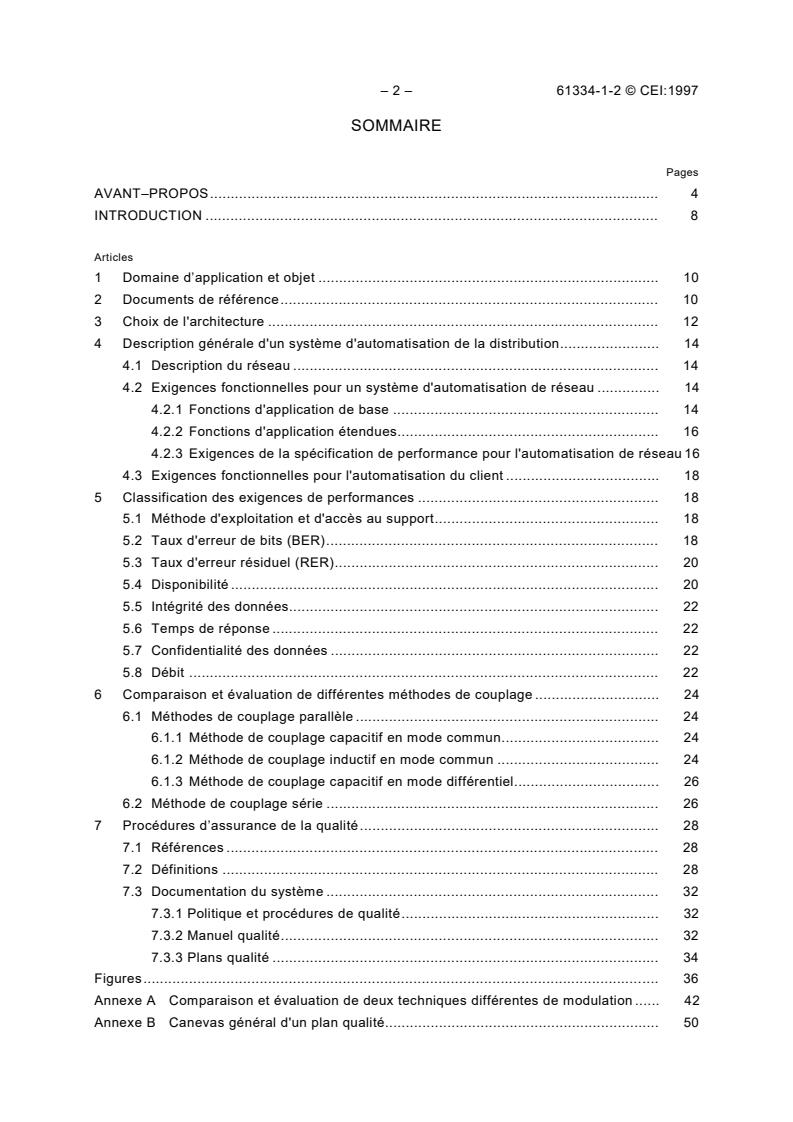
– 2 – 61334-1-2 © CEI:1997
SOMMAIRE
Pages
AVANT–PROPOS. 4
INTRODUCTION . 8
Articles
1 Domaine d’application et objet . 10
2 Documents de référence. 10
3 Choix de l'architecture . 12
4 Description générale d'un système d'automatisation de la distribution. 14
4.1 Description du réseau . 14
4.2 Exigences fonctionnelles pour un système d'automatisation de réseau . 14
4.2.1 Fonctions d'application de base . 14
4.2.2 Fonctions d'application étendues. 16
4.2.3 Exigences de la spécification de performance pour l'automatisation de réseau 16
4.3 Exigences fonctionnelles pour l'automatisation du client . 18
5 Classification des exigences de performances . 18
5.1 Méthode d'exploitation et d'accès au support. 18
5.2 Taux d'erreur de bits (BER). 18
5.3 Taux d'erreur résiduel (RER). 20
5.4 Disponibilité. 20
5.5 Intégrité des données. 22
5.6 Temps de réponse . 22
5.7 Confidentialité des données . 22
5.8 Débit . 22
6 Comparaison et évaluation de différentes méthodes de couplage . 24
6.1 Méthodes de couplage parallèle . 24
6.1.1 Méthode de couplage capacitif en mode commun. 24
6.1.2 Méthode de couplage inductif en mode commun . 24
6.1.3 Méthode de couplage capacitif en mode différentiel. 26
6.2 Méthode de couplage série . 26
7 Procédures d’assurance de la qualité. 28
7.1 Références. 28
7.2 Définitions . 28
7.3 Documentation du système . 32
7.3.1 Politique et procédures de qualité. 32
7.3.2 Manuel qualité. 32
7.3.3 Plans qualité . 34
Figures. 36
Annexe A Comparaison et évaluation de deux techniques différentes de modulation . 42
Annexe B Canevas général d'un plan qualité. 50
61334-1-2 © IEC:1997 – 3 –
CONTENTS
Page
FOREWORD . 5
INTRODUCTION. . 9
Clause
1 Scope and object . 11
2 Reference documents. 11
3 Choice of the architecture . 13
4 General description of a distribution automation system . 15
4.1 Description of the network. 15
4.2 Functional requirements for network automation system. 15
4.2.1 Basic application functions . 15
4.2.2 Extended application functions . 17
4.2.3 Performance specification for network automation requirements . 17
4.3 Functional requirements for customer automation . 19
5 Classification of performance requirements. 19
5.1 Operating and medium access mode. 19
5.2 Bit error rate (BER) . 19
5.3 Residual error rate (RER). 21
5.4 Availability. 21
5.5 Data integrity. 23
5.6 Response time. 23
5.7 Data confidentiality. 23
5.8 Throughput. 23
6 Comparison and valuation of different coupling methods . 25
6.1 Parallel coupling methods . 25
6.1.1 Common mode capacitive coupling methods . 25
6.1.2 Common mode inductive coupling method . 25
6.1.3 Differential mode capacitive coupling method . 27
6.2 Serial coupling method. 27
7 Quality assurance procedures. 29
7.1 References. 29
7.2 Definitions . 29
7.3 Documentation of the system . 33
7.3.1 Quality policies and procedures. 33
7.3.2 Quality manual. 33
7.3.3 Quality plans. 35
Figures. 37
Annex A Comparison and evaluation of two different modulation techniques . 43
Annex B General outline of a quality plan. 51
– 4 – 61334-1-2 © CEI:1997
COMMISSION ÉLECTROTECHNIQUE INTERNATIONALE
____________
AUTOMATISATION DE LA DISTRIBUTION À L’AIDE DE SYSTÈMES
DE COMMUNICATION À COURANTS PORTEURS –
Partie 1-2: Considérations générales –
Guide pour la spécification
AVANT-PROPOS
1) La CEI (Commission Electrotechnique Internationale) est une organisation mondiale de normalisation composée
de l'ensemble des comités électrotechniques nationaux (Comités nationaux de la CEI). La CEI a pour objet de
favoriser la coopération internationale pour toutes les questions de normalisation dans les domaines de
l'électricité et de l'électronique. A cet effet, la CEI, entre autres activités, publie des Normes internationales.
Leur élaboration est confiée à des comités d'études, aux travaux desquels tout Comité national intéressé par le
sujet traité peut participer. Les organisations internationales, gouvernementales et non gouvernementales, en
liaison avec la CEI, participent également aux travaux. La CEI collabore étroitement avec l'Organisation
Internationale de Normalisation (ISO), selon des conditions fixées par accord entre les deux organisations.
2) Les décisions ou accords officiels de la CEI concernant les questions techniques, représentent, dans la mesure
du possible un accord international sur les sujets étudiés, étant donné que les Comités nationaux intéressés
sont représentés dans chaque comité d’études.
3) Les documents produits se présentent sous la forme de recommandations internationales. Ils sont publiés
comme normes, rapports techniques ou guides et agréés comme tels par les Comités nationaux.
4) Dans le but d'encourager l'unification internationale, les Comités nationaux de la CEI s'engagent à appliquer de
façon transparente, dans toute la mesure possible, les Normes internationales de la CEI dans leurs normes
nationales et régionales. Toute divergence entre la norme de la CEI et la norme nationale correspondante doit
être indiquée en termes clairs dans cette dernière.
5) La CEI n’a fixé aucune procédure concernant le marquage comme indication d’approbation et sa responsabilité
n’est pas engagée quand un matériel est déclaré conforme à l’une de ses normes.
6) L’attention est attirée sur le fait que certains des éléments de la présente Norme internationale peuvent faire
l’objet de droits de propriété intellectuelle ou de droits analogues. La CEI ne saurait être tenue pour
responsable de ne pas avoir identifié de tels droits de propriété et de ne pas avoir signalé leur existence.
La tâche principale des comités d'études de la CEI est d'élaborer des Normes internationales.
Exceptionnellement, un comité d'études peut proposer la publication d'un rapport technique de
l'un des types suivants:
– type 1, lorsque, en dépit de maints effort, l'accord requis ne peut être réalisé en faveur de
la publication d'une Norme internationale;
– type 2, lorsque le sujet en question est encore en cours de développement technique ou
lorsque, pour une raison quelconque, la possibilité d'un accord pour la publication d'une
Norme internationale peut être envisagée pour l'avenir mais pas dans l'immédiat;
– type 3, lorsqu'un comité d'études a réuni des données de nature différente de celles qui
sont normalement publiées comme Normes internationales, cela pouvant comprendre, par
exemple, des informations sur l'état de la technique.
Les rapports techniques de types 1 et 2 font l'objet d'un nouvel examen trois ans au plus tard
après leur publication afin de décider éventuellement de leur transformation en Normes
internationales. Les rapports techniques de type 3 ne doivent pas nécessairement être révisés
avant que les données qu'ils contiennent ne soient plus jugées valables ou utiles.
La CEI 61334-1-2, rapport technique de type 3, a été établie par le comité d'études 57 de la
CEI: Conduite des systèmes de puissance et communications associées.
61334-1-2 © IEC:1997 – 5 –
INTERNATIONAL ELECTROTECNICAL COMMISSION
__________
DISTRIBUTION AUTOMATION USING
DISTRIBUTION LINE CARRIER SYSTEMS –
Part 1-2: General considerations –
Guide for specification
FOREWORD
1) The IEC (International Electrotechnical Commission) is a worldwide organization for standardization comprising
all national electrotechnical committees (IEC National Committees). The object of the IEC is to promote
international co-operation on all questions concerning standardization in the electrical and electronic fields. To
this end and in addition to other activities, the IEC publishes International Standards. Their preparation is
entrusted to technical committees; any IEC National Committee interested in the subject dealt with may
participate in this preparatory work. International, governmental and non-governmental organizations liaising
with the IEC also participate in this preparation. The IEC collaborates closely with the International Organization
for Standardization (ISO) in accordance with conditions determined by agreement between the two
organizations.
2) The formal decisions or agreements of the IEC on technical matters express, as nearly as possible, an
international consensus of opinion on the relevant subjects since each technical committee has representation
from all interested National Committees.
3) The documents produced have the form of recommendations for international use and are published in the form
of standards, technical reports or guides and they are accepted by the National Committees in that sense.
4) In order to promote international unification, IEC National Committees undertake to apply IEC International
Standards transparently to the maximum extent possible in their national and regional standards. Any
divergence between the IEC Standard and the corresponding national or regional standard shall be clearly
indicated in the latter.
5) The IEC provides no marking procedure to indicate its approval and cannot be rendered responsible for any
equipment declared to be in conformity with one of its standards.
6) Attention is drawn to the possibility that some of the elements of this International Standard may be the subject
of patent rights. The IEC shall not be held responsible for identifying any or all such patent rights.
The main task of IEC technical committees is to prepare International standards. In exceptional
circumstances, a technical committee may propose the publication of a technical report of one
of the following types:
– type 1, when the required support cannot be obtained for the publication of an International
standard, despite repeated efforts;
– type 2, when the subject is still under technical development or where for any other reason
there is the future but not immediate possibility of an agreement on an International
standard;
– type 3, when a technical committee has collected data of a different kind from that which is
normally published as an International standard, for example "state of the art".
Technical reports of types 1 and 2 are subject to review within three years of publication to
decide whether they can be transformed into International Standards. Technical reports of
type 3 do not necessarily have to be reviewed until the data they provide are considered to be
no longer valid or useful.
IEC 61334-1-2, which is a technical report of type 3, has been prepared by IEC technical
committee 57: Power system control and associated communications.
– 6 – 61334-1-2 © CEI:1997
Le texte de ce rapport technique est issu des documents suivants:
Projet de comité Rapport de vote
57/255/CDV 57/324/RVC
Le rapport de vote indiqué dans le tableau ci-dessus donne toute information sur le vote ayant
abouti à l'approbation de ce rapport technique.
La présente série des CEI 61334 concerne les systèmes d'automatisation de la distribution
faisant appel à des canaux de transmission bidirectionnels utilisant comme support physique
de transmission des données les lignes des réseaux de distribution moyenne et basse tension.
De tels canaux de communication seront dans ce qui suit dénommés «DLC», pour
«Distribution Line Carrier» (courants porteurs sur lignes de distribution).
Les systèmes d'automatisation de la distribution sont prévus pour offrir un grand nombre de
possibilités concernant deux applications principales: l'automatisation des réseaux et
l'automatisation des services aux abonnés.
Du fait que les réseaux moyenne et basse tension ont été conçus pour l'alimentation en
énergie électrique et que, de ce fait, ils ne peuvent offrir qu'un support médiocre aux
transmissions de données, des exigences sévères sont nécessaires pour assurer la
transmission correcte des données ainsi qu'une bonne disponibilité de communication, pour
rendre ces systèmes adaptés aux applications envisagées.
Le but de ce rapport technique est de fournir des informations adéquates pour obtenir une
conception correcte et un fonctionnement fiable de systèmes d'automatisation de la distribution
utilisant les DLC.
61334-1-2 © IEC:1997 – 7 –
The text of this technical report is based on the following documents:
Committee draft Report on voting
57/255/CDV 57/324/RVC
Full information on the voting for the approval of this technical report can be found in the report
on voting indicated in the above table.
This series of IEC 61334 concerns distribution automation systems supported by two-way
communication channels using medium and low voltage distribution power mains as data
transmission media.
Such communication channels will be referred as "DLC", which stands for distribution line
carrier.
Distribution automation systems are intended to provide a large amount of facilities related to
two main applications, concerning network automation and customer service automation.
As medium voltage and low voltage power mains have been designed for electric energy supply
and, consequently, can only offer poor performances for data transmission, stringent
requirements are necessary in order to ensure data integrity and transmission efficiency
suitable to the application needs.
The aim of this technical report is to provide adequate information for correct design and
reliable operation of distribution automation systems using DLC.
– 8 – 61334-1-2 © CEI:1997
INTRODUCTION
L'étude des systèmes d'automatisation de la distribution utilisant les lignes de distribution est
plutôt complexe, car elle implique la spécification d'une grande quantité d'informations
détaillées concernant:
– l'architecture des systèmes;
– les processus d'application;
– les paramètres optionnels;
– les équipements de traitement et de transmission;
– les interfaces entre les composants du système;
– les conditions d'environnement;
– les procédures d'assurance qualité.
La plupart des aspects mentionnés ci-dessus sont soit précisés dans des rapports techniques,
soit couverts par des Normes internationales ou dans des publications du CE 57 de la CEI et
dans les séries du CE 57 (GT 9) de la CEI sur les systèmes d'automatisation de la distribution
utilisant les systèmes de lignes de distribution; toutefois, beaucoup d'options sont disponibles
pour les ingénieurs qui doivent définir une application spécifique.
61334-1-2 © IEC:1997 – 9 –
INTRODUCTION
The design of distribution automation systems using distribution line carrier is quite complex,
as it involves the specification of a large amount of detailed information concerning:
– system architecture;
– application processes;
– operational parameters;
– processing and transmission equipment;
– interfaces between the components of the system;
– environmental conditions;
– quality assurance procedures.
Most of the above-mentioned aspects are clarified by technical reports or covered by
International standards either inside IEC TC 57 publications and within the IEC TC 57(WG 9)
series on distribution automation systems using distribution line carrier systems, but many
options are available to the engineers who have to design a specific application.
– 10 – 61334-1-2 © CEI:1997
AUTOMATISATION DE LA DISTRIBUTION À L’AIDE DE SYSTÈMES
DE COMMUNICATION À COURANTS PORTEURS –
Partie 1-2: Considérations générales –
Guide pour la spécification
1 Domaine d’application et objet
Le présent rapport technique de type 3 apporte des informations utiles pour l'étude d'un
système d'automatisation de la distribution (DAS) à l’aide de systèmes de communication à
courants porteurs (DLC) pour une application spécifique.
Pour des raison de clarté, les informations utiles à l'étude d'un système d'automatisation de la
distribution à l’aide de systèmes de communication à courants porteurs pour une application
spécifique ont été divisées en trois étapes:
– la première étape concerne les choix stratégiques déterminant l'architecture du système
d'automatisation de la distribution (article 3);
– la seconde étape traite des spécifications des processus d'application et des paramètres
optionnels d'exploitation (article 4);
– la troisième étape se réfère aux facilités que des équipements de traitement et des
équipements de transmission doivent fournir afin de couvrir les besoins de l'application
(article 5).
L’article 6 est dédié à une évaluation générale des diverses méthodes de couplage.
L’article 7 est affecté aux procédures d'assurance qualité afin de satisfaire aux besoins des
applications incluses dans un système DLC.
Ce rapport technique contient, en outre, deux annexes:
– l’annexe A contient une comparaison et une évaluation de deux techniques de modulation
différentes (modulation FSK en bande étroite et une modulation en large bande);
– l’annexe B contient le canevas général d'un plan qualité.
2 Documents de référence
CEI 60358:1990, Condensateurs de couplage et diviseurs capacitifs
CEI 60481:1974, Groupes de couplage pour systèmes à courants porteurs sur lignes d’énergie
CEI 60870-5-1:1990, Matériels et systèmes de téléconduite – Cinquième partie: Protocoles de
transmission – Section un: Formats de trames de transmission
CEI 61334-1-1:1995, Automatisation de la distribution à l’aide de systèmes de communication à
courants porteurs – Partie 1: Considérations générales – Section 1: Architecture des systèmes
d’automatisation de la distribution
61334-1-2 © IEC:1997 – 11 –
DISTRIBUTION AUTOMATION USING
DISTRIBUTION LINE CARRIER SYSTEMS –
Part 1-2: General considerations –
Guide for specification
1 Scope and object
This technical report of type 3 is intended to offer useful information to design a distribution
automation system (DAS) using distribution line carrier (DLC) systems for a specific
application.
For the sake of clarity, the information, useful to design a DAS using DLC systems for a
specific application, has been subdivided into three main steps:
– the first step concerns the strategic choices determining the architecture of the DAS
(clause 3);
– the second step deals with the specification of the application processes and the related
operational parameters (clause 4);
– the third step refers to the facilities that both processing and transmission equipment have
to provide in order to cope with the application needs (clause 5).
Clause 6 is dedicated to a general valuation of different coupling methods.
Clause 7 is instead dedicated to the quality assurance procedures in order to meet the
application needs included in a DLC system.
Moreover, this technical report contains two annexes:
– annex A containing the comparison and evaluation of two different modulation techniques
(narrow-band FSK modulation and wide-band modulation);
– annex B containing the general outline of a quality plan.
2 Reference documents
IEC 60358:1990, Coupling capacitors and capacitor dividers
IEC 60481:1974, Coupling devices for power line carrier systems
IEC 60870-5-1:1990, Telecontrol equipment and systems – Part 5: Transmission protocols –
Section one: Transmission frame formats
IEC 61334-1-1:1995, Distribution automation using distribution line carrier systems – Part 1:
General considerations – Section 1: Distribution automation system architecture
– 12 – 61334-1-2 © CEI:1997
CEI 61334-3-1, Automatisation de la distribution à l’aide de systèmes de communication à
courants porteurs – Partie 3: Prescriptions pour la signalisation sur réseaux – Section 1:
1)
Bandes de fréquences et niveaux de sortie
CEI 61361:1996, Lecture des compteurs électriques – Echanges de données local et à
distance – Applications et performance
ISO/CEI 8072:1994, Technologies de l’information – Interconnexion de systèmes ouverts (OSI)
– Définition du service de transport
ISO/CEI 8073:1992, Technologies de l’information – Télécommunication et échange
d’informations entre systèmes – Interconnexion de systèmes ouverts – Protocole pour
fourniture du service de transport en mode connexion
ISO 8402:1994, Management de la qualité et assurance de la qualité – Vocabulaire
ISO 9000, Normes pour le management de la qualité et l’assurance de la qualité
ISO 9001:1994, Systèmes qualité – Modèle pour l’assurance de la qualité en conception,
développement, production, installation et prestations associées
ISO 9002:1994, Systèmes qualité – Modèle pour l’assurance de la qualité en production,
installation et prestations associées
ISO 9003:1994, Systèmes qualité – Modèle pour l’assurance de la qualité en contrôle et essais
finals
ISO 9004: Management de la qualité et éléments de système qualité
ISO 9004-1:1994, Management de la qualité et éléments de système qualité – Partie 1: Lignes
directrices
3 Choix de l'architecture
En se référant à l'architecture générale d'un DAS utilisant un système de communication DLC
décrit dans la CEI 61334-1-1, le choix de la structure réelle d'un DAS dépend strictement des
facilités demandées.
Dans ce but, les possibilités suivantes doivent être examinées:
a) il convient qu’un DAS comprenant à la fois les facilités d’automatisation du réseau et du
client ait l'architecture illustrée par la figure 1 (architecture générale);
b) il convient qu’un DAS ne comprenant que les facilités d'automatisation de réseau à
moyenne tension (MT) ait l'architecture illustrée par la figure 2. Cette structure, extraite de
la structure générale, élimine le réseau à basse tension (BT) et les clients MT;
c) un DAS ne comprenant que les facilités d'automatisation des clients MT et BT peut avoir
deux différents types d'architectures:
1) l'architecture générale illustrée par la figure 1;
2) l'architecture illustrée par la figure 3; cette solution fournit des dispositions pour
l'utilisation de:
– sous-systèmes de télécommunications «étrangers» (par exemple le réseau
téléphonique public commuté, du STN) entre l'unité centrale et toutes les sous-
stations MT/BT et avec les clients MT,
– systèmes DLC entre chaque sous-station MT/BT et le client BT.
___________
1)
A publier.
61334-1-2 © IEC:1997 – 13 –
IEC 61334-3-1, Distribution automation using distribution line carrier systems – Part 3: Mains
1)
signalling requirements – Section 1: Frequency bands and output levels
IEC 61361:1996, Electricity metering – Local and remote data exchange Application and
performance
ISO/IEC 8072:1994, Information technology – Open Systems Interconnection – Transport
service definition
ISO/IEC 8073:1992, Information technology – Telecommunications and information exchange
between systems – Open Systems Interconnection – Protocol for providing the connection-
mode transport service
ISO 8402:1994, Quality management and quality assurance – Vocabulary
ISO 9000, Quality management and quality assurance standards
ISO 9001:1994, Quality systems – Model for quality assurance in design, development,
production, installation and servicing
ISO 9002:1994, Quality systems – Model for quality assurance in production, installation and
servicing
ISO 9003:1994, Quality systems – Model for quality assurance in final inspection and test
ISO 9004, Quality management and quality system elements
ISO 9004-1:1994, Quality management and quality system elements – Part 1: Guidelines
3 Choice of the architecture
With reference to the general architecture of a DAS using a DLC communication system
described in IEC 61334-1-1, the choice of the effective structure of a DAS system depends
strictly on the required facilities.
For this purpose, the following possibilities are to be considered:
a) a DAS that includes both network and customer automation facilities should have the
architecture as shown in figure 1 (general architecture);
b) a DAS that includes only MV-network automation facilities should have the architecture as
shown in figure 2. This structure comes from the general one eliminating the low voltage
network and the MV customers;
c) a DAS that includes only MV and LV customer automation facilities could have two different
types of architecture:
1) the general architecture as shown in figure 1;
2) the architecture as shown in figure 3; this solution makes provision for the use of:
– “foreign" telecommunication systems (e.g. the public switched telephone network or
PSTN) between the central unit and all MV/LV substations and MV customers;
– DLC system between each MV/LV substation and LV customers.
___________
1)
To be published.
– 14 – 61334-1-2 © CEI:1997
Il est recommandé que le choix entre ces deux architectures soit fait par les ingénieurs
qui doivent faire les plans du DAS et en établir les spécifications sur la base des
considérations suivantes:
– la structure du réseau MT et de ses modalités d'exploitation;
– le coût du système DLC MT et de son entretien;
– la fiabilité du système DLC MT;
– le coût de location et la disponibilité d'un système «étranger» de télécommunication.
4 Description générale d'un système d'automatisation de la distribution
La totalité des informations pour spécifier un DAS sera fournie dans l'ordre ci-dessous. Leur
applicabilité (totale ou partielle) dépend de l'architecture retenue.
4.1 Description du réseau
Une description détaillée du réseau d'énergie concerné est nécessaire pour étudier un système
de communication DLC supportant le DAS.
Ce qui suit met en évidence les principales informations:
– un plan d'ensemble du réseau MT, qui distingue les sous-stations HT/MT (celles qui
fournissent les alimentations MT) des sous-stations MT/BT pilotées;
– un plan des sections des jeux de barres MT de chaque sous-station HT/MT;
– un plan des alimentations MT (artère et/ou dérivations) qui fournit l'énergie aux sous-
stations MT/BT jusqu'aux points de déconnexion;
– la description complète de chaque sous-station MT/BT (plan électrique pour les sections
MT et BT, le type, le nom ou le numéro d'identification, etc.);
– l’information complète identifiant chaque client MT (nom, adresse, paramètres contractuels,
etc.);
– le plan de chaque alimentation BT (artère et/ou dérivations) qui fournit l'énergie au client
BT jusqu'aux points de déconnexion;
– l'information complète identifiant chaque client BT (nom, adresse, paramètres contractuels,
etc.).
4.2 Exigences fonctionnelles pour un système d'automatisation de réseau
4.2.1 Fonctions d'application de base
Les fonctions de base pour un système d'automatisation de réseau, principalement destinées à
améliorer la qualité de la fourniture d'électricité, sont indiquées dans le tableau 1.
61334-1-2 © IEC:1997 – 15 –
The choice between these two different architectures should be made by the engineers,
who have to plan the DAS and establish the specifications, on the base of the following
considerations:
– structure of the MV network and its operation modalities;
– cost of a MV-DLC system and its servicing;
– reliability of a MV-DLC system;
– rent cost and availability of a "foreign" telecommunication system.
4 General description of a distribution automation system
The whole information will be given in the following in order to specify a DAS. Their applicability
(total/partial) is function of the selected architecture.
4.1 Description of the network
A detailed description of the power network involved is necessary to design a DLC
communication system supporting the DAS.
In the following are pointed out the main information:
– general layout of MV-Network, distinguishing the HV/MV substations (that supplied the MV
feeders) and the MV/LV substations controlled;
– layout of the MV busbars section of each HV/MV substation;
– layout of each MV feeder (backbone and/or branches) that energize MV/LV substations up
to the disconnection points;
– the whole description of each MV/LV substation (electric layout for both MV and LV
sections, type, identification name or number, etc.);
– the whole information identifying each MV customer (name, address, contractual
parameters, etc.);
– layout of each LV feeder (backbone and/or branches) that energize LV customers up to the
disconnection point;
– the whole information identifying each LV customer (name, address, contractual
parameters, etc.).
4.2 Functional requirements for network automation system
4.2.1 Basic application functions
The basic functions of a network automation system, mainly aimed to the improvement of the
quality of the electricity supply are indicated in table 1.
– 16 – 61334-1-2 © CEI:1997
Tableau 1 – Fonctions d’application de base d'un système d'automatisation de réseau
Catégorie Exigences/objectifs
1 Surveillance 1.1 Lire les paramètres mesurés et/ou affichés à distance (courant, tension, fréquence,
température, etc.)
1.2 Recevoir les signaux d'avertissement d'enclenchement de commutateur
1.3 Recevoir les signaux/messages de l'exploitation des relais
1.4 Recevoir les signaux d'avertissement de fourniture d'énergie en courant continu
1.5 Confirmer les états (position ouvert/fermé) des commutateurs spécifiques
nécessaires à la mise à jour de l'état de connexion du réseau
1.6 Programme de mise à jour des états de tout ce qui est surveillé
2 Conduite 2.1 Initialiser l'ouverture/enclenchement de commutateurs éloignés (lignes,
transformateur, jeu de barres, condensateur)
2.2 Annuler/régler les indications d'alarmes locales
2.3 Armer/réarmer les verrouillages locaux/éloignés
2.4 Initialiser un changement de prise du transformateur en charge
Des indications supplémentaires d'exigences pour les systèmes d'automatisation de la
distribution sont contenues dans la CEI 61361.
4.2.2 Fonctions d'application étendues
Ces fonctions sont les suivantes:
– détection automatique et déconnexion du réseau de la section en défaut;
– restauration automatique du service sur la partie de réseau qui n'est pas affectée par le
défaut;
– application d'une stratégie améliorée pour la conduite de la tension et de la puissance
réactive sur le réseau MT;
– collecte et stockage de données relatives à l'exploitation du réseau à des fins de
planifications et d'ingénierie;
– inscription et compte rendu de données informatives;
– interface et procédures homme-machine.
4.2.3 Exigences de la spécification de performance pour l'automatisation de réseau
Tableau 2 – Paramètres d’un modem typique FSK bande étroite
Critères pour les dispositifs Lecture à distance Commutateur
des paramètres d'enclenchement éloigné
a) Période de temps habituelle d'utilisation attendue 24 h 24 h
b) Y-a-t-il des transactions quotidiennes ? Oui Oui
c) Fréquence attendue d'utilisation quotidienne par < 96 1 <
rapport à la capacité totale
d) Pénétration nécessaire Barre de sous-station Commutateur individuel
e) Temps de réponse cible 1 min – 2 min 5 s
f) Priorité des transactions Moyenne Haute
1)
g) Type de transaction Get (L P V )Do (L S O )
1 1 1 1 1 1
h) Taille des données par transaction (octets) 3 à 4 3 à 4
1)
Get (L P V )= Obtenir la valeur V du paramètre P à l’endroit L .
1 1 1 1 1 1
Do (L S O )= Exécuter l’opération O (ouverture/fermeture) sur le commutateur S à l’endroit L , etc.
1 1 1 1 1 1
61334-1-2 © IEC:1997 – 17 –
Table 1 – Basic functions of a network automation system
Category Requirements/purpose
1 Monitoring 1.1 Read remotely measured and/or displayed parameter (current, voltage,
frequency, temperature, etc.)
1.2 Receive alarm signal of switch trip
1.3 Receive alarm signal/message of relay operation
1.4 Receive alarm signal of d.c. power supply
1.5 Confirm status (open/close position) of specific switch, necessary to update
the status of connection of the network
1.6 Routine status update of all monitored
2 Control 2.1 Initiate close/trip of remote switch (feeder, transformer, busbar, capacitor)
2.2 Cancel/reset local alarm indication
2.3 Set/reset local control/remote control interlock
2.4 Initiate on-load tap change of the transformer
Further indications of the requirements for DAS are contained in IEC 61361.
4.2.2 Extended application functions
These include the following:
– automatic detection and disconnection of the faulty section of the network;
– automatic service restoration on the network portion not affected by fault;
– application of enhanced strategies for voltage and reactive power control on MV-network;
– collection and storage of data related to network operation for planning and engineering
purposes;
– data information logging and reporting;
– man machine interface and procedures.
4.2.3 Performance specification for network automation requirements
Table 2 – Parameters of a typical FSK narrow-band modem
Feature criteria Read remote Trip remote
parameters switch
a) Typical time period of expected use 24 h 24 h
b) Are there daily transactions ? Yes Yes
c) Expected frequency of use daily per total capacity96 1
d) Penetration required Substation bar Individual switch
e) Target response time 1 min – 2 min 5 s
f) Priority of transaction Medium High
1)
Get (L P V )Do (L S O )
g) Transaction type 1 1 1 1 1 1
h) Data size per transaction (byte) 3 to 4 3 to 4
1)
Get (L P V ) = Obtain parameter P value V at location L .
1 1 1 1 1 1
Do (L S O ) = Carry out operation O (open/close) on switch S at location L etc.
1 1 1 1 1 1
– 18 – 61334-1-2 © CEI:1997
4.3 Exigences fonctionnelles pour l'automatisation du client
En ce qui concerne les prescriptions pour l'automatisation du client, il est recommandé de se
référer à la CEI 61361.
Le présent rapport technique spécifie les diverses fonctions nécessaires au système
d'automatisation du client et définit les exigences de performances en termes de:
– type de message;
– heure du mess
...
Questions, Comments and Discussion
Ask us and Technical Secretary will try to provide an answer. You can facilitate discussion about the standard in here.
Loading comments...