


IEC 62486:2017
(Main)Railway applications - Current collection systems - Technical criteria for the interaction between pantograph and overhead contactline (to achieve free access)
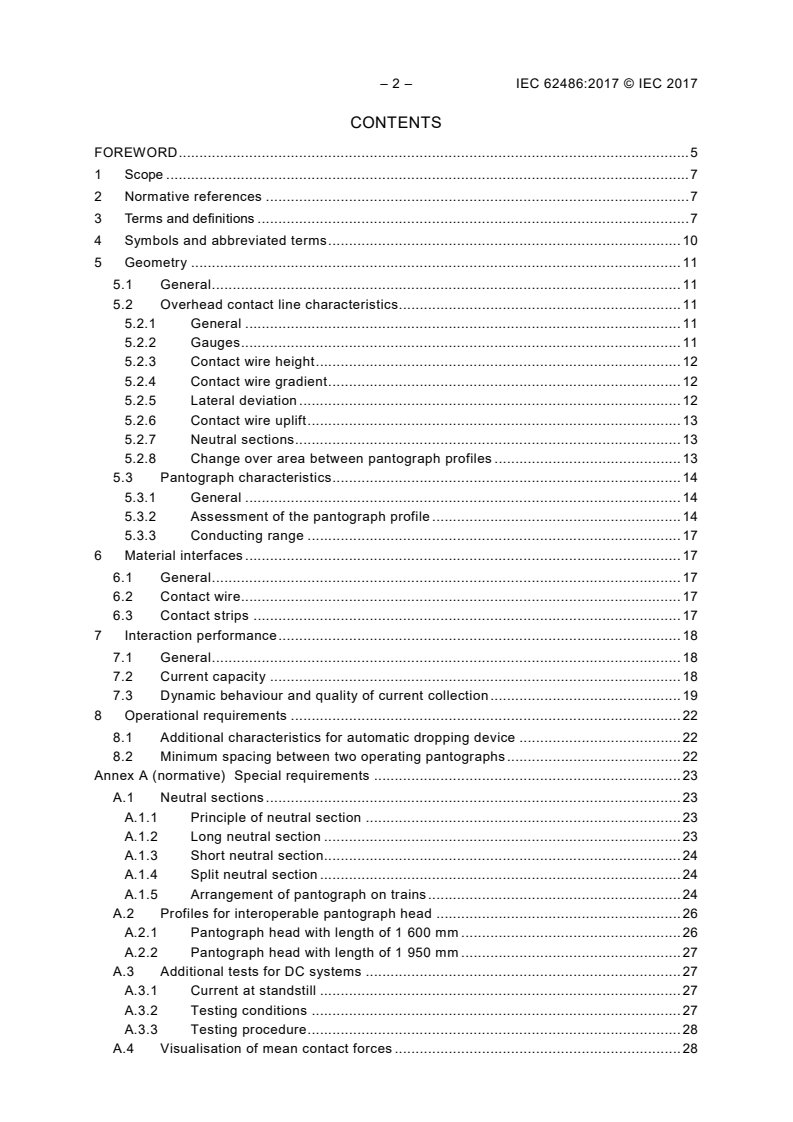
General Information
- Abstract
IEC 62486:2017 specifies requirements for the interaction between pantographs and overhead contact lines, to achieve interoperability. This new edition includes the following significant technical changes with respect to the previous edition:
- the upper line properties for both AC and DC power systems as well as the current collector characteristics have been clarified;
- the requirements for pantograph with individually spring parts of the pantograph head were taken;
- national conditions have been included in formative annexes.
- Status
- Published
- Publication Date
- 09-Aug-2017
- Technical Committee
- TC 9 - Electrical equipment and systems for railways
- Drafting Committee
- MT 62486 - TC 9/MT 62486
- Current Stage
- PPUB - Publication issued
- Start Date
- 10-Aug-2017
- Completion Date
- 11-Aug-2017
Buy Documents
IEC 62486:2017 - Railway applications - Current collection systems - Technical criteria for the interaction between pantograph and overhead contactline (to achieve free access) Released:8/10/2017
Overview
IEC 62486:2017 is an international standard published by the International Electrotechnical Commission (IEC) that addresses railway applications related to current collection systems. Specifically, it defines the technical criteria for the interaction between pantographs and overhead contact lines (OCL) to achieve free and reliable access for trains. The standard ensures interoperability and safety across diverse railway networks by providing comprehensive requirements for pantograph and overhead contact line design, performance, and operational behavior.
This 2017 edition incorporates significant technical updates including clarified upper line properties for AC and DC power systems, updated pantograph head characteristics such as individually sprung parts, and the inclusion of national annexes to consider country-specific conditions.
Key Topics
Pantograph and Overhead Contact Line Geometry: Defines critical dimensions such as contact wire height, lateral deviation, gradients, uplift, and neutral section configurations to optimize pantograph and OCL interaction.
Pantograph Characteristics: Outlines essential features including pantograph head profile, conducting range, and static and dynamic contact force requirements for both AC and DC electrical systems.
Material Interfaces: Details on contact wire and contact strip materials to ensure effective electrical conductivity and wear resistance.
Interaction Performance: Focuses on current capacity, dynamic behavior, and quality of current collection, including permissible limits on contact forces and electrical arcing.
Operational Requirements: Specifies apparatus functions like automatic dropping devices and minimum spacing between operating pantographs to maintain system integrity and safety.
National Annexes and Special Conditions: Includes detailed adaptations for specific countries such as China and Japan, addressing unique operational and technical needs.
Applications
IEC 62486:2017 provides practical technical guidelines critical for:
Railway Engineering Design: Engineers designing overhead contact systems and pantographs can apply these standardized criteria to ensure compatibility and interoperability across different rail networks.
Interoperability Across Networks: Facilitates seamless train operation over multiple rail infrastructures by standardizing pantograph/OCL interaction.
Safety and Reliability Enhancement: Ensures safe current collection minimizing mechanical and electrical failures, thus improving train reliability and operational safety.
Rolling Stock Development: Manufacturers can design pantographs compliant with international standards to improve market acceptance and operational flexibility.
Maintenance and Quality Control: Operators can use the defined parameters to monitor wear, dynamic behavior, and contact quality to enable proactive maintenance.
Related Standards
- IEC 61373: Railway applications - Shock and vibration tests for railway vehicles
- EN 50367: Railway applications - Current collection systems - Technical criteria for the interaction between pantograph and overhead contact line to achieve free access (European implementation related to IEC 62486)
- EN 50206: Railway applications - Rolling stock pantographs and contact strips
- UIC Leaflets: International Union of Railways technical recommendations concerning current collection systems and contact strip materials
Keywords: IEC 62486:2017, pantograph overhead contact line interaction, railway current collection systems, railway interoperability standards, pantograph design criteria, overhead contact wire geometry, railway electrical standards, railway pantograph requirements, railway maintenance standards, AC and DC railway power systems
Relations
- Effective Date
- 05-Sep-2023
Buy Documents
IEC 62486:2017 - Railway applications - Current collection systems - Technical criteria for the interaction between pantograph and overhead contactline (to achieve free access) Released:8/10/2017
Get Certified
Connect with accredited certification bodies for this standard

IRIS Certification (UNIFE)
International Railway Industry Standard certification.

TÜV SÜD Rail GmbH
TÜV SÜD railway certification services.

Bureau Veritas Railway Certification
Railway and transportation certification.
Sponsored listings
Frequently Asked Questions
IEC 62486:2017 is a standard published by the International Electrotechnical Commission (IEC). Its full title is "Railway applications - Current collection systems - Technical criteria for the interaction between pantograph and overhead contactline (to achieve free access)". This standard covers: IEC 62486:2017 specifies requirements for the interaction between pantographs and overhead contact lines, to achieve interoperability. This new edition includes the following significant technical changes with respect to the previous edition: - the upper line properties for both AC and DC power systems as well as the current collector characteristics have been clarified; - the requirements for pantograph with individually spring parts of the pantograph head were taken; - national conditions have been included in formative annexes.
IEC 62486:2017 specifies requirements for the interaction between pantographs and overhead contact lines, to achieve interoperability. This new edition includes the following significant technical changes with respect to the previous edition: - the upper line properties for both AC and DC power systems as well as the current collector characteristics have been clarified; - the requirements for pantograph with individually spring parts of the pantograph head were taken; - national conditions have been included in formative annexes.
IEC 62486:2017 is classified under the following ICS (International Classification for Standards) categories: 45.060.01 - Railway rolling stock in general. The ICS classification helps identify the subject area and facilitates finding related standards.
IEC 62486:2017 has the following relationships with other standards: It is inter standard links to IEC 62486:2010. Understanding these relationships helps ensure you are using the most current and applicable version of the standard.
IEC 62486:2017 is available in PDF format for immediate download after purchase. The document can be added to your cart and obtained through the secure checkout process. Digital delivery ensures instant access to the complete standard document.
Standards Content (Sample)
IEC 62486 ®
Edition 2.0 2017-08
INTERNATIONAL
STANDARD
NORME
INTERNATIONALE
colour
inside
Railway applications – Current collection systems – Technical criteria for the
interaction between pantograph and overhead contactline (to achieve free
access)
Applications ferroviaires – Systèmes de captage de courant –
Critères techniques d'interaction entre le pantographe et la ligne aérienne de
contact (réalisation du libre accès)
All rights reserved. Unless otherwise specified, no part of this publication may be reproduced or utilized in any form
or by any means, electronic or mechanical, including photocopying and microfilm, without permission in writing from
either IEC or IEC's member National Committee in the country of the requester. If you have any questions about IEC
copyright or have an enquiry about obtaining additional rights to this publication, please contact the address below or
your local IEC member National Committee for further information.
Droits de reproduction réservés. Sauf indication contraire, aucune partie de cette publication ne peut être reproduite
ni utilisée sous quelque forme que ce soit et par aucun procédé, électronique ou mécanique, y compris la photocopie
et les microfilms, sans l'accord écrit de l'IEC ou du Comité national de l'IEC du pays du demandeur. Si vous avez des
questions sur le copyright de l'IEC ou si vous désirez obtenir des droits supplémentaires sur cette publication, utilisez
les coordonnées ci-après ou contactez le Comité national de l'IEC de votre pays de résidence.
IEC Central Office Tel.: +41 22 919 02 11
3, rue de Varembé Fax: +41 22 919 03 00
CH-1211 Geneva 20 info@iec.ch
Switzerland www.iec.ch
About the IEC
The International Electrotechnical Commission (IEC) is the leading global organization that prepares and publishes
International Standards for all electrical, electronic and related technologies.
About IEC publications
The technical content of IEC publications is kept under constant review by the IEC. Please make sure that you have the
latest edition, a corrigenda or an amendment might have been published.
IEC Catalogue - webstore.iec.ch/catalogue Electropedia - www.electropedia.org
The stand-alone application for consulting the entire The world's leading online dictionary of electronic and
bibliographical information on IEC International Standards, electrical terms containing 20 000 terms and definitions in
Technical Specifications, Technical Reports and other English and French, with equivalent terms in 16 additional
documents. Available for PC, Mac OS, Android Tablets and languages. Also known as the International Electrotechnical
iPad. Vocabulary (IEV) online.
IEC publications search - www.iec.ch/searchpub IEC Glossary - std.iec.ch/glossary
The advanced search enables to find IEC publications by a 65 000 electrotechnical terminology entries in English and
variety of criteria (reference number, text, technical French extracted from the Terms and Definitions clause of
committee,…). It also gives information on projects, replaced IEC publications issued since 2002. Some entries have been
and withdrawn publications. collected from earlier publications of IEC TC 37, 77, 86 and
CISPR.
IEC Just Published - webstore.iec.ch/justpublished
Stay up to date on all new IEC publications. Just Published IEC Customer Service Centre - webstore.iec.ch/csc
details all new publications released. Available online and If you wish to give us your feedback on this publication or
also once a month by email. need further assistance, please contact the Customer Service
Centre: csc@iec.ch.
A propos de l'IEC
La Commission Electrotechnique Internationale (IEC) est la première organisation mondiale qui élabore et publie des
Normes internationales pour tout ce qui a trait à l'électricité, à l'électronique et aux technologies apparentées.
A propos des publications IEC
Le contenu technique des publications IEC est constamment revu. Veuillez vous assurer que vous possédez l’édition la
plus récente, un corrigendum ou amendement peut avoir été publié.
Catalogue IEC - webstore.iec.ch/catalogue Electropedia - www.electropedia.org
Application autonome pour consulter tous les renseignements
Le premier dictionnaire en ligne de termes électroniques et
bibliographiques sur les Normes internationales,
électriques. Il contient 20 000 termes et définitions en anglais
Spécifications techniques, Rapports techniques et autres
et en français, ainsi que les termes équivalents dans 16
documents de l'IEC. Disponible pour PC, Mac OS, tablettes
langues additionnelles. Egalement appelé Vocabulaire
Android et iPad.
Electrotechnique International (IEV) en ligne.
Recherche de publications IEC - www.iec.ch/searchpub
Glossaire IEC - std.iec.ch/glossary
65 000 entrées terminologiques électrotechniques, en anglais
La recherche avancée permet de trouver des publications IEC
en utilisant différents critères (numéro de référence, texte, et en français, extraites des articles Termes et Définitions des
comité d’études,…). Elle donne aussi des informations sur les publications IEC parues depuis 2002. Plus certaines entrées
projets et les publications remplacées ou retirées. antérieures extraites des publications des CE 37, 77, 86 et
CISPR de l'IEC.
IEC Just Published - webstore.iec.ch/justpublished
Service Clients - webstore.iec.ch/csc
Restez informé sur les nouvelles publications IEC. Just
Published détaille les nouvelles publications parues. Si vous désirez nous donner des commentaires sur cette
Disponible en ligne et aussi une fois par mois par email. publication ou si vous avez des questions contactez-nous:
csc@iec.ch.
IEC 62486 ®
Edition 2.0 2017-08
INTERNATIONAL
STANDARD
NORME
INTERNATIONALE
colour
inside
Railway applications – Current collection systems – Technical criteria for the
interaction between pantograph and overhead contactline (to achieve free
access)
Applications ferroviaires – Systèmes de captage de courant –
Critères techniques d'interaction entre le pantographe et la ligne aérienne de
contact (réalisation du libre accès)
INTERNATIONAL
ELECTROTECHNICAL
COMMISSION
COMMISSION
ELECTROTECHNIQUE
INTERNATIONALE
ICS 45.060.01 ISBN 978-2-8322-4602-3
– 2 – IEC 62486:2017 © IEC 2017
CONTENTS
FOREWORD . 5
1 Scope . 7
2 Normative references . 7
3 Terms and definitions . 7
4 Symbols and abbreviated terms . 10
5 Geometry . 11
5.1 General . 11
5.2 Overhead contact line characteristics . 11
5.2.1 General . 11
5.2.2 Gauges . 11
5.2.3 Contact wire height . 12
5.2.4 Contact wire gradient . 12
5.2.5 Lateral deviation . 12
5.2.6 Contact wire uplift . 13
5.2.7 Neutral sections . 13
5.2.8 Change over area between pantograph profiles . 13
5.3 Pantograph characteristics . 14
5.3.1 General . 14
5.3.2 Assessment of the pantograph profile . 14
5.3.3 Conducting range . 17
6 Material interfaces . 17
6.1 General . 17
6.2 Contact wire. 17
6.3 Contact strips . 17
7 Interaction performance . 18
7.1 General . 18
7.2 Current capacity . 18
7.3 Dynamic behaviour and quality of current collection . 19
8 Operational requirements . 22
8.1 Additional characteristics for automatic dropping device . 22
8.2 Minimum spacing between two operating pantographs . 22
Annex A (normative) Special requirements . 23
A.1 Neutral sections . 23
A.1.1 Principle of neutral section . 23
A.1.2 Long neutral section . 23
A.1.3 Short neutral section. 24
A.1.4 Split neutral section . 24
A.1.5 Arrangement of pantograph on trains . 24
A.2 Profiles for interoperable pantograph head . 26
A.2.1 Pantograph head with length of 1 600 mm . 26
A.2.2 Pantograph head with length of 1 950 mm . 27
A.3 Additional tests for DC systems . 27
A.3.1 Current at standstill . 27
A.3.2 Testing conditions . 27
A.3.3 Testing procedure . 28
A.4 Visualisation of mean contact forces . 28
A.5 Other limitations (national annex for China) . 29
A.6 National annex for Japan . 30
A.6.1 General . 30
A.6.2 Maximum lateral deviation . 30
A.6.3 Dynamic behaviour and quality of current collection (AQ, CQ) . 30
Annex B (informative) Special national conditions . 33
B.1 General . 33
B.2 National characteristics . 33
B.3 General characteristics of pantograph head . 42
Annex C (informative) Normally used materials for contact strips . 52
Bibliography . 53
Figure 1 – General detail of pantograph with independently suspended collector head . 16
Figure 2 – Transition point – 1 600 mm and 1 950 mm pantograph head . 17
Figure A.1 – Principle of neutral section . 23
Figure A.2 – Long neutral section . 23
Figure A.3 – Short neutral section . 24
Figure A.4 – Split neutral section . 24
Figure A.5 – Arrangement of pantograph on trains . 25
Figure A.6 – Profile of pantograph head with length of 1 600 mm . 26
Figure A.7 – Profile of pantograph head with length of 1 950 mm . 27
Figure A.8 – Visualisation of contact forces AC . 28
Figure A.9 – Visualisation of contact forces DC 1,5 kV . 29
Figure A.10 – Visualisation of contact forces DC 3,0 kV . 29
Figure B.1 – Pantograph head with length of 1 450 mm . 42
Figure B.2 – Pantograph head with length of 1 950 mm (Type 1) . 42
Figure B.3 – Pantograph head with length of 1 600 mm (GB, CTRL) . 43
Figure B.4 – Pantograph head with length of 1 950 mm (Type 2) . 43
Figure B.5 – Pantograph head with length of 1 800 mm (NO, SE) . 44
Figure B.6 – Pantograph head with length of 1 600 mm (GB) . 45
Figure B.7 – Pantograph head with length of 1 950 mm (PL) . 46
Figure B.8 – Pantograph head with length of 1 760 mm (BE) . 46
Figure B.9 – Pantograph head with length of 1 950 mm (Type 1 in CN) . 47
Figure B.10 – Pantograph head with length of 1 950 mm (Type 2 in CN) . 47
Figure B.11 – Pantograph head with length of 1 600 mm (CN) . 47
Figure B.12 – Pantograph head with length of 1 550 mm (Type 1 in CN) . 48
Figure B.13 – Pantograph head with length of 1 550 mm (Type 2 in CN) . 48
Figure B.14 – Pantograph head with length of 1 550 mm (Type 3 in CN) . 49
Figure B.15 – Pantograph head with length of 1 700 mm (CN) . 49
Figure B.16 – Pantograph head with length of 1 880 mm (JP type1) . 50
Figure B.17 – Pantograph head with length of 1 880 mm (JP type2) . 50
Figure B.18 – Pantograph head with length of 2 000 mm (RF) . 51
Table 1 – Range of nominal contact wire height for AC and DC systems . 12
– 4 – IEC 62486:2017 © IEC 2017
Table 2 – Maximum lateral deviation . 13
Table 3 – Pantograph characteristics for AC and DC systems . 14
Table 4 – Static contact forces . 19
Table 5 – Maximum current at standstill . 19
Table 6 – Limits for interaction performance (contact force) . 21
Table 7 – Values for interaction performance (arcs). 22
Table 8 – Minimum distances of operating pantographs . 22
Table A.1 – Values for interaction performance (arcs) . 30
Table A.2 – Maximum lateral deviation . 30
Table A.3 – Values for interaction performance (arcs and current loss) . 32
Table B.1 – Overhead contact line characteristics for AC systems . 34
Table B.2 – Overhead contact line characteristics for DC systems . 35
Table B.3 – Rolling stock characteristics for AC systems . 36
Table B.4 – Rolling stock characteristics for AC systems . 37
Table B.5 – Rolling stock characteristics for DC systems . 38
Table B.6 – Rolling stock characteristics for DC systems . 39
Table B.7 – Interaction performance for AC systems . 40
Table B.8 – Interaction performance for AC systems . 41
Table B.9 – Interaction performance for DC systems . 41
Table C.1 – Contact strip material normally used . 52
INTERNATIONAL ELECTROTECHNICAL COMMISSION
____________
RAILWAY APPLICATIONS – CURRENT COLLECTION SYSTEMS –
TECHNICAL CRITERIA FOR THE INTERACTION BETWEEN PANTOGRAPH
AND OVERHEAD CONTACTLINE (TO ACHIEVE FREE ACCESS)
FOREWORD
1) The International Electrotechnical Commission (IEC) is a worldwide organization for standardization comprising
all national electrotechnical committees (IEC National Committees). The object of IEC is to promote
international co-operation on all questions concerning standardization in the electrical and electronic fields. To
this end and in addition to other activities, IEC publishes International Standards, Technical Specifications,
Technical Reports, Publicly Available Specifications (PAS) and Guides (hereafter referred to as “IEC
Publication(s)”). Their preparation is entrusted to technical committees; any IEC National Committee interested
in the subject dealt with may participate in this preparatory work. International, governmental and non-
governmental organizations liaising with the IEC also participate in this preparation. IEC collaborates closely
with the International Organization for Standardization (ISO) in accordance with conditions determined by
agreement between the two organizations.
2) The formal decisions or agreements of IEC on technical matters express, as nearly as possible, an international
consensus of opinion on the relevant subjects since each technical committee has representation from all
interested IEC National Committees.
3) IEC Publications have the form of recommendations for international use and are accepted by IEC National
Committees in that sense. While all reasonable efforts are made to ensure that the technical content of IEC
Publications is accurate, IEC cannot be held responsible for the way in which they are used or for any
misinterpretation by any end user.
4) In order to promote international uniformity, IEC National Committees undertake to apply IEC Publications
transparently to the maximum extent possible in their national and regional publications. Any divergence
between any IEC Publication and the corresponding national or regional publication shall be clearly indicated in
the latter.
5) IEC itself does not provide any attestation of conformity. Independent certification bodies provide conformity
assessment services and, in some areas, access to IEC marks of conformity. IEC is not responsible for any
services carried out by independent certification bodies.
6) All users should ensure that they have the latest edition of this publication.
7) No liability shall attach to IEC or its directors, employees, servants or agents including individual experts and
members of its technical committees and IEC National Committees for any personal injury, property damage or
other damage of any nature whatsoever, whether direct or indirect, or for costs (including legal fees) and
expenses arising out of the publication, use of, or reliance upon, this IEC Publication or any other IEC
Publications.
8) Attention is drawn to the normative references cited in this publication. Use of the referenced publications is
indispensable for the correct application of this publication.
9) Attention is drawn to the possibility that some of the elements of this IEC Publication may be the subject of
patent rights. IEC shall not be held responsible for identifying any or all such patent rights.
International Standard IEC 62486 has been prepared by IEC technical committee 9: Electrical
equipment and systems for railways.
This second edition cancels and replaces the first edition published in 2010. This edition
constitutes a technical revision.
This edition includes the following significant technical changes with respect to the previous
edition:
a) the upper line properties for both AC and DC power systems as well as the current
collector characteristics have been clarified;
b) the requirements for pantograph with individually spring parts of the pantograph head
were taken;
c) the lateral deviation of the contact wire is made to EN 15273;
d) in Annex A have been added to specific conditions of CN and JP;
– 6 – IEC 62486:2017 © IEC 2017
e) in Annex B, special national conditions have been supplemented by the data of additional
IEC members.
The text of this standard is based on the following documents:
FDIS Report on voting
9/2277/FDIS 9/2298/RVD
Full information on the voting for the approval of this International Standard can be found in
the report on voting indicated in the above table.
This document has been drafted in accordance with the ISO/IEC Directives, Part 2.
This international standard is derived from the European standard EN 50367 that was offered
to the IEC by CENELEC.
The reader's attention is drawn to the fact that Annexes B and C list all of the “in-some-
country” clauses on differing practices of a less permanent nature relating to the subject of
this standard.
The committee has decided that the contents of this document will remain unchanged until the
stability date indicated on the IEC website under "http://webstore.iec.ch" in the data related to
the specific document. At this date, the document will be
• reconfirmed,
• withdrawn,
• replaced by a revised edition, or
• amended.
IMPORTANT – The 'colour inside' logo on the cover page of this publication indicates
that it contains colours which are considered to be useful for the correct
understanding of its contents. Users should therefore print this document using a
colour printer.
RAILWAY APPLICATIONS – CURRENT COLLECTION SYSTEMS –
TECHNICAL CRITERIA FOR THE INTERACTION BETWEEN PANTOGRAPH
AND OVERHEAD CONTACTLINE (TO ACHIEVE FREE ACCESS)
1 Scope
This document specifies requirements for the interaction between pantographs and overhead
contact lines, to achieve interoperability.
NOTE These requirements are defined for a limited number of pantograph types, referred to as 'interoperable
pantograph', together with the geometry and characteristics of compatible overhead contact lines.
This document describes parameters and values for all planned lines and future lines.
2 Normative references
The following documents are referred to in the text in such a way that some or all of their
content constitutes requirements of this document. For dated references, only the edition
cited applies. For undated references, the latest edition of the referenced document (including
any amendments) applies.
IEC 60050-811:1991, International Electrotechnical Vocabulary – Chapter 811: Electric
traction
IEC 60494-1:2013, Railway applications – Rolling stock – Pantographs – Characteristics and
tests – Part 1: Pantographs for main line vehicles
IEC 60913:2013, Railway applications – Fixed installations – Electric traction overhead
contact lines
IEC 62313:2009, Railway applications – Power supply and rolling stock – Technical criteria for
the coordination between power supply (substation) and rolling stock
IEC 62499:2008, Railway applications – Current collection systems – Pantographs, testing
methods for carbon contact strips
IEC 62846:2016, Railway applications – Current collection systems – Requirements for and
validation of measurements of the dynamic interaction between pantograph and overhead
contact line
IEC 62917, Railway applications – Fixed installations – Electric traction – Copper and copper
alloy grooved contact wires
3 Terms and definitions
For the purposes of this document, the terms and definitions given in IEC 60050-811:1991
and the following apply.
ISO and IEC maintain terminological databases for use in standardization at the following
addresses:
• IEC Electropedia: available at http://www.electropedia.org/
• ISO Online browsing platform: available at http://www.iso.org/obp
– 8 – IEC 62486:2017 © IEC 2017
3.1
arcing
flow of current through an air gap between a contact strip and a contact wire usually indicated
by the emission of intense light
3.2
automatic dropping device
device that lowers the pantograph in the event of pantograph head failure or damage of the
pantograph head
[SOURCE: IEC 60494-1:2013, 3.2.19]
3.3
contact force
vertical force applied by the pantograph to the overhead contact line
Note 1 to entry: The contact force is the sum of forces of all contact points.
3.4
contact point
point of the mechanical contact between a contact strip and a contact wire
3.5
contact wire height
distance from the top of the rail (or road surface for overhead contact line system for
trolleybus applications) to the lower face of the contact wire, measured perpendicular to the
track
Note 1 to entry: The contact wire height is measured perpendicular to the track or road surface.
3.6
continuous pantograph head profile
pantograph head with collector strips and horns suspended in one piece
3.7
encroachment of the pantograph head above the contact plane
perpendicular distance from the contact plane to the highest point of the pantograph head.
The contact plane is the plane parallel to base frame of pantograph at the contact point
Note 1 to entry: Additional information is given in EN 15273-1:2013, Figure 46.
3.8
maximum contact wire height
maximum value of the contact wire height above rail level occurring in any possible case
during the lifetime of the overhead contact line
3.9
maximum design contact wire height
maximum theoretical contact wire height not including tolerances and uplift, which the
pantograph is required to reach
3.10
maximum width of pantograph head
maximum distance measured along the axis of the track between the outer edges of the
contact strips
3.11
mean contact force F
m
statistical mean value of the contact force
Note 1 to entry: F is formed by the static and aerodynamic components of the pantograph contact force.
m
3.12
mechanical kinematic pantograph gauge
gauge of the pantograph head under all operating conditions
Note 1 to entry: Additional information is given in EN 15273-1:2013, Clause 3.
3.13
minimum contact wire height
minimum value of the contact wire height above rail level occurring in any possible case
during the lifetime of the overhead contact line
3.14
neutral section
section of a contact line provided with a sectioning point at each end, to prevent successive
electrical sections differing in voltage or phase being connected together by the passage of
current collectors
[SOURCE: IEC 60050-811:1991, 811-36-16]
3.15
nominal contact wire height
nominal value of the contact wire height above rail level at a support in the normal conditions
3.16
non-continuous pantograph head profile
pantograph head with collector strips separately (independently) suspended from the main
horns
3.17
overhead contact line
contact line placed above or beside the upper limit of the vehicle gauge and supplying
vehicles with electric energy through roof mounted current collection equipment
[SOURCE: IEC 60050-811:1991, 811-33-02]
3.18
percentage of arcing NQ
proportion of driving time with arcing
NQ this is given by the following formula:
t
∑ arc
NQ = ×100
t
total
where
t is the duration of an arc lasting longer 5 ms;
arc
t is the measuring time with a current greater than 30 % of the nominal current.
total
The result, given in %, is a characteristic for a given speed of the vehicle
3.19
static contact force
vertical force exerted upward by the pantograph head on the overhead contact line, caused by
the pantograph-raising device, whilst the pantograph is raised and the vehicle is stationary
– 10 – IEC 62486:2017 © IEC 2017
3.20
transition zone of pantograph head
range for the transition point between non independently suspended parts and independently
suspended parts of the pantograph head (see Figures 1 and 2)
3.21
gradient
ratio of the difference in height of the overhead contact line above top of rail ( or road surface
for overhead contact line system for trolleybus applications) at two successive supports to the
length of the span
[SOURCE: IEC 60913:2013, 3.4.2]
3.22
contact loss
condition where the contact force is zero
Note 1 to entry: Contact loss surely induces arcing except in the case of coasting. However, if two or more
pantographs are connected electrically each other, arc will immediately disappear and then the condition will shift
to ‘current loss’.
3.23
current loss
condition where current flowing through a pantograph is zero under the condition of contact
loss
Note 1 to entry: When a train is equipped with two or more pantographs electrically connected by a bus cable,
necessary traction power can be supplied by other pantographs through the bus cable in case of contact loss.
Therefore, current loss condition will generally not affect driving of the train.
4 Symbols and abbreviated terms
AC Alternative Current
AQ percentage of all arcing
CQ percentage of current loss
DC Direct Current
D’ length of neutral zone excluding overlapping parts taking into account the uplift by
pantograph passage and insulation clearances
D overall length of neutral section as distance between adjacent systems/phases
including overlapping parts taking into account the uplift by pantograph passage and
insulation clearances
d length of insulator inserted in contact wire
F mean contact force
m
F maximum contact force
max
F minimum mean contact force
m, min
F maximum mean contact force
m, max
F minimum contact force
min
F static contact force
stat
GC gauge C according to EN 15273
L Inner distance between two adjacent pantographs
L’ Outer distance between first and last operating pantographs
L” Inner distance between one and the second following operating pantographs
l maximum width of pantograph head
NQ percentage of arcing
σ standard deviation of contact force
σ maximum standard deviation of contact force
max
d Lateral deviation of contact wire
l
b Half-length of the pantograph head
w
b Half-length of the pantograph head conducting length (with insulating horns) or
w,c
working length (with conducting horns)
b' Length of mechanical kinematic pantograph gauge at contact wire height
h
h' Maximum verification height of the pantograph gauge in a collecting position
o
h' Minimum verification height of the pantograph gauge in a collecting position
u
h' Reference roll centre height for the pantograph gauge
c0
I' Reference cant deficiency taken into account by the vehicle for the pantograph
gauging
D' Reference cant taken into account by the vehicle for the pantograph gauge
Flexibility coefficient taken into account by agreement between the Railway
s'
Undertaking and the Infrastructure Manager for pantograph gauging
α Angle of independent suspended part of the pantograph head at the transition point
β Angle of the main horn on the fixed part of the pantograph head
5 Geometry
5.1 General
The geometric characteristics of the overhead contact line shall be designed and built in
accordance with 5.2. The geometric characteristics of the pantograph(s) shall be designed
and built in accordance with 5.3, according to the type of infrastructure on which it will operate.
5.2 Overhead contact line characteristics
5.2.1 General
The following geometric parameters of the overhead contact line are defined in order to
achieve free access:
• gauge;
• contact wire height;
• contact wire gradient;
• lateral deviation of the contact wire from the track centre line under action of a crosswind;
• free and unrestricted contact wire uplift at the support;
• neutral section arrangements.
The overhead contact line shall conform to IEC 60913.
5.2.2 Gauges
The design of the overhead contact line shall allow the operation of vehicles compliant to the
appropriate vehicle gauge for the route.
NOTE This gauge is calculated according to EN 15273.
– 12 – IEC 62486:2017 © IEC 2017
5.2.3 Contact wire height
The range of nominal contact wire height shall be in accordance with Table 1.
The contact wire may be higher in certain cases such as level crossings, loading areas, etc.
In these cases the maximum design contact wire height shall not be greater than 6,20 m.
The maximum contact wire height is 6,5 m.
The contact wire height may be lower in certain cases related to gauge such as bridges and
tunnels. Minimum contact wire height shall be calculated in accordance with IEC 60913:2013,
5.10.4.
Table 1 – Range of nominal contact wire height for AC and DC systems
Line speed v v ≤ 200 200 < v < 250 v ≥ 250
km/h
Range of nominal contact wire height [m] 5,0 up to 5,75 5,0 up to 5,5 5,0 up to 5,3
5.2.4 Contact wire gradient
The permissible contact wire gradient is defined in IEC 60913:2013, 5.10.3.
The variation in contact wire height shall fulfil the requirements imposed by IEC 60913:2013,
5.10.3.
The contact wire gradient specified in IEC 60913:2013, 5.10.3 may be exceeded on an
exceptional basis, where a series of restrictions on the contact wire height such as level
crossings, bridges, tunnels, etc., prevents compliance. In this case the requirements of 7.3
are not applicable, and the contact force shall not exceed the maximum value defined in
IEC 60913:2013, 5.2.5.2.
5.2.5 Lateral deviation
The maximum lateral deviation of the contact wire shall be calculated by taking into
consideration the total movement of the pantograph with respect to the nominal track position
and the conducting range (or working length, for pantographs with horns made from a
conducting material) as follows:
d = b + b − b'
l w,c w h
The values shall be adjusted taking into account the pantograph movement, track gauge and
track tolerances according to appropriate gauging standard and the following reference
parameters:
s' = 0,225
h' = 0,5 m
c0
I' = 0,066 m and D' = 0,066 m
0 0
h' = 6,500 m and h' = 5,000 m
o u
b = 600 mm for pantographs in accordance with Figure A.6
w,c
b = 800 mm for pantographs in accordance with Figure A.6
w
b = 775 mm for pantographs in accordance with Figure A.7
w,c
b = 975 mm for pantographs in accordance with Figure A.7
w
NOTE Appropriate gauging standard could be EN 15273 (or equivalent or UIC 505 series).
For interoperable pantographs defined in A.2 the limit for the maximum permissible lateral
deviation of the contact wire normal to the design track centre line under the action of cross
wind is given in Table 2.
Table 2 – Maximum lateral deviation
Dimensions in millimetres
Pantograph length Maximum lateral deviation
1 600 400
1 950 550
In the case of a multi-rail track, the requirement shall be fulfilled for each pair of rails
(designed to be operated as separated track) that is intended to be interoperability.
NOTE For additional national requirements outside Europe, see Clauses A.5 and A.6.
The wind speed and the pantograph length to be considered will be defined by the
infrastructure manager.
5.2.6 Contact wire uplift
The requirements for the allowance for contact wire uplift at the support are defined in
IEC 60913:2013, 5.10.2.
5.2.7 Neutral sections
For operation through neutral sections see IEC 62313. The requirements for the design of
neutral sections are defined as follows:
• trains shall be able to move from one section to an adjacent one (which is fed from a
different phase or system) without bridging the neutral section;
• the neutral section shall be designed in such a way that trains with multiple pantographs
arranged according to A.1.5 at an overall separation up to a maximum of 400 m can pass
through with their pantographs raised;
• adequate means shall be provided to allow a train that is stopped within the phase
separation section to be restarted.
In the case of trains with multiple pantographs, the pantographs shall be lowered for the
entire length of the neutral section if any of the above requirements cannot be met. Technical
or operational measures shall be taken to meet safety and availability requirements.
For compatibility between neutral sections and certain arrangements of pantographs, see
Clause 8.
5.2.8 Change over area between pantograph profiles
At connections between lines which are designed for different pantograph profiles, a change
over area shall be provided. In the changeover area one pantograph type shall be lowered
and the other type shall be raised. In the area which is common to the different pantograph
profiles, the overhead contact line shall be designed as follows:
• the lateral deviation of the contact wire according to 5.2.5 shall be calculated for a
pantograph with the shortest length of head;
• the pantograph gauge according to 5.2.2 shall be calculated for a pantograph with the
largest length of head.
– 14 – IEC 62486:2017 © IEC 2017
The new pantograph shall not be raised before the other is lowered.
NOTE Lowering of a pantograph before raising another one is necessary to avoid a critical uplift of the contact
wire and unexpected high contact forces.
5.3 Pantograph characteristics
5.3.1 General
The following geometric parameters of the pantograph are important to interaction
performance:
• geometric profile of pantograph head;
• working range of the height of pantograph;
• length of contact strips;
• maximum width of pantograph head;
• encroachment of the pantograph head above the contact line.
The maximum encroachment of pantograph head shall not exceed 60 mm under all conditions
according to EN 15273-1:2013, 8.1.1.3.
NOTE 1 Typically the critical case is with the contact point at the limit of the contact strips with maximum contact
forces applied.
The maximum lateral deviation of the contact wire using interoperable pantograph heads is
specified in 5.2.5.
The design of the pantograph (see Table 3) shall ensure performance in accordance with
Clause 7 for the speed range and a contact wire height according to 5.2.3 and Table 1. The
maximum value of working height shall be 6,5 m.
Table 3 – Pantograph characteristics for AC and DC systems
a
Profile of pantograph heads See Figure A.6 and Figure A.7
b
Maximum width of pantograph head (m) 0,65
Mechanical kinematic pantograph gauge See 5.2.2
a
See Figures B.1 to B.18 for the national profiles for existing lines.
b
Maximum width of pantograph head, see A.1.3.
NOTE 2 The reference point for the pantograph profiles refers to the contact point (of contact strip and contact
wire) at the centre of the pantograph head.
The pantograph shall conform to IEC 60494-1. Additional tests are defined in 5.3.2.
5.3.2 Assessment of the pantograph profile
5.3.2.1 General
An assessment of the pantograph profile shall be undertaken on a new pantograph.
5.3.2.2 Continuous pantograph head profile
Pantograph heads shall remain compliant with the overall profile according Figures A.6 and
A.7. Maximum vertical deviation from the nominal pantograph profile is allowed only
downwards and shall be less than 30 mm.
Deviations below the pantograph profile inside the minimum collector strip length shall not
exceed 5° against a line horizontal to the pantograph when in a horizontal orientation.
5.3.2.3 Non-continuous pantograph head profile (independent suspended collector
strips)
Additional assessments to 5.3.2.2 shall be undertaken as follows:
The transition between independent parts of the pantograph head shall be checked.
For pantograph heads fitted with contact strips having independent suspensions, the test
value of nominal static contact force given in Table 4 is applied to the centre of the head.
For pantographs capable of operating with different static forces (multi voltage pantographs),
the lowest value shall be used.
The location of the transition point between independently suspended parts of the collector
head shall be less than 300 mm from the end of the pantograph.
Deviations downwards from the pantograph profile shall not exceed following maximum
gradients against a line horizontal to the pantograph when in a horizontal orientation
• outside the transition zone of pantograph head 30°;
• at the transition point of pantograph head 40°.
In the transition
...