

IEC 63461:2024
(Main)Pelton hydraulic turbines - Model acceptance tests
General Information
- Abstract
IEC 63461:2024 applies to laboratory model tests of any type of Pelton hydraulic turbine with unit power greater than 5 MW. It contains the rules governing test conduct and provides measures to be taken if any phase of the tests is disputed.
The main objectives of this document are:
- to define the terms and quantities used;
- to specify methods of testing and of measuring the quantities involved, in order to ascertain the hydraulic performance of the model;
- to specify the methods of computation of results and of comparison with guarantees;
- to determine if the contract guarantees that fall within the scope of this document have been fulfilled;
- and to define the extent, content and structure of the final report.
Full application of the procedures herein described is not generally justified for machines with smaller power. Nevertheless, this document can be used for such machines by agreement between the purchaser and the supplier.
The content of the corrigendum 1 (2025-03) has been included in this copy.
- Status
- Published
- Publication Date
- 27-Jun-2024
- Technical Committee
- TC 4 - Hydraulic turbines
- Drafting Committee
- WG 35 - TC 4/WG 35
- Current Stage
- PPUB - Publication issued
- Start Date
- 28-Jun-2024
- Completion Date
- 26-Jul-2024


Overview
IEC 63461:2024 is an international standard published by the International Electrotechnical Commission (IEC) that governs model acceptance tests for Pelton hydraulic turbines. This standard specifically applies to laboratory model tests of Pelton turbines with unit power greater than 5 MW. It establishes comprehensive rules for conducting tests, defining terms and quantities, outlining measurement methods, and verifying hydraulic performance. Additionally, it prescribes criteria to determine if contractual guarantees have been fulfilled, along with the required structure and content for the final test report. While primarily designed for large turbines, smaller machines may also adopt these procedures upon agreement between the supplier and purchaser.
The standard integrates the latest amendments, including Corrigendum 1 (2025-03), ensuring up-to-date guidance on Pelton turbine model testing.
Key Topics
IEC 63461:2024 covers the following critical themes essential for professionals engaged in hydraulic turbine testing:
- Terminology and Definitions: Clarifies terms, symbols, units, and parameters critical for uniformity in test documentation and interpretation.
- Physical Properties: Details properties of water, air, and mercury related to testing conditions, such as density, viscosity, and vapor pressure.
- Test Requirements: Specifies laboratory and model prerequisites, dimensional checks, and permissible deviations in geometry ensuring fidelity between prototype and model.
- Test Procedures: Describes the organization, calibration, execution, and fault handling during tests to maintain accuracy and reliability.
- Data Acquisition and Processing: Provides guidelines on data capturing systems, processing fluctuating quantities, and evaluating uncertainties for precise measurement outputs.
- Measurement Methods: Defines accurate measurement techniques for discharge, pressure, free water levels, shaft torque, and rotational speed, highlighting calibration and uncertainty assessments.
- Test Execution and Result Analysis: Explains determination of specific hydraulic energy, power, efficiency, and conditions for hydraulic similitude vital for valid model-to-prototype performance extrapolation.
- Reporting: Establishes the extent, content, and structured format of test reports to facilitate clear, comprehensive communication of results.
Applications
The IEC 63461:2024 standard is critical for engineers, manufacturers, testing laboratories, and project managers involved in the design, validation, and acceptance of Pelton hydraulic turbines. Its applications include:
- Hydraulic Performance Verification: Ensuring that Pelton turbine models meet contractual hydraulic performance guarantees before full-scale production.
- Research and Development: Providing consistent methods for laboratory model testing that aid in turbine optimization and innovation.
- Quality Assurance: Standardizing acceptance tests to enhance confidence in turbine reliability and efficiency for projects exceeding 5 MW capacity.
- Dispute Resolution: Supplying defined procedures for handling discrepancies during testing phases to uphold transparency between suppliers and purchasers.
- Capacity Expansion: Adapting test protocols to smaller turbines upon agreement, supporting flexibility in turbine model validations.
By following IEC 63461, stakeholders ensure the reliability of turbine model testing results and the efficient scaling of laboratory data to actual operating conditions, contributing to safer and more effective hydropower installations.
Related Standards
Professionals utilizing IEC 63461:2024 may also consider the following complementary standards to support hydraulic turbine testing and associated practices:
- ISO 4373 – Pertains to free water level measurement methods relevant during turbine model testing.
- IEC 60041 – Covers field acceptance tests for hydraulic turbines, offering complementary procedures for prototype verification.
- IEC 60193 – Addresses hydraulic model acceptance tests for other types of turbines and components.
- International Electrotechnical Vocabulary (IEV) – Provides standardized terminology across electrotechnical and hydraulic domains.
- Relevant National Standards – Local standards on measurement accuracy, safety, and environmental conditions that may supplement IEC requirements.
Integrating IEC 63461 with these standards offers a comprehensive framework for the design, testing, and acceptance of Pelton and other hydraulic turbines worldwide.
Keywords: IEC 63461, Pelton hydraulic turbines, model acceptance tests, hydraulic performance, turbine testing standard, laboratory model tests, turbine efficiency, data acquisition, hydraulic similitude, turbine performance verification, IEC standard 2024, hydraulic turbine test procedures, turbine test report, turbine model accuracy.
Relations
- Replaces
IEC 60193:2019 - Hydraulic turbines, storage pumps and pump-turbines - Model acceptance tests - Effective Date
- 05-Sep-2023
- Corrected By
IEC 63461:2024/COR1:2025 - Corrigendum 1 - Pelton hydraulic turbines - Model acceptance tests - Effective Date
- 14-Feb-2025
Get Certified
Connect with accredited certification bodies for this standard

DNV
DNV is an independent assurance and risk management provider.

Lloyd's Register
Lloyd's Register is a global professional services organisation specialising in engineering and technology.
DNV Energy Systems
Energy and renewable energy certification.
Sponsored listings
Frequently Asked Questions
IEC 63461:2024 is a standard published by the International Electrotechnical Commission (IEC). Its full title is "Pelton hydraulic turbines - Model acceptance tests". This standard covers: IEC 63461:2024 applies to laboratory model tests of any type of Pelton hydraulic turbine with unit power greater than 5 MW. It contains the rules governing test conduct and provides measures to be taken if any phase of the tests is disputed. The main objectives of this document are: - to define the terms and quantities used; - to specify methods of testing and of measuring the quantities involved, in order to ascertain the hydraulic performance of the model; - to specify the methods of computation of results and of comparison with guarantees; - to determine if the contract guarantees that fall within the scope of this document have been fulfilled; - and to define the extent, content and structure of the final report. Full application of the procedures herein described is not generally justified for machines with smaller power. Nevertheless, this document can be used for such machines by agreement between the purchaser and the supplier. The content of the corrigendum 1 (2025-03) has been included in this copy.
IEC 63461:2024 applies to laboratory model tests of any type of Pelton hydraulic turbine with unit power greater than 5 MW. It contains the rules governing test conduct and provides measures to be taken if any phase of the tests is disputed. The main objectives of this document are: - to define the terms and quantities used; - to specify methods of testing and of measuring the quantities involved, in order to ascertain the hydraulic performance of the model; - to specify the methods of computation of results and of comparison with guarantees; - to determine if the contract guarantees that fall within the scope of this document have been fulfilled; - and to define the extent, content and structure of the final report. Full application of the procedures herein described is not generally justified for machines with smaller power. Nevertheless, this document can be used for such machines by agreement between the purchaser and the supplier. The content of the corrigendum 1 (2025-03) has been included in this copy.
IEC 63461:2024 is classified under the following ICS (International Classification for Standards) categories: 27.140 - Hydraulic energy engineering. The ICS classification helps identify the subject area and facilitates finding related standards.
IEC 63461:2024 has the following relationships with other standards: It is inter standard links to IEC 60193:2019, IEC 63461:2024/COR1:2025. Understanding these relationships helps ensure you are using the most current and applicable version of the standard.
IEC 63461:2024 is available in PDF format for immediate download after purchase. The document can be added to your cart and obtained through the secure checkout process. Digital delivery ensures instant access to the complete standard document.
Standards Content (Sample)
IEC 63461 ®
Edition 1.0 2024-06
INTERNATIONAL
STANDARD
NORME
INTERNATIONALE
Pelton hydraulic turbines – Model acceptance tests
Turbines Pelton – Essais de réception sur modèle
All rights reserved. Unless otherwise specified, no part of this publication may be reproduced or utilized in any form
or by any means, electronic or mechanical, including photocopying and microfilm, without permission in writing from
either IEC or IEC's member National Committee in the country of the requester. If you have any questions about IEC
copyright or have an enquiry about obtaining additional rights to this publication, please contact the address below or
your local IEC member National Committee for further information.
Droits de reproduction réservés. Sauf indication contraire, aucune partie de cette publication ne peut être reproduite ni
utilisée sous quelque forme que ce soit et par aucun procédé, électronique ou mécanique, y compris la photocopie et
les microfilms, sans l'accord écrit de l'IEC ou du Comité national de l'IEC du pays du demandeur. Si vous avez des
questions sur le copyright de l'IEC ou si vous désirez obtenir des droits supplémentaires sur cette publication, utilisez
les coordonnées ci-après ou contactez le Comité national de l'IEC de votre pays de résidence.
IEC Secretariat Tel.: +41 22 919 02 11
3, rue de Varembé info@iec.ch
CH-1211 Geneva 20 www.iec.ch
Switzerland
About the IEC
The International Electrotechnical Commission (IEC) is the leading global organization that prepares and publishes
International Standards for all electrical, electronic and related technologies.
About IEC publications
The technical content of IEC publications is kept under constant review by the IEC. Please make sure that you have the
latest edition, a corrigendum or an amendment might have been published.
IEC publications search - webstore.iec.ch/advsearchform IEC Products & Services Portal - products.iec.ch
The advanced search enables to find IEC publications by a Discover our powerful search engine and read freely all the
variety of criteria (reference number, text, technical publications previews, graphical symbols and the glossary.
committee, …). It also gives information on projects, replaced With a subscription you will always have access to up to date
and withdrawn publications. content tailored to your needs.
IEC Just Published - webstore.iec.ch/justpublished
Electropedia - www.electropedia.org
Stay up to date on all new IEC publications. Just Published
The world's leading online dictionary on electrotechnology,
details all new publications released. Available online and once
containing more than 22 500 terminological entries in English
a month by email.
and French, with equivalent terms in 25 additional languages.
Also known as the International Electrotechnical Vocabulary
IEC Customer Service Centre - webstore.iec.ch/csc
(IEV) online.
If you wish to give us your feedback on this publication or need
further assistance, please contact the Customer Service
Centre: sales@iec.ch.
A propos de l'IEC
La Commission Electrotechnique Internationale (IEC) est la première organisation mondiale qui élabore et publie des
Normes internationales pour tout ce qui a trait à l'électricité, à l'électronique et aux technologies apparentées.
A propos des publications IEC
Le contenu technique des publications IEC est constamment revu. Veuillez vous assurer que vous possédez l’édition la
plus récente, un corrigendum ou amendement peut avoir été publié.
Recherche de publications IEC - IEC Products & Services Portal - products.iec.ch
webstore.iec.ch/advsearchform Découvrez notre puissant moteur de recherche et consultez
La recherche avancée permet de trouver des publications IEC gratuitement tous les aperçus des publications, symboles
en utilisant différents critères (numéro de référence, texte, graphiques et le glossaire. Avec un abonnement, vous aurez
comité d’études, …). Elle donne aussi des informations sur les toujours accès à un contenu à jour adapté à vos besoins.
projets et les publications remplacées ou retirées.
Electropedia - www.electropedia.org
IEC Just Published - webstore.iec.ch/justpublished
Le premier dictionnaire d'électrotechnologie en ligne au monde,
Restez informé sur les nouvelles publications IEC. Just
avec plus de 22 500 articles terminologiques en anglais et en
Published détaille les nouvelles publications parues.
français, ainsi que les termes équivalents dans 25 langues
Disponible en ligne et une fois par mois par email.
additionnelles. Egalement appelé Vocabulaire
Electrotechnique International (IEV) en ligne.
Service Clients - webstore.iec.ch/csc
Si vous désirez nous donner des commentaires sur cette
publication ou si vous avez des questions contactez-nous:
sales@iec.ch.
IEC 63461 ®
Edition 1.0 2024-06
INTERNATIONAL
STANDARD
NORME
INTERNATIONALE
Pelton hydraulic turbines – Model acceptance tests
Turbines Pelton – Essais de réception sur modèle
INTERNATIONAL
ELECTROTECHNICAL
COMMISSION
COMMISSION
ELECTROTECHNIQUE
INTERNATIONALE
ICS 27.140 ISBN 978-2-8322-9236-5
– 2 – IEC 63461:2024 © IEC 2024
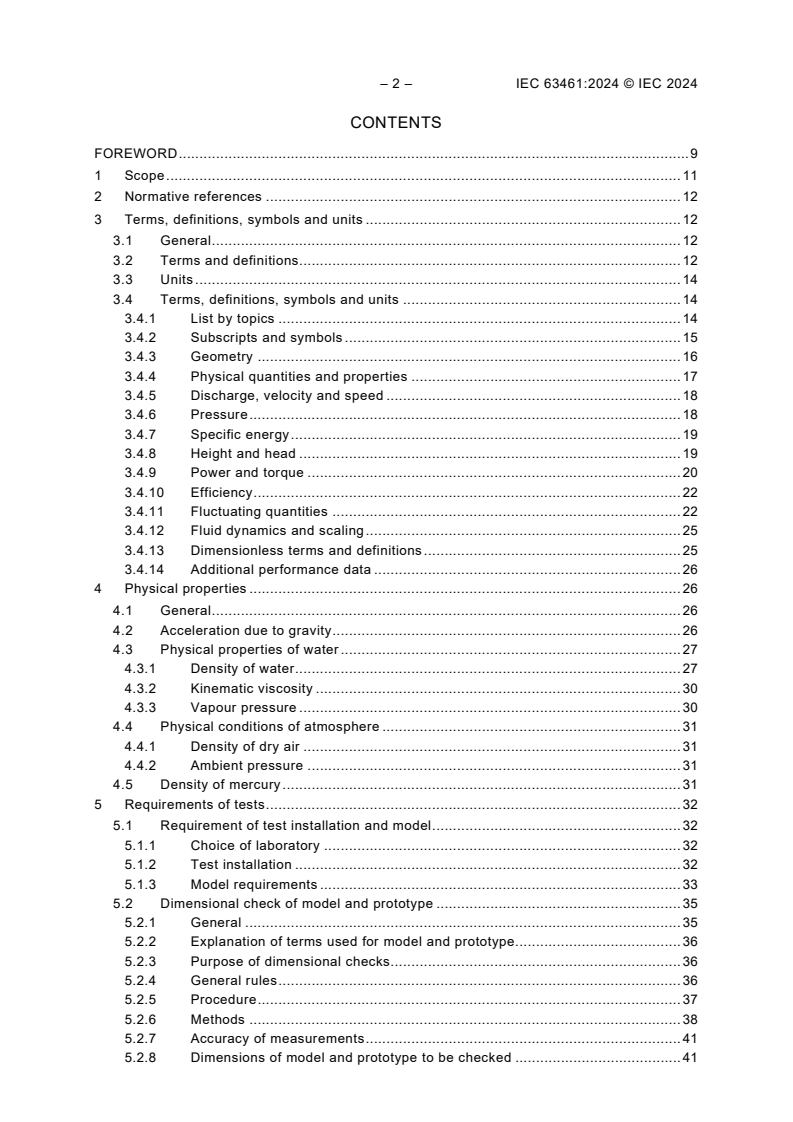
CONTENTS
FOREWORD . 9
1 Scope . 11
2 Normative references . 12
3 Terms, definitions, symbols and units . 12
3.1 General . 12
3.2 Terms and definitions. 12
3.3 Units . 14
3.4 Terms, definitions, symbols and units . 14
3.4.1 List by topics . 14
3.4.2 Subscripts and symbols . 15
3.4.3 Geometry . 16
3.4.4 Physical quantities and properties . 17
3.4.5 Discharge, velocity and speed . 18
3.4.6 Pressure . 18
3.4.7 Specific energy . 19
3.4.8 Height and head . 19
3.4.9 Power and torque . 20
3.4.10 Efficiency . 22
3.4.11 Fluctuating quantities . 22
3.4.12 Fluid dynamics and scaling . 25
3.4.13 Dimensionless terms and definitions . 25
3.4.14 Additional performance data . 26
4 Physical properties . 26
4.1 General . 26
4.2 Acceleration due to gravity . 26
4.3 Physical properties of water . 27
4.3.1 Density of water . 27
4.3.2 Kinematic viscosity . 30
4.3.3 Vapour pressure . 30
4.4 Physical conditions of atmosphere . 31
4.4.1 Density of dry air . 31
4.4.2 Ambient pressure . 31
4.5 Density of mercury . 31
5 Requirements of tests . 32
5.1 Requirement of test installation and model . 32
5.1.1 Choice of laboratory . 32
5.1.2 Test installation . 32
5.1.3 Model requirements . 33
5.2 Dimensional check of model and prototype . 35
5.2.1 General . 35
5.2.2 Explanation of terms used for model and prototype. 36
5.2.3 Purpose of dimensional checks. 36
5.2.4 General rules . 36
5.2.5 Procedure . 37
5.2.6 Methods . 38
5.2.7 Accuracy of measurements . 41
5.2.8 Dimensions of model and prototype to be checked . 41
5.2.9 Permissible maximum deviations in geometrical similarity between
prototype and model . 43
5.2.10 Surface waviness and roughness . 44
5.3 Test procedures . 46
5.3.1 Organization of tests. 46
5.3.2 Inspections and calibrations . 48
5.3.3 Execution of tests . 50
5.3.4 Faults and repetition of tests . 54
5.3.5 Preliminary test report . 55
5.3.6 Final test report . 55
6 Data acquisition . 55
6.1 Data acquisition and data processing . 55
6.1.1 General . 55
6.1.2 General requirements . 56
6.1.3 Data acquisition . 56
6.1.4 Component requirements . 58
6.1.5 Check of the data acquisition system . 61
6.2 Data acquisition and processing for measurement of fluctuating quantities . 63
6.2.1 General . 63
6.2.2 Data acquisition . 64
6.2.3 Data processing. 66
6.3 Error analysis . 67
6.3.1 Definitions . 67
6.3.2 Determination of uncertainties in model tests . 69
7 Methods of measurement . 74
7.1 Discharge measurement . 74
7.1.1 General . 74
7.1.2 Choice of the method of measurement . 75
7.1.3 Accuracy of measurement . 75
7.1.4 Primary methods . 76
7.1.5 Secondary methods . 77
7.2 Pressure measurement . 80
7.2.1 General . 80
7.2.2 Choice of pressure-measuring section . 80
7.2.3 Pressure taps and connecting lines . 81
7.2.4 Apparatus for pressure measurement . 84
7.2.5 Calibration of pressure measurement apparatus . 90
7.2.6 Vacuum measurements . 91
7.2.7 Uncertainty in pressure measurements . 91
7.3 Free water level measurement (see also ISO 4373) . 91
7.3.1 General . 91
7.3.2 Choice of water level measuring sections . 92
7.3.3 Number of measuring points in a measuring section . 92
7.3.4 Measuring methods . 92
7.3.5 Uncertainty in free water level measurement . 93
7.4 Shaft torque measurement . 94
7.4.1 General . 94
7.4.2 Methods of torque measurement . 94
7.4.3 Methods of absorbing/generating power . 95
– 4 – IEC 63461:2024 © IEC 2024
7.4.4 Layout of arrangement . 95
7.4.5 Checking of system . 99
7.4.6 Calibration . 100
7.4.7 Uncertainty in torque measurement (at a confidence level of 95 %) . 100
7.5 Rotational speed measurement . 102
7.5.1 General . 102
7.5.2 Methods of speed measurement . 102
7.5.3 Checking . 102
7.5.4 Uncertainty of measurement . 102
8 Test execution and results . 102
8.1 General . 102
8.2 Determination of E . 103
8.2.1 General . 103
8.2.2 Determination of the specific hydraulic energy E . 103
8.2.3 Simplified formulae for E . 106
8.3 Determination of power and efficiency . 108
8.3.1 Hydraulic power . 108
8.3.2 Mechanical power . 109
8.3.3 Hydraulic efficiency . 109
8.4 Hydraulic similitude . 110
8.4.1 Theoretical basic requirements and similitude numbers . 110
8.4.2 Conditions for hydraulic similitude as used in this document . 110
8.4.3 Similitude requirements for various types of model tests . 111
8.4.4 Reynolds similitude . 111
8.4.5 Froude similitude . 111
8.4.6 Other similitude conditions - Weber number . 111
8.5 Test conditions . 112
8.5.1 Determination of test conditions . 112
8.5.2 Minimum values for model size and test conditions to be fulfilled . 112
8.5.3 Stability and fluctuations during measurements . 113
8.5.4 Adjustment of the operating point . 113
8.6 Computation and presentation of test results . 113
8.6.1 General . 113
8.6.2 Power, discharge and efficiency in the guarantee range . 114
8.6.3 Computation of steady-state runaway speed and discharge . 118
9 Nature and extent of guarantees related to hydraulic performance . 119
9.1 General . 119
9.1.1 Design data and coordination . 119
9.1.2 Definition of the hydraulic performance guarantees . 120
9.1.3 Guarantees of correlated quantities . 120
9.1.4 Form of guarantees . 120
9.2 Main hydraulic performance guarantees verifiable by model test . 121
9.2.1 Guaranteed quantities for any machine . 121
9.2.2 Specific application . 121
9.3 Guarantees not verifiable by model test . 121
9.3.1 Guarantees on cavitation erosion . 121
9.3.2 Guarantees on maximum momentary overspeed and maximum
momentary pressure rise . 121
9.3.3 Guarantees covering noise and vibration . 122
9.3.4 Measurements not covered by this document . 122
9.4 Comparison with guarantees . 122
9.4.1 General . 122
9.4.2 Interpolation curve and total uncertainty bandwidth . 122
9.4.3 Power, discharge and/or specific hydraulic energy and efficiency in the
guarantee range . 123
9.4.4 Prototype mechanical losses . 124
9.4.5 Runaway speed and discharge . 124
9.4.6 Penalty and premium . 125
10 Additional performance data – Methods of measurement and results . 125
10.1 Additional data measurement . 125
10.1.1 General . 125
10.1.2 Test conditions and test procedures . 126
10.1.3 Uncertainty in measurements . 126
10.1.4 Model to prototype conversion . 127
10.2 Hydraulic loads on control components . 127
10.2.1 General . 127
10.2.2 Pelton needle force and deflector torque . 128
10.3 Influence of tail water level . 131
10.4 Testing in an extended operating range . 131
10.4.1 General . 131
10.4.2 Scope of tests . 131
10.4.3 Methods of testing in the extended operating range . 132
10.5 Differential pressure measurement in view of prototype index test . 133
10.5.1 General . 133
10.5.2 Purpose of test . 133
10.5.3 Execution of test . 133
10.5.4 Analysis of test results . 134
10.5.5 Transposition to prototype conditions . 135
10.5.6 Uncertainty . 135
10.6 Nozzle flow discharge calibration in view of prototype index test . 135
Annex A (informative) Dimensionless terms . 136
Annex B (normative) Physical properties, data . 138
Annex C (informative) Summarized test and calculation procedure . 146
C.1 General . 146
C.2 Agreements to be reached prior to testing . 146
C.3 Model, test facility and instrumentation . 147
C.3.1 Model manufacture and dimensional checks . 147
C.3.2 Test facility instrumentation and data acquisition system . 147
C.4 Tests and calculation of the model values . 147
C.4.1 Test types. 147
C.4.2 Measurement of the main quantities during the test . 147
C.4.3 Uncertainty of the measured quantities . 148
C.4.4 Calculation of the quantities related to the main hydraulic performance . 148
C.4.5 Calculation of the dimensionless factors or coefficients and of the
Thoma number . 148
C.5 Calculation of prototype quantities . 148
C.6 Plotting of model or prototype results . 149
C.7 Comparison with the guarantees . 149
– 6 – IEC 63461:2024 © IEC 2024
C.8 Final protocol . 149
C.9 Final test report . 149
Annex D (normative) Computation of the prototype runaway characteristics taking into
account friction and windage losses of the unit . 150
Annex E (informative) Example of determination of the best smooth curve: method of
separate segments . 151
E.1 General . 151
E.2 Principle of the method . 151
E.3 Choice of the minimum width of the intervals . 153
E.4 Determination of the intervals . 153
Annex F (informative) Examples of analysis of sources of error and uncertainty
evaluation . 154
F.1 General . 154
F.2 Example of analysis of sources of error and of uncertainty evaluation in the
measurement of a physical quantity . 154
F.2.1 General . 154
F.2.2 Errors arising during calibration . 155
F.2.3 Errors arising during the tests . 156
F.3 Example of calculation of uncertainty due to systematic errors in the
determination of the specific hydraulic energy, mechanical runner power and
hydraulic efficiency . 157
F.3.1 General . 157
F.3.2 Discharge . 157
F.3.3 Pressure . 157
F.3.4 Specific hydraulic energy . 157
F.3.5 Power . 158
F.3.6 Hydraulic efficiency . 159
Annex G (normative) The scale effect on hydraulic efficiency for Pelton turbines . 160
G.1 General . 160
G.2 Similarity considerations . 160
G.3 Transposition formula . 162
Annex H (normative) Analysis of random errors for a test at constant operating
conditions . 163
H.1 General . 163
H.2 Standard deviation . 163
H.3 Confidence levels . 164
H.4 Student's t distribution . 164
H.5 Maximum permissible value of uncertainty due to random errors. 165
H.6 Example of calculation . 166
Annex I (informative) Flux diagram of specific hydraulic energy and power . 167
Bibliography . 169
Figure 1 – Schematic representation of a Pelton machine . 16
Figure 2 – Reference diameter and bucket width . 17
Figure 3 – Reference level of a Pelton machine . 19
Figure 4 – Flux diagram for power . 21
Figure 5 – Illustration of some definitions related to oscillating quantities . 24
-2
Figure 6 – Acceleration due to gravity g (m ⋅ s ) . 27
−3
Figure 7 – Density of distilled water ρ (kg ⋅ m ) . 30
wd
Figure 8 – Example for homology limits for wetted parts of a vertical Pelton turbine . 34
Figure 9 – Example for homology limit for wetted parts of a horizontal Pelton turbine . 34
Figure 10 – Procedure for dimensional checks, comparison of results "steel to steel"
and application of tolerances for model and prototype . 37
Figure 11 – Pelton turbine: example of dimensions to be checked on the distributor and
the housing of vertical and horizontal shaft machines . 39
Figure 12 – Pelton turbine: example of dimensions to be checked on the buckets and
nozzles . 40
Figure 13 – Definition of waviness and surface roughness . 45
Figure 14 – Time multiplexing data acquisition system . 57
Figure 15 – Bus operated data acquisition system . 57
Figure 16 – Time delay . 59
Figure 17 – Typical low-pass filter attenuation characteristics . 59
Figure 18 – Different measurement chains and their recommended checkpoints . 62
Figure 19 – Typical data acquisition system . 64
Figure 20 – Frequency response of analogue anti-aliasing filter . 65
Figure 21 – Example of calibration curve . 70
Figure 22 – Examples of pressure taps . 82
Figure 23 – Types of pressure manifolds . 83
Figure 24 – Dead weight manometer with compensation by pressure or force
transducer (example of experimental set-up) . 88
Figure 25 – Pressure weighbeam (example of experimental set-up) . 89
Figure 26 – Stilling well . 92
Figure 27 – Point and hook gauges . 93
Figure 28 – Balance arrangement . 96
Figure 29 – Balance arrangement with two separate frames . 97
Figure 30 – Arrangement with machine bearings and seals not in balance . 97
Figure 31 – Arrangement using a torquemeter . 98
Figure 32 – Arrangement using a torquemeter with machine bearings and seals in
balance . 98
Figure 33 – Arrangement using a torquemeter with machine bearings and seals not in
balance . 99
Figure 34 – Example showing main elevations, heights and reference levels of the test
rig and model machine . 105
Figure 35 – Pelton turbines with horizontal axis: determination of specific hydraulic
energy of the machine . 108
Figure 36 – Pelton model turbine: performance hill diagram (example for a six-nozzle
machine) . 114
Figure 37 – Three-dimensional surface of hydraulic efficiency and curves of
performance at E constant . 116
nD
Figure 38 – Runaway curves for a six-nozzle Pelton turbine . 118
Figure 39 – Runaway speed determined by extrapolation . 118
Figure 40 – Measured hydraulic efficiency compared to guarantee point . 123
Figure 41 – Comparison between guarantees and measurements . 124
– 8 – IEC 63461:2024 © IEC 2024
Figure 42 – Pelton turbine runaway speed and discharge curves: comparison between
guarantees and measurements . 125
Figure 43 – Pelton needle force factor as a function of relative needle stroke . 130
Figure 44 – Example of pressure tap location for index test . 134
Figure 45 – Example of graphical representation of index test data . 134
Figure D.1 – Determination of the maximum runaway speed of the prototype taking into
account the friction and windage losses of the unit . 150
Figure E.1 – Principle of the method of separate segments . 152
Figure E.2 – Example of determination of intervals . 152
Figure G.1 – Influence of Froude number . 161
Figure G.2 – Influence of Weber number. 162
Figure G.3 – Influence of Reynolds number . 162
Figure I.1 – Turbine . 167
Table 1 – Coefficients of the Herbst and Roegener formula . 29
Table 2 – Permissible maximum deviations . 43
Table 3 – Maximum recommended prototype surface roughness Ra . 46
Table 4 – Summary of errors that determine total measurement uncertainty . 71
Table 5 – Examples of experimental setup of liquid column manometers . 85
Table 6 – Nomenclature for Figure 28 to Figure 33 . 96
Table 7 – Similitude numbers . 110
Table 8 – Similitude requirements for various types of model tests . 111
Table 9 – Minimum values for model size and test parameters . 113
Table 10 – Variables defining the operating point of a machine . 114
Table A.1 – Dimensionless terms . 137
−2
Table B.1 – Acceleration due to gravity g (m·s ) . 138
−3
Table B.2 – Density of distilled water ρ (kg·m ) . 139
wd
2 −1
Table B.3 – Kinematic viscosity of distilled water ν (m ·s ) . 141
Table B.4 – Vapour pressure of distilled water p (Pa) . 142
va
−3
Table B.5 – Density of dry air ρ (kg·m ) . 143
a
Table B.6 – Ambient pressure p (Pa) . 144
amb
−3
Table B.7 – Density of mercury ρ (kg·m ) . 145
Hg
Table G.1 – Numerical data for surface tension σ* . 161
Table H.1 – Confidence levels . 164
Table H.2 – Values of Student's t . 165
Table H.3 – Computation of the estimated standard deviation and the uncertainty for
eight observations . 166
INTERNATIONAL ELECTROTECHNICAL COMMISSION
____________
PELTON HYDRAULIC TURBINES –
MODEL ACCEPTANCE TESTS
FOREWORD
1) The International Electrotechnical Commission (IEC) is a worldwide organization for standardization comprising
all national electrotechnical committees (IEC National Committees). The object of IEC is to promote international
co-operation on all questions concerning standardization in the electrical and electronic fields. To this end and
in addition to other activities, IEC publishes International Standards, Technical Specifications, Technical Reports,
Publicly Available Specifications (PAS) and Guides (hereafter referred to as “IEC Publication(s)”). Their
preparation is entrusted to technical committees; any IEC National Committee interested in the subject dealt with
may participate in this preparatory work. International, governmental and non-governmental organizations liaising
with the IEC also participate in this preparation. IEC collaborates closely with the International Organization for
Standardization (ISO) in accordance with conditions determined by agreement between the two organizations.
2) The formal decisions or agreements of IEC on technical matters express, as nearly as possible, an international
consensus of opinion on the relevant subjects since each technical committee has representation from all
interested IEC National Committees.
3) IEC Publications have the form of recommendations for international use and are accepted by IEC National
Committees in that sense. While all reasonable efforts are made to ensure that the technical content of IEC
Publications is accurate, IEC cannot be held respo
...