

IEC/IEEE 63198-2775:2023
(Main)Technical guidelines for smart hydroelectric power plant
General Information
- Abstract
IEC/IEEE 63198-2775:2023 describes the integrated control and management of smart hydroelectric power plants and groups of plants using the latest proven and widely accepted digital equipment. The descriptions are applicable to all types of hydroelectric power plants except tidal and ocean power plants.
Based on internationally standardized communication models, this document incorporates guidelines for communication networks, sensors, local monitoring and control equipment, Integrated Control and Management Platform (ICAMP) as well as intelligent applications. In addition, special attention is also given to cyber security.
This document considers the future structure of completely digitalized power plants equipped with digitalized sensors and actuators as well as the intelligent control and management of power plants with existing instrumentation.
- Status
- Published
- Publication Date
- 16-Feb-2023
- Technical Committee
- TC 4 - Hydraulic turbines
- Drafting Committee
- WG 14 - TC 4/WG 14
- Current Stage
- PPUB - Publication issued
- Start Date
- 17-Feb-2023
- Completion Date
- 06-Jan-2023
Overview
IEC/IEEE 63198-2775:2023 sets comprehensive technical guidelines for the integration, control, and management of smart hydroelectric power plants. Developed by the International Electrotechnical Commission (IEC) in collaboration with IEEE, this international standard applies to all hydroelectric power plants except tidal and ocean power plants. It describes the use of latest proven digital equipment and advanced communication models to achieve fully digitalized and intelligent plants.
The standard supports the development and operation of plants equipped with digital sensors, smart actuators, and an Integrated Control and Management Platform (ICAMP). It also addresses cyber security, ensuring that smart hydroelectric power plants are protected against emerging digital threats. The goal is to promote interoperable, efficient, safe, and sustainable hydroelectric power generation using cutting-edge technology.
Key Topics
System Architecture
Details the architecture models, logical levels, zones, and network structures essential for an integrated smart hydroelectric plant and groups of plants. Supports retrofit and new constructions.Communication Networks
Specifies communication networks optimized for plant-level, unit-level, and process-level interaction using internationally standardized protocols, improving data flow and control accuracy.Smart Transducers and Intelligent Electronic Devices (IEDs)
Defines technical requirements for smart sensors and IEDs responsible for measurement, control execution, local control, and protection functions.Integrated Control and Management Platform (ICAMP)
Outlines the platform’s structure for data management, basic services, and intelligent applications that support economic operation, condition-based maintenance, dam safety analyses, and more.Cyber Security
Emphasizes network structure security, data integrity, device authentication, access control, and comprehensive management of IT infrastructure to safeguard against cyber threats.Operation, Maintenance, and Commissioning
Provides guidance on systematic commissioning, testing strategies, remote diagnostics, and documentation essential for sustained plant performance.
Applications
IEC/IEEE 63198-2775:2023 is highly relevant for:
- Hydroelectric Plant Operators seeking to modernize existing facilities with digital technologies.
- Engineering and Automation Vendors developing compatible control and monitoring equipment.
- Utility Companies managing groups of hydroelectric plants aiming to optimize performance through integrated control solutions.
- Cyber Security Experts involved in protecting critical infrastructure within hydroelectric power.
- Smart Grid Integrators requiring standards-compliant plants for seamless integration with larger power systems.
By following the standard, stakeholders can achieve:
- Enhanced reliability and efficiency through smart sensor networks and intelligent diagnostics.
- Improved decision-making with advanced data analytics and trend forecasting.
- Standardized communication reducing integration complexity and operational costs.
- Robust security frameworks protecting physical assets and digital operations.
- Scalable and flexible plant architectures suitable for future digital advancements.
Related Standards
IEC/IEEE 63198-2775:2023 complements and interacts with:
- IEC 62351 Series - Security standards for power system information infrastructure addressing data and communication security.
- IEC TC57 Profile Standards - Related to communication networks and systems for power utility automation.
- Other IEC and IEEE standards guiding instrumentation, control equipment, and cyber security best practices in power generation.
This standard integrates harmoniously with these foundational standards to ensure holistic governance for smart hydroelectric power plants.
By adhering to IEC/IEEE 63198-2775:2023, hydroelectric power plants can leverage the latest digital innovations while ensuring secure, efficient, and sustainable operation in line with international best practices. This standard is essential for advancing smart hydro generation and securing the critical infrastructure of tomorrow’s energy landscape.
Get Certified
Connect with accredited certification bodies for this standard

DNV
DNV is an independent assurance and risk management provider.

Lloyd's Register
Lloyd's Register is a global professional services organisation specialising in engineering and technology.
DNV Energy Systems
Energy and renewable energy certification.
Sponsored listings
Frequently Asked Questions
IEC/IEEE 63198-2775:2023 is a standard published by the International Electrotechnical Commission (IEC). Its full title is "Technical guidelines for smart hydroelectric power plant". This standard covers: IEC/IEEE 63198-2775:2023 describes the integrated control and management of smart hydroelectric power plants and groups of plants using the latest proven and widely accepted digital equipment. The descriptions are applicable to all types of hydroelectric power plants except tidal and ocean power plants. Based on internationally standardized communication models, this document incorporates guidelines for communication networks, sensors, local monitoring and control equipment, Integrated Control and Management Platform (ICAMP) as well as intelligent applications. In addition, special attention is also given to cyber security. This document considers the future structure of completely digitalized power plants equipped with digitalized sensors and actuators as well as the intelligent control and management of power plants with existing instrumentation.
IEC/IEEE 63198-2775:2023 describes the integrated control and management of smart hydroelectric power plants and groups of plants using the latest proven and widely accepted digital equipment. The descriptions are applicable to all types of hydroelectric power plants except tidal and ocean power plants. Based on internationally standardized communication models, this document incorporates guidelines for communication networks, sensors, local monitoring and control equipment, Integrated Control and Management Platform (ICAMP) as well as intelligent applications. In addition, special attention is also given to cyber security. This document considers the future structure of completely digitalized power plants equipped with digitalized sensors and actuators as well as the intelligent control and management of power plants with existing instrumentation.
IEC/IEEE 63198-2775:2023 is classified under the following ICS (International Classification for Standards) categories: 27.140 - Hydraulic energy engineering. The ICS classification helps identify the subject area and facilitates finding related standards.
IEC/IEEE 63198-2775:2023 is available in PDF format for immediate download after purchase. The document can be added to your cart and obtained through the secure checkout process. Digital delivery ensures instant access to the complete standard document.
Standards Content (Sample)
IEC/IEEE 63198-2775 ®
Edition 1.0 2023-02
INTERNATIONAL
STANDARD
NORME
INTERNATIONALE
Technical guidelines for smart hydroelectric power plant
Lignes directrices techniques d’une centrale hydroélectrique intelligente
All rights reserved. Unless otherwise specified, no part of this publication may be reproduced or utilized in any form or
by any means, electronic or mechanical, including photocopying and microfilm, without permission in writing being
secured. Requests for permission to reproduce should be addressed to either IEC at the address below or IEC’s
member National Committee in the country of the requester or from IEEE.
IEC Secretariat Institute of Electrical and Electronics Engineers, Inc.
3, rue de Varembé 3 Park Avenue
CH-1211 Geneva 20 New York, NY 10016-5997
Switzerland United States of America
Tel.: +41 22 919 02 11 stds.ipr@ieee.org
info@iec.ch www.ieee.org
www.iec.ch
About the IEC
The International Electrotechnical Commission (IEC) is the leading global organization that prepares and publishes
International Standards for all electrical, electronic and related technologies.
About IEC publications
The technical content of IEC publications is kept under constant review by the IEC. Please make sure that you have the
latest edition, a corrigendum or an amendment might have been published.
IEC publications search - webstore.iec.ch/advsearchform IEC Products & Services Portal - products.iec.ch
The advanced search enables to find IEC publications by a Discover our powerful search engine and read freely all the
variety of criteria (reference number, text, technical publications previews. With a subscription you will always have
committee, …). It also gives information on projects, replaced access to up to date content tailored to your needs.
and withdrawn publications.
Electropedia - www.electropedia.org
IEC Just Published - webstore.iec.ch/justpublished
The world's leading online dictionary on electrotechnology,
Stay up to date on all new IEC publications. Just Published
containing more than 22 300 terminological entries in English
details all new publications released. Available online and once
and French, with equivalent terms in 19 additional languages.
a month by email.
Also known as the International Electrotechnical Vocabulary
(IEV) online.
IEC Customer Service Centre - webstore.iec.ch/csc
If you wish to give us your feedback on this publication or need
further assistance, please contact the Customer Service
Centre: sales@iec.ch.
A propos de l'IEC
La Commission Electrotechnique Internationale (IEC) est la première organisation mondiale qui élabore et publie des
Normes internationales pour tout ce qui a trait à l'électricité, à l'électronique et aux technologies apparentées.
A propos des publications IEC
Le contenu technique des publications IEC est constamment revu. Veuillez vous assurer que vous possédez l’édition la
plus récente, un corrigendum ou amendement peut avoir été publié.
Recherche de publications IEC - Découvrez notre puissant moteur de recherche et consultez
webstore.iec.ch/advsearchform gratuitement tous les aperçus des publications. Avec un
La recherche avancée permet de trouver des publications IEC abonnement, vous aurez toujours accès à un contenu à jour
en utilisant différents critères (numéro de référence, texte, adapté à vos besoins.
comité d’études, …). Elle donne aussi des informations sur les
projets et les publications remplacées ou retirées. Electropedia - www.electropedia.org
Le premier dictionnaire d'électrotechnologie en ligne au monde,
IEC Just Published - webstore.iec.ch/justpublished
avec plus de 22 300 articles terminologiques en anglais et en
Restez informé sur les nouvelles publications IEC. Just
français, ainsi que les termes équivalents dans 19 langues
Published détaille les nouvelles publications parues.
additionnelles. Egalement appelé Vocabulaire
Disponible en ligne et une fois par mois par email.
Electrotechnique International (IEV) en ligne.
Service Clients - webstore.iec.ch/csc
Si vous désirez nous donner des commentaires sur cette
publication ou si vous avez des questions contactez-nous:
sales@iec.ch.
IEC Products & Services Portal - products.iec.ch
IEC/IEEE 63198-2775 ®
Edition 1.0 2023-02
INTERNATIONAL
STANDARD
NORME
INTERNATIONALE
Technical guidelines for smart hydroelectric power plant
Lignes directrices techniques d’une centrale hydroélectrique intelligente
INTERNATIONAL
ELECTROTECHNICAL
COMMISSION
COMMISSION
ELECTROTECHNIQUE
INTERNATIONALE
ICS 27.140 ISBN 978-2-8322-6197-2
– 2 – IEC/IEEE 63198-2775:2023
© IEC/IEEE 2023
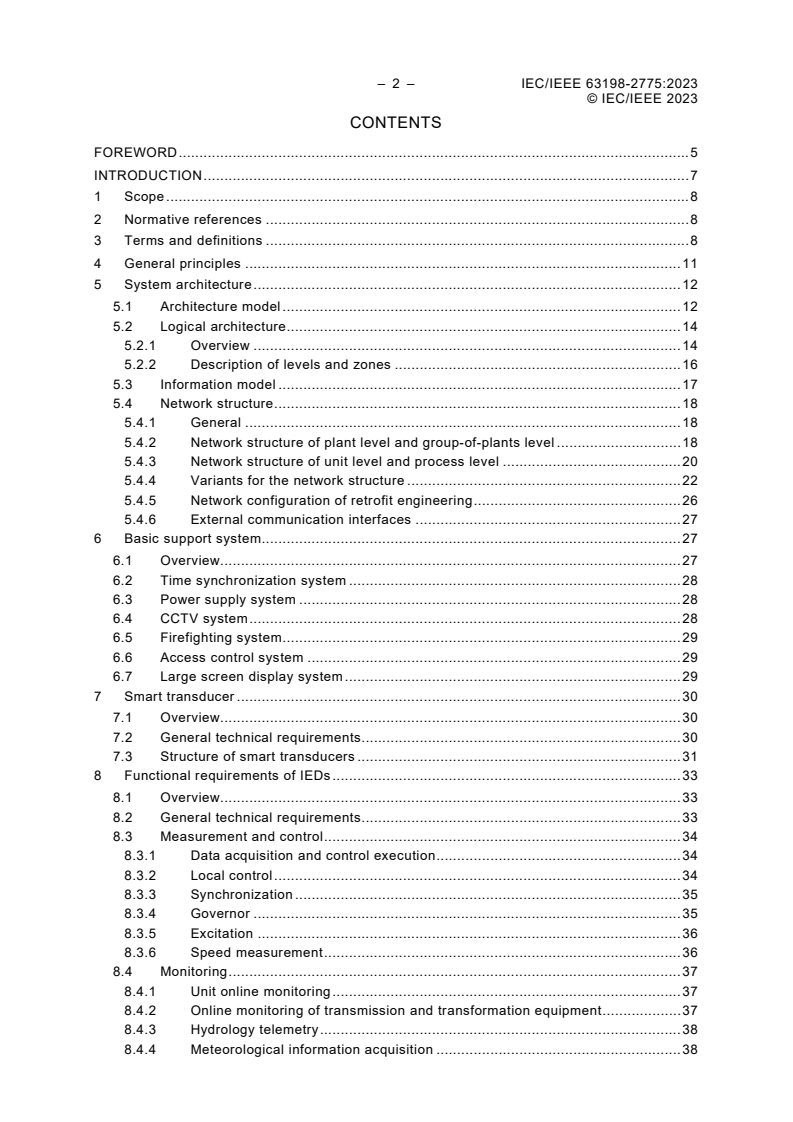
CONTENTS
FOREWORD . 5
INTRODUCTION . 7
1 Scope . 8
2 Normative references . 8
3 Terms and definitions . 8
4 General principles . 11
5 System architecture . 12
5.1 Architecture model . 12
5.2 Logical architecture . 14
5.2.1 Overview . 14
5.2.2 Description of levels and zones . 16
5.3 Information model . 17
5.4 Network structure . 18
5.4.1 General . 18
5.4.2 Network structure of plant level and group-of-plants level . 18
5.4.3 Network structure of unit level and process level . 20
5.4.4 Variants for the network structure . 22
5.4.5 Network configuration of retrofit engineering . 26
5.4.6 External communication interfaces . 27
6 Basic support system. 27
6.1 Overview. 27
6.2 Time synchronization system . 28
6.3 Power supply system . 28
6.4 CCTV system . 28
6.5 Firefighting system . 29
6.6 Access control system . 29
6.7 Large screen display system . 29
7 Smart transducer . 30
7.1 Overview. 30
7.2 General technical requirements. 30
7.3 Structure of smart transducers . 31
8 Functional requirements of IEDs . 33
8.1 Overview. 33
8.2 General technical requirements. 33
8.3 Measurement and control . 34
8.3.1 Data acquisition and control execution . 34
8.3.2 Local control . 34
8.3.3 Synchronization . 35
8.3.4 Governor . 35
8.3.5 Excitation . 36
8.3.6 Speed measurement . 36
8.4 Monitoring . 37
8.4.1 Unit online monitoring . 37
8.4.2 Online monitoring of transmission and transformation equipment . 37
8.4.3 Hydrology telemetry . 38
8.4.4 Meteorological information acquisition . 38
© IEC/IEEE 2023
8.4.5 Dam safety monitoring . 39
8.5 Protection . 39
8.5.1 Overview . 39
8.5.2 Electrical protection . 39
8.5.3 Mechanical protection . 40
9 Platform and intelligent application . 41
9.1 General . 41
9.2 Integrated control and management platform . 41
9.2.1 General . 41
9.2.2 Data management . 41
9.2.3 Basic service . 43
9.2.4 Basic applications . 46
9.3 Intelligent applications . 48
9.3.1 Hydroelectric power plant economic operation . 48
9.3.2 Decision support for Condition-Based Maintenance (CBM) . 52
9.3.3 Dam safety analysis and evaluation . 54
9.3.4 Security and safety interaction . 54
9.3.5 Plant environment monitoring . 55
9.3.6 Intelligent patrol . 56
9.3.7 Operation and maintenance simulation . 57
9.3.8 Intelligent alarm . 58
9.3.9 Intelligent work sheet and operation sheet . 59
9.3.10 Data analysis and trend forecast . 59
9.3.11 Emergency command support . 61
10 Cyber security . 63
10.1 General . 63
10.2 Network structure security. 63
10.3 Data and communication security. 65
10.4 Device and software security . 67
10.5 Access control . 68
10.6 IT infrastructure comprehensive supervision and management . 68
10.7 Audit and modification . 69
10.8 Emergency plan and response . 69
10.9 Employee training and awareness . 69
11 Commissioning, operation and maintenance . 69
11.1 Commissioning . 69
11.1.1 Overview . 69
11.1.2 Testing scene management . 70
11.1.3 Testing strategy management . 70
11.1.4 Automatic testing execution . 70
11.1.5 Testing record management . 70
11.2 Operation and maintenance . 70
11.2.1 Remote diagnosis . 70
11.2.2 Product maintenance . 70
11.2.3 Documents management . 71
12 Implementation procedures of a smart hydroelectric power plant . 71
Bibliography . 73
– 4 – IEC/IEEE 63198-2775:2023
© IEC/IEEE 2023
Figure 1 – System architecture model of a smart hydroelectric power plant. 13
Figure 2 – Typical system logic architecture of a smart hydroelectric power plant . 15
Figure 3 – Typical physical structure of plant level and group-of-plants level of a smart
hydroelectric power plant . 19
Figure 4 – Typical network structure schematic diagram of process level and unit level . 21
Figure 5 – Recommended communication network structures (Variant A) . 23
Figure 6 – Recommended communication network structures (Variant B) . 24
Figure 7 – Recommended communication network structures (Variant C) . 25
Figure 8 – Recommended communication network structures (Variant D) . 26
Figure 9 – Example of external interfaces of a smart hydroelectric power plant . 27
Figure 10 – Structure of smart transducers . 31
Figure 11 – Adaption of conventional transducers . 32
Figure 12 – Functional architecture of ICAMP . 41
Figure 13 – Recommended network architecture . 64
Figure 14 – Security categories, typical attacks, and countermeasures . 66
Figure 15 – Correlations between IEC 62351 series and IEC TC57 profile standards . 66
Figure 16 – Typical implementation procedures of a smart hydroelectric power plant . 72
© IEC/IEEE 2023
INTERNATIONAL ELECTROTECHNICAL COMMISSION
____________
TECHNICAL GUIDELINES FOR SMART HYDROELECTRIC POWER PLANT
FOREWORD
1) The International Electrotechnical Commission (IEC) is a worldwide organization for standardization comprising
all national electrotechnical committees (IEC National Committees). The object of IEC is to promote international
co-operation on all questions concerning standardization in the electrical and electronic fields. To this end and
in addition to other activities, IEC publishes International Standards, Technical Specifications, Technical Reports,
Publicly Available Specifications (PAS) and Guides (hereafter referred to as "IEC document(s)"). Their
preparation is entrusted to technical committees; any IEC National Committee interested in the subject dealt with
may participate in this preparatory work. International, governmental and non-governmental organizations liaising
with the IEC also participate in this preparation.
IEEE Standards documents are developed within IEEE Societies and Standards Coordinating Committees of the
IEEE Standards Association (IEEE SA) Standards Board. IEEE develops its standards through a consensus
development process, approved by the American National Standards Institute, which brings together volunteers
representing varied viewpoints and interests to achieve the final product. Volunteers are not necessarily members
of IEEE and serve without compensation. While IEEE administers the process and establishes rules to promote
fairness in the consensus development process, IEEE does not independently evaluate, test, or verify the
accuracy of any of the information contained in its standards. Use of IEEE Standards documents is wholly
voluntary. IEEE documents are made available for use subject to important notices and legal disclaimers (see
https://standards.ieee.org/ipr/disclaimers.html for more information).
IEC collaborates closely with IEEE in accordance with conditions determined by agreement between the two
organizations. This Dual Logo International Standard was jointly developed by the IEC and IEEE under the terms
of that agreement.
2) The formal decisions of IEC on technical matters express, as nearly as possible, an international consensus of
opinion on the relevant subjects since each technical committee has representation from all interested IEC
National Committees. The formal decisions of IEEE on technical matters, once consensus within IEEE Societies
and Standards Coordinating Committees has been reached, is determined by a balanced ballot of materially
interested parties who indicate interest in reviewing the proposed standard. Final approval of the IEEE standards
document is given by the IEEE Standards Association (IEEE SA) Standards Board.
3) IEC/IEEE Publications have the form of recommendations for international use and are accepted by IEC National
Committees/IEEE Societies in that sense. While all reasonable efforts are made to ensure that the technical
content of IEC/IEEE Publications is accurate, IEC or IEEE cannot be held responsible for the way in which they
are used or for any misinterpretation by any end user.
4) In order to promote international uniformity, IEC National Committees undertake to apply IEC Publications
(including IEC/IEEE Publications) transparently to the maximum extent possible in their national and regional
publications. Any divergence between any IEC/IEEE Publication and the corresponding national or regional
publication shall be clearly indicated in the latter.
5) IEC and IEEE do not provide any attestation of conformity. Independent certification bodies provide conformity
assessment services and, in some areas, access to IEC marks of conformity. IEC and IEEE are not responsible
for any services carried out by independent certification bodies.
6) All users should ensure that they have the latest edition of this publication.
7) No liability shall attach to IEC or IEEE or their directors, employees, servants or agents including individual
experts and members of technical committees and IEC National Committees, or volunteers of IEEE Societies and
the Standards Coordinating Committees of the IEEE Standards Association (IEEE SA) Standards Board, for any
personal injury, property damage or other damage of any nature whatsoever, whether direct or indirect, or for
costs (including legal fees) and expenses arising out of the publication, use of, or reliance upon, this IEC/IEEE
Publication or any other IEC or IEEE Publications.
8) Attention is drawn to the normative references cited in this publication. Use of the referenced publications is
indispensable for the correct application of this publication.
9) Attention is drawn to the possibility that implementation of this IEC/IEEE Publication may require use of material
covered by patent rights. By publication of this standard, no position is taken with respect to the existence or
validity of any patent rights in connection therewith. IEC or IEEE shall not be held responsible for identifying
Essential Patent Claims for which a license may be required, for conducting inquiries into the legal validity or
scope of Patent Claims or determining whether any licensing terms or conditions provided in connection with
submission of a Letter of Assurance, if any, or in any licensing agreements are reasonable or non-discriminatory.
Users of this standard are expressly advised that determination of the validity of any patent rights, and the risk
of infringement of such rights, is entirely their own responsibility.
– 6 – IEC/IEEE 63198-2775:2023
© IEC/IEEE 2023
IEC/IEEE 63198-2775 was prepared by IEC technical committee 4: Hydraulic Turbines, in
cooperation with Energy Development & Power Generation Committee of the IEEE Power &
Energy Society, under the IEC/IEEE Dual Logo Agreement between IEC and IEEE. It is an
International Standard.
This document is published as an IEC/IEEE Dual Logo standard.
The text of this International Standard is based on the following IEC documents:
Draft Report on voting
4/448/FDIS 4/451/RVD
Full information on the voting for its approval can be found in the report on voting indicated in
the above table.
The language used for the development of this International Standard is English.
This document was drafted in accordance with the rules given in the ISO/IEC Directives, Part 2,
available at www.iec.ch/members_experts/refdocs. The main document types developed by IEC
are described in greater detail at www.iec.ch/publications/.
The IEC Technical Committee and IEEE Technical Committee have decided that the contents
of this document will remain unchanged until the stability date indicated on the IEC website
under webstore.iec.ch in the data related to the specific document. At this date, the document
will be
• reconfirmed,
• withdrawn,
• replaced by a revised edition, or
• amended.
© IEC/IEEE 2023
INTRODUCTION
In the past few decades, the widespread use of automatic control systems in hydroelectric
power plants, including computer-based control systems, brought a number of benefits including
improved work efficiency, enhanced reliability and real-time capability, as well as optimized
Operating Expense (OPEX).
Nowadays, tremendous changes occur in hydroelectric power plants and their external
environment, thereby posing challenges in operation, maintenance, scheduling and
management.
The evolution of power grid codes and electricity markets, the growing sensibility of the public
about the environmental impact and such risks generated by operating hydroelectric power
plants as control of flow variation downstream, and the increasing demand for multi-purpose
utilization of water resources lead to the increasing difficulty in generation scheduling decision-
making. Giant unit/plant capacity enhances the role of hydroelectric power plants in maintaining
grid stability. The rationale for developing cascade hydroelectric power plants has been widely
recognized, as integrated operation and maintenance requirements have become increasingly
prominent. The latest technologies such as cloud computing, Artificial Intelligence (AI), big data,
Internet of Things (IoT), mobile terminal, and Virtual Reality (VR) are triggering a revolution in
hydroelectric power plant automation systems.
Newly installed, renovated and partially refurbished hydroelectric power plants and remote
control centers need innovative technologies to strengthen information sharing and coordination
among equipment and applications. With the goal to realize multi-dimensional information
sensing, comprehensive data display, interactive applications and intelligent warnings and
decisions, and to cope with the challenges of operation, maintenance, dispatching and
management, innovation involving multiple elements regarding system architecture, information
model, integrated standards, software structures, business procedure, applications, optimized
models, etc., should be conducted. The innovation based on such elements is multi-dimensional,
flexible and open to different demands, rather than a mere improvement of certain technologies,
so that hydroelectric power plants and remote control centers where those innovations are put
into use can be called a smart hydroelectric power plant.
In the present document, open architecture has been proposed for a smart hydroelectric power
plant and technical requirements for each part have been specified, thus improving the safe,
reliable, efficient and economic operation of hydroelectric power plants/remote control centers,
enhancing the interaction with the smart grid and facilitating ecological and environmental
responsibility. The overall system structure and functionality are mainly determined by the
scales, types, importance and complexity of specific smart hydroelectric power plants. The
document describes a representative set of architectures, components and functionalities. The
appropriate selection, extension or modification tailored to the needs of a specific power plant
shall be chosen in a specific project. The document can be used as a reference for engineers
of hydroelectric power plants/remote control centers, consultants or automation system vendors
in helping the design of smart hydroelectric power plants, development of hardware and
software products, implementation of projects, and compilation of related documents.
– 8 – IEC/IEEE 63198-2775:2023
© IEC/IEEE 2023
TECHNICAL GUIDELINES FOR SMART HYDROELECTRIC POWER PLANT
1 Scope
This document describes the integrated control and management of smart hydroelectric power
plants and groups of plants using the latest proven and widely accepted digital equipment. The
descriptions are applicable to all types of hydroelectric power plants except tidal and ocean
power plants.
Based on internationally standardized communication models, this document incorporates
guidelines for communication networks, sensors, local monitoring and control equipment,
Integrated Control and Management Platform (ICAMP) as well as intelligent applications. In
addition, special attention is also given to cyber security.
This document considers the future structure of completely digitalized power plants equipped
with digitalized sensors and actuators as well as the intelligent control and management of
power plants with existing instrumentation.
2 Normative references
There are no normative references in this document.
3 Terms and definitions
For the purposes of this document, the following terms and definitions apply. ISO, IEC, and
IEEE maintain terminological databases for use in standardization at the following addresses:
• IEC Electropedia: available at http://www.electropedia.org/
• ISO Online browsing platform: available at http://www.iso.org/obp
• IEEE Standards Dictionary Online: available at: http://dictionary.ieee.org
3.1
smart hydroelectric power plant
hydroelectric power plant or group of plants which is featuring digitalized information, networked
communication, standardized integration, interactive applications, optimized operation, and
intelligent decision
Note 1 to entry: Smart hydroelectric power plant uses Intelligent Electronic Devices (IEDs) and intelligent equipment
for the automatic acquisition, measurement, control, protection and other basic functions, and possesses economic
operation, analysis evaluation & decision support, security and safety interaction and other intelligent applications
based on the Integrated Control and Management Platform (ICAMP) in compliance with grid and regulatory
requirements.
3.2
process level
level of the architectural model which realizes data acquisition and command execution
throughout the power generation process, typically consists of transducers/smart transducers,
intelligent terminal, intelligent equipment, etc.
3.3
unit level
level of the architectural model which realizes monitoring, control and protection of equipment
related to different units according to the pre-set strategy, typically consists of various IEDs
© IEC/IEEE 2023
3.4
plant level
level of the architectural model which realizes monitoring, control, analysis, etc. for a plant,
typically consists of computers, network equipment, ICAMP, and various intelligent applications,
whose equipment is deployed in different physical locations such as a central control room and
server room
3.5
group-of-plants level
level of the architectural model which realizes monitoring, control, analysis, evaluation,
decision-support etc. for a group of plants, typically consists of computers, network devices,
ICAMP, and various intelligent applications including economic operation, condition-based
maintenance of a generation fleet, emergency command support, etc. whose devices are
distributed in different physical locations of a remote control center such as a control room,
reservoir scheduling duty office and server room
3.6
process bus
communication network which connects process-level and unit-level devices
3.7
plant bus
communication network which connects devices within the unit level and plant level, and
connects unit-level to plant-level devices
3.8
group-of-plants bus
communication network which connects devices within the group-of-plants level and connects
plant level to group-of-plants level devices
3.9
system
collection of parts and relationships among these parts that may be organized to accomplish
some purposes
[SOURCE: IEC 62357-1:2016, 3.1.3]
3.10
control zone
zone with applications of real-time monitoring and control functions
3.11
non-control zone
zone with applications which are potentially required for the generation process, but not
involved in control directly.
3.12
production control zone
zone consisting of control zone and non-control zone
3.13
management information zone
collection of management information systems outside the production control zone for power
generation utilities
– 10 – IEC/IEEE 63198-2775:2023
© IEC/IEEE 2023
3.14
Intelligent Electronic Device
IED
device within the unit level or process level incorporating one or more processors with the
capability of receiving or sending data/controls from or to an external source (for example,
electronic multi-function meters, digital relays, controllers)
3.15
smart transducer
analog or digital sensor or actuator combined with a microprocessor, a signal conditioning unit
and a communication interface
3.16
intelligent terminal
IED which realizes data acquisition or command output, supports unified information model,
has capabilities of self-diagnosis and self-recovery within the process level, connecting various
sensors of pressure, flow, temperature, position, status, etc. or actuators through cables, as
well as connecting other IEDs within the unit level through process bus, usually deployed near
terminal boxes or equipment
3.17
merging unit
interface unit that accepts multiple analogue CT/VT and produces multiple time synchronised
IEC 61850-9-2 compliant frames to provide data communication via the logical interface 4
[SOURCE: IEC TS 61850-2:2019, 3.109]
3.18
intelligent equipment
integration of electromechanical equipment or hydraulic facilities with electronic devices and
transducers, featured with digital measurement, networked communication, unified information
model, self-diagnosis and interactive information, and supports functions like monitoring,
control and protection
3.19
data management
function which realizes uniform storage and management of models and data, and provides
uniform data access service interfaces
3.20
basic service
technologies realizing background functionalities, for example, data communication, data
processing, data access, chart service, log management, authority management, task
management, workflow management, process management, Geographic Information System
(GIS), alarms, expert system etc.
3.21
basic application
software realizing basic business functionalities of hydroelectric power plants, for example,
supervision and control, reservoir scheduling automation, plant condition monitoring, dam
safety monitoring, comprehensive information display and analysis, mobile application, etc.
© IEC/IEEE 2023
3.22
Integrated Control and Management Platform
ICAMP
software platform which consists of data management, basic services and basic applications,
deployed separately in the control zone, non-control zone and management information zone,
supporting the unified modeling of devices and other resources in hydroelectric power plants,
providing standard interfaces and services for the integration of equipment, systems and
intelligent applications, realizing data sharing, centralized control & management and
collaborative interaction
3.23
intelligent application
application serving decision support of hydroelectric power plants, such as economic operation,
Condition-based Maintenance (CBM), emergency command support, dam safety analysis and
evaluation, intelligent alarm, etc., which is accomplished by modules deployed on the ICAMP
or individual decision support system
3.24
Automatic Generation Control
AGC
capability to control the power output of selectable units in response to total plant/group-of-
plants output, tie-line power flow, and power system frequency
3.25
Automatic Voltage Control
AVC
capability to control a specific power system voltage, via adjustment of unit excitation within the
limits of unit terminal voltage and reactive power (VAR) capability
3.26
joint control
functions that enable the automatic control to coordinate the power/water across the system,
e.g. AGC, AVC, water control of power plants or reservoirs
4 General principles
The general principles of smart hydroelectric power plants are as follows:
1) With the process bus, plant bus and group-of-plants bus as backbone network, a smart
hydroelectric power plant should adopt a "level and zone" architecture. Furthermore, it
should be based on smart transducers and IEDs within the process and unit levels, ICAMP
within the plant level or group-of-plants level as the software platform, and intelligent
applications deployed in correspondent zones as business requirements, promoting the safe
and reliable operation of hydroelectric power plants. Before defining the final system
architecture in a power plant, a careful risk analysis should be conducted on the
dependencies and consequences of failures, etc. An analysis should also be conducted on
maintenance needs, costs, effectiveness, etc., to meet the requirements in practical
operations and those of the supervisory authorities.
2) An information model with the capability of self-description should be adopted. Such an
information model enables IEDs and ICAMP to identify measured data correctly. The
information model makes application functions independent of communication protocols.
International standards described in 5.3 should be adopted in the model definition for
electrical and mechanical equipment, hydraulic facilities, and functions, thus realizing
object-oriented data management and enhancing the capability of fulfilling data sharing,
application collaborations and intelligent data analysis.
– 12 – IEC/IEEE 63198-2775:2023
© IEC/IEEE 2023
3) Network communication should be adopted for information transmission. From the
perspective of project practice and cost-effectiveness, smart transducers or "traditional
transducer plus intelligent terminals" should be considered while highly efficient process,
plant and group-of-plants buses should be used. Wireless networking (e.g. cellular data,
Zigbee, LORA) can also be considered to increase system flexibility and reduce system
installation and commissioning.
4) IEDs should embody interoperability. Interoperability is the ability of two or more devices
either from the same vendor or from different vendors to exchange information for the
correct execution of specified functions; it is the ability to operate in the same network or
the same communication path sharing information and commands.
5) Smart hydroelectric power plants should realize integrated operation and management.
Based on the ICAMP, it should facilitate integrated monitoring and data sharing for such
basic applications as supervision and control, reservoir scheduling automation, plant
condition monitoring, dam safety monitoring, protection information management and basic
support systems like Closed Circuit Television (CCTV) and firefighting. Comprehensive data
analysis and interactions among applications should be realized to promote the operation
reliability and efficiency of a single power plant or group-of-plants. Integrated operation and
management should meet demands such as unattended operation, coordinated dispatching
of water resources and electricity, and remote fault diagnosis.
6) Smart hydroelectric power plants should provide intelligent decision support. Based on the
features of a specific plant or group-of-plants, intelligent applications like condition-based
maintenance decision support, emergency command support, dam safety analysis and
evaluation, and intelligent alarm should be deployed selectively. Expert knowledge bases
should be established and expanded continuously. Various models of analysis, evaluation
and optimization should be built to improve the optimized decision-making capability.
7) Smart hydroelectric power plants should be featured with openness and flexibility. An open
and flexible architecture conforming to well-established international standards and
compatible with conventional automation devices and IEDs should be adopted and be able
to meet the need for thorough or partial refurbishment of smart hydroelectric power plants.
ICAMP should be equipped with standard and open interfaces, thereby providing data and
service access to third-party intelligent applications under the condition of cyber security.
5 System architecture
5.1 Architecture model
IEC 62357 proposes the Smart Grid Architecture Model (SGAM). According to SGAM, the
domains are divided into generation, transmission, distribution, Distributed Energy Resources
(DER) and customer premises. The smart hydroelectric power plant is an important part of the
smart grid and belongs to the generation domain. The smart hydroelectric power plant
architecture model is shown in Figure 1.
© IEC/IEEE 2023
Figure 1 – System architecture model of a smart hydroelectric power plant
NOTE "Levels", "Unit", "Plant", "Group-of-plants" in this document correspond to "Zones", "Field", "Station" and
"Operation" in IEC 62357 individually. The control center of the group is included in "Group-of-plants".
This document IEC 62357
Levels Zones
Unit Field
Plant Station
Group-of-plants Operation
In the context of Clause 5, a system is a boundary which includes all layers of the architecture
model of a smart hydroelectric power plant. Besides the domains of the electric energy
conversion chain, the system architecture model of a smart hydroelectric power plant, as shown
in Figure 1, is divided into two additional dimensions: for the first dimension based on the
hierarchy of operation and management, the architecture model is divided into process level,
unit level, plant level, and group-of-plants level, and each level is described in 5.2.2. The
enterprise level is not included in the scope of this document. The process and the unit levels
realize local control, the plant level realizes centralized control, and the group-of-plants level
realizes off-site control. For the second dimension based on interoperability, the architecture
model is divided into component layer, communication layer, information layer and function
layer. The four layers are described below.
The component layer specifies the physical components involved in a smart hydroelectric power
plant. It includes primary equipment, smart transducers, intelligent terminals, lEDs (generally
located within the process and unit levels), network infrastructure (wired and wireless
communication connections, routers, switches and firewalls), and any kinds of computers.
The communication layer describes mechanisms and protocols for the interoperable exchange
of information between components in the context of the underlying functions, services and
related information objects or data models.
– 14 –
...