


IEC 63027:2023
(Main)Photovoltaic power systems - DC arc detection and interruption
Photovoltaic power systems - DC arc detection and interruption
IEC 63027:2023 applies to equipment used for the detection and optionally the interruption of electric DC arcs in photovoltaic (PV) system circuits. The document covers test procedures for the detection of series arcs within PV circuits, and the response times of equipment employed to interrupt the arcs.
The document defines reference scenarios according to which the testing is conducted. This document covers equipment connected to systems not exceeding a maximum PV source circuit voltage of 1 500 V DC. This document provides requirements and testing procedures for arc-fault protection devices used in PV systems to reduce the risk of igniting an electrical fire.
Systèmes photovoltaïques - Détection et interruption d’arc en courant continu
IEC 63027:2023 s’applique aux équipements utilisés pour la détection et éventuellement pour l’interruption des arcs électriques en courant continu des circuits des systèmes photovoltaïques (PV). Il couvre les procédures d’essai de détection des arcs en série dans les circuits PV, et les temps de réponse de l'équipement utilisé pour interrompre les arcs.
Le document définit les scénarios de référence selon lesquels les essais sont réalisés. Le présent document couvre les équipements reliés à des systèmes qui ne dépassent pas une tension maximale de circuit de source PV de 1 500 V en courant continu. Le présent document fournit des exigences et des procédures d’essai pour les dispositifs de protection contre les défauts d’arc utilisés dans les systèmes PV afin de réduire le risque d’incendie d’origine électrique.
General Information
- Status
- Published
- Publication Date
- 02-May-2023
- Technical Committee
- TC 82 - Solar photovoltaic energy systems
- Drafting Committee
- WG 6 - TC 82/WG 6
- Current Stage
- PPUB - Publication issued
- Start Date
- 03-May-2023
- Completion Date
- 05-May-2023
Overview
IEC 63027:2023 is an international standard developed by the International Electrotechnical Commission (IEC) that addresses DC arc detection and interruption in photovoltaic (PV) power systems. It applies specifically to equipment designed to detect and, optionally, interrupt electric DC arcs within PV system circuits. The standard provides a comprehensive framework for testing procedures, response times, and performance requirements of arc-fault protection devices operating on PV source circuits up to 1,500 V DC.
This document plays a critical role in enhancing the safety and reliability of photovoltaic installations by reducing the risk of electrical fires caused by DC arc faults. IEC 63027:2023 supports equipment manufacturers, system designers, and safety inspectors by providing clear, uniform criteria for arc detection and interruption devices.
Key Topics
The standard is structured to cover several key technical areas important for practical implementation and compliance:
- Scope and Definitions: Establishes the fundamental terms related to arc detection and interruption devices used in PV systems.
- Classification of Devices:
- Protection coverage (series and parallel arc faults)
- Methods of implementation including PCE integrated devices, stand-alone devices, and distributed detection systems
- Functional capabilities such as detection only versus detection plus interruption
- Configurations including single string and multi-string monitoring, and the number of input ports or channels
- Ratings and Performance:
- Rated and limiting electrical values for devices
- Utilization categories defining appropriate applications
- Construction and Operational Requirements:
- Design expectations for safety and reliability
- Requirements for self-test functions and reconnection methods (manual, remote, automatic)
- Testing Procedures:
- Detailed setups for series arc fault testing, including equipment configurations such as arc generators and impedance networks
- Measurement methods for arc energy and device response times
- Specific test cases tailored for various PV applications including string inverters, micro inverters, and DC-DC converter systems
- Informative Annexes:
- Practical application examples illustrating device integration into PV systems
- Cross-reference charts linking application scenarios to test setups
Applications
IEC 63027:2023 is essential for a broad range of stakeholders within the photovoltaic energy sector, notably:
- Manufacturers: For designing and certifying arc-fault detection and protection equipment that complies with global safety requirements.
- System Integrators and Installers: To select and implement arc detection devices suitable for different PV system configurations, improving overall system safety.
- Safety Authorities and Inspectors: Providing a standardized reference to evaluate PV system compliance and ensure protection against DC arc hazards.
- Maintenance Personnel: Guiding inspection routines and functional testing for arc detection and interruption equipment within operating PV installations.
By following IEC 63027:2023, PV system operators can significantly mitigate fire risks associated with DC arcs, thereby enhancing the longevity, reliability, and safety of solar energy installations.
Related Standards
IEC 63027:2023 connects with several other standards and technical guidelines in the photovoltaic and electrical safety domain, including:
- IEC 61730 – Photovoltaic (PV) module safety qualification
- IEC 62548 – Design requirements for PV arrays
- IEC 60364-7-712 – Requirements for electrical installations of PV power supply systems
- UL 1699B (in the US) – Standard for Arc-Fault Circuit Interrupters for PV systems
- National electrical codes and fire safety regulations relevant to PV installations
Together, these standards provide a robust safety framework encompassing module design, system installation, and fault protection, supporting continuous improvement in photovoltaic system safety worldwide.
By adhering to IEC 63027:2023, professionals in the photovoltaic industry ensure that DC arc detection and interruption devices meet rigorous international standards, enabling safer and more reliable solar power systems to flourish globally. Keywords include: photovoltaic power systems, DC arc detection, arc-fault protection devices, PV system safety, DC arc interruption, IEC standards for solar systems, PV arc fault detection, electrical fire prevention in PV systems.
Get Certified
Connect with accredited certification bodies for this standard

DNV
DNV is an independent assurance and risk management provider.

Lloyd's Register
Lloyd's Register is a global professional services organisation specialising in engineering and technology.
DNV Energy Systems
Energy and renewable energy certification.
Sponsored listings
Frequently Asked Questions
IEC 63027:2023 is a standard published by the International Electrotechnical Commission (IEC). Its full title is "Photovoltaic power systems - DC arc detection and interruption". This standard covers: IEC 63027:2023 applies to equipment used for the detection and optionally the interruption of electric DC arcs in photovoltaic (PV) system circuits. The document covers test procedures for the detection of series arcs within PV circuits, and the response times of equipment employed to interrupt the arcs. The document defines reference scenarios according to which the testing is conducted. This document covers equipment connected to systems not exceeding a maximum PV source circuit voltage of 1 500 V DC. This document provides requirements and testing procedures for arc-fault protection devices used in PV systems to reduce the risk of igniting an electrical fire.
IEC 63027:2023 applies to equipment used for the detection and optionally the interruption of electric DC arcs in photovoltaic (PV) system circuits. The document covers test procedures for the detection of series arcs within PV circuits, and the response times of equipment employed to interrupt the arcs. The document defines reference scenarios according to which the testing is conducted. This document covers equipment connected to systems not exceeding a maximum PV source circuit voltage of 1 500 V DC. This document provides requirements and testing procedures for arc-fault protection devices used in PV systems to reduce the risk of igniting an electrical fire.
IEC 63027:2023 is classified under the following ICS (International Classification for Standards) categories: 27.160 - Solar energy engineering. The ICS classification helps identify the subject area and facilitates finding related standards.
IEC 63027:2023 is available in PDF format for immediate download after purchase. The document can be added to your cart and obtained through the secure checkout process. Digital delivery ensures instant access to the complete standard document.
Standards Content (Sample)
IEC 63027 ®
Edition 1.0 2023-05
INTERNATIONAL
STANDARD
NORME
INTERNATIONALE
colour
inside
Photovoltaic power systems – DC arc detection and interruption
Systèmes photovoltaïques – Détection et interruption d’arc en courant continu
All rights reserved. Unless otherwise specified, no part of this publication may be reproduced or utilized in any form
or by any means, electronic or mechanical, including photocopying and microfilm, without permission in writing from
either IEC or IEC's member National Committee in the country of the requester. If you have any questions about IEC
copyright or have an enquiry about obtaining additional rights to this publication, please contact the address below or
your local IEC member National Committee for further information.
Droits de reproduction réservés. Sauf indication contraire, aucune partie de cette publication ne peut être reproduite ni
utilisée sous quelque forme que ce soit et par aucun procédé, électronique ou mécanique, y compris la photocopie et
les microfilms, sans l'accord écrit de l'IEC ou du Comité national de l'IEC du pays du demandeur. Si vous avez des
questions sur le copyright de l'IEC ou si vous désirez obtenir des droits supplémentaires sur cette publication, utilisez
les coordonnées ci-après ou contactez le Comité national de l'IEC de votre pays de résidence.
IEC Secretariat Tel.: +41 22 919 02 11
3, rue de Varembé info@iec.ch
CH-1211 Geneva 20 www.iec.ch
Switzerland
About the IEC
The International Electrotechnical Commission (IEC) is the leading global organization that prepares and publishes
International Standards for all electrical, electronic and related technologies.
About IEC publications
The technical content of IEC publications is kept under constant review by the IEC. Please make sure that you have the
latest edition, a corrigendum or an amendment might have been published.
IEC publications search - webstore.iec.ch/advsearchform IEC Products & Services Portal - products.iec.ch
The advanced search enables to find IEC publications by a Discover our powerful search engine and read freely all the
variety of criteria (reference number, text, technical publications previews. With a subscription you will always have
committee, …). It also gives information on projects, replaced access to up to date content tailored to your needs.
and withdrawn publications.
Electropedia - www.electropedia.org
IEC Just Published - webstore.iec.ch/justpublished
The world's leading online dictionary on electrotechnology,
Stay up to date on all new IEC publications. Just Published
containing more than 22 300 terminological entries in English
details all new publications released. Available online and once
and French, with equivalent terms in 19 additional languages.
a month by email.
Also known as the International Electrotechnical Vocabulary
(IEV) online.
IEC Customer Service Centre - webstore.iec.ch/csc
If you wish to give us your feedback on this publication or need
further assistance, please contact the Customer Service
Centre: sales@iec.ch.
A propos de l'IEC
La Commission Electrotechnique Internationale (IEC) est la première organisation mondiale qui élabore et publie des
Normes internationales pour tout ce qui a trait à l'électricité, à l'électronique et aux technologies apparentées.
A propos des publications IEC
Le contenu technique des publications IEC est constamment revu. Veuillez vous assurer que vous possédez l’édition la
plus récente, un corrigendum ou amendement peut avoir été publié.
Recherche de publications IEC - IEC Products & Services Portal - products.iec.ch
webstore.iec.ch/advsearchform Découvrez notre puissant moteur de recherche et consultez
La recherche avancée permet de trouver des publications IEC gratuitement tous les aperçus des publications. Avec un
en utilisant différents critères (numéro de référence, texte, abonnement, vous aurez toujours accès à un contenu à jour
comité d’études, …). Elle donne aussi des informations sur les adapté à vos besoins.
projets et les publications remplacées ou retirées.
Electropedia - www.electropedia.org
IEC Just Published - webstore.iec.ch/justpublished
Le premier dictionnaire d'électrotechnologie en ligne au monde,
Restez informé sur les nouvelles publications IEC. Just
avec plus de 22 300 articles terminologiques en anglais et en
Published détaille les nouvelles publications parues.
français, ainsi que les termes équivalents dans 19 langues
Disponible en ligne et une fois par mois par email.
additionnelles. Egalement appelé Vocabulaire
Electrotechnique International (IEV) en ligne.
Service Clients - webstore.iec.ch/csc
Si vous désirez nous donner des commentaires sur cette
publication ou si vous avez des questions contactez-nous:
sales@iec.ch.
IEC 63027 ®
Edition 1.0 2023-05
INTERNATIONAL
STANDARD
NORME
INTERNATIONALE
colour
inside
Photovoltaic power systems – DC arc detection and interruption
Systèmes photovoltaïques – Détection et interruption d’arc en courant continu
INTERNATIONAL
ELECTROTECHNICAL
COMMISSION
COMMISSION
ELECTROTECHNIQUE
INTERNATIONALE
ICS 27.160 ISBN 978-2-8322-6743-1
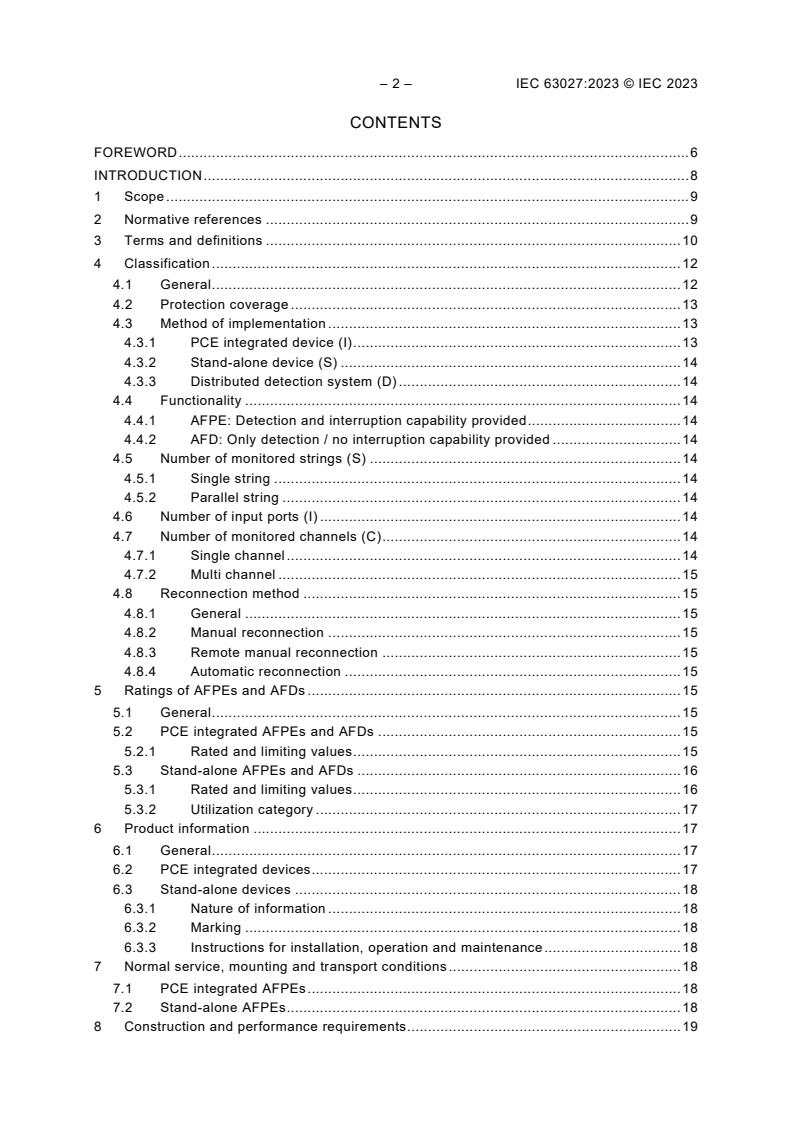
– 2 – IEC 63027:2023 © IEC 2023
CONTENTS
FOREWORD . 6
INTRODUCTION . 8
1 Scope . 9
2 Normative references . 9
3 Terms and definitions . 10
4 Classification . 12
4.1 General . 12
4.2 Protection coverage . 13
4.3 Method of implementation . 13
4.3.1 PCE integrated device (I) . 13
4.3.2 Stand-alone device (S) . 14
4.3.3 Distributed detection system (D) . 14
4.4 Functionality . 14
4.4.1 AFPE: Detection and interruption capability provided . 14
4.4.2 AFD: Only detection / no interruption capability provided . 14
4.5 Number of monitored strings (S) . 14
4.5.1 Single string . 14
4.5.2 Parallel string . 14
4.6 Number of input ports (I) . 14
4.7 Number of monitored channels (C) . 14
4.7.1 Single channel . 14
4.7.2 Multi channel . 15
4.8 Reconnection method . 15
4.8.1 General . 15
4.8.2 Manual reconnection . 15
4.8.3 Remote manual reconnection . 15
4.8.4 Automatic reconnection . 15
5 Ratings of AFPEs and AFDs . 15
5.1 General . 15
5.2 PCE integrated AFPEs and AFDs . 15
5.2.1 Rated and limiting values . 15
5.3 Stand-alone AFPEs and AFDs . 16
5.3.1 Rated and limiting values . 16
5.3.2 Utilization category . 17
6 Product information . 17
6.1 General . 17
6.2 PCE integrated devices . 17
6.3 Stand-alone devices . 18
6.3.1 Nature of information . 18
6.3.2 Marking . 18
6.3.3 Instructions for installation, operation and maintenance . 18
7 Normal service, mounting and transport conditions . 18
7.1 PCE integrated AFPEs . 18
7.2 Stand-alone AFPEs . 18
8 Construction and performance requirements . 19
8.1 General requirements for PCE integrated AFDs/AFPEs and stand-alone
AFDs/AFPEs . 19
8.1.1 General . 19
8.1.2 Construction requirements . 19
8.1.3 Operation in case of series arc fault event . 19
8.1.4 Reconnection capability of AFPE . 19
8.1.5 Self-test function . 20
8.2 PCE integrated AFDs and AFPEs . 21
8.3 Stand-alone AFDs and AFPEs . 21
9 Tests . 21
9.1 General . 21
9.2 Series arc fault test . 21
9.2.1 General . 21
9.2.2 Arc generator . 22
9.2.3 DC source . 23
9.2.4 Array line impedance network . 24
9.2.5 Line impedance network . 24
9.2.6 Test procedure . 25
9.2.7 Arc energy and response time measurement . 27
9.2.8 Self-test function . 27
9.2.9 Reconnection test . 28
Annex A (informative) String and channel examples . 29
A.1 General . 29
A.2 PCE integrated AFDs and AFPEs . 29
A.3 Stand-alone AFPEs . 30
A.4 Distributed AFPEs . 31
Annex B (normative) Test setups following different application cases . 32
B.1 General . 32
B.1.1 Overview . 32
B.1.2 PV source models . 33
B.1.3 Flow chart for test selection . 34
B.2 Application string inverter . 36
B.3 Application micro inverter . 37
B.4 Application module level DC/DC conversion . 39
B.4.1 Input setups . 39
B.4.2 Output setups . 42
B.5 Application external combined strings . 44
B.5.1 Input setups . 44
B.5.2 Output setups . 45
Annex C (informative) Application examples . 47
C.1 General . 47
C.2 Example 1: String inverter with integrated AFPE (F-I-AFPE) . 47
C.3 Example 2: Module level inverter with integrated AFPE (F-I-AFPE) . 48
C.4 Example 3: External AFPE (P-S-AFPE) . 49
C.5 Example 4: Module level DC-DC converter system with AFPE integrated
(F‑I‑AFPE) . 52
C.6 Example 5: String inverter with multiple Inputs (F-I-AFPE) . 55
C.7 Example 6: String inverter with multiple Inputs (F-I-AFPE) . 57
C.8 Example 7: String inverter with multiple Inputs (F-I-AFPE) . 59
– 4 – IEC 63027:2023 © IEC 2023
Annex D (informative) Cross reference application and test setup . 64
Bibliography . 65
Figure 1 – Schematic of the arc generator . 22
Figure 2 – Dimensions of arc generator electrodes . 23
Figure 3 – DC source decoupling network . 24
Figure 4 – Array line impedance network . 24
Figure 5 – Line impedance network . 24
Figure 6 – Limitation input current . 26
Figure A.1 – Schematic of string setting of PCE integrated AFDs and AFPEs . 29
Figure A.2 – Schematic of parallel setting of PCE integrated AFDs and AFPEs . 29
Figure A.3 – Schematic of string setting of stand-alone AFPEs . 30
Figure A.4 – Schematic of parallel setting of stand-alone AFPEs . 30
Figure A.5 – Schematic of single string, single channel distributed AFPEs . 31
Figure A.6 – Schematic of single string, single channel (Inverter integrated AFD and
controller) . 31
Figure B.1 – PV source model . 33
Figure B.2 – Flow chart to select applicable test cases . 35
Figure B.3 – Single string test setup (tests 1, 2, 4) . 36
Figure B.4 – Parallel string test setup (tests 1 and 2) . 36
Figure B.5 – Parallel string test setup (tests 3 and 5) . 36
Figure B.6 – Single string test setup (tests 1 and 2) . 37
Figure B.7 – Single string test setup (tests 1 and 2) – series modules . 37
Figure B.8 – Parallel string test setup (tests 1 and 2) . 37
Figure B.9 – Parallel string test setup (tests 1 and 2) – series modules . 38
Figure B.10 – Parallel string test setup (tests 3 and 5) . 38
Figure B.11 – Single string test setup (tests 1, 2, 4) . 39
Figure B.12 – Single string test setup (tests 1, 2, 4) – series modules . 39
Figure B.13 – Parallel string test setup (tests 1 and 2) . 40
Figure B.14 – Parallel string test setup (tests 1 and 2) . 41
Figure B.15 – Parallel string test setup (tests 3 and 5) . 42
Figure B.16 – Single string test setup (tests 1, 2, 4) . 42
Figure B.17 – Parallel string test setup (tests 1 and 2) . 43
Figure B.18 – Parallel string test setup (tests 3 and 5) . 43
Figure B.19 – Single string test setup (tests 1, 2, 4) . 44
Figure B.20 – Parallel string test setup (tests 1 and 2) . 44
Figure B.21 – Parallel string test setup (tests 3 and 5) . 45
Figure B.22 – Single string test setup (test 1 and 2) . 45
Figure B.23 – Parallel string test setup (tests 3 and 5) . 46
Figure C.1 – Example of a string inverter with single input . 47
Figure C.2 – Example of a module level inverter with single input . 48
Figure C.3 – Example of an external AFPE with multiple input ports . 50
Figure C.4 – Example of a module level DC-DC converter system . 52
Figure C.5 – Example of a string inverter with multiple input ports . 55
Figure C.6 – Example string inverter with multiple inputs . 58
Figure C.7 – Example string inverter with different channel classification . 60
Table 1 – Classification of protection coverage . 13
Table 2 – Combined classification of AFPEs and AFDs . 17
Table 3 – Marking and documentation requirements . 17
Table 4 – Requirements for documentation, marking and position of marking . 18
Table 5 – Arcing test conditions . 25
Table B.1 – General LRC component parameters . 33
Table B.2 – LCR component parameters for different module configurations . 34
Table C.1 – Overview tests F-I-AFPE string inverter . 48
Table C.2 – Overview tests F-I-AFPE module level inverter . 49
Table C.3 – Overview tests P-S-AFPE stand-alone AFPE . 51
Table C.4 – Overview tests F‑I‑AFPE . 55
Table C.5 – Overview tests F‑I‑AFPE . 57
Table C.6 – Overview tests F‑I‑AFPE . 59
Table C.7 – Overview tests F‑I‑AFPE . 63
Table D.1 – Cross reference application and test setup . 64
– 6 – IEC 63027:2023 © IEC 2023
INTERNATIONAL ELECTROTECHNICAL COMMISSION
____________
PHOTOVOLTAIC POWER SYSTEMS –
DC ARC DETECTION AND INTERRUPTION
FOREWORD
1) The International Electrotechnical Commission (IEC) is a worldwide organization for standardization comprising
all national electrotechnical committees (IEC National Committees). The object of IEC is to promote international
co-operation on all questions concerning standardization in the electrical and electronic fields. To this end and
in addition to other activities, IEC publishes International Standards, Technical Specifications, Technical Reports,
Publicly Available Specifications (PAS) and Guides (hereafter referred to as "IEC Publication(s)"). Their
preparation is entrusted to technical committees; any IEC National Committee interested in the subject dealt with
may participate in this preparatory work. International, governmental and non-governmental organizations liaising
with the IEC also participate in this preparation. IEC collaborates closely with the International Organization for
Standardization (ISO) in accordance with conditions determined by agreement between the two organizations.
2) The formal decisions or agreements of IEC on technical matters express, as nearly as possible, an international
consensus of opinion on the relevant subjects since each technical committee has representation from all
interested IEC National Committees.
3) IEC Publications have the form of recommendations for international use and are accepted by IEC National
Committees in that sense. While all reasonable efforts are made to ensure that the technical content of IEC
Publications is accurate, IEC cannot be held responsible for the way in which they are used or for any
misinterpretation by any end user.
4) In order to promote international uniformity, IEC National Committees undertake to apply IEC Publications
transparently to the maximum extent possible in their national and regional publications. Any divergence between
any IEC Publication and the corresponding national or regional publication shall be clearly indicated in the latter.
5) IEC itself does not provide any attestation of conformity. Independent certification bodies provide conformity
assessment services and, in some areas, access to IEC marks of conformity. IEC is not responsible for any
services carried out by independent certification bodies.
6) All users should ensure that they have the latest edition of this publication.
7) No liability shall attach to IEC or its directors, employees, servants or agents including individual experts and
members of its technical committees and IEC National Committees for any personal injury, property damage or
other damage of any nature whatsoever, whether direct or indirect, or for costs (including legal fees) and
expenses arising out of the publication, use of, or reliance upon, this IEC Publication or any other IEC
Publications.
8) Attention is drawn to the Normative references cited in this publication. Use of the referenced publications is
indispensable for the correct application of this publication.
9) Attention is drawn to the possibility that some of the elements of this IEC Publication may be the subject of patent
rights. IEC shall not be held responsible for identifying any or all such patent rights.
IEC 63027 has been prepared by IEC technical committee 82: Solar photovoltaic energy
systems. It is an International Standard.
The text of this International Standard is based on the following documents:
Draft Report on voting
82/2112/FDIS 82/2133/RVD
Full information on the voting for its approval can be found in the report on voting indicated in
the above table.
The language used for the development of this International Standard is English.
This document was drafted in accordance with ISO/IEC Directives, Part 2, and developed in
accordance with ISO/IEC Directives, Part 1 and ISO/IEC Directives, IEC Supplement, available
at www.iec.ch/members_experts/refdocs. The main document types developed by IEC are
described in greater detail at www.iec.ch/publications.
The committee has decided that the contents of this document will remain unchanged until the
stability date indicated on the IEC website under webstore.iec.ch in the data related to the
specific document. At this date, the document will be
• reconfirmed,
• withdrawn,
• replaced by a revised edition, or
• amended.
IMPORTANT – The "colour inside" logo on the cover page of this document indicates that it
contains colours which are considered to be useful for the correct understanding of its
contents. Users should therefore print this document using a colour printer.
– 8 – IEC 63027:2023 © IEC 2023
INTRODUCTION
This document provides requirements and testing procedures for arc-fault protection devices
used in PV systems to reduce the risk of igniting an electrical fire.
A PV system contains a number of distributed DC sources (PV modules) and circuits. In AC
systems series arc durations are limited by the alternating current crossing through zero ampere
twice per cycle. In DC systems the arcing current may be constant and longer arc durations are
expected. In contrast to a centralized power supply, where in case of a fault the circuit is
disconnected at the connection to the supply, a PV system is made up of distributed power
supplies which cannot disconnect circuits in a single location. For extinguishing series arcs,
however, the location of the arc within the circuit is irrelevant as long as the current is
interrupted. This arc fault protection may be located inside the inverter, on array circuits,
subarray circuits, string circuits, or at the module level. Therefore, this document provides a
range of test setups to cover the expected system topologies.
In PV systems earth fault protection is required according to the IEC installation standards.
Moreover, single core cables with double or reinforced insulation are required (except ELV
systems). Consequently, the risk of parallel arcs is quite low because in most cases an earth
fault occurs first. As such, this document does not address requirements or testing for parallel
arc detection. The larger risk for PV systems comes from series arcs, therefore the focus of this
document is to provide requirements and tests for arc fault protection equipment to ensure that
most series arcs in a PV system will be detected.
Many arc fault detectors detect arcs by analyzing and comparing the arc’s HF signal emission.
These devices may trip due to external disturbances from other equipment connected to the PV
array, e.g. the inverter. Therefore, interoperability needs to be evaluated. Other external
influences such as radio signals, sparks from trams, and load switching, among others, may
also cause nuisance tripping. These causes are a performance issue and therefore not
addressed by this document.
Arc fault detectors for PV systems have been introduced as a requirement in the USA since the
2011 U.S. National Electrical Code was published. This led to the development of a PV arc-fault
protection product standard, UL 1699B. Experience derived from these documents and their
application in the USA has been used as a basis for this document. This document was written
in parallel to the maintenance of UL 1699B. Both writing teams considered the work of each
other and aligned requirements as much as possible, including the dimensions of the electrodes.
Arc fault detectors have been mandatory for many years in the USA for certain AC installations.
Within the IEC, arc fault detectors required according to IEC 62606 have been introduced for
certain locations for AC circuits. For PV circuits there was no IEC product standard available.
This document therefore now provides test procedures for PV system arc fault detectors, where
required by installation standards.
This document was written for the special needs and characteristics of PV systems. The unique
aspects of PV DC sources (group of distributed sources, current behavior, dependency to
irradiance, system impedance, etc.) differ considerably from other DC sources and applications.
Therefore, this PV specific standard was necessary, and equipment compliant to this document
is not suitable for other DC sources and applications.
PHOTOVOLTAIC POWER SYSTEMS –
DC ARC DETECTION AND INTERRUPTION
1 Scope
This document applies to equipment used for the detection and optionally the interruption of
electric DC arcs in photovoltaic (PV) system circuits. The document covers test procedures for
the detection of series arcs within PV circuits, and the response times of equipment employed
to interrupt the arcs.
The document defines reference scenarios according to which the testing is conducted. This
document covers equipment connected to systems not exceeding a maximum PV source circuit
voltage of 1 500 V DC.
The detection of parallel circuit arcs is not covered in this document. This document is not
applicable to DC sources or applications other than PV DC sources.
NOTE Parallel arc detection may be considered for a future edition.
2 Normative references
The following documents are referred to in the text in such a way that some or all of their content
constitutes requirements of this document. For dated references, only the edition cited applies.
For undated references, the latest edition of the referenced document (including any
amendments) applies.
IEC 60730-1:2013, Automatic electrical controls – Part 1: General requirements
IEC 60730-1:2013/AMD1:2015
IEC 60730-1:2013/AMD2:2020
IEC 60947-1:2020, Low-voltage switchgear and controlgear – Part 1: General rules
IEC 60947-3:2020, Low-voltage switchgear and controlgear – Part 3: Switches, disconnectors,
switch-disconnectors and fuse-combination units
IEC 61508 (all parts), Functional safety of electrical/electronic/programmable electronic safety-
related systems
IEC TS 61836:2016, Solar photovoltaic energy systems – Terms, definitions and symbols
IEC 62109-1:2010, Safety of power converters for use in photovoltaic power systems – Part 1:
General requirements
– 10 – IEC 63027:2023 © IEC 2023
3 Terms and definitions
For the purposes of this document, the terms and definitions in IEC TS 61836 apply, as well as
the following:
ISO and IEC maintain terminology databases for use in standardization at the following
addresses:
• IEC Electropedia: available at https://www.electropedia.org/
• ISO Online browsing platform: available at https://www.iso.org/obp
3.1
arc
arcing
self-maintained gas conduction for which most of the charge carriers are electrons supplied by
primary‑electron emission
[SOURCE: IEC 60050-121:1998, 121-13-12]
3.2
arc fault
arcing fault
dangerous unintentional parallel or series arc between conductors
[SOURCE: IEC 62606:2013, 3.2, modified – "parallel or series" and "between conductors" has
been added]
3.3
arc fault detector
AFD
device or group of devices to detect arcs
3.4
arc fault interrupter
AFI
device triggered by an AFD and able to interrupt an arc
3.5
arc fault protection equipment
AFPE
combination of AFD and AFI to detect and interrupt arc faults
3.6
arc detection
function of sensing the presence of an arc fault
[SOURCE: IEC 62606:2013,3.5, modified – "consisting in" has been replaced by "of"]
3.7
arc interruption
function of extinguishing the arc by de-energizing it, achieved by e.g. opening the circuit using
a mechanical contact set with an air gap or a solid state switching device
3.8
series arc fault
arcing that is in series with the load and is the result of a failure in the intended continuity of a
conductor, connection, module or other system components in the direct current PV circuit
3.9
open-circuit voltage
V
oc
voltage at the output terminals of a PV device at a particular temperature and irradiance when
the output electric current of the PV device is zero, defining a voltage input parameter of the
AFPE or AFD
[SOURCE: IEC TS 61836:2016, 3.4.56, modified – "defining a voltage input parameter of the
AFPE or AFD" has been added]
3.10
current at maximum power point
I
mpp
current at the output terminals of a PV device at a particular temperature and irradiance at the
conditions of maximum power of the PV device, defining a current input parameter of the AFPE
or AFD
3.11
voltage at maximum power point
V
mpp
voltage at the output terminals of a PV device at a particular temperature and irradiance at the
conditions of maximum power of the PV device, defining a voltage input parameter of the AFPE
or AFD
3.12
rated channel current
current the AFPE or AFD channel can carry. This corresponds to the sum of all currents carried
by a channel
3.13
rated interruption current
current the AFI or AFPE can interrupt
3.14
maximum rated current per input port
I
pA
current that one input port of an AFD or AFPE is limited to
Note 1 to entry: The maximum current per input port is typically identical to the maximum arc current.
3.15
power conversion equipment
PCE
device or equipment able to convert electric power from one form to another
3.16
string
circuit of one or more series-connected PV modules
3.17
PCE integrated device
AFD or AFI or AFPE which are integrated into the PCE
3.18
stand-alone device
AFD or AFI or AFPE which are separated and independent from the PCE
– 12 – IEC 63027:2023 © IEC 2023
3.19
distributed detection system
AFPE which is distributed within the PV system
3.20
single channel device
device which has one sensor circuit for arc detection
3.21
multi channel device
device which has two or more independent sensor circuits for arc detection
3.22
device under test
DUT
particular sample that is being measured or observed
3.23
photovoltaic
PV
relating to the conversion of light directly into electrical energy
[SOURCE: IEC 62109-1:2010, 3.55]
3.24
short-circuit current
I
sc
electric current at the output terminals of a PV device at a particular temperature and irradiance
when the device output voltage is equal to or close to zero
[SOURCE: IEC 61836:2016, 3.4.80, modified – Note 1 has been deleted]
4 Classification
4.1 General
This clause gives an overview of the classifications used for AFD and AFPEs in this document.
The classification scheme describes the equipment type and considers the important aspects
relevant for testing and installation. Installation standards can refer to this classification to
specify requirements for arc fault protection.
Protection coverage: Defines which parts of a PV system or installation are covered by the AFD
or AFPE.
Method of implementation: Defines the type and design of the AFD or AFPE. The method of
implementation especially impacts construction requirements and testing.
Functionality: Indicates whether an equipment or device is an AFD or AFPE.
Number of monitored strings, inputs and channels: The maximum number of connected PV
strings, inputs and measurement channels that can be supported by the AFD or AFPE, and for
which it is tested.
Reconnection method: Defines which reconnection methods are supported by the product.
Annex B provides additional information and introduces measures to group the following
classifications into various use cases.
AFPE may have more than one classification, and different ratings may apply for each
classification. In this case the manufacturer shall document the installation and connection
requirements for each classification.
NOTE One example is an inverter that allows for the direct connection of PV strings or the connection of one DC
main cable. For direct string connections the classification could be F-I-AFPE-1-4-1 and for the main cable connection
the classification could be P-I-AFPE-6-1-1.
AFPE may provide input ports with different ratings (e.g. number of strings per input port,
current rating). In this case the tests shall be performed in the worst-case configuration.
4.2 Protection coverage
The protection coverage defines which circuits and components of the PV system are covered
by the AFD or AFPE.
Two types of classifications are defined, see Table 1.
Table 1 – Classification of protection coverage
System Code Description
F Arc fault protection is provided from the PV
modules up to the inverter input terminals.
(Full coverage)
P Arc fault protection is provided from the PV
modules up to the parallel connection of the
strings. No arc fault protection is provided for
wiring between the parallel connection and the
inverter input terminals. (Partial coverage)
NOTE Typically full coverage (F) is hard to achieve for high currents in DC main cables. Also, the 750 J protection
threshold may be difficult to achieve because of the high currents and the physical limits in interruption times. Fire
hazard protection may be provided by means of installation.
4.3 Method of implementation
4.3.1 PCE integrated device (I)
The AFPE is implemented within a PCE connected to the PV array and makes use of the
housing and terminals of the PCE.
– 14 – IEC 63027:2023 © IEC 2023
4.3.2 Stand-alone device (S)
The AFPE is a single device, that works independently and makes use of its own enclosure or
other dedicated enclosures.
4.3.3 Distributed detection system (D)
The AFPE comprises more than one device. The devices may be stand-alone devices or
integrated within a PCE.
4.4 Functionality
4.4.1 AFPE: Detection and interruption capability provided
The device incorporates AFD and AFI for full AFPE functionality.
4.4.2 AFD: Only detection / no interruption capability provided
The device only detects the arc. An AFD without a dedicated AFI does not fulfill the
requirements of an AFPE according to this document. Such devices may be used to indicate
arc events, e.g. in connection with a fire alarm system.
4.5 Number of monitored strings (S)
4.5.1 Single string
The AFD or AFPE are designed in a way that only one string of the array or one module may
be connected to one input port for detection and, in the case of AFPE, interruption.
4.5.2 Parallel string
The AFD or AFPE are designed in a way that multiple strings or modules may be connected for
detection and, in the case of AFPE, interruption. The maximum number of strings for one input
port shall be defined by the manufacturer. Parallel strings may be connected directly to the
device or at a junction external to the device.
NOTE Refer to Annex A for various string configurations.
4.6 Number of input ports (I)
An AFD or AFPE may be provided with one or more input ports per monitored channel. In case
of more than one input port typically the maximum arc current is lower than the rated sensing
current of the channel. The number of input ports per channel shall be defined by the
manufacturer, together with the maximum rated current per input port (I ).
pA
Parallel connection of strings outside the equipment enclosure or cabinet are not considered
input ports.
NOTE Refer to Annex A for various input configurations.
4.7 Number of monitored channels (C)
4.7.1 Single channel
The AFD or AFPE is designed in a way that only one sensing channel is provided to detect arcs.
4.7.2 Multi channel
The AFD or AFPE has two or more independent sensing channels to detect arcs. The number
of channels shall be defined by the manufacturer.
NOTE Refer to Annex A for various channel configurations.
4.8 Reconnection method
4.8.1 General
Installation standards can choose from the following reconnection methods in order to define
adequate response requirements after arc interruption by the AFPE.
4.8.2 Manual reco
...
Questions, Comments and Discussion
Ask us and Technical Secretary will try to provide an answer. You can facilitate discussion about the standard in here.
Loading comments...