


IEC TR 60721-4-7:2001+AMD1:2003 CSV
(Main)Classification of environmental conditions - Part 4-7: Guidance for the correlation and transformation of environmental condition classes of IEC 60721-3 to the environmental tests of IEC 60068 - Portable and non-stationary use
Classification of environmental conditions - Part 4-7: Guidance for the correlation and transformation of environmental condition classes of IEC 60721-3 to the environmental tests of IEC 60068 - Portable and non-stationary use
IEC TR 60721-4-7:2001+A1:2003 Deals with the correlation and transformation of the conditions given in IEC 60721-3-7 to the environmental tests defined in IEC 60068-2. An environment may consist of a number of environmental conditions such as dynamic, climatic and biological and other effects due to chemically and mechanically active substances. In this report, only dynamic and climatic conditions have been considered. The purpose of this technical report is to provide the specification writer with guidance together with a set of easy-to-use tables which correlate and transform these conditions.
This consolidated version consists of the first edition (2001) and its amendment 1 (2003). Therefore, no need to order amendment in addition to this publication.
Classification des conditions d'environnement - Partie 4-7: Guide pour la corrélation et la transformation des classes de conditions d'environnement de la CEI 60721-3 en essais d'environnement de la CEI 60068 - Utilisation en déplacement
IEC TR 60721-4-7:2001+A1:2003 Traite de la corrélation et de la transformation des conditions de la CEI 60721-3-7 en essais d'environnement définis dans la CEI 60068-2. Un environnement peut être constitué d'un certain nombre de conditions d'environnement telles que les conditions dynamiques, climatiques et biologiques ainsi que d'autres effets dus aux substances chimiquement et mécaniquement actives. Dans ce rapport, seules les conditions dynamiques et climatiques sont prises en considération. Le présent rapport technique a pour objet de fournir aux rédacteurs des spécifications un guide comportant un ensemble de tableaux faciles à utiliser qui permettent la corrélation et la transformation de ces conditions.
Cette version consolidée comprend la première édition (2001) et son amendement 1 (2003). Il n'est donc pas nécessaire de commander l'amendement avec cette publication.
General Information
- Status
- Published
- Publication Date
- 17-Aug-2003
- Technical Committee
- TC 104 - Environmental conditions, classification and methods of test
- Current Stage
- PPUB - Publication issued
- Start Date
- 18-Aug-2003
- Completion Date
- 18-Aug-2003
Overview
IEC TR 60721-4-7:2001+AMD1:2003 CSV is a technical report published by the International Electrotechnical Commission (IEC). It provides guidance for correlating and transforming the environmental condition classes specified in IEC 60721-3-7 to the environmental tests outlined in IEC 60068-2, specifically for portable and non-stationary use. This report is especially valuable for specification writers, offering practical tables and guidance for aligning defined environmental conditions with appropriate testing methods.
The scope of this standard is limited to dynamic and climatic conditions, which are typically encountered by equipment that is portable or used in non-stationary situations. Its intent is to simplify the process of selecting relevant environmental tests and to ensure consistent application of test severities across the electrotechnical industry.
Key Topics
- Correlation and Transformation: Guidance for matching environmental condition classes from IEC 60721-3-7 to the corresponding environmental tests in IEC 60068-2.
- Environmental Conditions: Focus on dynamic (e.g., vibration, shock, drop) and climatic (e.g., temperature, humidity, solar radiation) conditions experienced by portable products.
- Test Severities: Recommendations on selecting suitable levels of severity for environmental tests, taking into account the intended application and potential risks.
- Test Methods: Overview of commonly used environmental test procedures, such as vibration, damp heat, low pressure, and free-fall drop tests, referenced from IEC 60068-2.
- Easy-to-use Tables: The report is structured with tables providing practical recommendations for test selection based on specific condition classes from IEC 60721-3-7.
- Guidance and Flexibility: Emphasis on the report's use as a guiding document, allowing for adaptation and adjustment to particular product requirements or special risk considerations.
Applications
IEC TR 60721-4-7 is widely useful for:
- Specification Writers & Engineers: Assisting in the selection of relevant environmental test procedures for portable or non-stationary equipment during product design, testing, and qualification processes.
- Product Development: Supporting manufacturers in mapping real-world environmental exposures of portable products to standardized laboratory tests, ensuring product reliability and safety.
- Procurement and Quality Assurance: Helping purchasing and QA teams verify that products have been tested against the appropriate environmental scenarios for their intended use.
- Test Laboratories: Providing a structured approach to interpret environmental condition classes and align them with laboratory testing protocols.
Typical products and equipment that benefit from this guidance include portable medical devices, handheld testing instruments, transportable communication systems, and any electronic devices subject to frequent movement, transport, or changing operational environments.
Related Standards
For a comprehensive approach to environmental testing and classification, the following standards are closely linked to IEC TR 60721-4-7:
- IEC 60721-3-7 - Specifies classes of groups of environmental parameters and severities for portable and non-stationary use.
- IEC 60068-2 - Series of environmental test methods, including tests for cold, dry heat, solar radiation, vibration, shock, damp heat, and more.
- IEC 60721-4-0 - Provides general guidance for the correlation and transformation of environmental conditions to tests.
- ISO 554 & ISO 2533 - Define reference atmospheric conditions and standard atmospheres for testing.
Practical Value
By bridging the gap between environmental condition classification and environmental testing, IEC TR 60721-4-7 enables more precise, consistent, and practical specification development for portable and non-stationary equipment. It assures stakeholders that products will perform reliably in real-world conditions by referencing recognized international test methods, thus supporting global interoperability and compliance. This contributes directly to increased product robustness, higher customer confidence, and streamlined product certification processes.
Keywords: IEC TR 60721-4-7, environmental conditions, portable equipment, classification, IEC 60068-2, IEC environmental testing, specification guidance, dynamic conditions, climatic tests, international standards.
Buy Documents
IEC TR 60721-4-7:2001+AMD1:2003 CSV - Classification of environmental conditions - Part 4-7: Guidance for the correlation and transformation of environmental condition classes of IEC 60721-3 to the environmental tests of IEC 60068 - Portable and non-stationary use
Get Certified
Connect with accredited certification bodies for this standard

IMP NDT d.o.o.
Non-destructive testing services. Radiography, ultrasonic, magnetic particle, penetrant, visual inspection.
Inštitut za kovinske materiale in tehnologije
Institute of Metals and Technology. Materials testing, metallurgical analysis, NDT.
Q Techna d.o.o.
NDT and quality assurance specialist. 30+ years experience. NDT personnel certification per ISO 9712, nuclear and thermal power plant inspections, QA/
Sponsored listings
Frequently Asked Questions
IEC TR 60721-4-7:2001+AMD1:2003 CSV is a technical report published by the International Electrotechnical Commission (IEC). Its full title is "Classification of environmental conditions - Part 4-7: Guidance for the correlation and transformation of environmental condition classes of IEC 60721-3 to the environmental tests of IEC 60068 - Portable and non-stationary use". This standard covers: IEC TR 60721-4-7:2001+A1:2003 Deals with the correlation and transformation of the conditions given in IEC 60721-3-7 to the environmental tests defined in IEC 60068-2. An environment may consist of a number of environmental conditions such as dynamic, climatic and biological and other effects due to chemically and mechanically active substances. In this report, only dynamic and climatic conditions have been considered. The purpose of this technical report is to provide the specification writer with guidance together with a set of easy-to-use tables which correlate and transform these conditions. This consolidated version consists of the first edition (2001) and its amendment 1 (2003). Therefore, no need to order amendment in addition to this publication.
IEC TR 60721-4-7:2001+A1:2003 Deals with the correlation and transformation of the conditions given in IEC 60721-3-7 to the environmental tests defined in IEC 60068-2. An environment may consist of a number of environmental conditions such as dynamic, climatic and biological and other effects due to chemically and mechanically active substances. In this report, only dynamic and climatic conditions have been considered. The purpose of this technical report is to provide the specification writer with guidance together with a set of easy-to-use tables which correlate and transform these conditions. This consolidated version consists of the first edition (2001) and its amendment 1 (2003). Therefore, no need to order amendment in addition to this publication.
IEC TR 60721-4-7:2001+AMD1:2003 CSV is classified under the following ICS (International Classification for Standards) categories: 19.040 - Environmental testing. The ICS classification helps identify the subject area and facilitates finding related standards.
IEC TR 60721-4-7:2001+AMD1:2003 CSV is available in PDF format for immediate download after purchase. The document can be added to your cart and obtained through the secure checkout process. Digital delivery ensures instant access to the complete standard document.
Standards Content (Sample)
RAPPORT CEI
TECHNIQUE
IEC
TR 60721-4-7
TECHNICAL
Edition 1.1
REPORT
2003-08
PUBLICATION FONDAMENTALE DE SÉCURITÉ
BASIC SAFETY PUBLICATION
Edition 1:2001 consolidée par l'amendement 1:2003
Edition 1:2001 consolidated with amendment 1:2003
Classification des conditions d’environnement –
Partie 4-7:
Guide pour la corrélation et la transformation
des classes de conditions d’environnement
de la CEI 60721-3 en essais d’environnement
de la CEI 60068 –
Utilisation en déplacement
Classification of environmental conditions –
Part 4-7:
Guidance for the correlation and transformation
of environmental condition classes of IEC 60721-3
to the environmental tests of IEC 60068 –
Portable and non-stationary use
Numéro de référence
Reference number
CEI/IEC 60721-4-7:2001+A1:2003
Copyright © 1993 IEC, Geneva, Switzerland
All rights reserved. Unless otherwise specified, no part of this publication may be reproduced or utilized in any form
or by any means, electronic or mechanical, including photocopying and microfilm, without permission in writing from
either IEC or IEC's member National Committee in the country of the requester.
If you have any questions about IEC copyright or have an enquiry about obtaining additional rights to this publication,
please contact the address below or your local IEC member National Committee for further information.
Droits de reproduction réservés. Sauf indication contraire, aucune partie de cette publication ne peut être reproduite
ni utilisée sous quelque forme que ce soit et par aucun procédé, électronique ou mécanique, y compris la photocopie
et les microfilms, sans l'accord écrit de la CEI ou du Comité national de la CEI du pays du demandeur.
Si vous avez des questions sur le copyright de la CEI ou si vous désirez obtenir des droits supplémentaires sur cette
publication, utilisez les coordonnées ci-après ou contactez le Comité national de la CEI de votre pays de résidence.
IEC Central Office
3, rue de Varembé
CH-1211 Geneva 20
Switzerland
Email: inmail@iec.ch
Web: www.iec.ch
About the IEC
The International Electrotechnical Commission (IEC) is the leading global organization that prepares and publishes
International Standards for all electrical, electronic and related technologies.
About IEC publications
The technical content of IEC publications is kept under constant review by the IEC. Please make sure that you have the
latest edition, a corrigenda or an amendment might have been published.
Catalogue of IEC publications: www.iec.ch/searchpub
The IEC on-line Catalogue enables you to search by a variety of criteria (reference number, text, technical committee,…).
It also gives information on projects, withdrawn and replaced publications.
IEC Just Published: www.iec.ch/online_news/justpub
Stay up to date on all new IEC publications. Just Published details twice a month all new publications released. Available
on-line and also by email.
Customer Service Centre: www.iec.ch/webstore/custserv
If you wish to give us your feedback on this publication or need further assistance, please visit the Customer Service
Centre FAQ or contact us:
Email: csc@iec.ch
Tel.: +41 22 919 02 11
Fax: +41 22 919 03 00
A propos de la CEI
La Commission Electrotechnique Internationale (CEI) est la première organisation mondiale qui élabore et publie des
normes internationales pour tout ce qui a trait à l'électricité, à l'électronique et aux technologies apparentées.
A propos des publications CEI
Le contenu technique des publications de la CEI est constamment revu. Veuillez vous assurer que vous possédez
l’édition la plus récente, un corrigendum ou amendement peut avoir été publié.
Catalogue des publications de la CEI: www.iec.ch/searchpub/cur_fut-f.htm
Le Catalogue en-ligne de la CEI vous permet d’effectuer des recherches en utilisant différents critères (numéro de
référence, texte, comité d’études,…). Il donne aussi des informations sur les projets et les publications retirées ou
remplacées.
Just Published CEI: www.iec.ch/online_news/justpub
Restez informé sur les nouvelles publications de la CEI. Just Published détaille deux fois par mois les nouvelles
publications parues. Disponible en-ligne et aussi par email.
Service Clients: www.iec.ch/webstore/custserv/custserv_entry-f.htm
Si vous désirez nous donner des commentaires sur cette publication ou si vous avez des questions, visitez le FAQ du
Service clients ou contactez-nous:
Email: csc@iec.ch
Tél.: +41 22 919 02 11
Fax: +41 22 919 03 00
RAPPORT CEI
TECHNIQUE IEC
TR 60721-4-7
TECHNICAL
Edition 1.1
REPORT
2003-08
PUBLICATION FONDAMENTALE DE SÉCURITÉ
BASIC SAFETY PUBLICATION
Edition 1:2001 consolidée par l'amendement 1:2003
Edition 1:2001 consolidated with amendment 1:2003
Classification des conditions d’environnement –
Partie 4-7:
Guide pour la corrélation et la transformation
des classes de conditions d’environnement
de la CEI 60721-3 en essais d’environnement
de la CEI 60068 –
Utilisation en déplacement
Classification of environmental conditions –
Part 4-7:
Guidance for the correlation and transformation
of environmental condition classes of IEC 60721-3
to the environmental tests of IEC 60068 –
Portable and non-stationary use
Commission Electrotechnique Internationale
International Electrotechnical Commission
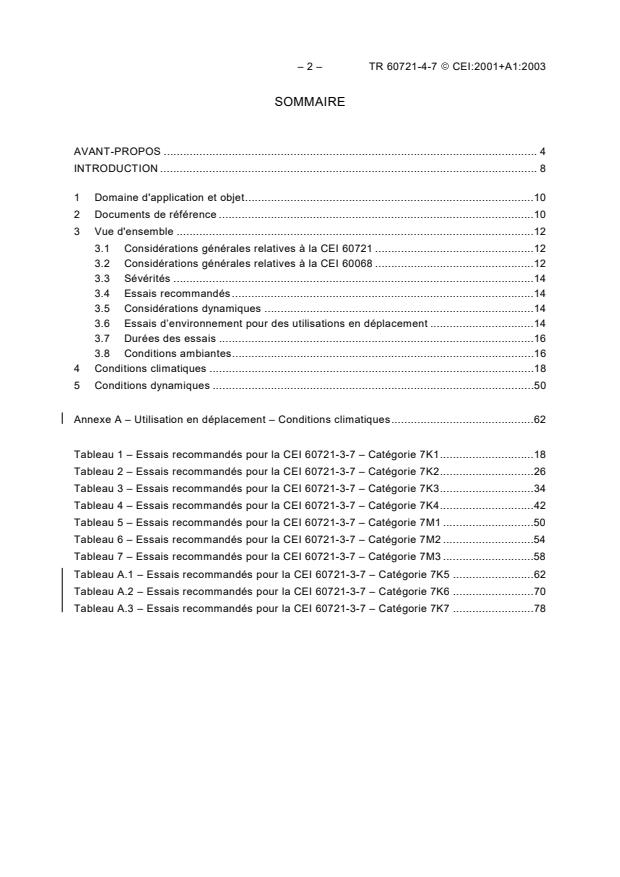
– 2 – TR 60721-4-7 CEI:2001+A1:2003
SOMMAIRE
AVANT-PROPOS . 4
INTRODUCTION . 8
1 Domaine d'application et objet.10
2 Documents de référence .10
3 Vue d'ensemble .12
3.1 Considérations générales relatives à la CEI 60721 .12
3.2 Considérations générales relatives à la CEI 60068 .12
3.3 Sévérités .14
3.4 Essais recommandés .14
3.5 Considérations dynamiques .14
3.6 Essais d’environnement pour des utilisations en déplacement .14
3.7 Durées des essais .16
3.8 Conditions ambiantes.16
4 Conditions climatiques .18
5 Conditions dynamiques .50
Annexe A – Utilisation en déplacement – Conditions climatiques.62
Tableau 1 – Essais recommandés pour la CEI 60721-3-7 – Catégorie 7K1.18
Tableau 2 – Essais recommandés pour la CEI 60721-3-7 – Catégorie 7K2.26
Tableau 3 – Essais recommandés pour la CEI 60721-3-7 – Catégorie 7K3.34
Tableau 4 – Essais recommandés pour la CEI 60721-3-7 – Catégorie 7K4.42
Tableau 5 – Essais recommandés pour la CEI 60721-3-7 – Catégorie 7M1 .50
Tableau 6 – Essais recommandés pour la CEI 60721-3-7 – Catégorie 7M2 .54
Tableau 7 – Essais recommandés pour la CEI 60721-3-7 – Catégorie 7M3 .58
Tableau A.1 – Essais recommandés pour la CEI 60721-3-7 – Catégorie 7K5 .62
Tableau A.2 – Essais recommandés pour la CEI 60721-3-7 – Catégorie 7K6 .70
Tableau A.3 – Essais recommandés pour la CEI 60721-3-7 – Catégorie 7K7 .78
TR 60721-4-7 IEC:2001+A1:2003 – 3 –
CONTENTS
FOREWORD . 5
INTRODUCTION . 9
1 Scope and object .11
2 Reference documents .11
3 Overview.13
3.1 General remarks concerning IEC 60721 .13
3.2 General remarks concerning IEC 60068 .13
3.3 Severities.15
3.4 Recommended tests .15
3.5 Dynamic considerations .15
3.6 Environmental tests for portable and non-stationary use .15
3.7 Test durations.17
3.8 Ambient .17
4 Climatic conditions .22
5 Dynamic conditions .52
Annex A – Portable use – Climatic conditions .66
Table 1 – Recommended tests for IEC 60721-3-7 – Class 7K1.22
Table 2 – Recommended tests for IEC 60721-3-7 – Class 7K2.30
Table 3 – Recommended tests for IEC 60721-3-7 – Class 7K3.38
Table 4 – Recommended tests for IEC 60721-3-7 – Class 7K4.46
Table 5 – Recommended tests for IEC 60721-3-7 – Class 7M1 .52
Table 6 – Recommended tests for IEC 60721-3-7 – Class 7M2 .56
Table 7 – Recommended tests for IEC 60721-3-7 – Class 7M3 .60
Table A.1 – Recommended tests for IEC 60721-3-7 – Class 7K5 .66
Table A.2 – Recommended tests for IEC 60721-3-7 – Class 7K6 .74
Table A.3 – Recommended tests for IEC 60721-3-7 – Class 7K7 .82
– 4 – TR 60721-4-7 CEI:2001+A1:2003
COMMISSION ÉLECTROTECHNIQUE INTERNATIONALE
____________
CLASSIFICATION DES CONDITIONS D’ENVIRONNEMENT –
Partie 4-7: Guide pour la corrélation et la transformation des classes
de conditions d’environnement de la CEI 60721-3
en essais d’environnement de la CEI 60068 –
Utilisation en déplacement
AVANT-PROPOS
1) La Commission Electrotechnique Internationale (CEI) est une organisation mondiale de normalisation composée
de l'ensemble des comités électrotechniques nationaux (Comités nationaux de la CEI). La CEI a pour objet de
favoriser la coopération internationale pour toutes les questions de normalisation dans les domaines de
l'électricité et de l'électronique. A cet effet, la CEI – entre autres activités – publie des Normes internationales,
des Spécifications techniques, des Rapports techniques et des Guides (ci-après dénommés "Publication(s) de
la CEI"). Leur élaboration est confiée à des comités d'études, aux travaux desquels tout Comité national
intéressé par le sujet traité peut participer. Les organisations internationales, gouvernementales et non
gouvernementales, en liaison avec la CEI, participent également aux travaux. La CEI collabore étroitement avec
l'Organisation Internationale de Normalisation (ISO), selon des conditions fixées par accord entre les deux
organisations.
2) Les décisions ou accords officiels de la CEI concernant les questions techniques représentent, dans la mesure
du possible, un accord international sur les sujets étudiés, étant donné que les Comités nationaux de la CEI
intéressés sont représentés dans chaque comité d’études.
3) Les Publications de la CEI se présentent sous la forme de recommandations internationales et sont agréées
comme telles par les Comités nationaux de la CEI. Tous les efforts raisonnables sont entrepris afin que la CEI
s'assure de l'exactitude du contenu technique de ses publications; la CEI ne peut pas être tenue responsable de
l'éventuelle mauvaise utilisation ou interprétation qui en est faite par un quelconque utilisateur final.
4) Dans le but d'encourager l'uniformité internationale, les Comités nationaux de la CEI s'engagent, dans toute la
mesure possible, à appliquer de façon transparente les Publications de la CEI dans leurs publications
nationales et régionales. Toutes divergences entre toutes Publications de la CEI et toutes publications
nationales ou régionales correspondantes doivent être indiquées en termes clairs dans ces dernières.
5) La CEI n’a prévu aucune procédure de marquage valant indication d’approbation et n'engage pas sa
responsabilité pour les équipements déclarés conformes à une de ses Publications.
6) Tous les utilisateurs doivent s'assurer qu'ils sont en possession de la dernière édition de cette publication.
7) Aucune responsabilité ne doit être imputée à la CEI, à ses administrateurs, employés, auxiliaires ou
mandataires, y compris ses experts particuliers et les membres de ses comités d'études et des Comités
nationaux de la CEI, pour tout préjudice causé en cas de dommages corporels et matériels, ou de tout autre
dommage de quelque nature que ce soit, directe ou indirecte, ou pour supporter les coûts (y compris les frais
de justice) et les dépenses découlant de la publication ou de l'utilisation de cette Publication de la CEI ou de
toute autre Publication de la CEI, ou au crédit qui lui est accordé.
8) L'attention est attirée sur les références normatives citées dans cette publication. L'utilisation de publications
référencées est obligatoire pour une application correcte de la présente publication.
9) L’attention est attirée sur le fait que certains des éléments de la présente Publication de la CEI peuvent faire
l’objet de droits de propriété intellectuelle ou de droits analogues. La CEI ne saurait être tenue pour
responsable de ne pas avoir identifié de tels droits de propriété et de ne pas avoir signalé leur existence.
La tâche principale des comités d’études de la CEI est l’élaboration des Normes inter-
nationales. Toutefois, un comité d’études peut proposer la publication d’un rapport technique
lorsqu’il a réuni des données de nature différente de celles qui sont normalement publiées
comme Normes internationales, cela pouvant comprendre, par exemple, des informations sur
l’état de la technique.
La CEI 60721-4-7, qui est un rapport technique, a été établie par le comité d’études 104 de la
CEI: Conditions, classification et essais d'environnement.
TR 60721-4-7 IEC:2001+A1:2003 – 5 –
INTERNATIONAL ELECTROTECHNICAL COMMISSION
____________
CLASSIFICATION OF ENVIRONMENTAL CONDITIONS –
Part 4-7: Guidance for the correlation and transformation
of environmental condition classes of IEC 60721-3
to the environmental tests of IEC 60068 –
Portable and non-stationary use
FOREWORD
1) The International Electrotechnical Commission (IEC) is a worldwide organization for standardization comprising
all national electrotechnical committees (IEC National Committees). The object of IEC is to promote
international co-operation on all questions concerning standardization in the electrical and electronic fields. To
this end and in addition to other activities, IEC publishes International Standards, Technical Specifications,
Technical Reports, and Guides (hereafter referred to as “IEC Publication(s)”). Their preparation is entrusted to
technical committees; any IEC National Committee interested in the subject dealt with may participate in this
preparatory work. International, governmental and non-governmental organizations liaising with the IEC also
participate in this preparation. IEC collaborates closely with the International Organization for Standardization
(ISO) in accordance with conditions determined by agreement between the two organizations.
2) The formal decisions or agreements of IEC on technical matters express, as nearly as possible, an international
consensus of opinion on the relevant subjects since each technical committee has representation from all
interested IEC National Committees.
3) IEC Publications have the form of recommendations for international use and are accepted by IEC National
Committees in that sense. While all reasonable efforts are made to ensure that the technical content of IEC
Publications is accurate, IEC cannot be held responsible for the way in which they are used or for any
misinterpretation by any end user.
4) In order to promote international uniformity, IEC National Committees undertake to apply IEC Publications
transparently to the maximum extent possible in their national and regional publications. Any divergence
between any IEC Publication and the corresponding national or regional publication shall be clearly indicated in
the latter.
5) IEC provides no marking procedure to indicate its approval and cannot be rendered responsible for any
equipment declared to be in conformity with an IEC Publication.
6) All users should ensure that they have the latest edition of this publication.
7) No liability shall attach to IEC or its directors, employees, servants or agents including individual experts and
members of its technical committees and IEC National Committees for any personal injury, property damage or
other damage of any nature whatsoever, whether direct or indirect, or for costs (including legal fees) and
expenses arising out of the publication, use of, or reliance upon, this IEC Publication or any other IEC
Publications.
8) Attention is drawn to the Normative references cited in this publication. Use of the referenced publications is
indispensable for the correct application of this publication.
9) Attention is drawn to the possibility that some of the elements of this IEC Publication may be the subject of
patent rights. IEC shall not be held responsible for identifying any or all such patent rights.
The main task of IEC technical committees is to prepare International Standards. However, a
technical committee may propose the publication of a technical report when it has collected
data of a different kind from that which is normally published as an International Standard, for
example, "state of the art".
IEC 60721-4-7, which is a technical report, has been prepared by IEC technical committee 104:
Environmental conditions, classification and methods of test.
– 8 – TR 60721-4-7 CEI:2001+A1:2003
INTRODUCTION
Il est essentiel d’insister sur l’aspect guide de ce rapport car il est pratiquement impossible de
spécifier des exigences obligatoires pour une utilisation universelle. Cependant, pour les cas
qui nécessitent des essais différents de ceux recommandés dans ce rapport, il convient que
les orientations données établissent des principes et une méthodologie visant à définir des
essais de remplacement.
Les indications de transformation sont fournies quand les agents utilisés pour définir les
conditions de la CEI 60721-3-7 sont différents de ceux utilisés pour définir les essais et/ou
les sévérités dans la CEI 60068-2.
Les raisons de cette corrélation sont indiquées afin de permettre aux rédacteurs des spécifi-
cations de modifier un essai si son application le justifie. Si la valeur des agents est différente
dans la CEI 60721-3-7 et dans la CEI 60068-2, les sévérités les plus proches des procédures
d’essai de la CEI 60068-2 sont utilisées. S’il est nécessaire de s’écarter d’une sévérité de
la CEI 60068-2, les raisons sont détaillées dans le présent rapport et un essai de remplace-
ment est recommandé dans les tableaux.
TR 60721-4-7 IEC:2001+A1:2003 – 9 –
INTRODUCTION
It is essential to emphasise the guidance nature of this report since it is virtually impossible to
specify mandatory requirements for worldwide use. However, for those cases which require
different tests from those recommended in this report, the guidance given should establish
principles and methodology to determine alternative tests.
Transformation guidance is provided where the parameters used to define conditions in
IEC 60721-3-7 are different from those used to define the tests and/or the severities
in IEC 60068-2.
The reasons for correlation are provided to enable specification writers to modify a test if their
application warrants it. Where differences in values of parameters exist between IEC 60721-3-7
and IEC 60068-2, the nearest severities of the IEC 60068-2 test procedures are used. If it is
necessary to deviate from an IEC 60068-2 severity, the reasons are detailed in the report and an
alternative test is recommended in the tables.
– 10 – TR 60721-4-7 CEI:2001+A1:2003
CLASSIFICATION DES CONDITIONS D’ENVIRONNEMENT –
Partie 4-7: Guide pour la corrélation et la transformation des classes
de conditions d’environnement de la CEI 60721-3
en essais d’environnement de la CEI 60068 –
Utilisation en déplacement
1 Domaine d'application et objet
Cette partie de la CEI 60721 est un rapport technique qui traite de la corrélation et de la trans-
formation des conditions de la CEI 60721-3-7 en essais d’environnement définis dans la
CEI 60068-2.
Un environnement peut être constitué d’un certain nombre de conditions d’environnement
telles que les conditions dynamiques, climatiques et biologiques ainsi que d’autres effets dus
aux substances chimiquement et mécaniquement actives. Dans ce rapport, seules les
conditions dynamiques et climatiques sont prises en considération.
Le présent rapport technique a pour objet de fournir aux rédacteurs des spécifications un guide
comportant un ensemble de tableaux faciles à utiliser qui permettent la corrélation et la
transformation de ces conditions.
2 Documents de référence
CEI 60068-1:1988, Essai d’environnement – Première partie: Généralités et guide
CEI 60068-2-1:1990, Essais d’environnement – Deuxième partie: Essais – Essais A: Froid
CEI 60068-2-2:1974, Essais d’environnement – Deuxième partie: Essais – Essais B: Chaleur sèche
CEI 60068-2-5:1975, Essais d’environnement – Deuxième partie: Essais – Essai Sa:
Rayonnement solaire artificiel au niveau du sol
CEI 60068-2-6:1995, Essais d’environnement – Partie 2: Essais – Essai Fc: Vibrations
(sinusoïdales)
CEI 60068-2-13:1983, Essais d’environnement – Deuxième partie: Essais – Essai M: Basse
pression atmosphérique
CEI 60068-2-14:1984, Essais d’environnement – Deuxième partie: Essais – Essai N: Variations
de température
CEI 60068-2-18:1989, Essais d’environnement – Deuxième partie: Essais – Essai R et guide: Eau
CEI 60068-2-27:1987, Essais d’environnement – Deuxième partie: Essais – Essai Ea et guide:
Chocs
CEI 60068-2-30:1980, Essais d’environnement – Deuxième partie: Essais – Essai Db et guide:
Essai cyclique de chaleur humide (cycle de 12 + 12 heures)
CEI 60068-2-31:1969, Essais d'environnement – Deuxième partie: Essais – Essai Ec: Chute et
culbute, essai destiné en premier lieu aux matériels
TR 60721-4-7 IEC:2001+A1:2003 – 11 –
CLASSIFICATION OF ENVIRONMENTAL CONDITIONS –
Part 4-7: Guidance for the correlation and transformation
of environmental condition classes of IEC 60721-3
to the environmental tests of IEC 60068 –
Portable and non-stationary use
1 Scope and object
This part of IEC 60721 is a technical report dealing with the correlation and transformation of
the conditions given in IEC 60721-3-7 to the environmental tests defined in IEC 60068-2.
An environment may consist of a number of environmental conditions such as dynamic,
climatic and biological and other effects due to chemically and mechanically active substances.
In this report, only dynamic and climatic conditions have been considered.
The purpose of this technical report is to provide the specification writer with guidance,
together with a set of easy-to-use tables which correlate and transform these conditions.
2 Reference documents
IEC 60068-1:1988, Environmental testing – Part 1: General and guidance
IEC 60068-2-1:1990, Environmental testing – Part 2: Tests – Tests A: Cold
IEC 60068-2-2:1974, Environmental testing – Part 2: Tests – Tests B: Dry heat
IEC 60068-2-5:1975, Environmental testing – Part 2: Tests – Test Sa: Simulated solar radiation
at ground level
IEC 60068-2-6:1995, Environmental testing – Part 2: Tests – Test Fc: Vibration (sinusoidal)
IEC 60068-2-13:1983, Environmental testing – Part 2: Tests – Test M: Low air pressure
IEC 60068-2-14:1984, Environmental testing – Part 2: Tests – Test N: Change of temperature
IEC 60068-2-18:1989, Environmental testing – Part 2: Tests – Test R and guidance: Water
IEC 60068-2-27:1987, Environmental testing – Part 2: Tests – Test Ea and guidance: Shock
IEC 60068-2-30:1980, Environmental testing – Part 2: Tests – Test Db and guidance: Damp heat,
cyclic (12 + 12 hour cycle)
IEC 60068-2-31:1969, Environmental testing – Part 2: Tests – Test Ec: Drop and topple,
primarily for equipment-type specimens
– 12 – TR 60721-4-7 CEI:2001+A1:2003
CEI 60068-2-32:1975, Essais d'environnement – Deuxième partie: Essais – Essai Ed: Chute
libre (méthode 1)
CEI 60068-2-55:1987, Essais d'environnement – Deuxième partie: Essais – Essai Ee et guide:
Rebondissement
CEI 60068-2-56:1988, Essais d’environnement – Deuxième partie: Essais – Essai Cb: Chaleur
humide, essai continu, recommandé principalement pour les équipements
CEI 60068-2-64:1993, Essais d’environnement – Partie 2: Méthodes d’essai – Essai Fh:
Vibrations aléatoires à large bande (asservissement numérique) et guide
CEI 60721-2-3:1987, Classification des conditions d’environnement – Deuxième partie:
Conditions d’environnement présentes dans la nature – Pression atmosphérique
CEI 60721-2-4:1987, Classification des conditions d’environnement – Deuxième partie:
Conditions d’environnement présentes dans la nature – Rayonnement solaire et température
CEI 60721-3-3:1994, Classification des conditions d’environnement – Partie 3: Classification
des groupements des agents d’environnement et de leurs sévérités – Section 3: Utilisation à
poste fixe, protégé contre les intempéries
CEI 60721-3-7: 1995, Classification des conditions d’environnement – Partie 3: Classification
des groupements des agents d’environnement et de leurs sévérités – Section 7: Utilisation en
déplacement
CEI 60721-4-0, Classification des conditions d’environnement – Partie 4-0: Guide pour la
corrélation et la transformation des classes de conditions d’environnement de la CEI 60721-3
1)
en essais d’environnement de la CEI 60068 – Introduction
ISO 554:1976, Atmosphères normales de conditionnement et/ou d’essai – Spécifications
ISO 2533:1975, Atmosphère type – Addendum 1 (1985), Addendum 2 (1997)
3 Vue d'ensemble
3.1 Considérations générales relatives à la CEI 60721
La CEI 60721-3-7 établit une classification des groupements d’agents d’environnement avec
les conditions d’environnement correspondantes auxquelles le produit peut être exposé
pendant le transport. Dans ces catégories, les agents sont indiqués individuellement, mais le
produit peut être exposé simultanément à ces agents. Certains de ces agents sont
indépendants alors que d’autres peuvent être fortement corrélés, par exemple le rayonnement
solaire et la température.
3.2 Considérations générales relatives à la CEI 60068
La CEI 60068-2 établit une série de procédures d’essai d’environnement et les sévérités
d’essai correspondantes. Le choix des sévérités d’essai dépend des conséquences du défaut
sur le produit. Deux types de produit peuvent être mis à des emplacements couverts par la
même catégorie d’environnement. Cependant, un type de produit peut être essayé avec des
conditions beaucoup plus sévères que l’autre en raison des différentes conséquences du
défaut. Ce rapport traite uniquement des conséquences normales des défauts. Pour des
conséquences plus importantes, il peut être nécessaire d’augmenter la sévérité d’essai à partir
de la connaissance du produit qu’en a un spécialiste.
________
1)
A publier.
TR 60721-4-7 IEC:2001+A1:2003 – 13 –
IEC 60068-2-32:1975, Environmental testing – Part 2: Tests – Test Ed: Free fall (Procedure 1)
IEC 60068-2-55:1987, Environmental testing – Part 2: Tests – Test Ee and guidance: Bounce
IEC 60068-2-56:1988, Environmental testing – Part 2: Tests – Test Cb: Damp heat, steady
state, primarily for equipmen
IEC 60068-2-64:1993, Environmental testing – Part 2: Test methods – Test Fh: Vibration,
broad-band, random (digital control) and guidance
IEC 60721-2-3:1987, Classification of environmental conditions – Part 2: Environmental con-
ditions appearing in nature – Air pressure
IEC 60721-2-4:1987, Classification of environmental conditions – Part 2: Environmental con-
ditions appearing in nature – Solar radiation and temperature
IEC 60721-3-3:1994, Classification of environmental conditions – Part 3: Classification of
groups of environmental parameters and their severities – Section 3: Stationary use at
weather-protected locations
IEC 60721-3-7:1995, Classification of environmental conditions – Part 3: Classification of
groups of environmental parameters and their severities – Section 7: Portable and non-
stationary use
IEC 60721-4-0, Classification of environmental conditions – Part 4-0: Guidance for the correlation
and transformation of the environmental condition classes of IEC 60721-3 to the environmental
1)
tests of IEC 60068 – Introduction
ISO 554:1976, Standard atmospheres for conditioning and/or testing – Specifications
ISO 2533:1975, Standard atmosphere – Addendum 1 (1985), Addendum 2 (1997)
3 Overview
3.1 General remarks concerning IEC 60721
IEC 60721-3-7 establishes classes of groups of environmental parameters with their
associated environmental conditions to which products may be exposed during transportation.
Parameters in these classes are given individually, but the product may be exposed to them
simultaneously. Some of the parameters are independent whilst others may be strongly
correlated, for example, solar radiation and temperature.
3.2 General remarks concerning IEC 60068
IEC 60068-2 establishes a series of environmental test procedures and appropriate test
severities. Selection of test severities depends upon the failure consequences of the product.
Two types of product may be placed at locations covered by the same environmental class.
However, one type of product may be tested under significantly more severe conditions than
the other because of its different failure consequences. This report only addresses normal
failure consequences; for higher failure consequences, the test severity may need to be
increased on the basis of specialist knowledge of the product.
________
1)
To be published.
– 14 – TR 60721-4-7 CEI:2001+A1:2003
3.3 Sévérités
La CEI 60721-3-7 établit des catégories de conditions d’environnement qui ont une faible
probabilité d’être dépassées en couvrant les conditions extrêmes de courte durée auxquelles le
produit peut être exposé. Les sévérités d’essai suggérées qui sont données dans les tableaux
correspondant de ce rapport en tiennent compte. Pour d’autres informations se reporter à la
CEI 60721-4-0, qui tient lieu d’introduction à la série CEI 60721-4.
3.4 Essais recommandés
Deux types d’essais sont indiqués dans les tableaux qui suivent. Le premier type précise
l’essai équivalent de la CEI 60068-2 utilisant les sévérités recommandées les plus proches.
Le second type est constitué par la méthode d’essai recommandée et les sévérités qui sont
considérées comme les plus adaptées aux essais de la plupart des produits électrotechniques.
3.5 Considérations dynamiques
Le produit est fréquemment déplacé d’un endroit à un autre. Pendant son transfert, il n’y a pas
d’emballage particulier pour le produit. La durée totale du transfert peut totaliser une partie
significative de la durée de vie du produit. Le produit n’est pas installé en permanence sur une
structure quelconque ou n’est pas placé sur un site fixe. Le produit peut être mis en
fonctionnement alors qu’il est à l’état stationnaire ou en déplacement.
Les niveaux de vibrations et les gammes de fréquences indiqués dans le tableau 6 de la
CEI 60721-3-7 font référence aux structures de l’emplacement. Les produits portatifs et utilisés
en déplacement ne sont normalement pas fixés de manière rigide à ces structures, et il y a lieu
de tenir compte de la nature du matériel particulier et de l’emplacement si ces données sont
utilisées pour concevoir une spécification d’essai.
L’effet de ces catégories nécessite par conséquent l’absence de liens, ou d’autres moyens de
fixation du matériel avec la table d’essai. Les accélérations correspondant à des vibrations
verticales supérieures à 10 m/s environ conduiront à des effets apparentés à des «rebonds»
dont la méthodologie est décrite dans la méthode A de la CEI 60068-2-55, avec une
accélération crête de 1,1 g à 1,2 g . Ceci implique pour le produit l’absence de points de
n n
fixation spécifiés. Les CEI 60068-2-6 et CEI 60068-2-64 requièrent que les points de fixation
soient déterminés pour le produit soumis à l’essai. L’utilisateur doit par conséquent définir ces
points préalablement à l’essai de vibrations.
3.6 Essais d’environnement pour des utilisations et en déplacement
Les catégories d’utilisation en déplacement spécifient les conditions d’environnement
auxquelles est exposé un produit portable pendant son utilisation, ceci incluant les périodes de
transfert, les démontages, la maintenance et les réparations. Les conditions d’environnement
créées par la proximité des produits situés à côté les uns des autres, dans une même
enveloppe, ne font pas partie de ces catégories.
Il convient que la spécification particulière indique à quel moment, pendant le programme d’essai
d’environnement, le produit est à l’état opérationnel, et quelles exigences de performance
il convient de mesurer avant, pendant et après l’essai, ainsi que les critères de défaut.
TR 60721-4-7 IEC:2001+A1:2003 – 15 –
3.3 Severities
IEC 60721-3-7 establishes classes of environmental conditions, having a low probability
of being exceeded, which cover the extreme short-term conditions to which products may be
exposed. The suggested test severities given in the tables of this report take this into account.
For further information, refer to IEC 60721-4-0, which serves as an introduction to the
IEC 60721-4 series.
3.4 Recommended tests
In the following tables two types of test are shown. The first details the equivalent IEC 60068-2
test using the nearest recommended severities. The second is the recommended test method
and severities, which are considered to be more suitable for testing most electrotechnical
products.
3.5 Dynamic considerations
The product is frequently moved from place to place. During transfer, there is no special
packaging for the product. The total transfer time may amount to a significant portion of the
product’s lifetime. The product is not permanently mounted on any structure or placed at a
fixed site. The product may be operated while being either in a stationary or in a transfer state.
Vibration levels and frequency ranges stated in table 6 of IEC 60721-3-7 refer to the structural
parts of the location. Products for portable and non-stationary use are not normally rigidly
connected to these, and the nature of the specific equipment and location shall be considered
if these data are used for the design of a test specification.
The effects of these classes therefore require the absence of tethers or other means of fixing
the equipment to the testing table. Vertical vibration accelerations greater than approximately
10 m/s will result in effects akin to "bounce", the methodology of which is described in
IEC 60068-2-55, method A, with a peak acceleration of 1,1 g to 1,2 g . This implies the lack of
n n
specified fixing points for the product. IEC 60068-2-6 and IEC 60068-2-64 require that fixing
points are determined for the specimen under test; the user shall therefore define these points
prior to vibration testing.
3.6 Environmental tests for portable and non-stationary use
The classes of portable and non-stationary use specify the environmental conditions to which
portable products are subjected whilst being used, including periods of transfer, down time,
maintenance and repair. Environmental conditions created by co-located products within an
enclosure are not included in these classes.
The relevant specification should specify when, during the environmental test programme, the
product is in its operational state, and which performance requirements should be measured
before, during and after the test, together with the failure criteria.
– 16 – TR 60721-4-7 CEI:2001+A1:2003
3.7 Durées des essais
Les durées recommandées dans les tableaux 1 à 7 sont choisies en fonction d’expériences qui
ont prouvé qu’elles étaient suffisantes pour démontrer l’effet de la condition sur la plupart des
produits. Cependant, l’utilisateur peut faire varier ces valeurs si l’expérimentation d’une
application particulière le justifie. Pour aider l’utilisateur, les notes jointes aux tableaux du
présent rapport expliquent le choix de la durée recommandée.
3.8 Conditions ambiantes
Le terme «conditions ambiantes» utilisé pour certains essais recommandés fait référence aux
conditions atmosphériques normales décrites en 5.3.1 de la CEI 60068-1, c’est-à-dire une
température comprise entre 15 °C et 35 °C, une humidité relative (HR) comprise entre 25 % et
75 % avec une humidité absolue maximale de 22 g/m et une pression atmosphérique
comprise entre 86 kPa et 106 kPa. Des informations sur les conditions atmosphériques
normales sont données dans l’ISO 2533 et ses deux addenda, alors qu’un résumé existe dans
la CEI 60721-2-3. Une «condition de référence» pour les essais est décrite dans l’ISO 554.
TR 60721-4-7 IEC:2001+A1:2003 – 17 –
3.7 Test durations
The durations recommended in tables 1 to 7 are selected on the basis that experience has
shown them to be sufficient to demonstrate the effect of the condition on most products.
However, the user may change these values if experience of a specific application warrants it.
To assist the user, the notes associated with the tables in this report explain why the recom-
mended duration was chosen.
3.8 Ambient
The term "ambient" which is used for some recommended tests refers to the standard
atmospheric conditions described in 5.3.1 of IEC 60068-1, that is, between 15 °C and 35 °C
and from 25 % to 75 % RH with a maximum absolute humidity of 22 g/m and at air pressure
between 86 kPa and 106 kPa. Details of the standard atmospheric conditions are provided in
ISO 2533 and its addenda, whilst a summary is provided in IEC 60721-2-3. A "reference
condition" for testing is described in ISO 554.
– 18 – TR 60721-4-7 CEI:2001+A1:2003
4 Conditions climatiques
Tableau 1 – Essais recommandés pour la CEI 60721-3-7 – Catégorie 7K1
(utilisation à des endroits fermés, dont la température est contrôlée et l’humidité non contrôlée)
CEI 60721-3-7 – Conditions climatiques CEI 60068-2 – Essais climatiques
Essai de la CEI 60068-2 le plus approchant Essai recommandé
Catégorie Notes
Agent d’environnement
7K1 n°
Méthode d’essai Sévérité Méthode d’essai Sévérité
x) Chaleur sèche +40 °C, 16 h 1), 2)
Chaleur sèche
60068-2-2: Bb/Bd
40 Chaleur humide
y) Froid +5 °C, 16 h 1), 2)
60068-2-1: Ab/Ad
Température 20
Humidité
°C 10
absolue
z) Chaleur humide +30 °C, HR 85 %, 96 h 1), 3)
g/m³
60068-2-56: Cb
-10
Froid
1,0
-20
0 20 40 60 80 100
Humidité relative % RH
Climatogramme catégorie 7K1
a) Basse température de l’air +5 °C Selon l’essai recommandé Voir ci-dessus
b) Haute température de l’air +40 °C Selon l’essai recommandé Voir ci-dessus
c) Faible humidité relative 5 % Selon l’essai recommandé Voir ci-dessus
d) Forte humidité relative 85 % Selon l’essai recommandé Voir ci-dessus
e) Faible humidité absolue 1 g/m Selon l’essai recommandé Voir ci-dessus
f) Forte humidité absolue 25 g/m Selon l’essai recommandé Voir ci-dessus
g) Variation rapide de la température +5 °C/ Selon l’essai recommandé 60068-2-14: Na +5 °C jusqu’à température 4)
+25 °C ambiante, cinq cycles
t = 3 h, t = <3 min
1 2
h) Basse pression atmosphérique 70 kPa 60068-2-13: M 70 kPa, 30 min Essai normalement non requis – Voir note 5) 5)
i) Haute pression atmosphérique 106 kPa Pas d’essai de la CEI 60068-2 Essai normalement non requis – Voir note 6) 6)
j) Taux de variation de la pression Négligeable Pas d’essai de la CEI 60068-2 Essai normalement non requis – Voir note 7) 7)
2 2
k) Rayonnement solaire 700 W/m 60068-2-5: Sa 1 120 W/m , 72 h, +40 °C Ajouter 10 °C à l’essai de chaleur sèche et 8)
Procédure C évaluer les matériaux par rapport aux réactions
photochimiques
l) Rayonnement de chaleur Pas d’essai de la CEI 60068-2 Essai normalement non requis – Voir note 9) 9)
Choix de l’utilisateur entre 7Z1, 7Z2 ou 7Z3
m) Mouvement de l’air environnant Pas d’essai de la CEI 60068-2 Essai normalement non requis – Voir note 10) 10)
Choix de l’utilisateur entre 7Z4, 7Z5, 7Z6 ou 7Z7
n) Condensation Oui Pas d’essai de la CEI 60068-2 60068-2-30: Db +40 °C, HR 90 à 100 % 11)
Variante 2 Deux cycles
TR 60721-4-7 IEC:2001+A1:2003 – 19 –
o) Précipitations (pluie, neige, grêle, etc.) Non
p) Intensité de la pluie Non
q) Basse température de la pluie Non
r) Eau d’autre origine que la pluie Pas d’essai de la CEI 60068-2 60068-2-18: Voir note 12) 12)
Choix de l’utilisateur entre 7Z8, 7Z9, 7Z10, 7Z11, 7Z12 ou 7Z13 Ra ou Rb
s) Formation de glace ou de gelées Non
NOTE «Non» dans la colonne catégorie signifie qu’il n’y a pas de condition spécifiée dans la CEI 60721-3-7.
Notes explicatives pour le tableau 1 – Catégorie 7K1
Observation – Comme indiqué dans la CEI 60721-3-7, les produits de cette
5) Pour les produits hermétiquement fermés ou pour les produits contenant ou
catégorie satisferont également aux exigences des catégories 2K1 et 3K3. traitant des liquides, l’essai M de la CEI 60068-2-13 est recommandé. Pour des
applications normales dans lesquelles l’effet de la pression atmosphérique est
1) Pour essayer des produits par rapport aux conditions du climatogramme,
évalué au niveau du composant, on ne recommande pas d’essai.
seuls trois essais sont normalement utilisés:
6) On ne recommande pas d’essai. Il n’y a pas de méthode d’essai dans la
– essai de chaleur sèche, pour lequel l’humidité relative ne doit pas
CEI 60068-2 pour cette condition qui est considérée comme peu contraignante
dépasser 50 % mais n’est pas particulièrement contrôlée;
pour la plupart des produits.
– essai au froid, pour lequel l’humidité n’est pas contrôlée;
7) On ne recommande pas d’essai. Il n’y a pas de valeur de sévérité dans la
CEI 60721-3-7, ni de méthode d’essai dans la CEI 60068-2 pour cette condition
– essai continu de chaleur humide, pour lequel à la
...
Questions, Comments and Discussion
Ask us and Technical Secretary will try to provide an answer. You can facilitate discussion about the standard in here.
Loading comments...