

ISO/IEC 14496-15:2022
(Main)Information technology — Coding of audio-visual objects — Part 15: Carriage of network abstraction layer (NAL) unit structured video in the ISO base media file format
General Information
- Abstract
This document specifies the storage format for streams of video that is structured as NAL Units, such as AVC (ISO/IEC 14496-10) and HEVC (ISO/IEC 23008-2) video streams. In addition, Annex E specifies parameters and sub-parameters applying when sample entries specified in this document are used as the 'codecs' parameter of a MIME type, as specified in IETF RFC 6381.
- Status
- Withdrawn
- Publication Date
- 10-Oct-2022
- Current Stage
- 9599 - Withdrawal of International Standard
- Start Date
- 31-Oct-2024
- Completion Date
- 29-Aug-2026


Overview
ISO/IEC 14496-15:2022 specifies how video streams that are structured as Network Abstraction Layer (NAL) units are stored in an ISO Base Media File Format (ISOBMFF) compliant container (the basis for MP4 and related file formats). The standard defines sample entries, in-stream and file-level structures, and metadata to enable storage, interchange and streaming of NAL‑unit video such as AVC (ISO/IEC 14496‑10), HEVC (ISO/IEC 23008‑2) and newer codecs (VVC, EVC). Annex E provides sub-parameters for the MIME “codecs” parameter in accordance with IETF RFC 6381.
Key topics and technical requirements
- NAL unit storage model: rules for packaging video data composed of NAL units into ISOBMFF samples and tracks so decoders can reconstruct bitstreams.
- Sample entry types: Definitions for codec-specific sample entries (including additions like
hvc3,hev3, tile-targeted types) and how they map to ISOBMFF boxes. - Codec support: Clauses cover AVC, SVC, MVC/MVD, HEVC, layered HEVC (L‑HEVC), tiled HEVC, VVC and EVC elementary streams and sample definitions.
- Track and timing semantics: Visual width/height, decoding/composition time (DTS/CTS), sample groups, roll/rap semantics for random access, and hinting for streaming servers.
- Auxiliary structures: SEI information boxes, NAL unit map entries, tile region and tile sub-track definitions, and sample-group/metadata schemes for subpicture, layer and extraction operations.
- MIME interoperability: Annex E normative sub-parameters for using sample entries as the
codecsparameter in MIME types (RFC 6381 compliance). - Backwards/forwards compatibility: Guidance for file brands/toolsets and handling unspecified nal_unit_type values (informative annexes).
Applications and who uses it
ISO/IEC 14496‑15:2022 is used wherever NAL‑structured video needs reliable storage, interchange or streaming:
- Media packagers and file creators (MP4 packagers, encoder wrappers)
- Streaming/CDN systems and streaming-server developers (hint tracks, segmenting)
- Player and decoder implementers (reconstruction of NAL streams from ISOBMFF)
- OTT platforms, broadcasters and archival systems that combine video with audio/subtitles in ISOBMFF
- Device manufacturers and chipset/SoC vendors implementing codec support and track parsing
- Standards bodies and integrators mapping MIME
codecsparameters for web and streaming delivery
Related standards
- ISO/IEC 14496‑12 - ISO Base Media File Format (container basis)
- ISO/IEC 14496‑14 - MP4 file format (derived format)
- ISO/IEC 14496‑10 - AVC/H.264
- ISO/IEC 23008‑2 - HEVC/H.265
- IETF RFC 6381 - codecs parameter for MIME types
- ISO/IEC 23090‑3 (VVC), ISO/IEC 23094‑1 (EVC) - codec references included in this edition
This standard is essential for interoperability between encoders, packagers, players and streaming infrastructures handling NAL‑based video in ISOBMFF containers.
Relations
- Effective Date
- 06-Jun-2022
- Effective Date
- 02-Mar-2024
- Effective Date
- 06-Jun-2022
- Effective Date
- 06-Jun-2022
Get Certified
Connect with accredited certification bodies for this standard

BSI Group
BSI (British Standards Institution) is the business standards company that helps organizations make excellence a habit.

NYCE
Mexican standards and certification body.
Sponsored listings
Frequently Asked Questions
ISO/IEC 14496-15:2022 is a standard published by the International Organization for Standardization (ISO). Its full title is "Information technology — Coding of audio-visual objects — Part 15: Carriage of network abstraction layer (NAL) unit structured video in the ISO base media file format". This standard covers: This document specifies the storage format for streams of video that is structured as NAL Units, such as AVC (ISO/IEC 14496-10) and HEVC (ISO/IEC 23008-2) video streams. In addition, Annex E specifies parameters and sub-parameters applying when sample entries specified in this document are used as the 'codecs' parameter of a MIME type, as specified in IETF RFC 6381.
This document specifies the storage format for streams of video that is structured as NAL Units, such as AVC (ISO/IEC 14496-10) and HEVC (ISO/IEC 23008-2) video streams. In addition, Annex E specifies parameters and sub-parameters applying when sample entries specified in this document are used as the 'codecs' parameter of a MIME type, as specified in IETF RFC 6381.
ISO/IEC 14496-15:2022 is classified under the following ICS (International Classification for Standards) categories: 35.040.40 - Coding of audio, video, multimedia and hypermedia information. The ICS classification helps identify the subject area and facilitates finding related standards.
ISO/IEC 14496-15:2022 has the following relationships with other standards: It is inter standard links to ISO/IEC 14496-15:2022/Amd 1:2023, ISO/IEC 14496-15:2024, ISO/IEC 14496-15:2019/Amd 1:2020, ISO/IEC 14496-15:2019. Understanding these relationships helps ensure you are using the most current and applicable version of the standard.
ISO/IEC 14496-15:2022 is available in PDF format for immediate download after purchase. The document can be added to your cart and obtained through the secure checkout process. Digital delivery ensures instant access to the complete standard document.
Standards Content (Sample)
INTERNATIONAL ISO/IEC
STANDARD 14496-15
Sixth edition
2022-10
Information technology — Coding of
audio-visual objects —
Part 15:
Carriage of network abstraction layer
(NAL) unit structured video in the ISO
base media file format
Technologies de l'information — Codage des objets audiovisuels —
Partie 15: Transport de vidéo structurée en unités NAL sur la couche
réseau au format ISO de base pour les fichiers médias
Reference number
© ISO/IEC 2022
© ISO/IEC 2022
All rights reserved. Unless otherwise specified, or required in the context of its implementation, no part of this publication may
be reproduced or utilized otherwise in any form or by any means, electronic or mechanical, including photocopying, or posting on
the internet or an intranet, without prior written permission. Permission can be requested from either ISO at the address below
or ISO’s member body in the country of the requester.
ISO copyright office
CP 401 • Ch. de Blandonnet 8
CH-1214 Vernier, Geneva
Phone: +41 22 749 01 11
Email: copyright@iso.org
Website: www.iso.org
Published in Switzerland
ii
© ISO/IEC 2022 – All rights reserved
Contents Page
Foreword . vi
Introduction . vii
1 Scope . 1
2 Normative references . 1
3 Terms, definitions, abbreviated terms and conventions . 1
3.1 Terms and definitions . 1
3.2 Abbreviated terms . 10
3.3 Conventions . 11
4 General definitions . 12
4.1 Overview . 12
4.2 Sample and configuration definition . 12
4.3 Video track structure . 14
4.4 Template fields used . 14
4.5 Visual width and height . 14
4.6 Decoding time (DTS) and composition time (CTS) . 15
4.7 Sample groups on random access recovery points 'roll' and random access points
'rap ' . 15
4.8 Hinting . 16
4.9 On change of sample entry (informative) . 16
4.10 SEI information box . 18
4.11 Post-decoder requirements scheme for signalling of SEI . 18
4.12 Alternative extraction source track grouping . 19
4.13 NAL unit map entry . 19
4.14 Rectangular region group entry . 21
4.15 Layer information sample group . 23
5 AVC elementary streams and sample definitions . 25
5.1 Overview . 25
5.2 Elementary stream structure . 25
5.3 Sample and configuration definition . 28
5.4 Derivation from ISO base media file format . 32
6 SVC elementary stream and sample definitions. 44
6.1 Overview . 44
6.2 Elementary stream structure . 44
6.3 Use of the plain AVC file format . 45
6.4 Sample and configuration definition . 45
6.5 Derivation from the ISO base media file format . 47
7 MVC and MVD elementary stream and sample definitions . 53
7.1 Overview . 53
7.2 Overview of MVC or MVD Storage . 55
7.3 MVC and MVD elementary stream structures . 56
© ISO/IEC 2022 – All rights reserved iii
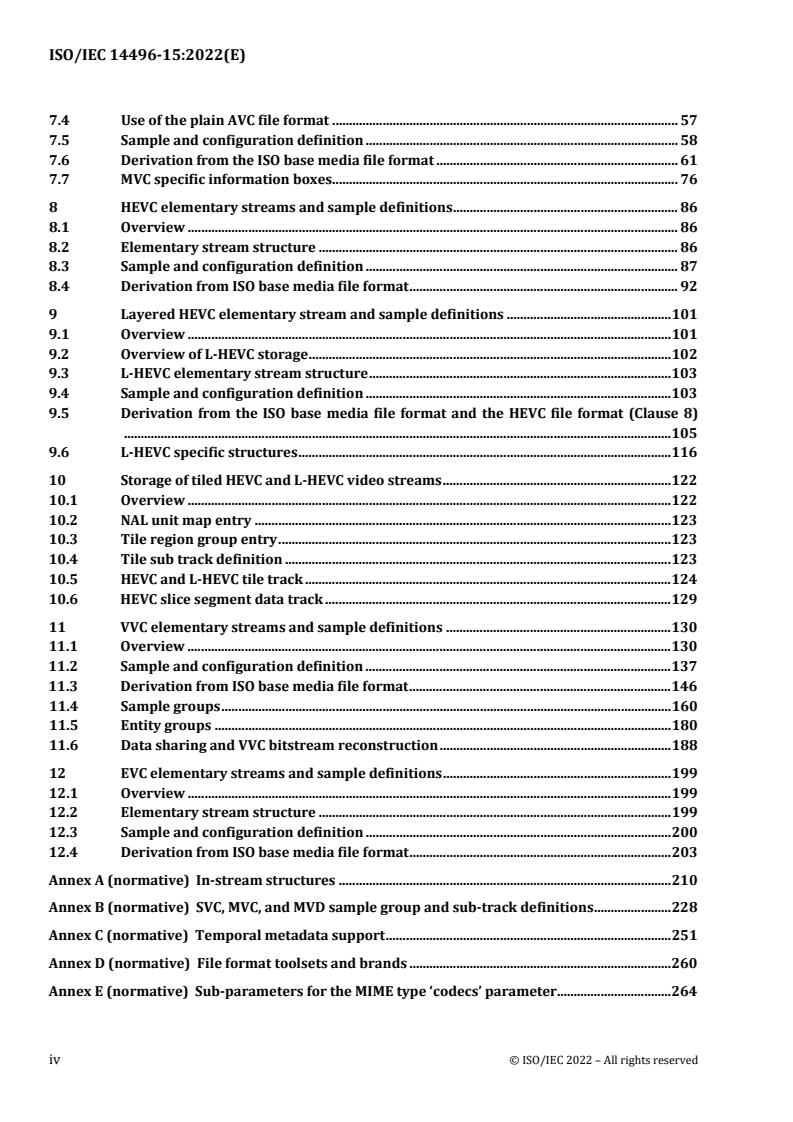
7.4 Use of the plain AVC file format . 57
7.5 Sample and configuration definition . 58
7.6 Derivation from the ISO base media file format . 61
7.7 MVC specific information boxes. 76
8 HEVC elementary streams and sample definitions . 86
8.1 Overview . 86
8.2 Elementary stream structure . 86
8.3 Sample and configuration definition . 87
8.4 Derivation from ISO base media file format . 92
9 Layered HEVC elementary stream and sample definitions . 101
9.1 Overview . 101
9.2 Overview of L-HEVC storage . 102
9.3 L-HEVC elementary stream structure . 103
9.4 Sample and configuration definition . 103
9.5 Derivation from the ISO base media file format and the HEVC file format (Clause 8)
................................................................................................................................................................... 105
9.6 L-HEVC specific structures . 116
10 Storage of tiled HEVC and L-HEVC video streams . 122
10.1 Overview . 122
10.2 NAL unit map entry . 123
10.3 Tile region group entry . 123
10.4 Tile sub track definition . 123
10.5 HEVC and L-HEVC tile track . 124
10.6 HEVC slice segment data track . 129
11 VVC elementary streams and sample definitions . 130
11.1 Overview . 130
11.2 Sample and configuration definition . 137
11.3 Derivation from ISO base media file format . 146
11.4 Sample groups . 160
11.5 Entity groups . 180
11.6 Data sharing and VVC bitstream reconstruction . 188
12 EVC elementary streams and sample definitions . 199
12.1 Overview . 199
12.2 Elementary stream structure . 199
12.3 Sample and configuration definition . 200
12.4 Derivation from ISO base media file format . 203
Annex A (normative) In-stream structures . 210
Annex B (normative) SVC, MVC, and MVD sample group and sub-track definitions . 228
Annex C (normative) Temporal metadata support . 251
Annex D (normative) File format toolsets and brands . 260
Annex E (normative) Sub-parameters for the MIME type ‘codecs’ parameter. 264
iv © ISO/IEC 2022 – All rights reserved
Annex F (informative) Unspecified nal_unit_type value management for sample entry types of
AVC and HEVC . 273
Annex G (informative) Examples of VVC base and subpicture tracks. 275
© ISO/IEC 2022 – All rights reserved v
Foreword
ISO (the International Organization for Standardization) and IEC (the International Electrotechnical
Commission) form the specialized system for worldwide standardization. National bodies that are
members of ISO or IEC participate in the development of International Standards through technical
committees established by the respective organization to deal with particular fields of technical activity.
ISO and IEC technical committees collaborate in fields of mutual interest. Other international
organizations, governmental and non-governmental, in liaison with ISO and IEC, also take part in the
work.
The procedures used to develop this document and those intended for its further maintenance are
described in the ISO/IEC Directives, Part 1. In particular, the different approval criteria needed for the
different types of document should be noted. This document was drafted in accordance with the editorial
rules of the ISO/IEC Directives, Part 2 (see www.iso.org/directives or
www.iec.ch/members_experts/refdocs).
Attention is drawn to the possibility that some of the elements of this document may be the subject of
patent rights. ISO and IEC shall not be held responsible for identifying any or all such patent rights. Details
of any patent rights identified during the development of the document will be in the Introduction and/or
on the ISO list of patent declarations received (see www.iso.org/patents) or the IEC list of patent
declarations received (see https://patents.iec.ch).
Any trade name used in this document is information given for the convenience of users and does not
constitute an endorsement.
For an explanation of the voluntary nature of standards, the meaning of ISO specific terms and
expressions related to conformity assessment, as well as information about ISO's adherence to the World
Trade Organization (WTO) principles in the Technical Barriers to Trade (TBT) see
www.iso.org/iso/foreword.html. In the IEC, see www.iec.ch/understanding-standards.
This document was prepared by Joint Technical Committee ISO/IEC JTC 1, Information technology,
Subcommittee SC 29, Coding of audio, picture, multimedia and hypermedia information.
This sixth edition cancels and replaces the fifth edition (ISO/IEC 14496-15:2019), which has been
technically revised. It also incorporates the Amendment ISO/IEC 14496-15:2019/Amd 1:2020.
The main changes are as follows:
- Support for the Versatile Video Coding (ISO/IEC 23090-3) and Essential Video Coding (ISO/IEC
23094-1)
- Addition of sample entry types 'hvc3’, ‘hev3’, ‘hvt2’, and ‘hvt3’ targeted at tile-based
delivery and merging of High Efficiency Video Coding (ISO/IEC 23008-2) bitstreams
A list of all parts in the ISO/IEC 14496 series can be found on the ISO and IEC websites.
Any feedback or questions on this document should be directed to the user’s national standards body. A
complete listing of these bodies can be found at www.iso.org/members.html and www.iec.ch/national-
committees.
vi © ISO/IEC 2022 – All rights reserved
Introduction
This document defines a storage format based on, and compatible with, the ISO Base Media File Format
(ISO/IEC 14496-12), which is used by the MP4 file format (ISO/IEC 14496-14) and the Motion JPEG 2000
file format (ISO/IEC 15444-3) among others. This document enables video streams formatted as Network
Adaptation Layer Units (NAL Units) to
a) be used in conjunction with other media streams, such as audio,
b) be used in an MPEG-4 systems environment, if desired,
c) be formatted for delivery by a streaming server, using hint tracks, and
d) inherit all the use cases and features of the ISO Base Media File Format on which MP4 and MJ2 are
based.
This document may be used as a standalone document; it specifies how NAL unit structured video content
shall be stored in an ISO Base Media File Format compliant format. However, it is normally used in the
context of a specification, such as the MP4 file format, derived from the ISO Base Media File Format, that
permits the use of NAL unit structured video such as AVC (ISO/IEC 14496-10) video and High Efficiency
Video Coding (HEVC, ISO/IEC 23008-2) video.
The ISO Base Media File Format is becoming increasingly common as a general-purpose media container
format for the exchange of digital media, and its use in this context should accelerate both adoption and
interoperability.
The International Organization for Standardization (ISO) and International Electrotechnical Commission
(IEC) draw attention to the fact that it is claimed that compliance with this document may involve the use
of a patent.
ISO and IEC take no position concerning the evidence, validity and scope of this patent right.
The holder of this patent right has assured ISO and IEC that he/she is willing to negotiate licences
under reasonable and non-discriminatory terms and conditions with applicants throughout the world.
In this respect, the statement of the holder of this patent right is registered with ISO and IEC.
Information may be obtained from the patent database available at www.iso.org/patents or
patents.iec.ch.
Attention is drawn to the possibility that some of the elements of this document may be the subject of
patent rights other than those in the patent database. ISO and IEC shall not be held responsible for
identifying any or all such patent rights.
© ISO/IEC 2022 – All rights reserved vii
INTERNATIONAL STANDARD ISO/IEC 14496-15:2022(E)
Information technology — Coding of audio-visual
objects —
Part 15:
Carriage of network abstraction layer (NAL) unit
structured video in the ISO base media file format
1 Scope
This document specifies the storage format for streams of video that is structured as NAL Units, such as
AVC (ISO/IEC 14496-10) and HEVC (ISO/IEC 23008-2) video streams. In addition, Annex E specifies
parameters and sub-parameters applying when sample entries specified in this document are used as the
'codecs' parameter of a MIME type, as specified in IETF RFC 6381.
2 Normative references
The following documents, in whole or in part, are normatively referenced in this document and are
indispensable for its application. For dated references, only the edition cited applies. For undated
references, the latest edition of the referenced document (including any amendments) applies.
ISO/IEC 14496-12:2020, Information technology — Coding of audio-visual objects — Part 12: ISO base
media file format
ISO/IEC 14496-10:2020, Information technology — Coding of audio-visual objects — Part 10: Advanced
Video Coding
ISO/IEC 23008-2:2020, Information technology — High efficiency coding and media delivery in
heterogeneous environments — Part 2: High efficiency video coding
ISO/IEC 23090-3:2021, Information technology — Coded representation of immersive media — Part 3:
Versatile video coding
ISO/IEC 23094-1:2020, Information technology — General video coding — Part 1: Essential video coding
IETF RFC 4648, The Base16, Base32, and Base64 data encodings
IETF RFC 6381, MIME codecs and profiles
3 Terms, definitions, abbreviated terms and conventions
3.1 Terms and definitions
For the purposes of this document, the terms and definitions given in ISO/IEC 14496-10,
ISO/IEC 23008-2, ISO/IEC 23090-3 or ISO/IEC 23094-1, and the following apply.
© ISO/IEC 2022 – All rights reserved 1
ISO and IEC maintain terminology databases for use in standardization at the following addresses:
— ISO Online browsing platform: available at https://www.iso.org/obp
— IEC Electropedia: available at https://www.electropedia.org/
3.1.1
3D-AVC NAL unit
3D AVC VCL NAL unit
NAL unit with type 21 with avc_3d_extension_flag equal to 1
3.1.2
aggregator
in-stream structure using a NAL unit header for grouping of NAL units belonging to the same sample
3.1.3
alternate region set
set of rectangular regions that are alternatives to be used as a rectangular region when reconstructing a
VVC bitstream from a VVC extraction base track
3.1.4
applicable video coding standard
video coding standard for the data carried in the track
Note 1 to entry: The video coding standard can be ISO/IEC 14496-10, ISO/IEC 23008-2, ISO/IEC 23090-3, or
ISO/IEC 23094-1.
3.1.5
AU- or picture-level non-VCL NAL unit
non-VCL NAL unit that applies to one or more entire AUs or one or more entire pictures
Note 1 to entry: An AU-level non-VCL NAL unit applies to one or more entire AUs. A picture-level non-VCL NAL unit
applies to one or more entire pictures. In VVC, AU-level or picture-level non-VCL NAL units include: 1) all the DCI, OPI, VPS,
SPS, PPS, AUD, PH, EOS, and EOB NAL units; 2) APS NAL units that apply to one or more entire AUs or pictures; and 3) SEI
NAL units that only contain SEI messages that apply to one or more entire AUs or pictures.
3.1.6
AVC base layer
maximum subset of a bitstream that is AVC compatible
Note 1 to entry: The AVC base layer is represented by AVC VCL NAL units and associated non-VCL NAL units. The AVC
base layer is not using any of the functionality of ISO/IEC 14496-10:2020, Annex G, Annex H, Annex I, or Annex J.
Note 2 to entry: The AVC base layer itself can be a temporal scalable bitstream.
3.1.7
AVC parameter set sample
sample in a parameter set elementary stream that consists of those parameter set NAL units that are to
be considered as if present in the video elementary stream at the same instant in time
3.1.8
AVC sample
access unit as defined in ISO/IEC 14496-10
2 © ISO/IEC 2022 – All rights reserved
3.1.9
AVC NAL unit
AVC VCL NAL unit and its associated non-VCL NAL units in a bitstream
3.1.10
AVC VCL NAL unit
NAL unit with type 1 to 5 (inclusive)
3.1.11
canonical order
order of NAL units that conforms to the applicable video standard
Note 1 to entry: When a single track carries a video bitstream, the NAL units are stored in the canonical order. When
multiple tracks are used to a carry a video bitstream, an implicit or explicit video bitstream reconstruction process might
be applied to recover the canonical order.
3.1.12
canonical stream format
elementary stream that contains NAL units in the canonical order and conforms to the constraints
specified in this document for carrying an elementary stream of the applicable video standard in one or
more tracks
3.1.13
complete subset
minimal set of tracks that contain all the information in the original bitstream
3.1.14
cropped frame dimensions
width and height of the decoded frame after applying the output cropping parameters
3.1.15
default sample group description index
default_group_description_index of SampleGroupDescriptionBox with version
greater than or equal to 2
3.1.16
elementary stream
sequence of one or more bitstreams of the applicable video standard
Note 1 to entry: The term elementary stream is not directly related to the terms video elementary stream, parameter
set elementary stream, and video and parameter set elementary stream.
Note 2 to entry: The applicable video standard can be included as a prefix to the term elementary stream. For example,
an AVC elementary stream refers to an elementary stream that is a sequence of one or more bitstreams conforming to
ISO/IEC 14496-10.
3.1.17
extractor
in-stream structure using a NAL unit header for extraction of data from other tracks
Note 1 to entry: Extractors contain instructions on how to extract data from other tracks. Logically an Extractor can be
seen as a pointer to data. While reading a track containing Extractors, the Extractor is replaced by the data it is pointing to.
© ISO/IEC 2022 – All rights reserved 3
3.1.18
HEVC sample
access unit as defined in ISO/IEC 23008-2
3.1.19
implicit reconstruction
reconstruction of a stream of access units from two or more tracks not using extractors
3.1.20
in-stream structure
structure residing within sample data
3.1.21
layer
scalable layer
set of VCL NAL units with the same values of dependency_id, quality_id, and
temporal_id, and the associated non-VCL NAL units
Note 1 to entry: A scalable layer with any of dependency_id, quality_id, and temporal_id not equal to 0 enhances the
video by one or more scalability levels in at least one direction (temporal, quality or spatial resolution)
Note 2 to entry: SVC uses a “layered” encoder design that results in a bitstream representing “coding layers”. In some
publications the ‘base layer’ is the first quality layer of a specific coding layer. In some publications the base layer is the
scalable layer with the lowest priority. The SVC file format uses “scalable layer” or “layer” in a general way for describing
nested bitstreams (using terms like AVC base layer or SVC enhancement layer).
3.1.22
layer
scalable layer
set of VCL NAL units with the same value of nuh_layer_id and the associated non-VCL
NAL units
3.1.23
layer set
set of layers represented within a bitstream created from another bitstream by operation of the sub-
bitstream extraction process
3.1.24
L-HEVC sample
picture units that are within an access unit as specified in Annex F of ISO/IEC 23008-2:2020 and are
represented by the track
3.1.25
MVC NAL unit
MVC VCL NAL unit and its associated non-VCL NAL units in an MVC stream
Note 1 to entry: The association of non-VCL NAL units with MVC VCL NAL units is specified in ISO/IEC 14496-10:2020,
Annex H.
3.1.26
MVC sample
one or more view components as defined in Annex H of ISO/IEC 14496-10:2020 and the associated non-
VCL NAL units
4 © ISO/IEC 2022 – All rights reserved
3.1.27
MVC VCL NAL unit
NAL unit with type 20, and NAL units with type 14 when the immediately following NAL units are AVC
VCL NAL units
Note 1 to entry: MVC VCL NAL units do not affect the decoding process of a legacy AVC decoder.
3.1.28
MVC+D depth NAL unit
MVC+D depth VCL NAL unit
NAL unit with type 21 containing a coded slice extension for a depth view component
3.1.29
MVD NAL unit
MVD VCL NAL unit
NAL unit with type 21, containing a coded slice extension for a depth view component coded with MVC+D
or 3D-AVC, or a 3D-AVC texture view component
3.1.30
MVD sample
one or more view components as defined in Annex I or Annex J of ISO/IEC 14496-10:2020 and the
associated non-VCL NAL units, where each view component contains a texture view component, a depth
view component or both
3.1.31
NAL-unit-like structure
data structure that is similar to NAL units in the sense that it also has a NAL unit header and a payload,
with a difference that the payload might not follow the start code emulation prevention mechanism
required for the NAL unit syntax
3.1.32
natively present
not included in an aggregator or an extractor
Note 1 to entry: Data referred to by (hence not included in) an aggregator is considered as natively present. Data
included in an aggregator is not considered as natively present.
3.1.33
operating point
independently decodable subset of a layered bitstream
Note 1 to entry: Each operating point consists of all the data needed to decode this particular bitstream subset.
Note 2 to entry: In an SVC stream an operating point represents a particular spatial resolution, temporal resolution,
and quality, and can be represented either by (i) specific values of DTQ (dependency_id, temporal_id and quality_id) or (ii)
specific values of P (priority_id) or (iii) combinations of them (e.g. PDTQ). Note that the usage of priority_id is defined by
the application. In an SVC file a track represents one or more operating points. Within a track tiers can be used to define
multiple operating points.
Note 3 to entry: The bitstream subset of an MVC or MVD operating point represents a particular set of target output
views at a particular temporal resolution, and consists of all the data needed to decode this particular bitstream subset. In
MVD each target output view in the bitstream subset of an MVD operating point can contain a texture view, a depth view or
both.
Note 4 to entry: An operating point is referred to as an operation point in Annex H of ISO/IEC 14496-10.
© ISO/IEC 2022 – All rights reserved 5
3.1.34
operating point
independently decodable subset of a layered bitstream, where one or more layers in the set of
layers are indicated to be output layers
Note 1 to entry: Each operating point consists of all the data needed to decode this particular bitstream subset.
Note 2 to entry: An operating point is referred to as an output operation point in ISO/IEC 23008-2.
3.1.35
operating point
temporal subset of an output layer set (OLS), identified by an output layer set (OLS) index and a
highest value of TemporalId
Note 1 to entry: Each operating point consists of all the data needed to decode this particular bitstream subset.
Note 2 to entry: An operating point is referred to as an operation point in ISO/IEC 23090-3.
3.1.36
output layer set
set of layers consisting of the layers of one of the specified layer sets, where one or more layers in the set
of layers are indicated to be output layers, as specified in ISO/IEC 23008-2
3.1.37
parameter set
video parameter set, sequence parameter set, picture parameter set, or adaptation parameter set as
defined in the applicable video standard
Note 1 to entry: This term is used to refer to all types of parameter sets.
3.1.38
parameter set elementary stream
elementary stream containing samples made up of only sequence and picture parameter set NAL units
synchronized with the video elementary stream
3.1.39
picture unit
set of VCL NAL units and their associated non-VCL NAL units
Note 1 to entry: The association of VCL NAL units and non-VCL NAL units with picture units is specified in the
applicable video standard.
3.1.40
prefix NAL unit
NAL units with type 14
Note 1 to entry: Prefix NAL units provide scalability information about AVC VCL NAL units and filler data NAL units.
Prefix NAL units do not affect the decoding process of a legacy AVC decoder. The behaviour of a legacy AVC file reader as a
response to prefix NAL units is undefined.
3.1.41
rectangular region
rectangle that does not contain holes and does not overlap with any other rectangular region of the same
picture
6 © ISO/IEC 2022 – All rights reserved
3.1.42
reference layer
layer that is indicated as possibly needed for decoding of another layer
Note 1 to entry: For layered HEVC, reference layers can be indicated by the 'oinf' sample group defined in subclause
9.6.2.
3.1.43
scalable layer representation
bitstream subset that is required for decoding the scalable layer, consisting of the scalable layer itself and
all the scalable layers on which the scalable layer depends
3.1.44
sub-picture
proper subset of coded slices of a scalable layer representation
3.1.45
sub-picture tier
tier that consists of sub-pictures that are constrained so that any coded slice that is not included
in the tier representation of this sub-picture tier is not referred to in inter prediction or inter-layer
prediction for decoding of this sub-picture tier
3.1.46
sub-layer
temporal sub-layer
set of VCL NAL units with a particular value of TemporalId and the associated non-VCL NAL units
3.1.47
sublayer
temporal sublayer
set of VCL NAL units with a particular value of TemporalId and the associated non-VCL NAL units
3.1.48
SVC enhancement layer
layer that specifies a part of a scalable bitstream that enhances the video
Note 1 to entry: An SVC enhancement layer is represented by SVC VCL NAL units and the associated non-VCL NAL units
and SEI messages.
Note 2 to entry: Usually an SVC enhancement layer represents a spatial or coarse-grain scalability (CGS) coding layer
(identified by a specific value of dependency_id).
3.1.49
SVC NAL unit
SVC VCL NAL unit and its associated non-VCL NAL units in an SVC stream
Note 1 to entry: The association of non-VCL NAL units with svc VCL NAL units is specified in ISO/IEC 14496-10:2020,
Annex G.
3.1.50
SVC sample
NAL units that belong to an access unit as defined in ISO/IEC 14496-10:2020, subclause 7.4.1.2, and are
represented by the track
© ISO/IEC 2022 – All rights reserved 7
3.1.51
SVC stream
bitstream represented by the operating point for which dependency_id is equal to mDid, temporal_id is
the greatest temporal_id value among mOpSet, and quality_id is the greatest quality_id value among
mOpSet, where the greatest value of dependency_id of all the operating points represented by DTQ
(dependency_id, temporal_id and quality_id) combinations is equal to mDid, and the set of all the
operating points with dependency_id equal to mDid is mOpSet.
Note 1 to entry: The term “SVC stream” is referenced by ‘decoding/accessing the entire stream’ in this document. There
can be NAL units that are not required for decoding this operating point.
3.1.52
SVC VCL NAL unit
NAL unit with type 20, and NAL units with type 14 when the immediately following NAL units are AVC
VCL NAL units
Note 1 to entry: SVC VCL NAL units do not affect the decoding process of a legacy AVC decoder.
3.1.53
temporal layer representation
representation of a temporal layer
temporal layer and all lower temporal layers
3.1.54
tier
set of operating points within a track, providing information about the operating
points and instructions on how to access the corresponding bitstream portions (using maps and groups)
Note 1 to entry: In SVC file format a tier represents one or more scalable layers of an SVC bitstream. In HEVC and VVC,
the term tier is used to represent a part of the interoperability point representation consisting of profile, tier, and level.
Readers should not be confused about these two different meanings of the word "tier".
Note 2 to entry: The term “tier” is used in SVC file format to avoid confusion with the frequently used term layer. A tier
represents a subset of a track and represents an operating point of an SVC bitstream. Tiers in a track subset the entire track,
no matter whether the track references another track by extractors.
Note 3 to entry: An MVC or MVD tier represents a particular set of temporal subsets of a particular set of views.
3.1.55
tier representation
representation of the tier
bitstream subset that is required for decoding the tier, consisting of the tier itself and all the tiers on
which the tier depends
3.1.56
video elementary stream
elementary stream containing access units made up of NAL units for coded picture data
3.1.57
video and parameter set elementary stream
elementary stream containing access units with coded pictures and with parameter sets
8 © ISO/IEC 2022 – All rights reserved
3.1.58
video stream
self-contained independently decodable video bitstream
3.1.59
virtual base view
AVC compatible representation of an independently coded non-base view
Note 1 to entry: The virtual base view of an independently coded non-base view is created according to the process
specified in ISO/IEC 14496-10:2020, subclause H.8.5.5. Samples containing data units of an independently coded non-base
view and samples of the virtual base view are aligned by decoding times.
3.1.60
VVC bitstream
bitstream conforming to the VVC standard (ISO/IEC 23090-3)
Note 1 to entry: Unless otherwise scoped in the text, the term VVC bitstream refers to the entire bitstream that the file
writer includes in a file, possibly stored in multiple tracks. In some occasions, Clause 11 specifically refers to the VVC
bitstream contained in a track, either natively or though resolving 'subp' track references or 'recr' track references.
3.1.61
VVC extraction base track
VVC track that references another VVC track through a 'recr' track reference
3.1.62
VVC merge base track
VVC track that references VVC subpicture tracks though a 'subp' track reference
3.1.63
VVC non-VCL track
track that contains only non-VCL NAL units and is referred to by a VVC track through a 'vvcN' track
reference
3.1.64
VVC subpicture
subpicture as defined in in the VVC standard (ISO/IEC 23090-3)
Note 1 to entry: Unless otherwise scoped in the text, the terms VVC subpicture and subpicture are used
interchangeably.
3.1.65
VVC subpicture track
track that contains either a sequence of one or more VVC subpictures forming a rectangular region or a
sequence of one or more complete slices forming a rectangular region
3.1.66
VVC track
track that represents a VVC elementary stream by including NAL units in its samples and/or sample
entries, and possibly by associating other VVC tracks containing other layers and/or sublayers of the VVC
elementary stream through 'vvcb' entity group and the 'vopi' sample group or through the 'opeg'
entity group, and possibly by referencing VVC subpicture tracks
© ISO/IEC 2022 – All rights reserved 9
3.2 Abbreviated terms
3D-AVC Three-dimensional Advanced Video Coding [refers to ISO/IEC 14496-10:2020 when the
techniques in Annex J (Multiview and Depth Video with Enhanced Non-Base View Coding)
are in use]
3D-HEVC Three-dimensional High Efficiency Video Coding [refers to ISO/IEC 23008-2:2020 when the
techniques in Annex I (3D High Efficiency Video Coding) are in use]
A3D Three-dimensional Advanced Video Coding [refers to ISO/IEC 14496-10:2020 when the
techniques in Annex J (Multiview and Depth Video with Enhanced Non-Base View Coding)
are in use]
NOTE 1 The abbreviation A3D is used in terminology related to syntax elements and structures, whereas the
abbreviation 3D-AVC is used otherwise.
ALF Adaptive Loop Filter
APS Adaptation Parameter Set
AU Access Unit
AUD Access Unit Delimiter
AVC Advanced Video Coding. Where contrasted with SVC, MVC, or MVD in this document, this
term refers to the main part of ISO/IEC 14496-10:2020, including none of Annex G (Scalable
Video Coding), Annex H (Multiview Video Coding), Annex I (Multiview and Depth Video
Coding), and Annex J (Multiview and Depth Video with Enhanced Non-Base View Coding)
BLA Broken Link Access
CBR Constant Bit Rate
CLVS Coded Layer Video Sequence
CRA Clean Random Access
CTU Coding Tree Unit
CVS Coded Video Sequence
DCI Decoding Capability Information
DRA Dynamic Range Adjustment
EOB End of Bitstream
EOS End of Sequence
EVC Essential Video Coding
FF File Format
GDR Gradual Decoding Refresh
HEVC High Efficiency Video Coding
HRD Hypothetical Reference Decoder
ID Identifier
IDR Instantaneous Decoding Refresh
IRAP Intra Random Access Point
ISOBMFF ISO Base Media File Format (ISO/IEC 14496-12)
L-HEVC Layered High Efficiency Video Coding
LMCS Luma Mapping with Chroma Scaling
10 © ISO/IEC 2022 – All rights reserved
MVC Multiview Video Coding [refers to ISO/IEC 14496-10:2020 when the techniques in Annex H
(Multiview Video Coding) are in use]
MVCD Multiview Video Coding Plus Depth [refers to ISO/IEC 14496-10:2020 when the techniques
in Annex I (Multiview and Depth Video Coding) are in use]
MVC+D Multiview Video Coding Plus Depth [refers to ISO/IEC 14496-10:2020 when the techniques
in Annex I (Multiview and Depth Video Coding) are in use]
NOTE 2 The abbreviation MVCD is used in terminology related to syntax elements and structures, whereas the
abbreviation MVC+D is used otherwise.
MV-HEVC Multiview High Efficiency Video Coding [refers to ISO/IEC 23008-2:2020 when the
techniques in Annex G (Multiview High Efficiency Video Coding) are in use]
MVD Multiview Video Coding Plus Depth [refers to ISO/IEC 14496-10:2020 when the techniques
in Annex I (Multiview and Depth Video Coding) or Annex J (Multiview and Depth Video with
Enhanced Non-Base View Coding) are in use]
NAL Network Abstraction Layer
OPI Operating Point Information
PH Picture Header
PPS Picture Parameter Set
PU Picture Unit
RADL Random Access Decodable Leading
RASL Random Access Skipped Leading
RBSP Raw Byte Sequence Payload
ROI Region-Of-Interest
SAP Stream Access Point
SEI Supplemental Enhancement Information
SH Slice Header
SHVC Scalable High efficiency Video Coding [refers to ISO/IEC 23008-2:2020 when the techniques
in Annex H (Scalable High Efficiency Video Coding) are in use]
SPS Sequence Parameter Set
STSA Step-wise Temporal Sub-layer Access [in the context of ISO/IEC 23008-2] or
Step-wise Temporal Sublayer Access [in the context of ISO/IEC 23090-3]
SVC Scalable Video Coding [refers to ISO/IEC 14496-10:2020 when the techniques in Annex G
(Scalable Video Coding) are in use]
TSA Temporal Sub-layer Access
VCL Video Coding Layer
VPS Video Parameter Set
VVC Versatile Video Coding
3.3 Conventions
Mathematical functions:
x ; x <= y
Min( x, y ) = �
y ; x > y
© ISO/IEC 2022 – All rights reserved 11
4 General definitions
4.1 Overview
The specifications in this clause apply to all coding systems identified by chapters in this specification,
unless specifically over-ridden by definitions in the clause for a specific coding system.
4.2 Sample and configuration definition
4.2.1 General
For sample formats specified in this document, a sample contains an access unit or a part of an access
unit (e.g. in a track containing a part of a multi-layer video bitstream), where an access unit is as defined
in the appropriate specification.
4.2.2 Canonical order and restrictions
NOTE 1 An elementary stream is stored in the ISO Base Media File Format in a manner that a single track contains the
elementary stream in the canonical stream format or a reader can reconstruct the canonical stream format from multiple
tracks carrying the elementary stream. The canonical stream format is as neutral as possible so that systems that need to
customize the stream for delivery over different transport protocols — MPEG-2 Systems, RTP, and so on — need not remove
information from the elementary stream while being free to add to the elementary stream. Furthermore, a canonical stream
format allows such operations to be performed against a known initial state.
When multiple tracks are used to store an elementary stream, as may be the case for Clauses 6, 7, 9, 10,
and 11, some tracks may contain canonical streams while others may
...