


ISO/IEC 23003-4:2025
(Main)Information technology — MPEG audio technologies — Part 4: Dynamic range control
Information technology — MPEG audio technologies — Part 4: Dynamic range control
This document specifies technology for loudness and dynamic range control (DRC). It is applicable to most MPEG audio technologies. It offers flexible solutions to efficiently support the widespread demand for technologies such as loudness normalization and dynamic range compression for various playback scenarios.
Technologies de l'information — Technologies audio MPEG — Partie 4: Contrôle de gamme dynamique
General Information
- Status
- Published
- Publication Date
- 18-Mar-2025
- Technical Committee
- ISO/IEC JTC 1/SC 29 - Coding of audio, picture, multimedia and hypermedia information
- Drafting Committee
- ISO/IEC JTC 1/SC 29/WG 6 - MPEG Audio coding
- Current Stage
- 6060 - International Standard published
- Start Date
- 19-Mar-2025
- Due Date
- 08-Aug-2025
- Completion Date
- 19-Mar-2025
Relations
- Effective Date
- 17-Feb-2024
- Effective Date
- 17-Feb-2024
- Effective Date
- 17-Feb-2024
Overview
ISO/IEC 23003-4:2025 - "Information technology - MPEG audio technologies - Part 4: Dynamic range control" defines standardized technology for loudness and dynamic range control (DRC) applicable across most MPEG audio systems. The third edition specifies decoder behavior, payload formats, time- and sub-band processing, gain generation, loudness normalization and equalization support, plus reference software and conformance procedures. It provides flexible tools to support loudness normalization, dynamic range compression, and playback-tailored delivery in broadcasting, streaming and consumer devices.
Key topics and technical requirements
The standard covers both conceptual and normative elements needed to implement interoperable DRC solutions:
- DRC decoder architecture: logical blocks, configuration, and how decoders derive peak and loudness values.
- DRC payloads and syntax: formats for DRC configuration, dynamic gain payloads, static payloads, and parametric tools as defined in the syntax sections.
- DRC set selection and application: pre-selection, request-based selection, album mode, precedence rules, and applying multiple DRC sets.
- Time-domain and sub-band processing: framing, time resolution, gain interpolation (including spline interpolation), look-ahead, node reservoirs, multi-band filter banks and dynamic equalization hooks.
- Gain generation: algorithms for creating DRC gain values at the decoder and methods to combine parametric and non-parametric DRC data.
- Loudness features: loudness normalization, loudness leveling, and loudness equalization support to meet target loudness profiles.
- Streaming and runtime: DRC behavior in streaming scenarios, configuration changes during active processing, and error handling.
- Complexity management and conformance: complexity estimation for DRC and EQ, reference software structure, test data and conformance test procedures.
Applications and who uses this standard
ISO/IEC 23003-4:2025 is practical for organizations and professionals needing consistent loudness and dynamic control:
- Broadcasters and streaming services implementing loudness normalization and adaptive DRC for different listening environments.
- Consumer electronics manufacturers (AV receivers, TVs, mobile devices) that apply dynamic range compression for quiet or noisy playback scenarios.
- Audio codec and middleware developers embedding DRC into MPEG audio ecosystems.
- Content producers and post-production houses ensuring program loudness consistency across platforms.
- Test labs and quality-assurance teams running conformance testing against standardized payloads and reference software.
Related standards
- Part of the ISO/IEC 23003 (MPEG audio technologies) family - this part focuses on DRC and complements codec-specific parts and broader MPEG audio standards.
Keywords: ISO/IEC 23003-4:2025, MPEG audio, dynamic range control, DRC decoder, loudness normalization, loudness leveling, DRC payload, audio streaming, conformance testing.

Get Certified
Connect with accredited certification bodies for this standard

BSI Group
BSI (British Standards Institution) is the business standards company that helps organizations make excellence a habit.

NYCE
Mexican standards and certification body.
Sponsored listings
Frequently Asked Questions
ISO/IEC 23003-4:2025 is a standard published by the International Organization for Standardization (ISO). Its full title is "Information technology — MPEG audio technologies — Part 4: Dynamic range control". This standard covers: This document specifies technology for loudness and dynamic range control (DRC). It is applicable to most MPEG audio technologies. It offers flexible solutions to efficiently support the widespread demand for technologies such as loudness normalization and dynamic range compression for various playback scenarios.
This document specifies technology for loudness and dynamic range control (DRC). It is applicable to most MPEG audio technologies. It offers flexible solutions to efficiently support the widespread demand for technologies such as loudness normalization and dynamic range compression for various playback scenarios.
ISO/IEC 23003-4:2025 is classified under the following ICS (International Classification for Standards) categories: 35.040.40 - Coding of audio, video, multimedia and hypermedia information. The ICS classification helps identify the subject area and facilitates finding related standards.
ISO/IEC 23003-4:2025 has the following relationships with other standards: It is inter standard links to ISO/IEC 23003-4:2020, ISO/IEC 23003-4:2020/Amd 2:2023, ISO/IEC 23003-4:2020/Amd 1:2022. Understanding these relationships helps ensure you are using the most current and applicable version of the standard.
ISO/IEC 23003-4:2025 is available in PDF format for immediate download after purchase. The document can be added to your cart and obtained through the secure checkout process. Digital delivery ensures instant access to the complete standard document.
Standards Content (Sample)
International
Standard
ISO/IEC 23003-4
Third edition
Information technology — MPEG
2025-03
audio technologies —
Part 4:
Dynamic range control
Technologies de l'information — Technologies audio MPEG —
Partie 4: Contrôle de gamme dynamique
Reference number
© ISO/IEC 2025
All rights reserved. Unless otherwise specified, or required in the context of its implementation, no part of this publication may
be reproduced or utilized otherwise in any form or by any means, electronic or mechanical, including photocopying, or posting on
the internet or an intranet, without prior written permission. Permission can be requested from either ISO at the address below
or ISO’s member body in the country of the requester.
ISO copyright office
CP 401 • Ch. de Blandonnet 8
CH-1214 Vernier, Geneva
Phone: +41 22 749 01 11
Email: copyright@iso.org
Website: www.iso.org
Published in Switzerland
© ISO/IEC 2025 – All rights reserved
ii
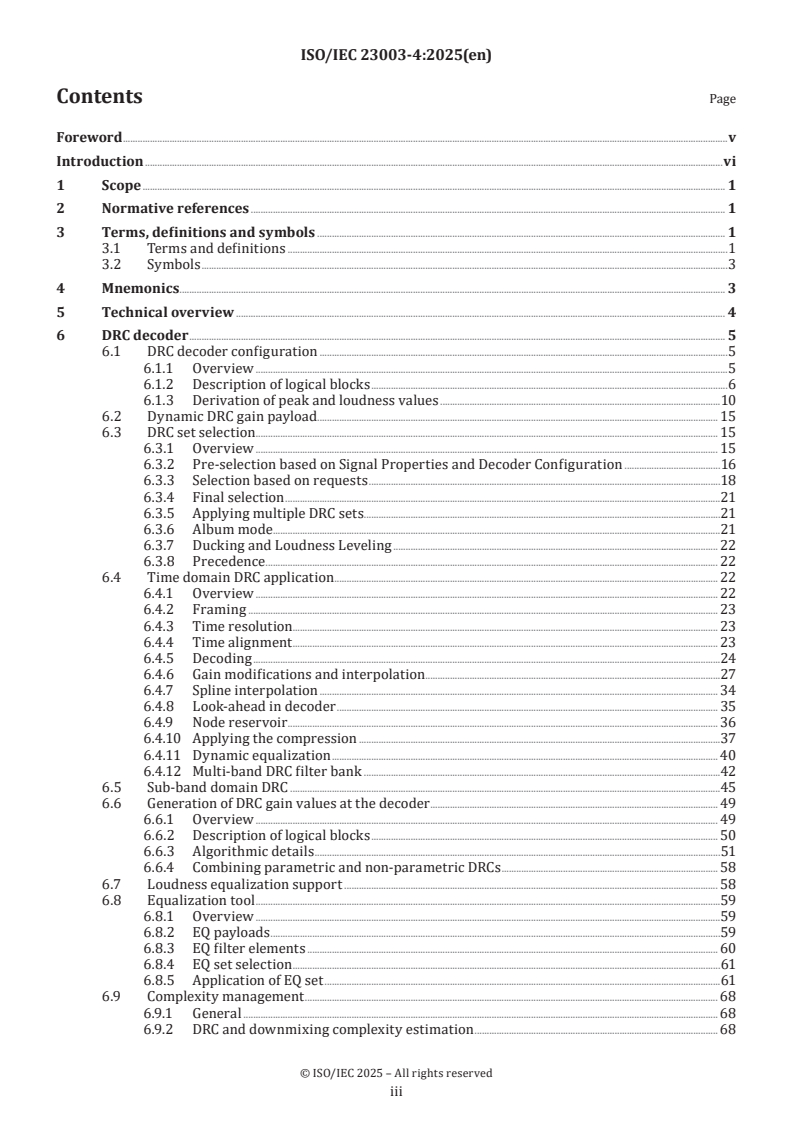
Contents Page
Foreword .v
Introduction .vi
1 Scope . 1
2 Normative references . 1
3 Terms, definitions and symbols . 1
3.1 Terms and definitions .1
3.2 Symbols .3
4 Mnemonics. 3
5 Technical overview . 4
6 DRC decoder . 5
6.1 DRC decoder configuration .5
6.1.1 Overview .5
6.1.2 Description of logical blocks .6
6.1.3 Derivation of peak and loudness values .10
6.2 Dynamic DRC gain payload . . 15
6.3 DRC set selection . 15
6.3.1 Overview . 15
6.3.2 Pre-selection based on Signal Properties and Decoder Configuration .16
6.3.3 Selection based on requests .18
6.3.4 Final selection .21
6.3.5 Applying multiple DRC sets.21
6.3.6 Album mode .21
6.3.7 Ducking and Loudness Leveling . 22
6.3.8 Precedence . 22
6.4 Time domain DRC application . 22
6.4.1 Overview . 22
6.4.2 Framing . 23
6.4.3 Time resolution. 23
6.4.4 Time alignment . 23
6.4.5 Decoding .24
6.4.6 Gain modifications and interpolation .27
6.4.7 Spline interpolation . 34
6.4.8 Look-ahead in decoder . 35
6.4.9 Node reservoir . 36
6.4.10 Applying the compression .37
6.4.11 Dynamic equalization . 40
6.4.12 Multi-band DRC filter bank .42
6.5 Sub-band domain DRC .45
6.6 Generation of DRC gain values at the decoder . 49
6.6.1 Overview . 49
6.6.2 Description of logical blocks . 50
6.6.3 Algorithmic details .51
6.6.4 Combining parametric and non-parametric DRCs . 58
6.7 Loudness equalization support . 58
6.8 Equalization tool .59
6.8.1 Overview .59
6.8.2 EQ payloads .59
6.8.3 EQ filter elements . 60
6.8.4 EQ set selection .61
6.8.5 Application of EQ set .61
6.9 Complexity management . 68
6.9.1 General . 68
6.9.2 DRC and downmixing complexity estimation . 68
© ISO/IEC 2025 – All rights reserved
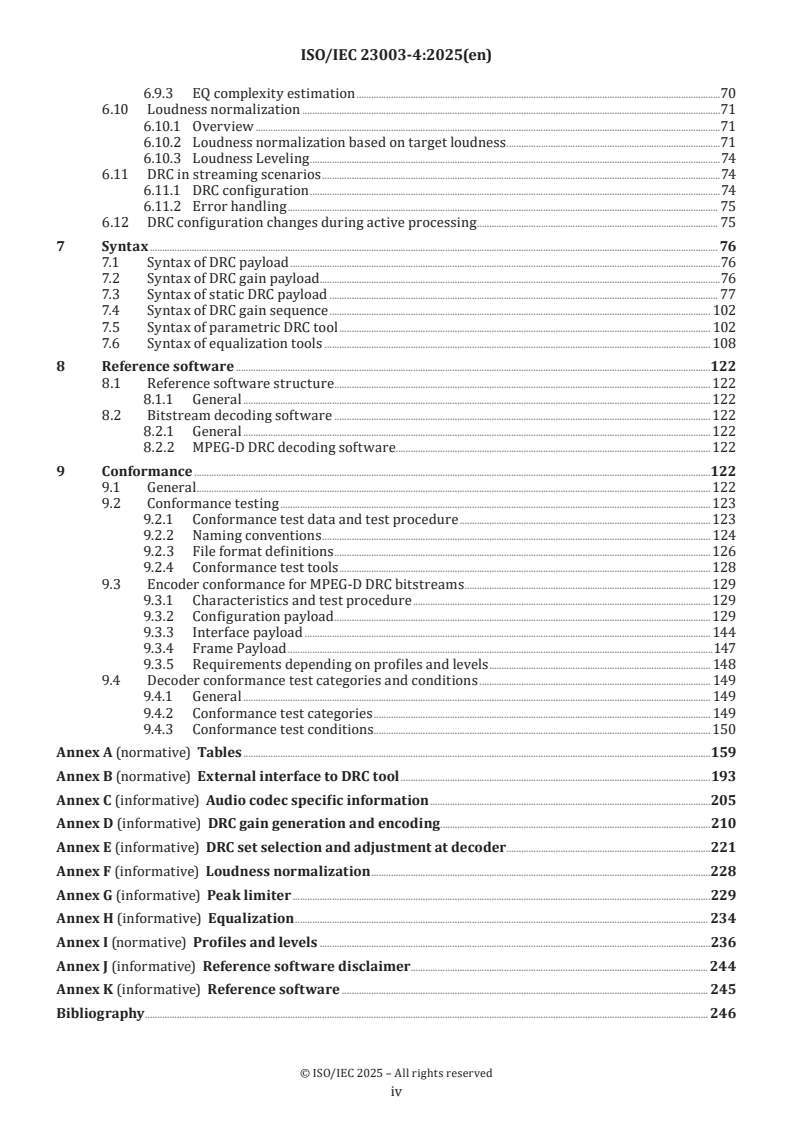
iii
6.9.3 EQ complexity estimation .70
6.10 Loudness normalization .71
6.10.1 Overview .71
6.10.2 Loudness normalization based on target loudness .71
6.10.3 Loudness Leveling .74
6.11 DRC in streaming scenarios .74
6.11.1 DRC configuration .74
6.11.2 Error handling . 75
6.12 DRC configuration changes during active processing . 75
7 Syntax . 76
7.1 Syntax of DRC payload .76
7.2 Syntax of DRC gain payload .76
7.3 Syntax of static DRC payload . 77
7.4 Syntax of DRC gain sequence . 102
7.5 Syntax of parametric DRC tool . 102
7.6 Syntax of equalization tools . 108
8 Reference software .122
8.1 Reference software structure . 122
8.1.1 General . 122
8.2 Bitstream decoding software . 122
8.2.1 General . 122
8.2.2 MPEG-D DRC decoding software . 122
9 Conformance .122
9.1 General . 122
9.2 Conformance testing . 123
9.2.1 Conformance test data and test procedure . 123
9.2.2 Naming conventions . 124
9.2.3 File format definitions . 126
9.2.4 Conformance test tools .128
9.3 Encoder conformance for MPEG-D DRC bitstreams . 129
9.3.1 Characteristics and test procedure . 129
9.3.2 Configuration payload .129
9.3.3 Interface payload . 144
9.3.4 Frame Payload .147
9.3.5 Requirements depending on profiles and levels . 148
9.4 Decoder conformance test categories and conditions . 149
9.4.1 General . 149
9.4.2 Conformance test categories . 149
9.4.3 Conformance test conditions. 150
Annex A (normative) Tables .159
Annex B (normative) External interface to DRC tool .193
Annex C (informative) Audio codec specific information .205
Annex D (informative) DRC gain generation and encoding.210
Annex E (informative) DRC set selection and adjustment at decoder .221
Annex F (informative) Loudness normalization .228
Annex G (informative) Peak limiter .229
Annex H (informative) Equalization . 234
Annex I (normative) Profiles and levels .236
Annex J (informative) Reference software disclaimer. 244
Annex K (informative) Reference software . 245
Bibliography . 246
© ISO/IEC 2025 – All rights reserved
iv
Foreword
ISO (the International Organization for Standardization) and IEC (the International Electrotechnical
Commission) form the specialized system for worldwide standardization. National bodies that are
members of ISO or IEC participate in the development of International Standards through technical
committees established by the respective organization to deal with particular fields of technical activity.
ISO and IEC technical committees collaborate in fields of mutual interest. Other international organizations,
governmental and non-governmental, in liaison with ISO and IEC, also take part in the work.
The procedures used to develop this document and those intended for its further maintenance are described
in the ISO/IEC Directives, Part 1. In particular, the different approval criteria needed for the different types
of document should be noted. This document was drafted in accordance with the editorial rules of the ISO/
IEC Directives, Part 2 (see www.iso.org/directives or www.iec.ch/members_experts/refdocs).
ISO and IEC draw attention to the possibility that the implementation of this document may involve the
use of (a) patent(s). ISO and IEC take no position concerning the evidence, validity or applicability of any
claimed patent rights in respect thereof. As of the date of publication of this document, ISO and IEC had
received notice of (a) patent(s) which may be required to implement this document. However, implementers
are cautioned that this may not represent the latest information, which may be obtained from the patent
database available at www.iso.org/patents and https://patents.iec.ch. ISO and IEC shall not be held
responsible for identifying any or all such patent rights.
Any trade name used in this document is information given for the convenience of users and does not
constitute an endorsement.
For an explanation of the voluntary nature of standards, the meaning of ISO specific terms and expressions
related to conformity assessment, as well as information about ISO's adherence to the World Trade
Organization (WTO) principles in the Technical Barriers to Trade (TBT) see www.iso.org/iso/foreword.html.
In the IEC, see www.iec.ch/understanding-standards.
This document was prepared by Joint Technical Committee ISO/IEC JTC 1, Information technology,
Subcommittee SC 29, Coding of audio, picture, multimedia, and hypermedia.
This third edition cancels and replaces the second edition (ISO/IEC 23003-4:2020), which has been
technically revised. It also incorporates the Amendments ISO/IEC 23003-4:2020/Amd 1:2022 and
ISO/IEC 23003-4:2020/Amd 2:2023.
The main changes are as follows:
— Functionality for side chain normalization and loudness leveling, related reference software, and
conformance have been integrated.
A list of all parts in the ISO/IEC 23003 series can be found on the ISO and IEC websites.
Any feedback or questions on this document should be directed to the user’s national standards
body. A complete listing of these bodies can be found at www.iso.org/members.html and
www.iec.ch/national-committees.
© ISO/IEC 2025 – All rights reserved
v
Introduction
Consumer audio systems and devices are used in a large variety of configurations and acoustical
environments. For many of these scenarios, the audio reproduction quality can be improved by appropriate
control of content dynamics and loudness.
This document provides a universal dynamic range control tool that supports loudness normalization. The
DRC tool offers a bitrate efficient representation of dynamically compressed versions of an audio signal.
This is achieved by adding a low-bitrate DRC metadata stream to the audio signal. The DRC tool includes
dedicated sections for clipping prevention, ducking/leveling, and for generating a fade-in and fade-out
to supplement the main dynamic range compression functionality. The DRC effects available at the DRC
decoder are generated at the DRC encoder side. At the DRC decoder side, the audio signal may be played back
without applying the DRC tool, or an appropriate DRC tool effect is selected and applied based on the given
playback scenario.
Loudness normalization is fully integrated with DRC and peak control to avoid clipping. A metadata-
controlled equalization tool is provided to compensate for playback scenarios that impact the spectral
balance, such as downmix or DRC. Furthermore, the DRC tool supports metadata-based loudness equalization
to compensate the effect of playback level changes on the spectral balance.
© ISO/IEC 2025 – All rights reserved
vi
International Standard ISO/IEC 23003-4:2025(en)
Information technology — MPEG audio technologies —
Part 4:
Dynamic range control
1 Scope
This document specifies technology for loudness and dynamic range control (DRC). It is applicable to most
MPEG audio technologies. It offers flexible solutions to efficiently support the widespread demand for
technologies such as loudness normalization and dynamic range compression for various playback scenarios.
2 Normative references
The following documents are referred to in the text in such a way that some or all of their content constitutes
requirements of this document. For dated references, only the edition cited applies. For undated references,
the latest edition of the referenced document (including any amendments) applies.
ISO/IEC 14496-12, Information technology — Coding of audio-visual objects — Part 12: ISO base media file format
ISO/IEC 14496-26:2024, Information technology — Coding of audio-visual objects — Part 26: Audio Conformance
ISO/IEC 23008-3:2022, Information technology — High efficiency coding and media delivery in heterogeneous
environments — Part 3: 3D audio
ISO/IEC 23091-3, Information technology — Coding-independent code points — Part 3: Audio
3 Terms, definitions and symbols
3.1 Terms and definitions
For the purposes of this document, the terms and definitions given in ISO/IEC 14496-12 and the following apply.
ISO and IEC maintain terminology databases for use in standardization at the following addresses:
— ISO Online browsing platform: available at https:// www .iso .org/ obp
— IEC Electropedia: available at https:// www .electropedia .org/
3.1.1
DRC sequence
series of DRC gain values that can be applied to one or more audio channels
3.1.2
DRC set
defined set of DRC sequences that produce a desired effect if applied to the audio signal
3.1.3
album
collection of audio recordings that are mastered in a consistent way
Note 1 to entry: Traditionally, a collection of songs released on a Compact Disk belongs into this category, for example.
© ISO/IEC 2025 – All rights reserved
3.1.4
conformance test bitstream
bitstream used for testing the conformance of MPEG-D DRC compliant audio decoders
3.1.5
conformance test case
conformance test category and a combination of one or more conformance test conditions for which a
conformance test sequence is provided
3.1.6
conformance test condition
condition which applies to properties of a conformance test sequence in order to test a certain functionality
of the MPEG-D DRC decoder
3.1.7
conformance test criteria
one or more conformance test tools and corresponding parameters applied to verify the conformance for a
certain conformance test sequence
3.1.8
conformance test sequence
set of a conformance test bitstream, a decoder setting, an input audio file and a corresponding reference file
3.1.9
decoder input parameters
input parameters that are supplied to an MPEG-D DRC decoder in addition to a conformance test bitstream,
a decoder interface bitstream and an input audio file
3.1.10
decoder setting
combination of a decoder interface bitstream and decoder input parameters that are supplied to an MPEG-D
DRC decoder
3.1.11
input DRC set selection parameters
input parameter set for testing of a DRC gain decoder instance
Note 1 to entry: This parameter set is solely used for conformance testing in the context of the DRC gain decoder
conformance test category (DrcGainDec).
3.1.12
reference audio file
decoded counterpart of a conformance test bitstream, a decoder setting and an input audio file
3.1.13
reference DRC set selection parameters
decoded counterpart of a conformance test bitstream and a decoder setting fed to the DRC set selection process
Note 1 to entry: This parameter set is an intermediate result of an MPEG-D DRC compliant decoder implementation
solely used for conformance testing in the context of the DRC selection process test category (DrcSelProc).
3.1.14
reference file
reference audio file or reference DRC set selection parameters
© ISO/IEC 2025 – All rights reserved
3.2 Symbols
a filter coefficient
i
b band index of DRC filter bank (starting at 0)
b filter coefficient
i
deltaTmin smallest permitted DRC gain sample interval in units of the audio sample interval
f cross-over frequency in Hz
c
f cross-over frequency expressed as fraction of the audio sample rate
c,norm
f (s) cross-over frequency of audio decoder sub-band s expressed as fraction of
c,norm,SB
the audio sample rate
NOTE 1 The cross-over frequency is the upper band edge frequency of the sub-band.
f audio sample rate in Hz
s
NOTE 2 If an audio decoder is present, it is the sample rate of the decoded time-domain
audio signal.
M DRC frame size in units of the audio sample interval 1/f
DRC s
N maximum permitted number of DRC samples per DRC frame
DRC
NOTE 3 Identical to the number of intervals with a duration of deltaTmin per DRC
frame.
N codec frame size in units of the audio sample interval 1/f
Codec s
π ratio of a circle’s circumference to its diameter
s audio decoder sub-band index (starting at 0)
z complex variable of the z-transform
4 Mnemonics
bslbf bit string, left bit first, where “left” is the order in which bit strings are written in the
ISO/IEC 14496 series
NOTE Bit strings are written as a string of 1s and 0s within single quote marks, for
example '1000 0001'. Blanks within a bit string are for ease of reading and have no
significance.
byte_align() number of bits to fill for byte alignment at the offset of n bits:
byte_align(n) = 8 ceil (n/8) – n
uimsbf unsigned integer, most significant bit first
vlclbf variable length code, left bit first, where “left” refers to the order in which the variable
length codes are written
bit(n) a bit string with n bits in the same format as bslbf
unsigned int(n) an unsigned integer with n bits in the same format as uimsbf
signed int(n) a signed integer with n bits, most significant bit first
mod modulo operator: (x mod y) = x-y floor (x/y)
© ISO/IEC 2025 – All rights reserved
sizeof(x) size operator that returns the bit size of a field x
TRUE/FALSE values of Boolean data type, which correspond to numerical 1 and 0, respectively
5 Technical overview
The technology described in this document is called the “DRC tool”. It provides efficient control of dynamic
range, loudness, and clipping based on metadata generated at the encoder. The decoder can choose to
selectively apply the metadata to the audio signal to achieve a desired result. Metadata for dynamic range
compression consists of encoded time-varying gain values that can be applied to the audio signal. Hence, the
main blocks of the DRC tool include a DRC gain encoder, a DRC gain decoder, a DRC gain modification block, and
a DRC gain application block. These blocks are exercised on a frame-by-frame basis during audio processing.
In addition to encoded time-varying gain values, the DRC gain decoder can also receive parametric DRC
metadata for generation of time-varying gain values at the decoder. Various DRC configurations can be
conveyed in a separate bitstream element, such as configurations for a downmix or combined DRCs. The
DRC set selection block decides based on the playback scenario and the applicable DRC configurations which
DRC gains to apply to the audio signal. Moreover, the DRC tool supports loudness normalization based on
loudness metadata.
A typical system for loudness and dynamic range control in the time domain is shown in Figure 1. A more
complex system including downmixer and peak limiter is shown in Figure 2. The decoder part of the DRC
tool is driven by metadata that efficiently represents the DRC gain samples and parameters for interpolation.
The gain samples can be updated as fast as necessary to accurately represent gain changes down to at least
1 ms update intervals. In the following, the decoder part of the DRC tool is referred to as “DRC decoder”,
which includes everything except the audio decoder and associated bitstream de-multiplexing.
Figure 1 — Block diagram of a typical system with audio decoder and DRC tool modules to achieve
loudness normalization (LN) and dynamic range control
© ISO/IEC 2025 – All rights reserved
Figure 2 — Block diagram of a more complex system including downmixer and peak limiter
(TD = time-domain, SD = subband-domain)
The DRC tool provides support for loudness equalization, sometimes called “loudness compensation”, that
can be applied to compensate for the effect of the playback level on the spectral balance. For this purpose,
time-varying loudness information can be recovered from DRC gain sequences to dynamically control the
compensation module. While the compensation module is out of scope, the interface describes in which
frequency ranges the loudness information should be applied.
A flexible tool for generic metadata-controlled equalization is provided. The tool can be used to reach the
desired spectral balance of the reproduced audio signal depending on a wide variety of playback scenarios,
such as downmix, DRC, or playback room size. It can operate in the sub-band domain of an audio decoder
and in the time domain.
The DRC tool is specified in Clause 6. The tool may be subject to profiles and levels that shall be in accordance
with Annex I. The bitstream field decoding of the DRC tool shall be in accordance with Annex A (Tables A.1
to A.105). If an interface for external parameter control of the DRC tool is used, it shall conform to Annex B.
6 DRC decoder
6.1 DRC decoder configuration
6.1.1 Overview
The DRC configuration information can be received in-stream using the static payloads uniDrcConfig() and
loudnessInfoSet() described below, or it can be delivered by a higher layer, such as in ISO/IEC 14496-12 (see
Table 1). The basic decoding process of the static information is virtually the same. The difference consists
mainly in a few syntax changes and reduced field sizes to increase the bit rate efficiency of the in-stream
configuration. The syntax of the in-stream static payload is given in 7.3. The associated metadata encoding
is given in A.6. The static DRC payload is evaluated once at the beginning of the decoding process and it is
monitored subsequently. For static DRC payload changes during playback, see 6.12.
Table 1 — Overview of configuration (setup) and separate metadata track in ISO/IEC 14496-12
Sample entry code Setup Track reference Sample format
(in sample entry)
Audio track As specified for the DRCInstructions box using "adrc" referring to the As specified for the audio
audio codec in use negative values for drcLo- metadata tracks carry- codec in use (unchanged)
(unchanged) cation ing gain values
Metadata "unid" (none) (none) Each sample is a uni-
track DrcGain() payload
© ISO/IEC 2025 – All rights reserved
The static payload is divided into several logical blocks:
— channelLayout();
— downmixInstructions(), downmixInstructionsV1();
— drcCoefficientsBasic(), drcCoefficientsUniDrc(), drcCoefficientsUniDrcV1();
— drcInstructionsBasic(), drcInstructionUniDrc(), drcInstructionUniDrcV1();
— loudnessInfo(), loudnessInfoV1();
— drcCoefficientsParametricDrc();
— parametricDrcInstructions();
— loudEqInstructions();
— eqCoefficients();
— eqInstructions().
Except for the channelLayout(), drcCoefficientsParametricDrc(), and eqCoefficients(), multiple instances
of a logical block can appear. The DRC decoder combines the information of the matching instances of the
logical blocks for a given playback scenario. Matching instances are found by matching several identifiers
(labels) contained in the blocks.
From the static payload, the decoder can also extract information about the effect of a particular DRC and
various associated loudness information, if present. If multiple DRCs are available, this information can be
used to select a particular DRC based on target criteria for dynamics and loudness (see 6.3)
uniDrcConfig() contains all blocks except for the loudnessInfo() blocks which are bundled in
loudnessInfoSet(). The last part of the uniDrcConfig() payload can include future extension payloads. In
the event that a uniDrcConfigExtType value is received that is not equal to UNIDRCCONFEXT_TERM, the DRC
tool parser shall read and discard the bits (otherBit) of the extension payload. Similarly, the last part of the
loudnessInfoSet() payload can include future extension payloads. In the event that a loudnessInfoSetExtType
value is received that is not equal to UNIDRCLOUDEXT_TERM, the DRC tool parser shall read and discard the
bits (otherBit) of the extension payload. Each extension payload type in uniDrcConfig() or loudnessInfoSet()
shall not appear more than once in the bitstream if not stated otherwise. An extension payload of type
UNIDRCCONFEXT_V1 or UNIDRCCONFEXT_V2 shall preceed an extension payload of type UNIDRCCONFEXT_
PARAM_DRC in the bitstream if both payloads are present. An extension payload of type UNIDRCCONFEXT_
V1 shall precede an extension payload of type UNIDRCCONFEXT_LEVELING in the bitstream if both payloads
are present. For ISO/IEC 14496-12, configuration extension payloads are provided according to Table 76.
The top level fields of uniDrcConfig() include the audio sample rate, which is a fundamental parameter for
the decoding process (if not present, the audio sample rate is inherited from the employed audio codec).
Moreover, the top level fields of uniDrcConfig() include the number of instances of each of the logical blocks,
except for the channelLayout() block which appears only once. The top level fields of loudnessInfoSet() only
include the number of loudnessInfo() blocks. The logical blocks are described in the following.
6.1.2 Description of logical blocks
6.1.2.1 channelLayout()
The channelLayout() block includes the channel count of the audio signal in the base layout. It may also
include the base layout unless it is specified elsewhere. For use cases where the base audio signal represents
objects or other audio content, the base channel count represents the total number of base content
channels. The base channel count value shall serve as the value of baseChannelCount for parsing the
downmixInstructions(), downmixInstructionsV1(), drcInstructionsUniDrc(), drcInstructionsUniDrcV1()
and eqInstructions() payloads as specified in Clause 7.
© ISO/IEC 2025 – All rights reserved
6.1.2.2 downmixInstructions() and downmixInstructionsV1()
This block includes a unique non-zero downmix identifier (downmixId) that can be used externally to refer
to this downmix. The targetChannelCount specifies the number of channels after downmixing to the target
layout. It may also contain downmix coefficients, unless they are specified elsewhere. For use cases where
the base audio signal represents objects or other audio content, the downmixId can be used to refer to a
specific target channel configuration of a present rendering engine. In contrast to downmixInstructions(),
the downmixInstructionsV1() payload includes an offset for all downmix coefficients and the coefficient
decoding does not depend on the LFE channel assignment. The downmixInstructions() box for
ISO/IEC 14496-12 contains the corresponding metadata of either one of the in-stream payloads as indicated
by the version parameter of the box.
6.1.2.3 drcCoefficientsBasic(), drcCoefficientsUniDrc(), and drcCoefficientsUniDrcV1()
A drcCoefficients block describes all available DRC gain sequences in one location. The block can have the
basic format or the uniDrc format. The basic format, drcCoefficientsBasic(), contains a subset of information
included in drcCoefficientsUniDrc() that can be used to describe DRCs other than the ones specified in this
document. drcCoefficientsUniDrc() contains for each sequence several indicators on how it is encoded, the
time resolution, time alignment, the number of DRC sub-bands and corresponding crossover frequencies
and DRC characteristics. The crossover frequencies shall increase with increasing band index. Alternatively,
explicit indices in a decoder sub-band domain can be specified for the assignment of DRC sub-bands. The sub-
band indices shall also increase with increasing band index. If the DRC gains are applied in the time-domain
by using the multi-band DRC filter bank specified in 6.4.12, explicit index signalling is not allowed. The index
of the DRC characteristic indicates which compression characteristic was used to produce the gain sequence.
The DRC location describes where these gain sequences can be found in the bitstream. The DRC gain sequences
in that location are inherently enumerated according to their order of appearance starting with 1.
The DRC location field encoding depends on the audio codec. A codec specification may include this
specification, and use values 1 to 4 to refer to codec-specific locations as indicated in Table 2. For example,
for AAC (ISO/IEC 14496-3), the codec-specific values of the DRC location field are encoded as shown in
Table 3.
Table 2 — Encoding of drcLocation for in-stream payload
drcLocation n Payload
0 Reserved
1 Location 1 (Codec-specific use)
2 Location 2 (Codec-specific use)
3 Location 3 (Codec-specific use)
4 Location 4 (Codec-specific use)
n > 4 reserved
Table 3 — Codec-specific encoding of drcLocation for MPEG-4 Audio
drcLocation n Payload
1 uniDrc() (defined in Clause 7)
2 dyn_rng_sgn[i] / dyn_rng_ctl[i] in dynamic_range_info()
(defined in ISO/IEC 14496-3:2019 subpart 4)
3 compression_value in MPEG4_ancillary_data()
(defined in ISO/IEC 14496-3:2019)
4 reserved
The DRC frame size can optionally be specified. It shall be provided if the DRC frame size deviates from the
default size specified in 6.4.2. If not specified, the default frame size is used.
The in-stream drcCoefficient syntax is given in Table 65, Table 67 and Table 68. The syntax for the
corresponding block for ISO/IEC 14496-12 (ISO base media file format) is shown in Table 66 and Table 69.
© ISO/IEC 2025 – All rights reserved
...
Questions, Comments and Discussion
Ask us and Technical Secretary will try to provide an answer. You can facilitate discussion about the standard in here.
Loading comments...