


ISO 20338:2019
(Main)Oxygen reduction systems for fire prevention — Design, installation, planning and maintenance
Oxygen reduction systems for fire prevention — Design, installation, planning and maintenance
This document specifies minimum requirements and defines the specifications governing the design, installation and maintenance of fixed oxygen reduction systems with oxygen reduced air for fire prevention in buildings and industrial production plants. It also applies to the extension and modification of existing systems. This document applies to oxygen reduction systems using nitrogen-enriched-air which are designed for continual oxygen reduction in enclosed spaces. NOTE Nitrogen is, today, the most suitable gas to be used for oxygen reduction. For other gases, this document can be used as a reference. This document does not apply to: — oxygen reduction systems that use water mist or combustion gases; — explosion suppression systems; — explosion prevention systems, in case of chemicals or materials containing their own supply of oxygen, such as cellulose nitrate; — fire extinguishing systems using gaseous extinguishing agents; — inertization of portable containers; — systems in which oxygen levels are reduced for reasons other than fire prevention (e.g. steel processing in the presence of inert gas to avoid the formation of oxide film); — inerting required during repair work on systems or equipment (e.g. welding) in order to eliminate the risk of fire or explosion. In addition to the conditions for the actual oxygen reduction system and its individual components, this document also covers certain structural specifications for the protected area. The space protected by an oxygen reduction system is a controlled and continuously monitored indoor climate for extended occupation. This document does not cover unventilated confined spaces that can contain hazardous gases.
Titre manque
General Information
- Status
- Published
- Publication Date
- 01-Sep-2019
- Technical Committee
- ISO/TC 21/SC 8 - Gaseous media and firefighting systems using gas
- Drafting Committee
- ISO/TC 21/SC 8 - Gaseous media and firefighting systems using gas
- Current Stage
- 9092 - International Standard to be revised
- Start Date
- 13-Nov-2025
- Completion Date
- 12-Feb-2026
Overview
ISO 20338:2019 - "Oxygen reduction systems for fire prevention - Design, installation, planning and maintenance" specifies minimum requirements and defines technical specifications for fixed oxygen reduction systems that use nitrogen-enriched-air (oxygen reduced air) to prevent fires in enclosed spaces. The standard covers design, installation, extension/modification and ongoing maintenance of systems intended for continual oxygen reduction in buildings and industrial production plants. It also addresses structural requirements for the protected area and the need for continuous monitoring and controlled indoor climates. The document excludes systems based on water mist, combustion gases, explosion suppression/prevention for oxygen-containing chemicals, gaseous extinguishing agents, portable container inerting, and processes where oxygen is reduced for non-fire-prevention reasons.
Key Topics and Requirements
- System scope and components: Minimum elements include oxygen reduced air supply, fixed distribution pipework with nozzles, oxygen sensors, a control panel and alarms.
- Design principles: Establishes requirement for a documented fire protection concept and qualified designers to set design concentration (maximum allowable oxygen level) based on ignition thresholds and safety margins.
- Oxygen concentration control: Defines concepts like design concentration, alarm thresholds, ignition threshold, and the role of safety margins to prevent ignition of combustible materials.
- Monitoring & measurement: Specifies measuring zones, continuous monitoring of oxygen concentration, sensors compliant with referenced standards, and data recording.
- Alarms, emergency planning and control: Alarm organization, emergency procedures, fault signals and control-panel functions are required to ensure safe occupation and rapid response.
- Distribution & installation: Pipework, supports, components and installation by qualified installers are covered.
- Operations & maintenance: Requirements for inspections, documentation, training of personnel, maintenance schedules and operations logs.
- Normative annex: Annex A provides ignition thresholds for nitrogen-enriched-air applications.
Practical Applications and Who Uses ISO 20338:2019
This standard is intended for practical use in:
- Fire protection engineers and system designers specifying oxygen reduction systems
- Facility managers and safety officers responsible for buildings and industrial plants
- Installers and maintenance personnel implementing and servicing systems
- Architects and consultants integrating passive and active fire prevention measures
- Regulators, insurers and auditors assessing compliance and risk mitigation
Typical applications include archives, data centers, museums, manufacturing enclosures and other controlled indoor volumes where continual oxygen reduction can prevent fire ignition and spread without affecting extended occupation.
Related Standards (normative references)
- ISO 7240 (Fire detection and alarm systems)
- EN 12094-1 (Components for gas extinguishing systems - control devices)
- EN 50104 (Electrical apparatus for oxygen measurement)
ISO 20338:2019 is a practical reference for organizations specifying, installing and maintaining fixed oxygen reduction systems using nitrogen-enriched-air to improve fire prevention strategies while ensuring occupant safety and regulatory compliance.



Get Certified
Connect with accredited certification bodies for this standard

NSF International
Global independent organization facilitating standards development and certification.

CIS Institut d.o.o.
Personal Protective Equipment (PPE) certification body. Notified Body NB-2890 for EU Regulation 2016/425 PPE.

Kiwa BDA Testing
Building and construction product certification.
Sponsored listings
Frequently Asked Questions
ISO 20338:2019 is a standard published by the International Organization for Standardization (ISO). Its full title is "Oxygen reduction systems for fire prevention — Design, installation, planning and maintenance". This standard covers: This document specifies minimum requirements and defines the specifications governing the design, installation and maintenance of fixed oxygen reduction systems with oxygen reduced air for fire prevention in buildings and industrial production plants. It also applies to the extension and modification of existing systems. This document applies to oxygen reduction systems using nitrogen-enriched-air which are designed for continual oxygen reduction in enclosed spaces. NOTE Nitrogen is, today, the most suitable gas to be used for oxygen reduction. For other gases, this document can be used as a reference. This document does not apply to: — oxygen reduction systems that use water mist or combustion gases; — explosion suppression systems; — explosion prevention systems, in case of chemicals or materials containing their own supply of oxygen, such as cellulose nitrate; — fire extinguishing systems using gaseous extinguishing agents; — inertization of portable containers; — systems in which oxygen levels are reduced for reasons other than fire prevention (e.g. steel processing in the presence of inert gas to avoid the formation of oxide film); — inerting required during repair work on systems or equipment (e.g. welding) in order to eliminate the risk of fire or explosion. In addition to the conditions for the actual oxygen reduction system and its individual components, this document also covers certain structural specifications for the protected area. The space protected by an oxygen reduction system is a controlled and continuously monitored indoor climate for extended occupation. This document does not cover unventilated confined spaces that can contain hazardous gases.
This document specifies minimum requirements and defines the specifications governing the design, installation and maintenance of fixed oxygen reduction systems with oxygen reduced air for fire prevention in buildings and industrial production plants. It also applies to the extension and modification of existing systems. This document applies to oxygen reduction systems using nitrogen-enriched-air which are designed for continual oxygen reduction in enclosed spaces. NOTE Nitrogen is, today, the most suitable gas to be used for oxygen reduction. For other gases, this document can be used as a reference. This document does not apply to: — oxygen reduction systems that use water mist or combustion gases; — explosion suppression systems; — explosion prevention systems, in case of chemicals or materials containing their own supply of oxygen, such as cellulose nitrate; — fire extinguishing systems using gaseous extinguishing agents; — inertization of portable containers; — systems in which oxygen levels are reduced for reasons other than fire prevention (e.g. steel processing in the presence of inert gas to avoid the formation of oxide film); — inerting required during repair work on systems or equipment (e.g. welding) in order to eliminate the risk of fire or explosion. In addition to the conditions for the actual oxygen reduction system and its individual components, this document also covers certain structural specifications for the protected area. The space protected by an oxygen reduction system is a controlled and continuously monitored indoor climate for extended occupation. This document does not cover unventilated confined spaces that can contain hazardous gases.
ISO 20338:2019 is classified under the following ICS (International Classification for Standards) categories: 13.220.10 - Fire-fighting. The ICS classification helps identify the subject area and facilitates finding related standards.
ISO 20338:2019 is available in PDF format for immediate download after purchase. The document can be added to your cart and obtained through the secure checkout process. Digital delivery ensures instant access to the complete standard document.
Standards Content (Sample)
INTERNATIONAL ISO
STANDARD 20338
First edition
2019-09
Oxygen reduction systems for fire
prevention — Design, installation,
planning and maintenance
Reference number
©
ISO 2019
© ISO 2019
All rights reserved. Unless otherwise specified, or required in the context of its implementation, no part of this publication may
be reproduced or utilized otherwise in any form or by any means, electronic or mechanical, including photocopying, or posting
on the internet or an intranet, without prior written permission. Permission can be requested from either ISO at the address
below or ISO’s member body in the country of the requester.
ISO copyright office
CP 401 • Ch. de Blandonnet 8
CH-1214 Vernier, Geneva
Phone: +41 22 749 01 11
Fax: +41 22 749 09 47
Email: copyright@iso.org
Website: www.iso.org
Published in Switzerland
ii © ISO 2019 – All rights reserved
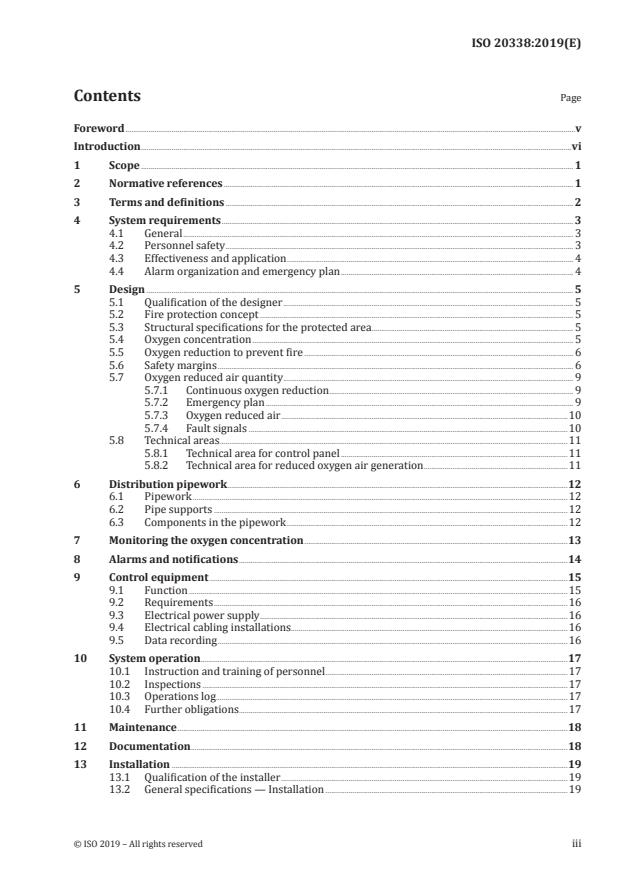
Contents Page
Foreword .v
Introduction .vi
1 Scope . 1
2 Normative references . 1
3 Terms and definitions . 2
4 System requirements . 3
4.1 General . 3
4.2 Personnel safety . 3
4.3 Effectiveness and application . 4
4.4 Alarm organization and emergency plan . 4
5 Design . 5
5.1 Qualification of the designer . 5
5.2 Fire protection concept . 5
5.3 Structural specifications for the protected area . 5
5.4 Oxygen concentration . 5
5.5 Oxygen reduction to prevent fire . 6
5.6 Safety margins . 6
5.7 Oxygen reduced air quantity . 9
5.7.1 Continuous oxygen reduction . 9
5.7.2 Emergency plan . 9
5.7.3 Oxygen reduced air .10
5.7.4 Fault signals .10
5.8 Technical areas .11
5.8.1 Technical area for control panel .11
5.8.2 Technical area for reduced oxygen air generation.11
6 Distribution pipework .12
6.1 Pipework .12
6.2 Pipe supports .12
6.3 Components in the pipework .12
7 Monitoring the oxygen concentration .13
8 Alarms and notifications .14
9 Control equipment .15
9.1 Function .15
9.2 Requirements .16
9.3 Electrical power supply .16
9.4 Electrical cabling installations.16
9.5 Data recording .16
10 System operation.17
10.1 Instruction and training of personnel .17
10.2 Inspections .17
10.3 Operations log.17
10.4 Further obligations .17
11 Maintenance .18
12 Documentation .18
13 Installation .19
13.1 Qualification of the installer .19
13.2 General specifications — Installation .19
Annex A (normative) Ignition thresholds for oxygen reduction using nitrogen-enriched air
in fire prevention .20
Bibliography .24
iv © ISO 2019 – All rights reserved
Foreword
ISO (the International Organization for Standardization) is a worldwide federation of national standards
bodies (ISO member bodies). The work of preparing International Standards is normally carried out
through ISO technical committees. Each member body interested in a subject for which a technical
committee has been established has the right to be represented on that committee. International
organizations, governmental and non-governmental, in liaison with ISO, also take part in the work.
ISO collaborates closely with the International Electrotechnical Commission (IEC) on all matters of
electrotechnical standardization.
The procedures used to develop this document and those intended for its further maintenance are
described in the ISO/IEC Directives, Part 1. In particular, the different approval criteria needed for the
different types of ISO documents should be noted. This document was drafted in accordance with the
editorial rules of the ISO/IEC Directives, Part 2 (see www .iso .org/directives).
Attention is drawn to the possibility that some of the elements of this document may be the subject of
patent rights. ISO shall not be held responsible for identifying any or all such patent rights. Details of
any patent rights identified during the development of the document will be in the Introduction and/or
on the ISO list of patent declarations received (see www .iso .org/patents).
Any trade name used in this document is information given for the convenience of users and does not
constitute an endorsement.
For an explanation of the voluntary nature of standards, the meaning of ISO specific terms and
expressions related to conformity assessment, as well as information about ISO's adherence to the
World Trade Organization (WTO) principles in the Technical Barriers to Trade (TBT) see www .iso
.org/iso/foreword .html.
This document was prepared by Technical Committee ISO/TC 21, Equipment for fire protection and fire
fighting, Subcommittee SC 8, Gaseous media and firefighting systems using gas.
Any feedback or questions on this document should be directed to the user’s national standards body. A
complete listing of these bodies can be found at www .iso .org/members .html.
Introduction
Oxygen reduction systems are designed to prevent fires from starting or spreading, by means of
the introduction of oxygen reduced air and creating an atmosphere in an area which is having lower
permanent oxygen concentration in respect to ambient conditions. Oxygen reduction systems are
not designed to extinguish fires. The design and installation are based on detailed knowledge of the
protected area, its occupancy and the materials in question. It is important to suit the fire protection
measures to the hazard as a whole.
vi © ISO 2019 – All rights reserved
INTERNATIONAL STANDARD ISO 20338:2019(E)
Oxygen reduction systems for fire prevention — Design,
installation, planning and maintenance
1 Scope
This document specifies minimum requirements and defines the specifications governing the
design, installation and maintenance of fixed oxygen reduction systems with oxygen reduced air
for fire prevention in buildings and industrial production plants. It also applies to the extension and
modification of existing systems.
This document applies to oxygen reduction systems using nitrogen-enriched-air which are designed for
continual oxygen reduction in enclosed spaces.
NOTE Nitrogen is, today, the most suitable gas to be used for oxygen reduction. For other gases, this
document can be used as a reference.
This document does not apply to:
— oxygen reduction systems that use water mist or combustion gases;
— explosion suppression systems;
— explosion prevention systems, in case of chemicals or materials containing their own supply of oxygen,
such as cellulose nitrate;
— fire extinguishing systems using gaseous extinguishing agents;
— inertization of portable containers;
— systems in which oxygen levels are reduced for reasons other than fire prevention (e.g. steel
processing in the presence of inert gas to avoid the formation of oxide film);
— inerting required during repair work on systems or equipment (e.g. welding) in order to eliminate
the risk of fire or explosion.
In addition to the conditions for the actual oxygen reduction system and its individual components, this
document also covers certain structural specifications for the protected area.
The space protected by an oxygen reduction system is a controlled and continuously monitored indoor
climate for extended occupation. This document does not cover unventilated confined spaces that can
contain hazardous gases.
2 Normative references
The following documents are referred to in the text in such a way that some or all of their content
constitutes requirements of this document. For dated references, only the edition cited applies. For
undated references, the latest edition of the referenced document (including any amendments) applies.
ISO 7240 (all parts), Fire detection and alarm systems
EN 12094-1, Fixed firefighting systems — Components for gas extinguishing systems — Part 1:
Requirements and test methods for electrical automatic control and delay devices
EN 50104, Electrical apparatus for the detection and measurement of oxygen — Performance requirements
and test methods
3 Terms and definitions
For the purposes of this document, the following terms and definitions apply.
ISO and IEC maintain terminological databases for use in standardization at the following addresses:
— IEC Electropedia: available at http: //www .electropedia .org/
— ISO Online browsing platform: available at https: //www .iso .org/obp
3.1
alarm threshold
value of a process parameter which, when reached, triggers an alarm and, where necessary, initiates
automatic protection measures
3.2
design concentration
oxygen concentration level determined by subtraction of the safety margin from the ignition threshold
Note 1 to entry: See also Figure 1 and Table 2.
Note 2 to entry: The design concentration represents the maximum oxygen concentration which shall not be
exceeded at any time.
3.3
combustible material
material capable of combustion or being ignited
Note 1 to entry: For the purposes of this document, whether the quantity of a combustible material is to be regarded
as significant or not should be determined by means of a risk analysis as part of the fire protection design.
3.4
ignition threshold
maximum oxygen concentration in a mixture of a combustible material with air and inert gas, in which
there can be no ignition, determined under established test conditions
Note 1 to entry: This is a specific characteristic of combustible material and inert gas (see A.1).
3.5
detection and alarm installation
remote detection system for the reliable detection of risk to people and property
3.6
measuring zones
virtual separation of the protected volume for oxygen measuring
3.7
normal operation
situation in which the equipment, protection systems and components are able to carry out their
designated functions within their design parameters
3.8
oxygen reduced air
air with an oxygen concentration lower than that in normal atmospheric conditions
3.9
oxygen reduced air supply
nitrogen enriched air stream with an oxygen concentration lower than that in normal atmospheric
conditions, ready to be introduced into a protected volume
2 © ISO 2019 – All rights reserved
3.10
protected volume
space to be protected by oxygen reduction system
Note 1 to entry: Protected volume is measured in cubic meters.
3.11
system
combination of components whose function and compatibility guarantees the safety of the installation
3.12
technical area
area where the control panel, the nitrogen-enriched-air production unit and/or other relevant system
components are placed
3.13
control panel
electrical device for monitoring, controlling and operating the alarm and other functions of the oxygen
reduction system
4 System requirements
4.1 General
An oxygen reduction system shall consist at its minimum of:
a) a supply of oxygen reduced air;
b) a fixed pipework system with fittings, valves, nozzles, outlets;
c) oxygen sensors and control panel;
d) alarms.
Oxygen reduced air is produced by air separation or by injecting inert gas or gas mixture into the
protected area.
The oxygen concentration in the protected area shall be monitored by means of measuring equipment.
During operation, the supply of nitrogen-enriched air shall be controlled automatically according to
demand. Where necessary, as a result of a risk analysis, additional means shall be provided to operate
the supply manually or an additional supply operated manually or automatically.
The oxygen reduction system can be equipped with automatic equipment designed to shut down
machinery and to close fire doors and other equipment, with the aim of creating and maintaining the
required oxygen concentration.
The level of oxygen reduction is defined by the individual risks of these areas (see Annex A).
Individual components should comply with the relevant technical standards, if they exist.
Alternatively, for electrical/electronic/programmable electronic safety related systems,
IEC 61508 (all parts) should be used.
4.2 Personnel safety
Oxygen reduced air can be dangerous for personnel within protected volumes, technical areas housing
the oxygen reduction systems and adjacent areas.
Requirements for unventilated confined spaces do not necessarily apply to space protected by oxygen
reduction systems that control and continuously monitor indoor climate for extended occupation.
Personnel safety measures shall be made for the fact that neighbouring volumes can have a reduced
oxygen concentration. These areas may also need to be monitored and/or personnel safety measures
may need to be taken.
Technical or organizational measures shall be taken to prevent unauthorized people from entering
protected areas with permanently reduced oxygen levels.
The measurement system shall be designed in such a way that a loss of function or a measurement
error can in no event lead to the minimum oxygen threshold not being detected.
The spreading of the oxygen-reduced atmosphere to other areas not intended for this (e.g. through wall
openings, cable ducts, floor drainages, leaking doors, conveyor belts) shall be prevented.
4.3 Effectiveness and application
A fire risk assessment detailing the key fire protection factors shall be undertaken. The assessment
should take into account:
— the type and quantity of material/materials requiring protection;
— the area(s) requiring protection;
— the right dimension of the oxygen reduced air supply to maintain the reduced oxygen concentration
on its design value;
— a back-up oxygen reduced air supply, if provided;
— alarm equipment.
Oxygen reduction systems provide preventive fire protection. The introduction of nitrogen-enriched-
air reduces the oxygen concentration of the air, thereby preventing the ignition or spread of fire except
for the following:
— chemicals containing their own supply of oxygen (e.g. cellulose nitrate);
— mixtures containing oxidizing materials (e.g. sodium chlorate or sodium nitrate);
— chemicals capable of undergoing autothermal decomposition (e.g. some organic peroxides);
— reactive metals (e.g. sodium, potassium, magnesium, titanium and zirconium), reactive hydrides or
metal amides, some of which may react violently.
NOTE While oxygen reduction systems cannot prevent ignition of the fuels listed above, they can prevent
the spread of fire to other fuels which can offer protection to surrounding infrastructure (e.g. the building
structure).
4.4 Alarm organization and emergency plan
An alarm organization is required for the following purposes:
— to alert affected and responsible persons;
— to alert the permanently attended location;
— to initiate other necessary protective measures.
The responsibilities for the alarm organization shall be defined.
The emergency plan should cover key words to designate the basic measures that need to be taken in
case of emergency, too low oxygen levels or fire signal.
4 © ISO 2019 – All rights reserved
5 Design
5.1 Qualification of the designer
The designer shall be sufficiently technically qualified to ensure effective protection.
5.2 Fire protection concept
The system design shall be part of the fire safety concept of the building.
As part of the system design, a fire risk assessment may lead to further fire protection measures.
EXAMPLE Since the oxygen reduction system cannot prevent or detect smouldering or pyrolizing processes
(e.g. overheated cables), suitable smoke detection systems for the protected volume (e.g. highly sensitive smoke
detection systems according to ISO 7240-20 class A) are installable as part of the main fire alarm system of the
facility.
Where special circumstances deviate from what is covered in this document (e.g. spatial configuration,
structure, installations, combustible materials, altitude different from sea level, temperature different
from normal, fumes or gases, requiring special measures) the designer shall take these into account.
5.3 Structural specifications for the protected area
Structural partitions shall comply with the criteria governing the protection target, as shown in Table 1.
Building regulation specifications are unaffected by these measures.
Table 1 — Structural partitions
Protected
Level Protection target Specification Achieved by
volume
Enclosing elements (walls, floor and
The contents of a room
a
roof) shall be sufficiently air tight
1 shall be protected from Room —
over the life time to protect from
internal fires.
internal fires.
Enclosing elements (walls, floor
The contents of a room shall The construction of
and roof) shall be sufficiently air
be protected from internal fire compartments
a
2 Room tight over the lifetime and provide
fires and from fires spread- according to the rele-
protection against the spread of fire
ing from an external source. vant guidelines.
from the surrounding area.
a
Openings shall be constantly sealed or sealable; otherwise, the openings shall be reflected in the calculation of the
nitrogen-enriched-air production.
The user should be aware of the relationship between leakage, reduced oxygen air supply and the
system duty cycle.
In the case of oxygen reduction systems, all operational openings that are not included in the calculation
of the required levels of oxygen shall be provided with closing mechanisms or monitored via limit
switches. These operational openings include emergency exit doors and other doors, gates, etc.
5.4 Oxygen concentration
The following information should be used (where relevant) to determine the design concentration:
— combustible material present (in normal operation and in the case of maintenance work or faults);
— geometry of the combustible materials (e.g. hollow items, thin walls);
— volume of gas contained in combustible materials (e.g. hollow parts, densely packed storage items);
— temperatures and pressures in the protected area;
— safety margin between oxygen concentrations established experimentally and the oxygen
concentrations required for the design of the oxygen reduction system.
5.5 Oxygen reduction to prevent fire
NOTE 1 Ignition can only be prevented in protected areas if the oxygen concentration within the protected
area does not exceed the design concentration. If this level is exceeded, the protection objective of "fire
prevention" can no longer be guaranteed.
If different combustible materials are present in the protected area, the lowest ignition threshold (i.e.
the most ignitable material in its most ignitable geometry) shall be taken as the basis for determining
the design concentration. In individual cases, additional tests can be carried out to establish ignition
thresholds for combustible materials in the forms and geometry in which the materials are actually
present.
Testing shall be conducted according to Annex A.
NOTE 2 Authorities having jurisdiction can include requirements beyond this document.
The following are examples where the test described in A.2 may not be appropriate when the protected
volume contains:
— high voltage electrical equipment;
— toilet paper;
— clothing in bales;
— stored goods which may allow a large amount of oxygen to enter the warehouse.
In no case shall the oxygen concentration be higher than specified in Annex A.
Ignition thresholds for oxygen reduction using nitrogen-enriched-air for various applications are given
in A.1. Values obtained with mixtures of other gas components can differ from these figures. These
concentrations are determined under the specific test conditions described in A.2.
Concentrations other than those shown in Table A.1 can be achieved and allowed when the test is
validated by test reports in accordance with A.2. Materials not listed in Table A.1 should be tested
in accordance with the test in A.2 and validated by test reports. The design of oxygen reduction
systems shall take into account the ignition levels and the safety margins described in 5.6. This design
concentration shall not be exceeded anywhere in the protected area. In case of any fault arising, action
shall be taken according to the emergency plan (see 5.7.2).
WARNING — Where stored goods may allow a large amount of oxygen to enter the warehouse, the
test structure and the test described in A.2 may not be sufficient. In such cases, an appropriate
design concentration is the subject of agreement with the authority having jurisdiction. Such
cases may include, for example, warehouses containing toilet paper or clothing in bales.
5.6 Safety margins
The safety margin for oxygen reduction systems shall be set at 0,75 % oxygen by volume.
The difference between the design concentration and the warning threshold, or warning threshold
and operating range, is established according to the combustible materials, operation and fault related
fluctuations in time and place of the inert gas concentration, the time needed for protection measures
and emergency action to take effect, and the tolerance of the oxygen monitoring facilities.
Definitions of concentration margins shown in Table 2 are as follows:
— Oxygen sensor tolerance: This margin covers the technical measuring errors.
6 © ISO 2019 – All rights reserved
— Operating margin 1 (warning): this margin takes into account the operational fluctuations in time
and place of the oxygen concentration to avoid false warnings, related to the warning threshold for
maximum oxygen concentration (see Clause 4).
— Operating margin 2 (pre-warning): this margin takes into account the delay before protective
measures take effect and alarm delays of the measuring device monitoring the oxygen concentration.
Operating margin 2 is dependent on the system configuration, the emergency concept and the
expected hold time.
— Working range high: this margin ensures a sufficient cycle time for the operation of the oxygen
reduced air supply.
— Working range low: this margin ensures a sufficient cycle time for the operation of the oxygen
reduced air supply.
— Operating margin 3 (pre-alarm): this margin takes into account the delay before protective measures
take effect and alarm delays of the device monitoring the oxygen concentration. Operation margin 3
is dependent on the system configuration and the emergency concept.
— Pre-alarm threshold for minimum oxygen concentration Operating margin 4 (alarm): this margin
determines the alarm value for the minimum oxygen concentration to avoid false alarms.
Key
X time Y O concentration
1 design values a Safety margin.
2 ignition threshold b Oxygen sensor tolerance.
3 maximum O concentration c Design operation range.
4 minimum O concentration d Oxygen sensor tolerance.
5 value for risk management e Altitude correction.
6 alarm and warning levels f Oxygen reduced air supply ON.
7 O max warning g Oxygen reduced air supply OFF.
8 O max pre-warning (see NOTE 1)
9 O min pre-alarm (see NOTE 1)
10 O min alarm
NOTE 1 Keys 8 and 9 are optional as it is only required if distribution valves are not monitored (see 5.7.3).
Figure 1 — Control diagram for oxygen reduction
Table 2 provides an example for the calculation of the oxygen concentration with different design values
at an altitude of 300 m.
Table 2 — Example for the calculation of the oxygen concentration
Design values Margin O concentration Remarks
Vol.-% Vol.-%
Ignition threshold 16,0
Safety margin −0,75
Design concentration 15,25
Oxygen sensor tolerance −0,2
Maximum O concentration 15,05 O max warning
2 2
Operating margin 1 (warning) −0,2
8 © ISO 2019 – All rights reserved
Table 2 (continued)
Design values Margin O concentration Remarks
Vol.-% Vol.-%
Pre-warning O concentration 14,85 O max pre warning
2 2
(optional)
Operating margin 2 (pre-warning) −0,2 (optional)
Oxygen reduced air supply ON 14,65
Working range high −0,2
Target value 14,45
Working range low −0,2
Oxygen reduced air supply OFF 14,25
Operating margin 3 (pre-alarm) −0,2 (optional)
Pre-alarm O concentration 14,05 O min pre alarm
2 2
(optional)
Operating margin 4 (alarm) −0,2
Minimum O concentration 13,85 O min alarm
2 2
Oxygen sensor tolerance −0,2
Altitude correction None Altitude 300 m
(less than 700 m)
Value for risk management 13,65
5.7 Oxygen reduced air quantity
5.7.1 Continuous oxygen reduction
When determining the oxygen reduced air flow required for continuous oxygen reduction, the following
factors shall be taken into account:
— the target value;
— the leak rate under normal operating conditions (including door openings, air locks and sluices and
frequency of the operation of those openings per day);
— the concentration of the oxygen reduced air;
— the period of operation.
To determine the necessary capacity for the protected volume (under normal operating conditions), an
additional 25 % shall be added to the calculated flow rate.
The basis for determining the leak rate of the protected volume can be, for example, a Door Fan
Test according to ISO 14520-1, or a test for determination of local mean ages of air in buildings for
characterizing ventilation conditions according to ISO 16000-8. In addition, air leakage due to normal
operation (e.g. through airlock entrances) shall be taken into account.
5.7.2 Emergency plan
An emergency plan that describes the progress of the oxygen concentration in the event of a failure of
the oxygen-reduced air shall be formulated. If there is a risk that after activation of the O max warnings
the design concentration is reached and a danger situation in the protected area cannot be ruled out,
contingency measures shall be taken. Contingency measures can be either technical or organizational
measures.
The emergency plan shall be discussed with all those responsible for fire protection and, where
applicable, personnel safety.
5.7.3 Oxygen reduced air
The oxygen reduced air system shall be able to deliver reliable supplies of the required quantity and
quality of gas for maximum specified demand periods (e.g. more frequent access to such areas, higher
rate of movements of goods in and out of a warehouse, wind load). All associated protected areas and
their requirements according to 5.7.1 shall also be taken into account.
The system and, if applicable, the reserve supply of oxygen reduced air shall be monitored, see also
Clause 7. Measures to be taken in the event of a fault shall be detailed in the emergency plan.
NOTE The reliability can be achieved for example by:
— monitoring the operating position of the manual stop valves located in the gas flow;
— monitoring the function of the oxygen reduced air production system and/or supply;
— monitoring the oxygen reduced air flow by means of flow monitors.
The oxygen reduced air shall be free of dangerous impurities and have a maximum volumetric
concentration of oxygen 2,3 %Vol. below the target value.
5.7.3.1 System using containers
If the oxygen-reduced air is stored in containers, the reliable quantity of oxygen reduced, air shall be
available for the required demand.
A fault alarm shall be issued as soon as this quantity is no longer sufficient to maintain the design
concentration for the period required for refill.
5.7.3.2 System using vaporizer
The necessary oxygen-reduced air shall be available at all times and if it is a stand-alone system, no
other uses shall be allowed for the vaporizer and the supply. If it is a back-up system, additional uses for
the supply can be allowed.
The oxygen-reduced air supply shall be monitored for faults. Should there be a problem with the oxygen-
reduced air supply, a fault alarm shall be displayed on the control panel.
5.7.3.3 System using oxygen-reduced air production equipment
The necessary oxygen-reduced air production equipment shall be available at all times and shall be
dedicated only to fire prevention purposes.
If back-up solutions (e.g. liquid nitrogen) are used, they shall assure at all times the necessary availability
of oxygen reduced air.
The oxygen reduced air production equipment shall be monitored for faults.
5.7.4 Fault signals
All relevant deviations from the normal operation of the oxygen reduced air system shall trigger a fault
signal on the control panel. These include:
— failure of the oxygen reduced air supply;
— measured oxygen concentration in the protected volume out of design operating range;
— the possible misalignment of section valves from their operating positions, or as an alternative the
oxygen concentration in the protected zone could be used. In this case, a pre-warning and pre-alarm
level shall be implemented;
10 © ISO 2019 – All rights reserved
— abnormal operating range of the generator (e.g. by low or too high pressure, concentration below
10 % of the normal operating range, high temperatures);
— short-circuit or open-circuit of all operation and alarm lines;
— failure of any oxygen sensor;
— breakdown of power supply.
5.8 Technical areas
5.8.1 Technical area for control panel
The control panel should be located in a designated area, which is not subject to major fire risk, and
should not be set up in the protected volume itself. If the control panel is located inside the protected
volume, a display for the actual oxygen concentration shall be visible from outside close to the entrance
of the protected volume and it shall be possible to switch off the oxygen reduced air supply from the
outside.
The location of the control panel shall comply with the following minimum requirements:
— be easily accessible;
— be protected against unauthorized access;
— maintain a minimum temperature range between 0 °C and +50 °C or specified by the manufacturer;
— be designed such that maintenance work and inspections can be carried out easily;
— have electrical lighting.
The operating instructions shall always be displayed in a prominent position.
5.8.2 Technical area for reduced oxygen air generation
The technical area for reduced oxygen air generation shall:
— have ventilation or in the case of closed volumes, the technical area should be equipped with an
oxygen sensor;
— be easily accessible;
— be protected against unauthorized access;
— maintain a minimum temperature range between 0 °C and +35 °C or specified by the manufacturer;
— be designed such that maintenance work and inspections can be carried out easily;
— have electrical lighting.
Components installed in the technical area shall be protected against excessively high temperatures
caused by exposure to the sun or other heat sources.
The technical area shall be separated from neighbouring volumes such that any components of
the oxygen reduction system located in that space are protected against mechanical and chemical
influences.
The following information about the oxygen reduction system shall be provided by the installer:
— name of the installer (where applicable the name of the maintenance company);
— year of installation or of any significant changes;
— operating and maintenance instructions and other important information;
— pipework and control diagrams;
— floor plans showing the protected areas.
6 Distribution pipework
6.1 Pipework
Pipework, pipe connections and integral moulded parts and components shall be able to withstand the
relevant working pressures, environmental aspects, fluids, gases and temperatures for their expected
lifetime. The rated pressure shall be no less than the maximum anticipated system pressure. In case of
possible closed pipe sections, the maximum anticipated system pressure is the maximum compressor
outlet pressure.
Only non-combustible materials may be used outside the protected area. Within the areas protected
by oxygen reduction systems, plastic pipes may also be used, although brittle plastics or plastics liable
to brittleness are not allowed. Pipes shall be located to avoid mechanical damage or protected against
mechanical damage where this is not possible. Flexible pipes and hoses, etc. may only be used where
rigid pipework is unsuitable.
The pipework shall be suitable for installation in the prevailing environmental conditions (e.g.
corrosion-resistant).
All pipework shall be accessible and clearly marked for identification.
In case of metallic pipework, the pipe network shall have equipotential bonding.
6.2 Pipe supports
All supports shall be able to withstand the relevant static and dynamic loads.
Supports may not be used for other purposes. The supports shall be fixed close to pipe connections.
6.3 Components in the pipework
Fittings, valves and shut-off devices shall comply with the relevant standards. All fittings shall be
accessible. Valves shall be secured at least against unintentional obstruction or misalignment of the
operating position. This can be done for example by removing the control lever. If there is a risk of
unauthorized access to a valve with manual operation option, the relevant valves shall be monitored by
fitting limit switches or other proper oxygen sensors on their operational positions. The inlets (e.g. nozzles
or outlet holes) shall be arranged such that the required homogenous oxygen-reduced air concentration
is established and the difference in the oxygen level should not differ more than 0,5 Vol % within the
protected volume, not considering direct influence of openings and inlets up to a distance of 1 m.
This needs to include consideration of known leakage areas and their position.
To achieve even distribution, at least one nozzle or outlet hole per 150 m should be installed. For
volumes higher than 10 m, an additional level of nozzles/outlet holes should be installed.
Alternatively, the oxygen reduced air flow can be applied directly into a Heating/Ventilation/Air
Conditioning system (HVAC). This makes it possible to support the homogenous distribution of the
oxygen reduced air.
In case a HVAC is used to distribute oxygen-reduced air, it shall be assured that the HVAC continues to
operate (e.g. energy backup, redundant air condition, monitoring).
WARNING — Permissible operating excess pressures shall be maintained in the compartment
air system.
12 © ISO 2019 – All rights reserved
The pressure and volume rate/production rate of the oxygen reduced air supply shall be taken into
account in this process.
Temperature and pressure fluctuations shall be taken into account.
7 Monitoring the oxygen concentration
In an oxygen reduction system, the monitoring process is carried out by directly measuring the oxygen
concentration. The measurement shall always be taken by at least three independent oxygen sensors
per protected volume (see Table 3) and at least one oxygen sensor per measurement zone.
Table 3 — Minimum amount of measuring zones
Volume in m
Minimum amount of meas- Minimum amount of
uring zones oxygen sensors
from to
>0 500 1 3
>500 4 000 4 4
>4 000 10 000 6 6
>10 000 25 000 8 8
>25 000 50 000 10 10
>50 000 100 000 12 12
>100 000 200 000 14 14
>200 000 300 000 16 16
>300 000 400 000 18 18
>400 000 Case by case evaluation Case by case evaluation
The measuring zones shall be evenly distributed through the perimeter of the volume (height and area).
Every protected volume with a separate inlet shall be considered as an individual volume. Closed false
floors and ceiling voids with less than 10 % opening are also considered as individual volumes. In
addition to Table 3, the location, number and type of measuring zon
...
Questions, Comments and Discussion
Ask us and Technical Secretary will try to provide an answer. You can facilitate discussion about the standard in here.
Loading comments...