


ISO 4210-9:2023
(Main)Cycles — Safety requirements for bicycles — Part 9: Saddles and seat-post test methods
Cycles — Safety requirements for bicycles — Part 9: Saddles and seat-post test methods
This document specifies saddle and seat-post test methods for ISO 4210‑2.
Cycles — Exigences de sécurité pour les bicyclettes — Partie 9: Méthodes d'essai des selles et des tiges de selles
Le présent document spécifie les méthodes d'essai de la selle et de la tige de selle pour l'ISO 4210-2.
General Information
- Status
- Published
- Publication Date
- 10-Jan-2023
- Technical Committee
- ISO/TC 149/SC 1 - Cycles and major sub-assemblies
- Current Stage
- 6060 - International Standard published
- Start Date
- 11-Jan-2023
- Due Date
- 12-Sep-2022
- Completion Date
- 11-Jan-2023
Relations
- Effective Date
- 09-Feb-2026
- Effective Date
- 12-Feb-2026
- Effective Date
- 23-Apr-2020
Overview
ISO 4210-9:2023 - Cycles: Saddles and seat-post test methods specifies laboratory test methods for saddles and seat-posts used to demonstrate compliance with ISO 4210‑2 (requirements for city, trekking, young adult, mountain and racing bicycles). Published as the second edition in 2023, this part of the ISO 4210 series focuses on strength, durability and safety test procedures for saddle assemblies and seat-posts rather than component standardization.
Key topics and technical requirements
- Scope and setup: Tests are performed with the seat-post inserted to the minimum insertion depth (per ISO 4210‑2) and clamped at the manufacturer’s recommended torque. Many tests require the seat-post axis set at 73° to the horizontal.
- Saddle/seat-post security test: Vertical and lateral loads are applied 25 mm from the saddle front/rear to produce maximum clamp torque. Typical forces: 650 N vertical and 250 N horizontal (varies by bicycle type).
- Saddle static strength: 400 N applied under the saddle nose and rear for 1 min in specified positions; symmetric loading if required by saddle design.
- Composite saddle rail static test: 1 200 N applied at 50 mm from the rear using a cylindrical load head (300 mm × 80 mm); rubber padding permitted if unpadded.
- Saddle + seat-post fatigue: Repeated vertically downward force of 1 000 N for 200 000 cycles using a 300 mm × 80 mm pad to avoid local damage.
- Seat-post fatigue and static tests:
- Fatigue stage: dynamic vertical loading for 100 000 cycles with forces typically 1 000–1 200 N, depending on bicycle type and whether the post is dropper/suspension.
- Static stage (composite posts only): higher static forces (typically 1 500–2 000 N per Table 3) held for 1 minute with displacement monitoring.
- Suspension seat-post static test: tensile force 400 N for 1 min.
- Test fixtures and padding: Specific pad sizes and rigid-mount geometry are defined to avoid localized damage and ensure repeatable results.
Practical applications and users
ISO 4210-9:2023 is intended for:
- Bicycle manufacturers and OEMs validating saddle and seat-post designs
- Component suppliers (saddles, rails, composite posts) for product development and QA
- Test laboratories conducting conformity and durability testing
- Certification bodies and compliance engineers demonstrating safety against ISO 4210‑2 requirements
- Design and safety engineers assessing failure modes (fatigue, static strength, clamp security)
Using these standardized test methods improves product safety, supports market access, and reduces warranty risk.
Related standards
- ISO 4210-2:2023 - Requirements for specific bicycle types (normative reference)
- ISO 4210-1 - Vocabulary
- ISO 4210-3 - Common test methods
Keywords: ISO 4210-9:2023, saddle test methods, seat-post fatigue test, bicycle safety standards, saddle static strength, composite saddle rail test.
ISO 4210-9:2023 - Cycles — Safety requirements for bicycles — Part 9: Saddles and seat-post test methods Released:11. 01. 2023
ISO 4210-9:2023 - Cycles — Exigences de sécurité pour les bicyclettes — Partie 9: Méthodes d'essai des selles et des tiges de selles Released:8/25/2023
Get Certified
Connect with accredited certification bodies for this standard

TÜV Rheinland
TÜV Rheinland is a leading international provider of technical services.

TÜV SÜD
TÜV SÜD is a trusted partner of choice for safety, security and sustainability solutions.

AIAG (Automotive Industry Action Group)
American automotive industry standards and training.
Sponsored listings
Frequently Asked Questions
ISO 4210-9:2023 is a standard published by the International Organization for Standardization (ISO). Its full title is "Cycles — Safety requirements for bicycles — Part 9: Saddles and seat-post test methods". This standard covers: This document specifies saddle and seat-post test methods for ISO 4210‑2.
This document specifies saddle and seat-post test methods for ISO 4210‑2.
ISO 4210-9:2023 is classified under the following ICS (International Classification for Standards) categories: 43.150 - Cycles. The ICS classification helps identify the subject area and facilitates finding related standards.
ISO 4210-9:2023 has the following relationships with other standards: It is inter standard links to EN ISO 4210-2:2023, EN ISO 4210-9:2023, ISO 4210-9:2014. Understanding these relationships helps ensure you are using the most current and applicable version of the standard.
ISO 4210-9:2023 is available in PDF format for immediate download after purchase. The document can be added to your cart and obtained through the secure checkout process. Digital delivery ensures instant access to the complete standard document.
Standards Content (Sample)
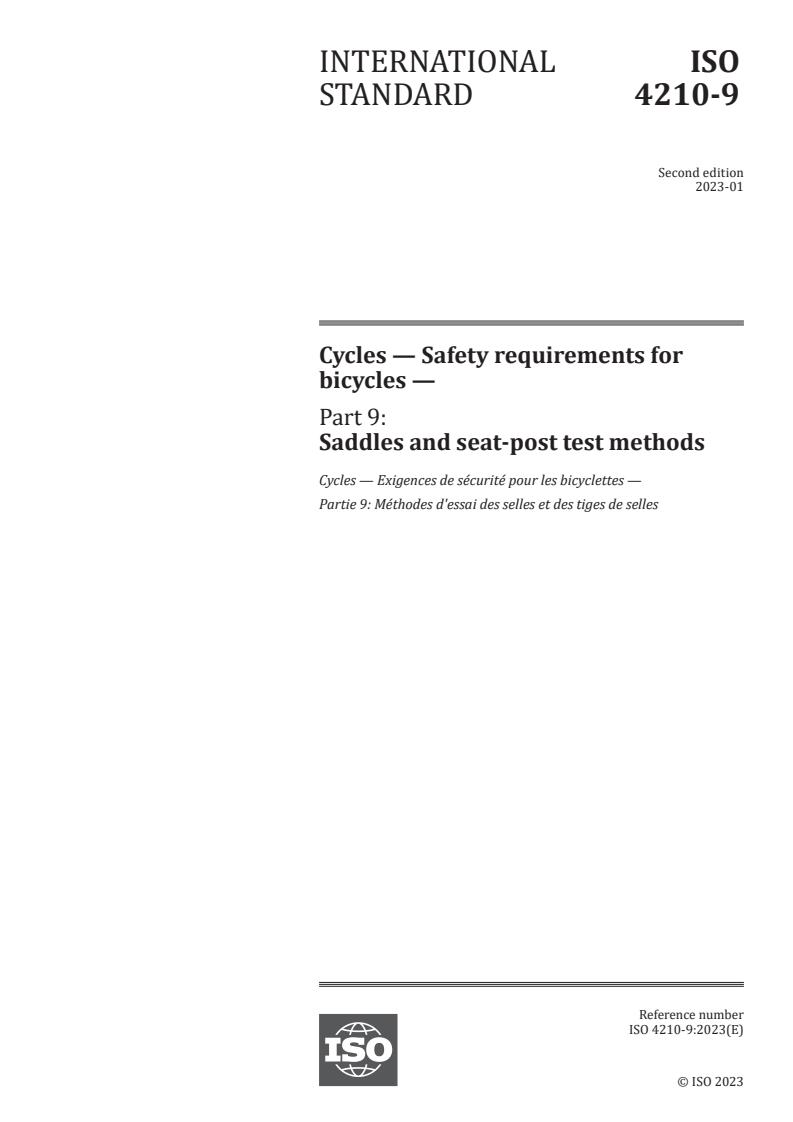
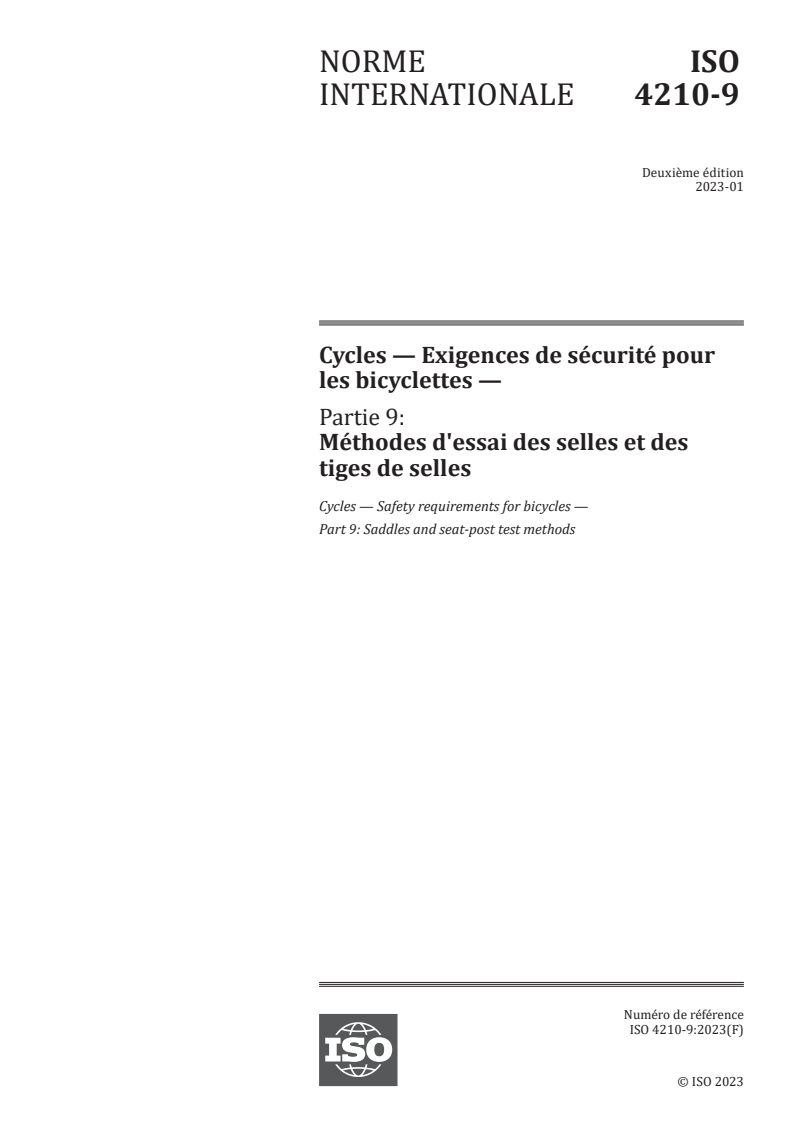
INTERNATIONAL ISO
STANDARD 4210-9
Second edition
2023-01
Cycles — Safety requirements for
bicycles —
Part 9:
Saddles and seat-post test methods
Cycles — Exigences de sécurité pour les bicyclettes —
Partie 9: Méthodes d'essai des selles et des tiges de selles
Reference number
© ISO 2023
All rights reserved. Unless otherwise specified, or required in the context of its implementation, no part of this publication may
be reproduced or utilized otherwise in any form or by any means, electronic or mechanical, including photocopying, or posting on
the internet or an intranet, without prior written permission. Permission can be requested from either ISO at the address below
or ISO’s member body in the country of the requester.
ISO copyright office
CP 401 • Ch. de Blandonnet 8
CH-1214 Vernier, Geneva
Phone: +41 22 749 01 11
Email: copyright@iso.org
Website: www.iso.org
Published in Switzerland
ii
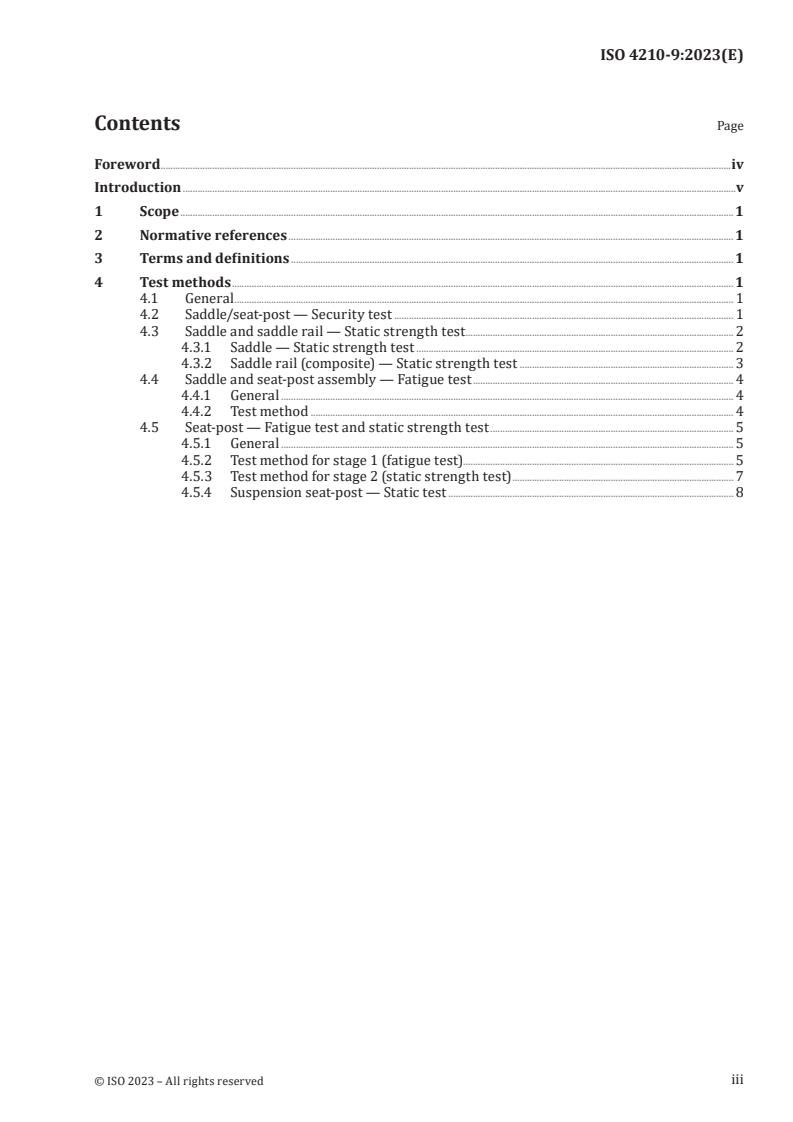
Contents Page
Foreword .iv
Introduction .v
1 Scope . 1
2 Normative references . 1
3 Terms and definitions . 1
4 Test methods . 1
4.1 General . 1
4.2 Saddle/seat-post — Security test . 1
4.3 Saddle and saddle rail — Static strength test . 2
4.3.1 Saddle — Static strength test . 2
4.3.2 Saddle rail (composite) — Static strength test . 3
4.4 Saddle and seat-post assembly — Fatigue test . 4
4.4.1 General . 4
4.4.2 Test method . 4
4.5 Seat-post — Fatigue test and static strength test . 5
4.5.1 General . 5
4.5.2 Test method for stage 1 (fatigue test). 5
4.5.3 Test method for stage 2 (static strength test) . 7
4.5.4 Suspension seat-post — Static test . 8
iii
Foreword
ISO (the International Organization for Standardization) is a worldwide federation of national standards
bodies (ISO member bodies). The work of preparing International Standards is normally carried out
through ISO technical committees. Each member body interested in a subject for which a technical
committee has been established has the right to be represented on that committee. International
organizations, governmental and non-governmental, in liaison with ISO, also take part in the work.
ISO collaborates closely with the International Electrotechnical Commission (IEC) on all matters of
electrotechnical standardization.
The procedures used to develop this document and those intended for its further maintenance are
described in the ISO/IEC Directives, Part 1. In particular, the different approval criteria needed for the
different types of ISO documents should be noted. This document was drafted in accordance with the
editorial rules of the ISO/IEC Directives, Part 2 (see www.iso.org/directives).
Attention is drawn to the possibility that some of the elements of this document may be the subject of
patent rights. ISO shall not be held responsible for identifying any or all such patent rights. Details of
any patent rights identified during the development of the document will be in the Introduction and/or
on the ISO list of patent declarations received (see www.iso.org/patents).
Any trade name used in this document is information given for the convenience of users and does not
constitute an endorsement.
For an explanation of the voluntary nature of standards, the meaning of ISO specific terms and
expressions related to conformity assessment, as well as information about ISO's adherence to
the World Trade Organization (WTO) principles in the Technical Barriers to Trade (TBT), see
www.iso.org/iso/foreword.html.
This document was prepared by Technical Committee ISO/TC 149, Cycles, Subcommittee SC 1, Cycles
and major sub-assemblies, in collaboration with the European Committee for Standardization (CEN)
Technical Committee CEN/TC 333, Cycles, in accordance with the Agreement on technical cooperation
between ISO and CEN (Vienna Agreement).
This second edition cancels and replaces the first edition (ISO 4210-9:2014), which has been technically
revised.
The main changes are as follows:
— improvement of 4.3.1;
— addition of 4.3.2;
— improvement of 4.4;
— addition of test condition for dropper/suspension dropper seat-post in 4.5;
— 4.5.3 has been changed to be only applicable if the seat-post is known to be constructed from
composite materials;
— addition of 4.5.4.
A list of all parts in the ISO 4210 series can be found on the ISO website.
Any feedback or questions on this document should be directed to the user’s national standards body. A
complete listing of these bodies can be found at www.iso.org/members.html.
iv
Introduction
This document has been developed in response to demand throughout the world, and the aim has been
to ensure that bicycles manufactured in conformity with this document will be as safe as is practically
possible. The tests have been designed to ensure the strength and durability of individual parts as well
as of the bicycle as a whole, demanding high quality throughout, and consideration of safety aspects
from the design stage onwards.
The scope has been limited to safety considerations and has specifically avoided standardization of
components.
If the bicycle should be used on public roads, national regulations apply.
v
INTERNATIONAL STANDARD ISO 4210-9:2023(E)
Cycles — Safety requirements for bicycles —
Part 9:
Saddles and seat-post test methods
1 Scope
This document specifies saddle and seat-post test methods for ISO 4210-2.
2 Normative references
The following documents are referred to in the text in such a way that some or all of their content
constitutes requirements of this document. For dated references, only the edition cited applies. For
undated references, the latest edition of the referenced document (including any amendments) applies.
ISO 4210-1, Cycles — Safety requirements for bicycles — Part 1: Vocabulary
ISO 4210-2:2023, Cycles — Safety requirements for bicycles — Part 2: Requirements for city and trekking,
young adult, mountain and racing bicycles
ISO 4210-3:2023, Cycles — Safety requirements for bicycles — Part 3: Common test methods
3 Terms and definitions
For the purposes of this document, the terms and definitions given in ISO 4210-1 apply.
ISO and IEC maintain terminological databases for use in standardization at the following addresses:
— ISO Online browsing platform: available at https:// www .iso .org/ obp
— IEC Electropedia: available at https:// www .electropedia .org/
4 Test methods
4.1 General
If a suspension seat-post is involved, the test may be conducted with the suspension system either free
to operate or locked. If it is locked, the pillar shall b
...
NORME ISO
INTERNATIONALE 4210-9
Deuxième édition
2023-01
Cycles — Exigences de sécurité pour
les bicyclettes —
Partie 9:
Méthodes d'essai des selles et des
tiges de selles
Cycles — Safety requirements for bicycles —
Part 9: Saddles and seat-post test methods
Numéro de référence
DOCUMENT PROTÉGÉ PAR COPYRIGHT
© ISO 2023
Tous droits réservés. Sauf prescription différente ou nécessité dans le contexte de sa mise en œuvre, aucune partie de cette
publication ne peut être reproduite ni utilisée sous quelque forme que ce soit et par aucun procédé, électronique ou mécanique,
y compris la photocopie, ou la diffusion sur l’internet ou sur un intranet, sans autorisation écrite préalable. Une autorisation peut
être demandée à l’ISO à l’adresse ci-après ou au comité membre de l’ISO dans le pays du demandeur.
ISO copyright office
Case postale 401 • Ch. de Blandonnet 8
CH-1214 Vernier, Genève
Tél.: +41 22 749 01 11
E-mail: copyright@iso.org
Web: www.iso.org
Publié en Suisse
ii
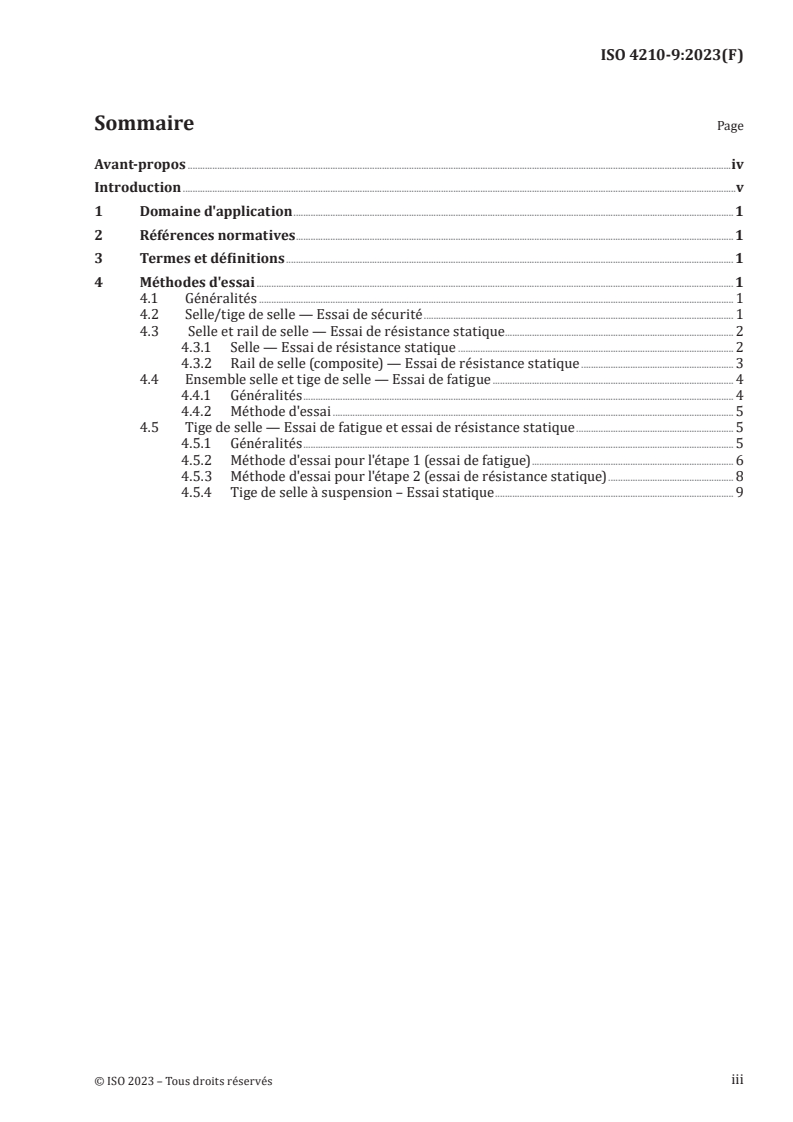
Sommaire Page
Avant-propos .iv
Introduction .v
1 Domaine d'application .1
2 Références normatives .1
3 Termes et définitions . 1
4 Méthodes d'essai . 1
4.1 Généralités . 1
4.2 Selle/tige de selle — Essai de sécurité . 1
4.3 Selle et rail de selle — Essai de résistance statique . 2
4.3.1 Selle — Essai de résistance statique . 2
4.3.2 Rail de selle (composite) — Essai de résistance statique . 3
4.4 Ensemble selle et tige de selle — Essai de fatigue . 4
4.4.1 Généralités . 4
4.4.2 Méthode d'essai . 5
4.5 Tige de selle — Essai de fatigue et essai de résistance statique . 5
4.5.1 Généralités . 5
4.5.2 Méthode d'essai pour l'étape 1 (essai de fatigue) . 6
4.5.3 Méthode d'essai pour l'étape 2 (essai de résistance statique) . 8
4.5.4 Tige de selle à suspension – Essai statique . 9
iii
Avant-propos
L'ISO (Organisation internationale de normalisation) est une fédération mondiale d'organismes
nationaux de normalisation (comités membres de l'ISO). L'élaboration des Normes internationales est
en général confiée aux comités techniques de l'ISO. Chaque comité membre intéressé par une étude
a le droit de faire partie du comité technique créé à cet effet. Les organisations internationales,
gouvernementales et non gouvernementales, en liaison avec l'ISO participent également aux travaux.
L'ISO collabore étroitement avec la Commission électrotechnique internationale (IEC) en ce qui
concerne la normalisation électrotechnique.
Les procédures utilisées pour élaborer le présent document et celles destinées à sa mise à jour sont
décrites dans les Directives ISO/IEC, Partie 1. Il convient, en particulier de prendre note des différents
critères d'approbation requis pour les différents types de documents ISO. Le présent document
a été rédigé conformément aux règles de rédaction données dans les Directives ISO/IEC, Partie 2
(voir www.iso.org/directives).
L'attention est appelée sur le fait que certains des éléments du présent document peuvent faire l'objet de
droits de propriété intellectuelle ou de droits analogues. L'ISO ne saurait être tenue pour responsable
de ne pas avoir identifié de tels droits de propriété et averti de leur existence. Les détails concernant
les références aux droits de propriété intellectuelle ou autres droits analogues identifiés lors de
l'élaboration du document sont indiqués dans l'Introduction et/ou dans la liste des déclarations de
brevets reçues par l'ISO (voir www.iso.org/brevets).
Les appellations commerciales éventuellement mentionnées dans le présent document sont données
pour information, par souci de commodité, à l’intention des utilisateurs et ne sauraient constituer un
engagement.
Pour une explication de la nature volontaire des normes, la signification des termes et expressions
spécifiques de l'ISO liés à l'évaluation de la conformité, ou pour toute information au sujet de l'adhésion
de l'ISO aux principes de l’Organisation mondiale du commerce (OMC) concernant les obstacles
techniques au commerce (OTC), voir www.iso.org/avant-propos.
Le présent document a été élaboré par le comité technique ISO/TC 149, Cycles, sous-comité SC 1, Cycles et
ses principaux sous-ensembles, en collaboration avec le comité technique CEN/TC 333, Cycles, du Comité
européen de normalisation (CEN), conformément à l’accord de coopération technique entre l’ISO et le
CEN (Accord de Vienne).
Cette deuxième édition annule et remplace la première édition (ISO 4210-9:2014), qui a fait l'objet d'une
révision technique.
Les principales modifications sont les suivantes:
— amélioration de 4.3.1;
— ajout de 4.3.2;
— amélioration de 4.4;
— ajout d'une condition d'essai pour les tiges de selle à suspension réglable en 4.5;
— 4.5.3 a été modifié pour n'être seulement applicable que si la tige de siège est construite en matériaux
composites;
— ajout de 4.5.4.
Une liste de toutes les parties de la série ISO 4210 est disponible sur le site web de l'ISO.
Il convient que l’utilisateur adresse tout retour d’information ou toute question concernant le présent
document à l’organisme national de normalisation de son pays. Une liste exhaustive desdits organismes
se trouve à l’adresse www.iso.org/fr/members.html.
iv
Introduction
Le présent document a été élaboré pour répondre à une demande présente dans le monde entier, et son
objectif est de garantir que les bicyclettes fabriquées en conformité avec celui-ci seront aussi sûres que
possible. Les essais ont été conçus pour assurer la résistance et la durabilité des différents composants
et de la bicyclette dans son ensemble, en exigeant une qualité élevée à tous les niveaux et en prenant en
compte les aspects de sécurité dès la phase de conception.
Le domaine d’application a été restreint aux questions de sécurité et a spécifiquement évité la
normalisation des composants.
Si la bicyclette est utilisée sur la voie publique, les réglementations nationales s'appliquent.
v
NORME INTERNATIONALE ISO 4210-9:2023(F)
Cycles — Exigences de sécurité pour les bicyclettes —
Partie 9:
Méthodes d'essai des selles et des tiges de selles
1 Domaine d'application
Le présent document spécifie les méthodes d'essai de la selle et de la tige de selle pour l'ISO 4210-2.
2 Références normatives
Les documents ci-après, dans leur intégralité ou non, sont des références normatives indispensables à
l’application du présent document. Pour les références datées, seule l’édition citée s’applique. Pour les
références non datées, la dernière édition du document de référence s’applique (y compris les éventuels
amendements).
ISO 4210-1, Cycles — Exigences de sécurité pour les bicyclettes — Partie 1: Vocabulaire
ISO 4210-2:2023, Cycles — Exigences de sécurité pour les bicyclettes — Partie 2: Exigences pour bicyclettes
de ville et tout chemin (trekking), jeunes adultes, tout-terrain et de course
ISO 4210-3:2023, Cycles — Exigences de sécurité pour les bicyclettes — Partie 3: Méthodes d'essai
communes
3 Termes et définitions
Pour les besoins du présent document, les termes et définitions donnés dans l’ISO 4210-1 s'appliquent.
L’ISO et l’IEC tiennent à jour des bases de données terminologiques destinées à être utilisées en
normalisation, consultables aux adresses suivantes:
— ISO Online browsing platform: disponible à l’adresse https:// www .iso .org/ obp
— IEC Electropedia: disponible à l’adresse https:// www .electropedia .org/
4 Méthodes d'essai
4.1 Généralités
Si l'essai concerne une tige de selle à suspension, il peut être effectué avec le système de suspension soit
libre, soit bloqué. S'il est bloqué, la tige doit être réglée à sa longueur maximale.
4.2 Selle/tige de selle — Essai de sécurité
Avec la tige de selle correctement fixée au cadre de la bicyclette à la profondeur minimale d'insertion
telle que spécifiée dans l'ISO 4210-2:2023, 4.15.2, et les chariots de selle serrés au couple recommandé
par le fabricant de bicyclettes, appliquer une force F verticalement et vers le bas en un point situé à
25 mm de l'avant ou de l'arrière de la selle, selon ce qui produit le couple le plus important sur le chariot
de selle. La selle doit être positionnée dans les colliers de serrage de l
...
Questions, Comments and Discussion
Ask us and Technical Secretary will try to provide an answer. You can facilitate discussion about the standard in here.
Loading comments...