

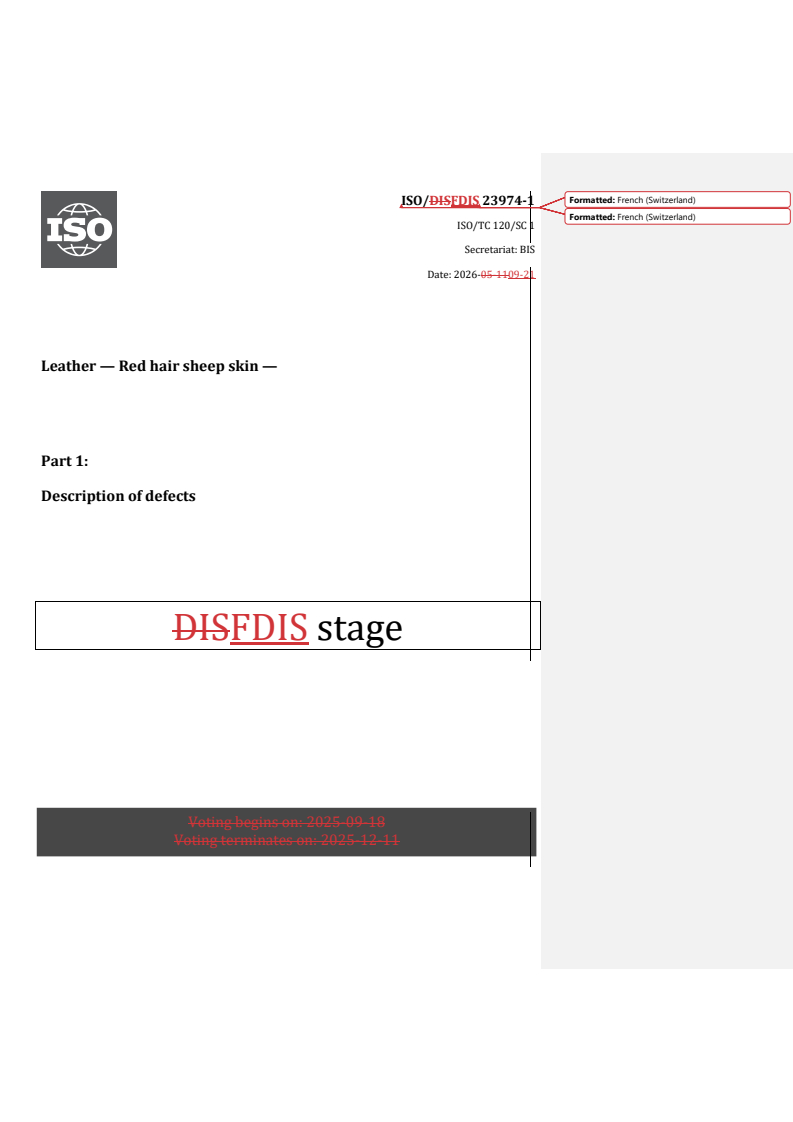
ISO/FDIS 23974-1
(Main)Leather — Red hair sheep skin — Part 1: Description of defects
- Abstract
This draft international standard describes the defects which may occur on raw red hair sheep skins. It is applicable to fresh and cured (air dried, wet salted or dry salted) red hair sheep skins.
- Status
- Not Published
- Technical Committee
- ISO/TC 120/SC 1 - Raw hides and skins, including pickled pelts
- Drafting Committee
- ISO/TC 120/SC 1 - Raw hides and skins, including pickled pelts
- Current Stage
- 5020 - FDIS ballot initiated: 2 months. Proof sent to secretariat
- Start Date
- 06-Oct-2026
- Completion Date
- 06-Oct-2026
Buy Documents
ISO/FDIS 23974-1 - Leather — Red hair sheep skin — Part 1: Description of defects
REDLINE ISO/FDIS 23974-1 - Leather — Red hair sheep skin — Part 1: Description of defects
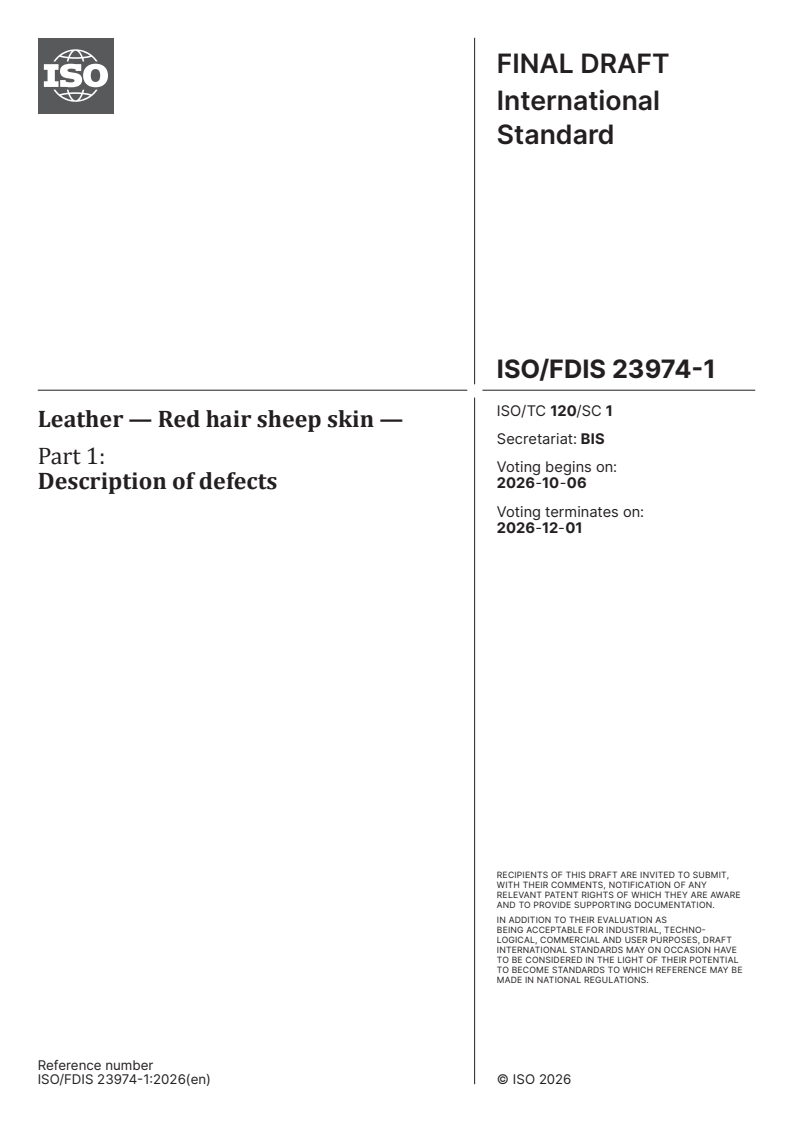
ISO/FDIS 23974-1 is an ISO draft international standard for red hair sheep skin. It specifies the defects that may occur on raw red hair sheep skins, including fresh and cured skins, so people handling, grading and buying these skins can describe condition in the same way.
What does ISO/FDIS 23974-1 specify?
ISO/FDIS 23974-1 specifies the defects that can occur on raw red hair sheep skins, and it applies to fresh and cured skins - air dried, wet salted or dry salted. The document is organized in four clauses: Scope, Normative references, Terms and definitions, and Defects.
Clause 4 groups the defect descriptions into three categories, which matters in practice because the cause of the defect often tells the reader when it arose and how to handle the skin.
- Clause 4.1 gives the overall classification:
- ante-mortem defects
- post-mortem defect
- preservation and storage defects
- Clause 4.2 covers defects linked to the live animal before slaughter, including disease, parasites and body damage.
- Clause 4.3 covers defects created during flaying and skinning.
- Clause 4.4 covers defects that develop during curing, drying and storage.
What are the key requirements of ISO/FDIS 23974-1?
ISO/FDIS 23974-1 is not a grading or acceptance standard. It is a defect-description standard, so the key technical value is a common language for recognizing where a defect comes from and how it shows up on the grain side or flesh side.
Ante-mortem defects
Clause 4.2 describes defects that arise before slaughter, such as abscess, fire-marks, grain damage, pox marks, thin skin, veininess and subcutaneous haemorrhage. In practice, these descriptions help inspectors separate animal-health or husbandry problems from damage caused later in processing.
Clause 4.2.2 covers defects caused by ectoparasites, including lice, sheep scab, ticks and bobble. The document links each one to visible signs such as wounds, bruises, pits, pin-prick marks, holes or stains, which is useful when sorting skins and assessing animal condition.
Post-mortem defect
Clause 4.3 describes defects caused during slaughter and removal of the skin. Butcher strain, deformation, flay cuts and nicking are all tied to flaying practice, knife use, trimming and handling.
This matters because these are preventable process defects. If they appear repeatedly, the reader can look at slaughterhouse technique, tooling and trimming practice rather than the animal itself.
Preservation and storage defects
Clause 4.4 covers defects that develop after the skin is removed. Putrefaction is linked to poor preservation, wetting, slow drying, improper piling and case hardening. In practice, this tells the reader to check curing method, drying rate and storage conditions.
Clause 4.4 also separates defects by preserved state:
- dry salted state defects caused by mineral salts and moisture
- raw dry state defects such as blood stains, case hardening, folding crack, glossiness, mildew, sticking and stain mark
- salted state defects such as red heat and salting defect
These descriptions matter because the same skin can show different problems depending on how it was preserved, dried or stored.
What terms does ISO/FDIS 23974-1 define?
ISO/FDIS 23974-1 does not provide a formal terms-and-definitions list, but it uses several key defect terms throughout Clause 4.
- Ante-mortem defects - defects that originate before slaughter, while the animal is still alive.
- Post-mortem defect - a defect caused during slaughter or skin removal.
- Preservation and storage defects - defects that develop during curing, drying or storage after removal.
- Putrefaction (Decay) - partial decomposition of the skin that can progress to rotting.
- Case hardening - rapid surface drying that prevents deeper layers from drying properly and can lead to internal decay.
- Red heat - red, pink or orange spots or patches on salted skins caused by halophilic bacteria.
- Flay cuts - cuts from a knife or skinning tool on the grain side or flesh side.
- Nicking - a score in the dermis that does not fully perforate the skin.
Who uses ISO/FDIS 23974-1?
ISO/FDIS 23974-1 is used by people who handle raw red hair sheep skins in the leather and raw hides and skins trade. Typical users include skin graders, buyers, processors, tanners, quality staff and slaughterhouse operators.
They use it to inspect incoming skins, describe visible defects consistently, trace problems back to animal condition, flaying practice or storage, and communicate condition during purchasing, grading and production.
What does the ISO/FDIS 23974-1 document contain?
ISO/FDIS 23974-1 contains short descriptions of named defects and the way they appear on red hair sheep skins. The text links many defects to their likely cause, such as disease, parasites, flaying damage, wetting, slow drying, poor salting or storage problems.
It also notes where the defect is seen - for example on the grain side, flesh side or both - which helps with inspection and sorting. The document uses Clause 4 to organize the defect list into categories so users can compare skins in a consistent way.
The content is practical and visual rather than procedural: it tells the reader what each defect is, how it shows up, and why it matters for skin quality and later processing.
Buy Documents
ISO/FDIS 23974-1 - Leather — Red hair sheep skin — Part 1: Description of defects
REDLINE ISO/FDIS 23974-1 - Leather — Red hair sheep skin — Part 1: Description of defects
Get Certified
Connect with accredited certification bodies for this standard

Control Union Certifications
Global certification for agriculture and sustainability.

Hohenstein Institut
Textile testing and certification.

Bureau Veritas Bangladesh
Bureau Veritas certification services in Bangladesh.
Sponsored listings
Frequently Asked Questions
ISO/FDIS 23974-1 is a draft published by the International Organization for Standardization (ISO). Its full title is "Leather — Red hair sheep skin — Part 1: Description of defects". This standard covers: This draft international standard describes the defects which may occur on raw red hair sheep skins. It is applicable to fresh and cured (air dried, wet salted or dry salted) red hair sheep skins.
This draft international standard describes the defects which may occur on raw red hair sheep skins. It is applicable to fresh and cured (air dried, wet salted or dry salted) red hair sheep skins.
ISO/FDIS 23974-1 is classified under the following ICS (International Classification for Standards) categories: 59.140.20 - Raw skins, hides and pelts. The ICS classification helps identify the subject area and facilitates finding related standards.
ISO/FDIS 23974-1 is available in PDF format for immediate download after purchase. The document can be added to your cart and obtained through the secure checkout process. Digital delivery ensures instant access to the complete standard document.
Standards Content (Sample)
FINAL DRAFT
International
Standard
ISO/TC 120/SC 1
Leather — Red hair sheep skin —
Secretariat: BIS
Part 1:
Voting begins on:
2026-10-06
Description of defects
Voting terminates on:
2026-12-01
RECIPIENTS OF THIS DRAFT ARE INVITED TO SUBMIT,
WITH THEIR COMMENTS, NOTIFICATION OF ANY
RELEVANT PATENT RIGHTS OF WHICH THEY ARE AWARE
AND TO PROVIDE SUPPOR TING DOCUMENTATION.
IN ADDITION TO THEIR EVALUATION AS
BEING ACCEPTABLE FOR INDUSTRIAL, TECHNO-
LOGICAL, COMMERCIAL AND USER PURPOSES, DRAFT
INTERNATIONAL STANDARDS MAY ON OCCASION HAVE
TO BE CONSIDERED IN THE LIGHT OF THEIR POTENTIAL
TO BECOME STAN DARDS TO WHICH REFERENCE MAY BE
MADE IN NATIONAL REGULATIONS.
Reference number
FINAL DRAFT
International
Standard
ISO/TC 120/SC 1
Leather — Red hair sheep skin —
Secretariat: BIS
Part 1:
Voting begins on:
Description of defects
Voting terminates on:
RECIPIENTS OF THIS DRAFT ARE INVITED TO SUBMIT,
WITH THEIR COMMENTS, NOTIFICATION OF ANY
RELEVANT PATENT RIGHTS OF WHICH THEY ARE AWARE
AND TO PROVIDE SUPPOR TING DOCUMENTATION.
© ISO 2026
IN ADDITION TO THEIR EVALUATION AS
All rights reserved. Unless otherwise specified, or required in the context of its implementation, no part of this publication may
BEING ACCEPTABLE FOR INDUSTRIAL, TECHNO-
LOGICAL, COMMERCIAL AND USER PURPOSES, DRAFT
be reproduced or utilized otherwise in any form or by any means, electronic or mechanical, including photocopying, or posting on
INTERNATIONAL STANDARDS MAY ON OCCASION HAVE
the internet or an intranet, without prior written permission. Permission can be requested from either ISO at the address below
TO BE CONSIDERED IN THE LIGHT OF THEIR POTENTIAL
or ISO’s member body in the country of the requester.
TO BECOME STAN DARDS TO WHICH REFERENCE MAY BE
MADE IN NATIONAL REGULATIONS.
ISO copyright office
CP 401 • Ch. de Blandonnet 8
CH-1214 Vernier, Geneva
Phone: +41 22 749 01 11
Email: copyright@iso.org
Website: www.iso.org
Published in Switzerland Reference number
ii
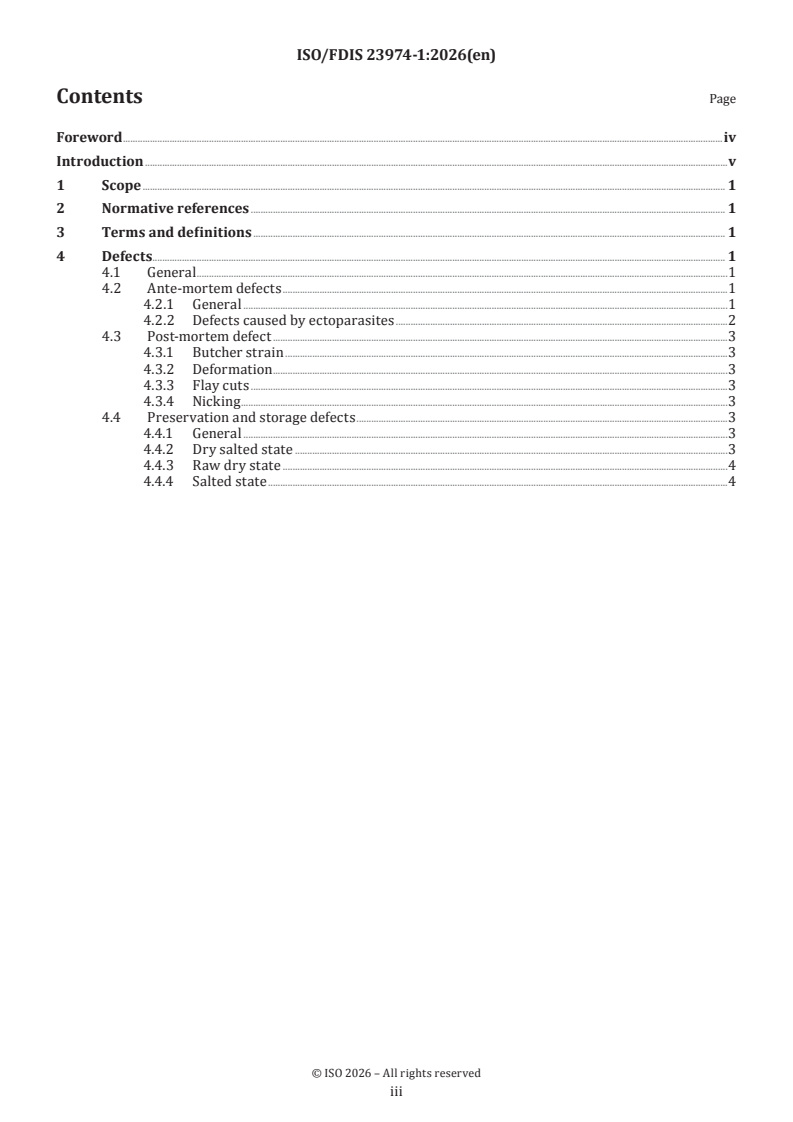
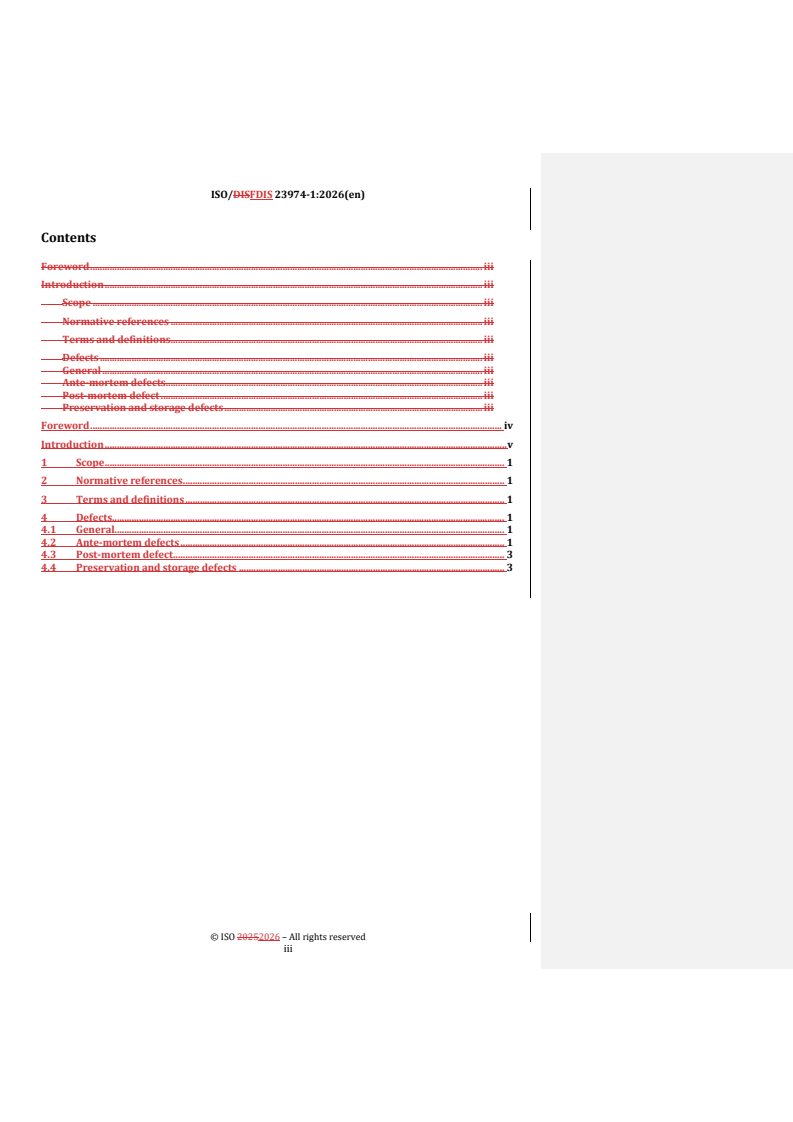
Contents Page
Foreword .iv
Introduction .v
1 Scope . 1
2 Normative references . 1
3 Terms and definitions . 1
4 Defects. 1
4.1 General .1
4.2 Ante-mortem defects .1
4.2.1 General .1
4.2.2 Defects caused by ectoparasites .2
4.3 Post-mortem defect .3
4.3.1 Butcher strain .3
4.3.2 Deformation .3
4.3.3 Flay cuts .3
4.3.4 Nicking .3
4.4 Preservation and storage defects .3
4.4.1 General .3
4.4.2 Dry salted state .3
4.4.3 Raw dry state .4
4.4.4 Salted state .4
iii
Foreword
ISO (the International Organization for Standardization) is a worldwide federation of national standards
bodies (ISO member bodies). The work of preparing International Standards is normally carried out through
ISO technical committees. Each member body interested in a subject for which a technical committee
has been established has the right to be represented on that committee. International organizations,
governmental and non-governmental, in liaison with ISO, also take part in the work. ISO collaborates closely
with the International Electrotechnical Commission (IEC) on all matters of electrotechnical standardization.
The procedures used to develop this document and those intended for its further maintenance are described
in the ISO/IEC Directives, Part 1. In particular, the different approval criteria needed for the different types
of ISO document should be noted. This document was drafted in accordance with the editorial rules of the
ISO/IEC Directives, Part 2 (see www.iso.org/directives).
ISO draws attention to the possibility that the implementation of this document may involve the use of (a)
patent(s). ISO takes no position concerning the evidence, validity or applicability of any claimed patent
rights in respect thereof. As of the date of publication of this document, ISO had not received notice of (a)
patent(s) which may be required to implement this document. However, implementers are cautioned that
this may not represent the latest information, which may be obtained from the patent database available at
www.iso.org/patents.ISO shall not be held responsible for identifying any or all such patent rights.
Any trade name used in this document is information given for the convenience of users and does not
constitute an endorsement.
For an explanation of the voluntary nature of standards, the meaning of ISO specific terms and expressions
related to conformity assessment, as well as information about ISO's adherence to the World Trade
Organization (WTO) principles in the Technical Barri
...
Formatted: French (Switzerland)
ISO/DISFDIS 23974-1
Formatted: French (Switzerland)
ISO/TC 120/SC 1
Secretariat: BIS
Date: 2026-05-1109-21
Leather — Red hair sheep skin —
Part 1:
Description of defects
DISFDIS stage
VVVVototototiiiinnnngggg b b b beeeeggggiiiinnnnssss on on on on:::: 2222000022225555----00009999----11118888
VVVVooootintintintingggg te te te termrmrmrmiiiinnnnaaaatetetetessss o o o onnnn:::: 2 2 2 2000022225555----11112222----11111111
ISO/DISFDIS 23974-1:2026(en)
All rights reserved. Unless otherwise specified, or required in the context of its implementation, no part of this publication
may be reproduced or utilized otherwise in any form or by any means, electronic or mechanical, including photocopying,
or posting on the internet or an intranet, without prior written permission. Permission can be requested from either ISO
at the address below or ISO’s member body in the country of the requester.
ISO copyright office
CP 401 • Ch. de Blandonnet 8
CH-1214 Vernier, Geneva
Phone: + 41 22 749 01 11
Formatted: French (Switzerland)
E-mail: copyright@iso.org
Website: www.iso.org
Published in Switzerland
ii
ISO/DISFDIS 23974-1:2026(en)
Contents
Foreword . iii
Introduction . iii
Scope . iii
Normative references . iii
Terms and definitions . iii
Defects . iii
General . iii
Ante-mortem defects . iii
Post-mortem defect . iii
Preservation and storage defects . iii
Foreword . iv
Introduction . v
1 Scope . 1
2 Normative references . 1
3 Terms and definitions . 1
4 Defects . 1
4.1 General. 1
4.2 Ante-mortem defects . 1
4.3 Post-mortem defect . 3
4.4 Preservation and storage defects . 3
iii
ISO/DISFDIS 23974-1:2026(en)
Foreword
ISO (the International Organization for Standardization) is a worldwide federation of national standards
bodies (ISO member bodies). The work of preparing International Standards is normally carried out through
ISO technical committees. Each member body interested in a subject for which a technical committee has been
established has the right to be represented on that committee. International organizations, governmental and
non-governmental, in liaison with ISO, also take part in the work. ISO collaborates closely with the
International Electrotechnical Commission (IEC) on all matters of electrotechnical standardization.
The procedures used to develop this document and those intended for its further maintenance are described
in the ISO/IEC Directives, Part 1. In particular, the different approval criteria needed for the different types of
ISO document should be noted. This document was drafted in accordance with the editorial rules of the
ISO/IEC Directives, Part 2 (see www.iso.org/directives).
ISO draws attention to the possibility that the implementation of this document may involve the use of (a)
patent(s). ISO takes no position concerning the evidence, validity or applicability of any claimed patent rights
in respect thereof. As of the date of publication of this document, ISO had not received notice of (a) patent(s)
which may be required to implement this document. However, implementers are cautioned that this may not
represent the latest information, which may be obtained from the patent database available at
www.iso.org/patents.ISO shall not be held responsible for identifying any or all such patent rights.
Any trade name used in this document is information given for the convenience of users and does not
constitute an endorsement.
For an explanation of the voluntary nature of standards, the meaning of ISO specific terms and expressions
related to conformity assessment, as well as information about ISO's adherence to the World Trade
Organization (WTO) principles in the Technical Barriers to Trade (TBT), see www.iso.org/iso/foreword.html.
This document was prepared by Technical Committee ISO/TC 120, Leather, Subcommittee SC 1, Raw hides and
skins, including pickled pelts.
A list of all parts in the ISO 23974 series can be found on the ISO website.
Any feedback or questions on this document should be directed to the user’s national standards body. A
complete listing of these bodies can be found at www.iso.org/members.html.
iv
ISO/DISFDIS 23974-1:2026(en)
Introduction
Red hair sheep are available in many regions of the world, in particular Asia and Africa. The skins of red hair
sheep have unique features and are used for specialized articles. The increasing demand for such skins
warrants the creation of a standard for the international community.
v
ISO/DISFDIS 23974-1:2026(en)
Leather — Red hair sheep skin —
Part 1:
Description of defects
1 Scope
This document specifies the defects which that can occur on raw red hair sheep skins. It is applicable to raw
and cured (air dried, wet salted or dry salted) red hair sheep skins.
2 Normative references
There are no normative references in this document.
3 Terms and definitions
No terms and definitions are listed in this document.
ISO and IEC maintain terminologicalterminology databases for use in standardization at the following
addresses:
— IEC Electropedia: available at http://www.electropedia.org/
— ISO Online browsing platform: available at http://www.iso.org/obp
4 Defects
4.1 General
The defects defined in this document are divided into three categories:
a) ante-mortem defects;
b) post-mortem defects;
c) preservation and storage defects.
4.2 Ante-mortem defects
4.2.1 General
...