

ISO 14813-1:2015
(Main)Intelligent transport systems — Reference model architecture(s) for the ITS sector — Part 1: ITS service domains, service groups and services
General Information
- Abstract
ISO 14813-1:2015 provides a description of the primary services that an ITS implementation can provide to ITS users. Those services with a common purpose can be collected together in "'ITS service domains'" and within these there can be a number of "'ITS service groups'" for particular parts of the domain. This part of ISO 14813 identifies thirteen service domains, within which numerous groups are then defined. In this version of ISO 14813-1:2015 an indication has been provided to show the relationship of each service to Cooperative-ITS. Cooperative-ITS provides services that have previously been unavailable, notably those for ITS users who are on the move. For many other services, Cooperative-ITS can actually be seen as a "delivery mechanism" that can be used to enhance their use and availability. Thus for some services, Cooperative-ITS is essential, whilst for others it adds value. However for a small number of services it is not relevant. ISO 14813-1:2015 is intended for use by at least two groups of people involved in the ITS sector. The first group is those looking for ideas about the services that ITS implementations can provide and the second is for those who are developing standards. For the first group, this part of ISO 14813 provides service descriptions that can act as the catalyst for more detailed descriptions. It is possible for the level of detail to differ from one ITS implementation to another, depending on whether or not a national ITS architecture is involved, and whether this architecture is based directly on services, or on groups of functions. For standards developers, this part of ISO 14813 is applicable to the working groups of ISO TC 204 and other Technical Committees who are developing standards for the ITS sector and associated sectors whose boundaries cross into the ITS sector (such as some aspects of public transport (transit), plus inter-modal freight and fleet management). This part of ISO 14813 is designed to provide information and explanation of services that can form the basis and reason for developing standards. ISO 14813-1:2015 is in itself, by its nature, advisory and informative. It is designed to assist the integration of services into a cohesive reference architecture, plus interoperability and the use of common data definitions. Specifically, services defined within the service groups shall be the basis for definition of 'use cases', 'user needs' or "user service requirements' depending on the methodology being used to develop the resultant ITS architecture functionality, along with definition of applicable data within data dictionaries, as well as applicable communications and data exchange standards.
- Status
- Withdrawn
- Publication Date
- 28-Sep-2015
- Technical Committee
- ISO/TC 204 - Intelligent transport systems
- Drafting Committee
- ISO/TC 204/WG 1 - Architecture
- Current Stage
- 9599 - Withdrawal of International Standard
- Start Date
- 02-Aug-2024
- Completion Date
- 29-Aug-2026

Overview
ISO 14813-1:2015 - Intelligent transport systems (ITS) - Reference model architecture(s) for the ITS sector - Part 1 defines the primary ITS service domains, service groups and services that an ITS implementation can provide. This second-edition standard catalogues a structured service taxonomy (13 service domains with their service groups and services) and explains how these services relate to Cooperative‑ITS (connected vehicles), reference architectures, and standards development. It is advisory and intended to support interoperability, common data definitions and coherent ITS architectures.
Key Topics
- ITS service taxonomy: identification of 13 service domains and associated service groups that form a common descriptive basis for ITS architectures.
- Cooperative‑ITS relationship: guidance on which services are enabled, enhanced or unaffected by Cooperative‑ITS; treating Cooperative‑ITS as a delivery mechanism for many services.
- Use-case and requirements input: services are intended to form the basis for use cases, user needs, or user service requirements depending on chosen architecture methodology.
- Data and interoperability: guidance on using services to define applicable data (data dictionaries, object identifiers), communications and data‑exchange standards.
- Reference architecture support: helps integrate services into cohesive ITS reference architectures and map existing national or regional architectures to a common model.
- Audience: aimed at ITS architects, standards developers and stakeholders in ISO TC 204, CEN TC 278 and related working groups.
Service Domains (annexes)
ISO 14813-1:2015 covers these domains (each detailed in an annex):
- Traveller Information
- Traffic Management and Operations
- Vehicle Services
- Freight Transport
- Public Transport
- Emergency Services
- Transport‑related Payment
- Road Transport Related Personal Safety
- Weather and Environmental Conditions Monitoring
- Disaster Response Management and Coordination
- National Security
- ITS Data Management
- Performance Management
Applications
- Developing or updating national/regional ITS architectures by selecting relevant service domains and groups.
- Creating use cases, user needs and functional requirements that feed ITS system design and procurement.
- Guiding standards development and mapping new standards to ITS service groups for consistency across regions.
- Designing interoperable solutions for traveler information, traffic management, tolling, fleet and freight management, emergency response, and connected‑vehicle services.
- Defining common data dictionaries, object identifiers and communications interfaces to improve cross‑vendor and cross‑agency interoperability.
Who Should Use It
- ITS architects and systems engineers
- Standards developers (ISO TC 204, CEN TC 278, national committees)
- Transport agencies, public transport operators, freight and fleet managers
- Vendors and software developers building ITS components
- Researchers and consultants working on ITS deployments
Related Standards
ISO 14813 is part of a series (Part 5: architecture description requirements; Part 6: ASN.1 data presentation) and is intended to be used alongside other TC 204/CEN standards for ITS data exchange, communications and system architecture.
Relations
- Effective Date
- 22-Oct-2022
- Effective Date
- 25-Sep-2010
Get Certified
Connect with accredited certification bodies for this standard

BSI Group
BSI (British Standards Institution) is the business standards company that helps organizations make excellence a habit.

Great Wall Tianjin Quality Assurance Center
Established 1993, first batch to receive national accreditation with IAF recognition.
Hong Kong Quality Assurance Agency (HKQAA)
Hong Kong's leading certification body.
Sponsored listings
Frequently Asked Questions
ISO 14813-1:2015 is a standard published by the International Organization for Standardization (ISO). Its full title is "Intelligent transport systems — Reference model architecture(s) for the ITS sector — Part 1: ITS service domains, service groups and services". This standard covers: ISO 14813-1:2015 provides a description of the primary services that an ITS implementation can provide to ITS users. Those services with a common purpose can be collected together in "'ITS service domains'" and within these there can be a number of "'ITS service groups'" for particular parts of the domain. This part of ISO 14813 identifies thirteen service domains, within which numerous groups are then defined. In this version of ISO 14813-1:2015 an indication has been provided to show the relationship of each service to Cooperative-ITS. Cooperative-ITS provides services that have previously been unavailable, notably those for ITS users who are on the move. For many other services, Cooperative-ITS can actually be seen as a "delivery mechanism" that can be used to enhance their use and availability. Thus for some services, Cooperative-ITS is essential, whilst for others it adds value. However for a small number of services it is not relevant. ISO 14813-1:2015 is intended for use by at least two groups of people involved in the ITS sector. The first group is those looking for ideas about the services that ITS implementations can provide and the second is for those who are developing standards. For the first group, this part of ISO 14813 provides service descriptions that can act as the catalyst for more detailed descriptions. It is possible for the level of detail to differ from one ITS implementation to another, depending on whether or not a national ITS architecture is involved, and whether this architecture is based directly on services, or on groups of functions. For standards developers, this part of ISO 14813 is applicable to the working groups of ISO TC 204 and other Technical Committees who are developing standards for the ITS sector and associated sectors whose boundaries cross into the ITS sector (such as some aspects of public transport (transit), plus inter-modal freight and fleet management). This part of ISO 14813 is designed to provide information and explanation of services that can form the basis and reason for developing standards. ISO 14813-1:2015 is in itself, by its nature, advisory and informative. It is designed to assist the integration of services into a cohesive reference architecture, plus interoperability and the use of common data definitions. Specifically, services defined within the service groups shall be the basis for definition of 'use cases', 'user needs' or "user service requirements' depending on the methodology being used to develop the resultant ITS architecture functionality, along with definition of applicable data within data dictionaries, as well as applicable communications and data exchange standards.
ISO 14813-1:2015 provides a description of the primary services that an ITS implementation can provide to ITS users. Those services with a common purpose can be collected together in "'ITS service domains'" and within these there can be a number of "'ITS service groups'" for particular parts of the domain. This part of ISO 14813 identifies thirteen service domains, within which numerous groups are then defined. In this version of ISO 14813-1:2015 an indication has been provided to show the relationship of each service to Cooperative-ITS. Cooperative-ITS provides services that have previously been unavailable, notably those for ITS users who are on the move. For many other services, Cooperative-ITS can actually be seen as a "delivery mechanism" that can be used to enhance their use and availability. Thus for some services, Cooperative-ITS is essential, whilst for others it adds value. However for a small number of services it is not relevant. ISO 14813-1:2015 is intended for use by at least two groups of people involved in the ITS sector. The first group is those looking for ideas about the services that ITS implementations can provide and the second is for those who are developing standards. For the first group, this part of ISO 14813 provides service descriptions that can act as the catalyst for more detailed descriptions. It is possible for the level of detail to differ from one ITS implementation to another, depending on whether or not a national ITS architecture is involved, and whether this architecture is based directly on services, or on groups of functions. For standards developers, this part of ISO 14813 is applicable to the working groups of ISO TC 204 and other Technical Committees who are developing standards for the ITS sector and associated sectors whose boundaries cross into the ITS sector (such as some aspects of public transport (transit), plus inter-modal freight and fleet management). This part of ISO 14813 is designed to provide information and explanation of services that can form the basis and reason for developing standards. ISO 14813-1:2015 is in itself, by its nature, advisory and informative. It is designed to assist the integration of services into a cohesive reference architecture, plus interoperability and the use of common data definitions. Specifically, services defined within the service groups shall be the basis for definition of 'use cases', 'user needs' or "user service requirements' depending on the methodology being used to develop the resultant ITS architecture functionality, along with definition of applicable data within data dictionaries, as well as applicable communications and data exchange standards.
ISO 14813-1:2015 is classified under the following ICS (International Classification for Standards) categories: 03.220.01 - Transport in general; 35.240.60 - IT applications in transport. The ICS classification helps identify the subject area and facilitates finding related standards.
ISO 14813-1:2015 has the following relationships with other standards: It is inter standard links to ISO 14813-1:2024, ISO 14813-1:2007. Understanding these relationships helps ensure you are using the most current and applicable version of the standard.
ISO 14813-1:2015 is available in PDF format for immediate download after purchase. The document can be added to your cart and obtained through the secure checkout process. Digital delivery ensures instant access to the complete standard document.
Standards Content (Sample)
INTERNATIONAL ISO
STANDARD 14813-1
Second edition
2015-10-01
Intelligent transport systems —
Reference model architecture(s) for
the ITS sector —
Part 1:
ITS service domains, service groups
and services
Systèmes intelligents de transport (ITS) — Architecture(s) de modèle
de référence pour le secteur ITS —
Partie 1: Domaines de service, groupes de service et services ITS
Reference number
©
ISO 2015
© ISO 2015, Published in Switzerland
All rights reserved. Unless otherwise specified, no part of this publication may be reproduced or utilized otherwise in any form
or by any means, electronic or mechanical, including photocopying, or posting on the internet or an intranet, without prior
written permission. Permission can be requested from either ISO at the address below or ISO’s member body in the country of
the requester.
ISO copyright office
Ch. de Blandonnet 8 • CP 401
CH-1214 Vernier, Geneva, Switzerland
Tel. +41 22 749 01 11
Fax +41 22 749 09 47
copyright@iso.org
www.iso.org
ii © ISO 2015 – All rights reserved
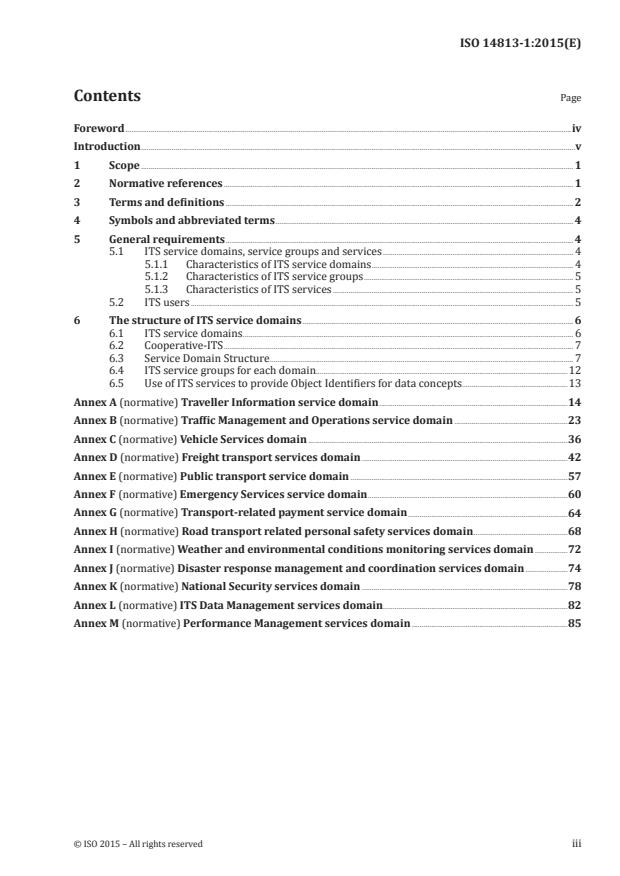
Contents Page
Foreword .iv
Introduction .v
1 Scope . 1
2 Normative references . 1
3 Terms and definitions . 2
4 Symbols and abbreviated terms . 4
5 General requirements . 4
5.1 ITS service domains, service groups and services . 4
5.1.1 Characteristics of ITS service domains . 4
5.1.2 Characteristics of ITS service groups . 5
5.1.3 Characteristics of ITS services . 5
5.2 ITS users . 5
6 The structure of ITS service domains . 6
6.1 ITS service domains . 6
6.2 Cooperative-ITS . 7
6.3 Service Domain Structure . 7
6.4 ITS service groups for each domain.12
6.5 Use of ITS services to provide Object Identifiers for data concepts.13
Annex A (normative) Traveller Information service domain .14
Annex B (normative) Traffic Management and Operations service domain .23
Annex C (normative) Vehicle Services domain .36
Annex D (normative) Freight transport services domain .42
Annex E (normative) Public transport service domain .57
Annex F (normative) Emergency Services service domain .60
Annex G (normative) Transport-related payment service domain .64
Annex H (normative) Road transport related personal safety services domain .68
Annex I (normative) Weather and environmental conditions monitoring services domain .72
Annex J (normative) Disaster response management and coordination services domain .74
Annex K (normative) National Security services domain .78
Annex L (normative) ITS Data Management services domain .82
Annex M (normative) Performance Management services domain .85
Foreword
ISO (the International Organization for Standardization) is a worldwide federation of national standards
bodies (ISO member bodies). The work of preparing International Standards is normally carried out
through ISO technical committees. Each member body interested in a subject for which a technical
committee has been established has the right to be represented on that committee. International
organizations, governmental and non-governmental, in liaison with ISO, also take part in the work.
ISO collaborates closely with the International Electrotechnical Commission (IEC) on all matters of
electrotechnical standardization.
The procedures used to develop this document and those intended for its further maintenance are
described in the ISO/IEC Directives, Part 1. In particular the different approval criteria needed for the
different types of ISO documents should be noted. This document was drafted in accordance with the
editorial rules of the ISO/IEC Directives, Part 2 (see www.iso.org/directives).
Attention is drawn to the possibility that some of the elements of this document may be the subject of
patent rights. ISO shall not be held responsible for identifying any or all such patent rights. Details of
any patent rights identified during the development of the document will be in the Introduction and/or
on the ISO list of patent declarations received (see www.iso.org/patents).
Any trade name used in this document is information given for the convenience of users and does not
constitute an endorsement.
For an explanation on the meaning of ISO specific terms and expressions related to conformity
assessment, as well as information about ISO’s adherence to the WTO principles in the Technical
Barriers to Trade (TBT) see the following URL: Foreword - Supplementary information
The committee responsible for this document is ISO/TC 204, Intelligent transport systems.
This second edition cancels and replaces the first edition (ISO 14813-1:2007), which has been
technically revised.
ISO 14813 consists of the following parts, under the general title Intelligent transport systems —
Reference model architecture(s) for the ITS sector:
— Part 1: ITS fundamental services
— Part 5: Requirements for architecture description in ITS standards
— Part 6: Data presentation in ASN.1
iv © ISO 2015 – All rights reserved
Introduction
Intelligent transport systems (ITS) service domains and groups reflect the evolution of technology-
oriented transportation practices and applications. So far this has been in the road transport domain,
but ITS is beginning to appear in the maritime and rail transport domains. This has become of
increasing importance and interest as the scope of ITS expands beyond its original range of services
in road traffic management, traveller information and electronic payment systems. ITS is now also
expected to address services in the following areas of the road transport domain:
— Transport network operations and maintenance activities;
— Freight mobility and inter-modal connectivity;
— Multi-modal travel including both pre-trip and on-trip information and journey planning where the
trip starts and/or finishes in the road transport domain;
— Variable road pricing strategies for freight and personal travel;
— Emergency and natural disaster-related response activities and coordination;
— National security needs related to transportation infrastructure;
— Cooperative-ITS – sometimes referred to as ‘connected vehicles’ or ‘connected vehicle/highway
systems’.
Services in some of the areas identified above also interface with more generalized activities and
environments outside the road transport domain. For example, it is possible for road pricing and revenue
systems activities to interface with electronic commerce, or eCommerce activities, and thus utilize
standards and principles associated with the banking industry along with generally accepted accounting
principles. The addressing of national security and coordination issues also requires addressing specific
national standards related to civil defence, emergency communications, and other procedures. These
interfaces, while largely outside the scope of TC 204, are nevertheless critical external influences on the
functionality of the various services supported by ‘ITS service domains and groups’.
The standards that have been developed within TC 204 must all be mapped to one or more of the ITS
domains, service groups and services described in this part of ISO 14813. Additionally, the development
of a standard international data dictionary and registry for ITS requires the ability to address both
current and emerging services that ITS can provide.
To this end, the ITS service domains, groups and services presented in this part of ISO 14813 serve
as a framework for developing ITS architectures and ITS-related concepts of operation, which in turn
lead to the definition of the appropriate requirements, functionality and standards necessary to deploy
specific ITS services. As the range of transportation activities that utilize ITS tools has broadened, the
original ‘fundamental services’ developed by TC 204 are now revised and expanded into ‘ITS service
domains and groups’.
Figure 1 illustrates the hierarchy of functional definitions, and how they might be used as the input to
ITS architectures. The Service Domains that apply to ITS are listed in 6.1 with each defining the nature
of the activities provided. Each of these Domains is then covered by separate annexes in this part of
ISO 14813, each of which includes the descriptions of its own Service Groups and Services. The Service
Groups describe more specific activities that are part of the Domain and the Services provide the more
detailed description of what is provided within each Service Group.
The way in which the descriptions of the services are used in ITS architectures depends on the
methodology that has been adopted for their creation. Thus the service descriptions can be used
to generate ‘use cases’ which are the input to an ITS architecture created using object orientated
methodology (see other parts of the ISO 14813 series), or ‘user needs’, which are the input to an ITS
architecture created using the process orientated methodology (see ISO/TR 26999).
Figure 1 — ITS services — Hierarchy of definitions for ‘ITS reference architecture’
In order to develop a cohesive reference architecture, and in order to establish the relationship and
interdependencies of the various ‘intelligent transport systems’ (ITS) services, it is beneficial to firstly
determine the underlying ITS services. Thus, the purpose of this part of ISO 14813 is to identify the ‘ITS
service groups’ and the domains within which the Service Groups reside, within the current perception
of the ITS sector.
‘ITS service domains and groups’ , while they build upon existing U.S., European Union, Japanese and
other international and national taxonomies, or classification systems, can also provide a common
descriptive basis for comparing these taxonomies, as well as others being developed throughout the world.
Currently there are many instantiations of ITS architecture in use around the world, with fragments
of ITS architectures being used as the basis for several International Standards. This part of ISO 14813
embraces architecture concepts from the following sources:
— Other ITS architecture activities from several parts of the world, including the US National ITS
Architecture and the European ITS Framework (FRAME) Architecture;
— Other ISO TC 204 and CEN TC278 working groups.
Most if not all ITS architectures that are in use around the world are based on either the US National ITS
Architecture or the European ITS Framework (FRAME) Architecture. Unfortunately, the terminology
used by these two ITS architectures is similar but not identical. The following table provides a high-
vi © ISO 2015 – All rights reserved
level comparison between some key terms used in these two ITS architectures that are relevant to this
part of ISO 14813.
ISO 14813-1 US Architecture FRAME Architecture
Actor Terminator Terminator/Actor
ITS Service Domain User Service Bundle ITS Service Group
ITS Service Group User Service ITS Service Topic
ITS Service User Service Requirement ITS Service
Note that in the FRAME Architecture, many of the terminators are classed as “generic”. This means that
they have several forms (called “actors”) for specific instances. An example of this is the terminator
“Driver”, which has specific instances that include actors such as drivers of private cars, plus drivers of
other vehicle types, e.g. public transport, freight and emergency.
By combining the results of the work that has been done to develop these two architectures the working
group has used the basic hypothesis that it is possible to define a set of ‘ITS service domains, groups
and services’ that can be used in a variety of combinations and configurations, to provide an outline
description of the different ITS architecture approaches.
Full documentation of all possible architectural approaches is not feasible given the high level of
resources required to carry this out. Indeed full documentation and description of all possible
approaches is undesirable as an item for standardisation. A defined and consistent approach is however
required to facilitate reuse and interoperability.
Users of this part of ISO 14813 should note that it is also possible to use a sub-set of the Services as the
starting point for the creation of an ITS architecture for a particular ITS implementation. It is possible
to add specific services that are peculiar to that implementation in order that the ITS architecture will
support all that the stakeholders would like ITS to provide.
A further important point to note is that it is assumed that the scope of the ITS sector always has a
definable boundary. Experience over the last 20 to 30 years has shown that this will change over time and
that it will be necessary for this International Standard to be revised again after five years, if not before.
INTERNATIONAL STANDARD ISO 14813-1:2015(E)
Intelligent transport systems — Reference model
architecture(s) for the ITS sector —
Part 1:
ITS service domains, service groups and services
1 Scope
This part of ISO 14813 provides a description of the primary services that an ITS implementation can
provide to ITS users. Those services with a common purpose can be collected together in “‘ITS service
domains’” and within these there can be a number of “‘ITS service groups’” for particular parts of the
domain. This part of ISO 14813 identifies thirteen service domains, within which numerous groups are
then defined.
In this version of this part of ISO 14813 an indication has been provided to show the relationship of each
service to Cooperative-ITS. Cooperative-ITS provides services that have previously been unavailable,
notably those for ITS users who are on the move. For many other services, Cooperative-ITS can actually
be seen as a “delivery mechanism” that can be used to enhance their use and availability. Thus for some
services, Cooperative-ITS is essential, whilst for others it adds value. However for a small number of
services it is not relevant.
This part of ISO 14813 is intended for use by at least two groups of people involved in the ITS sector.
The first group is those looking for ideas about the services that ITS implementations can provide and
the second is for those who are developing standards.
For the first group, this part of ISO 14813 provides service descriptions that can act as the catalyst for
more detailed descriptions. It is possible for the level of detail to differ from one ITS implementation
to another, depending on whether or not a national ITS architecture is involved, and whether this
architecture is based directly on services, or on groups of functions.
For standards developers, this part of ISO 14813 is applicable to the working groups of ISO TC 204 and
other Technical Committees who are developing standards for the ITS sector and associated sectors
whose boundaries cross into the ITS sector (such as some aspects of public transport (transit), plus
inter-modal freight and fleet management). This part of ISO 14813 is designed to provide information
and explanation of services that can form the basis and reason for developing standards.
This part of ISO 14813 is in itself, by its nature, advisory and informative. It is designed to assist the
integration of services into a cohesive reference architecture, plus interoperability and the use of
common data definitions. Specifically, services defined within the service groups shall be the basis
for definition of ‘use cases’, ‘user needs’ or “user service requirements’ depending on the methodology
being used to develop the resultant ITS architecture functionality, along with definition of applicable
data within data dictionaries, as well as applicable communications and data exchange standards.
2 Normative references
The following documents, in whole or in part, are normatively referenced in this document and are
indispensable for its application. For dated references, only the edition cited applies. For undated
references, the latest edition of the referenced document (including any amendments) applies.
ISO 14817-3, Intelligent transport systems — ITS central data registry and data dictionaries — Part 3:
Object identifier assignments for ITS data concepts
ISO/TR 17465-1:2014, Intelligent transport systems — Cooperative-ITS — Part 1: Terms and definitions
ISO 21217:2014, Intelligent transport systems — Communications access for land mobiles (CALM) —
Architecture
3 Terms and definitions
For the purposes of this document, the following terms and definitions apply.
3.1
actor
entity that fulfils a role
3.2
application
mechanism of delivering some or all parts of a service
3.3
cooperative-ITS
subset of overall ITS that communicates and shares information between ITS stations to give advice or
facilitate actions with the objective of improving safety, sustainability, efficiency and comfort beyond
the scope of stand-alone systems
Note 1 to entry: This definition also appears in ISO 21217:2014. It is sometimes referred to as ‘connected vehicles’
or ‘connected vehicle/highway systems’.
3.4
dangerous goods
substances or articles which are potentially hazardous (for example, poisonous to humans, harmful to
the environment, explosive, flammable or radioactive) that require regulatory control when transported
Note 1 to entry: This definition is taken from ISO/TR 15638-18.
3.5
dedicated transport network
transport mechanism that is able to carry people in special vehicles through a purpose built network,
which is usually separate from, but can be part of an existing road network
3.6
dispatch
action that requests specific resources to perform particular services
EXAMPLE The emergency communications centre dispatches an ambulance in response to an incident where
it is determined the victim must be taken to a hospital.
3.7
ITS service
functionality provided to users of intelligent transport systems designed to increase safety,
sustainability, efficiency, and/or comfort
Note 1 to entry: This definition also appears in ISO 21217:2014.
3.8
ITS service group
one or more similar or complementary ITS services provided to ITS users
3.9
ITS service domain
specific application area which comprises one or more ITS service groups
2 © ISO 2015 – All rights reserved
3.10
ITS stakeholders
individual or organisation having a right, share, claim or interest in a system or in its possession of
characteristics that meet their needs and expectations
Note 1 to entry: Their involvement can be through use, manufacture of products, provision of Services, or regulation.
3.11
ITS user
one who directly receives and can act on ITS data or control products
Note 1 to entry: An ITS user is one who receives, directly or indirectly, or provides to, the transaction of
an ITS service; these users of ITS services must be human, external systems, or another source of data, e.g.
detection equipment.
3.12
navigation
ITS service which provides directional information to an individual during a trip
3.13
mass
mass of a given heavy vehicle as measured by equipment affixed to the regulated vehicle
Note 1 to entry: This definition is taken from ISO/TS 15638-12.
3.14
paratransit
non-scheduled, non-fixed route public transport services for customers requiring special assistance
and access to specific destinations at a user-requested time
EXAMPLE Disabled or elderly persons.
3.15
probe data
vehicle sensor information that is processed, formatted, and transmitted to a land-based centre for
processing to create a good understanding of the driving environment
3.16
probe vehicle system /vehicle probe
system that comprises (1) vehicles which collect and transmit probe data and (2) land-based centres
which do probe processing
Note 1 to entry: Probe processing builds an accurate understanding of the overall roadway and driving
environment by fusing and analysing probe data sent from multiple vehicles and data from other data sources.
Note 2 to entry: This processed probe data can then be delivered back to vehicles to help them and their drivers
perform better, to public authorities to help them manage the transportation system, and to other users for a
variety of purposes.
3.17
route guidance
service which utilizes directional information, destination or real-time data to select an appropriate
route, either prior to or during a trip
3.18
transit
alternative term for public transport that is used in some countries and in some instances and is
expanded to “public transit”
3.19
telematics applications for regulated vehicles
provision of telematics services for regulated vehicles by an application service provider communicating
with a regulated (usually commercial) vehicle using ITS-station to ITS-station communications
4 Symbols and abbreviated terms
C-ITS Cooperative-ITS
EETS European Electronic Toll Service
EFC Electronic Fee Collection
HAZMAT Hazardous materials
IFMS Interoperable Fare Management Systems
ITS Intelligent transport systems
OBE On-board Equipment
PT public transport
RSE Roadside Equipment
TARV Telematics applications for regulated vehicles
TICS Transport information and control systems (old term for ITS)
UML Unified modelling language
5 General requirements
5.1 ITS service domains, service groups and services
5.1.1 Characteristics of ITS service domains
Regardless of any specific ITS implementation, ITS services and groups of services are usually combined
into different (although often interrelated) application areas. These application areas have as their
focus one or more groups of ITS users, such as travellers, road network operators, drivers (both of all
vehicles and of selected types), those who move freight. They are the highest level of abstraction in an
ITS architecture, and are called service domains.
ITS services do not represent the technology or the functionality that will be required by any of the one
or more ITS applications that are required to deliver them. In fact it is possible for the technology and
functionality used by the ITS applications to vary from one ITS implementations to another and for the
content of the ITS applications to vary because of the variances in the organisational structures used in
different geographical areas.
There is no proscribed relationship between ITS service domains and the areas of common functionality
that are included in different ITS architectures. Sometimes a relationship may appear to exist, but
this is often illusory and a reflection of the choice of names for the areas of common functionality.
For example, both the US National ITS Architecture and the European ITS Framework (FRAME)
Architecture include an area of functionality called “Manage Traffic”, which in both cases supports ITS
services other than those included in the “Traffic Management and Operations” ITS service domain
described in this part of ISO 14813.
4 © ISO 2015 – All rights reserved
5.1.2 Characteristics of ITS service groups
A service domain comprises one or more types of ITS service. It shall be possible for each type of
ITS service to comprise several instances of related services. These collations of related ITS service
instances are called “ITS service groups.” Therefore, an ITS service group consists of one or more
similar or complementary services that can be provided to ITS users.
There are several characteristics of ‘ITS service groups’ and services contained within:
a) Each ‘ITS service group’ is oriented to a specific activity related to management or information of
the road transport network that is divided into specific services that should address particular
users or modes.
b) The name of each service group should reflect the type of activities supported (e.g., “pre-trip
information”),
c) Each service within the service group should reference both the service group activity and the nature
of the users or modes supported by the service (e.g., “pre-trip information – public transport”)
d) Each level of the hierarchy should be at an equivalent level of granularity
5.1.3 Characteristics of ITS services
An ITS service consists of a product or activity that can be provided to a specific ITS user. Thus ITS
services shall be considered as the elemental building blocks of any ITS architecture/implementation.
The level of detail in this document is focused at the level of domains and service groups, and specific
services. It is noted that different countries partition their reference architectures in different ways –
some through more granular service or needs definition, others at a higher level of abstraction. However
in order to provide a level of consistency and to avoid ambiguities arising from different definitions of
services with the same name, high-level or outline definitions are provided for specific services. Despite
this, users are still able to add to or replace some of the specific services described in this document
in order to reflect particular location and/or jurisdictionally and/or societal requirements. Whenever
this is done the names of these new or replacement services must not conflict or replicate the names of
services used in this document.
The elaboration of specific ITS services must be undertaken in a consistent manner throughout
any specific architecture. There are several methodologies that assist the development of this
consistent elaboration.
ISO ITS architecture standards do not require the use of a specific methodology and it is possible to
use either Unified Modelling Language (UML – see ISO/TR 24529) or process orientated techniques
(see ISO 26999). The choice of methodology must be driven by factors such as the point in the ITS
implementation process at which the architecture is being developed and hence who is the target
audience for the architecture.
ISO 14813-5 provides guidance as to the requirements for architecture description in ITS standards
and ISO 17452 provides guidance and assistance for the use of UML in defining ITS interfaces.
5.2 ITS users
The general definition of the ITS user is that it represents a “partner”, i.e. one who receives an ITS
service through interaction with applications in the ITS implementation. ITS users have elsewhere been
described as one of the sets of “stakeholders” who are involved in ITS implementations. . By definition,
all human interaction with ITS implementations involves external actors interfacing with applications
across the boundary of the system.
NOTE Humans interacting with applications in an ITS implementation are sometimes called “external ITS
users.”
6 The structure of ITS service domains
6.1 ITS service domains
Categorisation of ITS activities is one of the first steps in defining the range of activities, some or all
of which can be supported by any ITS implementation. It serves to delineate different sectors of the
ITS industry.
The following lists and describes 13 ‘ITS service domains’. These are:
— Traveller Information – this domain addresses the provision of both static and dynamic information
about the road transport network to users prior to and during their trips, including inter-modal
options and transfers and the status of other transport modes.
— Traffic Management and Operations –this domain specifically addresses the management of the
movement of all types of vehicles, travellers and pedestrians throughout the road transport network,
and includes both automated monitoring and control activities as well as decision-making processes
(both automated and manual) that address real-time incidents and other disturbances on the
transportation network, as well as managing travel demand as needed to maintain overall mobility.
— Vehicle Services –this domain has as its focus the enhancement of safety, security and efficiency
in vehicle operations, by warnings and assistance to users or input to the operation of the vehicle.
These services use external information from on-board sensing devices, and/or from wireless
communications with other sources.
NOTE The lead on standardization for the on-board issues will be agreed between TC204 and TC22.
— Freight Transport – this service domain addresses the management of the operation of commercial
vehicle fleets and the movement of freight, including activities that expedite the authorization
process for freight to move across national and jurisdictional boundaries, activities that expedite
inter-modal transfers of freight and the operation of freight vehicles that use telematics applications
to enhance their operation and management.
— Public Transport – this service domain addresses the management of public transport (transit)
to enable them to provide services that operate more timely and efficiently and the provision of
operational information to the operator and user, including multimodal aspects.
— Emergency Service – the services in this domain are delivered in response to incidents that are
categorized as emergencies and permit emergency services to be more quickly initiated and
expedited throughout the transportation network.
— Transport-related Payment – this domain addresses activities that permit revenues for transportation
services and facilities to be collected either electronically through non-cash and non-stop payment,
or using mechanisms that require vehicles to stop.
— Road transport related Personal Safety – the services in this domain are responsible for the
protection of the personal safety of transport users including pedestrians and individuals using
road transportation facilities.
— Weather and Environmental Conditions Monitoring – the services in this domain are responsible for
activities that monitor and notify users and transport network managers of weather and environmental
conditions that are likely to have an impact on the road transport network and its users.
— Disaster Response Management and Coordination - the services in this domain are concerned with
road transport based activities that manage resources from multiple jurisdictions in their responses
to natural disasters, civil disturbances, or terror attacks.
— National Security - the services in this domain are concerned with the remote monitoring of vehicles
for explosives or HAZMAT detection, and operational control of such vehicles (permitting shut down
of vehicle operations if it is currently occupied by terrorists or known to be equipped (e.g., rigged
with explosives) to cause destruction.
6 © ISO 2015 – All rights reserved
— ITS Data Management – the services in this domain are responsible for the definition and
management of data that is capable of being used by some or all of the other services described in
this part of ISO 14813.
— Performance Management – the services in this domain are responsible for the on-line and off-
line simulation of road transport network operation using archived and/or live data that has been
obtained from monitoring of the road transport network.
The categorization of the services into 13 groups does also not imply that all ITS architectures and the
implementations deployed from them should be required to follow this construction. The construction
that they use should be that which is best suited to their ultimate use and should be independent of the
services that they support.
Services are often interdependent on, or providers to, other services within a service group or are key
enablers for the provision of services in other service groups. In ITS architecture elaborations based on
these services it is important that the proposed classification schema identify WHO is responsible for
the provision of the service.
6.2 Cooperative-ITS
The advent of Cooperative-ITS is seen by many as a completely new service or group of services.
However closer study reveals that much of what Cooperative-ITS “provides” can in fact be categorised
under one of the existing service groups. So for example, providing travel information in a vehicle
through communication with the roadside infrastructure and/or other vehicles belongs in the “Traveller
Information” group. The important attributes that Cooperative-ITS does provide are improved ways
of communication both to collect road transport data from which information can be derived and to
provide the information in real-time to the vehicle occupants. It also enables data to be shared between
vehicles and with other entities within an ITS implementation. The agreed definition of Cooperative-
ITS is provided in TR17465-1:2014.
NOTE In some countries, the use of the term “Cooperative-ITS” has been replaced by the term “Connected
Vehicles”.
6.3 Service Domain Structure
Table 1 shows the structure of each of the 13 service domains identified in 5.1. Within each domain are
a number of groups, each of which can have one or more constituent services.
Table 1 — Structure of ITS service domains and groups
Service domain Service group Service See clause
Traveller Real-time transport Traffic and roadway information A.2.2.1
Information Status Information
Public transport information A.2.2.2
Intermodal facility information A.2.2.3
Airport information A.2.2.4
Parking information – external to facilities A.2.2.5
Real-time in-vehicle In-vehicle signing – guidance and regulatory A.3.2.1
display
In-vehicle signing – parking information A.3.2.2
In-vehicle signing – speed and lane control A.3.2.3
In-vehicle signing – advance warning and advisory A.3.2.4
Specific public transport vehicle related information A.3.2.5
Real-time route guid- Dynamic in-vehicle route guidance using real-time information A.4.2.1
ance and information
Dynamic personal route guidance using real-time information A.4.2.2
Public Transport-specific trip guidance A.4.2.3
Multi-modal Multi-modal comparative trip guidance A.5.2.1
trip planning
Centralized trip planning using real-time and policy inputs A.5.2.2
Travel services Travel services information – destination A.6.2.1
information
Travel services information – current location A.6.2.2
Traffic Traffic management and Traffic monitoring B.2.2.1
Management and control
Surface street control (signals) B.2.2.2
Operations
Freeway traffic control – ramp control B.2.2.3
Freeway traffic control – mainline speed and lane management B.2.2.4
Preferential treatment for specific vehicle types (signal priority and pre-emption) B.2.2.5
Reversible lane management B.2.2.6
Coordination of surface street and freeway control B.2.2.7
Intermodal highway junction management B.2.2.8
Parking management B.2.2.9
Work zone traffic management B.2.2.10
Traffic advisory and warning information B.2.2.11
Incident monitoring and confirmation B.2.2.12
Transport related Incident on-site driver assistance B.3.2.1
incident management
Incident on-site traveller assistance B.3.2.2
Incident co-ordination and clearance B.3.2.3
Hazardous materials monitoring and management B.3.2.4
Collection of incident details from other transport mode B.3.2.5
Demand management Variable road pricing – dedicated lane B.4.2.1
Variable road pricing – entire facility B.4.2.2
Cordon and zone-based congestion pricing B.4.2.3
Access management B.4.2.4
High-occupancy lane management B.4.2.5
Air quality-based transport management B.4.2.6
Road transport infra- Roadway construction and maintenance management B.5.2.1
structure maintenance
Winter maintenance B.5.2.2
management
Pavement management B.5.2.3
Automated road management B.5.2.4
Work zone safety management B.5.2.5
8 © ISO 2015 – All rights reserved
Table 1 (continued)
Service domain Service group Service See clause
Policing/enforcing Access control B.6.2.1
traffic regulations
High-occupancy vehicle facility usage B.6.2.2
Parking regulation enforcement B.6.2.3
Speed limit enforcement B.6.2.4
Signal enforcement B.6.2.5
Vehicle services Road transport related In-vehicle driver vision management C.2.2.1
vision enhancement
External driver vision management C.2.2.2
Pedestrian and cyclist vision management C.2.2.3
Automated vehicle Automated highway operation C.3.2.1
operation
Automated low-speed manoeuvring C.3.2.2
Automated Parking C.3.2.3
Adaptive cruise control C.3.2.4
Cooperative adaptive cruise control C.3.2.5
Precision docking for public transport vehicles C.3.2.6
Collision mitigation / Longitudinal collision mitigation/avoidance C.4.2.1
avoidance
Lateral collision mitigation/avoidance C.4.2.2
Intersection collision mitigation/avoidance C.4.2.3
Safety readiness Vehicle internal systems monitoring C.5.2.1
Vehicle external conditions monitoring C.5.2.2
Pre-crash restraint
Pre-crash restraint deployment C.6.2.1
deployment
Table 1 (continued)
Service domain Service group Service See clause
Freight Commercial vehicle Weigh-in-motion D.2.2.1
transport pre-clearance
Non-stop pre-clearance D.2.2.2
Vehicle safety records monitoring D.2.2.3
Commercial vehicle Freight movement information exchange D.3.2.1
administrative
Automatically identify, monitor and exchange emergency response information
processes
D.3.2.2
for dangerous goods
Automated credential filing D.3.2.3
Automated commercial vehicle administration D.3.2.4
Automated border crossings D.3.2.5
Automated roadside Remote access to commercial vehicle safety data D.4.2.1
safety inspection
Remote access to commercial vehicle driver data D.4.2.2
Commercial vehicle Commercial vehicle internal systems monitoring D.5.2.1
on-board safety moni-
Commercial vehicle driver alertness monitoring D.5.2.2
toring
Commercial vehicle cargo state monitoring D.5.2.3
Intercity freight trans- Intercity commercial vehicle fleet tracking D.6.2.1
port fleet management
Intercity commercial vehicle fleet dispatching D.6.2.2
Intermodal information Vehicle and container arrival information exchange D.7.2.1
management
Customer freight information access D.7.2.2
Freight container tracking D.7.2.3
Management and Intermodal centre facility management D.8.2.1
control of intermodal
Intermodal vehicle and container control D.8.2.2
centres
Management of danger- Dangerous goods movement data collection and sharing D.9.2.1
ous freight
Dangerous goods movement data registry D.9.2.2
Dangerous goods movement fleet coordination D.9.2.3
Dangerous goods movement police/safety coordination D.9.2.4
Dangerous goods movement location monitoring D.9.2.5
Management of heavy Heavy goods vehicle data collection and sharing D.10.2.1
goods vehicles
Heavy goods vehicle registration processing D.10.2.2
Heavy goods vehicle location monitoring D.10.2.3
Management of local Delivery vehicle fleet tracking D.11.2.1
delivery vehicles
Delivery vehicle fleet dispatching D.11.2.2
Delivery zone and parking information services D.11.2.3
Telematics applications Procedures, and enforcement provisions for the providers of regulated services D.12.2.1
for regulated vehicles
Provision of system security D.12.2.2
(TARV)
Provision of vehicle information D.12.2.3
Provision of vehicle access management D.12.2.4
Provision of remote tachograph monitoring D.12.2.5
Provision of Emergency messaging system/eCall D.12.2.6
Provision of driver work records D.12.2.7
Provision of vehicle ‘mass’ monitoring D.12.2.8
Provision of vehicle location, speed and consignment data D.12.2.9
Provision of vehicle parking facilities D.12.2.10
Freight transport con- Collection of freight transport identification data D.13.2.1
tent identification and
Communication of freight transport identification data D.13.2.2
communication
10 © ISO 2015 – All rights reserved
Table 1 (continued)
Service domain Service group Service See clause
Public transport Public transport man- Public transport operational management E.2.2.1
age
...