


ISO/FDIS 19683
(Main)Space systems — Design qualification and acceptance tests of small spacecraft and units
Space systems — Design qualification and acceptance tests of small spacecraft and units
ISO 19683:2017 provides test methods and test requirements for design qualification and/or acceptance of small spacecraft or units. It provides the minimum test requirements and test methods to qualify the design and manufacturing methods of commercial small spacecraft and their units and to accept the final products. ISO 19683:2017 places emphasis on achieving reliability against infant mortality after satellite launch to orbit while maintaining low cost and fast delivery. ISO 19683:2017 is applied to satellites whose development methods are different from the ones used for traditional satellites that have little room for risk tolerance, as shown in Figure 1. The scope of this document encompasses different categories of small spacecraft, so-called mini-, micro, nano-, pico- and femto-, as well as CubeSat, spacecraft. Therefore, for the sake of convenience, the term "small spacecraft" is used throughout this document as a generic term. ISO 19683:2017 includes CubeSat, as long as it is developed with the untraditional processes.
Systèmes spatiaux — Qualification de la conception et essais de réception des petits véhicules spatiaux
General Information
- Status
- Not Published
- Technical Committee
- ISO/TC 20/SC 14 - Space systems and operations
- Drafting Committee
- ISO/TC 20/SC 14 - Space systems and operations
- Current Stage
- 5020 - FDIS ballot initiated: 2 months. Proof sent to secretariat
- Start Date
- 26-Feb-2026
- Completion Date
- 26-Feb-2026
Relations
- Effective Date
- 18-Feb-2023
Overview
ISO/FDIS 19683: Space systems - Design qualification and acceptance tests of small spacecraft and units is an international standard published by ISO. This document establishes minimum test methods and requirements for design qualification and acceptance of small spacecraft, including mini-, micro-, nano-, pico-, and femto-satellites, as well as CubeSats developed with non-traditional processes. The standard is intended to promote global trade and adoption by providing manufacturers, integrators, and customers with recognized guidelines that ensure the reliability, performance, and safety of small satellite systems and their units. The scope specifically emphasizes balancing reliability with low cost and rapid delivery, accommodating the unique development approaches often used in small spacecraft programs.
Key Topics
Test Methods and Requirements:
ISO/FDIS 19683 details systematic test approaches for qualifying and accepting the designs and manufacturing methods of small spacecraft and units. It defines required and optional tests, specifies minimum test levels and durations, and highlights differences with traditional satellite qualification practices.Test Types:
- Qualification Test (QT): Verifies if the design and manufacturing methods meet all system requirements with sufficient margin.
- Acceptance Test (AT): Conducted on the flight (final) product to confirm readiness for launch.
- Proto-Flight Test (PFT): Performed on a proto-flight model to satisfy both qualification and acceptance criteria.
- Retest: Outlined for situations needing verification after failures or design modifications.
Test Documentation:
Emphasizes minimal yet sufficiently detailed paperwork tailored for small teams. Test plans, procedures, results, and anomaly reports must be maintained for traceability.System and Unit Level Testing:
Provides lists of recommended and optional test items at both the satellite system and unit levels, including:- Functional, mission, and EMC tests
- Vibration, shock, and thermal cycling
- TID and SEE radiation tests
- Deployment, alignment, and interface validation
Each test is designed to support risk mitigation and ensure reliable performance in the space environment.
Satellite Constellation Programs:
Offers tailored strategies for batch manufacturing and successive deployment, including delta-qualification and adaptive test reduction based on flight heritage and design uniformity.Tailoring and Waivers:
Enables stakeholders to adapt test requirements and seek waivers as justified, with guidance provided for documenting such changes.
Applications
ISO/FDIS 19683 is highly relevant for:
Small Satellite Manufacturers:
Provides a unified framework to validate the performance and reliability of CubeSats and other small spacecraft, supporting consistent quality and competitiveness.Commercial Satellite Operators:
Ensures launched products meet a minimum threshold of space readiness despite rapid development cycles and the use of commercial off-the-shelf (COTS) components.Government and Academic Programs:
Supports technology demonstration missions, research endeavors, and educational projects seeking a recognized baseline for test protocols.Satellite Constellation Integrators:
Facilitates efficient and scalable testing strategies for batch production and deployment, common in next-generation Earth observation or communication constellations.Procurement and Contracting:
Offers a reference for specifying required acceptance and qualification tests in tenders or contracts, improving project transparency and traceability.
Related Standards
Several international space system standards are referenced or complement ISO/FDIS 19683:
- ISO 15864: General test methods for spacecraft, subsystems, and units
- ISO 17566: General test documentation
- ISO 14302: Electromagnetic compatibility requirements
- ISO 11221: Spacecraft charging-induced electrostatic discharge test methods
- ISO 24411: Micro-vibration testing
- ISO 17770: CubeSat dimensional standards
- ISO 14620-1: Space systems safety requirements
- ISO 24113: Debris mitigation requirements
- ISO TS 20991: Additional requirements for small spacecraft
By following ISO/FDIS 19683 and its related space standards, stakeholders ensure their small spacecraft projects conform to internationally recognized test procedures, supporting mission reliability, cost efficiency, and market access.
Buy Documents
ISO/FDIS 19683 - Space systems — Design qualification and acceptance tests of small spacecraft and units/28/2025
ISO/FDIS 19683 - Space systems — Design qualification and acceptance tests of small spacecraft and units/12/2026
REDLINE ISO/FDIS 19683 - Space systems — Design qualification and acceptance tests of small spacecraft and units/12/2026
Get Certified
Connect with accredited certification bodies for this standard

DEKRA North America
DEKRA certification services in North America.

Eagle Registrations Inc.
American certification body for aerospace and defense.

Element Materials Technology
Materials testing and product certification.
Sponsored listings
Frequently Asked Questions
ISO/FDIS 19683 is a draft published by the International Organization for Standardization (ISO). Its full title is "Space systems — Design qualification and acceptance tests of small spacecraft and units". This standard covers: ISO 19683:2017 provides test methods and test requirements for design qualification and/or acceptance of small spacecraft or units. It provides the minimum test requirements and test methods to qualify the design and manufacturing methods of commercial small spacecraft and their units and to accept the final products. ISO 19683:2017 places emphasis on achieving reliability against infant mortality after satellite launch to orbit while maintaining low cost and fast delivery. ISO 19683:2017 is applied to satellites whose development methods are different from the ones used for traditional satellites that have little room for risk tolerance, as shown in Figure 1. The scope of this document encompasses different categories of small spacecraft, so-called mini-, micro, nano-, pico- and femto-, as well as CubeSat, spacecraft. Therefore, for the sake of convenience, the term "small spacecraft" is used throughout this document as a generic term. ISO 19683:2017 includes CubeSat, as long as it is developed with the untraditional processes.
ISO 19683:2017 provides test methods and test requirements for design qualification and/or acceptance of small spacecraft or units. It provides the minimum test requirements and test methods to qualify the design and manufacturing methods of commercial small spacecraft and their units and to accept the final products. ISO 19683:2017 places emphasis on achieving reliability against infant mortality after satellite launch to orbit while maintaining low cost and fast delivery. ISO 19683:2017 is applied to satellites whose development methods are different from the ones used for traditional satellites that have little room for risk tolerance, as shown in Figure 1. The scope of this document encompasses different categories of small spacecraft, so-called mini-, micro, nano-, pico- and femto-, as well as CubeSat, spacecraft. Therefore, for the sake of convenience, the term "small spacecraft" is used throughout this document as a generic term. ISO 19683:2017 includes CubeSat, as long as it is developed with the untraditional processes.
ISO/FDIS 19683 is classified under the following ICS (International Classification for Standards) categories: 49.140 - Space systems and operations. The ICS classification helps identify the subject area and facilitates finding related standards.
ISO/FDIS 19683 has the following relationships with other standards: It is inter standard links to ISO 19683:2017. Understanding these relationships helps ensure you are using the most current and applicable version of the standard.
ISO/FDIS 19683 is available in PDF format for immediate download after purchase. The document can be added to your cart and obtained through the secure checkout process. Digital delivery ensures instant access to the complete standard document.
Standards Content (Sample)
DRAFT
International
Standard
ISO/DIS 19683
ISO/TC 20/SC 14
Space systems — Design
Secretariat: ANSI
qualification and acceptance tests of
Voting begins on:
small spacecraft and units
2025-03-25
Systèmes spatiaux — Qualification de la conception et essais de
Voting terminates on:
réception des petits véhicules spatiaux
2025-06-17
ICS: 49.140
THIS DOCUMENT IS A DRAFT CIRCULATED
FOR COMMENTS AND APPROVAL. IT
IS THEREFORE SUBJECT TO CHANGE
AND MAY NOT BE REFERRED TO AS AN
INTERNATIONAL STANDARD UNTIL
PUBLISHED AS SUCH.
IN ADDITION TO THEIR EVALUATION AS
BEING ACCEPTABLE FOR INDUSTRIAL,
TECHNOLOGICAL, COMMERCIAL AND
USER PURPOSES, DRAFT INTERNATIONAL
STANDARDS MAY ON OCCASION HAVE TO
This document is circulated as received from the committee secretariat.
BE CONSIDERED IN THE LIGHT OF THEIR
POTENTIAL TO BECOME STANDARDS TO
WHICH REFERENCE MAY BE MADE IN
NATIONAL REGULATIONS.
RECIPIENTS OF THIS DRAFT ARE INVITED
TO SUBMIT, WITH THEIR COMMENTS,
NOTIFICATION OF ANY RELEVANT PATENT
RIGHTS OF WHICH THEY ARE AWARE AND TO
PROVIDE SUPPORTING DOCUMENTATION.
Reference number
ISO/DIS 19683:2025(en)
DRAFT
ISO/DIS 19683:2025(en)
International
Standard
ISO/DIS 19683
ISO/TC 20/SC 14
Space systems — Design
Secretariat: ANSI
qualification and acceptance tests of
Voting begins on:
small spacecraft and units
Systèmes spatiaux — Qualification de la conception et essais de
Voting terminates on:
réception des petits véhicules spatiaux
ICS: 49.140
THIS DOCUMENT IS A DRAFT CIRCULATED
FOR COMMENTS AND APPROVAL. IT
IS THEREFORE SUBJECT TO CHANGE
AND MAY NOT BE REFERRED TO AS AN
INTERNATIONAL STANDARD UNTIL
PUBLISHED AS SUCH.
IN ADDITION TO THEIR EVALUATION AS
BEING ACCEPTABLE FOR INDUSTRIAL,
© ISO 2025
TECHNOLOGICAL, COMMERCIAL AND
USER PURPOSES, DRAFT INTERNATIONAL
All rights reserved. Unless otherwise specified, or required in the context of its implementation, no part of this publication may
STANDARDS MAY ON OCCASION HAVE TO
be reproduced or utilized otherwise in any form or by any means, electronic or mechanical, including photocopying, or posting on
This document is circulated as received from the committee secretariat. BE CONSIDERED IN THE LIGHT OF THEIR
the internet or an intranet, without prior written permission. Permission can be requested from either ISO at the address below
POTENTIAL TO BECOME STANDARDS TO
WHICH REFERENCE MAY BE MADE IN
or ISO’s member body in the country of the requester.
NATIONAL REGULATIONS.
ISO copyright office
RECIPIENTS OF THIS DRAFT ARE INVITED
CP 401 • Ch. de Blandonnet 8
TO SUBMIT, WITH THEIR COMMENTS,
CH-1214 Vernier, Geneva
NOTIFICATION OF ANY RELEVANT PATENT
Phone: +41 22 749 01 11
RIGHTS OF WHICH THEY ARE AWARE AND TO
PROVIDE SUPPORTING DOCUMENTATION.
Email: copyright@iso.org
Website: www.iso.org
Published in Switzerland Reference number
ISO/DIS 19683:2025(en)
ii
ISO/DIS 19683:2025(en)
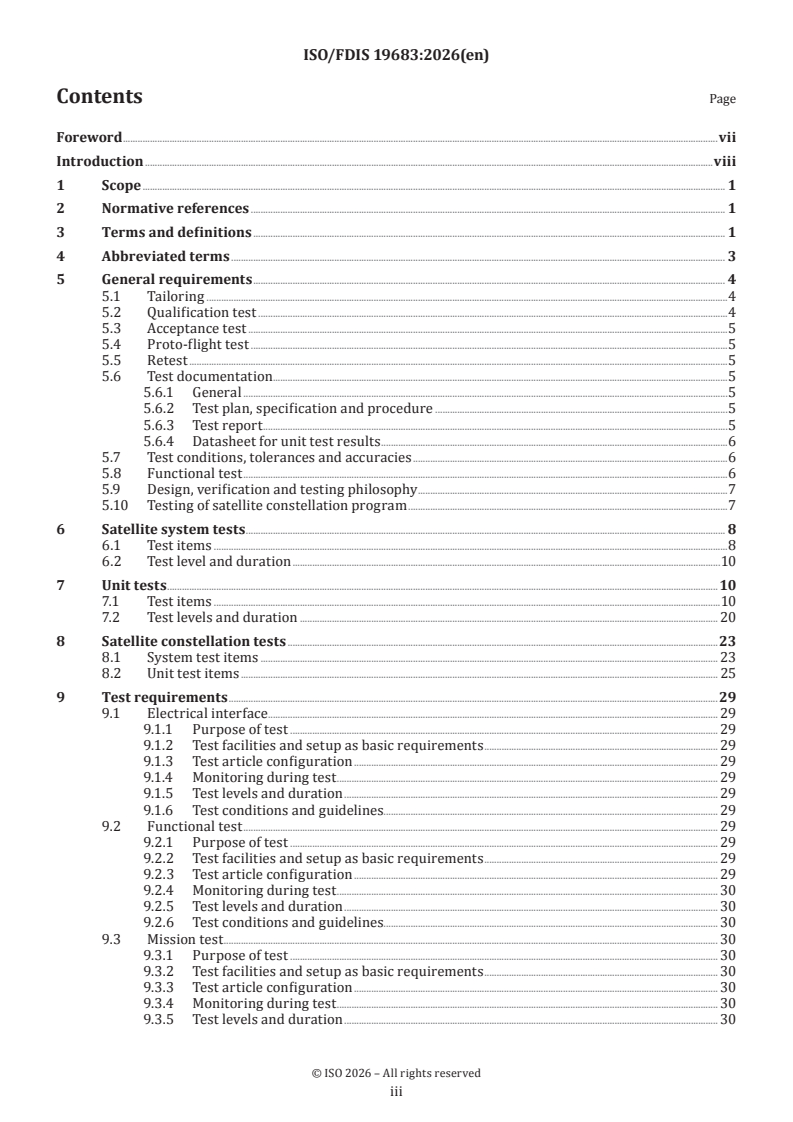
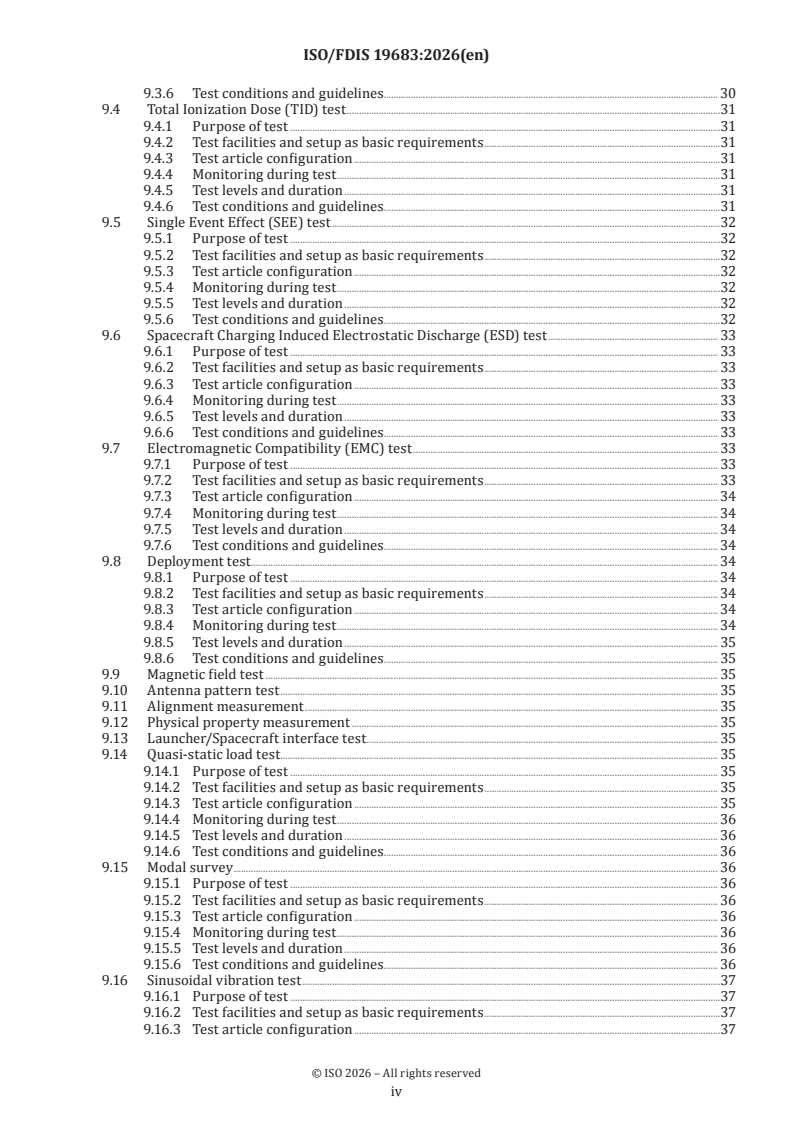
Contents Page
Foreword .vii
Introduction .viii
1 Scope . 1
2 Normative references . 2
3 Terms and definitions . 2
4 Abbreviated terms . 3
5 General requirements . 5
5.1 Tailoring .5
5.2 Qualification test .5
5.3 Acceptance test .5
5.4 Proto-flight test .5
5.5 Retest .5
5.6 Test documentation .5
5.6.1 Test plan, specification and procedure .5
5.6.2 Test report .6
5.6.3 Datasheet for unit test results .6
5.7 Test conditions, tolerances and accuracies .7
5.8 Functional test .7
5.9 Design, verification and testing philosophy .7
5.10 Testing of constellation satellite program .7
6 Satellite system tests . 8
6.1 Test items .8
6.2 Test level and duration .10
7 Unit tests .11
7.1 Test items .11
7.2 Test levels and duration .19
8 Constellation tests . .22
8.1 System test items . 22
8.2 Unit test items .24
9 Test requirements .27
9.1 Electrical interface .27
9.1.1 Purpose of test .27
9.1.2 Test facilities and setup as basic requirements .27
9.1.3 Test article configuration . 28
9.1.4 Monitoring during test . 28
9.1.5 Test levels and duration . 28
9.1.6 Test conditions and guidelines. 28
9.2 Functional test . 28
9.2.1 Purpose of test . 28
9.2.2 Test facilities and setup as basic requirements . 28
9.2.3 Test article configuration . 28
9.2.4 Monitoring during test . 28
9.2.5 Test levels and duration . 28
9.2.6 Test conditions and guidelines. 28
9.3 Mission test . 29
9.3.1 Purpose of test . 29
9.3.2 Test facilities and setup as basic requirements . 29
9.3.3 Test article configuration . 29
9.3.4 Monitoring during test . 29
9.3.5 Test levels and duration . 29
9.3.6 Test conditions and guidelines. 29
iii
ISO/DIS 19683:2025(en)
9.4 Total Ionization Dose (TID) test . 29
9.4.1 Purpose of test . 29
9.4.2 Test facilities and setup as basic requirements . 29
9.4.3 Test article configuration . 30
9.4.4 Monitoring during test . 30
9.4.5 Test levels and duration . 30
9.4.6 Test conditions and guidelines. 30
9.5 Single Event Effect (SEE) test . 30
9.5.1 Purpose of test . 30
9.5.2 Test facilities and setup as basic requirements . 30
9.5.3 Test article configuration . 30
9.5.4 Monitoring during test .31
9.5.5 Test levels and duration .31
9.5.6 Test conditions and guidelines.31
9.6 Spacecraft Charging Induced Electrostatic Discharge (ESD) test .31
9.6.1 Purpose of test .31
9.6.2 Test facilities and setup as basic requirements .31
9.6.3 Test article configuration .31
9.6.4 Monitoring during test .31
9.6.5 Test levels and duration .31
9.6.6 Test conditions and guidelines.32
9.7 Electromagnetic Compatibility (EMC) test .32
9.7.1 Purpose of test .32
9.7.2 Test facilities and setup as basic requirements .32
9.7.3 Test article configuration .32
9.7.4 Monitoring during test .32
9.7.5 Test levels and duration .32
9.7.6 Test conditions and guidelines.32
9.8 Deployment test. 33
9.8.1 Purpose of test . 33
9.8.2 Test facilities and setup as basic requirements . 33
9.8.3 Test article configuration . 33
9.8.4 Monitoring during test . 33
9.8.5 Test levels and duration . 33
9.8.6 Test conditions and guidelines. 33
9.9 Magnetic field test . 33
9.10 Antenna pattern test . 33
9.11 Alignment measurement . 33
9.12 Physical property measurement . 34
9.13 Launcher/Spacecraft interface test . 34
9.14 Quasi-static load test . . 34
9.14.1 Purpose of test . 34
9.14.2 Test facilities and setup as basic requirements . 34
9.14.3 Test article configuration . 34
9.14.4 Monitoring during test . 34
9.14.5 Test levels and duration . 34
9.14.6 Test conditions and guidelines. 34
9.15 Modal survey . 34
9.15.1 Purpose of test . 34
9.15.2 Test facilities and setup as basic requirements . 35
9.15.3 Test article configuration . 35
9.15.4 Monitoring during test . 35
9.15.5 Test levels and duration . 35
9.15.6 Test conditions and guidelines. 35
9.16 Sinusoidal vibration test . 35
9.16.1 Purpose of test . 35
9.16.2 Test facilities and setup as basic requirements . 35
9.16.3 Test article configuration . 35
9.16.4 Monitoring during test . 35
iv
ISO/DIS 19683:2025(en)
9.16.5 Test levels and duration . 35
9.16.6 Test conditions and guidelines. 36
9.17 Random vibration test . 36
9.17.1 Purpose of test . 36
9.17.2 Test facilities and setup as basic requirements . 36
9.17.3 Test article configuration . 36
9.17.4 Monitoring during test . 36
9.17.5 Test levels and duration . 36
9.17.6 Test conditions and guidelines. 36
9.18 Acoustic test . . 36
9.18.1 Purpose of test . 36
9.18.2 Test facilities and setup as basic requirements . 36
9.18.3 Test article configuration . 36
9.18.4 Monitoring during test .37
9.18.5 Test levels and duration .37
9.18.6 Test conditions and guidelines.37
9.19 Shock test .37
9.19.1 Purpose of test .37
9.19.2 Test facilities and setup as basic requirements .37
9.19.3 Test article configuration .37
9.19.4 Monitoring during test .37
9.19.5 Test levels and duration .37
9.19.6 Test conditions and guidelines.37
9.20 Thermal balance test . 38
9.20.1 Purpose of test . 38
9.20.2 Test facilities and setup as basic requirements . 38
9.20.3 Test article configuration . 38
9.20.4 Monitoring during test . 38
9.20.5 Test levels and duration . 38
9.20.6 Test conditions and guidelines. 38
9.21 Thermal vacuum test . 38
9.21.1 Purpose of test . 38
9.21.2 Test facilities and setup as basic requirements . 38
9.21.3 Test article configuration . 39
9.21.4 Monitoring during test . 39
9.21.5 Test levels and duration . 39
9.21.6 Test conditions and guidelines. 39
9.22 Functional test in vacuum . 39
9.22.1 Purpose of test . 39
9.22.2 Test facilities and setup as basic requirements . 40
9.22.3 Test article configuration . 40
9.22.4 Monitoring during test . 40
9.22.5 Test levels and duration . 40
9.22.6 Test conditions and guidelines. 40
9.23 Cold/Hot start test . 40
9.23.1 Purpose of test . 40
9.23.2 Test facilities and setup as basic requirements . 40
9.23.3 Test article configuration . 40
9.23.4 Monitoring during test .41
9.23.5 Test levels and duration .41
9.23.6 Test conditions and guidelines.41
9.24 Thermal cycle functional test.41
9.24.1 Purpose of test .41
9.24.2 Test facilities and setup as basic requirements .41
9.24.3 Test article configuration .41
9.24.4 Monitoring during test .41
9.24.5 Test levels and duration .42
9.24.6 Test conditions and guidelines.42
9.25 Thermal cycle endurance test .42
v
ISO/DIS 19683:2025(en)
9.25.1 Purpose of test .42
9.25.2 Test facilities and setup as basic requirements .42
9.25.3 Test article configuration .42
9.25.4 Monitoring during test .42
9.25.5 Test levels and duration .42
9.25.6 Test conditions and guidelines.43
9.26 Pressure test . .43
9.27 Leakage test .43
9.28 Microvibration test .43
9.28.1 Purpose of test .43
9.28.2 Test facilities and setup as basic requirements .43
9.28.3 Test article configuration .43
9.28.4 Monitoring during test .43
9.28.5 Test levels and duration .43
9.28.6 Test conditions and guidelines.43
9.29 Burn-in and wear-in test . 44
9.30 End-to-end mission simulation . 44
9.30.1 Purpose of test . 44
9.30.2 Test facilities and setup as basic requirements . 44
9.30.3 Test article configuration . 44
9.30.4 Monitoring during test . 44
9.30.5 Test levels and duration . 44
9.30.6 Test conditions and guidelines. 44
9.31 Bake out and outgas test . 44
9.31.1 Purpose of test . 44
9.31.2 Test facilities and setup as basic requirements .45
9.31.3 Test article configuration .45
9.31.4 Monitoring during test .45
9.31.5 Test levels and duration .45
9.31.6 Test conditions and guidelines.45
9.32 Tailoring and waiver guides .45
Annex A (normative) Tailoring and waiver guides . 47
Annex B (informative) Basis of test levels and duration .51
Annex C (informative) Design, verification and testing philosophy for small spacecrafts .54
Annex D (informative) Test selection logic flow .73
Annex E (informative) Environment stress screening and burn-in .85
Annex F (informative) Thermal vacuum or thermal cycle? .86
Bibliography .89
vi
ISO/DIS 19683:2025(en)
Foreword
ISO (the International Organization for Standardization) is a worldwide federation of national standards
bodies (ISO member bodies). The work of preparing International Standards is normally carried out through
ISO technical committees. Each member body interested in a subject for which a technical committee
has been established has the right to be represented on that committee. International organizations,
governmental and non-governmental, in liaison with ISO, also take part in the work. ISO collaborates closely
with the International Electrotechnical Commission (IEC) on all matters of electrotechnical standardization.
The procedures used to develop this document and those intended for its further maintenance are described
in the ISO/IEC Directives, Part 1. In particular, the different approval criteria needed for the different types
of ISO documents should be noted. This document was drafted in accordance with the editorial rules of the
ISO/IEC Directives, Part 2 (see www.iso.org/directives).
ISO draws attention to the possibility that the implementation of this document may involve the use of (a)
patent(s). ISO takes no position concerning the evidence, validity or applicability of any claimed /patent
rights in respect thereof. As of the date of publication of this document, ISO had not received notice of (a)
patent(s) which may be required to implement this document. However, implementers are cautioned that
this may not represent the latest information, which may be obtained from the patent database available at
www.iso.org/patents. ISO shall not be held responsible for identifying any or all such patent rights.
Any trade name used in this document is information given for the convenience of users and does not
constitute an endorsement.
For an explanation of the voluntary nature of standards, the meaning of ISO specific terms and expressions
related to conformity assessment, as well as information about ISO's adherence to the World Trade
Organization (WTO) principles in
...
FINAL DRAFT
International
Standard
ISO/TC 20/SC 14
Space systems — Design
Secretariat: ANSI
qualification and acceptance tests of
Voting begins on:
small spacecraft and units
2026-02-26
Systèmes spatiaux — Qualification de la conception et essais de
Voting terminates on:
réception des petits véhicules spatiaux
2026-04-23
RECIPIENTS OF THIS DRAFT ARE INVITED TO SUBMIT,
WITH THEIR COMMENTS, NOTIFICATION OF ANY
RELEVANT PATENT RIGHTS OF WHICH THEY ARE AWARE
AND TO PROVIDE SUPPOR TING DOCUMENTATION.
IN ADDITION TO THEIR EVALUATION AS
BEING ACCEPTABLE FOR INDUSTRIAL, TECHNO
LOGICAL, COMMERCIAL AND USER PURPOSES, DRAFT
INTERNATIONAL STANDARDS MAY ON OCCASION HAVE
TO BE CONSIDERED IN THE LIGHT OF THEIR POTENTIAL
TO BECOME STAN DARDS TO WHICH REFERENCE MAY BE
MADE IN NATIONAL REGULATIONS.
Reference number
FINAL DRAFT
International
Standard
ISO/TC 20/SC 14
Space systems — Design
Secretariat: ANSI
qualification and acceptance tests of
Voting begins on:
small spacecraft and units
Systèmes spatiaux — Qualification de la conception et essais de
Voting terminates on:
réception des petits véhicules spatiaux
RECIPIENTS OF THIS DRAFT ARE INVITED TO SUBMIT,
WITH THEIR COMMENTS, NOTIFICATION OF ANY
RELEVANT PATENT RIGHTS OF WHICH THEY ARE AWARE
AND TO PROVIDE SUPPOR TING DOCUMENTATION.
© ISO 2026
IN ADDITION TO THEIR EVALUATION AS
All rights reserved. Unless otherwise specified, or required in the context of its implementation, no part of this publication may
BEING ACCEPTABLE FOR INDUSTRIAL, TECHNO
LOGICAL, COMMERCIAL AND USER PURPOSES, DRAFT
be reproduced or utilized otherwise in any form or by any means, electronic or mechanical, including photocopying, or posting on
INTERNATIONAL STANDARDS MAY ON OCCASION HAVE
the internet or an intranet, without prior written permission. Permission can be requested from either ISO at the address below
TO BE CONSIDERED IN THE LIGHT OF THEIR POTENTIAL
or ISO’s member body in the country of the requester.
TO BECOME STAN DARDS TO WHICH REFERENCE MAY BE
MADE IN NATIONAL REGULATIONS.
ISO copyright office
CP 401 • Ch. de Blandonnet 8
CH-1214 Vernier, Geneva
Phone: +41 22 749 01 11
Email: copyright@iso.org
Website: www.iso.org
Published in Switzerland Reference number
ii
Contents Page
Foreword .vii
Introduction .viii
1 Scope . 1
2 Normative references . 1
3 Terms and definitions . 1
4 Abbreviated terms . 3
5 General requirements . 4
5.1 Tailoring .4
5.2 Qualification test .4
5.3 Acceptance test .5
5.4 Proto-flight test .5
5.5 Retest .5
5.6 Test documentation .5
5.6.1 General .5
5.6.2 Test plan, specification and procedure .5
5.6.3 Test report .5
5.6.4 Datasheet for unit test results .6
5.7 Test conditions, tolerances and accuracies .6
5.8 Functional test .6
5.9 Design, verification and testing philosophy .7
5.10 Testing of satellite constellation program .7
6 Satellite system tests . 8
6.1 Test items .8
6.2 Test level and duration .10
7 Unit tests .10
7.1 Test items .10
7.2 Test levels and duration . 20
8 Satellite constellation tests .23
8.1 System test items . 23
8.2 Unit test items . 25
9 Test requirements .29
9.1 Electrical interface . 29
9.1.1 Purpose of test . 29
9.1.2 Test facilities and setup as basic requirements . 29
9.1.3 Test article configuration . 29
9.1.4 Monitoring during test . 29
9.1.5 Test levels and duration . 29
9.1.6 Test conditions and guidelines. 29
9.2 Functional test . 29
9.2.1 Purpose of test . 29
9.2.2 Test facilities and setup as basic requirements . 29
9.2.3 Test article configuration . 29
9.2.4 Monitoring during test . 30
9.2.5 Test levels and duration . 30
9.2.6 Test conditions and guidelines. 30
9.3 Mission test . 30
9.3.1 Purpose of test . 30
9.3.2 Test facilities and setup as basic requirements . 30
9.3.3 Test article configuration . 30
9.3.4 Monitoring during test . 30
9.3.5 Test levels and duration . 30
iii
9.3.6 Test conditions and guidelines. 30
9.4 Total Ionization Dose (TID) test .31
9.4.1 Purpose of test .31
9.4.2 Test facilities and setup as basic requirements .31
9.4.3 Test article configuration .31
9.4.4 Monitoring during test .31
9.4.5 Test levels and duration .31
9.4.6 Test conditions and guidelines.31
9.5 Single Event Effect (SEE) test .32
9.5.1 Purpose of test .32
9.5.2 Test facilities and setup as basic requirements .32
9.5.3 Test article configuration .32
9.5.4 Monitoring during test .32
9.5.5 Test levels and duration .32
9.5.6 Test conditions and guidelines.32
9.6 Spacecraft Charging Induced Electrostatic Discharge (ESD) test . 33
9.6.1 Purpose of test . 33
9.6.2 Test facilities and setup as basic requirements . 33
9.6.3 Test article configuration . 33
9.6.4 Monitoring during test . 33
9.6.5 Test levels and duration . 33
9.6.6 Test conditions and guidelines. 33
9.7 Electromagnetic Compatibility (EMC) test . 33
9.7.1 Purpose of test . 33
9.7.2 Test facilities and setup as basic requirements . 33
9.7.3 Test article configuration . 34
9.7.4 Monitoring during test . 34
9.7.5 Test levels and duration . 34
9.7.6 Test conditions and guidelines. 34
9.8 Deployment test. 34
9.8.1 Purpose of test . 34
9.8.2 Test facilities and setup as basic requirements . 34
9.8.3 Test article configuration . 34
9.8.4 Monitoring during test . 34
9.8.5 Test levels and duration . 35
9.8.6 Test conditions and guidelines. 35
9.9 Magnetic field test . 35
9.10 Antenna pattern test . 35
9.11 Alignment measurement . 35
9.12 Physical property measurement . 35
9.13 Launcher/Spacecraft interface test . 35
9.14 Quasi-static load test . . 35
9.14.1 Purpose of test . 35
9.14.2 Test facilities and setup as basic requirements . 35
9.14.3 Test article configuration . 35
9.14.4 Monitoring during test . 36
9.14.5 Test levels and duration . 36
9.14.6 Test conditions and guidelines. 36
9.15 Modal survey . 36
9.15.1 Purpose of test . 36
9.15.2 Test facilities and setup as basic requirements . 36
9.15.3 Test article configuration . 36
9.15.4 Monitoring during test . 36
9.15.5 Test levels and duration . 36
9.15.6 Test conditions and guidelines. 36
9.16 Sinusoidal vibration test .37
9.16.1 Purpose of test .37
9.16.2 Test facilities and setup as basic requirements .37
9.16.3 Test article configuration .37
iv
9.16.4 Monitoring during test .37
9.16.5 Test levels and duration .37
9.16.6 Test conditions and guidelines.37
9.17 Random vibration test .37
9.17.1 Purpose of test .37
9.17.2 Test facilities and setup as basic requirements .37
9.17.3 Test article configuration .37
9.17.4 Monitoring during test .37
9.17.5 Test levels and duration . 38
9.17.6 Test conditions and guidelines. 38
9.18 Acoustic test . . 38
9.18.1 Purpose of test . 38
9.18.2 Test facilities and setup as basic requirements . 38
9.18.3 Test article configuration . 38
9.18.4 Monitoring during test . 38
9.18.5 Test levels and duration . 38
9.18.6 Test conditions and guidelines. 38
9.19 Shock test . 38
9.19.1 Purpose of test . 38
9.19.2 Test facilities and setup as basic requirements . 38
9.19.3 Test article configuration . 39
9.19.4 Monitoring during test . 39
9.19.5 Test levels and duration . 39
9.19.6 Test conditions and guidelines. 39
9.20 Thermal balance test . 39
9.20.1 Purpose of test . 39
9.20.2 Test facilities and setup as basic requirements . 39
9.20.3 Test article configuration . 39
9.20.4 Monitoring during test . 39
9.20.5 Test levels and duration . 39
9.20.6 Test conditions and guidelines. 40
9.21 Thermal vacuum test . 40
9.21.1 Purpose of test . 40
9.21.2 Test facilities and setup as basic requirements . 40
9.21.3 Test article configuration . 40
9.21.4 Monitoring during test . 40
9.21.5 Test levels and duration . 40
9.21.6 Test conditions and guidelines.41
9.22 Functional test in vacuum .41
9.22.1 Purpose of test .41
9.22.2 Test facilities and setup as basic requirements .41
9.22.3 Test article configuration .41
9.22.4 Monitoring during test .41
9.22.5 Test levels and duration .41
9.22.6 Test conditions and guidelines.42
9.23 Cold/Hot start test .42
9.23.1 Purpose of test .42
9.23.2 Test facilities and setup as basic requirements .42
9.23.3 Test article configuration .42
9.23.4 Monitoring during test .42
9.23.5 Test levels and duration .42
9.23.6 Test conditions and guidelines.42
9.24 Thermal cycle functional test.43
9.24.1 Purpose of test .43
9.24.2 Test facilities and setup as basic requirements .43
9.24.3 Test article configuration .43
9.24.4 Monitoring during test .43
9.24.5 Test levels and duration .43
9.24.6 Test conditions and guidelines.43
v
9.25 Thermal cycle endurance test . 44
9.25.1 Purpose of test . 44
9.25.2 Test facilities and setup as basic requirements . 44
9.25.3 Test article configuration . 44
9.25.4 Monitoring during test . 44
9.25.5 Test levels and duration . 44
9.25.6 Test conditions and guidelines. 44
9.26 Pressure test . . 44
9.27 Leakage test . 44
9.28 Microvibration test . 44
9.28.1 Purpose of test . 44
9.28.2 Test facilities and setup as basic requirements .45
9.28.3 Test article configuration .45
9.28.4 Monitoring during test .45
9.28.5 Test levels and duration .45
9.28.6 Test conditions and guidelines.45
9.29 Burn-in and wear-in test .45
9.30 End-to-end mission simulation .45
9.30.1 Purpose of test .45
9.30.2 Test facilities and setup as basic requirements .45
9.30.3 Test article configuration .45
9.30.4 Monitoring during test .45
9.30.5 Test levels and duration . 46
9.30.6 Test conditions and guidelines. 46
9.31 Bake out and outgas test . 46
9.31.1 Purpose of test . 46
9.31.2 Test facilities and setup as basic requirements . 46
9.31.3 Test article configuration . 46
9.31.4 Monitoring during test . 46
9.31.5 Test levels and duration . 46
9.31.6 Test conditions and guidelines. 46
9.32 Tailoring and waiver guides .47
Annex A (normative) Tailoring and waiver guides .48
Annex B (informative) Basis of test levels and duration .52
Annex C (informative) Design, verification and testing philosophy for small spacecrafts .55
Annex D (informative) Test selection logic flow . 74
Annex E (informative) Environment stress screening and burn-in .86
Annex F (informative) Thermal vacuum or thermal cycle? .87
Bibliography .90
vi
Foreword
ISO (the International Organization for Standardization) is a worldwide federation of national standards
bodies (ISO member bodies). The work of preparing International Standards is normally carried out through
ISO technical committees. Each member body interested in a subject for which a technical committee
has been established has the right to be represented on that committee. International organizations,
governmental and non-governmental, in liaison with ISO, also take part in the work. ISO collaborates closely
with the International Electrotechnical Commission (IEC) on all matters of electrotechnical standardization.
The procedures used to develop this document and those intended for its further maintenance are described
in the ISO/IEC Directives, Part 1. In particular, the different approval criteria needed for the different types
of ISO document should be noted. This document was drafted in accordance with the editorial rules of the
ISO/IEC Directives, Part 2 (see www.iso.org/directives).
ISO draws attention to the possibility that the implementation of this document may involve the use of (a)
patent(s). ISO takes no position concerning the evidence, validity or applicability of any claimed patent
rights in respect thereof. As of the date of publication of this document, ISO had not received notice of (a)
patent(s) which may be required to implement this document. However, implementers are cautioned that
this may not represent the latest information, which may be obtained from the patent database available at
www.iso.org/patents. ISO shall not be held responsible for identifying any or all such patent rights.
Any trade name used in this document is information given for the convenience of users and does not
constitute an endorsement.
For an explanation of the voluntary nature of standards, the meaning of ISO specific terms and expressions
related to conformity assessment, as well as information about ISO's adherence to the World Trade
Organization (WTO) principles in the Technical Barriers to Trade (TBT), see www.iso.org/iso/foreword.html.
This document was prepared by Technical Committee ISO/TC 20, Aircraft and space vehicles, Subcommittee
SC 14, Space systems and operations.
This second edition cancels and replaces the first edition (ISO 19683:2017), which has been technical
...
ISO/DISFDIS 19683:2025(en)
ISO/TC 20/SC 14
Secretariat: ANSI
Date: 2025-06-132026-02-12
Space systems — — Design qualification and acceptance tests of
small spacecraft and units
Systèmes spatiaux — Qualification de la conception et essais de réception des petits véhicules spatiaux
FDIS stage
All rights reserved. Unless otherwise specified, or required in the context of its implementation, no part of this publication
may be reproduced or utilized otherwise in any form or by any means, electronic or mechanical, including photocopying,
or posting on the internet or an intranet, without prior written permission. Permission can be requested from either ISO
at the address below or ISO’s member body in the country of the requester.
ISO copyright office
CP 401 • Ch. de Blandonnet 8
CH-1214 Vernier, Geneva
Phone: + 41 22 749 01 11
Fax: +41 22 749 09 47
EmailE-mail: copyright@iso.org
Website: www.iso.org
Published in Switzerland
© ISO ####2026 – All rights reserved
ii
ISO/DISFDIS 19683:20252026(en)
Contents Page
Foreword . v
Introduction . vi
1 Scope . 1
2 Normative references . 1
3 Terms and definitions . 1
4 Abbreviated terms . 3
5 General requirements . 4
5.1 Tailoring . 4
5.2 Qualification test . 4
5.3 Acceptance test . 5
5.4 Proto-flight test . 5
5.5 Retest . 5
5.6 Test documentation . 5
5.7 Test conditions, tolerances and accuracies . 7
5.8 Functional test . 7
5.9 Design, verification and testing philosophy . 7
5.10 Testing of satellite constellation program . 7
6 Satellite system tests . 8
6.1 Test items. 8
6.2 Test level and duration . 10
7 Unit tests . 10
7.1 Test items. 10
7.2 Test levels and duration . 15
8 Satellite constellation tests . 21
8.1 System test items . 21
8.2 Unit test items . 22
9 Test requirements . 24
9.1 Electrical interface . 24
9.2 Functional test . 25
9.3 Mission test . 26
9.4 Total Ionization Dose (TID) test . 26
9.5 Single Event Effect (SEE) test . 27
9.6 Spacecraft Charging Induced Electrostatic Discharge (ESD) test . 28
9.7 Electromagnetic Compatibility (EMC) test . 29
9.8 Deployment test . 30
9.9 Magnetic field test . 31
9.10 Antenna pattern test . 31
9.11 Alignment measurement . 31
9.12 Physical property measurement . 31
9.13 Launcher/Spacecraft interface test . 31
9.14 Quasi-static load test . 31
9.15 Modal survey . 32
9.16 Sinusoidal vibration test . 33
9.17 Random vibration test . 33
9.18 Acoustic test . 34
9.19 Shock test . 34
9.20 Thermal balance test . 35
iii
9.21 Thermal vacuum test . 36
9.22 Functional test in vacuum . 37
9.23 Cold/Hot start test . 38
9.24 Thermal cycle functional test . 39
9.25 Thermal cycle endurance test . 40
9.26 Pressure test . 41
9.27 Leakage test . 41
9.28 Microvibration test . 41
9.29 Burn-in and wear-in test . 41
9.30 End-to-end mission simulation . 42
9.31 Bake out and outgas test . 42
9.32 Tailoring and waiver guides . 43
Annex A (normative) Tailoring and waiver guides . 45
Annex B (informative) Basis of test levels and duration . 50
Annex C (informative) Design, verification and testing philosophy for small spacecrafts . 55
Annex D (informative) Test selection logic flow . 77
Annex E (informative) Environment stress screening and burn-in . 101
Annex F (informative) Thermal vacuum or thermal cycle? . 102
Bibliography . 107
© ISO ####2026 – All rights reserved
iv
ISO/DISFDIS 19683:20252026(en)
Foreword
ISO (the International Organization for Standardization) is a worldwide federation of national standards
bodies (ISO member bodies). The work of preparing International Standards is normally carried out through
ISO technical committees. Each member body interested in a subject for which a technical committee has been
established has the right to be represented on that committee. International organizations, governmental and
non-governmental, in liaison with ISO, also take part in the work. ISO collaborates closely with the
International Electrotechnical Commission (IEC) on all matters of electrotechnical standardization.
The procedures used to develop this document and those intended for its further maintenance are described
in the ISO/IEC Directives, Part 1. In particular, the different approval criteria needed for the different types of
ISO documentsdocument should be noted. This document was drafted in accordance with the editorial rules
of the ISO/IEC Directives, Part 2 (see www.iso.org/directives).
ISO draws attention to the possibility that the implementation of this document may involve the use of (a)
patent(s). ISO takes no position concerning the evidence, validity or applicability of any claimed /patent rights
in respect thereof. As of the date of publication of this document, ISO had not received notice of (a) patent(s)
which may be required to implement this document. However, implementers are cautioned that this may not
represent the latest information, which may be obtained from the patent database available at
www.iso.org/patents. ISO shall not be held responsible for identifying any or all such patent rights.
Any trade name used in this document is information given for the convenience of users and does not
constitute an endorsement.
For an explanation of the voluntary nature of standards, the meaning of ISO specific terms and expressions
related to conformity assessment, as well as information about ISO's adherence to the World Trade
Organization (WTO) principles in the Technical Barriers to Trade (TBT), see www.iso.org/iso/foreword.html.
This document was prepared by Technical Committee ISO/TC 20, Aircraft and space vehicles, Subcommittee
SC 14, Space systems and operations.
This second edition cancels and replaces the first edition (ISO 19683:2017), which has been technically
revised.
The main changes are as follows:
— — Updatedupdated terms and definitions,;
— — Added sub-clause 5.10added 5.10 on testing of satellite constellation program,;
— — Added a clause 8added Clause 8 on satellite constellation tests,;
— — Updated clause 9updated Clause 9 on test requirements,;
— updated Annex C— Updated Annex C.
— .
Any feedback or questions on this document should be directed to the user’s national standards body. A
complete listing of these bodies can be found at www.iso.org/members.html.
v
Introduction
There is an increasing demand for small, micro, nano or pico satellite development and utilization worldwide;
yet, there is no clear and globally accepted definition of what is considered “small”, “micro”, “nano” or “pico”
satellites. These satellites are often built with emphasis on low cost and fast delivery. They are characterized
by extensive use of non-space-qualified commercial-off-the-shelf (COTS) units (component). For the sake of
convenience, the term “small spacecraft” is used throughout this document as a generic term to refer to these
satellites.
A small spacecraft is a satellite that utilizes non-traditional risk-taking development and management
approaches to achieve low cost and fast delivery with a small number of team. To achieve these two points,
low cost and fast delivery, satellite design relies on the use of non-space-qualified COTS units (components),
making satellite size inherently smaller. The design accepts a certain level of risk associated with the use of
COTS. Because of the risk taking approach, small spacecraft often fails in orbit. But the replacement spacecraft
is quickly built and launched reflecting the lessons obtained in the previous spacecraft. As the launch cost
depends on the spacecraft size and/or mass, the spacecraft size becomes “small”.
Figure 1
illustrates the applicability of this document.
Figure 1 — Applicability of this document
© ISO ####2026 – All rights reserved
vi
ISO/DISFDIS 19683:20252026(en)
A certain set of tests is necessary to ensure the mission success of small spacecraft. Applying the same test
requirements and methods as those applied to traditional large or medium satellites, however, nullifies the
low-cost and fast-delivery advantages possessed by small spacecraft.
This document is meant to improve the reliability of small spacecraft, especially those with commercial
purpose, with emphasis on achieving reliability against infant mortality after satellite launch to orbit, while
maintaining the low-cost and fast-delivery nature of small spacecraft.
This document intends to promote worldwide trade of small spacecraft products by providing a minimum
level of assurance that a product made of non-space-qualified commercial-off-the-shelf parts and units can
work in space. This document also aims to serve as a testing guideline for those who intend to enter satellite
manufacturing through development of small spacecraft products.
vii
DRAFT International Standard ISO/DIS 19683:2025(en)
Space systems — — Design qualification and acceptance tests of small
spacecraft and units
1 Scope
This document provides test methods and test requirements for design either qualification or acceptance, or
both of small spacecraft or units. It provides the minimum test requirements and test methods to qualify the
design and manufacturing methods of commercial small spacecraft and their units and to accept the final
products.
This document is applicable to satellites whose development methods are different from the ones used for
traditional satellites that have little room for risk tolerance. The scope of this document encompasses different
categories of small spacecraft, so-called mini-, micro-, nano-, pico- and femto spacecraft.
This document includes CubeSat, as long as it is developed with the untraditional processes.
This document does not cover satellite deployment mechanisms, such as Picosatellite Orbital
Deployerpicosatellite orbital deployer (POD), as the verification requirements are defined in the Interface
[1][1]
Control Documentinterface control document (ICD) with the launcher, such as ISO 26869 .
This document does not cover software testing, although some tests such as functional test, mission test and
end-to-end test are inherently used to test the software installed in the hardware being tested. General
requirements and processes of satellite software testing can be found in various references, such as ECSS-E-
[2][2]
..
ST40
This document does not cover requirements regarding safety nor debris mitigation. Appropriate documents
[3][3] [4][4]
such as ISO 14620-1 or ISO 24113 can be referred to. Other common requirements for small spacecraft
[5][5]
can be found in ISO TS 20991 .
2 Normative references
The following documents are referred to in the text in such a way that some or all of their content constitutes
requirements of this document. For dated references, only the edition cited applies. For undated references,
the latest edition of the referenced document (including any amendments) applies.
ISO 11221:2011, Space systems — Space solar panels — Spacecraft charging induced electrostatic discharge
test methods
ISO 14302, Space systems — Electromagnetic compatibility requirements
ISO 15864:2021, Space systems — General test methods for spacecraft, subsystems and units
ISO 17566:2011, Space systems — General test documentation
ISO 24411:2022, Space systems — Micro-vibration testing
3 Terms and definitions
For the purposes of this document, the following terms and definitions apply.
ISO and IEC maintain terminology databases for use in standardization at the following addresses:
— — IEC Electropedia: available at https://www.electropedia.org/
— — ISO Online browsing platform: available at https://www.iso.org/obp
3.1 3.1
1U CubeSat
single CubeSat
satellite measuring 100 mm × 100 mm × 113,5 mm and weighing 1,33 kg or less
[6][6]
Note 1 to entry: For the exact external dimension, see ISO 17770 .
3.2 3.2
3U CubeSat
triple CubeSat
satellite measuring 100 mm × 100 mm × 340,5 mm and weighing 4,00 kg or less
[6][6]
Note 1 to entry: For the exact external dimension, see ISO 17770 .
3.3 3.3
batch
group of satellites with the same design produced with the same process at the same time
Note 1 to entry: The units (3.14(3.14)) contained in the satellites share the same design.
3.4 3.4
CubeSat
picosatellite measuring 100 mm cubic and weighting 1,33 kg or less
[SOURCE: ISO 17770:2017, 3.1, modified — Note 1 to entry has been removed.]
3.5 3.5
flat-sat
configuration where only units (3.14(3.14),), sometimes bare circuit boards only, are laid out in atmosphere
on a table while not being mounted to the satellite structure
3.6 3.6
flight model
spacecraft, subsystem or unit (3.14(3.14)) model dedicated to being launched and operated in orbit and
subjected to acceptance testing
3.7 3.7
formation flight
multiple satellites flying in close proximity and operated under precise coordination and control to achieve a
specific mission by maintaining relative positions
Note 1 to entry: Typically, all the satellites are deployed at the same time.
3.8 3.8
pathfinder
satellites launched before the full deployment of satellite constellation (3.10) to validate the satellite missions
and verify the satellite design in orbit
© ISO ####2026 – All rights reserved
ISO/DISFDIS 19683:20252026(en)
3.9
3.9
picosatellite orbital deployer
POD
box housing CubeSats (3.4(3.4)) during launch
3.93.10 3.10
satellite constellation
group of satellites with mostly the same design working together in coordination to achieve specific missions
Note 1 to entry: After pathfinder (3.8) missions, the satellites may be deployed in several stages with incremental
improvements of the satellite design.
3.103.11 3.11
satellite fleet
group of satellites operated together to achieve specific missions without maintaining relative positions
precisely.
Note 1 to entry: The satellite designs are not necessarily the same. The satellites are often deployed at different times.
3.113.12 3.12
satellite swarm
group of satellites deployed simultaneously or in close succession to achieve a specific mission through
dynamic interaction among the satellites taking advantage of having a large number of satellites
3.123.13 3.13
test article
spacecraft, subsystem or unit (3.14(3.14)) on which a test is conducted
3.133.14 3.14
unit
lowest level of hardware assembly that works with specified complex electrical, either thermal or mechanical,
or both functions.
Note 1 to entry: An example is a radio transceiver unit.
4 Abbreviated terms
AT Acceptanceacceptance test
COTS Commercialcommercial-off-the-self
CVCM Collectedcollected volatile condensable materials
EED electroexplosive devices
EM engineering model
EED Electroexplosive devices
EM Engineering model
EMC Electromagneticelectromagnetic compatibility
EMI Electromagneticelectromagnetic interference
ESD Electrostaticelectrostatic discharge
ESS Environmentenvironment stress screening
FM Flightflight model
FMEA Failure Modefailure mode and Effects Analysiseffects analysis
FMECA Failure Mode, Effects, and Criticality Analysisfailure mode, effects, and criticality analysis
IC Integratedintegrated circuit
ICD Interfaceinterface control document
LEO Lowlow Earth Orbitorbit
MEMS Micro Electro Mechanical Systemsmicro electro mechanical systems
MMA Movingmoving mechanical assembly
PFT Protoproto-flight test
PFM Protoproto-flight model
POD Picosatellite Orbital Deployer
POD picosatellite orbital deployer
QM Qualificationqualification model
QT Qualificationqualification test
QCM Quartz Crystal Microbalancequartz crystal microbalance
RF Radioradio frequency
PSD Powerpower spectral density
SAA South Atlantic Anomaly
SE Singlesingle event
SEE Singlesingle event effect
SRS Shockshock response spectrum
SSO Sun synchronous orbit
STM Structuralstructural thermal model
TID Totaltotal ionization dose
TML Totaltotal mass loss
5 General requirements
5.1 Tailoring
Specifications described in this document are tailorable upon agreement between the customer, the
manufacturer and the launch provider. Annex AAnnex A provides tailoring and waiver guides of test
requirements.
5.2 Qualification test
For satellite system level qualification tests, there is little difference between small spacecraft and traditional
satellite qualification tests in terms of objectives and requirements. Qualification tests demonstrate that items
meet design requirements and include proper margin. Qualification tests can serve as good practice for
personnel who are inexperienced in testing toward acceptance tests to be carried out later. If the same design
is used for many satellites, such as satellites of a satellite constellation program, the qualification tests are not
necessary except for the first satellite. ISO 15864:2021, 4.4 provides additional requirements for system
qualification test.
© ISO ####2026 – All rights reserved
ISO/DISFDIS 19683:20252026(en)
Unit level qualification tests dealt in this document is different from those done for traditional satellites. The
unit QT in this document provides a minimum guarantee that a given unit sold as “a satellite unit” has a certain
level of tolerance against the space environment. Therefore, the unit QT in this document does not include
proper margin against the maximum predicted environment stress, which depends on each satellite. This
document provides numeric values for the test level and duration of unit QTs as much as possible with their
rationale given in Annex BAnnex B. The satellite developers who purchase the COTS-unit tested according to
this document shall make consistent decisions about how to obtain the margin. The satellite developers may
purchase a dedicated test model in addition to the flight model and carry out another QT with the margin.
They may carry out PFT using a flight model or only AT taking the risk of little margin. The satellite developer
shall provide the test levels and duration of the additional QT, AT or PFT. See C.1C.1 for additional note.
5.3 Acceptance test
There is little difference in terms of objectives and requirements of acceptance tests between small spacecraft
and traditional satellites. The acceptance test shall be in accordance with ISO 15864:2021, 4.5.
5.4 Proto-flight test
There is little difference in terms of objectives and requirements of proto-flight tests between small spacecraft
and traditional satellites. The proto-flight test shall be in accordance with ISO 15864:2021, 4.6.
5.5 Retest
Situations that may require retest are described in ISO 15864:2021, 4.8.
5.6 Test documentation
5.6.1 General
In order to minimize program cost, the amount of paper work should be reduced as much as possible. The
documents used inside the developing organization can only be simplified considering the small size of the
team. At the same time, however, the test documentation shall be detailed enough to ensure traceability from
the later stages of satellite development or operation. The importance of the test procedure document should
not be underestimated, as well-prepared tests will eventually save both time and money.
For the unit QT, the test documentation shall provide the important information necessary to prove that the
COTS-based units have adequate durability against the space environment. See C.1C.1 for additional notes.
5.6.2 Test plan, specification and procedure
The simplicity of a small spacecraft allows the combination of the test plan, specification and procedure
documents for the system test or unit test into one document as recommended by ISO 17566. In the following
cases, it is recommended to separate the test plan/specification and the test procedure into two separate
documents.
a) a) The test is fairly complex and requires many discussions and iterations within the
development team to define the test specification.
b) b) The test is carried out at a location outside the developing organization and requires
consultation with the test institution well before the test.
c) c) The test shall be approved by the customer. The test plan/specification may be used as the
document for approval.
The contents of the test plan, specification and procedure shall be based on ISO 17566:2011, Table 2 or
Table 3. Some of the content in the specification, such as test facility requirements and procedural test
requirements, may be moved to the test procedure document. The documents may be revised as test
preparation progresses. It is important to keep track of the version number, the revision points and the
revision dates.
5.6.3 Test report
The test report content shall be based on ISO 17566:2011, Annex D. Any anomaly during the test and its
disposition shall be reported in the test report. The test report shall clearly describe the following information
or refer to the test documents that contain the information.
a) a) Temperature measurement points and the measured temperature profile in the case of
thermal tests, e.g. thermal cycle, thermal vacuum, thermal balance, etc.
b) b) Acceleration measurement points in the case of mechanical tests, e.g. vibration, shock, etc.
c) c) The points of reference (thermo-couples or accelerometers) used to control the test levels,
e.g. temperature, vibration, acoustic, etc.
d) d) The measured pressure profile during the test in the case of tests conducted in a vacuum, e.g.
thermal vacuum, vacuum functioning, multipaction, etc.
e) e) The power spectrum density waveform of the acceleration measured at the reference points in
the case of random vibration test or modal survey.
f) f) The shock response spectrum calculated from the acceleration measured at the reference
points in the case of shock test with the description of the method used to give the acceleration.
g) g) The source of radiation particles, their energy and the total fluence in the case of SEE test.
h) h) The radiation source and energy, total dose and shielding effects considered to derive the total
dose, dose rate and temperature during testing in the case of TID test.
i) i) The result of functional performance measurements before, during and after the environment
test.
If the test results in failure, the test report shall be precise enough to assist with the root cause analysis or
other investigation. See Reference [7][7] for root cause analysis.
5.6.4 Datasheet for unit test results
The following information shall be included in the datasheet for unit test results.
a) a) Random vibration spectrum in power spectral density, root-mean-square value of acceleration
and duration for each axis if random vibration test was carried out.
b) b) Vibration level, sweep rate and frequency range for each axis if sinusoidal vibration test was
carried out.
c) c) Radiation and conduction emission spectrum if EMC test was carried out.
d) d) Temperature profile, number of cycles, hot and cold soak temperatures and their duration,
temperature ramp rate (up/down) and gas environment if thermal cycle test in atmospheric pressure was
carried out.
e) e) Temperature profile, number of cycles, hot and cold soak temperatures and their duration,
temperature ramp rate (up/down) and pressure profile if thermal vacuum cycle test was carried out.
© ISO ####2026 – All rights reserved
ISO/DISFDIS 19683:20252026(en)
f) f) Shock response spectrum for each axis and the method of applying the shock acceleration if
shock test was carried out.
g) j) The source of radiation particles, their energy and the total fluence if SEE test was carried out.
h) k) The radiation source and energy, total dose, shielding effects considered to derive the total
dose, dose rate and temperature during testing if TID test was carried out.
i) l) The power spectral density of the measured force for various rotational speeds if
microvibration acceptance test was carried out.
5.7 Test conditions, tolerances and accuracies
The requirements in ISO 15864:2021, 4.10 shall apply.
5.8 Functional test
Complete functional tests shall be performed at the beginning and end of the test sequence. Partial functional
tests shall be conducted before and after each environmental exposure.
5.9 Design, verification and testing philosophy
Annex CAnnex C describes the difference of small spacecrafts from traditional satellites in terms of design,
verification and testing philosophy. Tables C.1Tables C.1 and C.2C.2 summarize the characteristics inherently
associated with the satellite program/design and the corresponding verification strategy when low cost and
fast delivery are the primary drivers.
5.10 Testing of satellite constellation program
Typically, a satellite constellation program launches pathfinder satellites to validate the satellite missions and
verify the satellite design in the flight environment before initiating full satellite constellation deployment.
During full deployment, multiple satellites are often produced simultaneously, forming a satellite production
batch (referred to as a “batch” in this document).
Within the same batch, all satellites share an identical design, and differences between them mainly arise from
variations in hardware assembly quality, including workmanship, electronic and mechanical parts, and
production lot inconsistencies. Full deployment usually involves multiple launches to populate different
orbital planes. Between these launches, minor modifications to the satellite design are often made based on
lessons learned from the operation of earlier generations.
The satellite used for pathfinder missions undergoes extensive testing before launch. The mission itself can be
considered an extension of the satellite system test, although it may not account for all environmental
variations in orbit, such as the 11-year solar cycle. During the full deployment phase, qualification testing of
the satellite is not required, as the design is already flight-proven.
If minor modifications are made to the satellite design—such as changes due to discontinued parts or units—
qualification tests may be conducted to verify only the modified elements. This is commonly referred to as
delta-qualification. If the launcher differs from that used in the pathfinder mission or previous batches, and
the new launch environment exceeds the previously tested limits, delta-qualification for the new launch
environment shall be done.
When the production lot of electronic parts changes, additional screening tests may be required, depending
on whether the satellite system integrator adopts a conservative approach to managing lot differences. The
levels and duration of acceptance testing may be relaxed compared to single-satellite programs. Some test
items may be skipped or conducted only on a limited number of satellites within the same batch. However,
tests that verify workmanship or individual satellite variations may need to be performed on all satellites,
depending on their criticality to safety and mission success.
After the first batch of satellites is built and operated in space, operational results provide valuable insights.
These insights may be used to further reduce the number of test items when building and testing the second
batch. This iterative process continues for subsequent batches. Figures of merit can be introduced to compare
the in-orbit performance of each batch, helping to evaluate how much testing can be relaxed.
The applicability of the satellite constellation program testing strategy to a specific satellite program depends
on two criteria: whether the satellite design is identical and whether the design is flight-proven.
Formation flight missions launch multiple satellites with the same design but typically do not include a
pathfinder mission before the main launch. In such cases, the single-satellite program testing strategy should
be applied. To improve efficiency, methods for testing multiple satellites simultaneously should be considered.
The satellite constellation testing strategy applies to satellite swarm programs if the satellites share a flight-
proven design validated by pathfinder missions. However, if satellite swarm is launched without pathfinder
missions, the single-satellite testing strategy must be applied, at least for the first generation. For subsequent
generations, if design changes are minimal, the satellite constellation testing strategy may be used.
For satellite fleets that build and launch only one satellite at a time, the single-satellite testing strategy can be
applied, skipping qualification testing (QT) from the second satellite onward, provided the design remains the
same or changes are minor. Additionally, acceptance test (AT) levels and durations may be relaxed, and some
test items skipped, if sufficient confidence has been established based on flight results from earlier satellites.
6 Satellite system tests
6.1 Test items
The satellite system test items are listed in Table 1Table 1. Annex D. Annex D provides test selection logic
flows.
Table 1 — System test items
Test items QT AT PFT
Electrical interface R R R
Functional test R R R
Mission test R R R
a a,b
Total Ionization Dose (TID) test O — O
a a,b
Single Event Effects (SEE) test O — O
Spacecraft Charging Induced Electrostatic Discharge (ESD)
To be done in the unit level.
test
s c, s s
Electromagnetic Compatibility (EMC) test O O O
Deployment test R R R
d d d
Magnetic field test O O O
Antenna pattern test To be done in the unit level.
e e e
Alignment measurement O O O
Physical property measurement R R R
Launcher/Spacecraft interface test R R R
© ISO ####2026 – All rights reserved
ISO/DISFDIS 19683:20252026(en)
Test items QT AT PFT
f f f
Quasi-static load test O O O
g g
Modal survey O — O
h h h
Sinusoidal vibration test O O O
i i i
Random vibration test R R R
i i i
Acoustic test O O O
j j j
Shock test O O O
k k
Thermal balance test O O
m
Thermal vacuum test O
l n l
Thermal cycle functional test R O R
Functional test in vacuum —
o o o
Cold/hot start test O O O
Thermal cycle endurance test To be done in the unit level.
p p p
Pressure test O O O
p p p
Leakage test O O O
r
Microvibration test To be done in the unit level .
Burn-in and wear-in test To be done in the unit level.
End-to-end mission simulation — R R
q,n q
Bake out and outgas — O O
Key
R Required
O Optional
a To be done in the flat-sat configuration without satellite structure. See Figure D.1Figure D.1.
b Use of dedicated test model.
c To be done in anechoic chamber if radio licence is not obtained yet. See Figure D.2Figure D.2.
d Required when characterization of residual or internally generated magnetic moment is critical for the mission success.
e Required for an observation (earth or astronomy) satellite.
f Required if launcher ICD requires or if structural analysis cannot replace testing. See Figure D.3Figure D.3.
g Required if very high accuracy of the structural analysis is necessary. See 9.159.15.
h Required if Launcher ICD requires. See Figure D.4Figure D.4.
i When acoustic test is also required by launcher ICD, either random vibration or acoustic test is recommended, whichever is more
appropriate, with the other discretionary. See Figure D.5Figure D.5 for the selection logic of acoustic test.
j Required if launcher ICD requires. See Figure D.6Figure D.6.
k Required if design is new and thermal accuracy does not have enough accuracy. See Figure D.7Figure D.7.
l Either thermal vacuum or a combination of thermal cycle function and functional test in vacuum is required. See
Figure D.7Figure D.7.
m Required if temperature distribution is large. See Figure D.7Figure D.7.
n Required if thermal vacuum test is not done. See Figure D.7Figure D.7.
o Required if separation temperature after cold launch is much higher or lower than the max/min temperature.
See Figure D.8Figure D.8.
p Required if pressure vessel is on-board the satellite.
q Required if launcher ICD requires or if a payload sensitive to contamination is on-board the satellite.
r Microvibration test is to characterize the unit-level microvibration. Regarding the necessity of spacecraft level micro-vibration test,
see ISO 24411:2022, Annex B.
Test items QT AT PFT
s Not required if the satellite is cold launched and the launcher ICD does not require. Even in that case, if the internal noise may affect
the mission, such as very small uplink or intersatellite link margin, radio-sensitive mission payload, intrasatellite communication, etc.,
system EMC test is required.
6.2 Test level and duration
The test level and duration of system tests shall be specific to each satellite, depending on the environments
to be encountered and the mission objectives. In the mechanical and thermal tests, the test level of AT shall
cover the maximum temperature range and acceleration predicted. For the mechanical and thermal QT or PFT,
appropriate margin shall be added.
7 Unit tests
7.1 Test items
The unit test items are listed in Tables 2Tables 2, 3, 3 and 44. Annex D. Annex D provides test selection logic
flows.
Table 2 — Unit test items (QT)
Electrical
Solar Pressur
t
Test items and Antenna MMA Battery Valve Thruster Optical Structural
array e vessel
electronic
Electrical interface
To be done at the assembly and integration to the system level.
test
Functional test R R R R R R R R R —
Mission test To be done in the system level.
Total Ionization
a
O — — — — — — — — —
Dose (TID) test
Single Event Effects
a
O
(SEE) test
Spacecraft Charging
b b
Induced Electrostatic O — — O — — — — — —
Discharge (ESD) test
Electromagnetic
c c c r
Compatibility (EMC) O O O — — — — O — —
test
d d d d d
Deployment test — O O O — — — — O O
e e e e e
Magnetic field test — — O — — O O O O —
Antenna pattern test — R — — — — — — — —
Alignment
s s s
— O — — — — — O O —
measurement
Physical property
R R R R R R R R R R
measurement
Launcher/Spacecraft
To be done in the system level.
interface test
Quasi-static load test To be done in the system level.
f f f f f f f f f f
Modal survey O O O O O O O O O O
© ISO ####2026 – All rights reserved
ISO/DISFDIS 19683:20252026(en)
Electrical
Solar Pressur
t
Test items and Antenna MMA Battery Valve Thruster Optical Structural
array e vessel
electronic
Sinusoidal vibration
g g g g
— O — O — — — — O O
test
Random vibration test R R R R R R R R R R
Acoustic test — — — — — — — — — —
h h h h h h h h h
Shock test O O O O O O — O O O
i i i i i
Thermal balance test — O O O — — — — O O
j j j j
Thermal vacuum test O O O O —
Thermal cycle
k k k k
O O O O —
l l l l l
functional test O O O O O
Functional test in
k k k k
O O O O —
vacuum
m m m
Cold/hot start test O — O — — O — — — —
Thermal cycle
n n n n n
R O O O — — — — O O
endurance test
o
Pressure test — — O — — R R R — —
o u o
Leakage test — — O R R R O — —
p
Microvibration test — — O — — — — — — —
Burn-in and wear-in
q
— — O — — — — — — —
test
End-to-end mission
To be done in the system level.
simulation
Bake out and outgas
To be done in the system level.
test
Key
R Required
O Optional
a May be do
...
Questions, Comments and Discussion
Ask us and Technical Secretary will try to provide an answer. You can facilitate discussion about the standard in here.
Loading comments...