

ISO/IEC 27090
(Main)Cybersecurity — Artificial intelligence (AI) — Addressing security threats and compromises to AI systems
- Abstract
This document addresses security threats and compromises specific to artificial intelligence (AI) systems. This document aims to provide information to organizations to help them better understand the consequences of security threats specific to AI systems, throughout their life cycle, and descriptions of how to detect and mitigate such threats. This document is applicable to all types and sizes of organizations, including public and private companies, government entities, and not-for-profit organizations, that develop or use AI systems
- Status
- Not Published
- Current Stage
- 6000 - International Standard under publication
- Start Date
- 19-Aug-2026
- Completion Date
- 10-Oct-2026
Buy Documents
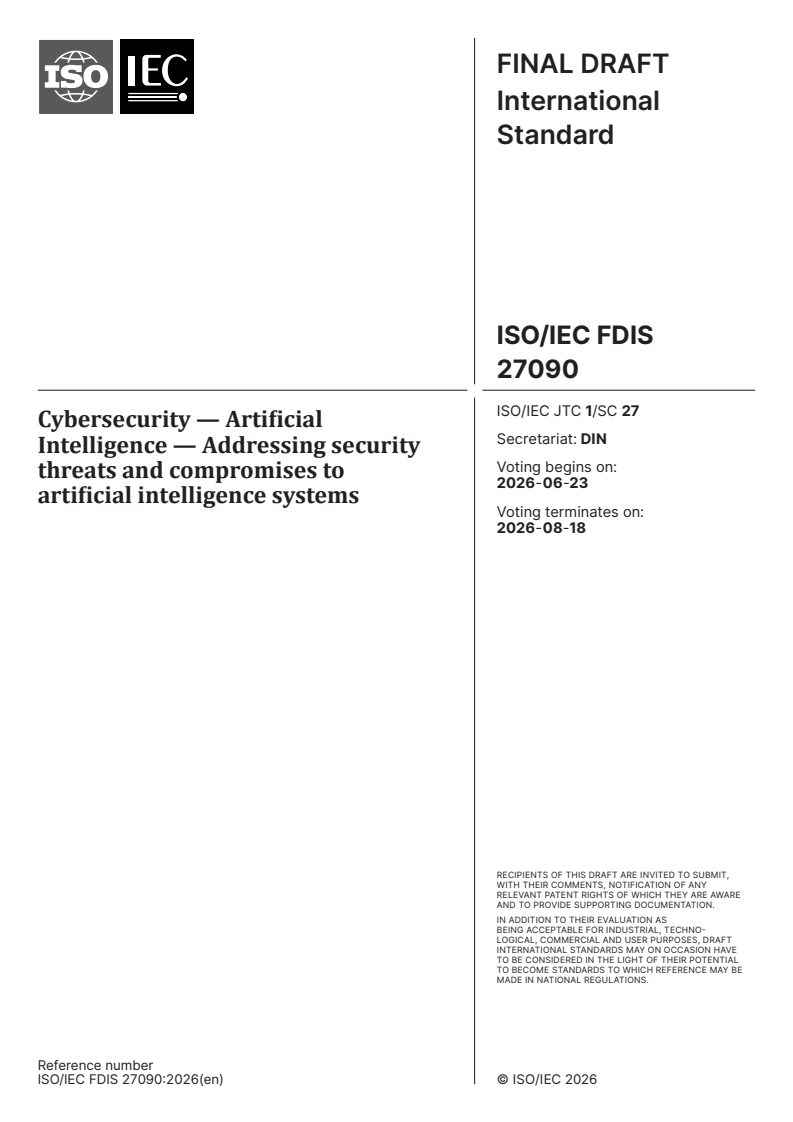
ISO/IEC FDIS 27090 - Cybersecurity — Artificial Intelligence — Addressing security threats and compromises to artificial intelligence systems
REDLINE ISO/IEC FDIS 27090 - Cybersecurity — Artificial Intelligence — Addressing security threats and compromises to artificial intelligence systems
ISO/IEC 27090 is an ISO and IEC guidance document on cybersecurity for AI systems. It explains security threats and compromises specific to AI systems, their consequences across the AI life cycle, and ways to detect and mitigate them for organizations that develop or use AI systems.
What does ISO/IEC 27090 specify?
ISO/IEC 27090 addresses security threats and compromises specific to artificial intelligence (AI) systems. It is written for organizations of all types and sizes - including public and private companies, government entities, and not-for-profit organizations - that develop or use AI systems.
The document is organized into:
- Clause 1 Scope
- Clause 2 Normative references
- Clause 3 Terms and definitions
- Clause 4 Abbreviated terms
- Clause 5 Application of information security
- Clause 6 Types of potential compromise to AI systems
- Clause 7 Mitigations and their interactions with threats and other applied mitigations
- Annexes A to C
| Annex | What it covers |
|---|---|
| Annex A | Mapping attacks to the AI system life cycle and to assets |
| Annex B | AI-specific versions of conventional attacks |
| Annex C | Federated machine learning |
What are the key requirements of ISO/IEC 27090?
ISO/IEC 27090 is guidance rather than a product specification, so its main value is in the controls, threat models, and mitigation patterns it collects. In practice, it tells an organization what to look at first, what to secure, and how AI-specific risks connect to ordinary cybersecurity.
Clause 5.1 says conventional information security controls still apply to AI systems, using a risk-based approach. The document points to ISO/IEC 27002 and treats AI systems as components of larger hardware, software, network, people, and physical environments. In practice, this means AI security starts with normal security hygiene, not only with model-specific controls.
Clause 5.2 calls for an AI governance programme. The organization should keep an inventory of AI systems and their use, analyze the risks, and manage those risks. That matters because AI security is harder to govern if no one knows which systems are in use, who owns them, or where they sit in the business.
Clause 5.3 applies zero trust principles to AI systems across the AI life cycle. The document emphasizes assuming breach, verifying every request, using end-to-end encryption, least privilege, and authenticating and authorizing each request. In practice, this is especially relevant for model APIs, retrieval augmented generation (RAG), and AI agents that can act outside the model itself.
Clause 5.4 calls for software engineering best practices plus AI-specific ones. It names automated testing, code review, secure architecture, documentation, version control, threat modelling, penetration testing, training data provenance and lineage, model traceability, continuous validation, and testing for model staleness and concept drift. For readers, the message is that AI development should be run like disciplined software engineering, not like isolated data science experimentation.
Clause 5.5 addresses supply chain management. The clause structure shows attention to general supply chain issues, AI-specific supply chain threats, complex AI supply chains, specific attack vectors, and mitigation strategies. This matters because data, models, tools, and services often come from many parties, and weaknesses can enter anywhere in that chain.
Clauses 5.6 and 5.7 use threat modelling and red teaming. Threat modelling helps identify attack surfaces and threat vectors, while red teaming emulates real-world adversaries. In practice, these activities help teams test whether controls work against AI-specific misuse rather than only against generic IT threats.
Clause 6 classifies the main AI compromise types and gives, for each one, a description, failures, detection, and mitigation. The list includes data poisoning attack, evasion attack, membership inference, model exfiltration attack, model inversion attack, direct model poisoning, direct model theft, direct training data leak, model input leak, sensitive model output, prompt injection attack, and output contains injection attacks. For a buyer or engineer, this clause is the practical checklist for what to test, monitor, and defend.
Clause 7 focuses on how mitigations interact. It highlights conflicting mitigations, continuity across the AI life cycle, model and mitigation deterioration over time, logging and monitoring, development environment protection, malicious input detection and filtering, throttling model use, and optimizing model size. In practice, this means controls should be reviewed as a system, because one mitigation can weaken another or lose effectiveness over time.
What terms does ISO/IEC 27090 define?
- Threat - a potential cause of an unwanted incident that can harm a system or organization.
- Vulnerability - a weakness in an asset or control that can be exploited by one or more threats.
- Data poisoning attack - an attack where an attacker manipulates data to affect the AI system’s behaviour.
- Evasion attack - an attack where an attacker alters inputs to induce incorrect behaviour from an AI system.
- Model exfiltration attack - an attack where repeated use of attacker-supplied inputs and observed outputs allows recreation of a similar model.
- Prompt injection attack - an attack where crafted content inside an input instruction triggers unintended system behaviour.
- Out of distribution (OOD) data - data with relevant features that were absent or not well represented in training and can lead to AI error.
- Trusted execution environment (TEE) - an execution environment that runs alongside but is isolated from the device main operating system.
Who uses ISO/IEC 27090?
ISO/IEC 27090 is used by organizations that develop or use AI systems and need to understand AI-specific security threats. That includes AI providers, producers, developers, deployers, operators, security teams, risk managers, quality managers, and buyers assessing AI-related risk.
It is relevant in public sector, private sector, and not-for-profit settings. The introduction specifically points to higher-consequence use in areas such as healthcare, robotics, and the automotive industry, where failures can affect people as well as businesses.
It also helps teams working on AI governance, threat modelling, red teaming, incident logging, supply chain oversight, and model monitoring. In practice, it is useful wherever AI systems handle training data, prompts, model outputs, APIs, or autonomous actions.
Which standards are used with ISO/IEC 27090?
The normative references are:
- ISO/IEC 22989:2022 - provides AI concepts and terminology used throughout the document.
- ISO/IEC 23053:2022 - provides the framework for AI systems using machine learning, including the ML pipeline context used in the annexes.
The document also points readers to these companion standards and guidance sources:
- ISO/IEC 27001:2022 and ISO/IEC 27002:2022 - the baseline information security management system and security controls referenced for conventional protections.
- ISO/IEC 5338:2023 - AI system life cycle processes, used to frame where threats can appear.
- ISO/IEC 23894:2023 - AI risk management, used for risk-based treatment of AI threats.
- ISO/IEC 42001:2023 - AI management system guidance for organizational governance.
- ISO/IEC 38507:2022 - governance implications of using AI within organizations.
What does the ISO/IEC 27090 document contain?
ISO/IEC 27090 contains two summary tables in Clause 6 that classify compromise types by asset, security property, and example attack type. It then gives a repeated structure for each threat: description, resulting failures, detection, and mitigation.
Annex A adds lifecycle and asset mapping, including figures that relate the ML pipeline and the AI system functional view to attacks and assets. It also includes formulas that explain the training and inference relationships for AI and ML models.
Annex B gives examples of AI-specific versions of conventional attacks such as denial-of-service, supply chain attacks, backdoor attacks, direct model theft, direct training data leak, and model input leak.
Annex C explains federated machine learning, including its high-level workflow, benefits such as reduced data transfer and improved confidentiality, and challenges such as disclosure risk, poisoning risk, heterogeneous devices, and network security during model exchange.
Buy Documents
ISO/IEC FDIS 27090 - Cybersecurity — Artificial Intelligence — Addressing security threats and compromises to artificial intelligence systems
REDLINE ISO/IEC FDIS 27090 - Cybersecurity — Artificial Intelligence — Addressing security threats and compromises to artificial intelligence systems
Get Certified
Connect with accredited certification bodies for this standard

BSI Group
BSI (British Standards Institution) is the business standards company that helps organizations make excellence a habit.

Bureau Veritas
Bureau Veritas is a world leader in laboratory testing, inspection and certification services.

DNV
DNV is an independent assurance and risk management provider.
Sponsored listings
Frequently Asked Questions
ISO/IEC 27090 is a draft published by the International Organization for Standardization (ISO). Its full title is "Cybersecurity — Artificial intelligence (AI) — Addressing security threats and compromises to AI systems". This standard covers: This document addresses security threats and compromises specific to artificial intelligence (AI) systems. This document aims to provide information to organizations to help them better understand the consequences of security threats specific to AI systems, throughout their life cycle, and descriptions of how to detect and mitigate such threats. This document is applicable to all types and sizes of organizations, including public and private companies, government entities, and not-for-profit organizations, that develop or use AI systems
This document addresses security threats and compromises specific to artificial intelligence (AI) systems. This document aims to provide information to organizations to help them better understand the consequences of security threats specific to AI systems, throughout their life cycle, and descriptions of how to detect and mitigate such threats. This document is applicable to all types and sizes of organizations, including public and private companies, government entities, and not-for-profit organizations, that develop or use AI systems
ISO/IEC 27090 is classified under the following ICS (International Classification for Standards) categories: 35.030 - IT Security. The ICS classification helps identify the subject area and facilitates finding related standards.
ISO/IEC 27090 is available in PDF format for immediate download after purchase. The document can be added to your cart and obtained through the secure checkout process. Digital delivery ensures instant access to the complete standard document.
Standards Content (Sample)
FINAL DRAFT
International
Standard
ISO/IEC FDIS
ISO/IEC JTC 1/SC 27
Cybersecurity — Artificial
Secretariat: DIN
Intelligence — Addressing security
Voting begins on:
threats and compromises to
2026-06-23
artificial intelligence systems
Voting terminates on:
2026-08-18
RECIPIENTS OF THIS DRAFT ARE INVITED TO SUBMIT,
WITH THEIR COMMENTS, NOTIFICATION OF ANY
RELEVANT PATENT RIGHTS OF WHICH THEY ARE AWARE
AND TO PROVIDE SUPPOR TING DOCUMENTATION.
IN ADDITION TO THEIR EVALUATION AS
BEING ACCEPTABLE FOR INDUSTRIAL, TECHNO
LOGICAL, COMMERCIAL AND USER PURPOSES, DRAFT
INTERNATIONAL STANDARDS MAY ON OCCASION HAVE
TO BE CONSIDERED IN THE LIGHT OF THEIR POTENTIAL
TO BECOME STAN DARDS TO WHICH REFERENCE MAY BE
MADE IN NATIONAL REGULATIONS.
Reference number
ISO/IEC FDIS 27090:2026(en) © ISO/IEC 2026
FINAL DRAFT
ISO/IEC FDIS 27090:2026(en)
International
Standard
ISO/IEC FDIS
ISO/IEC JTC 1/SC 27
Cybersecurity — Artificial
Secretariat: DIN
Intelligence — Addressing security
Voting begins on:
threats and compromises to
artificial intelligence systems
Voting terminates on:
RECIPIENTS OF THIS DRAFT ARE INVITED TO SUBMIT,
WITH THEIR COMMENTS, NOTIFICATION OF ANY
RELEVANT PATENT RIGHTS OF WHICH THEY ARE AWARE
AND TO PROVIDE SUPPOR TING DOCUMENTATION.
© ISO/IEC 2026
IN ADDITION TO THEIR EVALUATION AS
All rights reserved. Unless otherwise specified, or required in the context of its implementation, no part of this publication may
BEING ACCEPTABLE FOR INDUSTRIAL, TECHNO
LOGICAL, COMMERCIAL AND USER PURPOSES, DRAFT
be reproduced or utilized otherwise in any form or by any means, electronic or mechanical, including photocopying, or posting on
INTERNATIONAL STANDARDS MAY ON OCCASION HAVE
the internet or an intranet, without prior written permission. Permission can be requested from either ISO at the address below
TO BE CONSIDERED IN THE LIGHT OF THEIR POTENTIAL
or ISO’s member body in the country of the requester.
TO BECOME STAN DARDS TO WHICH REFERENCE MAY BE
MADE IN NATIONAL REGULATIONS.
ISO copyright office
CP 401 • Ch. de Blandonnet 8
CH-1214 Vernier, Geneva
Phone: +41 22 749 01 11
Email: copyright@iso.org
Website: www.iso.org
Published in Switzerland Reference number
ISO/IEC FDIS 27090:2026(en) © ISO/IEC 2026
© ISO/IEC 2026 – All rights reserved
ii
ISO/IEC FDIS 27090:2026(en)
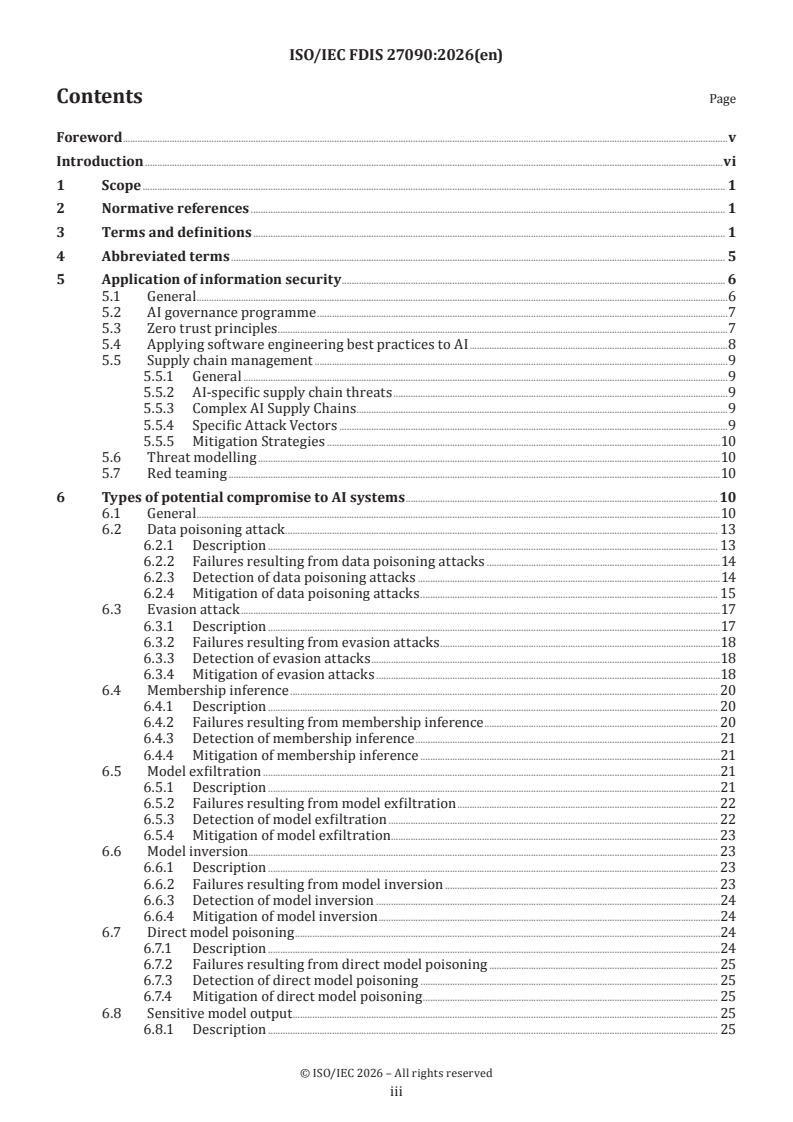
Contents Page
Foreword .v
Introduction .vi
1 Scope . 1
2 Normative references . 1
3 Terms and definitions . 1
4 Abbreviated terms . 5
5 Application of information security . . 6
5.1 General .6
5.2 AI governance programme .7
5.3 Zero trust principles .7
5.4 Applying software engineering best practices to AI .8
5.5 Supply chain management .9
5.5.1 General .9
5.5.2 AI-specific supply chain threats .9
5.5.3 Complex AI Supply Chains .9
5.5.4 Specific Attack Vectors .9
5.5.5 Mitigation Strategies .10
5.6 Threat modelling .10
5.7 Red teaming .10
6 Types of potential compromise to AI systems . 10
6.1 General .10
6.2 Data poisoning attack . 13
6.2.1 Description . 13
6.2.2 Failures resulting from data poisoning attacks .14
6.2.3 Detection of data poisoning attacks .14
6.2.4 Mitigation of data poisoning attacks . 15
6.3 Evasion attack .17
6.3.1 Description .17
6.3.2 Failures resulting from evasion attacks .18
6.3.3 Detection of evasion attacks .18
6.3.4 Mitigation of evasion attacks .18
6.4 Membership inference . 20
6.4.1 Description . 20
6.4.2 Failures resulting from membership inference . 20
6.4.3 Detection of membership inference .21
6.4.4 Mitigation of membership inference .21
6.5 Model exfiltration .21
6.5.1 Description .21
6.5.2 Failures resulting from model exfiltration . 22
6.5.3 Detection of model exfiltration . 22
6.5.4 Mitigation of model exfiltration . . 23
6.6 Model inversion . . 23
6.6.1 Description . 23
6.6.2 Failures resulting from model inversion . 23
6.6.3 Detection of model inversion .24
6.6.4 Mitigation of model inversion .24
6.7 Direct model poisoning .24
6.7.1 Description .24
6.7.2 Failures resulting from direct model poisoning . 25
6.7.3 Detection of direct model poisoning . 25
6.7.4 Mitigation of direct model poisoning . 25
6.8 Sensitive model output . 25
6.8.1 Description . 25
© ISO/IEC 2026 – All rights reserved
iii
ISO/IEC FDIS 27090:2026(en)
6.8.2 Failures resulting from sensitive model output . 25
6.8.3 Detection of sensitive model output . 25
6.8.4 Mitigations of sensitive model output . 25
6.9 Prompt injection . 26
6.9.1 Description . 26
6.9.2 Failures resulting from prompt injection . 26
6.9.3 Detection of prompt injection . . 26
6.9.4 Mitigation of prompt injection .27
6.10 Output contains injection attacks .27
6.10.1 Description .27
6.10.2 Failures resulting from output contains injection attacks .27
6.10.3 Detection of output contains injection attacks .27
6.10.4 Mitigations of output contains injection attacks .27
6.11 Considerations for AI systems . 28
6.11.1 General . 28
6.11.2 Reduce impact by data limitation . 28
6.11.3 Governing and controlling the effect of unwanted model behaviour during the
operation stage . 29
6.11.4 AI system and data provenance .32
7 Mitigations and their interactions with threats and other applied mitigations .33
7.1 General . 33
7.2 Conflicting interactions of mitigations . 33
7.3 Continuity of mitigations across the AI life cycle . 33
7.4 Model and Mitigation Deterioration Over Time . 33
7.5 Logging and monitoring . 34
7.6 Development environment protection . 34
7.7 Malicious input detection and filtering . 35
7.7.1 Detecting out of distribution inputs . 35
7.7.2 Detecting adversarial input . 35
7.8 Throttling model use . 36
7.9 Optimising the size of the model . 36
Annex A (informative) Mapping attacks to AI system life cycle and to assets .37
Annex B (informative) AI-specific versions of conventional attacks .44
Annex C Federated machine learning .49
Bibliography .51
© ISO/IEC 2026 – All rights reserved
iv
ISO/IEC FDIS 27090:2026(en)
Foreword
ISO (the International Organization for Standardization) and IEC (the International Electrotechnical
Commission) form the specialized system for worldwide standardization. National bodies that are
members of ISO or IEC participate in the development of International Standards through technical
committees established by the respective organization to deal with particular fields of technical activity.
ISO and IEC technical committees collaborate in fields of mutual interest. Other international organizations,
governmental and non-governmental, in liaison with ISO and IEC, also take part in the work.
The procedures used to develop this document and those intended for its further maintenance are described
in the ISO/IEC Directives, Part 1. In particular, the different approval criteria needed for the different types
of document should be noted. This document was drafted in accordance with the editorial rules of the ISO/
IEC Directives, Part 2 (see www.iso.org/directives or www.iec.ch/members_experts/refdocs).
ISO and IEC draw attention to the possibility that the implementation of this document may involve the
use of (a) patent(s). ISO and IEC take no position concerning the evidence, validity or applicability of any
claimed patent rights in respect thereof. As of the date of publication of this document, ISO and IEC had not
received notice of (a) patent(s) which may be required to implement this document. However, implementers
are cautioned that this may not represent the latest information, which may be obtained from the patent
database available at www.iso.org/patents and https://patents.iec.ch. ISO and IEC shall not be held
responsible for identifying any or all such patent rights.
Any trade name used in this document is information given for the convenience of users and does not
constitute an endorsement.
For an explanation of the voluntary nature of standards, the meaning of ISO specific terms and expressions
related to conformity assessment, as well as information about ISO's adherence to the World Trade
Organization (WTO) principles in the Technical Barriers to Trade (TBT) see www.iso.org/iso/foreword.html.
In the IEC, see www.iec.ch/understanding-standards.
This document was prepared by Joint Technical Committee ISO/IEC JTC 1, Information technology,
Subcommittee SC 27, Information security, cybersecurity and privacy protection.
Any feedback or questions on this document should be directed to the user’s national standards
body. A complete listing of these bodies can be found at www.iso.org/members.html and
www.iec.ch/national-committees.
© ISO/IEC 2026 – All rights reserved
v
ISO/IEC FDIS 27090:2026(en)
Introduction
Mitigating the risks of security threats to AI systems in a timely manner can help to improve the
trustworthiness of AI systems and of the organizations that use or develop them, and thus earn trust in
these systems and organizations. As technology continues to advance and innovate at a fast pace, emerging
and new security vulnerabilities discovered in AI systems can require continuous evaluation of security
objectives.
AI systems are subject to all of the traditional cybersecurity vulnerabilities, exploits and attacks. They
can be subject to new threats, notably those based on data, input manipulation or actions of AI models.
However, these additional concerns do not supersede conventional cybersecurity concerns. As the overall
cybersecurity threat landscape evolves, the need to protect AI systems against non-AI system specific
threats continues to be an ongoing pursuit.
AI systems have become more widespread as organizations embrace digital transformation, resulting in
an increasing likelihood of security attacks on these systems. Furthermore, as a result of the disparate and
widespread use of AI systems, and especially within safety critical contexts, the result of security attacks
can be severe and in some cases, lead to physical or mental repercussions for individuals.
Due to the way AI systems are developed, and their strong dependency on training data, which can include
user data or unvetted data, these systems can have additional vulnerabilities compared to conventional
information processing systems. Furthermore, there is a lack of understanding when it comes to the
inner workings of AI, specifically when it comes to understanding and diagnosing individual instances of
AI behaviour. This document provides guidance to organizations who are choosing to develop or deploy
AI systems, providing awareness of the types of security threats such systems can face, and helping
organizations understand the consequences of such threats and the most commonly related detection and
mitigation techniques. Such awareness and understanding of this new threat landscape is imperative for
securing AI systems against adversarial attacks.
This document describes various security threats and the exploitation of vulnerabilities that can happen
when using AI systems. The objective is to identify recommended measures to improve the security of AI
systems by identifying threats and the consequences of these threats. The identification of threats can help
users and developers of AI systems better understand security issues related to AI systems.
Security threats and vulnerabilities with a lack of controls in AI systems can lead to failures, impacting both
individuals and businesses.
It can be challenging to detect some threats to AI systems and thus, developing controls without effective
threat detection would not be useful or adequate. This document can help identify where security threats
can be effectively addressed.
[1]
In general, it is recommended that the established commonly accepted security practices in ISO/IEC 27001
[2]
and ISO/IEC 27002 are adhered to. However, the reliance of many AI systems on training data introduces
new threats. Attacks such as data poisoning can cause undesirable outcomes by injecting malicious or
unwanted data into training data. During the operational phase, AI systems gather data to support future
model updates. However, this process can be vulnerable to the introduction of corrupted data, potentially
compromising the integrity of future model retraining during the design and development stage. Where
continuous or iterative learning occurs, data inputs supplied during operation can also become training
data, so corrupted inputs can also become a vector for data poisoning. Accordingly, AI or machine-learning-
enabled work, data, and control flows can benefit from some additional controls. This document can provide
the necessary insights to apply both established and new controls, for example by explaining what the assets
are, and what aspects need protecting.
Other attacks such as model exfiltration through querying can be mitigated by conventional information
security measures such as rate limiting. Models and intellectual property can be stolen even when effective
conventional information security measures are in place, since a model exfiltration attack is established
through legitimate querying of the model. Threat detection is a challenge but an essential component to
effectively mitigate model exfiltration. The measures used to mitigate AI threats can use a defence-in-depth
strategy that leverages multiple security measures to protect an organization's assets.
© ISO/IEC 2026 – All rights reserved
vi
ISO/IEC FDIS 27090:2026(en)
If a choice is made to use unvetted or unverified data for training, risks can increase related to data poisoning
or attacks that can exploit ML data or control flows.
© ISO/IEC 2026 – All rights reserved
vii
FINAL DRAFT International Standard ISO/IEC FDIS 27090:2026(en)
Cybersecurity — Artificial Intelligence — Addressing security
threats and compromises to artificial intelligence systems
1 Scope
This document addresses security threats and compromises specific to artificial intelligence (AI)
systems. This document aims to provide information to organizations to help them better understand the
consequences of security threats specific to AI systems, throughout their life cycle, and descriptions of how
to detect and mitigate such threats.
This document is applicable to all types and sizes of organizations, including public and private companies,
government entities and not-for-profit organizations that develop or use AI systems.
2 Normative references
The following documents are referred to in the text in such a way that some or all of their content constitutes
requirements of this document. For dated references, only the edition cited applies. For undated references,
the latest edition of the referenced document (including any amendments) applies.
ISO/IEC 22989, Information technology — Artificial intelligence — Artificial intelligence concepts and
terminology
ISO/IEC 23053:2022, Framework for Artificial Intelligence (AI) Systems Using Machine Learning (ML)
3 Terms and definitions
For the purposes of this document, the terms and definitions given in ISO/IEC 22989, ISO/IEC 23053 and the
following apply.
ISO and IEC maintain terminology databases for use in standardization at the following addresses:
— ISO Online browsing platform: available at https:// www .iso .org/ obp
— IEC Electropedia: available at https:// www .electropedia .org/
3.1
availability
property of being accessible and usable on demand by an authorized entity
1)
[SOURCE: ISO/IEC 27000:— , 3.4]
3.2
confidentiality
property that information is not made available or disclosed to unauthorized individuals, entities, or
processes
[SOURCE: ISO/IEC 27000:—, 3.2]
1) Under preparation. Stage at the time of publication: ISO/IEC FDIS 27000:2026.
© ISO/IEC 2026 – All rights reserved
ISO/IEC FDIS 27090:2026(en)
3.3
integrity
property of accuracy and completeness
[SOURCE: ISO/IEC 27000:—, 3.36]
3.4
threat
potential cause of an unwanted incident, which can result in harm to a system or organization
[SOURCE: ISO/IEC 27002:2022, 3.1.34]
3.5
attack
successful or unsuccessful unauthorized attempt to destroy, alter, disable, gain access to an asset or any
attempt to expose, steal, or make unauthorized use of an asset
[SOURCE: ISO/IEC 27002:2022, 3.1.3]
3.6
attacker
person deliberately exploiting vulnerabilities in technical and non-technical security controls in order to
steal or compromise information systems and networks, or to compromise availability to legitimate users of
information system and network resources
[SOURCE: ISO/IEC 27033-1:2015, 3.3]
3.7
failure
termination of the ability of a product to perform a required function or its inability to perform within
previously specified limits
Note 1 to entry: Based on the definition in IEEE 610.12-1990.
2)
[SOURCE: ISO/IEC 25030:2007, A.20 ]
3.8
mitigation
limitation of any negative consequence of a particular incident
[SOURCE: ISO 22300:2025, 3.1.47]
3.9
vulnerability
weakness of an asset or control that can be exploited by one or more threats (3.4)
[SOURCE: ISO/IEC 27002:2022, 3.1.38]
3.10
zero-knowledge attack
attack (3.5) on a system that assumes no prior knowledge about the internal information of the system
under attack
Note 1 to entry: The attacker can use context or historical information to infer model vulnerability. The attacker can
probe the system to identify system vulnerabilities.
2) Withdrawn and replaced by ISO/IEC 25030:2019.
© ISO/IEC 2026 – All rights reserved
ISO/IEC FDIS 27090:2026(en)
3.11
perfect-knowledge attack
attack (3.5) on a system that assumes full understanding about the internal information of the system under
attack
Note 1 to entry: In the case of an artificial intelligence system, full knowledge about the internal architecture, variables
or current state of the model can be known by the attacker.
Note 2 to entry: This type of attack does not assume knowledge of credentials.
3.12
partial-knowledge attack
attack (3.5) on a system that assumes partial knowledge about the internal information of the system under
attack
Note 1 to entry: This type of attack does not assume knowledge of credentials.
3.13
data poisoning attack
attack (3.5) where the attacker (3.6) manipulates data to affect the artificial intelligence system’s behaviour
3.14
evasion attack
adversarial attack
attack (3.5) where the attacker (3.6) alters inputs to induce incorrect behaviour of an artificial intelligence
system in response to those inputs
Note 1 to entry: The input alterations can be imperceptible to humans.
3.15
membership inference
membership inference attack
attack (3.5) that results in an attacker (3.6) determining whether or not a given data sample was used in the
training dataset for the model
3.16
model exfiltration attack
model exfiltration
model stealing attack
model extraction attack
attack (3.5) where the attacker (3.6) recreates a model with functionality similar to that of the original
model through (potentially repeated) use of attacker-supplied inputs and observing corresponding outputs
of the artificial intelligence system
3.17
model inversion
model inversion attack
attack (3.5) where the attacker (3.6) reconstructs the original training data (or significant parts thereof) by
supplying inputs to an artificial intelligence system and observing corresponding outputs of the artificial
intelligence system
3.18
direct model poisoning
direct model poisoning attack
attack (3.5) where the attacker (3.6) manipulates the model during development or operations to affect the
artificial intelligence system’s behaviour
3.19
direct model theft
attack (3.5) where the attacker (3.6) obtains the confidential model parameters from an artificial intelligence
system
© ISO/IEC 2026 – All rights reserved
ISO/IEC FDIS 27090:2026(en)
3.20
direct training data leak
compromise to the confidentiality (3.2) of training data
3.21
model input leak
compromise of the confidentiality (3.2) of data input to the model during operation
3.22
sensitive model output
compromise via model output of the confidentiality (3.2) of some portion of a model’s previous input, such as
training data or user prompts
3.23
prompt injection attack
prompt injection
attack (3.5) where the attacker (3.6) crafts content that is provided as or incorporated into an input
instruction to the artificial intelligence system, triggering system behaviour unintended by the system’s
creators
3.24
backdoor attack
undocumented way of gaining unauthorized access to the application, system, or network while bypassing
all the implemented security measures
3.25
data provenance
information on the place and time of origin, derivation or generation of a dataset, proof of authenticity of the
dataset, or a record of past and present ownership of the dataset
[SOURCE: ISO/IEC 5259-1:2024, 3.1.6]
3.26
out of distribution data
OOD data
data containing features relevant for the artificial intelligence (AI) task, either absent or not sufficiently well
represented in the training dataset, that can result in an AI error
Note 1 to entry: Out of distribution (OOD) refers to data or inputs that fall outside the scope of what an AI or machine-
learning model was trained on or is designed to handle. When an AI system encounters OOD data, it can struggle
to make accurate predictions or decisions because it lacks the necessary knowledge and experience to handle such
inputs effectively. OOD data can lead to unexpected or unreliable model behaviour.
[SOURCE: ISO/PAS 8800:2024, 3.2.8]
3.27
foundation model
artificial intelligence model that can be used for or readily adapted to a wide range of tasks in one or more
domains
Note 1 to entry: A typical way to build a foundation model is to apply supervised machine learning or self-supervised
machine learning on a large amount of data.
Note 2 to entry: A foundation model can be used as part of various applications, tasks and use cases, which do not
necessarily involve generative artificial intelligence.
© ISO/IEC 2026 – All rights reserved
ISO/IEC FDIS 27090:2026(en)
3.28
large language model
LLM
machine learning model that encodes the functioning of natural language with a large number of parameters
and facilitates a variety of natural language processing (NLP) tasks
Note 1 to entry: Large language models can be used in a variety of NLP tasks, such as text generation, automatic
summarization, machine translation, classification and more.
Note 2 to entry: Large language models can use large amounts of data and require large compute resources to build.
Note 3 to entry: The functioning of natural language can include considerations of grammar, semantics or other
aspects of how natural language is used.
3.29
generative artificial intelligence
generative AI
research and development of mechanisms, methodologies and applications of generative
artificial intelligence systems
Note 1 to entry: Generative AI is a subdiscipline of artificial intelligence.
3.30
trusted execution environment
TEE
execution environment that runs alongside but is isolated from the device main operating system
[SOURCE: ISO/IEC 27071:2023, 3.3.15]
4 Abbreviated terms
AI artificial intelligence
API application programming interface
DoS denial of service
DP differential privacy
EOT expectation over transformation
IDBT input distortion based techniques
JEA just-enough-access
JIT just-in-time
LLM large language model
ML machine learning
NIST National Institute of Standards and Technology
OOD out of distribution
PII personally identifiable information
RAG retrieval augmented generation
RT random transformations
© ISO/IEC 2026 – All rights reserved
ISO/IEC FDIS 27090:2026(en)
5 Application of information security
5.1 General
Attacks on AI systems can occur throughout the AI system life cycle, as described in ISO/IEC 22989 and
[11] [11]
ISO/IEC 5338. ISO/IEC 22989 provides AI concepts and terminology and ISO/IEC 5338 describes AI
system life cycle processes. Attacks can be classified as attacks during the development and training of AI
systems or during the inference or operation of AI systems, or both. AI systems are susceptible to attacks
considered conventional to all types of information systems. Annex B includes examples of such attacks
that can have specific considerations for an AI system, including specific consequences resulting from such
attacks.
As with any other software system, an AI system's security relies on its hardware, software and
networking stack, as well as the associated organizational, people, physical and technological controls
[2]
(see ISO/IEC 27002:2022, Clauses 5 to 8). When considering AI system or model security and developing
associated control sets, it is important to consider the relevant context and appropriately harden and control
associated assets. Indeed, it is possible that securing the AI system's software stack can be a more efficient
starting point for security investment. For example, if loss of model confidentiality is a concern, securing
the stack against direct model theft would likely be a more effective and efficient starting point than more
resource-intensive controls meant to mitigate against prompt- or API-based exfiltration attempts.
Conventional security attacks on information processing systems can still affect AI systems and thus,
[2]
information security controls, such as those described in ISO/IEC 27002, shall be implemented, based
on the needs of the organization, the information security systems, and the risks identified as a result of
carrying out an information security risk assessment. The organization should consider the views and key
[2]
concepts outlined in ISO/IEC 27002:2022, 4.2, including: control types, information security properties,
cybersecurity concepts, operational capabilities and security domains. Information security is commonly
defined using the CIA triad – confidentiality, integrity, and availability – though organizations can have
specific security-related objectives and priorities for their AI systems based on organizational requirements
[1]
(see ISO/IEC 27001:2022, 6.1).
AI systems should be considered as software components that are usually integrated into another system,
application or data file rather than as a standalone AI or ML model. Therefore, security measures applied
to software and applications also apply to AI systems in all life cycle stages, such as design, deployment or
using an AI system in operation.
The implementation of best practices to protect against information security incidents is paramount for
the protection of AI systems. However, additional or adaptations of security measures can be required to
adequately address the unique threats to AI systems. Such security measures can be incorporated as part
[12] [13]
of risk management of the AI system, as described in ISO/IEC 23894 or relevant ETSI documents.
[14][15]
These measures can be used to mitigate identified risks as part of a responsible AI framework for
[16]
developing or using AI systems such as the AI management system defined in ISO/IEC 42001. Diligence
[1]
should be used when navigating management system standards for both security (e.g. ISO/IEC 27001 )
[16] [14]
and AI (e.g. ISO/IEC 42001 ), and AI security standards (ETSI EN 304 223 ). Examples of existing
measures that can be useful in the detection and mitigation of security attacks on AI systems include
integrity checks on datasets and denial of service mitigation. Logging and monitoring events related to the
operation of the AI system can aid in the analysis of undesirable and anomalous system and user behaviour
[2]
(see ISO/IEC 27002:2022, 8.15 and 8.16). Verification that the AI model has not been tampered with is
[98]
also important to ensure validity of operational results and avoid unwanted bias. Ensuring datasets
are accurately labelled and classified can help to appropriately handle and secure input datasets. Such
datasets should be appropriately secured with access controls and data loss prevention techniques applied
as necessary. Management and operation of the AI system, like other information systems, should include
processes such as threat modelling, security testing, and vulnerability management.
[2]
Security controls described in ISO/IEC 27002, such as those related to secure system architecture and
[2]
engineering principles as described in ISO/IEC 27002:2022, 8.27, should be implemented throughout
the AI system life cycle. Annex A provides further information on mapping attacks on AI systems to the
AI system life cycle and to assets. Potential AI specific compromises, security attacks and vulnerabilities
including but not limited to those specified in Table 1 shall be taken into account throughout the AI system
© ISO/IEC 2026 – All rights reserved
ISO/IEC FDIS 27090:2026(en)
life cycle. Actors across the supply chain can consider potential threats relevant to their function in the
supply chain throughout the entire AI system life cycle (these considerations can be applied to A.6.2.3 and
[16]
A.6.2.6 specified in ISO/IEC 42001:2023, Table A.1). The secure software development framework (SSDF)
[17]
, published by the National Institute of Standards and Technology (NIST) can be used for processes to
[18]
better secure software, including AI systems .
It is recommended to consider the threats according to the system being dealt with using a risk-based
approach. The information described this document are examples and should not be considered as a
reference.
5.2 AI governance programme
To ensure that AI systems and their use within an organization are subject to proper governance (including
security), an AI governance programme should be established and implemented. This involves taking
organizational responsibility for AI by maintaining an inventory of AI systems and their use, performing
[19]
risk analysis on them, and managing those risks (see ISO/IEC 38507 ).
[16]
For guidance on implementation, see ISO/IEC 42001 .
[16]
NOTE ISO/IEC 42001 is a management system standard that focuses on the management processes that
support responsible AI in an organization.
5.3 Zero trust principles
As part of a holistic approach to secure system engineering throughout the AI system life cycle, zero trust
principles can effectively protect AI systems. For each of the attacks described in this document, the zero
trust principles that are effective in helping to protect AI systems are included in the mitigation measures
associated for each attack described in Clause 6.
[2]
ISO/IEC 27002:2022, 8.27 includes zero trust principles to help ensure information systems are securely
designed, implemented and operated within the development life cycle. These principles can be summarized
as:
a) assuming the organization’s information systems are already breached;
b) employing a “never trust and always verify” approach for access to information systems;
c) ensuring requests to information systems use end-to-end encryption;
d) verifying each request to an information system as if it originated externally;
e) using least privilege access control, including access to interacting wi
...
Formatted
...
Style Definition
...
Style Definition
...
Style Definition
...
Style Definition
...
ISO/IEC DISFDIS 27090:2025(en)
Style Definition
...
ISO/IEC JTC 1/SC 27/WG 4
Style Definition
...
Style Definition
...
Secretariat: DIN
Style Definition
...
Date: 20252026-06-2508
Style Definition
...
Style Definition
...
Style Definition
...
Style Definition
...
Style Definition
...
Style Definition
...
Cybersecurity — Artificial Intelligence — Guidance for
Style Definition
...
addressingAddressing security threats and compromises to artificial
Style Definition
...
intelligence systems
Style Definition
...
Style Definition
...
Style Definition
...
Style Definition
...
Style Definition
...
Style Definition
...
Style Definition
...
Style Definition
...
FDIS stage
Style Definition
...
Style Definition
...
Style Definition
...
Style Definition
...
Style Definition
...
Style Definition
...
Style Definition
...
Style Definition
...
Style Definition
...
Style Definition
...
Style Definition
...
This draft is submitted to a parallel vote in ISO, IEC.
Style Definition
...
Style Definition
...
Style Definition
...
Style Definition
...
Style Definition
...
Style Definition
...
Style Definition
...
Style Definition
...
Style Definition
...
Style Definition
...
Style Definition
...
Style Definition
...
Style Definition
...
Style Definition
...
Style Definition
...
Style Definition
...
Style Definition
...
Style Definition
...
Style Definition
...
Style Definition
...
Style Definition
...
St l D fi iti
ISO/IEC DISFDIS 27090:2026(en) Formatted: Font: 11 pt, Bold
Formatted: Font: 11 pt, Bold
Formatted: Font: 11 pt, Bold
© ISO/IEC 20252026
Formatted: HeaderCentered, Space After: 0 pt, Line
spacing: single
All rights reserved. Unless otherwise specified, or required in the context of its implementation, no part of this publication
may be reproduced or utilized otherwise in any form or by any means, electronic or mechanical, including photocopying, Formatted: Default Paragraph Font
or posting on the internet or an intranet, without prior written permission. Permission can be requested from either ISO
Formatted: Indent: Left: 0 cm, Right: 0 cm, Space
at the address below or ISO’s member body in the country of the requester.
Before: 0 pt, No page break before, Adjust space
between Latin and Asian text, Adjust space between
ISO copyright office
Asian text and numbers
CP 401 • Ch. de Blandonnet 8
Formatted: Right: 1.5 cm, Bottom: 1 cm, Gutter: 0 cm,
CH-1214 Vernier, Geneva
Header distance from edge: 1.27 cm, Footer distance
Phone: + 41 22 749 01 11
from edge: 0.5 cm
EmailE-mail: copyright@iso.org
Website: www.iso.orgwww.iso.org
Formatted: German (Germany)
Published in Switzerland
Formatted: English (United Kingdom)
Formatted: Font: 10 pt
Formatted: Font: 10 pt
Formatted: Font: 11 pt
Formatted: FooterPageRomanNumber, Space After: 0
pt, Line spacing: single
ii © ISO/IEC 2024 2026 – All rights reserved
ii
ISO/IEC DISFDIS 27090:20252026(en) Formatted: Font: 11 pt
Formatted: Font: 11 pt
Formatted: Font: 11 pt
Contents
Formatted: HeaderCentered, Left, Space After: 0 pt,
Line spacing: single, Tab stops: Not at 0.71 cm
Foreword . vii
Formatted: Adjust space between Latin and Asian text,
Introduction . viii
Adjust space between Asian text and numbers
1 Scope . 1
2 Normative references . 1
3 Terms and definitions . 1
4 Abbreviated terms . 6
5 Application of information security . 6
5.1 General. 6
5.2 AI governance programme . 7
5.3 Zero trust principles . 8
5.4 Applying software engineering best practices to AI . 9
5.5 Supply chain management . 10
5.6 Threat modelling . 11
5.7 Red teaming . 12
6 Types of potential compromise to AI systems . 12
6.1 General. 12
6.2 Data poisoning attack . 14
6.3 Evasion attack . 19
6.4 Membership inference . 22
6.5 Model exfiltration . 24
6.6 Model inversion . 26
6.7 Direct model poisoning . 27
6.8 Sensitive model output . 28
6.9 Prompt injection . 29
6.10 Output contains injection attacks . 30
6.11 Considerations for AI systems . 31
7 Mitigations and their interactions with threats and other applied mitigations . 37
7.1 General. 37
7.2 Conflicting interactions of mitigations. 37
7.3 Continuity of mitigations across the AI life cycle . 37
7.4 Model and Mitigation Deterioration Over Time . 37
7.5 Logging and monitoring . 38
7.6 Development environment protection . 38
7.7 Malicious input detection and filtering. 39
7.8 Throttling model use . 40
7.9 Optimising the size of the model . 40
Annex A (informative) Mapping attacks to AI system life cycle and to assets . 41
Annex B (informative) AI-specific versions of conventional attacks . 49
Annex C Federated machine learning . 54
Formatted: Font: 10 pt
Bibliography . 56
Formatted: Font: 10 pt
Formatted: FooterCentered, Left, Space Before: 0 pt,
Foreword . vi
Tab stops: Not at 17.2 cm
Introduction . vii
Formatted: Font: 11 pt
1 Scope (mandatory) . 1 Formatted: FooterPageRomanNumber, Left, Space
After: 0 pt, Tab stops: Not at 17.2 cm
© ISO/IEC 20252026 – All rights reserved
iii
ISO/IEC DISFDIS 27090:2026(en) Formatted: Font: 11 pt, Bold
Formatted: Font: 11 pt, Bold
Formatted: Font: 11 pt, Bold
2 Normative references (mandatory) . 1
Formatted: HeaderCentered, Space After: 0 pt, Line
3 Terms and definitions (mandatory) . 1
spacing: single
4 Abbreviated terms . 3
5 Application of information security . 3
5.1 General. 3
5.2 Zero trust principles . 4
5.3 AI governance program . 5
5.4 Applying software engineering best practices to AI . 5
5.5 Supply chain management . 6
5.6 Reduce impact by data limitation . 7
5.6.1 General. 7
5.6.2 Data minimization . 7
5.6.3 Ensure allowed data. 7
5.6.4 Minimal retention . 7
5.6.5 Obfuscate data . 7
5.6.6 Minimize open technical details . 8
5.7 Controlling the effects of unwanted model behaviour during the operation stage . 8
5.7.1 General. 8
5.7.2 Oversight . 9
5.7.3 Least model privilege . 9
5.7.4 Transparency . 9
5.7.5 Continuous validation . 10
5.7.6 Explainability . 10
5.7.7 Unwanted bias testing . 10
5.8 Threat modelling . 10
5.9 Red teaming . 10
6 Threats to AI systems . 10
6.1 General. 10
6.2 Data poisoning attack . 12
6.2.1 Description . 12
6.2.2 Failures resulting from data poisoning attacks . 13
6.2.3 Detection of data poisoning attacks . 13
6.2.4 Mitigation of data poisoning attacks . 14
6.3 Evasion attack . 15
6.3.1 Description . 15
6.3.2 Failures resulting from evasion attacks . 17
6.3.3 Detection of evasion attacks . 17
6.3.4 Mitigation of evasion attacks . 17
6.4 Membership inference . 19
6.4.1 Description . 19
6.4.2 Failures resulting from membership inference . 19
6.4.3 Detection of membership inference . 20
6.4.4 Mitigation of membership inference . 20
6.5 Model exfiltration . 20
6.5.1 Description . 20
6.5.2 Failures resulting from model exfiltration . 21
6.5.3 Detection of model exfiltration . 21
Formatted: Font: 10 pt
6.5.4 Mitigation of model exfiltration . 22
6.6 Model inversion . 22
Formatted: Font: 10 pt
6.6.1 Description . 22
Formatted: Font: 11 pt
6.6.2 Failures resulting from model inversion . 22
Formatted: FooterPageRomanNumber, Space After: 0
6.6.3 Detection of model inversion . 23
pt, Line spacing: single
iv © ISO/IEC 2024 2026 – All rights reserved
iv
ISO/IEC DISFDIS 27090:20252026(en) Formatted: Font: 11 pt
Formatted: Font: 11 pt
Formatted: Font: 11 pt
6.6.4 Mitigation of model inversion . 23
Formatted: HeaderCentered, Left, Space After: 0 pt,
6.7 Direct model poisoning . 23
Line spacing: single, Tab stops: Not at 0.71 cm
6.7.1 Description . 23
6.7.2 Failures resulting from direct model poisoning . 23
6.7.3 Detection of direct model poisoning . 24
6.7.4 Mitigation of direct model poisoning . 24
6.8 Direct model theft . 24
6.8.1 Description . 24
6.8.2 Failures resulting from direct model theft . 24
6.8.3 Detection of direct model theft . 24
6.8.4 Mitigations of direct model theft . 24
6.9 Direct training data leak . 25
6.9.1 Description . 25
6.9.2 Failures resulting from training data leak . 25
6.9.3 Detection of training data leak . 25
6.9.4 Mitigations of training data leak . 25
6.10 Model input leak . 26
6.10.1 Description . 26
6.10.2 Failures resulting from model input leak . 27
6.10.3 Detection of model input leak . 27
6.10.4 Mitigations of model input leak . 27
6.11 Sensitive model output . 27
6.11.1 Description . 27
6.11.2 Failures resulting from sensitive model output . 27
6.11.3 Detection of sensitive model output . 27
6.11.4 Mitigations of sensitive model output . 27
6.12 Prompt injection . 28
6.12.1 Description . 28
6.12.2 Failures resulting from prompt injection . 28
6.12.3 Detection of prompt injection . 28
6.12.4 Mitigation of prompt injection . 28
6.13 Output contains injection attacks . 29
6.13.1 Description . 29
6.13.2 Failures resulting from output contains injection attacks . 29
6.13.3 Detection of output contains injection attacks . 29
6.13.4 Mitigations of output contains injection attacks . 29
7 Mitigations and their interactions with threats and other mitigations . 29
7.1 Overview . 29
7.2 Conflicting interactions of mitigations. 30
7.3 Continuity of mitigations across the AI life cycle . 30
7.3 Model and Mitigation Deterioration Over Time . 30
7.4 Logging and monitoring . 30
7.5 Development environment protection . 31
7.6 Malicious input detection and filtering. 31
7.6.1 Detecting odd input . 31
7.6.2 Detecting adversarial input . 32
7.7 Throttling model use . 32
Formatted: Font: 10 pt
7.8 Obscuring confidence . 32
Formatted: Font: 10 pt
7.9 Attaining a sufficiently small model . 32
Formatted: FooterCentered, Left, Space Before: 0 pt,
Annex A (informative) Mapping attacks to AI system life cycle and to assets . 33
Tab stops: Not at 17.2 cm
A.1 General. 33 Formatted: Font: 11 pt
A.2 Mapping attacks to the AI system life cycle . 33 Formatted: FooterPageRomanNumber, Left, Space
After: 0 pt, Tab stops: Not at 17.2 cm
© ISO/IEC 20252026 – All rights reserved
v
ISO/IEC DISFDIS 27090:2026(en) Formatted: Font: 11 pt, Bold
Formatted: Font: 11 pt, Bold
Formatted: Font: 11 pt, Bold
A.3 Asset identification and protection . 35
Formatted: HeaderCentered, Space After: 0 pt, Line
A.4 Mapping threats to AI and ML assets . 36
spacing: single
Annex B (informative) AI-specific versions of conventional attacks . 40
B.1 General. 40
B.2 Denial-of-Service, or Scaling, attacks . 40
B.2.1 Introduction . 40
B.2.2 Detection . 40
B.2.3 Mitigation . 40
B.3 Supply Chain attacks . 40
B.3.1 Introduction . 40
B.3.2 Detection . 40
B.3.3 Mitigation . 41
B.4 Backdoor attacks . 41
Bibliography . 42
Formatted: Font: 10 pt
Formatted: Font: 10 pt
Formatted: Font: 11 pt
Formatted: FooterPageRomanNumber, Space After: 0
pt, Line spacing: single
vi © ISO/IEC 2024 2026 – All rights reserved
vi
ISO/IEC DISFDIS 27090:20252026(en) Formatted: Font: 11 pt
Formatted: Font: 11 pt
Formatted: Font: 11 pt
Foreword
Formatted: HeaderCentered, Left, Space After: 0 pt,
Line spacing: single, Tab stops: Not at 0.71 cm
ISO (the International Organization for Standardization) and IEC (the International Electrotechnical
Commission) form the specialized system for worldwide standardization. National bodies that are members
of ISO or IEC participate in the development of International Standards through technical committees
established by the respective organization to deal with particular fields of technical activity. ISO and IEC
technical committees collaborate in fields of mutual interest. Other international organizations, governmental
and non-governmental, in liaison with ISO and IEC, also take part in the work.
The procedures used to develop this document and those intended for its further maintenance are described
in the ISO/IEC Directives, Part 1. In particular, the different approval criteria needed for the different types of
document should be noted. This document was drafted in accordance with the editorial rules of the ISO/IEC
Directives, Part 2 (see www.iso.org/directiveswww.iso.org/directives or
www.iec.ch/members_experts/refdocswww.iec.ch/members_experts/refdocs).
ISO and IEC draw attention to the possibility that the implementation of this document may involve the use of
(a) patent(s). ISO and IEC take no position concerning the evidence, validity or applicability of any claimed
patent rights in respect thereof. As of the date of publication of this document, ISO and IEC had not received
Formatted: Font color: Auto
notice of (a) patent(s) which may be required to implement this document. However, implementers are
cautioned that this may not represent the latest information, which may be obtained from the patent database
available at www.iso.org/patents and https://patents.iec.ch.www.iso.org/patents and https://patents.iec.ch.
ISO and IEC shall not be held responsible for identifying any or all such patent rights.
Any trade name used in this document is information given for the convenience of users and does not
constitute an endorsement.
For an explanation of the voluntary nature of standards, the meaning of ISO specific terms and expressions
related to conformity assessment, as well as information about ISO's adherence to the World Trade
Organization (WTO) principles in the Technical Barriers to Trade (TBT) see
www.iso.org/iso/foreword.html.www.iso.org/iso/foreword.html. In the IEC, see www.iec.ch/understanding-
standardswww.iec.ch/understanding-standards.
This document was prepared by Joint Technical Committee ISO/IEC JTC 1, Information technology,
Subcommittee SC 27, Information security, cybersecurity and privacy protection.
Any feedback or questions on this document should be directed to the user’s national standards body. A
complete listing of these bodies can be found at www.iso.org/members.htmlwww.iso.org/members.html and
www.iec.ch/national-committeeswww.iec.ch/national-committees.
Formatted: Font: 10 pt
Formatted: Font: 10 pt
Formatted: FooterCentered, Left, Space Before: 0 pt,
Tab stops: Not at 17.2 cm
Formatted: Font: 11 pt
Formatted: FooterPageRomanNumber, Left, Space
After: 0 pt, Tab stops: Not at 17.2 cm
© ISO/IEC 20252026 – All rights reserved
vii
ISO/IEC DISFDIS 27090:2026(en) Formatted: Font: 11 pt, Bold
Formatted: Font: 11 pt, Bold
Formatted: Font: 11 pt, Bold
Introduction
Formatted: HeaderCentered, Space After: 0 pt, Line
spacing: single
Mitigating the risks of security threats to AI systems in a timely manner can help to improve the
Formatted: Adjust space between Latin and Asian text,
trustworthiness of AI systems and of the organizations that use or develop them, and thus earn trust in these
Adjust space between Asian text and numbers
systems and organizations. As technology continues to advance and innovate at a fast pace, emerging and new
security vulnerabilities discovered in AI systems can require continuous evaluation of security objectives.
AI systems are subject to all of the traditional cybersecurity vulnerabilities, exploits and attacks. They can be
subject to new threats, notably those based on the data, based on input manipulation or on actions of AI models
. However, these additional concerns do not supersede conventional cybersecurity concerns. As the overall
cybersecurity threat landscape evolves, the need to protect AI systems against non-AI system specific threats
continues to be an ongoing pursuit.
AI systems have become more widespread as organizations embrace digital transformation, resulting in an
increasing likelihood of security attacks on these systems. Furthermore, as a result of the disparate and
widespread use of AI systems, and especially within safety critical contexts, the result of security attacks can
be severe and in some cases, lead to physical or mental repercussions for individuals.
Due to the way AI systems are developed, and their strong dependency on training data, which can include
user data or unvetted data, these systems can have additional vulnerabilities compared to conventional
information processing systems. Furthermore, there is a lack of understanding when it comes to the inner
workings of AI, specifically when it comes to understanding and diagnosing individual instances of AI
behaviour. This document provides guidance to organizations who are choosing to develop or deploy AI
systems, providing awareness of the types of security threats such systems can face, and helping organizations
understand the consequences of such threats and the most commonly related detection and mitigation
techniques. Such awareness and understanding of this new threat landscape is imperative for securing AI
systems against adversarial attacks.
This document describes various security threats and the exploitation of vulnerabilities that can happen when
using AI systems. The objective is to identify recommended measures to improve the security of AI systems
by identifying threats and the consequences of these threats. The identification of threats can help users and
developers of AI systems better understand security issues related to AI systems.
Security threats and vulnerabilities with a lack of controls in AI systems can lead to failures, impacting both
individuals and businesses.
It can be challenging to detect some threats to AI systems and thus, developing controls without effective
threat detection would not be useful or adequate. This document can help identify where security threats can
be effectively addressed.
In general, it is recommended that the established commonly accepted security practices in ISO/IEC 27001
[1][1] [2][2]
and ISO/IEC 27002 are adhered to. However, the reliance of many AI systems on training data
introduces new threats. Attacks such as data poisoning can cause undesirable outcomes by injecting malicious
or unwanted data into training data. During the operational phase, AI systems gather data to support future
model updates. However, this process maycan be vulnerable to the introduction of corrupted data, potentially
compromising the integrity of future model retraining during the design and development stage. Where
continuous or iterative learning occurs, data inputs supplied during operation can also become training data,
so corrupted inputs can also become a vector for data poisoning. Accordingly, AI or machine -learning (ML)--
enabled work, data, and control flows can benefit from some additional controls. This document can provide
Formatted: Font: 10 pt
the necessary insights to apply both established and new controls, for example by explaining what the assets
are, and what aspects need protecting.
Formatted: Font: 10 pt
Formatted: Font: 11 pt
Other attacks such as model exfiltration through querying can be mitigated by conventional information
Formatted: FooterPageRomanNumber, Space After: 0
security measures such as rate limiting. Models and intellectual property can be stolen even when effective
pt, Line spacing: single
viii © ISO/IEC 2024 2026 – All rights reserved
viii
ISO/IEC DISFDIS 27090:20252026(en) Formatted: Font: 11 pt
Formatted: Font: 11 pt
Formatted: Font: 11 pt
conventional information security measures are in place, since a model exfiltration attack is established
Formatted: HeaderCentered, Left, Space After: 0 pt,
through legitimate querying of the model. Threat detection is a challenge but an essential component to
Line spacing: single, Tab stops: Not at 0.71 cm
effectively mitigate model exfiltration. The measures used to mitigate AI threats can use a defence -in -depth
strategy that leverages multiple security measures to protect an organization's assets.
If a choice is made to use unvetted or unverified data for training, risks can increase related to data poisoning
or attacks that can exploit ML data or control flows.
Formatted: Font: 10 pt
Formatted: Font: 10 pt
Formatted: FooterCentered, Left, Space Before: 0 pt,
Tab stops: Not at 17.2 cm
Formatted: Font: 11 pt
Formatted: FooterPageRomanNumber, Left, Space
After: 0 pt, Tab stops: Not at 17.2 cm
© ISO/IEC 20252026 – All rights reserved
ix
DRAFT International Standard ISO/IEC DIS 27090:2025(en)
Formatted: Left
Formatted: Main Title 1, Space After: 0 pt, Adjust
Cybersecurity — Artificial Intelligence — Guidance for
space between Latin and Asian text, Adjust space
addressingAddressing security threats and compromises to artificial
between Asian text and numbers
intelligence systems
1 Scope Formatted: Right: 1.5 cm, Bottom: 1 cm, Gutter: 0 cm,
Section start: New page, Header distance from edge:
This document addresses security threats and compromises specific to artificial intelligence (AI) systems. This 1.27 cm, Footer distance from edge: 0.5 cm
document aims to provide information to organizations to help them better understand the consequences of
Formatted: Adjust space between Latin and Asian text,
security threats specific to AI systems, throughout their life cycle, and descriptions of how to detect and
Adjust space between Asian text and numbers
mitigate such threats.
This document is applicable to all types and sizes of organizations, including public and private companies,
government entities and not-for-profit organizations that develop or use AI systems.
Formatted: Default Paragraph Font
2 Normative references
Formatted: Default Paragraph Font
Formatted: Default Paragraph Font
The following documents are referred to in the text in such a way that some or all of their content constitutes
requirements of this document. For dated references, only the edition cited applies. For undated references,
Formatted: Adjust space between Latin and Asian text,
the latest edition of the referenced document (including any amendments) applies.
Adjust space between Asian text and numbers, Tab
stops: Not at 0.7 cm + 1.4 cm + 2.1 cm + 2.8 cm +
ISO/IEC 22989:2022, Information technology — Artificial intelligence — Artificial intelligence concepts and
3.5 cm + 4.2 cm + 4.9 cm + 5.6 cm + 6.3 cm + 7 cm
terminology
Formatted: Default Paragraph Font
Formatted: Default Paragraph Font
ISO/IEC 23053:2022, Framework for Artificial Intelligence (AI) Systems Using Machine Learning (ML)
Formatted: Default Paragraph Font
3 Terms and definitions
Formatted: Default Paragraph Font
Formatted: Adjust space between Latin and Asian text,
For the purposes of this document, the terms and definitions given in ISO/IEC 22989, ISO/IEC
Adjust space between Asian text and numbers
23053and23053 and the following apply.
Formatted: Default Paragraph Font
ISO and IEC maintain terminology databases for use in standardization at the following addresses:
Formatted: Default Paragraph Font
— — ISO Online browsing platform: available at https://www.iso.org/obphttps://www.iso.org/obp Formatted: Default Paragraph Font
Formatted: English (United Kingdom)
— — IEC Electropedia: available at https://www.electropedia.org/https://www.electropedia.org/
Formatted: Font: 11 pt, English (United Kingdom)
3.1 3.1
Formatted: English (United Kingdom)
availability
Formatted: English (United Kingdom)
property of being accessible and usable on demand by an authorized entity
Formatted: TermNum2, Adjust space between Latin
1 1)
and Asian text, Adjust space between Asian text and
[SOURCE: ISO/IEC 27000:2018 ,:— , 3.74]
numbers
Formatted: Default Paragraph Font
Formatted: Default Paragraph Font
Formatted: Default Paragraph Font
Formatted: Font: 11 pt
To be withdrawn and replaced by ISO/IEC 27000:2026.
1)
Under preparation. Stage at the time of publication: ISO/IEC FDIS 27000:2026. Formatted: Footer, Left, Space After: 0 pt, Tab stops:
Not at 17.2 cm
© ISO/IEC 2025 – All rights reserved
ISO/IEC DISFDIS 27090:2026(en) Formatted: Font: 11 pt, Bold
Formatted: Font: 11 pt, Bold
Formatted: Font: 11 pt, Bold
3.2 3.2
Formatted: HeaderCentered, Space After: 0 pt, Line
confidentiality
spacing: single
property that information is not made available or disclosed to unauthorized individuals, entities, or processes
[SOURCE: ISO/IEC 27000:2018,:—, 3.102]
Formatted: Default Paragraph Font
Formatted: Default Paragraph Font
3.3 3.3
Formatted: Default Paragraph Font
integrity
property of accuracy and completeness
[SOURCE: ISO/IEC 27000:2018,:—, 3.36]
Formatted: Default Paragraph Font
Formatted: Default Paragraph Font
3.4 3.4
Formatted: Default Paragraph Font
threat
potential cause of an unwanted incident, which can result in harm to a system or organization
[SOURCE: ISO/IEC 27000:201827002:2022, 3.741.34]
Formatted: Default Paragraph Font
Formatted: Default Paragraph Font
3.5 3.5
attack
successful or unsuccessful unauthorized attempt to destroy, expose, alter, disable, steal or gain unauthorized
access to an asset or any attempt to expose, steal, or make unauthorized use of an asset
[SOURCE: ISO/IEC 27000:201827002:2022, 3.2]
Formatted: Default Paragraph Font
1.3.6]
Formatted: TermNum2
3.6
attacker
Formatted: Source
person deliberately exploiting vulnerabilities in technical and non-technical security controls in order to steal
Formatted: TermNum2, Adjust space between Latin
or compromise information system
...