

ISO 1017:2006
(Main)Brown coals and lignites — Determination of acetone-soluble material ("resinous substance") in the benzene-soluble extract
General Information
- Abstract
ISO 1017:2006 specifies a method of determining the mass fraction of acetone-soluble material ("resinous substance") in the benzene-soluble extract from brown coals and lignites.
- Status
- Withdrawn
- Publication Date
- 28-Nov-2006
- Technical Committee
- ISO/TC 27/SC 5 - Methods of analysis
- Drafting Committee
- ISO/TC 27/SC 5/WG 7 - Brown coals and lignites
- Current Stage
- 9599 - Withdrawal of International Standard
- Start Date
- 29-May-2025
- Completion Date
- 29-Aug-2026

Overview
ISO 1017:2006 specifies a laboratory method for determining the mass fraction of acetone‑soluble material (termed “resinous substance”) in the benzene‑soluble extract obtained from brown coals and lignites. The method defines sample preparation, extraction conditions, drying and calculation rules so results are comparable between laboratories. Note: the acetone extract can also dissolve some waxes in addition to the resinous fraction.
Key topics and technical requirements
- Scope: Quantifies acetone‑soluble material in the benzene‑soluble fraction of brown coal/lignite extracts (reference to ISO 975 for obtaining the benzene extract).
- Reagents & safety: Uses analytical‑grade acetone (flammable - follow appropriate laboratory safety and ventilation).
- Apparatus: Centrifuge (capable of ~1 600 r/min), 15 ml glass centrifuge vessels with stoppers, 20 mm × 50 mm evaporating dish, vacuum drying oven (80 ± 2 °C at ≈50 kPa), air oven (100–110 °C), infrared lamp, and a 100 µm wire‑cloth sieve.
- Sample prep: Benzene‑soluble extract residue must pass a 100 µm sieve; viscous residues are cooled (solid CO2 to −80 °C) and crushed.
- Controlled extraction: Extract with acetone at 18–22 °C. Solvent and room temperatures at the start and end of the test must be within 0.5 °C of each other to ensure selectivity. Typical test: ~0.5 g sample, 7 ml acetone, shake 2 min; repeat (up to 4 times) until extract is colourless; decant/centrifuge/filter into evaporating dish.
- Drying & weighing: Evaporate acetone (vacuum oven or IR lamp), then dry to constant mass (air oven at 105 ± 3 °C) and weigh residue.
- Calculation: The mass fraction is calculated from the mass of acetone‑soluble residue and the mass of benzene‑soluble extract taken, using the temperature correction factor K as specified in the Standard.
- Precision: Repeatability and reproducibility limits are provided (e.g., for mass fraction <20%: repeatability 0.3% absolute, reproducibility 0.5% absolute). Results are reported as the mean of duplicate determinations to 0.1% (mass fraction).
Applications and users
- Coal and lignite testing laboratories performing quality control, fuel characterization and research.
- Mining companies and coal suppliers verifying resinous content for processing or blending decisions.
- Power plants and industrial users assessing fuel properties that affect combustion, tar formation or downstream processing.
- Research organizations studying brown coal/lignite chemistry and solvent extractables.
Related standards
- ISO 975 - Brown coals and lignites: determination of yield of benzene‑soluble extract (semi‑automatic method), referenced as the source of the benzene extract preparation.
- Prepared by ISO/TC 27 (Solid mineral fuels), Subcommittee SC 5 (Methods of analysis).
Keywords: ISO 1017:2006, brown coals, lignites, acetone‑soluble material, resinous substance, benzene‑soluble extract, laboratory method, coal analysis, precision limits.
Relations
- Effective Date
- 27-May-2023
- Effective Date
- 15-Apr-2008
Get Certified
Connect with accredited certification bodies for this standard

Bureau Veritas Chile
Bureau Veritas certification services in Chile.
Bureau Veritas Peru
Bureau Veritas certification services in Peru.
BVQI Peru
Bureau Veritas certification in Peru.
Sponsored listings
Frequently Asked Questions
ISO 1017:2006 is a standard published by the International Organization for Standardization (ISO). Its full title is "Brown coals and lignites — Determination of acetone-soluble material ("resinous substance") in the benzene-soluble extract". This standard covers: ISO 1017:2006 specifies a method of determining the mass fraction of acetone-soluble material ("resinous substance") in the benzene-soluble extract from brown coals and lignites.
ISO 1017:2006 specifies a method of determining the mass fraction of acetone-soluble material ("resinous substance") in the benzene-soluble extract from brown coals and lignites.
ISO 1017:2006 is classified under the following ICS (International Classification for Standards) categories: 73.040 - Coals. The ICS classification helps identify the subject area and facilitates finding related standards.
ISO 1017:2006 has the following relationships with other standards: It is inter standard links to ISO 1017:2025, ISO 1017:1985. Understanding these relationships helps ensure you are using the most current and applicable version of the standard.
ISO 1017:2006 is available in PDF format for immediate download after purchase. The document can be added to your cart and obtained through the secure checkout process. Digital delivery ensures instant access to the complete standard document.
Standards Content (Sample)
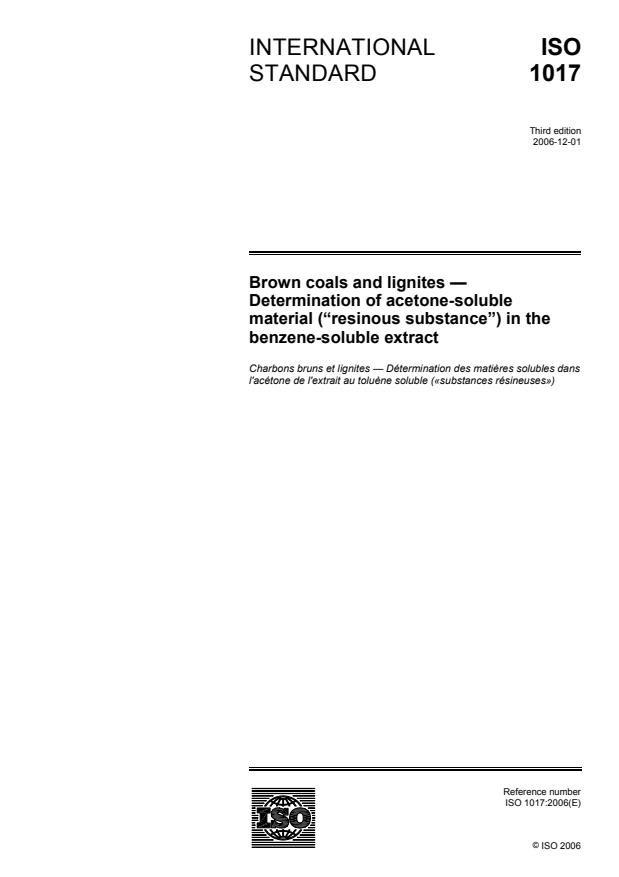
INTERNATIONAL ISO
STANDARD 1017
Third edition
2006-12-01
Brown coals and lignites —
Determination of acetone-soluble
material (“resinous substance”) in the
benzene-soluble extract
Charbons bruns et lignites — Détermination des matières solubles dans
l'acétone de l'extrait au toluène soluble («substances résineuses»)
Reference number
©
ISO 2006
PDF disclaimer
This PDF file may contain embedded typefaces. In accordance with Adobe's licensing policy, this file may be printed or viewed but
shall not be edited unless the typefaces which are embedded are licensed to and installed on the computer performing the editing. In
downloading this file, parties accept therein the responsibility of not infringing Adobe's licensing policy. The ISO Central Secretariat
accepts no liability in this area.
Adobe is a trademark of Adobe Systems Incorporated.
Details of the software products used to create this PDF file can be found in the General Info relative to the file; the PDF-creation
parameters were optimized for printing. Every care has been taken to ensure that the file is suitable for use by ISO member bodies. In
the unlikely event that a problem relating to it is found, please inform the Central Secretariat at the address given below.
© ISO 2006
All rights reserved. Unless otherwise specified, no part of this publication may be reproduced or utilized in any form or by any means,
electronic or mechanical, including photocopying and microfilm, without permission in writing from either ISO at the address below or
ISO's member body in the country of the requester.
ISO copyright office
Case postale 56 • CH-1211 Geneva 20
Tel. + 41 22 749 01 11
Fax + 41 22 749 09 47
E-mail copyright@iso.org
Web www.iso.org
Published in Switzerland
ii © ISO 2006 – All rights reserved
Foreword
ISO (the International Organization for Standardization) is a worldwide federation of national standards bodies
(ISO member bodies). The work of preparing International Standards is normally carried out through ISO
technical committees. Each member body interested in a subject for which a technical committee has been
established has the right to be represented on that committee. International organizations, governmental and
non-governmental, in liaison with ISO, also take part in the work. ISO collaborates closely with the
International Electrotechnical Commission (IEC) on all matters of electrotechnical standardization.
International Standards are drafted in accordance with the rules given in the ISO/IEC Directives, Part 2.
The main task of technical committees is to prepare International Standards. Draft International Standards
adopted by the technical committees are circulated to the member bodies for voting. Publication as an
International Standard requires approval by at least 75 % of the member bodies casting a vote.
Attention is drawn to the possibility that some of the elements of this document may be the subject of patent
rights. ISO shall not be held responsible for identifying any or all such patent rights.
ISO 1017 was prepared by Technical Committee ISO/TC 27, Solid mineral fuels, Subcommittee SC 5,
Methods of analysis.
This third edition cancels and replaces the second edition (ISO 1017:1985), which has been technically
revised.
INTERNATIONAL STANDARD ISO 1017:2006(E)
Brown coals and lignites — Determination of acetone-soluble
material (“resinous substance”) in the benzene-soluble extract
1 Scope
This International Standard specifies a method of determining the mass fraction of acetone-soluble material
(“resinous substance”) in the benzene-soluble extract from brown coals and lignites.
NOTE The acetone extract will also contain a percentage of wax dissolved simultaneously with the "resinous
substance".
2 Normative references
The following referenced documents are indispensable for the application of this document. For dated
references, only the edition cited applies. For undated references, the latest edition of the referenced
document (including any amendments) applies.
ISO 975, Brown coals and lignites — Determination of yield of benzene-soluble extract — Semi-automatic
method
3 Principle
The sample of benzene-soluble extract from brown coal or lignite obtained by the procedure described in
ISO 975 is extracted with acetone at a temperature of 18 to 22 °C. The soluble fraction is filtered or
centrifuged off and, after evaporation of the solvent, dried to constant mass.
The percentage of acetone-soluble material is calculated from the mass of residue after drying.
4 Reagent
4.1 Acetone, of analytical reagent grade.
WARNING — Acetone is flammable, and toxic by inhalation, ingestion or skin absorption
5 Apparatus
5.1 Centrifuge, capable of operating at 1 600 r/min.
The rotational frequency of the centrifuge shall be sufficient to ensure separation of the soluble fraction from
the parent coal.
5.
...