


ISO 9825:2005
(Main)Hydrometry — Field measurement of discharge in large rivers and rivers in flood
Hydrometry — Field measurement of discharge in large rivers and rivers in flood
ISO 9825:2005 deals specifically with the measurement of discharge in large rivers and the measurement of rivers in flood. It also describes the relevant field measurements when it becomes necessary to use indirect methods of estimating discharge.
Hydrométrie — Mesurage in situ du débit des grandes rivières et des débits de crue
General Information
Relations
Overview - ISO 9825:2005 (Hydrometry - Field measurement of discharge in large rivers and rivers in flood)
ISO 9825:2005 provides guidance for the field measurement of river discharge specifically in large rivers and rivers in flood. The standard addresses direct and indirect measurement methods, practical difficulties encountered at large scale (width, depth, high velocity, debris and turbulence), and the logistical and safety issues unique to flood conditions. Measurements and reporting use SI units and reference a suite of complementary ISO hydrometry standards.
Key topics and technical requirements
- Scope and purpose: Focus on discharge measurement techniques that are appropriate or require modification for large rivers and flood flows.
- Measurement challenges: Problems of scale (great width, great depth, high velocity), position fixing, and sampling accuracy under turbulent conditions.
- Primary methods covered:
- Velocity–area methods (current-meter from bridge, cableway or boat; moving-boat technique)
- Acoustic Doppler methods (ADCP/ADP profilers deployed from powerboats; internal compass and bottom-tracking; multi-beam velocity sampling)
- Tracer dilution techniques (for special circumstances; see ISO 9555 series)
- Weirs and flumes and other engineered structures where applicable
- Indirect methods when direct measurement is impractical (see ISO 1070)
- Operational guidance: Use of cableways for rivers up to ~500 m (trolley deployments), combined cable/boat approaches for 500 m–1 km, and position-fixing/advanced survey equipment for very wide sections. Emphasis on planning, crew safety, and use of multiple teams to reduce measurement time.
- Normative references and units: Cross-referenced to ISO 748, ISO 6416, ISO 6420, ISO 9555, ISO 1438‑1 and others; SI units mandated.
Applications - who uses ISO 9825:2005 and why
- Hydrologists and hydrometric technicians conducting field discharge surveys on large rivers and during flood events.
- Water resource and flood-risk engineers needing reliable discharge data for modelling, design and emergency response.
- Environmental agencies, utilities and researchers requiring standardized measurement practice for monitoring, compliance and data interoperability. Benefits include improved measurement consistency, enhanced safety and clearer selection criteria for methods (current-meter, moving-boat, acoustic Doppler, tracer techniques, weirs/flumes) under extreme or large-scale river conditions.
Related standards
Relevant ISO standards referenced by ISO 9825:2005 include:
- ISO 748 (velocity–area methods)
- ISO 6416 (ultrasonic/acoustic methods)
- ISO 6420 (position fixing for hydrometric boats)
- ISO 9555 (tracer-dilution methods)
- ISO 1070 (slope-area/indirect methods)
- A range of weir and flume standards (ISO 1438‑1, ISO 3846, ISO 4374, etc.)
Keywords: ISO 9825:2005, hydrometry, field measurement of discharge, large rivers, flood flow measurement, acoustic Doppler, current-meter, moving-boat, tracer dilution, weirs and flumes.
Standards Content (Sample)
INTERNATIONAL ISO
STANDARD 9825
Second edition
2005-05-15
Hydrometry — Field measurement of
discharge in large rivers and rivers in
flood
Hydrométrie — Mesurage in situ du débit des grandes rivières et des
débits de crue
Reference number
©
ISO 2005
PDF disclaimer
This PDF file may contain embedded typefaces. In accordance with Adobe's licensing policy, this file may be printed or viewed but
shall not be edited unless the typefaces which are embedded are licensed to and installed on the computer performing the editing. In
downloading this file, parties accept therein the responsibility of not infringing Adobe's licensing policy. The ISO Central Secretariat
accepts no liability in this area.
Adobe is a trademark of Adobe Systems Incorporated.
Details of the software products used to create this PDF file can be found in the General Info relative to the file; the PDF-creation
parameters were optimized for printing. Every care has been taken to ensure that the file is suitable for use by ISO member bodies. In
the unlikely event that a problem relating to it is found, please inform the Central Secretariat at the address given below.
© ISO 2005
All rights reserved. Unless otherwise specified, no part of this publication may be reproduced or utilized in any form or by any means,
electronic or mechanical, including photocopying and microfilm, without permission in writing from either ISO at the address below or
ISO's member body in the country of the requester.
ISO copyright office
Case postale 56 • CH-1211 Geneva 20
Tel. + 41 22 749 01 11
Fax + 41 22 749 09 47
E-mail copyright@iso.org
Web www.iso.org
Published in Switzerland
ii © ISO 2005 – All rights reserved
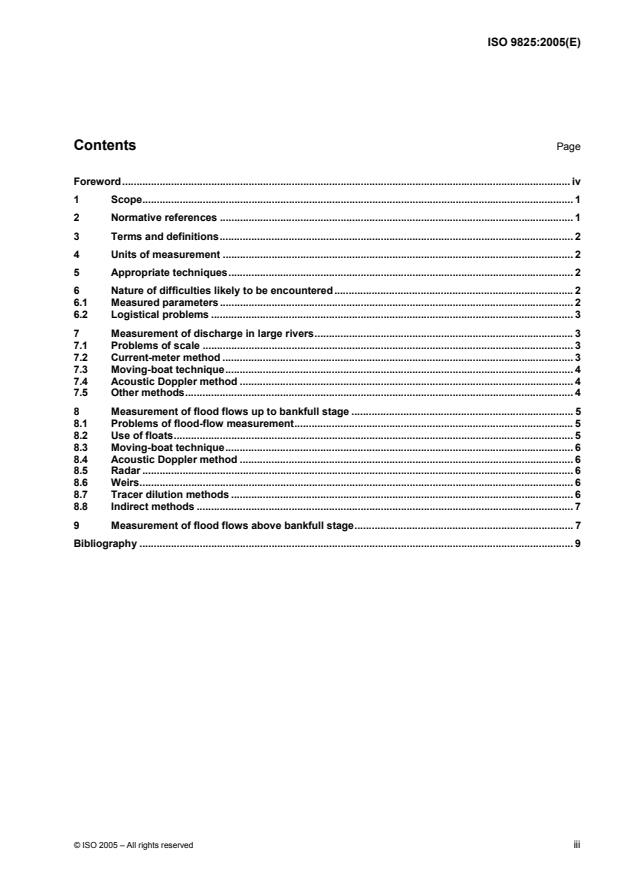
Contents Page
Foreword. iv
1 Scope. 1
2 Normative references . 1
3 Terms and definitions. 2
4 Units of measurement . 2
5 Appropriate techniques. 2
6 Nature of difficulties likely to be encountered. 2
6.1 Measured parameters . 2
6.2 Logistical problems . 3
7 Measurement of discharge in large rivers. 3
7.1 Problems of scale . 3
7.2 Current-meter method . 3
7.3 Moving-boat technique. 4
7.4 Acoustic Doppler method . 4
7.5 Other methods. 4
8 Measurement of flood flows up to bankfull stage . 5
8.1 Problems of flood-flow measurement. 5
8.2 Use of floats. 5
8.3 Moving-boat technique. 6
8.4 Acoustic Doppler method . 6
8.5 Radar . 6
8.6 Weirs. 6
8.7 Tracer dilution methods . 6
8.8 Indirect methods . 7
9 Measurement of flood flows above bankfull stage. 7
Bibliography . 9
Foreword
ISO (the International Organization for Standardization) is a worldwide federation of national standards bodies
(ISO member bodies). The work of preparing International Standards is normally carried out through ISO
technical committees. Each member body interested in a subject for which a technical committee has been
established has the right to be represented on that committee. International organizations, governmental and
non-governmental, in liaison with ISO, also take part in the work. ISO collaborates closely with the
International Electrotechnical Commission (IEC) on all matters of electrotechnical standardization.
International Standards are drafted in accordance with the rules given in the ISO/IEC Directives, Part 2.
The main task of technical committees is to prepare International Standards. Draft International Standards
adopted by the technical committees are circulated to the member bodies for voting. Publication as an
International Standard requires approval by at least 75 % of the member bodies casting a vote.
Attention is drawn to the possibility that some of the elements of this document may be the subject of patent
rights. ISO shall not be held responsible for identifying any or all such patent rights.
ISO 9825 was prepared by Technical Committee ISO/TC 113, Hydrometry.
This second edition cancels and replaces the first edition (ISO 9825:1994), which has been technically revised.
iv © ISO 2005 – All rights reserved
INTERNATIONAL STANDARD ISO 9825:2005(E)
Hydrometry — Field measurement of discharge in large rivers
and rivers in flood
1 Scope
This International Standard deals specifically with the measurement of discharge in large rivers and the
measurement of rivers in flood. It also describes the relevant field measurements when it becomes necessary
to use indirect methods of estimating discharge.
2 Normative references
The following referenced documents are indispensable for the application of this document. For dated
references, only the edition cited applies. For undated references, the latest edition of the referenced
document (including any amendments) applies.
ISO 748, Measurement of liquid flow in open channels — Velocity-area methods
ISO 772, Hydrometric determinations — Vocabulary and symbols
ISO 772, Amendment 1:2002
ISO 1070, Liquid flow measurement in open channels — Slope-area method
ISO 1438-1, Water flow measurement in open channels using weirs and Venturi flumes — Part 1: Thin-plate
weirs
ISO 3846, Liquid flow measurement in open channels by weirs and flumes — Rectangular broad-crested
weirs
ISO 3847, Liquid flow measurement in open channels by weirs and flumes — End-depth method for
estimation of flow in rectangular channels with a free overfall
ISO 4359, Liquid flow measurement in open channels — Rectangular, trapezoidal and U-shaped flumes
ISO 4360, Liquid flow measurement in open channels by weirs and flumes — Triangular profile weirs
ISO 4369, Measurement of liquid flow in open channels — Moving-boat method
ISO 4371, Measurement of liquid flow in open channels by weirs and flumes — End depth method for
estimation of flow in non-rectangular channels with a free overfall (approximate method)
ISO 4374, Liquid flow measurement in open channels — Round-nose horizontal broad-crested weirs
ISO 4377, Hydrometric determinations — Flow measurement in open channels using structures — Flat-V
weirs
ISO 6416, Hydrometry — Measurement of discharge by the ultrasonic (acoustic) method
ISO 6420, Liquid flow measurement in open channels — Position fixing equipment for hydrometric boats
ISO 8333, Liquid flow measurement in open channels by weirs and flumes — V-shaped broad-crested weirs
ISO 9213, Measurement of total discharge in open channels — Electromagnetic method using a full-channel-
width coil
ISO 9555-1, Measurement of liquid flow in open channels — Tracer dilution methods for the measurement of
steady flow — Part 1: General
ISO 9555-2, Measurement of liquid flow in open channels — Tracer dilution methods for the measurement of
steady flow — Part 2: Radioactive tracers
ISO 9555-3, Measurement of liquid flow in open channels — Tracer dilution methods for the measurement of
steady flow — Part 3: Chemical tracers
ISO 9555-4, Measurement of liquid flow in open channels — Tracer dilution methods for the measurement of
steady flow — Part 4: Fluorescent tracer
3 Terms and definitions
For the purposes of this document, the terms and definitions given in ISO 772 and Amendment 1 apply.
4 Units of measurement
The units of measurement used in this International Standard are SI units.
5 Appropriate techniques
Due to the dimensions of large rivers and the hazards associated with measuring flood flows, some of the
techniques available for discharge measurement on smaller rivers under normal flow conditions may not be
appropriate, or may need modification if used.
River dimensions, stream conditions, feasibility of measurements, measuring instruments and equipment,
purpose and available funds will, in a general sense, dictate the choice of methodology. In many instances,
the choice of technique will be decided upon by the physical conditions at the site. Hazards discussed in this
International Standard are confined to those peculiar to the measurement of discharge of large rivers and
rivers in flood.
Those techniques that may be partially or entirely appropriate within certain limitations imposed by degree of
difficulty of operation are the following:
a) velocity-area methods in accordance with ISO 748, ISO 4369, ISO 6416, ISO 6420, ISO 9213.
b) Tracer dilution methods in accordance with ISO 9555, Parts 1 to 4.
c) Weirs and flumes in accordance with ISO 1438-1, ISO 3846, ISO 3847, ISO 4359, ISO 4360, ISO 4371,
ISO 4374, ISO 4377, ISO 8333.
d) Indirect methods in accordance with ISO 1070.
6 Nature of difficulties likely to be encountered
6.1 Measured parameters
When any of the three parameters used to determine discharge (width, depth and velocity) is abnormally large,
it may cause problems that are not usually encountered.
2 © ISO 2005 – All rights reserved
Great width may pose problems for position fixing in the horizontal, and for measurement of velocity on any
overbank spill portion.
Great depth may create difficulty in locating a measuring device at the desired depth.
High velocities cause problems with regard to maintaining station, position fixing and location of
measurements in both the horizontal and vertical. The current meter is required to be calibrated to cover a
high range of velocities, for which facilities are generally not readily available.
These difficulties are accentuated by problems caused by floating debris, high turbulence and vortices, and
movement of large bed forms.
6.2 Logistical problems
The basic problems in the measurement of discharge of large rivers and rivers in flood are logistic, associated
either with the time required for measurement or with the need for special resources to be employed. However,
flood measurements may be accompanied by significant additional hazards to personnel and equipment.
An additional logistical problem is access to the flood measurement site, both in being able to reach the site
and getting to the site in time to measure a high flow. Because of this, indirect measurements assume great
importance in the case of rivers in flood.
7 Measurement of discharge in large rivers
7.1 Problems of scale
The problems relating to measurement of discharge in large rivers are essentially those of the following scales.
7.1.1 Great width
For most methods, great width presents difficulties in ascertaining the location of the measurement with
respect to the cross-section, since the orthodox means using tag-lines and optical survey instruments,
depending upon the actual dimensions, may preclude accurate results. More sophisticated position-fixing
equipment may be needed to overcome this problem, in accordance with ISO 6420.
7.1.2 Great depth
Great depth may call for a greater number of points on the vertical to be measured to sample mean velocity,
particularly if the vertical velocity distribution is not uniform due to the section being non-uniform.
7.1.3 High velocity
In many cases, high velocity creates difficulties, both with regard to locating a measuring platform at the
desired position on the horizontal and in maintaining that position, as well as enabling the desired point on the
vertical to be sampled. The turbulence, which usually accompanies high velocity, both compounds the
problems of sampling and reduces the accuracy of the measurement. In addition, high velocities require the
use of heavy sounding weights, which are difficult to use and increase the risk of injury to field personnel.
When using current meters, wet-line distortions lead to time-consuming corrections, and even then the
measurement point may well deviate from the cross-sectional line with which it is meant to conform.
7.2 Current-meter method
The standard method for measuring the discharge of large rivers is the velocity-area method using a current
meter, from a bridge, cableway, or powerboat or motor launch fitted with an echo-sounder. During high
velocity, fixing of position and other parameters may be made by cableway with a trolley for rivers up to 500 m
wide. From river widths of 500 m up to 1 km, a boat may be moved across the river with the help of a
cableway. For river widths greater than 1 km, the use of cableways is excluded. Stationary boats anchored
with great care and using conventional survey methods can be located for rivers up to 2 km wide, but for
greater widths more sophisticated position-fixing equipment may become necessary.
The care required in such operations, coupled with the need for an adequate number of verticals to be
measured, inevitably results in a single measurement becoming a very lengthy procedure. This can be
partially reduced by the use of several teams with several boats and current meters. Similarly, advance notice
of likely river-stage behaviour enables measurements to be planned to take advantage of stable stage
conditions, to counter the problem of lengthy measuring periods. Significant river traffic may cause further
delay.
7.3 Moving-boat technique
The moving-boat technique is a modification of the current-meter method
...
Frequently Asked Questions
ISO 9825:2005 is a standard published by the International Organization for Standardization (ISO). Its full title is "Hydrometry — Field measurement of discharge in large rivers and rivers in flood". This standard covers: ISO 9825:2005 deals specifically with the measurement of discharge in large rivers and the measurement of rivers in flood. It also describes the relevant field measurements when it becomes necessary to use indirect methods of estimating discharge.
ISO 9825:2005 deals specifically with the measurement of discharge in large rivers and the measurement of rivers in flood. It also describes the relevant field measurements when it becomes necessary to use indirect methods of estimating discharge.
ISO 9825:2005 is classified under the following ICS (International Classification for Standards) categories: 17.120.20 - Flow in open channels. The ICS classification helps identify the subject area and facilitates finding related standards.
ISO 9825:2005 has the following relationships with other standards: It is inter standard links to ISO 25178-606:2015, ISO 9825:1994. Understanding these relationships helps ensure you are using the most current and applicable version of the standard.
You can purchase ISO 9825:2005 directly from iTeh Standards. The document is available in PDF format and is delivered instantly after payment. Add the standard to your cart and complete the secure checkout process. iTeh Standards is an authorized distributor of ISO standards.
Questions, Comments and Discussion
Ask us and Technical Secretary will try to provide an answer. You can facilitate discussion about the standard in here.
Loading comments...