

ISO 15201:2006
(Main)Zinc and zinc alloys — Castings — Specifications
General Information
- Abstract
ISO 15201:2006 specifies the designation, chemical composition, marking and other requirements for zinc alloy castings, produced by pressure die, permanent mould or sand casting, or another casting process.
- Status
- Published
- Publication Date
- 24-Sep-2006
- Technical Committee
- ISO/TC 18 - Zinc and zinc alloys
- Drafting Committee
- ISO/TC 18 - Zinc and zinc alloys
- Current Stage
- 9093 - International Standard confirmed
- Start Date
- 06-Jan-2022
- Completion Date
- 29-Aug-2026
Buy Documents
ISO 15201:2006 - Zinc and zinc alloys — Castings — Specifications Released:9/25/2006
ISO 15201:2006 - Zinc et alliages de zinc — Pieces moulées — Spécifications Released:9/25/2006
Overview
ISO 15201:2006 - Zinc and zinc alloys - Castings - Specifications defines requirements for zinc alloy castings produced by pressure die, permanent mould or sand casting (and other casting processes). The standard covers alloy designation, chemical composition, marking and labelling, manufacturing inputs, sampling and chemical analysis procedures, and inspection documentation. Annexes include a recycling mark, cross‑reference to national alloy designations, and typical properties of die‑cast alloys at 20 °C.
Key topics and requirements
- Casting designation: Alloys use the ISO 301 system with a letter P in the second character to indicate a casting (e.g., ZP0410; short designation ZP5).
- Chemical composition: Tableed composition limits for common zinc alloys (examples: ZP0400/ZP3, ZP0410/ZP5, ZP0430/ZP2, ZP0810/ZP8, ZP1110/ZP12, ZP2720/ZP27). Castings must conform to these mass‑fraction limits.
- Manufacture: Acceptable feedstock includes ISO 301 ingots/liquid, die‑caster process returns (sprues, runners), and rejected castings (excluding metallic‑coated castings). Contaminating materials are prohibited.
- Sampling and analysis: Routine sampling frequency is at the supplier’s discretion; in disputes, wet chemical ISO methods are used on non‑coated samples (coating removal requires expertise). A defined rounding procedure applies to analytical results.
- Marking & labelling: Castings should be marked with producer’s mark, short designation, recycling mark (per ISO 7000 symbol 1135), and production period where possible. Packaging should be identified (alloy number, colour code).
- Inspection document: On request, suppliers must provide documentation per EN 10204 (test certificates) or a supplier’s declaration of conformity.
Applications and users
ISO 15201 is practical for:
- Die casters, foundries and heat‑treat shops specifying acceptable alloys and process returns.
- Quality managers and metallurgists responsible for chemical compliance, sampling and analysis.
- Procurement and design engineers who require consistent alloy designation, traceability and marking on zinc alloy castings.
- Manufacturers of hardware, automotive components, electronics housings and consumer products using zinc die castings where specification and traceability matter.
Using ISO 15201 helps ensure material consistency, regulatory compliance, and clear communication between purchasers and suppliers of zinc alloy castings.
Related standards
- ISO 301 (zinc alloy ingots intended for casting) - designation system referenced by ISO 15201
- ISO 7000 (graphical symbols) - recycling mark symbol 1135
- EN 10204 - types of inspection documents
- Referenced national standards and equivalents listed in Annex B (JIS, AS, ASTM mappings).
Buy Documents
ISO 15201:2006 - Zinc and zinc alloys — Castings — Specifications Released:9/25/2006
ISO 15201:2006 - Zinc et alliages de zinc — Pieces moulées — Spécifications Released:9/25/2006
Get Certified
Connect with accredited certification bodies for this standard

Element Materials Technology
Materials testing and product certification.

Inštitut za kovinske materiale in tehnologije
Institute of Metals and Technology. Materials testing, metallurgical analysis, NDT.
Sponsored listings
Frequently Asked Questions
ISO 15201:2006 is a standard published by the International Organization for Standardization (ISO). Its full title is "Zinc and zinc alloys — Castings — Specifications". This standard covers: ISO 15201:2006 specifies the designation, chemical composition, marking and other requirements for zinc alloy castings, produced by pressure die, permanent mould or sand casting, or another casting process.
ISO 15201:2006 specifies the designation, chemical composition, marking and other requirements for zinc alloy castings, produced by pressure die, permanent mould or sand casting, or another casting process.
ISO 15201:2006 is classified under the following ICS (International Classification for Standards) categories: 77.120.60 - Lead, zinc, tin and their alloys. The ICS classification helps identify the subject area and facilitates finding related standards.
ISO 15201:2006 is available in PDF format for immediate download after purchase. The document can be added to your cart and obtained through the secure checkout process. Digital delivery ensures instant access to the complete standard document.
Standards Content (Sample)
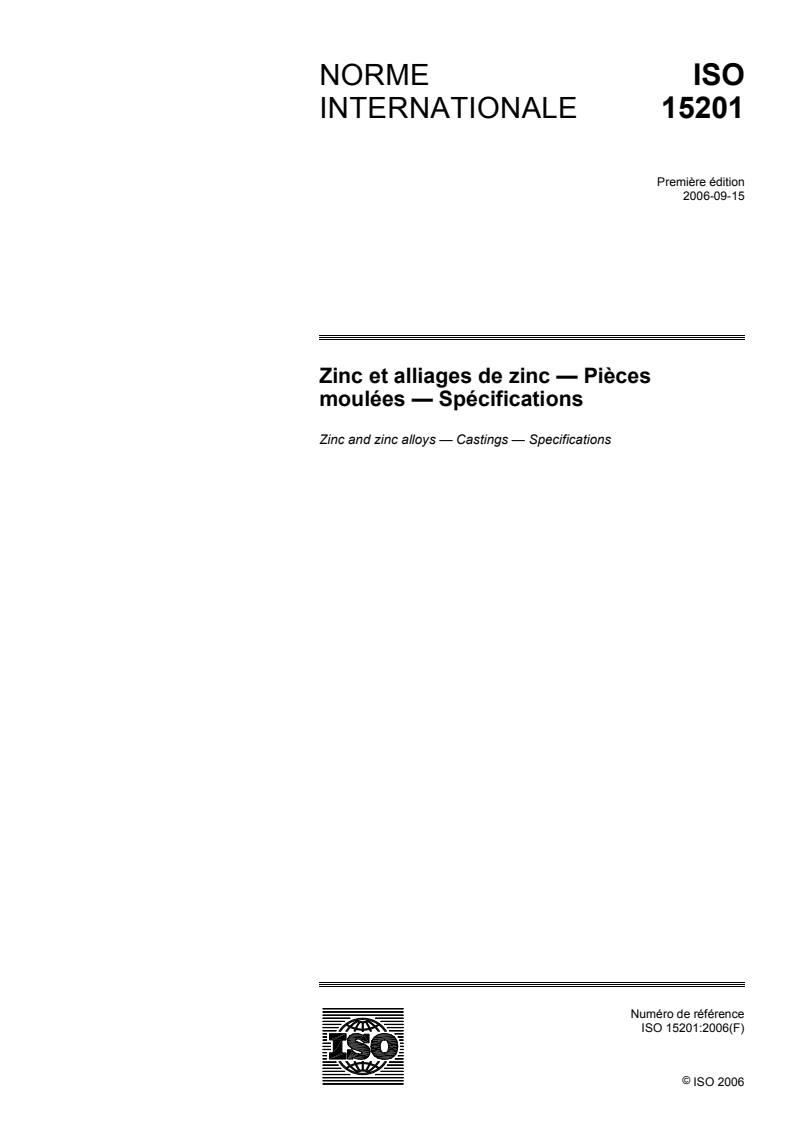
INTERNATIONAL ISO
STANDARD 15201
First edition
2006-09-15
Zinc and zinc alloys — Castings —
Specifications
Zinc et alliages de zinc — Pièces moulées — Spécifications
Reference number
©
ISO 2006
PDF disclaimer
This PDF file may contain embedded typefaces. In accordance with Adobe's licensing policy, this file may be printed or viewed but
shall not be edited unless the typefaces which are embedded are licensed to and installed on the computer performing the editing. In
downloading this file, parties accept therein the responsibility of not infringing Adobe's licensing policy. The ISO Central Secretariat
accepts no liability in this area.
Adobe is a trademark of Adobe Systems Incorporated.
Details of the software products used to create this PDF file can be found in the General Info relative to the file; the PDF-creation
parameters were optimized for printing. Every care has been taken to ensure that the file is suitable for use by ISO member bodies. In
the unlikely event that a problem relating to it is found, please inform the Central Secretariat at the address given below.
© ISO 2006
All rights reserved. Unless otherwise specified, no part of this publication may be reproduced or utilized in any form or by any means,
electronic or mechanical, including photocopying and microfilm, without permission in writing from either ISO at the address below or
ISO's member body in the country of the requester.
ISO copyright office
Case postale 56 • CH-1211 Geneva 20
Tel. + 41 22 749 01 11
Fax + 41 22 749 09 47
E-mail copyright@iso.org
Web www.iso.org
Published in Switzerland
ii © ISO 2006 – All rights reserved
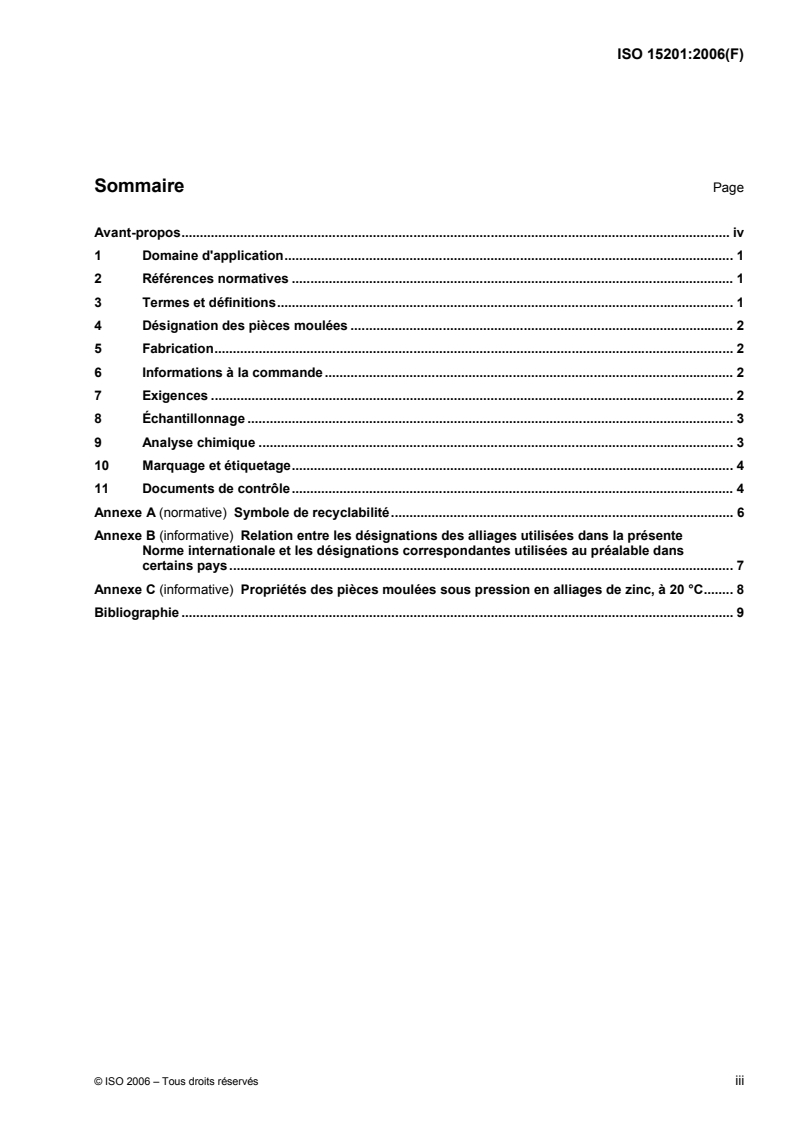
Contents Page
Foreword. iv
1 Scope. 1
2 Normative references. 1
3 Terms and definitions. 1
4 Casting designation. 1
5 Manufacture. 2
6 Ordering information. 2
7 Requirements. 2
8 Sampling. 3
9 Chemical analysis methods. 3
10 Marking and labelling . 4
11 Inspection document. 4
Annex A (normative) Recycling mark . 6
Annex B (informative) Relationship between the alloy designations used in this International
Standard and the corresponding designations used in a number of countries . 7
Annex C (informative) Properties of zinc-alloy die castings at 20 °C . 8
Bibliography . 9
Foreword
ISO (the International Organization for Standardization) is a worldwide federation of national standards bodies
(ISO member bodies). The work of preparing International Standards is normally carried out through ISO
technical committees. Each member body interested in a subject for which a technical committee has been
established has the right to be represented on that committee. International organizations, governmental and
non-governmental, in liaison with ISO, also take part in the work. ISO collaborates closely with the
International Electrotechnical Commission (IEC) on all matters of electrotechnical standardization.
International Standards are drafted in accordance with the rules given in the ISO/IEC Directives, Part 2.
The main task of technical committees is to prepare International Standards. Draft International Standards
adopted by the technical committees are circulated to the member bodies for voting. Publication as an
International Standard requires approval by at least 75 % of the member bodies casting a vote.
Attention is drawn to the possibility that some of the elements of this document may be the subject of patent
rights. ISO shall not be held responsible for identifying any or all such patent rights.
ISO 15201 was prepared by Technical Committee ISO/TC 18, Zinc and zinc alloys, Subcommittee SC 2, Zinc
alloys for casting.
iv © ISO 2006 – All rights reserved
INTERNATIONAL STANDARD ISO 15201:2006(E)
Zinc and zinc alloys — Castings — Specifications
1 Scope
This International Standard specifies the designation, chemical composition, marking and other requirements
for zinc alloy castings, produced by pressure die, permanent mould or sand casting, or another casting
process.
2 Normative references
The following referenced documents are indispensable for the application of this document. For dated
references, only the edition cited applies. For undated references, the latest edition of the referenced
document (including any amendments) applies.
ISO 301, Zinc alloy ingots intended for casting
ISO 7000:2004, Graphical symbols for use on equipment — Index and synopsis
EN 10204, Metallic products — Types of inspection documents
3 Terms and definitions
For the purposes of this document, the following terms and definitions apply.
3.1
pressure die casting
metal object produced by injecting molten metal under high pressure and high velocity into a metal die
3.2
permanent mould casting
metal object produced by introducing molten metal by gravity or low pressure into a mould or die constructed
of durable material, usually iron or steel, and allowing it to solidify
NOTE When a graphite mould is used, the process is known as "graphite permanent mould casting".
3.3
sand casting
metal object produced by introducing molten metal by gravity into a sand mould and allowing it to solidify
4 Casting designation
4.1 General
Zinc alloy castings conforming to this International Standard shall be designated by a number or short
designation in accordance with the system given in ISO 301, but having a letter P in the second character
position. P indicates that the product is a casting.
NOTE Informative Annex B gives the relationship between the national alloy designations and the designations used
in this International Standard.
4.2 Designation by a number
The alloy number shall be in accordance with the system given in ISO 301.
EXAMPLE A zinc alloy casting made from an alloy consisting nominally of 4 % aluminium, 1 % copper, and the
remainder zinc, shall be designated: ZP0410.
4.3 Short designation
The short designation shall be in accordance with the system given in ISO 301.
EXAMPLE A zinc alloy casting made from an alloy consisting nominally of 4 % aluminium, 1 % copper, and
...
NORME ISO
INTERNATIONALE 15201
Première édition
2006-09-15
Zinc et alliages de zinc — Pièces
moulées — Spécifications
Zinc and zinc alloys — Castings — Specifications
Numéro de référence
©
ISO 2006
PDF – Exonération de responsabilité
Le présent fichier PDF peut contenir des polices de caractères intégrées. Conformément aux conditions de licence d'Adobe, ce fichier
peut être imprimé ou visualisé, mais ne doit pas être modifié à moins que l'ordinateur employé à cet effet ne bénéficie d'une licence
autorisant l'utilisation de ces polices et que celles-ci y soient installées. Lors du téléchargement de ce fichier, les parties concernées
acceptent de fait la responsabilité de ne pas enfreindre les conditions de licence d'Adobe. Le Secrétariat central de l'ISO décline toute
responsabilité en la matière.
Adobe est une marque déposée d'Adobe Systems Incorporated.
Les détails relatifs aux produits logiciels utilisés pour la création du présent fichier PDF sont disponibles dans la rubrique General Info
du fichier; les paramètres de création PDF ont été optimisés pour l'impression. Toutes les mesures ont été prises pour garantir
l'exploitation de ce fichier par les comités membres de l'ISO. Dans le cas peu probable où surviendrait un problème d'utilisation,
veuillez en informer le Secrétariat central à l'adresse donnée ci-dessous.
© ISO 2006
Droits de reproduction réservés. Sauf prescription différente, aucune partie de cette publication ne peut être reproduite ni utilisée sous
quelque forme que ce soit et par aucun procédé, électronique ou mécanique, y compris la photocopie et les microfilms, sans l'accord écrit
de l'ISO à l'adresse ci-après ou du comité membre de l'ISO dans le pays du demandeur.
ISO copyright office
Case postale 56 • CH-1211 Geneva 20
Tel. + 41 22 749 01 11
Fax. + 41 22 749 09 47
E-mail copyright@iso.org
Web www.iso.org
Publié en Suisse
ii © ISO 2006 – Tous droits réservés
Sommaire Page
Avant-propos. iv
1 Domaine d'application. 1
2 Références normatives . 1
3 Termes et définitions. 1
4 Désignation des pièces moulées . 2
5 Fabrication. 2
6 Informations à la commande . 2
7 Exigences . 2
8 Échantillonnage . 3
9 Analyse chimique . 3
10 Marquage et étiquetage. 4
11 Documents de contrôle. 4
Annexe A (normative) Symbole de recyclabilité. 6
Annexe B (informative) Relation entre les désignations des alliages utilisées dans la présente
Norme internationale et les désignations correspondantes utilisées au préalable dans
certains pays . 7
Annexe C (informative) Propriétés des pièces moulées sous pression en alliages de zinc, à 20 °C. 8
Bibliographie . 9
Avant-propos
L'ISO (Organisation internationale de normalisation) est une fédération mondiale d'organismes nationaux de
normalisation (comités membres de l'ISO). L'élaboration des Normes internationales est en général confiée
aux comités techniques de l'ISO. Chaque comité membre intéressé par une étude a le droit de faire partie du
comité technique créé à cet effet. Les organisations internationales, gouvernementales et non
gouvernementales, en liaison avec l'ISO participent également aux travaux. L'ISO collabore étroitement avec
la Commission électrotechnique internationale (CEI) en ce qui concerne la normalisation électrotechnique.
Les Normes internationales sont rédigées conformément aux règles données dans les Directives ISO/CEI,
Partie 2.
La tâche principale des comités techniques est d'élaborer les Normes internationales. Les projets de Normes
internationales adoptés par les comités techniques sont soumis aux comités membres pour vote. Leur
publication comme Normes internationales requiert l'approbation de 75 % au moins des comités membres
votants.
L'attention est appelée sur le fait que certains des éléments du présent document peuvent faire l'objet de
droits de propriété intellectuelle ou de droits analogues. L'ISO ne saurait être tenue pour responsable de ne
pas avoir identifié de tels droits de propriété et averti de leur existence.
L'ISO 15201 a été élaborée par le comité technique ISO/TC 18, Zinc et alliages de zinc, sous-comité SC 2,
Alliages de zinc destinés à la fonderie.
iv © ISO 2006 – Tous droits réservés
NORME INTERNATIONALE ISO 15201:2006(F)
Zinc et alliages de zinc — Pièces moulées — Spécifications
1 Domaine d'application
La présente Norme internationale spécifie la désignation, la composition chimique, le marquage et les autres
exigences relatives aux pièces moulées en alliages de zinc, produites par moulage sous pression, moulage
en coquille ou moulage au sable ou autre procédé de moulage.
2 Références normatives
Les documents de référence suivants sont indispensables pour l'application du présent document. Pour les
références datées, seule l'édition citée s'applique. Pour les références non datées, la dernière édition du
document de référence s'applique (y compris les éventuels amendements).
ISO 301, Alliages de zinc en lingots destinés à la fonderie
ISO 7000:2004, Symboles graphiques utilisables sur le matériel — Index et tableau synoptique
EN 10204, Produits métalliques — Types de documents de contrôle.
3 Termes et définitions
Pour les besoins du présent document, les termes et définitions suivants s'appliquent.
3.1
pièce moulée sous pression
objet métallique produit par l'injection de métal fondu sous haute pression et haute vitesse dans une matrice
métallique
3.2
pièce moulée en coquille
objet métallique produit en introduisant, par gravité ou sous faible pression, du métal fondu dans un moule ou
une coquille fabriqués dans un matériau durable, en général fonte ou acier, et en le laissant se solidifier
NOTE Lorsqu'un moule en graphite est utilisé, ce procédé est appelé «coulée en coquille graphite».
3.3
pièce moulée au sable
objet métallique produit en introduisant par gravité du métal fondu dans un moule en sable, et en le laissant
se solidifier
4 Désignation des pièces moulées
4.1 Généralité
Les pièces moulées en alliages de zinc en conformité avec la présente Norme internationale doivent être
désignées par un numéro ou par une désignation abrégée en accord avec le système de désignation donné
dans l’ISO 301, mais ayant une lettre P en deuxième position de caractère. P indique que le produit est une
pièce moulée.
NOTE L’Annexe B (informative) donne la relation entre les désignations nationales des alliages et les désignations
utilisées dans la présente Norme internationale.
4.2 Désignation par un numéro
Le numéro de l'alliage doit être en conformité avec le système donné dans l’ISO 301.
EXEMPLE Une pièce moulée en alliage de zinc, fabriquée en alliage de composition nominale de 4 % d'aluminium,
1 % de cuivre et le reste en zinc, est désignée comme suit: ZP0410.
4.3 Désignation abrégée
La désignation abrégée doit être en accord avec le système de désignation donné dans l’ISO 301.
EXEMPLE Une pièce moulée en alliage de zinc, fabriquée en alliage de composition nominale de 4 % d'aluminium,
1 % de cuivre et le
...