

ISO 9895:2008
(Main)Paper and board — Compressive strength — Short-span test
General Information
- Abstract
ISO 9895:2008 specifies a method for determining the compressive strength in the machine and cross-directions of paper and board using a short-span compressive tester. It is intended for papers and boards used for the manufacture of containers and boxes. ISO 9895:2008 is recommended for papers and boards with a grammage from 100 g/m2 to 400 g/m2.
- Status
- Published
- Publication Date
- 15-Oct-2008
- Technical Committee
- ISO/TC 6/SC 2 - Test methods and quality specifications for paper and board
- Current Stage
- 9093 - International Standard confirmed
- Start Date
- 29-Jun-2023
- Completion Date
- 29-Aug-2026
Overview
ISO 9895:2008 - Paper and board - Compressive strength - Short-span test specifies a standardized laboratory method for measuring the edgewise (short-span) compressive strength of paper and board used in container and box manufacture. The method uses a short-span compressive tester to determine compressive strength in both the machine direction (MD) and cross direction (CD). ISO 9895:2008 is recommended for papers and boards with a grammage of 100–400 g/m².
Key Topics and Requirements
- Test principle: A 15 mm wide strip is clamped across a 0.70 mm ± 0.05 mm free span and the clamps are driven together until compressive failure. The maximum force is recorded.
- Apparatus:
- Short-span compressive tester with two clamps 30 mm long and high-friction surfaces.
- Constant clamping force of 2300 N ± 500 N.
- Test speed 3 mm/min ± 1 mm/min.
- Load measurement accurate to ±1% over 10–100% of full scale; device to check clamping force and allow calibration.
- Specimens and conditioning:
- Test pieces: strips ≥70 mm long, 15.0 mm ± 0.1 mm wide.
- Cut and condition according to ISO 186 and ISO 187; grammage per ISO 536 if required.
- At least 20 determinations per direction to reduce local variation effects.
- Calculations:
- Compressive strength (σC) = mean maximum force (F) / initial width (b) - reported in kN/m to three significant figures.
- Compressive index = (1000 × σC) / grammage (g) - reported in kN·m/kg.
- Precision:
- Typical single-lab coefficient of variation < ~3%; interlaboratory reproducibility ~3–7%.
- Limitations:
- Method is not suitable for measuring strain at break (see Annex B).
Applications and Users
- Who uses ISO 9895:2008:
- Paper and board manufacturers for product specification and R&D.
- Packaging converters and corrugated box manufacturers assessing box edge performance.
- Quality control and independent testing laboratories verifying compressive properties.
- Material engineers and product designers selecting papers/boards for container performance.
- Practical uses:
- Compare compressive strength of linerboards, flutings and packaging grades.
- Input parameter for structural packaging design and box compression analysis.
- Quality acceptance testing for incoming materials and production control.
Test Reporting & Related Standards
- Test reports should include reference to ISO 9895:2008, date/place, material ID, conditioning atmosphere, grammage (if measured), test direction, number of replicates, compressive strength (and coefficient of variation), compressive index (if required), and any departures from the procedure.
- Related standards: ISO 186, ISO 187, ISO 536, and ISO 5270 (laboratory sheets).
Keywords: ISO 9895:2008, short-span test, compressive strength, paper and board, grammage, machine direction, cross-direction, packaging, clamps, short-span compressive tester.
Relations
- Referred By
EN ISO 5270:2022 - Pulps - Laboratory sheets - Determination of physical properties (ISO 5270:2022) - Effective Date
- 25-Aug-2026
- Referred By
EN ISO 5270:2012 - Pulps - Laboratory sheets - Determination of physical properties (ISO 5270:2012) - Effective Date
- 25-Aug-2026
- Effective Date
- 15-Apr-2008
Get Certified
Connect with accredited certification bodies for this standard

Control Union Certifications
Global certification for agriculture and sustainability.

Gozdarski inštitut Slovenije
Slovenian Forestry Institute. Forest management certification support, timber testing.
Sponsored listings
Frequently Asked Questions
ISO 9895:2008 is a standard published by the International Organization for Standardization (ISO). Its full title is "Paper and board — Compressive strength — Short-span test". This standard covers: ISO 9895:2008 specifies a method for determining the compressive strength in the machine and cross-directions of paper and board using a short-span compressive tester. It is intended for papers and boards used for the manufacture of containers and boxes. ISO 9895:2008 is recommended for papers and boards with a grammage from 100 g/m2 to 400 g/m2.
ISO 9895:2008 specifies a method for determining the compressive strength in the machine and cross-directions of paper and board using a short-span compressive tester. It is intended for papers and boards used for the manufacture of containers and boxes. ISO 9895:2008 is recommended for papers and boards with a grammage from 100 g/m2 to 400 g/m2.
ISO 9895:2008 is classified under the following ICS (International Classification for Standards) categories: 85.060 - Paper and board. The ICS classification helps identify the subject area and facilitates finding related standards.
ISO 9895:2008 has the following relationships with other standards: It is inter standard links to EN ISO 5270:2022, EN ISO 5270:2012, ISO 9895:1989. Understanding these relationships helps ensure you are using the most current and applicable version of the standard.
ISO 9895:2008 is available in PDF format for immediate download after purchase. The document can be added to your cart and obtained through the secure checkout process. Digital delivery ensures instant access to the complete standard document.
Standards Content (Sample)
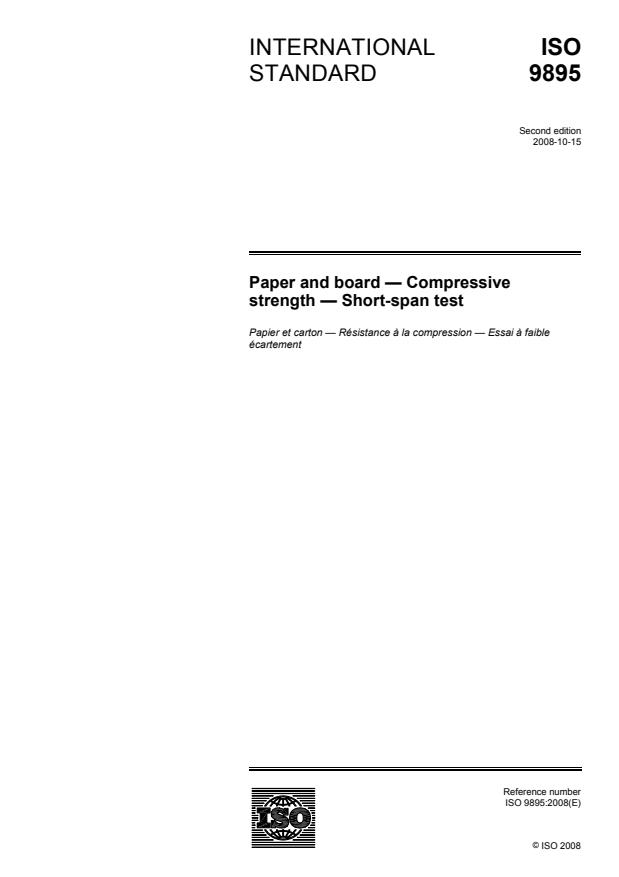
INTERNATIONAL ISO
STANDARD 9895
Second edition
2008-10-15
Paper and board — Compressive
strength — Short-span test
Papier et carton — Résistance à la compression — Essai à faible
écartement
Reference number
©
ISO 2008
PDF disclaimer
This PDF file may contain embedded typefaces. In accordance with Adobe's licensing policy, this file may be printed or viewed but
shall not be edited unless the typefaces which are embedded are licensed to and installed on the computer performing the editing. In
downloading this file, parties accept therein the responsibility of not infringing Adobe's licensing policy. The ISO Central Secretariat
accepts no liability in this area.
Adobe is a trademark of Adobe Systems Incorporated.
Details of the software products used to create this PDF file can be found in the General Info relative to the file; the PDF-creation
parameters were optimized for printing. Every care has been taken to ensure that the file is suitable for use by ISO member bodies. In
the unlikely event that a problem relating to it is found, please inform the Central Secretariat at the address given below.
© ISO 2008
All rights reserved. Unless otherwise specified, no part of this publication may be reproduced or utilized in any form or by any means,
electronic or mechanical, including photocopying and microfilm, without permission in writing from either ISO at the address below or
ISO's member body in the country of the requester.
ISO copyright office
Case postale 56 • CH-1211 Geneva 20
Tel. + 41 22 749 01 11
Fax + 41 22 749 09 47
E-mail copyright@iso.org
Web www.iso.org
Published in Switzerland
ii © ISO 2008 – All rights reserved
Contents Page
Foreword. iv
Introduction . v
1 Scope . 1
2 Normative references . 1
3 Terms and definitions. 1
4 Principle. 2
5 Apparatus . 2
6 Calibration . 3
7 Sampling. 3
8 Conditioning. 3
9 Preparation of test pieces. 3
10 Procedure . 3
11 Calculation and expression of results. 4
11.1 General. 4
11.2 Compressive strength. 4
11.3 Compressive index. 4
12 Precision. 5
12.1 General. 5
12.2 Repeatability. 5
12.3 Reproducibility. 5
13 Test report . 5
Annex A (normative) Specifications for the clamps. 6
Annex B (informative) The reason for not measuring strain at break . 7
Bibliography . 8
Foreword
ISO (the International Organization for Standardization) is a worldwide federation of national standards bodies
(ISO member bodies). The work of preparing International Standards is normally carried out through ISO
technical committees. Each member body interested in a subject for which a technical committee has been
established has the right to be represented on that committee. International organizations, governmental and
non-governmental, in liaison with ISO, also take part in the work. ISO collaborates closely with the
International Electrotechnical Commission (IEC) on all matters of electrotechnical standardization.
International Standards are drafted in accordance with the rules given in the ISO/IEC Directives, Part 2.
The main task of technical committees is to prepare International Standards. Draft International Standards
adopted by the technical committees are circulated to the member bodies for voting. Publication as an
International Standard requires approval by at least 75 % of the member bodies casting a vote.
Attention is drawn to the possibility that some of the elements of this document may be the subject of patent
rights. ISO shall not be held responsible for identifying any or all such patent rights.
ISO 9895 was prepared by Technical Committee ISO/TC 6, Paper, board and pulps, Subcommittee SC 2,
Test methods and quality specifications for paper and board.
This second edition cancels and replaces the first edition (ISO 9895:1989), which has been revised to insert a
grammage range in the scope of this International Standard. Compared to the first edition, some editorial
changes have also been made.
iv © ISO 2008 – All rights reserved
Introduction
This International Standard has been developed in order to specify the conditions for determining the
compressive strength of paper and board used for the manufacture of containers and boxes.
In this International Standard, the same terminology and symbols are used as in general literature concerning
materials physics and mechanics.
INTERNATIONAL STANDARD ISO 9895:2008(E)
Paper and board — Compressive strength — Short-span test
1 Scope
This International Standard specifies a method for determining the compressive strength in the machine and
cross-directions of paper and board using a short-span compressive tester. It is intended for papers and
boards used for the manufacture of containers and boxes.
This International Standard is recommended for papers and boards with a grammage from 100 g/m to
400 g/m .
NOTE 1 The procedure specified in this International Standard should not be used for the determination of strain at
break (see Annex B).
[1]
NOTE 2 For the determination of compressive strength of laboratory sheets, see instructions in ISO 5270 .
2 Normative references
The following referenced documents are indispensable for the application of this document. For dated
references, only the edition cited applies. For undated references, the latest edition of the referenced
document (including any amendments) applies.
ISO 186, Paper and board — Sampling to determine average quality
ISO 187, Paper, board and pulps — Standard atmosphere for conditioning and testing and procedure for
monitoring the atmosphere and conditioning of samples
ISO 536, Paper and board — Determination of grammage
3 Terms and definitions
For the purposes of this document, the following terms and definitions apply.
3.1
compressive strength
maximum compressive force per unit width that a test piece of paper or board can withstand until the onset of
failure
NOTE The compressive strength is expressed in kilonewtons per metre.
3.2
compressive index
compressive strength divided by the grammage
NOTE The compressive index is expressed in kilonewton metres per kilogram.
4 Principle
A test piece, 15 mm wide, is clamped between two clamps, spaced 0,70 mm apart, which are forced towards
each other until a compressive failure occurs. The maximum force is measured and the compressive strength
is calculated.
5 Apparatus
5.1 Compressive tester, with two clamps (see Figure
...