

ISO 3627:2001
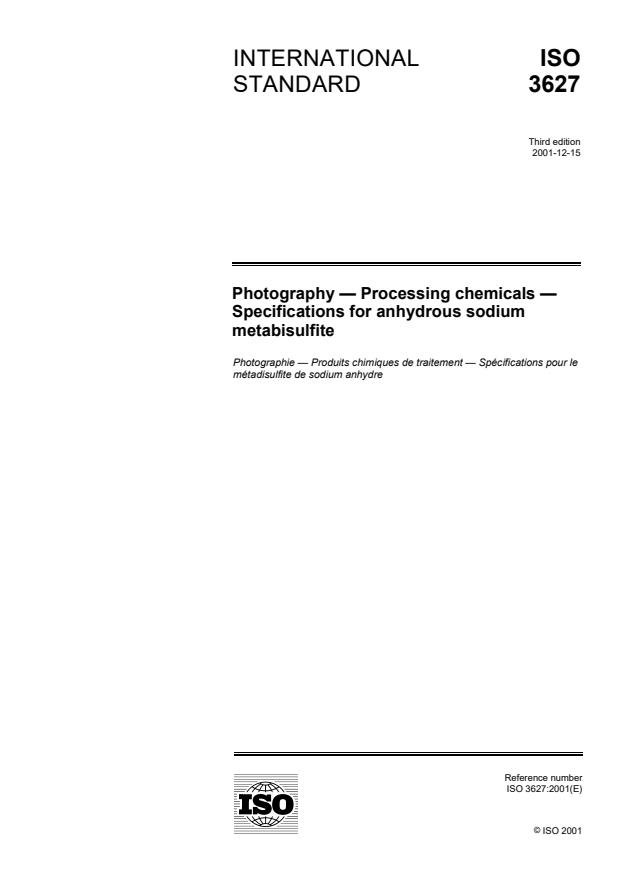
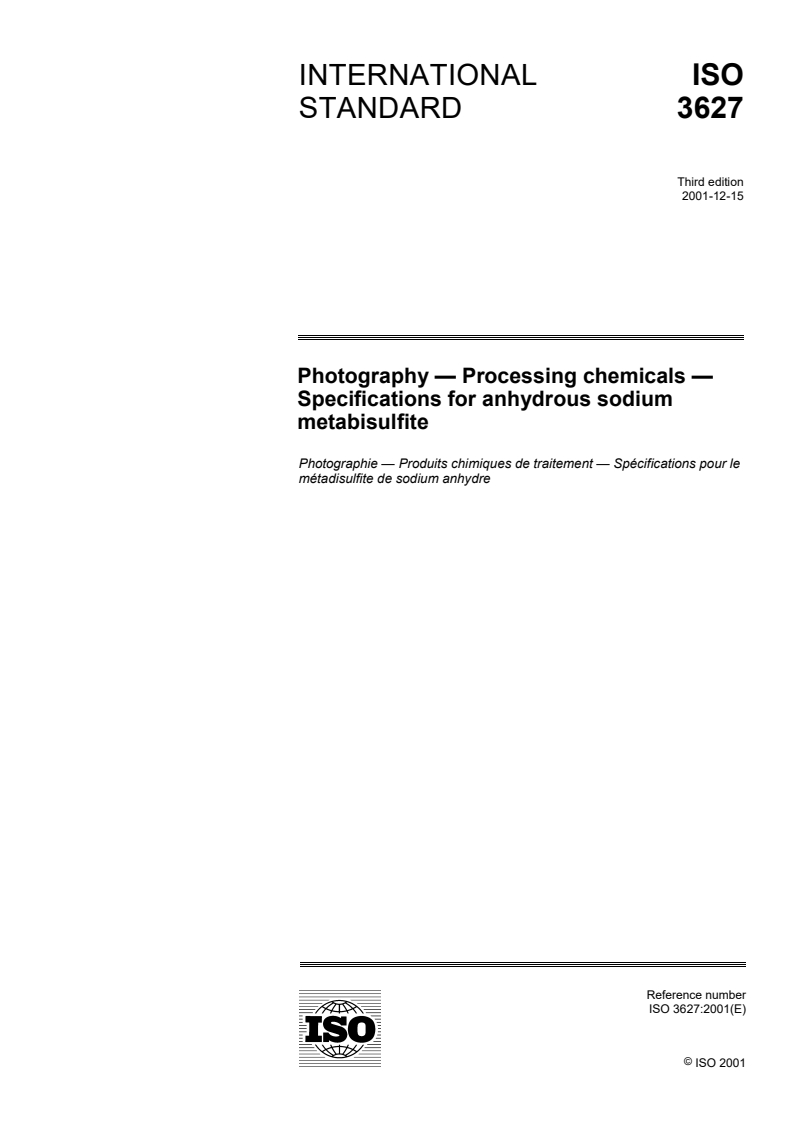
(Main)Photography — Processing chemicals — Specifications for anhydrous sodium metabisulfite
General Information
- Abstract
This International Standard establishes criteria for the purity of photographic-grade anhydrous sodium metabisulfite and specifies the tests to be used to determine the purity.
- Status
- Published
- Publication Date
- 19-Dec-2001
- Technical Committee
- ISO/TC 42 - Photography
- Drafting Committee
- ISO/TC 42 - Photography
- Current Stage
- 9093 - International Standard confirmed
- Start Date
- 06-Jun-2026
- Completion Date
- 29-Aug-2026
Buy Documents
ISO 3627:2001 - Photography -- Processing chemicals -- Specifications for anhydrous sodium metabisulfite
ISO 3627:2001 - Photography — Processing chemicals — Specifications for anhydrous sodium metabisulfite/20/2001
Overview
ISO 3627:2001 - "Photography - Processing chemicals - Specifications for anhydrous sodium metabisulfite" defines purity and test requirements for photographic‑grade anhydrous sodium metabisulfite. The standard establishes chemical and physical acceptance criteria, prescribes test methods (including titration procedures), and references general analytical methods for sampling and safety. It is intended to ensure chemicals used in photographic processing do not cause undesirable photographic effects.
Key topics and requirements
- Scope: Criteria for purity and tests to determine suitability for photographic use.
- Physical & storage: White or pale‑cream granular powder; store in a closed container at room temperature; avoid contact with acids.
- Mandatory requirements (summary):
- Assay (Na2S2O5): minimum 95.0% by mass.
- Mass fraction of heavy metals (as Pb): maximum 0.005%.
- Mass fraction of iron (Fe): maximum 0.005%.
- Mass fraction of thiosulfate (as S2O3 2−): maximum 0.03%.
- pH value (aqueous solution): 3.7 to 4.6.
- Reaction to ammoniacal silver nitrate: to pass test (identity/specific reactivity).
- Appearance of solution: clear and free from insoluble matter except for slight flocculence.
- Test methods: The standard specifies reagents, sampling, apparatus and analytical procedures, including back‑titration and direct‑titration assay methods using iodine/thiosulfate systems. It cites ISO 10349 series methods for general procedures, heavy metals/iron determination, and ammoniacal silver nitrate reaction tests.
- Safety note: Procedures may involve caustic or toxic reagents; ISO 3627:2001 highlights safe laboratory practice and references ISO 10349‑1 for hazard symbols and handling.
Applications - who uses this standard
- Photographic chemical manufacturers and raw material suppliers for quality control and product specifications.
- Analytical and quality‑assurance laboratories performing routine purity testing of anhydrous sodium metabisulfite.
- Photographic processors, conservation labs and formulators who require assurance that processing chemicals meet photographic‑grade purity to avoid defects.
- Procurement and compliance teams specifying supplier conformance for photographic processing chemicals.
Related standards
- ISO 10349‑1:1992 - Photographic‑grade chemicals - General test methods.
- ISO 10349‑5:1992 - Determination of heavy metals and iron content.
- ISO 10349‑9:1992 - Reaction to ammoniacal silver nitrate.
Keywords: ISO 3627:2001, anhydrous sodium metabisulfite, photographic‑grade, processing chemicals, purity assay, heavy metals, thiosulfate, pH, test methods.
Relations
- Effective Date
- 15-Apr-2008
Buy Documents
ISO 3627:2001 - Photography -- Processing chemicals -- Specifications for anhydrous sodium metabisulfite
ISO 3627:2001 - Photography — Processing chemicals — Specifications for anhydrous sodium metabisulfite/20/2001
Frequently Asked Questions
ISO 3627:2001 is a standard published by the International Organization for Standardization (ISO). Its full title is "Photography — Processing chemicals — Specifications for anhydrous sodium metabisulfite". This standard covers: This International Standard establishes criteria for the purity of photographic-grade anhydrous sodium metabisulfite and specifies the tests to be used to determine the purity.
This International Standard establishes criteria for the purity of photographic-grade anhydrous sodium metabisulfite and specifies the tests to be used to determine the purity.
ISO 3627:2001 is classified under the following ICS (International Classification for Standards) categories: 37.040.30 - Photographic chemicals. The ICS classification helps identify the subject area and facilitates finding related standards.
ISO 3627:2001 has the following relationships with other standards: It is inter standard links to ISO 3627:1994. Understanding these relationships helps ensure you are using the most current and applicable version of the standard.
ISO 3627:2001 is available in PDF format for immediate download after purchase. The document can be added to your cart and obtained through the secure checkout process. Digital delivery ensures instant access to the complete standard document.
Standards Content (Sample)
INTERNATIONAL ISO
STANDARD 3627
Third edition
2001-12-15
Photography — Processing chemicals —
Specifications for anhydrous sodium
metabisulfite
Photographie — Produits chimiques de traitement — Spécifications pour le
métadisulfite de sodium anhydre
Reference number
©
ISO 2001
PDF disclaimer
This PDF file may contain embedded typefaces. In accordance with Adobe's licensing policy, this file may be printed or viewed but shall not
be edited unless the typefaces which are embedded are licensed to and installed on the computer performing the editing. In downloading this
file, parties accept therein the responsibility of not infringing Adobe's licensing policy. The ISO Central Secretariat accepts no liability in this
area.
Adobe is a trademark of Adobe Systems Incorporated.
Details of the software products used to create this PDF file can be found in the General Info relative to the file; the PDF-creation parameters
were optimized for printing. Every care has been taken to ensure that the file is suitable for use by ISO member bodies. In the unlikely event
that a problem relating to it is found, please inform the Central Secretariat at the address given below.
All rights reserved. Unless otherwise specified, no part of this publication may be reproduced or utilized in any form or by any means, electronic
or mechanical, including photocopying and microfilm, without permission in writing from either ISO at the address below or ISO's member body
in the country of the requester.
ISO copyright office
Case postale 56 � CH-1211 Geneva 20
Tel. + 41 22 749 01 11
Fax + 41 22 749 09 47
E-mail copyright@iso.ch
Web www.iso.ch
Printed in Switzerland
ii © ISO 2001 – All rights reserved
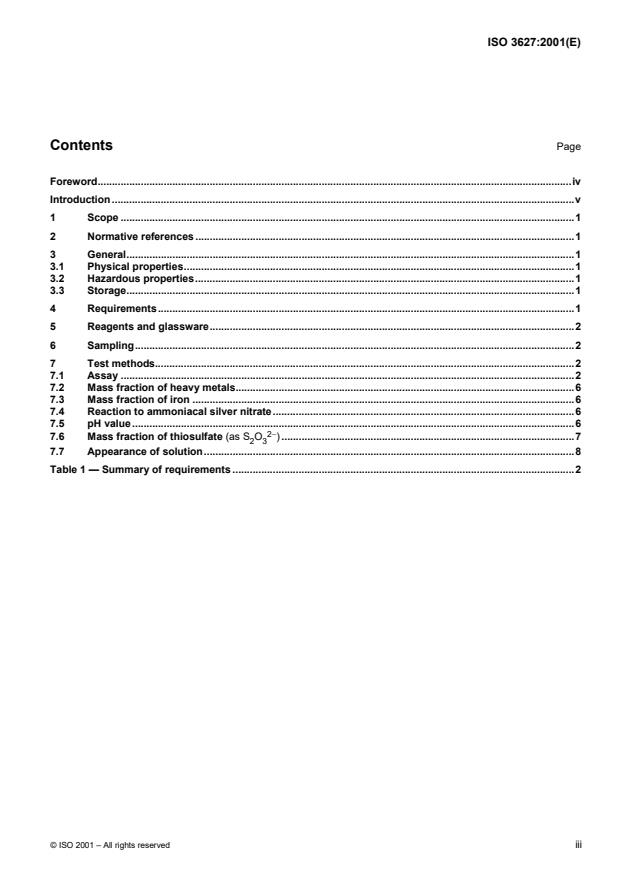
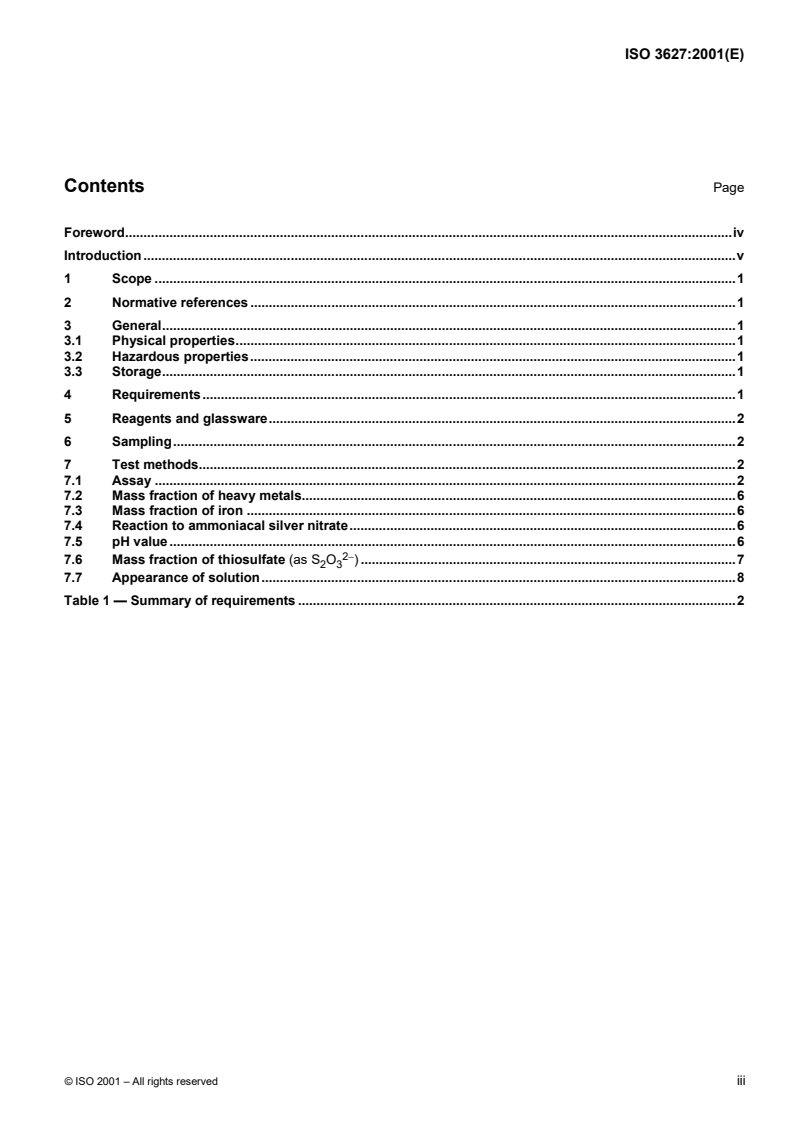
Contents Page
Foreword.iv
Introduction.v
1 Scope .1
2 Normative references .1
3 General.1
3.1 Physical properties.1
3.2 Hazardous properties.1
3.3 Storage.1
4 Requirements.1
5 Reagents and glassware.2
6 Sampling.2
7 Test methods.2
7.1 Assay .2
7.2 Mass fraction of heavy metals.6
7.3 Mass fraction of iron .6
7.4 Reaction to ammoniacal silver nitrate.6
7.5 pH value.6
2�
7.6 Mass fraction of thiosulfate (as S O ) .7
2 3
7.7 Appearance of solution.8
Table 1 — Summary of requirements .2
Foreword
ISO (the International Organization for Standardization) is a worldwide federation of national standards bodies (ISO
member bodies). The work of preparing International Standards is normally carried out through ISO technical
committees. Each member body interested in a subject for which a technical committee has been established has
the right to be represented on that committee. International organizations, governmental and non-governmental, in
liaison with ISO, also take part in the work. ISO collaborates closely with the International Electrotechnical
Commission (IEC) on all matters of electrotechnical standardization.
International Standards are drafted in accordance with the rules given in the ISO/IEC Directives, Part 3.
Draft International Standards adopted by the technical committees are circulated to the member bodies for voting.
Publication as an International Standard requires approval by at least 75 % of the member bodies casting a vote.
Attention is drawn to the possibility that some of the elements of this International Standard may be the subject of
patent rights. ISO shall not be held responsible for identifying any or all such patent rights.
International Standard ISO 3627 was prepared by Technical Committee ISO/TC 42, Photography.
This third edition cancels and replaces the second edition (ISO 3627:1994), of which it constitutes a technical
revision.
iv © ISO 2001 – All rights reserved
Introduction
This International Standard is one of a series that establishes criteria of purity for chemicals used in processing
photographic materials. General test methods and procedures cited in this International Standard are compiled in
ISO 10349-1.
This International Standard is intended for use by individuals with a working knowledge of analytical techniques,
which may not always be the case. Some of the procedures utilize caustic, toxic or otherwise hazardous chemicals.
Safe laboratory practice for the handling of chemicals requires the use of safety glasses or goggles and, in some
cases, other protective apparel such as rubber gloves, face masks or aprons. Normal precautions for the safe
performance of any chemical procedure shall be exercised at all times, but specific details have been provided for
hazardous materials. Hazard warnings designated by a letter enclosed in angle brackets "��" are used as a
reminder in those steps detailing handling operations and are defined in ISO 10349-1. More detailed information
regarding hazards, handling and use of these chemicals may be available from the manufacturer.
This International Standard provides chemical and physical requirements for the suitability of a photographic-grade
chemical. The tests correlate with undesirable photographic effects. Purity requirements are set as low as possible,
consistent with these photographic effects. These criteria are considered to be the minimum requirements
necessary to ensure sufficient purity for use in photographic processing solutions, except that if the purity of a
commonly available grade of chemical exceeds photographic processing requirements and if there is no economic
penalty in its use, the purity requirements have been set to take advantage of the availability of the higher-quality
material.
Every effort has been made to keep the number of requirements to a minimum. Inert impurities are limited to
amounts that will not unduly reduce the assay. All tests are performed on samples "as received" to reflect the
condition of materials furnished for use. Although the ultimate criterion for suitability of such a chemical is its
successful performance in an appropriate use test, the shorter, more economical test methods described in this
International Standard are generally adequate.
Assay procedures have been included in all cases where a satisfactory method is available. An effective assay
requirement serves not only as a safeguard of chemical purity, but also as a valuable complement to the identity
test. Identity tests have been included whenever a possibility exists that another chemical or mixture of chemicals
could pass the other tests.
All requirements listed in clause 4 are mandatory. The physical appearance of the material and any footnotes are
for general information only and are not part of the requirements.
Efforts have been made to employ tests that are capable of being run in any normally equipped laboratory and,
wherever possible, to avoid tests that require highly specialized equipment or techniques. Instrumental methods
have been specified only as alternative methods or alone in those cases where no other satisfactory method is
available.
Over the past few years, great improvements have been made in instrumentation for various analyses. Where such
techniques have equivalent or greater precision, they may be used in place of the tests described in this
International Standard. Correlation of such alternative procedures with the given method is the responsibility of the
user. In case of disagreement in results, the method called for in the specification shall prevail. Where a
requirement states "to pass test", however, alternative methods shall not be used.
INTERNATIONAL STANDARD ISO 3627:2001(E)
Photography — Processing chemicals — Specifications for
anhydrous sodium metabisulfite
1 Scope
This International Standard establishes criteria for the purity of photographic-grade anhydrous sodium metabisulfite
and specifies the tests to be used to determine the purity.
2 Normative references
The following normative documents contain provisions which, through reference in this text, constitute provisions of
this International Standard. For dated references, subsequent amendments to, or revisions of, any of these
publications do not apply. However, parties to agreements based on this International Standard are encouraged to
investigate the possibility of applying the most recent editions of the normative documents indicated below. For
undated references, the latest edition of the normative document referred to applies. Members of ISO and IEC
maintain registers of currently valid International Standards.
ISO 10349-1:1992, Photography — Photographic-grade chemicals — Test methods — Part 1: General.
ISO 10349-5:1992, Photography — Photographic-grade chemicals — Test methods — Part 5: Determination of
heavy metals and iron content.
ISO 10349-9:1992, Photography — Photographic-grade chemicals — Test methods — Part 9: Reaction to
ammoniacal silver nitrate.
3 General
3.1 Physical properties
Anhydrous sodium metabisulfite (Na S O ) exists as a white or pale-cream granular powder. It has a relative
2 2 5
molecular mass of 190,10.
3.2 Hazardous properties
Anhydrous sodium metabisulfite is not hazardous when handled with normal precautions. Avoid contact with acids.
3.3 Storage
Anhydrous sodium metabisulfite shall be stored in a closed container at room temperature.
4 Requirements
A summary of the requirements is shown in Table 1.
Table 1 — Summary of requirements
International Standard in
Test Limit Subclause
which test method is given
Assay Minimum: 95,0 % 7.1 ISO 3627
Mass fraction of heavy metals Maximum: 0,005 % 7.2 ISO 10349-5
(as Pb)
Mass fraction of iron (Fe) Maximum: 0,005 % 7.3 ISO 10349-5
Reaction to ammoniacal silver To pass test 7.4 ISO 10349-9
nitrate
pH value 3,7 to 4,6 7.5 ISO 3627
Mass fraction of thiosulfate Maximum: 0,03 % 7.6 ISO 3627
2�
(as S O )
2 3
Appearance of solution Clear and free from insoluble matter 7.7 ISO 3627
except for a slight flocculence
5 Reagents and glassware
All reagents, materials and gla
...
INTERNATIONAL ISO
STANDARD 3627
Third edition
2001-12-15
Photography — Processing chemicals —
Specifications for anhydrous sodium
metabisulfite
Photographie — Produits chimiques de traitement — Spécifications pour le
métadisulfite de sodium anhydre
Reference number
©
ISO 2001
PDF disclaimer
This PDF file may contain embedded typefaces. In accordance with Adobe's licensing policy, this file may be printed or viewed but shall not
be edited unless the typefaces which are embedded are licensed to and installed on the computer performing the editing. In downloading this
file, parties accept therein the responsibility of not infringing Adobe's licensing policy. The ISO Central Secretariat accepts no liability in this
area.
Adobe is a trademark of Adobe Systems Incorporated.
Details of the software products used to create this PDF file can be found in the General Info relative to the file; the PDF-creation parameters
were optimized for printing. Every care has been taken to ensure that the file is suitable for use by ISO member bodies. In the unlikely event
that a problem relating to it is found, please inform the Central Secretariat at the address given below.
All rights reserved. Unless otherwise specified, no part of this publication may be reproduced or utilized in any form or by any means, electronic
or mechanical, including photocopying and microfilm, without permission in writing from either ISO at the address below or ISO's member body
in the country of the requester.
ISO copyright office
Case postale 56 � CH-1211 Geneva 20
Tel. + 41 22 749 01 11
Fax + 41 22 749 09 47
E-mail copyright@iso.ch
Web www.iso.ch
Printed in Switzerland
ii © ISO 2001 – All rights reserved
Contents Page
Foreword.iv
Introduction.v
1 Scope .1
2 Normative references .1
3 General.1
3.1 Physical properties.1
3.2 Hazardous properties.1
3.3 Storage.1
4 Requirements.1
5 Reagents and glassware.2
6 Sampling.2
7 Test methods.2
7.1 Assay .2
7.2 Mass fraction of heavy metals.6
7.3 Mass fraction of iron .6
7.4 Reaction to ammoniacal silver nitrate.6
7.5 pH value.6
2�
7.6 Mass fraction of thiosulfate (as S O ) .7
2 3
7.7 Appearance of solution.8
Table 1 — Summary of requirements .2
Foreword
ISO (the International Organization for Standardization) is a worldwide federation of national standards bodies (ISO
member bodies). The work of preparing International Standards is normally carried out through ISO technical
committees. Each member body interested in a subject for which a technical committee has been established has
the right to be represented on that committee. International organizations, governmental and non-governmental, in
liaison with ISO, also take part in the work. ISO collaborates closely with the International Electrotechnical
Commission (IEC) on all matters of electrotechnical standardization.
International Standards are drafted in accordance with the rules given in the ISO/IEC Directives, Part 3.
Draft International Standards adopted by the technical committees are circulated to the member bodies for voting.
Publication as an International Standard requires approval by at least 75 % of the member bodies casting a vote.
Attention is drawn to the possibility that some of the elements of this International Standard may be the subject of
patent rights. ISO shall not be held responsible for identifying any or all such patent rights.
International Standard ISO 3627 was prepared by Technical Committee ISO/TC 42, Photography.
This third edition cancels and replaces the second edition (ISO 3627:1994), of which it constitutes a technical
revision.
iv © ISO 2001 – All rights reserved
Introduction
This International Standard is one of a series that establishes criteria of purity for chemicals used in processing
photographic materials. General test methods and procedures cited in this International Standard are compiled in
ISO 10349-1.
This International Standard is intended for use by individuals with a working knowledge of analytical techniques,
which may not always be the case. Some of the procedures utilize caustic, toxic or otherwise hazardous chemicals.
Safe laboratory practice for the handling of chemicals requires the use of safety glasses or goggles and, in some
cases, other protective apparel such as rubber gloves, face masks or aprons. Normal precautions for the safe
performance of any chemical procedure shall be exercised at all times, but specific details have been provided for
hazardous materials. Hazard warnings designated by a letter enclosed in angle brackets "��" are used as a
reminder in those steps detailing handling operations and are defined in ISO 10349-1. More detailed information
regarding hazards, handling and use of these chemicals may be available from the manufacturer.
This International Standard provides chemical and physical requirements for the suitability of a photographic-grade
chemical. The tests correlate with undesirable photographic effects. Purity requirements are set as low as possible,
consistent with these photographic effects. These criteria are considered to be the minimum requirements
necessary to ensure sufficient purity for use in photographic processing solutions, except that if the purity of a
commonly available grade of chemical exceeds photographic processing requirements and if there is no economic
penalty in its use, the purity requirements have been set to take advantage of the availability of the higher-quality
material.
Every effort has been made to keep the number of requirements to a minimum. Inert impurities are limited to
amounts that will not unduly reduce the assay. All tests are performed on samples "as received" to reflect the
condition of materials furnished for use. Although the ultimate criterion for suitability of such a chemical is its
successful performance in an appropriate use test, the shorter, more economical test methods described in this
International Standard are generally adequate.
Assay procedures have been included in all cases where a satisfactory method is available. An effective assay
requirement serves not only as a safeguard of chemical purity, but also as a valuable complement to the identity
test. Identity tests have been included whenever a possibility exists that another chemical or mixture of chemicals
could pass the other tests.
All requirements listed in clause 4 are mandatory. The physical appearance of the material and any footnotes are
for general information only and are not part of the requirements.
Efforts have been made to employ tests that are capable of being run in any normally equipped laboratory and,
wherever possible, to avoid tests that require highly specialized equipment or techniques. Instrumental methods
have been specified only as alternative methods or alone in those cases where no other satisfactory method is
available.
Over the past few years, great improvements have been made in instrumentation for various analyses. Where such
techniques have equivalent or greater precision, they may be used in place of the tests described in this
International Standard. Correlation of such alternative procedures with the given method is the responsibility of the
user. In case of disagreement in results, the method called for in the specification shall prevail. Where a
requirement states "to pass test", however, alternative methods shall not be used.
INTERNATIONAL STANDARD ISO 3627:2001(E)
Photography — Processing chemicals — Specifications for
anhydrous sodium metabisulfite
1 Scope
This International Standard establishes criteria for the purity of photographic-grade anhydrous sodium metabisulfite
and specifies the tests to be used to determine the purity.
2 Normative references
The following normative documents contain provisions which, through reference in this text, constitute provisions of
this International Standard. For dated references, subsequent amendments to, or revisions of, any of these
publications do not apply. However, parties to agreements based on this International Standard are encouraged to
investigate the possibility of applying the most recent editions of the normative documents indicated below. For
undated references, the latest edition of the normative document referred to applies. Members of ISO and IEC
maintain registers of currently valid International Standards.
ISO 10349-1:1992, Photography — Photographic-grade chemicals — Test methods — Part 1: General.
ISO 10349-5:1992, Photography — Photographic-grade chemicals — Test methods — Part 5: Determination of
heavy metals and iron content.
ISO 10349-9:1992, Photography — Photographic-grade chemicals — Test methods — Part 9: Reaction to
ammoniacal silver nitrate.
3 General
3.1 Physical properties
Anhydrous sodium metabisulfite (Na S O ) exists as a white or pale-cream granular powder. It has a relative
2 2 5
molecular mass of 190,10.
3.2 Hazardous properties
Anhydrous sodium metabisulfite is not hazardous when handled with normal precautions. Avoid contact with acids.
3.3 Storage
Anhydrous sodium metabisulfite shall be stored in a closed container at room temperature.
4 Requirements
A summary of the requirements is shown in Table 1.
Table 1 — Summary of requirements
International Standard in
Test Limit Subclause
which test method is given
Assay Minimum: 95,0 % 7.1 ISO 3627
Mass fraction of heavy metals Maximum: 0,005 % 7.2 ISO 10349-5
(as Pb)
Mass fraction of iron (Fe) Maximum: 0,005 % 7.3 ISO 10349-5
Reaction to ammoniacal silver To pass test 7.4 ISO 10349-9
nitrate
pH value 3,7 to 4,6 7.5 ISO 3627
Mass fraction of thiosulfate Maximum: 0,03 % 7.6 ISO 3627
2�
(as S O )
2 3
Appearance of solution Clear and free from insoluble matter 7.7 ISO 3627
except for a slight flocculence
5 Reagents and glassware
All reagents, materials and gla
...