

ISO 18218-1:2023
(Main)Leather — Determination of ethoxylated alkylphenols (APEO) — Part 1: Direct method
General Information
- Abstract
This document is a method for determining ethoxylated alkylphenols (APEO) [nonyphenol ethoxylate (NPEOn, where 2 ≤ n ≤ 16) and octylphenol ethoxylate (OPEOn, where 2 ≤ n ≤ 16)] in leather. This direct method is especially suitable when a larger number of leather samples are to be checked for the presence of ethoxylated alkylphenols. This method requires the use of liquid chromatography (LC) with a triple quadrupole mass spectrometer (MS/MS) to identify and quantify the ethoxylated alkylphenols. NOTE 1 In the leather industry, the most commonly used ethoxylated alkylphenol is the NPEO, with an average of 9 EO. It has an optimum cloud point in water for the typical leather processing temperatures of 40 °C to 55 °C. NOTE 2 This document and ISO 18218-2 use different solvents for the extraction of the ethoxylated alkylphenols from leather. Consequently, the two analytical methods are expected to give similar trends but not necessarily the same absolute result for the ethoxylated alkylphenol content in leather.
- Status
- Published
- Publication Date
- 11-Jun-2023
- Technical Committee
- IULTCS - International Union of Leather Technologists and Chemists Societies
- Current Stage
- 6060 - International Standard published
- Start Date
- 12-Jun-2023
- Due Date
- 16-Jan-2023
- Completion Date
- 12-Jun-2023
Buy Documents
ISO 18218-1:2023 - Leather — Determination of ethoxylated alkylphenols (APEO) — Part 1: Direct method Released:12. 06. 2023
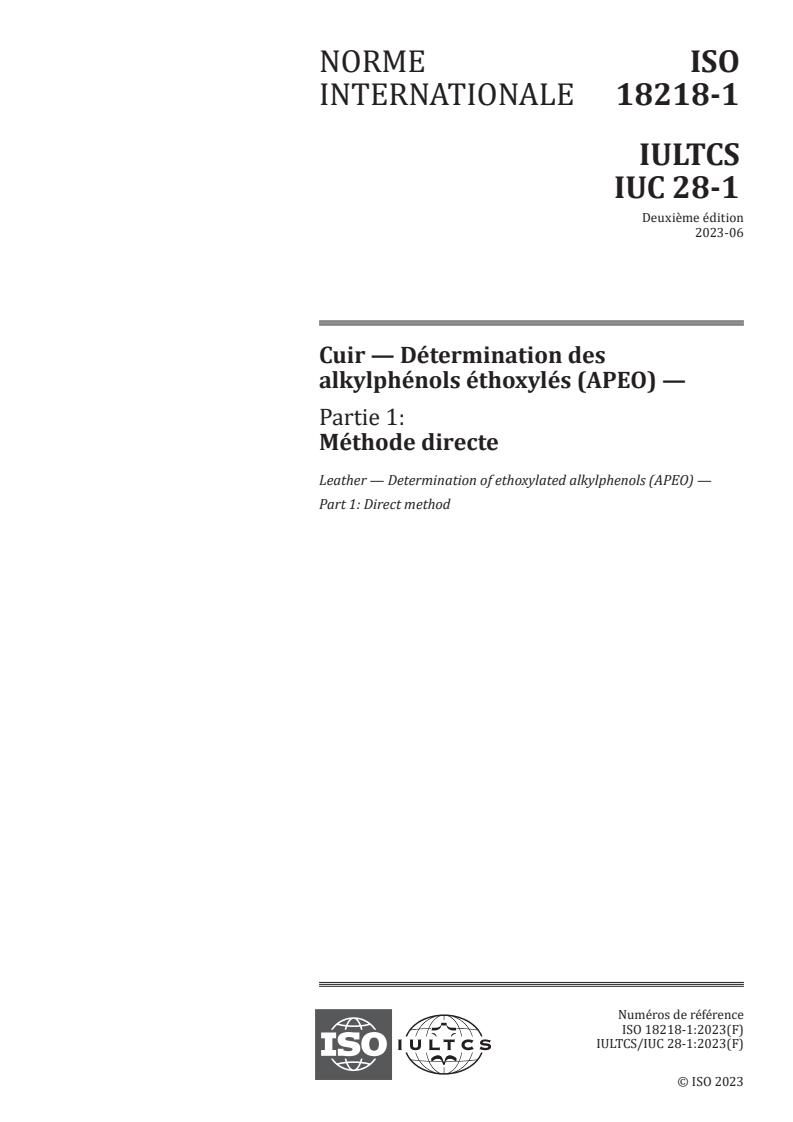
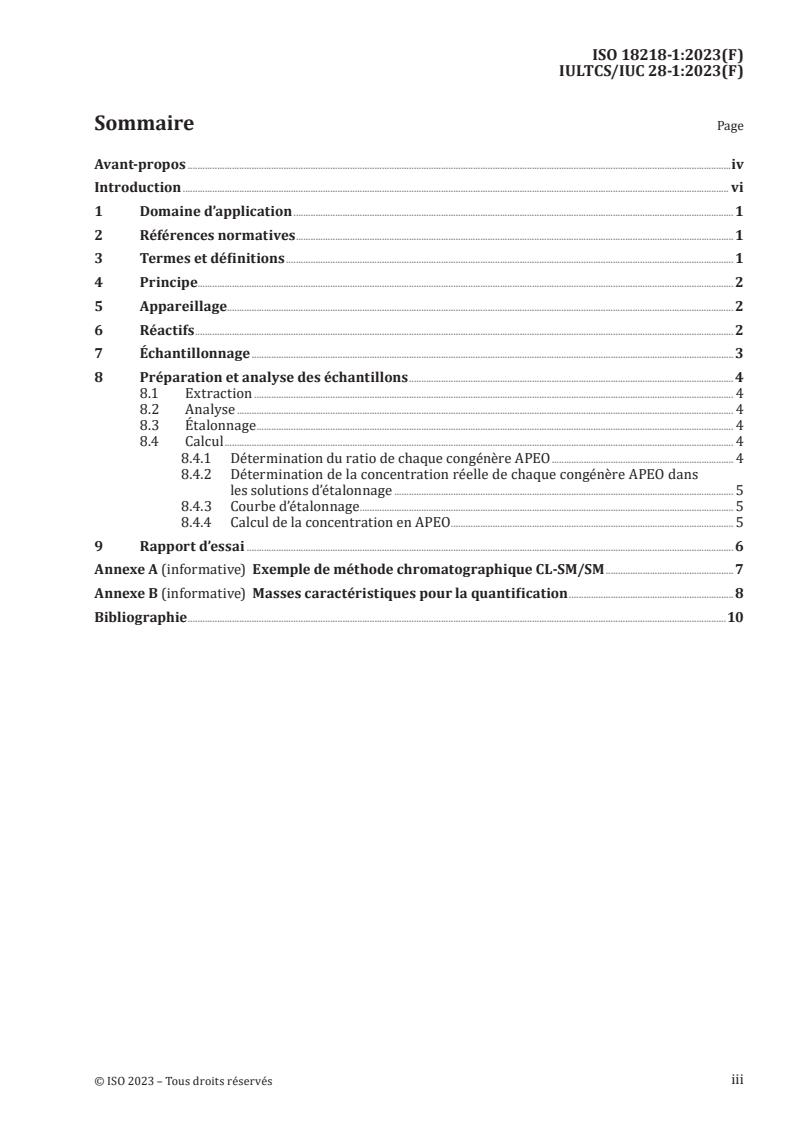
ISO 18218-1:2023 - Cuir — Détermination des alkylphénols éthoxylés (APEO) — Partie 1: Méthode directe Released:12. 06. 2023
Overview
ISO 18218-1:2023 specifies a direct analytical method for the determination of ethoxylated alkylphenols (APEO) in leather - principally nonylphenol ethoxylates (NPEOn, 2 ≤ n ≤ 16) and octylphenol ethoxylates (OPEOn, 2 ≤ n ≤ 16). The method is optimized for screening a large number of leather samples and requires liquid chromatography (LC) coupled to a triple quadrupole mass spectrometer (MS/MS) with electrospray ionization (ESI). Extraction is performed with methanol in an ultrasonic bath, followed by filtration and direct LC‑MS/MS analysis.
Key Topics
- Scope and purpose: Direct detection and quantification of APEO in leather to support environmental and regulatory compliance (e.g., REACH / EU restrictions on NPEO).
- Sample extraction: Approximately 1 g leather extracted with 20 ml methanol at (60 ± 5) °C for (60 ± 5) min in an ultrasonic bath; aliquots filtered (e.g., 0.2 µm) before LC analysis.
- Instrumentation: High‑performance LC with gradient elution and triple quadrupole MS/MS (ESI) for high selectivity and sensitivity-suitable for congener profiling (EO chain lengths 2–16).
- Standards & calibration: Use of stock (250 µg/ml) and standard solutions (25 µg/ml) with calibration examples spanning 0.5–2.5 µg/ml; quantification covers individual APEO congeners and total APEO content.
- Analytical details: Annex A provides example chromatographic conditions; Annex B lists characteristic masses for quantification. Method expects similar trends but not identical absolute values compared with ISO 18218‑2 due to different extraction solvents.
- Quality considerations: Use LC‑MS/MS grade methanol, traceable reference materials (commercial NPEO/OPEO technical grades cited), and ISO sampling/preparation practices (ISO 2418, ISO 4044, ISO 3696 referenced).
Applications
- Leather manufacturers and tanneries: Routine screening of incoming chemicals and finished leathers for APEO content to meet supply‑chain and product restrictions.
- Analytical and contract testing laboratories: High‑throughput testing using LC‑MS/MS for congener‑specific quantification of NPEO and OPEO.
- Regulatory compliance & auditing: Demonstrating conformity with environmental regulations restricting APEO/NPEO releases (REACH, EU directives).
- Sustainability and product safety teams: Monitoring surfactant residues that can biodegrade to endocrine‑active alkylphenols.
Related standards
- ISO 18218-2 - Indirect method for alkylphenol analysis (cleavage to alkylphenols).
- ISO 2418 - Specimen position and preparation for leather testing.
- ISO 4044 - Preparation of chemical test samples (leather).
- ISO 3696 - Laboratory water specification.
Keywords: ISO 18218-1:2023, leather testing, APEO determination, ethoxylated alkylphenols, NPEO, OPEO, LC‑MS/MS, methanol extraction, triple quadrupole mass spectrometer, nonylphenol ethoxylate.
Relations
- Effective Date
- 12-Feb-2026
- Effective Date
- 06-Jun-2022
- Revises
ISO 18218-1:2015 - Leather — Determination of ethoxylated alkylphenols — Part 1: Direct method - Effective Date
- 07-Aug-2021
Buy Documents
ISO 18218-1:2023 - Leather — Determination of ethoxylated alkylphenols (APEO) — Part 1: Direct method Released:12. 06. 2023
ISO 18218-1:2023 - Cuir — Détermination des alkylphénols éthoxylés (APEO) — Partie 1: Méthode directe Released:12. 06. 2023
Get Certified
Connect with accredited certification bodies for this standard

Control Union Certifications
Global certification for agriculture and sustainability.

Hohenstein Institut
Textile testing and certification.

Bureau Veritas Bangladesh
Bureau Veritas certification services in Bangladesh.
Sponsored listings
Frequently Asked Questions
ISO 18218-1:2023 is a standard published by the International Organization for Standardization (ISO). Its full title is "Leather — Determination of ethoxylated alkylphenols (APEO) — Part 1: Direct method". This standard covers: This document is a method for determining ethoxylated alkylphenols (APEO) [nonyphenol ethoxylate (NPEOn, where 2 ≤ n ≤ 16) and octylphenol ethoxylate (OPEOn, where 2 ≤ n ≤ 16)] in leather. This direct method is especially suitable when a larger number of leather samples are to be checked for the presence of ethoxylated alkylphenols. This method requires the use of liquid chromatography (LC) with a triple quadrupole mass spectrometer (MS/MS) to identify and quantify the ethoxylated alkylphenols. NOTE 1 In the leather industry, the most commonly used ethoxylated alkylphenol is the NPEO, with an average of 9 EO. It has an optimum cloud point in water for the typical leather processing temperatures of 40 °C to 55 °C. NOTE 2 This document and ISO 18218-2 use different solvents for the extraction of the ethoxylated alkylphenols from leather. Consequently, the two analytical methods are expected to give similar trends but not necessarily the same absolute result for the ethoxylated alkylphenol content in leather.
This document is a method for determining ethoxylated alkylphenols (APEO) [nonyphenol ethoxylate (NPEOn, where 2 ≤ n ≤ 16) and octylphenol ethoxylate (OPEOn, where 2 ≤ n ≤ 16)] in leather. This direct method is especially suitable when a larger number of leather samples are to be checked for the presence of ethoxylated alkylphenols. This method requires the use of liquid chromatography (LC) with a triple quadrupole mass spectrometer (MS/MS) to identify and quantify the ethoxylated alkylphenols. NOTE 1 In the leather industry, the most commonly used ethoxylated alkylphenol is the NPEO, with an average of 9 EO. It has an optimum cloud point in water for the typical leather processing temperatures of 40 °C to 55 °C. NOTE 2 This document and ISO 18218-2 use different solvents for the extraction of the ethoxylated alkylphenols from leather. Consequently, the two analytical methods are expected to give similar trends but not necessarily the same absolute result for the ethoxylated alkylphenol content in leather.
ISO 18218-1:2023 is classified under the following ICS (International Classification for Standards) categories: 59.140.30 - Leather and furs. The ICS classification helps identify the subject area and facilitates finding related standards.
ISO 18218-1:2023 has the following relationships with other standards: It is inter standard links to EN ISO 18218-1:2023, ISO 6742-2:2015/Amd 1:2018, ISO 18218-1:2015. Understanding these relationships helps ensure you are using the most current and applicable version of the standard.
ISO 18218-1:2023 is available in PDF format for immediate download after purchase. The document can be added to your cart and obtained through the secure checkout process. Digital delivery ensures instant access to the complete standard document.
Standards Content (Sample)
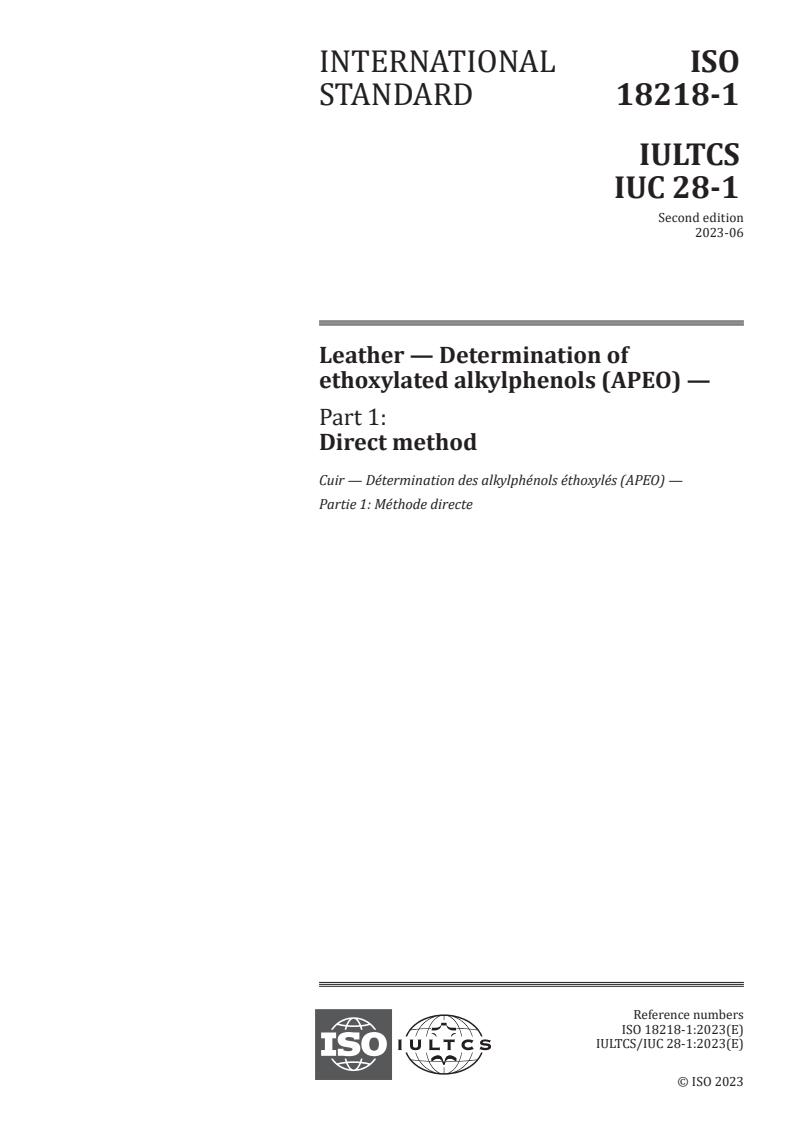
INTERNATIONAL ISO
STANDARD 18218-1
IULTCS
IUC 28-1
Second edition
2023-06
Leather — Determination of
ethoxylated alkylphenols (APEO) —
Part 1:
Direct method
Cuir — Détermination des alkylphénols éthoxylés (APEO) —
Partie 1: Méthode directe
Reference numbers
IULTCS/IUC 28-1:2023(E)
IULTCS/IUC 28-1:2023(E)
© ISO 2023
All rights reserved. Unless otherwise specified, or required in the context of its implementation, no part of this publication may
be reproduced or utilized otherwise in any form or by any means, electronic or mechanical, including photocopying, or posting on
the internet or an intranet, without prior written permission. Permission can be requested from either ISO at the address below
or ISO’s member body in the country of the requester.
ISO copyright office
CP 401 • Ch. de Blandonnet 8
CH-1214 Vernier, Geneva
Phone: +41 22 749 01 11
Email: copyright@iso.org
Website: www.iso.org
Published in Switzerland
ii
IULTCS/IUC 28-1:2023(E)
Contents Page
Foreword .iv
Introduction .v
1 Scope . 1
2 Normative references . 1
3 Terms and definitions . 1
4 Principle . 1
5 Apparatus . 2
6 Reagents . 2
7 Sampling . 3
8 Sample preparation and analysis . 3
8.1 Extraction . 3
8.2 Analysis . 4
8.3 Calibration . 4
8.4 Calculation . 4
8.4.1 Determination of the ratio of each APEO congener . 4
8.4.2 Determination of the real concentration of each APEO congener in the
calibration standards . 4
8.4.3 Calibration graph . 4
8.4.4 Calculation of the APEO concentration . 5
9 Test report . 5
Annex A (informative) Example of chromatographic method LC-MS/MS .7
Annex B (informative) Characteristic masses for quantification . 8
Bibliography .10
iii
IULTCS/IUC 28-1:2023(E)
Foreword
ISO (the International Organization for Standardization) is a worldwide federation of national standards
bodies (ISO member bodies). The work of preparing International Standards is normally carried out
through ISO technical committees. Each member body interested in a subject for which a technical
committee has been established has the right to be represented on that committee. International
organizations, governmental and non-governmental, in liaison with ISO, also take part in the work.
ISO collaborates closely with the International Electrotechnical Commission (IEC) on all matters of
electrotechnical standardization.
The procedures used to develop this document and those intended for its further maintenance are
described in the ISO/IEC Directives, Part 1. In particular, the different approval criteria needed for the
different types of ISO documents should be noted. This document was drafted in accordance with the
editorial rules of the ISO/IEC Directives, Part 2 (see www.iso.org/directives).
Attention is drawn to the possibility that some of the elements of this document may be the subject of
patent rights. ISO shall not be held responsible for identifying any or all such patent rights. Details of
any patent rights identified during the development of the document will be in the Introduction and/or
on the ISO list of patent declarations received (see www.iso.org/patents).
Any trade name used in this document is information given for the convenience of users and does not
constitute an endorsement.
For an explanation of the voluntary nature of standards, the meaning of ISO specific terms and
expressions related to conformity assessment, as well as information about ISO's adherence to
the World Trade Organization (WTO) principles in the Technical Barriers to Trade (TBT), see
www.iso.org/iso/foreword.html.
IULTCS, originally formed in 1897, is a world-wide organization of professional leather societies to
further the advancement of leather science and technology. IULTCS has three Commissions, which
are responsible for establishing international methods for the sampling and testing of leather. ISO
recognizes IULTCS as an international standardizing body for the preparation of test methods for
leather.
This document was prepared by the Chemical Test Commission of the International Union of Leather
Technologists and Chemists Societies (IUC Commission, IULTCS), in collaboration with the European
Committee for Standardization (CEN) Technical Committee CEN/TC 289, Leather, in accordance with
the Agreement on technical cooperation between ISO and CEN (Vienna Agreement).
This second edition cancels and replaces the first edition (ISO 18218-1:2015), which has been technically
revised.
The main changes are as follows:
— a new Clause 3 has been added and subsequent clauses renumbered;
— Clauses 6 and 8 have been technically revised;
— the NOTE in 7.1 of the previous edition has been deleted;
— a new calculation procedure in 8.4 has been added;
— Annex A has been technically revised;
— a new Annex B has been added.
A list of all parts in the ISO 18218 series can be found on the ISO website.
Any feedback or questions on this document should be directed to the user’s national standards body. A
complete listing of these bodies can be found at www.iso.org/members.html.
iv
IULTCS/IUC 28-1:2023(E)
Introduction
Nonylphenol ethoxylate belongs to the non-ionic surfactants. The biodegradation of nonylphenol
ethoxylate releases the persistent pollutant, the branched nonylphenol. Nonylphenol is a hormonal
acting substance that is toxic for waterborne organisms and many other organisms. For this reason, the
release of nonylphenol ethoxylate into the environment should be avoided.
[4]
In 2003 the European Directive 2003/53/EC restricted the sale and use of nonylphenol and
nonylphenol ethoxylate in product preparations for industries with discharges to wastewater.
Preparations containing concentrations equal to or higher than 0,1 % of nonylphenol ethoxylate
or nonylphenol were forbidden. This Directive is included as part of the EU Regulation 1907/2006
[3]
(REACH).
No detailed composition of the chemical substance nonylphenol ethoxylate can be given; it is assigned
the general structural formula:
(C alkyl chain, branched or linear)–Ph–[OCH CH ] –OH
9 2 2 n
where Ph = phenyl, n ≥ 1.
To cover the group of ethoxylates of 4-nonylphenol, branched and linear, the European Chemical Agency
(ECHA) has assigned the substance the following definition:
"4-nonylphenol, branched and linear, ethoxylated [substances with a linear and/or branched alkyl chain
with a carbon number of 9 covalently bound in position 4 to phenol, ethoxylated covering UVCB and
well-defined substances, polymers and homologues, which include any of the individual isomers and/or
[5]
combinations thereof]."
In the leather industry, nonylphenol ethoxylate and octylphenol ethoxylate surfactants have been used.
However, the water-insoluble substances nonylphenol and octylphenol have not been used. For this
reason, two different analytical procedures have been prepared for analysing leather samples.
This document is a method that directly determines the ethoxylated alkylphenol. It is an efficient
procedure for the analysis of a larger number of leather samples. This procedure requires liquid
chromatography (LC) with triple quadrupole mass spectrometer (MS/MS) to identify the nonylphenol
ethoxylate and octylphenol ethoxylate.
ISO 18218-2 specifies a procedure for analysing the alkylphenol component. The ethoxylated
alkylphenol is cleaved to form the alkylphenol, which is identified using LC or gas chromatography-
mass spectrometry (GC-MS) equipment. This method can also be used to indirectly determine the
alkylphenol ethoxylate content in leather.
v
INTERNATIONAL STANDARD
IULTCS/IUC 28-1:2023(E)
Leather — Determination of ethoxylated alkylphenols
(APEO) —
Part 1:
Direct method
1 Scope
This document is a method for determining ethoxylated alkylphenols (APEO) [nonyphenol ethoxylate
(NPEO , where 2 ≤ n ≤ 16) and octylphenol ethoxylate (OPEO , where 2 ≤ n ≤ 16)] in leather. This
n n
direct method is especially suitable when a larger number of leather samples are to be checked for the
presence of ethoxylated alkylphenols.
This method requires the use of liquid chromatography (LC) with a triple quadrupole mass spectrometer
(MS/MS) to identify and quantify the ethoxylated alkylphenols.
NOTE 1 In the leather industry, the most commonly used ethoxylated alkylphenol is the NPEO, with an average
of 9 EO. It has an optimum cloud point in water for the typical leather processing temperatures of 40 °C to 55 °C.
NOTE 2 This document and ISO 18218-2 use different solvents for the extraction of the ethoxylated
alkylphenols from leather. Consequently, the two analytical methods are expected to give similar trends but not
necessarily the same absolute result for the ethoxylated alkylphenol content in leather.
2 Normative references
The following documents are referred to in the text in such a way that some or all of their content
constitutes requirements of this document. For dated references, only the edition cited applies. For
undated references, the latest edition of the referenced document (including any amendments) applies.
ISO 2418, Leather — Chemical, physical, mechanical and fastness tests — Position and preparation of
specimens for testing
ISO 3696, Water for analytical laboratory use — Specification and test methods
ISO 4044, Leather — Chemical tests — Preparation of chemical test samples
3 Terms and definitions
No terms and definitions are listed in this document.
ISO and IEC maintain terminology databases for use in standardiza
...
NORME ISO
INTERNATIONALE 18218-1
IULTCS
IUC 28-1
Deuxième édition
2023-06
Cuir — Détermination des
alkylphénols éthoxylés (APEO) —
Partie 1:
Méthode directe
Leather — Determination of ethoxylated alkylphenols (APEO) —
Part 1: Direct method
Numéros de référence
IULTCS/IUC 28-1:2023(F)
IULTCS/IUC 28-1:2023(F)
DOCUMENT PROTÉGÉ PAR COPYRIGHT
© ISO 2023
Tous droits réservés. Sauf prescription différente ou nécessité dans le contexte de sa mise en œuvre, aucune partie de cette
publication ne peut être reproduite ni utilisée sous quelque forme que ce soit et par aucun procédé, électronique ou mécanique,
y compris la photocopie, ou la diffusion sur l’internet ou sur un intranet, sans autorisation écrite préalable. Une autorisation peut
être demandée à l’ISO à l’adresse ci-après ou au comité membre de l’ISO dans le pays du demandeur.
ISO copyright office
Case postale 401 • Ch. de Blandonnet 8
CH-1214 Vernier, Genève
Tél.: +41 22 749 01 11
E-mail: copyright@iso.org
Web: www.iso.org
Publié en Suisse
ii
IULTCS/IUC 28-1:2023(F)
Sommaire Page
Avant-propos .iv
Introduction . vi
1 Domaine d’application . 1
2 Références normatives .1
3 Termes et définitions . 1
4 Principe. 2
5 Appareillage . 2
6 Réactifs . 2
7 Échantillonnage .3
8 Préparation et analyse des échantillons . 4
8.1 Extraction . 4
8.2 Analyse . 4
8.3 Étalonnage . 4
8.4 Calcul . 4
8.4.1 Détermination du ratio de chaque congénère APEO . 4
8.4.2 Détermination de la concentration réelle de chaque congénère APEO dans
les solutions d’étalonnage . 5
8.4.3 Courbe d’étalonnage . 5
8.4.4 Calcul de la concentration en APEO . 5
9 Rapport d’essai . 6
Annexe A (informative) Exemple de méthode chromatographique CL-SM/SM .7
Annexe B (informative) Masses caractéristiques pour la quantification .8
Bibliographie .10
iii
IULTCS/IUC 28-1:2023(F)
Avant-propos
L'ISO (Organisation internationale de normalisation) est une fédération mondiale d'organismes
nationaux de normalisation (comités membres de l'ISO). L'élaboration des Normes internationales est
en général confiée aux comités techniques de l'ISO. Chaque comité membre intéressé par une étude
a le droit de faire partie du comité technique créé à cet effet. Les organisations internationales,
gouvernementales et non gouvernementales, en liaison avec l'ISO, participent également aux travaux.
L'ISO collabore étroitement avec la Commission électrotechnique internationale (IEC) en ce qui
concerne la normalisation électrotechnique.
Les procédures utilisées pour élaborer le présent document et celles destinées à sa mise à jour sont
décrites dans les Directives ISO/IEC, Partie 1. Il convient, en particulier, de prendre note des différents
critères d'approbation requis pour les différents types de documents ISO. Le présent document
a été rédigé conformément aux règles de rédaction données dans les Directives ISO/IEC, Partie 2
(voir www.iso.org/directives).
L'attention est appelée sur le fait que certains des éléments du présent document peuvent faire l'objet de
droits de propriété intellectuelle ou de droits analogues. L’ISO ne saurait être tenue pour responsable
de ne pas avoir identifié de tels droits de propriété. Les détails concernant les références aux droits
de propriété intellectuelle ou autres droits analogues identifiés lors de l'élaboration du document
sont indiqués dans l'Introduction et/ou dans la liste des déclarations de brevets reçues par l'ISO
(voir www.iso.org/brevets).
Les appellations commerciales éventuellement mentionnées dans le présent document sont données
pour information, par souci de commodité, à l'intention des utilisateurs et ne sauraient constituer un
engagement.
Pour une explication de la nature volontaire des normes, la signification des termes et expressions
spécifiques de l'ISO liés à l'évaluation de la conformité, ou pour toute information au sujet de l'adhésion
de l'ISO aux principes de l’Organisation mondiale du commerce (OMC) concernant les obstacles
techniques au commerce (OTC), voir le lien suivant: www.iso.org/iso/avant-propos.html.
L'IULTCS est une organisation mondiale de sociétés professionnelles des industries du cuir
fondée en 1897 ayant pour mission de favoriser l'avancement des sciences et technologies du cuir.
L’IULTCS a trois commissions qui sont responsables de l’établissement de méthodes internationales
d’échantillonnage et d’essai des cuirs. L’ISO reconnaît l’IULTCS en tant qu’organisme international à
activités normatives pour l’élaboration de méthodes d’essai relatives au cuir.
Le présent document a été élaboré par la Commission des essais chimiques de l'Union internationale des
sociétés de techniciens et chimistes du cuir (commission IUC, IULTCS) en collaboration avec le comité
technique CEN/TC 289, Cuir, du Comité européen de normalisation (CEN), conformément à l'Accord de
coopération technique entre l'ISO et le CEN (Accord de Vienne).
Cette deuxième édition annule et remplace la première édition (ISO 18218-1:2015) qui a fait l’objet
d’une révision technique.
Les principales modifications sont les suivantes:
— un nouvel Article 3 a été ajouté, la numérotation des articles suivants a été modifiée en conséquence;
— les Articles 6 et 8 ont fait l’objet d’une révision technique;
— la NOTE en 7.1 de l’édition précédente a été supprimée;
— un nouveau mode opératoire de calcul a été ajouté en 8.4;
— l’Annexe A a fait l’objet d’une révision technique;
— une nouvelle Annexe B a été ajoutée.
Une liste de toutes les parties de la série ISO 18218 peut être consultée sur le site web de l’ISO.
iv
IULTCS/IUC 28-1:2023(F)
Il convient que l’utilisateur adresse tout retour d’information ou toute question concernant le présent
document à l’organisme national de normalisation de son pays. Une liste exhaustive desdits organismes
se trouve à l’adresse www.iso.org/members.html.
v
IULTCS/IUC 28-1:2023(F)
Introduction
L’éthoxylate de nonylphénol appartient à la famille des agents tensio-actifs non ioniques. La
biodégradation de l’éthoxylate de nonylphénol libère du nonylphénol ramifié, qui est un polluant
persistant. Le nonylphénol est une substance agissant sur le système hormonal, il est toxique pour les
organismes d’origine hydrique et de nombreux autres organismes. C'est pourquoi il convient d'éviter de
rejeter de l’éthoxylate de nonylphénol dans l'environnement.
[4]
En 2003, la Directive européenne 2003/53/CE a restreint la mise sur le marché et l’emploi du
nonylphénol et de l’éthoxylate de nonylphénol dans les préparations de produits pour les industries avec
rejets dans les eaux usées. Les préparations dans lesquelles la teneur en éthoxylate de nonylphénol ou
en nonylphénol est supérieure ou égale à 0,1 % ont été interdites. Cette Directive fait partie intégrante
[3]
du Règlement UE 1907/2006 (REACH) .
Aucune composition détaillée de l’éthoxylate de nonylphénol ne peut être donnée, la formule semi-
développée suivante a ainsi été attribuée à cette substance chimique:
(C chaîne alkyle, ramifiée ou linéaire)–Ph–[OCH CH ] –OH
9 2 2 n
avec Ph = phényl, n ≥ 1.
Pour englober le groupe des éthoxylates de 4-nonylphénol, ramifiés et linéaires, l’Agence européenne
des produits chimiques (ECHA) a défini cette substance de la manière suivante:
«substance éthoxylée, à base de 4-nonylphénol ramifié et linéaire [substances présentant une chaîne
alkyle linéaire et/ou ramifiée, comportant 9 atomes de carbone liés par covalence en position 4 au
phénol, éthoxylées, correspondant aux substances UVCB et aux substances bien définies, aux polymères
[5]
et leurs homologues qui incluent un ou plusieurs isomères et/ou des combinaisons de ceux-ci].»
Des agents tensio-actifs à base d’éthoxylate de nonylphénol et d’éthoxylate d’octylphénol ont été utilisés
dans l’industrie du cuir. En revanche, le nonylphénol et l’octylphénol, qui sont des substances insolubles
dans l’eau, n’ont pas été utilisés. De ce fait, deux modes opératoires analytiques différents ont été
élaborés pour analyser les échantillons de cuir.
Le présent document est une méthode de détermination directe de la teneur en alkylphénol éthoxylé.
Cette méthode est efficace pour analyser un grand nombre d’échantillons de cuir. L’analyse est effectuée
par chromatographie en phase liquide (CL) couplée à la spectrométrie de masse en tandem avec un
analyseur à triple quadripôle (SM/SM), afin d’identifier les éthoxylates de nonylphénol et d’octylphénol.
L’ISO 18218-2 spécifie une méthode d’analyse de l’alkylphénol. L’alkylphénol éthoxylé est clivé pour
former l’alkylphénol, lequel est identifié en utilisant un équipement de chromatographie en phase
liquide (CL) ou de chromatographie en phase gazeuse couplée à la spectrométrie de masse (CG-SM).
Cette méthode peut également servir à déterminer indirectement la teneur en éthoxylate d’alkylphénol
dans le cuir et les produits auxiliaires de traitement.
vi
NORME INTERNATIONALE
IULTCS/IUC 28-1:2023(F)
Cuir — Détermination des alkylphénols éthoxylés
(APEO) —
Partie 1:
Méthode directe
1 Domaine d’application
Le présent document spécifie une méthode de détermination des alkylphénols éthoxylés (APEO)
[éthoxylate de nonylphénol (NPEO , où 2 ≤ n ≤ 16) et éthoxylate d’octylphénol (OPEO , où 2 ≤ n ≤ 16)]
n n
dans le cuir. Cette méthode d’analyse directe convient particulièrement lorsque les alkylphénols
éthoxylés doivent être dosés sur un grand nombre d’échantillons de cuir.
L’analyse est effectuée par chromatographie en phase liquide (CL) couplée à la spectrométrie de
masse en tandem avec un analyseur à triple quadripôle (SM/SM), afin d’identifier et de quantifier les
alkylphénols éthoxylés.
NOTE 1 Parmi les alkylphénols éthoxylés, celui qui est le plus utilisé dans l’industrie du cuir est le NPEO, qui
contient en moyenne 9 groupes éthoxy. La température de trouble dans l’eau de cette substance est optimale
compte tenu des températures généralement utilisées pour le traitement du cuir, qui sont comprises entre 40 °C
et 55 °C.
NOTE 2 Le présent document et l’ISO 18218-2 utilisent différents solvants pour l’extraction des alkylphénols
éthoxylés du cuir. Par conséquent, on peut s’attendre à ce que les résultats obtenus en suivant l’une des
deux méthodes analytiques soient comparables à ceux obtenus en suivant la seconde méthode, mais non
nécessairement identiques, pour ce qui concerne la teneur en alkylphénols éthoxylés dans le cuir.
2 Références normatives
Les documents suivants sont cités dans le texte de sorte qu’ils constituent, pour tout ou partie de leur
contenu, des exigences du présent document. Pour les références datées, seule l’édition citée s’applique.
Pour les références non datées, la dernière édition de la publication à laquelle il est fait référence
s'applique (y compris tous les amendements).
ISO 2418, Cuir — Essais chimiques, physiques, mécaniques et essais de solidité — Emplacement et
préparation des spécimens pour les essais
ISO 3696, Eau pour laboratoire à usage analytique — Spécification et méthodes d'essai
ISO 4044, Cuir — Essais chimiques - Préparation des échantillons pour essais chimiques
3 Termes et définitions
Le présent document ne contient pas de liste de termes et définitions.
L'ISO et l'IEC tiennent à jour des bases de données terminologiques destinées à être utilisées en
normalisation, consultables aux adresses suivantes:
— ISO Online browsing plat
...