

ISO 2171:2023
(Main)Cereals, pulses and by-products — Determination of ash yield by incineration
General Information
- Abstract
This document specifies a method for determining the ash yield by cereals, pulses and their milled products intended for human consumption. The source materials and products covered are: a) grains of cereals; b) flours and semolinas; c) other milling products (bran and high bran content products, shorts); d) mixed cereal flours (mixes); e) cereal by-products other than c) (such as wheat gluten, maize grits, broken rice kernels); f) pulses and their by-products (flour). This document does not apply to starches and starch derivatives (see ISO 3593), to products intended for animal feeding stuffs (see ISO 5984) or to seeds.
- Status
- Published
- Publication Date
- 20-Feb-2023
- Technical Committee
- ISO/TC 34/SC 4 - Cereals and pulses
- Drafting Committee
- ISO/TC 34/SC 4 - Cereals and pulses
- Current Stage
- 6060 - International Standard published
- Start Date
- 21-Feb-2023
- Due Date
- 10-Jul-2022
- Completion Date
- 21-Feb-2023
Buy Documents
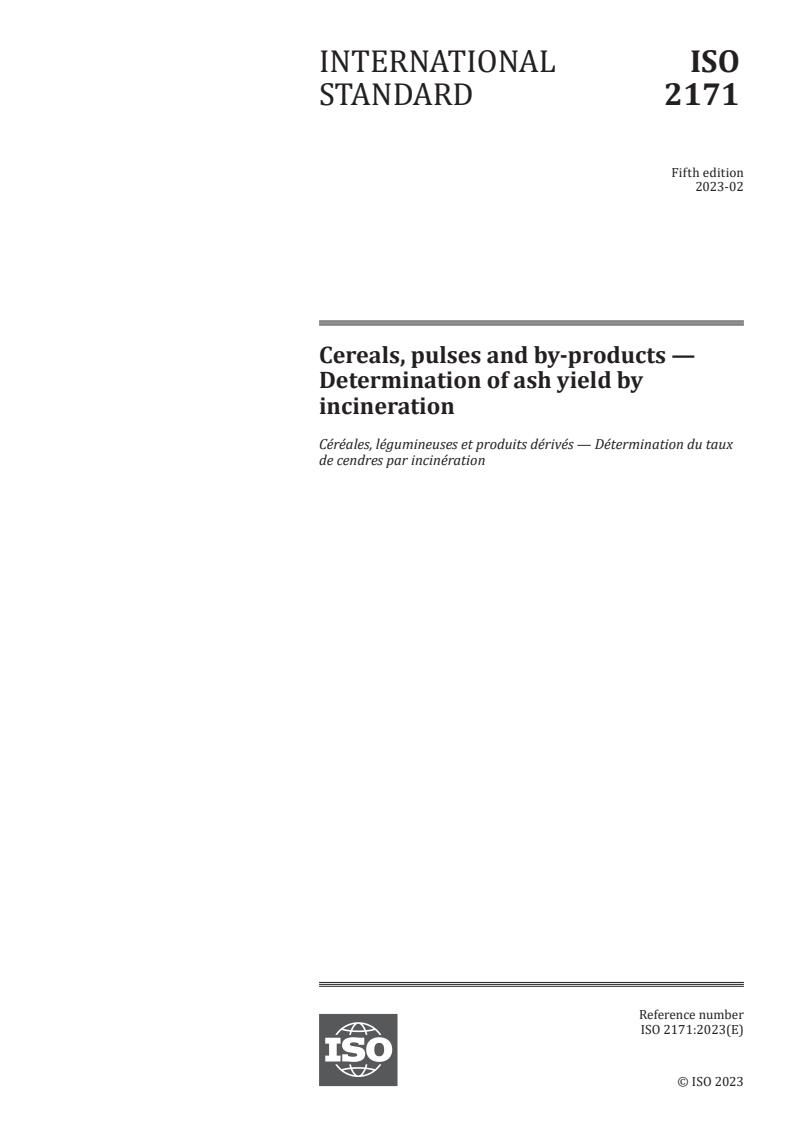
ISO 2171:2023 - Cereals, pulses and by-products — Determination of ash yield by incineration Released:21. 02. 2023
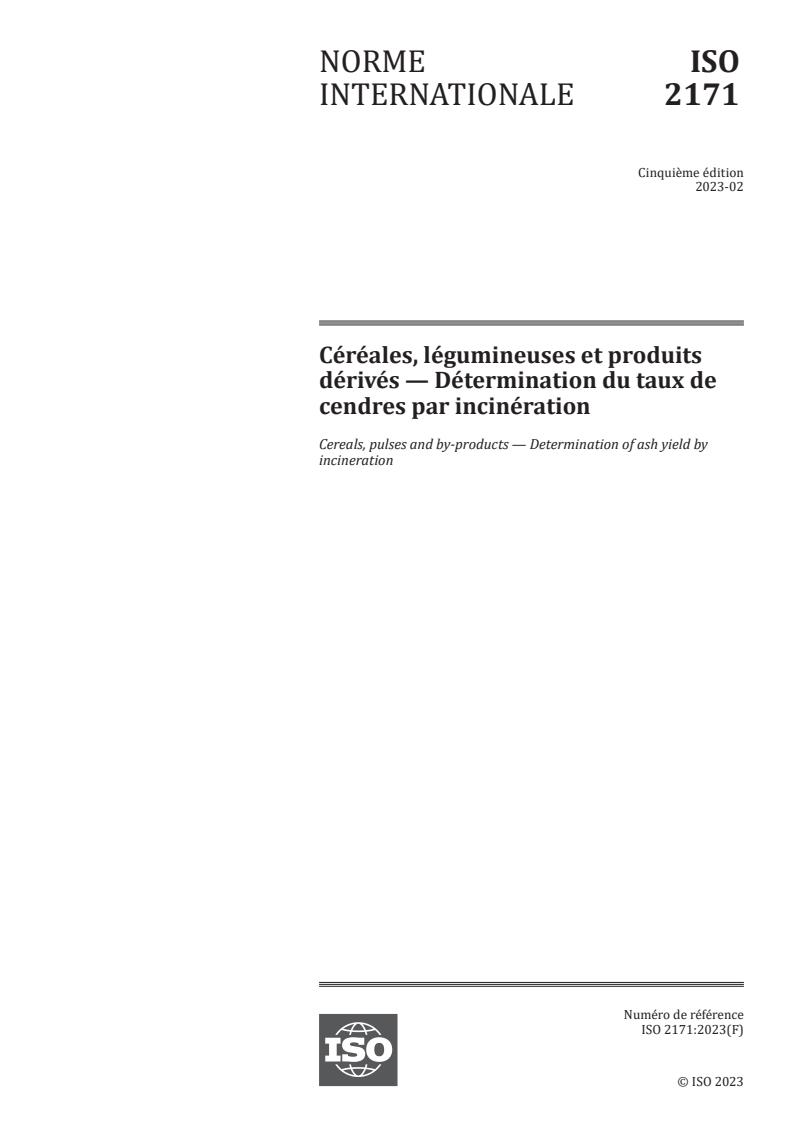
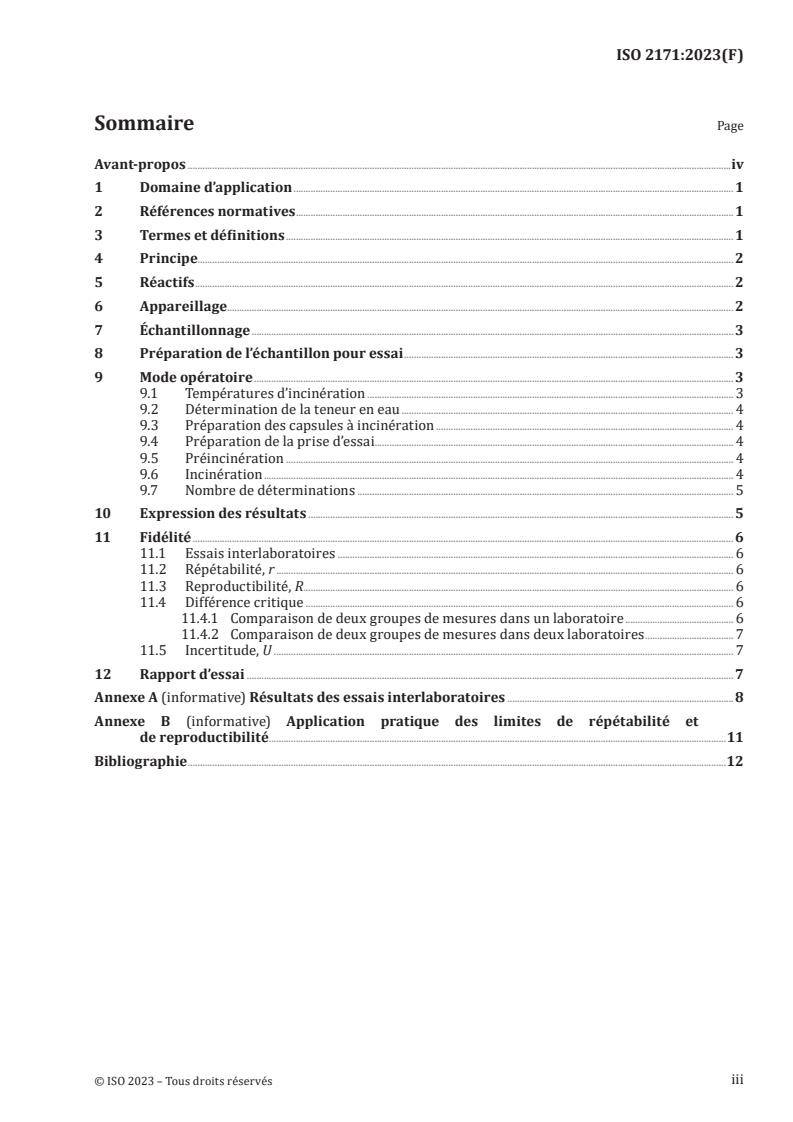
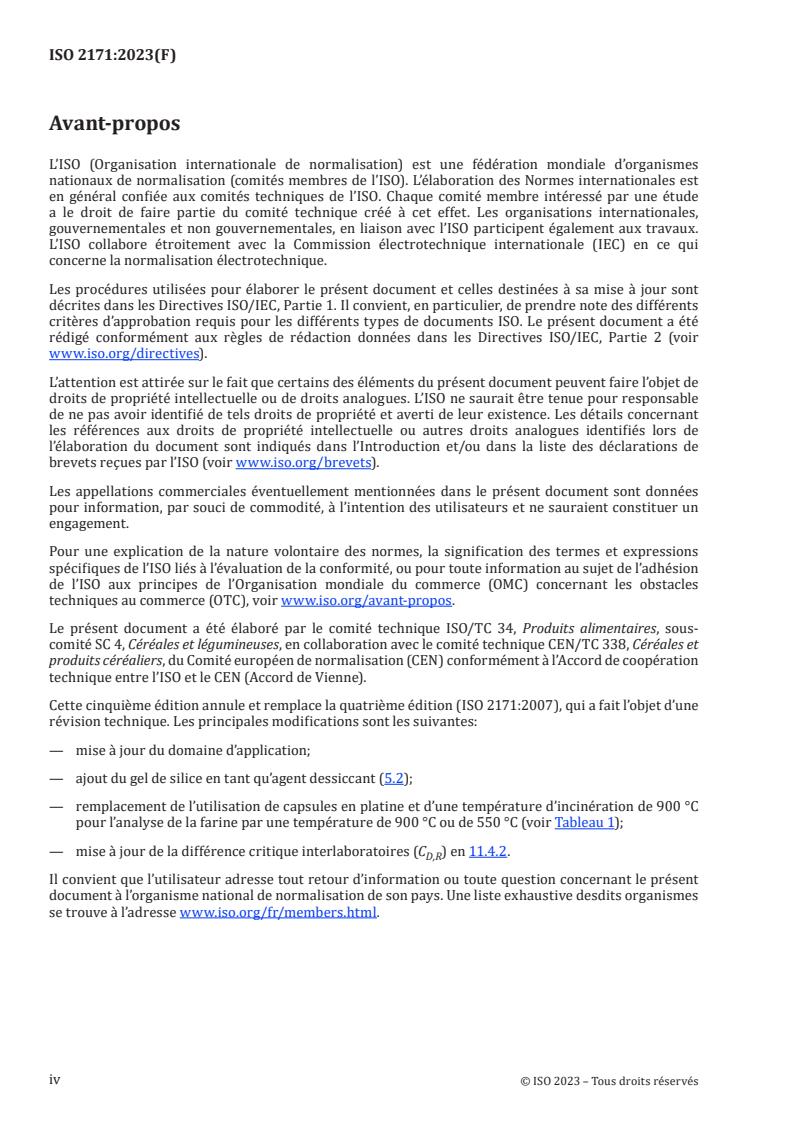
ISO 2171:2023 - Céréales, légumineuses et produits dérivés — Détermination du taux de cendres par incinération Released:21. 02. 2023
Overview
ISO 2171:2023 specifies an analytical method for determining ash yield by incineration in cereals, pulses and their milled products intended for human consumption. The standard covers whole grains, flours, semolinas, bran and high‑bran products, mixed cereal flours, cereal by‑products (e.g., wheat gluten, maize grits, broken rice kernels) and pulse flours. It does not apply to starches and starch derivatives, animal feeding stuffs or seeds.
Key SEO terms: ISO 2171:2023, ash yield, incineration, cereals, pulses, ash determination, milled products, laboratory method.
Key topics and technical requirements
- Principle: Incinerate a representative test portion until organic matter is completely combusted and weigh the inorganic residue (ash).
- Scope & exclusions: Explicit product list and exclusions (see ISO 3593, ISO 5984).
- Incineration temperatures: Two regimes are specified:
- 900 ± 25 °C (recommended for flour and some products) - platinum‑rhodium dishes preferred; test portion ~3.9–4.1 g; 1 h (flour) to 1–1.5 h (other products).
- 550 ± 10 °C (recommended for products containing salts and many milled or by‑products) - quartz or silica dishes; test portion ~4.9–5.1 g; 4 h minimum.
- Apparatus & reagents: electrically heated muffle furnace, analytical balance (0.01 mg), platinum‑rhodium or quartz ashing dishes, hydrochloric acid cleaning, desiccant (P2O5 or silica gel), ethanol for ignition at 550 °C.
- Sample preparation: Grinding and representative splitting; moisture must be determined beforehand per ISO 712, ISO 6540 (maize) or ISO 24557 (pulses) or validated NIR methods (ISO 12099).
- Procedure details: dish conditioning, pre‑ashing/ignition, ashing, cooling in desiccator and weighing. Hygroscopic nature of ash and optional vitrification at 900 °C are addressed.
- Quality metrics: repeatability, reproducibility, critical difference and uncertainty are defined and supported by interlaboratory data.
Applications and users
ISO 2171:2023 is intended for:
- Food testing and quality control laboratories performing compositional analysis of cereals and pulses
- Grain mills and flour producers monitoring ash content for grading and process control
- Food manufacturers and ingredient suppliers verifying raw material specifications
- Regulatory bodies and auditors assessing compliance with food standards
- Research institutions studying cereal/pulse composition and processing effects
Practical benefits include consistent ash yield results, improved comparability between laboratories, and guidance on appropriate sample handling and furnace conditions.
Related standards
- ISO 712, ISO 6540, ISO 24557 (moisture determination)
- ISO 12099 (NIR performance)
- ISO 3593 (starches - excluded)
- ISO 5984 (animal feeding stuffs - excluded)
- ISO 24333 (sampling guidance)
For laboratories and food industry professionals, ISO 2171:2023 provides a robust, internationally harmonized method for ash determination essential to product specification, grading and quality assurance.
Relations
- Effective Date
- 12-Feb-2026
- Effective Date
- 28-Apr-2018
Buy Documents
ISO 2171:2023 - Cereals, pulses and by-products — Determination of ash yield by incineration Released:21. 02. 2023
ISO 2171:2023 - Céréales, légumineuses et produits dérivés — Détermination du taux de cendres par incinération Released:21. 02. 2023
Get Certified
Connect with accredited certification bodies for this standard

BSI Group
BSI (British Standards Institution) is the business standards company that helps organizations make excellence a habit.

Bureau Veritas
Bureau Veritas is a world leader in laboratory testing, inspection and certification services.

DNV
DNV is an independent assurance and risk management provider.
Sponsored listings
Frequently Asked Questions
ISO 2171:2023 is a standard published by the International Organization for Standardization (ISO). Its full title is "Cereals, pulses and by-products — Determination of ash yield by incineration". This standard covers: This document specifies a method for determining the ash yield by cereals, pulses and their milled products intended for human consumption. The source materials and products covered are: a) grains of cereals; b) flours and semolinas; c) other milling products (bran and high bran content products, shorts); d) mixed cereal flours (mixes); e) cereal by-products other than c) (such as wheat gluten, maize grits, broken rice kernels); f) pulses and their by-products (flour). This document does not apply to starches and starch derivatives (see ISO 3593), to products intended for animal feeding stuffs (see ISO 5984) or to seeds.
This document specifies a method for determining the ash yield by cereals, pulses and their milled products intended for human consumption. The source materials and products covered are: a) grains of cereals; b) flours and semolinas; c) other milling products (bran and high bran content products, shorts); d) mixed cereal flours (mixes); e) cereal by-products other than c) (such as wheat gluten, maize grits, broken rice kernels); f) pulses and their by-products (flour). This document does not apply to starches and starch derivatives (see ISO 3593), to products intended for animal feeding stuffs (see ISO 5984) or to seeds.
ISO 2171:2023 is classified under the following ICS (International Classification for Standards) categories: 67.060 - Cereals, pulses and derived products. The ICS classification helps identify the subject area and facilitates finding related standards.
ISO 2171:2023 has the following relationships with other standards: It is inter standard links to EN ISO 2171:2023, ISO 2171:2007. Understanding these relationships helps ensure you are using the most current and applicable version of the standard.
ISO 2171:2023 is available in PDF format for immediate download after purchase. The document can be added to your cart and obtained through the secure checkout process. Digital delivery ensures instant access to the complete standard document.
Standards Content (Sample)
INTERNATIONAL ISO
STANDARD 2171
Fifth edition
2023-02
Cereals, pulses and by-products —
Determination of ash yield by
incineration
Céréales, légumineuses et produits dérivés — Détermination du taux
de cendres par incinération
Reference number
© ISO 2023
All rights reserved. Unless otherwise specified, or required in the context of its implementation, no part of this publication may
be reproduced or utilized otherwise in any form or by any means, electronic or mechanical, including photocopying, or posting on
the internet or an intranet, without prior written permission. Permission can be requested from either ISO at the address below
or ISO’s member body in the country of the requester.
ISO copyright office
CP 401 • Ch. de Blandonnet 8
CH-1214 Vernier, Geneva
Phone: +41 22 749 01 11
Email: copyright@iso.org
Website: www.iso.org
Published in Switzerland
ii
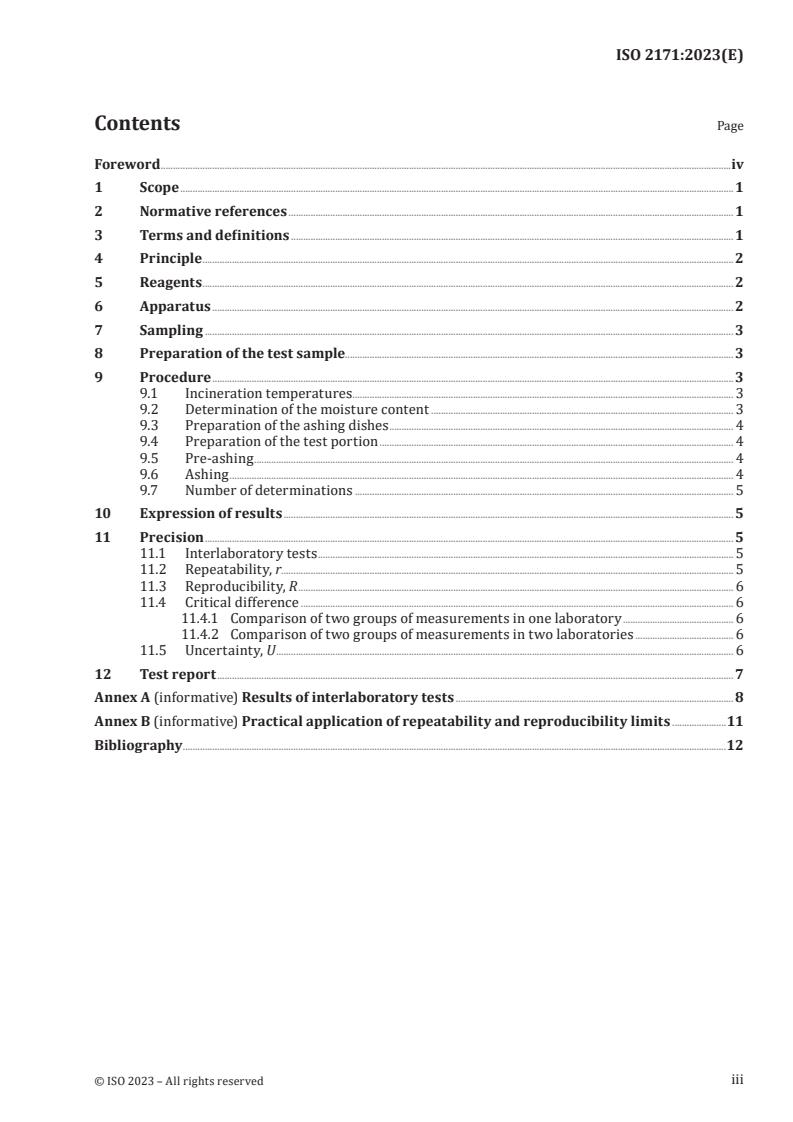
Contents Page
Foreword .iv
1 Scope . 1
2 Normative references . 1
3 Terms and definitions . 1
4 Principle . 2
5 Reagents . 2
6 Apparatus . 2
7 Sampling . 3
8 Preparation of the test sample. 3
9 Procedure .3
9.1 Incineration temperatures . 3
9.2 Determination of the moisture content . 3
9.3 Preparation of the ashing dishes . 4
9.4 Preparation of the test portion . 4
9.5 Pre-ashing . 4
9.6 Ashing . 4
9.7 Number of determinations . 5
10 Expression of results . 5
11 Precision . 5
11.1 Interlaboratory tests . 5
11.2 Repeatability, r. 5
11.3 Reproducibility, R . 6
11.4 Critical difference . 6
11.4.1 Comparison of two groups of measurements in one laboratory . 6
11.4.2 Comparison of two groups of measurements in two laboratories . 6
11.5 Uncertainty, U . 6
12 Test report . 7
Annex A (informative) Results of interlaboratory tests . 8
Annex B (informative) Practical application of repeatability and reproducibility limits .11
Bibliography .12
iii
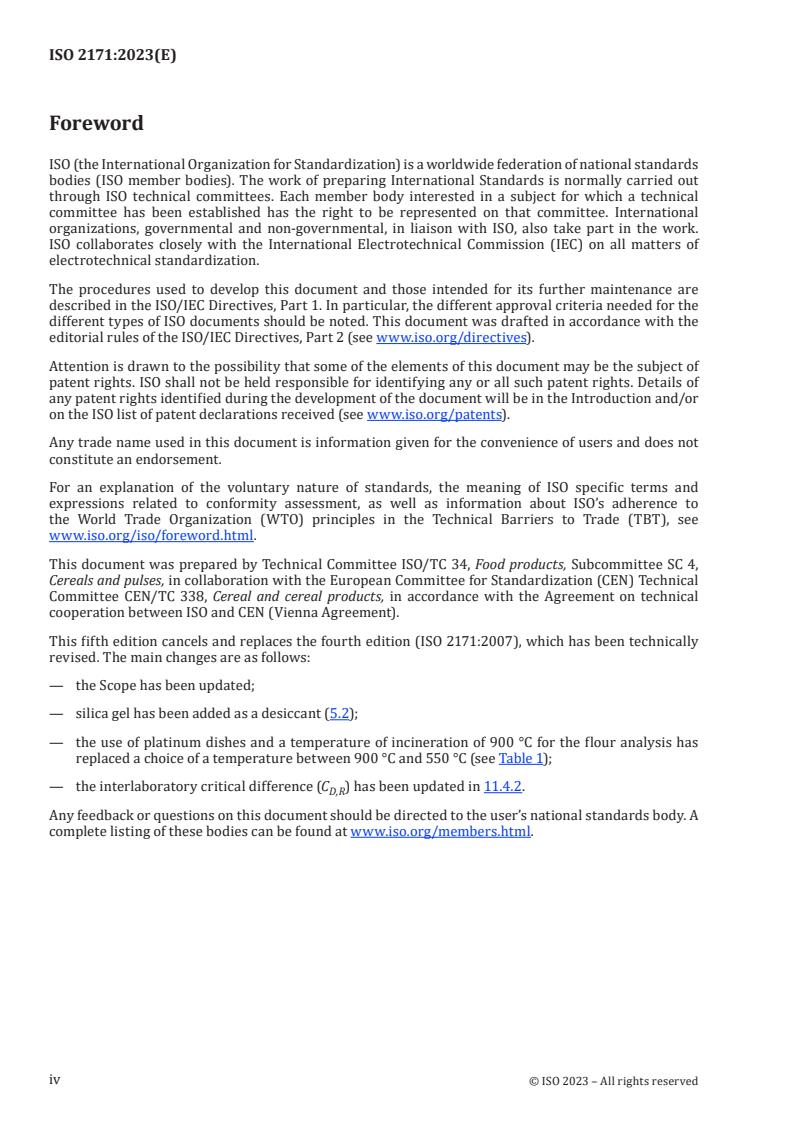
Foreword
ISO (the International Organization for Standardization) is a worldwide federation of national standards
bodies (ISO member bodies). The work of preparing International Standards is normally carried out
through ISO technical committees. Each member body interested in a subject for which a technical
committee has been established has the right to be represented on that committee. International
organizations, governmental and non-governmental, in liaison with ISO, also take part in the work.
ISO collaborates closely with the International Electrotechnical Commission (IEC) on all matters of
electrotechnical standardization.
The procedures used to develop this document and those intended for its further maintenance are
described in the ISO/IEC Directives, Part 1. In particular, the different approval criteria needed for the
different types of ISO documents should be noted. This document was drafted in accordance with the
editorial rules of the ISO/IEC Directives, Part 2 (see www.iso.org/directives).
Attention is drawn to the possibility that some of the elements of this document may be the subject of
patent rights. ISO shall not be held responsible for identifying any or all such patent rights. Details of
any patent rights identified during the development of the document will be in the Introduction and/or
on the ISO list of patent declarations received (see www.iso.org/patents).
Any trade name used in this document is information given for the convenience of users and does not
constitute an endorsement.
For an explanation of the voluntary nature of standards, the meaning of ISO specific terms and
expressions related to conformity assessment, as well as information about ISO’s adherence to
the World Trade Organization (WTO) principles in the Technical Barriers to Trade (TBT), see
www.iso.org/iso/foreword.html.
This document was prepared by Technical Committee ISO/TC 34, Food products, Subcommittee SC 4,
Cereals and pulses, in collaboration with the European Committee for Standardization (CEN) Technical
Committee CEN/TC 338, Cereal and cereal products, in accordance with the Agreement on technical
cooperation between ISO and CEN (Vienna Agreement).
This fifth edition cancels and replaces the fourth edition (ISO 2171:2007), which has been technically
revised. The main changes are as follows:
— the Scope has been updated;
— silica gel has been added as a desiccant (5.2);
— the use of platinum dishes and a temperature of incineration of 900 °C for the flour analysis has
replaced a choice of a temperature between 900 °C and 550 °C (see Table 1);
— the interlaboratory critical difference (C ) has been updated in 11.4.2.
D,R
Any feedback or questions on this document should be directed to the user’s national standards body. A
complete listing of these bodies can be found at www.iso.org/members.html.
iv
INTERNATIONAL STANDARD ISO 2171:2023(E)
Cereals, pulses and by-products — Determination of ash
yield by incineration
1 Scope
This document specifies a method for determining the ash yield by cereals, pulses and their milled
products intended for human consumption. The source materials and products covered are:
a) grains of cereals;
b) flours and semolinas;
c) other milling products (bran and high bran content products, shorts);
d) mixed cereal flours (mixes);
e) cereal by-products other than c) (such as wheat gluten, maize grits, broken rice kernels);
f) pulses and their by-products (flour).
This document does not apply to starches and starch derivatives (see ISO 3593), to products intended
for animal feeding stuffs (see ISO 5984) or to seeds.
2 Normative references
The following documents are referred to in the text in such a way that some or all of their content
constitutes requirements of this document. For dated references, only the edition cited applies. For
undated references, the latest edition of the referenced document (including any amendments) applies.
ISO 712, Cereals and cereal products — Determination of moisture content — Reference method
ISO 6540, Maize — Determination of moisture content (on milled grains and on whole grains)
ISO 24557, Pulses — Determination of moisture content — Air-oven method
3 Terms and definitions
For the purposes of this document, the following terms and definitions apply.
ISO and IEC maintain terminology databases for use in standardization at the following addresses:
— ISO Online browsing platform: available at https:// www .iso .org/ obp
— IEC Electropedia: available at https:// www .electropedia .org/
3.1
ash
incombustible residue obtained after incineration
Note 1 to entry: This is according to the method given in this document.
3.2
critical difference
difference between two averaged values obtained from two test results under repeatability conditions
4 Principle
A test portion is incinerated until combustion of organic matter is complete, then the residue obtained is
weighed. The residue obtained is flaky after incineration at (550 ± 10) °C and vitrified after incineration
at (900 ± 25) °C.
In general, products containing salts (e.g. sodium chloride, pyrophosphate) shall be incinerated at
(550 ± 10) °C.
5 Reagents
Unless stated otherwise, use only reagents of recognized analytical quality and distilled or
demineralized water or water of equivalent purity.
5.1 Hydrochloric acid, aqueous solution or ready-to-use solution of one part by volume of HCl (35 %
mass fraction) and one part by volume of water.
5.2 Desiccant, purified diphosphorus pentoxide (P O ) or silica gel.
4 10
5.3 Ethanol.
6 Apparatus
6.1 Grinding mill, easy to clean and having as little dead space as possible, and ensuring rapid,
uniform grinding.
6.2 Ashing dish, of capacity not less than 20 ml, rectangular or round shape, flat-bottomed and
having a surface area of not less than 12 cm . Suitable materials for the ashing dish which do not
deteriorate under test conditions at the temperature of operation are:
a) at 900 °C: platinum rhodium is recommended or, if unavailable, quartz can be used;
b) at 550 °C: quartz or silica.
The dishes shall be cleaned by complete immersion for at least 1 h in aqueous hydrochloric acid (5.1),
then rinsed with running water and then with distilled water.
After rinsing, the dishes a) or b) shall be dried in an oven (6.7) at a temperature and for a period
sufficient to eliminate water.
As quartz ashing dishes produce relatively lower ash yield and poorer precision compared with those
[8]
obtained with platinum dishes , the use of platinum-rhodium ashing dishes is recommended when
incineration is carried out at 900 °C. The precision data for 900 °C in Clause 11 was derived from the
results of interlaboratory tests carried out with platinum-rhodium ashing dishes. The users of quartz
ashing dishes for incineration at 900 °C are advised to check the precision data. In addition, the crucible
material is more prone to failure and it is possible the analysis will need to be repeated due to crucible
breakage.
6.3 Electrically heated muffle furnace, provided with a refractory coating, with a control system,
capable of reaching and maintaining the temperatures of (900 ± 25) °C or (550 ± 10) °C.
It is recommended to check the thermal geography of the furnace by filling it with capsules containing a
control sample in order to determine its degree of possible filling.
When the combustion is done inside the furnace, in the case of the ashing at 550 °C, it is recommended
to carry out a sweeping of the chimney of the oven, as this can clog quickly.
6.4 Vacuum desiccator, equipped with a perforated aluminium or porcelai
...
NORME ISO
INTERNATIONALE 2171
Cinquième édition
2023-02
Céréales, légumineuses et produits
dérivés — Détermination du taux de
cendres par incinération
Cereals, pulses and by-products — Determination of ash yield by
incineration
Numéro de référence
DOCUMENT PROTÉGÉ PAR COPYRIGHT
© ISO 2023
Tous droits réservés. Sauf prescription différente ou nécessité dans le contexte de sa mise en œuvre, aucune partie de cette
publication ne peut être reproduite ni utilisée sous quelque forme que ce soit et par aucun procédé, électronique ou mécanique,
y compris la photocopie, ou la diffusion sur l’internet ou sur un intranet, sans autorisation écrite préalable. Une autorisation peut
être demandée à l’ISO à l’adresse ci-après ou au comité membre de l’ISO dans le pays du demandeur.
ISO copyright office
Case postale 401 • Ch. de Blandonnet 8
CH-1214 Vernier, Genève
Tél.: +41 22 749 01 11
E-mail: copyright@iso.org
Web: www.iso.org
Publié en Suisse
ii
Sommaire Page
Avant-propos .iv
1 Domaine d’application . 1
2 Références normatives .1
3 Termes et définitions . 1
4 Principe. 2
5 Réactifs . 2
6 Appareillage . 2
7 Échantillonnage .3
8 Préparation de l’échantillon pour essai . 3
9 Mode opératoire . 3
9.1 Températures d’incinération . 3
9.2 Détermination de la teneur en eau . 4
9.3 Préparation des capsules à incinération . 4
9.4 Préparation de la prise d’essai. 4
9.5 Préincinération . 4
9.6 Incinération . 4
9.7 Nombre de déterminations . 5
10 Expression des résultats . 5
11 Fidélité . 6
11.1 Essais interlaboratoires . 6
11.2 Répétabilité, r . 6
11.3 Reproductibilité, R . . 6
11.4 Différence critique . 6
11.4.1 Comparaison de deux groupes de mesures dans un laboratoire . 6
11.4.2 Comparaison de deux groupes de mesures dans deux laboratoires . 7
11.5 Incertitude, U . 7
12 Rapport d’essai . 7
Annexe A (informative) Résultats des essais interlaboratoires . 8
Annexe B (informative) Application pratique des limites de répétabilité et
de reproductibilité .11
Bibliographie .12
iii
Avant-propos
L’ISO (Organisation internationale de normalisation) est une fédération mondiale d’organismes
nationaux de normalisation (comités membres de l’ISO). L’élaboration des Normes internationales est
en général confiée aux comités techniques de l’ISO. Chaque comité membre intéressé par une étude
a le droit de faire partie du comité technique créé à cet effet. Les organisations internationales,
gouvernementales et non gouvernementales, en liaison avec l’ISO participent également aux travaux.
L’ISO collabore étroitement avec la Commission électrotechnique internationale (IEC) en ce qui
concerne la normalisation électrotechnique.
Les procédures utilisées pour élaborer le présent document et celles destinées à sa mise à jour sont
décrites dans les Directives ISO/IEC, Partie 1. Il convient, en particulier, de prendre note des différents
critères d’approbation requis pour les différents types de documents ISO. Le présent document a été
rédigé conformément aux règles de rédaction données dans les Directives ISO/IEC, Partie 2 (voir
www.iso.org/directives).
L’attention est attirée sur le fait que certains des éléments du présent document peuvent faire l’objet de
droits de propriété intellectuelle ou de droits analogues. L’ISO ne saurait être tenue pour responsable
de ne pas avoir identifié de tels droits de propriété et averti de leur existence. Les détails concernant
les références aux droits de propriété intellectuelle ou autres droits analogues identifiés lors de
l’élaboration du document sont indiqués dans l’Introduction et/ou dans la liste des déclarations de
brevets reçues par l’ISO (voir www.iso.org/brevets).
Les appellations commerciales éventuellement mentionnées dans le présent document sont données
pour information, par souci de commodité, à l’intention des utilisateurs et ne sauraient constituer un
engagement.
Pour une explication de la nature volontaire des normes, la signification des termes et expressions
spécifiques de l’ISO liés à l’évaluation de la conformité, ou pour toute information au sujet de l’adhésion
de l’ISO aux principes de l’Organisation mondiale du commerce (OMC) concernant les obstacles
techniques au commerce (OTC), voir www.iso.org/avant-propos.
Le présent document a été élaboré par le comité technique ISO/TC 34, Produits alimentaires, sous-
comité SC 4, Céréales et légumineuses, en collaboration avec le comité technique CEN/TC 338, Céréales et
produits céréaliers, du Comité européen de normalisation (CEN) conformément à l’Accord de coopération
technique entre l’ISO et le CEN (Accord de Vienne).
Cette cinquième édition annule et remplace la quatrième édition (ISO 2171:2007), qui a fait l’objet d’une
révision technique. Les principales modifications sont les suivantes:
— mise à jour du domaine d’application;
— ajout du gel de silice en tant qu’agent dessiccant (5.2);
— remplacement de l’utilisation de capsules en platine et d’une température d’incinération de 900 °C
pour l’analyse de la farine par une température de 900 °C ou de 550 °C (voir Tableau 1);
— mise à jour de la différence critique interlaboratoires (C ) en 11.4.2.
D,R
Il convient que l’utilisateur adresse tout retour d’information ou toute question concernant le présent
document à l’organisme national de normalisation de son pays. Une liste exhaustive desdits organismes
se trouve à l’adresse www.iso.org/fr/members.html.
iv
NORME INTERNATIONALE ISO 2171:2023(F)
Céréales, légumineuses et produits dérivés —
Détermination du taux de cendres par incinération
1 Domaine d’application
Le présent document spécifie une méthode de détermination du taux de cendres dans les céréales,
les légumineuses et leurs produits de mouture destinés à l’alimentation humaine. Les matériaux et
produits sources sont:
a) les graines de céréales;
b) les farines et les semoules;
c) les autres produits de mouture (sons et produits à forte teneur en son, remoulages);
d) les farines de céréales composées;
e) les produits dérivés des céréales autres que c) (tels que le gluten de blé, le gruau de maïs, les
brisures de riz);
f) les légumineuses et leurs produits dérivés (farine).
Le présent document ne s’applique ni aux amidons et produits dérivés des amidons (voir l’ISO 3593), ni
aux produits destinés à l’alimentation animale (voir l’ISO 5984) ni aux semences.
2 Références normatives
Les documents suivants sont cités dans le texte de sorte qu’ils constituent, pour tout ou partie de leur
contenu, des exigences du présent document. Pour les références datées, seule l’édition citée s’applique.
Pour les références non datées, la dernière édition du document de référence s’applique (y compris les
éventuels amendements).
ISO 712, Céréales et produits céréaliers — Détermination de la teneur en eau — Méthode de référence
ISO 6540, Maïs — Détermination de la teneur en eau (sur grains broyés et sur grains entiers)
ISO 24557, Légumineuses — Détermination de la teneur en eau — Méthode par séchage à l’étuve
3 Termes et définitions
Pour les besoins du présent document, les termes et définitions suivants s’appliquent.
L’ISO et l’IEC tiennent à jour des bases de données terminologiques destinées à être utilisées en
normalisation, consultables aux adresses suivantes:
— ISO Online browsing platform: disponible à l’adresse https:// www .iso .org/ obp
— IEC Electropedia: disponible à l’adresse https:// www .electropedia .org/
3.1
cendres
résidu incombustible obtenu après incinération
Note 1 à l'article: Cela est conforme à la méthode indiquée dans le présent document.
3.2
différence critique
écart entre deux valeurs moyennées obtenues à partir de deux résultats d’essai sous des conditions de
répétabilité
4 Principe
Incinération d’une prise d’essai jusqu’à combustion complète des matières organiques puis pesée du
résidu obtenu. Le résidu obtenu est floconneux après incinération à (550 ± 10) °C et vitrifié après
incinération à (900 ± 25) °C.
De façon générale, les produits contenant des sels (chlorure de sodium, pyrophosphate par exemple)
doivent être incinérés à (550 ± 10) °C.
5 Réactifs
Sauf indication contraire, utiliser uniquement des réactifs de qualité analytique reconnue et de l’eau
distillée ou déminéralisée, ou de l’eau de pureté équivalente.
5.1 Acide chlorhydrique, solution aqueuse ou solution prête à l’emploi constituée d’un volume de
HCl (fraction massique de 35 %) et d’un volume d’eau.
5.2 Agent dessiccant, pentoxyde de diphosphore purifié (P O ) ou gel de silice.
4 10
5.3 Éthanol.
6 Appareillage
6.1 Broyeur, facile à nettoyer et ayant un espace mort aussi réduit que possible et apte à assurer un
broyage rapide et uniforme.
6.2 Capsule à incinération, de capacité au moins égale à 20 ml, de forme rectangulaire ou circulaire,
à fond plat et ayant une surface utile au moins égale à 12 cm . Les matériaux appropriés inaltérables
dans les conditions de température de l’essai sont les suivants:
a) à 900 °C: platine-rhodium (recommandé) ou, si indisponible, quartz;
b) à 550 °C: quartz ou silice.
Les capsules doivent être nettoyées par immersion complète pendant au moins 1 h dans une solution
aqueuse d’acide chlorhydrique (5.1) puis rincées à l’eau courante et ensuite à l’eau distillée.
Après rinçage, les capsules a) ou b) doivent être séchées dans une étuve (6.7) à une température et
pendant une durée suffisantes pour éliminer l’eau.
Étant donné que les taux de cendres obtenus avec des capsules à incinération en quartz sont plus faibles
[8]
ou présentent une précision inférieure à celle obtenue avec des capsules en platine , l’utilisation de
capsules à incinération en platine-rhodium est recommandée lorsque l’incinération est effectuée
à 900 °C. Les données de fidélité pour l’incinération à 900 °C indiquées à l’Article 11 sont issues des
résultats d’essais interlaboratoires effectués avec des capsules à incinération en platine-rhodium. Les
utilisateurs de capsules à incinération en quartz pour l’incinération à 900 °C sont invités à vérifier les
données de fidélité. De plus, le matériau de la capsule est plus susceptible de casser et il est possible de
devoir répéter l’analyse si la capsule se casse.
6.3 Four à moufle électrique, avec revêtement réfractaire, avec système de réglage, capable
d’atteindre et de maintenir les températures à (900 ± 25) °C ou à (550 ± 10) °C.
Il est recommandé de vérifier la géographie thermique du four en le remplissant avec des capsules
contenant un échantillon témoin afin de déterminer sa capacité de remplissage.
Lorsque la combustion est effectuée à l’intérieur du four, ce qui est le cas de l’incinération à 550 °C, il est
recommandé de réaliser un balayage de la cheminée du four, car celle-ci peut se boucher rapidement.
6.4 Dessiccateur sous vide, muni d’une plaque perforée en aluminium ou en porcelaine, et agent
dessiccant (5.2) comme déshydratant.
6.5 Balance analytique, d’une
...