


ISO/TS 20362:2022
(Main)Hard coal — Determination of plastometric indices — Automated Sapozhnikov penetration plastometer method
Hard coal — Determination of plastometric indices — Automated Sapozhnikov penetration plastometer method
This document specifies a method for the determination of plastometric indices with an automated Sapozhnikov penetration plastometer. These indices are the maximum thickness of the plastic layer, Y, in mm, and the final contraction, X, in mm. This document is applicable to hard coals with a determined ash level of less than 15 % as dry basis as described in ISO 11722 and ISO 1171.
Houille — Détermination des indices plastométriques — Méthode automatisée du plastomètre à pénétration Sapozhnikov
General Information
- Status
- Published
- Publication Date
- 04-Aug-2022
- Technical Committee
- ISO/TC 27/SC 5 - Methods of analysis
- Drafting Committee
- ISO/TC 27/SC 5/WG 10 - Plastic properties of coal
- Current Stage
- 9092 - International Standard to be revised
- Start Date
- 02-Feb-2026
- Completion Date
- 12-Feb-2026
Overview
ISO/TS 20362:2022 specifies a standardized method for determining plastometric indices of hard coal using an automated Sapozhnikov penetration plastometer. The standard defines two primary plastometric outputs: Y (maximum thickness of the plastic layer, in mm) and X (final contraction or plastometric shrinkage, in mm, defined as the height difference between 250 °C and 730 °C). ISO/TS 20362:2022 applies to hard coals with a determined ash content of less than 15 % (dry basis), referenced to ISO 11722 and ISO 1171.
Key Topics and Requirements
- Principle: Unidirectional heating from the base under constant pressure while an automated probe records displacement. Displacement curves are generated and processed by computer software using curve‑fitting (least squares) to extract upper/lower plastic layer profiles.
- Measured indices:
- Y - maximum perpendicular thickness between upper and lower plastic layers.
- X - plastometric contraction between sample height at 250 °C (zero line) and at 730 °C.
- Materials & consumables: cigarette rolling paper, filter paper, thin steel rod, refractory ceramic pads, abrasive cloth (e.g., Emery P80).
- Apparatus: full automated Sapozhnikov plastometer system (determinator + computer), electric furnace, thermocouples and wells, pressure lever assembly, displacement sensors, weighing device, sample preparation equipment (crusher, sieves).
- Procedure essentials: sample preparation, loading in steel retort with paper tube and pads, furnace temperature calibration, displacement calibration, automated measurement, and computerised analysis.
- Quality & reporting: calibration steps, determination of zero height, expression of results, and precision statements including repeatability and reproducibility limits are covered. Test report content is specified.
Applications and Users
ISO/TS 20362:2022 is intended for laboratories and organizations involved in coal testing and quality control, including:
- Coking coal testing labs assessing plastic properties for coke-making.
- Coal producers and traders specifying product quality and suitability for metallurgical use.
- Research institutes studying coal thermo-plastic behaviour.
- Industrial quality control in steel and coke plants where plastometric indices influence process performance.
Practical benefits include improved automation vs manual Sapozhnikov methods, reduced operator bias, consistent displacement curves, and automatic reporting - enhancing throughput and comparability of plastometric data.
Related Standards
- ISO 11722, ISO 1171 (ash determination reference)
- ISO 1213‑2 (vocabulary)
- ISO 3310‑2 (test sieves)
- ISO 13909‑2/3/4 (mechanical sampling and sample preparation)
- ISO 18283 (manual sampling)
Keywords: ISO/TS 20362:2022, plastometric indices, automated Sapozhnikov penetration plastometer, hard coal testing, Y and X indices, coal plastometry.


Get Certified
Connect with accredited certification bodies for this standard

Bureau Veritas Chile
Bureau Veritas certification services in Chile.
Bureau Veritas Peru
Bureau Veritas certification services in Peru.
BVQI Peru
Bureau Veritas certification in Peru.
Sponsored listings
Frequently Asked Questions
ISO/TS 20362:2022 is a technical specification published by the International Organization for Standardization (ISO). Its full title is "Hard coal — Determination of plastometric indices — Automated Sapozhnikov penetration plastometer method". This standard covers: This document specifies a method for the determination of plastometric indices with an automated Sapozhnikov penetration plastometer. These indices are the maximum thickness of the plastic layer, Y, in mm, and the final contraction, X, in mm. This document is applicable to hard coals with a determined ash level of less than 15 % as dry basis as described in ISO 11722 and ISO 1171.
This document specifies a method for the determination of plastometric indices with an automated Sapozhnikov penetration plastometer. These indices are the maximum thickness of the plastic layer, Y, in mm, and the final contraction, X, in mm. This document is applicable to hard coals with a determined ash level of less than 15 % as dry basis as described in ISO 11722 and ISO 1171.
ISO/TS 20362:2022 is classified under the following ICS (International Classification for Standards) categories: 73.040 - Coals. The ICS classification helps identify the subject area and facilitates finding related standards.
ISO/TS 20362:2022 is available in PDF format for immediate download after purchase. The document can be added to your cart and obtained through the secure checkout process. Digital delivery ensures instant access to the complete standard document.
Standards Content (Sample)
TECHNICAL ISO/TS
SPECIFICATION 20362
First edition
2022-08
Hard coal — Determination of
plastometric indices — Automated
Sapozhnikov penetration plastometer
method
Houille — Détermination des indices plastométriques — Méthode
automatisée du plastomètre à pénétration Sapozhnikov
Reference number
© ISO 2022
All rights reserved. Unless otherwise specified, or required in the context of its implementation, no part of this publication may
be reproduced or utilized otherwise in any form or by any means, electronic or mechanical, including photocopying, or posting on
the internet or an intranet, without prior written permission. Permission can be requested from either ISO at the address below
or ISO’s member body in the country of the requester.
ISO copyright office
CP 401 • Ch. de Blandonnet 8
CH-1214 Vernier, Geneva
Phone: +41 22 749 01 11
Email: copyright@iso.org
Website: www.iso.org
Published in Switzerland
ii
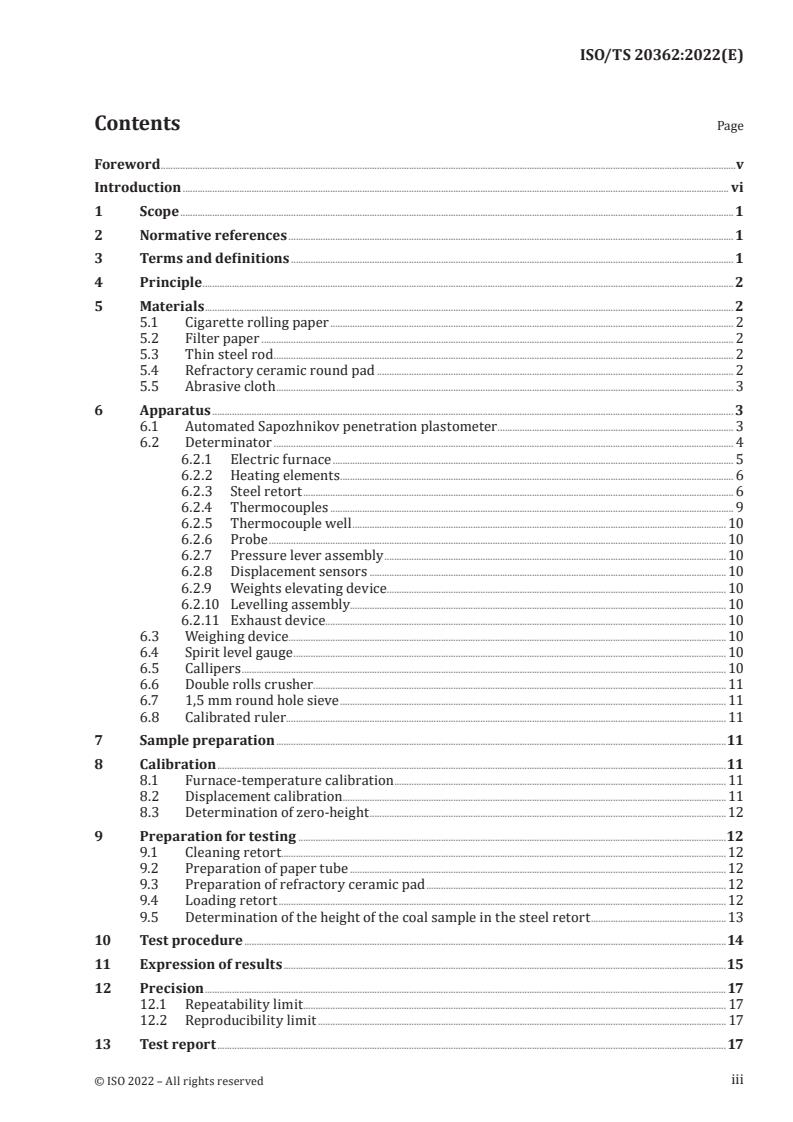
Contents Page
Foreword .v
Introduction . vi
1 Scope . 1
2 Normative references . 1
3 Terms and definitions . 1
4 Principle . 2
5 Materials . 2
5.1 Cigarette rolling paper . 2
5.2 Filter paper . 2
5.3 Thin steel rod . 2
5.4 Refractory ceramic round pad . 2
5.5 Abrasive cloth . 3
6 Apparatus . 3
6.1 Automated Sapozhnikov penetration plastometer . 3
6.2 Determinator . 4
6.2.1 Electric furnace . 5
6.2.2 Heating elements . 6
6.2.3 Steel retort . 6
6.2.4 Thermocouples . 9
6.2.5 Thermocouple well . 10
6.2.6 Probe . 10
6.2.7 Pressure lever assembly . 10
6.2.8 Displacement sensors . 10
6.2.9 Weights elevating device. 10
6.2.10 Levelling assembly . . 10
6.2.11 Exhaust device. 10
6.3 Weighing device . . . 10
6.4 Spirit level gauge . 10
6.5 Callipers . 10
6.6 Double rolls crusher. 11
6.7 1,5 mm round hole sieve . 11
6.8 Calibrated ruler . . 11
7 Sample preparation .11
8 Calibration .11
8.1 Furnace-temperature calibration . 11
8.2 Displacement calibration. 11
8.3 Determination of zero-height .12
9 Preparation for testing .12
9.1 Cleaning retort. 12
9.2 Preparation of paper tube . 12
9.3 Preparation of refractory ceramic pad .12
9.4 Loading retort . 12
9.5 Determination of the height of the coal sample in the steel retort .13
10 Test procedure .14
11 Expression of results .15
12 Precision .17
12.1 Repeatability limit . 17
12.2 Reproducibility limit . 17
13 Test report .17
iii
Annex A (informative) Schematic diagram of processing on plastometric graph .18
Annex B (informative) Methods for checking the cross sectional load on the coal sample .20
Bibliography .22
iv
Foreword
ISO (the International Organization for Standardization) is a worldwide federation of national standards
bodies (ISO member bodies). The work of preparing International Standards is normally carried out
through ISO technical committees. Each member body interested in a subject for which a technical
committee has been established has the right to be represented on that committee. International
organizations, governmental and non-governmental, in liaison with ISO, also take part in the work.
ISO collaborates closely with the International Electrotechnical Commission (IEC) on all matters of
electrotechnical standardization.
The procedures used to develop this document and those intended for its further maintenance are
described in the ISO/IEC Directives, Part 1. In particular, the different approval criteria needed for the
different types of ISO documents should be noted. This document was drafted in accordance with the
editorial rules of the ISO/IEC Directives, Part 2 (see www.iso.org/directives).
Attention is drawn to the possibility that some of the elements of this document may be the subject of
patent rights. ISO shall not be held responsible for identifying any or all such patent rights. Details of
any patent rights identified during the development of the document will be in the Introduction and/or
on the ISO list of patent declarations received (see www.iso.org/patents).
Any trade name used in this document is information given for the convenience of users and does not
constitute an endorsement.
For an explanation of the voluntary nature of standards, the meaning of ISO specific terms and
expressions related to conformity assessment, as well as information about ISO's adherence to the
World Trade Organization (WTO) principles in the Technical Barriers to Trade (TBT), see www.iso.org/
iso/foreword.html.
This document was prepared by Technical Committee ISO/TC 27, Coal and coke, Subcommittee SC 5,
Methods of analysis.
Any feedback or questions on this document should be directed to the user’s national standards body. A
complete listing of these bodies can be found at www.iso.org/members.html.
v
Introduction
Historically the determination of plastic layer indices has been performed by manual operation. Firstly,
the thickness of the plastic layer is detected with a probe by hand, then curves of the upper and lower
layer are manually established and the results calculated. This process is labour intensive and required
technicians with vast experience.
In recent years, the automated type of determinator was developed to measure the plastic layer indices.
Displacement curves are auto-established by computer. The intelligent manipulator automatically
measures the thickness of plastic layer and establishes curves of upper and lower plastic layer. The
result is reported by the system automatically.
The objective of this document is to provide an alternative method for determining the plastic layer
indices with automated Sapozhnikov penetration plastometer.
vi
TECHNICAL SPECIFICATION ISO/TS 20362:2022(E)
Hard coal — Determination of plastometric indices —
Automated Sapozhnikov penetration plastometer method
1 Scope
This document specifies a method for the determination of plastometric indices with an automated
Sapozhnikov penetration plastometer. These indices are the maximum thickness of the plastic layer, Y,
in mm, and the final contraction, X, in mm.
This document is applicable to hard coals with a determined ash level of less than 15 % as dry basis as
described in ISO 11722 and ISO 1171.
2 Normative references
The following documents are referred to in the text in such a way that some or all of their content
constitutes requirements of this document. For dated references, only the edition cited applies. For
undated references, the latest edition of the referenced document (including any amendments) applies.
ISO 1213-2, Solid mineral fuels — Vocabulary — Part 2: Terms relating to sampling, testing and analysis
ISO 3310-2, Test sieves — Technical requirements and testing — Part 2: Test sieves of perforated metal
plate
ISO 13909-2, Hard coal and coke — Mechanical sampling — Part 2: Coal — Sampling from moving streams
ISO 13909-3, Hard coal and coke — Mechanical sampling — Part 3: Coal — Sampling from stationary lots
ISO 13909-4, Hard coal and coke — Mechanical sampling — Part 4: Coal — Preparation of test samples
ISO 18283, Coal and coke — Manual sampling
3 Terms and definitions
For the purposes of this document, the terms and definitions given in ISO 1213-2 and the following
apply.
ISO and IEC maintain terminology databases for use in standardization at the following addresses:
— ISO Online browsing platform: available at https:// www .iso .org/ obp
— IEC Electropedia: available at https:// www .electropedia .org/
3.1
maximum thickness of plastic layer
Y
maximum perpendicular thickness between the upper and lower plastic layer
3.2
final contraction value
plastometric shrinkage
X
distance between the height of the coal sample at the temperature of 250 °C (the zero line) and at 730 °C
3.3
zero line
original height of the coal sample paralleling with abscissa axis drawn at the temperature of 250 °C
4 Principle
The coal sample is heated unidirectionally from the base at a standard rate under constant pressure
whilst the plastic layer develops. The plastic layer thickness is automatically measured periodically
throughout the test using a rounded end blunt probe. The manipulator arm lowers the probe through
the paper tube created in the coal sample until a change in pressure is recorded. The volume changes
are measured by displacement sensor and the displacement curve is auto-established by the computer.
The curve representing changes of the upper and lower layer is generated by the least square method.
The maximum thickness of the plastic layer is calculated by the maximum distance between both
layers and final contraction is obtained by comparing volume at 250 °C and the end of a measurement
automatically.
5 Materials
5.1 Cigarette rolling paper
Rolling papers (also known as blanks) small sheets, rolls, or leaves of paper, which are sold for rolling
cigarettes either by hand or with a rolling machine.
5.2 Filter paper
Qualitative filter paper, dimensions 60 mm wide and 190 mm to 200 mm long, used to line the inner
wall of the steel retort.
5.3 Thin steel rod
The diameter of the thin steel rod is 3 mm. Cigarette rolling paper is wrapped around the rod to make
a tube. The resultant paper tube is then placed into the steel retort and is surrounded by the coal after
loading.
5.4 Refractory ceramic round pad
Heat resistant refractory ceramic pads with thickness of 1,0 mm and diameter of 59 mm for use on the
top and bottom of the coal sample in the steel retort. The pads can be made by manual or mechanical
means. Each base pad requires a hole to allow the thermocouple well to fit through and a mark
corresponding the probe hole of the pressure plate. Each top pad requires two holes, one to allow the
thermocouple well to fit through and one to allow the paper tube to fit through. Figure 1 shows an
example of these pads.
Key
1 top pad
2 base pad
Figure 1 — Refractory ceramic round pad
5.5 Abrasive cloth
Emery Cloth P80 grade is suitable for removing coke residue from steel retort and associated
components.
6 Apparatus
6.1 Automated Sapozhnikov penetration plastometer
For determining plastometric indices with automated Sapozhnikov penetration plastometer,
commercially available, consisting of determinator and the computer system. The computer system
includes a computer, monitor, keyboard and printer (see Figure 2).
Key
1 determinator
2 monitor
3 computer
4 printer
5 computer system
Figure 2 — Sketch of automated Sapozhnikov penetration plastometer
6.2 Determinator
The determinator shall consist of the following components as shown in Figure 3 and Figure 4.
The pressure applied by the Sapozhnikov plastometer apparatus to the cross section of loaded coal
4 2
sample during the measurement of plastometric indices shall be 9,8 × 10 Pa (1 kg/cm ).
The pressure cross section on the loaded coal sample should be checked when the apparatus is newly
purchased, moved to a new location or when major parts have been replaced. Annex B provides
guidance on how to check the pressure on the cross section of the loaded coal sample.
Key
1 probe manipulator 8 base
2 exhaust 9 levelling assembly
3 pulley 10 steel retort
4 weight lifting device 11 pressure plate
5 displacement transducer 12 connecting arm
6 protective cover 13 probe and probe rod
7 brick stacks
Figure 3 — Overview of a typical determinator
Key
1 electric furnace 7 pressure plate
2 heating elements 8 thermocouple well
3 levelling assembly 9 probe
4 steel retort 10 thermocouples
5 retort body 11 pressure lever assembly
6 retort base 12 weights elevating device
13 displacement sensor
Figure 4 — Exploded view of a typical furnace assembly
6.2.1 Electric furnace
The furnace shall consist of two layers of rectangular furnace brick, each measuring
200 mm × 290 mm × 110 mm. The lower layer has a longitudinal groove to allow for visual inspection,
and four latitudinal grooves that support the four heating elements. The upper brick layer sits over the
lower brick layer and has two cylindrical holes that accommodate the steel retorts. The upper brick (see
Figure 4) surface shall be flat and very carefully positioned according to manufacturer’s specification,
to ensure the alignment of the rolling paper tube, relative to the probe.
NOTE 1 Typically the furnace brick has the refractoriness of 1 670 °C~1 710 °C, in which the contents of Al O
2 3
are not less than 40 %, and appearance porosity is not more than 26 %. Other refractory bricks can be used
provided the furnace can achieve these temperature specifications.
The furnace shall be heated electrically with automatic controls to ensure a heating rate of 3,0 °C/
min ± 0,1 °C/min is maintained from 250 °C to 730 °C and a heating rate of about 8 °C/min is maintained
before 250 °C.
NOTE 2 The difference between the displayed temperature and the target temperature is not more than
5 °C from 350 °C to 600 °C and 10 °C for other periods. The temperature is measured with the thermocouple
positioned in the thermocouple well in the steel retort.
6.2.2 Heating elements
There are four silicon carbide elements each protected by a quartz glass tube 200 mm × 20 mm. The
difference of resistance between the two series elements under each retort is not more than 0,5 Ω. The
elements must have a resistance of 6 Ω to 8 Ω with an active length of 150 mm and diameter of 8 mm.
The length of the cold end should be 60 mm long and diameter of 16 mm. The rated temperature of the
heat zone should be 1 200 °C to 1 400 °C. The heating efficiency of the elements decreases at a distance
of 15 mm from the cold end. The resistance of the heating elements must be checked at time intervals to
ensure compliance with these temperature specifications.
Heating elements made from different materials may be used provided they can achieve these
temperature specifications.
6.2.3 Steel retort
[5]
Component parts made with steel according to ISO C45E4 specifications shall consist of 6.2.3.1 to
6.2.3.3.
6.2.3.1 Retort body
The height from the inside base of the retort bottom to the top of the retort body shall be 110 mm.
The retort body shall be tapered, the internal diameter at the bottom shall be 59 mm and the internal
diameter, at a height 50 mm from the base, shall be 60 mm. The inner
...
Questions, Comments and Discussion
Ask us and Technical Secretary will try to provide an answer. You can facilitate discussion about the standard in here.
Loading comments...