


ISO/ASTM 51818:2020
(Main)Practice for dosimetry in an electron beam facility for radiation processing at energies between 80 and 300 keV
Practice for dosimetry in an electron beam facility for radiation processing at energies between 80 and 300 keV
This practice covers dosimetric procedures to be followed in installation qualification, operational qualification and performance qualification (IQ, OQ, PQ), and routine processing at electron beam facilities to ensure that the product has been treated with an acceptable range of absorbed doses. Other procedures related to IQ, OQ, PQ, and routine product processing that may influence absorbed dose in the product are also discussed. The electron beam energy range covered in this practice is between 80 and 300 keV, generally referred to as low energy. Dosimetry is only one component of a total quality assurance program for an irradiation facility. Other measures may be required for specific applications such as medical device sterilization and food preservation. Other specific ISO and ASTM standards exist for the irradiation of food and the radiation sterilization of health care products. For the radiation sterilization of health care products, see ISO 11137-1. In those areas covered by ISO 11137-1, that standard takes precedence. For food irradiation, see ISO 14470. Information about effective or regulatory dose limits for food products is not within the scope of this practice (see ASTM F1355 and F1356). This document is one of a set of standards that provides recommendations for properly implementing dosimetry in radiation processing, and describes a means of achieving compliance with the requirements of ISO/ASTM 52628. It is intended to be read in conjunction with ISO/ASTM 52628. This standard does not purport to address all of the safety concerns, if any, associated with its use. It is the responsibility of the user of this standard to establish appropriate safety, health, and environmental practices and determine the applicability of regulatory limitations prior to use. This international standard was developed in accordance with internationally recognized principles on standardization established in the Decision on Principles for the Development of International Standards, Guides and Recommendations issued by the World Trade Organization Technical Barriers to Trade (TBT) Committee.
Pratique de la dosimétrie dans une installation de traitement par irradiation utilisant un faisceau d'électrons d'énergies comprises entre 80 et 300 keV
General Information
- Status
- Published
- Publication Date
- 29-Jun-2020
- Drafting Committee
- ISO/TC 85/WG 3 - Dosimetry for radiation processing
- Current Stage
- 9599 - Withdrawal of International Standard
- Start Date
- 04-Apr-2025
- Completion Date
- 30-Oct-2025
Relations
- Effective Date
- 23-Mar-2024
- Effective Date
- 23-Apr-2020
Overview
ISO/ASTM 51818:2020 - Practice for dosimetry in an electron beam facility for radiation processing at energies between 80 and 300 keV - provides guidance on dosimetric procedures used to qualify and control low‑energy electron beam (e‑beam) facilities. The standard covers dosimetry for installation qualification (IQ), operational qualification (OQ), performance qualification (PQ) and routine processing, and addresses how to ensure products receive an acceptable range of absorbed dose. It emphasizes dosimetry as a key element of a wider quality assurance program and is intended to be used in conjunction with ISO/ASTM 52628.
Key topics and requirements
- Energy range and scope: Applicable to low‑energy electron beams (80–300 keV) used for surface treatments, curing, crosslinking and surface sterilization.
- IQ, OQ, PQ and routine monitoring: Describes dosimetric procedures required to demonstrate correct installation, proper operation and ongoing performance of e‑beam processes.
- Dosimetry systems: Selection, calibration and use of dosimeters (e.g., film, alanine) plus measurement instruments and procedures; importance of metrological traceability and calibration to national/international standards where required.
- Depth‑dose and beam characterization: Measurement of depth‑dose distributions, beam width, average beam current and conveying speed to relate machine parameters to absorbed dose in product.
- Uncertainty and documentation: Requirements for estimating measurement uncertainty, maintaining uncertainty budgets, and documenting results and procedures for routine process control.
- Limitations and precedence: Notes that ISO 11137‑1 takes precedence for health‑care product sterilization and ISO 14470 addresses food irradiation specifics; regulatory dose limits for food are out of scope.
Practical applications and who uses it
ISO/ASTM 51818:2020 is used by:
- Radiation processing engineers and facility managers operating low‑energy e‑beam equipment
- Quality assurance and validation teams performing IQ/OQ/PQ for irradiation lines
- Dosimetrists and metrology labs responsible for dose calibration, measurement traceability and uncertainty evaluation
- Manufacturers using e‑beam for surface sterilization, curing of coatings/inks, crosslinking films, or aseptic packaging
Practical benefits include reliable correlation of machine settings to absorbed dose, reproducible process control, and traceable dosimetry records that support regulatory and customer requirements.
Related standards
- ISO/ASTM 52628 - Practice for dosimetry in radiation processing (companion guidance)
- ISO 11137‑1 - Radiation sterilization of health care products (takes precedence where applicable)
- ISO 14470 - Food irradiation requirements
- ISO/IEC 17025 - Laboratory accreditation and competence
- ASTM F1355 / F1356 - Food irradiation guidance
- Additional ISO/ASTM dosimetry practices and guides (e.g., ISO/ASTM 51261, 51607, 51707)
Keywords: ISO/ASTM 51818:2020, dosimetry, electron beam, 80–300 keV, radiation processing, IQ OQ PQ, absorbed dose, depth‑dose, measurement uncertainty, traceability.
Frequently Asked Questions
ISO/ASTM 51818:2020 is a standard published by the International Organization for Standardization (ISO). Its full title is "Practice for dosimetry in an electron beam facility for radiation processing at energies between 80 and 300 keV". This standard covers: This practice covers dosimetric procedures to be followed in installation qualification, operational qualification and performance qualification (IQ, OQ, PQ), and routine processing at electron beam facilities to ensure that the product has been treated with an acceptable range of absorbed doses. Other procedures related to IQ, OQ, PQ, and routine product processing that may influence absorbed dose in the product are also discussed. The electron beam energy range covered in this practice is between 80 and 300 keV, generally referred to as low energy. Dosimetry is only one component of a total quality assurance program for an irradiation facility. Other measures may be required for specific applications such as medical device sterilization and food preservation. Other specific ISO and ASTM standards exist for the irradiation of food and the radiation sterilization of health care products. For the radiation sterilization of health care products, see ISO 11137-1. In those areas covered by ISO 11137-1, that standard takes precedence. For food irradiation, see ISO 14470. Information about effective or regulatory dose limits for food products is not within the scope of this practice (see ASTM F1355 and F1356). This document is one of a set of standards that provides recommendations for properly implementing dosimetry in radiation processing, and describes a means of achieving compliance with the requirements of ISO/ASTM 52628. It is intended to be read in conjunction with ISO/ASTM 52628. This standard does not purport to address all of the safety concerns, if any, associated with its use. It is the responsibility of the user of this standard to establish appropriate safety, health, and environmental practices and determine the applicability of regulatory limitations prior to use. This international standard was developed in accordance with internationally recognized principles on standardization established in the Decision on Principles for the Development of International Standards, Guides and Recommendations issued by the World Trade Organization Technical Barriers to Trade (TBT) Committee.
This practice covers dosimetric procedures to be followed in installation qualification, operational qualification and performance qualification (IQ, OQ, PQ), and routine processing at electron beam facilities to ensure that the product has been treated with an acceptable range of absorbed doses. Other procedures related to IQ, OQ, PQ, and routine product processing that may influence absorbed dose in the product are also discussed. The electron beam energy range covered in this practice is between 80 and 300 keV, generally referred to as low energy. Dosimetry is only one component of a total quality assurance program for an irradiation facility. Other measures may be required for specific applications such as medical device sterilization and food preservation. Other specific ISO and ASTM standards exist for the irradiation of food and the radiation sterilization of health care products. For the radiation sterilization of health care products, see ISO 11137-1. In those areas covered by ISO 11137-1, that standard takes precedence. For food irradiation, see ISO 14470. Information about effective or regulatory dose limits for food products is not within the scope of this practice (see ASTM F1355 and F1356). This document is one of a set of standards that provides recommendations for properly implementing dosimetry in radiation processing, and describes a means of achieving compliance with the requirements of ISO/ASTM 52628. It is intended to be read in conjunction with ISO/ASTM 52628. This standard does not purport to address all of the safety concerns, if any, associated with its use. It is the responsibility of the user of this standard to establish appropriate safety, health, and environmental practices and determine the applicability of regulatory limitations prior to use. This international standard was developed in accordance with internationally recognized principles on standardization established in the Decision on Principles for the Development of International Standards, Guides and Recommendations issued by the World Trade Organization Technical Barriers to Trade (TBT) Committee.
ISO/ASTM 51818:2020 is classified under the following ICS (International Classification for Standards) categories: 17.240 - Radiation measurements. The ICS classification helps identify the subject area and facilitates finding related standards.
ISO/ASTM 51818:2020 has the following relationships with other standards: It is inter standard links to ISO 11295, ISO/ASTM 51818:2013. Understanding these relationships helps ensure you are using the most current and applicable version of the standard.
You can purchase ISO/ASTM 51818:2020 directly from iTeh Standards. The document is available in PDF format and is delivered instantly after payment. Add the standard to your cart and complete the secure checkout process. iTeh Standards is an authorized distributor of ISO standards.
Standards Content (Sample)
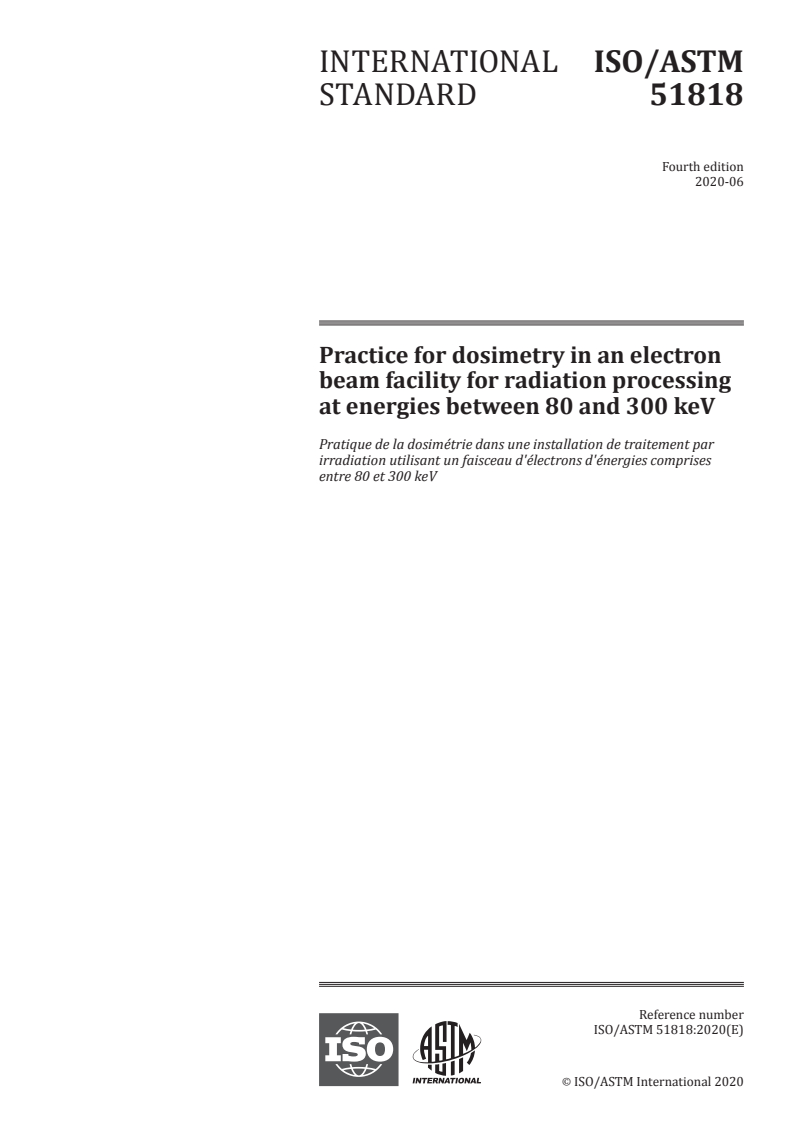
INTERNATIONAL ISO/ASTM
STANDARD 51818
Fourth edition
2020-06
Practice for dosimetry in an electron
beam facility for radiation processing
at energies between 80 and 300 keV
Pratique de la dosimétrie dans une installation de traitement par
irradiation utilisant un faisceau d'électrons d'énergies comprises
entre 80 et 300 keV
Reference number
©
ISO/ASTM International 2020
© ISO/ASTM International 2020
All rights reserved. Unless otherwise specified, or required in the context of its implementation, no part of this publication may be
reproduced or utilized otherwise in any form or by any means, electronic or mechanical, including photocopying, or posting on
the internet or an intranet, without prior written permission. Permission can be requested from either ISO at the address below
or ISO’s member body in the country of the requester. In the United States, such requests should be sent to ASTM International.
ISO copyright office ASTM International
CP 401 • Ch. de Blandonnet 8 100 Barr Harbor Drive, PO Box C700
CH-1214 Vernier, Geneva West Conshohocken, PA 19428-2959, USA
Phone: +41 22 749 01 11 Phone: +610 832 9634
Fax: +610 832 9635
Email: copyright@iso.org Email: khooper@astm.org
Website: www.iso.org Website: www.astm.org
Published in Switzerland
ii © ISO/ASTM International 2020 – All rights reserved
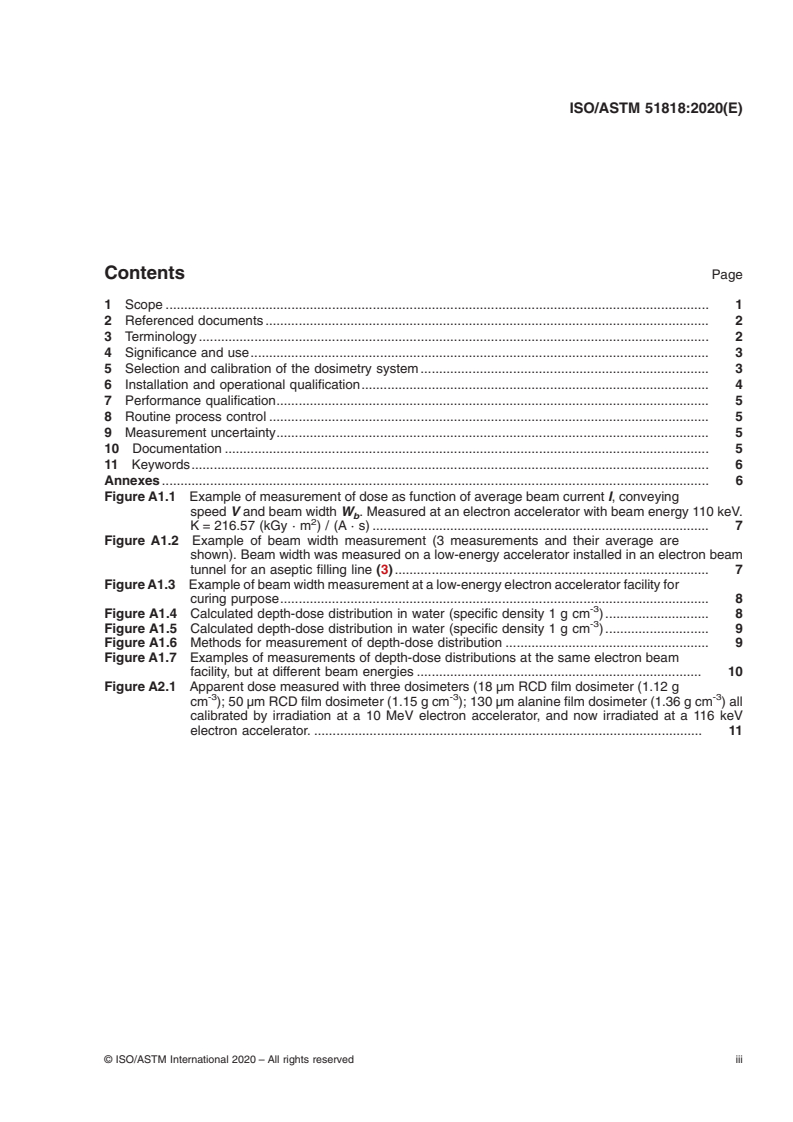
Contents Page
1 Scope. 1
2 Referenced documents. 2
3 Terminology. 2
4 Significance and use. 3
5 Selection and calibration of the dosimetry system. 3
6 Installation and operational qualification. 4
7 Performance qualification. 5
8 Routine process control. 5
9 Measurement uncertainty. 5
10 Documentation. 5
11 Keywords. 6
Annexes. 6
Figure A1.1 Example of measurement of dose as function of average beam currentI, conveying
speedV and beam widthW . Measured at an electron accelerator with beam energy 110 keV.
b
K = 216.57 (kGy · m ) / (A · s). 7
Figure A1.2 Example of beam width measurement (3 measurements and their average are
shown). Beam width was measured on a low-energy accelerator installed in an electron beam
tunnel for an aseptic filling line (3). 7
Figure A1.3 Exampleofbeamwidthmeasurementatalow-energyelectronacceleratorfacilityfor
curing purpose. 8
-3
Figure A1.4 Calculated depth-dose distribution in water (specific density1gcm ). 8
-3
Figure A1.5 Calculated depth-dose distribution in water (specific density1gcm ). 9
Figure A1.6 Methods for measurement of depth-dose distribution. 9
Figure A1.7 Examples of measurements of depth-dose distributions at the same electron beam
facility, but at different beam energies. 10
Figure A2.1 Apparent dose measured with three dosimeters (18 µm RCD film dosimeter (1.12 g
-3 -3 -3
cm ); 50 µm RCD film dosimeter (1.15 g cm ); 130 µm alanine film dosimeter (1.36 g cm ) all
calibrated by irradiation at a 10 MeV electron accelerator, and now irradiated at a 116 keV
electron accelerator. . 11
© ISO/ASTM International 2020 – All rights reserved iii
Foreword
ISO (the International Organization for Standardization) is a worldwide federation of national
standards bodies (ISO member bodies). The work of preparing International Standards is normally
carried out through ISO technical committees. Each member body interested in a subject for which a
technical committee has been established has the right to be represented on that committee.
International organizations, governmental and non‐governmental, in liaison with ISO, also take part in
the work. ISO collaborates closely with the International Electrotechnical Commission (IEC) on all
matters of electrotechnical standardization.
The procedures used to develop this document and those intended for its further maintenance are
described in the ISO/IEC Directives, Part 1. In particular, the different approval criteria needed for the
different types of ISO documents should be noted (see www.iso.org/directives).
ASTM International is one of the world’s largest voluntary standards development organizations with
global participation from affected stakeholders. ASTM technical committees follow rigorous due
process balloting procedures.
Attention is drawn to the possibility that some of the elements of this document may be the subject of
patent rights. ISO and ASTM International shall not be held responsible for identifying any or all such
patent rights. Details of any patent rights identified during the development of the document will be in
the Introduction and/or on the ISO list of patent declarations received (see www.iso.org/patents).
Any trade name used in this document is information given for the convenience of users and does not
constitute an endorsement.
For an explanation of the voluntary nature of standards, the meaning of ISO specific terms and
expressions related to conformity assessment, as well as information about ISO's adherence to the
World Trade Organization (WTO) principles in the Technical Barriers to Trade (TBT),
see www.iso.org/iso/foreword.html.
This document was prepared by ASTM Committee E61, Radiation processing (as ASTM E1818‐96), and
drafted in accordance with its editorial rules. It was assigned to Technical Committee ISO/TC 85,
Nuclear energy, nuclear technologies and radiation protection, and adopted under the “fast‐track
procedure”.
This fourth edition cancels and replaces the third edition (ISO/ASTM 51818:2013), which has been
technically revised.
Any feedback or questions on this document should be directed to the user’s national standards body. A
complete listing of these bodies can be found at www.iso.org/members.html.
iv © ISO/ASTM International 2020 – All rights reserved
This international standard was developed in accordance with internationally recognized principles on standardization established in the Decision on Principles for the
Development of International Standards, Guides and Recommendations issued by the World Trade Organization Technical Barriers to Trade (TBT) Committee.
Standard Practice for
Dosimetry in an Electron Beam Facility for Radiation
Processing at Energies Between 80 and 300 keV
This standard is issued under the fixed designation ISO/ASTM 51818; the number immediately following the designation indicates the
year of original adoption or, in the case of revision, the year of last revision.
INTRODUCTION
Low energy electron beams, typically 80 – 300 keV, are used in several industrial processes, from
curing of prints and crosslinking of plastic foils to surface sterilization of containers for pharmaceu-
ticals and medical devices.These different applications are addressed through IQ, OQ, PQ and routine
dose monitoring, although radiation curing and crosslinking might only require that reproducibility of
dose delivery during execution of the process can be demonstrated.
This standard practice describes the dose measurements that might be required for full documen-
tation of a low energy electron beam sterilization process. The dose measurement requirements for
sterilization using low energy electron beams are derived from the international standard for radiation
sterilization ISO 11137-1.
Not all low energy e-beam applications require dose measurement documentation with traceability
to national standards. For radiation curing or crosslinking processes, for example, it might not be a
requirement that calibration of the dosimetry system is established and maintained with traceability to
national or international standards. The user must decide whether or not measurement traceability is
required for the specific irradiation process, and it is the user who therefore accepts responsibility for
reproducibility and documentation of the process.
1. Scope 1.4 Other specific ISO and ASTM standards exist for the
irradiation of food and the radiation sterilization of health care
1.1 This practice covers dosimetric procedures to be fol-
products. For the radiation sterilization of health care products,
lowedininstallationqualification,operationalqualificationand
see ISO 11137-1. In those areas covered by ISO 11137-1, that
performance qualification (IQ, OQ, PQ), and routine process-
standard takes precedence. For food irradiation, see ISO
ing at electron beam facilities to ensure that the product has
14470.Informationabouteffectiveorregulatorydoselimitsfor
been treated with an acceptable range of absorbed doses. Other
food products is not within the scope of this practice (see
procedures related to IQ, OQ, PQ, and routine product pro-
cessing that may influence absorbed dose in the product are ASTM F1355 and F1356).
also discussed.
This document is one of a set of standards that provides
1.5
1.2 The electron beam energy range covered in this practice
recommendations for properly implementing dosimetry in
is between 80 and 300 keV, generally referred to as low energy.
radiation processing, and describes a means of achieving
1.3 Dosimetry is only one component of a total quality
compliance with the requirements of ISO/ASTM 52628.Itis
assurance program for an irradiation facility. Other measures
intended to be read in conjunction with ISO/ASTM 52628.
may be required for specific applications such as medical
1.6 This standard does not purport to address all of the
device sterilization and food preservation.
safety concerns, if any, associated with its use. It is the
responsibility of the user of this standard to establish appro-
This practice is under the jurisdiction of ASTM Committee E61 on Radiation
priate safety, health, and environmental practices and deter-
Processing and is the direct responsibility of Subcommittee E61.03 on Dosimetry
mine the applicability of regulatory limitations prior to use.
Application, and is also under the jurisdiction of ISO/TC 85/WG 3.
Current edition approved March 2020. Published June 2020. Originally pub-
1.7 This international standard was developed in accor-
lished as ASTM E1818–96. The present Fourth Edition of International Standard
dance with internationally recognized principles on standard-
51818:2013(E). ization established in the Decision on Principles for the
© ISO/ASTM International 2020 – All rights reserved
Development of International Standards, Guides and Recom- 17025:2017 General requirements for the competence of
mendations issued by the World Trade Organization Technical testing and calibration laboratories
Barriers to Trade (TBT) Committee. 12749-4 Nuclear energy, nuclear technologies, and radio-
logical protection – Vocabulary – Part 4: Dosimetry for
2. Referenced documents
radiation processing
2.5 Joint Committee for Guides in Metrology (JCGM)
2.1 ASTM Standards:
E2232 Guide for Selection and Use of Mathematical Meth- Reports:
JCGM 100:2008, GUM 1995, with minor corrections,
ods for Calculating Absorbed Dose in Radiation Process-
ing Applications Evaluation of measurement data – Guide to the expression
of uncertainty in measurement
E3083 Terminology Relating to Radiation Processing: Do-
simetry and Applications JCGM 200:2012, VIM International vocabulary of metrol-
ogy – Basic and general concepts and associated terms
F1355 GuideforIrradiationofFreshAgriculturalProduceas
a Phytosanitary Treatment
3. Terminology
F1356 Guide for Irradiation of Fresh, Frozen or Processed
Meat and Poultry to Control Pathogens and Other Micro- 3.1 Definitions:
organisms
3.1.1 absorbed dose (D)—quotient of dε¯ by dm, where dε¯ is
2.2 ISO/ASTM Standards: the mean energy imparted by ionizing radiation to matter of
51261 Practice for Calibration of Routine Dosimetry Sys- incremental mass dm (ICRU-85a), thus
tems for Radiation Processing
D 5 dε¯⁄dm
51275 Practice for Use of a Radiochromic Film Dosimetry
3.1.1.1 Discussion—TheSIunitofabsorbeddoseisthegray
System
(Gy),where1grayisequivalenttotheabsorptionof1jouleper
51607 Practice for Use of an Alanine-EPR Dosimetry Sys-
kilogram of the specified material (1 Gy=1J/ kg).
tem
3.1.1.2 Discussion—Throughout this practice, “absorbed
51649 Practice for Dosimetry in an Electron Beam Facility
dose” is referred to as “dose”.
forRadiationProcessingatEnergiesbetween300keVand
3.1.2 approved laboratory—laboratory that is a recognized
25 MeV
national metrology institute; or has been formally accredited to
51650 Practice for Use of a Cellulose Triacetate Dosimetry
ISO/IEC 17025; or has a quality system consistent with the
System
requirements of ISO/IEC 17025.
51707 Guide for Estimating Uncertainties in Dosimetry for
3.1.3 average beam current—time-averaged electron beam
Radiation Processing
current.
52303 Guide forAbsorbed-Dose Mapping in Radiation Pro-
cessing Facilities
3.1.4 beam width—dimension of the irradiation zone per-
52628 Practice for Dosimetry in Radiation Processing
pendicular to the direction of product movement, at a specified
52701 Guide for Performance Characterization of Dosim-
distance from the accelerator window.
eters and Dosimetry Systems for Use in Radiation Pro-
3.1.5 calibration curve—expression of the relation between
cessing
indication and corresponding measuredquantityvalue (VIM).
2.3 International Commission on Radiation Units and Mea-
3.1.5.1 Discussion—In radiation processing standards, the
surements (ICRU) Report:
term ‘dosimeter response’ is generally used for ‘indication.’
ICRU Report 80 Dosimetry Systems for Use in Radiation
3.1.6 depth-dose distribution—variation of absorbed dose
Processing
with depth from the incident surface of a material exposed to
ICRU Report 85a Fundamental Quantities and Units for
a given radiation.
Ionizing Radiation
3.1.7 dosimeter—device that, when irradiated, exhibits a
2.4 ISO Standards:
quantifiable change that can be related to absorbed dose in a
11137-1:2006 Sterilization of health care products – Radia-
given material using appropriate measurement instruments and
tion – Part 1: Requirements for development, validation
procedures.
and routine control of a sterilization process for medical
devices
3.1.8 dosimetry system—interrelatedelementsusedformea-
14470:2011 Food irradiation – Requirements for the suring absorbed dose, consisting of dosimeters, measurement
development, validation and routine control of the ioniz-
instruments and their associated reference standards, and
ing radiation used for the treatment of food
procedures for the system’s use.
3.1.9 electron beam energy—kinetic energy of the acceler-
ated electrons in the beam.
For referenced ASTM standards, visit the ASTM website, www.astm.org, or
contact ASTM Customer Service at service@astm.org. For Annual Book of ASTM
Standards volume information, refer to the standard’s Document Summary page on
the ASTM website. Document produced by Working Group 1 of the Joint Committee for Guides in
Available from the International Commission on Radiation Units and Metrology (JCGM WG1), Available free of charge at the BIPM website (http://
Measurements, 7910 Woodmont Ave., Suite 800, Bethesda, MD 20814, U.S.A. www.bipm.org).
4 6
Available from International Organization for Standardization (ISO), ISO Document produced by Working Group 2 of the Joint Committee for Guides in
Central Secretariat, BIBC II, Chemin de Blandonnet 8, CP 401, 1214 Vernier, Metrology (JCGM WG2), Available free of charge at the BIPM website (http://
Geneva, Switzerland, http://www.iso.org. www.bipm.org).
© ISO/ASTM International 2020 – All rights reserved
3.1.10 measurement uncertainty—non-negative parameter oftenusedinconjunctionwithphysical,chemical,orbiological
characterizing the dispersion of the quantity values being testing of the product, to help verify specific treatment param-
attributed to a measurand, based on the information used eters.
NOTE 2—In many cases dosimetry results can be related to other
(VIM).
quantitative product properties; for example, gel fraction, melt flow,
3.1.11 metrological traceability—property of a measure-
elastic modulus, molecular weight distribution, or degree of cure.
ment result whereby the result can be related to a reference
4.2 Radiation processing specifications usually include a
through a documented unbroken chain of calibrations, each
minimum or maximum absorbed dose limit, or both. For a
contributing to the measurement uncertainty (VIM).
given application these limits may be set by government
3.1.12 referencematerial—homogeneousmaterialofknown
regulation or by limits inherent to the product itself.
radiation absorption and scattering properties used to establish
4.3 Critical operating parameters must be controlled to
characteristics of the irradiation process, such as scan
obtain reproducible dose distribution in processed materials.
uniformity, depth-dose distribution, and reproducibility of dose
The electron beam energy, beam current, beam width and
delivery.
process line speed (conveying speed) affect absorbed dose.
3.1.13 routine monitoring position—position where ab-
4.4 Before any electron beam facility can be routinely
sorbed dose is monitored during routine processing to ensure
utilized, it must be characterized to determine the relationship
that the product is receiving the absorbed dose specified for the
between dose to product and the main operating parameters.
process.
This involves testing of the process equipment, calibrating the
3.1.14 uncertainty budget—statement of a measurement
measuring instruments and the dosimetry system, and demon-
uncertainty, of the components of that measurement
strating the ability to consistently deliver the required dose
uncertainty, and of their calculation and combination (VIM).
within predetermined specifications.
3.1.14.1 Discussion—An uncertainty budget should include
4.5 In order to establish metrological traceability for a
the measurement model, estimates, and measurement uncer-
dosimetry system and to measure doses with a known level of
tainties associated with the quantities in the measurement
uncertainty, it is necessary to calibrate the dosimetry system
model, covariances, type of applied probability density
under irradiation conditions that are consistent with those
functions, degrees of freedom, type of evaluation of measure-
encountered in routine use. For example, a dosimetry system
ment uncertainty, and any coverage factor.
calibration conducted using penetrating gamma radiation or
3.2 Definitions of Terms Specific to This Standard:
high energy electrons may result in significant dose measure-
3.2.1 D —absorbed dose to water in the first micrometer of
µ
ment errors when the dosimetry system is used at low energy
water equivalent absorbing material (1).
electron beam facilities. Details of calibration are discussed in
3.2.1.1 Discussion—D is a term used by an approved
µ
Section 5.
laboratory to specify reported surface dose values of transfer
standard dosimeters based on adjustments made to account for
5. Selection and calibration of the dosimetry system
user site specific calibration irradiation conditions.
5.1 Selection of Dosimetry Systems:
3.2.2 linear process rate—product length irradiated per unit
5.1.1 ISO/ASTM 52628 identifies requirements for selec-
time to deliver a given dose.
tion of dosimetry systems. For dosimetry at low-energy elec-
3.2.3 mass process rate—product mass irradiated per unit
tron beam facilities consideration should specifically be given
time to deliver a given dose.
to the limited range of such electrons which might give rise to
3.2.4 area process rate—product area irradiated per unit
significant dose gradients through the thickness of the dosim-
time to deliver a given dose.
eter. By choosing thin film dosimeters this problem can be
minimized (1).
NOTE 1—Definitions of other terms used in this standard that pertain to
radiation measurement and dosimetry may be found in ISO/ASTM 52628, 5.1.2 When selecting a dosimetry system, consideration
ASTM Terminology E3083, and ISO 12749-4. Definitions in these
should be given to effects of influence quantities on the
documents are compatible with ICRU Report 85a, and therefore, may be
response of the dosimeter (see ISO/ASTM 52701). One such
used as alternative references. Where appropriate, definitions used in this
influence quantity might be irradiation atmosphere, and some
standard have been derived from, and are consistent with, general
low-energy accelerator applications involve irradiation in
metrological definitions given in the VIM.
oxygen-free conditions which might influence dosimeter re-
sponse.
4. Significance and use
5.2 Calibration of the Dosimetry System:
4.1 A variety of irradiation processes use low energy elec-
5.2.1 The dosimetry system shall be calibrated prior to use
tron beam facilities to modify product characteristics. Dosim-
and at intervals thereafter in accordance with the user’s
etry requirements, the number and frequency of measurements,
documented procedure that specifies details of the calibration
and record keeping requirements will vary depending on the
process and quality assurance requirements. General condi-
type and end use of the products being processed. Dosimetry is
tions for calibration methods are given in ISO/ASTM 51261.
NOTE 3—For some applications it might not be a requirement that
The boldface numbers in parentheses refer to the bibliography at the end of this calibration of the dosimetry system is established and maintained with
standard. traceability to national or international standards. The user must decide
© ISO/ASTM International 2020 – All rights reserved
whether or not measurement traceability is required for the specific NOTE 8—Some applications may not require OQ dose measurements to
irradiation process, and it is the user who therefore accepts responsibility be traceable to a national standard (see Annex A4).
for reproducibility and documentation of the process. For more informa-
NOTE 9—Dose measurements for OQ may have to be carried out using
tion on relative dose measurements see Annex A4.
a dosimetry system calibration curve obtained by irradiation at another
facility. This calibration curve should be verified, and corrections applied
5.2.2 The calibration irradiation may be performed by
to the OQ dose measurements as needed.
irradiating the dosimeters at (a) an approved laboratory or (b)
NOTE 10—Distance between beam window and dosimeter should be
an irradiator where the normal irradiation conditions are used
specified for dose measurements carried out during OQ.
for calibration irradiation of routine dosimeters together with
6.2.1 The performance of the low-energy electron beam
transfer standard dosimeters issued and analyzed by an ap-
facility depends primarily on the electron beam energy. It
proved laboratory. In case of option (a), the resulting calibra-
might therefore be necessary to carry out separate OQ mea-
tion curve shall be verified for the actual conditions of use (see
surements for each energy selected for the operation of the
ISO/ASTM 51261). The same applies for option (b) if irradia-
facility.
tion conditions different from the actual production conditions
6.2.2 The relevant dosimetric OQ measurements are de-
have been used for the calibration irradiation.
scribed in more detail in AnnexA1. They typically include the
NOTE 4—While 5.2.2 is valid for most dosimeter calibration
following:
irradiations, it must be recognized that the irradiation of various dosim-
6.2.2.1 Dose as Function of Average Beam Current, Beam
eterswithlowenergyelectrons(lessthan300keV)willlikelyleadtodose
Width and Conveying Speed—Dose to the product irradiated in
gradients through the thickness of the dosimeter. When the dosimeter
an electron beam facility is proportional to average beam
response is measured, this will lead to a dose value (an apparent dose,
D ) that is based on the assumption that there are no dose gradients current (I), inversely proportional to conveying speed (V), and
app
within the dosimeter. However, if dose gradients exist within the
inversely proportional to beam width (W ). The last relation-
b
dosimeter, then for a given set of irradiation conditions, the apparent dose
ship is valid for product that is conveyed through the beam
will depend on the thickness of the dosimeter, i.e., dosimeters with
zone perpendicular to the beam width. This is expressed as:
different thickness will measure different apparent doses. One solution to
overcome this problem is that all dose measurements are specified as dose
D 5 ~K·I!/~V·W ! (1)
b
to water in the first micrometer of the water equivalent absorbing material.
This is given the symbol D and is independent of the dosimeter thickness
where:
µ
(1). Annex A2 describes the application of this principle for dose
D = absorbed dose (Gy),
measurements carried out during calibraton.
I = average beam current (A),
NOTE 5—Dose gradient within a dosimeter is most pronounced in
-1
V = conveying speed (m s ),
dosimeters with thicknesses that represent a significant fraction of the
W = beam width (m), and
electron range (see Fig. A2.1). Using thin dosimeters, e.g. in the order of
b
10 µm, will reduce the gradient and hence the difference between dose at K = slopeofthestraightlinerelationshipinEq1(Gy·m )
the front and the back of the dosimeter.
/ (A · s).
5.3 Measurement Instrument Calibration and Performance
This straight-line relationship shall be determined for each
Verification—For the calibration of the instruments, and for the
energy selected for the operation of the facility. In order to
verification of instrument performance between calibrations,
determine the relationship, dose shall be measured at a specific
ISO/ASTM 51261, the relevant ISO/ASTM orASTM standard
location using a number of selected parameter sets of beam
for the dosimetry system, and/or instrument-specific operating
current, conveying speed and beam width to cover the operat-
manuals should be consulted.
ing range of the facility.
NOTE 11—Deviations from the straight-line relationship should be
6. Installation and operational qualification
investigated.
6.1 Installation qualification (IQ) is carried out to demon-
6.2.2.2 Beam Width—The beam width is measured by irra-
strate that the irradiation equipment and any ancillary items
diating dosimeter strips or discrete dosimeters at selected
have been supplied and installed in accordance with their
intervals over the full beam width. Whenever possible, dosim-
specifications.
eters should be placed beyond the expected beam width to
6.1.1 IQ typically involves measurement of depth-dose
identify the limits of the full beam width.
distribution and dose uniformity that can be used to calculate
6.2.2.3 Depth-dose Distribution—The depth-dose distribu-
estimates of process throughput to verify the equipment
tion is measured using a stack of thin dosimeters or by placing
performance specifications.
a dosimeter strip under thin layers of plastic foils.
NOTE 6—The dosimetric measurements to be carried out during IQ
depend on the agreement between supplier and user of the facility. They
NOTE 12—Depth-dose distribution might be calculated using math-
might be similar to the ones carried out during Operational Qualification
ematical modeling (seeASTM E2232). Such calculations might be useful
(OQ).
in supporting and understanding measurements.
NOTE 7—A dosimetry system calibration curve obtained by dosimeter
6.2.2.4 Dose Distribution on Reference Material—The dis-
irradiation at another facility might be used for these dose measurements,
but in order to ensure that the dose measurements are valid, the calibration
tribution of dose on or in a reference material is measured by
curve must be verified for the actual conditions of use.
placing dosimeters on the surface of a reference material or
within a reference material.
6.2 Operational qualification (OQ) is carried out to charac-
terize the performance of the irradiation equipment with 6.2.2.5 Process Interruption—Aprocess interruption can be
respect to reproducibility of dose to product. This is achieved caused by, for example, failure of beam current delivery or by
through irradiator dose mapping. the conveyor stopping. The effect of a process interruption on
© ISO/ASTM International 2020 – All rights reserved
dose to product shall be determined, so that decisions about 7.5 The relationship between minimum and maximum
possible product disposition can be made. doses and the dose at a routine monitoring position is deter-
6.2.3 The measurements in 6.2.2 shall be repeated a suffi- mined.
cient number of times (at least three) to allow determination of
7.6 PQ dose mapping measurements shall be repeated a
the operating parameter variability based on a statistical
sufficient number of times (at least three) to allow statistical
evaluation of the dose measurements.
evaluation and characterization of the dose distribution data.
NOTE 13—The operating parameter variability can be determined from
7.7 Based on the measured uncertainties of this relationship
the scatter between repeated dose measurements made at different times
(see 7.5) process target doses measured at the routin
...
記事のタイトル:ISO / ASTM 51818:2020 - 80~300 keVの範囲での電子ビーム施設における放射線処理のための線量測定の実施方法 記事の内容:この実施方法は、80~300 keVのエネルギー範囲で放射線処理を行う電子ビーム施設において、適切な吸収線量の範囲で製品が処理されているかを確認するための線量測定手順について説明しています。本実施方法は、導入試験、運用試験、性能試験(IQ、OQ、PQ)および日常の処理に関わる他の手順も取り上げています。本実施方法で対象とする電子ビームのエネルギー範囲は、一般的に低エネルギーと呼ばれる範囲です。線量測定は、照射施設の品質保証プログラムの一部であり、医療機器の滅菌や食品の保存など、特定の応用には他の対策も必要となる場合があります。医療機器の放射線滅菌については、ISO 11137-1を参照してください。ISO 11137-1がカバーする範囲では、そちらが優先されます。食品の放射線滅菌については、ISO 14470を参照してください。食品製品の効果的な又は規制上の線量制限についての情報は、本実施方法の範囲外です(ASTM F1355およびF1356を参照)。本文書は、放射線処理における線量測定を適切に実施するための推奨事項を提供する一連の規格の一部であり、ISO / ASTM 52628の要件に適合する手段を説明しています。なお、本規格は使用時のすべての安全上の懸念事項等については扱っていないことを明記しています。本規格の利用者は、適切な安全、健康、環境の実施方法を確立し、使用する前に規制制限の適用可能性を判断する責任があります。この国際規格は、世界貿易機関技術的障壁に関する原則に従って開発されたものです。
The article discusses ISO/ASTM 51818:2020, which is a practice for dosimetry in electron beam facilities that use radiation processing at energies between 80 and 300 keV. The practice outlines dosimetric procedures for installation qualification, operational qualification, and performance qualification, as well as routine processing, to ensure that products receive an appropriate range of absorbed doses. It also addresses other procedures that may affect absorbed dose and mentions that dosimetry is just one part of a quality assurance program for an irradiation facility. Specific ISO and ASTM standards for the irradiation of food and the radiation sterilization of healthcare products are also mentioned. ISO 11137-1 takes precedence in the radiation sterilization of healthcare products, while ISO 14470 is relevant to food irradiation. The article notes that this practice does not cover effective or regulatory dose limits for food products. It is part of a set of standards that provide recommendations for implementing dosimetry in radiation processing and should be read alongside ISO/ASTM 52628. The article emphasizes that users of this standard should establish appropriate safety, health, and environmental practices and consider regulatory limitations.
기사 제목: ISO/ASTM 51818:2020 - 80~300 keV 에너지 범위에서 방사선 처리용 전자 빔 시설에서의 산랍량 측정에 관한 규정 기사 내용: 이 규정은 산랍량의 적정 범위로 제품이 처리되었는지 확인하기 위해 전자 빔 시설에서 설치 검사, 운영 검사 및 성능 검사(IQ, OQ, PQ) 및 일상 처리 과정에서 따라야 할 산랍량 측정 절차를 다루고 있다. 또한, IQ, OQ, PQ 및 제품 처리 과정과 관련된 다른 절차들 역시 이 규정에서 논의된다. 이 규정은 80~300 keV의 전자 빔 에너지 범위를 다루며, 일반적으로 낮은 에너지로 알려져 있다. 산랍량 측정은 방사선 처리 시설의 총 품질 보증 프로그램의 일부일 뿐이다. 의료 기기 살균 및 식품 보존과 같은 특정 용도에는 추가적인 조치가 필요할 수 있다. 의료 품목의 방사선 살균에 대해서는 ISO 11137-1을 참조하라. ISO 11137-1에서 다루는 영역에서는 이 표준이 우선시된다. 식품 방사선 살균에 대해서는 ISO 14470을 참조하라. 식품 제품에 대한 효과적인 또는 규제상 산랍량 한도에 관한 정보는 이 규칙의 범위에 포함되지 않는다 (ASTM F1355 및 F1356 참조). 이 문서는 방사선 처리에서 산랍량을 올바르게 구현하기 위한 권장사항을 제공하는 표준 세트 중 하나이다. ISO/ASTM 52628의 요구 사항을 준수하는 방법을 설명하고 있다. 이 표준은 사용 시 발생하는 모든 안전 문제 등에 대해 모든 내용을 다루지 않는다고 밝힌다. 이 표준의 사용자는 적절한 안전, 보건 및 환경 관행을 수립하고 규제 제약의 적용 가능성을 판단하는 것이 책임이다. 이 국제 표준은 세계 무역 기구 기술적 장벽에 관한 결정에 따라 세계적으로 인정받는 표준화 원칙을 준수하여 개발되었다.
Questions, Comments and Discussion
Ask us and Technical Secretary will try to provide an answer. You can facilitate discussion about the standard in here.
Loading comments...