

ISO 21246:2019
(Main)Information and documentation — Key indicators for museums
General Information
- Abstract
This document specifies a set of key indicators for assessing the quality of museums: — for the purpose of strategic planning and internal management of museums; — for reporting to stakeholders such as funding institutions, policy makers, or the public; — to promote the museums' role and value for learning and research, education and culture, social and economic life; — for comparing results over time and between museums. The aim of this document is to provide a selection of key indicators applicable to a wide range of museums. It is recognized that not all indicators are pertinent for each individual museum category or each individual museum. Limitations on the applicability of individual indicators are listed in the scope clause of the description of each indicator (see Annex A). This document is not intended to exclude the use of other indicators not specified in it.
- Status
- Published
- Publication Date
- 03-Dec-2019
- Technical Committee
- ISO/TC 46/SC 8 - Quality - Statistics and performance evaluation
- Drafting Committee
- ISO/TC 46/SC 8/WG 11 - International museum statistics
- Current Stage
- 9092 - International Standard to be revised
- Start Date
- 23-May-2025
- Completion Date
- 29-Aug-2026
Buy Documents






ISO 21246:2019 - Information and documentation -- Key indicators for museums

ISO 21246:2019 - Information and documentation — Key indicators for museums/4/2019
Overview
ISO 21246:2019 - Information and documentation - Key indicators for museums defines a standardized set of key indicators for museums to assess and report on museum quality and performance. It supports strategic planning, internal management, stakeholder reporting (funders, policy makers, public), and comparison of results over time or between institutions. The standard provides a selection of measurable indicators applicable across a wide range of museum types while recognizing that not every indicator fits every museum.
Key technical topics and requirements
- Core museum functions and quality aspects: collecting, preserving, exhibiting/presenting, educational activities, research and management.
- Indicator framework: each indicator is described with name, background, objective, scope, definition, method, interpretation and sources to ensure consistent use and comparability.
- Criteria and selection: guidance on what makes a robust museum performance indicator and how to choose appropriate indicators for specific contexts.
- Use and comparability: instructions for consistent data collection, benchmarking and longitudinal comparison.
- Annex A (normative): detailed description and calculation of listed indicators.
- Annex B (informative): a checklist of supplementary data for quality assessment.
Keywords: ISO 21246:2019, museum performance indicators, museum quality assessment, museum metrics.
Practical applications
ISO 21246 helps museums and stakeholders convert activities into actionable metrics for:
- Strategic planning and management - set targets, monitor outcomes and improve efficiency or effectiveness.
- Reporting and accountability - produce comparable reports for funders, boards and public audiences.
- Benchmarking and evaluation - compare visitor engagement, collection care, digitization progress and educational output across time or peer institutions.
- Project monitoring - measure outcomes for digitization initiatives, exhibitions, outreach and research programs.
- Communication and advocacy - quantify museum value in education, culture, social and economic life to support funding and partnerships.
Practical indicator areas include collections, exhibitions, digitization, visits/visitors/general awareness, educational activities and events, research, and management.
Who should use this standard
- Museum leadership: directors, strategic planners and boards
- Collections managers, registrars and conservators
- Exhibitions teams and education/outreach staff
- Museums’ statisticians, evaluators and researchers
- Policy makers, funders and cultural statisticians
- Consultants and bodies developing museum performance dashboards
Related standards
ISO 21246 references and aligns conceptually with other information/ documentation standards such as ISO 18461, ISO 11620, ISO 2789 and ISO 5127 (terminology and related metrics). These can be used alongside ISO 21246 for more technical or sector-specific guidance.
Buy Documents
ISO 21246:2019 - Information and documentation -- Key indicators for museums
ISO 21246:2019 - Information and documentation — Key indicators for museums/4/2019
Frequently Asked Questions
ISO 21246:2019 is a standard published by the International Organization for Standardization (ISO). Its full title is "Information and documentation — Key indicators for museums". This standard covers: This document specifies a set of key indicators for assessing the quality of museums: — for the purpose of strategic planning and internal management of museums; — for reporting to stakeholders such as funding institutions, policy makers, or the public; — to promote the museums' role and value for learning and research, education and culture, social and economic life; — for comparing results over time and between museums. The aim of this document is to provide a selection of key indicators applicable to a wide range of museums. It is recognized that not all indicators are pertinent for each individual museum category or each individual museum. Limitations on the applicability of individual indicators are listed in the scope clause of the description of each indicator (see Annex A). This document is not intended to exclude the use of other indicators not specified in it.
This document specifies a set of key indicators for assessing the quality of museums: — for the purpose of strategic planning and internal management of museums; — for reporting to stakeholders such as funding institutions, policy makers, or the public; — to promote the museums' role and value for learning and research, education and culture, social and economic life; — for comparing results over time and between museums. The aim of this document is to provide a selection of key indicators applicable to a wide range of museums. It is recognized that not all indicators are pertinent for each individual museum category or each individual museum. Limitations on the applicability of individual indicators are listed in the scope clause of the description of each indicator (see Annex A). This document is not intended to exclude the use of other indicators not specified in it.
ISO 21246:2019 is classified under the following ICS (International Classification for Standards) categories: 01.140.20 - Information sciences. The ICS classification helps identify the subject area and facilitates finding related standards.
ISO 21246:2019 is available in PDF format for immediate download after purchase. The document can be added to your cart and obtained through the secure checkout process. Digital delivery ensures instant access to the complete standard document.
Standards Content (Sample)
SLOVENSKI STANDARD
01-februar-2021
Informatika in dokumentacija - Ključni kazalniki za muzeje
Information and documentation - Key indicators for museums
Information et documentation - Indicateurs clés des musées
Ta slovenski standard je istoveten z: ISO 21246:2019
ICS:
01.140.20 Informacijske vede Information sciences
97.195 Umetniški in obrtniški izdelki. Items of art and handicrafts.
Kulturne dobrine in kulturna Cultural property and
dediščina heritage
2003-01.Slovenski inštitut za standardizacijo. Razmnoževanje celote ali delov tega standarda ni dovoljeno.
INTERNATIONAL ISO
STANDARD 21246
First edition
2019-11
Information and documentation —
Key indicators for museums
Information et documentation — Indicateurs clés des musées
Reference number
©
ISO 2019
© ISO 2019
All rights reserved. Unless otherwise specified, or required in the context of its implementation, no part of this publication may
be reproduced or utilized otherwise in any form or by any means, electronic or mechanical, including photocopying, or posting
on the internet or an intranet, without prior written permission. Permission can be requested from either ISO at the address
below or ISO’s member body in the country of the requester.
ISO copyright office
CP 401 • Ch. de Blandonnet 8
CH-1214 Vernier, Geneva
Phone: +41 22 749 01 11
Fax: +41 22 749 09 47
Email: copyright@iso.org
Website: www.iso.org
Published in Switzerland
ii © ISO 2019 – All rights reserved
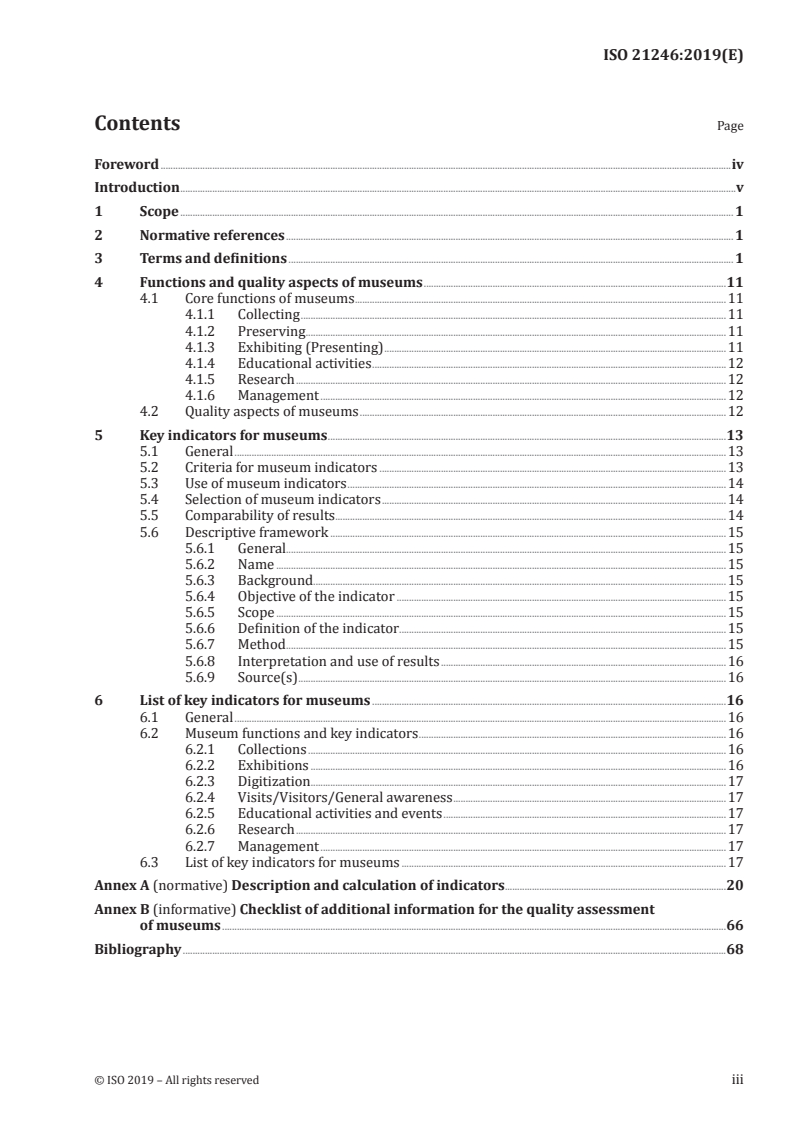
Contents Page
Foreword .iv
Introduction .v
1 Scope . 1
2 Normative references . 1
3 Terms and definitions . 1
4 Functions and quality aspects of museums .11
4.1 Core functions of museums .11
4.1.1 Collecting .11
4.1.2 Preserving .11
4.1.3 Exhibiting (Presenting) .11
4.1.4 Educational activities .12
4.1.5 Research .12
4.1.6 Management .12
4.2 Quality aspects of museums .12
5 Key indicators for museums .13
5.1 General .13
5.2 Criteria for museum indicators .13
5.3 Use of museum indicators .14
5.4 Selection of museum indicators .14
5.5 Comparability of results .14
5.6 Descriptive framework .15
5.6.1 General.15
5.6.2 Name .15
5.6.3 Background.15
5.6.4 Objective of the indicator .15
5.6.5 Scope .15
5.6.6 Definition of the indicator.15
5.6.7 Method .15
5.6.8 Interpretation and use of results .16
5.6.9 Source(s) .16
6 List of key indicators for museums .16
6.1 General .16
6.2 Museum functions and key indicators .16
6.2.1 Collections .16
6.2.2 Exhibitions .16
6.2.3 Digitization.17
6.2.4 Visits/Visitors/General awareness .17
6.2.5 Educational activities and events .17
6.2.6 Research .17
6.2.7 Management .17
6.3 List of key indicators for museums .17
Annex A (normative) Description and calculation of indicators .20
Annex B (informative) Checklist of additional information for the quality assessment
of museums .66
Bibliography .68
Foreword
ISO (the International Organization for Standardization) is a worldwide federation of national standards
bodies (ISO member bodies). The work of preparing International Standards is normally carried out
through ISO technical committees. Each member body interested in a subject for which a technical
committee has been established has the right to be represented on that committee. International
organizations, governmental and non-governmental, in liaison with ISO, also take part in the work.
ISO collaborates closely with the International Electrotechnical Commission (IEC) on all matters of
electrotechnical standardization.
The procedures used to develop this document and those intended for its further maintenance are
described in the ISO/IEC Directives, Part 1. In particular, the different approval criteria needed for the
different types of ISO documents should be noted. This document was drafted in accordance with the
editorial rules of the ISO/IEC Directives, Part 2 (see www .iso .org/ directives).
Attention is drawn to the possibility that some of the elements of this document may be the subject of
patent rights. ISO shall not be held responsible for identifying any or all such patent rights. Details of
any patent rights identified during the development of the document will be in the Introduction and/or
on the ISO list of patent declarations received (see www .iso .org/ patents).
Any trade name used in this document is information given for the convenience of users and does not
constitute an endorsement.
For an explanation of the voluntary nature of standards, the meaning of ISO specific terms and
expressions related to conformity assessment, as well as information about ISO's adherence to the
World Trade Organization (WTO) principles in the Technical Barriers to Trade (TBT), see www .iso .org/
iso/ foreword .html.
This document was prepared by Technical Committee ISO/TC 46, Information and documentation,
Subcommittee SC 8, Quality — Statistics and performance evaluation.
Any feedback or questions on this document should be directed to the user’s national standards body. A
complete listing of these bodies can be found at www .iso .org/ members .html.
iv © ISO 2019 – All rights reserved
Introduction
This document provides guidance to the museum community on the use of key museum indicators. It
specifies the requirements of a key indicator for museums and establishes a set of indicators to be used
by museums of all types.
Some of the indicators included in this document are already in use by museums, or have been proposed
in recent museum literature. Other indicators have been taken from library standards and adapted to the
requirements of museums. Annex A describes the key indicators that have been found useful for quality
assessment of museums. The data specified in Annex B can be used for complementing and supporting
the information gained by using the key museum indicators, though they are not in themselves such
indicators. This document has been developed in close cooperation with the International Council on
Museums (ICOM) and takes advantage of, particularly, the work of the European Group on Museum
Statistics (EGMUS).
INTERNATIONAL STANDARD ISO 21246:2019(E)
Information and documentation — Key indicators for
museums
1 Scope
This document specifies a set of key indicators for assessing the quality of museums:
— for the purpose of strategic planning and internal management of museums;
— for reporting to stakeholders such as funding institutions, policy makers, or the public;
— to promote the museums’ role and value for learning and research, education and culture, social and
economic life;
— for comparing results over time and between museums.
The aim of this document is to provide a selection of key indicators applicable to a wide range of
museums. It is recognized that not all indicators are pertinent for each individual museum category or
each individual museum. Limitations on the applicability of individual indicators are listed in the scope
clause of the description of each indicator (see Annex A).
This document is not intended to exclude the use of other indicators not specified in it.
2 Normative references
There are no normative references in this document.
3 Terms and definitions
For the purposes of this document, the following terms and definitions apply.
ISO and IEC maintain terminological databases for use in standardization at the following addresses:
— ISO Online browsing platform: available at https:// www .iso .org/ obp
— IEC Electropedia: available at http:// www .electropedia .org/
3.1
accessibility
ease of reaching and using a service or facility
[SOURCE: ISO 11620:2014, 3.2]
3.2
accession
addition
formal act of entering an object into the collections of a museum
Note 1 to entry: Once an object has been accessioned, it has a status beyond that of merely being the property
of the organization and can only be disposed of by referring to the governing body of the organization, e.g. the
trustees or director.
[SOURCE: ISO 18461:2016, 2.5.1]
3.3
accession register
itemized list or record of the objects properly added to a museum collection during a specified
period of time
[SOURCE: ISO 18461:2016, 2.8.1]
3.4
acquisition
process of gaining legal possession of an object for a museum collection through purchase, donation
(3.16), bequest, transfer or fieldwork
[SOURCE: ISO 18461:2016, 2.5.2]
3.5
capital expenditure
expenditure which results in the acquisition (3.4) of, or addition to, fixed assets
Note 1 to entry: This includes expenditure on building sites, new buildings and extensions, furnishings and
equipment for new and expanded buildings, computer systems (hardware and software), etc. When applicable,
local and national sales/purchase taxes [e.g. Value Added Tax (VAT)] are included.
[SOURCE: ISO 2789:2013, 2.6.1]
3.6
catalogue
collection of records filing/storing relevant information about an object in a museum collection
[SOURCE: ISO 18461:2016, 2.8.2, modified — The phrase “all known” has been excluded.]
3.7
cataloguing
process of recording and filing/storing relevant information about an object in a museum collection
Note 1 to entry: Such information can include origin, age, creator, title (e.g. for works of art), physical description
(materials and/or techniques used in its making, physical dimensions), use, provenance, etc. of the object.
[SOURCE: ISO 18461:2016, 2.8.3, modified — The phrase “all known” has been excluded]
3.8
collection
body of acquired objects held in title by a museum
[SOURCE: ISO 18461:2016, 2.5.9]
3.9
collection management
all practices and procedures implemented by a museum in acquiring, documenting, handling, accessing,
cataloguing (3.7), storing, securing, lending, conserving and disposing of collection objects
[SOURCE: ISO 18461:2016, 2.5.10]
3.10
collection policy
museum’s scope and its aims, practices and procedures of collection management (3.9)
Note 1 to entry: The collection policy also identifies the kinds of objects a museum will collect, the terms and
conditions governing acquisitions and the deaccession policy.
[SOURCE: ISO 18461:2016, 2.5.11]
2 © ISO 2019 – All rights reserved
3.11
conservation
preservation measures and actions applied to prevent, arrest or delay deterioration of a document
(3.15) or other material object
[SOURCE: ISO 5127:2017, 3.12.1.01]
3.12
digital collection
all objects in digital form in the museum collection, whether born digital or digitized
Note 1 to entry: Documents (3.15) are included.
[SOURCE: ISO 18461:2016, 2.5.13]
3.13
digitization
process of converting analogue materials into digital form
[SOURCE: ISO 2789:2013, 2.3.15]
3.14
digitized object
digitally reproduced object
Note 1 to entry: A two-dimensional or three-dimensional object is counted as digitized if its metadata and at
least one image of it are available in digital format.
Note 2 to entry: Documents such as autographs, books or audiovisual documents are counted as digitized if their
metadata and their contents are available in digital format.
Note 3 to entry: Documents (3.15) are included.
[SOURCE: ISO 18461:2016, 2.5.15]
3.15
document
recorded information or material object which can be treated as a unit in a documentation process
Note 1 to entry: Documents can differ in form and characteristics.
[SOURCE: ISO 5127:2017, 3.1.1.38, modified — Note 1 to entry of ISO 2789:2013, 2.3.17 has been
included.]
3.16
donation
gift
acquisition (3.4) without monetary compensation but with change of ownership and legal title
[SOURCE: ISO 5127:2017, 3.6.2.2.11]
3.17
educational services
learning sessions and learning materials and programmes in all formats for children and adults for the
purpose of enhancing skills and knowledge
Note 1 to entry: This includes the provision of services for schools and the cooperation with other partners in
preparing and offering educational services.
[SOURCE: ISO 21248:2019, 3.22, modified — The phrase “in library and information use” has been
excluded and the terms “and knowledge” added. Note 2 to entry has been omitted.]
3.18
effectiveness
measure of the degree to which given objectives are achieved
Note 1 to entry: An activity is effective if it maximizes the results it was established to produce.
[SOURCE: ISO 11620:2014, 3.15]
3.19
efficiency
measure of the utilisation of resources to realize a given objective (3.35)
Note 1 to entry: An activity is efficient if it minimizes the use of resources, or produces better performance with
the same resources.
[SOURCE: ISO 11620:2014, 3.16]
3.20
evaluation
process of determining the effectiveness (3.18), efficiency (3.19), utility and relevance of a service or
facility
[SOURCE: ISO 11620:2014, 3.19]
3.21
event
pre-arranged singular activity having an intent within the mission (3.28) of the museum
Note 1 to entry: The activity would usually be of a cultural, educational, social, political or scholarly nature,
and would take the form of lectures, film screening, theatre performances, round table discussions, vernissage,
finnisage, museum night, etc.
Note 2 to entry: Events can be organized inside or outside the museum premises.
Note 3 to entry: Events inside the museum premises organized by institutions outside the museum without the
museum’s participation should be counted separately.
Note 4 to entry: Guided tours, programmes, exhibitions and virtual events are excluded.
[SOURCE: ISO 18461:2016, 2.4.5]
3.22
exhibition
curated display of museum objects or other items of cultural heritage on a clear concept and
communicating a message
Note 1 to entry: Exhibitions can take place inside or outside the museum premises.
Note 2 to entry: Exhibitions can be temporary or permanent.
Note 3 to entry: Virtual exhibitions are excluded.
Note 4 to entry: Exhibitions inside the museum premises organized by institutions outside the museum without
the museum’s participation should be counted separately.
[SOURCE: ISO 18461:2016, 2.4.6]
4 © ISO 2019 – All rights reserved
3.23
full-time equivalent
FTE
measurement equal to one staff person working a full-time work schedule for one year
Note 1 to entry: For example, if out of three persons employed as museum employees, one works quarter-time,
one works half-time, and one works full-time, then the FTE of these three persons would be 0,25 + 0,5 + 1,0 = 1,75
employees (FTE).
[SOURCE: ISO 11620:2014, 3.23]
3.24
goal
desired state of affairs to be achieved by the implementation of agreed policies
[SOURCE: ISO 11620:2014, 3.24]
3.25
income generated
income generated by museum operations and from fees, charges, subscriptions and donations (3.16)
[SOURCE: ISO 2789:2013, 6.6.3, modified — the term “library” has been replaced by “museum”. The
phrase “that is available to the library for expenditure” has been excluded.]
3.26
inventory
itemized list or record of all objects contained in a museum collection during a specified period of time
[SOURCE: ISO 18461:2016, 2.8.7]
3.27
loan
lending of an object in the museum’s collection to, or borrowing an object from, other collecting
organisations, private collectors, or agencies
Note 1 to entry: Deposits (permanent loans) are counted separately.
[SOURCE: ISO 18461:2016, 2.4.7]
3.28
mission
statement approved by the authorities formulating the organization's goals (3.24) and its choices in
services and products development
[SOURCE: ISO 11620:2014, 3.33]
3.29
museum
non-profit, permanent institution in the service of society and its development, open to the public,
which acquires, conserves, researches, communicates and exhibits the tangible and intangible heritage
of humanity and its environment for the purposes of education, study and enjoyment
Note 1 to entry: Natural, archaeological and ethnographic monuments and sites and historical monuments and
sites of a museum nature are included, if they maintain a collection similar to museums.
Note 2 to entry: Zoos, aquaria, arboreta and botanical gardens are included, but should be reported separately.
Note 3 to entry: Collections in institutions of higher education that serve only the purposes of teaching and study
are excluded.
Note 4 to entry: Conservation institutes and exhibition galleries in libraries and archives centres are included if
they conform to the definition of museum.
Note 5 to entry: To conform to the definition it is not necessary that an institution be called a museum, but that it
has the role and function of a museum.
[SOURCE: ICOM, Museum definition, 2007]
3.30
museum employee
person who works for a museum in return for payment
[SOURCE: ISO 2789:2013, 2.7.1, modified — The term “library” has been replaced by “museum”.]
3.31
museum key indicator
numerical, symbolic or verbal expression assessing the activity of a museum in view of its mission (3.28)
Note 1 to entry: The indicators can be derived from museum statistics and from other data used to characterize
the museum activities.
3.32
museum staff research publication
research publication by museum staff on professional and academic subjects
Note 1 to entry: Includes publications in all formats, and presentations at conferences.
[SOURCE: ISO 2789:2013, 2.5.4, modified — The term “library” has been replaced by “museum”.]
3.33
museum website
unique domain on the Internet consisting of a collection of web pages that is published by a museum to
provide access to the museum’s services and resources
[SOURCE: ISO 2789:2013, 2.2.18, modified — The term “library” has been replaced by “museum”. Notes
to entry 1 to 3 have been omitted.]
3.34
object
item which forms part of a museum’s collection
Note 1 to entry: For objects in natural science collections the term “specimen” is generally used.
Note 2 to entry: Documents (3.15) are included.
[SOURCE: ISO 18461:2016, 2.5.24]
3.35
objective
specific target for an activity to be attained as a contribution to achieving the goal (3.24) of an
organization
[SOURCE: ISO 11620:2014, 3.34]
3.36
online access
successful request of a museum-provided online service
Note 1 to entry: An online access is one cycle of user activities that typically starts when a user connects to a
museum-provided online service and ends by a terminating activity that is either explicit (by leaving the service
through log-out or exit) or implicit (timeout due to user inactivity).
Note 2 to entry: Online accesses to the museum website are counted as virtual visits.
Note 3 to entry: If possible, requests by robots/web crawlers should be excluded.
6 © ISO 2019 – All rights reserved
[SOURCE: ISO 2789:2013, 2.2.1, modified — The term “access” has been changed to “online access”. The
term “library” has been replaced by “museum”. Note 3 to entry has been omitted.]
3.37
online catalogue
database of records and images describing objects of one or more museums presented for public access
[SOURCE: ISO 18461:2016, 2.4.11]
3.38
open access
unrestricted access to information, documents (3.15) or information services
Note 1 to entry: This does not necessarily imply that the access is free of charge.
[SOURCE: ISO 5127:2017, 3.11.1.05, modified — Note 1 to entry has been added.]
3.39
opening hours
hours in a normal week when the museum is accessible to visitors
[SOURCE: ISO 18461:2016, 2.6.4]
3.40
permanent exhibition
long-term exhibition
exhibition showing, over a long period of time, objects which are in long-term custody of the museum
[SOURCE: ISO 18461:2016, 2.4.13]
3.41
physical visit
act of entering the museum premises with the aim of experiencing its exhibitions, programmes or other
services directed towards the public
[SOURCE: ISO 18461:2016, 2.4.14, modified — The terms “into one or all of the parts of” have been
deleted, and the phrase “with the aim of experiencing its exhibitions, programmes or other services
directed towards the public” has been added.]
3.42
preservation
all measures taken, including financial and strategic decisions, to maintain the integrity and extend the
life of documents (3.15) or collections
[SOURCE: ISO 5127:2017, 3.2.1.39, modified — Notes 1 and 2 to entry have been omitted.]
3.43
process
set of interrelated or interacting activities which transform inputs into outputs (e.g. preparing an
exhibition, cataloguing, lending, reference service)
[SOURCE: ISO 16439:2014, 3.50]
3.44
professional staff member
museum employee (3.30) who has graduated at university level or in a special training course in the
museum sector and whose duty requires professional education or experience
3.45
programme
pre-arranged on-going and repeatable activity having an intent within the mission of the museum
Note 1 to entry: The activity would usually be of a cultural, educational, social political or scholarly nature, and
would take the form of workshops, travel programmes, courses for school classes, etc.
Note 2 to entry: Programmes can be organized inside or outside the museum premises.
Note 3 to entry: Programmes inside the museum premises organized by institutions outside the museum without
the museum’s participation should be counted separately.
Note 4 to entry: Events, guided tours, exhibitions and virtual events are excluded, but are counted separately.
Note 5 to entry: Virtual programmes are included, but should be counted separately.
[SOURCE: ISO 18461:2016, 2.4.15]
3.46
project
unique process, consisting of a set of coordinated and controlled activities with start and finish dates,
undertaken to achieve an objective conforming to specific requirements, including the constraints of
time, cost and resources
Note 1 to entry: An individual project can form part of a larger project structure.
Note 2 to entry: Adapted from ISO 9000:2015.
[SOURCE: ISO 18461:2016, 2.8.10]
3.47
record
set of data on one person, object or event (3.21), selected and presented for a predefined purpose
Note 1 to entry: The record can include elements such as title, creator, subject, description, date of origin, etc.
[SOURCE: ISO 18461:2016, 2.8.11]
3.48
reliability
degree to which a measure repeatedly and consistently produces the same result
[SOURCE: ISO 11620:2014, 3.44]
3.49
restoration
actions taken to return a document (3.15) or other material object which has suffered deterioration or
damage as closely as practicable to its original state
Note 1 to entry: In archival restoration, no attempt is made to recreate missing text, etc., and all restoration work
is kept clearly evident.
[SOURCE: ISO 5127:2017, 3.12.1.02, modified — The term “preservation” has been excluded in the
definition, and Note 2 to entry has been omitted.]
3.50
satisfaction survey
survey administered to a sample of a museum’s users to find out how they rate the quality of their
museum experiences, and any suggestions for improvement
Note 1 to entry: The survey may be conducted face to face, via handouts, telephone, email, or Internet.
Note 2 to entry: The survey can contain questions about user status, how often and how they normally use the
resources and services the museum provides.
8 © ISO 2019 – All rights reserved
Note 3 to entry: In a longitudinal study, the same or a similar survey instrument is administered more than once,
after a suitable interval of time has elapsed, to measure changes in patterns of usage, perceptions, attitudes, etc.
[SOURCE: ISO 16439:2014, 3.72, modified — The term “library” has been replaced by “museum”.]
3.51
score
result, often expressed numerically, of a museum indicator
3.52
special grant
grant of a non-recurrent nature to fully or partially fund projects
[SOURCE: ISO 2789:2013, 2.6.4, modified — The definition has been slightly modified.]
3.53
staff training
formal pre-planned training which can be held in-house or externally, and delivered by museum staff or
external experts
Note 1 to entry: Informal training, e.g. point-of-use training, is excluded.
Note 2 to entry: Online training is included.
[SOURCE: ISO 2789:2013, 2.7.6, modified — The term “library” has been replaced by “museum”, and
Note 2 to entry has been added.]
3.54
storage area
area of the museum where the objects are kept under controlled conditions if not on display or in
technical treatment
[SOURCE: ISO 18461:2016, 2.6.5]
3.55
target group
group of actual and potential visitors appropriate to a museum as the object of a specific service or as
the primary users of specific materials
Note 1 to entry: Such target groups can, for example, be children, school classes, researchers, or educators.
[SOURCE: ISO 11620:2014, 3.49, modified — “target population” has been changed to “target group”, the
term “library” has been replaced by “museum”, and Note 1 to entry has been added for clarification.]
3.56
temporary exhibition
short-term exhibition
exhibition shown during a limited period of time
Note 1 to entry: A temporary exhibition is counted only once, in the year it is started.
[SOURCE: ISO 18461:2016, 2.4.19]
travelling exhibition
exhibition that is shown consecutively in several locations
[SOURCE: ISO 18461:2016, 2.4.19]
3.58
user
recipient of museum services
Note 1 to entry: The recipient can be a person or an institution, including museums.
Note 2 to entry: Museum services include electronic services, physical services and visiting the museum premises.
[SOURCE: ISO 2789:2013, 2.2.36, modified — The term “library” has been replaced by “museum”.]
3.59
validity
extent to which the results of a research process represent what was intended
[SOURCE: ISO 20252:2006, 2.62]
3.60
value
importance that stakeholders (funding institutions, politicians, the public, users, staff) attach to
museums and which is related to the perception of actual or potential benefit
Note 1 to entry: Monetary value can be included.
[SOURCE: ISO 16439:2014, 3.75, modified — The term “library” has been replaced by “museum.]
3.61
virtual event
event in electronic format, specially designed for use via the Internet
[SOURCE: ISO 2789:2013, 2.2.38]
3.62
virtual exhibition
exhibition in electronic format, specially designed for use via the Internet
[SOURCE: ISO 18461:2016, 2.4.19]
3.63
virtual visit
one continuous cycle of user activities on the museum website (3.33), regardless of the number of pages
or elements viewed
Note 1 to entry: A virtual visit typically starts when a user accesses the museum website after visiting an
external page, and ends if no activity has been recorded for a defined period of time (a maximum of 30 min).
Another access after a longer interval initiates a new visit.
Note 2 to entry: A virtual visitor should at least be identified by a unique cookie and/or by a unique combination
of the user’s IP address and browser string (user agent). Known web spiders and harvesters should be excluded.
[SOURCE: ISO 2789:2013, 2.2.39, modified — The term “library” has been replaced by “museum”, and
the phrase “by users from outside the library's IP address space (usually from outside the library
premises)” has been omitted.]
3.64
visitor
person (individual) entering the museum premises with the aim of experiencing its exhibitions,
programmes, or other services directed towards the public
10 © ISO 2019 – All rights reserved
3.65
visitor with special needs
person that requires special services and/or facilities for a museum visit
Note 1 to entry: The special needs can be caused by physical and health impairment, cultural difference (e.g. non-
native speakers, new arrivals), educational background, or other circumstances that require special museum
services and/or facilities.
Note 2 to entry: Children, young people and seniors without additional needs are not included.
[SOURCE: ISO 2789:2013, 2.2.35, modified — “target population with special needs” has been replaced
by “visitor with special needs”, the text has been adapted to museum visitors. Note 3 and 4 to entry
have been omitted.]
3.66
volunteer
person working on museum tasks without payment
Note 1 to entry: Volunteers can receive token reimbursements or expense allowances.
[SOURCE: ISO 2789:2013, 2.7.7, modified — the term “library” has been replaced by “museum”.]
4 Functions and quality aspects of museums
4.1 Core functions of museums
4.1.1 Collecting
The main tasks are:
— to regularly acquire objects, along and within the collection policy of the museum;
— to formulate a written collection policy according to the museum’s mission and to constantly pursue
and update it;
— to catalogue/describe the collected objects in the inventory documents and in scientific catalogues
and databases;
— to make the collections visible and accessible by online catalogues and via the Internet.
4.1.2 Preserving
The main tasks are:
— to preserve the museum’s analogue and digital collections through safe storage, stable environment,
preventive conservation and restoration treatment;
— to develop and promote disaster management plans.
4.1.3 Exhibiting (Presenting)
The main tasks are:
— to present the collections to the general public via permanent and temporary exhibitions;
— to make the collections accessible in digital formats and in online environments;
— to offer regular and adequate opening times;
— to offer suitable services for persons with special needs.
4.1.4 Educational activities
The main tasks are:
— to support learning and education by offering educational programmes related to the museum’s
mission, collections and themes;
— to consider the needs of specific groups (adults, children, students, refugees, etc.) in programmes
and events;
— to provide services for schools.
4.1.5 Research
The main tasks are:
— to promote the collections by research and publications;
— to provide access for researchers;
— to initiate and support research projects on collection objects;
— to organize conferences and seminars based on the research.
4.1.6 Management
The main tasks are:
— to ensure effectiveness and cost-efficiency (using adequate technology and management methods);
— to arrange for clearly defined procedures;
— to provide for staff development;
— to cooperate locally, regionally, nationally and internationally with museums and other organizations.
4.2 Quality aspects of museums
A number of key factors are essential for achieving successful museum work. The most relevant of
these are:
a) a clear concept and general attractiveness of the permanent and temporary exhibitions;
b) adaptation of the permanent exhibition to current research and educational concepts;
c) a general research plan including research activities and publications by staff;
d) differentiated individual descriptions of each object;
e) uniqueness and/or context of collection objects (reasons why a specific object is kept in the
collection).
In addition, more general quality characteristics are named in the literature on museums. Examples are:
— competence of staff: Staff should be well trained in all museum activities;
— accuracy and reliability of the services, e.g. unbiased and scientifically sound presentation and
description of objects, up-to-date catalogues, correct answers to researchers’ questions;
— accessibility: The museum building, the exhibitions, the digitized collections and other services
should be easily accessible. Examples are adequate opening times, efficient sign-posting, usability
of databases and the website, simple-to-use online services, intellectual and physical accessibility;
12 © ISO 2019 – All rights reserved
— aesthetics: visual attractiveness (building, display of collection);
— visitor-orientation: Services should be oriented to the visitors and, along with that, to the specific
target groups that the museum aims to serve, e.g. families, the local community, citizens with special
interests, researchers, tourists or children;
— effectiveness and efficiency: All processes in the museum should be well organized and streamlined,
so that quality can be offered with minimum resources;
— helpfulness of staff: Staff working with the public should be friendly and responsive, and should
possess communication skills.
5 Key indicators for museums
5.1 General
For the following chapter, especially for the general description of museum key indicators and their use,
this document relies partly on ISO 11620.
Museum key indicators can give information to which extent the goals of a museum have been
reached. They can be used to assess the quality and effectiveness and/or efficiency of the functioning
and the services of a museum. They can and should also indicate problems and shortcomings in the
performance of the museum so that action can be taken to remedy these. It is vital that the indicators
in this document allow a rational, unbiased and not locally restricted assessment of museums and their
contribution to society.
Indicators combine data collected for the annual museum statistics and data that may be collected
additionally for a specific indicator. Each indicator shall be capable of showing whether a higher or a
lower score indicates higher quality.
All key indicators included in Annex A fulfil the criteria presented in 5.2 and are specified according to
the descriptive framework presented in 5.6. The indicators shall be calculated and used as specified in
Annex A.
5.2 Criteria for museum indicators
Museum indicators shall be:
a) informative for measuring an activity, for identifying achievements, and for identifying problems
and shortcomings in the performance of the museum;
b) reliable, i.e. constantly produce the same result when used repeatedly under the same
circumstances;
NOTE Variations do not make an indicator unreliable.
c) valid, i.e. shall measure what they are intended to measure;
NOTE Estimations are possible.
d) appropriate for their purpose, applicable to the institution and situation (museum environment) for
which they are meant and expressing exactly those, and only those, features that are intended to be
measured;
e) practical, i.e. using a reasonable amount of resources (money, time, qualified staff, involvement of
museum visitors, etc.).
If the museum indicator is intended for comparisons between museums, a further criterion applies:
1) The museum indicators shall be comparable: An indicator allows comparison if the same score,
making allowance for the accuracy of the score, means the same level of quality or efficiency in the
museums to be compared.
5.3 Use of museum indicators
Museum indicators can be used as tools:
— to assess the quality and effectiveness of activities, resources, and services provided by a museum;
— and to assess the efficiency of resources allocated by the museum to such activities and services.
The indicators can and should also indicate problems and shortcomings in the performance of the
museum.
As an evaluation tool, museum indicators have three principal objectives:
a) to make the management process more effective;
b) to serve as a basis for reference and for dialogues between museum staff, funding bodies, and the
user community;
c) to serve in comparative analysis of museums which have similar missions or objectives.
Users of museum indicators should recognize that it is impossible to achieve optimum scores
simultaneously on all indicators. For example, a museum may achieve a high level of popularity in the
population by spectacular exhibitions, but the staff resources spent on the exhibitions may be lacking
in other areas, so that cataloguing or digitisation cannot achieve high scores.
Scores on museum indicators shall be interpreted in the light of what the museum intends to accomplish,
and not simply in terms of optimizing scores on particular indicators.
5.4 Selection of museum indicators
This document recognizes that there are many different types of museums, e.g. in
...
INTERNATIONAL ISO
STANDARD 21246
First edition
2019-11
Information and documentation —
Key indicators for museums
Information et documentation — Indicateurs clés des musées
Reference number
©
ISO 2019
© ISO 2019
All rights reserved. Unless otherwise specified, or required in the context of its implementation, no part of this publication may
be reproduced or utilized otherwise in any form or by any means, electronic or mechanical, including photocopying, or posting
on the internet or an intranet, without prior written permission. Permission can be requested from either ISO at the address
below or ISO’s member body in the country of the requester.
ISO copyright office
CP 401 • Ch. de Blandonnet 8
CH-1214 Vernier, Geneva
Phone: +41 22 749 01 11
Fax: +41 22 749 09 47
Email: copyright@iso.org
Website: www.iso.org
Published in Switzerland
ii © ISO 2019 – All rights reserved
Contents Page
Foreword .iv
Introduction .v
1 Scope . 1
2 Normative references . 1
3 Terms and definitions . 1
4 Functions and quality aspects of museums .11
4.1 Core functions of museums .11
4.1.1 Collecting .11
4.1.2 Preserving .11
4.1.3 Exhibiting (Presenting) .11
4.1.4 Educational activities .12
4.1.5 Research .12
4.1.6 Management .12
4.2 Quality aspects of museums .12
5 Key indicators for museums .13
5.1 General .13
5.2 Criteria for museum indicators .13
5.3 Use of museum indicators .14
5.4 Selection of museum indicators .14
5.5 Comparability of results .14
5.6 Descriptive framework .15
5.6.1 General.15
5.6.2 Name .15
5.6.3 Background.15
5.6.4 Objective of the indicator .15
5.6.5 Scope .15
5.6.6 Definition of the indicator.15
5.6.7 Method .15
5.6.8 Interpretation and use of results .16
5.6.9 Source(s) .16
6 List of key indicators for museums .16
6.1 General .16
6.2 Museum functions and key indicators .16
6.2.1 Collections .16
6.2.2 Exhibitions .16
6.2.3 Digitization.17
6.2.4 Visits/Visitors/General awareness .17
6.2.5 Educational activities and events .17
6.2.6 Research .17
6.2.7 Management .17
6.3 List of key indicators for museums .17
Annex A (normative) Description and calculation of indicators .20
Annex B (informative) Checklist of additional information for the quality assessment
of museums .66
Bibliography .68
Foreword
ISO (the International Organization for Standardization) is a worldwide federation of national standards
bodies (ISO member bodies). The work of preparing International Standards is normally carried out
through ISO technical committees. Each member body interested in a subject for which a technical
committee has been established has the right to be represented on that committee. International
organizations, governmental and non-governmental, in liaison with ISO, also take part in the work.
ISO collaborates closely with the International Electrotechnical Commission (IEC) on all matters of
electrotechnical standardization.
The procedures used to develop this document and those intended for its further maintenance are
described in the ISO/IEC Directives, Part 1. In particular, the different approval criteria needed for the
different types of ISO documents should be noted. This document was drafted in accordance with the
editorial rules of the ISO/IEC Directives, Part 2 (see www .iso .org/ directives).
Attention is drawn to the possibility that some of the elements of this document may be the subject of
patent rights. ISO shall not be held responsible for identifying any or all such patent rights. Details of
any patent rights identified during the development of the document will be in the Introduction and/or
on the ISO list of patent declarations received (see www .iso .org/ patents).
Any trade name used in this document is information given for the convenience of users and does not
constitute an endorsement.
For an explanation of the voluntary nature of standards, the meaning of ISO specific terms and
expressions related to conformity assessment, as well as information about ISO's adherence to the
World Trade Organization (WTO) principles in the Technical Barriers to Trade (TBT), see www .iso .org/
iso/ foreword .html.
This document was prepared by Technical Committee ISO/TC 46, Information and documentation,
Subcommittee SC 8, Quality — Statistics and performance evaluation.
Any feedback or questions on this document should be directed to the user’s national standards body. A
complete listing of these bodies can be found at www .iso .org/ members .html.
iv © ISO 2019 – All rights reserved
Introduction
This document provides guidance to the museum community on the use of key museum indicators. It
specifies the requirements of a key indicator for museums and establishes a set of indicators to be used
by museums of all types.
Some of the indicators included in this document are already in use by museums, or have been proposed
in recent museum literature. Other indicators have been taken from library standards and adapted to the
requirements of museums. Annex A describes the key indicators that have been found useful for quality
assessment of museums. The data specified in Annex B can be used for complementing and supporting
the information gained by using the key museum indicators, though they are not in themselves such
indicators. This document has been developed in close cooperation with the International Council on
Museums (ICOM) and takes advantage of, particularly, the work of the European Group on Museum
Statistics (EGMUS).
INTERNATIONAL STANDARD ISO 21246:2019(E)
Information and documentation — Key indicators for
museums
1 Scope
This document specifies a set of key indicators for assessing the quality of museums:
— for the purpose of strategic planning and internal management of museums;
— for reporting to stakeholders such as funding institutions, policy makers, or the public;
— to promote the museums’ role and value for learning and research, education and culture, social and
economic life;
— for comparing results over time and between museums.
The aim of this document is to provide a selection of key indicators applicable to a wide range of
museums. It is recognized that not all indicators are pertinent for each individual museum category or
each individual museum. Limitations on the applicability of individual indicators are listed in the scope
clause of the description of each indicator (see Annex A).
This document is not intended to exclude the use of other indicators not specified in it.
2 Normative references
There are no normative references in this document.
3 Terms and definitions
For the purposes of this document, the following terms and definitions apply.
ISO and IEC maintain terminological databases for use in standardization at the following addresses:
— ISO Online browsing platform: available at https:// www .iso .org/ obp
— IEC Electropedia: available at http:// www .electropedia .org/
3.1
accessibility
ease of reaching and using a service or facility
[SOURCE: ISO 11620:2014, 3.2]
3.2
accession
addition
formal act of entering an object into the collections of a museum
Note 1 to entry: Once an object has been accessioned, it has a status beyond that of merely being the property
of the organization and can only be disposed of by referring to the governing body of the organization, e.g. the
trustees or director.
[SOURCE: ISO 18461:2016, 2.5.1]
3.3
accession register
itemized list or record of the objects properly added to a museum collection during a specified
period of time
[SOURCE: ISO 18461:2016, 2.8.1]
3.4
acquisition
process of gaining legal possession of an object for a museum collection through purchase, donation
(3.16), bequest, transfer or fieldwork
[SOURCE: ISO 18461:2016, 2.5.2]
3.5
capital expenditure
expenditure which results in the acquisition (3.4) of, or addition to, fixed assets
Note 1 to entry: This includes expenditure on building sites, new buildings and extensions, furnishings and
equipment for new and expanded buildings, computer systems (hardware and software), etc. When applicable,
local and national sales/purchase taxes [e.g. Value Added Tax (VAT)] are included.
[SOURCE: ISO 2789:2013, 2.6.1]
3.6
catalogue
collection of records filing/storing relevant information about an object in a museum collection
[SOURCE: ISO 18461:2016, 2.8.2, modified — The phrase “all known” has been excluded.]
3.7
cataloguing
process of recording and filing/storing relevant information about an object in a museum collection
Note 1 to entry: Such information can include origin, age, creator, title (e.g. for works of art), physical description
(materials and/or techniques used in its making, physical dimensions), use, provenance, etc. of the object.
[SOURCE: ISO 18461:2016, 2.8.3, modified — The phrase “all known” has been excluded]
3.8
collection
body of acquired objects held in title by a museum
[SOURCE: ISO 18461:2016, 2.5.9]
3.9
collection management
all practices and procedures implemented by a museum in acquiring, documenting, handling, accessing,
cataloguing (3.7), storing, securing, lending, conserving and disposing of collection objects
[SOURCE: ISO 18461:2016, 2.5.10]
3.10
collection policy
museum’s scope and its aims, practices and procedures of collection management (3.9)
Note 1 to entry: The collection policy also identifies the kinds of objects a museum will collect, the terms and
conditions governing acquisitions and the deaccession policy.
[SOURCE: ISO 18461:2016, 2.5.11]
2 © ISO 2019 – All rights reserved
3.11
conservation
preservation measures and actions applied to prevent, arrest or delay deterioration of a document
(3.15) or other material object
[SOURCE: ISO 5127:2017, 3.12.1.01]
3.12
digital collection
all objects in digital form in the museum collection, whether born digital or digitized
Note 1 to entry: Documents (3.15) are included.
[SOURCE: ISO 18461:2016, 2.5.13]
3.13
digitization
process of converting analogue materials into digital form
[SOURCE: ISO 2789:2013, 2.3.15]
3.14
digitized object
digitally reproduced object
Note 1 to entry: A two-dimensional or three-dimensional object is counted as digitized if its metadata and at
least one image of it are available in digital format.
Note 2 to entry: Documents such as autographs, books or audiovisual documents are counted as digitized if their
metadata and their contents are available in digital format.
Note 3 to entry: Documents (3.15) are included.
[SOURCE: ISO 18461:2016, 2.5.15]
3.15
document
recorded information or material object which can be treated as a unit in a documentation process
Note 1 to entry: Documents can differ in form and characteristics.
[SOURCE: ISO 5127:2017, 3.1.1.38, modified — Note 1 to entry of ISO 2789:2013, 2.3.17 has been
included.]
3.16
donation
gift
acquisition (3.4) without monetary compensation but with change of ownership and legal title
[SOURCE: ISO 5127:2017, 3.6.2.2.11]
3.17
educational services
learning sessions and learning materials and programmes in all formats for children and adults for the
purpose of enhancing skills and knowledge
Note 1 to entry: This includes the provision of services for schools and the cooperation with other partners in
preparing and offering educational services.
[SOURCE: ISO 21248:2019, 3.22, modified — The phrase “in library and information use” has been
excluded and the terms “and knowledge” added. Note 2 to entry has been omitted.]
3.18
effectiveness
measure of the degree to which given objectives are achieved
Note 1 to entry: An activity is effective if it maximizes the results it was established to produce.
[SOURCE: ISO 11620:2014, 3.15]
3.19
efficiency
measure of the utilisation of resources to realize a given objective (3.35)
Note 1 to entry: An activity is efficient if it minimizes the use of resources, or produces better performance with
the same resources.
[SOURCE: ISO 11620:2014, 3.16]
3.20
evaluation
process of determining the effectiveness (3.18), efficiency (3.19), utility and relevance of a service or
facility
[SOURCE: ISO 11620:2014, 3.19]
3.21
event
pre-arranged singular activity having an intent within the mission (3.28) of the museum
Note 1 to entry: The activity would usually be of a cultural, educational, social, political or scholarly nature,
and would take the form of lectures, film screening, theatre performances, round table discussions, vernissage,
finnisage, museum night, etc.
Note 2 to entry: Events can be organized inside or outside the museum premises.
Note 3 to entry: Events inside the museum premises organized by institutions outside the museum without the
museum’s participation should be counted separately.
Note 4 to entry: Guided tours, programmes, exhibitions and virtual events are excluded.
[SOURCE: ISO 18461:2016, 2.4.5]
3.22
exhibition
curated display of museum objects or other items of cultural heritage on a clear concept and
communicating a message
Note 1 to entry: Exhibitions can take place inside or outside the museum premises.
Note 2 to entry: Exhibitions can be temporary or permanent.
Note 3 to entry: Virtual exhibitions are excluded.
Note 4 to entry: Exhibitions inside the museum premises organized by institutions outside the museum without
the museum’s participation should be counted separately.
[SOURCE: ISO 18461:2016, 2.4.6]
4 © ISO 2019 – All rights reserved
3.23
full-time equivalent
FTE
measurement equal to one staff person working a full-time work schedule for one year
Note 1 to entry: For example, if out of three persons employed as museum employees, one works quarter-time,
one works half-time, and one works full-time, then the FTE of these three persons would be 0,25 + 0,5 + 1,0 = 1,75
employees (FTE).
[SOURCE: ISO 11620:2014, 3.23]
3.24
goal
desired state of affairs to be achieved by the implementation of agreed policies
[SOURCE: ISO 11620:2014, 3.24]
3.25
income generated
income generated by museum operations and from fees, charges, subscriptions and donations (3.16)
[SOURCE: ISO 2789:2013, 6.6.3, modified — the term “library” has been replaced by “museum”. The
phrase “that is available to the library for expenditure” has been excluded.]
3.26
inventory
itemized list or record of all objects contained in a museum collection during a specified period of time
[SOURCE: ISO 18461:2016, 2.8.7]
3.27
loan
lending of an object in the museum’s collection to, or borrowing an object from, other collecting
organisations, private collectors, or agencies
Note 1 to entry: Deposits (permanent loans) are counted separately.
[SOURCE: ISO 18461:2016, 2.4.7]
3.28
mission
statement approved by the authorities formulating the organization's goals (3.24) and its choices in
services and products development
[SOURCE: ISO 11620:2014, 3.33]
3.29
museum
non-profit, permanent institution in the service of society and its development, open to the public,
which acquires, conserves, researches, communicates and exhibits the tangible and intangible heritage
of humanity and its environment for the purposes of education, study and enjoyment
Note 1 to entry: Natural, archaeological and ethnographic monuments and sites and historical monuments and
sites of a museum nature are included, if they maintain a collection similar to museums.
Note 2 to entry: Zoos, aquaria, arboreta and botanical gardens are included, but should be reported separately.
Note 3 to entry: Collections in institutions of higher education that serve only the purposes of teaching and study
are excluded.
Note 4 to entry: Conservation institutes and exhibition galleries in libraries and archives centres are included if
they conform to the definition of museum.
Note 5 to entry: To conform to the definition it is not necessary that an institution be called a museum, but that it
has the role and function of a museum.
[SOURCE: ICOM, Museum definition, 2007]
3.30
museum employee
person who works for a museum in return for payment
[SOURCE: ISO 2789:2013, 2.7.1, modified — The term “library” has been replaced by “museum”.]
3.31
museum key indicator
numerical, symbolic or verbal expression assessing the activity of a museum in view of its mission (3.28)
Note 1 to entry: The indicators can be derived from museum statistics and from other data used to characterize
the museum activities.
3.32
museum staff research publication
research publication by museum staff on professional and academic subjects
Note 1 to entry: Includes publications in all formats, and presentations at conferences.
[SOURCE: ISO 2789:2013, 2.5.4, modified — The term “library” has been replaced by “museum”.]
3.33
museum website
unique domain on the Internet consisting of a collection of web pages that is published by a museum to
provide access to the museum’s services and resources
[SOURCE: ISO 2789:2013, 2.2.18, modified — The term “library” has been replaced by “museum”. Notes
to entry 1 to 3 have been omitted.]
3.34
object
item which forms part of a museum’s collection
Note 1 to entry: For objects in natural science collections the term “specimen” is generally used.
Note 2 to entry: Documents (3.15) are included.
[SOURCE: ISO 18461:2016, 2.5.24]
3.35
objective
specific target for an activity to be attained as a contribution to achieving the goal (3.24) of an
organization
[SOURCE: ISO 11620:2014, 3.34]
3.36
online access
successful request of a museum-provided online service
Note 1 to entry: An online access is one cycle of user activities that typically starts when a user connects to a
museum-provided online service and ends by a terminating activity that is either explicit (by leaving the service
through log-out or exit) or implicit (timeout due to user inactivity).
Note 2 to entry: Online accesses to the museum website are counted as virtual visits.
Note 3 to entry: If possible, requests by robots/web crawlers should be excluded.
6 © ISO 2019 – All rights reserved
[SOURCE: ISO 2789:2013, 2.2.1, modified — The term “access” has been changed to “online access”. The
term “library” has been replaced by “museum”. Note 3 to entry has been omitted.]
3.37
online catalogue
database of records and images describing objects of one or more museums presented for public access
[SOURCE: ISO 18461:2016, 2.4.11]
3.38
open access
unrestricted access to information, documents (3.15) or information services
Note 1 to entry: This does not necessarily imply that the access is free of charge.
[SOURCE: ISO 5127:2017, 3.11.1.05, modified — Note 1 to entry has been added.]
3.39
opening hours
hours in a normal week when the museum is accessible to visitors
[SOURCE: ISO 18461:2016, 2.6.4]
3.40
permanent exhibition
long-term exhibition
exhibition showing, over a long period of time, objects which are in long-term custody of the museum
[SOURCE: ISO 18461:2016, 2.4.13]
3.41
physical visit
act of entering the museum premises with the aim of experiencing its exhibitions, programmes or other
services directed towards the public
[SOURCE: ISO 18461:2016, 2.4.14, modified — The terms “into one or all of the parts of” have been
deleted, and the phrase “with the aim of experiencing its exhibitions, programmes or other services
directed towards the public” has been added.]
3.42
preservation
all measures taken, including financial and strategic decisions, to maintain the integrity and extend the
life of documents (3.15) or collections
[SOURCE: ISO 5127:2017, 3.2.1.39, modified — Notes 1 and 2 to entry have been omitted.]
3.43
process
set of interrelated or interacting activities which transform inputs into outputs (e.g. preparing an
exhibition, cataloguing, lending, reference service)
[SOURCE: ISO 16439:2014, 3.50]
3.44
professional staff member
museum employee (3.30) who has graduated at university level or in a special training course in the
museum sector and whose duty requires professional education or experience
3.45
programme
pre-arranged on-going and repeatable activity having an intent within the mission of the museum
Note 1 to entry: The activity would usually be of a cultural, educational, social political or scholarly nature, and
would take the form of workshops, travel programmes, courses for school classes, etc.
Note 2 to entry: Programmes can be organized inside or outside the museum premises.
Note 3 to entry: Programmes inside the museum premises organized by institutions outside the museum without
the museum’s participation should be counted separately.
Note 4 to entry: Events, guided tours, exhibitions and virtual events are excluded, but are counted separately.
Note 5 to entry: Virtual programmes are included, but should be counted separately.
[SOURCE: ISO 18461:2016, 2.4.15]
3.46
project
unique process, consisting of a set of coordinated and controlled activities with start and finish dates,
undertaken to achieve an objective conforming to specific requirements, including the constraints of
time, cost and resources
Note 1 to entry: An individual project can form part of a larger project structure.
Note 2 to entry: Adapted from ISO 9000:2015.
[SOURCE: ISO 18461:2016, 2.8.10]
3.47
record
set of data on one person, object or event (3.21), selected and presented for a predefined purpose
Note 1 to entry: The record can include elements such as title, creator, subject, description, date of origin, etc.
[SOURCE: ISO 18461:2016, 2.8.11]
3.48
reliability
degree to which a measure repeatedly and consistently produces the same result
[SOURCE: ISO 11620:2014, 3.44]
3.49
restoration
actions taken to return a document (3.15) or other material object which has suffered deterioration or
damage as closely as practicable to its original state
Note 1 to entry: In archival restoration, no attempt is made to recreate missing text, etc., and all restoration work
is kept clearly evident.
[SOURCE: ISO 5127:2017, 3.12.1.02, modified — The term “preservation” has been excluded in the
definition, and Note 2 to entry has been omitted.]
3.50
satisfaction survey
survey administered to a sample of a museum’s users to find out how they rate the quality of their
museum experiences, and any suggestions for improvement
Note 1 to entry: The survey may be conducted face to face, via handouts, telephone, email, or Internet.
Note 2 to entry: The survey can contain questions about user status, how often and how they normally use the
resources and services the museum provides.
8 © ISO 2019 – All rights reserved
Note 3 to entry: In a longitudinal study, the same or a similar survey instrument is administered more than once,
after a suitable interval of time has elapsed, to measure changes in patterns of usage, perceptions, attitudes, etc.
[SOURCE: ISO 16439:2014, 3.72, modified — The term “library” has been replaced by “museum”.]
3.51
score
result, often expressed numerically, of a museum indicator
3.52
special grant
grant of a non-recurrent nature to fully or partially fund projects
[SOURCE: ISO 2789:2013, 2.6.4, modified — The definition has been slightly modified.]
3.53
staff training
formal pre-planned training which can be held in-house or externally, and delivered by museum staff or
external experts
Note 1 to entry: Informal training, e.g. point-of-use training, is excluded.
Note 2 to entry: Online training is included.
[SOURCE: ISO 2789:2013, 2.7.6, modified — The term “library” has been replaced by “museum”, and
Note 2 to entry has been added.]
3.54
storage area
area of the museum where the objects are kept under controlled conditions if not on display or in
technical treatment
[SOURCE: ISO 18461:2016, 2.6.5]
3.55
target group
group of actual and potential visitors appropriate to a museum as the object of a specific service or as
the primary users of specific materials
Note 1 to entry: Such target groups can, for example, be children, school classes, researchers, or educators.
[SOURCE: ISO 11620:2014, 3.49, modified — “target population” has been changed to “target group”, the
term “library” has been replaced by “museum”, and Note 1 to entry has been added for clarification.]
3.56
temporary exhibition
short-term exhibition
exhibition shown during a limited period of time
Note 1 to entry: A temporary exhibition is counted only once, in the year it is started.
[SOURCE: ISO 18461:2016, 2.4.19]
travelling exhibition
exhibition that is shown consecutively in several locations
[SOURCE: ISO 18461:2016, 2.4.19]
3.58
user
recipient of museum services
Note 1 to entry: The recipient can be a person or an institution, including museums.
Note 2 to entry: Museum services include electronic services, physical services and visiting the museum premises.
[SOURCE: ISO 2789:2013, 2.2.36, modified — The term “library” has been replaced by “museum”.]
3.59
validity
extent to which the results of a research process represent what was intended
[SOURCE: ISO 20252:2006, 2.62]
3.60
value
importance that stakeholders (funding institutions, politicians, the public, users, staff) attach to
museums and which is related to the perception of actual or potential benefit
Note 1 to entry: Monetary value can be included.
[SOURCE: ISO 16439:2014, 3.75, modified — The term “library” has been replaced by “museum.]
3.61
virtual event
event in electronic format, specially designed for use via the Internet
[SOURCE: ISO 2789:2013, 2.2.38]
3.62
virtual exhibition
exhibition in electronic format, specially designed for use via the Internet
[SOURCE: ISO 18461:2016, 2.4.19]
3.63
virtual visit
one continuous cycle of user activities on the museum website (3.33), regardless of the number of pages
or elements viewed
Note 1 to entry: A virtual visit typically starts when a user accesses the museum website after visiting an
external page, and ends if no activity has been recorded for a defined period of time (a maximum of 30 min).
Another access after a longer interval initiates a new visit.
Note 2 to entry: A virtual visitor should at least be identified by a unique cookie and/or by a unique combination
of the user’s IP address and browser string (user agent). Known web spiders and harvesters should be excluded.
[SOURCE: ISO 2789:2013, 2.2.39, modified — The term “library” has been replaced by “museum”, and
the phrase “by users from outside the library's IP address space (usually from outside the library
premises)” has been omitted.]
3.64
visitor
person (individual) entering the museum premises with the aim of experiencing its exhibitions,
programmes, or other services directed towards the public
10 © ISO 2019 – All rights reserved
3.65
visitor with special needs
person that requires special services and/or facilities for a museum visit
Note 1 to entry: The special needs can be caused by physical and health impairment, cultural difference (e.g. non-
native speakers, new arrivals), educational background, or other circumstances that require special museum
services and/or facilities.
Note 2 to entry: Children, young people and seniors without additional needs are not included.
[SOURCE: ISO 2789:2013, 2.2.35, modified — “target population with special needs” has been replaced
by “visitor with special needs”, the text has been adapted to museum visitors. Note 3 and 4 to entry
have been omitted.]
3.66
volunteer
person working on museum tasks without payment
Note 1 to entry: Volunteers can receive token reimbursements or expense allowances.
[SOURCE: ISO 2789:2013, 2.7.7, modified — the term “library” has been replaced by “museum”.]
4 Functions and quality aspects of museums
4.1 Core functions of museums
4.1.1 Collecting
The main tasks are:
— to regularly acquire objects, along and within the collection policy of the museum;
— to formulate a written collection policy according to the museum’s mission and to constantly pursue
and update it;
— to catalogue/describe the collected objects in the inventory documents and in scientific catalogues
and databases;
— to make the collections visible and accessible by online catalogues and via the Internet.
4.1.2 Preserving
The main tasks are:
— to preserve the museum’s analogue and digital collections through safe storage, stable environment,
preventive conservation and restoration treatment;
— to develop and promote disaster management plans.
4.1.3 Exhibiting (Presenting)
The main tasks are:
— to present the collections to the general public via permanent and temporary exhibitions;
— to make the collections accessible in digital formats and in online environments;
— to offer regular and adequate opening times;
— to offer suitable services for persons with special needs.
4.1.4 Educational activities
The main tasks are:
— to support learning and education by offering educational programmes related to the museum’s
mission, collections and themes;
— to consider the needs of specific groups (adults, children, students, refugees, etc.) in programmes
and events;
— to provide services for schools.
4.1.5 Research
The main tasks are:
— to promote the collections by research and publications;
— to provide access for researchers;
— to initiate and support research projects on collection objects;
— to organize conferences and seminars based on the research.
4.1.6 Management
The main tasks are:
— to ensure effectiveness and cost-efficiency (using adequate technology and management methods);
— to arrange for clearly defined procedures;
— to provide for staff development;
— to cooperate locally, regionally, nationally and internationally with museums and other organizations.
4.2 Quality aspects of museums
A number of key factors are essential for achieving successful museum work. The most relevant of
these are:
a) a clear concept and general attractiveness of the permanent and temporary exhibitions;
b) adaptation of the permanent exhibition to current research and educational concepts;
c) a general research plan including research activities and publications by staff;
d) differentiated individual descriptions of each object;
e) uniqueness and/or context of collection objects (reasons why a specific object is kept in the
collection).
In addition, more general quality characteristics are named in the literature on museums. Examples are:
— competence of staff: Staff should be well trained in all museum activities;
— accuracy and reliability of the services, e.g. unbiased and scientifically sound presentation and
description of objects, up-to-date catalogues, correct answers to researchers’ questions;
— accessibility: The museum building, the exhibitions, the digitized collections and other services
should be easily accessible. Examples are adequate opening times, efficient sign-posting, usability
of databases and the website, simple-to-use online services, intellectual and physical accessibility;
12 © ISO 2019 – All rights reserved
— aesthetics: visual attractiveness (building, display of collection);
— visitor-orientation: Services should be oriented to the visitors and, along with that, to the specific
target groups that the museum aims to serve, e.g. families, the local community, citizens with special
interests, researchers, tourists or children;
— effectiveness and efficiency: All processes in the museum should be well organized and streamlined,
so that quality can be offered with minimum resources;
— helpfulness of staff: Staff working with the public should be friendly and responsive, and should
possess communication skills.
5 Key indicators for museums
5.1 General
For the following chapter, especially for the general description of museum key indicators and their use,
this document relies partly on ISO 11620.
Museum key indicators can give information to which extent the goals of a museum have been
reached. They can be used to assess the quality and effectiveness and/or efficiency of the functioning
and the services of a museum. They can and should also indicate problems and shortcomings in the
performance of the museum so that action can be taken to remedy these. It is vital that the indicators
in this document allow a rational, unbiased and not locally restricted assessment of museums and their
contribution to society.
Indicators combine data collected for the annual museum statistics and data that may be collected
additionally for a specific indicator. Each indicator shall be capable of showing whether a higher or a
lower score indicates higher quality.
All key indicators included in Annex A fulfil the criteria presented in 5.2 and are specified according to
the descriptive framework presented in 5.6. The indicators shall be calculated and used as specified in
Annex A.
5.2 Criteria for museum indicators
Museum indicators shall be:
a) informative for measuring an activity, for identifying achievements, and for identifying problems
and shortcomings in the performance of the museum;
b) reliable, i.e. constantly produce the same result when used repeatedly under the same
circumstances;
NOTE Variations do not make an indicator unreliable.
c) valid, i.e. shall measure what they are intended to measure;
NOTE Estimations are possible.
d) appropriate for their purpose, applicable to the institution and situation (museum environment) for
which they are meant and expressing exactly those, and only those, features that are intended to be
measured;
e) practical, i.e. using a reasonable amount of resources (money, time, qualified staff, involvement of
museum visitors, etc.).
If the museum indicator is intended for comparisons between museums, a further criterion applies:
1) The museum indicators shall be comparable: An indicator allows comparison if the same score,
making allowance for the accuracy of the score, means the same level of quality or efficiency in the
museums to be compared.
5.3 Use of museum indicators
Museum indicators can be used as tools:
— to assess the quality and effectiveness of activities, resources, and services provided by a museum;
— and to assess the efficiency of resources allocated by the museum to such activities and services.
The indicators can and should also indicate problems and shortcomings in the performance of the
museum.
As an evaluation tool, museum indicators have three principal objectives:
a) to make the management process more effective;
b) to serve as a basis for reference and for dialogues between museum staff, funding bodies, and the
user community;
c) to serve in comparative analysis of museums which have similar missions or objectives.
Users of museum indicators should recognize that it is impossible to achieve optimum scores
simultaneously on all indicators. For example, a museum may achieve a high level of popularity in the
population by spectacular exhibitions, but the staff resources spent on the exhibitions may be lacking
in other areas, so that cataloguing or digitisation cannot achieve high scores.
Scores on museum indicators shall be interpreted in the light of what the museum intends to accomplish,
and not simply in terms of optimizing scores on particular indicators.
5.4 Selection of museum indicators
This document recognizes that there are many different types of museums, e.g. in different settings,
serving different visitor populations. Since there is such a wide variation around the world, it is
important to understand that not all museum indicators are useful for all museums.
Museums, in consultation with the relevant parties, shall decide which indicators are most appropriate
in the given situation. The decision shall be made in the light of the mission, goals and objectives of
the museum. All parties concerned should be in agreement on the appropriateness of the museum
indicators used.
Several of the indicators will need appropriate staff skills on all levels to be implemented and processed.
5.5 Comparability of results
A primary purpose of using museum indicators is self-diagnosis. This may include longitudinal studies
that compare one year's performance with another, within the same museum.
A secondary purpose is to encourage meaningful and useful comparisons across different museums.
Standardizing museum indicators and the procedures for collecting the data assists in that process.
However, such comparisons shall always be made respecting each museum's:
— mission and core tasks;
— resources;
— different audiences;
14 © ISO 2019 – All rights reserved
...
INTERNATIONAL ISO
STANDARD 21246
First edition
2019-11
Information and documentation —
Key indicators for museums
Information et documentation — Indicateurs clés des musées
Reference number
©
ISO 2019
© ISO 2019
All rights reserved. Unless otherwise specified, or required in the context of its implementation, no part of this publication may
be reproduced or utilized otherwise in any form or by any means, electronic or mechanical, including photocopying, or posting
on the internet or an intranet, without prior written permission. Permission can be requested from either ISO at the address
below or ISO’s member body in the country of the requester.
ISO copyright office
CP 401 • Ch. de Blandonnet 8
CH-1214 Vernier, Geneva
Phone: +41 22 749 01 11
Fax: +41 22 749 09 47
Email: copyright@iso.org
Website: www.iso.org
Published in Switzerland
ii © ISO 2019 – All rights reserved
Contents Page
Foreword .iv
Introduction .v
1 Scope . 1
2 Normative references . 1
3 Terms and definitions . 1
4 Functions and quality aspects of museums .11
4.1 Core functions of museums .11
4.1.1 Collecting .11
4.1.2 Preserving .11
4.1.3 Exhibiting (Presenting) .11
4.1.4 Educational activities .12
4.1.5 Research .12
4.1.6 Management .12
4.2 Quality aspects of museums .12
5 Key indicators for museums .13
5.1 General .13
5.2 Criteria for museum indicators .13
5.3 Use of museum indicators .14
5.4 Selection of museum indicators .14
5.5 Comparability of results .14
5.6 Descriptive framework .15
5.6.1 General.15
5.6.2 Name .15
5.6.3 Background.15
5.6.4 Objective of the indicator .15
5.6.5 Scope .15
5.6.6 Definition of the indicator.15
5.6.7 Method .15
5.6.8 Interpretation and use of results .16
5.6.9 Source(s) .16
6 List of key indicators for museums .16
6.1 General .16
6.2 Museum functions and key indicators .16
6.2.1 Collections .16
6.2.2 Exhibitions .16
6.2.3 Digitization.17
6.2.4 Visits/Visitors/General awareness .17
6.2.5 Educational activities and events .17
6.2.6 Research .17
6.2.7 Management .17
6.3 List of key indicators for museums .17
Annex A (normative) Description and calculation of indicators .20
Annex B (informative) Checklist of additional information for the quality assessment
of museums .66
Bibliography .68
Foreword
ISO (the International Organization for Standardization) is a worldwide federation of national standards
bodies (ISO member bodies). The work of preparing International Standards is normally carried out
through ISO technical committees. Each member body interested in a subject for which a technical
committee has been established has the right to be represented on that committee. International
organizations, governmental and non-governmental, in liaison with ISO, also take part in the work.
ISO collaborates closely with the International Electrotechnical Commission (IEC) on all matters of
electrotechnical standardization.
The procedures used to develop this document and those intended for its further maintenance are
described in the ISO/IEC Directives, Part 1. In particular, the different approval criteria needed for the
different types of ISO documents should be noted. This document was drafted in accordance with the
editorial rules of the ISO/IEC Directives, Part 2 (see www .iso .org/ directives).
Attention is drawn to the possibility that some of the elements of this document may be the subject of
patent rights. ISO shall not be held responsible for identifying any or all such patent rights. Details of
any patent rights identified during the development of the document will be in the Introduction and/or
on the ISO list of patent declarations received (see www .iso .org/ patents).
Any trade name used in this document is information given for the convenience of users and does not
constitute an endorsement.
For an explanation of the voluntary nature of standards, the meaning of ISO specific terms and
expressions related to conformity assessment, as well as information about ISO's adherence to the
World Trade Organization (WTO) principles in the Technical Barriers to Trade (TBT), see www .iso .org/
iso/ foreword .html.
This document was prepared by Technical Committee ISO/TC 46, Information and documentation,
Subcommittee SC 8, Quality — Statistics and performance evaluation.
Any feedback or questions on this document should be directed to the user’s national standards body. A
complete listing of these bodies can be found at www .iso .org/ members .html.
iv © ISO 2019 – All rights reserved
Introduction
This document provides guidance to the museum community on the use of key museum indicators. It
specifies the requirements of a key indicator for museums and establishes a set of indicators to be used
by museums of all types.
Some of the indicators included in this document are already in use by museums, or have been proposed
in recent museum literature. Other indicators have been taken from library standards and adapted to the
requirements of museums. Annex A describes the key indicators that have been found useful for quality
assessment of museums. The data specified in Annex B can be used for complementing and supporting
the information gained by using the key museum indicators, though they are not in themselves such
indicators. This document has been developed in close cooperation with the International Council on
Museums (ICOM) and takes advantage of, particularly, the work of the European Group on Museum
Statistics (EGMUS).
INTERNATIONAL STANDARD ISO 21246:2019(E)
Information and documentation — Key indicators for
museums
1 Scope
This document specifies a set of key indicators for assessing the quality of museums:
— for the purpose of strategic planning and internal management of museums;
— for reporting to stakeholders such as funding institutions, policy makers, or the public;
— to promote the museums’ role and value for learning and research, education and culture, social and
economic life;
— for comparing results over time and between museums.
The aim of this document is to provide a selection of key indicators applicable to a wide range of
museums. It is recognized that not all indicators are pertinent for each individual museum category or
each individual museum. Limitations on the applicability of individual indicators are listed in the scope
clause of the description of each indicator (see Annex A).
This document is not intended to exclude the use of other indicators not specified in it.
2 Normative references
There are no normative references in this document.
3 Terms and definitions
For the purposes of this document, the following terms and definitions apply.
ISO and IEC maintain terminological databases for use in standardization at the following addresses:
— ISO Online browsing platform: available at https:// www .iso .org/ obp
— IEC Electropedia: available at http:// www .electropedia .org/
3.1
accessibility
ease of reaching and using a service or facility
[SOURCE: ISO 11620:2014, 3.2]
3.2
accession
addition
formal act of entering an object into the collections of a museum
Note 1 to entry: Once an object has been accessioned, it has a status beyond that of merely being the property
of the organization and can only be disposed of by referring to the governing body of the organization, e.g. the
trustees or director.
[SOURCE: ISO 18461:2016, 2.5.1]
3.3
accession register
itemized list or record of the objects properly added to a museum collection during a specified
period of time
[SOURCE: ISO 18461:2016, 2.8.1]
3.4
acquisition
process of gaining legal possession of an object for a museum collection through purchase, donation
(3.16), bequest, transfer or fieldwork
[SOURCE: ISO 18461:2016, 2.5.2]
3.5
capital expenditure
expenditure which results in the acquisition (3.4) of, or addition to, fixed assets
Note 1 to entry: This includes expenditure on building sites, new buildings and extensions, furnishings and
equipment for new and expanded buildings, computer systems (hardware and software), etc. When applicable,
local and national sales/purchase taxes [e.g. Value Added Tax (VAT)] are included.
[SOURCE: ISO 2789:2013, 2.6.1]
3.6
catalogue
collection of records filing/storing relevant information about an object in a museum collection
[SOURCE: ISO 18461:2016, 2.8.2, modified — The phrase “all known” has been excluded.]
3.7
cataloguing
process of recording and filing/storing relevant information about an object in a museum collection
Note 1 to entry: Such information can include origin, age, creator, title (e.g. for works of art), physical description
(materials and/or techniques used in its making, physical dimensions), use, provenance, etc. of the object.
[SOURCE: ISO 18461:2016, 2.8.3, modified — The phrase “all known” has been excluded]
3.8
collection
body of acquired objects held in title by a museum
[SOURCE: ISO 18461:2016, 2.5.9]
3.9
collection management
all practices and procedures implemented by a museum in acquiring, documenting, handling, accessing,
cataloguing (3.7), storing, securing, lending, conserving and disposing of collection objects
[SOURCE: ISO 18461:2016, 2.5.10]
3.10
collection policy
museum’s scope and its aims, practices and procedures of collection management (3.9)
Note 1 to entry: The collection policy also identifies the kinds of objects a museum will collect, the terms and
conditions governing acquisitions and the deaccession policy.
[SOURCE: ISO 18461:2016, 2.5.11]
2 © ISO 2019 – All rights reserved
3.11
conservation
preservation measures and actions applied to prevent, arrest or delay deterioration of a document
(3.15) or other material object
[SOURCE: ISO 5127:2017, 3.12.1.01]
3.12
digital collection
all objects in digital form in the museum collection, whether born digital or digitized
Note 1 to entry: Documents (3.15) are included.
[SOURCE: ISO 18461:2016, 2.5.13]
3.13
digitization
process of converting analogue materials into digital form
[SOURCE: ISO 2789:2013, 2.3.15]
3.14
digitized object
digitally reproduced object
Note 1 to entry: A two-dimensional or three-dimensional object is counted as digitized if its metadata and at
least one image of it are available in digital format.
Note 2 to entry: Documents such as autographs, books or audiovisual documents are counted as digitized if their
metadata and their contents are available in digital format.
Note 3 to entry: Documents (3.15) are included.
[SOURCE: ISO 18461:2016, 2.5.15]
3.15
document
recorded information or material object which can be treated as a unit in a documentation process
Note 1 to entry: Documents can differ in form and characteristics.
[SOURCE: ISO 5127:2017, 3.1.1.38, modified — Note 1 to entry of ISO 2789:2013, 2.3.17 has been
included.]
3.16
donation
gift
acquisition (3.4) without monetary compensation but with change of ownership and legal title
[SOURCE: ISO 5127:2017, 3.6.2.2.11]
3.17
educational services
learning sessions and learning materials and programmes in all formats for children and adults for the
purpose of enhancing skills and knowledge
Note 1 to entry: This includes the provision of services for schools and the cooperation with other partners in
preparing and offering educational services.
[SOURCE: ISO 21248:2019, 3.22, modified — The phrase “in library and information use” has been
excluded and the terms “and knowledge” added. Note 2 to entry has been omitted.]
3.18
effectiveness
measure of the degree to which given objectives are achieved
Note 1 to entry: An activity is effective if it maximizes the results it was established to produce.
[SOURCE: ISO 11620:2014, 3.15]
3.19
efficiency
measure of the utilisation of resources to realize a given objective (3.35)
Note 1 to entry: An activity is efficient if it minimizes the use of resources, or produces better performance with
the same resources.
[SOURCE: ISO 11620:2014, 3.16]
3.20
evaluation
process of determining the effectiveness (3.18), efficiency (3.19), utility and relevance of a service or
facility
[SOURCE: ISO 11620:2014, 3.19]
3.21
event
pre-arranged singular activity having an intent within the mission (3.28) of the museum
Note 1 to entry: The activity would usually be of a cultural, educational, social, political or scholarly nature,
and would take the form of lectures, film screening, theatre performances, round table discussions, vernissage,
finnisage, museum night, etc.
Note 2 to entry: Events can be organized inside or outside the museum premises.
Note 3 to entry: Events inside the museum premises organized by institutions outside the museum without the
museum’s participation should be counted separately.
Note 4 to entry: Guided tours, programmes, exhibitions and virtual events are excluded.
[SOURCE: ISO 18461:2016, 2.4.5]
3.22
exhibition
curated display of museum objects or other items of cultural heritage on a clear concept and
communicating a message
Note 1 to entry: Exhibitions can take place inside or outside the museum premises.
Note 2 to entry: Exhibitions can be temporary or permanent.
Note 3 to entry: Virtual exhibitions are excluded.
Note 4 to entry: Exhibitions inside the museum premises organized by institutions outside the museum without
the museum’s participation should be counted separately.
[SOURCE: ISO 18461:2016, 2.4.6]
4 © ISO 2019 – All rights reserved
3.23
full-time equivalent
FTE
measurement equal to one staff person working a full-time work schedule for one year
Note 1 to entry: For example, if out of three persons employed as museum employees, one works quarter-time,
one works half-time, and one works full-time, then the FTE of these three persons would be 0,25 + 0,5 + 1,0 = 1,75
employees (FTE).
[SOURCE: ISO 11620:2014, 3.23]
3.24
goal
desired state of affairs to be achieved by the implementation of agreed policies
[SOURCE: ISO 11620:2014, 3.24]
3.25
income generated
income generated by museum operations and from fees, charges, subscriptions and donations (3.16)
[SOURCE: ISO 2789:2013, 6.6.3, modified — the term “library” has been replaced by “museum”. The
phrase “that is available to the library for expenditure” has been excluded.]
3.26
inventory
itemized list or record of all objects contained in a museum collection during a specified period of time
[SOURCE: ISO 18461:2016, 2.8.7]
3.27
loan
lending of an object in the museum’s collection to, or borrowing an object from, other collecting
organisations, private collectors, or agencies
Note 1 to entry: Deposits (permanent loans) are counted separately.
[SOURCE: ISO 18461:2016, 2.4.7]
3.28
mission
statement approved by the authorities formulating the organization's goals (3.24) and its choices in
services and products development
[SOURCE: ISO 11620:2014, 3.33]
3.29
museum
non-profit, permanent institution in the service of society and its development, open to the public,
which acquires, conserves, researches, communicates and exhibits the tangible and intangible heritage
of humanity and its environment for the purposes of education, study and enjoyment
Note 1 to entry: Natural, archaeological and ethnographic monuments and sites and historical monuments and
sites of a museum nature are included, if they maintain a collection similar to museums.
Note 2 to entry: Zoos, aquaria, arboreta and botanical gardens are included, but should be reported separately.
Note 3 to entry: Collections in institutions of higher education that serve only the purposes of teaching and study
are excluded.
Note 4 to entry: Conservation institutes and exhibition galleries in libraries and archives centres are included if
they conform to the definition of museum.
Note 5 to entry: To conform to the definition it is not necessary that an institution be called a museum, but that it
has the role and function of a museum.
[SOURCE: ICOM, Museum definition, 2007]
3.30
museum employee
person who works for a museum in return for payment
[SOURCE: ISO 2789:2013, 2.7.1, modified — The term “library” has been replaced by “museum”.]
3.31
museum key indicator
numerical, symbolic or verbal expression assessing the activity of a museum in view of its mission (3.28)
Note 1 to entry: The indicators can be derived from museum statistics and from other data used to characterize
the museum activities.
3.32
museum staff research publication
research publication by museum staff on professional and academic subjects
Note 1 to entry: Includes publications in all formats, and presentations at conferences.
[SOURCE: ISO 2789:2013, 2.5.4, modified — The term “library” has been replaced by “museum”.]
3.33
museum website
unique domain on the Internet consisting of a collection of web pages that is published by a museum to
provide access to the museum’s services and resources
[SOURCE: ISO 2789:2013, 2.2.18, modified — The term “library” has been replaced by “museum”. Notes
to entry 1 to 3 have been omitted.]
3.34
object
item which forms part of a museum’s collection
Note 1 to entry: For objects in natural science collections the term “specimen” is generally used.
Note 2 to entry: Documents (3.15) are included.
[SOURCE: ISO 18461:2016, 2.5.24]
3.35
objective
specific target for an activity to be attained as a contribution to achieving the goal (3.24) of an
organization
[SOURCE: ISO 11620:2014, 3.34]
3.36
online access
successful request of a museum-provided online service
Note 1 to entry: An online access is one cycle of user activities that typically starts when a user connects to a
museum-provided online service and ends by a terminating activity that is either explicit (by leaving the service
through log-out or exit) or implicit (timeout due to user inactivity).
Note 2 to entry: Online accesses to the museum website are counted as virtual visits.
Note 3 to entry: If possible, requests by robots/web crawlers should be excluded.
6 © ISO 2019 – All rights reserved
[SOURCE: ISO 2789:2013, 2.2.1, modified — The term “access” has been changed to “online access”. The
term “library” has been replaced by “museum”. Note 3 to entry has been omitted.]
3.37
online catalogue
database of records and images describing objects of one or more museums presented for public access
[SOURCE: ISO 18461:2016, 2.4.11]
3.38
open access
unrestricted access to information, documents (3.15) or information services
Note 1 to entry: This does not necessarily imply that the access is free of charge.
[SOURCE: ISO 5127:2017, 3.11.1.05, modified — Note 1 to entry has been added.]
3.39
opening hours
hours in a normal week when the museum is accessible to visitors
[SOURCE: ISO 18461:2016, 2.6.4]
3.40
permanent exhibition
long-term exhibition
exhibition showing, over a long period of time, objects which are in long-term custody of the museum
[SOURCE: ISO 18461:2016, 2.4.13]
3.41
physical visit
act of entering the museum premises with the aim of experiencing its exhibitions, programmes or other
services directed towards the public
[SOURCE: ISO 18461:2016, 2.4.14, modified — The terms “into one or all of the parts of” have been
deleted, and the phrase “with the aim of experiencing its exhibitions, programmes or other services
directed towards the public” has been added.]
3.42
preservation
all measures taken, including financial and strategic decisions, to maintain the integrity and extend the
life of documents (3.15) or collections
[SOURCE: ISO 5127:2017, 3.2.1.39, modified — Notes 1 and 2 to entry have been omitted.]
3.43
process
set of interrelated or interacting activities which transform inputs into outputs (e.g. preparing an
exhibition, cataloguing, lending, reference service)
[SOURCE: ISO 16439:2014, 3.50]
3.44
professional staff member
museum employee (3.30) who has graduated at university level or in a special training course in the
museum sector and whose duty requires professional education or experience
3.45
programme
pre-arranged on-going and repeatable activity having an intent within the mission of the museum
Note 1 to entry: The activity would usually be of a cultural, educational, social political or scholarly nature, and
would take the form of workshops, travel programmes, courses for school classes, etc.
Note 2 to entry: Programmes can be organized inside or outside the museum premises.
Note 3 to entry: Programmes inside the museum premises organized by institutions outside the museum without
the museum’s participation should be counted separately.
Note 4 to entry: Events, guided tours, exhibitions and virtual events are excluded, but are counted separately.
Note 5 to entry: Virtual programmes are included, but should be counted separately.
[SOURCE: ISO 18461:2016, 2.4.15]
3.46
project
unique process, consisting of a set of coordinated and controlled activities with start and finish dates,
undertaken to achieve an objective conforming to specific requirements, including the constraints of
time, cost and resources
Note 1 to entry: An individual project can form part of a larger project structure.
Note 2 to entry: Adapted from ISO 9000:2015.
[SOURCE: ISO 18461:2016, 2.8.10]
3.47
record
set of data on one person, object or event (3.21), selected and presented for a predefined purpose
Note 1 to entry: The record can include elements such as title, creator, subject, description, date of origin, etc.
[SOURCE: ISO 18461:2016, 2.8.11]
3.48
reliability
degree to which a measure repeatedly and consistently produces the same result
[SOURCE: ISO 11620:2014, 3.44]
3.49
restoration
actions taken to return a document (3.15) or other material object which has suffered deterioration or
damage as closely as practicable to its original state
Note 1 to entry: In archival restoration, no attempt is made to recreate missing text, etc., and all restoration work
is kept clearly evident.
[SOURCE: ISO 5127:2017, 3.12.1.02, modified — The term “preservation” has been excluded in the
definition, and Note 2 to entry has been omitted.]
3.50
satisfaction survey
survey administered to a sample of a museum’s users to find out how they rate the quality of their
museum experiences, and any suggestions for improvement
Note 1 to entry: The survey may be conducted face to face, via handouts, telephone, email, or Internet.
Note 2 to entry: The survey can contain questions about user status, how often and how they normally use the
resources and services the museum provides.
8 © ISO 2019 – All rights reserved
Note 3 to entry: In a longitudinal study, the same or a similar survey instrument is administered more than once,
after a suitable interval of time has elapsed, to measure changes in patterns of usage, perceptions, attitudes, etc.
[SOURCE: ISO 16439:2014, 3.72, modified — The term “library” has been replaced by “museum”.]
3.51
score
result, often expressed numerically, of a museum indicator
3.52
special grant
grant of a non-recurrent nature to fully or partially fund projects
[SOURCE: ISO 2789:2013, 2.6.4, modified — The definition has been slightly modified.]
3.53
staff training
formal pre-planned training which can be held in-house or externally, and delivered by museum staff or
external experts
Note 1 to entry: Informal training, e.g. point-of-use training, is excluded.
Note 2 to entry: Online training is included.
[SOURCE: ISO 2789:2013, 2.7.6, modified — The term “library” has been replaced by “museum”, and
Note 2 to entry has been added.]
3.54
storage area
area of the museum where the objects are kept under controlled conditions if not on display or in
technical treatment
[SOURCE: ISO 18461:2016, 2.6.5]
3.55
target group
group of actual and potential visitors appropriate to a museum as the object of a specific service or as
the primary users of specific materials
Note 1 to entry: Such target groups can, for example, be children, school classes, researchers, or educators.
[SOURCE: ISO 11620:2014, 3.49, modified — “target population” has been changed to “target group”, the
term “library” has been replaced by “museum”, and Note 1 to entry has been added for clarification.]
3.56
temporary exhibition
short-term exhibition
exhibition shown during a limited period of time
Note 1 to entry: A temporary exhibition is counted only once, in the year it is started.
[SOURCE: ISO 18461:2016, 2.4.19]
travelling exhibition
exhibition that is shown consecutively in several locations
[SOURCE: ISO 18461:2016, 2.4.19]
3.58
user
recipient of museum services
Note 1 to entry: The recipient can be a person or an institution, including museums.
Note 2 to entry: Museum services include electronic services, physical services and visiting the museum premises.
[SOURCE: ISO 2789:2013, 2.2.36, modified — The term “library” has been replaced by “museum”.]
3.59
validity
extent to which the results of a research process represent what was intended
[SOURCE: ISO 20252:2006, 2.62]
3.60
value
importance that stakeholders (funding institutions, politicians, the public, users, staff) attach to
museums and which is related to the perception of actual or potential benefit
Note 1 to entry: Monetary value can be included.
[SOURCE: ISO 16439:2014, 3.75, modified — The term “library” has been replaced by “museum.]
3.61
virtual event
event in electronic format, specially designed for use via the Internet
[SOURCE: ISO 2789:2013, 2.2.38]
3.62
virtual exhibition
exhibition in electronic format, specially designed for use via the Internet
[SOURCE: ISO 18461:2016, 2.4.19]
3.63
virtual visit
one continuous cycle of user activities on the museum website (3.33), regardless of the number of pages
or elements viewed
Note 1 to entry: A virtual visit typically starts when a user accesses the museum website after visiting an
external page, and ends if no activity has been recorded for a defined period of time (a maximum of 30 min).
Another access after a longer interval initiates a new visit.
Note 2 to entry: A virtual visitor should at least be identified by a unique cookie and/or by a unique combination
of the user’s IP address and browser string (user agent). Known web spiders and harvesters should be excluded.
[SOURCE: ISO 2789:2013, 2.2.39, modified — The term “library” has been replaced by “museum”, and
the phrase “by users from outside the library's IP address space (usually from outside the library
premises)” has been omitted.]
3.64
visitor
person (individual) entering the museum premises with the aim of experiencing its exhibitions,
programmes, or other services directed towards the public
10 © ISO 2019 – All rights reserved
3.65
visitor with special needs
person that requires special services and/or facilities for a museum visit
Note 1 to entry: The special needs can be caused by physical and health impairment, cultural difference (e.g. non-
native speakers, new arrivals), educational background, or other circumstances that require special museum
services and/or facilities.
Note 2 to entry: Children, young people and seniors without additional needs are not included.
[SOURCE: ISO 2789:2013, 2.2.35, modified — “target population with special needs” has been replaced
by “visitor with special needs”, the text has been adapted to museum visitors. Note 3 and 4 to entry
have been omitted.]
3.66
volunteer
person working on museum tasks without payment
Note 1 to entry: Volunteers can receive token reimbursements or expense allowances.
[SOURCE: ISO 2789:2013, 2.7.7, modified — the term “library” has been replaced by “museum”.]
4 Functions and quality aspects of museums
4.1 Core functions of museums
4.1.1 Collecting
The main tasks are:
— to regularly acquire objects, along and within the collection policy of the museum;
— to formulate a written collection policy according to the museum’s mission and to constantly pursue
and update it;
— to catalogue/describe the collected objects in the inventory documents and in scientific catalogues
and databases;
— to make the collections visible and accessible by online catalogues and via the Internet.
4.1.2 Preserving
The main tasks are:
— to preserve the museum’s analogue and digital collections through safe storage, stable environment,
preventive conservation and restoration treatment;
— to develop and promote disaster management plans.
4.1.3 Exhibiting (Presenting)
The main tasks are:
— to present the collections to the general public via permanent and temporary exhibitions;
— to make the collections accessible in digital formats and in online environments;
— to offer regular and adequate opening times;
— to offer suitable services for persons with special needs.
4.1.4 Educational activities
The main tasks are:
— to support learning and education by offering educational programmes related to the museum’s
mission, collections and themes;
— to consider the needs of specific groups (adults, children, students, refugees, etc.) in programmes
and events;
— to provide services for schools.
4.1.5 Research
The main tasks are:
— to promote the collections by research and publications;
— to provide access for researchers;
— to initiate and support research projects on collection objects;
— to organize conferences and seminars based on the research.
4.1.6 Management
The main tasks are:
— to ensure effectiveness and cost-efficiency (using adequate technology and management methods);
— to arrange for clearly defined procedures;
— to provide for staff development;
— to cooperate locally, regionally, nationally and internationally with museums and other organizations.
4.2 Quality aspects of museums
A number of key factors are essential for achieving successful museum work. The most relevant of
these are:
a) a clear concept and general attractiveness of the permanent and temporary exhibitions;
b) adaptation of the permanent exhibition to current research and educational concepts;
c) a general research plan including research activities and publications by staff;
d) differentiated individual descriptions of each object;
e) uniqueness and/or context of collection objects (reasons why a specific object is kept in the
collection).
In addition, more general quality characteristics are named in the literature on museums. Examples are:
— competence of staff: Staff should be well trained in all museum activities;
— accuracy and reliability of the services, e.g. unbiased and scientifically sound presentation and
description of objects, up-to-date catalogues, correct answers to researchers’ questions;
— accessibility: The museum building, the exhibitions, the digitized collections and other services
should be easily accessible. Examples are adequate opening times, efficient sign-posting, usability
of databases and the website, simple-to-use online services, intellectual and physical accessibility;
12 © ISO 2019 – All rights reserved
— aesthetics: visual attractiveness (building, display of collection);
— visitor-orientation: Services should be oriented to the visitors and, along with that, to the specific
target groups that the museum aims to serve, e.g. families, the local community, citizens with special
interests, researchers, tourists or children;
— effectiveness and efficiency: All processes in the museum should be well organized and streamlined,
so that quality can be offered with minimum resources;
— helpfulness of staff: Staff working with the public should be friendly and responsive, and should
possess communication skills.
5 Key indicators for museums
5.1 General
For the following chapter, especially for the general description of museum key indicators and their use,
this document relies partly on ISO 11620.
Museum key indicators can give information to which extent the goals of a museum have been
reached. They can be used to assess the quality and effectiveness and/or efficiency of the functioning
and the services of a museum. They can and should also indicate problems and shortcomings in the
performance of the museum so that action can be taken to remedy these. It is vital that the indicators
in this document allow a rational, unbiased and not locally restricted assessment of museums and their
contribution to society.
Indicators combine data collected for the annual museum statistics and data that may be collected
additionally for a specific indicator. Each indicator shall be capable of showing whether a higher or a
lower score indicates higher quality.
All key indicators included in Annex A fulfil the criteria presented in 5.2 and are specified according to
the descriptive framework presented in 5.6. The indicators shall be calculated and used as specified in
Annex A.
5.2 Criteria for museum indicators
Museum indicators shall be:
a) informative for measuring an activity, for identifying achievements, and for identifying problems
and shortcomings in the performance of the museum;
b) reliable, i.e. constantly produce the same result when used repeatedly under the same
circumstances;
NOTE Variations do not make an indicator unreliable.
c) valid, i.e. shall measure what they are intended to measure;
NOTE Estimations are possible.
d) appropriate for their purpose, applicable to the institution and situation (museum environment) for
which they are meant and expressing exactly those, and only those, features that are intended to be
measured;
e) practical, i.e. using a reasonable amount of resources (money, time, qualified staff, involvement of
museum visitors, etc.).
If the museum indicator is intended for comparisons between museums, a further criterion applies:
1) The museum indicators shall be comparable: An indicator allows comparison if the same score,
making allowance for the accuracy of the score, means the same level of quality or efficiency in the
museums to be compared.
5.3 Use of museum indicators
Museum indicators can be used as tools:
— to assess the quality and effectiveness of activities, resources, and services provided by a museum;
— and to assess the efficiency of resources allocated by the museum to such activities and services.
The indicators can and should also indicate problems and shortcomings in the performance of the
museum.
As an evaluation tool, museum indicators have three principal objectives:
a) to make the management process more effective;
b) to serve as a basis for reference and for dialogues between museum staff, funding bodies, and the
user community;
c) to serve in comparative analysis of museums which have similar missions or objectives.
Users of museum indicators should recognize that it is impossible to achieve optimum scores
simultaneously on all indicators. For example, a museum may achieve a high level of popularity in the
population by spectacular exhibitions, but the staff resources spent on the exhibitions may be lacking
in other areas, so that cataloguing or digitisation cannot achieve high scores.
Scores on museum indicators shall be interpreted in the light of what the museum intends to accomplish,
and not simply in terms of optimizing scores on particular indicators.
5.4 Selection of museum indicators
This document recognizes that there are many different types of museums, e.g. in different settings,
serving different visitor populations. Since there is such a wide variation around the world, it is
important to understand that not all museum indicators are useful for all museums.
Museums, in consultation with the relevant parties, shall decide which indicators are most appropriate
in the given situation. The decision shall be made in the light of the mission, goals and objectives of
the museum. All parties concerned should be in agreement on the appropriateness of the museum
indicators used.
Several of the indicators will need appropriate staff skills on all levels to be implemented and processed.
5.5 Comparability of results
A primary purpose of using museum indicators is self-diagnosis. This may include longitudinal studies
that compare one year's performance with another, within the same museum.
A secondary purpose is to encourage meaningful and useful comparisons across different museums.
Standardizing museum indicators and the procedures for collecting the data assists in that process.
However, such comparisons shall always be made respecting each museum's:
— mission and core tasks;
— resources;
— different audiences;
14 © ISO 2019 – All rights reserved
...