


ISO 11620:2023
(Main)Information and documentation — Library performance indicators
Information and documentation — Library performance indicators
This document specifies the requirements of a performance indicator for libraries and establishes a set of indicators to be used by libraries of all types. It also provides guidance on how to implement performance indicators in libraries where such indicators are not already in use. This document is applicable to all types of libraries in all countries. However, not all performance indicators apply to all libraries. Limitations on the applicability of individual performance indicators are listed in the scope clause of the description of each indicator (see Annex A). This document provides a standardized terminology and concise definitions of the performance indicators. Furthermore, it contains detailed descriptions of the indicators and of the collection and the analysis of data needed. This document is not intended to exclude the use of performance indicators not specified in it.
Information et documentation — Indicateurs de performance des bibliothèques
Le présent document spécifie les exigences relatives à un indicateur de performance de bibliothèque et définit une série d'indicateurs destinés à être utilisés par tous les types de bibliothèques. Il fournit également des préconisations sur la manière de mettre en œuvre des indicateurs de performance dans les bibliothèques qui n'en emploient pas encore. Le présent document s'applique à tous les types de bibliothèques, dans tous les pays. Néanmoins, les indicateurs de performance ne sont pas tous applicables à toutes les bibliothèques. Les limites d'applicabilité des différents indicateurs de performance sont précisées dans l'article «domaine d'application» de la description de chacun des indicateurs (voir Annexe A). Le présent document propose une terminologie normalisée et fournit une définition concise pour les différents indicateurs de performance. Il contient en outre des descriptions détaillées de ces indicateurs, ainsi que le recueil et l'analyse des données nécessaires. Le présent document n'a pas vocation à exclure l'emploi d'autres indicateurs de performance que ceux spécifiés ici.
Informatika in dokumentacija - Kazalniki uspešnosti knjižnic
Standard ISO 11620:2014 se uporablja za vse vrste knjižnic v vseh državah. Vendar se vsi kazalniki uspešnosti ne uporabljajo za vse knjižnice. Omejitve uporabe posameznih kazalnikov uspešnosti so navedene v točki o področju uporabe pri opisu posameznega kazalnika.
Kazalnike uspešnosti je mogoče uporabiti za primerjavo skozi čas za isto knjižnico. Mogoče so tudi primerjave med knjižnicami, vendar je pri tem potrebna pazljivost. Pri primerjavah med knjižnicami je treba upoštevati morebitne razlike v uporabnikih knjižnic in knjižničnih atributih, pri čemer sta potrebna dobro razumevanje uporabljenih kazalnikov in omejitev primerjav ter previdnost pri razlagi podatkov.
Standard ISO 11620:2014 ponuja sprejete, preskušene in javno dostopne (tj. nelastniške) metodologije in pristope za merjenje obsega uspešnosti knjižničnih storitev.
General Information
- Status
- Published
- Publication Date
- 31-May-2023
- Technical Committee
- ISO/TC 46/SC 8 - Quality - Statistics and performance evaluation
- Drafting Committee
- ISO/TC 46/SC 8 - Quality - Statistics and performance evaluation
- Current Stage
- 6060 - International Standard published
- Start Date
- 01-Jun-2023
- Due Date
- 04-Jun-2023
- Completion Date
- 01-Jun-2023
Relations
- Effective Date
- 06-Jun-2022
Overview
ISO 11620:2023 - Information and documentation - Library performance indicators defines a standardized set of performance indicators and the requirements for their use in libraries. Applicable to libraries of all types and countries, the standard provides concise terminology, indicator definitions, and detailed guidance on data collection and analysis. It supports quality management and performance measurement while acknowledging that not every indicator fits every library (limitations for individual indicators are given in Annex A).
Keywords: ISO 11620, library performance indicators, library metrics, performance measurement, library quality management.
Key topics and technical requirements
- Requirements of a performance indicator: criteria that an indicator must meet to be included (see Clause 5.2).
- Standardized terminology and definitions: clear, consistent terms for access, active user, digital collection, content unit, etc., to ensure comparable measurement.
- Indicator descriptions and data protocols: each indicator includes a definition, scope, data collection methods and guidance on analysis (full descriptions in Annex A).
- Descriptive framework and presentation: structured presentation of indicators (Clause 5.3), including use of the Balanced Scorecard approach to cover multiple perspectives of library performance.
- Performance measurement guidance: advice on selection, objectives, limitations, and implementation of indicators (Clause 4). Distinguishes performance measurement from impact assessment and suggests possible impact indicators.
- Recent updates (4th edition, 2023): added indicators for library training participation (aligned with UN SDGs), awareness and impact-related indicators, staff research and research-support indicators; removed obsolete or infeasible indicators.
- Data quality and comparability: emphasis on consistent definitions and careful interpretation - comparisons over time are primary; inter-library comparisons require caution and contextual adjustment.
Practical applications and target users
ISO 11620 is practical for:
- Library managers and directors implementing systematic performance measurement and reporting.
- Assessment teams and analysts designing data collection, dashboards, and Balanced Scorecard metrics.
- Policy makers, funders and accreditation bodies requiring transparent, standardized indicators for accountability.
- Library consultants and researchers developing benchmarking, service improvement, and impact studies.
Typical uses:
- Internal performance monitoring and continuous improvement
- Strategic planning and resource allocation
- Transparent reporting to stakeholders and funders
- Benchmarking over time or (with caution) across libraries
Related standards
- ISO 2789:2022 (library statistics and related definitions referenced in ISO 11620)
- ISO 15489-1 (records management terminology cited)
- ISO/TC 176 guidance on quality management (contextual support for quality-based measurement)
Use ISO 11620 as the foundation for consistent, evidence-based library performance measurement while adapting indicator selection and interpretation to local missions and communities.



ISO 11620:2023 - Information and documentation — Library performance indicators Released:1. 06. 2023

ISO 11620:2023 - Information et documentation — Indicateurs de performance des bibliotheques Released:11. 06. 2025

REDLINE ISO 11620:2023 - Information et documentation — Indicateurs de performance des bibliotheques Released:11. 06. 2025
Frequently Asked Questions
ISO 11620:2023 is a standard published by the International Organization for Standardization (ISO). Its full title is "Information and documentation — Library performance indicators". This standard covers: This document specifies the requirements of a performance indicator for libraries and establishes a set of indicators to be used by libraries of all types. It also provides guidance on how to implement performance indicators in libraries where such indicators are not already in use. This document is applicable to all types of libraries in all countries. However, not all performance indicators apply to all libraries. Limitations on the applicability of individual performance indicators are listed in the scope clause of the description of each indicator (see Annex A). This document provides a standardized terminology and concise definitions of the performance indicators. Furthermore, it contains detailed descriptions of the indicators and of the collection and the analysis of data needed. This document is not intended to exclude the use of performance indicators not specified in it.
This document specifies the requirements of a performance indicator for libraries and establishes a set of indicators to be used by libraries of all types. It also provides guidance on how to implement performance indicators in libraries where such indicators are not already in use. This document is applicable to all types of libraries in all countries. However, not all performance indicators apply to all libraries. Limitations on the applicability of individual performance indicators are listed in the scope clause of the description of each indicator (see Annex A). This document provides a standardized terminology and concise definitions of the performance indicators. Furthermore, it contains detailed descriptions of the indicators and of the collection and the analysis of data needed. This document is not intended to exclude the use of performance indicators not specified in it.
ISO 11620:2023 is classified under the following ICS (International Classification for Standards) categories: 01.140.20 - Information sciences. The ICS classification helps identify the subject area and facilitates finding related standards.
ISO 11620:2023 has the following relationships with other standards: It is inter standard links to ISO 11620:2014. Understanding these relationships helps ensure you are using the most current and applicable version of the standard.
ISO 11620:2023 is available in PDF format for immediate download after purchase. The document can be added to your cart and obtained through the secure checkout process. Digital delivery ensures instant access to the complete standard document.
Standards Content (Sample)
SLOVENSKI STANDARD
01-december-2023
Nadomešča:
SIST ISO 11620:2015
Informatika in dokumentacija - Kazalniki uspešnosti knjižnic
Information and documentation — Library performance indicators
Information et documentation — Indicateurs de performance des bibliothèques
Ta slovenski standard je istoveten z: ISO 11620:2023
ICS:
01.140.20 Informacijske vede Information sciences
2003-01.Slovenski inštitut za standardizacijo. Razmnoževanje celote ali delov tega standarda ni dovoljeno.
INTERNATIONAL ISO
STANDARD 11620
Fourth edition
2023-06
Information and documentation —
Library performance indicators
Information et documentation — Indicateurs de performance des
bibliothèques
Reference number
© ISO 2023
All rights reserved. Unless otherwise specified, or required in the context of its implementation, no part of this publication may
be reproduced or utilized otherwise in any form or by any means, electronic or mechanical, including photocopying, or posting on
the internet or an intranet, without prior written permission. Permission can be requested from either ISO at the address below
or ISO’s member body in the country of the requester.
ISO copyright office
CP 401 • Ch. de Blandonnet 8
CH-1214 Vernier, Geneva
Phone: +41 22 749 01 11
Email: copyright@iso.org
Website: www.iso.org
Published in Switzerland
ii
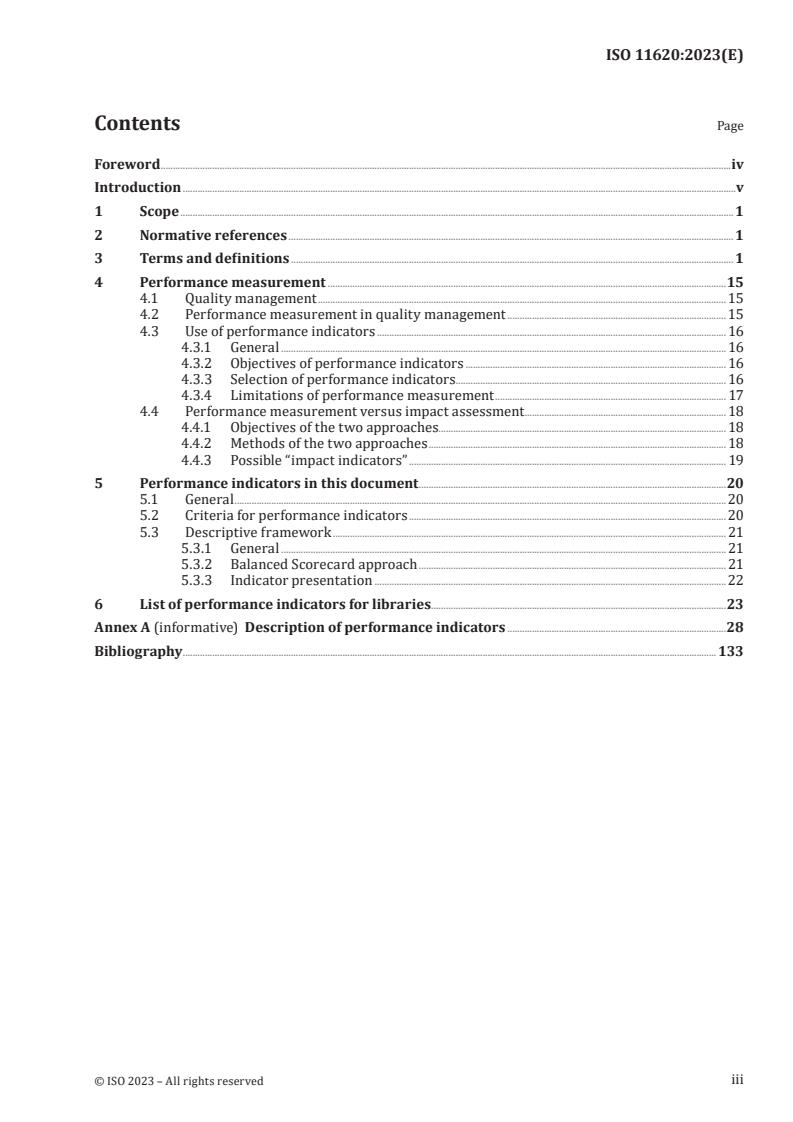
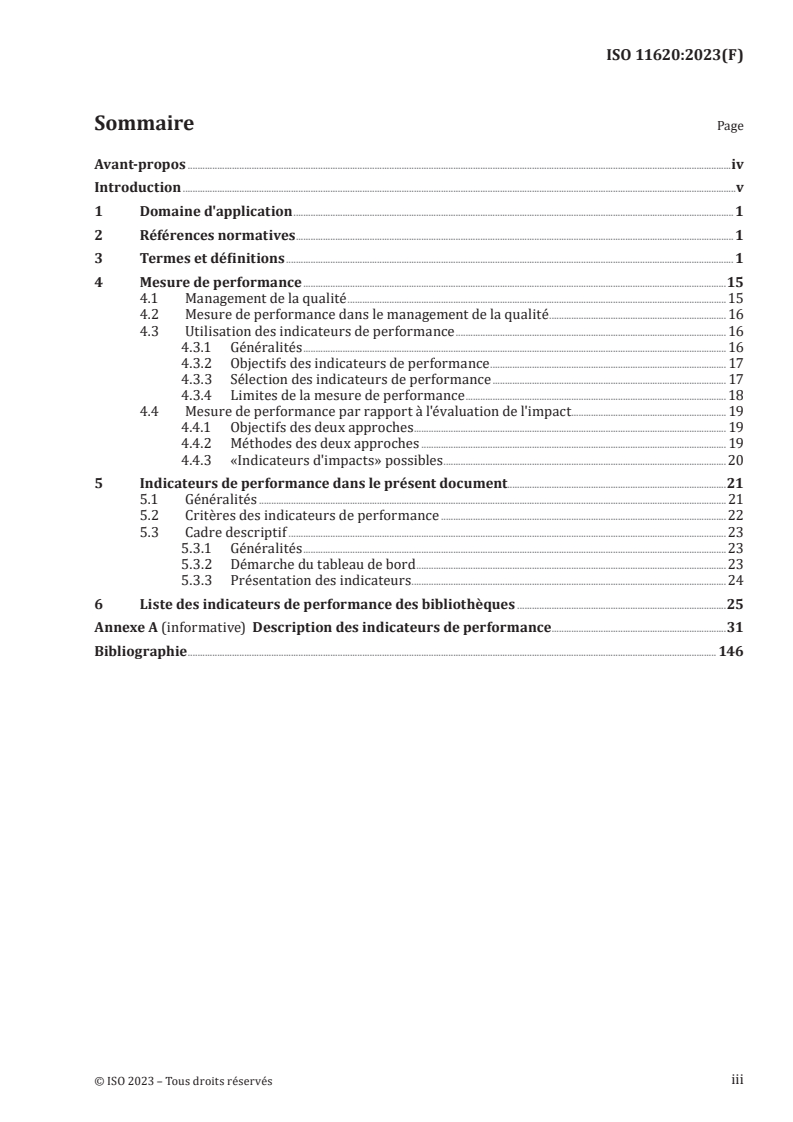
Contents Page
Foreword .iv
Introduction .v
1 Scope . 1
2 Normative references . 1
3 Terms and definitions . 1
4 Performance measurement .15
4.1 Quality management . 15
4.2 Performance measurement in quality management . 15
4.3 Use of performance indicators . 16
4.3.1 General . 16
4.3.2 Objectives of performance indicators . 16
4.3.3 Selection of performance indicators . . 16
4.3.4 Limitations of performance measurement . 17
4.4 Performance measurement versus impact assessment . 18
4.4.1 Objectives of the two approaches. 18
4.4.2 Methods of the two approaches . 18
4.4.3 Possible “impact indicators” . 19
5 Performance indicators in this document .20
5.1 General . 20
5.2 Criteria for performance indicators . 20
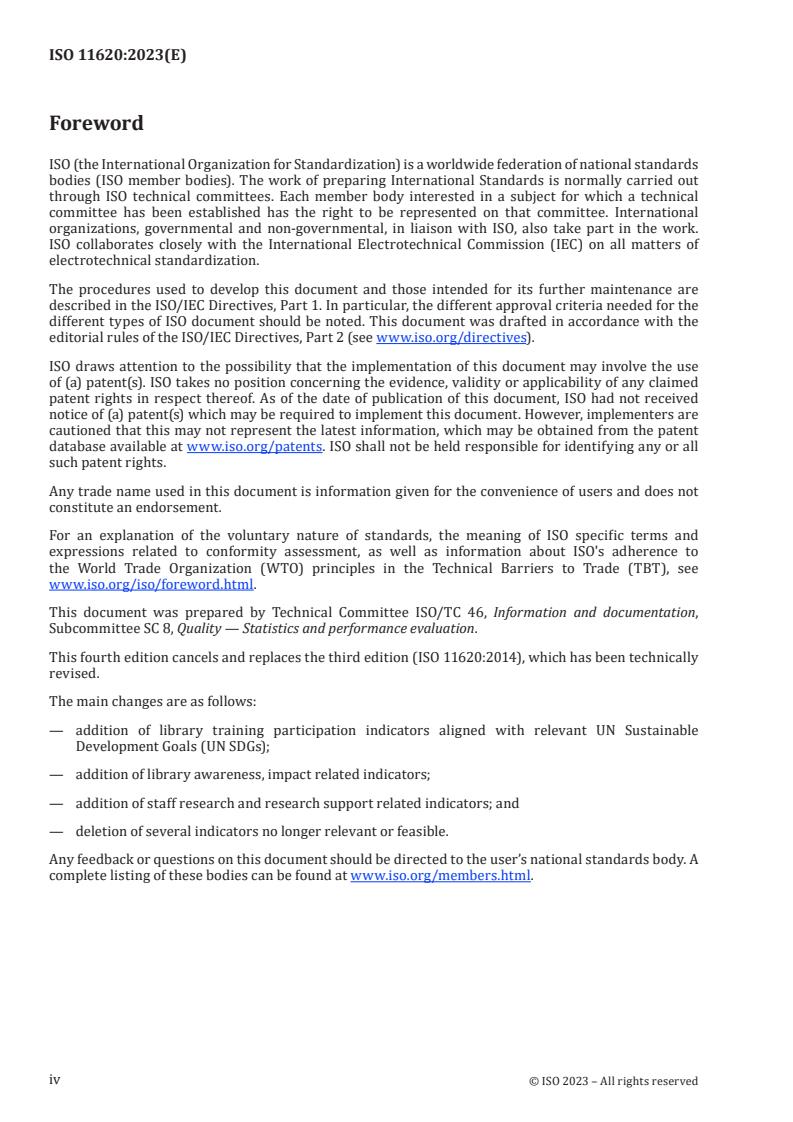
5.3 Descriptive framework . 21
5.3.1 General . 21
5.3.2 Balanced Scorecard approach . 21
5.3.3 Indicator presentation .22
6 List of performance indicators for libraries .23
Annex A (informative) Description of performance indicators .28
Bibliography . 133
iii
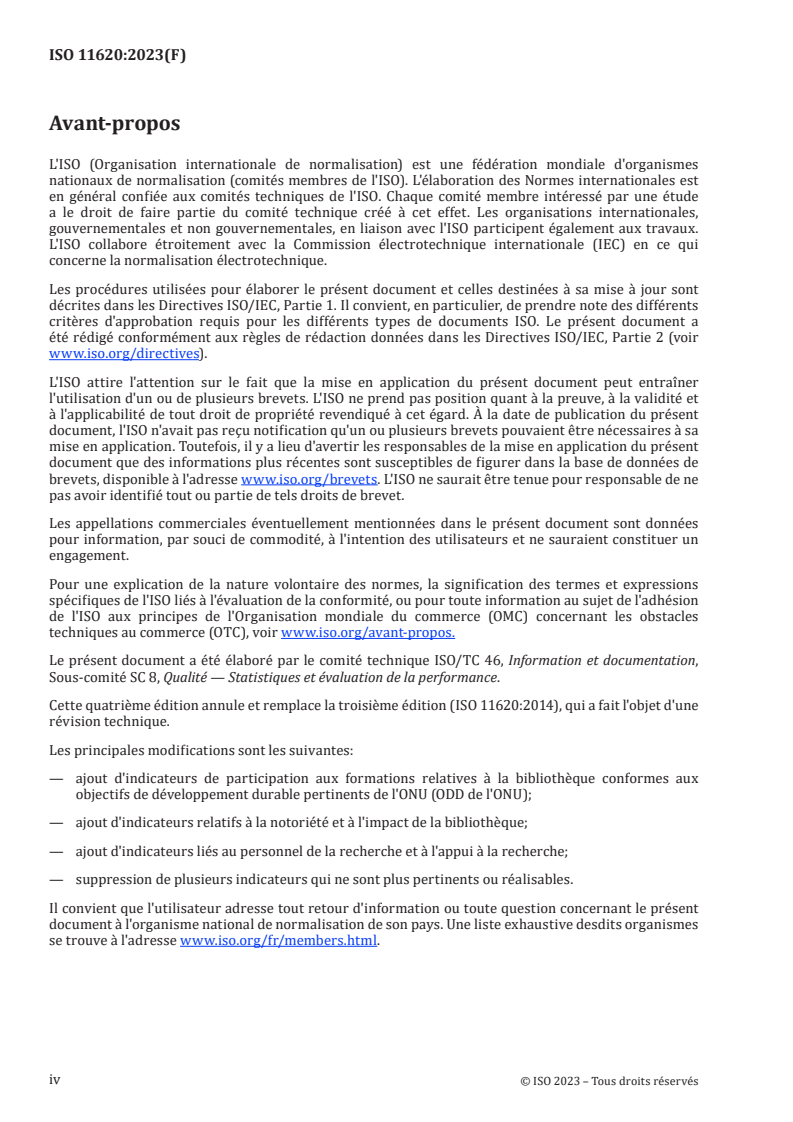
Foreword
ISO (the International Organization for Standardization) is a worldwide federation of national standards
bodies (ISO member bodies). The work of preparing International Standards is normally carried out
through ISO technical committees. Each member body interested in a subject for which a technical
committee has been established has the right to be represented on that committee. International
organizations, governmental and non-governmental, in liaison with ISO, also take part in the work.
ISO collaborates closely with the International Electrotechnical Commission (IEC) on all matters of
electrotechnical standardization.
The procedures used to develop this document and those intended for its further maintenance are
described in the ISO/IEC Directives, Part 1. In particular, the different approval criteria needed for the
different types of ISO document should be noted. This document was drafted in accordance with the
editorial rules of the ISO/IEC Directives, Part 2 (see www.iso.org/directives).
ISO draws attention to the possibility that the implementation of this document may involve the use
of (a) patent(s). ISO takes no position concerning the evidence, validity or applicability of any claimed
patent rights in respect thereof. As of the date of publication of this document, ISO had not received
notice of (a) patent(s) which may be required to implement this document. However, implementers are
cautioned that this may not represent the latest information, which may be obtained from the patent
database available at www.iso.org/patents. ISO shall not be held responsible for identifying any or all
such patent rights.
Any trade name used in this document is information given for the convenience of users and does not
constitute an endorsement.
For an explanation of the voluntary nature of standards, the meaning of ISO specific terms and
expressions related to conformity assessment, as well as information about ISO's adherence to
the World Trade Organization (WTO) principles in the Technical Barriers to Trade (TBT), see
www.iso.org/iso/foreword.html.
This document was prepared by Technical Committee ISO/TC 46, Information and documentation,
Subcommittee SC 8, Quality — Statistics and performance evaluation.
This fourth edition cancels and replaces the third edition (ISO 11620:2014), which has been technically
revised.
The main changes are as follows:
— addition of library training participation indicators aligned with relevant UN Sustainable
Development Goals (UN SDGs);
— addition of library awareness, impact related indicators;
— addition of staff research and research support related indicators; and
— deletion of several indicators no longer relevant or feasible.
Any feedback or questions on this document should be directed to the user’s national standards body. A
complete listing of these bodies can be found at www.iso.org/members.html.
iv
Introduction
This document is concerned with the evaluation of libraries of all types.
The main purpose of this document is to endorse the use of performance indicators regarding the
quality of library services in libraries and to spread knowledge about how to conduct performance
measurement.
Performance indicators can be used for comparison over time within the same library. Comparisons
between libraries can also be made, but only with caution. Comparisons between libraries will need
to consider any differences in the constituencies of the libraries and library attributes, with a good
understanding of the indicators used, limitations to comparisons, and careful interpretation of the data.
There are other limitations to the performance indicators in this document that depend on local factors,
such as the community the library serves, service mandates, and the technological and financial
infrastructure. Results from the use of performance indicators in this document are intended to be
interpreted with regard to these factors.
Performance indicators are not specified for all services, activities, and types of use of the library, either
because such indicators have not been proposed and tested at the time of formulation of this document,
or because they did not fulfil the criteria specified (see 5.2).
The performance indicators included in this document do not reflect all possible measures or evaluation
techniques. It offers accepted, tested, and publicly accessible (i.e. non-proprietary) methodologies and
approaches to measuring a range of library service performance.
The quality of library services is related to the broader topic of quality management and quality
assurance. This document acknowledges and supports the International Standards prepared by
ISO/TC 176.
Every indicator in this document is given a unique name. This name sometimes differs from the
literature upon which its description is based. Such differences are documented in the descriptions of
the indicators.
The performance indicators included in this document are either in widespread use, well documented
in the literature, or sufficiently field-tested. Additional indicators have been developed by the working
group in analogy to existing ones in order to cover as far as possible all library services and activities.
Library services will continue to develop and evolve, and such evolution will require monitoring as
related to the indicators in this document. The library and information community is encouraged
to establish mechanisms and to give high priority to developing relevant indicators for existing and
emerging library services and resources.
This document will be maintained by a working group that will monitor developments and incorporate
additional indicators as they are tested and validated.
v
INTERNATIONAL STANDARD ISO 11620:2023(E)
Information and documentation — Library performance
indicators
1 Scope
This document specifies the requirements of a performance indicator for libraries and establishes a
set of indicators to be used by libraries of all types. It also provides guidance on how to implement
performance indicators in libraries where such indicators are not already in use.
This document is applicable to all types of libraries in all countries. However, not all performance
indicators apply to all libraries. Limitations on the applicability of individual performance indicators
are listed in the scope clause of the description of each indicator (see Annex A).
This document provides a standardized terminology and concise definitions of the performance
indicators. Furthermore, it contains detailed descriptions of the indicators and of the collection and the
analysis of data needed.
This document is not intended to exclude the use of performance indicators not specified in it.
2 Normative references
There are no normative references in this document.
3 Terms and definitions
For the purposes of this document, the following terms and definitions apply.
ISO and IEC maintain terminology databases for use in standardization at the following addresses:
— ISO Online browsing platform: available at https:// www .iso .org/ obp
— IEC Electropedia: available at https:// www .electropedia .org/
3.1
access
successful request of a library-provided online service
[SOURCE: ISO 2789:2022, 3.2.1]
3.2
access
right, opportunity, means of finding, using or retrieving information, of using a service; or
entering a building
[SOURCE: ISO 15489-1:2016, 3.1, modified — “of using a service; or entering a building” has been added.]
3.3
accessibility
ease of reaching and using a service or facility
3.4
active borrower
registered user who has borrowed at least one item during the reporting period
Note 1 to entry: This count underrates the number of active users, but is still for many libraries the only
manageable measure.
[SOURCE: ISO 2789:2022, 3.2.3]
3.5
active user
registered user who has visited or made use of library facilities or services during the reporting period
Note 1 to entry: This includes active borrowers.
Note 2 to entry: This can include the use of digital library services, if it is possible, to identify digital use and
virtual visits of the individual user, or if data can be obtained by means of surveys.
Note 3 to entry: If a library identifies non-registered active users, e.g. by surveys, these should be counted
separately.
[SOURCE: ISO 2789:2022, 3.2.4]
3.6
appropriateness
suitability of any given indicator for evaluating a specific activity
3.7
availability
degree to which content, documents, facilities, or services are actually provided by the library at the
time required by users
3.8
capital expenditure
expenditure which results in the acquisition of, or addition to, fixed assets
Note 1 to entry: This includes expenditure on building sites, new buildings and extensions, furnishings and
equipment for new and expanded buildings, computer systems (hardware and software), etc. When applicable,
local and national sales/purchase taxes [e.g. Value Added Tax (VAT)] are included.
[SOURCE: ISO 2789:2022, 3.6.1]
3.9
closed stacks
stacks that are not accessible to users
[SOURCE: ISO/TR 11219:2012, 2.19, modified — Note 1 to entry has been deleted.]
3.10
conservation
preservation measures and actions applied to prevent, arrest or delay deterioration of a document or
other material object
[SOURCE: ISO 5127:2017, 3.12.1.01]
3.11
content unit
original or a digest of other published work
Note 1 to entry: This includes documents or parts of documents (e.g. articles, abstracts, content tables, images)
and descriptive records.
Note 2 to entry: PDF, Postscript, HTML and other formats of the same content unit will be counted as separate
items.
[SOURCE: ISO 2789:2022, 3.3.9]
3.12
database
collection of electronically stored descriptive records or content units (including facts, texts, pictures,
and sound) with a common user interface and software for the retrieval and manipulation of the data
Note 1 to entry: The units or records are usually collected with a particular intent and are related to a defined
topic. A database can be issued on CD-ROM, diskette, or other direct-access method, or as a computer file accessed
via dial-up methods or via the Internet.
Note 2 to entry: Licensed databases are counted separately even if access to several licensed database products
is affected through the same interface.
Note 3 to entry: A common interface providing access to a packet of serials or digital documents, usually offered
by a publisher or vendor, is also to be counted as database. Additionally, the single serials or digital documents
should be counted as serials or digital documents.
[SOURCE: ISO 2789:2022, 3.3.10]
3.13
descriptive record
computer-processed bibliographic or other individual record in a standard format that references and/
or describes a document in any physical form or a content unit
Note 1 to entry: A collection of descriptive records is usually published in the form of a database.
Note 2 to entry: The record can include elements such as title, author, subject, abstract, date of origin.
[SOURCE: ISO 2789:2022, 3.3.12]
3.14
digital collection
all resources in digital form in the library collection, whether born digital or digitized
Note 1 to entry: The digital collection includes databases, electronic serials, and digital documents.
Note 2 to entry: Free Internet resources which have been catalogued by the library in its online catalogue or a
database are counted separately.
Note 3 to entry: The resources can be networked, installed on stand-alone workstations or stored on physical
carriers.
[SOURCE: ISO 2789:2022, 3.3.13]
3.15
digital document
information unit with a defined content, born digital, or digitized, that has been created or digitized by
the library or acquired in digital form as part of the library collection
Note 1 to entry: This includes eBooks, electronic patents, networked audiovisual documents, and other digital
documents, e.g. reports, cartographic and music documents, preprints, etc. Databases and electronic serials are
excluded.
Note 2 to entry: Items incorporated in databases are covered by 3.12.
Note 3 to entry: A digital document can be structured into one or more files.
Note 4 to entry: A digital document consists of one or more content units. Before digitization, the library should
decide which content units should be searchable afterwards, e.g. articles in serials or songs on records.
[SOURCE: ISO 2789:2022, 3.3.14]
3.16
digital service
library service delivered digitally, whether from local servers or provided via networks
Note 1 to entry: Digital library services include the online catalogue, the library website, the digital collection,
electronic lending, electronic document delivery (mediated), digital reference service, digitally delivered user
training, services for mobile devices, services for interactive use (including services on social networks), and
Internet access offered via the library.
Note 2 to entry: This does not include booking physical services (e.g. rooms or library tours) digitally.
[SOURCE: ISO 2789:2022, 3.2.10]
3.17
digitization
process of converting analogue materials into digital form
Note 1 to entry: Digitization for document supply from the library collection to a user or institution is excluded.
Note 2 to entry: Digitization for preservation purposes is included.
Note 3 to entry: Mass digitization is included.
Note 4 to entry: Purchase of electronic copies for replacing print copies is excluded.
[SOURCE: ISO 2789:2022, 3.3.17]
3.18
document
recorded information or material object, which can be treated as a unit in a documentation process
Note 1 to entry: Documents can differ in form and characteristics.
[SOURCE: ISO 5127:2017, 3.1.1.38, modified — Notes to entry have been deleted and replaced.]
3.19
download
successful request of a content unit from a library-provided online service or other Internet service
[SOURCE: ISO 2789:2022, 3.2.12]
3.20
eBook
electronic book
non-serial digital document, licensed or not, where searchable text is prevalent, and which can be seen
in analogy to a print book (monograph)
Note 1 to entry: The use of eBooks is, in many cases, dependent on a dedicated device and/or a special reader or
viewing software.
Note 2 to entry: eBooks can be lent to users either on portable devices (eBook readers) or by transmitting the
contents to the user's PC or other device for a limited time period.
Note 3 to entry: Doctoral dissertations in electronic format are included.
Note 4 to entry: Documents digitized by the library are included.
[SOURCE: ISO 2789:2022, 3.3.22]
3.21
educational services
learning sessions and learning materials and programmes in all formats for children and adults for the
purpose of enhancing skills in library and information use
Note 1 to entry: This includes the provision of services for schools and the cooperation with other libraries in
preparing and offering educational services.
Note 2 to entry: Education of librarians is excluded.
[SOURCE: ISO 21248: 2019, 3.22]
3.22
effectiveness
measure of the degree to which given objectives are achieved
Note 1 to entry: An activity is effective if it maximizes the results it was established to produce.
3.23
efficiency
measure of the utilization of resources to realize a given objective
Note 1 to entry: An activity is efficient if it minimizes the use of resources or produces better performance with
the same resources.
3.24
electronic document delivery, mediated
electronic transmission of a document or part of a document from the library collection to a user,
mediated by library staff, not necessarily via another library
Note 1 to entry: Electronic transmission of documents to members of the population to be served is included. Fax
transmission is excluded.
Note 2 to entry: Can be split up as to transmission with or without charge to the user.
Note 3 to entry: Unmediated downloading by users from the electronic collection of the library is excluded.
[SOURCE: ISO 2789:2022, 3.2.14]
3.25
evaluation
process of estimating the effectiveness, efficiency, utility, and relevance of a service or facility
3.26
event
pre-arranged activity with cultural, educational, social, political, scholarly, or other intent
EXAMPLE Exhibitions, author visits, literary discussions, workshops
Note 1 to entry: Only events arranged by the library on its own or in partnership with other institutions are
included, whether inside or outside the library premises. Events inside the library premises organized by
institutions outside the library without the library’s cooperation are excluded.
Note 2 to entry: User training lessons and library tours are excluded.
Note 3 to entry: Ongoing programs are included. Each session of a program is counted as one event.
Note 4 to entry: Virtual events are included.
[SOURCE: ISO 2789:2022 3.2.16]
3.27
external user
user of a library who does not belong to that library’s population to be served
[SOURCE: ISO 2789:2022, 3.2.19]
3.28
facilities
equipment, study places, etc. provided for library users
Note 1 to entry: Includes photocopiers, online terminals, CD-ROM workstations, seats for reading, and study
carrels, but excludes toilets, cafes, and public telephones.
3.29
fixed level of proficiency
FLP
minimum benchmark of basic knowledge in a domain (literacy or numeracy) measured through
learning assessments
[SOURCE: UNESCO SGD indicator metadata – Indicator 4.4.1 (Harmonized metadata template - format
version 1.0)]
3.30
free Internet resource
internet resource with unrestricted (open) access for which no payment is required
[SOURCE: ISO 2789:2022, 3.3.26]
3.31
full-time equivalent
FTE
measurement equal to one staff person working a full-time work schedule for one year
Note 1 to entry: For example, if out of three persons employed as librarians, one works quarter-time, one works
half-time, and one works full-time, then the FTE of these three persons would be 0,25 + 0,5 + 1,0 = 1,75 librarians
(FTE).
Note 2 to entry: Not all libraries can use the same number of hours per year to determine an FTE. Thus, any
comparative measures between libraries might need to consider any differences in hours.
3.32
functional literacy
ability to understand, evaluate, use and engage with written texts to participate in society, to achieve
one’s goals, and to develop one’s knowledge and potential
[SOURCE: OECD, 2016]
3.33
functional numeracy
ability to access, use, interpret and communicate mathematical information and ideas, in order to
engage in and manage the mathematical demands of a range of situations in adult life
[SOURCE: OECD, 2016]
3.34
goal
desired state of affairs to be achieved by the implementation of agreed policies
3.35
impact
difference or change in an individual or group resulting from the contact with library services
Note 1 to entry: The change can be tangible or intangible.
[SOURCE: ISO 16439:2014, 3.25]
3.36
ICT
information and communication technology
diverse set of technological tools and resources used to transmit, store, create, share or exchange
information
Note 1 to entry: These technological tools and resources include computers, the Internet (websites, blogs and
emails), live broadcasting technologies (radio, television and webcasting), recorded broadcasting technologies
(podcasting, audio and video players and storage devices) and telephony (fixed or mobile, satellite, visio/video-
conferencing, etc.).
[SOURCE: UNESCO SGD indicator metadata – Glossary]
3.37
ICT proficiency
ability to perform an ICT related activity, which constitutes a learning target that can be assessed in the
context of a training lesson
[SOURCE: UNESCO SGD indicator metadata – Indicator 4.4.1 (Harmonized metadata template - format
version 1.0).]
3.38
ICT skills
skills that allow an effective use of ICT, independently of the device used, measured through the
accomplishment of ICT related activities.
[SOURCE: UNESCO SGD indicator metadata – Indicator 4.4.1 (Harmonized metadata template - format
version 1.0).]
3.39
indirect user
non-registered user who uses library services via a registered user
[SOURCE: ISO 2789:2022, 3.2.22]
3.40
indicator
expression (which can be numeric, symbolic, or verbal) used to characterize activities (events, objects,
persons) both in quantitative and qualitative terms in order to assess the value of the activities
characterized, and the associated method
3.41
in-house use
in-library use
use of documents on the premises having been taken by a user from open access stock
Note 1 to entry: In-house use includes browsing at the shelves in the sense of a short investigation of the contents
but excludes looking at the side or spine titles only for selecting material.
[SOURCE: ISO 2789:2022, 3.2.24]
3.42
institutional repository
open access repository for storing the publications of an institution, or a group of institutions, such as
e-prints, technical reports, theses and dissertations, datasets, and teaching and learning materials
[SOURCE: ISO 2789:2022, 3.3.29]
3.43
interlibrary loan
transaction of lending a document in its original physical form or delivery of a document, or part of it, in
copied form, from one library to another which is not under the same administration
Note 1 to entry: Mediated transmission of documents in electronic form is counted as electronic document
delivery.
[SOURCE: ISO 2789:2022, 3.2.25, modified — Note 2 to entry has been omitted]
3.44
library
organization, or part of an organization, the main aim of which is to facilitate the use of such information
resources, services and facilities as are required to meet the informational, research, educational,
cultural or recreational needs of its users
Note 1 to entry: The supply of the required information resources can be accomplished by building and
maintaining a collection and/or by organizing access to information resources.
Note 2 to entry: These are the basic requirements for a library and do not exclude any additional resources and
services incidental to its main purpose.
[SOURCE: ISO 2789:2022, 3.1.6]
3.45
library research
systematic study and analysis of some aspect of library and information science
Note 1 to entry: The results are usually published in a journal of library and information science or presented at
a library and information conference.
[SOURCE: ISO 2789:2022, 3.5.4]
3.46
library staff research publication
research publication by library staff in professional and academic subjects
Note 1 to entry: Includes publications in all formats, and presentations at conferences.
[SOURCE: ISO 2789:2022, 3.5.5]
3.47
library website
unique domain on the Internet consisting of a collection of web pages that is published by a library to
provide access to the library’s services and resources
Note 1 to entry: The pages of a website are usually interconnected by the use of hypertext links.
Note 2 to entry: Excludes documents that fit the definitions of electronic collection and free Internet resources
that can be linked from the library website.
Note 3 to entry: Excludes web services in the library’s domain that are operated on behalf of other organizations.
[SOURCE: ISO 2789:2022, 3.2.27]
3.48
loan
direct lending or delivery transaction of an item in non-electronic form (e.g. book), of a digital document
on a physical carrier (e.g. CD-ROM) or other device (e.g. eBook reader), or transmission of a digital
document to one user for a limited time period (e.g. eBook)
Note 1 to entry: Renewals are excluded but can be counted separately.
Note 2 to entry: Loans include registered loans within the library (on-site loans).
Note 3 to entry: Loans include copied documents supplied in place of original documents (including fax) and
printouts of electronic documents made by library staff for the user.
Note 4 to entry: Loans of documents in physical form to distance users are included.
Note 5 to entry: Mediated electronic transmission of documents is counted as electronic document delivery if
their use is permitted for unlimited time. This includes transmissions to members of the population to be served.
[SOURCE: ISO 2789:2022, 3.2.29, modified — Note 6 has been omitted.]
3.49
metadata
structured data about data
Note 1 to entry: The data are associated with either an information system or an information object for purposes
of description, administration, legal requirements, technical functionality, use and usage, and preservation.
Note 2 to entry: Adapted from Dublin Core Metadata Initiative, 2005.
3.50
mission
statement approved by the authorities formulating the organization's goals and its choices in services
and products development
3.51
mobile device
portable computing device, typically having a display screen with touch, pen and/or keyboard input
and Internet connection
[SOURCE: ISO 2789:2022, 3.2.32]
3.52
non-user
person belonging to a specific library’s population to be served but not using that library’s physical
and/or digital services
Note 1 to entry: The definition includes former users of the library.
[SOURCE: ISO 16439:2014, 3.39]
3.53
objective
specific target for an activity to be attained as a contribution to achieving the goal of an organization
3.54
opening hours
hours in a normal week when the main physical services of the library (e.g. reference and loan services,
reading rooms) are available to users
[SOURCE: ISO 2789:2022, 3.4.8]
3.55
operating expenditure
ordinary expenditure
recurrent expenditure
expenditure incurred in the running of a library
Note 1 to entry: This is money spent on staff and on resources that are used and replaced regularly. This
includes expenditure on employees, rent, acquisitions and licensing, binding, computer network (operations
and maintenance), telecommunication, building, maintenance, utilities (electricity, water, sewage, heating, etc.),
repair or replacement of existing furnishings and equipment, and events, etc. This can also be termed “current”
or “recurrent” expenditure. When applicable, local and national sales/purchase taxes [e.g. Value Added Tax
(VAT)] are included.
[SOURCE: ISO 2789:2022, 3.6.4]
3.56
partnership
ongoing, formalized cooperation between a library and one or more other organizations, including
other libraries, usually concerning particular services or activities
Note 1 to entry: A partnership will usually have a contractual basis. Partners can make different contributions,
e.g. expertise, funding, training, materials in kind, premises, etc.
Note 2 to entry: Cooperation between two or more libraries within a single administrative unit is excluded.
Note 3 to entry: Time-limited cooperation on a specified project is excluded and counted as a cooperative project
(see 3.61).
Note 4 to entry: A one-way relationship, whether paid or unpaid, where one partner is only supplying, the other
only receiving services, is excluded.
[SOURCE: ISO 2789:2022, 3.5.6]
3.57
performance
effectiveness of the provision of services by the library and the efficiency of the allocation and use of
resources in providing services
3.58
performance indicator
numerical, symbolic, or verbal expression derived from library statistics and data used to characterize
the performance of a library
3.59
population to be served
number of individuals for whom the library is set up to provide its services and materials
Note 1 to entry: For public libraries, this will normally be the population of the legal service area (authority). For
libraries of an institution of higher education, this will normally be the total of academic and professional staff
plus students.
3.60
preservation
all measures taken, including financial and strategic decisions, to maintain the integrity and extend the
life of documents or collections
[SOURCE: ISO 5127:2017, 3.2.1.39, modified — Notes 1 and 2 to entry have been omitted.]
3.61
project
unique process, consisting of a set of coordinated and controlled activities with start and finish dates,
undertaken to achieve an objective conforming to specific requirements, including the constraints of
time, cost, and resources
[SOURCE: ISO 9000:2015, 3.4.2]
Note 1 to entry: An individual project can form part of a larger project structure.
3.62
quality
entirety of features and characteristics of a product or service that bear on its ability to satisfy stated
or implied needs
Note 1 to entry: The quality of products and services includes not only their intended function and performance,
but also their perceived value and benefit to the customer. See ISO 9000:2015, 2.2.1.
[SOURCE: ISO 10845-1:2020, 3.27, modified — Note to entry has been added.]
3.63
rare materials
incunabula, manuscripts, books published before 1800, and newer books that are made precious by
their limited issue, by their binding, by dedications, and similar characteristics.
Note 1 to entry: Usually, such materials belong to special collections with special shelf marks and are shelved
separately in a secure location to which access is restricted.
Note 2 to entry: This excludes archives and records concerning private persons, institutions, and organizations
(collections containing manuscripts, letters, notes, photos, and other material given by bequest to the library or
purchased as such by, or on behalf of, the library).
[SOURCE: ISO 21248:2019, 3.75]
3.64
reference question
information contact that involves the knowledge or use of one or more information sources (such
as printed and non-printed materials, machine-readable databases, the library's own and other
institutions' catalogues) by library staff
Note 1 to entry: This can also involve recommendations, interpretation or instruction in the use of such sources.
Note 2 to entry: One reference question can address several issues.
Note 3 to entry: The question can be delivered personally or by means of telephone, regular mail, fax, or electronic
media (via email, the library website, or other networked communications mechanisms).
Note 4 to entry: It is essential that libraries do not include informational (directional and administrative)
questions, e.g. for locating staff or facilities, regarding opening times, or about handling equipment, such as
printers or computer terminals.
[SOURCE: ISO 2789:2022, 3.2.43]
3.65
reference service
provision of oral or written information and assistance, in response to requests, by the staff of an
information and documentation organization
[SOURCE: ISO 5127:2017, 3.11.5.03]
3.66
registered user
person or organization registered with a library in order to use its collection and/or services within or
away from the library
Note 1 to entry: Users can be registered upon their request or automatically when enrolling in the institution.
Note 2 to entry: The registration should be monitored at regular intervals, minimum of every three years, so that
inactive users can be removed from the register.
[SOURCE: ISO 2789:2022, 3.2.46]
3.67
rejected access
turnaway
unsuccessful request of an online service via the library
Note 1 to entry: The failure can be due to the library having no license for the service or to the request exceeding
the simultaneous user limit.
Note 2 to entry: Request failure because of wrong passwords is excluded
[SOURCE: ISO 2789:2022, 3.2.47]
3.68
reliability
degree to which a measure repeatedly and consistently produces the same result
3.69
renewal
extension of the loan period for a document usually initiated by the user
Note 1 to entry: Automatic renewals generated by the library system without user interaction are included.
[SOURCE: ISO 2789:2022, 3.2.48]
3.70
research support
library service that allows a researcher to spend more time, more efficiently in his/her role as a
researcher, and contributes positively to the quality of the research
Note 1 to entry: Generally, research support services are offered to academics at universities in order to support
their role as researcher.
3.71
restoration
actions taken to return a document or other material object which has suffered deterioration or damage
as closely as practicable to its original state
Note 1 to entry: In archival restoration, no attempt is made to recreate missing text, etc., and all restoration work
is kept clearly evident.
[SOURCE: ISO 5127:2017, 3.12.1.02, modified — The term “preservation” has been excluded in the
definition, and Note 2 to entry has been omitted.]
3.72
special collection
collection of materials segregated from a library collection according to form, subject, genre, period,
geographical area, condition, rarity, source, or value
Note 1 to entry: Special collections are usually administered separately.
Note 2 to entry: Access to special collections can be restricted.
[SOURCE: ISO 21248:2019, 3.83]
3.73
special grant
grant of a non-recurrent nature to fund (or partly fund) projects
[SOURCE: ISO 2789:2022, 3.6.6]
3.74
stable condition
suitability for use
Note 1 to entry: Stable material can have some damage but can be used without immediate risk of
further damage. Unstable material will be further damaged if used.
[SOURCE: ISO 21248:2019, 3.85]
3.75
staff training
formal pre-planned training in professional skills and competences, including social skills
Note 1 to entry: The training can be held in-house or externally, and delivered by library staff or external experts.
Note 2 to entry: Web-based training services are included.
Note 3 to entry: Informal training, e.g. point-of-use training, is exclude
[SOURCE: ISO 2789:2022, 3.7.6]
3.76
target population
groups of actual and potential users appropriate to an individual library as the object of a specific
service or as the primary users of specific materials
3.77
title
words or symbols at the head of a document that identify it and normally distinguish-it from other
documents
[SOURCE: ISO 5127:2017, 3.7.4.01, modified — Note 1 has been omitted]
Note 1 to entry: For measuring purposes, "title" describes a document, which forms a separate item with a
distinctive title, whether issued in one or several physical units, and disregarding the number of copies of the
document held by the library.
Note 2 to entry: This applies equally to print, digital, audiovisual and other library materials.
Note 3 to entry: A book or serial title can be distinguished from other such titles by its unique International
Standard Book Number (ISBN) or International Standard Serial Number (ISSN).
[SOURCE: ISO 2789:2022, 3.3.58]
3.78
unstaffed opening hours
hours when a library, or a specified library area, is open to controlled access, without staff present but
with facilities for self-service
Note 1 to entry: Access can be restricted to a specified part of the population to be served, e.g. researchers and
postgraduate students.
[SOURCE: ISO 2789:2022, 3.4.10]
3.79
user
DEPRECATED: patron
DEPRECATED: customer
recipient of library services
Note 1 to entry: The recipient can be a person or an institution, including libraries.
Note 2 to entry: Library services include digital services, physical services, and visiting the library premises.
3.80
user place
place provided for users for reading or studying, whether with or without seating or equipment
Note 1 to entry: Includes places in carrels, in seminar and study rooms, and in the audiovisual and children's
departments of the library, and informal seating in lounges, group areas, etc.
Note 2 to entry: Excludes places in halls and lecture auditory theatres intended for audiences of special events.
Also excludes floor space and cushions on which users can sit.
[SOURCE: ISO 2789:2022, 3.4.12]
3.81
user service area
part of the library that is accessible to users
Note 1 to entry: This includes space for reading and studying (individual or group), lending, reference and
information, and any other services delivered to users, self-service areas (lending and returning plus sorting
robots), also areas for recreation and communication, sickrooms, the entrance hall, and open access storage
areas as integrated parts of user service areas; media centres, workplaces for st
...
INTERNATIONAL ISO
STANDARD 11620
Fourth edition
2023-06
Information and documentation —
Library performance indicators
Information et documentation — Indicateurs de performance des
bibliothèques
Reference number
© ISO 2023
All rights reserved. Unless otherwise specified, or required in the context of its implementation, no part of this publication may
be reproduced or utilized otherwise in any form or by any means, electronic or mechanical, including photocopying, or posting on
the internet or an intranet, without prior written permission. Permission can be requested from either ISO at the address below
or ISO’s member body in the country of the requester.
ISO copyright office
CP 401 • Ch. de Blandonnet 8
CH-1214 Vernier, Geneva
Phone: +41 22 749 01 11
Email: copyright@iso.org
Website: www.iso.org
Published in Switzerland
ii
Contents Page
Foreword .iv
Introduction .v
1 Scope . 1
2 Normative references . 1
3 Terms and definitions . 1
4 Performance measurement .15
4.1 Quality management . 15
4.2 Performance measurement in quality management . 15
4.3 Use of performance indicators . 16
4.3.1 General . 16
4.3.2 Objectives of performance indicators . 16
4.3.3 Selection of performance indicators . . 16
4.3.4 Limitations of performance measurement . 17
4.4 Performance measurement versus impact assessment . 18
4.4.1 Objectives of the two approaches. 18
4.4.2 Methods of the two approaches . 18
4.4.3 Possible “impact indicators” . 19
5 Performance indicators in this document .20
5.1 General . 20
5.2 Criteria for performance indicators . 20
5.3 Descriptive framework . 21
5.3.1 General . 21
5.3.2 Balanced Scorecard approach . 21
5.3.3 Indicator presentation .22
6 List of performance indicators for libraries .23
Annex A (informative) Description of performance indicators .28
Bibliography . 133
iii
Foreword
ISO (the International Organization for Standardization) is a worldwide federation of national standards
bodies (ISO member bodies). The work of preparing International Standards is normally carried out
through ISO technical committees. Each member body interested in a subject for which a technical
committee has been established has the right to be represented on that committee. International
organizations, governmental and non-governmental, in liaison with ISO, also take part in the work.
ISO collaborates closely with the International Electrotechnical Commission (IEC) on all matters of
electrotechnical standardization.
The procedures used to develop this document and those intended for its further maintenance are
described in the ISO/IEC Directives, Part 1. In particular, the different approval criteria needed for the
different types of ISO document should be noted. This document was drafted in accordance with the
editorial rules of the ISO/IEC Directives, Part 2 (see www.iso.org/directives).
ISO draws attention to the possibility that the implementation of this document may involve the use
of (a) patent(s). ISO takes no position concerning the evidence, validity or applicability of any claimed
patent rights in respect thereof. As of the date of publication of this document, ISO had not received
notice of (a) patent(s) which may be required to implement this document. However, implementers are
cautioned that this may not represent the latest information, which may be obtained from the patent
database available at www.iso.org/patents. ISO shall not be held responsible for identifying any or all
such patent rights.
Any trade name used in this document is information given for the convenience of users and does not
constitute an endorsement.
For an explanation of the voluntary nature of standards, the meaning of ISO specific terms and
expressions related to conformity assessment, as well as information about ISO's adherence to
the World Trade Organization (WTO) principles in the Technical Barriers to Trade (TBT), see
www.iso.org/iso/foreword.html.
This document was prepared by Technical Committee ISO/TC 46, Information and documentation,
Subcommittee SC 8, Quality — Statistics and performance evaluation.
This fourth edition cancels and replaces the third edition (ISO 11620:2014), which has been technically
revised.
The main changes are as follows:
— addition of library training participation indicators aligned with relevant UN Sustainable
Development Goals (UN SDGs);
— addition of library awareness, impact related indicators;
— addition of staff research and research support related indicators; and
— deletion of several indicators no longer relevant or feasible.
Any feedback or questions on this document should be directed to the user’s national standards body. A
complete listing of these bodies can be found at www.iso.org/members.html.
iv
Introduction
This document is concerned with the evaluation of libraries of all types.
The main purpose of this document is to endorse the use of performance indicators regarding the
quality of library services in libraries and to spread knowledge about how to conduct performance
measurement.
Performance indicators can be used for comparison over time within the same library. Comparisons
between libraries can also be made, but only with caution. Comparisons between libraries will need
to consider any differences in the constituencies of the libraries and library attributes, with a good
understanding of the indicators used, limitations to comparisons, and careful interpretation of the data.
There are other limitations to the performance indicators in this document that depend on local factors,
such as the community the library serves, service mandates, and the technological and financial
infrastructure. Results from the use of performance indicators in this document are intended to be
interpreted with regard to these factors.
Performance indicators are not specified for all services, activities, and types of use of the library, either
because such indicators have not been proposed and tested at the time of formulation of this document,
or because they did not fulfil the criteria specified (see 5.2).
The performance indicators included in this document do not reflect all possible measures or evaluation
techniques. It offers accepted, tested, and publicly accessible (i.e. non-proprietary) methodologies and
approaches to measuring a range of library service performance.
The quality of library services is related to the broader topic of quality management and quality
assurance. This document acknowledges and supports the International Standards prepared by
ISO/TC 176.
Every indicator in this document is given a unique name. This name sometimes differs from the
literature upon which its description is based. Such differences are documented in the descriptions of
the indicators.
The performance indicators included in this document are either in widespread use, well documented
in the literature, or sufficiently field-tested. Additional indicators have been developed by the working
group in analogy to existing ones in order to cover as far as possible all library services and activities.
Library services will continue to develop and evolve, and such evolution will require monitoring as
related to the indicators in this document. The library and information community is encouraged
to establish mechanisms and to give high priority to developing relevant indicators for existing and
emerging library services and resources.
This document will be maintained by a working group that will monitor developments and incorporate
additional indicators as they are tested and validated.
v
INTERNATIONAL STANDARD ISO 11620:2023(E)
Information and documentation — Library performance
indicators
1 Scope
This document specifies the requirements of a performance indicator for libraries and establishes a
set of indicators to be used by libraries of all types. It also provides guidance on how to implement
performance indicators in libraries where such indicators are not already in use.
This document is applicable to all types of libraries in all countries. However, not all performance
indicators apply to all libraries. Limitations on the applicability of individual performance indicators
are listed in the scope clause of the description of each indicator (see Annex A).
This document provides a standardized terminology and concise definitions of the performance
indicators. Furthermore, it contains detailed descriptions of the indicators and of the collection and the
analysis of data needed.
This document is not intended to exclude the use of performance indicators not specified in it.
2 Normative references
There are no normative references in this document.
3 Terms and definitions
For the purposes of this document, the following terms and definitions apply.
ISO and IEC maintain terminology databases for use in standardization at the following addresses:
— ISO Online browsing platform: available at https:// www .iso .org/ obp
— IEC Electropedia: available at https:// www .electropedia .org/
3.1
access
successful request of a library-provided online service
[SOURCE: ISO 2789:2022, 3.2.1]
3.2
access
right, opportunity, means of finding, using or retrieving information, of using a service; or
entering a building
[SOURCE: ISO 15489-1:2016, 3.1, modified — “of using a service; or entering a building” has been added.]
3.3
accessibility
ease of reaching and using a service or facility
3.4
active borrower
registered user who has borrowed at least one item during the reporting period
Note 1 to entry: This count underrates the number of active users, but is still for many libraries the only
manageable measure.
[SOURCE: ISO 2789:2022, 3.2.3]
3.5
active user
registered user who has visited or made use of library facilities or services during the reporting period
Note 1 to entry: This includes active borrowers.
Note 2 to entry: This can include the use of digital library services, if it is possible, to identify digital use and
virtual visits of the individual user, or if data can be obtained by means of surveys.
Note 3 to entry: If a library identifies non-registered active users, e.g. by surveys, these should be counted
separately.
[SOURCE: ISO 2789:2022, 3.2.4]
3.6
appropriateness
suitability of any given indicator for evaluating a specific activity
3.7
availability
degree to which content, documents, facilities, or services are actually provided by the library at the
time required by users
3.8
capital expenditure
expenditure which results in the acquisition of, or addition to, fixed assets
Note 1 to entry: This includes expenditure on building sites, new buildings and extensions, furnishings and
equipment for new and expanded buildings, computer systems (hardware and software), etc. When applicable,
local and national sales/purchase taxes [e.g. Value Added Tax (VAT)] are included.
[SOURCE: ISO 2789:2022, 3.6.1]
3.9
closed stacks
stacks that are not accessible to users
[SOURCE: ISO/TR 11219:2012, 2.19, modified — Note 1 to entry has been deleted.]
3.10
conservation
preservation measures and actions applied to prevent, arrest or delay deterioration of a document or
other material object
[SOURCE: ISO 5127:2017, 3.12.1.01]
3.11
content unit
original or a digest of other published work
Note 1 to entry: This includes documents or parts of documents (e.g. articles, abstracts, content tables, images)
and descriptive records.
Note 2 to entry: PDF, Postscript, HTML and other formats of the same content unit will be counted as separate
items.
[SOURCE: ISO 2789:2022, 3.3.9]
3.12
database
collection of electronically stored descriptive records or content units (including facts, texts, pictures,
and sound) with a common user interface and software for the retrieval and manipulation of the data
Note 1 to entry: The units or records are usually collected with a particular intent and are related to a defined
topic. A database can be issued on CD-ROM, diskette, or other direct-access method, or as a computer file accessed
via dial-up methods or via the Internet.
Note 2 to entry: Licensed databases are counted separately even if access to several licensed database products
is affected through the same interface.
Note 3 to entry: A common interface providing access to a packet of serials or digital documents, usually offered
by a publisher or vendor, is also to be counted as database. Additionally, the single serials or digital documents
should be counted as serials or digital documents.
[SOURCE: ISO 2789:2022, 3.3.10]
3.13
descriptive record
computer-processed bibliographic or other individual record in a standard format that references and/
or describes a document in any physical form or a content unit
Note 1 to entry: A collection of descriptive records is usually published in the form of a database.
Note 2 to entry: The record can include elements such as title, author, subject, abstract, date of origin.
[SOURCE: ISO 2789:2022, 3.3.12]
3.14
digital collection
all resources in digital form in the library collection, whether born digital or digitized
Note 1 to entry: The digital collection includes databases, electronic serials, and digital documents.
Note 2 to entry: Free Internet resources which have been catalogued by the library in its online catalogue or a
database are counted separately.
Note 3 to entry: The resources can be networked, installed on stand-alone workstations or stored on physical
carriers.
[SOURCE: ISO 2789:2022, 3.3.13]
3.15
digital document
information unit with a defined content, born digital, or digitized, that has been created or digitized by
the library or acquired in digital form as part of the library collection
Note 1 to entry: This includes eBooks, electronic patents, networked audiovisual documents, and other digital
documents, e.g. reports, cartographic and music documents, preprints, etc. Databases and electronic serials are
excluded.
Note 2 to entry: Items incorporated in databases are covered by 3.12.
Note 3 to entry: A digital document can be structured into one or more files.
Note 4 to entry: A digital document consists of one or more content units. Before digitization, the library should
decide which content units should be searchable afterwards, e.g. articles in serials or songs on records.
[SOURCE: ISO 2789:2022, 3.3.14]
3.16
digital service
library service delivered digitally, whether from local servers or provided via networks
Note 1 to entry: Digital library services include the online catalogue, the library website, the digital collection,
electronic lending, electronic document delivery (mediated), digital reference service, digitally delivered user
training, services for mobile devices, services for interactive use (including services on social networks), and
Internet access offered via the library.
Note 2 to entry: This does not include booking physical services (e.g. rooms or library tours) digitally.
[SOURCE: ISO 2789:2022, 3.2.10]
3.17
digitization
process of converting analogue materials into digital form
Note 1 to entry: Digitization for document supply from the library collection to a user or institution is excluded.
Note 2 to entry: Digitization for preservation purposes is included.
Note 3 to entry: Mass digitization is included.
Note 4 to entry: Purchase of electronic copies for replacing print copies is excluded.
[SOURCE: ISO 2789:2022, 3.3.17]
3.18
document
recorded information or material object, which can be treated as a unit in a documentation process
Note 1 to entry: Documents can differ in form and characteristics.
[SOURCE: ISO 5127:2017, 3.1.1.38, modified — Notes to entry have been deleted and replaced.]
3.19
download
successful request of a content unit from a library-provided online service or other Internet service
[SOURCE: ISO 2789:2022, 3.2.12]
3.20
eBook
electronic book
non-serial digital document, licensed or not, where searchable text is prevalent, and which can be seen
in analogy to a print book (monograph)
Note 1 to entry: The use of eBooks is, in many cases, dependent on a dedicated device and/or a special reader or
viewing software.
Note 2 to entry: eBooks can be lent to users either on portable devices (eBook readers) or by transmitting the
contents to the user's PC or other device for a limited time period.
Note 3 to entry: Doctoral dissertations in electronic format are included.
Note 4 to entry: Documents digitized by the library are included.
[SOURCE: ISO 2789:2022, 3.3.22]
3.21
educational services
learning sessions and learning materials and programmes in all formats for children and adults for the
purpose of enhancing skills in library and information use
Note 1 to entry: This includes the provision of services for schools and the cooperation with other libraries in
preparing and offering educational services.
Note 2 to entry: Education of librarians is excluded.
[SOURCE: ISO 21248: 2019, 3.22]
3.22
effectiveness
measure of the degree to which given objectives are achieved
Note 1 to entry: An activity is effective if it maximizes the results it was established to produce.
3.23
efficiency
measure of the utilization of resources to realize a given objective
Note 1 to entry: An activity is efficient if it minimizes the use of resources or produces better performance with
the same resources.
3.24
electronic document delivery, mediated
electronic transmission of a document or part of a document from the library collection to a user,
mediated by library staff, not necessarily via another library
Note 1 to entry: Electronic transmission of documents to members of the population to be served is included. Fax
transmission is excluded.
Note 2 to entry: Can be split up as to transmission with or without charge to the user.
Note 3 to entry: Unmediated downloading by users from the electronic collection of the library is excluded.
[SOURCE: ISO 2789:2022, 3.2.14]
3.25
evaluation
process of estimating the effectiveness, efficiency, utility, and relevance of a service or facility
3.26
event
pre-arranged activity with cultural, educational, social, political, scholarly, or other intent
EXAMPLE Exhibitions, author visits, literary discussions, workshops
Note 1 to entry: Only events arranged by the library on its own or in partnership with other institutions are
included, whether inside or outside the library premises. Events inside the library premises organized by
institutions outside the library without the library’s cooperation are excluded.
Note 2 to entry: User training lessons and library tours are excluded.
Note 3 to entry: Ongoing programs are included. Each session of a program is counted as one event.
Note 4 to entry: Virtual events are included.
[SOURCE: ISO 2789:2022 3.2.16]
3.27
external user
user of a library who does not belong to that library’s population to be served
[SOURCE: ISO 2789:2022, 3.2.19]
3.28
facilities
equipment, study places, etc. provided for library users
Note 1 to entry: Includes photocopiers, online terminals, CD-ROM workstations, seats for reading, and study
carrels, but excludes toilets, cafes, and public telephones.
3.29
fixed level of proficiency
FLP
minimum benchmark of basic knowledge in a domain (literacy or numeracy) measured through
learning assessments
[SOURCE: UNESCO SGD indicator metadata – Indicator 4.4.1 (Harmonized metadata template - format
version 1.0)]
3.30
free Internet resource
internet resource with unrestricted (open) access for which no payment is required
[SOURCE: ISO 2789:2022, 3.3.26]
3.31
full-time equivalent
FTE
measurement equal to one staff person working a full-time work schedule for one year
Note 1 to entry: For example, if out of three persons employed as librarians, one works quarter-time, one works
half-time, and one works full-time, then the FTE of these three persons would be 0,25 + 0,5 + 1,0 = 1,75 librarians
(FTE).
Note 2 to entry: Not all libraries can use the same number of hours per year to determine an FTE. Thus, any
comparative measures between libraries might need to consider any differences in hours.
3.32
functional literacy
ability to understand, evaluate, use and engage with written texts to participate in society, to achieve
one’s goals, and to develop one’s knowledge and potential
[SOURCE: OECD, 2016]
3.33
functional numeracy
ability to access, use, interpret and communicate mathematical information and ideas, in order to
engage in and manage the mathematical demands of a range of situations in adult life
[SOURCE: OECD, 2016]
3.34
goal
desired state of affairs to be achieved by the implementation of agreed policies
3.35
impact
difference or change in an individual or group resulting from the contact with library services
Note 1 to entry: The change can be tangible or intangible.
[SOURCE: ISO 16439:2014, 3.25]
3.36
ICT
information and communication technology
diverse set of technological tools and resources used to transmit, store, create, share or exchange
information
Note 1 to entry: These technological tools and resources include computers, the Internet (websites, blogs and
emails), live broadcasting technologies (radio, television and webcasting), recorded broadcasting technologies
(podcasting, audio and video players and storage devices) and telephony (fixed or mobile, satellite, visio/video-
conferencing, etc.).
[SOURCE: UNESCO SGD indicator metadata – Glossary]
3.37
ICT proficiency
ability to perform an ICT related activity, which constitutes a learning target that can be assessed in the
context of a training lesson
[SOURCE: UNESCO SGD indicator metadata – Indicator 4.4.1 (Harmonized metadata template - format
version 1.0).]
3.38
ICT skills
skills that allow an effective use of ICT, independently of the device used, measured through the
accomplishment of ICT related activities.
[SOURCE: UNESCO SGD indicator metadata – Indicator 4.4.1 (Harmonized metadata template - format
version 1.0).]
3.39
indirect user
non-registered user who uses library services via a registered user
[SOURCE: ISO 2789:2022, 3.2.22]
3.40
indicator
expression (which can be numeric, symbolic, or verbal) used to characterize activities (events, objects,
persons) both in quantitative and qualitative terms in order to assess the value of the activities
characterized, and the associated method
3.41
in-house use
in-library use
use of documents on the premises having been taken by a user from open access stock
Note 1 to entry: In-house use includes browsing at the shelves in the sense of a short investigation of the contents
but excludes looking at the side or spine titles only for selecting material.
[SOURCE: ISO 2789:2022, 3.2.24]
3.42
institutional repository
open access repository for storing the publications of an institution, or a group of institutions, such as
e-prints, technical reports, theses and dissertations, datasets, and teaching and learning materials
[SOURCE: ISO 2789:2022, 3.3.29]
3.43
interlibrary loan
transaction of lending a document in its original physical form or delivery of a document, or part of it, in
copied form, from one library to another which is not under the same administration
Note 1 to entry: Mediated transmission of documents in electronic form is counted as electronic document
delivery.
[SOURCE: ISO 2789:2022, 3.2.25, modified — Note 2 to entry has been omitted]
3.44
library
organization, or part of an organization, the main aim of which is to facilitate the use of such information
resources, services and facilities as are required to meet the informational, research, educational,
cultural or recreational needs of its users
Note 1 to entry: The supply of the required information resources can be accomplished by building and
maintaining a collection and/or by organizing access to information resources.
Note 2 to entry: These are the basic requirements for a library and do not exclude any additional resources and
services incidental to its main purpose.
[SOURCE: ISO 2789:2022, 3.1.6]
3.45
library research
systematic study and analysis of some aspect of library and information science
Note 1 to entry: The results are usually published in a journal of library and information science or presented at
a library and information conference.
[SOURCE: ISO 2789:2022, 3.5.4]
3.46
library staff research publication
research publication by library staff in professional and academic subjects
Note 1 to entry: Includes publications in all formats, and presentations at conferences.
[SOURCE: ISO 2789:2022, 3.5.5]
3.47
library website
unique domain on the Internet consisting of a collection of web pages that is published by a library to
provide access to the library’s services and resources
Note 1 to entry: The pages of a website are usually interconnected by the use of hypertext links.
Note 2 to entry: Excludes documents that fit the definitions of electronic collection and free Internet resources
that can be linked from the library website.
Note 3 to entry: Excludes web services in the library’s domain that are operated on behalf of other organizations.
[SOURCE: ISO 2789:2022, 3.2.27]
3.48
loan
direct lending or delivery transaction of an item in non-electronic form (e.g. book), of a digital document
on a physical carrier (e.g. CD-ROM) or other device (e.g. eBook reader), or transmission of a digital
document to one user for a limited time period (e.g. eBook)
Note 1 to entry: Renewals are excluded but can be counted separately.
Note 2 to entry: Loans include registered loans within the library (on-site loans).
Note 3 to entry: Loans include copied documents supplied in place of original documents (including fax) and
printouts of electronic documents made by library staff for the user.
Note 4 to entry: Loans of documents in physical form to distance users are included.
Note 5 to entry: Mediated electronic transmission of documents is counted as electronic document delivery if
their use is permitted for unlimited time. This includes transmissions to members of the population to be served.
[SOURCE: ISO 2789:2022, 3.2.29, modified — Note 6 has been omitted.]
3.49
metadata
structured data about data
Note 1 to entry: The data are associated with either an information system or an information object for purposes
of description, administration, legal requirements, technical functionality, use and usage, and preservation.
Note 2 to entry: Adapted from Dublin Core Metadata Initiative, 2005.
3.50
mission
statement approved by the authorities formulating the organization's goals and its choices in services
and products development
3.51
mobile device
portable computing device, typically having a display screen with touch, pen and/or keyboard input
and Internet connection
[SOURCE: ISO 2789:2022, 3.2.32]
3.52
non-user
person belonging to a specific library’s population to be served but not using that library’s physical
and/or digital services
Note 1 to entry: The definition includes former users of the library.
[SOURCE: ISO 16439:2014, 3.39]
3.53
objective
specific target for an activity to be attained as a contribution to achieving the goal of an organization
3.54
opening hours
hours in a normal week when the main physical services of the library (e.g. reference and loan services,
reading rooms) are available to users
[SOURCE: ISO 2789:2022, 3.4.8]
3.55
operating expenditure
ordinary expenditure
recurrent expenditure
expenditure incurred in the running of a library
Note 1 to entry: This is money spent on staff and on resources that are used and replaced regularly. This
includes expenditure on employees, rent, acquisitions and licensing, binding, computer network (operations
and maintenance), telecommunication, building, maintenance, utilities (electricity, water, sewage, heating, etc.),
repair or replacement of existing furnishings and equipment, and events, etc. This can also be termed “current”
or “recurrent” expenditure. When applicable, local and national sales/purchase taxes [e.g. Value Added Tax
(VAT)] are included.
[SOURCE: ISO 2789:2022, 3.6.4]
3.56
partnership
ongoing, formalized cooperation between a library and one or more other organizations, including
other libraries, usually concerning particular services or activities
Note 1 to entry: A partnership will usually have a contractual basis. Partners can make different contributions,
e.g. expertise, funding, training, materials in kind, premises, etc.
Note 2 to entry: Cooperation between two or more libraries within a single administrative unit is excluded.
Note 3 to entry: Time-limited cooperation on a specified project is excluded and counted as a cooperative project
(see 3.61).
Note 4 to entry: A one-way relationship, whether paid or unpaid, where one partner is only supplying, the other
only receiving services, is excluded.
[SOURCE: ISO 2789:2022, 3.5.6]
3.57
performance
effectiveness of the provision of services by the library and the efficiency of the allocation and use of
resources in providing services
3.58
performance indicator
numerical, symbolic, or verbal expression derived from library statistics and data used to characterize
the performance of a library
3.59
population to be served
number of individuals for whom the library is set up to provide its services and materials
Note 1 to entry: For public libraries, this will normally be the population of the legal service area (authority). For
libraries of an institution of higher education, this will normally be the total of academic and professional staff
plus students.
3.60
preservation
all measures taken, including financial and strategic decisions, to maintain the integrity and extend the
life of documents or collections
[SOURCE: ISO 5127:2017, 3.2.1.39, modified — Notes 1 and 2 to entry have been omitted.]
3.61
project
unique process, consisting of a set of coordinated and controlled activities with start and finish dates,
undertaken to achieve an objective conforming to specific requirements, including the constraints of
time, cost, and resources
[SOURCE: ISO 9000:2015, 3.4.2]
Note 1 to entry: An individual project can form part of a larger project structure.
3.62
quality
entirety of features and characteristics of a product or service that bear on its ability to satisfy stated
or implied needs
Note 1 to entry: The quality of products and services includes not only their intended function and performance,
but also their perceived value and benefit to the customer. See ISO 9000:2015, 2.2.1.
[SOURCE: ISO 10845-1:2020, 3.27, modified — Note to entry has been added.]
3.63
rare materials
incunabula, manuscripts, books published before 1800, and newer books that are made precious by
their limited issue, by their binding, by dedications, and similar characteristics.
Note 1 to entry: Usually, such materials belong to special collections with special shelf marks and are shelved
separately in a secure location to which access is restricted.
Note 2 to entry: This excludes archives and records concerning private persons, institutions, and organizations
(collections containing manuscripts, letters, notes, photos, and other material given by bequest to the library or
purchased as such by, or on behalf of, the library).
[SOURCE: ISO 21248:2019, 3.75]
3.64
reference question
information contact that involves the knowledge or use of one or more information sources (such
as printed and non-printed materials, machine-readable databases, the library's own and other
institutions' catalogues) by library staff
Note 1 to entry: This can also involve recommendations, interpretation or instruction in the use of such sources.
Note 2 to entry: One reference question can address several issues.
Note 3 to entry: The question can be delivered personally or by means of telephone, regular mail, fax, or electronic
media (via email, the library website, or other networked communications mechanisms).
Note 4 to entry: It is essential that libraries do not include informational (directional and administrative)
questions, e.g. for locating staff or facilities, regarding opening times, or about handling equipment, such as
printers or computer terminals.
[SOURCE: ISO 2789:2022, 3.2.43]
3.65
reference service
provision of oral or written information and assistance, in response to requests, by the staff of an
information and documentation organization
[SOURCE: ISO 5127:2017, 3.11.5.03]
3.66
registered user
person or organization registered with a library in order to use its collection and/or services within or
away from the library
Note 1 to entry: Users can be registered upon their request or automatically when enrolling in the institution.
Note 2 to entry: The registration should be monitored at regular intervals, minimum of every three years, so that
inactive users can be removed from the register.
[SOURCE: ISO 2789:2022, 3.2.46]
3.67
rejected access
turnaway
unsuccessful request of an online service via the library
Note 1 to entry: The failure can be due to the library having no license for the service or to the request exceeding
the simultaneous user limit.
Note 2 to entry: Request failure because of wrong passwords is excluded
[SOURCE: ISO 2789:2022, 3.2.47]
3.68
reliability
degree to which a measure repeatedly and consistently produces the same result
3.69
renewal
extension of the loan period for a document usually initiated by the user
Note 1 to entry: Automatic renewals generated by the library system without user interaction are included.
[SOURCE: ISO 2789:2022, 3.2.48]
3.70
research support
library service that allows a researcher to spend more time, more efficiently in his/her role as a
researcher, and contributes positively to the quality of the research
Note 1 to entry: Generally, research support services are offered to academics at universities in order to support
their role as researcher.
3.71
restoration
actions taken to return a document or other material object which has suffered deterioration or damage
as closely as practicable to its original state
Note 1 to entry: In archival restoration, no attempt is made to recreate missing text, etc., and all restoration work
is kept clearly evident.
[SOURCE: ISO 5127:2017, 3.12.1.02, modified — The term “preservation” has been excluded in the
definition, and Note 2 to entry has been omitted.]
3.72
special collection
collection of materials segregated from a library collection according to form, subject, genre, period,
geographical area, condition, rarity, source, or value
Note 1 to entry: Special collections are usually administered separately.
Note 2 to entry: Access to special collections can be restricted.
[SOURCE: ISO 21248:2019, 3.83]
3.73
special grant
grant of a non-recurrent nature to fund (or partly fund) projects
[SOURCE: ISO 2789:2022, 3.6.6]
3.74
stable condition
suitability for use
Note 1 to entry: Stable material can have some damage but can be used without immediate risk of
further damage. Unstable material will be further damaged if used.
[SOURCE: ISO 21248:2019, 3.85]
3.75
staff training
formal pre-planned training in professional skills and competences, including social skills
Note 1 to entry: The training can be held in-house or externally, and delivered by library staff or external experts.
Note 2 to entry: Web-based training services are included.
Note 3 to entry: Informal training, e.g. point-of-use training, is exclude
[SOURCE: ISO 2789:2022, 3.7.6]
3.76
target population
groups of actual and potential users appropriate to an individual library as the object of a specific
service or as the primary users of specific materials
3.77
title
words or symbols at the head of a document that identify it and normally distinguish-it from other
documents
[SOURCE: ISO 5127:2017, 3.7.4.01, modified — Note 1 has been omitted]
Note 1 to entry: For measuring purposes, "title" describes a document, which forms a separate item with a
distinctive title, whether issued in one or several physical units, and disregarding the number of copies of the
document held by the library.
Note 2 to entry: This applies equally to print, digital, audiovisual and other library materials.
Note 3 to entry: A book or serial title can be distinguished from other such titles by its unique International
Standard Book Number (ISBN) or International Standard Serial Number (ISSN).
[SOURCE: ISO 2789:2022, 3.3.58]
3.78
unstaffed opening hours
hours when a library, or a specified library area, is open to controlled access, without staff present but
with facilities for self-service
Note 1 to entry: Access can be restricted to a specified part of the population to be served, e.g. researchers and
postgraduate students.
[SOURCE: ISO 2789:2022, 3.4.10]
3.79
user
DEPRECATED: patron
DEPRECATED: customer
recipient of library services
Note 1 to entry: The recipient can be a person or an institution, including libraries.
Note 2 to entry: Library services include digital services, physical services, and visiting the library premises.
3.80
user place
place provided for users for reading or studying, whether with or without seating or equipment
Note 1 to entry: Includes places in carrels, in seminar and study rooms, and in the audiovisual and children's
departments of the library, and informal seating in lounges, group areas, etc.
Note 2 to entry: Excludes places in halls and lecture auditory theatres intended for audiences of special events.
Also excludes floor space and cushions on which users can sit.
[SOURCE: ISO 2789:2022, 3.4.12]
3.81
user service area
part of the library that is accessible to users
Note 1 to entry: This includes space for reading and studying (individual or group), lending, reference and
information, and any other services delivered to users, self-service areas (lending and returning plus sorting
robots), also areas for recreation and communication, sickrooms, the entrance hall, and open access storage
areas as integrated parts of user service areas; media centres, workplaces for staff in these areas.
3.82
user training
training programme set up with a specified lesson plan, which aims at specific learning outcomes for
the use of library and other information services
Note 1 to entry: User training can be offered as a tour of the library, as library tuition, or as a web-based service
for users.
Note 2 to entry: The duration of lessons is irrelevant.
[SOURCE: ISO 2789:2022, 3.2.59]
3.83
validity
degree to which an indicator actually measures what it is intended to measure
3.84
visit
person (individual) entering the library premises
[SOURCE: ISO 2789:2022, 3.2.61]
3.85
visit
continuous cycle of user activities that starts when a user causes a page impression on a
digital service
Note 1 to entry: A visitor is no physical person, but a browser or end device.
Note 2 to entry: Each following page impression that the user causes is counted as belonging to this visit.
Note 3 to entry: A visit is counted as finished when for more than 30 minutes no age impressio
...
NORME ISO
INTERNATIONALE 11620
Quatrième édition
2023-06
Information et documentation —
Indicateurs de performance des
bibliothèques
Information and documentation — Library performance indicators
Numéro de référence
DOCUMENT PROTÉGÉ PAR COPYRIGHT
© ISO 2023
Tous droits réservés. Sauf prescription différente ou nécessité dans le contexte de sa mise en œuvre, aucune partie de cette
publication ne peut être reproduite ni utilisée sous quelque forme que ce soit et par aucun procédé, électronique ou mécanique,
y compris la photocopie, ou la diffusion sur l’internet ou sur un intranet, sans autorisation écrite préalable. Une autorisation peut
être demandée à l’ISO à l’adresse ci-après ou au comité membre de l’ISO dans le pays du demandeur.
ISO copyright office
Case postale 401 • Ch. de Blandonnet 8
CH-1214 Vernier, Genève
Tél.: +41 22 749 01 11
E-mail: copyright@iso.org
Web: www.iso.org
Publié en Suisse
ii
Sommaire Page
Avant-propos .iv
Introduction .v
1 Domaine d'application .1
2 Références normatives .1
3 Termes et définitions . 1
4 Mesure de performance .15
4.1 Management de la qualité .15
4.2 Mesure de performance dans le management de la qualité . 16
4.3 Utilisation des indicateurs de performance . 16
4.3.1 Généralités . 16
4.3.2 Objectifs des indicateurs de performance . 17
4.3.3 Sélection des indicateurs de performance . 17
4.3.4 Limites de la mesure de performance . 18
4.4 Mesure de performance par rapport à l'évaluation de l'impact. 19
4.4.1 Objectifs des deux approches . 19
4.4.2 Méthodes des deux approches . 19
4.4.3 «Indicateurs d'impacts» possibles . 20
5 Indicateurs de performance dans le présent document.21
5.1 Généralités . 21
5.2 Critères des indicateurs de performance . 22
5.3 Cadre descriptif . 23
5.3.1 Généralités .23
5.3.2 Démarche du tableau de bord . 23
5.3.3 Présentation des indicateurs. 24
6 Liste des indicateurs de performance des bibliothèques .25
Annexe A (informative) Description des indicateurs de performance .31
Bibliographie . 146
iii
Avant-propos
L'ISO (Organisation internationale de normalisation) est une fédération mondiale d'organismes
nationaux de normalisation (comités membres de l'ISO). L'élaboration des Normes internationales est
en général confiée aux comités techniques de l'ISO. Chaque comité membre intéressé par une étude
a le droit de faire partie du comité technique créé à cet effet. Les organisations internationales,
gouvernementales et non gouvernementales, en liaison avec l'ISO participent également aux travaux.
L'ISO collabore étroitement avec la Commission électrotechnique internationale (IEC) en ce qui
concerne la normalisation électrotechnique.
Les procédures utilisées pour élaborer le présent document et celles destinées à sa mise à jour sont
décrites dans les Directives ISO/IEC, Partie 1. Il convient, en particulier, de prendre note des différents
critères d'approbation requis pour les différents types de documents ISO. Le présent document a
été rédigé conformément aux règles de rédaction données dans les Directives ISO/IEC, Partie 2 (voir
www.iso.org/directives).
L'ISO attire l'attention sur le fait que la mise en application du présent document peut entraîner
l'utilisation d'un ou de plusieurs brevets. L'ISO ne prend pas position quant à la preuve, à la validité et
à l'applicabilité de tout droit de propriété revendiqué à cet égard. À la date de publication du présent
document, l'ISO n'avait pas reçu notification qu'un ou plusieurs brevets pouvaient être nécessaires à sa
mise en application. Toutefois, il y a lieu d'avertir les responsables de la mise en application du présent
document que des informations plus récentes sont susceptibles de figurer dans la base de données de
brevets, disponible à l'adresse www.iso.org/brevets. L'ISO ne saurait être tenue pour responsable de ne
pas avoir identifié tout ou partie de tels droits de brevet.
Les appellations commerciales éventuellement mentionnées dans le présent document sont données
pour information, par souci de commodité, à l'intention des utilisateurs et ne sauraient constituer un
engagement.
Pour une explication de la nature volontaire des normes, la signification des termes et expressions
spécifiques de l'ISO liés à l'évaluation de la conformité, ou pour toute information au sujet de l'adhésion
de l'ISO aux principes de l'Organisation mondiale du commerce (OMC) concernant les obstacles
techniques au commerce (OTC), voir www.iso.org/avant-propos.
Le présent document a été élaboré par le comité technique ISO/TC 46, Information et documentation,
Sous-comité SC 8, Qualité — Statistiques et évaluation de la performance.
Cette quatrième édition annule et remplace la troisième édition (ISO 11620:2014), qui a fait l'objet d'une
révision technique.
Les principales modifications sont les suivantes:
— ajout d'indicateurs de participation aux formations relatives à la bibliothèque conformes aux
objectifs de développement durable pertinents de l'ONU (ODD de l'ONU);
— ajout d'indicateurs relatifs à la notoriété et à l'impact de la bibliothèque;
— ajout d'indicateurs liés au personnel de la recherche et à l'appui à la recherche;
— suppression de plusieurs indicateurs qui ne sont plus pertinents ou réalisables.
Il convient que l'utilisateur adresse tout retour d'information ou toute question concernant le présent
document à l'organisme national de normalisation de son pays. Une liste exhaustive desdits organismes
se trouve à l'adresse www.iso.org/fr/members.html.
iv
Introduction
Le présent document traite de l'évaluation des bibliothèques de tous types.
Il a pour principal objectif d'une part, de promouvoir l'emploi d'indicateurs de performance caractérisant
la qualité des services dans les bibliothèques, et d'autre part, de montrer comment procéder à la mesure
d'une performance.
Les indicateurs de performance peuvent être utilisés pour effectuer des comparaisons dans le temps,
au sein d'une même bibliothèque. Ils peuvent également être employés pour faire des comparaisons
entre bibliothèques, mais il faut alors procéder avec prudence. Il est nécessaire que les comparaisons
entre bibliothèques prennent en compte toutes les différences entre les spécificités administratives et
autres caractéristiques des bibliothèques, et elles doivent s'appuyer sur une bonne compréhension des
indicateurs utilisés et des limites posées, ainsi que sur une interprétation prudente des données.
Les indicateurs de performance cités dans le présent document sont soumis à d'autres limites qui
dépendent de facteurs locaux, comme la population desservie par la bibliothèque considérée, les
missions définies ainsi que les infrastructures technologiques et financières. Les résultats obtenus
suite à l'emploi des indicateurs de performance cités dans le présent document sont destinés à être
interprétés compte tenu de ces facteurs.
Certains services, activités, et types d'utilisation de la bibliothèque ne sont couverts par aucun
indicateur de performance, soit parce que de tels indicateurs n'avaient pas été proposés ou testés au
moment de l'élaboration du présent document, soit parce que les indicateurs existants ne remplissaient
pas les critères spécifiques (voir 5.2).
Les indicateurs de performance répertoriés dans le présent document ne reflètent pas la totalité des
mesures et techniques d'évaluation possibles. Ce document propose des méthodologies et des approches
reconnues, testées et accessibles au public (c'est-à-dire non exclusives) qui permettent de mesurer tout
un éventail de performances de services de bibliothèque.
La qualité des services de bibliothèque s'inscrit dans une sphère plus vaste: celle du management de
la qualité et de l'assurance de la qualité. Le présent document tient compte des, et respecte les Normes
internationales élaborées par l'ISO/TC 176.
Dans le présent document, chaque indicateur se voit attribuer une dénomination unique. Cette
dénomination diffère parfois de celle employée dans la documentation sur laquelle se fonde la
description associée. Les éventuelles différences sont détaillées dans la description de l'indicateur
concerné.
Les indicateurs de performance qui figurent dans le présent document sont soit d'usage courant et
largement décrits dans la littérature, soit ont été suffisamment testés sur le terrain. D'autres indicateurs
ont été élaborés par le groupe de travail, par analogie avec les indicateurs existants, afin de couvrir,
dans la mesure du possible, l'ensemble des services et activités de la bibliothèque.
Étant donné que les services de bibliothèque vont continuer à se développer et à évoluer, cette évolution
nécessitera une vigilance par rapport aux indicateurs décrits dans le présent document. La communauté
des bibliothèques et des services d'information est invitée à établir des mécanismes et à se concentrer
sur la mise au point d'indicateurs pertinents pour les services et ressources de bibliothèque existants
et émergents.
Le présent document sera mis à jour par un groupe de travail qui suivra ces progrès et intégrera des
indicateurs supplémentaires à mesure qu'ils seront testés et validés.
v
NORME INTERNATIONALE ISO 11620:2023(F)
Information et documentation — Indicateurs de
performance des bibliothèques
1 Domaine d'application
Le présent document spécifie les exigences relatives à un indicateur de performance de bibliothèque
et définit une série d'indicateurs destinés à être utilisés par tous les types de bibliothèques. Il fournit
également des préconisations sur la manière de mettre en œuvre des indicateurs de performance dans
les bibliothèques qui n'en emploient pas encore.
Le présent document s'applique à tous les types de bibliothèques, dans tous les pays. Néanmoins,
les indicateurs de performance ne sont pas tous applicables à toutes les bibliothèques. Les limites
d'applicabilité des différents indicateurs de performance sont précisées dans l'article «domaine
d'application» de la description de chacun des indicateurs (voir Annexe A).
Le présent document propose une terminologie normalisée et fournit une définition concise pour les
différents indicateurs de performance. Il contient en outre des descriptions détaillées de ces indicateurs,
ainsi que le recueil et l'analyse des données nécessaires.
Le présent document n'a pas vocation à exclure l'emploi d'autres indicateurs de performance que ceux
spécifiés ici.
2 Références normatives
Le présent document ne contient aucune référence normative.
3 Termes et définitions
Pour les besoins du présent document, les termes et définitions suivants s'appliquent.
L'ISO et l'IEC tiennent à jour des bases de données terminologiques destinées à être utilisées en
normalisation, consultables aux adresses suivantes:
— ISO Online browsing platform: disponible à l'adresse https:// www .iso .org/ obp
— IEC Electropedia: disponible à l'adresse https:// www .electropedia .org/
3.1
accès
requête réussie sur un service en ligne fourni par la bibliothèque
[SOURCE: ISO 2789:2022, 3.2.1]
3.2
accès
droit, modalités et moyens de recherche, d'utilisation ou de récupération de l'information,
d'utilisation d'un service; ou d'entrée dans un bâtiment
[SOURCE: ISO 15489‑1:2016, 3.1, modifiée — «d'utilisation d'un service ou d'entrée dans un bâtiment»
a été ajouté.]
3.3
accessibilité
facilité d'accès et d'utilisation d'un service ou d'une installation
3.4
emprunteur actif
usager inscrit ayant emprunté au moins un document au cours de la période de référence
Note 1 à l'article: Ce comptage sous-estime le nombre d'usagers actifs, mais il reste la seule mesure gérable pour
de nombreuses bibliothèques.
[SOURCE: ISO 2789:2022, 3.2.3]
3.5
usager actif
usager inscrit qui est entré à la bibliothèque ou a utilisé ses équipements ou ses services au cours de la
période de référence
Note 1 à l'article: Cela comprend les emprunteurs actifs.
Note 2 à l'article: Cela peut comprendre l'utilisation des services numériques de bibliothèque s'il est possible
d'identifier l'utilisation numérique et les visites virtuelles de chaque usager, ou si des données peuvent être
obtenues au moyen d'enquêtes.
Note 3 à l'article: Si une bibliothèque identifie des usagers actifs non inscrits, au cours d'enquêtes par exemple, il
convient de les compter séparément.
[SOURCE: ISO 2789:2022, 3.2.4]
3.6
adéquation
aptitude d'un indicateur donné à évaluer une activité spécifique
3.7
disponibilité
faculté des usagers de disposer d'un contenu, de documents, d'installations ou de services effectivement
fournis par la bibliothèque au moment où ils en ont besoin
3.8
dépenses d'investissement
dépenses résultant de l'acquisition ou de l'ajout d'immobilisations
Note 1 à l'article: Cela comprend les dépenses concernant les bâtiments, qu'il s'agisse de constructions nouvelles
ou d'extensions, le mobilier et les équipements pour les constructions nouvelles ou les extensions, les systèmes
informatiques (logiciels et matériels), etc. Dans les cas où elles s'appliquent, ces dépenses comprennent aussi les
taxes locales ou nationales (par exemple la TVA, etc.).
[SOURCE: ISO 2789:2022, 3.6.1]
3.9
magasins fermés
magasins non accessibles aux usagers
[SOURCE: ISO/TR 11219:2012, 2.19, modifié — La Note 1 à l'article n'a pas été reprise.]
3.10
conservation
mesures de préservation et actions mises en œuvre pour prévenir, contenir ou retarder la détérioration
d'un document ou de tout autre objet matériel
[SOURCE: ISO 5127:2017, 3.12.1.01]
3.11
unité de contenu documentaire
original ou résumé d'autres publications
Note 1 à l'article: Cela comprend les documents ou parties de documents (par exemple articles, résumés, tables
des matières, images) et les enregistrements descriptifs.
Note 2 à l'article: Les formats PDF, Postscript, HTML et autres de la même unité de contenu documentaire, seront
comptés séparément.
[SOURCE: ISO 2789:2022, 3.3.9]
3.12
base de données
ensemble d'enregistrements descriptifs ou d'unités de contenu documentaire informatiques (données
factuelles, textes, images et sons), doté d'une interface commune et d'un logiciel pour récupérer ou
exploiter les données
Note 1 à l'article: Les unités ou les enregistrements sont généralement classés avec un objectif précis et
concernent un sujet défini. Une base de données peut être publiée sur cédérom, disquette ou d'autres supports ou
en tant que fichier informatique accessible par téléphone ou sur internet.
Note 2 à l'article: Les bases de données soumises à licence sont comptabilisées à l'unité, même si l'accès à plusieurs
bases de données soumises à licence est proposé par la même interface.
Note 3 à l'article: Une interface unique d'accès à un bouquet de revues ou de documents numériques,
habituellement proposée par un éditeur ou un fournisseur est également comptée comme une base de données.
En outre, il convient que chaque revue ou document numérique soit comptabilisé comme tel.
[SOURCE: ISO 2789:2022, 3.3.10]
3.13
enregistrement descriptif
enregistrement bibliographique ou autre, traité en informatique dans un format normalisé, qui
référence et/ou décrit un document matériel ou une unité de contenu documentaire
Note 1 à l'article: Une collection d'enregistrements descriptifs est habituellement publiée sous forme de base de
données.
Note 2 à l'article: L'enregistrement descriptif peut comprendre des éléments tels que le titre, l'auteur, le sujet, le
résumé, la date de création.
[SOURCE: ISO 2789:2022, 3.3.12]
3.14
collection numérique
toutes les ressources de la bibliothèque qui sont sous forme numérique, qu'elles soient nativement
numériques ou numérisées
Note 1 à l'article: La collection numérique comprend les bases de données, les périodiques électroniques et les
documents numériques.
Note 2 à l'article: Les ressources gratuites d'internet qui ont été cataloguées par la bibliothèque et figurent dans
le catalogue en ligne ou dans une base de données sont comptabilisées séparément.
Note 3 à l'article: Les ressources peuvent être mises en réseau, installées sur des postes de travail autonomes ou
archivées sur des supports matériels.
[SOURCE: ISO 2789:2022, 3.3.13]
3.15
document numérique
unité documentaire à contenu défini, nativement numérique ou numérisée, qui a été créée ou
numérisée par la bibliothèque ou acquise sous forme numérique comme élément de la collection de
cette bibliothèque
Note 1 à l'article: Cela comprend les livres numériques, les brevets électroniques, les documents audiovisuels
en réseau et les autres documents numériques, par exemple les rapports, les documents cartographiques et
musicaux, les pré-publications, etc. Les bases de données et les périodiques électroniques sont exclus.
Note 2 à l'article: Les éléments faisant partie des bases de données sont décrits en 3.12.
Note 3 à l'article: Un document numérique peut être structuré en un ou plusieurs fichiers.
Note 4 à l'article: Un document numérique comprend une ou plusieurs unités de contenu documentaire. Avant
numérisation, il convient que la bibliothèque décide des unités de contenu documentaire qu'il convient de pouvoir
interroger, par exemple des articles dans des publications en série ou des musiques sur enregistrements.
[SOURCE: ISO 2789:2022, 3.3.14]
3.16
service numérique
service de bibliothèque fourni en ligne, par des serveurs locaux ou via les réseaux
Note 1 à l'article: Les services numériques de bibliothèque comprennent le catalogue en ligne, le site de
la bibliothèque, la collection numérique, le prêt numérique, la fourniture électronique de documents (par
l'intermédiaire de la bibliothèque), un service de référence numérique, la formation numérique des usagers, les
services pour les appareils mobiles, les services à usage interactif (y compris les services sur les réseaux sociaux),
et l'accès à internet proposé par la bibliothèque.
Note 2 à l'article: Cela ne comprend pas la réservation en ligne de services physiques (salles ou visites de la
bibliothèque, par exemple).
[SOURCE: ISO 2789:2022, 3.2.10]
3.17
numérisation
processus permettant de convertir des supports physiques sous forme numérique
Note 1 à l'article: La numérisation visant à fournir des documents de la collection à un usager ou à un établissement
est exclue.
Note 2 à l'article: La numérisation réalisée à des fins de conservation est comprise.
Note 3 à l'article: La numérisation de masse est comprise.
Note 4 à l'article: L'achat de copies numériques pour remplacer des copies imprimées est exclu.
[SOURCE: ISO 2789:2022, 3.3.17]
3.18
document
information enregistrée ou objet matériel qui peut être traité comme une unité dans une chaîne
documentaire
Note 1 à l'article: Des documents peuvent avoir des formes et des caractéristiques différentes.
[SOURCE: ISO 5127:2017, 3.1.1.38, modifié — Les notes à l'article ont été supprimées et remplacées.]
3.19
téléchargement
requête réussie d'une unité de contenu documentaire à partir d'un service en ligne fourni par la
bibliothèque ou de tout autre service d'internet
[SOURCE: ISO 2789:2022, 3.2.12]
3.20
livre numérique
e-book
document numérique non publié en série, sous licence ou non, dans lequel le texte interrogeable occupe
une place prépondérante et qui peut être considéré comme équivalent à un livre imprimé (monographie)
Note 1 à l'article: L'utilisation de livres numériques est souvent liée à un matériel dédié et/ou à un logiciel de
lecture ou de visionnage spécifique.
Note 2 à l'article: Les livres numériques peuvent être prêtés aux usagers soit avec un matériel portable (liseuse)
soit en chargeant le contenu sur le micro-ordinateur de l'usager pour une période limitée.
Note 3 à l'article: Les thèses de doctorat numériques sont comprises.
Note 4 à l'article: Les livres numérisés par la bibliothèque sont inclus.
[SOURCE: ISO 2789:2022, 3.3.22]
3.21
services de formation
sessions de formation, supports et programmes de formation dans tout format à destination des enfants
et des adultes ayant pour objectif de renforcer les compétences d'utilisation de la bibliothèque et de
l'information
Note 1 à l'article: Cela inclut la fourniture de services à des écoles et la coopération avec d'autres bibliothèques en
vue de la préparation et de l'offre de services de formation.
Note 2 à l'article: La formation des bibliothécaires est exclue.
[SOURCE: ISO 21248: 2019, 3.22]
3.22
efficacité
mesure de l'aptitude à atteindre des objectifs donnés
Note 1 à l'article: Une activité est efficace si elle se rapproche au maximum des résultats qu'elle est censée
produire.
3.23
efficience
mesure des ressources utilisées pour atteindre un objectif donné
Note 1 à l'article: Une activité est efficiente si elle emploie le minimum de ressources ou si elle produit une
excellente performance avec ces mêmes ressources.
3.24
fourniture électronique de document (accès indirect)
transmission électronique d'un document ou d'un extrait de document, appartenant à la collection
de la bibliothèque, à un usager, par l'intermédiaire du personnel de la bibliothèque et qui n'est pas
nécessairement effectuée par le biais d'une autre bibliothèque
Note 1 à l'article: La transmission électronique de documents aux membres de la population à desservir est
comprise. La transmission par télécopie est exclue.
Note 2 à l'article: On peut distinguer deux catégories selon que la fourniture est gratuite ou payante pour l'usager.
Note 3 à l'article: Le téléchargement direct par l'usager à partir de la collection électronique de la bibliothèque
est exclu.
[SOURCE: ISO 2789:2022, 3.2.14]
3.25
évaluation
processus consistant à estimer l'efficacité, l'efficience, l'utilité et la pertinence d'un service ou d'une
installation
3.26
événement
activité programmée à l'avance à caractère scientifique, culturel, éducatif, social, politique ou autre
EXEMPLE Expositions, résidences d'auteur, discussions littéraires, ateliers.
Note 1 à l'article: Seules les manifestations organisées par la bibliothèque pour son propre compte ou en
partenariat avec d'autres institutions sont comprises, qu'elles soient organisées à l'intérieur ou à l'extérieur des
locaux de la bibliothèque. Les manifestations à l'intérieur des locaux de la bibliothèque organisées par d'autres
institutions sans sa coopération sont exclues.
Note 2 à l'article: Les séances de formation des usagers et les visites de bibliothèque sont exclues.
Note 3 à l'article: Les programmes permanents sont compris. Chaque session d'un programme est comptabilisée
comme une manifestation.
Note 4 à l'article: Les manifestations virtuelles sont comprises.
[SOURCE: ISO 2789:2022 3.2.16]
3.27
usager externe
usager d'une bibliothèque qui ne fait pas partie de la population à desservir
[SOURCE: ISO 2789:2022, 3.2.19]
3.28
installations
équipements, postes de travail, etc. offerts aux usagers de la bibliothèque
Note 1 à l'article: Les photocopieurs, les terminaux en ligne, les postes de consultation de cédéroms, les sièges
pour lire et les carrels réservés à l'étude sont compris, mais les installations telles que toilettes, distributeurs de
café et téléphones publics sont exclues.
3.29
niveau de compétence fixe
FLP (Fixed Level of Proficiency) = Niveau de compétence fixe (FLP)Le point de référence minimal
des connaissances de base dans un domaine (littératie ou numératie) mesuré par des évaluations de
l'apprentissage
[SOURCE: Métadonnées des indicateurs des objectifs de développement durable (ODD) de l'UNESCO –
Indicateur 4.4.1 (Modèle de métadonnées harmonisé - version de format 1.0)]
3.30
ressource gratuite de l'internet
ressource de l'internet sans restriction d'accès (accès libre) pour laquelle aucun paiement n'est requis
[SOURCE: ISO 2789:2022, 3.3.26]
3.31
équivalent temps plein
ETP
mesure correspondant à un agent travaillant à plein temps pendant un an
Note 1 à l'article: Par exemple, si, parmi trois bibliothécaires, l'un effectue un quart de temps, l'autre un mi-temps
et le dernier un plein temps, l'ETP pour ces trois agents sera 0,25 + 0,5 + 1,0 = 1,75 ETP de bibliothécaire.
Note 2 à l'article: Les bibliothèques peuvent ne pas toutes utiliser le même nombre d'heures par an pour définir un
ETP. Toute mesure de comparaison entre bibliothèques peut donc nécessiter la prise en compte des éventuelles
différences de nombre d'heures.
3.32
compétences en littératie
capacité à comprendre, à évaluer, à utiliser et à communiquer au moyen de textes écrits pour participer
à la société, atteindre ses propres objectifs et développer ses propres connaissances et son potentiel
[SOURCE: OCDE, 2016]
3.33
compétences en calcul des adultes
la capacité à accéder, à utiliser, à interpréter et à communiquer des informations et des idées
mathématiques, afin de répondre aux exigences mathématiques d'une série de situations de la vie
adulte et de les gérer
[SOURCE: OCDE, 2016]
3.34
objectif général
situation que l'on souhaite atteindre par la mise en œuvre de politiques convenues
3.35
impact
différence ou changement se produisant chez une personne ou dans un groupe résultant du contact
avec les services de la bibliothèque
Note 1 à l'article: Ce changement peut être tangible ou intangible.
[SOURCE: ISO 16439:2014, 3.25]
3.36
TIC
Technologies de l'Information et de la Communication
ensemble d'outils et de ressources technologiques permettant de transmettre, enregistrer, créer,
partager ou échanger des informations
Note 1 à l'article: Notamment les ordinateurs, l'internet (sites web, blogs et messagerie électronique), les
technologies et appareils de diffusion en direct (radio, télévision et diffusion sur l'Internet) et en différé (fichiers
de diffusion pour baladeur, lecteurs audio et vidéo et supports d'enregistrement) et la téléphonie (fixe ou mobile,
satellite, visioconférence, etc.).
[SOURCE: Métadonnées des indicateurs de l'ODD de l'UNESCO – Glossaire]
3.37
maîtrise des TIC
capacité à réaliser une activité liée aux TIC, qui constitue une cible d'apprentissage pouvant être évaluée
au cours d'une formation
[SOURCE: Métadonnées des indicateurs de l'ODD de l'UNESCO - Indicateur 4.4.1 (Modèle de métadonnées
harmonisé - version de format 1.0).]
3.38
compétences dans le domaine des TIC
compétences qui permettent une utilisation efficace des TIC, indépendamment de l'appareil utilisé,
mesurées par l'accomplissement d'activités liées aux TIC
[SOURCE: Métadonnées des indicateurs de l'ODD de l'UNESCO - Indicateur 4.4.1 (Modèle de métadonnées
harmonisé - version de format 1.0).]
3.39
usager indirect
usager non inscrit qui utilise les services de bibliothèque par l'intermédiaire d'un usager inscrit
[SOURCE: ISO 2789:2022, 3.2.22]
3.40
indicateur
expression (numérique, symbolique ou verbale) permettant de caractériser des activités (manifestations,
objets ou personnes) en termes quantitatifs et qualitatifs afin d'en déterminer la valeur, ainsi que la
méthode associée
3.41
consultation sur place
consultation dans les locaux de documents en libre accès pris par un usager
Note 1 à l'article: La consultation sur place comprend le fait de parcourir les rayonnages pour un examen rapide
du contenu d'un document, mais exclut le seul repérage rapide des titres (sur le plat ou au dos du livre) dans le but
de choisir un ouvrage.
[SOURCE: ISO 2789:2022, 3.2.24]
3.42
archive institutionnelle
archive ouverte destinée au stockage des publications d'un établissement, ou d'un groupe
d'établissements, telles que pré- et post-publications (preprints et postprints), rapports techniques,
thèses et mémoires, ensembles de données et documents en appui à la formation
[SOURCE: ISO 2789:2022, 3.3.29]
3.43
prêt entre bibliothèques
transaction de prêt d'un document sous sa forme matérielle originale ou fourniture d'un document ou
d'une partie de document, sous forme de copie d'une bibliothèque à une autre qui ne dépend pas du
même établissement
Note 1 à l'article: La transmission de documents sous forme électronique par l'intermédiaire de la bibliothèque
est comptée comme fourniture électronique de document.
[SOURCE: ISO 2789:2022, 3.2.25, modifié — La Note 2 à l'article n'a pas été reprise.]
3.44
bibliothèque
organisation ou partie d'organisation, dont le but principal est de faciliter l'utilisation des ressources
documentaires, des services et des équipements adaptés aux besoins d'information, de recherche,
d'éducation, de culture et de loisirs de ses usagers
Note 1 à l'article: L'offre des ressources documentaires requises peut être assurée par le développement et la
gestion d'une collection et/ou par une organisation de l'accès aux ressources documentaires.
Note 2 à l'article: Ce sont les prérequis pour une bibliothèque qui n'excluent aucune ressource et aucun service
complémentaire.
[SOURCE: ISO 2789:2022, 3.1.6]
3.45
bibliothéconomie
étude et analyse systématiques de certains aspects des sciences de l'information et des bibliothèques
Note 1 à l'article: Les résultats sont généralement publiés dans une revue des sciences de l'information et des
bibliothèques ou présentés lors d'une conférence sur les sciences de l'information et des bibliothèques.
[SOURCE: ISO 2789:2022, 3.5.4]
3.46
publication de recherche du personnel de la bibliothèque
publication de recherche réalisée par le personnel de la bibliothèque sur des sujets d'ordre professionnel
et universitaire
Note 1 à l'article: Comprend les publications dans tous les formats et les présentations lors de conférences.
[SOURCE: ISO 2789:2022, 3.5.5]
3.47
site de la bibliothèque
ensemble de pages éditées par la bibliothèque publiées sur internet et destinées à donner accès aux
services et ressources de la bibliothèque via une adresse unique
Note 1 à l'article: Les pages du site sont généralement reliées grâce à des liens hypertextes.
Note 2 à l'article: Les documents qui répondent à la définition de collection numérique et les ressources gratuites
d'internet pour lesquelles un lien pourrait être établi à partir du site de la bibliothèque sont exclus.
Note 3 à l'article: Les services en ligne sous le nom de domaine de la bibliothèque qui sont mis en œuvre au nom
d'autres organisations sont exclus.
[SOURCE: ISO 2789:2022, 3.2.27]
3.48
prêt
prêt direct ou fourniture à un usager d'un document sous forme non électronique (par exemple un livre)
ou d'un document numérique sur support matériel (par exemple un cédérom) ou tout autre dispositif
(par exemple une liseuse) ou transmission d'un document numérique à un usager pour une durée
limitée (par exemple un livre numérique)
Note 1 à l'article: Les renouvellements de prêt sont exclus, mais ils peuvent être comptés séparément.
Note 2 à l'article: Les prêts comprennent les prêts enregistrés dans la bibliothèque (emprunts sur place).
Note 3 à l'article: Les prêts comprennent la copie d'un document fourni à la place de l'original (télécopies incluses),
et les impressions de documents numériques effectuées par le personnel pour un usager.
Note 4 à l'article: Les prêts de documents sous leur forme matérielle à des usagers distants sont compris.
Note 5 à l'article: La transmission électronique de documents par l'intermédiaire de la bibliothèque est comptée
en tant que fourniture électronique de documents si l'utilisation en est permise pour un temps illimité. Cela
comprend les transmissions à des membres de la population à desservir.
[SOURCE: ISO 2789:2022, 3.2.29, modifié — La Note 6 n'a pas été reprise.]
3.49
métadonnées
données structurées se rapportant à des données
Note 1 à l'article: Les données sont associées à un système d'information ou à un objet d'information à des fins
de description, d'administration, de respect des exigences légales, de fonctionnalités techniques, d'utilisation et
d'usage et de conservation.
Note 2 à l'article: Adapté de Dublin Core Metadata Initiative, 2005.
3.50
mission
déclaration validée par l'autorité de tutelle exprimant les objectifs généraux de l'organisation et ses
choix en matière de développement de services et de produits
3.51
appareil mobile
appareil informatique portable, comprenant généralement un écran tactile, un stylet, et/ou un clavier,
ainsi qu'une connexion à internet
[SOURCE: ISO 2789:2022, 3.2.32]
3.52
non-usager
personne appartenant à la population à desservir d'une bibliothèque, mais qui n'utilise pas les services
physiques/numériques de cette bibliothèque
Note 1 à l'article: La définition inclut les anciens usagers de la bibliothèque.
[SOURCE: ISO 16439:2014, 3.39]
3.53
objectif opérationnel
but spécifique qu'une activité doit atteindre afin de contribuer à la réalisation de l'objectif général d'une
organisation
3.54
horaires d'ouverture
au cours d'une semaine ordinaire, heures pendant lesquelles les principaux services matériels de
la bibliothèque sont accessibles aux usagers (par exemple services de référence et de prêt, salles de
lecture)
[SOURCE: ISO 2789:2022, 3.4.8]
3.55
dépenses de fonctionnement
dépenses ordinaires
dépenses récurrentes
dépenses relevant de la gestion courante d'une bibliothèque
Note 1 à l'article: Ce sont les dépenses consacrées au personnel, ainsi qu'aux ressources utilisées et renouvelées
régulièrement. Elles englobent les dépenses couvrant la rémunération du personnel, les locations diverses,
les acquisitions documentaires et les contrats de licence, la reliure, le réseau informatique (exploitation et
maintenance), les télécommunications, la maintenance des bâtiments, les services (électricité, eau, égouts,
chauffage, etc.), la réparation ou le remplacement des mobiliers et des équipements, les manifestations, etc. On
peut aussi les qualifier de dépenses «courantes» ou «récurrentes». Dans les cas où elles s'appliquent, ces dépenses
comprennent aussi les taxes locales ou nationales (par exemple la TVA).
[SOURCE: ISO 2789:2022, 3.6.4]
3.56
partenariat
coopération permanente et formalisée entre une bibliothèque et un ou plusieurs organismes, y compris
d'autres bibliothèques, concernant généralement des services ou des activités spécifiques
Note 1 à l'article: Un partenariat est généralement de nature contractuelle. Les partenaires peuvent participer de
différentes manières, par exemple expertise, financement, formation, équipements de toute nature, locaux.
Note 2 à l'article: La coopération entre deux bibliothèques ou plus au sein d'une même unité administrative est
exclue.
Note 3 à l'article: Toute coopération de durée limitée relative à un projet spécifique est exclue et comptabilisée
comme un projet de coopération (voir 3.61).
Note 4 à l'article: Est exclue toute relation unilatérale, financée ou non, impliquant un partenaire chargé
uniquement d'assurer les services et l'autre uniquement destiné à les recevoir.
[SOURCE: ISO 2789:2022, 3.5.6]
3.57
performance
efficacité caractérisant la fourniture de services par la bibliothèque et l'efficience de l'affectation et de
l'emploi des ressources pour fournir ces services
3.58
indicateur de performance
expression numérique, symbolique ou verbale, dérivée des statistiques de bibliothèques ou de données
permettant de caractériser la performance d'une bibliothèque
3.59
population à desservir
ensemble des personnes auxquelles la bibliothèque est destinée à fournir ses services et ses documents
Note 1 à l'article: En règle générale, pour les bibliothèques publiques, il s'agit de la population relevant de la
même collectivité (autorité) territoriale. Pour les bibliothèques d'établissements d'enseignement supérieur, cela
comprend généralement l'ensemble des personnels enseignants et administratifs et des étudiants.
3.60
conservation
ensemble des mesures prises, y compris les décisions financières et stratégiques, pour maintenir
l'intégrité des documents ou des collections et en prolonger la durée de vie
[SOURCE: ISO 5127:2017, 3.2.1.39, modifié — Les Notes 1 et 2 à l'article n'ont pas été reprises.]
3.61
projet
processus unique qui consiste en un ensemble d'activités coordonnées et maîtrisées comportant
des dates de début et de fin, entrepris dans le but d'atteindre un objectif conforme à des exigences
spécifiques, incluant les contraintes de délais, de coûts et de ressources
[SOURCE: ISO 9000:2015, 3.4.2]
Note 1 à l'article: Il est possible qu'un projet individuel fasse partie d'une structure de projet plus large.
3.62
qualité
ensemble des particularités et caractéristiques d'un produit ou d'un service qui lui confère les capacités
de répondre aux besoins implicites ou exprimés
Note 1 à l'article: La qualité des produits et services inclut non seulement leur fonction et performances prévues,
mais aussi la valeur et le bénéfice perçus par le client. Voir ISO 9000:2015, 2.2.1.
[SOURCE: ISO 10845‑1:2020, 3.27, modifiée — La Note à l'article a été ajoutée.]
3.63
documents rares
incunables, manuscrits et livres publiés avant 1800 et livres plus récent dont la valeur tient à leur
édition limitée, leur reliure, leurs dédicaces ou des caractéristiques analogues
Note 1 à l'article: En général, de tels documents appartiennent à des collections spécialisées avec des cotations
particulières et sont conservés en rayonnage séparé dans un lieu sécurisé d'accès limité.
Note 2 à l'article: Cela exclut les archives privées de particuliers, d'institutions et d'organisations (collections
comprenant des manuscrits, des lettres, des carnets, des photographies et d'autres documents donnés par legs à
la bibliothèque ou achetés par ou pour le compte de la bibliothèque).
[SOURCE: ISO 21248:2019, 3.75]
3.64
question de référence
échange avec un usager, pour répondre à une question qui implique, pour le personnel de la bibliothèque,
de connaître et d'utiliser une ou plusieurs sources d'information (telles que des documents imprimés et
non imprimés, des bases de données lisibles par machine, les catalogues de la bibliothèque et d'autres
établissements)
Note 1 à l'article: Cela peut également impliquer des recommandations, une interprétation ou des indications
relatives à l'utilisation de ces sources.
Note 2 à l'article: Une question de référence peut renvoyer à plusieurs problématiques.
Note 3 à l'article: La question peut être adressée de vive voix, par téléphone, par courrier, par télécopie ou par
voie électronique (messagerie électronique, site de la bibliothèque ou tout autre moyen de communication en
réseau).
Note 4 à l'article: Il est essentiel que les bibliothèques ne comptabilisent pas les demandes d'information
(demandes d'orientation et questions administratives) visant à trouver un agent de la bibliothèque ou à repérer
des équipements, de même que celles concernant les horaires d'ouverture ou le fonctionnement des équipements
(imprimantes ou ordinateurs par exemple).
[SOURCE: ISO 2789:2022, 3.2.43]
3.65
service de référence
fourniture verbale ou écrite d'information et d'assistance, en réponse à des demandes, par le personnel
d'un organisme d'information et de documentation
[SOURCE: ISO 5127:2017, 3.11.5.03]
3.66
usager inscrit
personne physique ou morale inscrite dans une bibliothèque pour utiliser ses collections et/ou ses
services à l'intérieur ou à l'extérieur des locaux
Note 1 à l'article: Les usagers peuvent être inscrits soit à leur demande, soit automatiquement lors de leur
inscription à l'institution de rattachement de la bibliothèque.
Note 2 à l'article: Il convient de contrôler l'inscription à intervalles réguliers, au minimum tous les trois ans, de
sorte que les usagers inactifs puissent être éliminés du registre.
[SOURCE: ISO 2789:2022, 3.2.46]
3.67
accès rejeté
turnaway
requête infructueuse sur un service en ligne fourni par l'interm
...
Style Definition
ISO/TC 46/SC 8
...
Formatted: Font: 11 pt, Font color: Auto, French
Date : 2023-06
(Switzerland)
Formatted: Font: 11 pt, Not Bold, Font color: Auto, French
(Switzerland)
Formatted: zzCover, Left, Space After: 0 pt, Border: Top: (No
Quatrième édition
border), Bottom: (No border), Left: (No border), Right: (No
border), Between : (No border)
2023-06
Formatted: Font: 14 pt, Font color: Auto, French
(Switzerland)
ISO/TC 46/SC 8
Formatted: Font: 11 pt, Not Bold, Font color: Auto, French
Secrétariat : KATS (Switzerland)
Formatted: zzCover, Left, Space After: 0 pt, Border: Top: (No
border), Bottom: (No border), Left: (No border), Right: (No
border), Between : (No border)
Formatted: Font color: Auto, French (Switzerland)
Information et documentation — Indicateurs de performance des
Formatted: Cover Title_A1, Space After: 0 pt, Border: Top:
bibliothèques
(No border), Bottom: (No border), Left: (No border), Right:
(No border), Between : (No border)
Information and documentation — Library performance indicators
Formatted: Font color: Auto
ICS : 01.140.20
Type du document: Norme internationale
Sous-type du document:
Stade du document: (60) Publication
Langue du document: F
DOCUMENT PROTÉGÉ PAR COPYRIGHT
©
Type du document: Norme internationale
Sous-type du document:
Stade du document: (60) Publication
Langue du document: F
ISO 11620:2023(F) Formatted: Font color: Auto
Formatted: Header, Left, Space After: 0 pt, Border: Top: (No
border), Bottom: (No border), Left: (No border), Right: (No
border), Between : (No border)
© ISO 2023
Formatted: Font color: Auto
Tous droits réservés. Sauf prescription différente ou nécessité dans le contexte de sa mise en œuvreoeuvre, aucune
Formatted: Left: 1.9 cm, Right: 1.9 cm, Bottom: 1 cm,
Gutter: 0 cm, Header distance from edge: 1.27 cm, Footer
partie de cette publication ne peut être reproduite ni utilisée sous quelque forme que ce soit et par aucun procédé,
distance from edge: 0.5 cm
électronique ou mécanique, y compris la photocopie, ou la diffusion sur l'internetl’internet ou sur un intranet, sans
autorisation écrite préalable. Une autorisation peut être demandée à l’ISO à l’adresse ci-après ou au comité membre
Formatted: Font color: Auto, French (Switzerland)
de l’ISO dans le pays du demandeur.
Formatted: Font color: Auto, French (Switzerland)
ISO Copyright Officecopyright office Formatted: zzCopyright, Indent: Left: 0 cm, Right: 0 cm,
Case PostaleCP 401 ∙ • Ch. de Blandonnet 8 Border: Top: (No border), Bottom: (No border), Left: (No
border), Right: (No border), Between : (No border), Tab
CH-1214 Vernier, GenèveGeneva
stops: Not at 0.91 cm + 16.97 cm
Tél. : Phone: + 41 22 749 01 11
E-mail : : copyright@iso.org
Formatted: Font color: Auto, French (Switzerland)
Web : www.iso.org
Formatted: Font color: Auto, French (Switzerland)
Formatted: Font color: Auto, French (Switzerland)
Website: www.iso.org
Formatted: Font color: Auto, English (United Kingdom)
Publié en Suisse
Formatted: Font color: Auto, English (United Kingdom)
Formatted: Font color: Auto, English (United Kingdom)
Formatted: Font color: Auto, English (United Kingdom)
Formatted: Font color: Auto, English (United Kingdom)
Formatted: Font color: Auto, French (Switzerland)
Formatted: Font color: Auto, French (Switzerland)
Formatted: Font color: Auto, French (Switzerland)
Formatted: zzCopyright, Indent: Left: 0 cm, First line: 0 cm,
Right: 0 cm, Border: Top: (No border), Bottom: (No border),
Left: (No border), Right: (No border), Between : (No border),
Tab stops: Not at 0.91 cm + 16.97 cm
Formatted: Footer, Left, Border: Top: (No border), Bottom:
(No border), Left: (No border), Right: (No border), Between :
(No border)
Formatted: Font: 11 pt, Font color: Auto
iii
ISO 11620:2023(F) Formatted: Font color: Auto
Formatted: Header, Space After: 0 pt, Border: Top: (No
border), Bottom: (No border), Left: (No border), Right: (No
border), Between : (No border)
Sommaire Page
Formatted: Font color: Auto
Avant-propos . vii
Formatted: zzContents, Space After: 0 pt, Line spacing:
single, No page break before, Don't keep with next, Border:
Introduction . ix
Top: (No border), Bottom: (No border), Left: (No border),
Right: (No border), Between : (No border), Tab stops: Not at
1 Domaine d'application . 1
16.34 cm
2 Références normatives . 1
Formatted: Font: 14 pt, Font color: Auto
3 Termes et définitions . 1
Formatted: Font color: Auto
4 Mesure de performance . 17
4.1 Management de la qualité . 17
4.2 Mesure de performance dans le management de la qualité . 18
4.3 Utilisation des indicateurs de performance . 19
4.3.1 Généralités . 19
4.3.2 Objectifs des indicateurs de performance . 19
4.3.3 Sélection des indicateurs de performance . 19
4.3.4 Limites de la mesure de performance . 20
4.4 Mesure de performance par rapport à l'évaluation de l'impact . 21
4.4.1 Objectifs des deux approches . 21
4.4.2 Méthodes des deux approches . 22
4.4.3 «Indicateurs d'impacts» possibles . 23
5 Indicateurs de performance dans le présent document . 24
5.1 Généralités . 24
5.2 Critères des indicateurs de performance . 24
5.3 Cadre descriptif . 25
5.3.1 Généralités . 25
5.3.2 Démarche du tableau de bord . 25
5.3.3 Présentation des indicateurs . 27
6 Liste des indicateurs de performance des bibliothèques . 28
Annex A (informative) Description des indicateurs de performance . 40
A.1 Ressources, accès et infrastructure . 40
A.1.1 Collection . 40
A.1.2 Accès . 50
A.1.3 Installations . 64
A.1.4 Personnel . 72
A.2 Utilisation . 74
A.2.1 Collection . 74
Formatted: Footer, Border: Top: (No border), Bottom: (No
A.2.2 Accès . 83
border), Left: (No border), Right: (No border), Between : (No
border)
A.2.3 Installations . 97
Formatted: Font: 11 pt, Font color: Auto
iv
iv © ISO 2023 – Tous droits réservés
ISO 11620:2023(F) Formatted: Font color: Auto
Formatted: Header, Left, Space After: 0 pt, Border: Top: (No
border), Bottom: (No border), Left: (No border), Right: (No
border), Between : (No border)
A.2.4 Généralités . 98
Formatted: Font color: Auto
A.3 Efficience . 120
A.3.1 Collection . 120
A.3.2 Accès . 127
A.3.3 Personnel . 129
A.3.4 Généralités . 140
A.4 Potentiel et développement . 145
A.4.1 Personnel . 145
A.4.2 Généralités . 155
Bibliographie . 161
Avant-propos iv
Introduction v
1 Domaine d'application 1
2 Références normatives 1
3 Termes et définitions 1
4 Mesure de performance 19
4.1 Management de la qualité 19
4.2 Mesure de performance dans le management de la qualité 20
4.3 Utilisation des indicateurs de performance 21
4.3.1 Généralités 21
4.3.2 Objectifs des indicateurs de performance 21
4.3.3 Sélection des indicateurs de performance 21
4.3.4 Limites de la mesure de performance 22
4.4 Mesure de performance par rapport à l'évaluation de l'impact 23
4.4.1 Objectifs des deux approches 23
4.4.2 Méthodes des deux approches 24
4.4.3 « Indicateurs d'impacts » possibles 25
5 Indicateurs de performance dans le présent document 26
5.1 Généralités 26
5.2 Critères des indicateurs de performance 26
5.3 Cadre descriptif 27
5.3.1 Généralités 27
5.3.2 Démarche du tableau de bord 28
Formatted: Footer, Left, Border: Top: (No border), Bottom:
5.3.3 Présentation des indicateurs 29
(No border), Left: (No border), Right: (No border), Between :
(No border)
6 Liste des indicateurs de performance des bibliothèques 30
Formatted: Font: 11 pt, Font color: Auto
v
ISO 11620:2023(F) Formatted: Font color: Auto
Formatted: Header, Space After: 0 pt, Border: Top: (No
border), Bottom: (No border), Left: (No border), Right: (No
border), Between : (No border)
Annexe A (informative) Description des indicateurs de performance 37
Formatted: Font color: Auto
Bibliographie 160
Formatted: Footer, Border: Top: (No border), Bottom: (No
border), Left: (No border), Right: (No border), Between : (No
border)
Formatted: Font: 11 pt, Font color: Auto
vi
vi © ISO 2023 – Tous droits réservés
ISO 11620:2023(F) Formatted: Font color: Auto
Formatted: Header, Left, Space After: 0 pt, Border: Top: (No
border), Bottom: (No border), Left: (No border), Right: (No
border), Between : (No border)
Avant-propos
Formatted: Font color: Auto
L'ISO (Organisation internationale de normalisation) est une fédération mondiale d'organismes
Formatted: French (Switzerland)
nationaux de normalisation (comités membres de l'ISO). L'élaboration des Normes internationales est en
Formatted: Font color: Auto, French (Switzerland)
général confiée aux comités techniques de l'ISO. Chaque comité membre intéressé par une étude a le droit
Formatted: Foreword Text, Border: Top: (No border),
de faire partie du comité technique créé à cet effet. Les organisations internationales, gouvernementales
Bottom: (No border), Left: (No border), Right: (No border),
et non gouvernementales, en liaison avec l'ISO participent également aux travaux. L'ISO collabore
Between : (No border), Tab stops: Not at 0.7 cm + 1.4 cm +
étroitement avec la Commission électrotechnique internationale (IEC) en ce qui concerne la
2.1 cm + 2.8 cm + 3.5 cm + 4.2 cm + 4.9 cm + 5.6 cm + 6.3
normalisation électrotechnique. cm + 7 cm
Formatted: Font color: Auto, French (Switzerland)
Les procédures utilisées pour élaborer le présent document et celles destinées à sa mise à jour sont
décrites dans les Directives ISO/IEC, Partie 1. Il convient, en particulier, de prendre note des différents
critères d'approbation requis pour les différents types de documents ISO. Le présent document a été
rédigé conformément aux règles de rédaction données dans les Directives ISO/IEC, Partie 2 Formatted: Font color: Auto, French (Switzerland)
(voir www.iso.org/directives).
Field Code Changed
Formatted: Hyperlink, Font color: Auto, French (Switzerland)
L'ISO attire l'attention sur le fait que la mise en application du présent document peut entraîner
Formatted: Hyperlink, Font color: Auto, English (United
l'utilisation d'un ou de plusieurs brevets. L'ISO ne prend pas position quant à la preuve, à la validité et à
Kingdom)
l'applicabilité de tout droit de propriété revendiqué à cet égard. À la date de publication du présent
document, l'ISO n'avait pas reçu notification qu'un ou plusieurs brevets pouvaient être nécessaires à sa Formatted: Font color: Auto, French (Switzerland)
mise en application. Toutefois, il y a lieu d'avertir les responsables de la mise en application du présent
document que des informations plus récentes sont susceptibles de figurer dans la base de données de
Formatted: Hyperlink, Font color: Auto, French (Switzerland)
brevets, disponible à l'adresse www.iso.org/brevets. L'ISO ne saurait être tenue pour responsable de ne
Formatted: Hyperlink, Font color: Auto, English (United
pas avoir identifié tout ou partie de tels droits de brevet.
Kingdom)
Formatted: Font color: Auto, French (Switzerland)
Les appellations commerciales éventuellement mentionnées dans le présent document sont données
pour information, par souci de commodité, à l'intention des utilisateurs et ne sauraient constituer un
Field Code Changed
engagement.
Formatted: Font color: Auto, French (Switzerland)
Field Code Changed
Pour une explication de la nature volontaire des normes, la signification des termes et expressions
Formatted: Hyperlink, Font color: Auto, French (Switzerland)
spécifiques de l'ISO liés à l'évaluation de la conformité, ou pour toute information au sujet de l'adhésion
de l'ISO aux principes de l'Organisation mondiale du commerce (OMC) concernant les obstacles
Formatted
...
techniques au commerce (OTC), voir www.iso.org/avant-propos.
Formatted: Font color: Auto, French (Switzerland)
Formatted: Font color: Auto, French (Switzerland)
Le présent document a été élaboré par le comité technique ISO/TC 46, Information et documentation,
Sous--comité SC 8, Qualité — Statistiques et évaluation de la performance.
Formatted: Font color: Auto, French (Switzerland)
Formatted: Font color: Auto, French (Switzerland)
Cette quatrième édition annule et remplace la troisième édition (ISO 11620:2014), qui a fait l'objet d'une
Formatted: Font color: Auto, French (Switzerland)
révision technique.
Formatted: Font color: Auto, French (Switzerland)
Les principales modifications sont les suivantes :
Formatted: Font color: Auto, French (Switzerland)
Formatted: Font color: Auto, French (Switzerland)
— — ajout d'indicateurs de participation aux formations relatives à la bibliothèque conformes aux
objectifs de développement durable pertinents de l'ONU (ODD de l'ONU) ;); Formatted: Font color: Auto, French (Switzerland)
Formatted: Font color: Auto, French (Switzerland)
— — ajout d'indicateurs relatifs à la notoriété et à l'impact de la bibliothèque ;
Formatted: Font color: Auto, French (Switzerland)
Formatted: Font color: Auto, French (Switzerland)
— — ajout d'indicateurs liés au personnel de la recherche et à l'appui à la recherche ;
Formatted: Font color: Auto, French (Switzerland)
— — suppression de plusieurs indicateurs qui ne sont plus pertinents ou réalisables.
Formatted
...
Formatted: Font: 11 pt, Font color: Auto
vii
ISO 11620:2023(F) Formatted: Font color: Auto
Formatted: Header, Space After: 0 pt, Border: Top: (No
border), Bottom: (No border), Left: (No border), Right: (No
border), Between : (No border)
Il convient que l'utilisateur adresse tout retour d'information ou toute question concernant le présent
Formatted: Font color: Auto
document à l'organisme national de normalisation de son pays. Une liste exhaustive desdits organismes
se trouve à l'adresse www.iso.org/fr/members.html.
Field Code Changed
Formatted: Hyperlink, Font color: Auto, French (Switzerland)
Formatted: Hyperlink, Font color: Auto, English (United
Kingdom)
Formatted: Font color: Auto, French (Switzerland)
Formatted: Footer, Border: Top: (No border), Bottom: (No
border), Left: (No border), Right: (No border), Between : (No
border)
Formatted: Font: 11 pt, Font color: Auto
viii
viii © ISO 2023 – Tous droits réservés
ISO 11620:2023(F) Formatted: Font color: Auto
Formatted: Header, Left, Space After: 0 pt, Border: Top: (No
border), Bottom: (No border), Left: (No border), Right: (No
border), Between : (No border)
Introduction
Formatted: Font color: Auto
Formatted: French (Switzerland)
Le présent document traite de l'évaluation des bibliothèques de tous types.
Formatted: Font color: Auto, French (Switzerland)
Il a pour principal objectif d'une part, de promouvoir l'emploi d'indicateurs de performance caractérisant
Formatted: Body Text, Space After: 0 pt, Border: Top: (No
la qualité des services dans les bibliothèques, et d'autre part, de montrer comment procéder à la mesure
border), Bottom: (No border), Left: (No border), Right: (No
d'une performance.
border), Between : (No border), Tab stops: Not at 0.7 cm +
1.4 cm + 2.1 cm + 2.8 cm + 3.5 cm + 4.2 cm + 4.9 cm + 5.6
Les indicateurs de performance peuvent être utilisés pour effectuer des comparaisons dans le temps, au
cm + 6.3 cm + 7 cm
sein d'une même bibliothèque. Ils peuvent également être employés pour faire des comparaisons entre
bibliothèques, mais il faut alors procéder avec prudence. Il est nécessaire que les comparaisons entre
bibliothèques prennent en compte toutes les différences entre les spécificités administratives et autres
caractéristiques des bibliothèques, et elles doivent s'appuyer sur une bonne compréhension des
indicateurs utilisés et des limites posées, ainsi que sur une interprétation prudente des données.
Les indicateurs de performance cités dans le présent document sont soumis à d'autres limites qui
dépendent de facteurs locaux, comme la population desservie par la bibliothèque considérée, les missions
définies ainsi que les infrastructures technologiques et financières. Les résultats obtenus suite à l'emploi
des indicateurs de performance cités dans le présent document sont destinés à être interprétés compte
tenu de ces facteurs.
Certains services, activités, et types d'utilisation de la bibliothèque ne sont couverts par aucun indicateur
de performance, soit parce que de tels indicateurs n'avaient pas été proposés ou testés au moment de
l'élaboration du présent document, soit parce que les indicateurs existants ne remplissaient pas les
critères spécifiques (voir 5.2). 5.2). Formatted: Font color: Auto, French (Switzerland)
Les indicateurs de performance répertoriés dans le présent document ne reflètent pas la totalité des
mesures et techniques d'évaluation possibles. Ce document propose des méthodologies et des approches
reconnues, testées et accessibles au public (c'est-à-dire non exclusives) qui permettent de mesurer tout
un éventail de performances de services de bibliothèque.
La qualité des services de bibliothèque s'inscrit dans une sphère plus vaste: celle du management de la
qualité et de l'assurance de la qualité. Le présent document tient compte des, et respecte les Normes
internationales élaborées par l'ISO/TC 176.
Formatted: Font color: Auto, French (Switzerland)
Dans le présent document, chaque indicateur se voit attribuer une dénomination unique. Cette
dénomination diffère parfois de celle employée dans la documentation sur laquelle se fonde la description
associée. Les éventuelles différences sont détaillées dans la description de l'indicateur concerné.
Les indicateurs de performance qui figurent dans le présent document sont soit d'usage courant et
largement décrits dans la littérature, soit ont été suffisamment testés sur le terrain. D'autres indicateurs
ont été élaborés par le groupe de travail, par analogie avec les indicateurs existants, afin de couvrir, dans
la mesure du possible, l'ensemble des services et activités de la bibliothèque.
Étant donné que les services de bibliothèque vont continuer à se développer et à évoluer, cette évolution
nécessitera une vigilance par rapport aux indicateurs décrits dans le présent document. La communauté
des bibliothèques et des services d'information est invitée à établir des mécanismes et à se concentrer
sur la mise au point d'indicateurs pertinents pour les services et ressources de bibliothèque existants et
émergents.
Le présent document sera mis à jour par un groupe de travail qui suivra ces progrès et intégrera des
indicateurs supplémentaires à mesure qu'ils seront testés et validés.
Formatted: Footer, Left, Border: Top: (No border), Bottom:
(No border), Left: (No border), Right: (No border), Between :
(No border)
Formatted: Font: 11 pt, Font color: Auto
ix
NORME INTERNATIONALE ISO 11620:2023(F)
Formatted: Font color: Auto, French (Switzerland)
Information et documentation — Indicateurs de performance des
bibliothèques
Formatted: Space Before: 0 pt, No bullets or numbering
Formatted: Font color: Auto, French (Switzerland)
1 Domaine d'application
Formatted: Body Text, Space After: 0 pt, Border: Top: (No
border), Bottom: (No border), Left: (No border), Right: (No
Le présent document spécifie les exigences relatives à un indicateur de performance de bibliothèque et
border), Between : (No border), Tab stops: Not at 0.7 cm +
définit une série d'indicateurs destinés à être utilisés par tous les types de bibliothèques. Il fournit 1.4 cm + 2.1 cm + 2.8 cm + 3.5 cm + 4.2 cm + 4.9 cm + 5.6
cm + 6.3 cm + 7 cm
également des préconisations sur la manière de mettre en œuvre des indicateurs de performance dans
les bibliothèques qui n'en emploient pas encore.
Formatted: Font color: Auto, French (Switzerland)
Formatted: Font color: Auto, French (Switzerland)
Le présent document s'applique à tous les types de bibliothèques, dans tous les pays. Néanmoins, les
indicateurs de performance ne sont pas tous applicables à toutes les bibliothèques. Les limites
Formatted: Font color: Auto, French (Switzerland)
d'applicabilité des différents indicateurs de performance sont précisées dans l'article « domaine
Formatted: No bullets or numbering
d'application » de la description de chacun des indicateurs (voir Annexe A).Annexe A).
Formatted: Font color: Auto, French (Switzerland)
Le présent document propose une terminologie normalisée et fournit une définition concise pour les
Formatted: Body Text, Space After: 0 pt, Border: Top: (No
différents indicateurs de performance. Il contient en outre des descriptions détaillées de ces indicateurs,
border), Bottom: (No border), Left: (No border), Right: (No
ainsi que le recueil et l'analyse des données nécessaires.
border), Between : (No border), Tab stops: Not at 0.7 cm +
1.4 cm + 2.1 cm + 2.8 cm + 3.5 cm + 4.2 cm + 4.9 cm + 5.6
Le présent document n'a pas vocation à exclure l'emploi d'autres indicateurs de performance que ceux
cm + 6.3 cm + 7 cm
spécifiés ici.
Formatted: No bullets or numbering
Formatted: Font color: Auto, French (Switzerland)
2 Références normatives
Formatted
...
Le présent document ne contient aucune référence normative.
Formatted: Font color: Auto, French (Switzerland)
Formatted: Font color: Auto, French (Switzerland)
3 Termes et définitions
Formatted: Font color: Auto, French (Switzerland)
Pour les besoins du présent document, les termes et définitions suivants s'appliquent.
Field Code Changed
L'ISO et l'IEC tiennent à jour des bases de données terminologiques destinées à être utilisées en
Formatted: Hyperlink, Font color: Auto, French (Switzerland)
normalisation, consultables aux adresses suivantes :
Formatted
...
— — ISO Online browsing platform : disponible à l'adresse https://www.iso.org/obp
Formatted: Font color: Auto, French (Switzerland)
Formatted: Font color: Auto, French (Switzerland)
— — IEC Electropedia : disponible à l'adresse https://www.electropedia.org/
Formatted: Font color: Auto, French (Switzerland)
3.1
Field Code Changed
accès
Formatted: Hyperlink, Font color: Auto, French (Switzerland)
requête réussie sur un service en ligne fourni par la bibliothèque
Formatted
...
[SOURCE : ISO 2789:2022, 3.2.1]
Formatted: Font color: Auto, French (Switzerland)
Formatted: Font color: Auto, French (Switzerland)
3.2
Formatted: Font color: Auto, French (Switzerland)
accès
droit, modalités et moyens de recherche, d'utilisation ou de récupération de l'information, Formatted: Font color: Auto, French (Switzerland)
d'utilisation d'un service ; ou d'entrée dans un bâtiment
Formatted: Font color: Auto, French (Switzerland)
Formatted: Font color: Auto, French (Switzerland)
[SOURCE : ISO 15489-‑1:2016, 3.1, modifiée — « d'utilisation d'un service ou d'entrée dans un bâtiment »
Formatted: Font color: Auto, French (Switzerland)
a été ajouté.]
Formatted: Font color: Auto, French (Switzerland)
ISO 11620:2023(F) Formatted: Font color: Auto
Formatted: Header, Left, Space After: 0 pt, Border: Top: (No
border), Bottom: (No border), Left: (No border), Right: (No
border), Between : (No border)
3.3
Formatted: Font color: Auto
accessibilité
facilité d'accès et d'utilisation d'un service ou d'une installation
Formatted: Font color: Auto, French (Switzerland)
Formatted: TermNum, Border: Top: (No border), Bottom:
3.4
(No border), Left: (No border), Right: (No border), Between :
emprunteur actif
(No border), Tab stops: Not at 0.7 cm + 1.4 cm + 2.1 cm +
usager inscrit ayant emprunté au moins un document au cours de la période de référence
2.8 cm + 3.5 cm + 4.2 cm + 4.9 cm + 5.6 cm + 6.3 cm + 7
Formatted: Header distance from edge: 1.27 cm, Footer
Note 1 à l'article : : Ce comptage sous-estime le nombre d'usagers actifs, mais il reste la seule mesure gérable pour
distance from edge: 0.5 cm
de nombreuses bibliothèques.
Formatted: Font color: Auto, French (Switzerland)
[SOURCE : ISO 2789:2022, 3.2.3, modifiée]
Formatted: Font color: Auto, French (Switzerland)
Formatted: Font color: Auto, French (Switzerland)
3.5
Formatted: Font color: Auto, French (Switzerland)
usager actif
usager inscrit qui est entré à la bibliothèque ou a utilisé ses équipements ou ses services au cours de la Formatted: Font color: Auto, French (Switzerland)
période de référence
Note 1 à l'article : : Cela comprend les emprunteurs actifs.
Formatted: Font color: Auto, French (Switzerland)
Formatted: Font color: Auto, French (Switzerland)
Note 2 à l'article : : Cela peut comprendre l'utilisation des services numériques de bibliothèque s'il est possible
Formatted: Font color: Auto, French (Switzerland)
d'identifier l'utilisation numérique et les visites virtuelles de chaque usager, ou si des données peuvent être
obtenues au moyen d'enquêtes.
Formatted: Font color: Auto, French (Switzerland)
Note 3 à l'article : : Si une bibliothèque identifie des usagers actifs non inscrits, au cours d'enquêtes par exemple, il
Formatted: Font color: Auto, French (Switzerland)
convient de les compter séparément.
Formatted: Font color: Auto, French (Switzerland)
[SOURCE : ISO 2789:2022, 3.2.4] Formatted: Font color: Auto, French (Switzerland)
3.6
adéquation
aptitude d'un indicateur donné à évaluer une activité spécifique
3.7
disponibilité
faculté des usagers de disposer d'un contenu, de documents, d'installations ou de services effectivement
fournis par la bibliothèque au moment où ils en ont besoin
3.8
dépenses d'investissement
Formatted: French (Switzerland)
dépenses résultant de l'acquisition ou de l'ajout d'immobilisations
Formatted: Font color: Auto, French (Switzerland)
Note 1 à l'article : : Cela comprend les dépenses concernant les bâtiments, qu'il s'agisse de constructions nouvelles
Formatted: Font color: Auto, French (Switzerland)
ou d'extensions, le mobilier et les équipements pour les constructions nouvelles ou les extensions, les systèmes
Formatted: Font color: Auto, French (Switzerland)
informatiques (logiciels et matériels), etc. Dans les cas où elles s'appliquent, ces dépenses comprennent aussi les
taxes locales ou nationales (par exemple la TVA, etc.).
Formatted: Font color: Auto, French (Switzerland)
Formatted: Font color: Auto, French (Switzerland)
[SOURCE : ISO 2789:2022, 3.6.1, modifiée]
Formatted: Font color: Auto, French (Switzerland)
3.9
Formatted: Footer, Left, Border: Top: (No border), Bottom:
magasins fermés
(No border), Left: (No border), Right: (No border), Between :
magasins non accessibles aux usagers (No border)
Formatted: Font: 11 pt, Font color: Auto
ISO 11620:2023(F) Formatted: Font color: Auto
Formatted: Font color: Auto
Formatted: Header, Space After: 0 pt, Border: Top: (No
[SOURCE : ISO/TR 11219:2012, 2.19, modifié — La Note 1 à l'article n'a pas été reprise.]
border), Bottom: (No border), Left: (No border), Right: (No
border), Between : (No border)
3.10
Formatted: Font color: Auto, French (Switzerland)
conservation
Formatted: Font color: Auto, French (Switzerland)
mesures de préservation et actions mises en œuvre pour prévenir, contenir ou retarder la détérioration
Formatted: Font color: Auto, French (Switzerland)
d'un document ou de tout autre objet matériel
[SOURCE : ISO 5127:2017, 3.12.1.01]
Formatted: Font color: Auto, French (Switzerland)
3.11
unité de contenu documentaire
original ou résumé d'autres publications
Note 1 à l'article : : Cela comprend les documents ou parties de documents (par exemple articles, résumés, tables
Formatted: Font color: Auto, French (Switzerland)
des matières, images) et les enregistrements descriptifs.
Formatted: Font color: Auto, French (Switzerland)
Note 2 à l'article : : Les formats PDF, Postscript, HTML et autres de la même unité de contenu documentaire, seront
Formatted: Font color: Auto, French (Switzerland)
comptés séparément.
Formatted: Font color: Auto, French (Switzerland)
[SOURCE : ISO 2789:2022, 3.3.9] Formatted: Font color: Auto, French (Switzerland)
3.12
base de données
ensemble d'enregistrements descriptifs ou d'unités de contenu documentaire informatiques (données
factuelles, textes, images et sons), doté d'une interface commune et d'un logiciel pour récupérer ou
exploiter les données
Note 1 à l'article : : Les unités ou les enregistrements sont généralement classés avec un objectif précis et
Formatted: Font color: Auto, French (Switzerland)
concernent un sujet défini. Une base de données peut être publiée sur cédérom, disquette ou d'autres supports ou
Formatted: Font color: Auto, French (Switzerland)
en tant que fichier informatique accessible par téléphone ou sur internet.
Formatted: Font color: Auto, French (Switzerland)
Note 2 à l'article : : Les bases de données soumises à licence sont comptabilisées à l'unité, même si l'accès à
Formatted: Font color: Auto, French (Switzerland)
plusieurs bases de données soumises à licence est proposé par la même interface.
Formatted: Font color: Auto, French (Switzerland)
Note 3 à l'article : : Une interface unique d'accès à un bouquet de revues ou de documents numériques,
Formatted: Font color: Auto, French (Switzerland)
habituellement proposée par un éditeur ou un fournisseur est également comptée comme une base de données. En
Formatted: Font color: Auto, French (Switzerland)
outre, il convient que chaque revue ou document numérique soit comptabilisé comme tel.
[SOURCE : ISO 2789:2022, 3.3.10] Formatted: Font color: Auto, French (Switzerland)
3.13
enregistrement descriptif
Formatted: Font color: Auto, French (Switzerland)
enregistrement bibliographique ou autre, traité en informatique dans un format normalisé, qui référence
Formatted: Font color: Auto, French (Switzerland)
et/ou décrit un document matériel ou une unité de contenu documentaire
Formatted: Font color: Auto, French (Switzerland)
Note 1 à l'article : : Une collection d'enregistrements descriptifs est habituellement publiée sous forme de base de
Formatted: Font color: Auto, French (Switzerland)
données.
Formatted: Font color: Auto, French (Switzerland)
Note 2 à l'article : : L'enregistrement descriptif peut comprendre des éléments tels que le titre, l'auteur, le sujet, le
Formatted: Font color: Auto, French (Switzerland)
résumé, la date de création.
Formatted: Footer, Border: Top: (No border), Bottom: (No
border), Left: (No border), Right: (No border), Between : (No
[SOURCE : ISO 2789:2022, 3.3.12, modifiée]
border)
Formatted: Font: 11 pt, Font color: Auto
2 © ISO 2023 – Tous droits réservés
ISO 11620:2023(F) Formatted: Font color: Auto
Formatted: Header, Left, Space After: 0 pt, Border: Top: (No
border), Bottom: (No border), Left: (No border), Right: (No
border), Between : (No border)
3.14
Formatted: Font color: Auto
collection numérique
toutes les ressources de la bibliothèque qui sont sous forme numérique, qu'elles soient nativement
numériques ou numérisées
Note 1 à l'article : : La collection numérique comprend les bases de données, les périodiques électroniques et les
Formatted: Font color: Auto, French (Switzerland)
documents numériques.
Formatted: Font color: Auto, French (Switzerland)
Note 2 à l'article : : Les ressources gratuites d'internet qui ont été cataloguées par la bibliothèque et figurent dans
Formatted: Font color: Auto, French (Switzerland)
le catalogue en ligne ou dans une base de données sont comptabilisées séparément.
Formatted: Font color: Auto, French (Switzerland)
Note 3 à l'article : : Les ressources peuvent être mises en réseau, installées sur des postes de travail autonomes ou
Formatted: Font color: Auto, French (Switzerland)
archivées sur des supports matériels.
Formatted: Font color: Auto, French (Switzerland)
[SOURCE : ISO 2789:2022, 3.3.13] Formatted: Font color: Auto, French (Switzerland)
3.15
document numérique
unité documentaire à contenu défini, nativement numérique ou numérisée, qui a été créée ou numérisée
par la bibliothèque ou acquise sous forme numérique comme élément de la collection de cette
bibliothèque
Note 1 à l'article : : Cela comprend les livres numériques, les brevets électroniques, les documents audiovisuels en
Formatted: Font color: Auto, French (Switzerland)
réseau et les autres documents numériques, par exemple les rapports, les documents cartographiques et musicaux,
Formatted: Font color: Auto, French (Switzerland)
les pré-publications, etc. Les bases de données et les périodiques électroniques sont exclus.
Note 2 à l'article : : Les éléments faisant partie des bases de données sont décrits en 3.12. 3.12.
Formatted: Font color: Auto, French (Switzerland)
Formatted: Font color: Auto, French (Switzerland)
Note 3 à l'article : : Un document numérique peut être structuré en un ou plusieurs fichiers.
Formatted: Font color: Auto, French (Switzerland)
Note 4 à l'article : : Un document numérique comprend une ou plusieurs unités de contenu documentaire. Avant
Formatted: Font color: Auto, French (Switzerland)
numérisation, il convient que la bibliothèque décide des unités de contenu documentaire qu'il convient de pouvoir
Formatted: Font color: Auto, French (Switzerland)
interroger, par exemple des articles dans des publications en série ou des musiques sur enregistrements.
Formatted: Font color: Auto, French (Switzerland)
[SOURCE : ISO 2789:2022, 3.3.14]
Formatted: Font color: Auto, French (Switzerland)
Formatted: Font color: Auto, French (Switzerland)
3.16
Formatted: Font color: Auto, French (Switzerland)
service numérique
service de bibliothèque fourni en ligne, par des serveurs locaux ou via les réseaux
Note 1 à l'article : : Les services numériques de bibliothèque comprennent le catalogue en ligne, le site de la
Formatted: Font color: Auto, French (Switzerland)
bibliothèque, la collection numérique, le prêt numérique, la fourniture électronique de documents (par
Formatted: Font color: Auto, French (Switzerland)
l'intermédiaire de la bibliothèque), un service de référence numérique, la formation numérique des usagers, les
services pour les appareils mobiles, les services à usage interactif (y compris les services sur les réseaux sociaux),
et l'accès à internet proposé par la bibliothèque.
Note 2 à l'article : : Cela ne comprend pas la réservation en ligne de services physiques (salles ou visites de la
Formatted: Font color: Auto, French (Switzerland)
bibliothèque, par exemple).
Formatted: Font color: Auto, French (Switzerland)
Formatted: Font color: Auto, French (Switzerland)
[SOURCE : ISO 2789:2022, 3.2.10]
Formatted: Footer, Left, Border: Top: (No border), Bottom:
3.17 (No border), Left: (No border), Right: (No border), Between :
(No border)
numérisation
processus permettant de convertir des supports physiques sous forme numérique
Formatted: Font: 11 pt, Font color: Auto
ISO 11620:2023(F) Formatted: Font color: Auto
Formatted: Font color: Auto
Formatted: Header, Space After: 0 pt, Border: Top: (No
Note 1 à l'article : : La numérisation visant à fournir des documents de la collection à un usager ou à un
border), Bottom: (No border), Left: (No border), Right: (No
établissement est exclue.
border), Between : (No border)
Formatted: Font color: Auto, French (Switzerland)
Note 2 à l'article : : La numérisation réalisée à des fins de conservation est comprise.
Formatted: Font color: Auto, French (Switzerland)
Note 3 à l'article : : La numérisation de masse est comprise.
Formatted: Font color: Auto, French (Switzerland)
Formatted: Font color: Auto, French (Switzerland)
Note 4 à l'article : : L'achat de copies numériques pour remplacer des copies imprimées est exclu.
Formatted: Font color: Auto, French (Switzerland)
[SOURCE : ISO 2789:2022, 3.3.17]
Formatted: Font color: Auto, French (Switzerland)
Formatted: Font color: Auto, French (Switzerland)
3.18
document Formatted: Font color: Auto, French (Switzerland)
information enregistrée ou objet matériel qui peut être traité comme une unité dans une chaîne
Formatted: Font color: Auto, French (Switzerland)
documentaire
Note 1 à l'article : : Des documents peuvent avoir des formes et des caractéristiques différentes.
Formatted: Font color: Auto, French (Switzerland)
Formatted: Font color: Auto, French (Switzerland)
[SOURCE : ISO 5127:2017, 3.1.1.38, modifié — Les notes à l'article ont été supprimées et remplacées.]
Formatted: Font color: Auto, French (Switzerland)
3.19
Formatted: Font color: Auto, French (Switzerland)
téléchargement
Formatted: Font color: Auto, French (Switzerland)
requête réussie d'une unité de contenu documentaire à partir d'un service en ligne fourni par la
bibliothèque ou de tout autre service d'internet
[SOURCE : ISO 2789:2022, 3.2.12]
Formatted: Font color: Auto, French (Switzerland)
3.20
livre numérique
e-book Formatted: Regular Italic, Font: Not Italic, Font color: Auto,
French (Switzerland)
document numérique non publié en série, sous licence ou non, dans lequel le texte interrogeable occupe
une place prépondérante et qui peut être considéré comme équivalent à un livre imprimé (monographie)
Formatted: Font color: Auto, French (Switzerland)
Note 1 à l'article : : L'utilisation de livres numériques est souvent liée à un matériel dédié et/ou à un logiciel de
Formatted: Font color: Auto, French (Switzerland)
lecture ou de visionnage spécifique.
Formatted: Font color: Auto, French (Switzerland)
Note 2 à l'article : : Les livres numériques peuvent être prêtés aux usagers soit avec un matériel portable (liseuse)
Formatted: Font color: Auto, French (Switzerla
...
Questions, Comments and Discussion
Ask us and Technical Secretary will try to provide an answer. You can facilitate discussion about the standard in here.
Loading comments...