


ISO 882-2:1993
(Main)Cardamom (Elettaria cardamomum (Linnaeus) Maton var. minuscula Burkill) — Specification — Part 2: Seeds
Cardamom (Elettaria cardamomum (Linnaeus) Maton var. minuscula Burkill) — Specification — Part 2: Seeds
Specifies requirements for the following: odour and flavour, freedom from insects, moulds, etc., extraneous matter, empty and malformed capsules, immature and shrivelled capsules, chemical properties, grading, sampling, test methods, packing and marking. Recommendations relating to storage and transport conditions are given in annex A.
Cardamome (Elettaria cardamomum (Linnaeus) Maton var. minuscula Burkill) — Spécifications — Partie 2: Graines
La présente partie de l'ISO 882 prescrit les spécifications des graines de cardamome, [Elettaria cardamomum (Linnaeus) Maton var. minuscula Burkill]. Des recommandations relatives aux conditions d'entreposage et de transport sont données en annexe A.
Kardamon (Elettaria cardamomum (Linnaeus) Maton var. minuscula Burkill) - Specifikacija - 2. del: Semena
General Information
- Status
- Published
- Publication Date
- 24-Mar-1993
- Technical Committee
- ISO/TC 34/SC 7 - Spices, culinary herbs and condiments
- Drafting Committee
- ISO/TC 34/SC 7 - Spices, culinary herbs and condiments
- Current Stage
- 9093 - International Standard confirmed
- Start Date
- 12-Dec-2025
- Completion Date
- 12-Feb-2026
Relations
- Effective Date
- 15-Apr-2008
Overview
ISO 882-2:1993 - Cardamom (Elettaria cardamomum var. minuscula) - Specification - Part 2: Seeds sets out quality and handling requirements for cardamom seeds. The standard defines sensory, physical and chemical criteria, sampling and test methods, and requirements for packing and marking. Annex A gives recommendations for storage and transport; Annex B provides informative national designations (example: Indian categories).
Key keywords: ISO 882-2:1993, cardamom seeds specification, Elettaria cardamomum, spice quality, test methods, sampling, packing and marking, storage and transport.
Key Topics and Requirements
- Scope and product definition: Applies to shelled (decorticated) cardamom seeds separated from capsules (Elettaria cardamomum var. minuscula).
- Sensory requirements: Seeds must have a characteristic, fresh odour and flavour and be free from foreign or off-odours (rancidity, mustiness).
- Freedom from contamination:
- No live insects; practically free from mould, dead insects, insect fragments and rodent contamination visible to the naked eye (or with necessary magnification).
- Extraneous matter (dust, capsule fragments, stems): limit set at 2% (m/m), determined per ISO 927.
- Light seeds (brown/red, broken, immature, shrivelled): limit set at 5% (m/m), determined per ISO 927.
- Chemical parameters:
- Moisture: maximum 13% (w/w) measured per ISO 939.
- Essential oil and total ash specifications are required and tested using referenced ISO methods (see Related Standards); the standard references ISO methods for determination of essential oil content and ash.
- Grading and classification: Seeds may be classified by national standards or appropriate grading systems; Annex B shows example categories.
- Sampling and test methods:
- Sampling as per ISO 948.
- Sample preparation (grinding) per ISO 2825 and analysis using the ISO test methods cited in the standard.
- Packing and marking:
- Packaging: clean, sound tinplate containers or wooden crates with suitable lining (e.g., waterproof paper, kraft or plastic).
- Marking must include product name (botanical and commercial), packer/producer name and address, lot code, net mass, country of origin, category (if classified) and year of harvest (if known).
Practical Applications and Users
- Useful for cardamom growers, processors, exporters and importers to ensure consistent product quality.
- Adopted by quality control laboratories and food safety regulators for conformity testing.
- Valuable to spice traders, buyers and retailers for procurement specifications and labeling compliance.
- Supports best practice in storage and transport to maintain spice quality and marketability.
Related Standards
- ISO 927 - Determination of extraneous matter
- ISO 939 - Determination of moisture content
- ISO 6571 - Determination of essential oil content (spices)
- ISO 928 - Determination of total ash
- ISO 948 - Sampling of spices
- ISO 2825 - Sample preparation for analysis
This standard helps stakeholders maintain consistent spice quality, reduce contamination risks and meet international trade expectations for cardamom seeds.

ISO 882-2:1993 - Cardamom (Elettaria cardamomum (Linnaeus) Maton var. minuscula Burkill) -- Specification
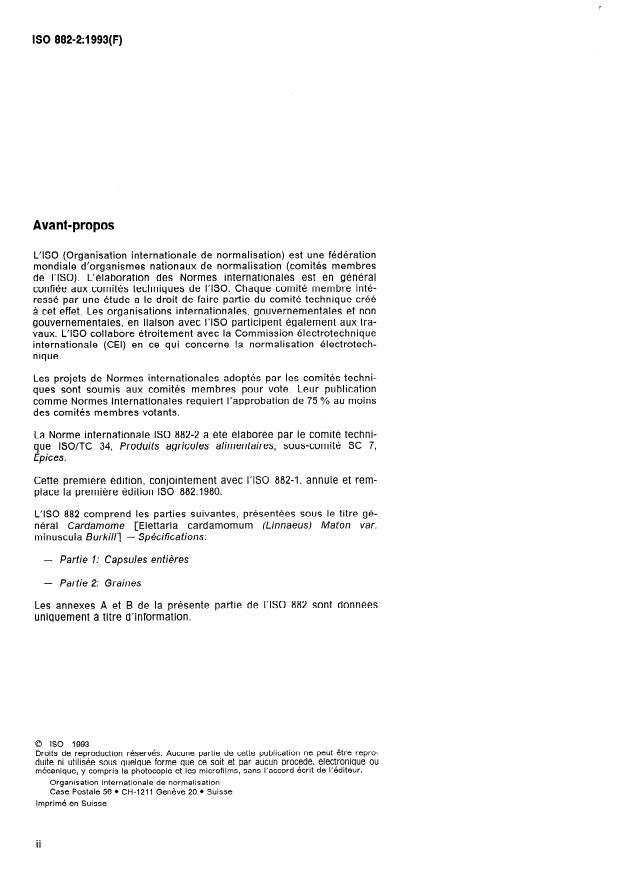
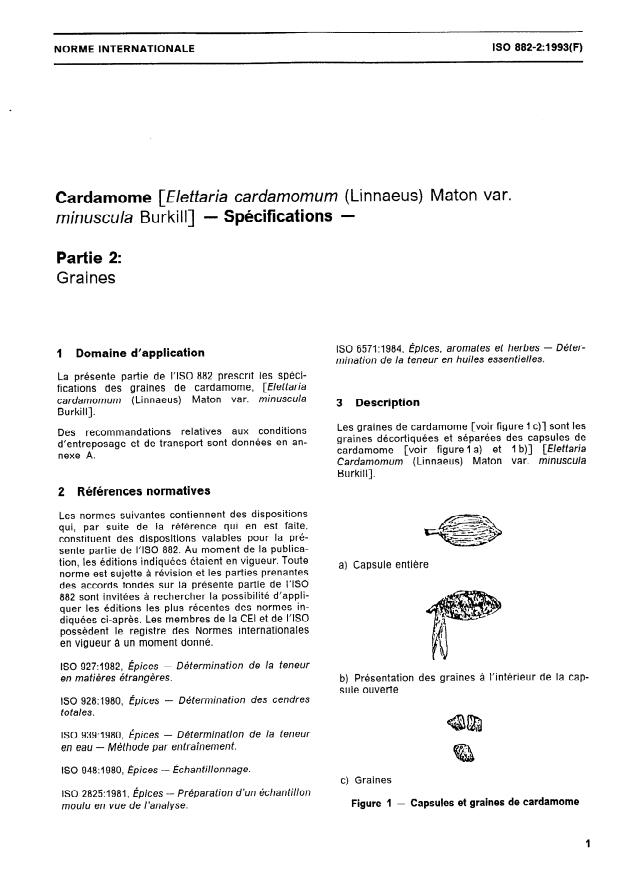
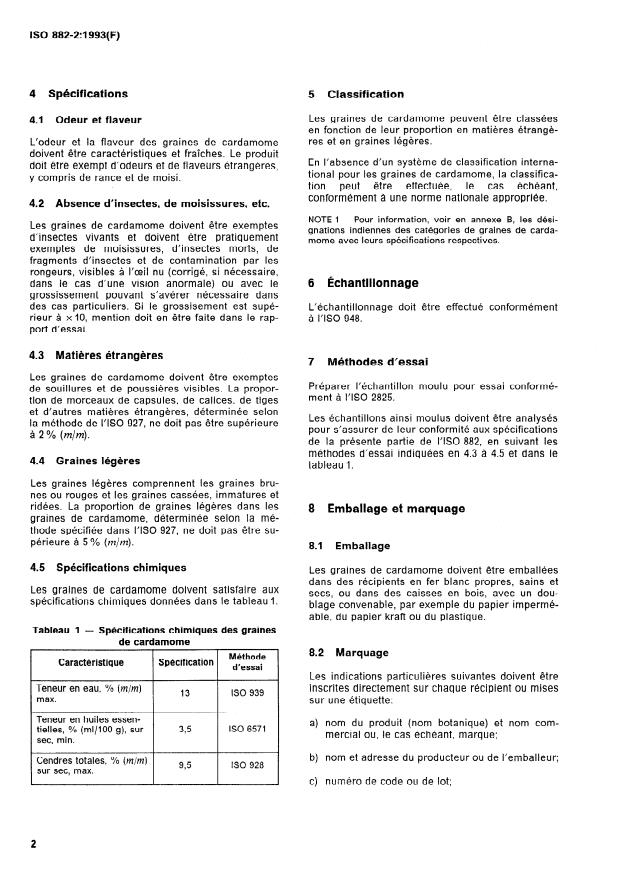
ISO 882-2:1993 - Cardamome (Elettaria cardamomum (Linnaeus) Maton var. minuscula Burkill) -- Spécifications
ISO 882-2:1993 - Cardamome (Elettaria cardamomum (Linnaeus) Maton var. minuscula Burkill) -- Spécifications
Get Certified
Connect with accredited certification bodies for this standard

BSI Group
BSI (British Standards Institution) is the business standards company that helps organizations make excellence a habit.

Bureau Veritas
Bureau Veritas is a world leader in laboratory testing, inspection and certification services.

DNV
DNV is an independent assurance and risk management provider.
Sponsored listings
Frequently Asked Questions
ISO 882-2:1993 is a standard published by the International Organization for Standardization (ISO). Its full title is "Cardamom (Elettaria cardamomum (Linnaeus) Maton var. minuscula Burkill) — Specification — Part 2: Seeds". This standard covers: Specifies requirements for the following: odour and flavour, freedom from insects, moulds, etc., extraneous matter, empty and malformed capsules, immature and shrivelled capsules, chemical properties, grading, sampling, test methods, packing and marking. Recommendations relating to storage and transport conditions are given in annex A.
Specifies requirements for the following: odour and flavour, freedom from insects, moulds, etc., extraneous matter, empty and malformed capsules, immature and shrivelled capsules, chemical properties, grading, sampling, test methods, packing and marking. Recommendations relating to storage and transport conditions are given in annex A.
ISO 882-2:1993 is classified under the following ICS (International Classification for Standards) categories: 67.220.10 - Spices and condiments. The ICS classification helps identify the subject area and facilitates finding related standards.
ISO 882-2:1993 has the following relationships with other standards: It is inter standard links to ISO 882:1980. Understanding these relationships helps ensure you are using the most current and applicable version of the standard.
ISO 882-2:1993 is available in PDF format for immediate download after purchase. The document can be added to your cart and obtained through the secure checkout process. Digital delivery ensures instant access to the complete standard document.
Standards Content (Sample)
SLOVENSKI STANDARD
01-junij-1997
Kardamon (Elettaria cardamomum (Linnaeus) Maton var. minuscula Burkill) -
Specifikacija - 2. del: Semena
Cardamom (Elettaria cardamomum (Linnaeus) Maton var. minuscula Burkill) --
Specification -- Part 2: Seeds
Cardamome (Elettaria cardamomum (Linnaeus) Maton var. minuscula Burkill) --
Spécifications -- Partie 2: Graines
Ta slovenski standard je istoveten z: ISO 882-2:1993
ICS:
67.220.10 =DþLPEH Spices and condiments
2003-01.Slovenski inštitut za standardizacijo. Razmnoževanje celote ali delov tega standarda ni dovoljeno.
INTERNATIONAL
STANDARD
First edition
1993-04-0 1
Cardamom [Hettaria cardamomum (Linnaeus)
Maton Var. minuscula Burkill] - Specification -
Part 2:
Seeds
Cardamome [Elettaria cardamomum (Linnaeus) Maton KW. minuscula
B urkill] - Spkifications -
Partie 2: Graines
Reference number
ISO 882-2: 1993(E)
ISO 88292:1993(E)
Foreword
ISO (the International Organization for Standardization) is a worldwide
federation of national Standards bodies (ISO member bodies). The work
of preparing International Standards is normally carried out through ISO
technical committees. Esch member body interested in a subject for
which a technical committee has been established has the right to be
represented on that committee. International organizations, govern-
mental and non-governmental, in liaison with ISO, also take part in the
work. ISO collaborates closely with the International Electrotechnical
Commission (IEC) on all matters of electrotechnical standardization.
Draft International Standards adopted by the technical committees are
circulated to the member bodies for voting. Publication as an Inter-
national Standard requires approval by at least 75 % of the member
bodies casting a vote.
International Standard ISO 882-2 was prepared by Technical Committee
ISOITC 34, Agricultural food products, Sub-Committee SC 7, Spices and
condiments.
This first edition of ISO 882-2 together with ISO 882-1 cancel and re-
place ISO 882:1980.
ISO 882 consists of the following Parts, under the general title
Cardamom [Elettaria cardamomum (Linnaeus) Maton var. minuscula
B urkill] - Specification:
- Part 1: Whole capsules
- Part 2: Seeds
Annexes A and B of this patt of ISO 882 are for information only.
0 ISO 1993
All rights reserved. No part of this publication may be reproduced or utilized in any form
or by any means, electronie or mechanical, including photocopying and microfilm, without
Permission in writing from the publisher.
,ation
International Organizati on for Standardiz
Case Postale 56 l CH-l 211 Geneve 20 l Switzerl and
Printed in Switzerland
ii
INTERNATIONAL STANDARD
ISO 882=2:1993(E)
Cardamom [Hettaria cardamomum (Linnaeus) Maton var.
minuscula Burkill] - Specification -
Part 2:
Seeds
3 Description
1 Scope
This patt of ISO 882 specifies the requirements for
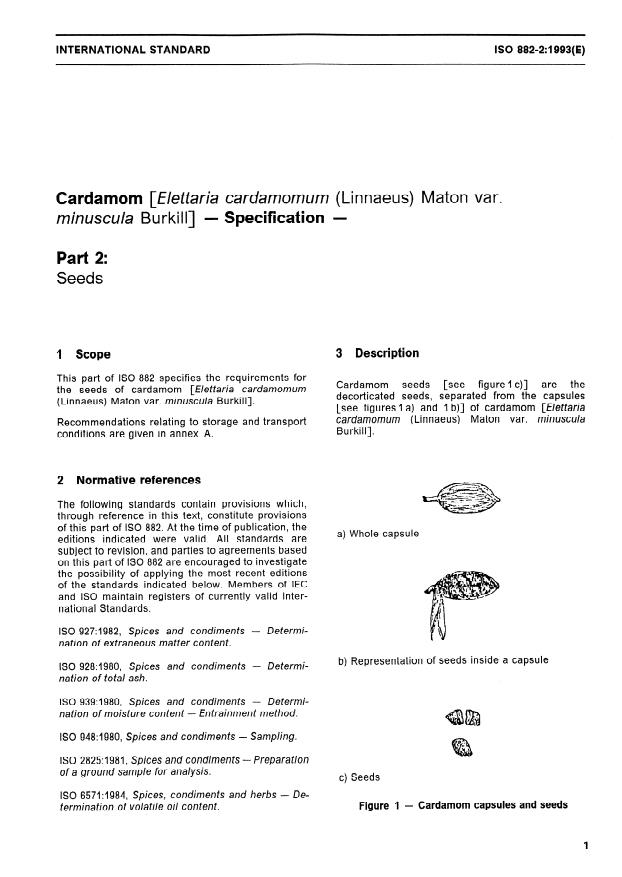
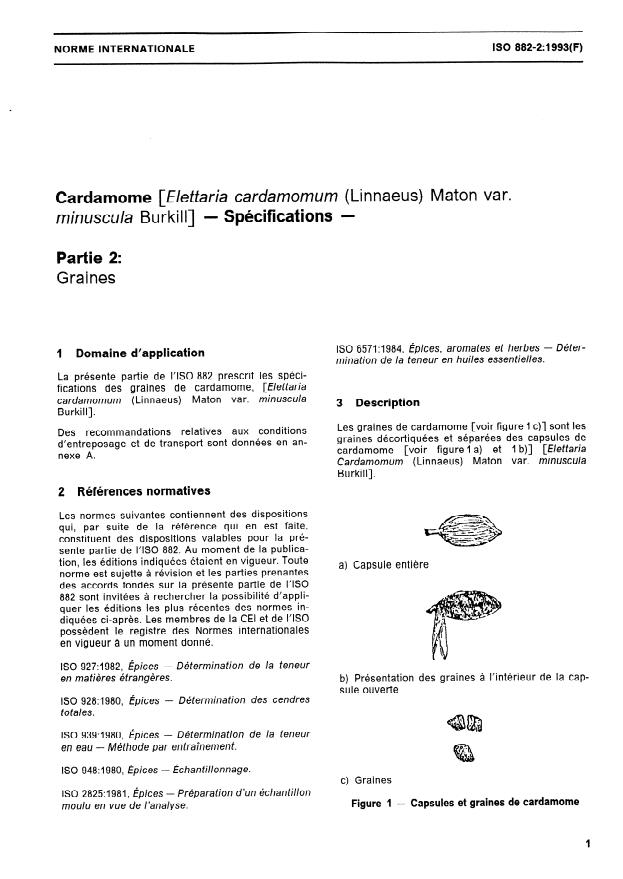
Cardamom seeds [see figure 1 c)] are the
the seeds of cardamom [Elettaria cardamomum
decorticated seeds, separated from the capsules
(Linnaeus) Maton var. minuscula Burkill].
[see figures 1 a) and 1 b)] of cardamom [Elettaria
cardamomum (Linnaeus) Maton var. minuscula
Recommendations relating to storage and transport
Burkill].
conditions are given in annex A.
2 Normative references
The following Standards contain provisions which,
through reference in this text, constitute provisions
of this patt of ISO 882. At the time of publication, the
a) Whole capsule
editions indicated were valid. All Standards are
subject to revision, and Parties to agreements based
on this part of ISO 882 are encouraged to investigate
the possibility of applying the most recent editions
of the Standards indicated below. Members of IEC
and ISO maintain registers of currently valid Inter-
national Standards.
ISO 927:1982, Spices and condiments - Determi-
nation of extraneous matter content.
b) Representation of seeds inside a capsule
ISO 9283980, Spices and condiments - Determi-
nation of total ash.
ISO 939:1980, Spices and condiments - Determi-
nation of moisture content - Entrainment method.
ISO 948:1980, Spices and condiments - Sampling.
ISO 2825:1981, Spices and condiments - Reparation
of a ground Sample for analysis.
c) Seeds
I
...
INTERNATIONAL
STANDARD
First edition
1993-04-0 1
Cardamom [Hettaria cardamomum (Linnaeus)
Maton Var. minuscula Burkill] - Specification -
Part 2:
Seeds
Cardamome [Elettaria cardamomum (Linnaeus) Maton KW. minuscula
B urkill] - Spkifications -
Partie 2: Graines
Reference number
ISO 882-2: 1993(E)
ISO 88292:1993(E)
Foreword
ISO (the International Organization for Standardization) is a worldwide
federation of national Standards bodies (ISO member bodies). The work
of preparing International Standards is normally carried out through ISO
technical committees. Esch member body interested in a subject for
which a technical committee has been established has the right to be
represented on that committee. International organizations, govern-
mental and non-governmental, in liaison with ISO, also take part in the
work. ISO collaborates closely with the International Electrotechnical
Commission (IEC) on all matters of electrotechnical standardization.
Draft International Standards adopted by the technical committees are
circulated to the member bodies for voting. Publication as an Inter-
national Standard requires approval by at least 75 % of the member
bodies casting a vote.
International Standard ISO 882-2 was prepared by Technical Committee
ISOITC 34, Agricultural food products, Sub-Committee SC 7, Spices and
condiments.
This first edition of ISO 882-2 together with ISO 882-1 cancel and re-
place ISO 882:1980.
ISO 882 consists of the following Parts, under the general title
Cardamom [Elettaria cardamomum (Linnaeus) Maton var. minuscula
B urkill] - Specification:
- Part 1: Whole capsules
- Part 2: Seeds
Annexes A and B of this patt of ISO 882 are for information only.
0 ISO 1993
All rights reserved. No part of this publication may be reproduced or utilized in any form
or by any means, electronie or mechanical, including photocopying and microfilm, without
Permission in writing from the publisher.
,ation
International Organizati on for Standardiz
Case Postale 56 l CH-l 211 Geneve 20 l Switzerl and
Printed in Switzerland
ii
INTERNATIONAL STANDARD
ISO 882=2:1993(E)
Cardamom [Hettaria cardamomum (Linnaeus) Maton var.
minuscula Burkill] - Specification -
Part 2:
Seeds
3 Description
1 Scope
This patt of ISO 882 specifies the requirements for
Cardamom seeds [see figure 1 c)] are the
the seeds of cardamom [Elettaria cardamomum
decorticated seeds, separated from the capsules
(Linnaeus) Maton var. minuscula Burkill].
[see figures 1 a) and 1 b)] of cardamom [Elettaria
cardamomum (Linnaeus) Maton var. minuscula
Recommendations relating to storage and transport
Burkill].
conditions are given in annex A.
2 Normative references
The following Standards contain provisions which,
through reference in this text, constitute provisions
of this patt of ISO 882. At the time of publication, the
a) Whole capsule
editions indicated were valid. All Standards are
subject to revision, and Parties to agreements based
on this part of ISO 882 are encouraged to investigate
the possibility of applying the most recent editions
of the Standards indicated below. Members of IEC
and ISO maintain registers of currently valid Inter-
national Standards.
ISO 927:1982, Spices and condiments - Determi-
nation of extraneous matter content.
b) Representation of seeds inside a capsule
ISO 9283980, Spices and condiments - Determi-
nation of total ash.
ISO 939:1980, Spices and condiments - Determi-
nation of moisture content - Entrainment method.
ISO 948:1980, Spices and condiments - Sampling.
ISO 2825:1981, Spices and condiments - Reparation
of a ground Sample for analysis.
c) Seeds
ISO 6571:1984, Spices, condiments and herbs - De-
termination of volatile oil content. Figure 1 - Cardamom capsules and seeds
ISO 88202:1993(E)
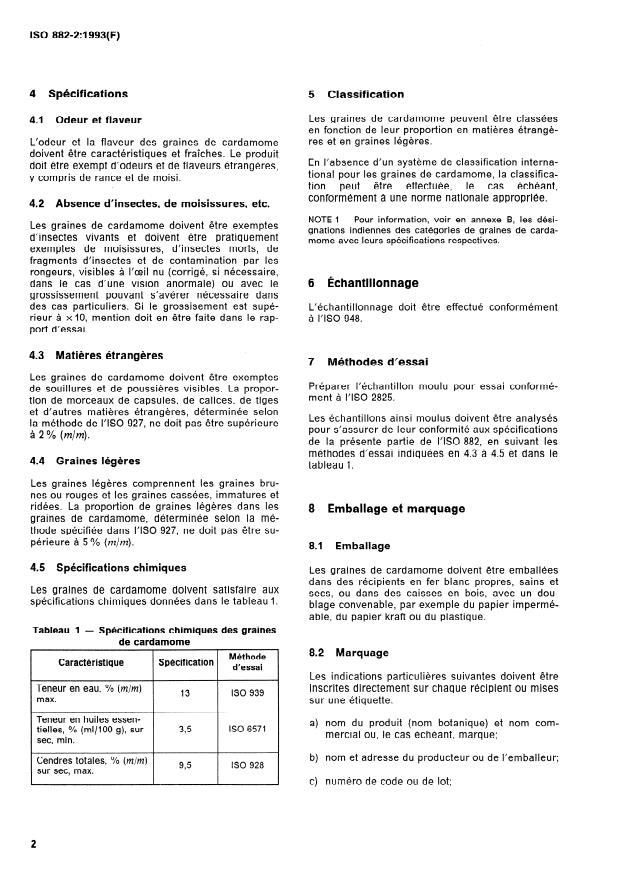
4 Requirements
5 Grading
The cardamom seeds may be graded as a function
4.1 Odour and flavour
of the proportion of extraneous matter and light
seeds present.
The odour and flavour of cardamom seeds shall be
characteristic and fresh. The product shall be free
In the absence of an international grading System for
from foreign odours a
...
ISO
NORME
882-2
INTERNATIONALE
Première édition
1993-04-01
Cardamome [Hettaria cardamomum (Linnaeus)
Maton var. minuscula Burkill] -
Spécifications -
Partie 2:
Graines
Cardamom [Elettaria cardamomum (Linnaeus) Maton var. minuscula
B W-W] - Specification -
Part 2: Seeds
Numéro de référence
ISO 882-2: 1993(F)
---
ISO 882=2:1993(F)
Avant-propos
L’ISO (Organisation internationale de normalisation) est une fédération
mondiale d’organismes nationaux de normalisation (comités membres
de I’ISO). L’élaboration des Normes internationales est en général
confiée aux comités techniques de I’ISO. Chaque comité membre inté-
ressé par une étude a le droit de faire partie du comité technique créé
à cet effet. Les organisations internationales, gouvernementales et non
gouvernementales, en liaison avec I’ISO participent également aux tra-
vaux. L’ISO collabore étroitement avec la Commission électrotechnique
internationale (CEI) en ce qui concerne la normalisation électrotech-
nique.
Les projets de Normes internationales adoptés par les comités techni-
ques sont soumis aux comités membres pour vote. Leur publication
comme Normes internationales requiert l’approbation de 75 % au moins
des comités membres votants.
La Norme internationale ISO 882-2 a été élaborée par le comité techni-
que ISO/TC 34, Produifs agricoles alimentaires, sous-comité SC 7,
Epices.
Cette première édition, conjointement avec I’ISO 882-1, annule et rem-
place la première édition ISO 882:1980.
L’ISO 882 comprend les parties suivantes, présentées sous le titre gé-
néral Cardamome [Elettaria cardamomum (Linnaeus) Maton var.
minuscula Burkill] - Spécifications:
- Partie 1: Capsules entières
- Partie 2: Graines
Les annexes A et B de la présente partie de I’ISO 882 sont données
uniquement a titre d’information.
0 ISO 1993
Droits de reproduction réservés. Aucune partie de cette publication ne peut être repro-
duite ni utilisée sous quelque forme que ce soit et par aucun procédé, électronique ou
mécanique, y compris la photocopie et les microfilms, sans l’accord écrit de l’éditeur.
Organisation internationale de normalisation
Case Postale 56 * CH-121 1 Genève 20 l Suisse
Imprimé en Suisse
ii
NORME INTERNATIONALE
ISO 882=2:1993(F)
Cardamorne [Elettaria cardamomum (Linnaeus) Maton var.
minuscula Burkill] - Spécifications -
Partie 2:
Graines
ISO 6571:1984, Épices, aromates et herbes - Déter-
1 Domaine d’application
mination de la teneur en huiles essentielles.
La présente partie de I’ISO 882 prescrit les spéci-
fications des graines de cardamorne, [Elettaria
cardamomum (Linnaeus) Maton var. minuscula
3 Description
Burkill].
Les graines de cardamorne [voir figure 1 c)] sont les
Des recommandations relatives aux conditions
graines décortiquées et séparées des capsules de
d’entreposage et de transport sont données en an-
cardamorne [voir figure 1 a) et 1 b)] [Elettaria
nexe A.
Cardamomum (Linnaeus) Maton var. minuscula
Burkill].
2 Références normatives
Les normes suivantes contiennent des dispositions
qui, par suite de la référence qui en est faite,
constituent des dispositions valables pour la pré-
sente partie de I’ISO 882. Au moment de la publica-
tion, les éditions indiquées étaient en vigueur. Toute
a) Capsule entière
norme est sujette à révision et les parties prenantes
des accords fondés sur la présente partie de I’ISO
882 sont invitées à rechercher la possibilité d’appli-
. .
\*
-* \
quer les éditions les plus récentes des normes in-
IJy *‘-k : !-,
*
G!L-
m
diquées ci-après. Les membres de la CEI et de I’ISO
/iz c )
possèdent le registre des Normes internationales c‘
f’ I
en vigueur à un moment donné.
i”h
\
iii
Détermination de la teneur
ISO 927:1982, Epices -
en matières étrangères.
b) Présentation des graines à l’intérieur de la cap-
sule ouverte
Détermination des cendres
ISO 928:1980, Épices -
totales.
Détermination de la teneur
ISO 939:1980, Épices -
en eau - Méthode par entrafnement.
ISO 948: 1980, Épices - Échantillonnage.
c) Graines
ISO 2825:1981, Épices - Préparation d’un échantillon
Figure 1 - Capsules et graines de cardamorne
moulu en vue de l’analyse.
ISO 882=2:1993(F)
4 Spécifications 5 Classification
Les graines de cardamome peuvent être classées
4.1 Odeur et flaveur
en fonction de leur proportion en matières étrangè-
res et en graines légères.
L’odeur et la flaveur des graines de cardamorne
doivent être caractéristiques et fraîches. Le produit
En l’absence d’un système de classification interna-
doit être exempt d’odeurs et de flaveurs étrangères,
tional pour les graines de cardamome, la classifïca-
y compris de rance et
...
ISO
NORME
882-2
INTERNATIONALE
Première édition
1993-04-01
Cardamome [Hettaria cardamomum (Linnaeus)
Maton var. minuscula Burkill] -
Spécifications -
Partie 2:
Graines
Cardamom [Elettaria cardamomum (Linnaeus) Maton var. minuscula
B W-W] - Specification -
Part 2: Seeds
Numéro de référence
ISO 882-2: 1993(F)
---
ISO 882=2:1993(F)
Avant-propos
L’ISO (Organisation internationale de normalisation) est une fédération
mondiale d’organismes nationaux de normalisation (comités membres
de I’ISO). L’élaboration des Normes internationales est en général
confiée aux comités techniques de I’ISO. Chaque comité membre inté-
ressé par une étude a le droit de faire partie du comité technique créé
à cet effet. Les organisations internationales, gouvernementales et non
gouvernementales, en liaison avec I’ISO participent également aux tra-
vaux. L’ISO collabore étroitement avec la Commission électrotechnique
internationale (CEI) en ce qui concerne la normalisation électrotech-
nique.
Les projets de Normes internationales adoptés par les comités techni-
ques sont soumis aux comités membres pour vote. Leur publication
comme Normes internationales requiert l’approbation de 75 % au moins
des comités membres votants.
La Norme internationale ISO 882-2 a été élaborée par le comité techni-
que ISO/TC 34, Produifs agricoles alimentaires, sous-comité SC 7,
Epices.
Cette première édition, conjointement avec I’ISO 882-1, annule et rem-
place la première édition ISO 882:1980.
L’ISO 882 comprend les parties suivantes, présentées sous le titre gé-
néral Cardamome [Elettaria cardamomum (Linnaeus) Maton var.
minuscula Burkill] - Spécifications:
- Partie 1: Capsules entières
- Partie 2: Graines
Les annexes A et B de la présente partie de I’ISO 882 sont données
uniquement a titre d’information.
0 ISO 1993
Droits de reproduction réservés. Aucune partie de cette publication ne peut être repro-
duite ni utilisée sous quelque forme que ce soit et par aucun procédé, électronique ou
mécanique, y compris la photocopie et les microfilms, sans l’accord écrit de l’éditeur.
Organisation internationale de normalisation
Case Postale 56 * CH-121 1 Genève 20 l Suisse
Imprimé en Suisse
ii
NORME INTERNATIONALE
ISO 882=2:1993(F)
Cardamorne [Elettaria cardamomum (Linnaeus) Maton var.
minuscula Burkill] - Spécifications -
Partie 2:
Graines
ISO 6571:1984, Épices, aromates et herbes - Déter-
1 Domaine d’application
mination de la teneur en huiles essentielles.
La présente partie de I’ISO 882 prescrit les spéci-
fications des graines de cardamorne, [Elettaria
cardamomum (Linnaeus) Maton var. minuscula
3 Description
Burkill].
Les graines de cardamorne [voir figure 1 c)] sont les
Des recommandations relatives aux conditions
graines décortiquées et séparées des capsules de
d’entreposage et de transport sont données en an-
cardamorne [voir figure 1 a) et 1 b)] [Elettaria
nexe A.
Cardamomum (Linnaeus) Maton var. minuscula
Burkill].
2 Références normatives
Les normes suivantes contiennent des dispositions
qui, par suite de la référence qui en est faite,
constituent des dispositions valables pour la pré-
sente partie de I’ISO 882. Au moment de la publica-
tion, les éditions indiquées étaient en vigueur. Toute
a) Capsule entière
norme est sujette à révision et les parties prenantes
des accords fondés sur la présente partie de I’ISO
882 sont invitées à rechercher la possibilité d’appli-
. .
\*
-* \
quer les éditions les plus récentes des normes in-
IJy *‘-k : !-,
*
G!L-
m
diquées ci-après. Les membres de la CEI et de I’ISO
/iz c )
possèdent le registre des Normes internationales c‘
f’ I
en vigueur à un moment donné.
i”h
\
iii
Détermination de la teneur
ISO 927:1982, Epices -
en matières étrangères.
b) Présentation des graines à l’intérieur de la cap-
sule ouverte
Détermination des cendres
ISO 928:1980, Épices -
totales.
Détermination de la teneur
ISO 939:1980, Épices -
en eau - Méthode par entrafnement.
ISO 948: 1980, Épices - Échantillonnage.
c) Graines
ISO 2825:1981, Épices - Préparation d’un échantillon
Figure 1 - Capsules et graines de cardamorne
moulu en vue de l’analyse.
ISO 882=2:1993(F)
4 Spécifications 5 Classification
Les graines de cardamome peuvent être classées
4.1 Odeur et flaveur
en fonction de leur proportion en matières étrangè-
res et en graines légères.
L’odeur et la flaveur des graines de cardamorne
doivent être caractéristiques et fraîches. Le produit
En l’absence d’un système de classification interna-
doit être exempt d’odeurs et de flaveurs étrangères,
tional pour les graines de cardamome, la classifïca-
y compris de rance et
...
Questions, Comments and Discussion
Ask us and Technical Secretary will try to provide an answer. You can facilitate discussion about the standard in here.
Loading comments...