

ISO 18077:2022
(Main)Reload startup physics tests for pressurized water reactors
General Information
- Abstract
This document applies to the reactor physics tests that are performed following a refuelling or other core alteration of a PWR for which nuclear design calculations are required. This document does not address the physics test program for the initial core of a commercial PWR. This document specifies the minimum acceptable startup reactor physics test program to determine if the operating characteristics of the core are consistent with the design predictions, which provides assurance that the core can be operated as designed. This document does not address surveillance of reactor physics parameters during operation or other required tests such as mechanical tests of system components (for example, the rod drop time test), visual verification requirements for fuel assembly loading, or the calibration of instrumentation or control systems (even though these tests are an integral part of an overall program to ensure that the core behaves as designed).
- Status
- Published
- Publication Date
- 06-Dec-2022
- Technical Committee
- ISO/TC 85/SC 6 - Reactor technology
- Drafting Committee
- ISO/TC 85/SC 6/WG 1 - Power reactor analyses and measurements
- Current Stage
- 6060 - International Standard published
- Start Date
- 07-Dec-2022
- Due Date
- 03-Jan-2023
- Completion Date
- 07-Dec-2022


Overview - ISO 18077:2022 (Reload startup physics tests for PWRs)
ISO 18077:2022 defines the minimum acceptable startup reactor physics test program for commercial pressurized water reactors (PWRs) after refuelling or other core alterations that require nuclear design calculations. The standard is limited to reload/alteration startup testing (not the initial core) and focuses on demonstrating that the as-built core behaves consistently with design predictions before returning to normal operation. It does not cover in‑operation surveillance, mechanical system tests, fuel loading visual verification, or instrument/control system calibration.
Key topics and technical requirements
- Scope and intent: Establishes the baseline set of physics tests and selection criteria needed to confirm core behavior following core modification.
- Minimum test program: Specifies required measurements and the basis for each test to show agreement between measurements and design predictions within predetermined review criteria (the document uses review criteria only; acceptance criteria are outside its scope).
- Primary physics characteristics to confirm:
- Reactivity balance (e.g., boron endpoint checks to confirm fuel inventory and poisons)
- Reactivity control (notably the isothermal temperature coefficient (ITC))
- Power distribution (core power shape verification)
- Capability to shutdown and requirements to shutdown (control rod worth and shutdown margin confirmation)
- Test methods and evaluation: Clause 6 describes test method requirements (objectives, initial conditions, methods, and evaluation). Annex A provides user guidance with acceptable methods, typical test criteria, and practical recommendations; alternative methods may be used if they meet Clause 6 requirements.
- Operational assumptions and limitations: Assumes the same analytical methods are used for design and startup predictions and that operation remains within the plant’s historical database. Major design changes may require expanded testing.
- Updated content in the 2022 edition: Clarifies review vs. acceptance criteria, adds guidance that progression to the next power plateau requires acceptable results at the current plateau, and includes editorial/clarifying changes.
Practical applications and users
Who uses ISO 18077:2022:
- Reactor physics engineers and core design teams
- Nuclear power plant operators and startup test engineers
- Regulatory authorities and safety assessors
- Vendors and consultants conducting reload testing or validation
Practical uses:
- Designing and executing reload startup physics test programs
- Verifying that a refuelled or altered PWR core matches safety analysis and licensing assumptions
- Supporting plant return-to-service decisions after refuelling
Related standards
ISO 18077:2022 is informed by and related to several ANSI/ANS standards referenced in the document, including:
- ANSI/ANS-19.6.1 (basis for minimum startup physics program)
- ANSI/ANS-19.4 (reactor physics measurement quality)
- ANSI/ANS-19.11 (moderator temperature coefficient methods)
- ANSI/ANS-3.2 and ANSI/ANS-3.1 (administrative, QA, and personnel qualification aspects)
Keywords: ISO 18077:2022, reload startup physics tests, PWR, pressurized water reactor, startup reactor physics test program, reactivity balance, isothermal temperature coefficient, power distribution, control rod worth.
Relations
- Effective Date
- 23-Apr-2020
Get Certified
Connect with accredited certification bodies for this standard

DNV
DNV is an independent assurance and risk management provider.

Lloyd's Register
Lloyd's Register is a global professional services organisation specialising in engineering and technology.
DNV Energy Systems
Energy and renewable energy certification.
Sponsored listings
Frequently Asked Questions
ISO 18077:2022 is a standard published by the International Organization for Standardization (ISO). Its full title is "Reload startup physics tests for pressurized water reactors". This standard covers: This document applies to the reactor physics tests that are performed following a refuelling or other core alteration of a PWR for which nuclear design calculations are required. This document does not address the physics test program for the initial core of a commercial PWR. This document specifies the minimum acceptable startup reactor physics test program to determine if the operating characteristics of the core are consistent with the design predictions, which provides assurance that the core can be operated as designed. This document does not address surveillance of reactor physics parameters during operation or other required tests such as mechanical tests of system components (for example, the rod drop time test), visual verification requirements for fuel assembly loading, or the calibration of instrumentation or control systems (even though these tests are an integral part of an overall program to ensure that the core behaves as designed).
This document applies to the reactor physics tests that are performed following a refuelling or other core alteration of a PWR for which nuclear design calculations are required. This document does not address the physics test program for the initial core of a commercial PWR. This document specifies the minimum acceptable startup reactor physics test program to determine if the operating characteristics of the core are consistent with the design predictions, which provides assurance that the core can be operated as designed. This document does not address surveillance of reactor physics parameters during operation or other required tests such as mechanical tests of system components (for example, the rod drop time test), visual verification requirements for fuel assembly loading, or the calibration of instrumentation or control systems (even though these tests are an integral part of an overall program to ensure that the core behaves as designed).
ISO 18077:2022 is classified under the following ICS (International Classification for Standards) categories: 27.120.10 - Reactor engineering. The ICS classification helps identify the subject area and facilitates finding related standards.
ISO 18077:2022 has the following relationships with other standards: It is inter standard links to ISO 18077:2018. Understanding these relationships helps ensure you are using the most current and applicable version of the standard.
ISO 18077:2022 is available in PDF format for immediate download after purchase. The document can be added to your cart and obtained through the secure checkout process. Digital delivery ensures instant access to the complete standard document.
Standards Content (Sample)
INTERNATIONAL ISO
STANDARD 18077
Second edition
2022-12
Reload startup physics tests for
pressurized water reactors
Essais physiques au redémarrage pour les réacteurs à eau pressurisée
Reference number
© ISO 2022
All rights reserved. Unless otherwise specified, or required in the context of its implementation, no part of this publication may
be reproduced or utilized otherwise in any form or by any means, electronic or mechanical, including photocopying, or posting on
the internet or an intranet, without prior written permission. Permission can be requested from either ISO at the address below
or ISO’s member body in the country of the requester.
ISO copyright office
CP 401 • Ch. de Blandonnet 8
CH-1214 Vernier, Geneva
Phone: +41 22 749 01 11
Email: copyright@iso.org
Website: www.iso.org
Published in Switzerland
ii
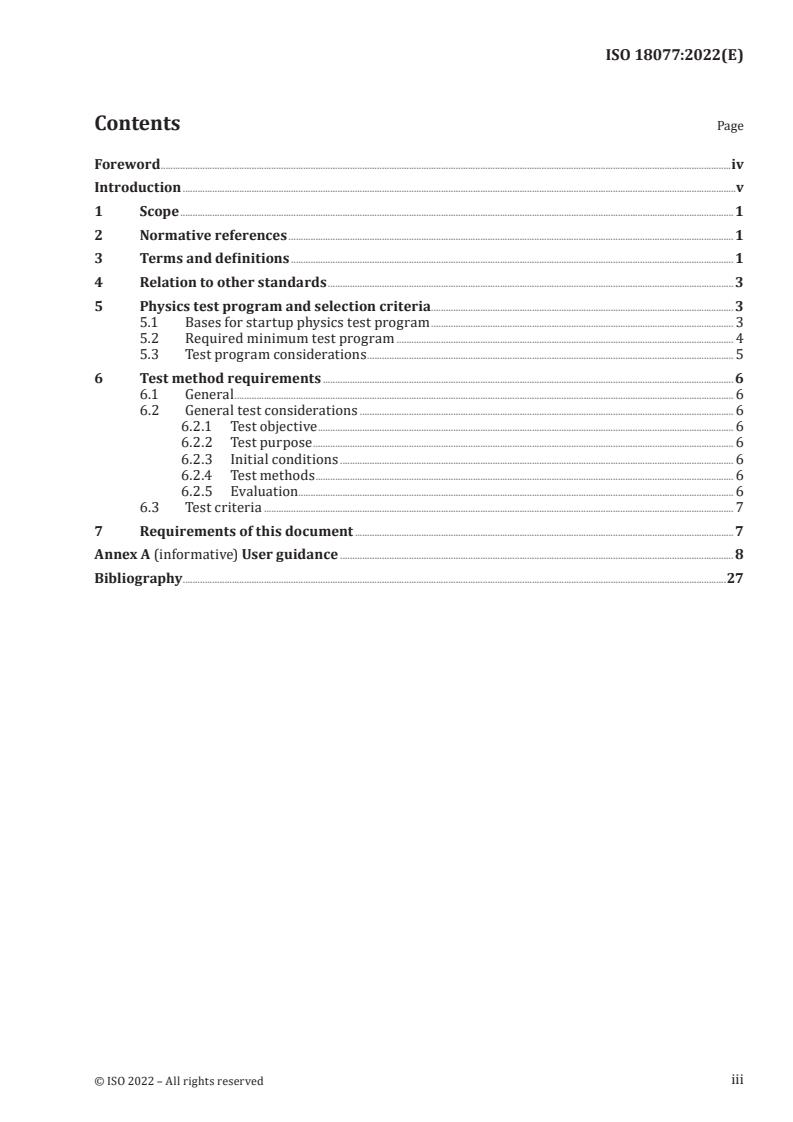
Contents Page
Foreword .iv
Introduction .v
1 Scope . 1
2 Normative references . 1
3 Terms and definitions . 1
4 Relation to other standards .3
5 Physics test program and selection criteria . 3
5.1 Bases for startup physics test program . 3
5.2 Required minimum test program . 4
5.3 Test program considerations . 5
6 Test method requirements . 6
6.1 General . 6
6.2 General test considerations . 6
6.2.1 Test objective . 6
6.2.2 Test purpose . 6
6.2.3 Initial conditions . 6
6.2.4 Test methods . 6
6.2.5 Evaluation . . 6
6.3 Test criteria . 7
7 Requirements of this document .7
Annex A (informative) User guidance . 8
Bibliography .27
iii
Foreword
ISO (the International Organization for Standardization) is a worldwide federation of national standards
bodies (ISO member bodies). The work of preparing International Standards is normally carried out
through ISO technical committees. Each member body interested in a subject for which a technical
committee has been established has the right to be represented on that committee. International
organizations, governmental and non-governmental, in liaison with ISO, also take part in the work.
ISO collaborates closely with the International Electrotechnical Commission (IEC) on all matters of
electrotechnical standardization.
The procedures used to develop this document and those intended for its further maintenance are
described in the ISO/IEC Directives, Part 1. In particular, the different approval criteria needed for the
different types of ISO documents should be noted. This document was drafted in accordance with the
editorial rules of the ISO/IEC Directives, Part 2 (see www.iso.org/directives).
Attention is drawn to the possibility that some of the elements of this document may be the subject of
patent rights. ISO shall not be held responsible for identifying any or all such patent rights. Details of
any patent rights identified during the development of the document will be in the Introduction and/or
on the ISO list of patent declarations received (see www.iso.org/patents).
Any trade name used in this document is information given for the convenience of users and does not
constitute an endorsement.
For an explanation of the voluntary nature of standards, the meaning of ISO specific terms and
expressions related to conformity assessment, as well as information about ISO's adherence to
the World Trade Organization (WTO) principles in the Technical Barriers to Trade (TBT), see
www.iso.org/iso/foreword.html.
This document was prepared by Technical Committee ISO/TC 85, Nuclear energy, nuclear technologies,
and radiological protection, Subcommittee SC 6, Reactor technology.
This second edition cancels and replaces the first edition (ISO 18077:2018), which has been technically
revised.
The main changes are as follows:
— discussion of the difference between review criteria and acceptance criteria was moved from the
annex to the main part of the document with a clear statement that the document uses only review
criteria;
— a new Subclause 5.3 was added to clarify that testing at the next power plateau should proceed only
after acceptable results are obtained at the current power plateau;
— a footnote was added to Table A.1 to address cores designed to be asymmetric;
— several editing changes were made.
Any feedback or questions on this document should be directed to the user’s national standards body. A
complete listing of these bodies can be found at www.iso.org/members.html.
iv
Introduction
In conjunction with each refuelling shutdown or other significant reactor core alteration, nuclear
design calculations are performed to ensure that the reactor physics characteristics of the new core
will be consistent with the safety limits. Prior to return to normal operation, successful execution of a
physics test program is required to determine if the operating characteristics of the core are accurately
represented by the design predictions and to ensure that the core can be operated as designed.
This document specifies the content of the minimum acceptable startup physics test program for
commercial pressurized water reactors (PWRs) and provides the bases for each of the tests. Previously
1)
used acceptable methods for performing the individual tests are provided in Annex A . Alternate
methods may be used as long as they are shown to meet the requirements of Clause 6.
Successful completion of the physics test program is demonstrated when the test results agree with the
predicted results within predetermined test criteria. Successful completion of the physics test program
and successful completion of other tests that are performed after each refuelling or significant reactor
core alteration provide assurance that the plant can be operated as designed.
This document assumes that the same previously accepted analytical methods are used for both the
design of the reactor core and the startup test predictions. It also assumes that the expected operation
of the core will fall within the historical database established for the plant and/or sister plants.
When major changes are made in the core design, the test program should be reviewed to determine
if more extensive testing is needed. Typical changes that might fall in this category include the initial
use of novel fuel cycle designs, significant changes in fuel enrichments, fuel assembly design changes,
burnable absorber design changes, and cores resulting from unplanned short cycles. Changes such as
these may lead to operation in regions outside of the industry's experience database and therefore may
necessitate expanding the test program.
1) Annex A is the User's guidance, which provides acceptable methods, guidelines, precautions, suggestions and
typical test criteria for each required test.
v
INTERNATIONAL STANDARD ISO 18077:2022(E)
Reload startup physics tests for pressurized water reactors
1 Scope
This document applies to the reactor physics tests that are performed following a refuelling or other
core alteration of a PWR for which nuclear design calculations are required. This document does not
address the physics test program for the initial core of a commercial PWR.
This document specifies the minimum acceptable startup reactor physics test program to determine
if the operating characteristics of the core are consistent with the design predictions, which provides
assurance that the core can be operated as designed.
This document does not address surveillance of reactor physics parameters during operation or other
required tests such as mechanical tests of system components (for example, the rod drop time test),
visual verification requirements for fuel assembly loading, or the calibration of instrumentation or
control systems (even though these tests are an integral part of an overall program to ensure that the
core behaves as designed).
2 Normative references
There are no normative references in this document.
3 Terms and definitions
For the purposes of this document, the following terms and definitions apply.
ISO and IEC maintain terminological databases for use in standardization at the following addresses:
— ISO Online browsing platform: available at https:// www .iso .org/ obp
— IEC Electropedia: available at https:// www .electropedia .org/
3.1
all rods out
ARO
all full-length control rods withdrawn
Note 1 to entry: Part-length rods may be inserted.
3.2
control rod
one or more reactivity control members mechanically attached to a single fixture
3.3
control rod group
one or more rods that are inserted or withdrawn simultaneously
Note 1 to entry: The term “all control rod groups” means all safety and regulating control rod groups. This term
may also be shortened to simply “rod group.”
Note 2 to entry: Some utilities use the term "bank" instead of "group". A control rod bank is the same as a control
rod group.
3.4
decades per minute
DPM
unit used to measure a rate of change in flux as measured by the ex-core detectors
3.5
hot full power
full power
rated thermal power
HFP
licensed core thermal power level
3.6
hot zero power
HZP
reactor operating state where the core is essentially critical but is not producing measurable heat from
nuclear fission, the reactivity due to xenon is negligible, and the primary coolant system is at design
temperature and pressure for zero power
Note 1 to entry: At HZP, the flux signal should be high enough so that the reactivity computer can account for
contamination sources such as noise, gamma background, and leakage.
3.7
isothermal temperature coefficient
ITC
change in reactivity per unit change in the fuel and moderator temperature when the fuel and moderator
are at the same temperature
3.8
part-length rod
control rod (3.2) whose primary absorber material does not extend the entire length of the control rod
(3.2) (typically the lower half of the control rod’s active length)
Note 1 to entry: It is used for axial shape control. For the purposes of this document, the term “part-length rod”
can also represent a “part-strength” control rod.
3.9
percent milli-rho
pcm
-3
unit of reactivity worth equivalent to 10 % Δρ
Note 1 to entry: See definition of “reactivity worth” below.
Note 2 to entry: Throughout this document, pcm is the unit of reactivity to be used.
3.10
reactivity computer
analog or digital device that calculates the core reactivity by using an external signal that is proportional
to the core neutron flux
3.11
reactivity worth
change in reactivity expressed in terms of percent
()kk− ⋅100
%Δρ =
kk⋅
where
k is the effective multiplication constant for reactor state 1
k is the effective multiplication constant for reactor state 2
3.12
regulating control rod group
group of control rods (3.2) that may be partially or fully inserted in the core during normal operation
3.13
safety rod group
control rod group (3.3) that remains withdrawn from the core during normal operation and is inserted
during abnormal or accident conditions
3.14
test criterion
predetermined value for evaluating the result of each test
Note 1 to entry: There are two different levels of criteria, review and acceptance. A review criterion is based on
differences between calculations and measurements that would suggest a problem with the as-built core, the
measurement, or the prediction. Only review criteria are applicable to this document. An acceptance criterion
is based on a safety analysis assumption or a Technical Specification limit and is outside of the scope of this
document. See Annex A for a more complete discussion of the test criteria and applicability.
4 Relation to other standards
[2]
ANSI/ANS-3.2-2012(R2022) provides requirements and recommendations for an administrative
control and quality assurance program for the safe and efficient operation of nuclear power plants.
Provisions for test and applicable test equipment control required by this document are also included
[3]
in ANSI/ANS-3.2-2012(R2022). ANSI/ANS 3.1-2014(R2020) provides for the selection, qualification,
and training of personnel for nuclear power plants, including personnel responsible for startup testing.
[4]
ANSI/ANS-19.4-2017(R2022) addresses reactor physics measurements that are intended to yield
documented data of both the type and quality required for validating nuclear analysis methods.
[5]
ANSI/ANS-19.11-2017(R2022) describes how to calculate and measure the moderator temperature
[6]
coefficient of reactivity. ANSI/ANS 19.6.1-2019 defines the minimum acceptable startup physics test
program and acceptable test methods to determine if the reactor core operating characteristics are
consistent with the design predictions and is the basis for this document.
5 Physics test program and selection criteria
5.1 Bases for startup physics test program
During the reload design process, the reactor safety is determined by analysis. Following the reload,
specific core characteristics shall be confirmed by measurement to ensure that the reconstructed core
is accurately represented by that analysis and is operating as designed. Thus, the testing results seek to
confirm that the reactor can be operated within the bounds of the technical specifications, that there is
sufficient operational flexibility, and that the plant can be expected to safely deliver the designed power
output. The paramount objective of a physics test program is to demonstrate that the reconstructed
core is accurately represented by the core design and safety analysis used to certify that the core is
safe.
The important analysis characteristics that shall be confirmed by measurement are the following:
a) Reactivity balance: reactivity balance neutronically demonstrates that the total amount of fuel
loaded in the core is consistent with design. The boron endpoint measurements confirm that the
amount of various fissionable materials in the core, as well as the reactivity effects of various fixed
poisons (e.g. burnable absorbers) and transient poisons (e.g. samarium), is consistent with the
design calculations.
b) Reactivity control: reactivity control refers to the reactor core parameters that have an impact on
the ability of the operators to control the plant. The primary parameter that confirms this is the
isothermal temperature coefficient.
c) Power distribution: the power distribution is a measurement (check) that the core is loaded properly
and will perform as designed. When the measured power distributions agree with predictions,
there is high confidence that the as-built core and the designed core are the same. In addition,
there is increased confidence that the conclusions of the safety analyses are correct. Finally, close
agreement between measured and predicted power distributions increases the confidence that
reactivity control parameters will perform as designed.
d) Capability to shutdown: capability to shutdown is demonstrated by showing that the measured
control rod worths are consistent with the calculated values. The shutdown margin calculations
are based upon design values, which have to be confirmed.
e) Requirements to shutdown: the requirements to shutdown are the reactivity elements that the
safety and regulating control rods have to overcome in a reactor trip. The shutdown margin
calculations are based upon design values, which have to be confirmed.
Any new testing process or program of tests that are not described in Annex A shall specify how the
above parameters are to be confirmed.
A minimum test program is designed to ensure a complete certification, assuming no anomalies were
identified during the test program. When results show deviations from predictions that are beyond the
experience base, supplementary actions shall be identified and performed, as necessary. A complete
design verification test program shall identify the minimum testing that will be performed and the
supplementary actions that may be performed.
5.2 Required minimum test program
The characteristics required to be confirmed by this standard, example measured parameters used
for confirmation, and power levels before which they shall be confirmed are provided by Table 1.
The characteristics and power levels are requirements while there is some flexibility in how those
requirements are met. For example, the power distribution shall be confirmed at lower powers before
escalating to the next level even though the method for confirmation may be flexible. The parameters
were selected by considering the following requirements:
a) The information obtained from the parameter cannot be inferred from other tests that are
performed. This requirement means that redundant tests can be excluded. In the event that a
particular parameter fails to pass the test criteria, however, other (redundant) tests should be
performed to help resolve the discrepancy.
b) Each test shall be able to quantitatively confirm an important physics characteristic of the reactor
core. This requirement means that the following types of measurements were excluded (although
they may be performed for other reasons):
1) Mechanical tests of system components (rod drop time, etc.),
2) tests used solely for instrument calibration,
3) tests used to benchmark computer models.
c) Each measurement shall be accurate, and an accurate prediction shall be available. This requirement
means that the expected difference between the measured result and the prediction shall be small
so that if the measurement and the prediction agree, there is confidence that the core will behave
as predicted. Conversely, if there actually is a design discrepancy in the core, the measurement will
reveal it (the measurement and prediction will not agree).
d) The test program shall be designed to not violate the plant's shutdown margin requirements. This
requirement means that the plant shutdown margin requirements shall not be violated while
performing startup physics testing.
Table 1 — Required physics characteristics to be confirmed
Power level
Characteristic(s) Example measured parameter to use for confirmation
%
a
Reactivity balance All-rods-out boron concentration <5
Capability to shutdown, Control rod worths <5
b
power distribution
Reactivity control Isothermal temperature coefficient <5
Power distribution Flux symmetry or direct power distribution measurement be- 0 to 30
tween 0 and 30 % of full power
Power distribution If a direct low-power distribution measurement has yet to be 30 to 50
confirmed, then it shall be confirmed (compared to predictions)
c
prior to exceeding 50 % power
Power distribution Power distribution measurement results shall be assessed 50 to 80
collectively to ensure that local and global core characteristic
trends are acceptable prior to exceeding 80 % power
Power distribution Direct power distribution measurement at full power >90
Reactivity balance, require- Hot-zero-power to hot-full-power reactivity measurement >90
ment to shutdown
a
Measurements made prior to power operation (<5 %) are special in that they confirm characteristics that cannot be
adequately confirmed during operation at power.
b
Although the power distribution may not be directly measured at <5 % power, an indirect measurement such as the
control rod worth error distribution provides the first indication that the power distribution is consistent with predictions.
c
See A.3.4.6 for a discussion of direct and indirect power distribution measurements.
5.3 Test program considerations
The startup test program shall be established to provide assurances that operation at the next plateau
in the program will be acceptable. In other words, a safe and controlled approach to power ascension
with a new core will be followed. This is accomplished by establishing the rules that dictate that
favorable results of the tests at one power plateau meets the criteria to allow progression to the next
power plateau. Therefore, this requires resolution of any observed differences (failure of a review or
acceptance criterion) at any plateau prior to proceeding up in power.
Having established processes for resolution of a specific criterion failure would be very helpful in
executing a physics test program efficiently. Utilizing the information in Table A.2 and A.3 will provide
guidance on how to establish such a resolution process.
6 Test method requirements
6.1 General
Established test methods for the confirmation of each characteristic required by this document are
described in Annex A. Whether one of these methods or a different method is used, the user shall verify
that the following requirements are met:
a) The intent, content, purpose, and other requirements of the overall startup program as outlined in
this document are met;
b) The method unambiguously confirms one or more of the five physics characteristics described in
5.1;
c) The method has been validated by successful benchmarking;
d) The method has withstood independent peer review.
6.2 General test considerations
6.2.1 Test objective
The general objective of each test is to measure a reactor physics parameter.
6.2.2 Test purpose
The general purpose of each test is to determine if the measured reactor physics parameter is consistent
with the predicted value. Data from the test results may also be used to establish appropriate operating
limits or to determine compliance with appropriate Technical Specifications.
6.2.3 Initial conditions
In general, initial conditions are specified for each test such that an accurate measurement can be
performed at the same or nearly the same conditions assumed in the prediction. The test results or
predictions shall be adjusted to account for any difference between the specified conditions and those
that were present at the time of measurement. Except for unusual circumstances, each adjustment
due to different conditions shall have a negligible effect on the uncertainty in the measured-versus-
predicted comparison. All adjustments shall be documented.
6.2.4 Test methods
For each test, Annex A provides abstracts of proven methods for performing the test. Alternate
methods can be used as long as they are shown to be acceptable by meeting the requirements of 6.2.
In general, the stated initial core conditions shall be achieved as closely as practical, and the reactor
physics parameter shall be measured accurately (i.e. consistent with the assumptions used to establish
the test criteria). To ensure that the measurement uncertainty is minimized, precautions are provided
in Annex A. During each test, the appropriate core conditions shall be recorded, and those conditions
shall be maintained within the specified range for the test.
6.2.5 Evaluation
In general, each test is considered to be successful if the difference between the prediction and the
measurement (or, for some tests, the physics parameter inferred from the measurement) is less than a
predetermined criterion. This difference shall be evaluated after appropriate adjustments have been
made to account for any differences between the specified core conditions and those that were present
at the time of measurement.
The predetermined criteria shall be developed with adequate allowance for uncertainties in both
the measurement and prediction. Typical criteria based on current technology and best practices are
provided in Annex A.
6.3 Test criteria
If the difference between the measured and predicted values for a physics parameter exceeds the
predetermined criterion, these actions should be taken:
a) Validate that there are no measurement process failures and that the test conditions are consistent
with the conditions modelled in the predictions.
b) Confirm the result by reanalysis, a repeat measurement, or an alternative measurement method.
c) Inform the core design organization to ensure that there are no unintended consequences to this
failure and that no safety concerns are evident.
The test criteria are flexible since it is unknown what problems or deficiencies might be encountered
during testing and to what extent test conditions may vary from those assumed in developing the
test predictions and criteria. The test criteria shall, therefore, be applied along with common sense
and historical perspective (previous cycles, sister plants, etc.) to establish whether or not the reactor
core has satisfactorily passed the test program. The simple meeting or failing a test criterion does not
definitively establish whether or not a core is deficient in a given area. The results should be reviewed
not only as individual tests but also as related sets and in light of results from previous cycles and
results from similar cores. Most problems will cause deviations from expected results in more than one
parameter. By reviewing the results in a global sense, considerably more assurance can be given that
the reactor core is functioning as expected.
The physics test program results should be evaluated along with the results of other tests performed
during startup. The failure of one or more of the physics test results to meet the test criteria shall be
evaluated relative to the implications on plant safety. The results of this evaluation shall be employed
as a guide for continued plant operation.
7 Requirements of this document
Conformity with this document shall be demonstrated by meeting the following requirements:
a) Test program: have ability to accurately confirm the required physics characteristics listed in
Table 1;
b) Test methods: perform each test using a verified and validated procedure (examples are given in
Annex A);
c) Test acceptance: compare the results of each test to predetermined test criteria;
d) Test documentation: document the results of the test program including, as a minimum, the
following items:
1) the test methods employed;
2) the measured parameters;
3) the predicted parameters and any corrections made to account for different core conditions;
4) the predetermined test criteria for test acceptance;
5) an evaluation of the test results based on a comparison between the measured and predicted
parameters, taking into account the uncertainties in both the measurements and predictions.
Annex A
(informative)
User guidance
A.1 General
The purpose of this annex is to provide the users of this document a set of acceptable methods, general
guidelines, precautions, and suggestions for each test. Also included in this annex are values of test
criteria based on industry experience at the time of its writing. Users should develop their own test
criteria based on expected differences between measurements and predictions. This annex should help
the user formulate a startup physics test program that will meet the requirements of this document.
This annex is not a set of requirements nor should it be used as a detailed procedure for performing
each test.
A.2 Acronyms
Following are definitions of acronyms used in this annex.
ARO: all rods out
CBC: critical boron concentration
DBW: differential boron worth
DPM: decades per minute
DRWM: dynamic rod worth measurement
FP: full power
HFP: hot full power
HZP: hot zero power
ITC: isothermal temperature coefficient
M/D: movable detector
pcm: percent milli-rho
ppm: parts per million by weight
PWR: pressurized water reactor
RCS: reactor coolant system
N
()ΔRPD
i
rms: root-mean-square (square root of the average squared difference) = .
∑
N
i=1
RPD: relative power density
VCT: volume control tank (also known as letdown storage tank)
A.3 Typical criteria and bases
A.3.1 Overview
The use of criteria for evaluation of test results is a long-standing practice in industry. This method
allows for on-the-spot evaluation of the test results against the nuclear design predictions. The ideal
criterion to be used is tight enough such that no design anomaly would go unnoticed but loose enough
such that typical differences would not violate the criterion. Some of the factors that enter into the
determination of the criteria are the design model limitations, the measurement limitations, and
the compatibility between the design and measurement methods. The criteria are established by
differences between calculations and measurements that would suggest a problem with the as-built
core, the measurement, or the prediction. The criteria are not established by rigorous analysis of the
test methods or design models.
Another long-standing practice in the industry is the establishment of two level criteria for the
evaluation of the test results. These two criteria are often referred to as “Test (review) criteria”
and “acceptance criteria”. The differences in these two criteria are better defined in the following
descriptions.
A.3.2 Test (review) criteria
Test (review) criteria are based on differences between calculations and measurements as discussed
above and are not based on the safety analysis. Therefore, these criteria typically have two-sided
tolerances. These criteria are used to identify measurement or design errors. Failure of any one test
criterion does not necessarily warrant stopping the testing process or power ascension. The user should
address these test criteria as part of a continuing evaluation of the design and measurement processes.
A.3.3 Acceptance criteria
Acceptance criteria are those criteria that have a direct link to the safety analysis or are defined by
Technical Specifications. These criteria are typically one sided and are constructed from Safety Analysis
or related assumptions. Failure of these criteria should not prevent further testing at the current power
plateau for supporting information. Failure of these criteria, however, should prevent power ascension
until the issue is resolved. Resolution of a failure is often performed under established procedures
(e.g. Technical Specification action statements). The established procedures will typically stipulate the
power ascension requirements.
For the purposes of this annex, all criteria referenced herein are test (review) criteria. It is outside the
scope of this annex to define or require acceptance criteria because the safety analysis basis is plant
specific. Typical test criteria for each test are shown in Table A.1. These values are guidelines only and
represent about twice the expected differences between measurements and predictions being seen by
the industry as of the writing of this annex.
Table A.1 — Typical test criteria
Test parameters Test criteria
HZP critical boron ±50 ppm or ±500 pcm equivalent
a
Control rod worth ±15 % or ±100 pcm, whichever is greater
(For rod swap, the reference group should be
Individual group or user-specified group
within 10 %.)
Sum of groups or total integral of measured worths
a
±10 % (For DRWM, the total worth should be
within 8 %.)
ITC ±4 pcm/°C
b c
Flux symmetry ±10 % (Meas versus Meas)
Deviation between the highest and lowest values in the sym-
metric locations
d
Power distribution ±0,10 RPD for each measured assembly
e
power and rms (radial) < 0,05
a
HZP to HFP reactivity measurement ±50 ppm or ±500 pcm equivalent or ±10 %
a
For calculating percent differences use (Meas - Pred) × 100/Pred, where Meas indicates the measured value and
Pred indicates the predicted value. Having percent difference defined with Pred (i.e., predicted) in the denominator is
consistent with comparisons of measured-versus-predicted data for safety-related purposes (e.g. total control rod worth
and peaking). This definition of percent difference simply recognizes that PWR reload cores are licensed with calculated
(predicted) data.
b
If a core is designed with a known asymmetry, the review criteria for this test is changed to comparison of measured
flux in symmetric locations to predicted flux in the same location to within ±10 %.
c
Percent difference is (Highest - Lowest) × 100/Avg, where Highest is the largest measured value in a particular
symmetric location, Lowest is the smallest measured value, and Avg is the average of all the measured values in the same
symmetric location (which could be 2, 4, or 8 values).
d
RPD (Relative Power Density; also assembly power density/core average power density) Average RPD = 1,00)
e
rms (Root Mean Square of the relative power difference )
A.3.4 Bases
A.3.4.1 Bases for test criteria
The test criteria shown in this annex are indicative of industry experience at the time of this writing. As
industry experience changes, the criteria should change with it. Also, new technology, more advanced
fuel cycles, etc., may necessitate different criteria until industry experience is gained.
The test criteria are based on differences between calculations and measurements. The intent of each
test criterion is to provide a value that, if exceeded, suggests that something may be wrong. When a
test result falls outside of the test criteria, it means that there may be a problem with the as-built core,
the measurement itself, the test equipment, or the design calculations or that the conditions during the
measurement were significantly different from the conditions assumed for the prediction.
The test criteria are established assuming that known biases are accounted for in the predictions
before comparisons are made.
A.3.4.2 Bases for critical boron concentration measurement
The objective of this test is to confirm the reactivity balance. This test measures the overall reactivity of
the reactor and validates the accuracy of the predicted criticality calculations. This test is performed at
a nearly all rods out (ARO) configuration to minimize error from the use of control rod worth to correct
for any control rod insertion that may exist. This test provides a verification of the design models used
to perform reactivity balance calculations and to provide operators with estimated critical conditions.
This verification ensures that predicted shutdown boron concentrations provide the necessary margin
to criticality to meet operability requirements.
This test provides verification that soluble boron sources provide adequate negative reactivity as
modelled in the accident analyses.
A.3.4.3 Bases for control rod measurement
The objective of the control rod worth measurement is to confirm the capability to shut down and
control reactivity. It demonstrates that the reactivity worth of the safety and regulating control rods is
consistent with predictions. This test provides a level of assurance that the fuel and core components
are configured consistent with design assumptions. The total safety and regulating control rod worth
verifies adequate shutdown margin capability. Control rod group worths and shapes provide initial
indication of an acceptable power distribution. Also, the rod group shapes provide an indication of the
reactivity control characteristics of the core.
Since control rod worth cannot be inferred from other operating parameters, this test represents the
only opportunity to verify that the rod worths are consistent with those assumed in the shutdown
margin calculations and in the safety analyses for the core. This test is performed prior to power
ascension to maximize available design margin in case some problem with the rod worths exists.
Also this test helps ensure the integrity of the rods and that the rods are latched. Several different
methods are available for the measurement of control rod worths. Each method has its own inherent
measurement process control issues that are to be addressed to obtain reliable results.
A.3.4.4 Bases for Isothermal temperature coefficient measurement
The objective of the isothermal temperature coefficient (ITC) measurement is to confirm the reactivity
control characteristic. The test demonstrates that the reactivity response to temperature changes
in the reactor core is consistent with design predictions. This measurement is performed at a nearly
ARO condition, thus maximizing the boron concentration for the test and resulting in the most positive
ITC. This measurement is performed at hot zero power (HZP) to ensure that the ITC is consistent with
design and operational expectations before power ascension.
A.3.4.5 Bases for flux symmetry measurement
The objective of this measurement is to confirm that the power distribution in the core is consistent with
design predictions at low power prior to escalating to higher power. The flux symmetry measurement
is applicable only to plants that choose to not perform a complete power distribution measurement at
low power (such as those with a fixed in-core detector system). While fixed in-core detector systems
can provide continuous power distribution indication during power ascension, the accuracy may not
be sufficient to perform a complete power distribution measurement below 30 % power. The flux
symmetry measurement may reveal core anomalies (e.g. dropped rods, detached rod fingers, fuel
misloadings, flow anomalies, etc.) prior to complete power distribution tests at higher power levels.
A.3.4.6 Bases for power distribution measurements
The objective of the power distribution measurements is to confirm that the power distribution is
consistent with design predictions at low, intermediate, and high power levels. The measurements
verify that the power distribution is within its design and licensing bases, and they may identify any
power distribution anomalies. These measurements provide comprehensive assurance that the fuel
and core components are configured consistent with design assumptions.
The power distribution is confirmed by measurement at various power conditions during power
ascension. Confirmation may be direct (e.g. in-core detectors) or indirect (e.g. all bank worths). The
level of confidence in the power distribution results is minimal with the bank worth results, good
with the flux symmetry results, and best with a direct power distribution measurement using in-
core detectors. A direct power distribution measurement is necessary before exceeding 50 % of full
power (FP) to provide a high level of confidence that unforeseen power distribution anomalies will not
result in violations of design assumptions. All of the power distribution measurement results are to be
assessed collectively to ensure that local and global core characteristic trends are evaluated during
power ascension.
Startup power distribution measurements using in-core detectors should be taken using as many
detector locations that cover as much of the core as practical. Thus, any core configuration anomaly
(e.g. misloaded fuel assembly or dropped rod) will have a higher chance of being detected.
A.3.4.7 Bases for HZP to HFP reactivity measurement
The objective of the HZP to hot full power (HFP) reactivity measurement is to confirm the requirement
to shutdown. The test demonstrates that the reactivity deficit resulting from the increase in reactor
power from zero to near FP (> 90 %) is consistent with design predictions. While this test incorporates
a number of reactivity effects (xenon, moderator temperature, fuel temperature, soluble boron
worth), it is the only measurement that provides verification of the calculated total power defect.
This measurement is performed to ensure the power deficit is consistent with design predictions and
operability requirements for shutdown margin.
Measurement of the power deficit verifies the reactivity requirements of the safety and regulating
control rod system to ensure adequate shutdown margin is maintained.
A.4 Acceptable test
...